Increments for 1H and 13C NMR chemical shifts in pinacol arylboronates
英文原文与中文译文逐段对照 · English original with Chinese translation
Di Qiu, Zhitong Zheng, Fanyang Mo, Yan Zhang, and Jianbo Wang
邱迪,郑志通,莫凡洋,张艳,王剑波
Abstract: Arylboronates are important compounds widely used in cross-coupling reactions. By analyzing the NMR spectra data of a variety of pinacol arylboronates, we have determined the increments for ${}^{1}\mathrm{H}$ and ${}^{13}\mathrm{C}$ NMR chemical shifts caused by a pinacol boronate substituent in the benzene ring. These data can be used in the estimation of chemical shifts of aromatic pinacol boronates.
摘要:芳基硼酸酯是广泛用于交叉偶联反应的重要化合物。通过分析多种频哪醇芳基硼酸酯的核磁共振光谱数据,我们确定了频哪醇硼酸酯取代基在苯环中引起的${}^{1}\mathrm{H}$和${}^{13}\mathrm{C}$核磁共振化学位移的增量。这些数据可用于估算芳族频哪醇硼酸酯的化学位移。
Key words: ${}^{1}\mathrm{H}$ NMR, ${}^{13}\mathrm{C}$ NMR, pinacol boronates, chemical shift increments.
关键词:${}^{1}\mathrm{H}$核磁共振,${}^{13}\mathrm{C}$核磁共振,频哪醇硼酸酯,化学位移增量。
Résumé : Les esters arylboronates sont des composés importants fréquemment utilisés dans des réactions de couplages croi-sés. Sur la base d’une analyse de données spectrales de RMN pour une variétés d’arylboronates du pinacol, il a été possible de déterminer les incréments dans les déplacements chimiques de RMN du ${}^{1}\mathrm{H}$ et du ${}^{13}\mathrm{C}$ provoqués par un substituant pré- sent dans le noyau aromatique d’un boronate du pinacol. Ces donnéés peuvent être utilisées pour évaluer les déplacements chimiques de boronates aromatiques du pinacol.
摘要:芳基硼酸酯是常用于交叉偶联反应的重要化合物。基于对多种频哪醇芳基硼酸酯的核磁共振光谱数据的分析,能够确定频哪醇硼酸酯在芳环中存在的取代基所引起的${}^{1}\mathrm{H}$和${}^{13}\mathrm{C}$核磁共振化学位移的增量。这些数据可用于评估芳族频哪醇硼酸酯的化学位移。
Mots-clés : RMN du ${}^{1}\mathrm{H}$ , RMN du ${}^{13}\mathrm{C}$ , boronates du pinacol, incréments dans les déplacements chimiques.
关键词:${}^{1}\mathrm{H}$核磁共振,${}^{13}\mathrm{C}$核磁共振,频哪醇硼酸酯,化学位移增量。
[Traduit par la Rédaction]
[编辑部翻译]
Introduction
引言
Functionalized arylboronic acid and arylboronates have attracted much attention in the organic chemistry community in recent years because of their extensive applications in organic synthesis as well as in other fields. ${}^{1,2}$ Particularly, the Pd-catalyzed reaction of aromatic boron compounds, namely Suzuki-Miyaura cross-coupling reactions, have proved to be powerful tools for the construction of ${\mathrm{{Csp}}}^{2} - {\mathrm{{Csp}}}^{2}$ bond formations. The widespread use of aromatic boron compounds has stimulated the development of methods for the synthesis of these valuable chemicals. Pinacol boronic esters can be easily prepared from the corresponding boronic acids. They can also be synthesized by using Pd-catalyzed coupling of bis (pinacolato)diboron with aromatic halides (Miyaura boryla-tion) or by rhodium- or iridium-catalyzed direct $\mathrm{C} - \mathrm{H}$ bond activation. ${}^{\mathrm{{If}},3}$ Because of the importance of aromatic boron compounds, it is highly desirable to develop methods that can conveniently and rapidly determine the structure of aromatic boronates. ${}^{4}$ In this context, Voss and co-workers ${}^{5}$ developed a formula to show the increments for ${}^{1}\mathrm{H}$ and ${}^{13}\mathrm{C}$ NMR chemical shifts of arylboronic acids. Since pinacol arylboronates are also widely used in organic synthesis, it would be helpful to develop methods that can be used for rapid structure elucidation. To the best of our knowledge, the corresponding NMR chemical-shift increments for pinacol arylboronates have not been reported in the literature. As a continuation of our recent interest in the chemistry of aromatic pinacol esters, ${}^{6}$ we have investigated the increments for ${}^{1}\mathrm{H}$ and ${}^{13}\mathrm{C}$ NMR chemical shifts caused by the pinacol boronate group in the benzene rings.
近年来,功能化芳基硼酸和芳基硼酸酯因其在有机合成及其他领域的广泛应用而备受有机化学界关注。${}^{1,2}$ 特别是,芳香族硼化合物的钯催化反应,即铃木 - 宫浦交叉偶联反应,已被证明是构建 ${\mathrm{{Csp}}}^{2} - {\mathrm{{Csp}}}^{2}$ 键形成的有力工具。芳香族硼化合物的广泛使用推动了这些有价值化学品合成方法的发展。频哪醇硼酸酯可由相应的硼酸轻松制备。它们也可通过钯催化双(频哪醇合)二硼与芳基卤化物的偶联(宫浦硼酸化反应)或铑或铱催化的直接 $\mathrm{C} - \mathrm{H}$ 键活化来合成。${}^{\mathrm{{If}},3}$ 由于芳香族硼化合物的重要性,非常需要开发能够方便、快速确定芳基硼酸酯结构的方法。${}^{4}$ 在这种背景下,沃斯及其同事 ${}^{5}$ 开发了一个公式来表示芳基硼酸的 ${}^{1}\mathrm{H}$ 和 ${}^{13}\mathrm{C}$ NMR 化学位移增量。由于频哪醇芳基硼酸酯在有机合成中也广泛使用,开发可用于快速结构解析的方法将很有帮助。据我们所知,频哪醇芳基硼酸酯相应的 NMR 化学位移增量在文献中尚未见报道。作为我们近期对芳香频哪醇酯化学兴趣的延续,${}^{6}$ 我们研究了苯环中频哪醇硼酸酯基团引起的 ${}^{1}\mathrm{H}$ 和 ${}^{13}\mathrm{C}$ NMR 化学位移增量。
Results and discussion
结果与讨论
We used the pinacol arylboronates $\mathbf{1} - \mathbf{6}$ shown below as the reference compounds to calculate the NMR increments. ${\mathrm{{CDCl}}}_{3}$ is used as the NMR solvent and the spectra were all measured with a Bruker 400 MHz NMR spectrometer.
我们使用如下所示的频哪醇硼酸芳基酯$\mathbf{1} - \mathbf{6}$作为参考化合物来计算核磁共振增量。${\mathrm{{CDCl}}}_{3}$用作核磁共振溶剂,所有光谱均使用布鲁克400兆赫核磁共振光谱仪测量。
$$ \text{ 1] }{I}^{\mathrm{H}}{}_{\mathrm{B}} = \delta \left( {{}^{1}\mathrm{H}}\right) - \left( {{7.34} + \sum {I}^{\mathrm{H}}\mathrm{s}}\right) $$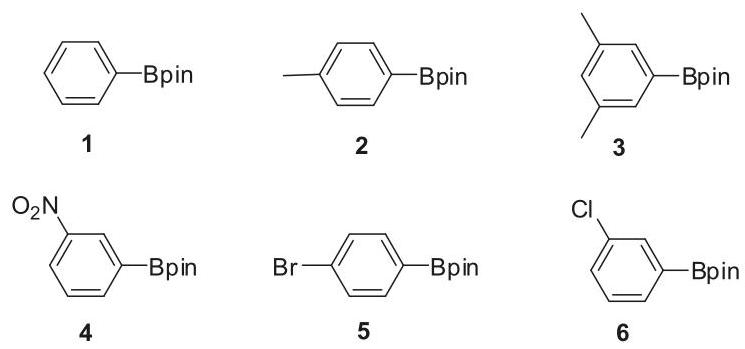
Increments ${I}^{\mathrm{H}}{}_{\mathrm{B}}$ for the ${}^{1}\mathrm{H}$ chemical-shift differences caused by the pinacol boronate group (Bpin) are calculated from the $\delta \left( {{}^{1}\mathrm{H}}\right)$ of the pinacol arylboronates 1-6 by using eq. [1] (7.34 is the ${}^{1}\mathrm{H}$ NMR chemical shift of benzene in ${\mathrm{{CDCl}}}_{3}$ ). The results are summarized in Table 1. The increments for ${I}^{\mathrm{H}}\mathrm{s}$ are taken from the literature (for methyl, meta $= - {0.12}$ and para $= - {0.22}$ ; for nitro, meta $= {0.26}$ ; for bromo, para $=$ -0.04; and for chloro, meta $= - {0.02}){.}^{7}$
由频哪醇硼酸酯基团(Bpin)引起的${}^{1}\mathrm{H}$化学位移差异的增量${I}^{\mathrm{H}}{}_{\mathrm{B}}$,通过使用等式1,从频哪醇硼酸芳基酯1 - 6的$\delta \left( {{}^{1}\mathrm{H}}\right)$计算得出。结果总结在表1中。${I}^{\mathrm{H}}\mathrm{s}$的增量取自文献(对于甲基,间位$= - {0.12}$和对位$= - {0.22}$;对于硝基,间位$= {0.26}$;对于溴,对位$=$ - 0.04;对于氯,间位$= - {0.02}){.}^{7}$)
Received 21 April 2011. Accepted 28 June 2011. Published at www.nrcresearchpress.com/cjc on 26 October 2011.
2011年4月21日收到。2011年 June 28日接受。于2011年10月26日在www.nrcresearchpress.com/cjc上发表。
D. Qiu, Z. Zheng, F. Mo, Y. Zhang, and J. Wang. Beijing National Laboratory of Molecular Sciences (BNLMS) and Key Laboratory of Bioorganic Chemistry and Molecular Engineering of the Ministry of Education, College of Chemistry, Peking University, Beijing 100871, China.
邱丹,郑泽,莫凡,张宇,王健。中国北京大学化学与分子工程学院,分子科学国家实验室(北京),生物有机化学与分子工程教育部重点实验室,北京100871。
Corresponding author: Jianbo Wang ().
通讯作者:王建波()。
This article is part of a Special Issue dedicated to Professor Tak-Hang Chan.
本文是献给陈德恒教授的特刊的一部分。
Table 1. ${}^{1}\mathrm{H}$ chemical shifts $\left( {\delta ,\mathrm{{ppm}}}\right)$ and increments for the ${}^{1}\mathrm{H}$ chemical-shift differences $\left( {{}^{1}{\mathrm{H}}_{\mathrm{B}}}\right)$ caused by the pinacol boronate group for the pinacol arylboronates.
表1. 频哪醇硼酸芳基酯中由频哪醇硼酸酯基团引起的${}^{1}\mathrm{H}$化学位移$\left( {\delta ,\mathrm{{ppm}}}\right)$以及${}^{1}\mathrm{H}$化学位移差异$\left( {{}^{1}{\mathrm{H}}_{\mathrm{B}}}\right)$的增量。
| Position | Pinacol arylboronate | |||||||||||
| 1 | 2 | 3 | 4 | 5 | 6 | |||||||
| $\delta$ | ${I}^{\mathrm{H}}\mathrm{B}$ | $\delta$ | ${I}^{\mathrm{H}}\mathrm{B}$ | $\delta$ | ${I}^{\mathrm{H}}\mathrm{B}$ | $\delta$ | ${I}^{\mathrm{H}}\mathrm{B}$ | $\delta$ | ${I}^{\mathrm{H}}\mathrm{B}$ | $\delta$ | ${I}^{\mathrm{H}}\mathrm{B}$ | |
| ortho-H | 7.81 | 0.47 | 7.70 | 0.48 | 7.44 | 0.49 | 8.64 | 0.42 | 7.66 | 0.46 | 7.78 | 0.41 |
| 7.81 | 0.47 | 7.70 | 0.48 | 7.44 | 0.49 | 8.10 | 0.39 | 7.66 | 0.46 | 7.66 | 0.37 | |
| meta-H | 7.36 | 0.02 | 7.18 | 0.04 | - | - | 7.54 | -0.01 | 7.50 | 0.03 | 7.30 | 0.01 |
| 7.36 | 0.02 | 7.18 | 0.04 | - | - | - | - | 7.50 | 0.03 | - | - | |
| para-H | 7.45 | 0.11 | - | - | 7.10 | 0.14 | 8.30 | 0.08 | - | - | 7.42 | 0.05 |
From the results shown in Table 1, the mean ${I}^{\mathrm{H}}{}_{\mathrm{B}}$ s and the standard deviation can be calculated as follows:
根据表1所示结果,平均${I}^{\mathrm{H}}{}_{\mathrm{B}}$值和标准偏差可如下计算:
$$ {I}^{\mathrm{H}}{}_{\mathrm{B}}\text{ (ortho) } = {0.44} \pm {0.04} $$$$ {I}^{\mathrm{H}}{}_{\mathrm{B}}\text{ (meta) } = {0.02} \pm {0.02} $$$$ {I}^{\mathrm{H}}{}_{\mathrm{B}}\text{ (para) } = {0.10} \pm {0.04} $$Compared with the chemical-shift increments caused by the boronic acid group ( ${I}^{\mathrm{H}}{}_{\mathrm{B}}$ (ortho) $= {1.02} \pm {0.03},{I}^{\mathrm{H}}{}_{\mathrm{B}}$ (meta) $= \; {0.25} \pm {0.04},{I}^{\mathrm{H}}{}_{\mathrm{B}}$ (para) $= {0.34} \pm {0.04}),{}^{5}{I}^{\mathrm{H}}{}_{\mathrm{B}}$ values for the pinacol boronate substituent clearly indicate that it is less electron withdrawing when compared with boronic acid. ${}^{8}$ They are comparable to the values of a cyano or a trifluo-romethyl substituent, whereas the corresponding values for the boronic acid substituent are comparable to those of a nitro substituent. However, the factors that are related to the NMR chemical shift of boronic acids are more complicated because of reversible anhydride formation and possible dimerization through hydrogen bonding.
与硼酸基团引起的化学位移增量相比(频哪醇硼酸酯取代基的${I}^{\mathrm{H}}{}_{\mathrm{B}}$(邻位)$= {1.02} \pm {0.03},{I}^{\mathrm{H}}{}_{\mathrm{B}}$(间位)$= \; {0.25} \pm {0.04},{I}^{\mathrm{H}}{}_{\mathrm{B}}$(对位)$= {0.34} \pm {0.04}),{}^{5}{I}^{\mathrm{H}}{}_{\mathrm{B}}$值清楚地表明,与硼酸相比,它的吸电子性较弱。${}^{8}$它们与氰基或三氟甲基取代基的值相当,而硼酸取代基的相应值与硝基取代基的值相当。然而,由于可逆酸酐形成和可能通过氢键二聚,与硼酸核磁共振化学位移相关的因素更为复杂。
Similarly, the corresponding ${}^{13}\mathrm{C}$ chemical-shift increments $\left( {I{C}_{B}}\right)$ caused by the pinacol boronate substituent can be calculated from the $\delta \left( {{}^{13}\mathrm{C}}\right)$ of the pinacol arylboronates $\mathbf{1} - \mathbf{6}$ by using eq. [2] (128.32 is the ${}^{13}\mathrm{C}$ NMR chemical shift of benzene in ${\mathrm{{CDCl}}}_{3}$ ). The results are summarized in Table 2. The increments for ${I}^{\mathrm{C}}\mathrm{s}$ are taken from the literature for methyl, ipso $=$ 9.3, ortho $= {0.6}$ , meta $= {0.0}$ , and para $= - {3.1}$ ; for nitro, ipso $=$ 19.6, ortho $= - {5.3}$ , meta $= {0.8}$ , and para $= {6.0}$ ; for bromo, ipso $= - {5.4}$ , ortho $= {3.3}$ , meta $= {2.2}$ , and para $= - {1.0}{)}^{7}$
同样地,由频哪醇硼酸酯取代基引起的相应的${}^{13}\mathrm{C}$化学位移增量$\left( {I{C}_{B}}\right)$,可以通过使用等式[2],从频哪醇芳基硼酸酯$\mathbf{1} - \mathbf{6}$的$\delta \left( {{}^{13}\mathrm{C}}\right)$计算得出(128.32是苯在${\mathrm{{CDCl}}}_{3}$中的${}^{13}\mathrm{C}$核磁共振化学位移)。结果总结在表2中。${I}^{\mathrm{C}}\mathrm{s}$的增量取自文献中甲基的数据,本位$=$为9.3,邻位$= {0.6}$,间位$= {0.0}$,对位$= - {3.1}$;硝基的数据,本位$=$为19.6,邻位$= - {5.3}$,间位$= {0.8}$,对位$= {6.0}$;溴的数据,本位$= - {5.4}$,邻位$= {3.3}$,间位$= {2.2}$,对位$= - {1.0}{)}^{7}$
[2] $\;{I}^{\mathrm{C}}{}_{\mathrm{B}} = \delta \left( {{}^{13}\mathrm{C}}\right) - \left( {{128.32} + \sum {I}^{\mathrm{C}}\mathrm{s}}\right)$
From the results shown in Table 2, the average increments and the standard deviation can be calculated as follows:
根据表2中所示的结果,可以按如下方式计算平均增量和标准偏差:
$$ {I}^{\mathrm{C}}{}_{\mathrm{B}}\text{ (ortho) } = {6.2} \pm {0.2} $$$$ {I}^{\mathrm{C}}{}_{\mathrm{B}}\text{ (meta) } = - {0.5} \pm {0.2} $$$$ {I}^{\mathrm{C}}{}_{\mathrm{B}}\text{ (para) } = {3.1} \pm {0.5} $$With the ${I}^{\mathrm{H}}{}_{\mathrm{B}}$ and the ${I}^{\mathrm{C}}{}_{\mathrm{B}}$ data in hand, we subsequently verified the efficacy of these data in the estimation of chemical shifts of aromatic pinacol boronates by using the compounds 7-22.
有了${I}^{\mathrm{H}}{}_{\mathrm{B}}$和${I}^{\mathrm{C}}{}_{\mathrm{B}}$数据之后,我们随后使用化合物7 - 22验证了这些数据在估算芳族频哪醇硼酸酯化学位移方面的有效性。
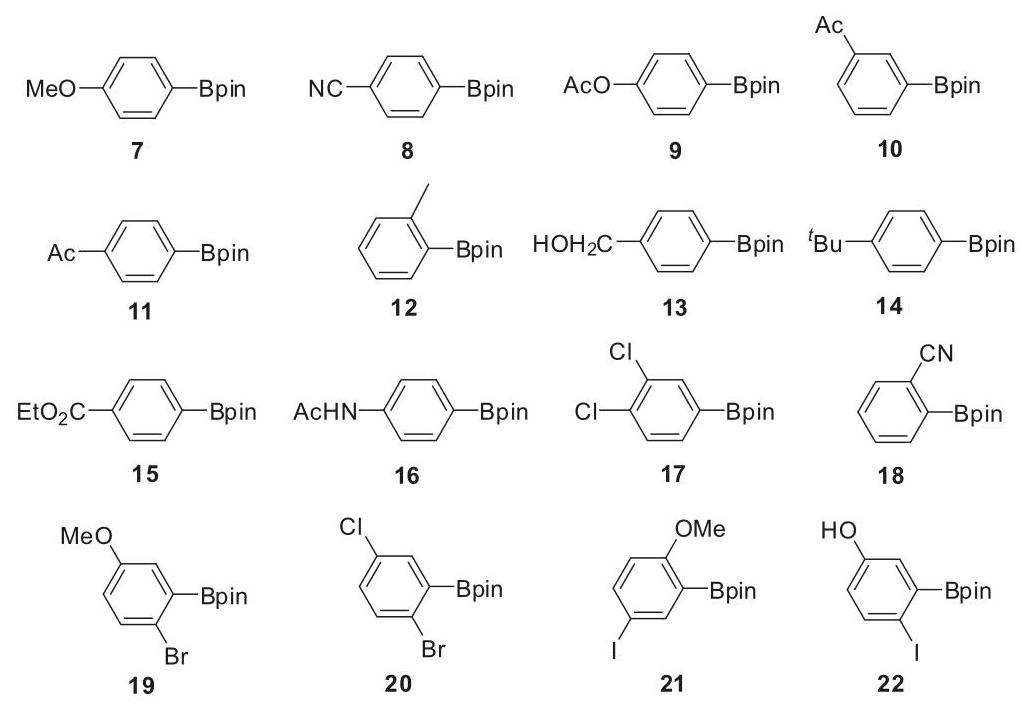
Table 2. ${}^{13}\mathrm{C}$ chemical shifts $\left( {\delta ,\mathrm{{ppm}}}\right)$ and increments for the ${}^{13}\mathrm{C}$ chemical-shift differences $\left( {{I}^{\mathrm{C}}{}_{\mathrm{B}}}\right)$ caused by the pinacol boronate group for the pinacol arylboronates.
表2. 频哪醇芳基硼酸酯中由频哪醇硼酸酯基团引起的${}^{13}\mathrm{C}$化学位移$\left( {\delta ,\mathrm{{ppm}}}\right)$以及${}^{13}\mathrm{C}$化学位移差$\left( {{I}^{\mathrm{C}}{}_{\mathrm{B}}}\right)$的增量。
| Position | Pinacol arylboronate | |||||||||||
| 1 | 2 | 3 | 4 | 5 | 6 | |||||||
| $\delta$ | ${I}^{\mathrm{C}}{}_{\mathrm{B}}$ | $\delta$ | ${I}^{\mathrm{C}}\mathrm{B}$ | $\delta$ | ${I}^{\mathrm{C}}\mathrm{B}$ | $\delta$ | $I{C}_{B}$ | $\delta$ | ${I}^{\mathrm{C}}\mathrm{B}$ | $\delta$ | ${I}^{\mathrm{C}}\mathrm{B}$ | |
| C-2 | 134.72 | 6.40 | 134.79 | 6.58 | 132.37 | 6.35 | 129.37 | 6.01 | 136.29 | 6.30 | 134.54 | 5.97 |
| C-6 | 134.72 | 6.40 | 134.79 | 6.58 | 132.37 | 6.35 | 140.61 | 6.07 | 136.29 | 6.30 | 132.62 | 6.23 |
| C-3 | 127.69 | -0.63 | 128.49 | -0.52 | 137.12 | -0.62 | 147.82 | -0.23 | 130.93 | -0.55 | 134.01 | -0.20 |
| C-5 | 127.69 | -0.63 | 128.49 | -0.52 | 137.12 | -0.62 | 128.70 | -0.53 | 130.93 | -0.55 | 129.16 | -0.52 |
| C-4 | 131.23 | 2.91 | 141.35 | 3.56 | 132.96 | 3.07 | 125.82 | 2.46 | 126.20 | 3.73 | 131.24 | 2.67 |
Table 3. Comparison of calculated and experimental ${}^{1}\mathrm{H}$ NMR chemical shifts ( $\delta$ , ppm) of the pinacol arylboronates.
表3. 频哪醇芳基硼酸酯的计算和实验${}^{1}\mathrm{H}$核磁共振化学位移($\delta$,ppm)的比较。
| Compound | Position | |||||
| ortho-H | meta-H | para-H | ||||
| $\delta$ (ppm) | ||||||
| Calculated | Measured | Calculated | Measured | Calculated | Measured | |
| 7 | 7.69 | 7.75 | 6.88 | 6.89 | - | - |
| 8 | 7.96 | 7.88 | 7.54 | 7.64 | - | - |
| 9 | 7.81 | 7.83 | 7.11 | 7.09 | - | - |
| 10 | 8.40 | 8.37 | 7.50 | 7.47 | 8.06 | 8.00 |
| 7.99 | 8.06 | |||||
| 11 | 7.92 | 7.94~7.88 | 7.98 | 7.94~7.88 | - | - |
| 12 | 7.66 | 7.76 | 7.16 | 7.16 | 7.32 | 7.31 |
| 7.14 | 7.16 | |||||
| 13 | 7.71 | 7.79 | 7.29 | 7.34 | - | - |
| 14 | 7.70 | 7.76 | 7.38 | 7.41 | - | - |
| 15 | 7.85 | 7.87 | 8.06 | 8.02 | - | - |
| 16 | 7.71 | 7.76 | 7.48 | 7.52 | - | - |
| 17 | 7.83 | 7.86 | 7.41 | 7.43 | - | - |
| 7.58 | 7.60 | |||||
| 18 | 7.96 | 7.89 | 7.72 | 7.70 | 7.55 | 7.55 |
| 7.64 | 7.55 | |||||
| 19 | 7.22 | 7.13 | 7.45 | 7.41 | 6.88 | 6.80 |
| 20 | 7.73 | 7.58 | 7.48 | 7.45 | 7.39 | 7.20 |
| 21 | 8.08 | 7.92 | 6.67 | 6.63 | 7.74 | 7.65 |
| 22 | 7.01 | 7.02 | 7.63 | 7.64 | 6.67 | 6.60 |
The calculated ${}^{1}\mathrm{H}$ and ${}^{13}\mathrm{C}$ chemical shifts of pinacol aryl-boronates found by using eqs. [1] and [2] and the corresponding measured chemical shifts are summarized in Tables 3 and 4 (see the Supplementary data for more information). The measured data were all recorded by a Bruker- 400 NMR spectrometer. The increments of other functional groups are taken from the literature. ${}^{7}$
使用等式[1]和[2]找到的频哪醇芳基硼酸酯的计算${}^{1}\mathrm{H}$和${}^{13}\mathrm{C}$化学位移以及相应的测量化学位移总结在表3和表4中(更多信息见补充数据)。测量数据均由布鲁克400核磁共振光谱仪记录。其他官能团的增量取自文献。${}^{7}$
From the data collected in Tables 3 and 4, the standard deviations for the estimated and measured chemical shifts were obtained.
根据表3和表4中收集的数据,获得了估算和测量化学位移的标准偏差。
$$ {d}^{\mathrm{H}}{}_{\mathrm{B}}\left( \text{ ortho }\right) = {0.06} \pm {0.04} $$$$ {d}^{\mathrm{H}}{}_{\mathrm{B}}\left( \text{ meta }\right) = {0.02} \pm {0.02} $$$$ {d}^{\mathrm{H}}{}_{\mathrm{B}}\left( \text{ para }\right) = {0.07} \pm {0.06} $$$$ {d}^{\mathrm{C}}{}_{\mathrm{B}}\left( \text{ ortho }\right) = {0.9} \pm {1.3} $$$$ {d}^{\mathrm{C}}{}_{\mathrm{B}}\left( \text{ meta }\right) = {0.8} \pm {0.9} $$$$ {d}^{\mathrm{C}}{}_{\mathrm{B}}\left( \text{ para }\right) = {0.8} \pm {0.5} $$The data compiled in Tables 3 and 4 demonstrate satisfactory agreement of the calculated and measured ${}^{1}\mathrm{H}$ and ${}^{13}\mathrm{C}$ NMR chemical shifts. However, when there are multiple sub-stituents in the aromatic ring, relatively larger deviations of the ${}^{13}\mathrm{C}$ chemical shifts are observed, as shown by compounds 19-22.
表3和表4中汇编的数据表明,计算和测量的${}^{1}\mathrm{H}$和${}^{13}\mathrm{C}$核磁共振化学位移具有令人满意的一致性。然而,当芳环中有多个取代基时,观察到${}^{13}\mathrm{C}$化学位移有相对较大的偏差,如化合物19 - 22所示。
Conclusion
结论
In conclusion, we have obtained the increments for ${}^{1}\mathrm{H}$ and ${}^{13}\mathrm{C}$ NMR chemical shifts caused by the existence of a pinacol boronate substituent in the aromatic rings. These data could be widely used in the estimation of the NMR chemical shifts of aromatic pinacol boronates. ${}^{9}$
总之,我们已经获得了芳环中存在频哪醇硼酸酯取代基时,${}^{1}\mathrm{H}$和${}^{13}\mathrm{C}$ NMR化学位移的增量。这些数据可广泛用于估算芳族频哪醇硼酸酯的NMR化学位移。${}^{9}$
Supplementary data
补充数据
Supplementary data are available for this article through the journal Web site at http://nrcresearchpress.com/doi/suppl/ 10.1139/v11-099.
可通过期刊网站http://nrcresearchpress.com/doi/suppl/ 10.1139/v11-099获取本文的补充数据。
Table 4. Comparison of calculated and measured ${}^{13}\mathrm{C}$ NMR chemical shifts $\left( {\delta ,\mathrm{{ppm}}}\right)$ of the pinacol arylboronates.
表4. 频哪醇芳基硼酸酯的计算和测量的${}^{13}\mathrm{C}$ NMR化学位移$\left( {\delta ,\mathrm{{ppm}}}\right)$的比较。
| Compound | Position | |||||
| C-2,6 | C-3,5 | C-4 | ||||
| $\delta$ (ppm) | ||||||
| Calculated | Measured | Calculated | Measured | Calculated | Measured | |
| 7 | 135.4 | 136.48 | 113.1 | 113.29 | 161.6 | 162.13 |
| 8 | 135.2 | 135.06 | 131.3 | 131.10 | 115.4 | 114.51 |
| 9 | 135.8 | 136.16 | 121.4 | 120.91 | 154.4 | 153.16 |
| 10 | 134.7 | 134.76 | 137.1 | 136.47 | 131.6 | 130.72 |
| 138.7 | 139.35 | 128.0 | 127.99 | |||
| 11 | 134.7 | 134.86 | 128.0 | 127.24 | 140.7 | 138.94 |
| 12 | 144.0 | 144.81 | 128.6 | 129.75 | 131.3 | 130.75 |
| 135.2 | 135.83 | 124.8 | 124.68 | |||
| 13 | 134.5 | 134.96 | 126.4 | 126.00 | 144.4 | 144.00 |
| 14 | 134.1 | 134.67 | 124.4 | 124.68 | 153.5 | 154.47 |
| 15 | 134.3 | 134.59 | 128.9 | 128.52 | 133.5 | 132.65 |
| 16 | 135.0 | 135.78 | 119.9 | 118.51 | 141.3 | 140.55 |
| 17 | 136.6 | 136.52 | 131.9 | 132.21 | 135.5 | 135.45 |
| 133.8 | 133.73 | 129.9 | 129.98 | |||
| 18 | 118.5 | 118.91 | 131.3 | 131.03 | 132.1 | 133.37 |
| 135.2 | 135.80 | 132.1 | 131.51 | |||
| 19 | 122.0 | 121.09 | 157.0 | 158.05 | 118.9 | 118.31 |
| 121.0 | 118.04 | 132.0 | 133.47 | |||
| 20 | 136.9 | 136.04 | 133.2 | 132.77 | 133.8 | 133.90 |
| 127.1 | 125.68 | 132.1 | 131.74 | |||
| 21 | 164.3 | 163.84 | 115.7 | 112.94 | 142.2 | 140.89 |
| 145.3 | 144.83 | 87.4 | 83.76 | |||
| 22 | 124.4 | 123.17 | 154.3 | 154.88 | 121.3 | 119.51 |
| 94.9 | 88.65 | 139.1 | 140.48 | |||
Acknowledgements
致谢
Financial support from the National Natural Science Foundation of China (Grant Nos. 20902005, 20832002, 210722009, and 20821062) and the 973 Program (No. 2009CB825300) is gratefully acknowledged.
感谢中国国家自然科学基金(批准号:20902005、20832002、210722009和20821062)以及973计划(编号:2009CB825300)的资助。
References
参考文献
(1) (a) For selected reviews see Miyaura, N.; Suzuki, A. Chem. Rev. 1995, 95 (7), 2457. doi:10.1021/cr00039a007; (b) Suzuki, A. Acc. Chem. Res. 1982, 15 (6), 178. doi:10.1021/ar00078a003; (c) Miyaura, N. J. Organomet. Chem. 2002, 653 (1-2), 54. doi:10.1016/S0022-328X(02)01264-0; (d) Miyaura, N. Bull. Chem. Soc. Jpn. 2008, 81 (12), 1535. doi:10.1246/bcsj.81.1535; (e) Merino, P.; Tejero, T. Angew. Chem. Int. Ed. 2010, 49 (40), 7164. doi:10.1002/anie.201003191; (f) Miyaura, N. Top. Curr. Chem. 2002, 219, 11. doi:10.1007/3-540-45313-X_2.
(2) Hall, D. G. Boronic Acids; Wiley-VCH: Weinheim, 2005.
(3) (a) Mkhalid, I. A. I.; Barnard, J. H.; Marder, T. B.; Murphy, J. M.; Hartwig, J. F. Chem. Rev. 2010, 110 (2), 890. doi:10.1021/ cr900206p; (b) Ishiyama, T.; Murata, M.; Miyaura, N. J. Org. Chem. 1995, 60 (23), 7508. doi:10.1021/jo00128a024.
(4) (a) Wrackmeyer, B. Prog. Nucl. Magn. Reson. Spectrosc. 1979, 12 (4), 227. doi:10.1016/0079-6565(79)80003-5; (b) Gragg, B. R.; Layton, W. J.; Niedenzu, K. J. Organomet. Chem. 1977, 132 (1), 29. doi:10.1016/S0022-328X(00)92511-7; (c) Niedenzu, K.; Müller, K.-D.; Layton, M. S.; Komorowsky, L. Z. Anorg. Allg. Chem. 1978, 439, 112. doi:10.1002/zaac.19784390113.
(5) Bruns, S.; Sinnwell, V.; Voss, J. Magn. Reson. Chem. 2003, 41 (4), 269. doi:10.1002/mrc.1163.
(6) (a) Mo, F.; Jiang, Y.; Qiu, D.; Zhang, Y.; Wang, J. Angew. Chem. Int. Ed. 2010, 49 (10), 1846. doi:10.1002/anie. 200905824; (b) Qiu, D.; Mo, F.; Zheng, Z.; Zhang, Y.; Wang, J. Org. Lett. 2010, 12 (23), 5474. doi:10.1021/ol102350v.
(7) Williams, D. H.; Fleming, I. Spectroscopic Methods in Organic Chemistry; 5th ed.; McGraw-Hill: Berkshire, 1995.
(8) Entwistle, C. D.; Marder, T. B. Chem. Mater. 2004, 16 (23), 4574. doi:10.1021/cm0495717.
(9) The validity of these data has been further verified by comparison of the estimated NMR chemical shifts with those reported in the literature; see the Supplementary data.