Gold(III)-Catalyzed Direct Acetoxylation of Arenes with Iodobenzene Diacetate
中文 / Bilingual · English version
Di Qiu, Zhitong Zheng, Fanyang Mo, Qing Xiao, Yu Tian, Yan Zhang, and Jianbo Wang*
Beijing National Laboratory of Molecular Sciences (BNLMS) and Key Laboratory of Bioorganic Chemistry and Molecular Engineering of Ministry of Education, College of Chemistry, Peking University, Beijing 100871, China
2011 Vol. 13, No. 19 4988-4991
Received June 1, 2011

${\mathrm{{AuCl}}}_{3}$ -catalyzed direct acetoxylation of electron-rich aromatic compounds has been achieved with iodobenzene diacetate as the acetoxylation reagent.
Direct acetoxylation of arenes with transition metal catalysis has remained a challenging task over the past decades. ${}^{1}$ In 1996, Crabtree and co-workers reported the direct palladium(II)-catalyzed acetoxylation of arenes with iodobenzene diacetate. ${}^{2}$ The reaction achieved moderately high efficiency; however, the regioselectivity of the reaction is far from satisfactory. More recently, Sanford and coworkers have developed highly regioselective acetoxyla-tion by employing a directing group strategy. ${}^{1,3}$ Detailed mechanistic investigation indicated that the Pd(IV)/Pd(II) catalytic cycle was involved in the reaction. With a similar Pd(II)-catalyzed system, regioselective acetoxylation of indole derivatives has been reported by Lei, ${}^{4\mathrm{a}}$ Pelcman, ${}^{4\mathrm{\;b}}$ Zhang, ${}^{4c}$ and Kwong ${}^{4d}$ recently. Moreover, Yu and coworkers have reported a Cu(II)-catalyzed acetoxylation with ${\mathrm{O}}_{2}$ as the oxidant. ${}^{5}$ Although remarkable achievements have been made in this area, ${}^{6}$ it is still highly desirable to develop an alternative approach toward the goal of direct catalytic acetoxylation of aromatics with high efficiency and generality.
In recent years, gold catalysts have been extensively studied for their unique feature in mediating various transformations in organic chemistry. ${}^{7}$ In particular, gold-catalyzed direct $\mathrm{C} - \mathrm{H}$ bond functionalization has attracted great attention as an effective approach toward aromatic $\mathrm{C} - \mathrm{H}$ bond activation. ${}^{7\mathrm{\;d}}$ It has been well-established that gold(III) can electrophilically metalate an aromatic $\mathrm{C} - \mathrm{H}$ bond to generate aryl gold(III) species. ${}^{8}$ Several ${\mathrm{{AuCl}}}_{3}$ -catalyzed $\mathrm{C} - \mathrm{C}$ bond-forming reactions have been suggested to follow the direct auration pathway. ${}^{9}$ We have recently reported a highly efficient ${\mathrm{{AuCl}}}_{3}$ -catalyzed halogenation of aromatics by $N$ -halo-succinimide. ${}^{10}$ To account for the extraordinary high catalytic efficiency of this reaction, a dual activation mode has been proposed. Herein we further demonstrate that ${\mathrm{{AuCl}}}_{3}$ is also a highly efficient catalyst in the direct acetoxylation of arenes with iodobenzene diacetate. ${}^{{11},{12}}$ A dual activation process may also operate with direct auration of aromatic substrates and activation of PhI- ${\left( \mathrm{{OAc}}\right) }_{2}$ through complexation.
(5) Chen, X.; Hao, X.; Goodhue, C. E.; Yu, J. J. Am. Chem. Soc. 2006, 128, 6790.
(6) For other examples of palladium-catalyzed acetoxylation of arenes, see: (a) Okamoto, M.; Yamaji, T. Chem. Lett. 2001, 30, 212. (b) Wang, G.; Yuan, T.; Wu, X. J. Org. Chem. 2008, 73, 4717.
(7) For selected recent reviews on Au-catalyzed transformations, see: (a) Li, Z.; Brouwer, C.; He, C. Chem. Rev. 2008, 108, 3239. (b) Arcadi, A. Chem. Rev. 2008, 108, 3266. (c) Jiménez-Núñnez, E.; Echavarren, A. M. Chem. Rev. 2008, 108, 3326. (d) Gorin, D. J.; Sherry, B. B. D.; Toste, F. D. Chem. Rev. 2008, 108, 3351. (e) Boorman, T. C.; Larrosa, I. Chem. Soc. Rev. 2011, 40, 1910. (f) Bandini, M. Chem. Soc. Rev. 2011, 40, 1358. (g) Hopkinson, M. N.; Gee, A. D.; Gouverneur, V. Chem.-Eur. J. 2011, 17, 8248.
(8) (a) Kharasch, M. S.; Isbell, H. S. J. Am. Chem. Soc. 1931, 53, 3053. (b) Liddle, K. S.; Perkin, C. J. Chem. Soc., Chem. Commun. 1972, 26. (c) de Graaf, P. W.; Boersma, J.; van der Kerk, G. J. M. J. Organomet. Chem. 1976, 105, 399. (d) Fuchita, Y.; Utsunomiya, Y.; Yasutake, M. J. Chem. Soc., Dalton Trans. 2001, 2330.
(1) For a recent review, see: Lyons, T. W.; Sanford, M. S. Chem. Rev. 2010, 110, 1147.
(2) Yoneyama, T.; Crabtree, R. H. J. Mol. Catal. A 1996, 108, 35.
(3) (a) Dick, A. R.; Hull, K. L.; Sanford, M. S. J. Am. Chem. Soc. 2004, 126, 2300. (b) Desai, L. V.; Hull, K. L.; Sanford, M. S. J. Am. Chem. Soc. 2004, 126, 9542. (c) Dick, A. R.; Kampf, J. W.; Sanford, M. S. J. Am. Chem. Soc. 2005, 127, 12790. (d) Dick, A. R.; Kampf, J. W.; Sanford, M. S. Organometallics 2005, 24, 482. (e) Kalyani, D.; Sanford, M. S. Org. Lett. 2005, 7, 4149. (f) Racowski, J. M.; Dick, A. R.; Sanford, M. S. J. Am. Chem. Soc. 2009, 131, 10974. (g) Stowers, K. J.; Sanford, M. S. Org. Lett. 2009, 11, 4584. (h) Neufeldt, S. R.; Sanford, M. S. Org. Lett. 2010, 12, 532.
(4) For palladium-catalyzed acetoxylation of indoles, see: (a) Liu, Q.; Li, G.; Yi, H.; Wu, P.; Liu, J.; Lei, A. Chem.—Eur. J. 2011, 17, 2353. (b) Mutule, I.; Suna, E.; Olofsson, K.; Palcman, B. J. Org. Chem. 2009, 74, 7195. (c) Liang, Z.; Zhao, J.; Zhang, Y. J. Org. Chem. 2010, 75, 170. (d) Choy, P. Y.; Lau, C. P.; Kwong, F. Y. J. Org. Chem. 2011, 76, 80.
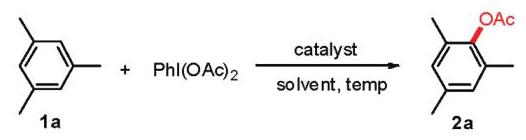
At the outset of the investigation, mesitylene 1a was employed as the substrate to react with $\mathrm{{PhI}}{\left( \mathrm{{OAc}}\right) }_{2}$ in the presence of ${\mathrm{{AuCl}}}_{3}\left( {2\mathrm{\;{mol}}\% }\right)$ in 1,2-dichloroethane at different temperatures. We observed that the reaction was highly sensitive to temperature (Table 1, entries 1, 2). At ${60}^{ \circ }\mathrm{C}$ , only a trace amount of product could be detected, while, at ${80}^{ \circ }\mathrm{C}$ , we could isolate the acetoxylation product in moderately high yield (entry 2). However, di- and triacetoxylation products were also observed. The over-acetoxylation problem could be easily circumvented by employing an excess amount of aromatic substrates (entries 4-7). It was also observed that the reaction time could be significantly shortened by carrying it out at ${110}^{ \circ }\mathrm{C}$ .
Table 1. ${\mathrm{{AuCl}}}_{3}$ -Catalyzed Reaction of Mesitylene 1a and $\mathrm{{PhI}}{\left( \mathrm{{OAc}}\right) }_{2}{}^{a}$
| entry | ratio | catalyst (mol %) | solvent | temp (°C) | $t$ (h) | yield (%) $b$ |
| 1 | 1:1.2 | ${\mathrm{{AuCl}}}_{3}\left( 2\right)$ | DCE | 60 | 24 | trace |
| 2 | 1:1.2 | ${\mathrm{{AuCl}}}_{3}$ (2) | DCE | 80 | 24 | ${56}^{c}$ |
| 3 | 1:1.5 | ${\mathrm{{AuCl}}}_{3}\left( 2\right)$ | DCE | 80 | 24 | ${68}^{c}$ |
| 4 | 1.5:1 | ${\mathrm{{AuCl}}}_{3}$ (2) | DCE | 110 | 12 | ${61}^{c}$ |
| 5 | 2.0:1 | ${\mathrm{{AuCl}}}_{3}$ (2) | DCE | 110 | 12 | 72 |
| 6 | 2.5:1 | ${\mathrm{{AuCl}}}_{3}$ (2) | DCE | 110 | 12 | 75 |
| 7 | 3.0:1 | ${\mathrm{{AuCl}}}_{3}\left( 2\right)$ | DCE | 110 | 12 | 69 |
| 8 | 2.5:1 | ${\mathrm{{AuCl}}}_{3}\left( 1\right)$ | DCE | 110 | 24 | 61 |
| 9 | 2.5:1 | ${\mathrm{{AuCl}}}_{3}\left( 5\right)$ | DMF | 110 | 24 | 0 |
| 10 | 2.5:1 | ${\mathrm{{AuCl}}}_{3}$ (5) | ${\mathrm{{CH}}}_{3}\mathrm{{CN}}$ | 110 | 12 | <5 |
| 11 | 2.5:1 | ${\mathrm{{AuCl}}}_{3}\left( 5\right)$ | AcOH | 110 | 24 | 53 |
| 12 | 1.5:1 | ${\mathrm{{FeCl}}}_{3}\left( {20}\right)$ | DCE | 80 | 24 | 0 |
| 13 | 1.5:1 | ${\mathrm{{FeBr}}}_{3}\left( {20}\right)$ | DCE | 80 | 24 | 0 |
| 14 | 2.5:1 | Pd(OAc) ${}_{2}$ (5) | DCE | 110 | 24 | trace |
| 15 | 2.5:1 | AcOH(200) | DCE | 110 | 24 | 0 |
| 16 | 2.5:1 | ${\mathrm{H}}_{2}{\mathrm{{SO}}}_{4}\left( {200}\right)$ | DCE | 110 | 24 | trace |
| 17 | 2.5:1 | $d$ | AcOH | 110 | 24 | trace |
${}^{a}$ Reaction conditions: mesitylene 1a, PhI(OAc) ${}_{2}$ (1 mmol), solvent (2 mL). The reaction was monitored by GC-MS. The ratio refers to 1a/ $\mathrm{{PhI}}{\left( \mathrm{{OAc}}\right) }_{2}.{}^{b}$ Isolated yield based on $\mathrm{{PhI}}{\left( \mathrm{{OAc}}\right) }_{2}.{}^{c}$ Di- and triacetoxyla-tion products were observed. ${}^{d}$ No catalyst was used. DCE = 1,2- dichloroethane, DMF $= N, N$ -dimethylformamide.
Reducing the Au(III) catalyst loading to 1 mol % resulted in a longer reaction time and slightly diminished yield (entry 8). The solvents were found to significantly affect the reaction, and the initially used DCE provided the optimal results (entries 9-11). Finally, for comparison we also carried out the reaction under Fe(III)- and Pd(II)- catalyzed conditions, and under strong acidic conditions as well. None of them afforded the expected acetoxylation products (entries 12-17). The control experiment indicates that no reaction occurs in the absence of catalyst (entry 17).
With the optimal reaction conditions in hand, we proceeded to extend the scope of the reaction, and the results are summarized in Table 2. The reaction is general for electron-rich aromatics. For the substrates bearing three or more methyl groups, the acetoxylation all worked well with 2 mol % ${\mathrm{{AuCl}}}_{3}$ catalyst, even for the substrates bearing halogen substituents or an acetyl group (entries 4-6). When the strong electron-withdrawing group CN was present, a slightly higher catalyst loading was required (entry 7). The aromatic substrates bearing only two methyl substituents require a higher catalyst loading and the reaction took a longer time (entry 8). The diminished yield in this case was due to the formation of homocoupling of $p$ -xylene. ${}^{{13},{14}}$ Interestingly, the acetoxylation also worked with toluene derivatives bearing electron-withdrawing substituents (entries 11, 12). However, an acetoxylation product could not be identified with toluene itself as substrate.
The ${\mathrm{{AuCl}}}_{3}$ -catalyzed conditions could also be applied to the aromatic substrates bearing methoxy groups, although a slightly higher catalyst loading was required. It was also observed that the reaction showed excellent regioselectivities. Thus, the reaction with anisole provided the product with an acetoxy group introduced to the para position. For all other substituted anisole substrates, the regioselectivity of the acetoxylation is dominated by the methoxy substituent.
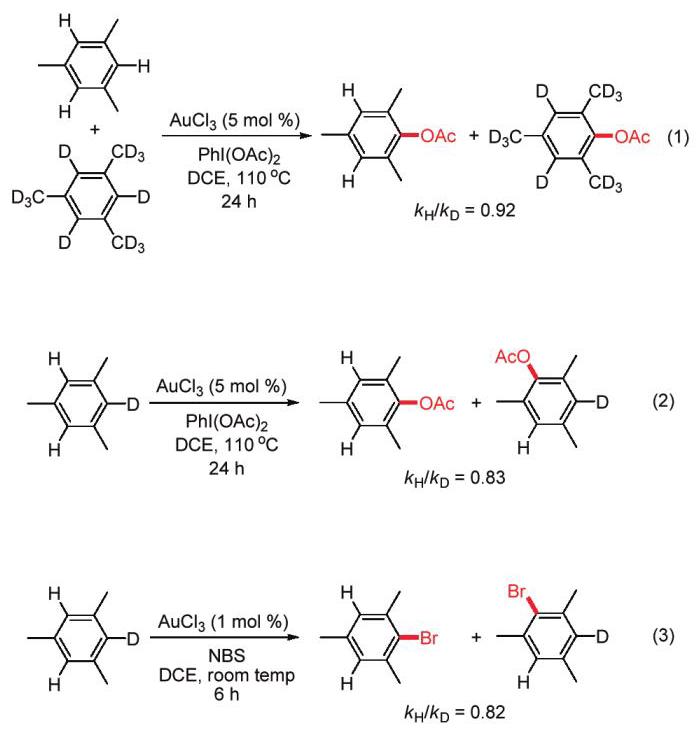
To gain insight into the reaction mechanism, kinetic isotope effect (KIE) experiments have been carried out in both an inter- and intramolecular manner. For the intermolecular experiment, an inverse KIE of 0.92 was observed (eq 1), while the corresponding intramolecular experiment afforded an inverse KIE of 0.83 (eq 2). For comparison, the intramolecular KIE for our previously reported ${\mathrm{{AuCl}}}_{3}$ -catalyzed bromination with NBS was also measured (eq 3). ${}^{10}$ It gave a similar inverse KIE value of 0.82. The inverse K IE value is consistent with electrophilic aromatic substitution, which shows similar inverse KIE data in many cases. ${}^{{15},{16}}$ On the contrary, it has been suggested that electrophilic metalations are characterized by significant primary isotope effects. For example, the electrophilic mercuration of chlorobenzene by $\mathrm{{Hg}}{\left( {\mathrm{O}}_{2}{\mathrm{{CCF}}}_{3}\right) }_{2}$ shows a primary isotope effect of ${3.9}^{17}$ Recently, a large primary KIE of 5 has been observed for
(9) (a) Li, Z.; Capretto, D. A.; Rahaman, R. O.; He, C. J. Am. Chem. Soc. 2007, 129, 12058. (b) Shi, Z.; He, C. J. Org. Chem. 2004, 69, 3669. (c) Shi, Z.; He, C. J. Am. Chem. Soc. 2004, 126, 5964. (d) Shi, Z.; He, C. J. Am. Chem. Soc. 2004, 126, 13596. (e) Reetz, M. T.; Sommer, K. Eur. J. Org. Chem. 2003, 3485. (f) Dyker, G.; Muth, E.; Hashmi, A. S. K.; Ding, L. Adv. Synth. Catal. 2003, 345, 1247. (g) Hashmi, A. S. K.; Schwarz, L.; Choi, J. H.; Frost, T. M. Angew. Chem., Int. Ed. 2000, 39, 2285. (h) Luo, Y.; Li, C.-J. Chem. Commun. 2004, 1930. (i) Sun, X.; Sun, W.; Fan, R.; Wu, J. Adv. Synth. Catal. 2007, 349, 2151.
(10) (a) Mo, F.; Yan, J. M.; Qiu, D.; Li, F.; Zhang, Y.; Wang, J. Angew. Chem., Int. Ed. 2010, 49, 2028. (b) Qiu, D.; Mo, F.; Zheng, Z.; Zhang, Y.; Wang, J. Org. Lett. 2010, 12, 5474.
(11) For a recent report on ${\mathrm{{AuCl}}}_{3}$ -catalyzed direct amination of arenes, see: Gu, L.; Neo, B. S.; Zhang, Y. Org. Lett. 2011, 13, 1872.
(12) For a review on hypervalent iodine, see: Zhdankin, V. V.; Stang, P. J. Chem. Rev. 2008, 108, 5299.
(13) Kar, A.; Mangu, N.; Kaiser, H. M.; Tse, M. K. J. Organomet. Chem. 2009, 694, 524.
(14) For detailed discussion on the acetoxylation and homocoupling, see Supporting Information.
Table 2. ${\mathrm{{AuCl}}}_{3}$ -Catalyzed Acetoxylation of Arenes ${}^{a}$
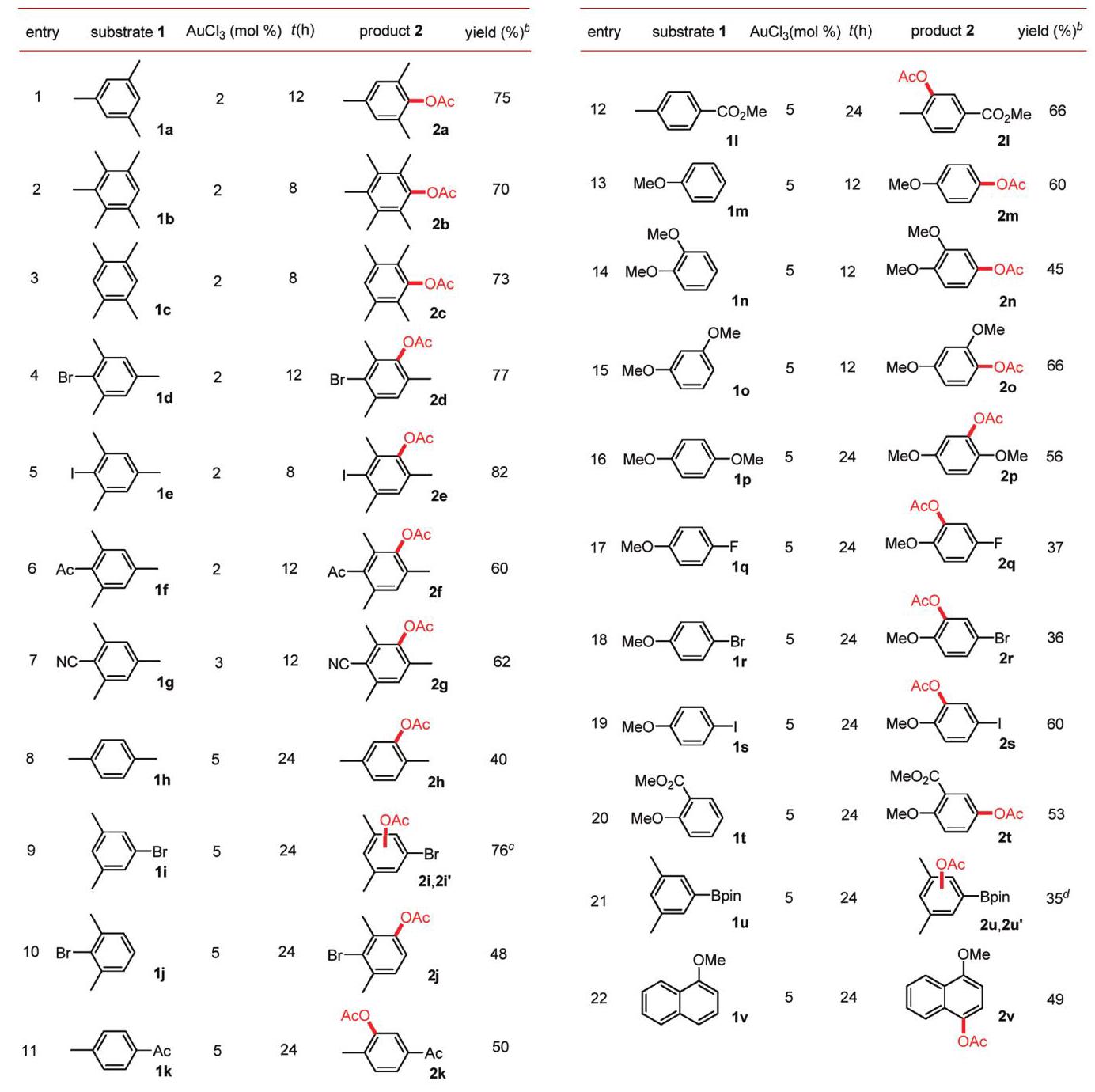
${}^{a}$ Reaction condition: a solution of arene $1\left( {{2.5}\mathrm{\;{mmol}}}\right) ,\mathrm{{PhI}}{\left( \mathrm{{OAc}}\right) }_{2}\left( {1\mathrm{{mmol}}}\right)$ , and ${\mathrm{{AuCl}}}_{3}\left( {2\text{ or }5\mathrm{\;{mol}}\% }\right)$ in DCE $\left( {2\mathrm{{mL}}}\right)$ was heated at ${110}^{ \circ }\mathrm{C}$ . The reaction was monitored by GC-MS. ${}^{b}$ Isolated yield by silica gel column chromatography based on PhI(OAc), ${}^{c}$ The ratio of $2\mathrm{i}$ to $2{\mathrm{i}}^{\prime }$ was $2 : 1$ , as determined by the integral of ${}^{1}\mathrm{H}$ NMR. 2i: 4-bromo-2,6-dimethylphenyl acetate. 2i’: 2-bromo-4,6-dimethylphenyl acetate. ${}^{d}$ The ratio of 2u to 2u’ was 1:4, as determined by the integral of 1H NMR. 2u: 2,6-dimethyl-4-(4,4,5,5-tetramethyl-1,3,2-dioxaborolan-2-yl)phenyl acetata. 2u’: 2,4-dimethyl- 6-(4,4,5,5-tetramethyl-1,3,2-dioxaborolan-2-yl)phenyl acetate.
(15) Tunge, J. A.; Foresee, L. N. Organometallics 2005, 24, 6440 and refenences cited therein.
(16) Recently, Zhang and coworkers have observed a normal KIE value of 1.1 in Au(III)-catalyzed aromatic auration; see: Zhang, G.; Luo, Y.; Wang, Y.; Zhang, L. Angew. Chem., Int. Ed. 2011, 50, 4450.
(17) Lau, W.; Kochi, J. K. J. Am. Chem. Soc. 1986, 108, 6720.
(18) Lu, P.; Boorman, T. C.; Slawin, A. M. Z.; Larrosa, I. J. Am. Chem. Soc. 2010, 132, 5580.
direct $\mathrm{C} - \mathrm{H}$ activation of electron-poor arenes with $\mathrm{{Au}}\left( \mathrm{I}\right)$ complexes. ${}^{18}$
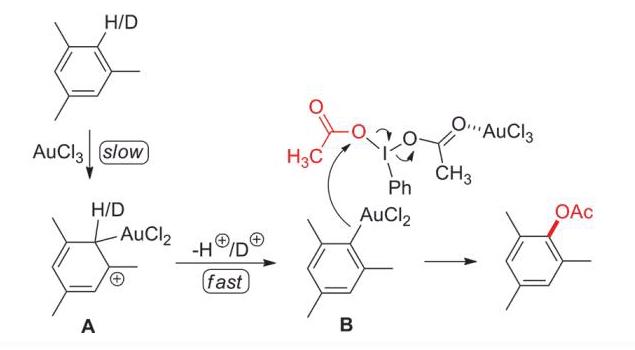
The formation of the arylgold(III) species has been well-documented in the literature, and it has been demonstrated that the aromatic auration proceeds in an electrophilic manner. ${}^{8}$ The dual activation mode provides a probable explanation for the extraordinarily high catalytic efficiency of ${\mathrm{{AuCl}}}_{3}$ as compared with other Lewis acid or protonic acid catalysts (Table 1, entries 12-16). ${}^{{10},{11},{19}}$ To accommodate the observed inverse KIE data, we assume that the formation of $\sigma$ -complex $\mathbf{A}$ (Wheland intermediate) is the rate-limiting step, in which an inverse secondary KIE is expected (Scheme 1). The subsequent deprotonation to form mesitylgold(III) species $\mathbf{B}$ is a fast step. Finally, the mesitylgold(III) species $\mathbf{B}$ attacks the Au-activated iodobenzene diacetate to afford the acetoxylation product. The rate-limiting step assumption is consistent with the observed similar data of intermolecular KIE. However, further studies are needed to unambiguously establish the reaction mechanism. ${}^{20}$
Scheme 1. Plausible Reaction Pathway
In conclusion, we have developed an efficient gold(III)- catalyzed acetoxylation of arenes with iodobenzene diacetate. ${}^{21}$ This catalytic system is suitable for the electron-rich aromatics, which affords the corresponding acet-oxylation products in moderately high yields. Further studies to enhance the catalytic activity and to design a new acetoxylation reagent with higher reactivity are currently underway in our laboratory.
Acknowledgment. The project is supported by National Basic Research Program of China (973 Program, No. 2009CB825300), Natural Science Foundation of China (Grant Nos. 20902005, 20832002, 20772003, 20821062).
Supporting Information Available. Experiment procedure, characterization data, ${}^{1}\mathrm{H}$ and ${}^{13}\mathrm{C}$ NMR spectra, KIE measurement experiments. This material is available free of charge via the Internet at http://pubs.acs.org.
(19) However, the possibility cannot be ruled out that acetoxylation proceeds through intermediate $\mathbf{B}$ without activation of $\mathrm{{PhI}}{\left( \mathrm{{OAc}}\right) }_{2}$ .
(20) Other mechanistic possibilities cannot be ruled out. For example, in the first step of the catalytic cycle, an intermediate iodonium salt of the electron-rich aromatic substrate may be formed, which undergoes a subsequent Au-mediated process leading to the final product. See: (a) Lubriks, D.; Sokolovs, I.; Suna, E. Org. Lett. 2011, 13, 4324. Such a mechanism is possible because it is known that nonsymmetrical aryl- (phenyl)iodonium acetates can be formed from electron-rich arenes under Lewis acidic conditions. See: (b) Shah, A.; Pike, V. W.; Widdow-son, D. A. J. Chem. Soc., Perkin Trans. 1 1997, 2463. We thank the referee who called our attention to such mechanistic possibility.
(21) For a recent report of direct acetoxylation of anilide promoted by stoichiometric ${\mathrm{{BF}}}_{3} \cdot {\mathrm{{OEt}}}_{2}$ , see: Liu, H.; Wang, X.; Gu, Y. Org. Biomol. Chem. 2011, 9, 1614.