Automation and AI-Powered Prediction in Chromatographic Separation
中文 / Bilingual · English version
Chengchun Liu and Fanyang Mo*
CONSPECTUS: Chromatography remains one of the most versatile separation technologies in chemistry, spanning thin-layer chromatography (TLC) for rapid analysis, column chromatography (CC) for purification, gas chromatography (GC) for volatile analytes, and high-performance liquid chromatography (HPLC) for precise and enantioselective separations. Despite its centrality, the development of chromatographic methods has long relied on empirical trial-and-error and tacit practitioner knowledge, making reproducibility and systematic optimization difficult. The convergence of laboratory automation and artificial intelligence (AI) is now reshaping this landscape. Automated platforms generate large-scale, standardized data sets, while machine-learning models
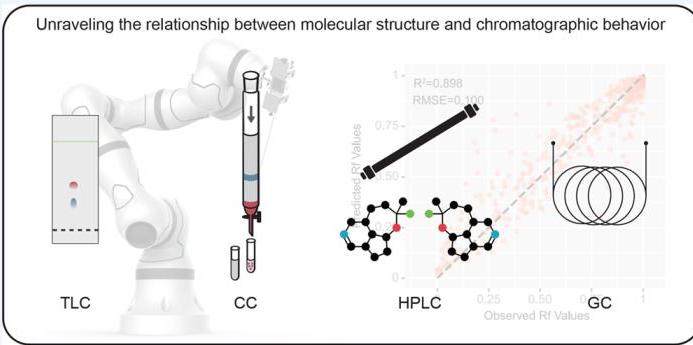
capture quantitative relationships between molecular structures, chromatographic conditions, and retention outcomes. Crucially, by embedding mechanistic constraints-such as polarity-driven adsorption, programmed heating effects, or stereochemical recognition-models transcend black-box prediction and deliver interpretable insights into separation mechanisms. Our research illustrates how chromatography can be transformed into a predictive science through the integration of automation, machine learning, and cross-method transfer. Robotic TLC and CC systems provide reproducible polarity data that inform predictive models and even transferable equations linking TLC ${R}_{f}$ values to CC retention volumes. Multimodal frameworks extend these principles to GC, combining molecular features with heating programs to predict retention under dynamic conditions. For HPLC enantioseparation, chirality-aware graph neural networks capture subtle stereochemical differences and, when coupled with uncertainty quantification, yield separation probabilities that mirror experimental decision-making. This Account focuses on the development of a unified framework for AI-assisted chromatography, highlighting advances in data acquisition, feature engineering, algorithmic design, and cross-scale modeling. Together, these developments chart a path toward universal chromatographic predictors-tools that are accurate, interpretable, and transferable across methods. By closing the loop with automated experimentation, they lay the foundation for predictive and programmable chromatography capable of accelerating discovery and enhancing reproducibility across the chemical sciences.
KEY REFERENCES
Xu, H.; Lin, J.; Liu, Q.; Chen, Y.; Zhang, J.; Yang, Y.; Young, M. C.; Xu, Y.; Zhang, D.; Mo, F. High-throughput discovery of chemical structure-polarity relationships combining automation and machine learning. Chem 2022, 8, 3202. ${}^{1}$ This study integrates automated TLC experiments with machine learning to reveal structure-polarity relationships, enabling predictive chromatography and accelerating data-driven chemical discovery.
Wu, W.; Xu, H.; Xu, Y.; Luo, P.; Zeng, Q.; Chen, Y.; Xu, Y.; Zhang, D.; Mo, F. Intelligent column chromatography prediction model based on automation and machine learning. Chem 2025, 11, 102598. ${}^{2}$ This work develops an intelligent model integrating automated data collection and machine learning to predict column-chromatography behavior, enhancing purification efficiency and reducing empirical trial-and-error.
Xu, H.; Wu, W.; Chen, Y.; Zhang, D.; Mo, F. Explicit relation between thin-layer chromatography and column
ACS Publications
chromatography from statistics and machine learning. Nat. Commun. 2025, 16, 832. ${}^{3}$ This study derives explicit equations linking TLC Rf values to CC retention volumes using automated experiments and interpretable machine learning, providing a quantitative rationale for selecting chromatographic conditions.
- Lin, J.; Song, L.; Chen, Y.; Liu, C.; Chen, S.; Mo, F. Multimodal learning for gas chromatography retention prediction and isomer separation. Digit. Discov. 2025, 4, ${2465.}^{4}$ This work introduces a multimodal learning framework that integrates structural and temperature-program data to predict GC retention times and optimize isomer separations with high efficiency.

Received: October 2, 2025
Revised: November 24, 2025
Accepted: December 2, 2025
Published: December 22, 2025
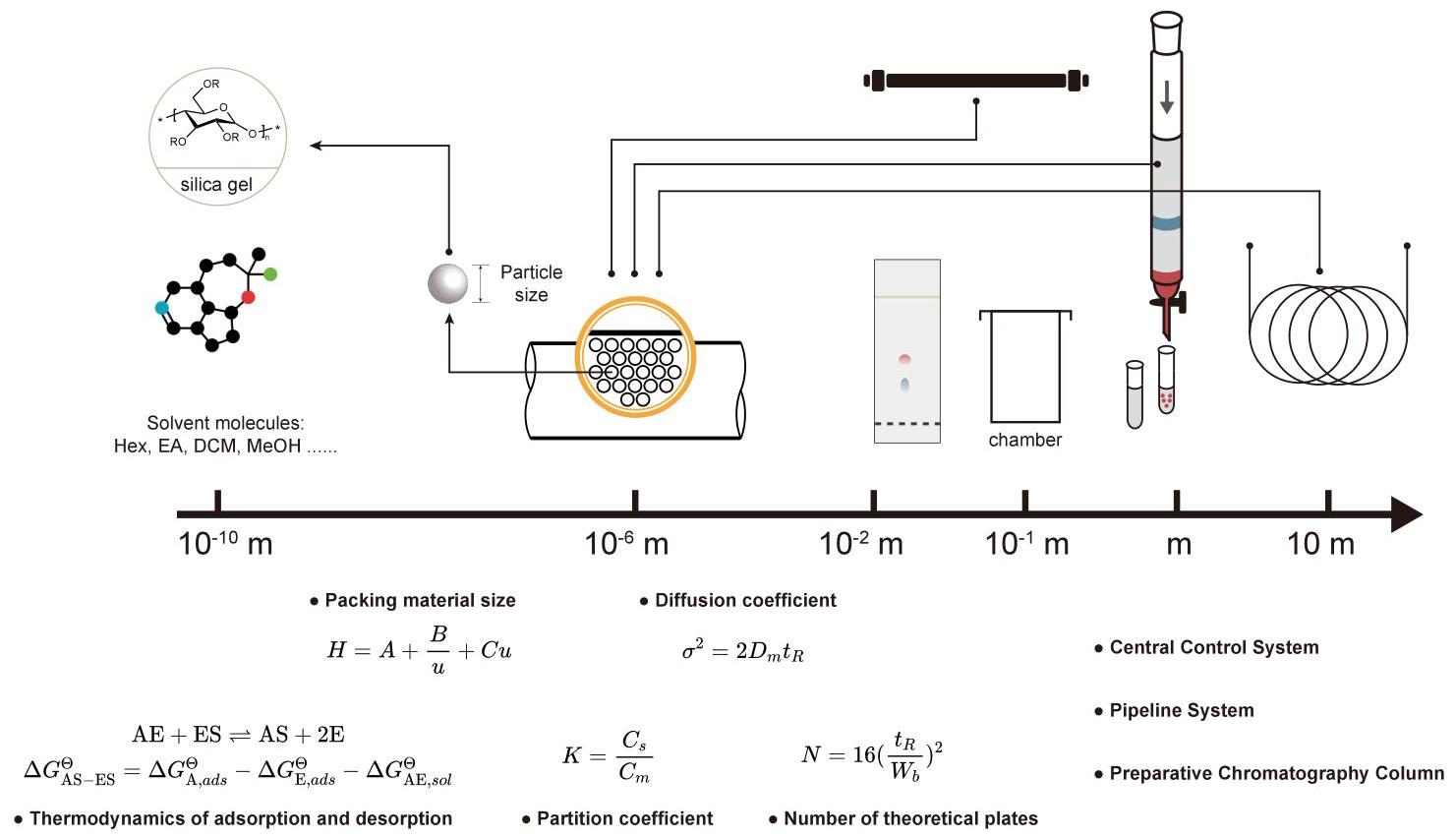
Figure 1. Cross-scale physical principles of chromatography. Processes span molecular thermodynamics, packing material diffusion, device-level transport, and system-scale operation, together shaping retention and resolution.
- Xu, H.; Lin, J.; Zhang, D.; Mo, F. Retention time prediction for chromatographic enantioseparation using quantile geometry-enhanced graph neural networks. Nat. Commun. 2023, 14, 3095. ${}^{5}$ This work presents a quantile geometry-enhanced graph neural network to predict enantioseparation retention times with uncertainty awareness, enabling machine-learning-guided optimization of chiral chromatography.
1. INTRODUCTION
Chromatography has been indispensable to chemical research for more than a century, providing chemists with the means to analyze mixtures, purify products, and resolve complex stereochemical systems. ${}^{6 - {13}}$ Yet, method development remains one of its least systematic aspects. Condition selection-whether solvent ratios in thin-layer chromatography (TLC) and column chromatography (CC), heating programs in gas chromatography (GC), or stationary-phase choice in high-performance liquid chromatography (HPLC)-is still guided primarily by accumulated laboratory intuition. This reliance on empirical heuristics hampers reproducibility, slows discovery, and constrains knowledge transfer across laboratories. At a deeper level, chromatographic behavior arises from inherently multi-scale phenomena encompassing molecular interactions, transport processes, and device-level parameters, making rational prediction particularly challenging. As illustrated in Figure 1, these tightly coupled processes span molecular, mesoscale, device, and system levels, generating cross-scale dependencies that simple molecular or empirical models cannot fully capture. Building on these challenges, the strength of artificial intelligence (AI) lies in its ability to integrate heterogeneous information across scales; therefore, we explore data-driven and mechanistically guided models that hold promise for reconciling molecular, mesoscale, device, and system-level contributions to chromatographic retention.
More broadly, the convergence of high-throughput automation, robotics, and machine learning is reshaping experimental chemistry. ${}^{{14} - {34}}$ Standardized data collection, algorithmic extraction of metadata, and model-driven planning are enabling closed-loop “self-driving” workflows that compress design-make-measure cycles. ${}^{{35} - {41}}$ Within this landscape, separation science is a natural next frontier for predictive and programmable methods.
Within this broader shift, chromatography can be reimagined as a predictive science. Robotic systems can execute experiments with reproducible precision, while machine-learning models provide quantitative links between molecular structure, experimental parameters, and retention outcomes. When designed with mechanistic awareness, such models do more than predict-they reveal interpretable connections between molecular properties and chromatographic behavior. ${}^{1 - 5}$
In this Account, we highlight our efforts to establish a unified framework for AI-assisted chromatography. We begin by describing how automation and algorithmic pipelines enable the construction of large, metadata-rich data sets across TLC, ${}^{1,{42}}$ CC, ${}^{2}\mathrm{{GC}},{}^{4}$ and HPLC. ${}^{5}\mathrm{{We}}$ then discuss strategies for feature engineering that embed polarity, size, and stereochemical descriptors, ensuring that models reflect the governing chemistry of separation. Building on this foundation, we examine algorithmic frameworks tailored to different chromatographic modes, from ensemble learners for polarity-driven systems to multimodal neural networks for programmed separations and chirality-aware graph models for enantiosepara-tion. Finally, we consider the challenges of connecting molecular-scale descriptors with device- and system-level variability, outlining how transfer learning and interpretable machine learning enable cross-scale generalization.
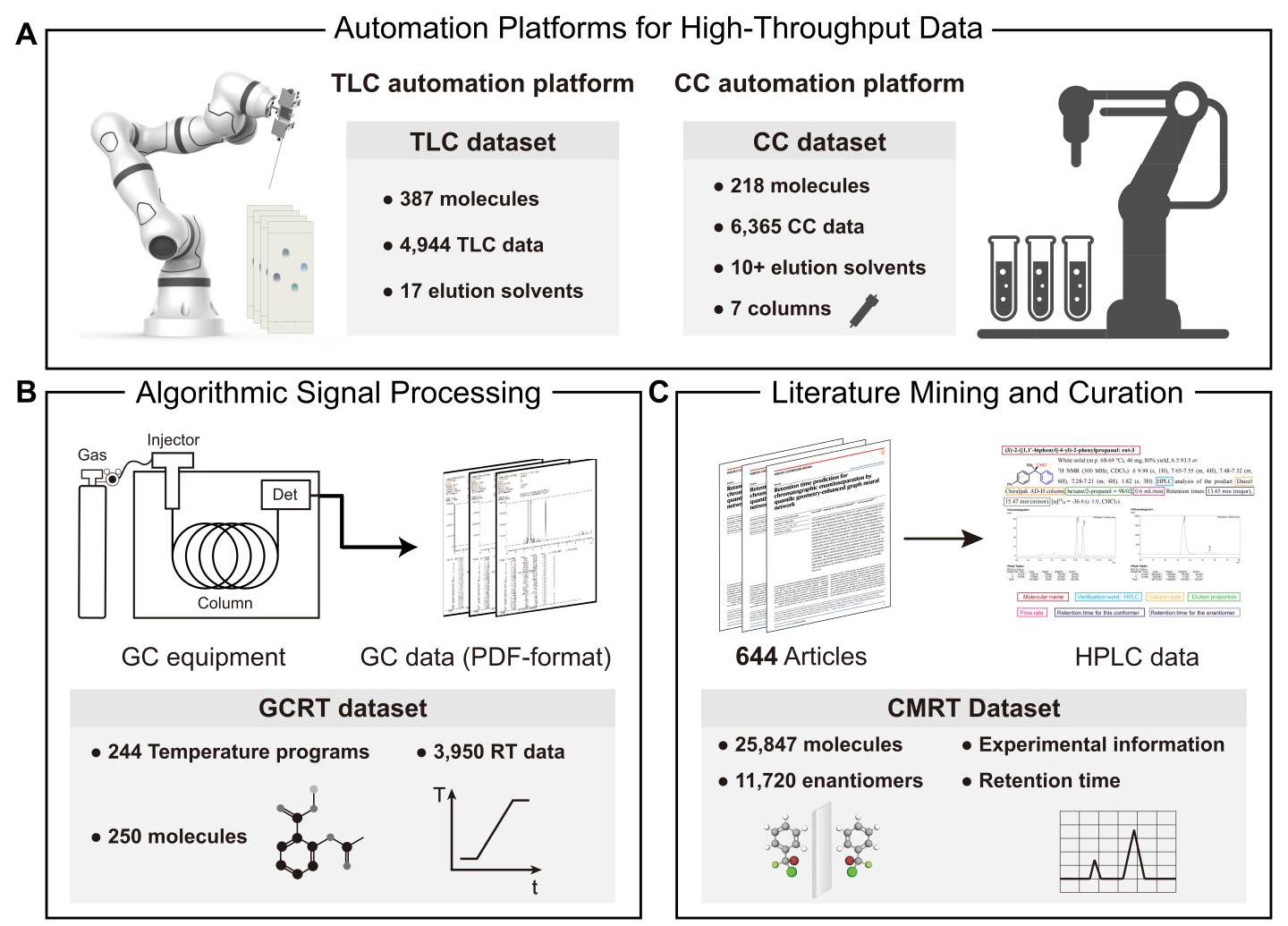
Figure 2. Data acquisition pipelines for chromatography. (A) Automation platforms for high-throughput TLC (left) and CC (right). (B) Algorithmic signal processing for GC. (C) Literature mining and curation for HPLC.
Through this integration of standardized data generation, mechanistically informed modeling, and cross-scale transferability, we argue that chromatography can evolve from an empirical art into a predictive, programmable, and universally reproducible discipline.
2. DATA ACQUISITION
Transforming chromatography from heuristic practice to predictive science hinges on large, standardized, and metadata-rich data sets. To this end, we employed four complementary strategies: (i) robotic automation for high-throughput experiments, (ii) algorithmic extraction of retention parameters from raw signals, (iii) literature mining and manual curation of legacy data, and (iv) systematic design of condition grids and compound coverage. Together, these methods ensure reproducibility, scalability, and transferability across chromatographic modalities.
2.1. Automation Platforms for High-Throughput Data
We developed dedicated robotic systems for TLC and CC, see Figure 2A. For TLC, a benchtop platform equipped with two collaborative robotic arms automates spotting, plate development, and UV imaging. This system produced 4,944 standardized ${R}_{f}$ values from 387 compounds under 17 solvent compositions. ${}^{1,{42}}$ For CC, an automated device integrating pumps, injector, detector, and controller executed injections, eluent mixing, and real-time signal capture. Across 7 column formats and 10+ eluent systems, we collected 6,365 runs from 218 compounds. ${}^{2}$ These robotic platforms transform TLC and CC from operator-dependent techniques into scalable data sources.
2.2. Algorithmic Signal Processing
Gas chromatography (GC) posed a different challenge: chromatograms are typically embedded in vendor-specific PDF reports. We developed a Gas Chromatography Peak Information Extraction Algorithm to convert these files into structured tables. Parameters such as retention time, peak area, and height were parsed automatically, while temperature programs were discretized into time-series inputs. ${}^{4}$ This pipeline enabled the construction of the Gas Chromatography Retention Time (GCRT) data set containing 3,950 records for 250 compounds under 244 temperature programs (Figure 2B).
2.3. Literature Mining and Curation
For high-performance liquid chromatography (HPLC) enantio-separation, systematic experimentation is impractical due to the wide diversity of chiral stationary phases. Instead, we established the Chiral Molecule Retention Time (CMRT) data set by extracting retention times from published reports. ${}^{5}$ Records were standardized for column type, mobile phase composition, flow rate, and retention time, yielding a data set sufficiently broad to support predictive modeling of both retention and enantioseparation probability (Figure 2C). In addition, chemical structures were normalized and encoded as SMILES, ensuring consistent and machine-readable representations across all entries.
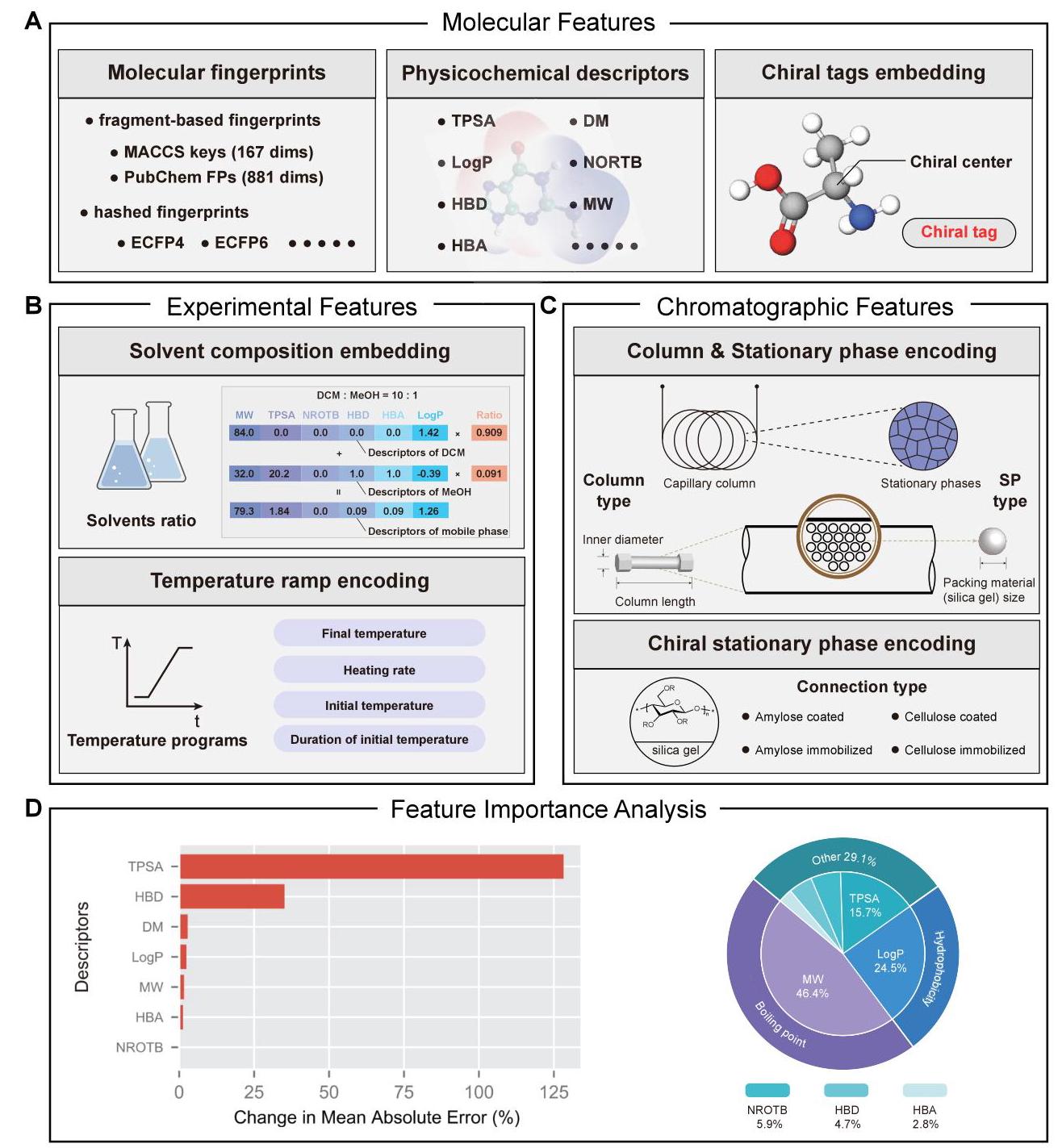
Figure 3. Feature engineering strategies and importance analysis for chromatographic prediction. (A) Molecular features: fragment-based fingerprints, physicochemical descriptors, and stereochemical annotations via chiral tags. (B) Experimental features: solvent composition embeddings derived from weighted solvent descriptors and temperature ramp encoding to capture heating programs. (C) Chromatographic features: column geometry and stationary-phase descriptors and chiral stationary phase encoding. (D) Feature importance analysis: ablation studies in TLC (left) and SHAP analysis in GC (right).
2.4. Data Set Design Principles
Across all modalities, data set construction adhered to common design rules:
Reproducibility: robotic control or algorithmic parsing minimizes operator variance and human bias.
Rich metadata: solvent composition, flow conditions, temperature programs, and detector settings are consistently recorded to enable covariate-aware modeling.
Coverage: condition grids (e.g., solvent ratios, loadings, temperature profiles) and compound-class diversity ensure robustness and enable transfer learning across chromatographic methods.
3. FEATURE ENGINEERING STRATEGIES
Feature engineering in chromatography is not merely a technical step of descriptor selection but a way of embedding mechanistic priors about molecular interactions with stationary and mobile phases. The central aim is to design representations that balance general structural information with chemically meaningful drivers of retention, ensuring that predictive models remain interpretable as well as accurate. These features can be broadly grouped into three categories: molecular features, experimental features, and chromatographic features (Figure 3).
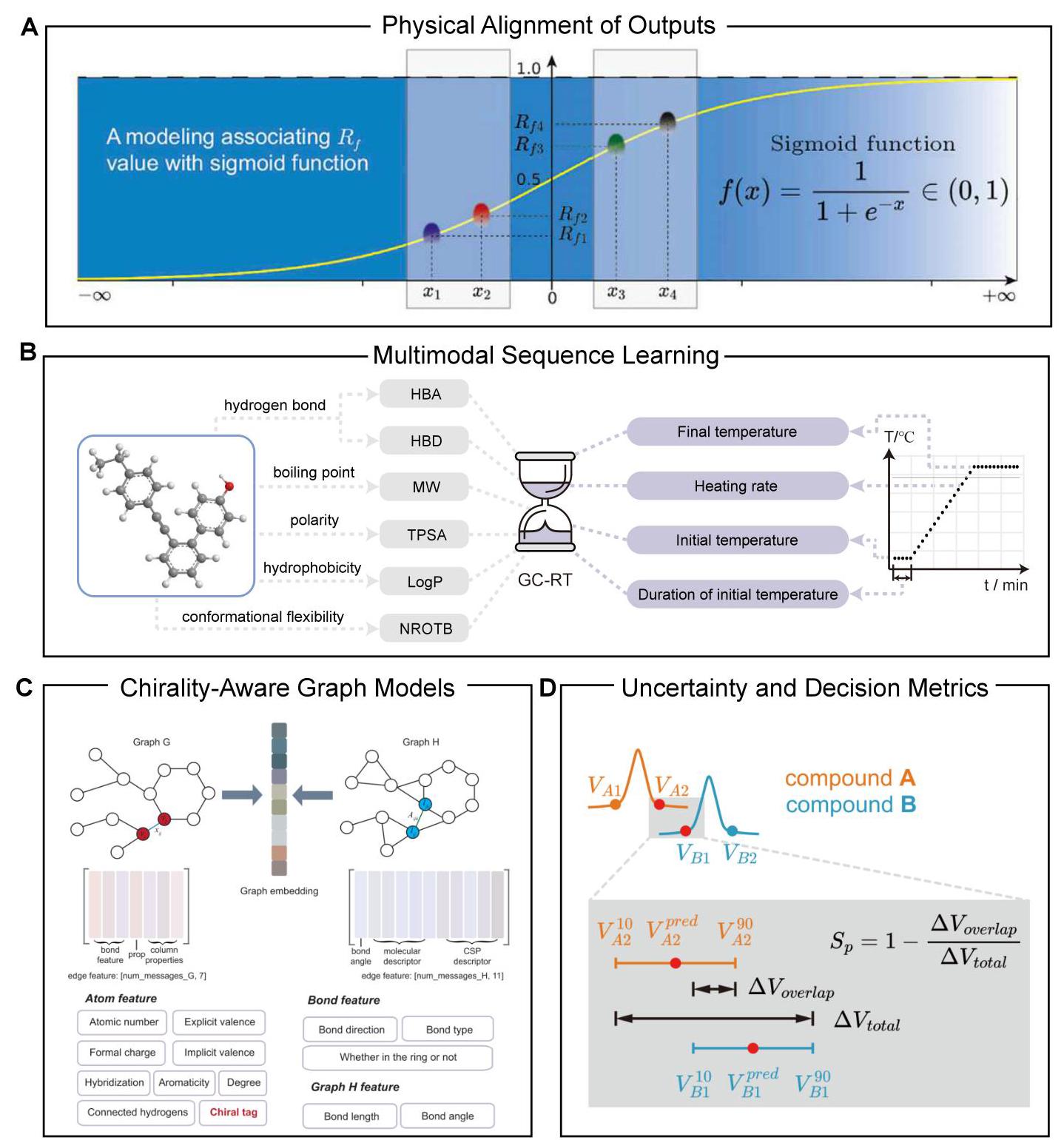
Figure 4. Algorithmic frameworks for chromatographic prediction. (A) Physical alignment of outputs: sigmoid mapping ensures ${R}_{f} \in \left( {0,1}\right)$ and encodes monotonicity constraints. (B) Multimodal sequence learning: GC retention modeled by combining molecular descriptors with heating-program sequences. (C) Chirality-aware graph models: enantioseparation prediction using stereochemical tags and CSP descriptors. (D) Uncertainty and decision metrics: quantile learning provides predictive intervals and defines the separation probability ${S}_{p}$ for robust decision-making.
3.1. Molecular Features
Molecular features capture intrinsic properties of solutes that govern their interactions with chromatographic media (Figure 3A). Generic fingerprints such as MACCS keys or ECFP encode connectivity patterns, offering a fast but coarse representation. In contrast, physicochemical descriptors-molecular weight, topological polar surface area (TPSA), hydrogen-bond donor/ acceptor counts, dipole moment-directly quantify polarity, size, and hydrogen-bonding capacity. These descriptors correspond to key chromatographic behaviors: compounds with larger TPSA or stronger hydrogen-bonding ability interact more strongly with silica surfaces in TLC or CC, resulting in lower ${R}_{f}$ values or delayed elution. ${}^{1,2}$ For enantioseparation in HPLC, conventional descriptors collapse enantiomers into identical vectors, erasing the stereochemical differences that drive resolution. ${}^{5}$ To recover this information, stereocenter annotations, chiral tags, and geometry-aware graph embeddings are introduced. These explicitly preserve the asymmetric environments that govern chiral recognition, mirroring how experimentalists consider the configuration at stereocenters when predicting interactions with chiral stationary phases.
3.2. Experimental Features
Experimental conditions define the external context in which separations occur (Figure 3B). For liquid-phase methods, solvent descriptors (e.g., dielectric constant, hydrogen-bonding ability, polarity index) are combined in proportion to solvent ratios to form embeddings that represent mobile phase composition. This allows models to capture molecule-solvent interactions in a data-driven manner rather than relying on heuristic polarity scales. For example, mixing dichloromethane (low polarity) and methanol (high polarity, hydrogen-bond donor) produces a mobile phase whose effective properties can be computed as a weighted combination of descriptors, reflecting how experimentalists rationalize solvent strength. In GC, the retention of analytes is influenced by both molecular properties and the applied temperature program. ${}^{4}$ Discretizing heating ramps into sequences of initial temperature, hold duration, heating rate, and final temperature allows sequence encoders to learn how volatility and boiling points interact with kinetic desorption processes. This mirrors the chemical intuition that small, volatile molecules elute early at low temperatures, while larger or more polar analytes require higher thermal energy to desorb from the stationary phase.
3.3. Chromatographic Features
Chromatographic features describe the properties of columns and stationary phases that directly shape retention and resolution (Figure 3C). In GC, stationary phase polarity, film thickness, and capillary dimensions (inner diameter, length) govern analyte-phase interactions and diffusion paths, thereby determining selectivity and efficiency. ${}^{4}$ In HPLC, descriptors of particle size, pore diameter, and stationary-phase chemistry encode how mass transfer and surface chemistry affect separation performance. ${}^{5}$ For chiral stationary phases (CSPs), encoding whether polysaccharides are coated or immobilized, and whether amylose or cellulose is used, reflects critical chemical determinants of enantioselectivity. Such descriptors capture the fact that immobilized CSPs often provide greater robustness but different selectivity compared to coated variants. Embedding these chromatographic descriptors ensures that models remain portable across laboratories, instruments, and column designs, reflecting the experimental practice of transferring methods by matching stationary-phase and column specifications.
3.4. Qualitative Insights
Feature attribution analyses consistently recover chemically intuitive drivers of retention (Figure 3D). In TLC, TPSA and HBD/HBA dominate, reflecting adsorption on silica Si-OH sites: stronger polarity lowers $\Delta {G}_{\text{ ads }}$ , raises the distribution coefficient $K = {C}_{s}/{C}_{m}$ , and through ${R}_{f} \approx 1/\left( {1 + k}\right)$ decreases ${R}_{f}$ . Protic eluents disrupt these interactions, explaining shifts toward higher ${R}_{f}$ at fixed polarity. In GC, retention is governed mainly by molecular weight and hydrophobicity. Heavier analytes, with higher vaporization enthalpies, and hydrophobic ones, dissolving more readily in polysiloxane films, show longer residence times; modeling heating ramps as sequences captures the $T\left( t\right)$ - dependent modulation of these effects. For HPLC enantiosepa-ration, predictive power hinges on explicit stereochemical encoding: resolution arises from small free-energy differences $\left( {\Delta \Delta G}\right)$ in solute-CSP complexes, mediated by directional H-bonding, $\pi - \pi$ stacking, and steric fit near stereocenters. Together, these patterns mirror established mechanistic expectations-polarity-driven adsorption for TLC, volatility and phase affinity for GC, and stereochemical recognition for HPLC-showing that machine-learning models can compress heterogeneous data into quantitative, interpretable structure-condition-retention relationships.
4. ALGORITHMIC FRAMEWORKS
The design of chromatographic prediction models must balance numerical accuracy, physical validity, and chemical interpretability. Guided by these principles, we organize algorithmic strategies into four complementary layers (Figure 4).
4.1. Physical Alignment of Outputs
Chromatographic targets must respect their intrinsic domains. For thin-layer chromatography, ${R}_{f}$ values are bounded between 0 and 1; this constraint can be enforced through a sigmoid activation that naturally maps regression outputs into the valid interval (Figure 4A). Chemically, this reflects the fact that solute mobility on silica cannot exceed the solvent front and cannot be negative. By introducing a sigmoid mapping, the model formalizes the bounded diffusion-adsorption equilibrium that governs ${R}_{f}$ values. ${}^{1}$ For column chromatography, monotonicity with solvent polarity and adsorption strength is encoded to avoid unphysical extrapolation. This mirrors the chemical intuition that stronger hydrogen-bond donors or larger polar surface areas consistently slow elution under polar stationary phases. Embedding these constraints thus prevents the model from predicting inversions that contradict known chromatographic mechanisms.
4.2. Multimodal Sequence Learning
Gas chromatography retention depends jointly on intrinsic molecular descriptors (e.g., polarity, hydrophobicity, boiling point, conformational flexibility) and external heating programs. To capture this interplay, multimodal architectures combine graph-based encoders of molecular structure with recurrent or attention-based encoders of temporal sequences such as initial temperature, heating rate, and final temperature (Figure 4B). From a chemical perspective, retention in GC reflects vapor-liquid partitioning equilibria that evolve dynamically with temperature. ${}^{4}$ Small, volatile molecules desorb rapidly, whereas larger or more polar compounds require higher energy to elute. By embedding heating ramps as temporal sequences, the model learns how volatility profiles interact with kinetic desorption, an effect that classical descriptors alone cannot capture. This mechanistic encoding allows predictions to generalize across nonlinear heating gradients and provides a transferable framework for temperature-programmed separations.
4.3. Chirality-Aware Graph Models
High-performance liquid chromatography for enantioseparation poses the challenge of distinguishing constitutionally identical enantiomers. Chirality-aware graph neural networks explicitly tag stereocenters and encode local three-dimensional environments (Figure 4C). This reflects the chemical reality that enantiomer separation arises from asymmetric interactions between solutes and the chiral stationary phase (CSP). ${}^{5}$ Hydrogen bonding, stacking, and steric fit differ subtly between mirror-image configurations, and these differences are often localized near stereogenic centers. By encoding stereocenters and CSP descriptors into the model, the framework captures the same interaction motifs that experimentalists exploit when screening columns. Thus, the algorithm does not merely predict retention but also highlights which stereochemical environments are most influential for enantioselectivity.
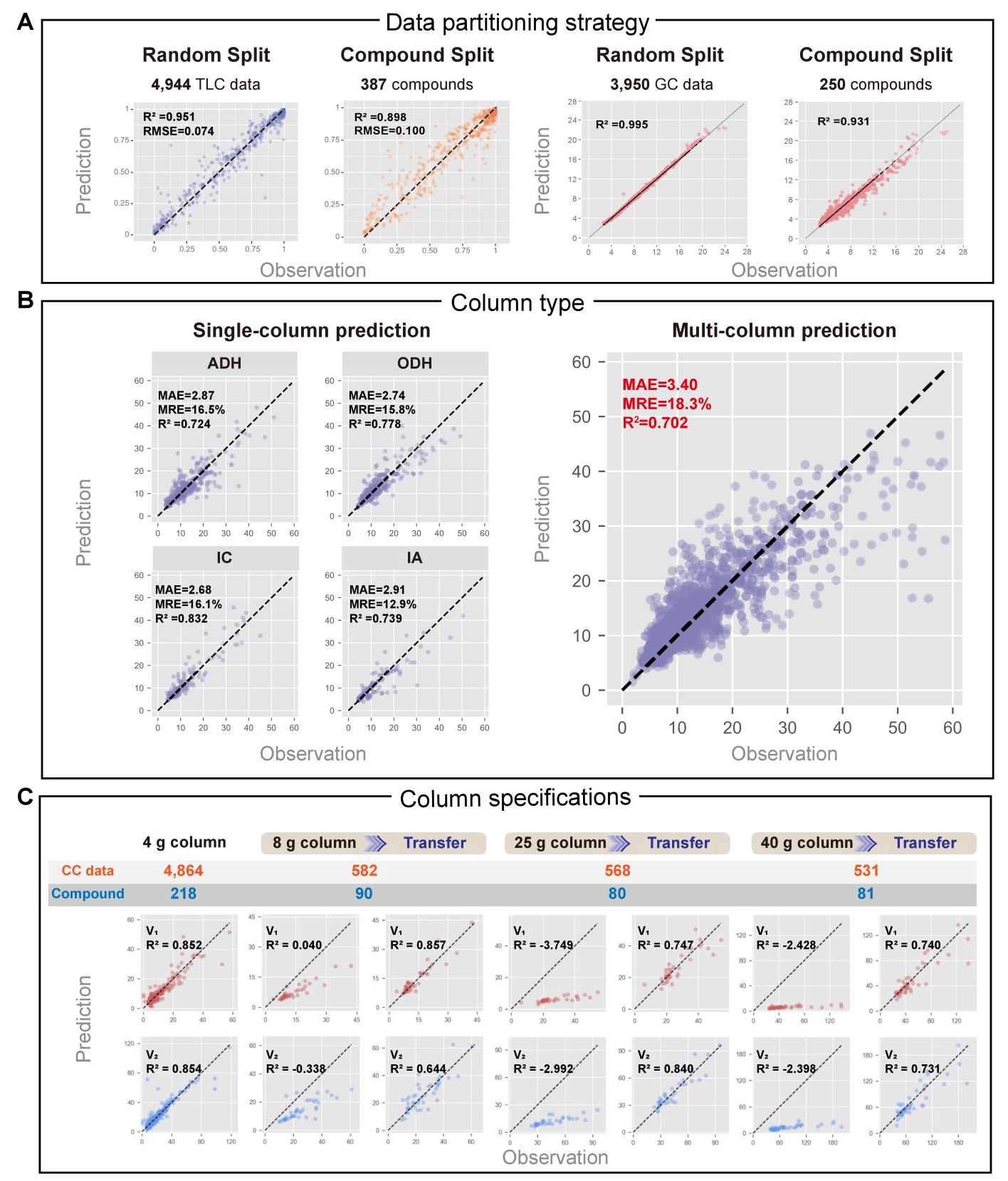
Figure 5. Model performance and generalization across chromatographic settings. (A) Data partitioning: evaluation under random and compound-level splits. (B) Column type: assessment of HPLC enantioseparation across different chiral stationary phases. (C) Column specifications: assessment of CC performance across cartridges of different sizes with transfer learning.
4.4. Uncertainty and Decision Metrics
Accurate prediction alone is insufficient for experimental decision-making when separations hinge on narrow thresholds (e.g., $\Delta {t}_{R} \sim {0.3}\mathrm{\;{min}}$ ). We therefore use quantile learning to produce distributional predictions and convert them into a single, chemically interpretable metric: the separation probability ${S}_{p}$ (Figure 4D). ${}^{2}$
Assuming compound A elutes before B (so that ${V}_{2}$ of A precedes ${V}_{1}$ of B), let ${V}_{\mathrm{A}2}^{90}$ denote the 90th percentile of the end elution volume of $\mathrm{A}$ and ${V}_{\mathrm{B}1}^{10}$ the 10th percentile of the start elution volume of $\mathrm{B}$ ; likewise define ${V}_{\mathrm{A}2}^{10}$ and ${V}_{\mathrm{B}1}^{90}$ . We then quantify the overlap between A’s late tail and B’s early front and normalize it by the uncertainty span between A’s early tail and B’s late front:
$$ {S}_{p} = 1 - \frac{\max \left( {0,{V}_{\mathrm{A}2}^{90} - {V}_{\mathrm{B}1}^{10}}\right) }{{V}_{\mathrm{B}1}^{90} - {V}_{\mathrm{A}2}^{10}} \tag{1} $$Here ${S}_{p} = 1$ when ${V}_{\mathrm{A}2}^{90} \leq {V}_{\mathrm{B}1}^{10}$ (no overlap), and ${S}_{p}$ decreases toward 0 as the overlap grows within the span $\left\lbrack {{V}_{\mathrm{A}2}^{10},{V}_{\mathrm{B}1}^{90}}\right\rbrack$ . For the reverse elution order, swap the roles of $\mathrm{A}$ and $\mathrm{B}$ (notation: ${V}_{1}/{V}_{2}$ correspond to start/end elution volumes, i.e., ${V}_{\mathrm{S}}/{V}_{\mathrm{E}}$ ).
The choice of the 10th/90th percentiles is not arbitrary. Intervals such as the 25th/75th percentiles are too narrow to reflect real chromatographic variability, whereas the 5th/95th percentiles are overly influenced by outliers. The 10th/90th interval provides a practical balance: it captures the dominant experimental uncertainty while excluding extreme predictions, and it aligns with how practitioners evaluate retention windows in routine CC/HPLC operation.
This quantile-overlap rule is distribution-free, aligns with chromatographic intuition (larger mean gap and narrower predictive intervals increase ${S}_{p}$ ), and turns predictive uncertainty into an actionable decision for solvent choice in CC or column-solvent selection in HPLC.
5. MODEL PERFORMANCE AND GENERALIZATION
The predictive performance of chromatographic models is governed less by data set size than by the extent to which underlying physicochemical mechanisms are appropriately embedded. To evaluate model robustness, we systematically examined three representative dimensions: data partitioning strategy, column type, and column specifications (Figure 5).
5.1. Data Partitioning Strategy
Data partitioning provides a direct measure of extrapolative capability. For TLC, ensemble learners trained on 4,944 records achieved ${R}^{2} = {0.951}$ under random splits and ${R}^{2} = {0.898}$ under compound-level splits (Figure 5A, left). ${}^{1}$ The modest decline reflects the chemical generality of descriptors such as TPSA and HBD, which encode adsorption tendencies on silica. Molecules with larger polar surface areas or stronger hydrogen-bond donating ability consistently exhibit lower ${R}_{f}$ values, enabling generalization to previously unseen compounds. In GC, multimodal models trained on 3,950 runs attained ${R}^{2} = {0.995}$ under random splits and retained ${R}^{2} = {0.931}$ under compound-level splits (Figure 5A, right). ${}^{4}$ This stability arises from the dominant role of volatility (molecular weight, boiling point) and hydrophobic interactions with the stationary phase, coupled with explicit encoding of heating ramps. By representing temperature programs as temporal sequences, the models capture vapor-liquid partition dynamics, yielding robust extrapolation to novel analytes.
5.2. Column Type: Chiral Stationary Phases
Enantioseparation in HPLC presents a more stringent challenge, as enantiomers are constitutionally identical and separation depends on asymmetric interactions with the chiral stationary phase (CSP). When trained on individual CSPs (ADH, ODH, IC, IA), QGeoGNNs achieved ${R}^{2} = {0.724} - {0.832}$ with mean absolute errors of 2.7-2.9 min (Figure 5B, left), indicating that stereochemical recognition-mediated by directional hydrogen bonding, $\pi - \pi$ stacking, and steric complementarity-can be reliably encoded within a fixed CSP environment. ${}^{5}$ In contrast, pooling multiple CSPs reduced performance to ${R}^{2} = {0.702}$ with MAE = 3.40 min and MRE = 18.3% (Figure 5B, right). This decline is chemically meaningful: amylose- and cellulose-derived CSPs differ in helical chirality and hydrogen-bond topology, while coated versus immobilized phases exhibit distinct conformational rigidity. Without explicit descriptors of CSP chemistry, the model conflates distinct recognition mechanisms, underscoring the necessity of condition-aware encoding or targeted transfer learning for cross-column generalization.
5.3. Column Specifications: Transfer across Cartridge Formats
Variations in column specifications primarily affect hydrodynamic behavior rather than chemical selectivity. For the $4\mathrm{\;g}$ cartridge (4,864 runs, 218 compounds), predictive performance was high, with ${R}^{2} = {0.852}$ for ${V}_{1}$ and ${R}^{2} = {0.854}$ for ${V}_{2}$ (Figure 5C, left). Direct application of this baseline model to larger cartridges, however, yielded substantial degradation, with negative ${R}^{2}$ values for $8\mathrm{\;g},{25}\mathrm{\;g}$ , and ${40}\mathrm{\;g}$ formats. These results indicate systematic offsets in elution volumes arising from increased void volume and band broadening rather than stochastic noise. ${}^{2}$ Application of transfer learning with limited calibration experiments restored accuracy, yielding ${R}^{2} = {0.857}/ \; {0.644}\left( {8\mathrm{\;g}}\right) ,{0.747}/{0.840}\left( {{25}\mathrm{\;g}}\right)$ , and ${0.740}/{0.731}\left( {{40}\mathrm{\;g}}\right)$ . The comparatively greater sensitivity of ${V}_{2}$ reflects its dependence on peak width and dispersion effects, which are more susceptible to hydrodynamic scaling. These findings demonstrate that adsorption equilibria generalize across formats, while column-specific transport phenomena require explicit recalibration.
5.4. Small Data, Big Task
Across these evaluations, a consistent principle emerges: accurate and interpretable chromatographic predictions can be achieved with relatively modest data sets, provided that mechanistic priors are embedded within the model. In TLC and CC, polarity-adsorption relationships support generalization under compound-level splits with only a few thousand training points. In GC, fewer than 4,000 records suffice to capture volatility-temperature coupling across diverse heating ramps. In CC, transfer learning with tens of calibration runs enables adaptation to cartridges differing by an order of magnitude in size. These observations exemplify a “small data, big task” paradigm: the incorporation of physical priors-adsorption equilibria, volatility-driven desorption, stereochemical recognition, and hydrodynamic dispersion-allows models to generalize effectively across compounds, chromatographic modes, and hardware formats. This principle highlights the central role of mechanistically informed AI in achieving extrapolative accuracy and practical applicability in chromatographic prediction.
Moreover, the computational cost of training these models is modest. All models in this Account were trained on a single NVIDIA RTX 4090 GPU. For TLC, model training typically requires only ${10} - {20}\mathrm{\;{min}}$ . The CC model, trained for up to 1,000 epochs with early stopping, usually converges within 40-50 min, while transfer-learning adaptations to new cartridge formats require only an additional 10-15 min. For HPLC, full model training completes within approximately 4-5 h, and GC models converge around ${700} - {800}$ epochs, with a complete 1,500-epoch schedule taking about 5-6 h. These timings indicate that the proposed frameworks are computationally efficient and readily trainable or fine-tunable on standard workstation hardware, facilitating practical deployment in both academic and industrial laboratories.
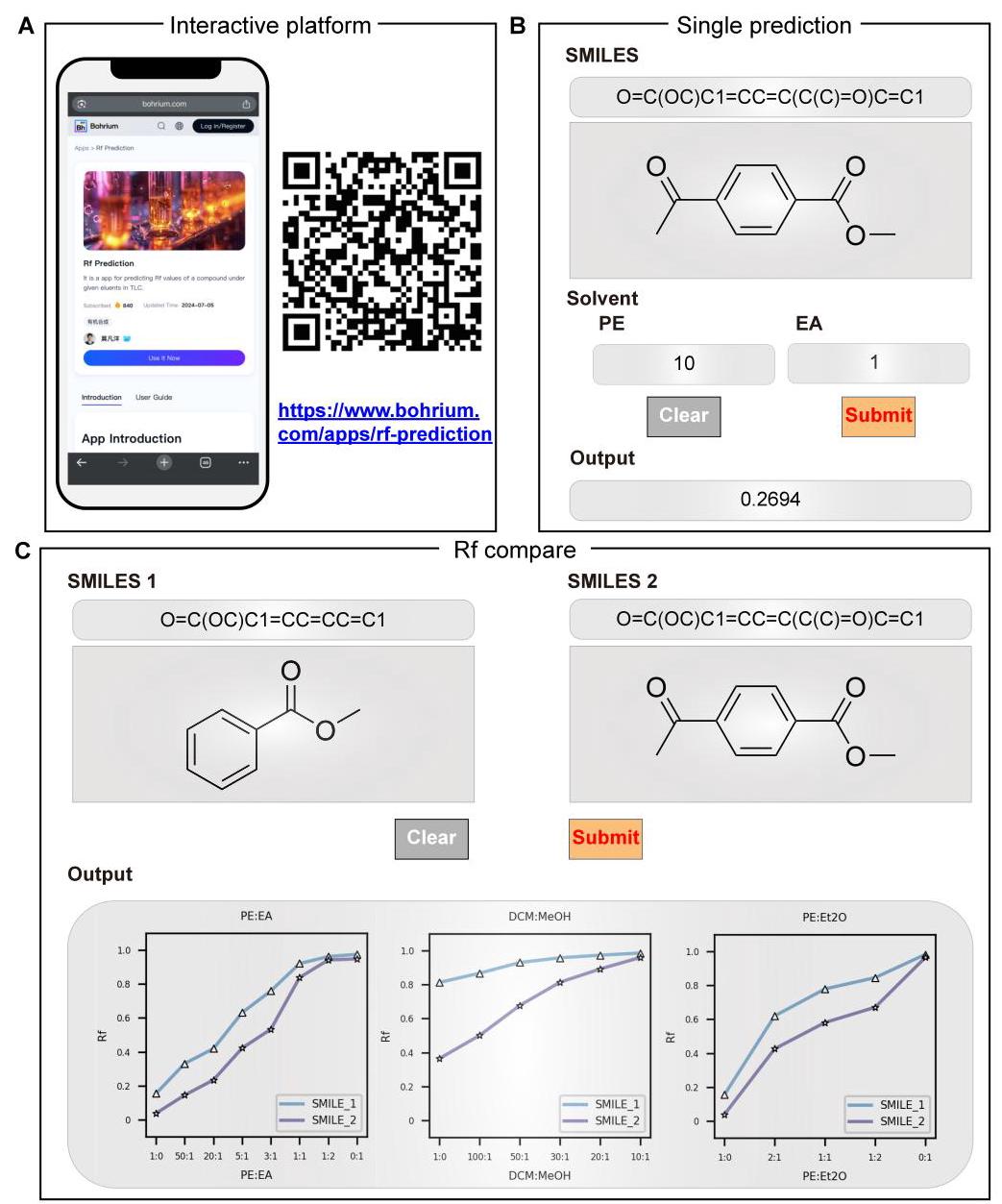
Figure 6. User-facing deployment of TLC ${R}_{f}$ prediction models. (A) Interactive platform interface with mobile and QR-code access. (B) Single prediction from SMILES and user-defined solvent composition. (C) Comparison of solvent-dependent ${R}_{f}$ values for two molecules across eluent systems.
6. MODEL DEPLOYMENT AND PRACTICAL INTEGRATION
The ultimate value of predictive modeling lies in how seamlessly it integrates with chemical practice. In chromatography, deployment spans three complementary levels: user-facing tools, closed-loop automation, and scalability across heterogeneous laboratory setups.
6.1. From Prediction Models to User Interfaces
Interactive web applications have become a key vehicle for translating predictive models into practical scientific tools, as they lower technical barriers and promote accessibility for researchers without programming expertise. ${}^{43}$ To bring our TLC ${R}_{f}$ prediction model into routine laboratory use, we deploy it as an online application on Bohrium (available at https:// www.bohrium.com/apps/rf-prediction), providing a streamlined interface for experimental planning (Figure 6A).
The single prediction module (Figure 6B) takes a SMILES input and outputs the predicted ${R}_{f}$ value under user-defined solvent compositions across supported eluent systems. The ${R}_{f}$ comparison module (Figure 6C) evaluates two molecules across multiple solvent systems, enabling rapid analysis of solvent-dependent ${R}_{f}$ trends for purification planning and structural differentiation.
This deployment constitutes the initial release of our platform (TLC 1.0). While TLC 1.0 effectively covers the organic chemical space represented in our training data, highly polar molecules-such as amino acids, peptides, and sugars-fall outside this domain and are often better resolved by reverse-phase TLC rather than the normal-phase conditions modeled here. Accordingly, we are extending the framework toward TLC 2.0, incorporating reverse-phase TLC to expand coverage to highly polar and biorelevant species. Together, these modules provide an extensible foundation for AI-assisted chromatographic planning.
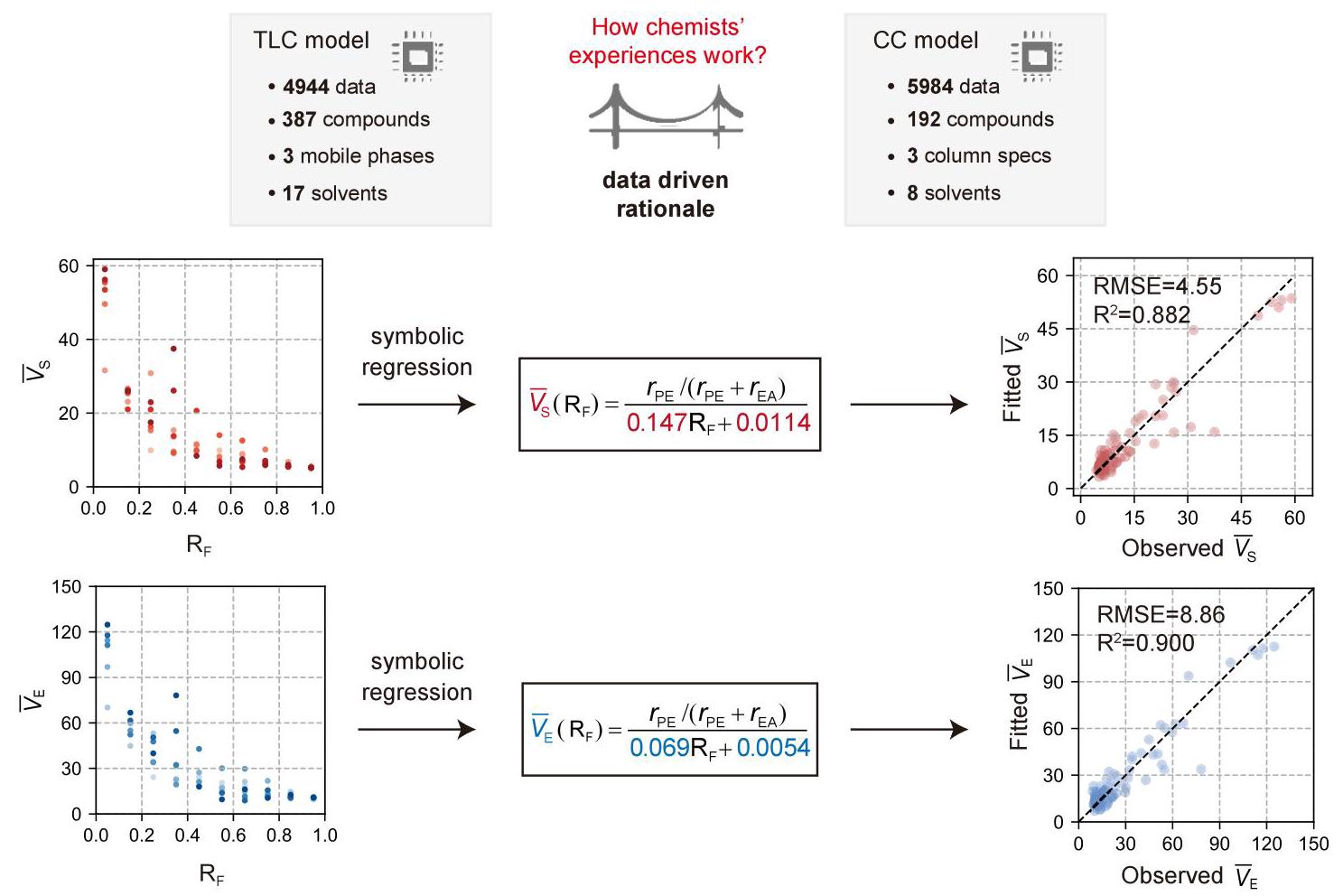
Figure 7. Formalizing the TLC-CC correspondence. Symbolic regression reveals explicit scaling laws between TLC mobility $\left( {R}_{f}\right)$ and CC elution volumes $\left( {{V}_{\mathrm{S}},{V}_{\mathrm{E}}}\right)$ , achieving ${R}^{2} = {0.882}$ and ${R}^{2} = {0.900}$ . These relations convert empirical heuristics into transferable equations linking analytical TLC to preparative CC.
6.2. Practical Integration of Predictive Models
Integrating predictive models with robotic platforms transforms them from passive predictors into active drivers of experimentation: TLC/CC systems use predictions to guide solvent selection, GC models prescreen temperature programs, and HPLC probabilities prioritize column-solvent combinations. Experimental outcomes are automatically fed back, closing the loop between computation and experiment.
Within the broader chromatographic ecosystem, a range of predictive approaches has been developed-spanning commercial QSRR (quantitative structure-retention relationship)-based software, open LC predictors such as OPERA-RT, ${}^{44}$ MS-assisted scoring frameworks such as MetFrag RT, ${}^{45}$ and method-transfer tools including PredRet ${}^{46}$ and retention projection. These methods have provided considerable value for modality-specific tasks such as reversed-phase LC retention estimation, GC method screening, and cross-instrument retention harmonization.
However, existing tools are generally tailored to specific chromatographic mechanisms (e.g., gradient LC or temperature-programmed GC) and are not designed to capture the adsorption-driven, solvent-ratio-dependent behavior characteristic of normal-phase TLC/CC, nor do they offer unified decision metrics that extend across multiple separation modes. In this context, our framework is formulated to be mode-general rather than mode-specific-providing a single structure-condition-retention formulation that supports prediction and condition ranking across TLC, CC, GC, and HPLC. Ultimately, the objective is not predictive accuracy alone, but the translation of those predictions into experimentally actionable decisions that accelerate chromatographic method development across diverse laboratory environments.
7. FROM EMPIRICAL HEURISTICS TO MECHANISTIC FOUNDATIONS
7.1. From TLC-CC Experience to Mathematical Formalization
Thin-layer chromatography (TLC) has long served as a heuristic guide for column chromatography (CC), where chemists estimate elution strength by observing ${R}_{f}$ values. Traditionally, this “TLC-CC correspondence” has been qualitative, resting on empirical experience rather than quantitative rules. By systematically analyzing paired data sets, we established explicit mathematical relations between TLC mobility and CC elution volumes $\left( {{V}_{\mathrm{S}},{V}_{\mathrm{E}}}\right)$ , thereby converting tacit knowledge into transferable eqs (Figure 7). ${}^{3}$
Symbolic regression on 4,944 TLC measurements and 5,984 CC runs yielded linearized scaling laws that connect ${R}_{f}$ values with normalized elution volumes (eqs 2a and 2b)
$$ {\bar{V}}_{\mathrm{S}}\left( {R}_{f}\right) = \frac{{r}_{\mathrm{{PE}}}}{{r}_{\mathrm{{PE}}} + {r}_{\mathrm{{EA}}}}\left( {{0.147}{R}_{f} + {0.0114}}\right) \tag{2a} $$$$ {\bar{V}}_{\mathrm{E}}\left( {R}_{f}\right) = \frac{{r}_{\mathrm{{PE}}}}{{r}_{\mathrm{{PE}}} + {r}_{\mathrm{{EA}}}}\left( {{0.069}{R}_{f} + {0.0054}}\right) \tag{2b} $$where ${r}_{\mathrm{{PE}}}$ and ${r}_{\mathrm{{EA}}}$ denote solvent composition ratios.
The fitted models achieve ${R}^{2} = {0.882}\left( {V}_{\mathrm{S}}\right)$ and ${R}^{2} = {0.900} \; \left( {V}_{\mathrm{E}}\right)$ , with RMSE values of 4.55 and 8.86, respectively, confirming that TLC mobility encodes sufficient physical information to predict preparative CC performance with quantitative accuracy. Chemically, the trends align with adsorption-desorption thermodynamics: solutes with higher ${R}_{f}$ exhibit weaker interactions with silica and thus elute at lower volumes, while strongly adsorbing solutes $\left( {{R}_{f} \rightarrow 0}\right)$ require larger solvent volumes to overcome surface retention. The difference between ${V}_{\mathrm{S}}$ and ${V}_{\mathrm{E}}$ further reflects the onset versus completion of elution, analogous to the spread between breakthrough and saturation in adsorption isotherms.
By formalizing the TLC-CC relationship into explicit equations, these results transform experiential heuristics into a data-driven rationale. This not only validates the empirical practice of “using TLC to guide CC” but also provides a generalizable framework for method transfer, where TLC measurements can be quantitatively translated into preparative-scale solvent and column conditions.
7.2. Unified Thermodynamic-Kinetic Framework for Chromatographic Retention
Although TLC, CC, GC, and chiral HPLC operate under distinct physicochemical regimes, all chromatographic processes can be framed within a unified abstraction: retention reflects the coupled influence of thermodynamic phase preference and transport-mediated peak development. Thermodynamics determines how molecular features-polarity, volatility, or stereochemistry-shape the Gibbs free-energy differences between coexisting phases, whether adsorption sites on silica, vapor-liquid equilibria in GC stationary films, or asymmetric binding pockets on chiral stationary phases. Transport phenomena-diffusion, mass-transfer resistance, and hydrodynamic flow-govern how these free-energy landscapes translate into observable retention coordinates.
Within this framework, TLC and CC represent polarity-controlled adsorption equilibria, GC expresses temperature-dependent vapor-liquid partitioning under dynamic heating programs, and chiral HPLC encodes ${\Delta \Delta G}$ -scale differences in diastereomeric complexation. Despite their mechanistic differences, all modalities map molecular structure and operating conditions onto macroscopic retention through a shared thermodynamic-kinetic convolution. This abstraction provides a coherent foundation for cross-modal analysis and guides the design of machine-learning models that incorporate mode-specific descriptors while adhering to common chromatographic principles.
8. SUMMARY AND OUTLOOK
This Account highlights how automation, mechanistically informed feature engineering, and tailored algorithms transform chromatography from an empirical practice into a predictive science. By integrating predictive models with robotic platforms, separations can be guided in real time and refined through experimental feedback, while transfer learning and condition embeddings ensure portability across laboratories.
Beyond the modalities examined in this Account, the same mechanistically informed principles may, in principle, be applicable to additional chromatographic systems. Reversed-phase liquid chromatography (RP-LC), for example, is driven by hydrophobicity- and solvation-related interactions under gradient elution, ${}^{{47},{48}}$ whereas supercritical fluid chromatography (SFC) involves pressure- and density-dependent transport phenomena. ${}^{{49},{50}}$ Extending the framework to such modes would require mode-specific descriptors and well-standardized conditions, and we view this as a promising direction for future methodological development.
Looking forward, advances in preparative automation, from prep-TLC to fully integrated column systems, promise end-to-end workflows with minimal manual intervention. Large language models (LLMs) further complement structured data sets by mining literature, extracting heuristics, and enhancing interpretability. ${}^{{51} - {55}}$ Together, these developments point toward a future in which chromatography is predictive, programmable, and universally reproducible, enabling self-optimizing workflows that accelerate discovery across chemical sciences.
AUTHOR INFORMATION
Corresponding Author
Fanyang Mo - School of AI for Science, Peking University Shenzhen Graduate School, Shenzhen 518055, China; AI for Science (AI4S)-Preferred Program, School of Advanced Materials, and Guangdong Provincial Key Laboratory of Nano-Micro Materials Research, Peking University Shenzhen Graduate School, Shenzhen 518055, China; State Key Laboratory of Advanced Waterproof Materials, School of Materials Science and Engineering, Peking University, Beijing 100871, China; © orcid.org/0000-0002-4140-3020;
Author
Chengchun Liu - School of AI for Science, Peking University Shenzhen Graduate School, Shenzhen 518055, China; AI for Science (AI4S)-Preferred Program, Peking University Shenzhen Graduate School, Shenzhen 518055, China; State Key Laboratory of Advanced Waterproof Materials, School of Materials Science and Engineering, Peking University, Beijing 100871, China; (C) orcid.org/0009-0002-5550-4145
Complete contact information is available at:
https://pubs.acs.org/10.1021/acs.accounts.5c00677
Author Contributions
F.M. and C.L. conceived the project, designed the method, and analyzed the results. C.L. organized and prepared structural data. F.M. and C.L. wrote the paper. F.M. supervised the project. CRediT: Chengchun Liu conceptualization, data curation, formal analysis, methodology, visualization, writing - original draft; Fanyang Mo conceptualization, data curation, formal analysis, funding acquisition, investigation, methodology, project administration, resources, software, supervision, validation, visualization, writing - original draft, writing - review & editing.
Notes
The authors declare no competing financial interest.
Biographies
Chengchun Liu received his B.Sc. degree in Chemistry from Nankai University and is currently a Ph.D. candidate in the School of Materials Science and Engineering, Peking University, under the supervision of Prof. Fanyang Mo. His research interests focus on AI-assisted spectroscopy, chromatographic separation, and computational methods for chemical informatics.
Fanyang Mo received his B.Sc. and M.S. degrees in Chemistry from Beijing Institute of Technology in 2004 and 2006, respectively, and his Ph.D. from Peking University under the supervision of Prof. Jianbo Wang. After postdoctoral research at the Scripps Research Institute and The University of Texas at Austin, he joined Peking University in 2015, where he is now an Associate Professor. His research interests focus on AI for Chemistry, chromatographic separation, laboratory automation, and computational methods for chemical informatics.
ACKNOWLEDGMENTS
We thank Peking University Shenzhen Graduate School and Shenzhen Government for the start-up funding support. We thank the High-Performance Computing Platform of Peking University for machine learning model training.
ABBREVIATIONS
AI, Artificial Intelligence; CC, Column Chromatography; CMRT, Chiral Molecular Retention Time; CSP, Chiral Stationary Phase; GC, Gas Chromatography; HPLC, High-Performance Liquid Chromatography; QGeoGNN, Quantile Geometry-enhanced Graph Neural Network; RT, Retention Time; SMILES, Simplified Molecular Input Line Entry System; TLC, Thin-Layer Chromatography; TPSA, Topological Polar Surface Area; QSRR, Quantitative Structure-Retention Relationship
R REFERENCES
(1) Xu, H.; Lin, J.; Liu, Q.; Chen, Y.; Zhang, J.; Yang, Y.; Young, M. C.; Xu, Y.; Zhang, D.; Mo, F. High-throughput discovery of chemical structure-polarity relationships combining automation and machine-learning techniques. Chem 2022, 8, 3202-3214.
(2) Wu, W.; Xu, H.; Xu, Y.; Luo, P.; Zeng, Q.; Chen, Y.; Xu, Y.; Zhang, D.; Mo, F. Intelligent column chromatography prediction model based on automation and machine learning. Chem 2025, 11, 102598.
(3) Xu, H.; Wu, W.; Chen, Y.; Zhang, D.; Mo, F. Explicit relation between thin film chromatography and column chromatography conditions from statistics and machine learning. Nat. Commun. 2025, 16, 832.
(4) Lin, J.; Song, L.; Chen, Y.; Liu, C.; Chen, S.; Mo, F. Multimodal learning in synthetic chemistry applications: gas chromatography retention time prediction and isomer separation optimization. Digit. Discovery 2025, 4, 2465-2477.
(5) Xu, H.; Lin, J.; Zhang, D.; Mo, F. Retention time prediction for chromatographic enantioseparation by quantile geometry-enhanced graph neural network. Nat. Commun. 2023, 14, 3095.
(6) Buszewski, B.; Bocian, S.; Felinger, A. Artifacts in Liquid-Phase Separations-System, Solvent, and Impurity Peaks. Chem. Rev. 2012, 112, 2629-2641.
(7) Zuvela, P.; Skoczylas, M.; Jay Liu, J.; Baczek, T.; Kaliszan, R.; Wong, M. W.; Buszewski, B. Column characterization and selection systems in reversed-phase high-performance liquid chromatography. Chem. Rev. 2019, 119, 3674-3729.
(8) Peluso, P.; Chankvetadze, B. Recognition in the domain of molecular chirality: from noncovalent interactions to separation of enantiomers. Chem. Rev. 2022, 122, 13235-13400.
(9) Abdulhussain, N.; Nawada, S.; Schoenmakers, P. Latest trends on the future of three-dimensional separations in chromatography. Chem. Rev. 2021, 121, 12016-12034.
(10) Lorenz, H.; Seidel-Morgenstern, A. Processes to separate enantiomers. Angew. Chem., Int. Ed. 2014, 53, 1218-1250.
(11) Kuehnbaum, N. L.; Britz-McKibbin, P. New advances in separation science for metabolomics: resolving chemical diversity in a post-genomic era. Chem. Rev. 2013, 113, 2437-2468.
(12) Thomas, S. N.; French, D.; Jannetto, P. J.; Rappold, B. A.; Clarke, W. A. Liquid chromatography-tandem mass spectrometry for clinical diagnostics. Nat. Rev. Methods Primers 2022, 2, 96.
(13) Striegel, A. M.; Brewer, A. K.; Zielke, C. Size-exclusion chromatography with multi-angle static light scattering. Nat. Rev. Methods Primers 2025, 5, 40.
(14) Zacate, S. B.; Dantas, J. A.; Lin, S.; Doyle, A. G.; Sigman, M. S. Considerations in Pursuing Reaction Scope Generality. Angew. Chem., Int. Ed. 2025, 64, No. e202511091.
(15) Ruos, M. E.; Romer, N. P.; Deichert, J. A.; Alabanza, L. M.; Gandhi, S. S.; Brown, G. Z.; Walroth, R. C.; Cruz, K.; Gosselin, F.; Hong, A. Y.; et al. Data Science-Guided Development of Deoxyfluori-nation Reagents with Enhanced Reactivity, Practicality, and Safety. J. Am. Chem. Soc. 2025, 147, 25815-25824.
(16) Souza, L. W.; Ricke, N. D.; Chaffin, B. C.; Fortunato, M. E.; Jiang, S.; Soylu, C.; Caya, T. C.; Lau, S. H.; Wieser, K. A.; Doyle, A. G.; et al. Applying Active Learning toward Building a Generalizable Model for Ni-Photoredox Cross-Electrophile Coupling of Aryl and Alkyl Bromides. J. Am. Chem. Soc. 2025, 147, 18747-18759.
(17) Gandhi, S. S.; Brown, G. Z.; Aikonen, S.; Compton, J. S.; Neves, P.; Martinez Alvarado, J. I.; Strambeanu, I. I.; Leonard, K. A.; Doyle, A. G. Data Science-Driven Discovery of Optimal Conditions and a Condition-Selection Model for the Chan-Lam Coupling of Primary Sulfonamides. ACS Catal. 2025, 15, 2292-2304.
(18) Wang, J. Y.; Stevens, J. M.; Kariofillis, S. K.; Tom, M.-J.; Golden, D. L.; Li, J.; Tabora, J. E.; Parasram, M.; Shields, B. J.; Primer, D. N.; et al. Identifying general reaction conditions by bandit optimization. Nature 2024, 626, 1025-1033.
(19) Raghavan, P.; Haas, B. C.; Ruos, M. E.; Schleinitz, J.; Doyle, A. G.; Reisman, S. E.; Sigman, M. S.; Coley, C. W. Dataset design for building models of chemical reactivity. ACS Cent. Sci. 2023, 9, 2196- 2204.
(20) Romer, N. P.; Min, D. S.; Wang, J. Y.; Walroth, R. C.; Mack, K. A.; Sirois, L. E.; Gosselin, F.; Zell, D.; Doyle, A. G.; Sigman, M. S. Data science guided multiobjective optimization of a stereoconvergent nickel-catalyzed reduction of enol tosylates to access trisubstituted alkenes. ACS Catal. 2024, 14, 4699-4708.
(21) Zuranski, A. M.; Gandhi, S. S.; Doyle, A. G. A machine learning approach to model interaction effects: Development and application to alcohol deoxyfluorination. J. Am. Chem. Soc. 2023, 145, 7898-7909.
(22) Kariofillis, S. K.; Jiang, S.; Zurański, A. M.; Gandhi, S. S.; Martinez Alvarado, J. I.; Doyle, A. G. Using data science to guide aryl bromide substrate scope analysis in a Ni/photoredox-catalyzed cross-coupling with acetals as alcohol-derived radical sources. J. Am. Chem. Soc. 2022, 144, 1045-1055.
(23) Liu, C.; Zou, R.; Mo, F. Infrared Spectra Prediction for Functional Group Region Utilizing a Machine Learning Approach with Structural Neighboring Mechanism. Anal. Chem. 2024, 96, 15550- 15562.
(24) Kearnes, S. M.; Maser, M. R.; Wleklinski, M.; Kast, A.; Doyle, A. G.; Dreher, S. D.; Hawkins, J. M.; Jensen, K. F.; Coley, C. W. The open reaction database. J. Am. Chem. Soc. 2021, 143, 18820-18826.
(25) Williams, W. L.; Zeng, L.; Gensch, T.; Sigman, M. S.; Doyle, A. G.; Anslyn, E. V. The evolution of data-driven modeling in organic chemistry. ACS Cent. Sci. 2021, 7, 1622-1637.
(26) Zuranski, A. M.; Martinez Alvarado, J. I.; Shields, B. J.; Doyle, A. G. Predicting reaction yields via supervised learning. Acc. Chem. Res. 2021, 54, 1856-1865.
(27) Shen, Y.; Borowski, J. E.; Hardy, M. A.; Sarpong, R.; Doyle, A. G.; Cernak, T. Automation and computer-assisted planning for chemical synthesis. Nat. Rev. Methods Primers 2021, 1, 23.
(28) Shields, B. J.; Stevens, J.; Li, J.; Parasram, M.; Damani, F.; Alvarado, J. I. M.; Janey, J. M.; Adams, R. P.; Doyle, A. G. Bayesian reaction optimization as a tool for chemical synthesis. Nature 2021, 590, 89-96.
(29) Ahneman, D. T.; Estrada, J. G.; Lin, S.; Dreher, S. D.; Doyle, A. G. Predicting reaction performance in $\mathrm{C} - \mathrm{N}$ cross-coupling using machine learning. Science 2018, 360, 186-190.
(30) Nielsen, M. K.; Ahneman, D. T.; Riera, O.; Doyle, A. G. Deoxyfluorination with sulfonyl fluorides: navigating reaction space with machine learning. J. Am. Chem. Soc. 2018, 140, 5004-5008.
(31) Wilbraham, L.; Mehr, S. H. M.; Cronin, L. Digitizing chemistry using the chemical processing unit: from synthesis to discovery. Acc. Chem. Res. 2021, 54, 253-262.
(32) Szymanski, J. K.; Abul-Haija, Y. M.; Cronin, L. Exploring strategies to bias sequence in natural and synthetic oligomers and polymers. Acc. Chem. Res. 2018, 51, 649-658.
(33) Sharma, A.; Czégel, D.; Lachmann, M.; Kempes, C. P.; Walker, S. I.; Cronin, L. Assembly theory explains and quantifies selection and evolution. Nature 2023, 622, 321-328.
(34) Granda, J. M.; Donina, L.; Dragone, V.; Long, D.-L.; Cronin, L. Controlling an organic synthesis robot with machine learning to search for new reactivity. Nature 2018, 559, 377-381.
(35) Rohrbach, S.; Siauciulis, M.; Chisholm, G.; Pirvan, P.-A.; Saleeb, M.; Mehr, S. H. M.; Trushina, E.; Leonov, A. I.; Keenan, G.; Khan, A.; et al. Digitization and validation of a chemical synthesis literature database in the ChemPU. Science 2022, 377, 172-180.
(36) Strieth-Kalthoff, F.; Hao, H.; Rathore, V.; Derasp, J.; Gaudin, T.; Angello, N. H.; Seifrid, M.; Trushina, E.; Guy, M.; Liu, J.; et al. Delocalized, asynchronous, closed-loop discovery of organic laser emitters. Science 2024, 384, No. eadk9227.
(37) Mehr, S. H. M.; Craven, M.; Leonov, A. I.; Keenan, G.; Cronin, L. A universal system for digitization and automatic execution of the chemical synthesis literature. Science 2020, 370, 101-108.
(38) Steiner, S.; Wolf, J.; Glatzel, S.; Andreou, A.; Granda, J. M.; Keenan, G.; Hinkley, T.; Aragon-Camarasa, G.; Kitson, P. J.; Angelone, D.; et al. Organic synthesis in a modular robotic system driven by a chemical programming language. Science 2019, 363, No. eaav2211.
(39) Kitson, P. J.; Marie, G.; Francoia, J.-P.; Zalesskiy, S. S.; Sigerson, R. C.; Mathieson, J. S.; Cronin, L. Digitization of multistep organic synthesis in reactionware for on-demand pharmaceuticals. Science 2018, 359, 314-319.
(40) Dai, T.; Vijayakrishnan, S.; Szczypiński, F. T.; Ayme, J.-F.; Simaei, E.; Fellowes, T.; Clowes, R.; Kotopanov, L.; Shields, C. E.; Zhou, Z.; et al. Autonomous mobile robots for exploratory synthetic chemistry. Nature 2024, 635, 890-897.
(41) Burger, B.; Maffettone, P. M.; Gusev, V. V.; Aitchison, C. M.; Bai, Y.; Wang, X.; Li, X.; Alston, B. M.; Li, B.; Clowes, R.; et al. A mobile robotic chemist. Nature 2020, 583, 237-241.
(42) Xu, H.; Zhang, D.; Mo, F. High-throughput automated platform for thin layer chromatography analysis. STAR Protoc 2022, 3, 101893.
(43) Torres, J. A. G.; Lau, S. H.; Anchuri, P.; Stevens, J. M.; Tabora, J. E.; Li, J.; Borovika, A.; Adams, R. P.; Doyle, A. G. A multi-objective active learning platform and web app for reaction optimization. J. Am. Chem. Soc. 2022, 144, 19999-20007.
(44) Mansouri, K.; Grulke, C. M.; Judson, R. S.; Williams, A. J. OPERA models for predicting physicochemical properties and environmental fate endpoints. J. Cheminform. 2018, 10, 10.
(45) Ruttkies, C.; Schymanski, E. L.; Wolf, S.; Hollender, J.; Neumann, S. MetFrag relaunched: incorporating strategies beyond in silico fragmentation. J. Cheminform. 2016, 8, 3.
(46) Stanstrup, J.; Neumann, S.; Vrhovsek, U. PredRet: prediction of retention time by direct mapping between multiple chromatographic systems. Anal. Chem. 2015, 87, 9421-9428.
(47) Stienstra, C. M.; Nazdrajic, E.; Hopkins, W. S. From Reverse Phase Chromatography to HILIC: Graph Transformers Power Method-Independent Machine Learning of Retention Times. Anal. Chem. 2025, 97, 4461-4472.
(48) Zhang, Y.; Liu, F.; Li, X. Q.; Gao, Y.; Li, K. C.; Zhang, Q. H. Retention time dataset for heterogeneous molecules in reversed-phase liquid chromatography. Sci. Data 2024, 11, 946.
(49) Plachka, K.; Pilarova, V.; Gazárková, T.; Svec, F.; Garrigues, J.-C.; Nováková, L. Advancing Fundamental Understanding of Retention Interactions in Supercritical Fluid Chromatography Using Artificial Neural Networks: Polar Stationary Phases with-OH Moieties. Anal. Chem. 2024, 96, 12748-12759.

CAS BIOFINDER DISCOVERY PLATFORM™
BRIDGE BIOLOGY AND CHEMISTRY FOR FASTER ANSWERS
Analyze target relationships, compound effects, and disease pathways
Explore the platform
CAS
(50) Plachka, K.; Pilarova, V.; Gazárková, T.; Svec, F.; Garrigues, J.-C.; Nováková, L. AI-Enhanced Understanding of Retention Interactions in Supercritical Fluid Chromatography: Neural Network Insights into Retention on Selected Non-Polar Stationary Phases. Anal. Chem. 2025, 97, 2164-2175.
(51) MacKnight, R.; Boiko, D. A.; Regio, J. E.; Gallegos, L. C.; Neukomm, T. A.; Gomes, G. Rethinking chemical research in the age of large language models. Nat. Comput. Sci. 2025, 5, 715.
(52) Jablonka, K. M.; Schwaller, P.; Ortega-Guerrero, A.; Smit, B. Leveraging large language models for predictive chemistry. Nat. Mach. Intell. 2024, 6, 161-169.
(53) Bran, A. M.; Cox, S.; Schilter, O.; Baldassari, C.; White, A. D.; Schwaller, P. Augmenting large language models with chemistry tools. Nat. Mach. Intell. 2024, 6, 525-535.
(54) Boiko, D. A.; MacKnight, R.; Kline, B.; Gomes, G. Autonomous chemical research with large language models. Nature 2023, 624, 570- 578.
(55) Zheng, Z.; Rampal, N.; Inizan, T. J.; Borgs, C.; Chayes, J. T.; Yaghi, O. M. Large language models for reticular chemistry. Nat. Rev. Mater. 2025, 10, 369-381.