A base-free, one-pot diazotization/cross-coupling of anilines with arylboronic acids
中文 / Bilingual · English version
Fanyang Mo, Di Qiu, Yubo Jiang, Yan Zhang, Jianbo Wang*
Beijing National Laboratory of Molecular Sciences (BNLMS), and Key Laboratory of Bioorganic Chemistry and Molecular Engineering of Ministry of Education, College of Chemistry, Peking University, Beijing 100871, China
A R T I C L E I N F O
Article history:
Received 14 October 2010
Revised 9 November 2010
Accepted 19 November 2010
Available online 24 November 2010
Keywords:
Pd-catalyzed
Suzuki-Miyaura coupling
Diazotization
Aryl amine
A B S T R A C T
Pd-catalyzed one-pot diazotization/cross-coupling is realized for the synthesis of biaryls directly from anilines and arylboronic acids.
© 2010 Elsevier Ltd. All rights reserved.
Suzuki-Miyaura cross-coupling is a powerful tool for the construction of $\mathrm{C} - \mathrm{C}$ bonds. ${}^{1}$ In general, aryl halides or triflates are used as coupling partners. The search for alternative electrophilic coupling partner continues to attract interests among the synthetic organic community. ${}^{2}$ Arenediazonium salts represent an attractive alternative due to their high reactivity and easy availability from aniline derivatives. ${}^{3 - 7}$ The first utilization of the aryldiazonium salts as electrophiles in palladium-catalyzed Suzuki-Miyaura cross-couplings was achieved independently by Gene ${\mathrm{t}}^{4}$ and Seng-upta. ${}^{5}$ These investigations allow biaryls synthesis with moderate to good yields by coupling of aryldiazonium tetrafluoroborates and arylboronic acids in the presence of catalytic amounts of Pd(OAc) ${}_{2}$ and without adding base and ligands. In 2001, Andrus and Song reported a palladium-imidazolium carbene catalyst system for the cross-coupling of arylboronic acid with aryldiazonium tetrafluoroborates. The reaction could be carried out at low temperature (0 ${}^{ \circ }\mathrm{C}$ or room temperature) and afforded the coupling products with high yields. ${}^{6}$
Although aryldiazonium tetrafluoroborates have been well established as coupling partners in Pd-catalyzed reactions, there are some drawbacks. First, aryldiazonium tetrafluoroborates are generally unstable and only few of them are commercially available. Therefore, they should be newly prepared before use. However, the procedure for the preparation of aryldiazonium tet-rafluoroborates is hazardous and tedious due to the use of fluoro-boric acid and recrystallization in separation process. ${}^{8}$ As a result, the reaction usually gives low yield especially when carried out in a small scale. Consequently, the advantage of easy availability of aniline starting materials may be counteracted by the lack of efficiency and flexibility in the preparation of aryldiazonium tetrafluoroborates.
We conceived that a one-pot diazotization/cross-coupling would circumvent these setbacks. Such an approach has been pursued first by Fujiwara and coworkers in ${1980}^{ \circ }$ although in their seminal work stoichiometric amount of $\mathrm{{Pd}}{\left( \mathrm{{OAc}}\right) }_{2}$ was required in order to obtain good yields. Almost at the same time, Matsuda and coworkers described the same coupling reaction but using alkyl nitrite as diazotizing agent and catalytic amounts of ${\mathrm{{Pd}}}_{2}{\left( \mathrm{{dba}}\right) }_{3} \cdot {}^{10}$ Andrus and Song have also demonstrated the one-pot diazotization/cross-coupling in their catalytic system with palladium-imidazolium carbene as catalyst. ${}^{6}$ Encouraged by these developments, we wish to report in this Letter an efficient Pd-catalyzed base-free cross-coupling of arylamines and arylboronic acids with tert-butyl nitrite as diazotizating agent. ${}^{11}$ The reaction does not need to use ${\mathrm{{BF}}}_{3} \cdot {\mathrm{{OEt}}}_{2}$ as in the case of Andrus’s system.
Initial screening of the reaction conditions with aniline 1a, $p$ -tolylboronic acid 2a, and tert-butyl nitrite revealed that the usual Suzuki-Miyaura coupling protocol [DME, Pd(PPh3)4, aqueous ${\mathrm{{Na}}}_{2}{\mathrm{{CO}}}_{3}$ ] failed to afford any desired product. After some experimentations, it was concluded that the desired cross-coupling product 3a could be obtained in 36% GC-MS yield under a condition with $5\mathrm{\;{mol}}\% \mathrm{{Pd}}{\left( {\mathrm{{PPh}}}_{3}\right) }_{4}$ in ${\mathrm{{CH}}}_{3}\mathrm{{CN}}$ at ${90}^{ \circ }\mathrm{C}$ (Table 1, entry 1). Encouraged by this initial result, we further proceeded to optimize the reaction conditions. First, different solvents were examined and it was concluded that DMF afforded the best yield of 64% (entries 2-5). Control experiment indicated that without palladium catalyst, the reaction failed to give any coupling product (entry 6). Besides, the reaction could not be improved by adding a base (entry 7). Next, we examined other palladium catalysts; however, the reaction could not be improved (entries 8-10). The reaction became sluggish when the temperature decreased from 90 to ${70}^{ \circ }\mathrm{C}$ . To our delight, it was noted that the reaction could be significantly improved when catalyzed by a combination of ${\mathrm{{Pd}}}_{2}{\mathrm{{dba}}}_{3}\left( {{2.5}\mathrm{\;{mol}}\% }\right)$ and P(2-furyl) ${}_{3}$ (15 mol %) (entry 13). Finally, adding 1 equiv of acetic acid was found to further improve the reaction (entry 14). The positive effect of acetic acid in one-pot diazotization-coupling reaction has also been observed by Matsuda ${}^{10}$ and Beller. ${}^{12}$ We reasoned that acetic acid not only accelerated the diazotization process but also influenced the transmetallation step by anion exchange with ${}^{t}{\mathrm{{BuO}}}^{ - }$ .
- Corresponding author.
(J. Wang).
Table 1
Pd-catalyzed cross-coupling of aniline 1a and $p$ -tolylboronic acid 2a ${}^{a}$

| Entry | Cat. (mol %) | Solvent (mol %) | Additive | Temp (°C) | Yieldb (3a, %) |
| 1 | Pd(PP ${\text{ h }}_{3}{\text{ ) }}_{4}$ (5) | MeCN | - | 90 | 36 |
| 2 | Pd(PP ${\text{ h }}_{3}{\text{ ) }}_{4}$ (5) | DCE | - | 90 | 8 |
| 3 | $\mathrm{{Pd}}{\left( {\mathrm{{PPh}}}_{3}\right) }_{4}\left( 5\right)$ | Toluene | - | 90 | 17 |
| 4 | Pd ${\left( {\mathrm{{PPh}}}_{3}\right) }_{4}\left( 5\right)$ | DMSO | - | 90 | 52 |
| 5 | Pd ${\left( {\mathrm{{PPh}}}_{3}\right) }_{4}\left( 5\right)$ | DMF | - | 90 | 64 |
| 6 | - | MeCN | - | 90 | 0 |
| 7 | Pd(PP ${\mathrm{h}}_{3}{)}_{4}\left( 5\right)$ | DMF | ${\mathrm{K}}_{2}{\mathrm{{CO}}}_{3}$ (200) | 90 | 8 |
| 8 | ${\mathrm{{PdCl}}}_{2}{\left( {\mathrm{{PPh}}}_{3}\right) }_{2}\left( 5\right)$ | DMF | - | 90 | 12 |
| 9 | $\mathrm{{Pd}}{\left( {\mathrm{P}}^{t}\mathrm{{Bu}}\right) }_{3}\left( 5\right)$ | DMF | - | 90 | 32 |
| 10 | Pd(OAc)2(5) | DMF | - | 90 | 17 |
| 11 | Pd(PP ${\mathrm{h}}_{3}{)}_{4}\left( 5\right)$ | DMF | - | 90 | 49 |
| 12 | Pd(PP ${\mathrm{h}}_{3}{)}_{4}\left( 5\right)$ | DMF | AcOH (100) | 90 | 70 |
| 13 | ${\mathrm{{Pd}}}_{2}{\mathrm{{dba}}}_{3}\left( {2.5}\right) /\mathrm{P}{\left( 2\text{ -furyl }\right) }_{3}\left( {15}\right)$ | DMF | - | 90 | 74 |
| 14 | ${\mathrm{{Pd}}}_{2}{\mathrm{{dba}}}_{3}\left( {2.5}\right) \mathrm{P}{\left( 2\text{ -furyl }\right) }_{3}\left( {15}\right)$ | DMF | AcOH (100) | 90 | 91 |
a Reaction conditions: aniline 1a (0.5 mmol); 1a:2a: ${}^{6}\mathrm{{BuONO}} = 1 : {1.3} : {1.2}$ ; solvent $2\mathrm{\;{mL}}$ , under ${\mathrm{N}}_{2}$ .
${}^{b}$ GC-MS yield using mesitylene as internal standard.
Table 2
The scope of the one-pot diazotization-coupling reaction ${}^{a}$
| Entry | Arylamines 1a-n | Products 3a′-n | Yield ${}^{b}\left( \% \right)$ |
| 1 2 3 4 5 6 |       1f |       3f | 81 77 73 52 75 56 |
(continued on next page)
Table 2 (continued)
| Entry | Arylamines 1a-n | Products 3a’-n | Yield ${}^{b}$ (%) |
| 7 |  |  | 56 |
| 8 |  1h |  3h | 56 |
| 9 |  |  | 48 |
| 10 |  |  | 70 |
| 11 |  1k |  3k | 50 |
| 12 |  11 |  31 | 63 |
| 13 |  1m |  | 52 |
| 14 |  1n |  | 50 |
a Reaction were carried out in $1\mathrm{{mmol}}$ scale, DMF $4\mathrm{\;{mL}}$ under ${\mathrm{N}}_{2}$ atmosphere.
${}^{b}$ Isolated yield.
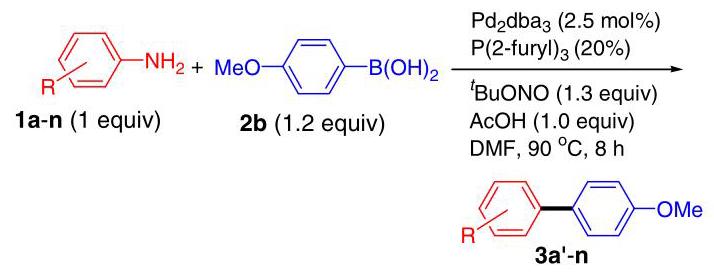
With ${\mathrm{{Pd}}}_{2}{\mathrm{{dba}}}_{3}/\mathrm{P}{\left( 2\text{ -furyl }\right) }_{3}$ catalytic system, the scope of the one-pot diazotization/coupling reaction was examined by a series of arylamines 1a-n and 4-methoxyphenylboronic acid $2{\mathbf{b}}^{13}$ The results are summarized in Table 2. For a wide range of arylamines, the reaction afforded the biaryl products $3{a}^{\prime } - n$ in moderate to good yields. Substrates with weak electronic effect generally gave good yields, as shown by methyl and halide substituted arylamines (entries 1-5). However, it was noted that the steric hindrance significantly diminished the yield (entry 4). It is also worthy to note that the reaction tolerates a wide range of subtituents, wheather it is of electron withdrawing or electron donating.
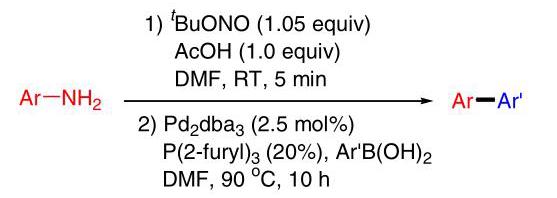
The yields of this one-pot diazotization/coupling reaction were moderate to good and the main byproduct is homo coupling of arylboronic acids. Control experiment showed that tert-butyl nitrite could function as an oxidant in homo coupling of arylboronic acid catalyzed by $\mathrm{{Pd}}\left( 0\right)$ . The advantage of this one-pot reaction lies in its operational simplicity and convenience. It is important to note that the aryldiazonium salts are formed very quickly for some substrates, such as ethyl $p$ -aminobenzoate. For this type of substrates, we have applied an alternative procedure in which the diazotization is carried out first and the cross-coupling with boronic acid is then performed upon the completion of the diazotization, namely a one-pot, two-step process. This procedure was then applied to the coupling of arylboronic acids with arylamines (Table 3). In a typical experiment, arylamine and tert-butyl nitrite were first mixed with a ratio of 1:1.05 and set to react at room temperature. The diazotization was complete within $5\mathrm{\;{min}}$ as monitored by TLC analysis. Then $\operatorname{Pd}\left( 0\right)$ catalyst, $\mathrm{P}{\left( \text{ furyl }\right) }_{3}$ , and boronic acid were added and the reaction was carried out at ${90}{}^{ \circ }\mathrm{C}$ . For a wide range of arylboronic acids, the reaction afforded products 30-z in moderate yields.
The mechanism of this diazotization-coupling is proposed to be the standard oxidative addition-reductive elimination mechanism of Pd-catalyzed cross-coupling (Scheme 1). The first-step is diazotization of arylamine to form corresponding aryldiazonium salt. It is known that aryldiazonium salt cations can coordinate transition metals to give species like $\mathbf{A}$ , in which the metal has increased its oxidation number by two units. ${}^{15}$ Alternatively, this process could also be considered as an oxidative addition of $\mathrm{{Pd}}\left( 0\right) {\mathrm{L}}_{n}$ with aryldi-azonium salt to afford Pd(II) intermediate. Extrusion of dinitrogen from intermediate $\mathbf{A}$ leads to the formation of complex $\mathbf{B}$ , from which transmetallation to form C. Reductive elimination is followed to afford the final biaryl product.
Table 3
Cross-coupling of arylamines with arylboronic acids by one-pot, two-step process ${}^{14}$
| Entry | Arylamine 1 | Boronic acid 2 | Yield ${}^{a}$ (3,%) |
| 1 |  |  2c | 30, 50 |
| 2 |  1n |  | 3p, 52 |
| 3 |  1n   1n  1n  1b  10  1m   1j  1k |  B(OH) | 3q, 51 |
| 4 |  B(OH)2 | 3r, 50 | |
| 2f | |||
| 5 |  | 3s, 54 | |
| 6 |  2h | 3t, 58 | |
| 7 |  2g | 3u, 55 | |
| 8 | B(OH)2 2h | 3v, 53 | |
| 9 |  2i | 3w, 45 | |
| 10 |  2g | 3x, 31 | |
| 11 |  2d | 3y, 48 | |
| 12 |  2i | $3\mathbf{z},{65}$ |
a Isolated yield.
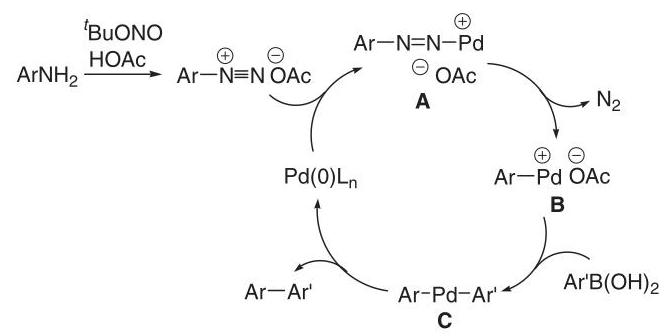
Scheme 1. Possible reaction mechanism.
In conclusion, we have developed a convenient Pd-catalyzed one-pot diazotization/cross-coupling of arylamines and arylbo-ronic acids. Since arylamines are abundant and easily available, this transformation provides an efficient and economic approach for the preparation of biaryl products.
Acknowledgments
The project is generously supported by Natural Science Foundation of China (Grant Nos. 20902005, 20832002, 20772003, 20821062), the Ministry of Education of China, and National Basic Research Program of China (973 Program, No. 2009CB825300).
Supplementary data
Supplementary data associated with this article can be found, in the online version, at doi:10.1016/j.tetlet.2010.11.099.
References and notes
For selected reviews, see: (a) Suzuki, A. Acc. Chem. Res. 1982, 15, 178; (b) Miyaura, N.; Suzuki, A. Chem. Rev. 1995, 95, 2457; (c) Miyaura, N. J. Organomet. Chem. 2002, 653, 54; (d) Miyaura, N. Bull. Chem. Soc. Jpn. 2008, 81, 1535.
(a) Littke, A. F.; Fu, G. C. Angew. Chem., Int. Ed. 2002, 41, 4176; (b) Zapf, A. Angew. Chem., Int. Ed. 2003, 42, 5394.
Roglans, A.; Pla-Quintana, A.; Moreno-Manas, M. Chem. Rev. 2006, 106, 4622.
(a) Darses, S.; Jeffery, T.; Genet, J. P.; Brayer, J. L.; Demoute, J. P. Tetrahedron Lett. 1996, 37, 3857; (b) Darses, S.; Jeffery, T.; Brayer, J. L.; Demoute, J. P.; Genet, J. P. Bull. Soc. Chim. Fr. 1996, 133, 1095.
(a) Sengupta, S.; Bhattacharyya, S. J. Org. Chem. 1997, 62, 3405; (b) Sengupta, S.; Sadhukhan, S. K. Tetrahedron Lett. 1998, 39, 715.
Andrus, M. B.; Song, C. Org. Lett. 2001, 3, 3761.
For selected recent examples of using arenediazonium salts in Pd-catalyzed cross-coupling reactions, see: (a) Nan, G.; Ren, F.; Luo, M. Beilstein J. Org. Chem. 2010, 6, 70. doi:10.3762/bjoc.6.70; (b) Bonin, H.; Delbrayelle, D.; Demonchaux, P.; Gras, E. Chem. Commun. 2010, 46, 2677; (c) Coy, B. E. D.; Jovanovic, L.; Sefkow, M. Org. Lett. 2010, 12, 1976; (d) Fabrizi, G.; Goggiamani, A.; Sferrazza, A.; Cacchi, S. Angew. Chem., Int. Ed. 2010, 49, 4067; (e) Felpin, F.-X.; Ibarguren, O.; Nassar-Hardy, L.; Fouquet, E. J. Org. Chem. 2009, 74, 1349; (f) Ahmed-Omer, B.; Barrow, D. A.; Wirth, T. Tetrahedron Lett. 2009, 50, 3352; (g) Felpin, F.-X.; Coste, J.; Zakri, C.; Fouquet, E. Chem. Eur. J. 2009, 15, 7238; (h) Moro, A. V.; Cardoso, F. S. P.; Correia, C. R. D. Org. Lett. 2009, 11, 3642; (i) Schmidt, B.; Hoelter, F. Chem. Eur. J. 2009, 15, 11948; (j) Cacchi, S.; Fabrizi, G.; Goggiamani, A.; Sferrazza, A. Synlett 2009, 1277; (k) Felpin, F.-X.; Fouquet, E.; Zakri, C. Adv. Synth. Catal. 2009, 351, 649; (1) Kuethe, J. T.; Childers, K. G. Adv. Synth. Catal. 2008, 350, 1577; (m) Liu, C.-Y.; Andrey, G.; Knochel, P. Chem. Asian J. 2007, 2, 1020; (n) Dai, M.; Liang, B.; Wang, C.; Chen, J.; Yang, Z. Org. Lett. 2004, 6, 221.
(a)Vogel’s Textbook of Practical Organic Chemistry; S Furniss, B., Hannaford, A. J., Smith, P. W. G., Tatchell, A. R., Eds., 5th ed.; Longman: Singapore, 1989; (b) Balz, G.; Schiemann, G. Ber. 1927, 60, 1186; (c) Dunker, M. F. W.; tarkey, E. B.; Jenkins, G. L. J. Am. Chem. Soc. 1936, 58, 2308; (d) Roe, A. Org. React. 1949, 5, 193; (e) Doyle, M. P.; Byker, W. J. J. Org. Chem. 1979, 44, 1572.
Akiyama, F.; Miyazaki, H.; Kaneda, K.; Teranishi, S.; Fujiwara, Y.; Abe, M.; Taniguchi, H. J. Org. Chem. 1980, 45, 2359.
(a) Kikukawa, K.; Maemura, K.; Nagira, K.; Wada, F.; Matsuda, T. Chem. Lett. 1980, 551; (b) Kikukawa, K.; Maemura, K.; Kiseki, Y.; Wada, F.; Matsuda, T.; Giam, C. S. J. Org. Chem. 1981, 46, 4885.
(a) Doyle, M. P.; Siegfried, B.; Dellaria, J. F., Jr. J. Org. Chem. 1977, 42, 2426; (b) Doyle, M. P.; Dellaria, . J. F., Jr; Siegfried, B.; Bishop, S. W. J. Org. Chem. 1977, 42, 3494.
Beller, M.; Fischer, H.; Kühlein, K. Tetrahedron Lett. 1994, 35, 8773.
General procedure. ${\mathrm{{Pd}}}_{2}{\mathrm{{dba}}}_{3}\left( {{23}\mathrm{{mg}},{2.5}\mathrm{{mol}}\% }\right) ,\mathrm{P}{\left( 2\text{ -furyl }\right) }_{3}\left( {{46}\mathrm{{mg}},{20}\mathrm{{mol}}\% }\right)$ , 4-methoxybenzeneboronic acid $2\mathbf{b}$ (182 mg,1.2 equiv), and $p$ -toluidine $1\mathbf{b}$ (107 mg, 1 mmol) were weighed in a ${25}\mathrm{\;{mL}}$ Schlenk round bottle flask under nitrogen atmosphere. The system was degassed four times by oil pump. DMF (4 mL), ‘BuONO (134 mg, 1.3 equiv), and HOAc (60 mg, 1.0 equiv) were then added in succession by syringe. The resulting reaction mixture was allowed to stir at ${90}{}^{ \circ }\mathrm{C}$ for $8\mathrm{\;h}$ . The solution was then concentrated under reduced pressure and the crude residue was purified by flash column chromatography with petroleum ether to give 4-methoxy-4’-methylbiphenyl 3b (152 mg, 77%).
General procedure. ${\mathrm{{Pd}}}_{2}{\mathrm{{dba}}}_{3}\left( {{23}\mathrm{{mg}},{2.5}\mathrm{\;{mol}}\% }\right) ,\mathrm{P}{\left( 2\text{ -furyl }\right) }_{3}\left( {{46}\mathrm{{mg}},{20}\mathrm{\;{mol}}\% }\right)$ , and benzeneboronic acid 2c (146mg,1.2 equiv) were weighed in a ${25}\mathrm{\;{mL}}$Schlenk round bottle flask under nitrogen atmosphere. The system was degassed four times by oil pump. Ethyl 4-aminobenzoate $1\mathrm{\;n}$ (165 mg, 1 mmol) was weighed in another ${25}\mathrm{\;{mL}}$ Schlenk round bottle flask under nitrogen atmosphere. DMF (2 mL), ${}^{t}$ BuONO (108 mg,1.05 equiv), and HOAc (60mg, 1.0 equiv) were added in succession by syringe and this reaction mixture was stirred for $5\mathrm{\;{min}}$ . Then the solution containing the newly generated diazonium salt was transferred to the above Schlenk round bottle by syringe. In the course of this transfer, another 2 mL DMF was added to the reaction system. The resulting reaction solution was stirred at ${90}^{ \circ }\mathrm{C}$ for ${10}\mathrm{\;h}$ . The solution was then concentrated under reduced pressure and the crude residue was purified by flash column chromatography (petroleum ether/EtOAc = 30:1) to afford the product ethyl biphenyl-4-carboxylate 3o (113 mg, 50%).
(a) Sutton, D. Chem. Rev. 1993, 93, 995; (b) King, R. B. J. Organomet. Chem. 1995, 500, 187.