Machine Learning-Driven Discovery and Structure-Activity Relationship Analysis of Conductive Metal-Organic Frameworks
中文 / Bilingual · English version
Jinglong Lin, Huibao Zhang, Mojgan Asadi, Kai Zhao, Luming Yang, Yunlong Fan, Jintao Zhu, Qianyi Liu, Lei Sun, Wen Jun Xie, Chenru Duan, Fanyang Mo, and Jin-Hu Dou*
Supporting Information
ABSTRACT: Electrically conductive metal-organic frameworks (MOFs) are a class of materials with emergent applications in fields such as electrocatalysis, electrochemical energy storage, and chemiresistive sensors due to their unique combination of porosity and conductivity. However, due to the structural complexity and versatility, rational design of conductive MOFs is still challenging, which limits their further development and applications. To overcome this limitation, we established a database of 224 conductive MOFs, covering all of the reported conductive MOFs as far as we know, and utilized a combination of machine learning (ML) models and density functional theory (DFT) calculations to develop structure-conductivity relationship models. The interpretability of the models provided guidelines for the design of these materials and allowed us to identify new conductive MOFs through rapid screening. Subsequent experiments confirmed the model’s reliability and viability by synthesizing and validating a conductive MOF, CuTTPD, selected via the ML screening. Our results demonstrate that ML models are powerful tools for prescreening new conductive MOFs, thereby accelerating the development of this field.
INTRODUCTION
Metal-organic frameworks (MOFs) are self-assembled porous materials consisting of metal ions and organic ligands. They have found applications in catalysis, ${}^{1,2}$ energy storage, ${}^{3}$ and gas separation ${}^{4,5}$ due to their high porosity and capacity of incorporating chemically active sites. Recently, the emergent research field of electrically conductive MOFs has attracted much interest because of their unique capability to conduct electricity in lattices with subnanometer-scale pores. Consequently, these nanoporous conductors have been applied in various fields such as electrocatalysis, ${}^{6}$ supercapacitors, ${}^{7}$ and transistors. ${}^{8}$ However, the development of this field is greatly hindered by the underexploration of electrical properties of MOFs: electrical conductivity has been reported for only several hundred materials among the tens of thousands of known MOFs. With these limited number of studies, several qualitative design principles have been proposed to improve carrier concentration and mobility, two crucial factors for achieving high electrical conductivity, mainly through the use of redox-active ligands and postsynthetic doping through donor-acceptor interaction. ${}^{9 - {11}}$ Nonetheless, deviations from these rules often occur, introducing uncertainty into the rational design of new conductive MOFs. Screening of known MOFs may help to articulate their structure-conductivity relationship. However, such screening is a complex and inefficient task due to the vast design space spanning over factors including metal-ligand combination, topology, and pore size. Consequently, more predictive guidelines are required for the efficient screening toward conductive MOFs.
Machine learning (ML) is a method that empowers computers to learn from data and iteratively improve performance through the application of adaptive algorithms. Amid its rapid development, ML has been implemented by many researchers in the prediction of MOF properties, such as water stability and heat capacity. Generative models based on ML have also been utilized to design new MOFs with specific desired properties. ${}^{{12} - {17}}$ In this work, we developed efficient ML models for screening new conductive MOFs. We first compiled the conductive MOF (CM) database consisting of 224 experimentally tested MOFs along with their respective conductivity data, mined from the literature. We then categorized these MOFs into either two or three categories based on their level of conductivity using a binning algorithm and trained eight ML models derived from different algorithms for each category. The accuracy of ensemble model reached 90.48% on a binary classification test set and 85.71% on a ternary classification test set. Additionally, we developed three regression models, among which the artificial neural network (ANN) performed the best, achieving an ${R}^{2}$ value of 0.737 on test set. Searching in another MOF database, the QMOF database, ${}^{{18},{19}}$ using the trained ensemble model and ANN allowed us to both identify highly conductive MOFs with known experimental conductivity values and predict ones not yet characterized experimentally. Furthermore, our significance analysis revealed several factors influencing the conductivity of MOFs, some of which were understated in previous literature and can be rationalized in the context of existing theory for solid-state conductive materials. This ML-based prescreening method is capable of facilitating conductive MOF research by reducing overall experimental duration and costs. The insights gained through this study would contribute to the development of more efficient and effective methods for the design and synthesis of MOFs with the desired conductive properties.
Received: January 26, 2024
Revised: May 8, 2024
Accepted: May 9, 2024
Published: May 20, 2024
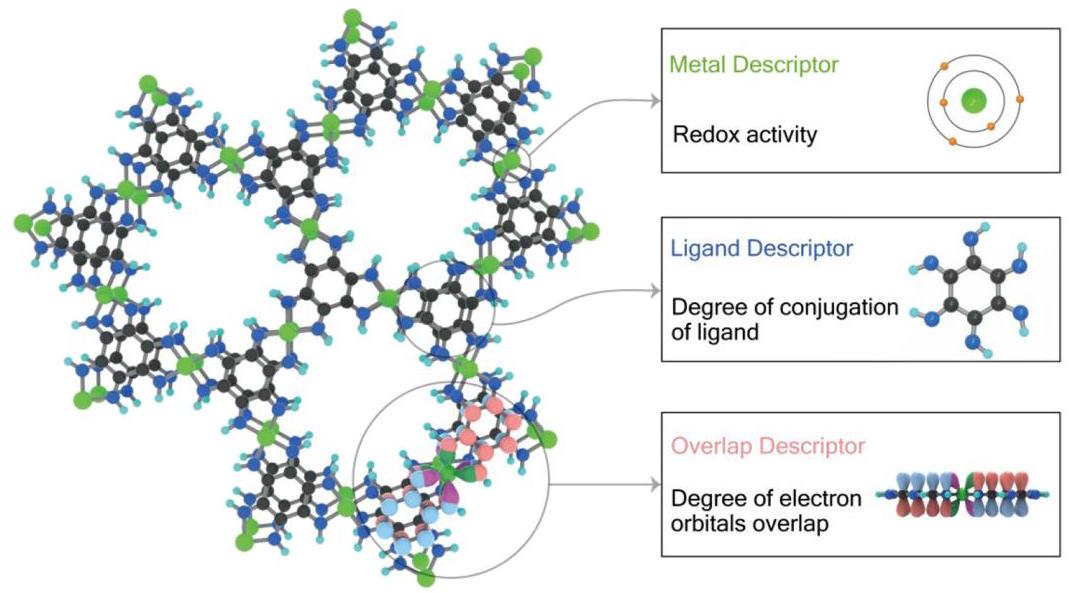
Figure 1. Feature engineering of the MOFs. The descriptors of MOF are divided into three aspects. The metal descriptor considers electronic property, redox activity, and physical properties of the metal ions. The ligand descriptor contains physical and chemical information and the degree of conjugation of the ligand. The overlap descriptor is calculated by density functional calculation and reflects the degree of metal-ligand orbitals overlap.
RESULTS AND DISCUSSION
Feature Engineering of MOFs. To obtain ML models with high accuracy, it is crucial to provide a reasonable description of the physical and chemical properties of the MOF building blocks. To date, three charge transport models are usually invoked to explain the conduction mechanism of MOFs, including through-bond, ${}^{{10},{20} - {22}}$ through-space, ${}^{{11},{23}}$ and guest-promoted ${}^{9,{24},{25}}$ charge transport. The through-bond mechanism allows charge transport through the coordination bonds between the metal and linker with suitable spatial and energetic orbital overlap. The through-space mechanism, on the other hand, enables charge transport through noncovalent interactions between electroactive molecular moieties, such as those involved in $\pi - \pi$ stacking. Finally, the guest-promoted mechanism facilitates charge transport within an MOF through the host-guest redox interaction. Based on this knowledge, we implement three multidimensional vectors to describe the conductive MOF properties, including a metal descriptor, a ligand descriptor, and an overlap descriptor (Figure 1). The metal descriptor is a six-dimensional vector that contains the electronegativity $\left( \chi \right)$ , valence, atomic radius $\left( r\right)$ , softness, hardness, and coordination number (CN) of the metal centers. Among these, softness and hardness together describe the polarizability and electron accepting capacity of metal ions according to the classical Hard and Soft Acids and Bases (HSAB) theory. ${}^{{26},{27}}$ For example, metal ions with higher softness and lower hardness are more likely to form covalent interactions. CN describes the metal-ligand connectivity and can be obtained from topological analysis. Other features are obtained from the Mendeleev Python package. ${}^{28}$ The ligand descriptor is also a 6-dimensional vector, including molecular weight (MW), topological polar surface area (TPSA), lipid-water partition coefficient (LogP), number of hydrogen bond donors (HBD), number of hydrogen bond acceptors (HBA), and number of rotatable bonds (NROTB). TPSA represents the total surface area of polar atoms in a molecule. HBD and HBA are identified as atoms that can donate or accept hydrogen bonds, respectively. The overlap descriptor is a four-dimensional vector including the acid dissociation constant $\left( {\mathrm{p}{K}_{\mathrm{a}}}\right)$ , energy of the highest occupied molecular orbital (HOMO), energy of the lowest unoccupied molecular orbital (LUMO), and the HOMO-LUMO gap (GAP). Among all features, the $\mathrm{p}{K}_{\mathrm{a}}$ values were obtained from a trained prediction model ${}^{29}$ ; HOMO, LUMO, and GAP were obtained from DFT calculation; others were obtained using the RDkit Python package. ${}^{30}$ In the case where an MOF contains multiple types of metal ions or ligands, the descriptor is calculated as an average of each type of metal or ligand weighted by their respective stoichiometry. To more clearly understand the positive and negative correlations between the aforementioned different features, we calculated the feature linear correlation matrix (Supplementary Figure S2).
CM Database and QMOF Database. The CM database encompasses 224 MOFs with respective conductivity data gathered from the literature (see SI 2-9 for details). These MOFs feature both 2D and 3D topological forms. As depicted in Figure 2a, the CM database comprises 67 distinct ligands and 33 metal nodes, with the five most common metals being Cu (20.09%), Ni (14.73%), Fe (12.50%), Cd (9.38%), and Zn (8.93%). Because conductivity spans up to 15 orders of magnitude, we used logarithmic values to enhance data stationarity while reducing collinearity and heteroskedasticity in ML models. To establish an unbiased model, we employed a binning algorithm that divides the MOFs into either three categories (low, medium, and high conductivity) or two categories (low and high conductivity), with each category containing roughly equal numbers of samples (see SI 2-9 for details). It is important to note that the “highly conductive MOF” mentioned in this article merely represents the “high”
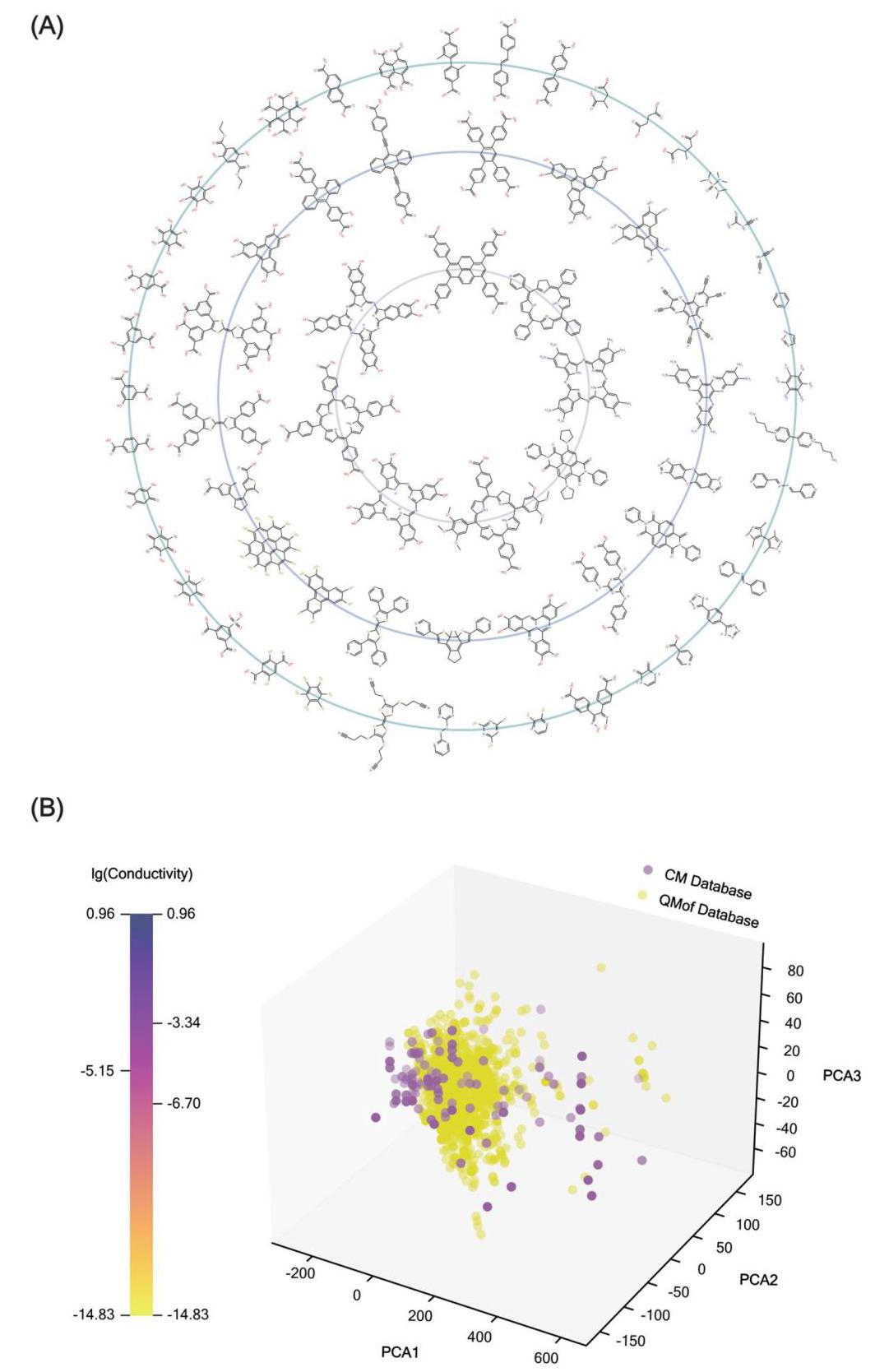
Figure 2. CM and QMOF databases. (A) CM database contains 67 different ligands that are divided into three types according to the ring number (i.e., the degree of conjugation) in the figure. The outermost, middle, and innermost circles correspond to ligands with 0-2, 3-7, and >8 rings. Within each circle, the ligands are sorted by their functional group type. (B) Data distribution of the CM database and the QMOF database in 3-dimensional principal component space. The color bars show how the 2-category conductivity labels and the 3-category conductivity labels are divided. For the two categories, the conductivity threshold is set at ${10}^{-{5.15}}\mathrm{\;S}/\mathrm{{cm}}$ . In the case of the three-category conductivity, two thresholds are established at ${10}^{-{3.34}}$ and ${10}^{-{6.70}}\mathrm{\;S}/\mathrm{{cm}}$ . The aforementioned thresholds are effectuated via the KBinsDiscretizer methodology in Scikit-learn, thereby circumventing issues pertaining to data imbalance.
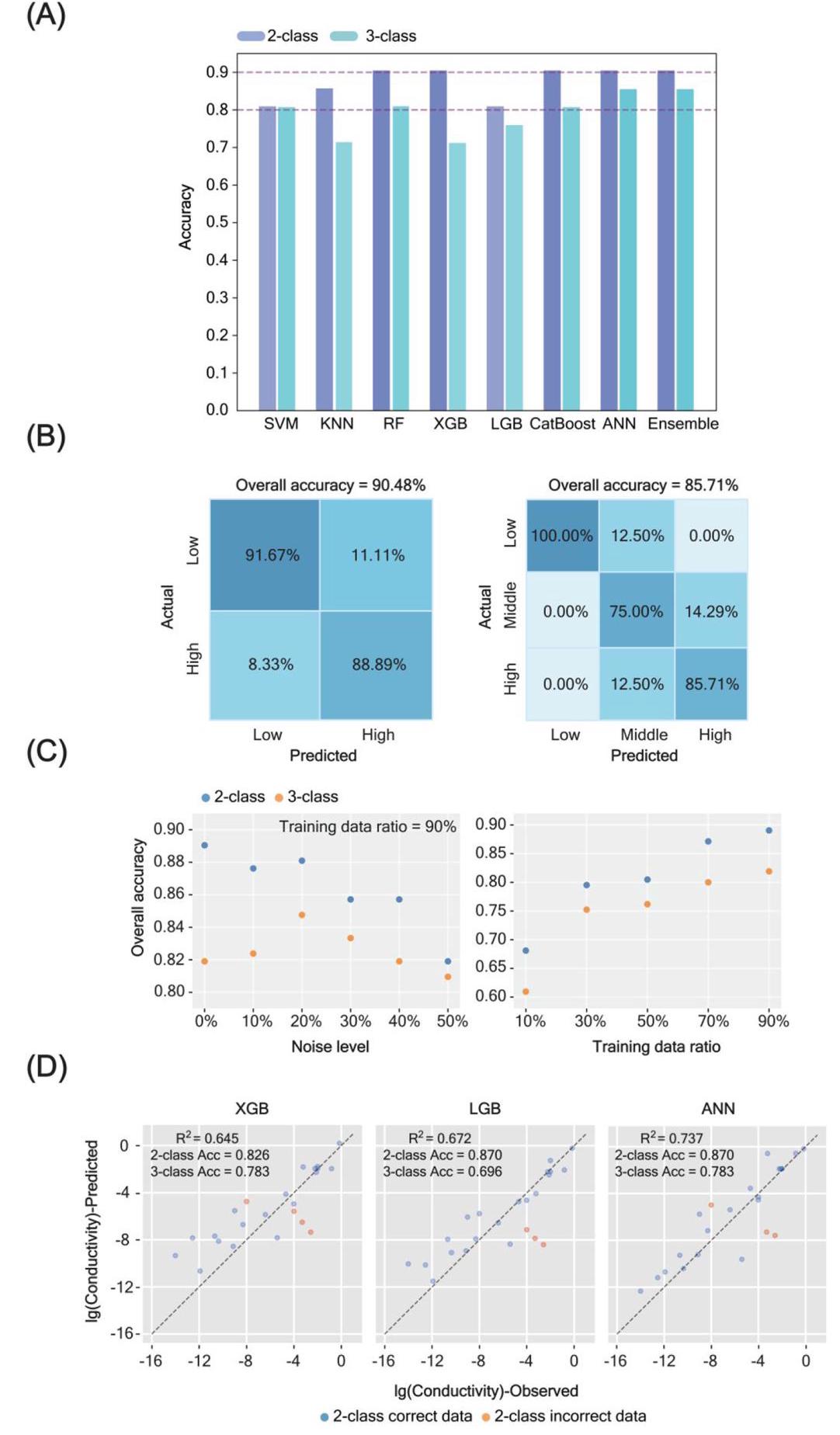
Figure 3. Performance of ML models. (A) Comparison of the classification performance of eight ML models. (B) Confusion matrix of the ensemble model predicting the results of the test set. (C) Prediction results of the ensemble algorithm on the test set under different noise levels and different training set ratios. (D) Performance of three ML regression models on the test set.
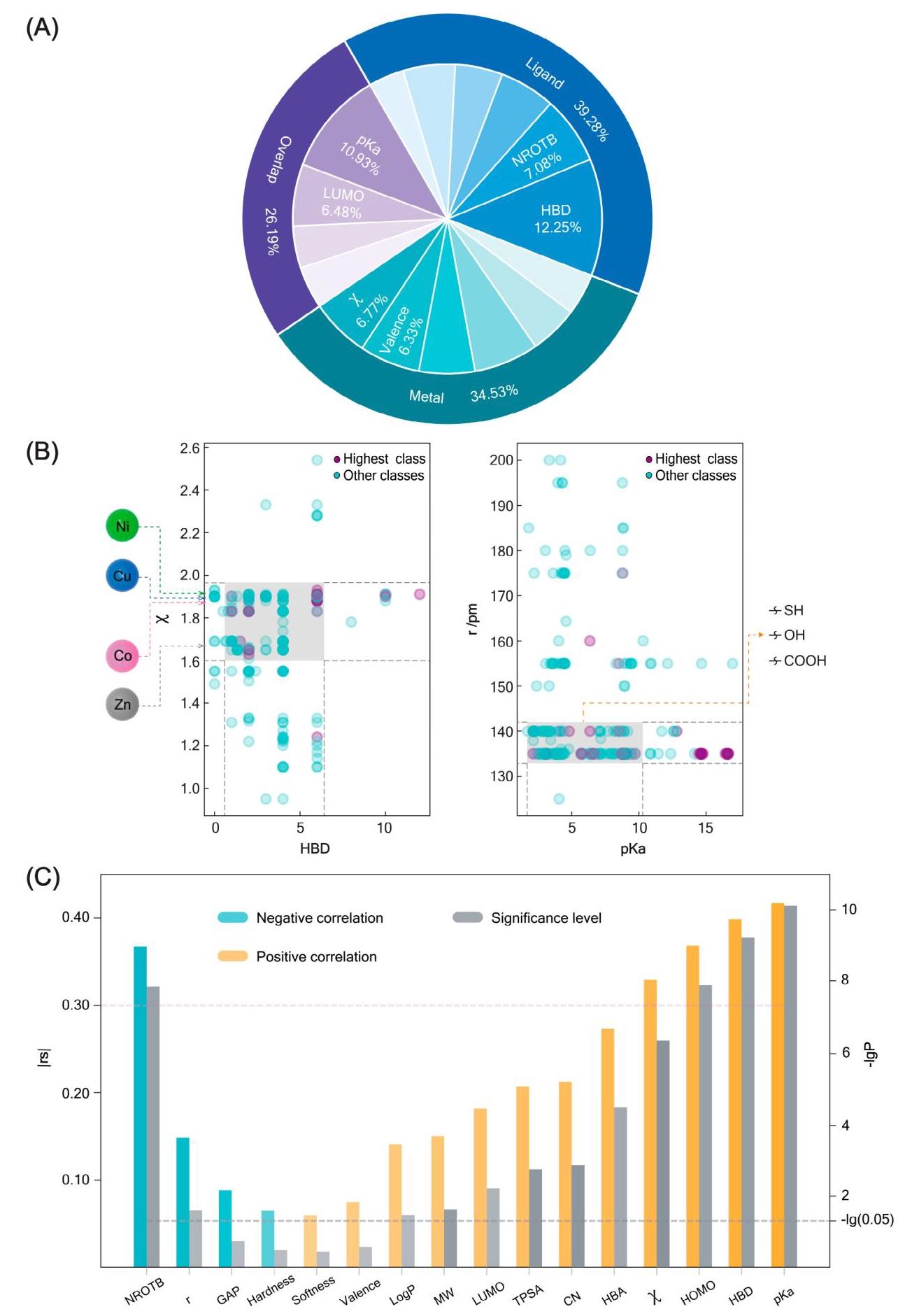
Figure 4. Model interpretability. (A) Feature importance distributions and ratios (calculated based on ensemble model) for the three MOF descriptors. The two most important features in each descriptor are selected for annotation. (B) For the four significant features, the distribution of the CM database is under six categories. The most conductive class of MOFs is represented by purple dots, and the remaining classes are represented by cyan dots. The gray region indicates the aggregations of highly conductive MOFs. $\chi$ , Electronegativity; $r$ , Atomic radius. (C) lrsI and confidence level for different features. Negatively correlated features are represented by cyan bars, and positively correlated features are represented by orange bars.
Figure 4. continued
When $\left| {rs}\right| < {0.3}$ , the feature is weakly correlated with conductivity. When $P < {0.05}$ , equivalent to $- \lg P > - \lg \left( {0.05}\right)$ , the result is deemed statistically significant. Irsl, Absolute value of the Spearman correlation coefficient. classification threshold of the ML model, rather than its absolute level of conductivity.
Upon training the ML models with known conductive MOFs in the CM database, we applied these models to the QMOF database, which contains a large collection of computed MOF electronic structures. To investigate the data distribution of the CM database, we executed principal component analysis (PCA) for dimensionality reduction on both the CM and QMOF databases (Figure 2b). The CM database exhibits broad coverage and even distribution in the three-dimensional PCA space, suggesting that our training data possess a degree of representativeness.
Model Training and Testing. In this study, we employed an extensive suite of ML models for our analysis. Specifically, for classification problems, we utilized K-Nearest Neighbors ${}^{31}$ (KNN), Support Vector Machines ${}^{32}$ (SVM), Random Forests ${}^{33}$ (RF), eXtreme Gradient Boosing ${}^{34}$ (XGBoost), Light Gradient Boosting Machine ${}^{35}$ (LightGBM), and Category Boosting ${}^{36}$ (CatBoost), all implemented through the scikit-learn Python package. ${}^{37}$ Additionally, we developed an ${\mathrm{{ANN}}}^{38}$ using the PyTorch framework ${}^{39}$ (see SI 2-7 for details). In addition to these individual models, we also implemented an ensemble model that combined predictions from the CatBoost, RF, and ANN models. This ensemble model uses a voting mechanism to determine the final classification, with the class receiving the majority vote being assigned as the output (see SI 2-8 for details). This method leverages the strengths of multiple models to provide more reliable and robust predictions. We selected 21 of 224 conductive MOF datasets as test sets through random stratified sampling, excluding them from model training. For regression problems, we developed three ML algorithms (XGBoost, LightGBM, and ANN) to predict the logarithmic values of conductivity. To reduce overfitting, we designed an ANN architecture suitable for small-sample learning given limited training data. This architecture is “funnel-shaped,” with a decreasing number of neurons in each hidden layer, and the output of each layer is processed through batch normalization and dropout methods (see SI 2-7 for details).
Figure 3 presents the classification and regression performance of the different ML models. Specifically, Figure 3a highlights the accuracy of eight distinct ML models, among which the ensemble algorithm emerges with the highest accuracy. To analyze the prediction accuracy of the eight models, we calculated the area (AUC) under the receiver operating characteristic (ROC) curves, which illustrate the relationship between sensitivity and specificity. A higher AUC value corresponds to a larger area under the ROC curve and better trade-off between sensitivity and specificity. Analysis of ROC curves of different ML models (Supplementary Figure S1) reveals that the ANN model has the highest AUC value.
Figure 3b showcases the confusion matrix for both binary and ternary classifications using the ensemble model. The binary ensemble model yields an accuracy of 90.48% on the test set whereas the ternary model achieves an 85.71% accuracy. In addition to accuracy, recall and precision are vital evaluation indices for ML classification models. Recall, which focuses on model comprehensiveness, represents the proportion of samples correctly predicted as positive examples by the model among the actual positive examples. The ensemble model has recall values 77.78% (two categories) and 85.71% (three categories) for screening highly conductive MOFs, meaning that this model is capable of identifying most of the highly conductive MOFs (conductivity $> {10}^{-{3.34}}\mathrm{\;S}/\mathrm{{cm}}$ ) in the data set. Meanwhile, implementation of this model to conductive MOF research also requires high precision, which evaluates the fraction of predicted positives that are true positives. As demonstrated in Figure 3b, the ensemble model has precision of 88.89% and 85.71% in screening highly conductive MOFs when two and three categories were investigated, respectively. These values reflect that the model has a high reliability in screening highly conductive MOFs. Additionally, the three-category ensemble algorithm was able to fully capture the chemical commonalities of MOFs with lower conductivity, as indicated by a precision of 100% when applied to screen these materials. These analyses of MOFs with both high and low conductivity demonstrate that the ML model exhibits high accuracy, recall, and precision, which, in turn, indicate the successful learning of high-quality surrogate models.
Figure 3c presents the performance of the ensemble model under varying noise levels and training data ratios (see SI 2-9 for details). As the noise level increases, the model’s performance on the test set tends to decrease. The accuracies for the two-category and the three-category models remain above 80% with a Gaussian noise level of 50%, reflecting the stability and robust antinoise capability of the model. On the other hand, performance of the model on the test dataset generally improves with an increase in the training data ratio, indicating that the model learns more chemical intuition. However, the changes in the data points are not monotonic, which is a result of the limited sample number and the high degree of randomness of the database.
Figure 3d delineates the efficacy of the three ML regression models in the test set. We meticulously quantified the ${R}^{2}$ metrics for each algorithm. Moreover, leveraging the bifurcation thresholds of 2-class models, we scrutinized the classification precision of our regression frameworks. Notably, although the classification accuracy modestly trails the benchmarks set in Figure 3b, the principal misclassifications predominantly cluster around the threshold $\left( {{10}^{-{5.15}}\mathrm{\;S}/\mathrm{{cm}}}\right)$ . Remarkably, the ANN model outshines its counterparts in regression prowess, achieving an ${R}^{2}$ value of 0.737, eclipsing conventional boosting methodologies. This observation underscores the robustness and adaptability of our novel model in scenarios characterized by a limited number of data samples.
Exploring the Conduction Mechanism of MOFs through ML Model. In our quest to unravel the conductive mechanisms in MOFs, we deployed data-driven ML algorithms and established feature importance via the ensemble model. This encompassed the extraction of feature importance directly from the built-in mechanisms of both the CatBoost and Random Forest models. Typically, these mechanisms operate by gauging the total decrease in the model’s prediction error attributable to each feature. Concurrently, for the ANN, we adopted SHAP (SHapley Additive exPlanations) values, a technique based on the game theory that attributes an importance score to each feature for a specific prediction, achieved by assessing the feature’s contribution to the prediction output. Consequently, we computed what we refer to as ‘collective feature importance scores.’ These are the averaged feature importance values derived from multiple models (CatBoost, Random Forest, and ANN), allowing for a more comprehensive and robust evaluation of each feature’s relative importance. Figure 4a displays the average feature contribution computed by the ensemble model. We found that the ligand descriptor importance accounts for the largest proportion (39.28%), whereas HBD in the ligand descriptor and $\mathrm{p}{K}_{\mathrm{a}}$ in the overlap descriptor are the two most significant features, contributing 12.25% and 10.93%, respectively.
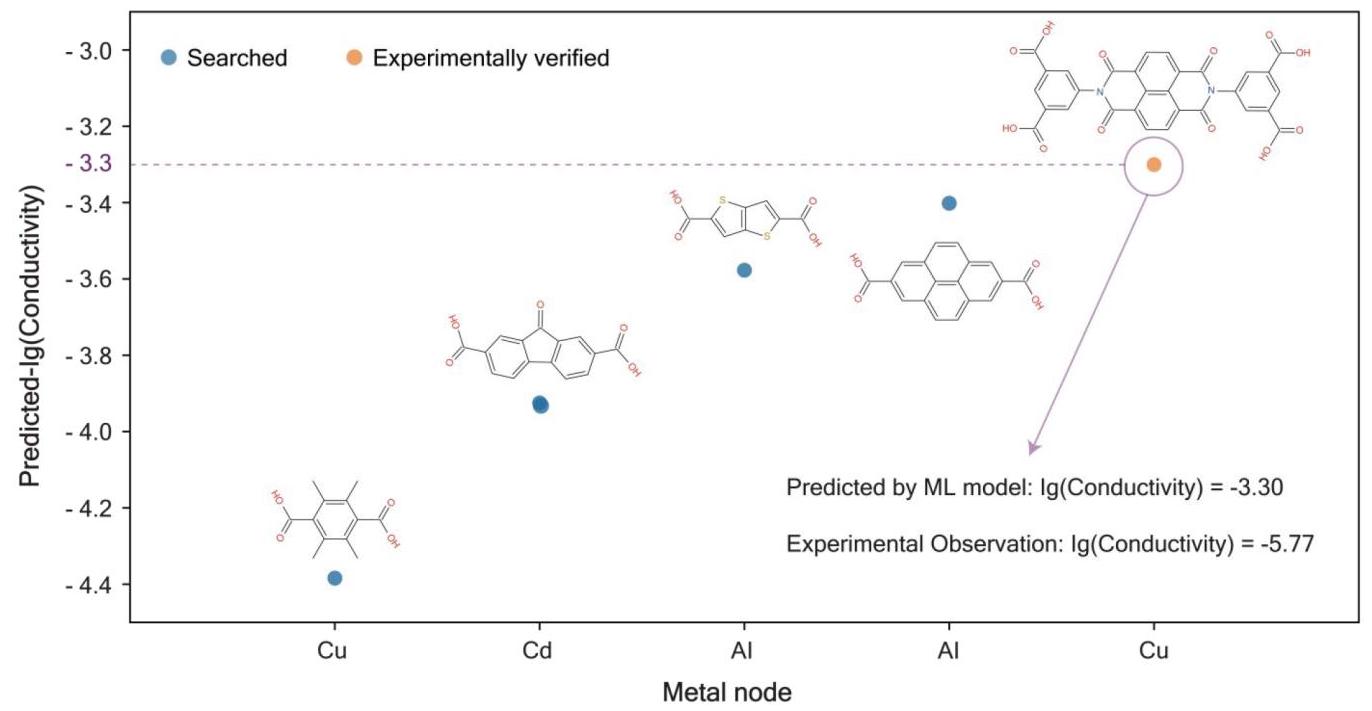
Figure 5. Experimental verification. The figure illustrates five potential conductive MOFs, identified from the QMOF database employing ML models, with the corresponding ligands and metal nodes showcased. The experimentally determined conductivity of the CuTTPD MOF (10 the regime of the highest conductive MOFs, relatively close to the predicted value ( ${10}^{-{3.30}}\mathrm{\;S}/\mathrm{{cm}}$ ). Additionally, the electronegativities of these metals all reside within the range of 1.6-2.0, in agreement with the aforementioned principles.
To better understand the relationship between these two features and the metal descriptors, we examined features in the metal descriptor with the largest distributions in the conductive MOFs dataset (Figure 4b). For this purpose, the most conductive MOFs were divided into six groups based on their conductivity to ensure statistical significance. For the group with the highest conductivity (between ${10}^{-{1.63}}$ and ${10}^{0.96}\mathrm{\;S}/\mathrm{{cm}}$ ), the most important contributions come from $\chi$ (with range of 1.6- 1.93,97.4%) and $r$ (with range of 135-140 pm,92.1%) of the metal, as well as $\mathrm{p}{K}_{\mathrm{a}}$ (with range of 2.1-10,63.1%) and HBD of the ligands (with range of 1-6, 92.1%). These distribution rules provide guidelines for the rational design of highly conductive MOFs. For instance, metal nodes with $\chi$ in the range of 1.6- 1.93, including Ni, Cu, Co, Zn, and Al, are advised.
In order to further explore the correlation between each feature and the MOF conductivity, we calculated their Spearman correlation ${}^{40}$ coefficients (rs) and $P$ values (Figure 4c), which are nonparametric correlation measurement methods for evaluating the monotonic relationship between two variables. Perfect correlation is represented by $\left| {rs}\right| = 1$ and $P = 0$ , whereas $\mid \; \mathrm{{rsl}} = 0$ and $P = 1$ represent the absence of correlation. Positive and negative correlations are represented by $\mathrm{{rs}} > 0$ and $\mathrm{{rs}} < 0$ , respectively. In order to maintain robustness and control for spurious correlations, we set the confidence threshold at $P =$ 0.05. A correlation between variables can be considered significant if $P$ is less than this threshold. A correlation is further considered strong if $\left| {1\mathrm{\;s}\mathrm{\;l}}\right| > {0.3}$ .
As shown in Figure 4c, five parameters, including NROTB, $\mathrm{p}{K}_{\mathrm{a}},\mathrm{{HBD}},\mathrm{{HOMO}}$ , and $\chi$ , experience strong correlation (lrs $| >$ 0.3) with the MOF conductivity, with a negative correlation for NROTB and positive correlations for the other four parameters. The correlations observed for NROTB, HOMO, and $\chi$ have already been discussed and rationalized in existing literature on conductive MOFs. Specifically, lower NROTB, corresponding to more rigid and conjugated ligands, allows more stable $\pi - \pi$ stacking and metal-ligand orbital overlap while reducing phonon scattering. ${}^{41}$ Higher HOMO energy for the ligand and larger $\chi$ for the metal allow better ligand-metal energy overlap, which leads to more diffuse bands and, accordingly, higher charge mobility. Additionally, higher HOMO facilitates ligand oxidation during MOF formation, which could lead to higher carrier density in resulting MOFs, for instance, in the case of ligands functionalized with hydroxyl and amino groups. ${}^{{41},{42}}$ In contrast, the influence of parameters such as the ligand $\mathrm{p}{K}_{\mathrm{a}}$ and HBD on the MOF conductivity has rarely been acknowledged in the literature so far. Nevertheless, these correlations can still be rationalized within existing conductive MOF theories. For the ligands investigated here, a larger HBD is characteristic of those functionalized with hydroxyl, amino, thiol, and carboxylic acid groups. Among these functional groups, hydroxyl and amino groups exhibit $\mathrm{p}{K}_{\mathrm{a}}$ values larger than those with carboxylic acid groups. These groups are also highly redox active, giving rise to the highly delocalized semiquinone or iminosemiquinone forms during MOF formation, which leads to higher conductivity. ${}^{{42} - {44}}$ Thus, for the ligands investigated here, HBD and $\mathrm{p}{K}_{\mathrm{a}}$ together reflect the redox activity of the coordination sites. We note that care must be taken when evaluating the redox activity of the ligand since redox properties of the ligand core could mask those of the coordination sites. Altogether, the above evidence shows that our ML models identify descriptors that are directly relevant to the metal-ligand energy overlap.
Experimental Verification. To further validate the reliability of our ML models, we synthesized and characterized one exemplary candidate for a conductive MOF, obtained from searching the QMOF database, with known structure but lacking conductivity data. By employing the trained ensemble models of both 2-category and 3-category to the QMOF library, we first identified five potential candidates, which were then ranked based on their scores of conductivity using the trained ANN model (Figure 5). As a proof of concept, we synthesized the candidate with the highest score, which is composed of ${\mathrm{{Cu}}}^{2 + }$ and 5,5’-(1,3,6,8-tetraoxo-1,3,6,8-tetrahydrobenzo[lmn][3,8]- phenanthroline-2,7-diyl)diisophthalic acid (TTPD). ${}^{45}$ In CuTTPD, copper ions and oxygen atoms on carboxyl function groups from TTPD form a pyramid $\left\lbrack {\mathrm{{CuO}}}_{5}\right\rbrack$ configuration. The chemical bond between two adjacent copper ions endows bimetallic paddlewheel ${\mathrm{{Cu}}}_{2}{\left( \mathrm{{COO}}\right) }_{4}$ secondary building units (SBUs), which themselves connect to each other through oxygen atoms to form 1D Cu-O chains. These chains are further linked through the conjugated naphthalene diimide core of the TTPD ligand, rendering a three-dimensional structure (Supplementary Figure S6). This MOF fulfills several criteria of highly conductive MOFs predicted by our ML models: the electronegativity of copper is 1.90 , and the HBD of TTPD is 4, both of which are within the above-mentioned optimal ranges. Thus, our model predicts CuTTPD to exhibit high conductivity.
Remarkably, the experimentally determined conductivity of CuTTPD $\left( {{10}^{-{5.77}}\mathrm{\;S}/\mathrm{{cm}}}\right)$ is relatively proximate to the predicted value $\left( {{10}^{-{3.30}}\mathrm{\;S}/\mathrm{{cm}}}\right)$ . Such conductivity could be rationalized by the structure of this material. The conjugated core of TTPD facilitates charge delocalization, the reductive naphthalene diimide moiety and the oxidative ${\mathrm{{Cu}}}^{2 + }$ enable ligand-to-metal charge transfer, and the Cu-O chains along the crystallographic c-direction promote charge transport thanks to the strong overlap between d orbitals of $\mathrm{{Cu}}$ and $\mathrm{p}$ orbitals of $\mathrm{O}$ (Supplementary Figure S6). We note that our model successfully captures some of these features. For instance, the high electronegativity of $\mathrm{{Cu}}$ gives rise to an efficient energy overlap between metal ions and ligands. Collectively, these findings substantiate the robust performance of our predictive model. Beyond database screening, researchers can apply our ML model proactively in materials design. In this context, ML algorithms evaluate the designed MOFs, enabling informed decisions regarding material synthesis. Overall, our method streamlines the design and development process of 2D electronic materials.
CONCLUSIONS
In summary, we trained classification and regression models using data on 224 conductive MOFs collected from the literature. By integrating DFT calculations with the trained models for feature engineering, we discovered that the ensemble model performs best in classification, achieving an accuracy of 90.48%, while ANN shows the best performance in regression, with an ${R}^{2}$ value of 0.737 . Further investigations of the structure-property relationships of the conductive MOFs based on the ML models allowed for the prediction of MOFs with potential conductivity within the QMOF database. We envision that our ML model can serve as a supplementary tool for experimental investigations of conductive MOFs, reducing trial and error for experimentalists and expediting scientific discoveries.
BY EXPERIMENTAL SECTION
Synthesis of TTPD-Cu-MOF. In a typical synthesis of TTPD-Cu- $\mathrm{{MOF}}$ , a ${20}\mathrm{\;{mL}}$ vial was charged with $\mathrm{{Cu}}{\left( {\mathrm{{NO}}}_{3}\right) }_{2} \cdot 3{\mathrm{H}}_{2}\mathrm{O}\left( {{24.9}\mathrm{{mg}}}\right)$ and TTPD (30.5 mg). To this mixture, DMA (3 mL) and water (1 mL) were added. The mixture was then subjected to ultrasonication for 5 min. Subsequently, the vial was sealed and heated at ${80}{}^{ \circ }\mathrm{C}$ for ${24}\mathrm{\;h}$ . After cooling to room temperature, the resulting green precipitate was collected by filtration, washed three times with DMA, and dried under vacuum. The yield of the green powder was 62% based on TTPD.
ASSOCIATED CONTENT
Data Availability Statement
All data related to this study are available from the corresponding author on reasonable request.
(c) Supporting Information
The Supporting Information is available free of charge at https://pubs.acs.org/doi/10.1021/acs.chemmater.4c00229.
Details of the model and experiments (principles of the machine learning model, settings of the model hyper-parameters, DFT calculation methods, experimental methods, and spectroscopic data) (PDF)
AUTHOR INFORMATION
Corresponding Author
Jin-Hu Dou - School of Materials Science and Engineering, Peking University, Beijing 100871, China; (Corcid.org/0000- 0002-6920-9051;
Authors
Jinglong Lin - School of Materials Science and Engineering, Peking University, Beijing 100871, China
Huibao Zhang - School of Electronics Engineering and Computer Science, Peking University, Beijing 100871, China
Mojgan Asadi - Department of Chemistry, University of Southern California, Los Angeles, California 90089, United States
Kai Zhao - School of Materials Science and Engineering, Peking University, Beijing 100871, China
Luming Yang - Research Group EPR Spectroscopy, Max Planck Institute for Multidisciplinary Sciences, Göttingen 37077, Germany
Yunlong Fan - School of Materials Science and Engineering, Peking University, Beijing 100871, China
Jintao Zhu - Center for Quantitative Biology, Peking University, Beijing 100871, China
Qianyi Liu - Department of Chemistry, University of Chicago, Chicago, Illinois 60637, United States
Lei Sun - Department of Chemistry and Department of Physics, School of Science, Westlake University, Hangzhou 310030, China; Institute of Natural Sciences, Westlake Institute for Advanced Study, Hangzhou 310024, China; (Corcid.org/ 0000-0001-8467-6750
Wen Jun Xie - Department of Medicinal Chemistry, University of Florida, Gainesville, Florida 32610, United States; © orcid.org/0000-0002-3982-9305
Chenru Duan - Department of Chemistry, Massachusetts Institute of Technology, Cambridge, Massachusetts 02139, United States
Fanyang Mo - School of Materials Science and Engineering, Peking University, Beijing 100871, China; © orcid.org/0000- 0002-4140-3020
Complete contact information is available at:
https://pubs.acs.org/10.1021/acs.chemmater.4c00229
https://pubs.acs.org/10.1021/acs.chemmater.4c00229
Author Contributions
J.D. and Y.F. constructed the conductive MOFs (CM) database. J.L. and F.M. performed chemoinformatic and machine learning studies. J.L. and H.Z. analyzed the data. K.Z. performed experiments and measurements. J.Z. and Q.L. performed the DFT calculations. All authors wrote the manuscript. J.D. supervised the whole project.
Funding
This work was financially supported by the National Key R&D Program of China (grant no. 2023YFE0206400), National Natural Science Foundation of China (grant no. 22171185), and the Clinical Medicine Plus X-Young Scholars Project at Peking University, backed by the Fundamental Research Funds for the Central Universities. The authors extend their deepest gratitude for the invaluable assistance these grants provided.
Notes
The authors declare no competing financial interest.
All ML algorithms and methods, including the experiment details are included in the Supporting Information.
ACKNOWLEDGMENTS
J.L. acknowledges the invaluable assistance in $\mathrm{p}{K}_{\mathrm{a}}$ prediction provided by Professor S.Z. Luo, Researcher L. Zhang, and Ph.D. student S.Y. Liu from the Department of Chemistry, Tsinghua University.
R REFERENCES
(1) Chen, L.-F.; Xu, Q. Converting MOFs into Amination Catalysts. Science 2017, 358, 304-305.
(2) Zhao, S.; Tan, C.; He, C.-T.; An, P.; Xie, F.; Jiang, S.; Zhu, Y.; Wu, K.-H.; Zhang, B.; Li, H.; Zhang, J.; Chen, Y.; Liu, S.; Dong, J.; Tang, Z. Structural Transformation of Highly Active Metal-Organic Framework Electrocatalysts during the Oxygen Evolution Reaction. Nat. Energy 2020, 5, 881-890.
(3) Bi, S.; Banda, H.; Chen, M.; Niu, L.; Chen, M.; Wu, T.; Wang, J.; Wang, R.; Feng, J.; Chen, T.; Dincă, M.; Kornyshev, A. A.; Feng, G. Molecular Understanding of Charge Storage and Charging Dynamics in Supercapacitors with MOF Electrodes and Ionic Liquid Electrolytes. Nat. Mater. 2020, 19, 552-558.
(4) Chen, K.-J.; Madden, D. G.; Mukherjee, S.; Pham, T.; Forrest, K. A.; Kumar, A.; Space, B.; Kong, J.; Zhang, Q.-Y.; Zaworotko, M. J. Synergistic Sorbent Separation for One-Step Ethylene Purification from a Four-Component Mixture. Science 2019, 366, 241-246.
(5) Datta, S. J.; Mayoral, A.; Murthy srivatsa bettahalli, N.; Bhatt, P. M.; Karunakaran, M.; Carja, I. D.; Fan, D.; Graziane, M.; Mileo, P.; Semino, R.; Maurin, G.; Terasaki, O.; Eddaoudi, M. Rational Design of Mixed-Matrix Metal-Organic Framework Membranes for Molecular Separations. Science 2022, 376, 1080-1087.
(6) Huang, X.; Yao, H.; Cui, Y.; Hao, W.; Zhu, J.; Xu, W.; Zhu, D. Conductive Copper Benzenehexathiol Coordination Polymer as a Hydrogen Evolution Catalyst. ACS Appl. Mater. Interfaces 2017, 9, 40752-40759.
(7) Sheberla, D.; Bachman, J. C.; Elias, J. S.; Sun, C.-J.; Shao-horn, Y.; Dinca, M. Conductive MOF Electrodes for Stable Supercapacitors with High Areal Capacitance. Nat. Mater. 2017, 16, 220-224.
(8) Huang, X.; Sheng, P.; Tu, Z.; Zhang, F.; Wang, J.; Geng, H.; Zou, Y.; Di, C.-A.; Yi, Y.; Sun, Y.; Xu, W.; Zhu, D. A two-Dimensional $\pi$ -d Conjugated Coordination Polymer with Extremely High Electrical Conductivity and Ambipolar Transport Behaviour. Nat. Commun. 2015, 6, 7408.
(9) Han, S.; Warren, S. C.; Yoon, S. M.; Malliakas, C. D.; Hou, X.; Wei, Y.; Kanatzidis, M. G.; Grzybowski, B. A. Tunneling Electrical Connection to the Interior of Metal-Organic Frameworks. J. Am. Chem. Soc. 2015, 137, 8169-8175.
(10) Kambe, T.; Sakamoto, R.; Hoshiko, K.; Takada, K.; Miyachi, M.; Ryu, J.-H.; Sasaki, S.; Kim, J.; Nakazato, K.; Takata, M.; Nishihara, H. π- Conjugated Nickel Bis(dithiolene) Complex Nanosheet. J. Am. Chem. Soc. 2013, 135, 2462-2465.
(11) Narayan, T. C.; Miyakai, T.; Seki, S.; Dincă, M. High Charge Mobility in a Tetrathiafulvalene-Based Microporous Metal-Organic Framework. J. Am. Chem. Soc. 2012, 134, 12932-12935.
(12) Batra, R.; Chen, C.; Evans, T. G.; Walton, K. S.; Ramprasad, R. Prediction of Water Stability of Metal-Organic Frameworks using Machine Learning. Nat. Mach. Intell. 2020, 2, 704-710.
(13) Moosavi, S. M.; Novotny, B. A.; Ongari, D.; Moubarak, E.; Asgari, M.; Kadioglu, Ö.; Charalambous, C.; Ortega-guerrero, A.; Farmahini, A. H.; Sarkisov, L.; Garcia, S.; Noé, F.; Smit, B. A Data-Science Approach to Predict the Heat Capacity of Nanoporous Materials. Nat. Mater. 2022, 21, 1419-1425.
(14) Yao, Z.; Sánchez-lengeling, B.; Bobbitt, N. S.; Bucior, B. J.; Kumar, S. G. H.; Collins, S. P.; Burns, T.; Woo, T. K.; Farha, O. K.; Snurr, R. Q.; Aspuru-guzik, A. Inverse Design of Nanoporous Crystalline Reticular Materials with Deep Generative Models. Nat. Mach. Intell. 2021, 3, 76-86.
(15) Nandy, A.; Duan, C.; Kulik, H. J. Using Machine Learning and Data Mining to Leverage Community Knowledge for the Engineering of Stable Metal-Organic Frameworks. J. Am. Chem. Soc. 2021, 143, 17535-17547.
(16) Zheng, Z.; Zhang, O.; Borgs, C.; Chayes, J. T.; Yaghi, O. M. ChatGPT Chemistry Assistant for Text Mining and Prediction of MOF Synthesis. J. Am. Chem. Soc. 2023, 145, 18048-18062.
(17) Nandy, A.; Yue, S.; Oh, C.; Duan, C.; Terrones, G. G.; Chung, Y. G.; Kulik, H. J. A Database of Ultrastable MOFs Reassembled from Stable Fragments with Machine Learning Models. Matter 2023, 6, 1585-1603.
(18) Rosen, A. S.; Fung, V.; Huck, P.; O’donnell, C. T.; Horton, M. K.; Truhlar, D. G.; Persson, K. A.; Notestein, J. M.; Snurr, R. Q. High-Throughput Predictions of Metal-Organic Framework Electronic Properties: Theoretical Challenges, Graph Neural Networks, and Data Exploration. npj Comput. Mater. 2022, 8, 112.
(19) Rosen, A. S.; Iyer, S. M.; Ray, D.; Yao, Z.; Aspuru-guzik, A.; Gagliardi, L.; Notestein, J. M.; Snurr, R. Q. Machine Learning the Quantum-Chemical Properties of Metal-Organic Frameworks for Accelerated Materials Discovery. Matter 2021, 4, 1578-1597.
(20) Kambe, T.; Sakamoto, R.; Kusamoto, T.; Pal, T.; Fukui, N.; Hoshiko, K.; Shimojima, T.; Wang, Z.; Hirahara, T.; Ishizaka, K.; Hasegawa, S.; Liu, F.; Nishihara, H. Redox Control and High Conductivity of Nickel Bis(dithiolene) Complex $\pi$ -Nanosheet: A Potential Organic Two-Dimensional Topological Insulator. J. Am. Chem. Soc. 2014, 136, 14357-14360.
(21) Sun, Y.; Sheng, P.; Di, C.; Jiao, F.; Xu, W.; Qiu, D.; Zhu, D. Organic Thermoelectric Materials and Devices Based on $p$ -and $n$ -Type Poly(metal 1, 1, 2, 2-ethenetetrathiolate)s. Adv. Mater. 2012, 24, 932- 937.
(22) Takaishi, S.; Hosoda, M.; Kajiwara, T.; Miyasaka, H.; Yamashita, M.; Nakanishi, Y.; Kitagawa, Y.; Yamaguchi, K.; Kobayashi, A.; Kitagawa, H. Electroconductive Porous Coordination Polymer Cu- $\left\lbrack {\mathrm{{Cu}}{\left( \mathrm{{pdt}}\right) }_{2}}\right\rbrack$ Composed of Donor and Acceptor Building Units. Inorg. Chem. 2009, 48, 9048-9050.
(23) Zhang, Z.; Zhao, H.; Kojima, H.; Mori, T.; Dunbar, K. R. Conducting Organic Frameworks Based on a Main-Group Metal and Organocyanide Radicals. Chem. - Eur. J. 2013, 19, 3348-3357.
(24) Talin, A. A.; Centrone, A.; Ford, A. C.; Foster, M. E.; Stavila, V.; Haney, P.; Kinney, R. A.; Szalai, V.; El gabaly, F.; Yoon, H. P.; Léonard, F.; Allendorf, M. D. Tunable Electrical Conductivity in Metal-Organic Framework Thin-Film Devices. Science 2014, 343, 66-69.
(25) Wang, T. C.; Hod, I.; Audu, C. O.; Vermeulen, N. A.; Nguyen, S. T.; Farha, O. K.; Hupp, J. T. Rendering High Surface Area, Mesoporous Metal-Organic Frameworks Electronically Conductive. ACS Appl. Mater. Interfaces 2017, 9, 12584-12591.
(26) Pearson, R. G. Chemical Hardness and Density Functional Theory. J. Chem. Sci. 2005, 117, 369-377.
(27) Lopachin, R. M.; Gavin, T.; Decaprio, A.; Barber, D. S. Application of the Hard and Soft, Acids and Bases (HSAB) Theory to Toxicant-Target Interactions. Chem. Res. Toxicol. 2012, 25, 239-251.
(28) Mentel, L. Mendeleev-a Python Resource for Properties of Chemical Elements, Ions and Isotopes, 2014. https://github.com/ Immentel/mendeleev, accessed May 5, 2024.
(29) Yang, Q.; Li, Y.; Yang, J.-D.; Liu, Y.; Zhang, L.; Luo, S.; Cheng, J.- P. Holistic Prediction of the pKa in Diverse Solvents Based on a Machine-Learning Approach. Angew. Chem. 2020, 132, 19444-19453.
(30) Landrum, G.Rdkit Documentation. Release 2013, vol 1; pp 1-79.
(31) Kramer, O. K-nearest neighbors. Dimensionality Reduction with Unsupervised Nearest Neighbors; Springer Berlin Heidelberg: Berlin, Heidelberg, 2013; pp 13-23.
(32) Hearst, M. A.; Dumais, S. T.; Osuna, E.; Platt, J.; Scholkopf, B. Support Vector Machines. IEEE Intelligent Systems and their applications 1998, 13, 18-28.
(33) Breiman, L. Random Forests. Machine learning 2001, 45, 5-32. (34) Chen, T.; He, T.; Benesty, M.; Khotilovich, V.; Tang, Y.; Cho, H.; Chen, K.; Mitchell, R.; Cano, L.; Zhou, T.; Li, M.; Xie, J.; Lin, M.; Geng, Y.; Li, Y. Xgboost: Extreme Gradient Boosting, R package version 0.82.1, 2019.
(35) Ke, G.; Meng, Q.; Finley, T.; Wang, T.; Chen, W.; Ma, W.; Ye, Q.; Liu, T.-Y. Lightgbm: A Highly Efficient Gradient Boosting Decision Tree. NeurIPS, 2017.
(36) Prokhorenkova, L.; Gusev, G.; Vorobev, A.; Dorogush, A. V.; Gulin, A. CatBoost: Unbiased Boosting with Categorical Features. NeurIPS, 2018.
(37) Pedregosa, F.; Varoquaux, G.; Gramfort, A.; Michel, V.; Thirion, B.; Grisel, O.; Blondel, M.; Prettenhofer, P.; Weiss, R.; Dubourg, V. Scikit-learn: Machine Learning in Python. J. Mach. Learn. Res. 2011, 12, 2825-2830.
(38) Agatonovic-kustrin, S.; Beresford, R. Basic Concepts of Artificial Neural Network (ANN) Modeling and Its Application in Pharmaceutical Research. J. Pharm. Biomed. Anal. 2000, 22, 717-727.
(39) Paszke, A.; Gross, S.; Chintala, S.; Chanan, G.; Yang, E.; Devito, Z.; Lin, Z.; Desmaison, A.; Antiga, L.; Lerer, A. Automatic Differentiation in Pytorch. 31st Conference on Neural Information Processing Systems, 2017.
(40) Myers, L.; Sirois, M. J. Spearman Correlation Coefficients, Differences between. Encyclopedia of statistical sciences; Wiley Online Library, 2004; vol 12.
(41) Campbell, M. G.; Sheberla, D.; Liu, S. F.; Swager, T. M.; Dincă, M. ${\mathrm{{Cu}}}_{3}{\left( \text{ hexaiminotriphenylene }\right) }_{2}$ : An Electrically Conductive 2D Metal-Organic Framework for Chemiresistive Sensing. Angew. Chem., Int. Ed. 2015, 54, 4349-4352.
(42) Yao, M. S.; Lv, X. J.; Fu, Z. H.; Li, W. H.; Deng, W. H.; Wu, G. D.; Xu, G. Layer-by-Layer Assembled Conductive Metal-Organic Framework Nanofilms for Room-Temperature Chemiresistive Sensing. Angew. Chem., Int. Ed. 2017, 56, 16510-16514.
(43) Park, S. S.; Hontz, E. R.; Sun, L.; Hendon, C. H.; Walsh, A.; Van voorhis, T.; Dincä, M. Cation-Dependent Intrinsic Electrical Conductivity in Isostructural Tetrathiafulvalene-Based Microporous Metal-Organic Frameworks. J. Am. Chem. Soc. 2015, 137, 1774-1777.
(44) Sheberla, D.; Sun, L.; Blood-forsythe, M. A.; Er, S.; Wade, C. R.; Brozek, C. K.; Aspuru-guzik, A.; Dincă, M. High Electrical Conductivity in ${\mathrm{{Ni}}}_{3}{\left( 2,3,6,7,{10},{11}\text{ -hexaiminotriphenylene }\right) }_{2}$ , a Semiconducting Metal-Organic Graphene Analogue. J. Am. Chem. Soc. 2014, 136, 8859-8862.
(45) Ye, Y.; Ma, Z.; Chen, L.; Lin, H.; Lin, Q.; Liu, L.; Li, Z.; Chen, S.; Zhang, Z.; Xiang, S. Microporous Metal-Organic Frameworks with Open Metal Sites and $\pi$ -Lewis Acidic Pore Surfaces for Recovering Ethylene from Polyethylene Off-Gas. J. Mater. Chem. A 2018, 6, 20822-20828.
CAS BIOFINDER DISCOVERY PLATFORM™
CAS BIOFINDER HELPS YOU FIND YOUR NEXT BREAKTHROUGH FASTER
Navigate pathways, targets, and diseases with precision
Explore CAS BioFinder
CAS