Visible-Light Induced Transition-Metal Free Redox-Neutral Carboxylation of Remote C(sp3)-H bonds via 1,5-Hydrogen Atom Transfer
中文 / Bilingual · English version
Wenke Li, Beiqi Sun, Lei Zhang, and Fanyang Mo*
Cite This: J. Org. Chem. 2024, 89, 521-526
Metrics & More
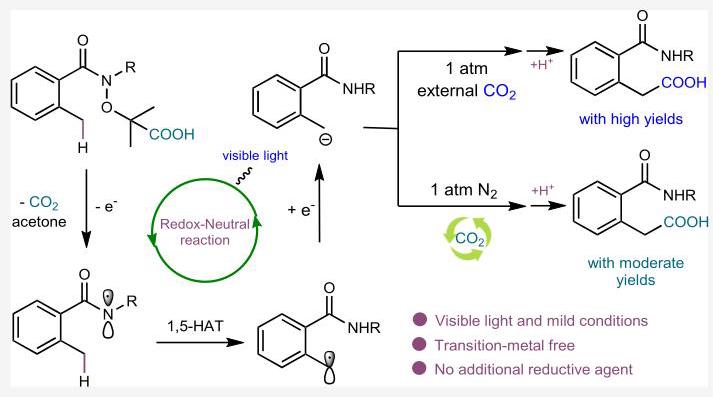
ABSTRACT: The direct carboxylation of the benzylic $\mathrm{C} - \mathrm{H}$ bonds under mild conditions is of great importance and is quite challenging. Herein, we report an approach for the carboxylation of remote benzylic $\mathrm{C}\left( {\mathrm{{sp}}}^{3}\right) - \mathrm{H}$ bonds by integrating the redox-neutral visible-light photoredox catalysis and the nitrogen-centered 1,5- hydrogen atom transfer. The chemical transformation progresses via consecutive single electron transfer, 1,5-hydrogen atom transfer, formation of benzylic carbanion, and nucleophilic attack on the ${\mathrm{{CO}}}_{2}$ steps, thereby enabling access to the desired carboxylation products with moderate to high yields. We also endeavor to recover the ${\mathrm{{CO}}}_{2}$ groups generated in situ intramolecularly to achieve carboxylation under a nitrogen atmosphere, resulting in moderate yields of corresponding carboxylation.
I INTRODUCTION
Approaches that enable efficient and selective functionalization of $\mathrm{C}\left( {\mathrm{{sp}}}^{3}\right) - \mathrm{H}$ bonds are of significant interest, given the ubiquitous presence of these linkages within organic compounds. ${}^{1,2}$ However, the ubiquity of $\mathrm{C}\left( {\mathrm{{sp}}}^{3}\right) - \mathrm{H}$ bonds also poses a significant challenge in terms of selectivity due to their energetic and spatial similarity. ${}^{3}$ Recently, the strategy involving hydrogen-atom transfer (HAT) mediated by radicals has surfaced as a compelling alternative to the conventional approach of transition-metal catalysis. ${}^{3}$ The 1,5-hydrogen atom transfer (1,5-HAT) serves as a complementary tool for site-selective modification of $\mathrm{C}\left( {\mathrm{{sp}}}^{3}\right) - \mathrm{H}$ bonds at distal positions to functional groups. ${}^{4 - 6}$ Enolate chemistry and transition-metal-mediated reactivity offer facile functionaliza-tion of $\alpha$ - and $\beta$ -positions of directing groups. ${}^{7}$ In contrast, achieving selective functionalization of $\mathrm{C}\left( {\mathrm{{sp}}}^{3}\right) - \mathrm{H}$ at distal $\gamma$ - and $\delta$ -positions presents greater challenges (Figure 1a). ${}^{8 - {11}}\mathrm{\;A}$ feasible solution to this issue can be achieved by generating nitrogen radicals through the departure of specific groups, followed by 1,5-HAT and subsequent functionalization of the translocated carbon-centered radicals. ${}^{12}$
The initial application of the nitrogen-centered radical 1,5- HAT reaction can be traced back to the Hofmann-Löffler-Freytag (HLF) reaction in the 19th century. ${}^{{13},{14}}$ In this reaction, this reactivity, which constitutes a crucial step, arises from the fact that the bond-dissociation energy (BDE) of the N-H bond is higher than that of the $\mathrm{C} - \mathrm{H}$ bond. However, the harsh conditions have limited its wider applicability in the domain of organic synthesis processes. More recently, the renaissance of photochemistry has led to numerous efforts being devoted to visible-light photoredox catalysis. By integrating photocatalysis with the nitrogen-centered radical 1,5-HAT reaction, not only can remote $\mathrm{C}\left( {\mathrm{{sp}}}^{3}\right) - \mathrm{H}$ bonds be selectively functionalized under mild conditions ${}^{6,{15} - {18}}$ but also the coupling of $\mathrm{C} - \mathrm{C}$ and $\mathrm{C} - \mathrm{Y}$ bonds ${\left( \mathrm{Y} = \mathrm{O},\mathrm{N},\mathrm{X},\mathrm{{Si}},\mathrm{B},\text{ etc. }\right) }^{2,{19} - {25}}$ can be facilitated.
Carbon dioxide $\left( {\mathrm{{CO}}}_{2}\right)$ presents an ideal but challenging renewable single carbon (C1) synthetic block for organic synthesis. ${}^{{15},{26} - {30}}$ Due to the inherent electrophilicity of ${\mathrm{{CO}}}_{2}$ , researchers have successfully achieved carboxylation reactions of $\mathrm{C}\left( \mathrm{{sp}}\right) - \mathrm{H}$ and $\mathrm{C}\left( {\mathrm{{sp}}}^{2}\right) - \mathrm{H}$ bonds in the presence of appropriate bases. ${}^{{15},{26},{27},{31} - {35}}$ However, direct carboxylation of an unactivated $\mathrm{C}\left( {\mathrm{{sp}}}^{3}\right) - \mathrm{H}$ bond with ${\mathrm{{CO}}}_{2}$ has rarely been reported. The relatively high stability of the benzylic carbon radical and its smooth reduction to carbanion enable an efficient attack on ${\mathrm{{CO}}}_{2}$ for achieving carboxylation reactions; many researchers have focused their attention on the carboxylation of benzylic $\mathrm{C}\left( {\mathrm{{sp}}}^{3}\right) -$ H bonds. ${}^{{36},{37}}$ In 2015, Murakami’s group reported the direct carboxylation reactions of the benzylic $\mathrm{C}\left( {\mathrm{{sp}}}^{3}\right) - \mathrm{H}$ bond excited by ultraviolet light. ${}^{38}$ In 2019, König’s group reported the first visible-light-mediated direct carboxylation of the benzylic $\mathrm{C}\left( {\mathrm{{sp}}}^{3}\right) - \mathrm{H}$ bond, which introduced an approach for the direct carboxylation of benzyl $\mathrm{C}\left( {\mathrm{{sp}}}^{3}\right) - \mathrm{H}$ bonds. ${}^{35}$ In 2020, Yu’s group presented a facile approach for remote $\mathrm{C}\left( {\mathrm{{sp}}}^{3}\right) - \mathrm{H}$ bond carboxylation through a 1,5-HAT strategy, furnishing an array of non-natural $\alpha$ -amino acids. ${}^{39}$
Received: October 4, 2023
Revised: November 29, 2023
Accepted: December 1, 2023
Published: December 13, 2023
a. Functionalization of $\mathrm{C}\left( {\mathrm{{sp}}}^{3}\right) - \mathrm{H}$ bonds
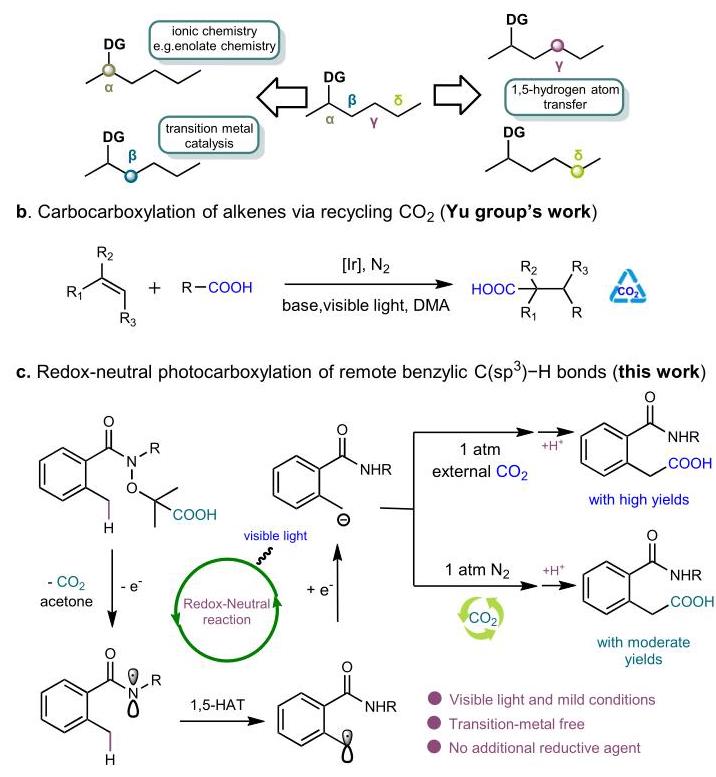
Figure 1. Functionalization of remote $\mathrm{C}\left( {\mathrm{{sp}}}^{3}\right) - \mathrm{H}$ bonds.
However, in such processes, stoichiometric carbon dioxide $\left( {\mathrm{{CO}}}_{2}\right)$ is emitted as an unused byproduct without being recycled in the transformations. In 2021, Yu’s group presented a compelling approach for the synthesis of amino acids by harnessing released ${\mathrm{{CO}}}_{2}$ , thereby establishing an atomically efficient and sustainable carbocarboxylation system (Figure 1b). ${}^{40}$ In this research, Yu’s group has achieved the first intermolecular carbon dioxide recovery for the carboxylation reaction. However, to the best of our knowledge, there are few reports on the recovery of carbon dioxide intramolecularly. Inspired by our previous work ${}^{41}$ and the Leonori group’s work, ${}^{7}$ we have designed and synthesized a series of benzylic $\alpha$ - oxiamido acids for the first time. With these substrates, we developed visible-light-induced transition-metal-free redox-neutral carboxylation of remote benzylic $\mathrm{C}\left( {\mathrm{{sp}}}^{3}\right) - \mathrm{H}$ bonds (Figure 1c). Furthermore, the intermolecular recovery of carbon dioxide has also been successfully accomplished. The low-concentration ${\mathrm{{CO}}}_{2}$ generated in situ can be reutilized as a reagent in the carboxylation reaction, representing a carbon-economical and sustainable process, different from previous carboxylation that required high pressure and a significant excess of ${\mathrm{{CO}}}_{2}$ (Table 1).
IR RESULTS AND DISCUSSION
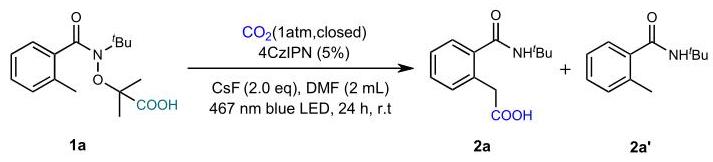
Ultimately, the subsequent reaction process was meticulously devised. We proposed a redox-neutral photoredox pathway in which the substrate undergoes oxidation, leaving carbon dioxide and acetone and resulting in the formation of nitrogen radicals. Then the 1,5-HAT process occurs followed by reduction of the resulting radical intermediate to form carbanions, which initiate a nucleophilic attack on carbon dioxide, leading to the formation of the corresponding carboxylation products. We initiated our investigations with a benzylic $\alpha$ -oxiamido acid 1a as the model substrate with a photocatalyst, solvent, and base, under 1 atm of ${\mathrm{{CO}}}_{2}$ and ${40}\mathrm{\;W}{467}\mathrm{\;{nm}}$ blue LED irradiation at room temperature. After substantial optimizations, we obtained the desired product 2a in 75% isolated yield in the presence of 4CzIPN as the photocatalyst, CsF as base as well as DMF as solvent under 1 atm ${\mathrm{{CO}}}_{2}$ atmosphere. Under the optimized conditions, the primary byproduct was hydrogenation product $2{a}^{\prime }$ with an isolated yield of 12% (entry 1). In the absence of either 4CzIPN or light, no carboxylation product 2a was observed, thereby demonstrating the indispensability of these two components (entries 2-3). It is noteworthy that 2a still exhibits a yield of 21% in a nitrogen atmosphere, indicating the potential utilization of the low-concentration ${\mathrm{{CO}}}_{2}$ generated in situ as a viable raw material for participation in the carboxylation reaction (entry 4). Using ${\mathrm{{Cs}}}_{2}{\mathrm{{CO}}}_{3}$ instead of $\mathrm{{CsF}}$ decreased the yield (entry 5). Replacing a ${467}\mathrm{\;{nm}}$ LED with ${456}\mathrm{\;{nm}}$ , reducing the quantity of 4CzIPN or substituting it with other photo-catalysts, replacing DMF with alternative solvents, and shortening the reaction time showed inferior results (entries 6-11).
Table 1. Optimization of Reaction Conditions ${}^{a}$
| entry | deviations | yields ${\left( \% \right) }^{b}$ | |
| 2a | 2a ${}^{\prime }$ | ||
| 1 | none | 82 (75) | 12 |
| 2 | no light | none | none |
| 3 | no 4CzIPN | none | 15 |
| 4 | ${\mathrm{N}}_{2}$ instead of ${\mathrm{{CO}}}_{2}$ | 21 | 72 |
| 5 | ${\mathrm{{Cs}}}_{2}{\mathrm{{CO}}}_{3}$ instead of $\mathrm{{CsF}}$ | 62 | 15 |
| 6 | ${456}\mathrm{\;{nm}}$ instead of ${467}\mathrm{\;{nm}}$ | 58 | 27 |
| 7 | $\left\{ {{\left\lbrack \mathrm{r}\left\lbrack \mathrm{{dF}}\left( {\mathrm{{CF}}}_{3}\right) \mathrm{{ppy}}\right. \right\rbrack }_{2}\left( \mathrm{{dtbpy}}\right) }\right\} {\mathrm{{PF}}}_{6}\left( {5\% }\right)$ | 45 | 34 |
| 8 | eosin Y (5%) | 17 | 32 |
| 9 | 4CzIPN (2%) | 67 | 10 |
| 10 | ${\mathrm{{CH}}}_{3}\mathrm{{CN}}$ instead of DMF | 41 | 36 |
| 11 | ${12}\mathrm{\;h}$ | 64 | 8 |
${}^{a}$ Reaction conditions: 1a (0.2 mmol),4CzIPN (5%), CsF (2.0 equiv), DMF (2 mL), irradiation by Kessil 40 W blue LED for 24 h under 1 atm ${\mathrm{{CO}}}_{2}$ at ambient temperature. ${}^{b1}\mathrm{H}$ NMR yields using1,1,2,2- tetrachloroethane as an internal standard and yields of isolated products in parentheses. DMF = N, N-dimethylformamide, 4CzIPN = 2,4,5,6-tetra-9H-carbazol-9-yl-1,3-benzenedicarbonitrile.
With the optimized reaction conditions at our disposal, we proceeded to investigate the substrate scope of our catalytic system for visible-light photoredox-catalyzed carboxylation of benzylic $\mathrm{C}\left( {\mathrm{{sp}}}^{3}\right) - \mathrm{H}$ bonds. As summarized in Figure 2, a broad range of benzylic $\alpha$ -oxiamido acids bearing diverse functional groups on the central arene were used as starting materials. By substituting the tert-butyl group with either an isopropyl or cyclohexyl group, the substrates can undergo the desired transformation to form carboxylation products with inferior yields, which may be attributed to the replacement of a tertiary N-connected alkyl group with a secondary one, leading to weakened N-H bond and thermodynamic effects on the 1,5- HAT process (2b-2c). ${}^{25}\alpha$ -Oxiamido acids bearing monosubstituted groups at the para-position of the amido bond, such as electron-rich groups (OMe and Me) or electron-poor groups (F, Cl, and Br) on the benzene ring, have been demonstrated to be suitable starting materials, giving the desired products in good yields (2d-2h). When the monosubstituted groups are positioned at the ortho sites of the amide bond, there is a distinct decrease in the yield of the corresponding carboxylation products (2i and 2j), while the substrates bearing monosubstituted groups at the meta-position of the amide bond give moderate to desired carboxylation products (2k, 2i, and 2m). The substrates bearing methyl or fluoro disubstitution on the arene core were also suitable, resulting in moderate to high yields (2n, 2o, and 2p).
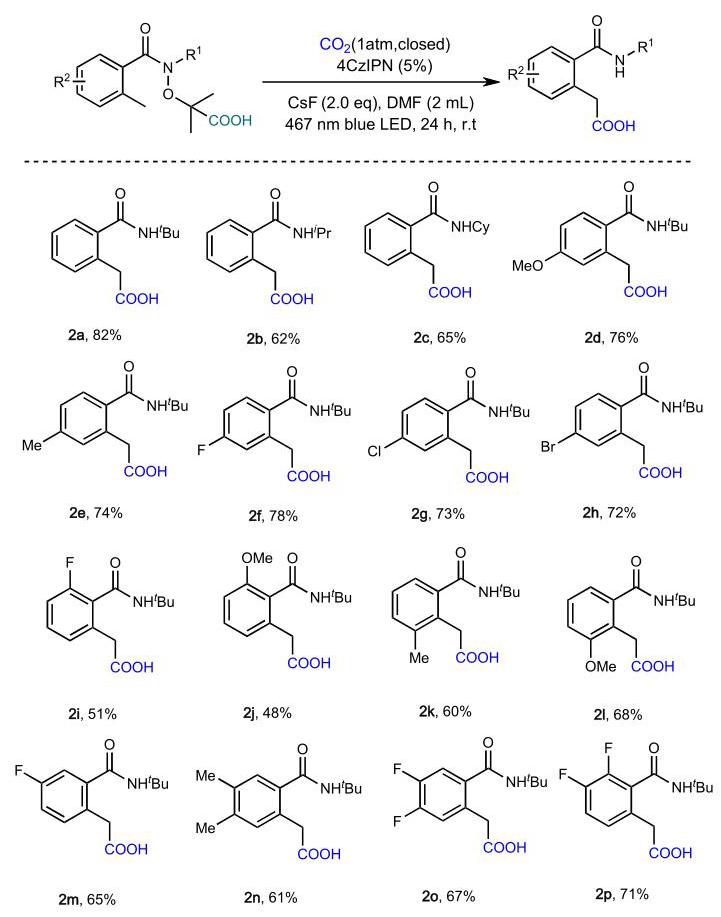
Figure 2. Scope of carboxylation of the remote benzylic $\mathrm{C} - \mathrm{H}$ bond with ${\mathrm{{CO}}}_{2}$ .
We then investigated the utilization of in situ-generated low-concentration ${\mathrm{{CO}}}_{2}$ as a carbon source for carboxylation reactions under a nitrogen atmosphere (see the Supporting Information for details). With the optimal reaction conditions, we realized the efficient utilization of in situ-generated low-concentration ${\mathrm{{CO}}}_{2}$ without additional sources of carbon dioxide. As shown in Figure 3, under the nitrogen atmosphere, model substrate $\alpha$ -oxiamido acid 1a produces moderate quantities of the corresponding carboxylation products. Considering the utilization of CsF as the base instead of ${\mathrm{{Cs}}}_{2}{\mathrm{{CO}}}_{3}$ and conducting the reaction under the nitrogen atmosphere, we believe that ${\mathrm{{CO}}}_{2}$ released from 1a serves as the source for the carboxyl group. This process represents a carbon-efficient and sustainable approach, distinct from previous carboxylation methods that necessitated high pressure and excessive amounts of ${\mathrm{{CO}}}_{2}$ . Furthermore, we subsequently examined the reactivity of various $\alpha$ -oxime acids as substrates. The core arenes, bearing monosubstituted groups such as methoxy (2b), fluoro (2c), chloro (2d), bromo (2e), and methyl (2f), give moderate yields. However, the presence of halides or methyl disubstitution on the arene leads to decreased yields of the corresponding products (2g and 2h). In order to demonstrate the utility of this method, we also tested the gram-scale reaction conditions, giving 2a in moderate yields (see Table S4 in the Supporting Information for more details).
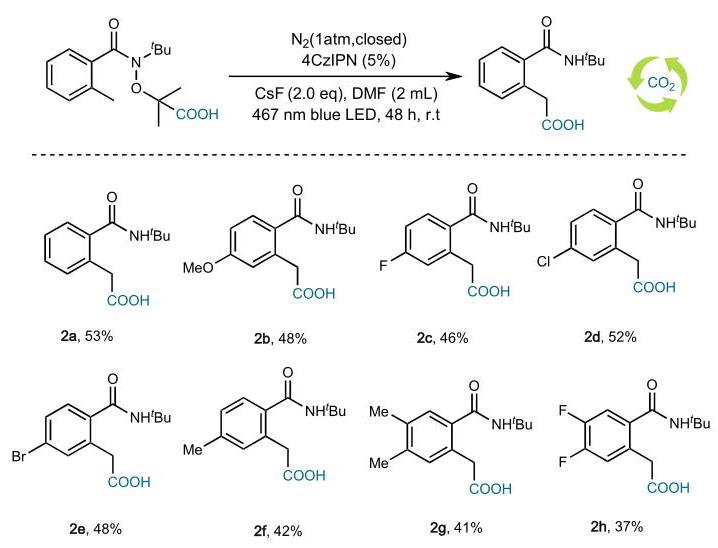
Figure 3. Carboxylation of the remote benzylic $\mathrm{C} - \mathrm{H}$ bond under an ${\mathrm{N}}_{2}$ atmosphere.
Subsequently, a series of control experiments were conducted to gain mechanistic insights (Figure 4). We initially conducted radical inhibition experiments by incorporating (2,2,6,6- tetramethylpiperidin-1-ly)oxyl (TEMPO) into the standard reaction conditions; a noncarboxylation product was observed, and the direct TEMPO trapping product 3a was detected simultaneously, indicating potential involvement of radical intermediates. Further isotope-labeling experiments conducted under a nitrogen atmosphere indicated the formation of a benzylic anion as an intermediate, which can be quenched with ${\mathrm{D}}_{2}\mathrm{O}$ to yield 3b. Based on our proposed formation of benzylic carbanion as a critical intermediate under our reaction conditions, we considered this remote C-H bond activation could be applied to other electrophiles. Successful implementation of this reaction suggests that this strategy would be useful for achieving various other functionalizations of the remote $\mathrm{C} -$ H bond (3c). The experiments using ${}^{13}\mathrm{C}$ -labeled ${\mathrm{{CO}}}_{2}$ generated the ${}^{13}\mathrm{C} - 2\mathrm{a}$ with a yield of ${78}\%$ , giving ${69}\% {}^{13}\mathrm{C}$ incorporation, providing strong evidence that part of the carboxyl group in the desired product came from the starting material 1a.
Based on the control experiments and previous studies, ${}^{41}$ a plausible mechanism for the overall transformation is proposed and outlined in Figure 5. First, the photocatalyst 4CzIPN, upon photoexcitation, would oxidize $\alpha$ -oxiamido acid 1a, delivering amidyl radical I through fragmentation. The electrophilic amidyl radical II would promote a 1,5-HAT, affording the more stable benzylic radical III, which would be reduced by the photocatalyst species to both afford benzylic anionic species IV and regenerate the requisite 4CzIPN. The subsequent nucleophilic attack on ${\mathrm{{CO}}}_{2}$ and the following protonation can provide the observed carboxylic acids.
In conclusion, we herein report the visible-light-induced transition-metal-free redox-neutral carboxylation of remote benzylic $\mathrm{C}\left( {\mathrm{{sp}}}^{3}\right) - \mathrm{H}$ bonds by nitrogen-centered radical 1,5- HAT. Our control experimental investigations strongly indicate that $\alpha$ -oxiamido acid oxidation, the subsequent 1,5-HAT, and the generation of benzylic anionic species are the essential steps. It is noteworthy that the low-concentration ${\mathrm{{CO}}}_{2}$ generated in situ can be reutilized as a reagent in the carboxylation reaction and give moderate yields of corresponding carboxylation products. This reaction proceeds smoothly without adding any transition metal or additional reductive reagent under mild conditions, affording the desired carboxylic acids in moderate to excellent yields with a broad substrate scope. This study presents a representative method of remote $\mathrm{C} - \mathrm{H}$ bond functionalization.
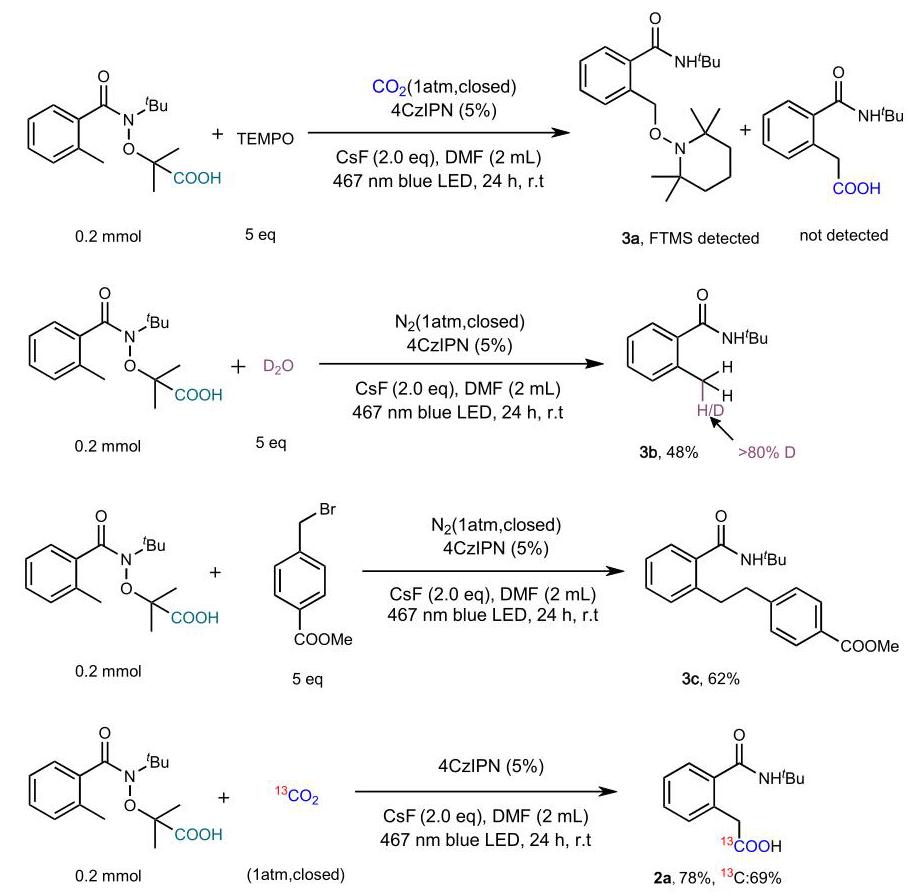
Figure 4. Control experiments and substrates undergo reactions with other electrophiles.
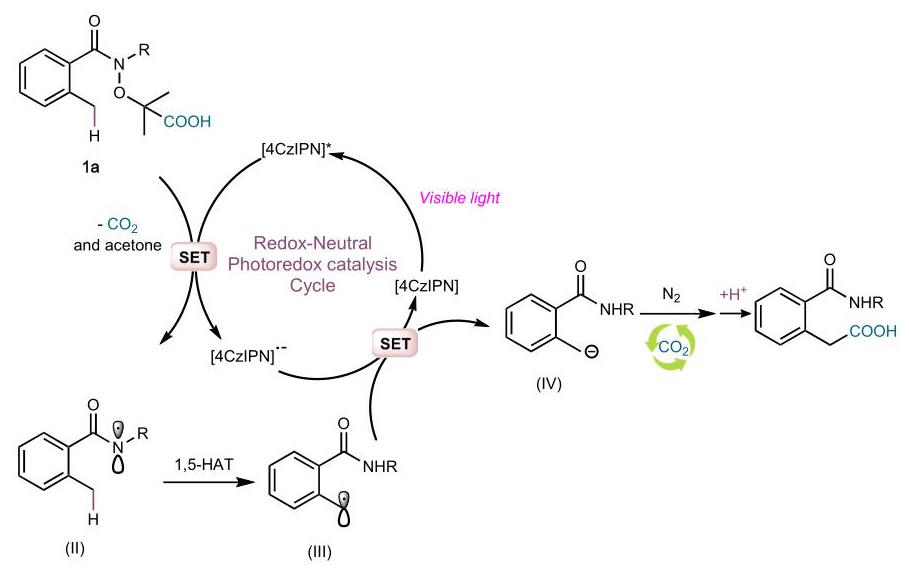
Figure 5. Plausible reaction mechanism.
II ASSOCIATED CONTENT
Data Availability Statement
The data underlying this study are available in the published article and its Supporting Information.
(c) Supporting Information
The Supporting Information is available free of charge at https://pubs.acs.org/doi/10.1021/acs.joc.3c02250.
Reaction condition optimizations, part of mechanistic studies, characterization data, and copies of spectra of products ( ${}^{1}\mathrm{H}$ and ${}^{13}\mathrm{C}$ NMR and HRMS) (PDF)
A UTHOR INFORMATION
Corresponding Author
Fanyang Mo - School of Materials Science and Engineering, Peking University, Beijing 100871, China; (Corcid.org/0000- 0002-4140-3020;
Authors
Wenke Li - College of Engineering, Peking University, Beijing 100871, China
Beiqi Sun - College of Engineering, Peking University, Beijing 100871, China
Lei Zhang - College of Engineering, Peking University, Beijing 100871, China; (C) orcid.org/0000-0001-9031-4318
Complete contact information is available at:
https://pubs.acs.org/10.1021/acs.joc.3c02250
Notes
The authors declare no competing financial interest.
BACKNOWLEDGMENTS
We are grateful for the support from the National Natural Science Foundation of China (grant nos. 22071004, 21933001, and 22150013). We also thank Prof. Ding Ma from College of Chemistry and Molecular Engineering, Peking University, for generously donating 1 L of ${}^{13}{\mathrm{{CO}}}_{2}$ gas.
BREFERENCES
(1) Engle, K. M.; Mei, T. S.; Wasa, M.; Yu, J. Q. Weak Coordination as a Powerful Means for Developing Broadly Useful C-H Functionaliza-tion Reactions. Acc. Chem. Res. 2012, 45, 788-802.
(2) He, J.; Wasa, M.; Chan, K.; Shao, Q.; Yu, J. Q. Palladium-catalyzed transformations of alkyl C-H bonds. Chem. Rev. 2017, 117, 8754- 8786.
(3) Bergman, R. G. C-H activation. Nature 2007, 446, 391-393.
(4) Shen, X.; Zhao, J. J.; Yu, S. Photoredox-catalyzed intermolecular remote $\mathrm{C} - \mathrm{H}$ and $\mathrm{C} - \mathrm{C}$ vinylation via iminyl radicals. Org. Lett. 2018, 20, 5523-5527.
(5) Chen, H.; Jin, W. W.; Yu, S. Enantioselective remote C (sp3)-H cyanation via dual photoredox and copper catalysis. Org. Lett. 2020, 22, 5910-5914.
(6) Guo, W.; Wang, Q.; Zhu, J. Visible light photoredox-catalysed remote $\mathrm{C} - \mathrm{H}$ functionalisation enabled by 1,5-hydrogen atom transfer (1, 5-HAT). Chem. Soc. Rev. 2021, 50, 7359-7377.
(7) Morcillo, S. P.; Dauncey, E. M.; Kim, J. H.; Douglas, J. J.; Sheikh, N. S.; Leonori, D. Photoinduced remote functionalization of amides and amines using electrophilic nitrogen radicals. Angew. Chem., Int. Ed. 2018, 57, 12945-12949.
(8) Chu, J. C.; Rovis, T. Complementary strategies for directed C (sp3)- H functionalization: a comparison of transition-metal-catalyzed activation, hydrogen atom transfer, and carbene/nitrene transfer. Angew. Chem., Int. Ed. 2018, 57, 62-101.
(9) Bume, D. D.; Pitts, C. R.; Ghorbani, F.; Harry, S.; Capilato, J. N.; Siegler, M. A.; Lectka, T. Ketones as directing groups in photocatalytic sp 3 C-H fluorination. Chem. Sci. 2017, 8, 6918-6923.
(10) Pitts, C.; Bume, D. D.; Harry, S. A.; Siegler, M. A.; Lectka, T. Multiple enone-directed reactivity modes lead to the selective photochemical fluorination of polycyclic terpenoid derivatives. J. Am. Chem. Soc. 2017, 139, 2208-2211.
(11) Sharma, A.; Hartwig, J. F. Metal-catalysed azidation of tertiary C-H bonds suitable for late-stage functionalization. Nature 2015, 517, 600-604.
(12) Nagib, D.; Stateman, L.; Nakafuku, K. Remote C-H functionalization via selective hydrogen atom transfer. Synthesis 2018, 50, 1569-1586.
(13) Hofmann, A. Ueber die Einwirkung des Broms in alkalischer Lösung auf Amide. Ber. Dtsch. Chem. Ges. 1882, 15, 762-775.
(14) Löffler, K.; Kober, S. Über die Bildung des i-Nicotins aus N-Methyl-p-pyridyl-butylamin (Dihydrometanicotin). Ber. Dtsch. Chem. Ges. 1909, 42, 3431-3438.
(15) Martinez, C.; Muniz, K. An Iodine-Catalyzed Hofmann-Löffler Reaction. Angew. Chem., Int. Ed. 2015, 54, 8287-8291.
(16) Choi, G. J.; Zhu, Q.; Miller, D. C.; Gu, C. J.; Knowles, R. R. Catalytic alkylation of remote $\mathrm{C} - \mathrm{H}$ bonds enabled by proton-coupled electron transfer. Nature 2016, 539, 268-271.
(17) Chu, J. C. K.; Rovis, T. Amide-directed photoredox-catalysed C-C bond formation at unactivated sp 3 C-H bonds. Nature 2016, 539, 272-275.
(18) Groendyke, B. J.; AbuSalim, D. I.; Cook, S. P. Iron-catalyzed, fluoroamide-directed C-H fluorination. J. Am. Chem. Soc. 2016, 138, 12771-12774.
(19) Zhu, Y. C.; Huang, K. M.; Pan, J.; Qiu, X.; Luo, X.; Qin, Q.; Wei, J.; Wen, X.; Zhang, L. Z.; Jiao, N. Silver-catalyzed remote Csp3-H functionalization of aliphatic alcohols. Nat. Commun. 2018, 9, 2625.
(20) Zhang, J.; Li, Y.; Zhang, F. Y.; Hu, C. C.; Chen, Y. Y. Generation of alkoxyl radicals by photoredox catalysis enables selective C (sp3)- H functionalization under mild reaction conditions. Angew. Chem., Int. Ed. 2016, 55, 1872-1875.
(21) Min, Q.; Yang, J.; Pang, M.; Ao, G.; Liu, F. Copper-catalyzed remote C (sp3)-H amination of carboxamides. Org. Lett. 2020, 22, 2828-2832.
(22) Zhao, Y. T.; Xia, W. J. Recent advances in radical-based C-N bond formation via photo-/electrochemistry. Chem. Soc. Rev. 2018, 47, 2591-2608.
(23) Qin, Q.; Yu, S. Visible-light-promoted remote C (sp3)-H amidation and chlorination. Org. Lett. 2015, 17, 1894-1897.
(24) Na, C. G.; Alexanian, E. J. A General Approach to Site-Specific, Intramolecular C- H Functionalization Using Dithiocarbamates. Angew. Chem., Int. Ed. 2018, 57, 13106-13109.
(25) Sun, B.; Li, W.; Liu, Q.; Zhang, G.; Mo, F. Transition metal-free visible light photoredox-catalyzed remote C (sp3)- H borylation enabled by 1, 5-hydrogen atom transfer. Commun. Chem. 2023, 6, 156.
(26) Sakakura, T.; Choi, J. C.; Yasuda, H. Transformation of carbon dioxide. Chem. Rev. 2007, 107, 2365-2387.
(27) Tortajada, A.; Börjesson, M.; Martin, R. Nickel-catalyzed reductive carboxylation and amidation reactions. Acc. Chem. Res. 2021, 54, 3941-3952.
(28) Cauwenbergh, R.; Goyal, V.; Maiti, R.; Natte, K.; Das, S. Challenges and recent advancements in the transformation of CO 2 into carboxylic acids: straightforward assembly with homogeneous 3d metals. Chem. Soc. Rev. 2022, 51, 9371-9423.
(29) Zhang, Y.; Zhang, T.; Das, S. Selective functionalization of benzylic C (sp3)-H bonds to synthesize complex molecules. Chem 2022, 8, 3175-3201.
(30) Schilling, W.; Das, S. CO2-catalyzed/promoted transformation of organic functional groups. Tetrahedron Lett. 2018, 59, 3821-3828.
(31) Ye, J. H.; Miao, M.; Huang, H.; Yan, S. S.; Yin, Z. B.; Zhou, W. J.; Yu, D. G. Visible-light-driven iron-promoted thiocarboxylation of styrenes and acrylates with CO2. Angew. Chem., Int. Ed. 2017, 56, 15416-15420.
(32) Zhu, C.; Zhang, Y. F.; Liu, Z. Y.; Zhou, L.; Liu, H.; Feng, C. Selective C-F bond carboxylation of gem-difluoroalkenes with CO 2 by photoredox/palladium dual catalysis. Chem. Sci. 2019, 10, 6721- 6726.
(33) Fan, X. Y.; Gong, X.; Ma, M. Y.; Wang, R.; Walsh, P. J. Visible light-promoted CO2 fixation with imines to synthesize diaryl $\alpha$ -amino acids. Nat. Commun. 2018, 9, 4936.
(34) Wencel-Delord, J. CO2+ Light:“Green” Valorization of Simple Arenes and Styrenes. Chem 2020, 6, 2437-2439.
(35) Meng, Q. Y.; Schirmer, T. E.; Berger, A. L.; Donabauer, K.; König, B. Photocarboxylation of benzylic C-H bonds. J. Am. Chem. Soc. 2019, 141, 11393-11397.
(36) Song, Q. W.; Zhou, Z. H.; He, L. N. Efficient, selective and sustainable catalysis of carbon dioxide. Green Chem. 2017, 19, 3707- 3728.
(37) He, X.; Qiu, L. Q.; Wang, W. J.; Chen, K. H.; He, L. N. Photocarboxylation with CO 2: an appealing and sustainable strategy for CO 2 fixation. Green Chem. 2020, 22, 7301-7320.
(38) Masuda, Y.; Ishida, N.; Murakami, M. Light-driven carboxylation of o-alkylphenyl ketones with CO2. J. Am. Chem. Soc. 2015, 137, 14063-14066.
(39) Song, L.; Fu, D.; Chen, L.; Jiang, Y.; Ye, J.; Zhu, L.; Lan, Y.; Fu, Q.; Yu, D. Visible-light photoredox-catalyzed remote difunctionalizing carboxylation of unactivated alkenes with CO2. Angew. Chem., Int. Ed. 2020, 59, 21121-21128.
(40) Liao, L.-L.; Cao, G.-M.; Jiang, Y.-X.; Jin, X.-H.; Hu, X.-L.; Chruma, J. J.; Sun, G.-Q.; Gui, Y.-Y.; Yu, D.-G. α-Amino Acids and Peptides as Bifunctional Reagents: Carbocarboxylation of Activated Alkenes via Recycling CO. J. Am. Chem. Soc. 2021, 143, 2812-2821.
(41) Li, W.; Sun, B.; Zhang, L.; Mo, F. Photocarboxylation of remote $\mathrm{C} - \mathrm{H}$ bonds through nitrogen-centred radical 1,5-hydrogen atom transfer. Green Chem. 2023, 25, 5030-5034.

CAS BIOFINDER DISCOVERY PLATFORM™
BRIDGE BIOLOGY AND CHEMISTRY FOR FASTER ANSWERS
Analyze target relationships,
compound effects, and disease
pathways
Explore the platform