First-principles Investigation of the Unique Role of Anode Surfaces in Organic Electrochemical Reactions
中文 / Bilingual · English version
Jianning Zhang, Xin Wen, Weibin Chen, Lei Zhang, Fanyang Mo,* and Shenzhen Xu*
Cite This: J. Phys. Chem. C 2023, 127, 15215-15226
ACCESS
ABSTRACT: The Kolbe reaction is one of the most classical electrochemical reactions, which enables carboxylic acids or carboxylates to undergo decarboxylation processes via anodic oxidation, forming dimeric alkanes. The reaction could be influenced by many factors separately or synergistically, and changing a single factor may completely change the reaction path. Platinum (Pt) and graphite are common electrode materials used in electrochemical reactions. Electrochemists have obtained abundant empirical evidence that the electrode materials surfaces can affect reaction paths and products, but conventional experiments have difficulty obtaining a microscopic understanding of the specific role of surfaces. In this work, we employ ab initio atomic models to simulate the Kolbe-type oxidation reactions of acetic acid as a model reactant on Pt and graphite surfaces from both thermodynamic and kinetic perspectives. An atomic-scale understanding is presented to explain why Pt and graphite electrode surfaces exhibit different preferences for reaction paths, and we also reveal the joint impact of surface morphologies and adsorption configurations on the kinetics of rate-limiting steps. For the surface morphologies, low-coordinated Pt atoms make the decarboxylation easier to happen on the Pt surface than on the graphite surface. The adsorption configuration of oxidative reaction intermediates is also a determining factor for the energy barriers of different reaction paths on the two surfaces. These discoveries provide mechanistic insights into the anodic oxidation of carboxylic acids, facilitating the understanding of microscopic electrochemical processes and the exploration of new electrochemistry.
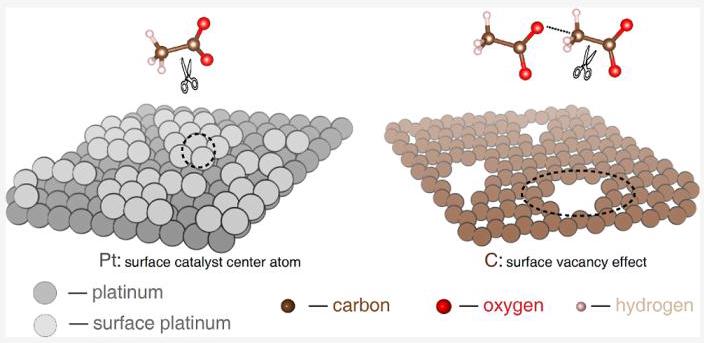
INTRODUCTION
Organic electrochemical reactions are frequently used for academic and industrial applications because of their mild conditions, high efficiency, and environmental friendliness. ${}^{1 - 8}$ There are many factors that can influence the reaction processes, leading to different reaction paths with distinct products and efficiencies. ${}^{9 - {11}}$ For example, the electrochemical oxidation of carboxylic acid will undergo two main, completely different reaction paths, the Kolbe pathway (usually named the Kolbe reaction) and the non-Kolbe pathway, to generate different products under the influence of different experimental conditions. Electrochemists have conducted extensive experimental studies to realize various reaction paths with different mechanisms via altering the experimental conditions in Kolbe reactions. Numerous experimental observations and results are discussed and summarized in many classic electrochemical textbooks. ${}^{12}$ Generally, the Kolbe pathway and non-Kolbe pathway are always a pair of competing paths, and the relative activities of the two reaction paths depend on several reaction conditions, including solvents, ${}^{13}$ electrode surfaces, ${}^{9,{13},{14}}$ reactant species, ${}^{14}$ and so on. ${}^{{15},{16}}$ As shown in Figure 1 (top panel), it is found that Pt, iridium, and vitreous carbon anodes favor the Kolbe pathway to produce long-chain alkane, whereas graphite and porous carbon anodes facilitate the non-Kolbe pathway with cation intermediates generated during the oxidation reaction and further reacting with nucleophiles. ${}^{12}$ These results, which have been verified extensively in previous experiments, are known as the universal laws of Kolbe-type reactions. ${}^{9,{17}}$ One of our previous studies also illustrated the selectivity of Kolbe-type reaction paths by altering the anodic materials. ${}^{10}$ Employing the same interesting carboxylic acid molecules, we realized a 1,4-migration rearrangement triggered by radical intermediates on Pt electrodes and a 1,2-migration rearrangement triggered by carbon cation intermediates on graphite electrodes. Electrochemical researchers are curious about the origin of the selectivity impacted by electrode materials, and the intrinsic mechanism of the selectivity is still elusive based on reported experimental investigation. ${}^{18}$
Ab initio atomic-scale models based on the density functional theory ${\left( \mathrm{{DFT}}\right) }^{{19},{20}}$ provide us powerful tools to investigate the microscopic mechanism of electrochemical surface reactions. The thermodynamics and kinetics of possible reaction pathways on different electrode surfaces can be obtained via calculating the energies of reaction intermediate states and transition states. Based on our previous experimental research on carboxylic acid oxidation on Pt and graphite electrodes, ${}^{{10},{21},{22}}$ herein we employ acetic acid as a model reactant and choose Pt and graphite as model electrode surfaces to perform DFT simulations (Figure 1 middle and bottom panels). We investigate the relationship between the selectivity of reaction paths and the electrode surface properties, including surface morphologies and adsorption configurations, which will provide atomic-scale insights into anodic oxidation for future electrochemical synthesis.
Received: May 16, 2023
Revised: July 6, 2023
Published: July 31, 2023
- The Kolbe oxidation reaction of alkyl carboxylic acid on different surfaces -
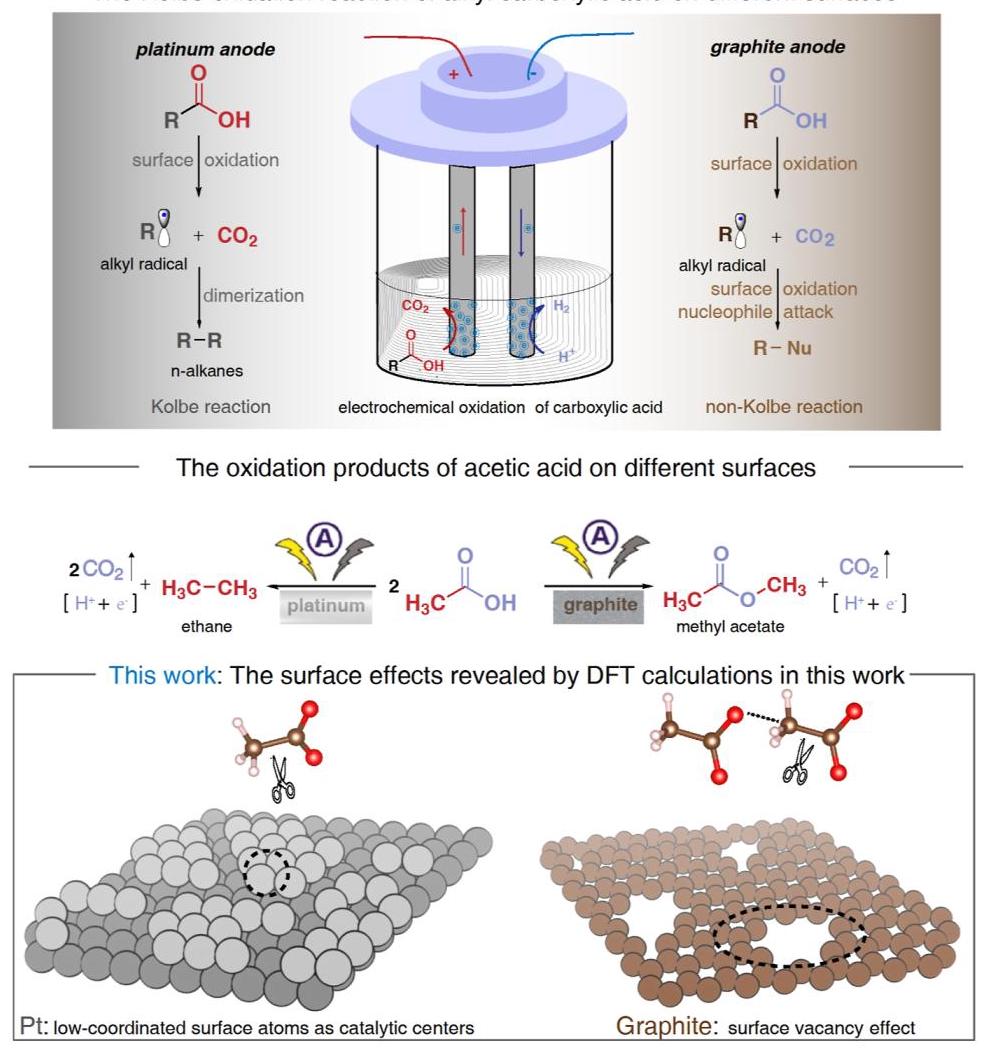
Figure 1. Introduction to this work. The top panel shows the general process of electrochemical oxidative decarboxylation of carboxylic acid R-COOH. The Pt surface favors the Kolbe reaction, in which radicals R* are formed and dimerize to form alkanes. The graphite surface favors a non-Kolbe reaction in which radicals ${\mathrm{R}}^{ \bullet }$ would be oxidized to form carbocations and be subsequently attacked by nucleophiles. The middle panel shows the reaction products of acetic acid on the Pt surface and the graphite surface in experiments. ${}^{9,{23}}$ The bottom panel shows the theoretical insights from the DFT calculations in this work, revealing that the low-coordinated surface Pt atoms play a crucial role in the decarboxylation of acetic acid and that the reaction activity of the graphite surface comes from the surface vacancy defects. For all figures throughout this work, the colors represent different elements: red-oxygen, brown-carbon, white-hydrogen, grey-Pt, and light gray-low-coordinated surface Pt.
METHODS
We used the Vienna Ab initio Simulation Package (VASP) version ${6.1.0}^{{24} - {26}}$ to perform spin-polarized DFT calculations. The projector augmented wave (PAW) method potentials ${}^{27}$ was used to simulate the nuclei and frozen-core electrons of Pt, C, O, and H. We employed the Perdew-Burke-Ernzerhof (PBE) ${}^{28}$ formulation, which adopts the generalized gradient approximation (GGA) as the exchange-correlation functional. The corresponding self-consistently optimized valence electrons were: $5{\mathrm{\;d}}^{9}6{\mathrm{\;s}}^{1}$ for $\mathrm{{Pt}},2{\mathrm{\;s}}^{2}2{\mathrm{p}}^{2}$ for $\mathrm{C},2{\mathrm{\;s}}^{2}2{\mathrm{p}}^{4}$ for $\mathrm{O}$ , and $1{\mathrm{\;s}}^{1}$ for $\mathrm{H}$ . To describe the interaction of adsorbates accurately, we applied the Grimme’s D2 dispersion correction to account for the van der Waals force. ${}^{29}$ The method of Methfessel-Paxton order 1 was used to determine partial occupancies, and the width of the smearing is ${0.2}\mathrm{{eV}}$ because the electrode materials investigated in this work were all metallic. We applied a force-convergence criterion of less than ${0.03}\mathrm{{eV}}/\mathrm{A}$ (for each direction) to each atom that was allowed to relax. The kinetic-energy cutoff for the plane-wave basis was ${500}\mathrm{{eV}}$ for all of our calculations. We performed convergence tests about the cutoff energy, and the results showed that when the cutoff energy increased from 500 to 600 eV, the total energy difference was below 0.1 meV per atom.
We built a slab model for simulating the Pt(111) surface and the graphite surface. We obtained the Pt metal lattice constant using a primitive cell (containing one Pt atom) with a converged $k$ -point mesh of ${13} \times {13} \times {13}$ . We made a three-layer slab of Pt and a three-layer slab of graphite. The vacuum regions in the slabs have a thickness of no less than ${20\text{ Å }}$ . In order to consider the effect of solvent, we included water molecules on the surface (Figure 2). The size of the supercells for simulating the Pt(111) surface was ${19.06\text{ Å }} \times {19.06\text{ Å }} \times {40}$ Å with 147 Pt atoms in total for the thermodynamic modeling. The $k$ -point mesh of $1 \times 1 \times 1$ was employed in geometry optimization, and $2 \times 2 \times 1$ employed in single-point energy calculations for Brillouin zone sampling. A smaller supercell of the Pt slab was used for kinetic calculations because of the high computational expense of the transition state (TS) search calculations, which contains 75 Pt atoms with dimensions of ${13.68\text{ Å }} \times {13.68\text{ Å }} \times {25\text{ Å }}$ and do not include the co-adsorbed solvent water molecules. We also made convergence tests for the $k$ -point mesh used for this smaller Pt slab model. When we changed the $k$ -point mesh from $2 \times 2 \times 1$ to $3 \times 3 \times 1$ , the reaction energy change was $< {0.05}\mathrm{{eV}}$ . We therefore employed the $2 \times 2 \times {1k}$ -points in the kinetic barrier calculations for the Pt surface cases. The size of the supercells for simulating the graphite surface was ${12.31\text{ Å }} \times {12.31\text{ Å }} \times {25\text{ Å }}$ (75 carbon atoms in total), with a $k$ -point mesh of $1 \times 1 \times 1$ for Brillouin zone sampling in geometry optimizations and single-point energy calculations. The convergence test also confirmed that the $1 \times 1 \times {1k}$ -point mesh for the graphite slab cases could meet the accuracy requirement.
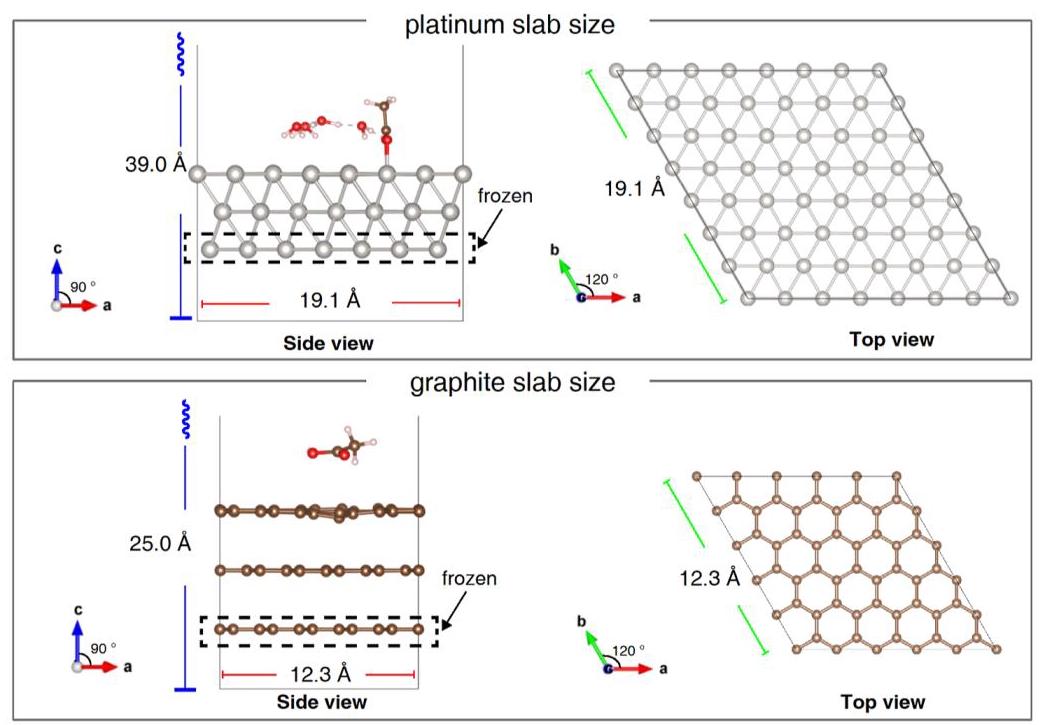
Figure 2. Surface slab setup of Pt and graphite electrodes. The size of the Pt surface slab model is ${19.06\text{ Å }} \times {19.06\text{ Å }} \times {40.00\text{ Å }}$ for the computation of thermodynamic properties. The size of the graphite surface slab model is ${12.31\text{ Å }} \times {12.31\text{ Å }} \times {25\text{ Å }}$ . The bottom layer (marked by the dashed frame) of the Pt and the graphite slabs is frozen in their equilibrium bulk positions during the geometry optimizations.
For the kinetic properties calculations, we employed the climbing image nudged elastic band (CI-NEB) method ${}^{30}$ and the DIMER method ${}^{31}$ to do the TS search and calculate kinetic barriers. We inserted five structures (images) between the initial state (IS) and the final state (FS) and optimized the image structures to find a minimum-energy path and the TS configuration. We performed vibrational frequency analysis to confirm the optimized TS structures, which should exhibit a single, nontrivial imaginary mode. We computed the vibrational frequencies of the modes involving atoms belonging to the adsorbates and surface adsorption sites in our supercell; not all of the atoms in the surface model were included due to the high computational cost. A few TS cases exhibited small imaginary modes $\left( { < {150}\mathrm{i}{\mathrm{{cm}}}^{-1}}\right)$ , which resulted from the rotation of adsorbates (not involved in reaction paths) or the noise of the numerical finite difference method used to construct the Hessian matrices. We thus ignored these small imaginary modes here. We also calculated zero-point energies (ZPEs), thermal corrections, and entropy terms (at $T = {298.15}$ K) to evaluate vibrational free-energy contributions based on the harmonic oscillator approximation (see Figure S5). We chose the reaction path shown in Figure 4 where the $\mathrm{C} - \mathrm{C}$ bond of an acetoxy radical was broken facilitated by the surface Pt atoms as our testing case. The influence of vibrational free energy corrections on reaction energies was less than ${0.1}\mathrm{{eV}}$ in the testing cases. Compared to the typical energy changes along our investigated reaction paths in this work (higher than ${1.8}\mathrm{{eV}}$ ), the vibrational free energy corrections were negligible (thus excluded from the energy diagrams presented in this study).
We applied the implicit solvation model ${}^{{32},{33}}$ to test the solvation effect on the reaction energetics. The solvent environment was represented by a polarizable continuum with a dielectric constant $= {80}$ corresponding to pure liquid ${\mathrm{H}}_{2}\mathrm{O}$ . The energy tests verified that solvation corrections for the decarboxylation of an acetoxy radical resulted in small energy differences $\left( { < {0.1}\mathrm{{eV}}}\right)$ compared to the results without solvation corrections. Considering the extra computational cost, we did not include the implicit solvation model for the study of rest reaction pathways.
An important electrochemical oxidation process considered in our model was the process from an acetic acid molecule to an acetoxy radical, which could be expressed by the following eq 1
$$ {\mathrm{{CH}}}_{3}\mathrm{{COOH}}{ + }^{ * } \rightarrow {\mathrm{{CH}}}_{3}{\mathrm{{COO}}}^{ * }{}^{ * } + {\mathrm{H}}^{ + } + {\mathrm{e}}^{ - } $$$$ \text{ (*: adsorption site) } \tag{1} $$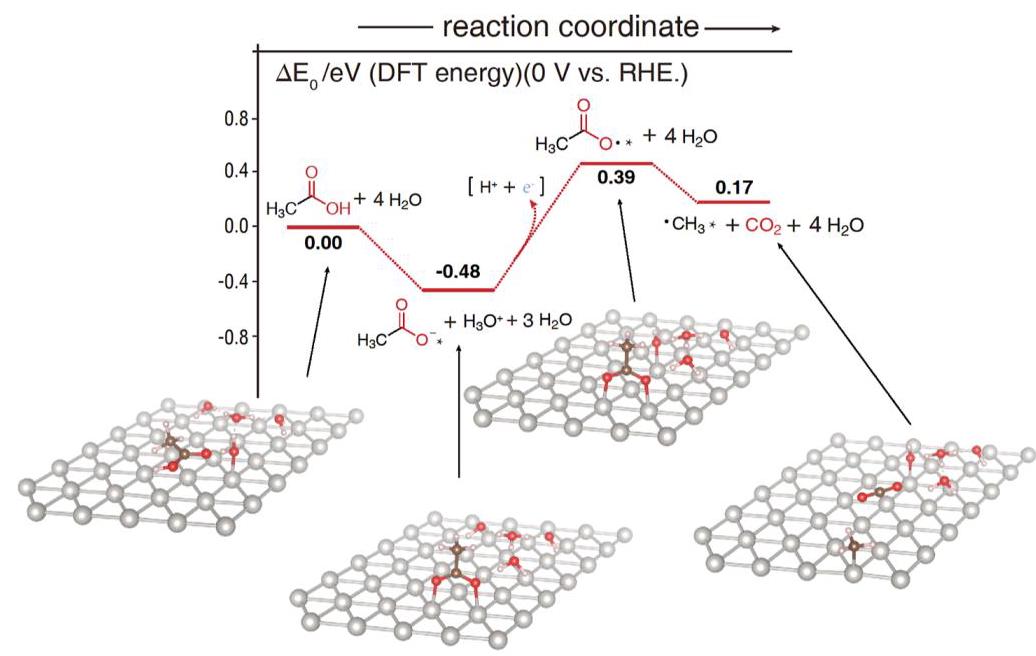
Figure 3. DFT total energies of different reaction states during the Kolbe reaction of acetic acid on the Pt surface. The 1st state: an acetic acid and four ${\mathrm{H}}_{2}\mathrm{O}$ molecules; the 2nd state: an acetate anion and a hydrated proton $\left( {{\mathrm{H}}_{3}{\mathrm{O}}^{ + }}\right)$ with three molecules of water (i.e., an Eigen cation); the 3rd state: an acetoxy radical and four ${\mathrm{H}}_{2}\mathrm{O}$ molecules; the $4\mathrm{{th}}$ state: a methyl radical, a ${\mathrm{{CO}}}_{2}$ molecule, and four ${\mathrm{H}}_{2}\mathrm{O}$ molecules.
For the reaction product, the energy of the proton and electron pair $\left( {{\mathrm{H}}^{ + } + {\mathrm{e}}^{ - }}\right)$ was calculated by the computational hydrogen electrode model, ${}^{{34},{35}}$ which is described as the eq 2
$$ E\left( {{\mathrm{H}}^{ + } + {\mathrm{e}}^{ - }}\right) = 1/{2E}\left( {\mathrm{H}}_{2}\right) - \left| e\right| \times U \tag{2} $$where $E\left( {{\mathrm{H}}^{ + } + {\mathrm{e}}^{ - }}\right)$ is the energy of the proton and electron pair; $E\left( {\mathrm{H}}_{2}\right)$ is the energy of an isolated gas-phase ${\mathrm{H}}_{2}$ ; le| is the elementary charge; and $U$ is the applied potential vs the reversible hydrogen electrode (RHE).
B RESULTS AND DISCUSSION
Simulations of the Reaction Paths on Different Surfaces. We chose acetic acid as the reactant in our modeling system. According to the experimental work by Dickinson in 1962, ${}^{23}$ the electrochemical oxidation of acetic acid on the Pt surface in water will produce ethane and carbon dioxide (the Kolbe reaction). In order to understand the mechanism of this electro-oxidation reaction, previous chemists have proposed several theories for this Kolbe reaction, e.g., the discharged ion theory, ${}^{{36},{37}}$ the hydrogen peroxide theory, ${}^{38}$ and so on. These theories tend to describe the Kolbe reaction as a homogenous reaction, where the reaction intermediates are formed on the electrode surfaces and further diffuse into the solvent to produce the product. Dickinson and Wynne-Jones gave their comments on these theories according to the existing experimental work. ${}^{39}$ They think the assumption of a homogenous reaction path has contradictions with some experimental observations, such as critical concentrations of acids and electrode effects. Vijh and Conway further summarized the experimental results of the electrode kinetic effects of the Kolbe reaction. ${}^{40}$ They think the heterogeneous reaction hypothesis, in which reaction intermediates are generated and transformed to products on both surfaces, is easier to explain the electrodes effects. Vijh concluded that the reaction on Pt surfaces underwent the process shown by the following eqs $3 - {5.}^{40}$ The acetic acid is first ionized to an acetate anion adsorbed on the Pt surface, then oxidized to form an acetoxy radical, which undergoes a subsequent decarboxylation reaction process, producing a methyl radical.
Ionization of acetic acid
$$ {\mathrm{{CH}}}_{3}\mathrm{{COOH}} + {}^{ * } \rightarrow {\mathrm{{CH}}}_{3}{\mathrm{{COO}}}^{- * } + {\mathrm{H}}^{ + } \tag{3} $$Oxidation of the acetate anion
$$ {\mathrm{{CH}}}_{3}{\mathrm{{COO}}}^{- * } \rightarrow {\mathrm{{CH}}}_{3}{\mathrm{{COO}}}^{\bullet * } + {\mathrm{e}}^{ - } \tag{4} $$Decarboxylation of the acetoxy radical
$$ {\mathrm{{CH}}}_{3}{\mathrm{{COO}}}^{\bullet * } \rightarrow {\mathrm{{CH}}}_{3}{}^{\bullet * } + {\mathrm{{CO}}}_{2} \tag{5} $$Inspired by Vijh’s work, we chose the above reaction steps to perform our thermodynamic calculations. In our model, the acetic acid first dissociates into an acetate anion and a hydronium ion, which would be expected to happen in a realistic aqueous environment. The hydronium ion has different possible configurations. We apply the Eigen cation configuration in our model, which is a hydrated proton $\left( {{\mathrm{H}}_{3}{\mathrm{O}}^{ + }}\right)$ connected with three water molecules $\left( {{\mathrm{H}}_{2}\mathrm{O}}\right)$ through hydrogen bond interaction (the 2nd state in Figure 3). Then, the adsorbed acetate anion is oxidized on the electrode surface to generate an acetoxy radical. We find that the acetoxy radical forms a stable vertical bidentate configuration on the Pt surface, and our DFT-predicted configuration is consistent with the experimental infrared spectroscopy results. ${}^{{41},{42}}$ The decarboxylation of the acetoxy radical forms a methyl radical and a ${\mathrm{{CO}}}_{2}$ molecule on the surface. The complete path described above is presented in Figure 3. According to a recent experimental study, it was concluded that carbolyte anions are prone to oxidation, whereas carboxylic acids exhibit difficulty undergoing oxidation on a Pt surface. ${}^{43}$ It is thus reasonable to consider that the ionization process of acetic acid occurs prior to the Kolbe oxidation process.
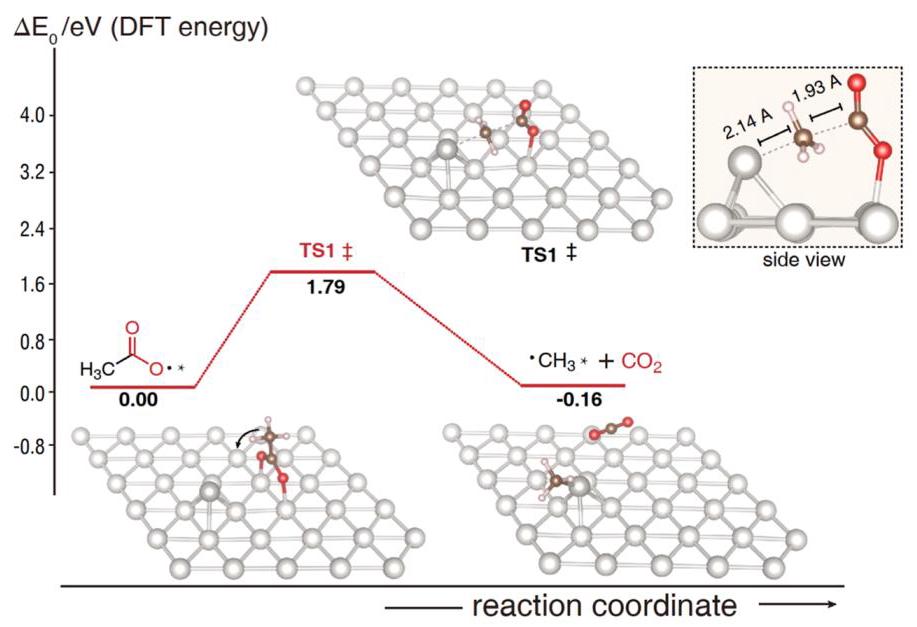
Figure 4. DFT energy diagram of the decarboxylation process from an acetoxy radical to a methyl radical and a ${\mathrm{{CO}}}_{2}$ . A low-coordinated Pt adatom acts as the active center. The geometries of IS, TS, and FS are shown in the figure.
In Figure 3, the step of the 2nd $\rightarrow$ 3rd states is the oxidation reaction of an acetate anion, generating an acetoxy radical. Our computed oxidation potential is ${0.87}\mathrm{\;V}$ vs RHE based on a thermodynamic calculation. In experiments, Dickinson reported that generated ${\mathrm{{CO}}}_{2}$ was detected when the anode potential exceeded ${2.0}\mathrm{\;V}$ vs the saturated calomel electrode (SCE). ${}^{23}$ They used a mixed solution of sodium acetate and acetic acid in an equal molar ratio, and the $\mathrm{{pH}}$ value of this mixed solution in the experiment was approximately 4.74 according to the ionization constant of acetic acid. The experimental oxidation potential was ${2.5}\mathrm{\;V}$ vs RHE (equivalent to ${2.0}\mathrm{\;V}$ vs $\mathrm{{SCE}}$ at $\mathrm{{pH}} = {4.74}$ ) based on eq 6 after transforming the reference potential
$$ E\left( \mathrm{{RHE}}\right) = E\left( \mathrm{{SCE}}\right) + {0.059} \times \mathrm{{pH}}\left( \mathrm{V}\right) + {0.24}\left( \mathrm{\;V}\right) \tag{6} $$$E\left( \mathrm{{RHE}}\right)$ is the potential vs RHE, and $E\left( \mathrm{{SCE}}\right)$ is the potential vs SCE. We thus find the overpotential of acetic acid oxidation in the experiment to be quite large $\left( {{1.63}\mathrm{\;V}}\right)$ based on our thermodynamic analysis. This large overpotential reflects the high kinetic barrier of the Kolbe reaction, which may stem from the decarboxylation process occurring on the surface. Because the vertical configuration of the acetoxy radical on the surface makes the C-C bond relatively far away from surface, ${}^{41}$ which leads to a configurational resistance for the decarboxylation reaction. The $\mathrm{C} - \mathrm{C}$ bond cleavage thus requires additional assistance in this system, which can be catalyzed by certain low-coordinated Pt atoms on the surface.
We then focus on the kinetics of the $\mathrm{C} - \mathrm{C}$ bond cleavage in acetoxy radicals on the Pt surface. We first consider an absolutely flat Pt surface (atomic-level flat and no oxides), where we simulate the decarboxylation process using the constrained molecular dynamics (CMD) method (see Figure S1). We insert several enhanced sampling points into the speculated path; that is, in the approaching process of the acetoxy radical’s methyl group toward the surface, we select several fixed lengths of the C-Pt bond, where the C atom belongs to the methyl group of the acetoxy radical and the Pt atom is the adsorption site for the dissociated methyl group. The C-Pt length is just the reaction coordinate of the decarboxylation process. We sample possible structures at each point with a fixed $\mathrm{C} - \mathrm{{Pt}}$ length. This enhanced sampling calculation shows that when we force the methyl group to gradually get close to the Pt surface, the $\mathrm{C} - \mathrm{H}$ bond is cleaved more easily than the $\mathrm{C} - \mathrm{C}$ bond and the product ${\mathrm{{CH}}}_{2}{\mathrm{{COO}}}^{\bullet * }$ radical will be formed. The qualitative results given by the CMD simulations indicate that it is unlikely to form $* * {\mathrm{{CH}}}_{3}$ via the decarboxylation of ${\mathrm{{CH}}}_{3}{\mathrm{{COO}}}^{\bullet * }$ on the atomic-level, absolutely flat Pt surface. The high kinetic energy barrier of this type of decarboxylation step was also verified by a recent computational study. ${}^{44}$ Their results show that the kinetic barrier of the decarboxylation process of the acetic acid radical on the atomic-level flat Pt surface is ${2.5}\mathrm{{eV}}$ , even when a highly oxidizing potential of ${2.0}\mathrm{\;V}$ vs the standard hydrogen electrode (SHE) is applied.
However, we realize that the realistic Pt surface can’t be atomic-level flat; that is, there are one or more low-coordinated Pt atoms existing on the surface. ${}^{45}$ There is some literature reporting the catalysis effects of Pt atoms of different coordination numbers in electrochemical reactions. ${}^{{46},{47}}$ We speculate that these low-coordinated Pt atoms can also promote the decarboxylation process, helping the acetoxy radical produce methyl radical and carbon dioxide. We perform DFT calculations to verify our conjecture. In order to investigate the role of low-coordinated Pt atoms, we construct a simplified model with a Pt adatom at the surface next to the acetoxy radical. This is just a representative modeling case for approximating the realistic surface morphology to explore the catalytic activity of low-coordinated Pt atoms on the surface, which does not mean the presence of a significant amount of single Pt adatoms. Our results show that the low-coordinated Pt adatom can facilitate the decarboxylation process with a kinetic barrier of ${1.79}\mathrm{{eV}}$ (Figure 4). With the assistance of low-coordinated Pt adatoms on the surface, the acetoxy radical can generate a methyl radical and carbon dioxide through a configurational inversion process (namely the Walden inversion). We can see that although this energy barrier (1.79 eV) is still relatively high, which actually explains the large overpotential observed in the experiment, ${}^{23}$ this Pt-adatom-assisted path already exhibits a much lower kinetic barrier than that of the $\mathrm{C} - \mathrm{C}$ bond cleavage path on the atomic-level flat Pt surface (2.5 eV, as predicted by the earlier computational study ${}^{44}$ ). We further investigate the kinetics of alternative pathways on the Pt surface, which helps us analyze the likely reaction mechanisms.
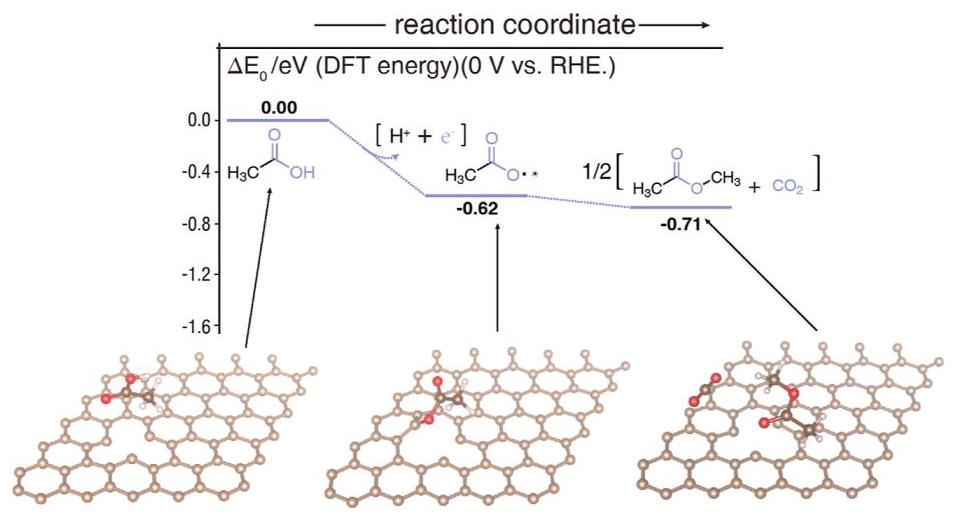
Figure 5. DFT total energies of different reaction states of the acetic acid oxidation on the graphite surface. The 1st state: an acetic acid; the 2nd state: an acetoxy radical; the 3rd state: a methyl acetate and a ${\mathrm{{CO}}}_{2}$ . The relative DFT energy of the 3rd state is calculated by the following method: we add two adsorbed acetoxy radicals to the model and calculate the energy change $\left( {\Delta E}\right)$ of the reaction: $2{\mathrm{{CH}}}_{3}{\mathrm{{COO}}}^{* * } \rightarrow {\mathrm{{CH}}}_{3}{\mathrm{{COOCH}}}_{3} + {\mathrm{{CO}}}_{2}$ . The DFT energy of the 3rd state is obtained by adding the normalized ${\Delta E}/2$ onto the DFT energy of the 2nd state.
An alternative pathway is that the acetoxy radical may desorb from the surface and subsequently undergo decarboxylation. We further computed the energy change associated with this desorption step (see Figure S2). The substantial increase in energy (2.95 eV) signifies the challenge of acetoxy radical desorption from the surface. Our analysis thus suggests that the acetoxy radical is likely to undergo decarboxylation on the Pt surface.
Furthermore, we can see that the onset of the above Kolbe reaction occurs at a high overpotential in aqueous solutions, under which water can be oxidized before ${\mathrm{{CO}}}_{2}$ is generated. ${}^{23}$ Therefore, the intermediate species of the water oxidation reaction, such as adsorbed oxygen atoms (O*), adsorbed hydroxide radicals (OH), etc., may also participate in the decarboxylation of ${\mathrm{{CH}}}_{3}{\mathrm{{COO}}}^{\bullet * }$ . We investigate the effect of ${\mathrm{O}}^{ * }$ , a representative ${\mathrm{H}}_{2}\mathrm{O}$ -oxidation intermediate species, on the decarboxylation step’s kinetics (see Figure S3). Although this reaction path is similar to the above case of a low-coordinated Pt adatom as the active center, the O-involved energy barrier $\left( {{3.30}\mathrm{{eV}}}\right)$ is much higher than that in the Pt-adatom case $\left( {{1.79}\mathrm{{eV}}}\right)$ , indicating the promotion of decarboxylation kinetics is more likely to be induced by the low-coordinated Pt atoms on the electrode surface.
We apply similar methods (as discussed in the Pt surface case) to analyze the oxidation reaction of acetic acid on the graphite surface, which follows a quite different reaction path. In 1968, Sato’s experiments showed that methyl acetate was the main product of acetic acid oxidation on the graphite surface. ${}^{8}$ They used glacial acetic acid or methanol as the solvent and found that methyl acetate was the main product in both cases. Sato and the following researchers think that two possible paths may occur on the graphite surface: (1) the direct reaction of acetoxy radicals forms methyl acetate; (2) a carbocation intermediate is formed under a high oxidation potential from a methyl radical. ${}^{9,{48}}$ Here, we note that we focus on the different selectivities of different electrodes (Pt vs graphite) in this work, and we are not trying to demonstrate which path (the direct formation of a methyl acetate or the formation of a carbocation) is more likely to proceed on the specific graphite surface. The complete comparisons are presented in the next section.
When glacial acetic acid is used as the solvent, the ionization of acetic acid is weak. It means the concentration of acetate anions in the solvent can be ignored, and the main form of acetic acid is the neutral acetic acid molecule. We chose this reaction system to build our simulation model. Our DFT calculations start with neutral acetic acid as a reactant. We find that acetic acid and acetoxy radicals do not adsorb on the pristine graphite surface because of the low affinity between them and the aromatic graphite surface. It means electrochemical oxidation cannot occur easily on the pristine graphite surface. However, it has been found that there are a large number of paramagnetic centers on the graphite surface, including boron doping and vacancy defects, and some researchers think the oxidation reaction of acid occurs at the paramagnetic centers of graphite. ${}^{{49} - {51}}$ Therefore, we build a graphite model with a surface carbon vacancy defect as a representative case for a realistic graphite surface with paramagnetic centers. The introduction of a carbon vacancy defect creates unsaturated coordinated carbon atoms on the surface, which could exhibit stronger interaction with adsorbates. Our calculation results confirm that the oxygen atom of the adsorbed acetoxy radical binds with a low-coordinated carbon atom next to the vacancy defect of the graphite surface. The adsorption configuration is shown in Figure 5 (the middle panel).
In our DFT model, we investigate methyl acetate formation by the reaction of two acetoxy radicals. ${}^{9}$ The reaction involving two acetoxy radicals is divided into three states, which are summarized in the eqs 7 and 8 and Figure 5. In the 1st state, the acetic acid physisorbs at the surface; the step of the $1\mathrm{{st}} \rightarrow$ 2nd states is the oxidation of acetic acid (eq 7). In the step of the 2nd $\rightarrow$ 3rd state, a reaction between two acetoxy radicals occurs with a methyl group transfer. The products are methyl acetate and ${\mathrm{{CO}}}_{2}$ .
Oxidation of acetic acid
$$ {\mathrm{{CH}}}_{3}\mathrm{{COOH}} + {}^{ * } \rightarrow {\mathrm{{CH}}}_{3}{\mathrm{{COO}}}^{ \bullet }{}^{ * } + {\mathrm{H}}^{ + } + {\mathrm{e}}^{ - } \tag{7} $$Formation of methyl acetate
$$ {\mathrm{{CH}}}_{3}{\mathrm{{COO}}}^{ \bullet }{}^{ * } \rightarrow {0.5} \times \left( {{\mathrm{{CH}}}_{3}{\mathrm{{COOCH}}}_{3} + {\mathrm{{CO}}}_{2}}\right) \tag{8} $$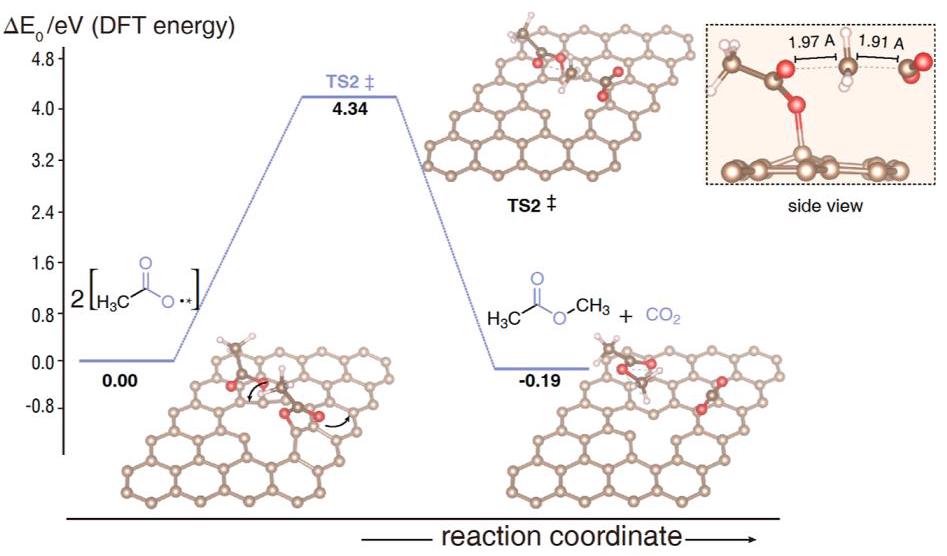
Figure 6. DFT energy diagram of the methyl acetate formation process on the graphite surface. Geometries of IS, TS, and FS are shown in the figure.
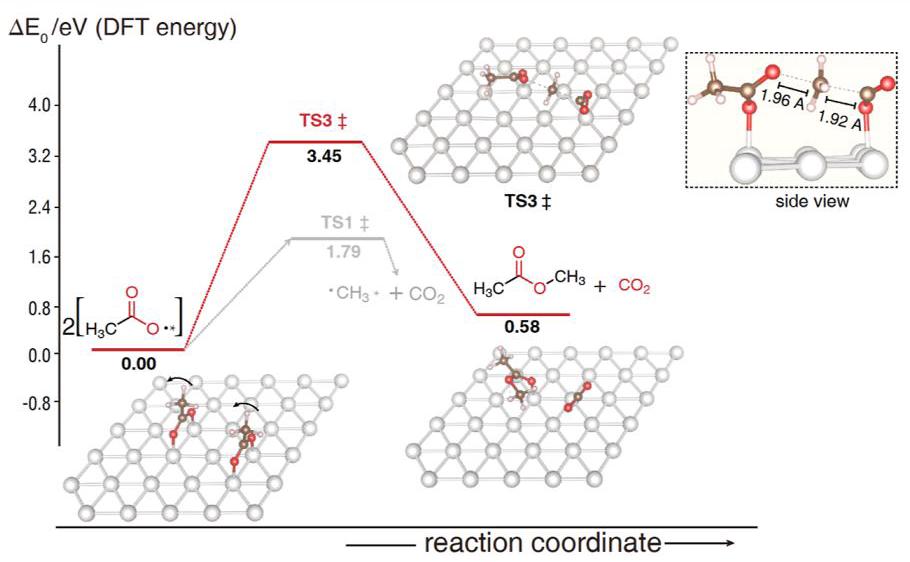
Figure 7. DFT energy diagram of the acetic acid oxidation on the Pt surface. The red line represents the energy change of the methyl acetate formation process. IS, TS, and FS atomic configurations of the reaction are shown in the figure. The gray line shows the energy change of the decarboxylation reaction from an acetoxy radical to a methyl radical and ${\mathrm{{CO}}}_{2}$ on the Pt surface for comparison (presented in Figure 4).
According to our calculation results, the oxidation potential of acetic acid is -0.62 V vs RHE on the graphite surface. In experiments, Sato reported that the anodic potential of ${\mathrm{{CO}}}_{2}$ generation from the graphite surface was around ${1.4}\mathrm{\;V}$ vs SCE. The accurate $\mathrm{{pH}}$ value of glacial acetic acid is hard to estimate. Some literature reported the $\mathrm{{pH}}$ value of glacial acetic acid is approximately ${3.0}.{}^{52}$ We assume that the $\mathrm{{pH}}$ value of the system is 3.0; the experimental oxidation potential thus is ${1.8}\mathrm{\;V}$ vs RHE (equivalent to ${1.4}\mathrm{\;V}$ vs SCE at $\mathrm{{pH}} = {3.0}$ ) based on eq 6 after changing the reference potential. It means that a large overpotential $\left( { \sim {2.4}\mathrm{\;V}}\right)$ is applied in the experiments. We think that the overpotential originates from the high kinetic barrier of the step in which two acetoxy radicals react to produce the methyl acetate. Therefore, we performed kinetic calculations to find the TS of the reaction of two acetoxy radicals and obtain the kinetic barrier value (Figure 6). There are two acetoxy radicals binding with two adjacent low-coordinated carbon atoms of the surface defect in our model. The C-C bond of one acetoxy radical is broken, and the dissociated methyl group is directly transferred to another acetoxy radical. The results show that the formation of methyl acetate proceeds with a kinetic barrier of ${4.34}\mathrm{{eV}}$ . In this reaction path, the methyl group of one acetoxy radical undergoes a configurational inversion (the Walden inversion) to get connected to another acetoxy radical. The kinetic barrier of the methyl acetate formation from the acetic acid on a graphite surface is much higher than that of the methyl radical formation on a Pt surface. This could be the reason for the higher overpotential observed on the graphite electrode $\left( { \sim {2.4}\mathrm{\;V}}\right)$ compared to the Pt electrode case $\left( { \sim {1.6}\mathrm{\;V}}\right)$ . We also calculate the energy barrier of the ${\mathrm{{CH}}}_{3}{}^{\bullet * }$ radical formation on the graphite surface, which exhibits an even higher value (refer to the next section).
Simulations of Switched Reaction Paths on the Two Different Surfaces. In order to investigate the reason for different selectivities of the oxidation reactions on different material surfaces, we switch the two reaction paths in the above simulations of the Pt and graphite cases, namely, the process of methyl acetate formation on the Pt surface and the process of generating methyl radicals on the graphite surface. We are interested in the kinetic barriers of these switched reaction paths, which will be used to compare with the barrier results of the paths investigated in the above section (Figures 4 and 6). We therefore add an additional acetoxy radical molecule in the Pt surface model with methyl acetate as the product (Figure 7). The energy barrier of this reaction (3.45 eV) is much higher than that of the ${\mathrm{{CH}}}_{3}{}^{\bullet * }$ formation $\left( {{1.79}\mathrm{{eV}}}\right)$ on the Pt surface, indicating that the methyl acetate formation is much more difficult to proceed compared to the ${\mathrm{{CH}}}_{3}{}^{\bullet * }$ generation on the Pt electrode surface.
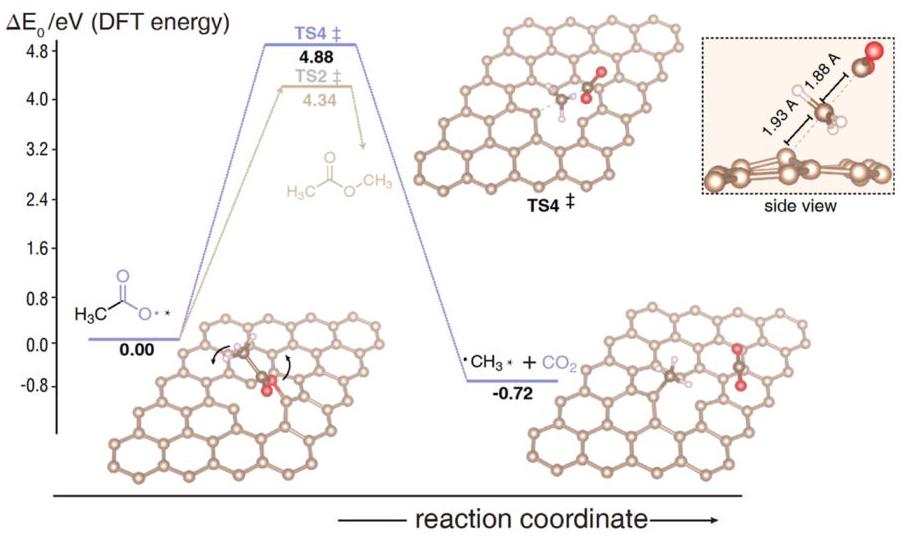
Figure 8. DFT energy diagram of the acetic acid oxidation on the graphite surface. The blue line represents the energy change of the decarboxylation reaction to generate a methyl radical. IS, TS, and FS atomic configurations of the reaction path are shown in the figure. The light-colored line shows the energy change of the methyl acetate formation on the graphite surface for comparison (presented in Figure 6).
For the graphite surface case, we simulate the reaction of the methyl radical formation, in which an acetoxy radical generates a methyl radical and ${\mathrm{{CO}}}_{2}$ . The adjacent low-coordinated carbon atom of the carbon vacancy defect performs as the catalytic site. Our calculations reveal that the methyl carbon atom directly forms a bond with the low-coordinated carbon atom to generate an adsorbed methyl radical. The TS of this reaction is shown in Figure 8, and the corresponding kinetic barrier is ${4.88}\mathrm{{eV}}$ in our simulation. By comparing this value with the kinetic barrier of the methyl acetate formation (4.34 eV in Figure 6) on the graphite surface, we find that a methyl acetate is more easily formed than a methyl radical in the graphite electrode case.
Discussions of the Reaction Mechanisms on Different
Surfaces. Based on the above results, we think that the selectivity of carboxylic acid electrochemical oxidation reactions depends on two important factors. The first one is the adsorption configuration of acid, which determines the relative energy barriers along different reaction paths. The other factor is the catalytic effect of the surface low-coordinated atoms, which could facilitate the decarboxylation process. As shown in Figure 3, the acetate on the Pt surface exhibits a stable bidentate vertical adsorption configuration. In this configuration, the C-C bond is far from the surface, which induces a high kinetic barrier for the decarboxylation process. The C-C bond is a stable covalent bond, and the surface atoms may facilitate its cleavage. We introduce a low-coordinated Pt adatom on the surface in our model, which serves as a representative case for simulating a more realistic Pt surface. We find that the low-coordinated Pt adatom indeed lowers the kinetic barrier, whose catalytic role comes from two main aspects based on our calculations: (1) low-coordinated Pt atoms exhibit intrinsically high activities; (2) when the Pt adatom protrudes from the surface, it can reduce the change of the configurational angle of the C-C bond along the bond cleavage process, thus lowering the reaction kinetic barrier. On the surface of graphite, defects are ubiquitous, and the adsorption configuration of acetoxy radicals is unidentate at the defect site. There is a higher kinetic barrier to dissociating the $\mathrm{C} - \mathrm{C}$ bond and forming adsorbed methyl radicals on the graphite surface because the configurational angle change is larger and the surface carbon atoms do not exhibit strong activities. However, when another acetoxy radical exists, they interact relatively more easily to form a methyl acetate. The reactions on both surfaces show high kinetic barriers, which are consistent with the high overpotentials observed in earlier experiments. ${}^{9,{39}}$ Our modeling results reveal that the large overpotential can be explained by the high kinetic barrier of the C-C bond cleavage process. In this process, the acetoxy radicals usually undergo a configurational inversion step, namely the Walden inversion, to achieve the decarboxylation process. A characteristic of the Walden inversion is that the reaction activity is significantly suppressed by the steric hindrance. Previous researchers summarized experimental phenomena as follows: the greater the steric hindrance of the carboxylic acid’s $\alpha$ -position is, the lower the reaction yield is. ${}^{{53} - {55}}$ For example, acetic acid can generate the coupling product ethane with a high yield of 93%; however, if the hydrogen atom of the acetic acid’s $\alpha$ -position is substituted by any other alkyl groups, the coupling product yield will decrease. ${}^{53}$ In addition, the concentration of acetic acid may also have an influence on the overpotential. In the case of a pure acetic acid solvent environment, Pt can also be used as an anode for the acetic acid oxidation. As shown in Figure S4, the computed potential of the acetic acid oxidation (without any ${\mathrm{H}}_{2}\mathrm{O}$ molecules in the surface model as a crude approximation for the pure acetic acid solvent environment) is around ${0.42}\mathrm{\;V}$ vs RHE, in contrast to the oxidation potential of ${0.79}\mathrm{\;V}$ vs RHE in the aqueous solvent environment on the Pt surface.
Recently, the Chan group also modeled the Kolbe reaction on the Pt surface. ${}^{44}$ They used water as the solvent and proposed that the Pt surface is oxidized by oxygen generated from the oxygen evolution reaction (OER); then, the Kolbe reaction occurs on the oxidized Pt surface to produce ethane molecules. Although the oxidized surface was observed in previous experiments, ${}^{56}$ we think some other possible paths of the Kolbe reaction can better explain the experimental results. The recent theoretical work concluded that the ideally pristine Pt surface could not promote the Kolbe reaction because of the high kinetic barrier of decarboxylation on the pristine Pt surface. ${}^{44}$ Our calculations of the pristine Pt surface case also exhibit high energy barriers, which are consistent with their results. However, due to the fact that a realistic Pt surface cannot be ideally atomic-flat, ${}^{45}$ we consider low-coordinated Pt adatoms on the surface to approximate a more realistic situation. Our work shows that the low-coordinated Pt atoms play a critical catalytic role in activating the $\mathrm{C} - \mathrm{C}$ bond cleavage of the adsorbed acetoxy radical. Moreover, when changing the water solvent to other components like methanol, acetic acid, ${}^{8,9}$ and dimethylformamide, ${}^{57}$ the Kolbe reactions also occur, and Sato found that the Kolbe reaction of acetic acid proceeded efficiently in methanol, while the methanol oxidation was limited under the corresponding electrochemical condition. ${}^{9}$ They did not find the formation of solvent oxidation intermediates (like ${\mathrm{O}}^{ * }$ ) in the experiment. In these systems with non-aqueous solvent molecules, the Pt electrode surfaces are not likely to be covered by oxide terminations. In addition, the adsorption configuration of the acetoxy radical molecule is an important factor for the selectivities of the reaction paths based on our calculations. According to some spectroscopy experiments, ${}^{{41},{42}}$ the adsorption configuration of acetate is bidentate, which is the most stable configuration of acetate on a flat Pt surface. If an unoxidized termination dominates the Pt surface, the bidentate configuration will be observed, which means the C-C bond will be perpendicular to the surface. In the recent computational study, ${}^{44}$ the stable configuration of acetate on an oxidized Pt surface is that the $\mathrm{C} - \mathrm{C}$ bond of the acetate is parallel to the surface. If an oxidized surface dominates the reaction, the bidentate configuration will be less likely to exist on the surface, which is somehow contradictory to the earlier spectroscopy experiments. ${}^{{41},{42}}$ Some researchers also observed the existence of oxidized Pt surfaces, but they think that the Kolbe reaction is less likely to occur on the oxidized surfaces. ${}^{{56},{58}}$ Moreover, for some types of oxide electrode materials (Ni and Pt oxides), previous experimental evidence showed the inefficiency of Kolbe reactions. ${}^{{23},{40},{59},{60}}$ Given the above evidence and discussions, the adsorption configurations of the acetate radical and the catalytic roles of the oxidized vs unoxidized Pt surfaces have not reached an agreement.
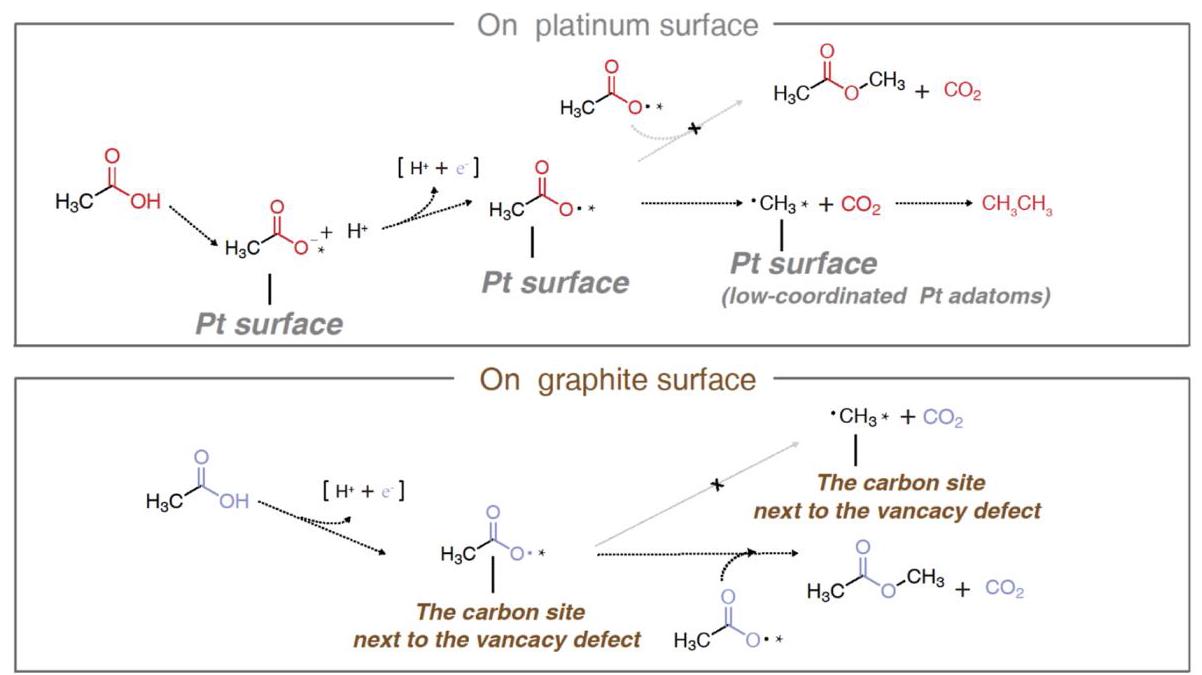
Figure 9. Reaction paths of acetic acid oxidation reactions on two different surfaces. The top panel shows the oxidation of acetic acid on the Pt electrode surface. The methyl acetate formation has a higher kinetic barrier compared to the generation of the methyl radical. The bottom panel shows the acetic acid oxidation on the graphite electrode surface, where the formation of methyl acetate is an easier process.
Another significant feature of the Kolbe reaction is the high Tafel slope region. ${}^{{56},{58},{61}}$ Due to the high kinetic barrier of decarboxylation, the methyl radical cannot be generated rapidly following the formation of acetoxy radicals. It means the acetoxy radical will cover the surface and form a dipole layer. The dipole layer will prevent carboxylic acid radicals from further adsorbing on the surface when the potential is not sufficiently high for breaking the C-C bond, which could induce the high Tafel slope region. The exact mechanism resulting in the large Tafel slope is still under debate, and we expect future research on this question.
CONCLUSIONS
We employ ab initio atomic-scale models to simulate the oxidation reaction of acetic acid on the Pt and graphite surfaces, which exhibit different selectivities of reaction paths. As shown in Figure 9, the acetoxy radical is bonded to the Pt surface and forms a bidentate vertical adsorption configuration. In this configuration, the C-C bond is far from the surface, which induces a high kinetic barrier for the decarboxylation process. We introduce a low-coordinated Pt adatom on the surface in our model, which serves as a representative case for simulating a realistic Pt surface. We find that the low-coordinated Pt adatom can lower the kinetic barrier. For the graphite surface case, carbon vacancy defects are ubiquitous, and the adsorption configuration of acetoxy radicals is unidentate at the defects. The dissociation of the C-C bond and the formation of adsorbed methyl radicals on the graphite surface have a significant kinetic barrier due to the larger change in configurational angle and the relatively low activity of the surface carbon atoms. When another acetoxy radical exists, they interact relatively more easily to form methyl acetate. The high kinetic barriers on both surfaces predicted from our DFT calculations are consistent with the high overpotential observed in earlier experiments. ${}^{9,{39}}$
Our study also discusses the catalytic effect of oxidized vs unoxidized Pt surfaces. A recent computational study proposed that the acetic acid oxidation reaction should occur on an oxidized Pt surface. However, our simulation results imply that the unoxidized Pt surface may facilitate the reaction as well. The bidentate adsorption configuration of acetic acid in experiments is consistent with the most stable configuration on the unoxidized Pt surface in our model. ${}^{{41},{42}}$ We consider Pt adatoms on the surface, and these atoms exhibit relatively good catalytic activity for the formation of methyl radicals. Some other experimental evidence also indicates that the oxidized Pt surface is not a necessary condition for activating the Kolbe reactions. ${}^{{40},{56},{58},{60}}$
Overall, our computational study reveals the origin of the Pt vs graphite electrodes’ different selectivities for the oxidation reactions of acetic acids. Based on mechanistic understanding, we could further increase the Kolbe reaction’s activity and control the reaction paths’ selectivities by various surface engineering approaches, e.g., introduction of more low-coordinated Pt atoms to the Pt surface or exposure of more edges and vertices of the Pt electrode material can potentially facilitate the methyl radical formation. We expect more interesting electrode materials with different surface morphologies to be synthesized and applied in the Kolbe reaction field.
ASSOCIATED CONTENT
(c) Supporting Information
The Supporting Information is available free of charge at https://pubs.acs.org/doi/10.1021/acs.jpcc.3c03221.
CMD method for simulations of methyl radical formation on the atomic-flat platinum surface; desorption of acetoxy radicals from the Pt surface; C-C bond cleavage catalyzed by an adsorbed oxygen radical; simulations of the electrochemical oxidation of acetic acids with glacial acetic acid as solvent; and vibrational and solvation corrections for reaction energies (PDF)
Cartesian coordinates of the intermediate states (obtained in the thermodynamic calculations) and the IS, TS, and FS structures (obtained in the kinetic calculations) (ZIP)
A AUTHOR INFORMATION
Corresponding Authors
Fanyang Mo - School of Materials Science and Engineering, Peking University, Beijing 100871, PR China; © orcid.org/ 0000-0002-4140-3020;
Shenzhen Xu - School of Materials Science and Engineering, Peking University, Beijing 100871, PR China; Beijing Key Laboratory of Theory and Technology for Advanced Battery Materials, School of Materials Science and Engineering, Peking University, Beijing 100871, PR China; AI for Science Institute, Beijing 100084, PR China; (C) orcid.org/0000- 0001-7268-9917;
Authors
Jianning Zhang - School of Materials Science and Engineering, Peking University, Beijing 100871, PR China; Department of Energy and Resources Engineering, College of Engineering, Peking University, Beijing 100871, PR China
Xin Wen - School of Materials Science and Engineering, Peking University, Beijing 100871, PR China; Present Address: Beijing National Laboratory for Molecular Sciences (BNLMS), Institute of Chemistry, Chinese Academy of Sciences, Beijing 100049, PR China
Weibin Chen - School of Materials Science and Engineering, Peking University, Beijing 100871, PR China; Department of Energy and Resources Engineering, College of Engineering, Peking University, Beijing 100871, PR China
Lei Zhang - Department of Energy and Resources Engineering, College of Engineering, Peking University, Beijing 100871, PR China; Present Address: Department of Chemistry, National University of Singapore 117544, Republic of Singapore.; (C) orcid.org/0000-0001-9031-4318
Complete contact information is available at:
https://pubs.acs.org/10.1021/acs.jpcc.3c03221
Author Contributions
Jianning Zhang: Literature review, DFT calculations and data analysis, academic discussions, and writing the paper manuscript. Xin Wen: DFT calculations and data analysis and academic discussions. Weibin Chen: DFT calculations and academic discussions. Lei Zhang: Academic discussions and editing the paper manuscript. Fanyang Mo: Project design, funding support, and editing the paper manuscript. Shenzhen Xu: Project design, guidance on the model constructions and computational details, academic discussions, software support, and writing the paper manuscript.
Notes
The authors declare no competing financial interest.
I ACKNOWLEDGMENTS
This project is supported by the National Natural Science Foundation of China (grant nos. 21933001, 22071004, and 52273223). The DFT calculations are supported by the High Performance Computing Platform of Peking University and the Beijing Beilong Super Cloud Computing Co., Ltd. The authors also acknowledge Professor Xidong Wang (School of Materials Science and Engineering, Peking University) for his support.
R REFERENCES
(1) Waldvogel, S. R.; Lips, S.; Selt, M.; Riehl, B.; Kampf, C. J. Electrochemical Arylation Reaction. Chem. Rev. 2018, 118, 6706- 6765.
(2) Yan, M.; Kawamata, Y.; Baran, P. S. Synthetic Organic Electrochemical Methods since 2000: On the Verge of a Renaissance. Chem. Rev. 2017, 117, 13230-13319.
(3) Yoshida, J.-I.; Kataoka, K.; Horcajada, R.; Nagaki, A. Modern Strategies in Electroorganic Synthesis. Chem. Rev. 2008, 108, 2265- 2299.
(4) Ma, C.; Fang, P.; Mei, T.-S. Recent Advances in C-H Functionalization Using Electrochemical Transition Metal Catalysis. ACS Catal. 2018, 8, 7179-7189.
(5) Moeller, K. D. Synthetic Applications of Anodic Electrochemistry. Tetrahedron 2000, 56, 9527-9554.
(6) Sperry, J. B.; Wright, D. L. The Application of Cathodic Reductions and Anodic Oxidations in the Synthesis of Complex Molecules. Chem. Soc. Rev. 2006, 35, 605-621.
(7) Tang, S.; Liu, Y.; Lei, A. Electrochemical Oxidative Cross-Coupling with Hydrogen Evolution: A Green and Sustainable Way for Bond Formation. Chem 2018, 4, 27-45.
(8) Schäfer, H.-J. Recent Contributions of Kolbe Electrolysis to Organic Synthesis. In Electrochemistry IV; Steckhan, E., Ed.; Springer Berlin Heidelberg: Berlin, Heidelberg, 1990; pp 91-151.
(9) Sato, N.; Sekine, T.; Sugino, K. Anodic Processes of Acetate Ion in Methanol and in Glacial Acetic Acid at Various Anode Materials. J. Electrochem. Soc. 1968, 115, 242.
(10) Zhang, Z.; Zhang, L.; Zhang, X.; Yang, J.; Yin, Y.; Jiang, Y.; Zeng, C.; Lu, G.; Yang, Y.; Mo, F. Anodic Oxidation Triggered Divergent 1,2- and 1,4-Group Transfer Reactions of B-Hydrox-ycarboxylic Acids Enabled by Electrochemical Regulation. Chem. Sci. 2020, 11, 12021-12028.
(11) Kuhn, A. T.; Mortimer, C. J.; Bond, G. C.; Lindley, J. A Critical Analysis of Correlations between the Rate of the Electrochemical Hydrogen Evolution Reaction and Physical Properties of the Elements. J. Electroanal. Chem. Interfacial Electrochem. 1972, 34, 1-14.
(12) Tanaka, H.; Peters, M.; Torii, S. Oxidation of Carboxylic Acids and Derivatives. Organic Electrochemistry: Revised and Expanded, 5th ed.; CRC Press, 2015; pp 1267-1308.
(13) Koehl, W. J. Anodic Oxidation of Aliphatic Acids at Carbon Anodes. J. Am. Chem. Soc. 1964, 86, 4686-4690.
(14) Ross, S. D.; Finkelstein, M. Anodic Oxidations. V. Kolbe Oxidation of Phenylacetic Acid and 1-Methylcyclohexaneacetic Acid at Platinum and at Carbon. J. Org. Chem. 1969, 34, 2923-2927.
(15) Woolford, R. G.; Arbic, W.; Rosser, A. The Electrolysis of Ω- Bromocarboxylic Acids: Ii. Preparation of Long-Chain Ω-Bromocar-boxylic Esters by Mixed Coupling Reactions. Can. J. Chem. 1964, 42, 1788-1791.
(16) Woolford, R. G. The Electrolysis of Ω-Bromocarboxylic Acids. Can. J. Chem. 1962, 40, 1846-1850.
(17) Torii, S.; Okamoto, T.; Tanaka, H. Electrolytic Decarboxylation Reactions. I. Electrosynthesis Of .Gamma.-Substituted Butyrolactones And .Gamma.-Substituted .Alpha., Beta.-Butenolides From .Gamma.- Substituted Paraconic Acids. J. Org. Chem. 1974, 39, 2486-2488.
(18) Kingston, C.; Palkowitz, M. D.; Takahira, Y.; Vantourout, J. C.; Peters, B. K.; Kawamata, Y.; Baran, P. S. A Survival Guide for the “Electro-Curious”. Acc. Chem. Res. 2020, 53, 72-83.
(19) Hohenberg, P.; Kohn, W. Inhomogeneous Electron Gas. Phys. Rev. 1964, 136, B864-B871.
(20) Kohn, W.; Sham, L. J. Self-Consistent Equations Including Exchange and Correlation Effects. Phys. Rev. 1965, 140, A1133- A1138.
(21) Zhang, L.; Zhang, Z.; Zhang, J.; Li, K.; Mo, F. Oxidant-Free Oxidation of C-H Bonds by Cathodic Hydrogen Evolution: A Phosphonic Kolbe Oxidation/Cyclization Process. Green Chem. 2018, 20, 3916-3920.
(22) Zhang, L.; Zhang, Z.; Hong, J.; Yu, J.; Zhang, J.; Mo, F. Oxidant-Free C(Sp2)-H Functionalization/C-O Bond Formation: A kolbe Oxidative Cyclization Process. J. Org. Chem. 2018, 83, 3200- 3207.
(23) Dickinson, T.; Wynne-Jones, W. F. K. Mechanism of Kolbe’s Electrosynthesis. Part 1.-Anode Potential Phenomena. Trans. Faraday Soc. 1962, 58, 382-387.
(24) Kresse, G.; Hafner, J. Norm-Conserving and Ultrasoft Pseudopotentials for First-Row and Transition Elements. J. Phys.: Condens. Matter 1994, 6, 8245-8257.
(25) Kresse, G.; Furthmüller, J. Efficient Iterative Schemes for Ab Initio Total-Energy Calculations Using a Plane-Wave Basis Set. Phys. Rev. B: Condens. Matter Mater. Phys. 1996, 54, 11169-11186.
(26) Botana, A. S.; Norman, M. R. Electronic Structure and Magnetism of Transition Metal Dihalides: Bulk to Monolayer. Phys. Rev. Mater. 2019, 3, 044001.
(27) Blöchl, P. E.; Jepsen, O.; Andersen, O. K. Improved Tetrahedron Method for Brillouin-Zone Integrations. Phys. Rev. B: Condens. Matter Mater. Phys. 1994, 49, 16223-16233.
(28) Blaha, P.; Schwarz, K.; Tran, F.; Laskowski, R.; Madsen, G. K. H.; Marks, L. D. Wien2k: An Apw+Lo Program for Calculating the Properties of Solids. J. Chem. Phys. 2020, 152, 074101.
(29) Grimme, S. Semiempirical Gga-Type Density Functional Constructed with a Long-Range Dispersion Correction. J. Comput. Chem. 2006, 27, 1787-1799.
(30) Henkelman, G.; Jónsson, H. Improved Tangent Estimate in the Nudged Elastic Band Method for Finding Minimum Energy Paths and Saddle Points. J. Chem. Phys. 2000, 113, 9978-9985.
(31) Henkelman, G.; Jónsson, H. A Dimer Method for Finding Saddle Points on High Dimensional Potential Surfaces Using Only First Derivatives. J. Chem. Phys. 1999, 111, 7010-7022.
(32) Mathew, K.; Sundararaman, R.; Letchworth-Weaver, K.; Arias, T. A.; Hennig, R. G. Implicit Solvation Model for Density-Functional Study of Nanocrystal Surfaces and Reaction Pathways. J. Chem. Phys. 2014, 140, 084106.
(33) Mathew, K.; Kolluru, V. S. C.; Mula, S.; Steinmann, S. N.; Hennig, R. G. Implicit Self-Consistent Electrolyte Model in Plane-Wave Density-Functional Theory. J. Chem. Phys. 2019, 151, 234101.
(34) Norskov, J. K.; Rossmeisl, J.; Logadottir, A.; Lindqvist, L.; Kitchin, J. R.; Bligaard, T.; Jónsson, H. Origin of the Overpotential for Oxygen Reduction at a Fuel-Cell Cathode. J. Phys. Chem. B 2004, 108, 17886-17892.
(35) Skúlason, E.; Tripkovic, V.; Björketun, M. E.; Gudmundsdóttir, S.; Karlberg, G.; Rossmeisl, J.; Bligaard, T.; Jónsson, H.; Nørskov, J. K. Modeling the Electrochemical Hydrogen Oxidation and Evolution Reactions on the Basis of Density Functional Theory Calculations. J. Phys. Chem. C 2010, 114, 18182-18197.
(36) Walker, O. J.; Weiss, J. The Influence of the Electrode Surface on Anodic Processes. Trans. Faraday Soc. 1935, 31, 1011-1017.
(37) Shukla, S. N.; Walker, O. J. Anode Phenomena in the Electrolysis of Potassium Acetate Solutions. Part Ii. Discharge Potential of the Acetate Ion. Trans. Faraday Soc. 1931, 27, 722-730.
(38) Glasstone, S.; Hickling, A. The Mechanism of the Kolbe Electrosynthesis and Allied Reactions. Trans. Electrochem. Soc. 1939, 75, 333.
(39) Dickinson, T.; Wynne-Jones, W. F. K. Mechanism of Kolbe’s Electrosynthesis. Part 3.—Theoretical Discussion. Trans. Faraday Soc. 1962, 58, 400-404.
(40) Vijh, A. K.; Conway, B. E. Electrode Kinetic Aspects of the Kolbe Reaction. Chem. Rev. 1967, 67, 623-664.
(41) Heinen, M.; Jusys, Z.; Behm, R. J. Ethanol, Acetaldehyde and Acetic Acid Adsorption/Electrooxidation on a Pt Thin Film Electrode under Continuous Electrolyte Flow: An in Situ Atr-Ftirs Flow Cell Study. J. Phys. Chem. C 2010, 114, 9850-9864.
(42) Cai, D.; Zhang, J.; Lu, J.; Zha, Q. The study of in situ FTIR adsorption spectroscopy for Kolbe reaction on the platinum electrode. Spectrosc. Spectral Anal. 1989, 09, 12.
(43) Hioki, Y.; Costantini, M.; Griffin, J.; Harper, K. C.; Merini, M. P.; Nissl, B.; Kawamata, Y.; Baran, P. S. Overcoming the Limitations of Kolbe Coupling with Waveform-Controlled Electrosynthesis. Science 2023, 380, 81-87.
(44) Liu, S.; Govindarajan, N.; Prats, H.; Chan, K. Understanding the Reaction Mechanism of Kolbe Electrolysis on Pt Anodes. Chem Catal. 2022, 2, 1100-1113.
(45) Chang, L. Y.; Barnard, A. S.; Gontard, L. C.; Dunin-Borkowski, R. E. Resolving the Structure of Active Sites on Platinum Catalytic Nanoparticles. Nano Lett. 2010, 10, 3073-3076.
(46) Bondue, C. J.; Calle-Vallejo, F.; Figueiredo, M. C.; Koper, M. T. M. Structural Principles to Steer the Selectivity of the Electrocatalytic Reduction of Aliphatic Ketones on Platinum. Nat. Catal. 2019, 2, 243-250.
(47) Esposito, D. V.; Hunt, S. T.; Stottlemyer, A. L.; Dobson, K. D.; McCandless, B. E.; Birkmire, R. W.; Chen, J. G. Low-Cost Hydrogen-Evolution Catalysts Based on Monolayer Platinum on Tungsten Monocarbide Substrates. Angew. Chem., Int. Ed. 2010, 49, 9859-9862.
(48) Heard, D. M.; Lennox, A. J. J. Electrode Materials in Modern Organic Electrochemistry. Angew. Chem., Int. Ed. 2020, 59, 18866- 18884.
(49) Nair, R. R.; Sepioni, M.; Tsai, I. L.; Lehtinen, O.; Keinonen, J.; Krasheninnikov, A. V.; Thomson, T.; Geim, A. K.; Grigorieva, I. V. Spin-Half Paramagnetism in Graphene Induced by Point Defects. Nat. Phys. 2012, 8, 199-202.
(50) Vassiliev, Y. B.; Kovsman, E. P.; Freidlin, G. N. Electrosynthesis of Dibasic Saturated Acids of Normal Structure—I. The Influence of Different Parameters on the Yield of Electrosynthesis Products. Electrochim. Acta 1982, 27, 937-952.
(51) Ross, S. D. Section of Chemical Sciences: Anodic Oxidation of Organic Compounds. Trans. N. Y. Acad. Sci. 1968, 30, 901-909.
(52) Hall, N. F. The Strength of Organic Bases in Glacial Acetic Acid Solution1. J. Am. Chem. Soc. 1930, 52, 5115-5128.
(53) Schäfer, H. J. 2.8-Kolbe Reactions. In Comprehensive Organic Synthesis; Trost, B. M., Fleming, I., Eds.; Pergamon: Oxford, 1991; pp 633-658.
(54) Advances in Organic Chemistry: Methods and Results. In Index to Reviews, Symposia Volumes and Monographs in Organic Chemistry; Kharasch, N., Wolf, W., Eds.; Pergamon, 1966; p 16.
(55) Weinberg, N. L.; Weinberg, H. R. Electrochemical Oxidation of Organic Compounds. Chem. Rev. 1968, 68, 449-523.
(56) Conway, B. E.; Vijh, A. K. Controlled Potential Studies on the Kolbe Reaction and the Role of Coadsorbed Surface Oxides. I. Platinum in Trifluoroacetate Solutions. J. Phys. Chem. 1967, 71, 3637-3654.
(57) Rand, L.; Mohar, A. F. The Electrolytic Formation and Cleavage of N-Methyl-N-(Triphenylacetoxymethyl)Formamide. J. Org. Chem. 1965, 30, 3156-3157.
(58) Vijh, A. K.; Conway, B. E. Controlled Potential Studies on the Kolbe Reaction and the Role of Coadsorbed Surface Oxides. Ii. The Reaction at Gold. J. Phys. Chem. 1967, 71, 3655-3664.
(59) Glasstone, S.; Hickling, A. The Hydrogen Peroxide Theory of Electrolytic Oxidation. Chem. Rev. 1939, 25, 407-441.
(60) Conway, B. E.; Vijh, A. K. Kolbe Electrosynthesis. Role of CO-Adsorbed Surface Oxides. J. Org. Chem. 1966, 31, 4283-4285.
(61) Grinberg, V. A.; Sterlin, S. R.; Lundgren, C. A.; Cherstkov, V. F.; Delyagina, N. I.; Mysov, E. I.; Stepanov, A. A.; Denisovich, L. I. Electrochemical Perfluoroalkoxylation of Aromatic Compounds. Russ. Chem. Bull. 1997, 46, 1441-1444.