Gold(III)-Catalyzed Halogenation of Aromatic Boronates with N-Halosuccinimides
中文 / Bilingual · English version
Di Qiu, Fanyang Mo, Zhitong Zheng, Yan Zhang, and Jianbo Wang*
Beijing National Laboratory of Molecular Sciences (BNLMS) and Key Laboratory of Bioorganic Chemistry and Molecular Engineering of Ministry of Education, College of Chemistry, Peking University, Beijing 100871, China
ORGANIC LETTERS
2010 Vol. 12, No. 23 5474-5477
ABSTRACT
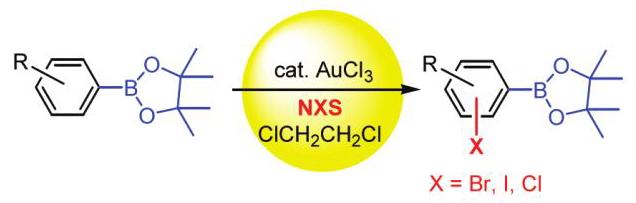
Aromatic boronates bearing halogen substituents in the aromatic ring can be synthesized by ${\mathrm{{AuCl}}}_{3}$ -catalyzed halogenations with N-halosuccinimides.
Functionalized aromatic boronic acids and esters have attracted great attention in recent years because of their extensive application in organic synthesis as well as in other fields. ${}^{1,2}$ Aromatic boronates bearing halogen substituents are particularly valuable because multiple Suzuki-Miyaura cross-coupling reactions are possible from such compounds. ${}^{3}$ Halogen-substituted arylboronic compounds have been commonly synthesized by selective monoborylation of aromatic substrates bearing more than one halide. ${}^{4}$ Apparently, this approach is limited in scope by the availability of multih-alogen-substituted aromatic starting materials as well as by the difficulties associated with the selective monoborylation. Recently, direct C-H borylation of mono- and dihaloarenes has been developed into a useful method for preparing haloarylboronates. ${}^{5}$
On the other hand, halogenation of arylboronic compounds would be an attractive alternative approach to access these arylboronic compounds. Although arylboronic compounds are relatively stable in general, their further derivatization has been found difficult due to the chemical property of the boron group that makes them reactive toward commonly used organic reagents. In particular, protodeboronation or ipso substitution of the boron group easily occurs. ${}^{6}$ For this reason, halogenation of arylboronic acid derivatives has been rarely documented in the literature. In 1961, Kuivila and co-workers reported AcOH-mediated bromination and chlorination of arylboronic acids. The reaction is only limited to methoxy-substituted arylboronic acids. ${}^{7}$ More recently, Hall and coworkers reported a Ag(I)-mediated iodination and bromination of arylboronic acids. ${}^{8}$ The reaction occurs under mild conditions $\left( {{25}^{ \circ }\mathrm{C}}\right)$ and is regioselective. However, this reaction is generally restricted to arylboronic acids bearing electron-donating substituents, and moreover, a stoichiometric amount of silver salt is used.
(5) For a recent review, see: Mkhalid, I. A. I.; Barnard, J. H.; Marder, T. B.; Murphy, J. M.; Hartwig, J. F. Chem. Rev. 2010, 110, 890.
(6) For examples, see: (a) Kabalka, G. W.; Sastry, K. A. R.; Sastry, U.; Somayaji, V. Org. Prep. Proced. Int. 1982, 14, 359. (b) Thiebes, C.; Prakash, G. K. S.; Petasis, N. A.; Olah, G. A. Synlett 1998, 2, 141. (c) Szumigala, R. H., Jr.; Devine, P. N.; Gauthier, D. R., Jr.; Volante, R. P. J. Org. Chem. 2004, 69, 566. (d) Thompson, A. L. S.; Kabalka, G. W.; Akula, M. R.; Huffman, J. W. Synthesis 2005, 547. (e) Murphy, J. M.; Liao, X.; Hartwig, J. F. J. Am. Chem. Soc. 2007, 129, 15434. (f) Wu, H.; Hynes, J., Jr. Org. Lett. 2010, 12, 1192.
(1) For selected reviews, see: (a) Suzuki, A. Acc. Chem. Res. 1982, 15, 178. (b) Miyaura, N.; Suzuki, A. Chem. Rev. 1995, 95, 2457. (c) Miyaura, N. J. Organomet. Chem. 2002, 653, 54. (d) Miyaura, N. Bull. Chem. Soc. Jpn. 2008, 81, 1535. (e) Merino, P.; Tejero, T. Angew Chem. Int. Ed. 2010, 49, 7164.
(2) Hall, D. G. Boronic Acids; Wiley-VCH: Weinheim, 2005.
(2) Hall, D. G. Boronic Acids; Wiley-VCH: Weinheim, 2005。
(3) (a) Wang, C.; Glorius, F. Angew. Chem., Int. Ed. 2009, 48, 5240. (b) Tobisu, M.; Chatani, N. Angew. Chem., Int. Ed. 2009, 48, 3565.
(3) (a) Wang, C.; Glorius, F. Angew. Chem., Int. Ed. 2009, 48, 5240。(b) Tobisu, M.; Chatani, N. Angew. Chem., Int. Ed. 2009, 48, 3565。
(4) For examples, see: (a) Kabalka, G. W.; Sastry, U.; Sastry, K. A. R. J. Organomet. Chem. 1983, 259, 269. (b) Ishiyama, T.; Murata, M.; Miyaura, N. J. Org. Chem. 1995, 60, 7508. (c) Baron, O.; Knochel, P. Angew. Chem., Int. Ed. 2005, 44, 3133. (d) Jiang, Q.; Ryan, M.; Zhichkin, P. J. Org. Chem. 2007, 72, 6618. (e) Ablordeppey, S. Y.; Altundas, R.; Bricker, B.; Zhu, X. Y.; Eyunni, V. K.; Kumar, S.; Jackson, T.; Khan, A.; Roth, B. L. Bioorg. Med. Chem. 2008, 16, 7291. (f) Konno, H.; Aimoto, S.; Smith, S. O.; Nosaka, K.; Akaji, K. Bioorg. Med. Chem. 2009, 17, 5769.
${\mathrm{{We}}}^{9}$ have recently reported a highly efficient ${\mathrm{{AuCl}}}_{3}$ - catalyzed halogenation of aromatics by $N$ -bromo-, $N$ -iodo-, and $N$ -chlorosuccinimide (NBS, NIS, and NCS, respectively). ${}^{{10},{11}}$ The halogenation conditions are mild, and in particular, the catalyst loading of ${\mathrm{{AuCl}}}_{3}$ is very low (0.01-1.0 mmol %). In this paper, we further demonstrate that ${\mathrm{{AuCl}}}_{3}$ can also be used for the halogenation of arylboronates. The reaction is highly efficient and demonstrates high regioselectivities in most cases.
At the outset, we observed with delight that the bromination of pinacol benzylboronate with NBS occurs efficiently with $2\mathrm{\;{mol}}\% {\mathrm{{AuCl}}}_{3}$ in ${\mathrm{{ClCH}}}_{2}{\mathrm{{CH}}}_{2}\mathrm{{Cl}}$ (DCE) at ${60}^{ \circ }\mathrm{C}$ (Table 1, entry 1). However, the regioselectivity is rather low, with the ratio of ortholmeta/para being nearly 1:1:1. We proceeded to compare other typical Lewis acid catalysts that have been widely used for bromination with NBS. The results summarized in Table 1 clearly demonstrate that ${\mathrm{{AuCl}}}_{3}$ has much higher efficiency. Strong Lewis acids, such as ${\mathrm{{FeCl}}}_{3}$ and FeBr3, which are commonly used as Lewis acid catalysts in halogenation reactions, only afforded conversion of 51% and 12%, respectively, even with a catalyst loading of 20 mol % (Table 1, entries 2 and 3), while ${\mathrm{{BF}}}_{3} \cdot {\mathrm{{OEt}}}_{2}$ only afforded a conversion of less than $5\%$ (entry 4). ${\mathrm{{NH}}}_{4}{\mathrm{{NO}}}_{3}$ , which has been an efficient catalyst in this type of reaction as reported by Tanemura and co-workers, ${}^{{10}\mathrm{a}}$ was not efficient (entry 5). Moreover, we found that neither ${\mathrm{{AlCl}}}_{3}$ nor ${\mathrm{H}}_{2}{\mathrm{{SO}}}_{4}$ was active in this reaction (entries 6 and 7). Finally, control experiments in the absence of ${\mathrm{{AuCl}}}_{3}$ demonstrate that $\mathrm{{Au}}$ catalyst is required for the halogenation (entry 8).
Table 1. Bromination of Pinacol Phenylboronate Using Various Catalysts ${}^{a}$

| entry | catalyst (mol %) | conversion ${}^{b}$ (%) |
| 1 | ${\mathrm{{AuCl}}}_{3}$ (2) | 100 |
| 2 | ${\mathrm{{FeCl}}}_{3}$ (20) | 51 |
| 3 | ${\mathrm{{FeBr}}}_{3}\left( {20}\right)$ | 12 |
| 4 | ${\mathrm{{BF}}}_{3} \bullet {\mathrm{{OEt}}}_{2}\left( {20}\right)$ | <5 |
| 5 | ${\mathrm{{NH}}}_{4}{\mathrm{{NO}}}_{3}\left( {20}\right)$ | <5 |
| 6 | ${\mathrm{{AlCl}}}_{3}\left( {20}\right)$ | <5 |
| 7 | ${\mathrm{H}}_{2}{\mathrm{{SO}}}_{4}\left( {20}\right)$ | <5 |
| 8 | none | <5 |
${}^{a}$ Reaction conditions: PhBpin (1 mmol), NBS (1.2 mmol), DCE (2 $\mathrm{{mL}}),{60}^{ \circ }\mathrm{C},6\mathrm{\;h}.{}^{b}$ Conversion was determined by GC-MS with $n$ -dodecane as the internal standard. DCE: 1,2-dichloroethane. NBS: N-bromosuccinimide.
With the efficient ${\mathrm{{AuCl}}}_{3}$ -catalyzed halogenations being confirmed, we then proceeded to study the scope of the reaction. ${}^{12}$ A variety of arylboronate substrates have been subjected to the reaction and the data are shown in Table 2. The results show that ${\mathrm{{AuCl}}}_{3}$ could catalyze a wide range of arylboronates, including these bearing heterocyclic rings (entries 13, 14, and 20). Moreover, the reaction works well with arylboronates bearing electron-withdrawing substituents on aromatic rings, although higher catalyst loading and reaction temperature as well as longer reaction times are required in these cases (entries 7-12). It was particularly noted that temperature was an important factor for the reaction. Depending on the substrates, the reaction temperature needs to be adjusted to enable complete bromination. Moreover, high temperature in some cases led to multiha-logenation. It has been noted that the 2-position of thiophene is more active so the bromination or iodination occurs at the 2-position preferentially (entries 13, 14, and 20). The low yield in the case of $1\mathrm{\;m}$ is due to the ipso substitution of the boron group by the bromine (entry 13).
The structures of the halogenation products have been established by spectra data. ${}^{13}$ Moreover, four of them are further confirmed by X-ray crystallographic analyses of the products (2a, 2f) or their corresponding hydrolyzed acids (2b’, 2q’) (Figure 1).
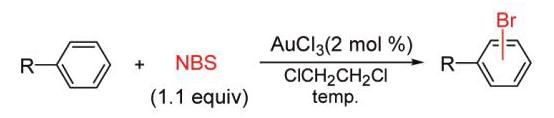
An interesting question in the halogenation of arylbor-onates concerns the property of the boronate group in affecting the halogenation activity and regioselectivity. We proceeded to investigate this issue by comparing the halogenation of benzene and pinacol phenylboronate under identical conditions. The data collected in Table 3 demonstrate that the pinacol boronate group is a weak activating group (compare entries 1-4). Next, we found that in the bromination of phenylboronate the corresponding products could be isolated in 75% yield as regioisomers. The ratio of ortholmeta/para is nearly 1:1:1 as detected by ${}^{1}\mathrm{H}$ NMR. The directing effect of boron is obscure with the ratio of ortho + para versus meta being approximately 2:1, which means meta is slightly disfavored.
The experiments suggest that the pinacol boronate group is a weakly activating and ortho/para-directing group. This may be explained by the following reasoning. First, boron has smaller value of electronegativity than carbon (2.04 versus 2.55). Consequently, the inductive effect of boron is electron-donating. On the other hand, since boron has an empty p-orbital, the resonance effect is electron-withdrawing. However, the boron may be complexed with a Lewis base (such as carbonyl oxygen of succinimide) in the reaction system, which may counteract the electron-withdrawing effect. ${}^{14}$
(7) Kuivila, H. G.; Benjamin, L. E.; Murphy, C. J.; Price, A. D.; Polevy, J. H. J. Org. Chem. 1962, 27, 825.
(8) Al-Zoubi, R. M.; Hall, D. G. Org. Lett. 2010, 12, 2480.
(9) Mo, F.; Yan, J. M.; Qiu, D.; Li, F.; Zhang, Y.; Wang, J. Angew. Chem., Int. Ed. 2010, 49, 2028.
(10) For examples of halogenations with NXS, see: (a) Tanemura, K.; Suzuki, T.; Nishida, Y.; Satsumabayashi, K.; Horaguchi, T. Chem. Lett. 2003, 32, 932. (b) Zhang, Y.; Shibatomi, K.; Yamamoto, H. Synlett 2005, 2837. (c) Zysman-Colman, E.; Arias, K.; Siegel, J. S. Can. J. Chem. 2009, 87, 440.
(11) For examples of tramsition-metal-catalyzed halogenation with NXS, see: (a) Kalyani, D.; Dick, A. R.; Anani, W. Q.; Sanford, M. S. Org. Lett. 2006, 8, 2523. (b) Kalyani, D.; Dick, A. R.; Anani, W. Q.; Sanford, M. S. Tetrahedron 2006, 62, 11483.
(12) For the reaction scope of the boron group, see the Supporting Information.
(13) For details of the structure characterization, see the Supporting Information.
Table 2. ${\mathrm{{AuCl}}}_{3}$ -Catalyzed Halogenation of Pinacol Arylboronates ${}^{a}$
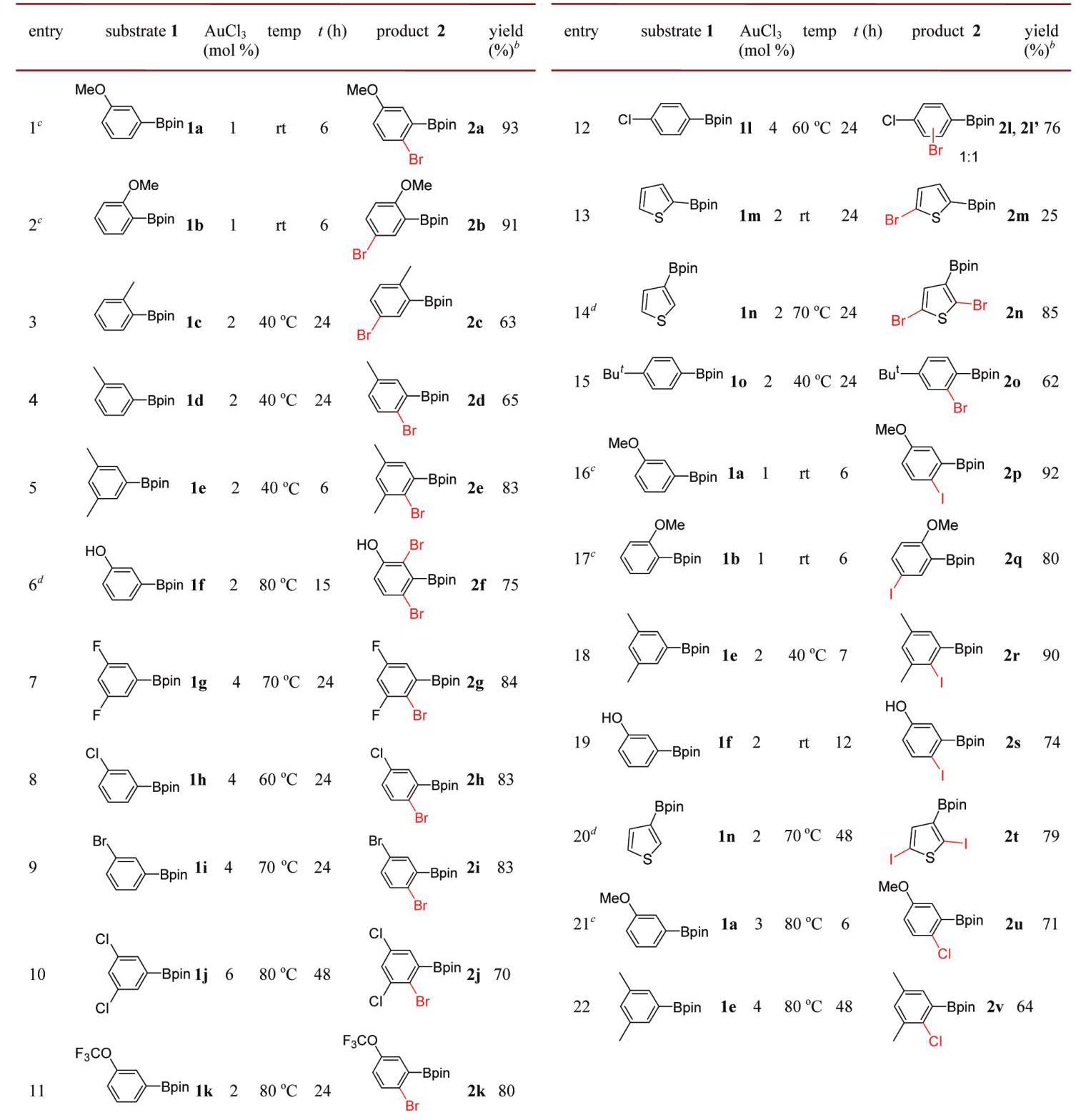
${}^{a}$ Reaction conditions: ArBpin (1 mmol), NXS (1.2 mmol), DCE (2 mL). ${}^{b}$ Isolated yield. ${}^{c}$ 1.0 equiv of NXS was used. ${}^{d}$ 2.4 equiv of NXS was used.
Since the electronic effect of the pinacol boronate group is rather weak, the regioselectivity of the Au-catalyzed bromination is controlled by other substituents on the aromatic ring in most cases. For example, even a weak directing group such as a methyl in the aromatic ring overrides the pinacol boronate group to control the regioselectivity of bromination (Table 2, entry 3). The bromination selectivity of the reaction with pinacol p-tert-butylphenylboronate 1o indicates steric effects also play an important role (Table 2, entry 15). Interestingly, there is an obvious trend that halogenation occurs favorably at the position ortho to the boron substituent. A similar ortho directing effect has also been observed in Hall’s Ag-mediated halogenation reaction. ${}^{8}$
(14) For a discussion of electronic effects of boron groups, see: Entwistle, C. D.; Marder, T. B. Chem. Mater. 2004, 16, 4574.
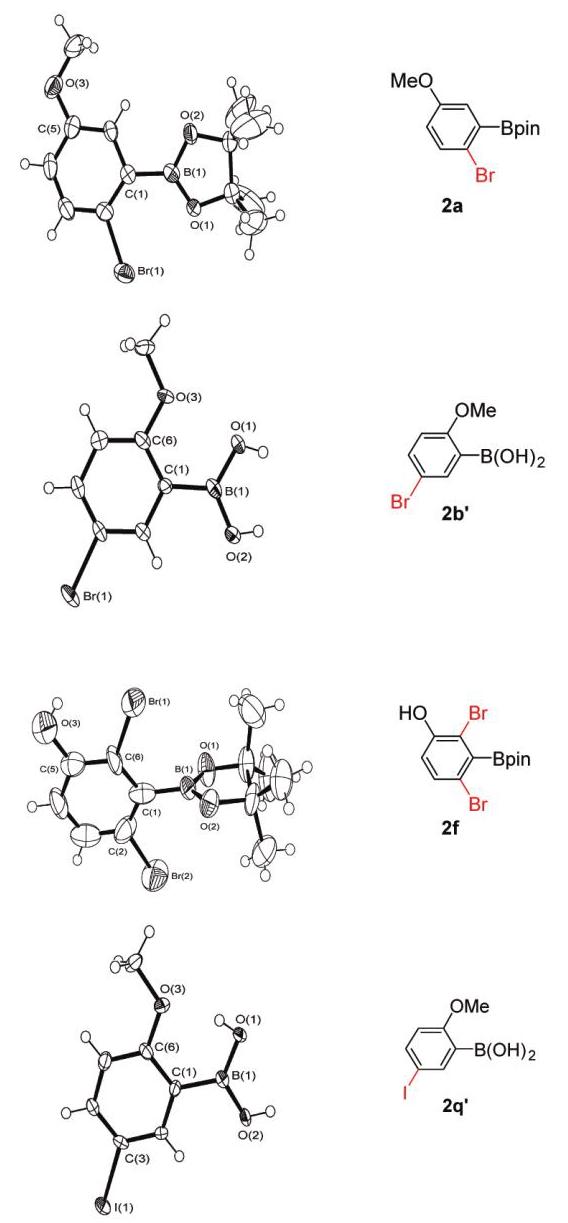
Figure 1. X-ray structures of $2\mathbf{a},2\mathbf{f},2{\mathbf{b}}^{\prime }$ , and $2{\mathbf{q}}^{\prime }$ .
Table 3. Comparison of the Reactivity in ${\mathrm{{AuCl}}}_{3}$ -Catalyzed Bromination ${}^{a}$
| entry | substrate, $\mathrm{R} =$ | temp (°C) | $t$ (h) | conversion ${}^{b}$ (%) |
| 1 | H | 40 | 6 | 15 |
| 2 | H | 40 | 24 | 30 |
| 3 | Bpin | 40 | 6 | 24 |
| 4 | Bpin | 40 | 24 | 46 |
| 5 | H | 60 | 6 | 42 |
| 6 | Bpin | 60 | 6 | >99 |
${}^{a}$ Reaction conditions: R-Ph (1 mmol), NBS (1.1 mmol), DCE (2 mL). ${}^{b}$ Conversion was determined by GC-MS with $n$ -dodecane as the internal standard.
Scheme 1. Application of Halogenated Arylboronic Compounds in Consecutive Suzuki-Miyaura Cross-Coupling
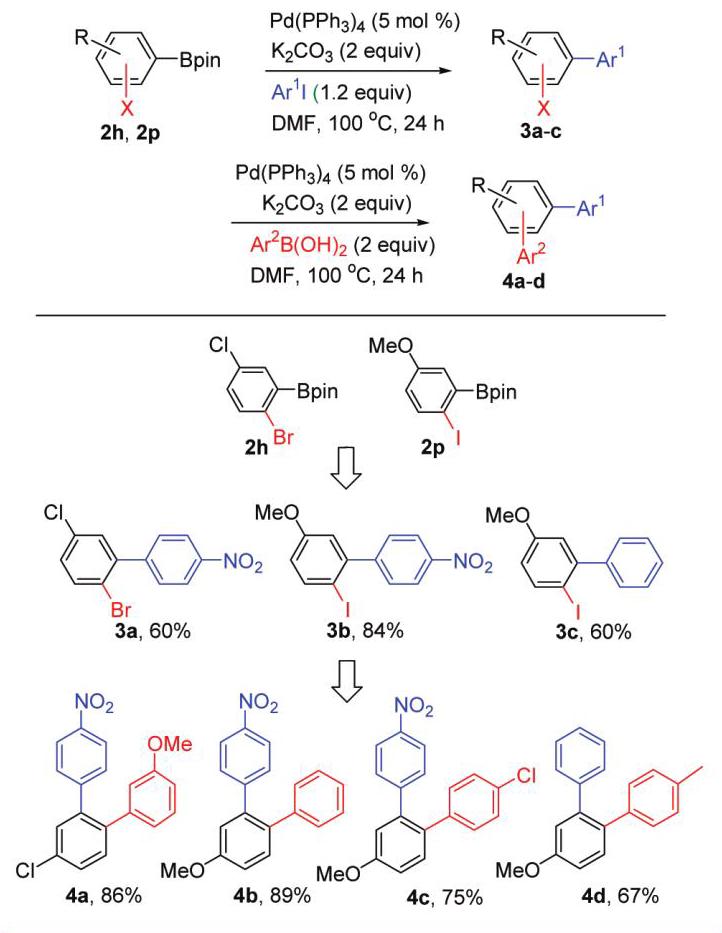
The halogenated arylboronic compounds are valuable in organic synthesis. To demonstrate the utility of the products, we have carried out experiments of consecutive Suzuki-Miyaura coupling reactions (Scheme 1). Thus, starting from 2h and 2p, substituted o-terphenyl products 4a-d could be prepared in two steps in high yields.
In conclusion, we have developed an efficient catalytic halogenation reaction of arylboronates. It has the advantages of low catalyst loading, mild halogenation conditions, and generally good yields and high regioselectivity. This reaction provides an easy approach toward functionalized arylbor-onates that are otherwise difficult to access.
Acknowledgment. This project was supported by the NSFC (Grant Nos. 20902005, 20832002, 20772003, 20821062) and 973 Program (No. 2009CB825300).
Supporting Information Available: Experimental procedure, characterization data, and ${}^{1}\mathrm{H}$ and ${}^{13}\mathrm{C}$ NMR spectra for all new compounds. This material is available free of charge via the Internet at http://pubs.acs.org.
OL102350V