Photocarboxylation of Remote C-H Bond through Nitrogen-Centred Radicals 1,5-Hydrogen Atom Transfer
中文 / Bilingual · English version
Wenke Li," Beiqi Sun," Lei Zhang" and Fanyang Mo D *b
Check for updates
Cite this: Green Chem., 2023, 25, 5030
Received 2nd May 2023, Accepted 13th June 2023
DOI: 10.1039/d3gc01426f
DOI: 10.1039/d3gc01426f
rsc.li/greenchem
rsc.li/greenchem
The carboxylation of the $\mathrm{C} - \mathrm{H}$ bond utilizing ${\mathrm{{CO}}}_{2}$ represents a challenging but attractive tactic for capitalizing on the abundant availability of ${\mathrm{{CO}}}_{2}$ in organic synthesis. In this investigation, we report visible-light-driven carboxylation of a remote C-H bond via a nitrogen-centered 1,5-hydrogen atom transfer (1,5-HAT) mechanism. The achievement of direct photocarboxylation of the remote benzylic $\mathrm{C} - \mathrm{H}$ bond has been realized. The functionalization of electron-deficient alkenes, in conjunction with remote aliphatic $\mathrm{C} - \mathrm{H}$ bonds and ${\mathrm{{CO}}}_{2}$ , has been developed employing the 1,5-HAT strategy as well. These methods enable the photocarboxylation of different types of $\mathrm{C} - \mathrm{H}$ bonds and feature mild reaction conditions, a comprehensive range of substrates, and exceptional functional group tolerance, providing a sustainable and eco-friendly approach to valuable carboxylic acids and derivatives.
The efficient and selective functionalization of unactivated $\mathrm{C}\left( {\mathrm{{sp}}}^{3}\right) - \mathrm{H}$ bonds is a long-sought-after goal in organic synthetic chemistry. ${}^{1}$ However, the inherently low reactivity and ubiquity of these bonds present considerable challenges. As an alternative to transition-metal-catalyzed C-H activation, the hydrogen atom transfer (HAT) strategy has garnered significant attention due to its capacity to facilitate site-selective functionalization of $\mathrm{C}\left( {\mathrm{{sp}}}^{3}\right) - \mathrm{H}$ in complex molecules. ${}^{2}$ According to the reports, 1,5-HAT has broadly expanded the potential of C-H bond activation, constituting a significant breakthrough in the site-selective functionalization of remote inert $\mathrm{C}\left( {\mathrm{{sp}}}^{3}\right) - \mathrm{H}$ in complex molecules. ${}^{3 - 6}$ The initial application via 1,5-HAT, embodied by the Hofmann-Löffler-Freytag (HLF) reaction (Fig. 1a), can be traced back to the late 19th century. This reaction proceeds via the generation of a nitrogen-centered radical, followed by an intramolecular 1,5-HAT process, ultimately yielding a carbon-centered radical. ${}^{7,8}$ However, the harsh conditions of the HLF reaction confine its extensive application to organic synthesis.
Recently, the renaissance of photochemistry has promoted the development of milder ways of exploring this reactivity. The synergism of visible-light photoredox catalysis with 1,5-HAT led to the development of the remote functionalization of $\mathrm{C}\left( {\mathrm{{sp}}}^{3}\right) - \mathrm{H}$ bonds. ${}^{3 - 5,9,{10}}$
Over the past few decades, the amidyl radical-based 1,5- HAT process has been widely reported. In 2016, the Knowles and Rovis groups independently reported the generation of amidyl radicals via the proton-coupled electron transfer (PCET) process (Fig. 1b). ${}^{{11},{12}}$ The direct $\mathrm{N} - \mathrm{H}$ bond cleavage is the crucial step, resulting in the generation of amidyl radicals. Subsequently, the translocated carbon-centered radical reacted with the alkene with electron-withdrawing groups (EWGs) by the Giese radical addition reaction leading to remote C-H functionalization. Another method to generate amidyl radicals is via N-X bond cleavage, including N-halogen bond cleavage, ${}^{{13} - {15}}\mathrm{\;N} - \mathrm{N}$ bond cleavage, ${}^{16}$ and $\mathrm{N} - \mathrm{O}$ cleavage. ${}^{4,{17} - {19}}$ Prompted by the interest in the nitrogen-centered-radical based 1,5-HAT strategy, researchers recently have made remarkable contributions to remote $\mathrm{C} - \mathrm{H}$ bond functionali-zation via nitrogen-centered-radical (NCR)-triggered radical translocation processes. These innovative approaches have enabled the formation of a diverse range of bonds, including the building of C-C, ${}^{{13},{20}}$ C-O, ${}^{{21},{22}}$ C-N, ${}^{{23} - {26}}$ C-S, ${}^{27}$ and C-X $\left( {\mathrm{X} = \text{ halogen }}\right)$ bonds. ${}^{{14},{19},{28}}$
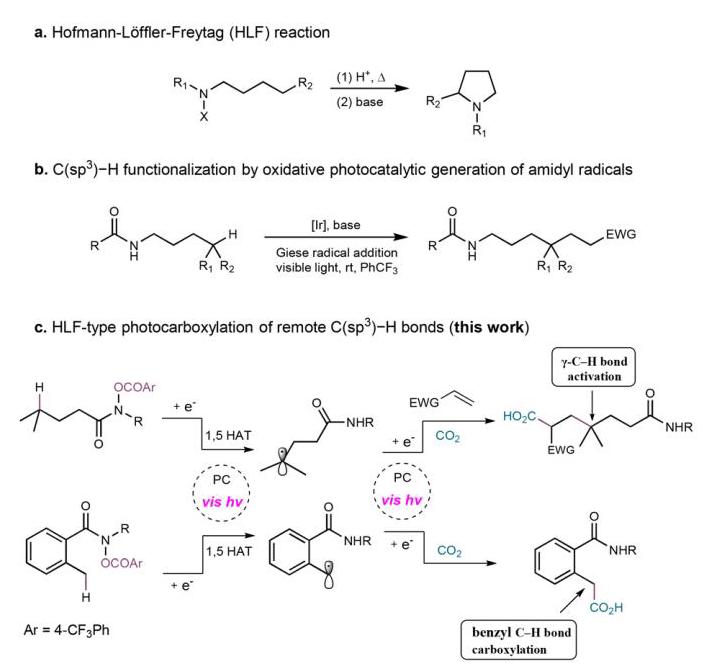
Fig. 1 Visible light-driven carboxylation of a $\mathrm{C}\left( {\mathrm{{sp}}}^{3}\right) - \mathrm{H}$ bond with ${\mathrm{{CO}}}_{2}$ .
${}^{a}$ College of Engineering, Peking University, Beijing 100871, China
${}^{b}$ School of Materials Science and Engineering, Beijing 100871, China.
† Electronic supplementary information (ESI) available. See DOI: https://doi.org/ 10.1039/d3gc01426f
Owing to its abundance, minimal toxicity, and renewability, carbon dioxide $\left( {\mathrm{{CO}}}_{2}\right)$ , the well-known greenhouse gas, emerges as an ideal one-carbon building block for the formation of C-C bonds in organic synthesis. ${}^{{28} - {32}}$ Carboxylation employing ${\mathrm{{CO}}}_{2}$ epitomizes a remarkable transformation, proffering a highly atom-economical route to the synthesis of valuable carboxylic acids and their derivatives. ${}^{{33} - {36}}$ The emerging visible-light-induced carboxylation in organic synthesis has recently encountered an intriguing transformation. ${}^{{37} - {41}}$ Many researchers have made outstanding contributions to the carboxylation of different types of $\mathrm{C} - \mathrm{H}$ bonds. ${}^{{42} - {57}}$ In this context, the generation of carbanions via visible-light photoredox catalysis, concomitant with the reduction of ${\mathrm{{CO}}}_{2}$ for carboxylation purposes, has emerged as a prevalent methodology employed in photo-carboxylation reactions. ${}^{{43},{45},{46},{49},{54},{57},{58}}$ He and co-workers have meticulously detailed recent work related to photocarbox-ylation reactions involving ${\mathrm{{CO}}}_{2}$ in their comprehensive review. ${}^{{59},{60}}$ In 2015, Murakami and his colleagues disclosed a unique approach wherein ultraviolet light excitation ( ${365}\mathrm{\;{nm}}$ ) was employed to amalgamate the 1,5-hydrogen atom transfer (HAT) process with carboxylation, offering new insights for the photocarboxylation of remote carbon-hydrogen bonds. ${}^{61}$ The nitrogen-centered-radical based HLF-type remote $\mathrm{C}\left( {\mathrm{{sp}}}^{3}\right) - \mathrm{H}$ functionalization, which involves the 1,5-HAT process and subsequent Giese radical addition, is a widely recognized and established mechanism within the field of organic chemistry. ${}^{{11},{12}}$ However, nitrogen-centered-radical based HLF-type remote $\mathrm{C}\left( {\mathrm{{sp}}}^{3}\right) - \mathrm{H}$ photocarboxylation is still synthetically challenging and remains mainly unexplored. Herein, we disclose an innovative method for the carboxylation of remote $\mathrm{C}\left( {\mathrm{{sp}}}^{3}\right) - \mathrm{H}$ bonds with ${\mathrm{{CO}}}_{2}$ under visible light irradiation, utilizing a nitrogen-centered 1,5-hydrogen atom transfer strategy (Fig. 1c). To the best of our knowledge, this is the first report on the combination of the nitrogen-centered-radical based HLF-type reaction with photocarboxylation.
Due to the inherently weak N-O bond, hydroxylamine derivatives have been seen as prominent precursors for the generation of amidyl radicals through visible-light photoredox catalysis. Inspired by the Yu group, ${}^{3,{62}}$ we have harnessed hydroxamic acid derivatives as amidyl radical precursors and exploited the carbon-centered radical engendered via the migration of the 1,5-HAT process to realize the photocarboxyla-tion of different types of remote C-H bonds. In the case of remote aliphatic C-H bonds, we herein reported a visible-light-promoted functionalization of alkenes by employing abundant ${\mathrm{{CO}}}_{2}$ and aliphatic hydroxamic acid derivatives. For remote benzylic C-H bonds, photocarboxylation could be realized directly. These strategies for remote C-H bond photocarboxyla-tion, characterized by their exceptional step-economy and ambient conditions with visible light, enable the assembly of molecular complexity in an environmentally benign and sustainable pattern.
We envisioned a photoredox process involving the 1,5-HAT process, the subsequent Giese radical addition, and the reduction of the radical intermediate to a carbanion, which subsequently leads to a nucleophilic attack on carbon dioxide resulting in carboxylation products. For remote aliphatic C-H bonds, the initial reaction conditions were established by employing a hydroxamic acid derivative 1a as the model substrate and benzyl acrylate 2a as a radical acceptor, with a solvent, photocatalyst, base, and ${\mathrm{{CO}}}_{2}$ under blue light irradiation at ambient temperature. After a series of methodical investigations of the reaction parameters, we obtained in the presence of benzyl acrylate as the radical acceptor, (Ir[dF $\left. {{\left( {\mathrm{{CF}}}_{3}\right) }_{\mathrm{{PPy}}}{\rbrack }_{2}\left( \text{ dtbpy }\right) }\right) {\mathrm{{PF}}}_{6}$ in DMF as the photocatalyst, ${\mathrm{{Cs}}}_{2}{\mathrm{{CO}}}_{3}$ as the base and DIPEA as the additive under a ${\mathrm{{CO}}}_{2}$ atmosphere, under the optimal conditions, the desired product 3a in 82% yield. Nearly no carboxylation product 3a was detected in the absence of either $\left( {\operatorname{Ir}{\left\lbrack \mathrm{{dF}}\left( {\mathrm{{CF}}}_{3}\right) \mathrm{{ppy}}\right\rbrack }_{2}\left( \mathrm{{dtbpy}}\right) }\right) {\mathrm{{PF}}}_{6}$ , carbon dioxide, or DIPEA as an additive or light, demonstrating that these four components were essential (entries 2-5). It should be noted that lower yields were obtained when replacing the photocatalyst, in the absence of ${\mathrm{{Cs}}}_{2}{\mathrm{{CO}}}_{3}$ , when changing the solvent, when reducing the amount of photocatalyst, or when shortening the reaction time (entries 6-11).
With the optimal reaction conditions, the generality of this three-component carboxylation was investigated with a variety of hydroxamic acid derivatives and alkenes, as summarized in Table 1; benzyl acrylate was selected as a radical acceptor, and different types of aliphatic hydroxamic acid derivatives as starting materials delivered the expected products in good yields (3a, 3b, 3c, and 3d). The scope of electron-withdrawing group alkenes was explored subsequently, including 2-phenoxyetha-nol acrylate (3e) and a series of alkyl acrylate esters (3f, 3g, 3h), which delivered the corresponding products in moderate-to-good yields (61-80%). Moreover, styrene with an electron-withdrawing substituent at the para position, such as cyano (3i) and esters (3j), also delivered the expected products in good yields (Fig. 2).
Table 1 Optimization of the reaction conditions ${}^{a}$
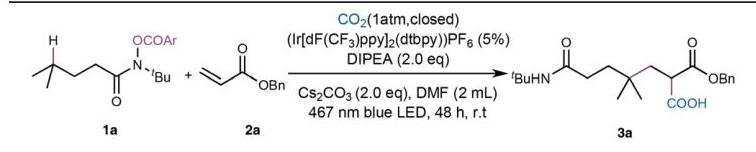
| Entry | Deviations | Yields ${}^{b}\left( \% \right)$ |
| 1 | None | 82 (75) |
| 2 | No light | Trace |
| 3 | No $\left( {{\mathrm{{Ir}\left\lbrack {{dF}\left( {C{F}_{3}}\right) {ppy}}\right\rbrack }}_{2}\left( \text{ dtbpy }\right) }\right) {\mathrm{{PF}}}_{6}$ | Trace |
| 4 | ${\mathrm{N}}_{2}$ instead of ${\mathrm{{CO}}}_{2}$ | Trace |
| 5 | No DIPEA | Trace |
| 6 | 4CzIPN instead of $\left( {\operatorname{Ir}{\left\lbrack \mathrm{{dF}}\left( {\mathrm{{CF}}}_{3}\right) \mathrm{{ppy}}\right\rbrack }_{2}\left( \mathrm{{dtbpy}}\right) }\right) {\mathrm{{PF}}}_{6}$ | 35 |
| 7 | No ${\mathrm{{Cs}}}_{2}{\mathrm{{CO}}}_{3}$ | 61 |
| 8 | 456 nm instead of 467 nm | 58 |
| 9 | ${\mathrm{{CH}}}_{3}\mathrm{{CN}}$ instead of DMF | 29 |
| 10 | $\left( {\mathrm{{Ir}}{\left\lbrack \mathrm{{dF}}\left( {\mathrm{{CF}}}_{3}\right) \mathrm{{ppy}}\right\rbrack }_{2}\left( \mathrm{{dtbpy}}\right) }\right) {\mathrm{{PF}}}_{6}\left( {2\% }\right)$ | 65 |
| 11 | 24 h | 71 |
${}^{a}$ Reaction conditions: 1a (0.2 mmol),1b (5.0 eq.),(Ir[dF(CF ${}_{3}$ ) ppy] ${}_{2}$ (dtbpy)) ${\mathrm{{PF}}}_{6}$ (5%), DIPEA (2.0 eq.), ${\mathrm{{Cs}}}_{2}{\mathrm{{CO}}}_{3}$ (2.0 eq.), DMF (2 mL), and irradiation by Kessil ${40}\mathrm{\;W}$ blue LED for ${48}\mathrm{\;h}$ under 1 atm ${\mathrm{{CO}}}_{2}$ at ambient temperature. ${}^{b{}^{1}}\mathrm{H}$ NMR yields using 1,1,2,2-tetrachloroethane as an internal standard with the yields of isolated products given in parentheses. DMF = $N, N$ -dimethylformamide and DIPEA = $N, N$ - diisopropylethylamine.
With the successful development of three-component carboxylation of the aliphatic hydroxamic acid derivative with electron-withdrawing alkenes, we envisioned that the same strategy might be possibly extended to the benzylic hydroxamic acid derivative 4a. Intriguingly, when 4a was used as the model substrate and benzyl acrylate 4a or styrene derivative 4c was used as the radical acceptor, both the direct carboxylation product and the alkene addition carboxylation products were detected (Fig. 3). When benzyl acrylate was chosen as the radical acceptor, the ratio of the direct carboxylation product to the alkene addition carboxylation product was almost the same, both in moderate yields. If the styrene derivatives were chosen as the model alkene, the selectivity of the alkene carboxylation product was increased to 74%. We speculate that the benzyl carbanion must be stable enough to result in the formation of direct carboxylation products.
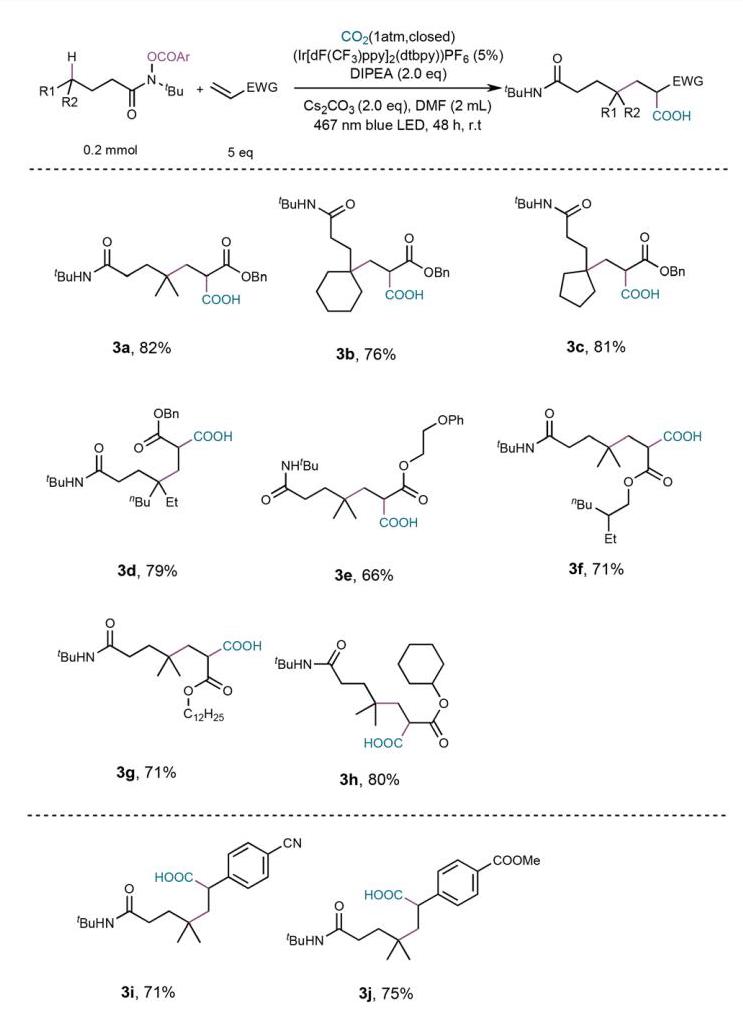
Fig. 2 Scope of carboxylation of remote $\mathrm{C} - \mathrm{H}$ bonds with electron-deficient alkenes and ${\mathrm{{CO}}}_{2}$ .
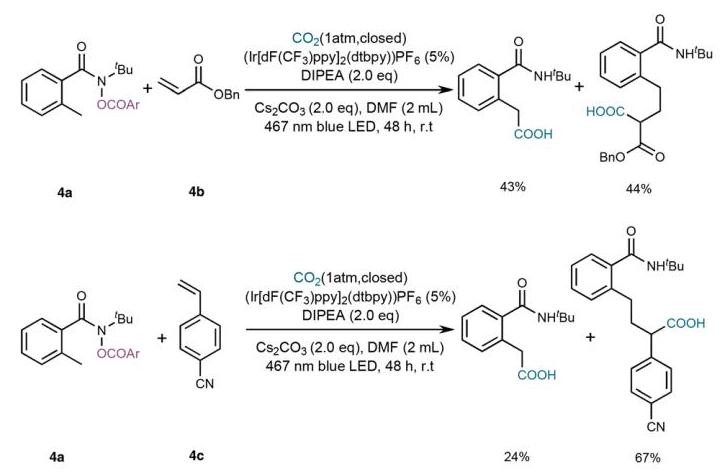
Fig. 3 The reaction of benzylic hydroxamic acid derivatives with electron-deficient alkenes and ${\mathrm{{CO}}}_{2}$ .
Under the optimal reaction conditions, we then investigated the substrate scope of this visible-light-driven metal-free remote benzylic $\mathrm{C} - \mathrm{H}$ bond carboxylation. As summarized in Fig. 4, a broad range of benzylic hydroxamic acid derivatives bearing diverse functional groups on the central arene amide as starting materials, including fluoro (6j, 6k), bromo (6e), chloro (6f), methyl (6b, 6i), and methoxy (6d, 6h), delivered the corresponding products in moderate-to-good yields (57-82%). The substrates bearing methyl disubstitution on the arene core (6i) were also suitable. This reaction was not hampered by ortho substitution (6h, 6k) on the central benzene ring. When the isopropyl or cyclohexyl benzylic hydroxamic acid derivatives were used as starting materials, a low yield of the desired product was obtained (6c, 6g).
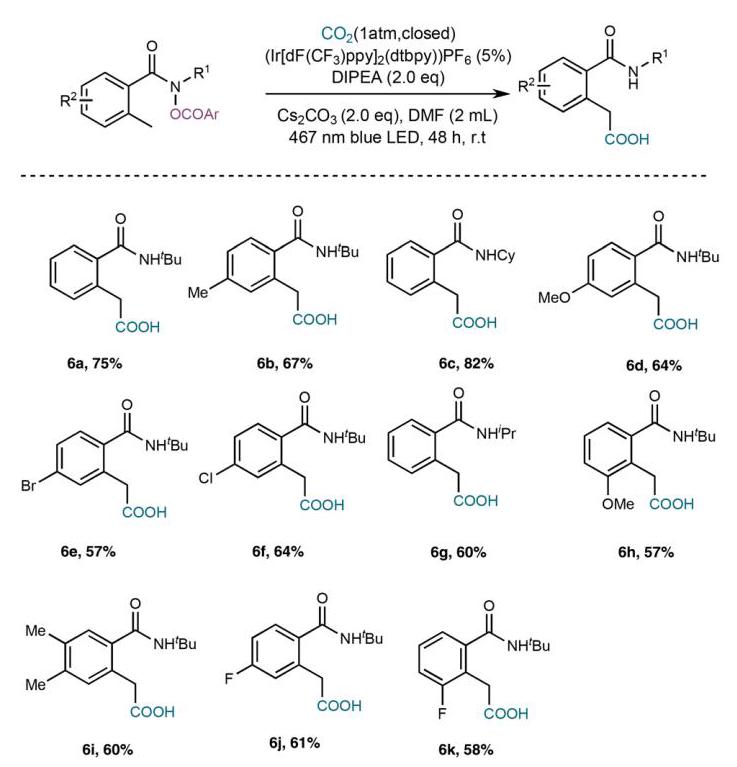
Fig. 4 Scope of carboxylation of remote benzylic $\mathrm{C} - \mathrm{H}$ bonds with ${\mathrm{{CO}}}_{2}$ .
A series of control experiments were conducted to gain more mechanistic insight into this new transformation. We initially carried out radical inhibition experiments. As illustrated in Fig. 5, when 2,2,6,6-tetramethyl-1-piperidinyloxy (TEMPO) was added to the standard reaction conditions, we found that the formation of the desired products was significantly inhibited. Moreover, the direct TEMPO trapping products were detected simultaneously (7a, 7b), suggesting that radical intermediates might be involved. When ${\mathrm{D}}_{2}\mathrm{O}$ was added to the reaction mixture, up to 85% deuterium incorporation at the benzylic position of $7\mathbf{c}$ was observed, suggesting the formation of a benzylic carbanion intermediate.
Based on the control experiments and previous studies, ${}^{4}$ a plausible mechanism for the overall transformation is proposed and outlined in Fig. 6. First, the Ir ${}^{\mathrm{{III}}}$ -photocatalyst, upon photoexcitation, would reduce the hydroxamic acid derivatives, which could deliver the amidyl radical intermediate I through fragmentation and regenerate the requisite ${\operatorname{Ir}}^{\mathrm{{IV}}}$ . The electrophilic amidyl radical I would promote a 1,5-hydrogen atom transfer, affording the radical intermediate II, after the subsequent Giese radical addition generating the intermediate III, which would be reduced by the Ir ${}^{\mathrm{{III}}}$ species to both afford the carbon anion intermediate IV and regenerate the requisite ${\operatorname{Ir}}^{\mathrm{{IV}}}$ . The subsequent nucleophilic attack on ${\mathrm{{CO}}}_{2}$ and the following protonation can provide the observed carboxylic acids. The photoactive ${\operatorname{Ir}}^{\mathrm{{IV}}}$ -photocatalyst is likely to be regenerated by oxidizing a molecule of DIPEA.
In conclusion, we herein report the combination of the HLF-type reaction with photocarboxylation. The visible-light-driven carboxylation of remote $\mathrm{C} - \mathrm{H}$ bonds by nitrogen-centered radical 1,5-hydrogen atom transfer was developed. Unlike previously reported ways of generating radicals, our control experimental investigations strongly indicate N-O cleavage and 1,5-hydrogen atom transfer to be the essential steps for the generation of radicals, which were reduced to the corresponding carbanions through single-electron transfer. Subsequently, the carbanions further underwent nucleophilic attack on ${\mathrm{{CO}}}_{2}$ to generate carboxylates. It is noteworthy that this reaction proceeds smoothly without adding any metal reagent under mild conditions, affording the desired carboxylic acids in moderate to excellent yields with broad substrate scope. This study presents a representative method of remote C-H bond functionalization.
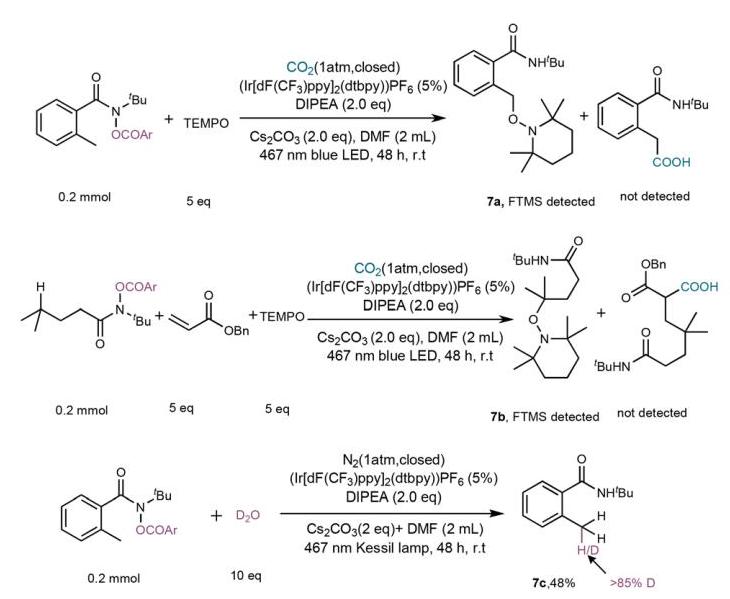
Fig. 5 Control experiments for the elucidation of the mechanism.
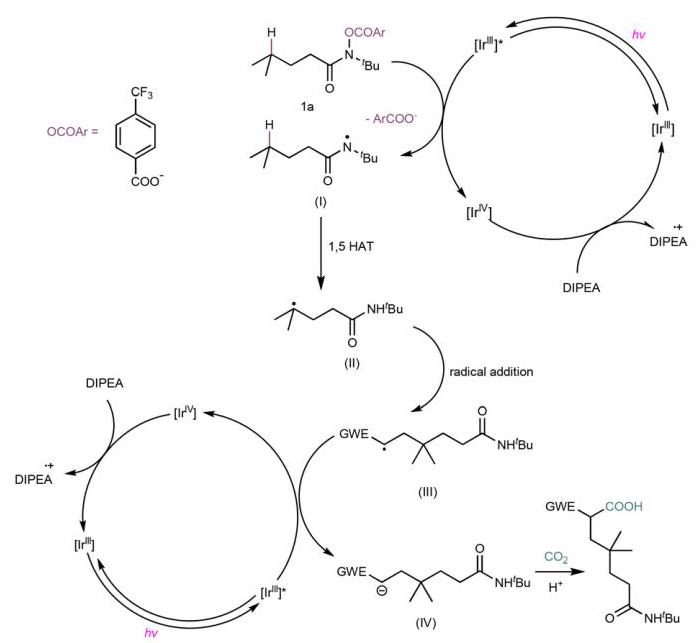
Fig. 6 Plausible reaction mechanism.
Conflicts of interest
There are no conflicts to declare.
Acknowledgements
This work is supported by the Natural Science Foundation of China (Grant No. 22071004, 21933001, 22150013).
References
1 R. G. Bergman, Nature, 2007, 446, 391-393.
2 Q. Min, J. Yang, M. Pang, G. Ao and F. Liu, Org. Lett., 2020, 22, 2828-2832.
3 X. Shen, J. J. Zhao and S. Yu, Org. Lett., 2018, 20, 5523- 5527.
4 H. Chen, W. Jin and S. Yu, Org. Lett., 2020, 22, 5910-5914.
5 L. M. Stateman, K. M. Nakafuku and D. A. Nagib, Synthesis, 2018, 50, 1569-1586.
6 W. Guo, Q. Wang and J. Zhu, Chem. Soc. Rev., 2021, 50, 7359-7377.
7 A. Hofmann, Ber. Dtsch. Chem. Ges., 1882, 15, 762-775.
8 K. Löffler and S. Kober, Ber. Dtsch. Chem. Ges., 1909, 42, 3431-3438.
9 G. Kumar, S. Pradhan and I. Chatterjee, Chem. - Asian J., 2020, 15, 651-672.
10 X. Wu and C. Zhu, CCS Chem., 2020, 2, 813-828.
11 G. J. Choi, Q. Zhu, D. C. Miller, C. J. Gu and R. R. Knowles, Nature, 2016, 539, 268-271.
12 J. C. K. Chu and T. Rovis, Nature, 2016, 539, 272-275.
13 Q. Guo, Q. Peng, H. Chai, Y. Huo, S. Wang and Z. Xu, Nat. Commun., 2020, 11, 1463.
14 Q. Qin and S. Yu, Org. Lett., 2015, 17, 1894-1897.
15 R. Z. Liu, J. Li, J. Sun, X. G. Liu, S. Qu, P. Li and B. Zhang, Angew. Chem., Int. Ed., 2020, 59, 4428-4433.
16 N. Kim, C. Lee, T. Kim and S. Hong, Org. Lett., 2019, 21, 9719-9723.
17 H. Jung, H. Keum, J. Kweon and S. Chang, J. Am. Chem. Soc., 2020, 142, 5811-5818.
18 K. Wu, L. Wang, S. Colon-Rodriguez, G. U. Flechsig and T. Wang, Angew. Chem., Int. Ed., 2019, 58, 1774-1778.
19 S. P. Morcillo, E. M. Dauncey, J. H. Kim, J. J. Douglas, N. S. Sheikh and D. Leonori, Angew. Chem., Int. Ed., 2018, 57, 12945-12949.
20 H. Chen and S. Yu, Org. Biomol. Chem., 2020, 18, 4519- 4532.
21 A. R. Rivero, P. Fodran, A. Ondrejková and C. Wallentin, Org. Lett., 2020, 22, 8436-8440.
22 K. Kim, N. Kim and S. Hong, Bull. Korean Chem. Soc., 2021, 42, 548-552.
23 Q. Min, J. Yang, M. Pang, G. Ao and F. Liu, Org. Lett., 2020, 22, 2828-2832.
24 Y. Zhao and W. Xia, Chem. Soc. Rev., 2018, 47, 2591-2608.
25 E. A. Wappes, S. C. Fosu, T. C. Chopko and D. A. Nagib, Angew. Chem., 2016, 128, 10128-10132.
26 J. Davies, T. D. Svejstrup, D. Fernandez Reina, N. S. Sheikh and D. Leonori, J. Am. Chem. Soc., 2016, 138, 8092-8095.
27 C. G. Na and E. J. Alexanian, Angew. Chem., 2018, 130, 13290-13293.
28 C. Martinez and K. Muniz, Angew. Chem., Int. Ed., 2015, 54, 8287-8291.
29 T. Sakakura, J. C. Choi and H. Yasuda, Chem. Rev., 2007, 107, 2365-2387.
30 T. Sakakura and K. Kohno, Chem. Commun., 2009, 1312- 1330.
31 A. Tortajada, M. Börjesson and R. Martin, Acc. Chem. Res., 2021, 54, 3941-3952.
32 A. Tortajada, F. Hernandez, M. Borjesson, T. Moragas and R. Martin, Angew. Chem., Int. Ed., 2018, 57, 15948-15982.
33 M. Borjesson, T. Moragas, D. Gallego and R. Martin, ACS Catal., 2016, 6, 6739-6749.
34 T. Fujihara and Y. Tsuji, Front. Chem., 2019, 7, 430.
35 K. Huang, C. L. Sun and Z. J. Shi, Chem. Soc. Rev., 2011, 40, 2435-2452.
36 C. S. Yeung, Angew. Chem., Int. Ed., 2019, 58, 5492-5502.
37 Y. Cao, X. He, N. Wang, H. R. Li and L. N. He, Chin. J. Chem., 2018, 36, 644-659.
38 J. Hou, J. S. Li and J. Wu, Asian J. Org. Chem., 2018, 7, 1439-1447.
39 K. Shimomaki, K. Murata, R. Martin and N. Iwasawa, J. Am. Chem. Soc., 2017, 139, 9467-9470.
40 F. Tan and G. Yin, Chin. J. Chem., 2018, 36, 545-554.
41 Z. B. Yin, J. H. Ye, W. J. Zhou, Y. H. Zhang, L. Ding, Y. Y. Gui, S. S. Yan, J. Li and D. G. Yu, Org. Lett., 2017, 20, 190-193.
42 Y. Jin, N. Toriumi and N. Iwasawa, ChemSusChem, 2022, 15, e202102095.
43 H. Seo, M. H. Katcher and T. F. Jamison, Nat. Chem., 2017, 9, 453-456.
44 N. Ishida, Y. Masuda, S. Uemoto and M. Murakami, Chemistry, 2016, 22, 6524-6527.
45 V. R. Yatham, Y. Shen and R. Martin, Angew. Chem., Int. Ed., 2017, 56, 10915-10919.
46 J. H. Ye, M. Miao, H. Huang, S. S. Yan, Z. B. Yin, W. J. Zhou and D. G. Yu, Angew. Chem., Int. Ed., 2017, 56, 15416- 15420.
47 J. Hou, A. Ee, W. Feng, J. H. Xu, Y. Zhao and J. Wu, J. Am. Chem. Soc., 2018, 140, 5257-5263.
48 Q. Y. Meng, S. Wang, G. S. Huff and B. Konig, J. Am. Chem. Soc., 2018, 140, 3198-3201.
49 L. L. Liao, G. M. Cao, J. H. Ye, G. Q. Sun, W. J. Zhou, Y. Y. Gui, S. S. Yan, G. Shen and D. G. Yu, J. Am. Chem. Soc., 2018, 140, 17338-17342.
50 C. Zhu, Y. F. Zhang, Z. Y. Liu, L. Zhou, H. Liu and C. Feng, Chem. Sci., 2019, 10, 6721-6726.
51 B. Sahoo, P. Bellotti, F. Hernandez, Q. Y. Meng, S. Crespi, B. Konig and R. Martin, Chemistry, 2019, 25, 9001-9005.
52 H. Wang, Y. Gao, C. Zhou and G. Li, J. Am. Chem. Soc., 2020, 142, 8122-8129.
53 Y. Masuda, N. Ishida and M. Murakami, J. Am. Chem. Soc., 2015, 137, 14063-14066.
54 J. Wencel Delord, Chem, 2020, 6, 2437-2439.
55 N. Ishida, Y. Masuda, Y. Imamura, K. Yamazaki and M. Murakami, J. Am. Chem. Soc., 2019, 141, 19611-19615.
56 Q. Y. Meng, T. E. Schirmer, A. L. Berger, K. Donabauer and B. Konig, J. Am. Chem. Soc., 2019, 141, 11393-11397.
57 L. Song, D. Fu, L. Chen, Y. Jiang, J. Ye, L. Zhu, Y. Lan, Q. Fu and D. Yu, Angew. Chem., Int. Ed., 2020, 59, 21121-21128.
58 Z. Zhang, J. H. Ye, T. Ju, L. L. Liao, H. Huang, Y. Y. Gui, W. J. Zhou and D. G. Yu, ACS Catal., 2020, 10, 10871- 10885.
59 Q. W. Song, Z. H. Zhou and L. N. He, Green Chem., 2017, 19, 3707-3728.
60 X. He, L. Q. Qiu, W. J. Wang, K. H. Chen and L. N. He, Green Chem., 2020, 22, 7301-7320.
61 Y. Masuda, N. Ishida and M. Murakami, J. Am. Chem. Soc., 2015, 137, 14063-14066.
62 H. Chen, W. Fan, X. A. Yuan and S. Yu, Nat. Commun., 2019, 10, 4743.