Direct Stannylation and Silylation of Benzyl Alcohol by Palladium Catalysis
中文 / Bilingual · English version
Guanglu Yue, Qianyi Liu, Jingyao Wei, Yanqiong Pi, Di Qiu,* and Fanyang Mo*
Cite This: J. Org. Chem. 2023, 88, 2735-2741
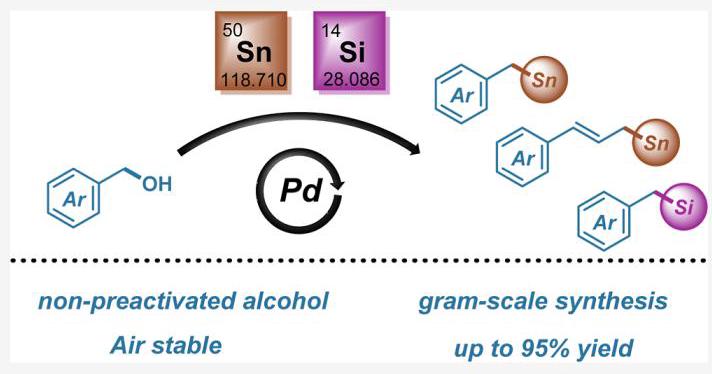
ABSTRACT: A direct transformation of non-preactivated benzyl alcohols to benzyl stannanes and benzyl silanes was realized through Pd-catalyzed $\mathrm{C}\left( {\mathrm{{sp}}}^{3}\right) - \mathrm{O}$ activation process. By using versatile tin and silicon sources, these reactions exhibit a broad substrate scope and a high efficiency under mild conditions, affording functionalized benzyl and allylic stannanes and benzylsilanes with high yields. The successful implementation of gram-scale stannylation/silylation as well as the one-pot Stille coupling reaction demonstrates the potential application of this method in organic synthesis. Both experimental and theoretical investigations reveal the mechanistic details of this reaction.
1. INTRODUCTION
Alcohols and their derivatives are serving as a class of abundant compounds with important application value, which widely exist in biomolecules and drug molecules. ${}^{1 - 3}$ At the same time, they have also drawn the attention of chemists as a molecular building block in organic synthesis. ${}^{4 - 6}$ Compared with organic halides, alcohols have also become the coupling reaction partner favored by scientists due to their advantages of natural existence, environmental friendliness, and low toxicity. ${}^{7 - {11}}$ However, the bond dissociation energy (BDE) of the C-O bond in alcohol is relatively strong, making it difficult for low-valent metals to directly activate the $\mathrm{C} - \mathrm{O}$ bond by oxidative addition. ${}^{{12},{13}}$ Therefore, a variety of $\mathrm{C} - \mathrm{O}$ electrophiles have been established recently to reduce their BDE of the $\mathrm{C} - \mathrm{O}$ bond, aiming to achieve the selective of $\mathrm{C} - \mathrm{O}$ bond reorganization. For example, carbamates, ${}^{{14} - {16}}$ sulfonates, ${}^{{17} - {20}}$ ethers, ${}^{{21} - {23}}$ and so forth are typically used in transition-metal-catalyzed $\mathrm{C} - \mathrm{O}$ bond coupling reactions, allowing the selective $\mathrm{C} - \mathrm{C}$ bond and carbon-heteroatom bond construction.
With the widespread development of transition-metal-catalyzed C-O electrophiles to build C-C bond, ${}^{4 - {11}}$ the construction of carbon-heteroatom bond remains a great challenge. ${}^{24}$ In view of the great importance of organic boron and silicon compounds in cross-coupling reactions, chemists have used different transition-metal complexes to cleave C-O bond in electrophilic alcohol derivatives to build C-B/Si bond, such as the employment of ${\mathrm{{Ni}}}^{{25} - {31}}\mathrm{\;{Pd}},{}^{32}\mathrm{{Au}},{}^{33}$ and other metals ${}^{{34} - {37}}$ (Scheme 1a). On the other hand, organotin reagents are featured as important molecular building blocks in medicinal chemistry, ${}^{{38} - {42}}$ materials science, ${}^{{43},{44}}$ and organic synthesis. ${}^{{45} - {47}}$ We envisioned whether the $\mathrm{C} - \mathrm{{Sn}}$ bond can be constructed by $\mathrm{C} - \mathrm{O}$ bond breaking in the $\mathrm{C} - \mathrm{O}$ electrophiles, especially directly in the alcohols. In 2016, Martin’s group successfully realized the $\mathrm{C} - \mathrm{{Sn}}$ bond formation by Ni-catalyzed $\mathrm{C}\left( {\mathrm{{sp}}}^{3}\right) - \mathrm{O}$ bond activation of aryl esters ${}^{48}$ (Scheme 1b). Based on the previous research of stannanes in our group, ${}^{{49},{50}}$ we further envisioned whether the $\mathrm{C}\left( {\mathrm{{sp}}}^{3}\right) - \mathrm{{Sn}}$ bond can be constructed by $\mathrm{C}\left( {\mathrm{{sp}}}^{3}\right) - \mathrm{O}$ bond breaking in the $\mathrm{C} - \mathrm{O}$ electrophiles, especially directly in the alcohols without any pre-activation (Scheme 1c).
2. RESULTS AND DISCUSSION
Initially, naphthalen-2-ylmethanol (1a) and ${\left( {\mathrm{{SnMe}}}_{3}\right) }_{2}$ (2a) were employed as model substrates for this investigation. Having optimized the reaction conditions, we were delighted to find that a catalytic system containing $\mathrm{{Pd}}{\left( \mathrm{{OAc}}\right) }_{2},1,{1}^{\prime }$ - bis(dicyclohexylphosphino)ferrocene (DCPF), $\mathrm{{Ti}}{\left( {\mathrm{O}}^{i}\mathrm{{Pr}}\right) }_{4}$ , and ${\mathrm{{Piv}}}_{2}\mathrm{O}$ promoted the targeted reaction at ${140}{}^{ \circ }\mathrm{C}$ , affording 3a in 80% isolated yield (Table 1, entry 1). A number of control experiments were conducted to provide further insight of this reaction. Not surprisingly, a decreased amount of tin source 2a led to lower yields (entries 2 and 3). Use of less catalyst (5 mol %) gave incomplete conversion on a small scale (entry 4). With use of other ligands, such as $1,{1}^{\prime }$ -bis- (diphenylphosphino)ferrocene (DPPF), the reaction was almost shut down (entry 5). Acid anhydride seems to be critical: the yield was intensively diminished in the absence of
Received: September 20, 2022
Published: February 15, 2023
Scheme 1. Construction of Benzylstannanes and Silanes via C-O Bond Cleavage
a) Transition-Metal-Catalyzed Borylation/Silyation via C-O Bond Activation
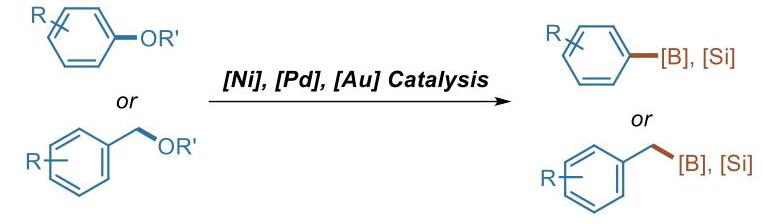
b) Ni-Catalyzed Stannylation via C(sp3)-O Bond Activation
R

c) Pd-Catalyzed Stannylation and Silylation via C(sp3)-O Bond Activation (this work)
R
OH [Pd] Catalysis FG
R
$\left( {{FG} = {\mathrm{{SnMe}}}_{3},{\mathrm{{SnBu}}}_{3},{\mathrm{{SiMe}}}_{3},{\mathrm{{SiMe}}}_{2}\mathrm{{Ph}}}\right) \; {\mathrm{{Piv}}}_{2}\mathrm{O}$ (entry 6); the replacement of ${\mathrm{{Piv}}}_{2}\mathrm{O}$ with $\mathrm{{TsCl}}$ led to trace products (entry 7), while the use of other acid anhydrides, such as ${\mathrm{{Ac}}}_{2}\mathrm{O}$ , did not affect the reaction yield (entries 8). Given that ${\mathrm{{Ac}}}_{2}\mathrm{O}$ is moisture-sensitive and flammable, we decided to still use ${\mathrm{{Piv}}}_{2}\mathrm{O}$ . Additionally, controlled experiments reveal that the palladium catalyst and additives are critical for this stannylation reaction (entries 9- 11). Unlike the air sensitivity of the Ni-catalyzed reaction, this Pd-catalyzed protocol can still afford 3a with 78% isolated yield without ${\mathrm{N}}_{2}$ protection (entry 12).
Table 1. Optimization of the Reaction Conditions ${}^{a}$

| entry | deviation from standard conditions | yield ${\left( \% \right) }^{b}$ |
| 1 | none | 80 |
| 2 | 1.4 equiv of ${\left( {\mathrm{{SnMe}}}_{3}\right) }_{2}$ | 71 |
| 3 | 1.2 equiv of ${\left( {\mathrm{{SnMe}}}_{3}\right) }_{2}$ | 56 |
| 4 | 5 mol % of $\mathrm{{Pd}}{\left( \mathrm{{OAc}}\right) }_{2}$ | 39 |
| 5 | DPPF instead of DCPF | trace |
| 6 | TsCl instead of ${\mathrm{{Piv}}}_{2}\mathrm{O}$ | trace |
| 7 | ${\mathrm{{Ac}}}_{2}\mathrm{O}$ instead of ${\mathrm{{Piv}}}_{2}\mathrm{O}$ | 80 |
| 8 | $\mathrm{w}/\mathrm{o}{\mathrm{{Piv}}}_{2}\mathrm{O}$ | 54 |
| 9 | $\mathrm{w}/\mathrm{o}\mathrm{{Ti}}{\left( {\mathrm{O}}^{i}\mathrm{{Pr}}\right) }_{4}$ | 28 |
| 10 | $\mathrm{w}/\mathrm{o}{\mathrm{{Piv}}}_{2}\mathrm{O}$ or $\mathrm{{Ti}}{\left( {\mathrm{O}}^{i}\mathrm{{Pr}}\right) }_{4}$ | 39 |
| 11 | w/o Pd(OAc) ${}_{2}$ | 0 |
| 12 | in an air atmosphere | 78 |
${}^{a}$ Reaction conditions: naphthalen-2-ylmethanol 1a $\left( {{0.2}\mathrm{{mmol}}}\right) ,\left( {\mathrm{{Sn}}{\mathrm{{Me}}}_{3}}\right) {}_{2}\left( {{0.3}\mathrm{{mmol}}}\right) ,\mathrm{{Pd}}{\left( \mathrm{{OAc}}\right) }_{2}\left( {{10}\mathrm{\;{mol}}\% }\right) ,\mathrm{{DCPF}}\left( {{15}\mathrm{\;{mol}}\% }\right) ,\mathrm{{Ti}}{\left( {\mathrm{O}}^{i}\mathrm{{Pr}}\right) }_{4}({0.15}$ mmol), Piv, O(0.2 mmol), toluene (1 mL), 140°C in a N, 2 atmosphere, 3 h. DCPF = 1,1’-bis(dicyclohexylphosphino)ferrocene. Piv,0 = pivalic anhydride. DPPF $= 1,{1}^{\prime }$ -bis(diphenylphosphino)ferrocene. TsCl $=$ tosyl chloride. ${\mathrm{{Ac}}}_{2}\mathrm{O} =$ acetic anhydride. ${}^{b}$ Isolated yields.
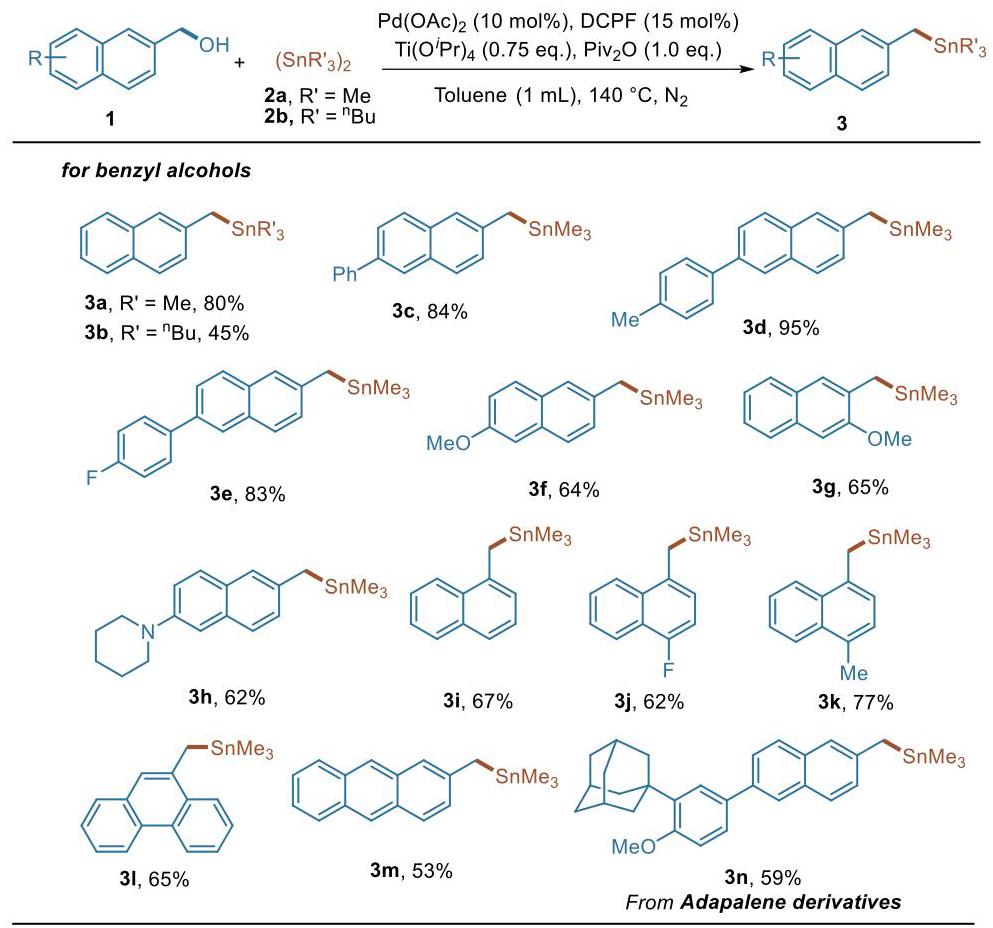
With these optimized conditions, we then evaluated the scope of this stannylation process (Scheme 2). Overall, a great many naphthalen-2-yl as well as 1-yl methanol derivatives (3a- 3k) could be accommodated in this benzylic stannylation reaction, affording the corresponding stannanes in good to excellent yields (45-95% yields). Compared with using ${\left( {\mathrm{{SnBu}}}_{3}\right) }_{2}$ (2b) as the stannylation reagent to obtain 3b, the reaction using 2a affords better yield of 3a, suggesting the steric hinder effect of the butyl group in 2b. Various stannylated naphthalen-2-yl and 1-yl scaffolds are smoothly constructed through this Pd-catalyzed C-O activation protocol. Both electron-donating groups and electron-withdrawing groups were compatible with the transformation, such as methoxy (3f, 3g), amino (3h), methyl (3k), and fluorine (3j) substituents. The substrate containing ortho-substituted methoxy group also affords $3\mathbf{g}$ with moderate yield. To explore the scope of other aromatic rings, phenanthrene (31) and anthracene stannane derivatives (3m) can be obtained with moderate to good yields. Moreover, to demonstrate the applicability of this stannylation method in complex molecules, we smoothly converted the alcohol groups embedded in Adapalene framework into the trimethylstannyl groups (3n), allowing the selective modification of this drug scaffold through sequential Stille coupling reaction.
Scheme 2. Scope of Naphthyl Methanol substrates
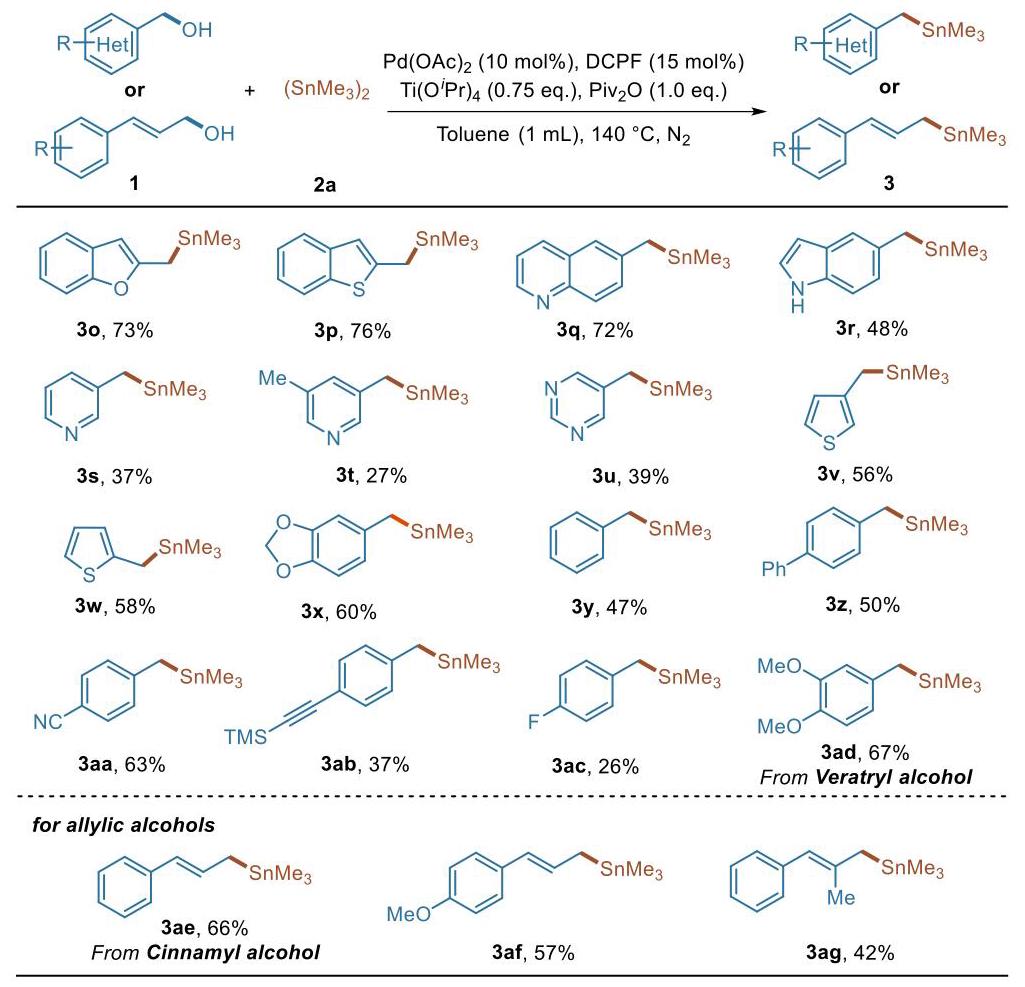
We then examined the functional group tolerance of simple benzyl alcohols and allyl alcohols (Scheme 3). Typically, benzofuran (3o), benzothiophene (3p), quinoline (3q), indole (3r), pyridine (3s, 3t), pyrimidine (3u), and thiophene (3v, 3w) substituted methanol derivatives could be obtained with moderate to good yields (27-76% yields). Additionally, a variety of substituents on the ring of simple benzyl alcohols can also afford the corresponding stannylation products in moderate yields (3x-3ac). In the fluoro-substituted case of 3ac, the diminished efficiency was probably due to high volatile properties. Furthermore, we also found that this stannylation protocol was compatible by using allyl alcohols as the substrates, affording allylic trimethylstannanes in moderate yield (3ae-3ag). Notably, the stannylation reaction of natural products of veratryl alcohol and cinnamyl alcohol was also successful, and the corresponding products 3ad and 3ae were isolated in 67 and 66% yields, respectively.
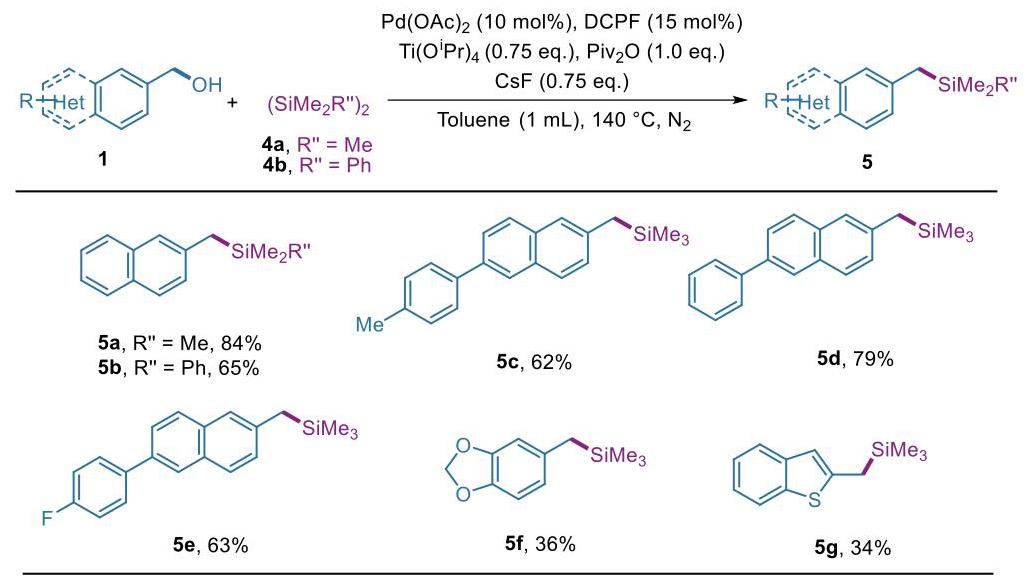
The success of the Pd-catalyzed $\mathrm{C}\left( {\mathrm{{sp}}}^{3}\right) - \mathrm{O}$ bond stannyla-tion from naphthylmethanols encouraged us to further explore the homologous silylation process (Scheme 4). However, simply replacement of hexamethylditin (2a) with hexamethyl-disilane (4a) under the standard conditions did not give an acceptable yield of silylation products. After further screening the reaction conditions, we found that adding 0.75 equiv amount of CsF under the standard conditions can efficiently promote the silylation process. Subsequently, we also examined the substrate scope of this silylation process. As shown in Scheme 4, 2-naphthyl as well as aryl-substituted naphthyl methanols smoothly completed this reaction, providing the corresponding silylation products in 63-84% yields (5a-5e). For the benzylic substrates, the piperonyl and benzothiophene methanols afforded silylation products with relatively low yields. Likewise, by using ${\left( {\mathrm{{SiMe}}}_{2}\mathrm{{Ph}}\right) }_{2}4\mathbf{b}$ as the coupling partner, the silylation product (5b) can also be obtained in 65% yield.
In view of the low yield of $3\mathrm{\;b}$ using ${\left( {\mathrm{{SnBu}}}_{3}\right) }_{2}$ as the tin source, we then examined the stannylation reaction using ${\mathrm{{Me}}}_{3}{\mathrm{{Si}}}_{ - }{\mathrm{{SnBu}}}_{3}$ as the stannylation reagent, which was assisted by CsF to promote the transmetallation process (eq 1). ${}^{48}$ To our delight, the desired stannylation product (3b) was obtained with a higher yield, 75%.

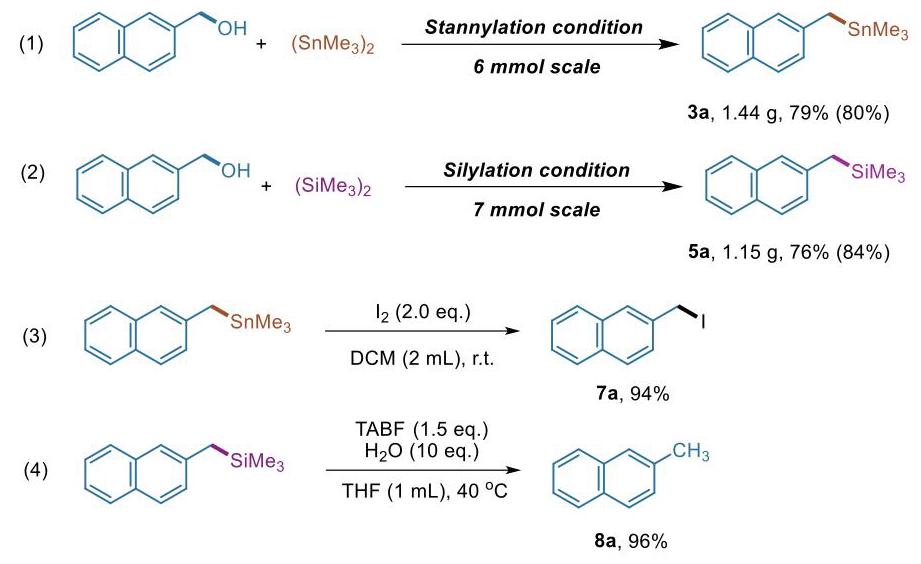
In order to demonstrate the practical application of this Pd-catalyzed protocol, we have tested the gram-scale stannylation and silylation using 1a as the substrate under standard conditions (Scheme 5). To our delight, the corresponding stannylation product (3a) and silylation product (5a) were successfully obtained with comparable good yields (79 and 76%, respectively). The selective functional group transformations of 3a and 5a were also successfully realized, affording iodination product 7a and desilted methylation product 8a with excellent yields, respectively. The successful gram-scale stannylation/silylation as well as the further transformation of stannyl and silyl products demonstrates the potential application of this method.
Scheme 3. Scope of Benzyl Alcohols and Allyl Alcohol Substrates
Scheme 4. Silylation Substrate Scope for Benzyl Alcohols
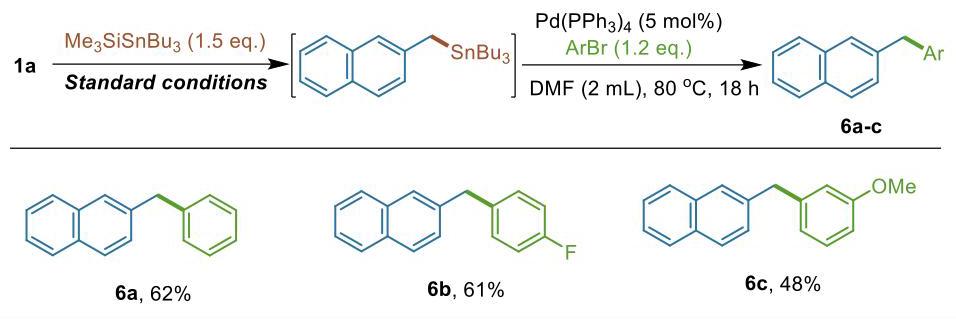
We then carried out the tandem Pd-catalyzed Stille cross-coupling reaction without purification of the crude stannyla-tion products (Scheme 6). Upon completion of the stannylation step, toluene was removed in vacuum. The residue was dissolved in dimethylformamide and directly subjected to sequential Stille reaction to afford the biaryl methanes (6a-6c) in moderate yields within two steps.
For exploring the reaction details, we tried to investigate the effect of ${\mathrm{{Piv}}}_{2}\mathrm{O}$ during this stannylation reaction (Scheme 7). Initially, we assumed that ${\mathrm{{Piv}}}_{2}\mathrm{O}$ interacted with alcohol 1a to form pivalic ester $1{a}^{\prime }$ , thereby activating the $\mathrm{C}\left( {\mathrm{{sp}}}^{3}\right) - \mathrm{O}$ bond. Therefore, we performed this reaction under standard conditions using $1{a}^{\prime }$ as the substrate. However, the desired product 3a was obtained in a diminished yield of 57%. Considering that ${\mathrm{{Piv}}}_{2}\mathrm{O}$ may be converted to $\mathrm{{PivOH}}$ in the reaction, we then added $\mathrm{{PivOH}}$ , without adding ${\mathrm{{Piv}}}_{2}\mathrm{O}$ under standard conditions. Stannylation product 3a was obtained with 59 and 54% yields, respectively. The yield of 3a still did not change significantly, which indicates that the pivalic ester $1{a}^{\prime }$ is not the key intermediate of the reaction. The results in Table 1 (entry 7) show that the acid anhydride is a very important additive. Thus, we speculate that ${\mathrm{{Piv}}}_{2}\mathrm{O}$ may play a role in assisting anion exchange in the catalytic cycle.
Scheme 5. Gram-Scale Stannylation/Silylation and Further Transformations of 3a/5a
Scheme 6. Sequential Stannylation/Stille Cross-Coupling Reactions
Scheme 7. Investigation of the Role of ${\mathrm{{Piv}}}_{2}\mathrm{O}$

w/o Pi ${\mathrm{v}}_{2}\mathrm{O}$ conditions ${\mathrm{{Piv}}}_{2}\mathrm{O}$ (1.0 eq.) PivOH (1.0 eq.)
(instead of ${\mathrm{{Piv}}}_{2}\mathrm{O}$ )
Yields of 3a 57% 59% 54%
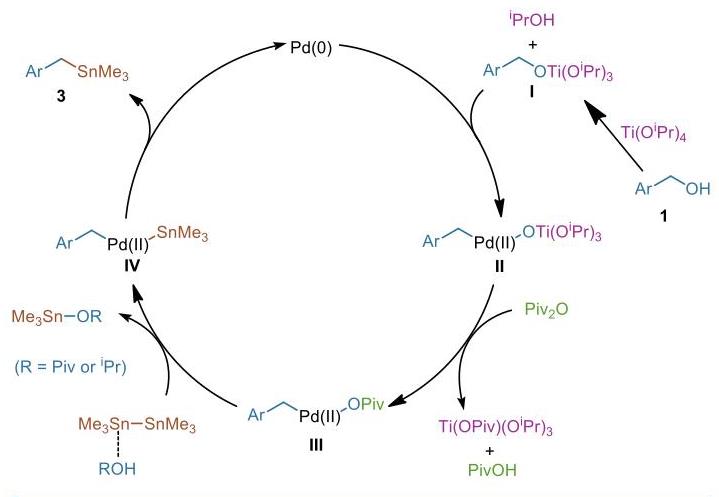
Based on our investigation and literature reported, ${}^{{12},{13},{51},{52}}$ we have proposed a possible mechanism for palladium-catalyzed $\mathrm{C}\left( {\mathrm{{sp}}}^{3}\right) - \mathrm{O}$ bond cleavage stannylation reactions (Scheme 8). At first, benzyl alcohol 1 reacts with $\mathrm{{Ti}}{\left( {\mathrm{O}}^{i}\mathrm{{Pr}}\right) }_{4}$ to activate the $\mathrm{C}\left( {\mathrm{{sp}}}^{3}\right) - \mathrm{O}$ bond through the formation of benzyl titanate I. Subsequently, oxidative addition of I with Pd(0) species occurs to form Pd(II) complex II. We speculated that the bulky $\mathrm{{OTi}}{\left( \mathrm{{OR}}\right) }_{3}$ counterion could react with ${\mathrm{{Piv}}}_{2}{\mathrm{O}}^{.53}$ Thus, this complex II undergoes sequential anion exchange with ${\mathrm{{Piv}}}_{2}\mathrm{O}$ to form an active benzyl-Pd(II)-OPiv complex III. Next, III undergoes transmetallation process with activated ditin species to obtain intermediate IV. Finally, reductive elimination of benzyl-Pd(II)-Sn species IV provides target product 3, along with the regeneration of $\mathrm{{Pd}}\left( 0\right)$ species to complete this catalytic cycle. The proposed mechanism is further supported by density functional theory (DFT) calculations. The computed free-energy profile of the overall catalytic cycle of benzyl alcohols is shown in Scheme S1.
Scheme 8. Possible Reaction Mechanism
3. CONCLUSIONS
In conclusion, we have developed the palladium-catalyzed stannylation and silylation reactions of benzylic/allylic alcohols through selective $\mathrm{C}\left( {\mathrm{{sp}}}^{3}\right) - \mathrm{O}$ bond cleavage. This reaction affords functionalized benzyl/allyl stannanes and benzylsilanes in moderate to good yields. Additionally, this strategy has the feature of good functional group tolerance, using non-pre-activated alcohols as the substrates, and can be carried out under an air atmosphere. The success of gram-scale stannylation/silylation as well as the tandem Stille coupling reactions demonstrates the possibility for further application of this synthetic method. Both the experimental and theoretical research studies reveal the mechanistic details of this reaction.
ASSOCIATED CONTENT
Data Availability Statement
The data underlying this study are available in the published article and its Supporting Information.
(c) Supporting Information
The Supporting Information is available free of charge at https://pubs.acs.org/doi/10.1021/acs.joc.2c02265.
General experimental methods, ${}^{1}\mathrm{H}$ NMR spectra, ${}^{13}\mathrm{C}$ NMR spectra, and coordinates and energies for the calculated structures (PDF)
A AUTHOR INFORMATION
Corresponding Authors
Di Qiu - Tianjin Key Laboratory of Structure and Performance for Functional Molecules, College of Chemistry, Tianjin Normal University, Tianjin 300387, China;
Fanyang Mo - School of Materials Science and Engineering, Peking University, Beijing 100871, China; (C) orcid.org/ 0000-0002-4140-3020;
Authors
Guanglu Yue - Tianjin Key Laboratory of Structure and Performance for Functional Molecules, College of Chemistry, Tianjin Normal University, Tianjin 300387, China
Qianyi Liu - School of Materials Science and Engineering, Peking University, Beijing 100871, China
Jingyao Wei - Tianjin Key Laboratory of Structure and Performance for Functional Molecules, College of Chemistry, Tianjin Normal University, Tianjin 300387, China
Yanqiong Pi - Tianjin Key Laboratory of Structure and Performance for Functional Molecules, College of Chemistry, Tianjin Normal University, Tianjin 300387, China
Complete contact information is available at: https://pubs.acs.org/10.1021/acs.joc.2c02265
Notes
The authors declare no competing financial interest.
ACKNOWLEDGMENTS
The authors thank the Tianjin Normal University Research Innovation Project for Postgraduate Students (2022KYCX115Y), the Science and Technology Development Fund of Tianjin Education Commission for Higher Education (2020KJ007), and the National Natural Science Foundation of China (22071004).
EREFERENCES
(1) Lindsley, C. W. The Top Prescription Drugs of 2010 in the United States: Antipsychotics Show Strong Growth. ACS Chem. Neurosci. 2011, 2, 276-277.
(2) Grembecka, M. Alcohols-Their Role in the Modern World of Sweeteners: A Review. Eur. Food Res. Technol. 2015, 241, 1-14.
(3) Wu, L.; Moteki, T.; Gokhale, A. A.; Flaherty, D. W.; Toste, F. D. Production of Fuels and Chemicals from Biomass: Condensation Reactions and Beyond. Chem 2016, 1, 32-58.
(4) Cherney, A. H.; Kadunce, N. T.; Reisman, S. E. Enantioselecti-veand Enantiospecific Transition-Metal-Catalyzed Cross-Coupling Reactions of Organometallic Reagents to Construct C-C Bonds. Chem. Rev. 2015, 115, 9587-9652.
(5) Huang, F.; Liu, Z.; Yu, Z. K. C-Alkylation of Ketones and Related Compounds by Alcohols: Transition-Metal-Catalyzed Dehydrogenation. Angew. Chem., Int. Ed. 2016, 55, 862-875.
(6) Zhao, B. L.; Rogge, T.; Ackermann, L. Z. Z.; Shi, Z. Metal-Catalysed C-Het (F, O, S, N) and C-C Bond Arylation. Chem. Soc. Rev. 2021, 50, 8903-8953.
(7) Yu, D. G.; Li, B. J.; Shi, Z. J. Exploration of New C-O Electrophiles in Cross-Coupling Reactions. Acc. Chem. Res. 2010, 43, 1486-1495.
(8) Li, B. J.; Yu, D. G.; Sun, C. L.; Shi, Z. J. Activation of “Inert” Alkenyl/Aryl C-O Bond and Its Application in Cross-Coupling Reactions. Chem.-Eur. J. 2011, 17, 1728-1759.
(9) Yu, D. G.; Wang, X.; Zhu, R. Y.; Luo, S.; Zhang, X. B.; Wang, B. Q.; Wang, L.; Shi, Z. J. Direct Arylation/Alkylation/Magnesiation of Benzyl Alcohols in the Presence of Grignard Reagents Via Ni-, Fe-, or Co-Catalyzed ${\mathrm{{sp}}}^{3}\mathrm{C} - \mathrm{O}$ Bond Activation. J. Am. Chem. Soc. 2012,134, 14638-14641.
(10) Cornella, J.; Zarate, C.; Martin, R. Metal-Catalyzed Activation of Ethers via C-O Bond Cleavage: A New Strategy for Molecular Diversity. Chem. Soc. Rev. 2014, 43, 8081-8097.
(11) Liu, F.; Jiang, H.; Zhou, Y.; Shi, Z. J. Direct Transformation of Arenols Based on C-O Activation. Chin. J. Chem. 2020, 38, 855-863.
(12) Zhang, S. Q.; Hong, X. Mechanism and Selectivity Control in Ni- and Pd-Catalyzed Cross-Couplings Involving Carbon-Oxygen Bond Activation. Acc. Chem. Res. 2021, 54, 2158-2171.
(13) Chernyshev, V. M.; Ananikov, V. P. Nickel and Palladium Catalysis: Stronger Demand than Ever. ACS Catal. 2022, 12, 1180- 1200.
(14) Antoft-Finch, A.; Blackburn, T.; Snieckus, V. N, N-Diethyl O-Carbamate: Directed Metalation Group and Orthogonal Suzuki-Miyaura Cross-Coupling Partner. J. Am. Chem. Soc. 2009, 131, 17750-17752.
(15) Quasdorf, K. W.; Riener, M.; Petrova, K. V.; Garg, N. K. Suzuki-Miyaura Coupling of Aryl Carbamates, Carbonates, and Sulfamates. J. Am. Chem. Soc. 2009, 131, 17748-17749.
(16) Yoshikai, N.; Matsuda, H.; Nakamura, E. Hydroxyphosphine Ligand for Nickel-Catalyzed Cross-Coupling through Nickel/ Magnesium Bimetallic Cooperation. J. Am. Chem. Soc. 2009, 131, 9590-9599.
(17) Scott, W. J.; Crisp, G. T.; Stille, J. K. Palladium-Catalyzed Coupling of Vinyl Triflates with Organostannanes. A Short Synthesis of Pleraplysillin-1. J. Am. Chem. Soc. 1984, 106, 4630-4632.
(18) Zhou, J.; Fu, G. C. Palladium-Catalyzed Negishi Cross-Coupling Reactions of Unactivated Alkyl Iodides, Bromides, Chlorides, and Tosylates. J. Am. Chem. Soc. 2003, 125, 12527-12530.
(19) Ito, S.; Fujiwara, Y.-i.; Nakamura, E.; Nakamura, M. Iron-Catalyzed Cross-Coupling of Alkyl Sulfonates with Arylzinc Reagents. Org. Lett. 2009, 11, 4306-4309.
(20) Xia, A.; Lv, P.; Xie, X.; Liu, Y. H. Nickel-Catalyzed Cyanation of Unactivated Alkyl Sulfonates with $\mathrm{{Zn}}{\left( \mathrm{{CN}}\right) }_{2}$ . Org. Lett. 2020,22, 7842-7847.
(21) Wenkert, E.; Michelotti, E. L.; Swindell, C. S. Nickel-Induced Conversion of Carbon-Oxygen into Carbon-Carbon Bonds. One-Step Transformations of Enol Ethers into Olefins and Aryl Ethers into Biaryls. J. Am. Chem. Soc. 1979, 101, 2246-2247.
(22) Guan, B. T.; Xiang, T.; Wu, S. K.; Sun, Z. P.; Wang, B. Q.; Zhao, K. Q.; Shi, Z. J. Methylation of arenes via Ni-catalyzed aryl C-O/F activation. Chem. Commun. 2008, 1437-1439.
(23) Wiensch, E.; Montgomery, J. Nickel-Catalyzed Amination of Silyloxyarenes through C-O Bond Activation. Angew. Chem., Int. Ed. 2018, 57, 11045-11049.
(24) Qiu, Z.; Li, C.-J. Transformations of Less-Activated Phenols and Phenol Derivatives via C-O Cleavage. Chem. Rev. 2020, 120, 10454-10515.
(25) Tobisu, M.; Zhao, J.; Kinuta, H.; Furukawa, T.; Igarashi, T.; Chatani, N. Nickel-Catalyzed Borylation of Aryl and Benzyl 2-Pyridyl Ethers: A Method for Converting a Robust ortho-Directing Group. Adv. Synth. Catal. 2016, 358, 2417-2421.
(26) Martin, R.; Martin-Montero, T.; Krolikowski, C.; Zarate, R.; Manzano, R. Stereospecific Nickel-Catalyzed Borylation of Secondary Benzyl Pivalates. Synlett 2017, 28, 2604-2608.
(27) Pein, W. L.; Wiensch, E. M.; Montgomery, J. Nickel-Catalyzed Ipso-Borylation of Silyloxyarenes via C-O Bond Activation. Org. Lett. 2021, 23, 4588-4592.
(28) Liu, X.; Xu, B.; Su, W. P. Ni-Catalyzed Deoxygenative Borylation of Phenols via O-Phenyl-uronium Activation. ACS Catal. 2022, 12, 8904-8910. (e) Zarate, C.; Martin, R. A Mild Ni/Cu-Catalyzed Silylation via C-O Cleavage. J. Am. Chem. Soc. 2014, 136, 2236-2239.
(29) Zarate, C.; Nakajima, M.; Martin, R. A Mild and Ligand-Free Ni-Catalyzed Silylation via C-OMe Cleavage. J. Am. Chem. Soc. 2017, 139, 1191-1197.
(30) Wiensch, E. M.; Todd, D. P.; Montgomery, J. Silyloxyarenes as Versatile Coupling Substrates Enabled by Nickel-Catalyzed C-O Bond Cleavage. ACS Catal. 2017, 7, 5568-5571.
(31) Cao, Z. C.; Luo, F.-X.; Shi, W.-J.; Shi, Z. J. Direct Borylation of Benzyl Alcohol and its Analogues in the Absence of Bases. Org. Chem. Front. 2015, 2, 1505-1510.
(32) Miura, H.; Hachiya, Y.; Nishio, H.; Fukuta, Y.; Toyomasu, T.; Kobayashi, K.; Masaki, Y.; Shishido, T. Practical Synthesis of Allyl, Allenyl, and Benzyl Boronates through ${\mathrm{S}}_{\mathrm{N}}1$ ’-Type Borylation under Heterogeneous Gold Catalysis. ACS Catal. 2021, 11, 758-766.
(33) Kinuta, H.; Tobisu, M.; Chatani, N. Rhodium-Catalyzed Borylation of Aryl 2-Pyridyl Ethers through Cleavage of the Carbon-Oxygen Bond: Borylative Removal of the Directing Group. J. Am. Chem. Soc. 2015, 137, 1593-1600.
(34) Zeng, X.; Zhang, Y.; Liu, Z.; Geng, S.; He, Y.; Feng, Z. Iron-Catalyzed Borylation of Aryl Ethers via Cleavage of C-O Bonds. Org. Lett. 2020, 22, 2950-2955.
(35) Zhang, J.; Zhang, Y.; Geng, S.; Chen, S.; Liu, Z.; Zeng, X.; He, Y.; Feng, Z. C-O. Bond Silylation Catalyzed by Iron: A General Method for the Construction of Csp2-Si Bonds. Org. Lett. 2020, 22, 2669-2674.
(36) Mao, L.; Szabó, K. J.; Marder, T. B. Synthesis of Benzyl-, Allyl-, and Allenyl-boronates via Copper-Catalyzed Borylation of Alcohols. Org. Lett. 2017, 19, 1204-1207.
(37) Ragan, J. A.; Raggon, J. W.; Hill, P. D.; Jones, B. P.; McDermott, R. E.; Munchhof, M. J.; Marx, M. A.; Casavant, J. M.; Cooper, B. A.; Doty, J. L.; Lu, Y. Cross-Coupling Methods for the Large-Scale Preparation of an Imidazole-Thienopyridine: Synthesis of [2-(3-Methyl-3H-imidazol-4-yl)- thieno[3,2-b]pyridin-7-yl]-(2- methyl-1H-indol-5-yl)-amine. Org. Process Res. Dev. 2003, 7, 676- 683.
(38) Alonso, E.; Fuwa, H.; Vale, C.; Suga, Y.; Goto, T.; Konno, Y.; Sasaki, M.; LaFerla, F. M.; Vieytes, M. R.; Giménez-Llort, L.; Botana, L. M. Design and Synthesis of Skeletal Analogues of Gambierol: Attenuation of Amyloid- $\beta$ and Tau Pathology with Voltage-Gated Potassium Channel and N-Methyl-d-aspartate Receptor Implications. J. Am. Chem. Soc. 2012, 134, 7467-7479.
(39) Valot, G.; Regens, C. S.; O’Malley, D. P.; Godineau, E.; Takikawa, H.; Fürstner, A. Total Synthesis of Amphidinolide F. Angew. Chem., Int. Ed. 2013, 52, 9534-9538.
(40) Li, H.-L.; Chen, Q.-F.; Lu, Z.-H.; Li, A. Total Syntheses of Aflavazole and 14-Hydroxyaflavinine. J. Am. Chem. Soc. 2016, 138, 15555-15558.
(41) Heravi, M. M.; Mohammadkhani, L. Recent Applications of Stille Reaction in Total Synthesis of Natural Products: An Update. J. Organomet. Chem. 2018, 869, 106-200.
(42) Carsten, B.; He, F.; Son, H. J.; Xu, T.; Yu, L. Stille Polycondensation for Synthesis of Functional Materials. Chem. Rev. 2011, 111, 1493-1528.
(43) Yu, Z. D.; Lu, Y.; Wang, J. Y.; Pei, J. Conformation Control of Conjugated Polymers. Chem.-Eur. J. 2020, 26, 16194-16205.
(44) Neumann, W. P.; Moser, W. The Organic Chemistry of Tin; Interscience: New York, 1970.
(45) Beletskaya, I. P. The Cross-Coupling Reactions of Organic Halides with Organic Derivatives of Tin, Mercury and Copper Catalyzed by Palladium. J. Organomet. Chem. 1983, 250, 551-564.
(46) Stille, J. K. The Palladium-Catalyzed Cross-Coupling Reactions of Organotin Reagents with Organic Electrophiles [New Synthetic Methods (58)]. Angew. Chem., Int. Ed. 1986, 25, 508-524.
(47) Yue, G.; Wei, J.; Qiu, D.; Mo, F. Recent Advances in the Synthesis of Arylstannanes. Acta Chim. Sin. 2022, 80, 956-969.
(48) Gu, Y.; Martín, R. Ni-Catalyzed Stannylation of Aryl Esters via C-O Bond Cleavage. Angew. Chem., Int. Ed. 2017, 56, 3187-3190.
(49) Lian, C.; Yue, G.; Zhang, H.; Wei, L.; Liu, D.; Liu, S.; Fang, H.; Qiu, D. Synthesis of Arylstannanes by Palladium-Catalyzed Desulfitative Coupling Reaction of Sodium Arylsulfinates with Distannanes. Tetrahedron Lett. 2018, 59, 4019-4023.
(50) Li, S.; Lian, C.; Yue, G.; Zhang, J.; Qiu, D.; Mo, F. Transition Metal Free Stannylation of Alkyl Halides: The Rapid Synthesis of Alkyltrimethylstannanes. J. Org. Chem. 2022, 87, 4291-4297.
(51) Espinet, P.; Echavarren, A. M. The Mechanisms of the Stille Reaction. Angew. Chem., Int. Ed. 2004, 43, 4704-4734.
(52) Li, Y.-X.; Xuan, Q.-Q.; Liu, L.; Wang, D.; Chen, Y.-J.; Li, C.-J. A Pd(0)-Catalyzed Direct Dehydrative Coupling of Terminal Alkynes with Allylic Alcohols To Acces 1,4-Enynes. J. Am. Chem. Soc. 2013, 135, 12536-12539.
(53) Satoh, T.; Ikeda, M.; Miura, M.; Nomura, M. Palladium-Catalyzed Etherification of Allyl Alcohols Using Phenols in the Presence of Titanium(IV) Isopropoxide. J. Org. Chem. 1997, 62, 4877-4879.