Preview: "Cage escape" in photosensitized of diazonium derivatives
中文 / Bilingual · English version
Chem Catalysis
Preview “Cage escape” in photosensitized diazonium derivatives
Jianning Zhang ${}^{1}$ and Fanyang Mo ${}^{1, * }$
In this issue of Chem Catalysis, Troian-Gautier and co-workers focus on the mechanism of the photosensitized activation reaction of diazonium derivatives by studying the electron-transfer process between photosensitizers and diazonium salts. Their proposed “cage-escape” mechanistic picture is verified in the C-B bond-formation reaction of diazonium salts.
Diazonium salts are widely used radical precursors in organic synthesis, the dyeing industry, and the modification of metallic or non-metallic material surfaces. ${}^{1 - 3}$ In organic synthesis, classical named reactions (e.g., the Sandmeyer, Pschorr, and Gomberg-Bachmann reactions) are applied in the transformation of diazonium salts to other functional organic molecules. Photosensitized activation reactions of diazonium salts have also been developed for C-C or C-heteroatom bond formation ${}^{4,5}$ (Figure 1A).
The article by Troian-Gautier and coworkers in this issue of Chem Catalysis focuses on the primitive reaction steps in the photosensitized aryl diazonium activation of diazonium salts, i.e., the excitation of the photocatalyst and the electron-transfer process. ${}^{6}$ Detailed experimental, spectroscopic, and theoretical results provide precise kinetic information on the interaction between photosensitizers (PSs) and diazonium salts. Further, the C-B bond formation of diazonium salts is an example that verifies that the observations and different yields are consistent with the proposed mechanism.
Nine commercial or synthesized PSs (including six rare-earth transition-metal PSs and three earth-abundant transition-metal PSs) and 13 quenchers (including ten aryl diazonium salts and three calix[4]arene tetradiazonium derivatives) were chosen as the studied molecules (Figure 1B). The Hammett parameters (σ) of 13 quenchers ranged from -0.83 to 0.78 according to previous work, ${}^{7}$ indicateing the different electronegativities of the diazonium salts.
The authors recorded the ground-state absorption spectra and photoluminescence (PL) spectra under excitation within the visible range of solar light to show the differences among the photophysical properties of PSs. The iridium and ruthenium transition-metal PSs showed absorption features at wavelengths greater than ${400}\mathrm{\;{nm}}$ (i.e.,[Ru(bpy) ${}_{3}$ ] ${}^{2 + }$ : 450 nm), and some earth-abundant transition-metal PSs showed absorption peaks around ${500}\mathrm{\;{nm}}$ (i.e.,[Fe(phtmeimb) ${}_{2}$ ] ${}^{ + }$ : 500 nm). The PL spectra of different PSs under solar light ranged from ${472}\mathrm{\;{nm}}$ for ${\left\lbrack \operatorname{lr}\left( {\left( {\mathrm{{dFCF}}}_{3}\mathrm{{ppy}}\right) }_{2}\left( \mathrm{{dtb}}\right) \right) \right\rbrack }^{ + }$ to ${737}\mathrm{\;{nm}}$ for ${\left\lbrack \mathrm{{Os}}{\left( \mathrm{{bpy}}\right) }_{3}\right\rbrack }^{2 + }$ . Time-resolved PL recorded the excited-state lifetimes ranging from 2 ns for ${\left\lbrack \mathrm{{Fe}}{\left( \text{ ph }\text{ meim }\mathrm{b}\right) }_{2}\right\rbrack }^{ + }$ to 2,010 ns for [Ir( ${\left( {\mathrm{{dFCF}}}_{3}\mathrm{{ppy}}\right) }_{2}{\left( \mathrm{{dtb}}\right) }^{ + }$ .
Cyclic voltammetry and differential pulse voltammetry (DPV) determined the reduction and oxidation potentials of the PSs and quenchers. The excited-state oxidation potentials of the PSs ranged from -0.63 to $- {0.78}\mathrm{\;V}$ versus normal hydrogen electrode (NHE), and the reduction potentials of the quenchers ranged from -0.51 to ${0.77}\mathrm{\;V}$ versus NHE, trending linearly with their Hammett parameters. These results suggest the thermodynamic spontaneity of the electron-transfer process from PSs to quenchers.
The results of steady-state quenching experiments also verified the thermodynamic spontaneity. In almost all cases, an increase in quencher concentration resulted in a decrease in PS excited-state lifetime. The quenching rate constants $\left( {\mathrm{k}}_{\mathrm{q}}\right)$ increased with the driving force for electron transfer before reaching a plateau, which could have been caused by a solvent diffusion limit.
The photolysis experiments confirmed that the photoreaction of PSs and quenchers is truly via excited-state electron transfer. Under continuous irradiation, the metal-to-ligand charge transfer (MLCT) transitions of PSs were gradually bleached as the reaction of PSs and quenchers proceeded. This indicates that excited-state electron transfer can occur. Moreover, reduction experiments of ascorbic acid tested the reversibility of the reaction. Nanosecond transient absorption experiments also confirmed the presence of oxidative excited-state electrons.
The excited PSs and quenchers form an “encounter complex” and then undergo a cage-escape process to generate products (Figure 1A). The authors estimated the cage-escape yields $\left( {\varphi }_{\mathrm{{CE}}}\right)$ , which describe the efficiency with which the oxidized and reduced species separate. The typical ${\varphi }_{\mathrm{{CE}}}$ value (i.e., methyviolo-gen as electron acceptors and anthracene derivatives as electron donors) ranges from 14% to 27%. Most oxidized and reduced species cannot escape a solvent cage. On the contrary, they regenerate the initial state via geminate charge recombination. The estimated ${\varphi }_{\mathrm{{CE}}}$ value for diazonium derivatives can reach almost 100%, which indicates the complete release of the diazonium radical. A possible reason for the high ${\varphi }_{\mathrm{{CE}}}$ value is the irreversible generation of inert ${\mathrm{N}}_{2}$ gas. The ${\mathrm{N}}_{2}$ gas extrusion impedes back electron transfer within the solvent cage, so the diazonium radical can be released efficiently after one-electron reduction.
${}^{1}$ School of Materials Science and Engineering, Peking University, Beijing 100871, China
*Correspondence:
https://doi.org/10.1016/j.checat.2023.100527
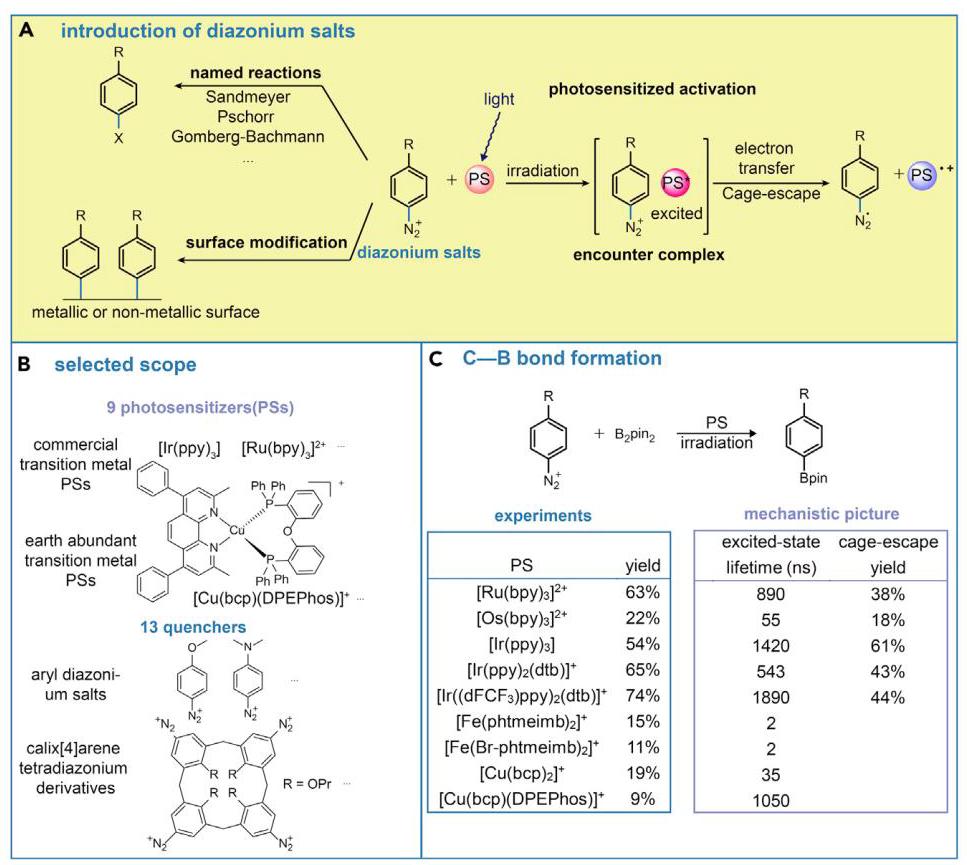
Figure 1. Mechanism insights and experimental verification of photosensitized activation reaction of diazonium derivatives
(A) The introduction of diazonium salt transformation.
(B) The selected substrate scope.
(C) Experimental verification of the proposed mechanism.
Furthermore, theoretical density functional theory calculation confirmed that C-N bond cleavage occurs after the electron-transfer process.
Troian-Gautier and co-workers chose the C-B bond formation of diazonium salts as an actual photoredox catalysis reaction to verify the proposed mechanistic picture (Figure 1C) and measured the product yields. They found a correlation between the reaction yields and ${\varphi }_{\mathrm{{CE}}}$ , showing that differences in yields can come from differences in cage-escape yields in the transformation of diazonium salts.
Overall, this work by Troian-Gautier and colleagues investigated the electron-transfer process in the photosensitive reaction of diazonium salts. The authors estimated the cage-escape yields, and the values can explain the yield differences in actual reactions. This could inspire the design of more efficient visible-light-mediated transformations.
DECLARATION OF INTERESTS
The authors declare no competing interests.
REFERENCES
On a new series of bodies in which nitrogen is substituted for hydrogen. Phil. Trans. Roy. Soc. Lond. 154, 667-731.
Mo, F., Qiu, D., Zhang, L., and Wang, J. (2021). Recent development of aryl diazonium chemistry for the derivatization of aromatic compounds. Chem. Rev. 121, 5741-5829.
Bélanger, D., and Pinson, J. (2011). Electrografting: A powerful method for surface modification. Chem. Soc. Rev. 40, 3995-4048.
Cano-Yelo, H., and Deronzier, A. (1984). Photooxidation of tris(2,2’-bipyridine)ruthenium(II) by para-substituted benzene diazonium salts in acetonitrile. Two-compartment J. Chem. Soc. Faraday Trans. 1 80, 3011-3019.
Cano-Yelo, H., and Deronzier, A. (1984). Photooxidation of some carbinols by the Ru(II) polypyridyl complex-aryl diazonium salt
Ripak, A., De Kreijger, S., Sampaio, R.N., Vincent, C.A., Cauet, E., Jabin, I., Tambar, U.K., Elias, B., and Troian-Gautier, L. (2023). Photosensitized activation of diazonium derivatives for C-B bond formation. Chem Catal. 3, 100490.
Hansch, C., Leo, A., and Taft, R.W. (1991). A survey of Hammett substituent constants and resonance and field parameters. Chem. Rev.