Diastereoselective addition of lithium enolate of γ-substituted α-diazoacetoacetate to N-sulfinyl imines
中文 / Bilingual · English version
MO FanYang, LI Fei &WANG JianBo ${}^{ * }$
Beijing National Laboratory of Molecular Sciences (BNLMS) and Key Laboratory of Bioorganic Chemistry and Molecular Engineering of Ministry of Education, College of Chemistry, Peking University, Beijing 100871, China
Received September 10, 2009; accepted December 1, 2009
Highly diastereoselective addition of lithium enolate of $\gamma$ -substituted $\alpha$ -diazoacetoacetate to chiral $N$ -sulfinyl imines has been developed. The addition products were further subjected to photo-induced Wolff rearrangement or Rh(II)-catalyzed intramolecular N-H insertion to afford chiral 4,5-disubstituted 2-oxo and 3-oxo pyrrolidines, respectively.
diazo compound, pyrrolidine, $N$ -sulfinyl imine, rhodium, diastereoselective addition
Citation: Mo F Y, Li F, Wang J B. Diastereoselective addition of lithium enolate of $\gamma$ -substituted $\alpha$ -diazoacetoacetate to $N$ -sulfinyl imines. Chinese Sci Bull,2010, 55: 2847-2854, doi: 10.1007/s11434-010-3140-5
The importance of 2-oxo and 3-oxo pyrrolidines as common structure features of many alkaloid natural products, bioac-tive compounds, drugs, and drug candidates is well recognized [1-3]. As a consequence, numerous methodologies have been developed for their synthesis over the years [4-14]. Among various methods, the application of chiral sulfinimines is practical and reliable [13]. Davis’s N-p-tolylsulfinimines [15-26] and Ellman’s N-tert-butyl derivatives [27-30] are the two representatives which have been successfully utilized in a variety of transformations. We have recently developed a new synthesis of 2-oxo and 3-oxo pyrrolidines based on the nucleophilic addition of the lithium enolate of $\alpha$ -diazoacetoacetate to chiral $N$ -sulfinyl imines, followed by photo-induced Wolff rearrangement or Rh(II)-catalyzed intramolecular N-H insertion (Scheme 1) [31].
Here we report the further extension of this methodology to the diastereoselective addition reaction when there is a substituent in the $\gamma$ -position of $\alpha$ -diazoacetoacetate. We found that when the size of the substituted group is small, such as methyl or ethyl, the addition reaction could proceed smoothly. The addition product could be further transformed to the pyrrolidine derivatives by the previously established approach. However, when the substituent is phenyl group, no addition reaction occurs. The diastereoselectivity of the reaction has distinct solvent effect (Figure 1).
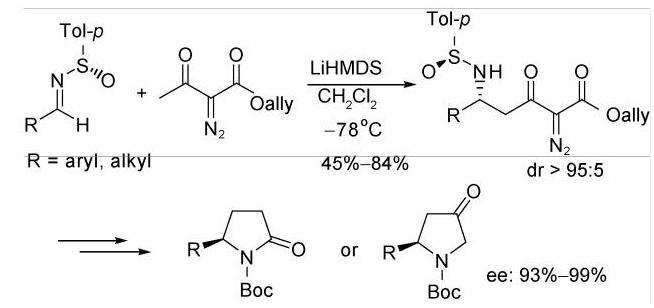
Scheme 1
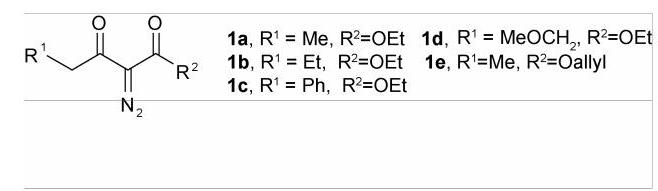
Figure 1 $\gamma$ -Substituted $\alpha$ -diazoacetoacetates.
*Corresponding author ()
1 Experimental
1.1 General
All reactions were performed under a nitrogen atmosphere in a flame-dried reaction flask. All solvents were distilled prior to use. ${\mathrm{{CH}}}_{2}{\mathrm{{Cl}}}_{2}$ was distilled over calcium hydride, and THF was distilled over sodium. For chromatography, 200-300 mesh silica gel (Qindao, China) was employed. ${}^{1}\mathrm{H}$ and ${}^{13}\mathrm{C}$ NMR spectra were recorded at 300 and ${75}\mathrm{{MHz}}$ with Varian Mercury 300 spectrometer. Chemical shifts are reported in ppm using tetramethylsilane as internal standard. IR spectra were recorded with a Nicolet Avatar 330 FT-IR infrared spectrometer.
1.2 General procedure for the diastereoselective addi- tion of ethyl 2-diazo-3-oxopentanoate 1a with $N$ -sulfinyl- imine 2
To a solution of $2\left( {{0.5}\mathrm{{mmol}}}\right)$ in ${\mathrm{{Et}}}_{2}\mathrm{O}\left( {{20}\mathrm{\;{mL}}}\right)$ was added LiHMDS (2 mmol of ${1.0}\mathrm{\;{mol}}{\mathrm{\;L}}^{-1}$ in hexane) at $- {78}^{ \circ }\mathrm{C}$ and then $1\mathrm{a}\left( {{1.5}\mathrm{{mmol}}}\right)$ in ${\mathrm{{Et}}}_{2}\mathrm{O}\left( {5\mathrm{\;{mL}}}\right)$ was dropped in the solution in $5\mathrm{\;{min}}$ . After stirring for another $5 - {10}\mathrm{\;{min}}$ , the reaction was quenched with saturated aqueous ${\mathrm{{NH}}}_{4}\mathrm{{Cl}}$ at $- {78}^{ \circ }\mathrm{C}$ and then warmed quickly to room temperature. The organic layer was separated and the aqueous layer was extracted with EtOAc $\left( {2 \times {15}\mathrm{\;{mL}}}\right)$ . The organic layers were then combined and dried over ${\mathrm{{Na}}}_{2}{\mathrm{{SO}}}_{4}$ . The crude product was purified by flash silica gel column chromatography to yield the addition products 3a-3j.
1.3 Characterization data
Ethyl 2-diazo-4-methyl-5-(4-methylphenylsulfinamido)-3- oxo-5-phenylpentanoate (3a). Yellow oil. ${}^{1}\mathrm{H}$ NMR (300 MHz, CDCl ${}_{3}$ ) 7.51-7.48 (m, 2H), 7.37-7.36 (m, 4H), ${7.28} - {7.25}\left( {\mathrm{\;m},3\mathrm{H}}\right) ,{5.24}\left( {\mathrm{\;d},1\mathrm{H}, J = {6.9}\mathrm{\;{Hz}}}\right) ,{4.55}(\mathrm{t},1\mathrm{H}, J = \; {7.2}\mathrm{\;{Hz}}),{4.25}\left( {\mathrm{q},2\mathrm{H}, J = {7.2}\mathrm{\;{Hz}}}\right) ,{4.16} - {4.06}\left( {\mathrm{\;m},1\mathrm{H}}\right) ,{2.40}(\mathrm{\;s}$ , 3H), ${1.29}\left( {\mathrm{t},3\mathrm{H}, J = {7.2}\mathrm{\;{Hz}}}\right) ,{1.00}\left( {\mathrm{\;d},3\mathrm{H}, J = {6.9}\mathrm{\;{Hz}}}\right) ;{}^{13}\mathrm{C}$ NMR (75 MHz, CDCl3) 195.0, 160.9, 141.9, 141.0, 140.5, 129.2, 128.4, 127.6, 127.4, 125.3, 61.4, 61.2, 47.2, 21.1, 15.4, 14.1; IR (film) 2922, 2137, 1713, 1654, 1375, 1300, 1205, 1092, 1068, 1017, 976, 842, 811, 754, 699, 683 c ${\mathrm{m}}^{-1}$ ; EI-MS $\left( {m/z\text{ , relative intensity): }{385}\left( {12}\right) ,{369}\left( 5\right) ,{278}\left( {18}\right) }\right)$ , 246(42), 220(15), 199(22), 173(30), 139(61), 123(59), 91(100), 77(59), 69(34), 30(43). HRMS (EI) calcd for ${\mathrm{C}}_{21}{\mathrm{H}}_{23}{\mathrm{\;N}}_{3}{\mathrm{O}}_{4}\mathrm{\;S}{413.14093}$ , found 413.14082.
Ethyl 5-(4-chlorophenyl)-2-diazo-4-methyl-5-(4-methy-lphenylsulfinamido)-3-oxopentanoate (3b). Yellow oil. ${}^{1}\mathrm{H}$ NMR (300 MHz, CDCl ${}_{3}$ ) 7.57-7.43 (m, 2H), 7.36-7.24 (m, 6H), 5.30 (d, 1H, J = 7.2 Hz), 4.45 (t, 1H, J = 7.5 Hz), 4.25 $\left( {\mathrm{q},2\mathrm{H}, J = {7.2}\mathrm{\;{Hz}}}\right) ,{4.09} - {4.00}\left( {\mathrm{\;m},1\mathrm{H}}\right) ,{2.41}\left( {\mathrm{\;s},3\mathrm{H}}\right) ,{1.30}(\mathrm{t}$ , $3\mathrm{H}, J = {7.2}\mathrm{\;{Hz}}),{1.00}\left( {\mathrm{\;d},3\mathrm{H}, J = {6.9}\mathrm{\;{Hz}}}\right) ;{}^{13}\mathrm{C}$ NMR (75 MHz, CDCl3) 194.9, 160.9, 141.5, 141.2, 139.3, 133.3, 129.3, 128.8, 128.6, 125.4, 61.5, 60.3, 47.1, 21.2, 15.5, 14.1; IR (film) 2978, 2138, 1713, 1300, 1140, 1090, 1014, 812 ${\mathrm{{cm}}}^{-1}$ ; EI-MS ( $m/z$ , relative intensity): 419 (6),294 (14),278 (31), 139 (100), 51 (60), 29 (55); HRMS (EI) calcd for ${\mathrm{C}}_{21}{\mathrm{H}}_{22}{\mathrm{\;N}}_{3}{\mathrm{O}}_{4}{\mathrm{\;S}}^{35}\mathrm{{Cl}}$ 447.10196, found 447.10115.
Ethyl 5-(3-bromophenyl)-2-diazo-4-methyl-5-(4-met-hylphenylsulfinamido)-3-oxopentanoate (3c). Yellow oil. ${}^{1}\mathrm{H}$ NMR (300 MHz, CDCl3) 7.50-7.40 (m, 4H), 7.30-7.22 (m, 4H), 5.30(d, 1H, J = 7.2 Hz), 4.45 (t, 1H, J = 7.5 Hz), 4.25 $\left( {\mathrm{q},2\mathrm{H}, J = {7.2}\mathrm{\;{Hz}}}\right) ,{4.10} - {4.00}\left( {\mathrm{\;m},1\mathrm{H}}\right) ,{2.41}\left( {\mathrm{\;s},3\mathrm{H}}\right) ,{1.30}(\mathrm{t}$ , $3\mathrm{H}, J = {7.2}\mathrm{\;{Hz}}),{1.01}\left( {\mathrm{\;d},3\mathrm{H}, J = {6.9}\mathrm{\;{Hz}}}\right) ;{}^{13}\mathrm{C}$ NMR (75 MHz, CDCl3) 194.8, 161.0, 143.2, 141.2, 130.8, 130.4, 130.0, 129.4, 126.2, 125.4, 122.5, 61.6, 60.5, 47.0, 21.3, 15.6, 14.1; IR (film) 2975, 2139, 1712, 1652, 1375, 1301, 1204,1091,1017,811 ${\mathrm{\;{cm}}}^{-1}$ ; EI-MS $(m/z$ , relative intensity): 465 (9), 324 (29), 278 (31), 184 (58), 139 (100), 91 (86), 29 (96); HRMS (EI) calcd for ${\mathrm{C}}_{21}{\mathrm{H}}_{22}{\mathrm{\;N}}_{3}{\mathrm{O}}_{4}{\mathrm{\;S}}^{79}\mathrm{{Br}}{491.05144}$ , found 491.04966.
(E)-ethyl 2-diazo-4-methyl-5-(4-methylphenylsulfin-amido)- 3-oxo-7-phenylhept-6-enoate (3d). Yellow oil. ${}^{1}\mathrm{H}$ NMR $\left( {{300}\mathrm{{MHz}},{\mathrm{{CDCl}}}_{3}}\right) {7.59} - {7.57}\left( {\mathrm{\;m},2\mathrm{H}}\right) ,{7.41} - {7.20}\left( {\mathrm{\;m},7\mathrm{H}}\right)$ , ${6.62} - {6.57}\left( {\mathrm{\;m},1\mathrm{H}}\right) ,{6.25} - {6.18}\left( {\mathrm{\;m},1\mathrm{H}}\right) ,{5.02}(\mathrm{\;d},1\mathrm{H}, J = {6.9}$ Hz), 4.26(q, 2H, J = 7.2 Hz), 4.17-4.12 (m, 1H), 3.93-3.84 $\left( {\mathrm{m},1\mathrm{H}}\right) ,{2.40}\left( {\mathrm{\;s},3\mathrm{H}}\right) ,{1.29}\left( {\mathrm{t},3\mathrm{H}, J = {7.2}\mathrm{\;{Hz}}}\right) ,{1.15}(\mathrm{\;d},3\mathrm{H}$ , $J = {7.2}\mathrm{\;{Hz}});{}^{13}\mathrm{C}\mathrm{{NMR}}\left( {{75}\mathrm{{MHz}},{\mathrm{{CDCl}}}_{3}}\right) {195.0},{160.8}$ , 142.0, 141.0 136.3, 132.8, 129.3, 128.6, 128.4, 128.4, 127.7, 126.6, 126.5, 125.5, 125.4, 61.5, 59.3, 46.2, 21.2, 15.0, 14.1; IR (film) 2979, 2137, 1713, 1645, 1374, 1299, 1201, 1091, 1016,808 ${\mathrm{\;{cm}}}^{-1}$ ; EI-MS ( $m/z$ , relative intensity): 411 (10), 289 (24), 278 (54), 139 (98), 123 (100), 91 (96), 77 (55), 29 (36); HRMS(EI) calcd for ${\mathrm{C}}_{23}{\mathrm{H}}_{25}{\mathrm{\;N}}_{3}{\mathrm{O}}_{4}\mathrm{\;S}$ 439.15658, found 439.15688.
Ethyl 2-diazo-4-methyl-5-(4-methylphenylsulfin-amido)- 3- oxo-5-o-tolylpentanoate (3e). Yellow oil. ${}^{1}\mathrm{H}$ NMR (300 MHz, CDCl3) 7.57-7.38 (m, 3H), 7.27-7.15 (m, 5H), 5.20 $\left( {\mathrm{d},1\mathrm{H}, J = {6.9}\mathrm{\;{Hz}}}\right) ,{4.81}\left( {\mathrm{t},1\mathrm{H}, J = {8.1}\mathrm{\;{Hz}}}\right) ,{4.22}(\mathrm{q},2\mathrm{H}, J = \; {7.2}\mathrm{\;{Hz}}),{4.16} - {4.07}\left( {\mathrm{\;m},1\mathrm{H}}\right) ,{2.40}\left( {\mathrm{\;s},3\mathrm{H}}\right) ,{2.39}\left( {\mathrm{\;s},3\mathrm{H}}\right) ,{1.28}$ (t, $3\mathrm{H}, J = {7.2}\mathrm{\;{Hz}}$ ), ${1.04}\left( {\mathrm{\;d},3\mathrm{H}, J = {6.9}\mathrm{\;{Hz}}}\right) ;{}^{13}\mathrm{C}$ NMR (75 MHz, CDCl3) 195.2, 161.0, 142.0, 141.0, 138.7, 135.8, 130.4, 129.3, 127.4, 126.8, 126.2, 125.4, 61.4, 56.8, 46.6, 21.2, 19.5, 15.0, 14.1; IR (film) 2971, 2138, 1713, 1650, 1374,1300,1203,1056,1017,812,763 ${\mathrm{{cm}}}^{-1}$ ; EI-MS ( $m/z$ , relative intensity): 338 (9), 310 (13), 278 (22), 259 (24), 198 (32), 151 (64), 139 (100), 120 (67), 91 (91), 69 (42), 57 (47), 42 (44), 29 (92); HRMS(EI) calcd for ${\mathrm{C}}_{22}{\mathrm{H}}_{25}{\mathrm{\;N}}_{3}{\mathrm{O}}_{4}\mathrm{\;S}$ 427.15658, found 427.15454.
Ethyl 2-diazo-5-(4-fluorophenyl)-4-methyl-5-(4-methy-lphenylsulfinamido)-3-oxopentanoate (3f). Yellow oil. ${}^{1}\mathrm{H}$ NMR (300 MHz, CDC1, ${\text{ J }}_{2}$ . ${\text{ J }}_{3}$ . ${\text{ H }}_{2}$ M $\left( {\text{ M },\text{ 2 H }}\right) ,$ 7.35-7.26 (m, 4H), 7.07-7.01 (m, 2H), 5.23 (d, 1H, J = 6.9 Hz), 4.49 (t, $1\mathrm{H}, J = {7.5}\mathrm{\;{Hz}}),{4.25}\left( {\mathrm{q},2\mathrm{H}, J = {7.2}\mathrm{\;{Hz}}}\right) ,{4.09} - {4.00}\left( {\mathrm{\;m},1\mathrm{H}}\right)$ , ${2.41}\left( {\mathrm{\;s},3\mathrm{H}}\right) ,{1.30}\left( {\mathrm{t},3\mathrm{H}, J = {7.2}\mathrm{\;{Hz}}}\right) ,{0.98}(\mathrm{\;d},3\mathrm{H}, J = {6.9}$ Hz); ${}^{13}\mathrm{C}$ NMR (75 MHz, ${\mathrm{{CDCl}}}_{3}$ ) 194.9,163.7,161.0,160.4, 141.5, 141.2, 136.3, 136.3, 129.3, 129.2, 129.1, 125.4, 115.5, 115.2, 61.5, 60.3, 47.3, 21.2, 15.4, 14.1; IR (film) 2979, 2136, 1713, 1651, 1509, 1300, 1204, 1091, 1064, 1016,812 ${\mathrm{{cm}}}^{-1}$ ; EI-MS $(m/z$ , relative intensity): 403 (7), 429 (8), 262 (43), 218 (25), 139 (100), 124 (58), 91 (39), 29 (47); HRMS(EI) calcd for ${\mathrm{C}}_{21}{\mathrm{H}}_{22}{\mathrm{{NFO}}}_{4}\mathrm{\;S}\left( {-{\mathrm{N}}_{2}}\right)$ 403.12536, found 403.12531.
Ethyl 2-diazo-4-methyl-5-(4-methylphenylsulfin-amido)- 3-oxohept-6-enoate (3g). Yellow oil. ${}^{1}\mathrm{H}$ NMR (300 MHz, ${\mathrm{{CDCl}}}_{3}){7.56}\left( {\mathrm{\;d},2\mathrm{H}, J = {8.4}\mathrm{\;{Hz}}}\right) ,{7.29}\left( {\mathrm{\;d},2\mathrm{H}, J = {8.1}\mathrm{\;{Hz}}}\right)$ , 5.95-5.84 (m, 1H), 5.30-5.21 (m, 2H), 5.05 (d, 1H, J = 7.5 $\mathrm{{Hz}}),{4.28}\left( {\mathrm{q},1\mathrm{H}, J = {7.2}\mathrm{\;{Hz}}}\right) ,{3.92}(\mathrm{{dd}},1\mathrm{H},{J}_{1} = {6.6}\mathrm{\;{Hz}},{J}_{2} \; = {7.5}\mathrm{\;{Hz}}),{3.84} - {3.75}\left( {\mathrm{\;m},1\mathrm{H}}\right) ,{2.40}\left( {\mathrm{\;s},3\mathrm{H}}\right) ,{1.31}(\mathrm{t},3\mathrm{H}, J \; = {7.2}\mathrm{\;{Hz}}),{1.09}\left( {\mathrm{\;d},3\mathrm{H}, J = {6.9}\mathrm{\;{Hz}}}\right) ;{}^{13}\mathrm{C}\mathrm{{NMR}}({75}\mathrm{{MHz}}$ , ${\mathrm{{CDCl}}}_{3}){195.1},{160.8},{141.5},{141.0},{137.6},{129.2},{125.6}$ , 117.5, 61.5, 59.3, 45.5, 21.2, 14.8, 14.1; EI-MS (m/z, relative intensity): 335 (96), 278 (40), 246 (28), 196 (42), 150 (52), 139 (100), 123 (45), 91 (37), 29 (25); HRMS(EI) calcd for ${\mathrm{C}}_{17}{\mathrm{H}}_{21}{\mathrm{\;N}}_{3}{\mathrm{O}}_{4}\mathrm{\;S}$ 363.12528, found 363.12541.
Ethyl 2-diazo-5-(furan-2-yl)-4-methyl-5-(4-methylph-en-ylsulfinamido)-3-oxopentanoate (3h). Yellow oil. ${}^{1}\mathrm{H}$ NMR (300 MHz, CDCl ${}_{3}$ ) 7.52-7.49 (m, 2H), 7.38-7.26 (m, 3H), ${6.32} - {6.31}\left( {\mathrm{\;m},2\mathrm{H}}\right) ,{5.23}\left( {\mathrm{\;d},1\mathrm{H}, J = {8.1}\mathrm{\;{Hz}}}\right) ,{4.58}(\mathrm{t},1\mathrm{H}, J = \; {7.8}\mathrm{\;{Hz}}),{4.28}\left( {\mathrm{q},2\mathrm{H}, J = {7.2}\mathrm{\;{Hz}}}\right) ,{4.22} - {4.15}\left( {\mathrm{\;m},1\mathrm{H}}\right) ,{2.39}(\mathrm{\;s}$ , 3H), ${1.32}\left( {\mathrm{t},3\mathrm{H}, J = {7.2}\mathrm{\;{Hz}}}\right) ,{1.00}\left( {\mathrm{\;d},3\mathrm{H}, J = {6.9}\mathrm{\;{Hz}}}\right) ;{}^{13}\mathrm{C}$ NMR (75 MHz, CDCl ${}_{3}$ ) 194.6, 160.8, 153.0, 142.0, 141.5, 141.0, 129.2, 125.4, 110.2, 108.2, 61.4, 54.5, 45.0, 21.2, 14.9, 14.1; IR (film) 2984, 2137, 1714, 1650, 1375, 1302, 1210,1092,1015,812,734 ${\mathrm{{cm}}}^{-1}$ ; EI-MS $(m/z$ , relative intensity): 375 (6), 264 (12), 234 (23), 190 (25), 139 (100), 124 (43), 29 (68); HRMS(EI) calcd for ${\mathrm{C}}_{19}{\mathrm{H}}_{21}{\mathrm{\;N}}_{3}{\mathrm{O}}_{5}\mathrm{\;S}$ 403.1202, found 403.1210.
Ethyl 5-(biphenyl-4-yl)-2-diazo-4-methyl-5-(4-methyl-phenylsulfinamido)-3-oxopentanoate (3i). Yellow oil. ${}^{1}\mathrm{H}$ NMR (300 MHz, CDCl ${}_{3}$ ) 7.60-7.51 (m, 6H), 7.44-7.39 (m, 4H), 7.35-7.26 (m, 3H), 5.31 (d, 1H, J = 6.9 Hz), 4.58 (t, $1\mathrm{H}, J = {7.5}\mathrm{\;{Hz}}),{4.23}\left( {\mathrm{q},2\mathrm{H}, J = {7.5}\mathrm{\;{Hz}}}\right) ,{4.18} - {4.09}\left( {\mathrm{\;m},1\mathrm{H}}\right)$ , ${2.39}\left( {\mathrm{\;s},3\mathrm{H}}\right) ,{1.27}\left( {\mathrm{t},3\mathrm{H}, J = {7.2}\mathrm{\;{Hz}}}\right) ,{1.04}(\mathrm{\;d},3\mathrm{H}, J = {6.9}$ Hz); ${}^{13}\mathrm{C}$ NMR (75MHz, ${\mathrm{{CDCl}}}_{3}$ ) 195.1, 161.0, 141.9, 141.0, 140.4, 140.3, 139.6, 129.3, 128.6, 127.9, 127.1, 127.1, 126.8, 125.4, 61.4, 60.9, 47.2, 21.2, 15.6, 14.1; IR (film) 2926, 2138, 1715, 1650, 1375, 1301, 1204, 1091, 1068, 1017,909,733 ${\mathrm{{cm}}}^{-1}$ ; EI-MS $\left( {m/z}\right.$ , relative intensity): 461 (4), 445 (5), 339 (45), 323 (81), 396 (57), 246 (58), 182 (100), 139 (65), 91 (49), 29 (44); HRMS(EI) calcd for ${\mathrm{C}}_{27}{\mathrm{H}}_{27}{\mathrm{{NO}}}_{4}\mathrm{\;S}\left( {-{\mathrm{N}}_{2}}\right) {461.1661}$ , found 461.1674.
Ethyl 2-diazo-4-methyl-5-(4-methylphenylsulfin-amido)-5- (6-methylpyridin-2-yl)-3-oxopentanoate (3j). Yellow oil. ${}^{1}\mathrm{H}$ NMR (300 MHz, CDCl ${}_{3}$ ) 7.54-7.49 (m, 3 H), 7.29-7.27(m, 2H), 7.13-7.10 (m, 1 H), 7.01-6.98 (m, 1 H), 5.95 (d, 1 H, J = 9.6 Hz), 4.45 (dd, 1 H, J = 9.6, 2.1 Hz), 4.27(q, 2 H, J = ${7.2}\mathrm{\;{Hz}}),{4.20} - {4.10}\left( {\mathrm{\;m},1\mathrm{H}}\right) ,{2.49}\left( {\mathrm{\;s},3\mathrm{H}}\right) ,{2.41}\left( {\mathrm{\;s},3\mathrm{H}}\right)$ , ${1.32}\left( {\mathrm{t},3\mathrm{H}, J = {7.2}\mathrm{\;{Hz}}}\right) ,{0.88}\left( {\mathrm{\;d},3\mathrm{H}, J = {7.2}\mathrm{\;{Hz}}}\right) ;{}^{13}\mathrm{C}\mathrm{N}\mathrm{M}\mathrm{R}$ (75 MHz, CDCl3) 195.2, 160.8, 159.4, 157.7, 141.2, 140.9, 136.4, 129.2, 125.7, 121.7, 119.3, 61.3, 60.1, 45.6, 24.2, 21.2, 14.8, 14.2; IR (film) 3289, 2957, 2928, 2131, 1718, 1649, 1458, 1374, 1301, 1206, 1124, 1093, 1072, 1017, 814, ${748}{\mathrm{\;{cm}}}^{-1}$ ; EI-MS (m/z, relative intensity): 428 (5),400 (6), 337 (44), 259 (20), 151 (74), 139 (100), 121 (62), 91 (40), 65 (30), 57 (25), 39 (23), 29 (68); HRMS (EI) calcd for ${\mathrm{C}}_{21}{\mathrm{H}}_{24}{\mathrm{\;N}}_{4}{\mathrm{O}}_{4}\mathrm{\;S}{428.1518}$ , found 428.1516.
Allyl 5-(4-chlorophenyl)-2-diazo-4-methyl-5-(4-meth-yl-phenylsulfinamido)-3-oxopentanoate (5). Yellow oil. ${}^{1}\mathrm{H}$ NMR (300 MHz, CDCl ${}_{3}$ ) 7.55 (d, 2H, $J = {8.4}\mathrm{\;{Hz}}$ ), 7.34-7.27 (m, 6H), 5.96-5.85 (m, 1H), 5.41-5.27 (m, 3H), ${4.69} - {4.67}\left( {\mathrm{\;m},2\mathrm{H}}\right) ,{4.46}\left( {\mathrm{t},1\mathrm{H}, J = {7.5}\mathrm{\;{Hz}}}\right) ,{4.15} - {3.92}(\mathrm{\;m}$ , 1H), 2.41 (s, 3H), 0.99 (d, 3H, J = 6.9 Hz); ${}^{13}\mathrm{C}$ NMR (75 MHz, CDCl3) 194.8, 160.7, 141.4, 141.3, 139.3, 133.4, 131.1, 129.4, 128.8, 128.7, 125.5, 119.4, 66.0, 60.4, 47.2, 21.3, 15.6; IR (film) 2978, 2141, 1715, 1649, 1491, 1377, 1301,1204,1090,987,811,732 ${\mathrm{{cm}}}^{-1}$ ; EI-MS $(m/z$ , relative intensity): 431 (3), 364 (3), 278 (8), 139 (55), 124 (97), 91 (100), 57 (12); HRMS (EI) calcd for ${\mathrm{C}}_{22}{\mathrm{H}}_{22}{\mathrm{{NO}}}_{4}{\mathrm{\;S}}^{35}\mathrm{{Cl}}\left( {\mathrm{M} - {\mathrm{N}}_{2}}\right)$ 431.096, found ${431.096}.{\left\lbrack \alpha \right\rbrack }_{\mathrm{D}}{}^{20} = {176.6}^{ \circ }\left( {c = {1.55}\text{ in }{\mathrm{{CHCl}}}_{3}}\right)$ .
Allyl 5-(tert-butoxycarbonylamino)-5-(4-chlorophenyl)-2- diazo-4-methyl-3-oxopentanoate (6). The addition product 5 (302 mg,0.7 mmol) was treated by TFA (400 mg,3.5 mmol, 5.0 equiv.) in $\mathrm{{MeOH}}\left( {5\mathrm{\;{mL}}}\right)$ at ${0}^{ \circ }\mathrm{C}$ . Monitored by TLC, the sulfinyl group in5was removed in about $2\mathrm{\;h}$ to give the corresponding amine salt. The solution was concentrated, and then was dissolved in THF. The solution was treated at ${0}^{ \circ }\mathrm{C}$ with ${\mathrm{{Boc}}}_{2}\mathrm{O}\left( {{180}\mathrm{{mg}},{0.84}\mathrm{{mmol}},{1.2}\text{ equiv.) }/{\mathrm{{Et}}}_{3}\mathrm{\;N}\text{ (424 }}\right.$ mg, 4.2 mmol, 6 equiv.) and a catalytic amount of DMAP ( $4\mathrm{{mg}},{0.035}\mathrm{{mmol}},{0.05}$ equiv.). After stirred for about $2\mathrm{\;h}$ , the solution was concentrated and purified by flash chromatography (Petroleum ether: EtOAc = 10/1) to give the $N$ -Boc protected product $6\left( {{280}\mathrm{{mg}},{95}\% }\right.$ for the two steps). Yellow oil. ${}^{1}\mathrm{H}$ NMR (300 MHz, ${\mathrm{{CDCl}}}_{3}$ ) 7.27-7.19 (m,4H), ${6.14}\left( {\mathrm{\;d},1\mathrm{H}, J = {8.7}\mathrm{\;{Hz}}}\right) ,{5.97} - {5.84}\left( {\mathrm{\;m},1\mathrm{H}}\right) ,{5.35} - {5.25}(\mathrm{\;m}$ , 2H), ${4.83}\left( {\mathrm{t},1\mathrm{H}, J = {6.6}\mathrm{\;{Hz}}}\right) ,{4.68}\left( {\mathrm{\;d},2\mathrm{H}, J = {5.7}\mathrm{\;{Hz}}}\right)$ , ${4.20} - {4.03}\left( {\mathrm{\;m},1\mathrm{H}}\right) ,{1.41}\left( {\mathrm{\;s},9\mathrm{H}}\right) ,{1.21}\left( {\mathrm{\;d},3\mathrm{H}, J = {7.2}\mathrm{\;{Hz}}}\right)$ ; ${}^{13}\mathrm{C}\;\mathrm{{NMR}}\left( {{75}\mathrm{{MHz}},{\mathrm{{CDCl}}}_{3}}\right) \;{195.6},\;{160.5},\;{155.4},\;{139.9},$ 132.7, 131.0, 128.4, 127.7, 119.3, 79.4, 77.4, 76.9, 76.5, 65.9, 56.7, 45.3, 28.2, 15.4, IR (film) 3416, 2977, 2141, 1713, 1650, 1491, 1366, 1301, 1166, 1091, 993, 736 cm ${}^{-1}$ ; EI-MS $\left( {m/z\text{ , relative intensity): 421 (3),348 (5),293 (12), }}\right)$ 252 (48), 240 (46), 208 (35), 184 (95), 166 (46), 142 (44), 140 (100), 138 (48), 57 (62), 41 (34), 39 (13); HRMS (EI) calcd for ${\mathrm{C}}_{20}{\mathrm{H}}_{24}{\mathrm{\;N}}_{3}{\mathrm{O}}_{5}{}^{35}\mathrm{{Cl}}{421.1404}$ , found ${421.1407}.{\left\lbrack \alpha \right\rbrack }_{\mathrm{D}}{}^{20} \; = + {79.2}^{ \circ }\left( {c = {0.85}\text{ in }{\mathrm{{CHCl}}}_{3}}\right)$ .
(4S,5R)-3-allyl 1-tert-butyl 5-(4-chlorophenyl)-4-methyl- 2-oxopyrrolidine-1,3-dicarboxylate (7). A solution of 6 (109 mg, 0.26 mmol) in benzene (30 mL) in a Pyrex tube was irradiated with a 500-W Hg lamp with a water-cooled tube inserted into the solvent. The reaction temperature was kept at about ${35}^{ \circ }\mathrm{C}$ . The reaction was complete in about ${1.5}\mathrm{\;h}$ (monitored by IR and TLC). The solution was concentrated under reduced pressure to give the crude product, which was purified by flash chromatography (Petroleum ether: EtOAc = 5/1) to yield the diastereomeric mixture of the corresponding 3-allyloxycarbonyl-2-oxo pyrrolidines 7, 85 mg (yield 84%). The diastereomeric mixture could not be separated by column chromatography because of the isomerization of the products on silica gel. Yellow oil. ${}^{1}\mathrm{H}$ NMR (300 MHz, CDCl ${}_{3}$ ) 7.36 (d, 2H, J = 8.4 Hz), 7.24 (d, 2H, J $= {8.4}\mathrm{\;{Hz}}),{5.99} - {5.86}\left( {\mathrm{\;m},1\mathrm{H}}\right) ,{5.41} - {5.24}\left( {\mathrm{\;m},2\mathrm{H}}\right) ,{4.77} - {4.63} \; \left( {\mathrm{m},2\mathrm{H}}\right) ,{4.43}\left( {\mathrm{\;d},1\mathrm{H}, J = {8.7}}\right) ,{3.33}\left( {\mathrm{\;d},1\mathrm{H}, J = {11.0}\mathrm{\;{Hz}}}\right)$ , 2.59-2.33 (m, 1H), 1.23 (s, 9H), 1.16(1.08) (d, 3H, J = 6.6 Hz); ${}^{13}\mathrm{C}$ NMR (75 MHz, ${\mathrm{{CDCl}}}_{3}$ ) 168.4,167.5,148.6,139.1, 133.6, 131.2, 131.0, 128.8, 128.8, 127.3, 127.1, 119.1, 118.7, 83.5, 83.4, 67.4, 66.8, 66.2, 66.0, 56.6, 54.3, 40.1, 39.3, 27.4, 15.9, 12.3; IR (film) 2980, 1786, 1732, 1493, 1369, 1318, 1246, 1145, 1074, 990, 827, 734 cm ${}^{-1}$ ; EI-MS $\left( {m/z,\text{ relative intensity): }{393}\left( 4\right) ,{339}\left( {13}\right) ,{337}\left( {35}\right) ,{293}}\right)$ (36), 254 (33), 252 (100), 234 (45), 208 (22), 140 (32), 56 (58),41 (63), 39 (26); HRMS (EI) calcd for ${\mathrm{C}}_{20}{\mathrm{H}}_{24}{\mathrm{{NO}}}_{5}{}^{35}\mathrm{{Cl}}$ 393.1343, found 393.1348.
(2R,3S)-tert-butyl 2-(4-chlorophenyl)-3-methyl-5-ox-opy-rrolidine-1-carboxylate (8). 7 (112 mg, 0.28 mmol) was dissolved in THF ${\left( 8\mathrm{\;{mL}}\right) }_{1},\mathrm{{Pd}}{\left( {\mathrm{{PPh}}}_{3}\right) }_{4}$ (16 mg, 0.014 mmol,5 mol%), and morpholine (37 mg, 0.42 mmol, 1.5 equiv.) wasere added at room temperature. When the reaction was complete as monitored by TLC, the solution was concentrated under reduced pressure and purified by flash column chromatography with silica gel to afford the pyrrolidine derivative $8\left( {{76}\mathrm{{mg}}\text{ , yield }{86}\% }\right)$ . White solid. mp. 137-139°C $\left( {{\mathrm{{CH}}}_{2}{\mathrm{{Cl}}}_{2}}\right)$ . ${}^{1}\mathrm{H}$ NMR (300 MHz, ${\mathrm{{CDCl}}}_{3}$ ) 7.34 (d, $2\mathrm{H}, J = {8.4}\mathrm{\;{Hz}}),{7.17}\left( {\mathrm{\;d},2\mathrm{H}, J = {8.4}\mathrm{\;{Hz}}}\right) ,{4.55}(\mathrm{\;d},1\mathrm{H}, J = \; {5.4}\mathrm{\;{Hz}}),{2.83} - {2.74}\left( {\mathrm{\;m},1\mathrm{H}}\right) ,{2.27} - {2.10}\left( {\mathrm{\;m},2\mathrm{H}}\right) ,{1.25}(\mathrm{\;s}$ , 9H), 1.19 (d, 3H, J = 6.6 Hz); ${}^{13}\mathrm{C}$ NMR (75 MHz, CDCl ${}_{3}$ ) 173.8, 149.2, 140.2, 133.3, 128.8, 126.6, 83.0, 68.6, 39.3, 35.6, 27.5, 18.6; IR (film) 2974, 1785, 1752, 1719, 1492, 1367,1303,1252,1142,1089,1014,807 ${\mathrm{{cm}}}^{-1}$ ; EI-MS $(m/z$ , relative intensity): 309 (5), 253 (25), 236 (15), 209 (60), 174 (93), 140 (100), 138 (62), 56 (20), 41 (22); HRMS (EI) calcd for ${\mathrm{C}}_{16}{\mathrm{H}}_{20}{\mathrm{{NO}}}_{3}\mathrm{{Cl}}{309.1132}$ , found ${309.1135}.{\left\lbrack \alpha \right\rbrack }_{\mathrm{D}}{}^{20} = \; + {35.5}^{ \circ }\left( {c = {0.85}\text{ in }{\mathrm{{CHCl}}}_{3}}\right)$ .
(2R,3R)-tert-butyl 2-(4-chlorophenyl)-3-methyl-4-ox-opy-rrolidine-1-carboxylate (9). A solution of8(195 mg,0.46 mmol) and ${\mathrm{{Rh}}}_{2}{\left( \mathrm{{OAc}}\right) }_{4}\left( {2\mathrm{{mg}},{0.0046}\mathrm{{mmol}},1\mathrm{\;{mol}}\% }\right)$ in benzene $\left( {{12}\mathrm{\;{mL}}}\right)$ was heated to reflux. The reflux was continued for about ${10}\mathrm{\;{min}}$ and then the solution was cooled to room temperature. $\mathrm{{Pd}}{\left( {\mathrm{{PPh}}}_{3}\right) }_{4}\left( {{26}\mathrm{{mg}},{0.023}\mathrm{{mmol}},5\mathrm{{mol}}\% }\right)$ and morpholine ( ${60}\mathrm{{mg}},{0.69}\mathrm{{mmol}},{1.5}$ equiv.) were added and the mixture was stirred for about $1\mathrm{\;h}$ under argon. When the reaction was complete as monitored by TLC, the solution was concentrated under reduced pressure and purified by flash column chromatography with silica gel (Petroleum ether : EtOAc = 5/1) to afford the 3-oxo pyrrolidines 9 (120 mg, 84%). ${}^{1}\mathrm{H}$ NMR (300 MHz, CDCl3) 7.33(d, 2H, J = 8.4 $\mathrm{{Hz}}),{7.18}\left( {\mathrm{\;d},2\mathrm{H}, J = {8.4}\mathrm{\;{Hz}}}\right) ,{4.62}\left( {\mathrm{\;d},1\mathrm{H}, J = {4.8}\mathrm{\;{Hz}}}\right) ,{4.06}(\mathrm{\;s}$ , 2H), 2.54-2.45 (m, 1H), 1.30 (s, 9H), 1.26 (d, 3H, J = 7.2 Hz); ${}^{13}\mathrm{C}$ NMR (75 MHz, ${\mathrm{{CDCl}}}_{3}$ ) 211.3, 154.3, 141.4,133.0, 128.8, 126.7, 80.7, 65.8, 53.4, 52.4, 28.0, 13.7; IR (film) 2976, 1759, 1696, 1492, 1391, 1366, 1155, 1089, 1015, 859, 827, 790, ${732},{682}{\mathrm{\;{cm}}}^{-1}$ ; EI-MS (m/z, relative intensity): 309 (4),253 (25), 209 (17), 152 (100), 117 (46), 57 (25); HRMS (EI) calcd for ${\mathrm{C}}_{16}{\mathrm{H}}_{20}{\mathrm{{NO}}}_{3}\mathrm{{Cl}}{309.1132}$ , found 309.1136. ${\left\lbrack \alpha \right\rbrack }_{\mathrm{D}}^{20} = \; + {21.2}^{ \circ }\left( {c = {0.98}\text{ in }{\mathrm{{CHCl}}}_{3}}\right)$ .
1.4 Allyl 2-diazo-5-methoxy-3-oxopentanoate(1d)
To 1.80 g (45 mmol) of NaH (60% in mineral oil) was added ${10}\mathrm{\;{mL}}$ of dry hexane under a nitrogen atmosphere. The mixture was stirred briefly and allowed to settle, and the hexane was carefully decanted off to remove most of the mineral oil. The NaH was then suspended in ${40}\mathrm{\;{mL}}$ of dry THF and with stirring at ${0}^{ \circ }\mathrm{C}$ . A solution of allyl acetoacetate $\left( {{5.68}\mathrm{\;g},{40}\mathrm{{mmol}}}\right)$ in ${15}\mathrm{\;{mL}}$ of THF was added dropwise over ${0.5}\mathrm{\;h}$ . The mixture was stirred for ${0.5}\mathrm{\;h}$ after the addition and then cooled to $- {25}^{ \circ }\mathrm{C}$ , and ${18}\mathrm{\;{mL}}\left( {{45}\mathrm{{mmol}}}\right)$ solution of $n$ -butyl lithium ( ${2.5}\mathrm{\;{mol}}{\mathrm{\;L}}^{-1}$ in hexane) was added dropwise over 15 min. The mixture was stirred for ${0.5}\mathrm{\;h}$ after the addition, and then a solution of ${6.25}\mathrm{\;g}$ (50 mmol) of bromo (methoxy) methane in ${10}\mathrm{\;{mL}}$ of THF was added slowly. The mixture was stirred at $- {25}^{ \circ }\mathrm{C}$ for $1\mathrm{\;h}$ , and then ${50}\mathrm{\;{mL}}$ of cold $1\mathrm{\;{mol}}{\mathrm{\;L}}^{-1}\mathrm{{HCl}}$ was added slowly, followed by ${50}\mathrm{\;{mL}}$ of ${\mathrm{{CH}}}_{2}{\mathrm{{Cl}}}_{2}$ . The phases were separated, and the aqueous layer was extracted again with ${50}\mathrm{\;{mL}}$ of ${\mathrm{{CH}}}_{2}{\mathrm{{Cl}}}_{2}$ . The combined organic extract was dried over ${\mathrm{{Na}}}_{2}{\mathrm{{SO}}}_{4}$ , filtered, and concentrated to give the crude product allyl 5-methoxy-3-oxopentanoate which was used in the next step without further purification. This compound was added ${100}\mathrm{\;{mL}}{\mathrm{{CH}}}_{2}{\mathrm{{Cl}}}_{2}$ ,4-acetamidobenzenesulfonyl azide (9.60 g,40 mmol) and ${\mathrm{{Et}}}_{3}\mathrm{\;N}{4.04}\mathrm{\;g}\left( {{40}\mathrm{{mmol}}}\right)$ successively. The mixture was stirred overnight. The resulting suspension was filtered and the filter cake was washed with ${\mathrm{{CH}}}_{2}{\mathrm{{Cl}}}_{2}$ . The combined filtrate was concentrated and the residue was purified by chromatography (Petroleum ether: EtOAc 10/1) to afford the title compound (4.20 g, 50%) as yellow liquid. (Scheme 2) ${}^{1}\mathrm{H}$ NMR (300 MHz, ${\mathrm{{CDCl}}}_{3}$ ) 6.01-5.88 (m,1H), 5.39-5.28 (m, 2H), 4.75-4.72 (m, 2H), 3.72 (t, 2H, J = 6.0 Hz), 3.36 (s, 3H), 3.14 (t, 2H, J = 6.0 Hz); ${}^{13}\mathrm{C}$ NMR (75 MHz, ${\mathrm{{CDCl}}}_{3}){190.4},{160.8},{131.3},{119.0},{67.2},{65.7},{58.7},{40.0}$ ; IR (film) 2922, 2136, 1716, 1655, 1369, 1302, 1215, 1115, 1071, 997,743 ${\mathrm{{cm}}}^{-1}$ ; EI-MS $(m/z$ , relative intensity): ${169}\left( {10}\right) ,{153} \; \left( {12}\right) ,{143}\left( {12}\right) ,{108}\left( {23}\right) ,{98}\left( {24}\right) ,{85}\left( {43}\right) ,{58}\left( {77}\right) ,{45}\left( {90}\right) ,{40}$ (100), 29 (52), 27 (50); Anal. Calcd for ${\mathrm{C}}_{9}{\mathrm{H}}_{12}{\mathrm{\;N}}_{2}{\mathrm{O}}_{4}$ : C, 50.94; H, 5.70; N, 13.20. Found: C, 51.12; H, 5.71; N, 13.19.
2 Results and discussion
$N$ -Sulfinylimines 2a-2j have been obtained by condensation of the corresponding aldehydes with $N$ -p-tolylsulfinylamide following the Davis’ protocol [32] with slight modifications in the work-up [33]. Diazo compounds 1a-1e were prepared according to the literature procedures [34-36].
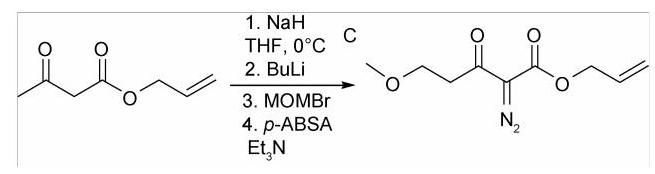
Scheme 2
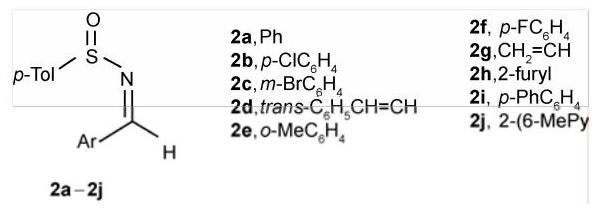
Figure 2 $N$ -Sulfinylimines.
As a model study for the optimization of the reaction conditions, we first choose the phenyl $N$ -p-tolylsulfinimine 2a and ethyl 2-diazo-3-oxopentanoate 1a as substrates for test. Initially, we found that dropwise addition of diazo 1a to the mixture of imine 2a and LiHMDS in ethyl ether smoothly at $- {78}^{ \circ }\mathrm{C}$ afforded corresponding $\delta$ -amino- $\alpha$ -diazo-β-carbonyl ester $3\mathrm{a}$ with ${56}\%$ yield and 5.5:1 dr value (Table 1, entry 1). By careful examination we observed that this addition reaction was reversible. Consequently, prolonging reaction time from ${15}\mathrm{\;{min}}$ to $1\mathrm{\;h}$ could not improve the reaction (Table 1, entry 2). To our delight, by increasing the amount of nucleophile the diastereoselectivity could be remarkably improved, while the yield had no obvious change (Table 1, entry 4). Carrying out the reaction at $- {94}^{ \circ }\mathrm{C}$ or prolonging the reaction time afforded similar result (Table 1, entry 5). To our surprise, when diethyl ether was replaced by THF as the solvent, the reaction gave essentially no diastereo-selectivity (Table 1, entry 3). Finally, with mixed solvent (ethyl ether and hexane) the reaction afforded a reasonable yield and moderate dr value (Table 1, entry 6).
The ratios of the syn- and anti-3a were determined by integration of the characteristic doublets of the amino proton resonances in the ${}^{1}\mathrm{H}$ NMR of the crude product 3a. In syn-3a the ${\mathrm{H}}^{\mathrm{a}}$ and ${\mathrm{H}}^{\mathrm{b}}$ appear at $\delta$ 5.23 ppm and $\delta$ 4.55, respectively, while in anti-3a they appear at ${\delta 4.83}$ and ${\delta 4.90}$ (Figure 3) [37].
Based on the previous studies, we have conceived that the absolute stereochemistry for addition product is controlled by the $N$ -sulfinyl group and can be predicted by a six-membered chairlike transition state [17]. The addition of the $E$ - and $Z$ -enolate of $\mathbf{{1a}}$ to sulfinimines $\mathbf{{2a}}$ results in exclusive re face addition, which affords the syn-3a and anti-3a $\delta$ -amino $\alpha$ -diazo- $\beta$ -carbonyl ester via transition states TS-1 and TS-2, respectively (Scheme 3). The fact that syn-3a is favored in nearly all cases suggests that the $E$ -enolate of $1\mathrm{a}$ is more selectively formed in the above conditions and more reactive toward addition to the sulfinimine than the Z-enolate is. As the 1, 3-axial interacts in TS-2 Z-enolate, TS-1 E-enolate is favored to give the corresponding product syn-3a. As mentioned above, when THF is involved as a solvent, the diastereoselectivity of the reaction is very low (close to 1:1, see Table 1, entry 3). This may be due to non-selective formation of $E$ - and $Z$ -enolate in THF. It has been reported by Davis et al. that $E$ -enolate is favored in LiHMDS/diethyl ether as compared to LiHMDS/ THF [17]. This is consistent with the observation made in this study. Moreover, in the transition structure, ${\mathrm{{Li}}}^{ + }$ plays an important role in forming the relatively ordered chelation structure. The low selectivity observed in THF, which is known to coordinate to ${\mathrm{{Li}}}^{ + }$ , could be the result of the failure of the formation of such ordered chelation structure.
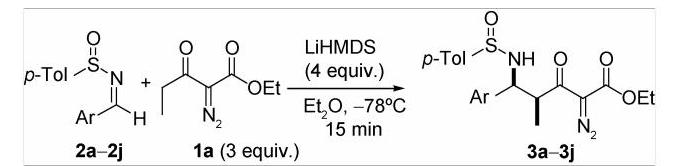
Next, we proceeded to explore the scope of this addition reaction (Table 2). The reaction proceeded with a high degree of stereo-control and moderate yields with various aryl substituted $N$ -sulfinyl imines (2a-2j). The substituents on the aromatic ring had little influence on the reaction. Both electron-donating and electron-withdrawing groups gave similar results. Based on the similarity of the ${}^{1}\mathrm{H}$ NMR spectra, it was concluded that all the reactions gave the major products with syn selectivity.
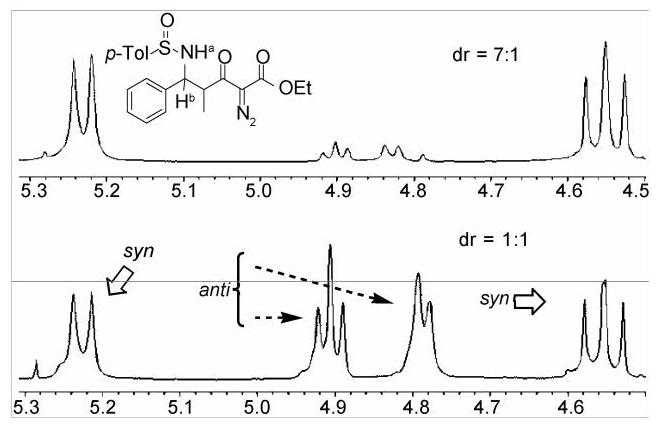
Figure 3 Determination of dr value by ${}^{1}\mathrm{H}$ NMR.
Table 1 Optimization of reaction conditions

| Entry | Ratio (imine : diazo : LiHMDS) | Solvent | $T\left( {{}^{ \circ }\mathrm{C}}\right)$ | $t$ (min) | Yield ${\left( \% \right) }^{\mathrm{a)}}$ | dr |
| 1 | $1 : {1.5} : 2$ | ${\mathrm{{Et}}}_{2}\mathrm{O}$ | -78 | 15 | 56 | 5.5:1 |
| 2 | $1 : {1.5} : 2$ | ${\mathrm{{Et}}}_{2}\mathrm{O}$ | -78 | 60 | 57 | 7:1 |
| 3 | $1 : {1.5} : 2$ | THF | -78 | 15 | 55 | 5:6 |
| 4 | $1 : 3 : 4$ | ${\mathrm{{Et}}}_{2}\mathrm{O}$ | -78 | 15 | 62 | >19:1 |
| 5 | 1:3:4 | ${\mathrm{{Et}}}_{2}\mathrm{O}$ | -94 | 60 | 52 | >19:1 |
| 6 | 1:3:4 | ${\mathrm{{Et}}}_{2}\mathrm{O} +$ Hexane | -78 | 15 | 54 | 13:1 |
a) Isolated yield. b) Ratio was determined by ${}^{1}\mathrm{H}$ NMR (300 MHz) of the crude product.
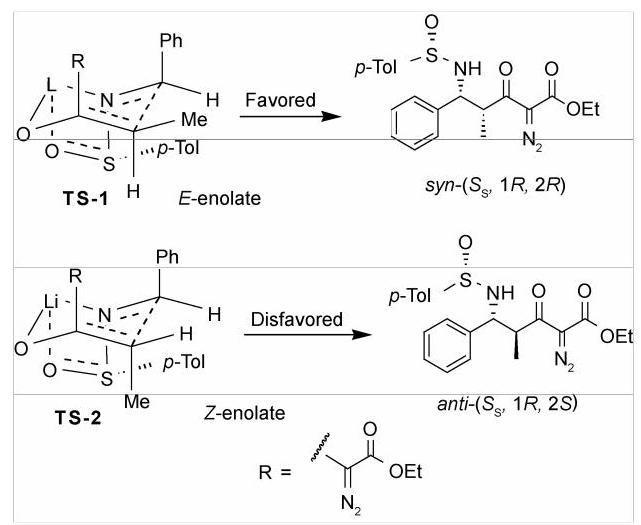
Scheme 3
We further attempted to explore diazo compounds $\mathbf{{1b}} - \mathbf{{1d}}$ as the substrates (Scheme 4). In the case of ethyl $\gamma$ -substituted of $\alpha$ -diazoacetoacetate $\mathbf{{1b}}$ , the addition reaction can proceed smoothly, giving corresponding product 4b in 58% yield and $\mathrm{{dr}} > {19} : 1$ . However, in the cases of $\alpha$ -diazoacetoacetates 1c and 1d, the reaction could not occur, presumably due to the steric bulky of the substituents.
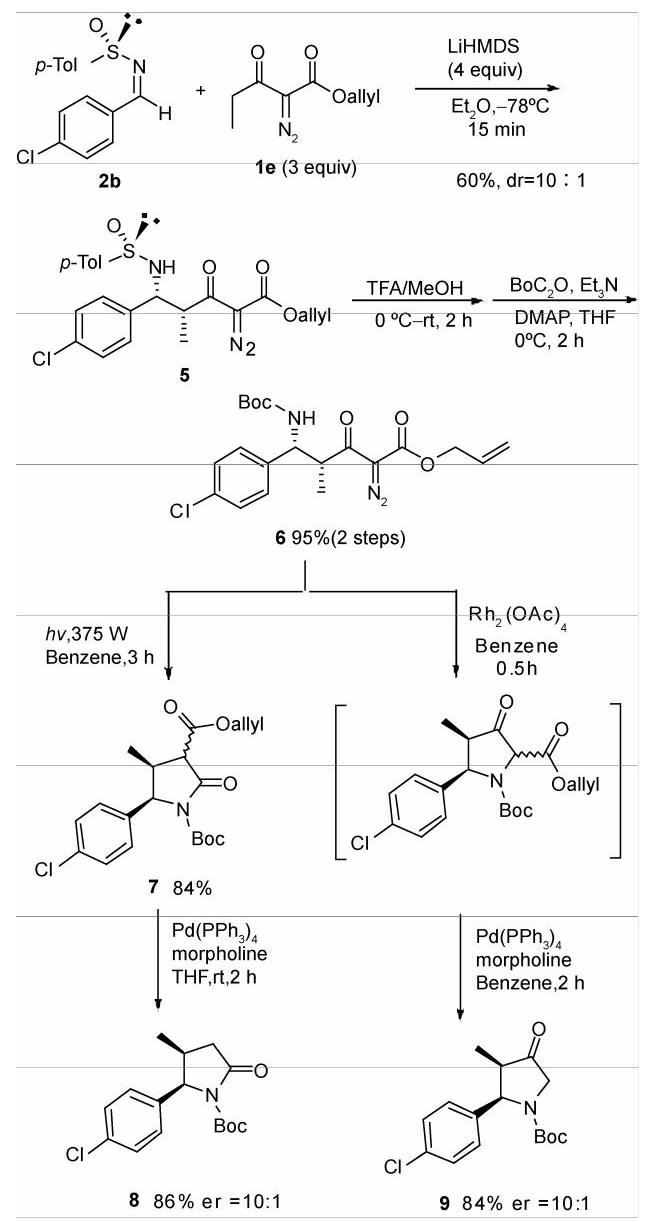
Finally, we synthesized 4,5-disubsitituted 2-oxo and 3-oxo pyrrolidines diastereoselectively by using our newly developed methodology (Scheme 5). Starting from chiral $N$ - sulfinyl imine 2b, addition of lithium enolate with allyl 2-diazo-3-oxopentanoate 1e to it gave the corresponding product 5 in 60% yield and 10:1 dr value. Because $N$ -sulfinyl group was not compatible with the photochemical condition according to our previous study [31], 5 was converted to $N$ -Boc protected diazo compound 6 before photolysis. With compound 6 in hand, we proceeded to convert these chiral diazo compounds to 2-oxo and 3-oxo pyrrolidines by the reaction sequence that we have been reported previously. First, photolysis by high-pressure Hg lamp $\left( {\lambda > {300}\mathrm{\;{nm}}}\right)$ was carried out, and the diazo compound 6 underwent Wolff rearrangement to form ketene intermediate [38-41], which was followed by intramolecular nucleophilic attack by the amino group, affording 2-oxo- 3-allyloxycarbonyl pyrrolidine 7 in excellent yield. However, the diastereoselectivity of this reaction was poor due to the easy epimerization at C3. Consequently, the ally-loxycarbonyl was removed by Pd(0)-catalyzed reaction [42,43] and 4,5-disubstituted 2-oxo pyrrolidine 8 was obtained.
Table 2 Reaction scope
| Imine (2a-2j, Ar) | Yield (%) a) | dr b) |
| 2a, Ph | 3a, 62 | >19:1 |
| 2b, $p - {\mathrm{{ClC}}}_{6}{\mathrm{H}}_{4}$ | 3b, 64 | 18:1 |
| 2c, $m - {\mathrm{{BrC}}}_{6}{\mathrm{H}}_{4}$ | 3c, 52 | 17:1 |
| 2d, trans $- {\mathrm{C}}_{6}{\mathrm{H}}_{5}\mathrm{{CH}} = \mathrm{{CH}}$ | 3d, 48 | >19:1 |
| 2e, $o - {\mathrm{{MeC}}}_{6}{\mathrm{H}}_{4}$ | 3e, 57 | >19:1 |
| 2f, $p - {\mathrm{{FC}}}_{6}{\mathrm{H}}_{4}$ | 3f, 42 | 13:1 |
| 2g, ${\mathrm{{CH}}}_{2} = \mathrm{{CH}}$ | 3g, 48 | >19:1 |
| 2h, 2-furyl | 3h, 56 | >19:1 |
| 2i, $p - {\mathrm{{PhC}}}_{6}{\mathrm{H}}_{4}$ | 3i, 51 | 15:1 |
| 2j, 2-(6-MePy) | 3j, 48 | >19:1 |
a) Isolated yield after chromatography. b) Ratio was determined by ${}^{1}\mathrm{H}$ NMR (400 MHz) of the crude product.
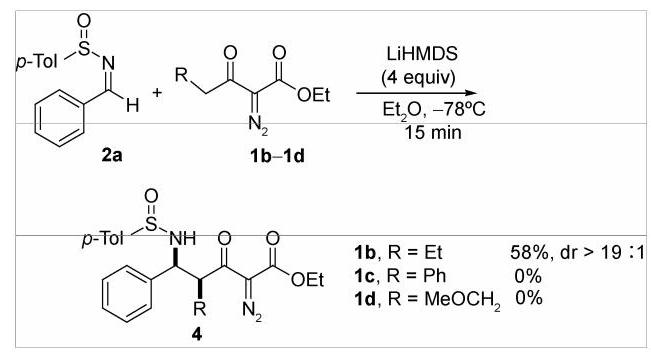
Scheme 4
Scheme 5
On the other hand, $N$ -Boc protected $\delta$ -amino diazo compound6was subjected to ${\mathrm{{Rh}}}_{2}{\left( \mathrm{{OAc}}\right) }_{4}$ catalysis, and the expected intramolecular $\mathrm{N} - \mathrm{H}$ insertion product was obtained as a mixture of diastereoisomers and tautomers. The mixture was further catalyzed with $\mathrm{{Pd}}{\left( {\mathrm{{PPh}}}_{3}\right) }_{4}$ to remove the alloxycarbonyl group. 4-Methyl-5-(4-chlorophenyl) disubstituted 3-oxo pyrrolidine 9 was thus obtained in 84% overall yield from 6 .
3 Conclusions
In summary, the highly diastereoselective addition of lithium enolate of $\gamma$ -substituted $\alpha$ -diazoacetoacetate to $N$ -sulfi-nylimines has been achieved to afford $\delta - N$ -sulfinylamino $\alpha$ - diazo- $\beta$ -ketoesters. Two chiral carbon centers were formed selectively in one step. The chiral $\delta - N$ -sulfinylamino $\alpha$ -diazo $\beta$ -ketoesters can be easily converted into 4,5-disubstituted 2-oxo and 3-oxo pyrrolidines.
This paper is dedicated to Professor LIU YouCheng on the occasion of his 90th birthday. This work was supported by the National Natural Science Foundation of China (20832002, 20772003, 20821062), the Ministry of Education of the People’s Republic of China, and National Basic Research Program of China (2009CB825300).
1 Daly J W, Spande T F, Garraffo H M. Alkaloids from Amphibian Skin: . A tabulation of over eight-hundred compounds. J Nat Prod, 2005, 68: 1556-1575
2 O H D. Pyrrole, pyrrolidine, pyridine, piperidine and tropane alkaloids. Nat Prod Rep, 2000, 17: 435-446
3 Corey E J, Li W D Z. Total synthesis and biological activity of lac-tacystin, omuralide and analogs. Chem Pharm Bull, 1999, 47: 1-10
4 Huang P Q. New Methods for the Asymmetric Synthesis of Nitrogen Heterocycles. Research Signpost, Trivandrum India, 2005
5 Smith M B. Science of Synthesis. Georg Thieme Verlag: Stuttgart Germany, 2005
6 Renaud P, Giraud L. 1-amino- and 1-amidoalkyl radicals: Generation and stereoselective reactions. Synthesis, 1996, 913-926
7 Fallis A G, Brinza I M. Free radical cyclizations involving nitrogen. Tetrahedron, 1997, 53: 17543-17594
8 Ley S V, Cox L R, Meek G. (π-Allyl)tricarbonyliron lactone complexes in organic synthesis: A useful and conceptually unusual route to lactones and lactams. Chem Rev, 1996, 96: 423-442
9 Moyer M P, Feldman P L, Rapoport H. Intramolecular nitrogen-hydrogen, oxygen-hydrogen and sulfur-hydrogen insertion reactions. Synthesis of heterocycles from $\alpha$ -diazo $\beta$ -keto esters. J Org Chem, 1985, 50: 5223-5230
10 Clark J S, Hodgson P B. Intramolecular generation and rearrangement of ammonium ylides from copper carbenoids: a general method for the synthesis of cyclic amines. J Chem Soc Chem Commun, 1994, 23: 2701-2702
11 Wang J, Hou Y, Wu P. Intramolecular N-H insertion of $\alpha$ -diazoca-rbonyls catalyzed by $\mathrm{{Cu}}{\left( \text{ acac }\right) }_{2}$ : An efficient route to derivatives of 3-oxoazetidines, 3-oxopyrrolidines and 3-oxopiperidines. J Chem Soc Perkin Trans 1,1999, 2277-2280
12 Yang H, Jurkauskas V, Mackintosh N, et al. Trifluoroacetic acid-mediated intramolecular formal N-H insertion reactions with amino- $\alpha$ -diazoketones: A facile and efficient synthesis of optically pure pyrrolidinones and piperidinones. Can J Chem, 2000, 78: 800-808
13 Davis F A, Fang T, Goswami R. Asymmetric synthesis of substituted prolines from δ-amino β-ketoesters. Methyl (2S, 5R)-(+)-5- phenylpyrrolidine-2-carboxylate. Org Lett, 2002, 4: 1599-1602
14 Berlin S, Ericsson C, Engman L. Radical carbonylation/reductive cyclization for the construction of tetrahydrofuran-3-ones and pyrrolidin- 3-ones. J Org Chem, 2003, 68: 8386-8396
15 Davis F A, Deng J. Asymmetric total synthesis of (-)-agelastatin a using sulfinimine ( $N$ -sulfinyl imine) derived methodologies. Org Lett, 2005, 7: 621-623
16 Davis F A, Zhang J, Li Y, et al. Asymmetric synthesis of 2,4,5- trisubstituted piperidines from sulfinimine-derived $\delta$ -amino $\beta$ -ketoesters. Formal synthesis of pseudodistomin B triacetate. J Org Chem, 2005, 70: 5413-5419
17 Davis F A, Yang B. Asymmetric synthesis of $\alpha$ -substituted $\beta$ -amino ketones from sulfinimines ( $N$ -sulfinyl imines). Synthesis of the in-dolizidine alkaloid (-)-223A. J Am Chem Soc, 2005, 127: 8398-8407
18 Davis F A, Xu H, Wu Y, et al. Asymmetric synthesis of polyfunc-tionalized pyrrolidines from sulfinimine-derived pyrrolidine 2-pho-sphonates. Synthesis of pyrrolidine 225C. Org Lett, 2006, 8: 2273- 2276
19 Davis F A, Melamed J Y, Sharik S S. Total synthesis of (-)-normalindine via addition of metalated 4-methyl-3-cyanopyridine to an enantiopure sulfinimine. J Org Chem, 2006, 71: 8761-8766
20 Davis F A, Santhanaraman M. Asymmetric synthesis of (-)-nupha-ramine and (-)-(5S,8R,9S)-5-(3-furyl)-8-methyl octahydroindolizidine from $\beta$ -amino ketones and the intramolecular mannich reaction. J Org Chem, 2006, 71: 4222-4226
21 Davis F A. Adventures in sulfur-nitrogen chemistry. J Org Chem, 2006, 71: 8993-9003
22 Davis F A, Song M, Augustine A. Asymmetric synthesis of trans-2,5-disubstituted pyrrolidines from enantiopure homoallylic amines. Synthesis of pyrrolidine (-)-197B. J Org Chem, 2006, 71: 2779-2786
23 Davis F A, Ramachandar T, Chai J, et al. Asymmetric synthesis of $\alpha$ -amino aldehydes from sulfinimine ( $N$ -sulfinyl imine)-derived $\alpha$ -amino 1,3-dithianes. Formal synthesis of (-)-2,3-trans-3,4-cis-di-hydroxyproline. Tetrahedron Lett, 2006, 47: 2743-2746
24 Davis F A, Xu H, Zhang J. Asymmetric synthesis of ring functionalized trans-2,6-disubstituted piperidines from N-sulfinyl $\delta$ -amino $\beta$ -keto phosphonates. Total synthesis of (-)-myrtine. J Org Chem, 2007, 72: 2046-2052
25 Davis F A, Zhang Y, Li D. Sulfinimine-derived 2,3-diamino esters in the asymmetric synthesis of piperidine $\left( {{2S},{3S}}\right) - \left( +\right)$ -CP-99,994. Tetrahedron Lett, 2007, 48: 7838-7840
26 Davis F A, Ramachandar T. α-Amino 1,3-dithioketal mediated asymmetric synthesis of piperidines (L-733,060) and tetrahydrofuran glycines. Tetrahedron Lett, 2008, 49: 870-872
27 Weix D J, Shi Y, Ellman J A. Diastereoselective and enantioselective Rh(I)-catalyzed additions of arylboronic acids to $N$ -tert-butanesulfinyl and $N$ -diphenylphosphinoyl aldimines. J Am Chem Soc,2005,127: 1092-1093
28 Peltier H M, Ellman J A. N-sulfinyl metalloenamine conjugate additions: Asymmetric synthesis of piperidines. J Org Chem, 2005, 70: 7342-7345
29 Beenen M A, Weix D J, Ellman J A. Asymmetric synthesis of protected arylglycines by rhodium-catalyzed addition of arylboronic acids to $N$ -tert-butanesulfinyl imino esters. J Am Chem Soc, 2006, 128: 6304-6305
30 Patterson A W, Ellman J A. Asymmetric synthesis of α,α-dibranched propargylamines by acetylide additions to N-tert-butanesulfinyl ketimines. J Org Chem, 2006, 71: 7110-7112
31 Dong C, Mo F, Wang J. Highly diastereoselective addition of the lithium enolate of $\alpha$ -diazoacetoacetate to $N$ -sulfinyl imines: Enantioselec-tive synthesis of 2-oxo and 3-oxo pyrrolidines. J Org Chem, 2008, 73: 1971-1974
32 Davis F A, Zhang Y, Andemichael Y, et al. Improved synthesis of en-antiopure sulfinimines (thiooxime $s$ -oxides) from $p$ -toluenesulfinamide and aldehydes and ketones. J Org Chem, 1999, 64: 1403- 1406
33 García R J, Alemán J, Belén C M, et al. A general method for the preparation of $N$ -sulfonyl aldimines and ketimines. Org Lett,2005,7: 179-182
34 Green G M, Peet N P, Metz W A. Polystyrene-supported benzene-sulfonyl azide: A diazo transfer reagent that is both efficient and safe. J Org Chem, 2001, 66: 2509-2511
35 Davies H M L, Cantrell W R Jr, Romines K R, et al. Synthesis of furans via rhodium(II) acetate-catalyzed reaction of acetylenes with $\alpha$ -diazocarbonyls: Ethyl 2-methyl-5-phenyl-3-furancarboxylate. Org Synth, 1992, 70: 93-100
36 Holmquist C R, Roskamp E J. A selective method for the direct conversion of aldehydes into $\beta$ -keto esters with ethyl diazoacetate catalyzed by tin(II) chloride. J Org Chem, 1989, 54: 3258-3260
37 Davies F A, Zhang Y, Qiu H. Asymmetric synthesis of anti- and syn-2,3-diamino esters using sulfinimines. Water concentration effects. Org Lett, 2007, 9: 833-836
38 Wolfgang K. 100 Years of the Wolff Rearrangement. Eur J Org Chem, 2002, 2193-2256
39 Wang J, Hou Y. Wolff rearrangement of diazo ketones derived from $N - p$ -tolylsulfonyl-protected $\alpha$ - and $\beta$ -amino acids. J Chem Soc Perkin Trans 1, 1998, 1919-1924
40 Wang J, Hou Y, Wu P, et al. Stereoselective synthesis of enanti-omerically pure 4,5-disubstituted pyrrolidinones from $\beta$ -amino esters. Tetrahedron: Asymmetry, 1999, 10: 4553-4561
41 Lee D J, Kim K, Park Y J. Novel synthesis of 5,6-dihydro- 4H-thieno[3,2-b]pyrrol-5-ones via the rhodium(II)-mediated Wolff rearrangement of 3-(thieno-2-yl)-3-oxo-2-diazopropanoates. Org Lett, 2002, 4: 873-876
42 Tsuji J, Nisar M, Shimizu I. Facile palladium-catalyzed decarboxylation reaction of allylic β-keto esters. J Org Chem, 1985, 50: 3416- 3417
43 Hayakawa Y, Kato H, Uchiyama M, et al. Allyloxycarbonyl group: A versatile blocking group for nucleotide synthesis. J Org Chem, 1986, 51: 2400-2402