Electrocatalytic Oxidative Hydrofunctionalization Reactions of Alkenes via Co(II/III/IV) Cycle
中文 / Bilingual · English version
Fan Yang, Yi-Chen Nie, Han-Yuan Liu, Lei Zhang, Fanyang Mo, and Rong Zhu*
Cite This: ACS Catal. 2022, 12, 2132-2137
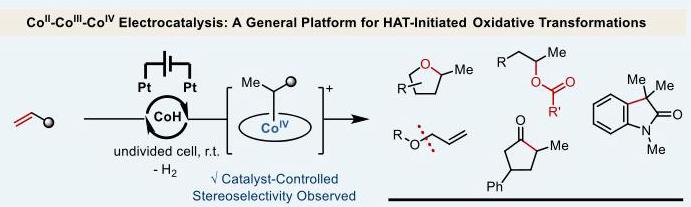
ABSTRACT: Here we disclose a general Co(II/III/IV) electrocatalytic platform for alkene functionalization. Driven by electricity, a set of the oxidative hydrofunctionalization reactions via hydrogen atom transfer were demonstrated without the need for stochio-metric chemical oxidants. The scope of the reactions encompasses hydroalkoxylation, hydroacyloxylation, hydroarylation, semipinacol rearrangement, and deallylation. Mechanistic studies and stereochemical evidence support an ECEC process involving an electrochemically generated organocobalt(IV) intermediate. This work presents an example of reactivity space expansion in electrocatalysis in the ${\mathrm{{VB}}}_{12}$ -system by going beyond the common oxidation states of Co(I/II/II).
KEYWORDS: cobalt, hydrogen atom transfer, electrocatalysis, hydrofunctionalization, alkenes
Using electric current as a traceless reagent in transition-metal catalysis has opened up a new avenue for the development of sustainable transformations. ${}^{1}$ Transition-metal complexes can serve as electron transfer mediators to reduce overpotentials and meanwhile bring in rich and tunable reactivities for electrosynthesis. ${}^{2}$ Cobalt complexes were among the first explored metal-based redox catalysts in electrosynthesis because of their multiple accessible oxidation states. ${}^{3}$ In particular, vitamin ${\mathrm{B}}_{12}$ and its mimics (cobaloxime, CoSalen, etc.) have received considerable attention for their good redox cyclability and distinct reactivities at ${\mathrm{{Co}}}^{\mathrm{I}},{\mathrm{{Co}}}^{\mathrm{{II}}}$ , and ${\mathrm{{Co}}}^{\mathrm{{III}}}$ oxidation states, respectively (Figure 1a). ${}^{4}$ For example, the square planar four-coordinate ${\mathrm{{Co}}}^{\mathrm{I}}$ “supernucleophile” has been employed for electroreductive dehalogenation, ${}^{5}$ Giese reaction, ${}^{6}$ and carboxylation ${}^{7}$ since 1980s, and more recently, it has been used in $\mathrm{{Co}} - \mathrm{H}$ -catalyzed olefin isomerization ${}^{8}$ and related reactions ${}^{9}$ via hydrogen-atom-transfer (HAT). The combination of electrochemical HAT reaction and copper-mediated radical functionalization has resulted in an elegant solution for enantioselective hydrocyanation of conjugated alkenes. ${}^{10}$
Electrochemically going beyond the common oxidation states $\left( {\mathrm{{Co}}}^{\mathrm{I}/\mathrm{{II}}/\mathrm{{III}}}\right)$ may allow one to explore new reactivity space. An inspiring example is Ackermann’s discovery of a formal ${\mathrm{{Co}}}^{\mathrm{{IV}}}$ intermediate in electrocatalytic $\mathrm{C} - \mathrm{H}$ functionalization reactions. ${}^{11}$ In ${\mathrm{{VB}}}_{12}$ -related systems, cationic organocobalt(IV) complexes have been known since the 1970s (Figure 1b). ${}^{12}$ Their organometallic radical cation nature makes them susceptible to nucleophilic displacement at the alkyl ligand. ${}^{13}$ This was recently leveraged in a series of HAT-initiated oxidative hydrofunctionalization reactions using stoichiometric chemical oxidants such as $N$ -fluoropyridiniums, hypervalent iodine reagents, and persulfates. ${}^{14}$ In our previous work, a well-defined organocobalt(III) complex was electrochemically characterized, where the ${\mathrm{{Co}}}^{\mathrm{{III}}/\mathrm{{IV}}}$ oxidation proved accessible at quite low potential $\left( {E}_{\mathrm{p}/2}\right.$ vs $\left. {{\mathrm{{Fc}}}^{ + }/\mathrm{{Fc}} \sim - {0.01}\mathrm{\;V}}\right) \cdot {}^{15}$ However, to the best of our knowledge, such a ${\mathrm{{Co}}}^{\mathrm{{IV}}}$ state in ${\mathrm{{VB}}}_{12}$ -related catalysts has not been explored in electrosynthesis.
Here we report a general electrocatalytic platform enabling a set of HAT-initiated oxidative transformations in undivided cells via electrochemically generated ${\mathrm{{Co}}}^{\mathrm{{IV}}}$ intermediates (Figure 1c). Replacing stoichiometric oxidants leads to a more cost-effective and/or safer protocol that generates less waste stream. The scope of the reactions encompasses hydroalkoxylation, hydroacyloxylation, hydroarylation, semi-pinacol rearrangement, and deallylation without the need for tedious optimizations. The relevance of ${\mathrm{{Co}}}^{\mathrm{{IV}}}$ intermediates was supported by the observed catalyst-controlled stereoselectivity.
We commenced our investigation by studying the electrocatalytic intramolecular hydroalkoxylation of 2,2-diphenylpent- 4-en-1-ol (1a) as the model reaction (Figure 2a). A set of optimal conditions was identified as shown in entry 1. In methanol at ambient temperature, constant current $\left( {5\mathrm{\;{mA}}}\right)$ electrolysis using platinum mesh electrodes was performed in the presence of a catalytic amount of CoSalen complex 3a and diphenylsilane as a hydride source. The cyclization product 2a was obtained in 87% yield after 3.75-h electrolysis (2.3 F/mol, corresponding to 87% faradaic efficiency). CoSalen complex 3b, bearing a less sterically hindered backbone, furnished substantially lower conversion and yield, which could be attributable to the instability of the ligand backbone during electrolysis (entry 2). The reaction proved to be relatively insensitive to the choice of the electrolyte or the silane (entry 3-4), while it was significantly affected by the solvent and catalyst loading (entry 5-6). Changing the anode from platinum mesh to reticulated vitreous carbon (RVC) provided a comparable yield (entry 7). Doubling the current led to catalyst decomposition and thus low conversion (entry 8). Control experiments established the essential roles of the catalysts, silane, and electricity, respectively (entries 9-11).
Received: December 3, 2021
Revised: January 8, 2022
Published: January 27, 2022
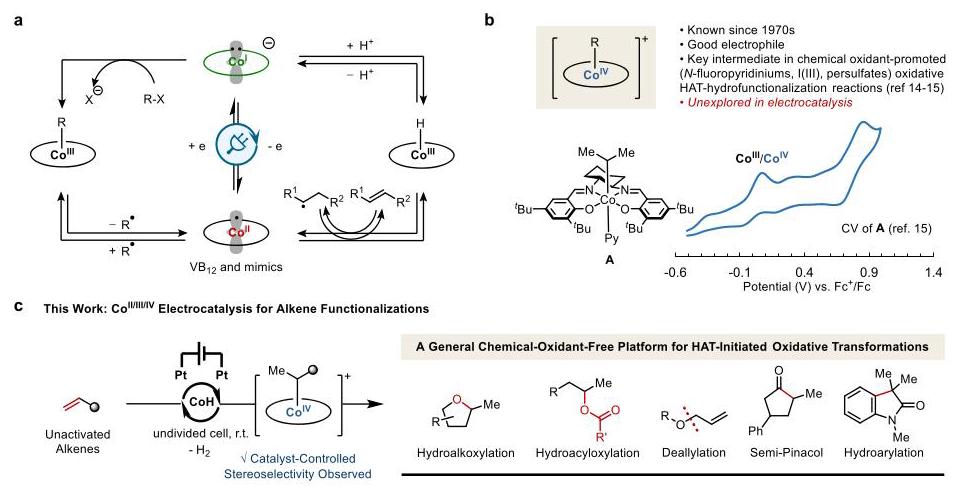
Figure 1. (a) Established electrosynthesis catalyzed by ${\mathrm{{VB}}}_{12}$ and analogues typically involves oxidation states I, II, and III. (b) Related organocobalt(IV) complex remains unexplored in electrocatalysis. Reproduced with permission from ref 15. (c) This work: a general platform for electrocatalytic oxidative functionalization of olefins via ${\mathrm{{Co}}}^{\mathrm{{IV}}}$ .
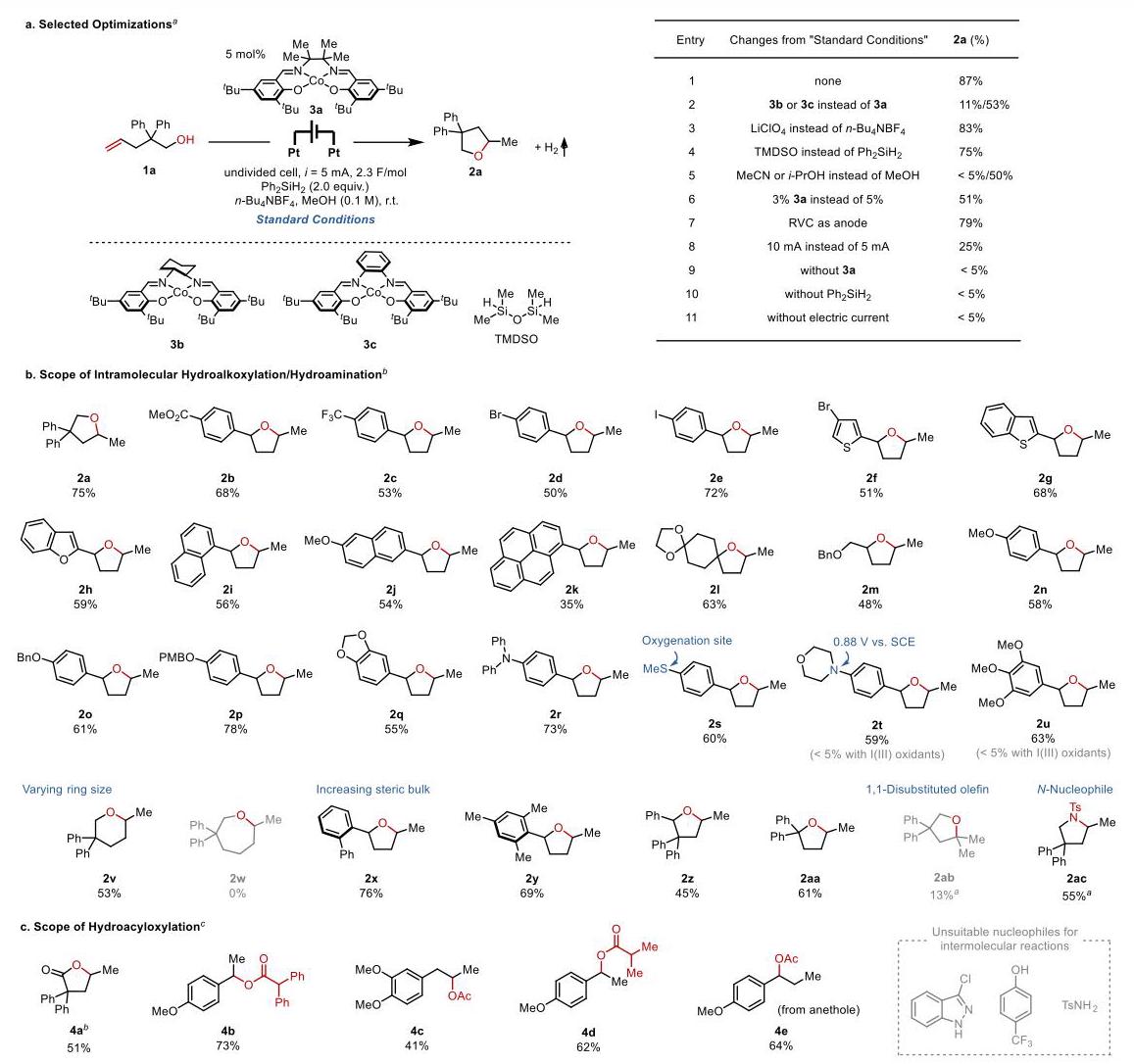
Figure 2. Selected optimizations and scope of the electrocatalytic hydroalkoxylation(hydroamination) and hydroacyloxylation reactions. ${}^{a}$ Yields were determined by ${}^{1}\mathrm{H}$ NMR analysis of the crude reaction mixture. ${}^{b}$ Isolated yields under standard conditions (d.r. ranged from 1.1:1 to 1.9:1 in the cases where diastereomers were produced, see SI). ‘Solated yields under modified standard conditions where MeCN and TMDSO were used in place of $\mathrm{{MeOH}}$ and ${\mathrm{{Ph}}}_{2}{\mathrm{{SiH}}}_{2}$ , respectively. For 4b-e,3.0 equiv of carboxylic acid was used.
With the optimized protocol in hand, the scope and limitation of the intramolecular hydroalkoxylation was first investigated (Figure 2b). We examined various $\gamma$ -hydroxy alkenes bearing a range of functional groups including esters (2b), aryl halides (2d, e), heterocycles (2f-h), fused aromatics (2i-k), and acid-sensitive protecting groups (2l), which afforded cyclization products in good yields. We were particularly interested in substrates that are incompatible with strong chemical oxidants such as $N$ -fluoropyridiniums or I ${}^{\mathrm{{III}}}$ reagents. To this, the electrocatalytic system demonstrated excellent compatibility with electrophores such as sulfide (2s), tertiary amines (2t), ${}^{16}$ or electron-rich aryls (2u), which is consistent with the low potential of ${\mathrm{{Co}}}^{\mathrm{{III}}/\mathrm{{IV}}}$ transition. Ring closure to afford a six-membered-ring proceeded smoothly (2v), while medium-ring formation was rather difficult (2w). On the nucleophile side, more hindered secondary alcohols as well as tertiary alcohols and sulfonamides can be employed (2x-2aa and 2ac). The addition of carboxylic acid was also demonstrated in both intra- and intermolecular fashion, which displayed efficiency that is comparable to the chemical oxidant-based protocols (Figure 2c). ${}^{14}$ g Notably, potential byproducts derived from anodic decarboxylation were not observed. Regarding the alkene substitutions, unactivated monosubstituted alkenes and styrenes proved to be viable, while 1,1- disubsituted alkenes afforded mostly an isomerization product (2ab). This corroborates with previous observations in chemical oxidant-mediated reactions, which could be attributable to the disfavored formation of corresponding organocobalt(IV) species. Internal olefins except for aryl substituted ones (4e) generally displayed low reactivity, which was anticipated for $\mathrm{{Co}} - \mathrm{H}$ HAT-initiated reactions.
Under the electrocatalytic conditions, methanol was found to add across a vinyl ether (5) in Markovnikov-selective fashion (Figure 3a). Inspired by recent reports on HAT-initiated alkene isomerization under chemical oxidation or electroreduction conditions ${}^{8,{17}}$ as well as results from our own lab, we envisioned a tandem isomerization/hydromethoxyla-tion reaction that leads to trapping at the more cation-stabilizing site (Figure 3b). The in situ hydrolysis of the resulting acetal would provide a cheap and chemoselective means for allyl deprotection, which is alternative to strong base-mediated ${}^{18}$ or precious metal-catalyzed methods. ${}^{19}$ Indeed, we were able to show efficient deallylation to reveal ${1}^{ \circ }$ , ${2}^{ \circ },{3}^{ \circ }$ alcohols, carboxylic acids, and anilines (Figure 3c).
To demonstrate the generality of this electrocatalytic protocol, C-C bond forming rearrangement and cyclization reactions were carried out (Figure 4). For example, semi-pinacol rearrangement of a cyclobutane-containing allylic alcohol 9 was achieved, furnishing the ring-expansion product 10 in good yield. An intramolecular hydroarylation reaction was demonstrated (12). Cyclization at the $\alpha$ -position of an amide likely proceeded via a radical rather than a cationic intermediate, which is in line with Vanderwal’s proposal on HAT-initiated oxidative polyene cyclization. ${}^{20}$ Compared with chemical oxidant-based systems, the electrocatalytic method displayed similar efficiency at a lower expense and with less organic waste production, which could be important for scaling up applications.
A series of experiments were performed in order to probe the mechanism of the electrocatalytic hydrofunctionalization reactions (Figure 5). First, cyclic voltammetry of Co complex 3a displayed a reversible oxidation event at ${E}_{1/2} = - {0.17}\mathrm{\;V}$ vs ${\mathrm{{Fc}}}^{ + }/\mathrm{{Fc}}$ in methanol, which was not affected by the addition of silane (Figure 5a). Interestingly, the reduction wave disappeared upon adding potassium methoxide. It indicates that methoxide, which could be cathodically generated, might serve as a necessary catalyst for silane activation and thus affect the formation of $\mathrm{{Co}} - \mathrm{H}$ from ${\mathrm{{Co}}}^{\mathrm{{III}}}$ . This also corroborates with the solvent effect observed during optimization (Figure 2a, entry 5). Next, hydride transfer from the silane was confirmed by a deuterium-labeling experiment, whereas running the reaction in ${\mathrm{{CD}}}_{3}\mathrm{{OD}}$ provided nearly no D incorporation (Figure 5b). Interestingly, the D% incorporation was substantially lower than expected in the first case, which is most likely due to $\mathrm{H}/\mathrm{D}$ scrambling by reversible HAT (rather than $\mathrm{{Co}} - \mathrm{D}/{\mathrm{H}}^{ + }$ exchange or oxidation of methanol). Further, the HAT process was evaluated by a radical clock substrate, where the ring-opening trapping product was predominantly observed, suggesting the radical nature of the intermediate generated by HAT (Figure 5c).
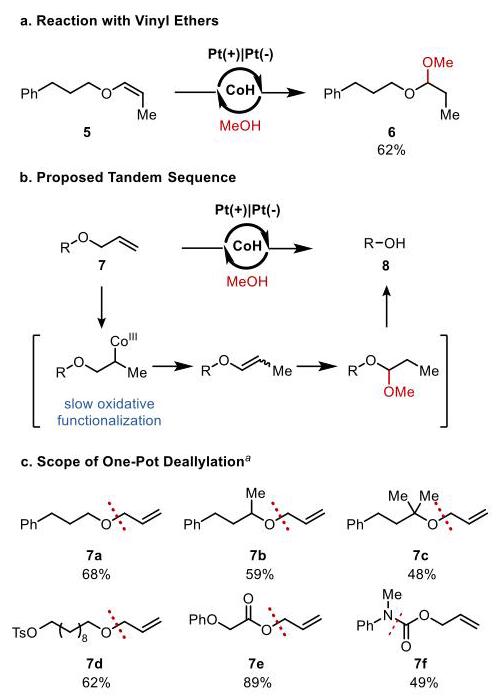
Figure 3. Selective deallylation via tandem isomerization/hydro-methoxylation sequence. ${}^{a}$ Isolated yields. Conditions: substrate (0.30 mmol,1 equiv),3a (5 mol %), TMDSO (2.0 equiv), $n - {\mathrm{{Bu}}}_{4}{\mathrm{{NBF}}}_{4}$ (2.0 equiv) in $\mathrm{{MeOH}}\left( {{3.0}\mathrm{\;{mL}}}\right)$ , Pt mesh electrode, undivided cell, constant current $i = 5\mathrm{\;{mA}},{2.3}\mathrm{\;F}/\mathrm{{mol}},{25}^{ \circ }\mathrm{C}$ .
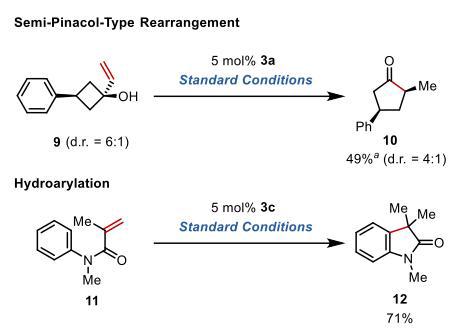
Figure 4. Electrocatalytic $\mathrm{C} - \mathrm{C}$ bond forming hydrofunctionaliza-tions. ${}^{a}$ TMDSO was used in place of ${\mathrm{{Ph}}}_{2}{\mathrm{{SiH}}}_{2}$ . Determined by ${}^{1}\mathrm{H}$ NMR analysis of the crude reaction mixture.
A key mechanistic evidence for the involvement of a ${\mathrm{{Co}}}^{\mathrm{{IV}}}$ intermediate was provided by the attempted asymmetric synthesis using a chiral CoSalen catalyst (Figure 5d). Despite the low enantiomeric excess, this observed catalyst controlled stereoselectivity strongly supports the ${\mathrm{{Co}}}^{\mathrm{{IV}}}$ hypothesis. ${}^{{14}\mathrm{\;b},\mathrm{\;d},\mathrm{f}}$ Nonetheless, we observed an interesting correlation between the anode material and the selectivity. Tentatively, this might be attributable to the more facile oxidation of free radicals on RVC compared with platinum. ${}^{21}$ Unfortunately, substantial optimizations did not provide satisfying ee’s.
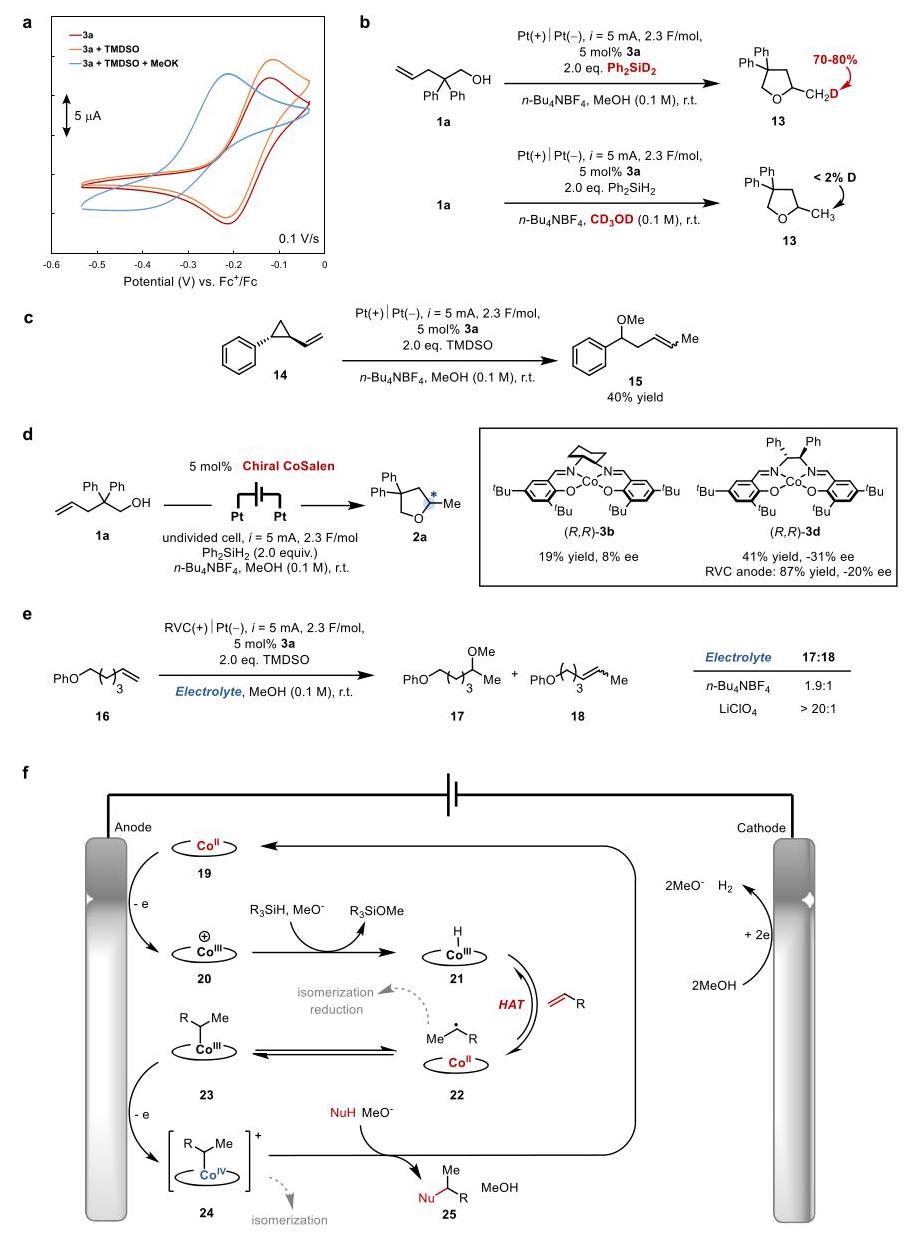
Figure 5. Mechanistic studies. (a) Cyclic voltammograms obtained in ${0.1}\mathrm{M}n - {\mathrm{{Bu}}}_{4}{\mathrm{{NClO}}}_{4}$ , MeOH. (b) Isotope labeling experiment. (c) Radical clock test. (d) Observation of catalyst-controlled stereoselectivity was consistent with the involvement of ${\mathrm{{Co}}}^{\mathrm{{IV}}}$ . (e) Electrolyte effect in hydromethoxylation reaction. (f) Current mechanistic hypothesis.
The putative ${\mathrm{{Co}}}^{\mathrm{{IV}}}$ species generated at the electrode could be intercepted either before or after diffusing into the bulk solution. An electrolyte effect could be used to probe this step. Moeller has shown that for a radical-cation-mediated reaction carried out in methanol, the effective methanol concentration near the anode could be lowered by an electrolyte that forms a more hydrophobic electric double layer (EDL). ${}^{22}$ Indeed, we noticed that for the hydromethoxylation reaction shown in Figure 5e, the selectivity for methanol trapping over isomerization was substantially lower with the more hydrophobic ${\mathrm{{NBu}}}_{4}{\mathrm{{BF}}}_{4}$ than with ${\mathrm{{LiClO}}}_{4}$ . Therefore, it seems that the ${\mathrm{{Co}}}^{\mathrm{{IV}}}$ species is mostly trapped near the electrode rather than in the bulk solution, which is consistent with the irreversible oxidation wave assigned to ${\mathrm{{Co}}}^{\mathrm{{III}}/\mathrm{{IV}}}$ in Figure 1b.
On the basis of these observations, a plausible catalytic cycle involving an ECEC sequence is depicted in Figure 5f. Anodic oxidation of the ${\mathrm{{Co}}}^{\mathrm{{II}}}$ complex and cathode reduction of methanol would afford ${\mathrm{{Co}}}^{\mathrm{{III}}}$ and methoxide anion, respectively. Hydride exchange between the silane and ${\mathrm{{Co}}}^{\mathrm{{III}}}$ could be facilitated by methoxide. The resulting $\mathrm{{Co}} - \mathrm{H}$ species 21 would undergo HAT with an alkene to afford an alkyl radical 22, followed by ${\mathrm{{Co}}}^{\mathrm{{II}}}$ trapping to give an alkylcobalt(III) complex 23. A second anodic oxidation then takes place to convert 23 to a highly electrophilic ${\mathrm{{Co}}}^{\mathrm{{IV}}}$ complex 24, which would be rapidly intercepted by a nucleophile next to the anode to form the hydrofunctionalization product 25 and regenerate the ${\mathrm{{Co}}}^{\mathrm{{II}}}$ complex. The major side pathways include reduction (hydrogenation) and isomerization. The latter could be a result of either back-HAT from the alkyl radical to ${\mathrm{{Co}}}^{\mathrm{{II}}}$ and/or the deprotonation of ${\mathrm{{Co}}}^{\mathrm{{IV}}}$ complex 24.
In conclusion, we disclose a general electricity-driven method for the Co-catalyzed oxidative hydrofunctionalization reactions of alkenes via a ${\mathrm{{Co}}}^{\mathrm{{II}}/\mathrm{{III}}/\mathrm{{IV}}}$ cycle. Being free of stoichiometric chemical oxidants, this method applies to the formal Markovnikov-selective addition of alcohols and carboxylic acids to unactivated alkenes with excellent functional group compatibility, as well as two types of C-C bond forming reactions. A tandem isomerization/hydromethoxyla-tion sequence was also developed for selective allyl deprotection. Mechanistic studies provided evidence for an ECEC mechanism involving ${\mathrm{{Co}}}^{\mathrm{{IV}}}$ intermediates, where moderate enantioselectivity was achieved to preliminarily demonstrate the potential of catalyst control. We anticipate that the results reported here will facilitate future investigations on chemo- and stereoselective electrocatalysis involving high valent cobalt organometallics.
ASSOCIATED CONTENT
(c) Supporting Information
The Supporting Information is available free of charge at https://pubs.acs.org/doi/10.1021/acscatal.1c05557.
Experimental procedures, characterization, spectra, and kinetic data (PDF)
A AUTHOR INFORMATION
Corresponding Author
Rong Zhu - Beijing National Laboratory for Molecular Sciences (BNLMS), Key Laboratory of Bioorganic Chemistry and Molecular Engineering of Ministry of Education, College of Chemistry and Molecular Engineering, Peking University, Beijing 100871, China; (C) orcid.org/0000-0001-5035- 3531;
Authors
Fan Yang - Beijing National Laboratory for Molecular Sciences (BNLMS), Key Laboratory of Bioorganic Chemistry and Molecular Engineering of Ministry of Education, College of Chemistry and Molecular Engineering, Peking University, Beijing 100871, China
Yi-Chen Nie - Beijing National Laboratory for Molecular Sciences (BNLMS), Key Laboratory of Bioorganic Chemistry and Molecular Engineering of Ministry of Education, College of Chemistry and Molecular Engineering, Peking University, Beijing 100871, China
Han-Yuan Liu - Beijing National Laboratory for Molecular Sciences (BNLMS), Key Laboratory of Bioorganic Chemistry and Molecular Engineering of Ministry of Education, College of Chemistry and Molecular Engineering, Peking University, Beijing 100871, China
Lei Zhang - Beijing National Laboratory for Molecular Sciences (BNLMS), Key Laboratory of Bioorganic Chemistry and Molecular Engineering of Ministry of Education, College of Chemistry and Molecular Engineering, Peking University, Beijing 100871, China; orcid.org/0000-0001-9031-4318
Fanyang Mo - School of Materials Science and Engineering, Peking University, Beijing 100871, China
Complete contact information is available at: https://pubs.acs.org/10.1021/acscatal.1c05557
Notes
The authors declare no competing financial interest.
ACKNOWLEDGMENTS
Financial support was provided by the Natural Science Foundation of China (21901011), the Clinical Medicine Plus X Young Scholars Project of Peking University (7100602764) and startup fund from the College of Chemistry and Molecular Engineering, Peking University and BNLMS. We thank Dr. Yuanhe Li (PKU) for the enantiomeric excess measurement of the chiral compounds and Dr. Jinchao Wei (Institute of Chemistry, Chinese Academy of Sciences) for assistance of high-resolution mass data, and we thank Yun-Nian Yin (PKU) for assistance with experiments.
CREFERENCES
(1) (a) Yan, M.; Kawamata, Y.; Baran, P. S. Synthetic Organic Electrochemical Methods Since 2000: On the Verge of a Renaissance. Chem. Rev. 2017, 117, 13230-13319. (b) Meyer, T. H.; Choi, I.; Tian, C.; Ackermann, L. Powering the Future: How Can Electrochemistry Make a Difference in Organic Synthesis? Chem. 2020, 6, 2484-2496. (c) Gandeepan, P.; Finger, L. H.; Meyer, T. H.; Ackermann, L. 3d metallaelectrocatalysis for resource economical syntheses. Chem. Soc. Rev. 2020, 49, 4254-4272. (d) Novaes, L. F. T.; Liu, J.; Shen, Y.; Lu, L.; Meinhardt, J. M.; Lin, S. Electrocatalysis as an enabling technology for organic synthesis. Chem. Soc. Rev. 2021, 50, 7941-8002.
(2) (a) Francke, R.; Little, R. D. Redox catalysis in organic electrosynthesis: basic principles and recent developments. Chem. Soc. Rev. 2014, 43, 2492-2521. (b) Ma, C.; Fang, P.; Liu, D.; Jiao, K.-J.; Gao, P.-S.; Qiu, H.; Mei, T.-S. Transition metal-catalyzed organic reactions in undivided electrochemical cells. Chem. Sci. 2021, 12, 12866-12873. (c) Ma, C.; Fang, P.; Liu, Z.-R.; Xu, S.-S.; Xu, K.; Cheng, X.; Lei, A.; Xu, H.-C.; Zeng, C.; Mei, T.-S. Recent advances in organic electrosynthesis employing transition metal complexes as electrocatalysts. Science Bulletin 2021, 66, 2412-2429. (d) Chang, X.; Zhang, Q.; Guo, C. Asymmetric Electrochemical Transformations. Angew. Chem., Int. Ed. 2020, 59, 12612-12622. (e) Tang, S.; Liu, Y.; Lei, A. Electrochemical Oxidative Cross-coupling with Hydrogen Evolution: A Green and Sustainable Way for Bond Formation. Chem. 2018, 4, 27-45.
(3) (a) Zhong, J.; Yu, Y.; Zhang, D.; Ye, K. Merging cobalt catalysis and electrochemistry in organic synthesis. Chin. Chem. Lett. 2021, 32, 963-972. (b) Sauermann, N.; Meyer, T. H.; Tian, C.; Ackermann, L. Electrochemical Cobalt-Catalyzed C-H Oxygenation at Room Temperature. J. Am. Chem. Soc. 2017, 139, 18452-18455. (c) Gao, X.; Wang, P.; Zeng, L.; Tang, S.; Lei, A. Cobalt(II)-Catalyzed Electrooxidative C-H Amination of Arenes with Alkylamines. J. Am. Chem. Soc. 2018, 140, 4195-4199. (d) Chalkley, M. J.; Garrido-Barros, P.; Peters, J. C. A molecular mediator for reductive concerted proton-electron transfers via electrocatalysis. Science 2020, 369, 850- 854.
(4) (a) Yin, Y.-N.; Ouyang, D.-C.; Wang, J.-J; Zhu, R. Recent advances in CoSalen-catalyzed radical reactions. Sci. Sin Chim 2020, 50, 1217-1232. (b) Michiyuki, T.; Komeyama, K. Recent Advances in Four-Coordinated Planar Cobalt Catalysis in Organic Synthesis. Asian J. Org. Chem. 2020, 9, 343-358.
(5) Shimakoshi, H.; Luo, Z.; Inaba, T.; Hisaeda, Y. Electrolysis of trichloromethylated organic compounds under aerobic conditions catalyzed by the ${\mathrm{B}}_{12}$ model complex for ester and amide formation. Dalton Trans. 2016, 45, 10173-10180.
(6) Scheffold, R.; Orlinski, R. Synthesis and reactions of porphine-type metal complexes. 15. Carbon-carbon bond formation by light assisted ${\mathrm{B}}_{12}$ -catalysis. Nucleophilic acylation of Michael olefins. J. Am. Chem. Soc. 1983, 105, 7200-7202.
(7) (a) Chen, B.-L.; Zhu, H.-W.; Xiao, Y.; Sun, Q.-L.; Wang, H.; Lu, J.-X. Asymmetric electrocarboxylation of 1-phenylethyl chloride catalyzed by electrogenerated chiral ${\left\lbrack {\mathrm{{Co}}}^{1}\text{ (salen) }\right\rbrack }^{ - }$ complex. Electro-chem. Commun. 2014, 42, 55-59. (b) Yang, Z.; Yu, Y.; Lai, L.; Zhou, L.; Ye, K.; Chen, F.-E. Carbon dioxide cycle via electrocatalysis: Electrochemical carboxylation of ${\mathrm{{CO}}}_{2}$ and decarboxylative function-alization of carboxylic acids. Green Synth. Catal. 2021, 2, 19-26.
(8) Gnaim, S.; Bauer, A.; Zhang, H.-J.; Chen, L.; Gannet, C.; Malapit, C. A.; Hill, D.; Vogt, D.; Tang, T.; Daley, R.; Hao, W.; Quertenmont, M.; Beck, W. D.; Kandahari, E.; Vantourout, J. C.; Echeverria, P.-G.; Abruna, H.; Blackmond, D.; Minteer, S.; Reisman, S.; Sigman, M. S.; Baran, P. S. Cobalt-Electrocatalytic Hydrogen Atom Transfer for Functionalization of Unsaturated C-C Bonds. ChemRxiv, Aug. 25, 2021, Version 1. DOI: 10.33774/chemrxiv-2021-b34zI.
(9) (a) Cai, C.-Y.; Wu, Z.-J.; Liu, J.-Y.; Chen, M.; Song, J.; Xu, H.-C. Tailored cobalt-salen complexes enable electrocatalytic intramolecular allylic C-H functionalizations. Nat. Commun. 2021, 12, 3745. (b) Chen, M.; Wu, Z.-J.; Song, J.; Xu, H.-C. Dual-functional cobalt catalyst enables electrocatalytic allylic C-H alkylation. ChemRxiv, Nov. 18, 2021, Version 2. DOI: 10.33774/chemrxiv-2021-tsk2m-v2.
(10) Song, L.; Fu, N.; Ernst, B. G.; Lee, W. H.; Frederick, M. O.; DiStasio, R. A.; Lin, S. Dual electrocatalysis enables enantioselective hydrocyanation of conjugated alkenes. Nat. Chem. 2020, 12, 747- 754.
(11) Meyer, T. H.; Oliveira, J. C. A.; Ghorai, D.; Ackermann, L. Insights into Cobalta(III/IV/II)-Electrocatalysis: Oxidation-Induced Reductive Elimination for Twofold C-H Activation. Angew. Chem., Int. Ed. 2020, 59, 10955-10960.
(12) Halpern, J.; Chan, M. S.; Hanson, J.; Roche, T. S.; Topich, J. A. Detection and characterization of radical cations produced by one-electron chemical and electrochemical oxidations of organocobalt compounds. J. Am. Chem. Soc. 1975, 97, 1606-1608.
(13) Vol’pin, M. E.; Levitin, I. Y.; Sigan, A. L.; Halpern, J.; Tom, G. M. Reactivity of organocobalt(IV) chelate complexes toward nucleophiles: diversity of mechanisms. Inorg. Chim. Acta 1980, 41, 271-277.
(14) (a) Shigehisa, H.; Hayashi, M.; Ohkawa, H.; Suzuki, T.; Okayasu, H.; Mukai, M.; Yamazaki, A.; Kawai, R.; Kikuchi, H.; Satoh, Y.; Fukuyama, A.; Hiroya, K. Catalytic Synthesis of Saturated Oxygen Heterocycles by Hydrofunctionalization of Unactivated Olefins: Unprotected and Protected Strategies. J. Am. Chem. Soc. 2016, 138, 10597-10604. (b) Ebisawa, K.; Izumi, K.; Ooka, Y.; Kato, H.; Kanazawa, S.; Komatsu, S.; Nishi, E.; Shigehisa, H. Catalyst- and Silane-Controlled Enantioselective Hydrofunctionalization of Alkenes by Cobalt-Catalyzed Hydrogen Atom Transfer and Radical-Polar Crossover. J. Am. Chem. Soc. 2020, 142, 13481-13490. (c) Touney, E. E.; Foy, N. J.; Pronin, S. V. Catalytic Radical-Polar Crossover Reactions of Allylic Alcohols. J. Am. Chem. Soc. 2018, 140, 16982- 16987. (d) Discolo, C. A.; Touney, E. E.; Pronin, S. V. Catalytic Asymmetric Radical-Polar Crossover Hydroalkoxylation. J. Am. Chem. Soc. 2019, 141, 17527-17532. (e) Yahata, K.; Kaneko, Y.; Akai, S. Cobalt-Catalyzed Intermolecular Markovnikov Hydroamination of Nonactivated Olefins: ${N}^{2}$ -Selective Alkylation of Benzotriazole. Org. Lett. 2020, 22, 598-603. (f) Qin, T.; Lv, G.; Meng, Q.; Zhang, G.; Xiong, T.; Zhang, Q. Cobalt-Catalyzed Radical Hydroamination of Alkenes with N-fluorobenzenesulfonimides. Angew. Chem., Int. Ed. 2021, 60, 25949-25957. (g) Zhou, X.-L.; Yang, F.; Sun, H.-L.; Yin, Y.-N.; Ye, W.-T.; Zhu, R. Cobalt-Catalyzed Intermolecular Hydro-functionalization of Alkenes: Evidence for a Bimetallic Pathway. J. Am. Chem. Soc. 2019, 141, 7250-7255. (h) Yin, Y.-N.; Ding, R.-Q.; Ouyang, D.-C.; Zhang, Q.; Zhu, R. Highly chemoselective synthesis of hindered amides via cobalt-catalyzed intermolecular oxidative hydro-amidation. Nat. Commun. 2021, 12, 2552. (i) Shevick, S. L.; Obradors, C.; Shenvi, R. A. Mechanistic Interrogation of Co/Ni-Dual Catalyzed Hydroarylation. J. Am. Chem. Soc. 2018, 140, 12056- 12068.
(15) Sun, H.-L.; Yang, F.; Ye, W.-T.; Wang, J.-J.; Zhu, R. Dual Cobalt and Photoredox Catalysis Enabled Intermolecular Oxidative Hydrofunctionalization. ACS Catal. 2020, 10, 4983-4989.
(16) Roth, H. G.; Romero, N. A.; Nicewicz, D. A. Experimental and Calculated Electrochemical Potentials of Common Organic Molecules for Applications to Single-Electron Redox Chemistry. Synlett 2016, 27, 714-723. For comparison with previously developed methods, see SI-S37.
(17) (a) Crossley, S. W. M.; Barabé, F.; Shenvi, R. A. Simple, Chemoselective, Catalytic Olefin Isomerization. J. Am. Chem. Soc. 2014, 136, 16788-16791. (b) Huang, G.; Ke, M.; Tao, Y.; Chen, F. Specific Z-Selectivity in the Oxidative Isomerization of Allyl Ethers to Generate Geometrically Defined Z-Enol Ethers Using a Cobalt(II)- (salen) Complex Catalyst. J. Org. Chem. 2020, 85, 5321-5329. (c) Li, N.; Gui, Y.; Chu, M.; You, M.; Qiu, X.; Liu, H.; Wang, S.; Deng, M.; Ji, B. Cobalt-Catalyzed Deprotection of Allyl Carboxylic Esters Induced by Hydrogen Atom Transfer. Org. Lett. 2021, 23, 8460- 8464.
(18) Bailey, W. F.; England, M. D.; Mealy, M. J.; Thongsornkleeb, C.; Teng, L. Facile O-deallylation of allyl ethers via ${\mathrm{S}}_{\mathrm{N}}{2}^{\prime }$ reaction with tert-butyllithium. Org. Lett. 2000, 2, 489-491.
(19) (a) Kuznik, N.; Krompiec, S. Transition metal complexes as catalysts of double-bond migration in O-allyl systems. Coord. Chem. Rev. 2007, 251, 222-233. (b) Li, J.; Yu, J.; Zhao, J.; Wang, J.; Zheng, S.; Lin, S.; Chen, L.; Yang, M.; Jia, S.; Zhang, X.; Chen, P. R. Palladium-triggered deprotection chemistry for protein activation in living cells. Nat. Chem. 2014, 6, 352-361. (c) Vutukuri, D. R.; Bharathi, P.; Yu, Z.; Rajasekaran, K.; Tran, M.-H.; Thayumanavan, S. A mild deprotection strategy for allyl-protecting groups and its implications in sequence specific dendrimer synthesis. J. Org. Chem. 2003, 68, 1146-1149.
(20) Vrubliauskas, D.; Vanderwal, C. D. Cobalt-Catalyzed Hydrogen Atom Transfer Induces Bicyclizations that Tolerate Electron-rich and -deficient Intermediate Alkenes. Angew. Chem., Int. Ed. 2020, 59, 6115-6121.
(21) Heard, D. M.; Lennox, A. J. J. Electrode Materials in Modern Organic Electrochemistry. Angew. Chem., Int. Ed. 2020, 59, 18866- 18884.
(22) Redden, A.; Moeller, K. D. Anodic coupling reactions: Exploring the Generality of Curtin-Hammett Controlled Reactions. Org. Lett. 2011, 13, 1678-1681.
Recommended by ACS
Pairing Iron and Nickel Catalysis for Electrochemical Esterification of Aryl Halides with Carbazates
Peng Xue, Niankai Fu, et al.
OCTOBER 06, 2022
ORGANIC LETTERS READ
Benzylic C(sp3)-H Bonds Play the Dual Role of Starting Material and Oxidation Inhibitor for Hydrazides in the Electrochemical Synthesis of Hydrazones
Issa Yavari and Sina Shaabanzadeh
NOVEMBER 08, 2022
THE JOURNAL OF ORGANIC CHEMISTRY READ
Electrocatalytic Radical-Polar Crossover Hydroetherification of Alkenes with Phenols
Steve H Park, Hyunwoo Kim, et al.
AUGUST 12, 2022
ACS CATALYSIS READ
Electrocatalytic Ketyl-Olefin Cyclization at a Favorable Applied Bias Enabled by a Concerted Proton-Electron Transfer Mediator
Joseph Derosa, Jonas C. Peters, et al.
APRIL 18, 2022
INORGANIC CHEMISTRY READ
Get More Suggestions