Transition metal- and photo-free radical borylation of alkyl bromides and iodides by silane
中文 / Bilingual · English version
Beiqi Sun, Sihan Zheng and Fanyang Mo b *
Check for updates
Cite this: DOI: 10.1039/d1cc02134f
Received 5th December 2020, Accepted 29th April 2021
DOI: 10.1039/d1cc02134f
DOI: 10.1039/d1cc02134f
rsc.li/chemcomm
rsc.li/chemcomm
We report operationally simple and neutral conditions for boryla-tion of alkyl bromides and iodides to alkyl boronic esters under transition metal- and light-free conditions. A series of substrates with a wide range of functional groups were effectively transformed into the borylation products in moderate to good yields. Mechanistic studies, including radical clock experiments and DFT calculations, gave detailed insight into the radical borylation process.
Alkyl boronic esters are highly versatile building blocks in organic synthesis because C-B bonds can easily be transformed into various useful functional groups. ${}^{1}$ Furthermore, alkyl boronic esters are important substrates for transition-metal catalyzed C-C bond forming reactions. ${}^{2,3,4}$ Diboron compounds are often used in borylation reactions. ${}^{5,6}$ In the past decades, a series of transition-metal catalysts have been reported for the construction of C-B bonds from alkyl halides with diborons (Fig. 1a). These metals include Pd, ${}^{7,8}\mathrm{{Cu}},{}^{9 - {17}}\mathrm{{Ni}},{}^{{18},{19}}\mathrm{{Zn}},{}^{20}\mathrm{{Fe}},{}^{{21},{22}}{\mathrm{{Ag}}}^{23}$ and $\mathrm{{Mn}}$ . ${}^{24}$ Although these reactions are highly reliable, a potential problem is metal residues in the products. While some metals, such as iron, have higher residue tolerance, other metals, such as palladium, have lower residue tolerance. Given that a considerable number of boronic esters have been used in areas related to biological and medicinal applications, ${}^{25}$ it is still highly desirable to develop complementary metal-free borylation methods.
In recent years, various approaches to transition metal-free borylation of alkyl halides have been developed: for example, those reported by the Studer group, ${}^{26}$ the Jiao group ${}^{27}$ and the Song group ${}^{28}$ (Fig. 1b). Studer and co-workers reported boryla-tion of alkyl iodides using bis(catecholato)diboron $\left( {{\mathrm{B}}_{2}{\text{ cat }}_{2}}\right)$ as a boron source under visible light irradiation conditions. Furthermore, Jiao and co-workers developed photoinduced borylation of alkyl bromides catalyzed using an organocatalyst (4-phenylpyridine). Very recently, the Song group developed a photoinduced radical borylation of aliphatic halides and pseu-dohalides with NaI as a catalyst. Our laboratory has also been interested in the development of borylation of organic substrates, ${}^{29}$ especially in an operationally simple way. In 2019, we reported a base-assisted radical borylation reaction of alkyl iodides under metal and light free conditions. ${}^{30}$ Herein we wish to further report an easy and efficient borylation of alkyl bromides and iodides without assistance of metal and light (Fig. 1c). This method operates under neutral reaction conditions and uses bench stable, commercially available silane (tris(trimethylsilyl)silane) and ${\mathrm{B}}_{2}{\mathrm{{cat}}}_{2}$ for the borylation of a broad range of alkyl bromides and alkyl iodides with good functional group tolerance (Table 1).
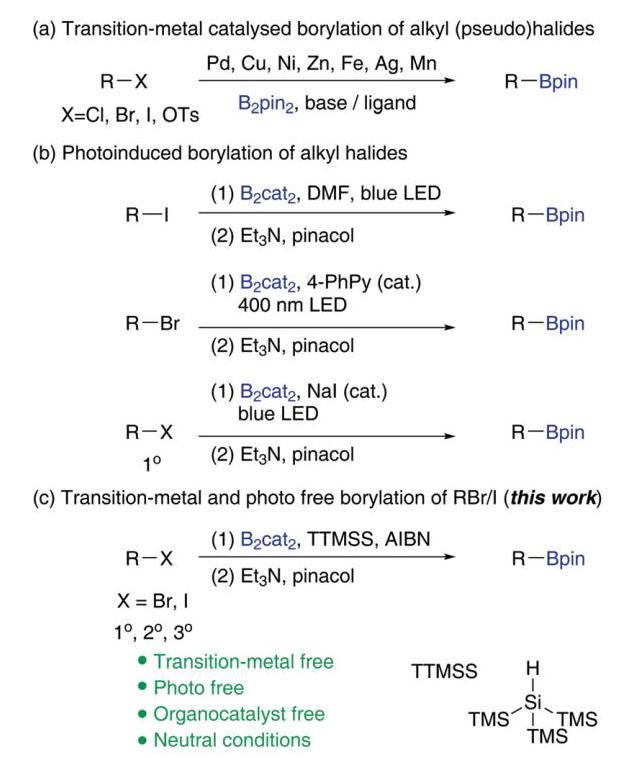
Fig. 1 Borylation of alkyl halides.
School of Materials Science and Engineering, Peking University, Beijing 100871, China.
† Electronic supplementary information (ESI) available. CCDC 2079272. For ESI and crystallographic data in CIF or other electronic format see DOI: 10.1039/ d1cc02134f
Table 1 Optimization of reaction conditions ${}^{a}$
| $n - {\mathrm{C}}_{8}{\mathrm{H}}_{17}\mathrm{{Br}}$ | ${\mathrm{B}}_{2}{\mathrm{{cat}}}_{2}$ | TTMSS, AIBN, DMA, 80°C then pinacol, ${\mathrm{{Et}}}_{3}\mathrm{\;N}$ | $n - {\mathrm{C}}_{8}{\mathrm{H}}_{17}$ Bpin | ||
| 1a 2a | |||||
| Entry | TTMSS | AIBN | ${\mathrm{B}}_{2}{\text{ cat }}_{2}$ | Time (h) | Yield (%) |
| ${1}^{b}$ | 1.15 | 1.0 | 4.0 | 21 | 59 |
| 2 | 2.0 | 2.0 | 4.0 | 15 | 87 |
| 3 | 2.0 | 2.0 | 4.0 | 21 | 89 (81) |
| 4 | 2.0 | 2.0 | 4.0 | 21 | 90 |
| ${5}^{c}$ | 2.0 | 2.0 | 4.0 | 21 | 89 |
| 6 | 1.1 | 1.1 | 4.0 | 12 | 87 |
| 7 | 1.1 | 1.1 | 2.0 | 6 | 89 |
| 8 | 1.1 | 1.1 | 1.5 | 6 | 73 |
| 9 | 1.1 | 1.1 | 2.0 | 6 | 79 |
| 10 | 1.1 | 1.1 | 1.5 | 6 | 84 (81) |
| 11 | 1.1 | 1.1 | 1.2 | 6 | 70 |
| 12 | 1.0 | 1.1 | 1.2 | 6 | 72 |
| 13 | 1.1 | 1.1 | 2.5 | 6 | 81 |
| 14 | 1.1 | 1.1 | 3.0 | 6 | 75 |
| ${15}^{d}$ | 1.15 | 0 | 4.0 | 48 | Trace |
| ${16}^{e}$ | 1.1 | 1.1 | 1.5 | 6 | 76 |
${}^{a}$ Reaction conditions: 1a ( ${0.3}\mathrm{{mmol}}$ ), ${\mathrm{B}}_{2}{\text{ cat }}_{2}$ , AIBN (azobisisobutyroni-trile), TTMSS (tris(trimethylsilyl)silane), DMA (2 mL), ${80}^{ \circ }\mathrm{C}$ . The reactions were set up in a glovebox and the glovebox was heated outside. Then pinacol (4.0 equiv.) and ${\mathrm{{Et}}}_{3}\mathrm{\;N}\left( {1\mathrm{\;{mL}}}\right)$ were added. Decane was used as an internal standard. GC-fid yield, the yields in brackets are isolated yields. ${}^{b}$ The reaction temperature was ${70}{}^{ \circ }\mathrm{C}$ . ${}^{c}$ Using ACCN (1, ${1}^{\prime }$ -azobis(cyclohexanecarbonitrile)) instead of AIBN. ${}^{d}{10}\mathrm{\;W}$ blue LED (10 cm distance), room temperature. ${}^{e}$ The reaction was set up in air.
At the outset of the research, we must consider how to activate the alkyl C-Br bond without the help of metal and light. In this context, tributylstannane is an optional reagent which produces carbon radicals by abstraction of X from C-X derivatives. ${}^{31}$ However, due to its toxicity, we then turned our attention to other environmentally friendly reagents. Tris(trimethylsilyl)silane (TTMSS) is an organosilicon compound and notable as possessing a weak Si-H bond, with a bond dissociation energy estimated at 84 kcal ${\mathrm{{mol}}}^{-1}$ . The compound has been described as an environmentally benign analogue of tributyltin hydride. ${}^{32}$ It has been shown that the silyl radical $\left( {{\mathrm{R}}_{3}{Si}}\right)$ generated by the initiation process can cleave alkyl $\mathrm{C} - \mathrm{X}$ bonds $\left( {\mathrm{X} = \mathrm{{Cl}},\mathrm{{Br}},\mathrm{I}}\right)$ to give alkyl radicals; ${}^{33}$ this promising feature drew our great interest. As such, we commenced our study by investigating the borylation of octyl bromide (1a) under transition-metal and light free conditions using ${\mathrm{B}}_{2}{\text{ cat }}_{2}$ as the borylating reagent and the TTMSS/ AIBN combination as the dehalogenation reagents. After the reaction finished, pinacol (4.0 equiv.) and triethylamine were added to the mixture prior to purification, in order to transform R-Bcat to R-Bpin, which allowed us to isolate it. We got a positive result at ${70}^{ \circ }\mathrm{C}$ (entry 1) in the first place. The desired octyl boronate (2a) was obtained in 59% (GC-fid yield with decane as an internal standard). We then increased the amounts of AIBN and TTMSS at ${80}^{ \circ }\mathrm{C}$ ; the yields were relatively higher (entries 2-4). We also tried 1, 1’-azobis(cyclohexanecarbonitrile) (ACCN) with a higher decomposition temperature for initiation; the yield was about the same (entry 5). Next, we gradually decreased the equivalency of reagents and the reaction time (entries 6-10), and found that the yields remained almost unaffected. The optimal yield (84%) is shown in entry 10. Further lowering the amount of ${\mathrm{B}}_{2}{\mathrm{{cat}}}_{2}$ or TTMSS gave slightly decreased yields (entries 11 and 12). It was shown that 1.5 equivalents of ${\mathrm{B}}_{2}{\text{ cat }}_{2}$ is suitable for this reaction (entries 13 and 14). Finally, a control reaction with no AIBN but with shining light from a blue LED only afforded a trace amount of desired product (entry 15). We also tried this reaction in air and the yield was not affected too much (76% yield, entry 16).
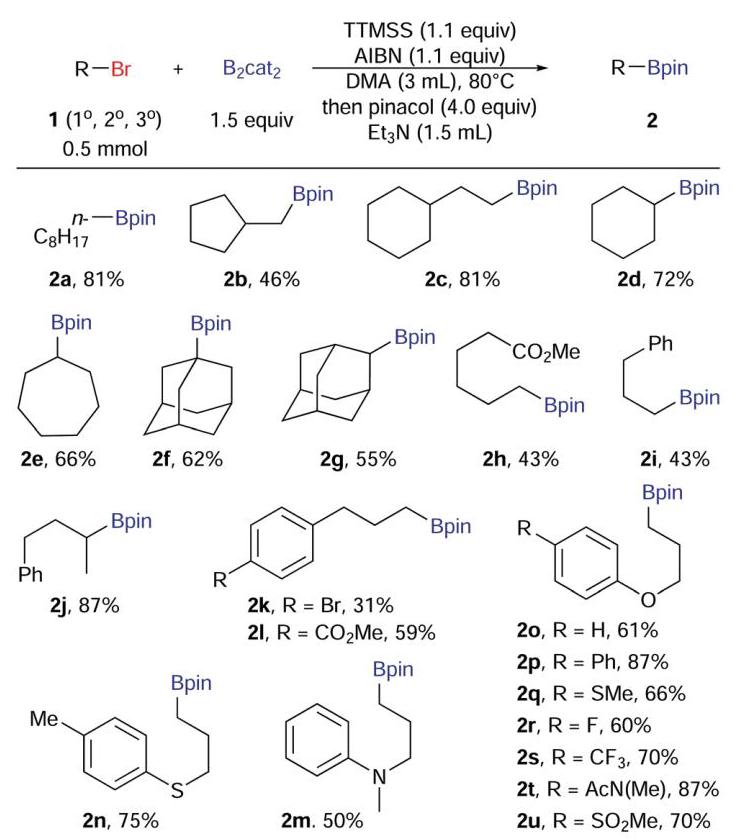
Fig. 2 Substrate scope studies of alkyl bromides.
With the optimized conditions in hand, we next explored the substrate scope of alkyl bromides (Fig. 2). In general, this method is not sensitive to the steric hindrance of the substrates, as a series of primary, secondary and tertiary alkyl bromides all afford the corresponding borylated products in moderate to good yields. For primary substrates, the borylation products were obtained in 46%-81% yields (2a-2c). Specifically, a number of secondary cyclic bromides were tested, and the corresponding borylation products were formed in 55%-87% yields (2d, 2e, 2g and 2j). When tertiary 1-adamantyl bromide was used as the substrate, the reaction went smoothly and provided a tertiary alkyl boronate in 62% yield (2f). Transformations with phenyl, ester, aromatic amine and sulfide groups were compatible with this method (2h-2n), affording up to 87% yield. It should be noted that when both aryl and alkyl bromides were present in a substrate (e.g. 1k), the reaction proceeded on the alkyl side with the aryl side reserved, affording product $2\mathbf{k}$ , albeit in a decreased yield. We also applied this method to a series of 4-substituted aromatic ether substrates; many functional groups such as phenyl (2p, 87%), thiomethyl (2q, 66%), fluorine (2r, 60%), trifluoromethyl (2s, 70%), amide (2t, 87%) and mesyl (2u, 70%) groups were tolerated and all gave good yields.
We next investigated the substrate scope of alkyl iodides (Fig. 3). In general, the borylation products were obtained at a lower temperature $\left( {{70}^{ \circ }\mathrm{C}}\right)$ with a shorter time (2 h). In $2\mathbf{w}$ , the iodine atom was more active than chlorine and only one side was borylated in 65% yield. The double bond (2x), cyclic ether (2y), and naphthyl (2z) were all tolerated and gave moderate to good yields. A heterocycle like thiophene was also compatible and afforded 76% yield. Cholesteryl iodide could be transformed into cholesteryl boronic ester 2ab in 59% yield with a 4 : 1 diastereoselectivity. One of the isomers was identified by X-ray crystallography (for details, see the ESI†).
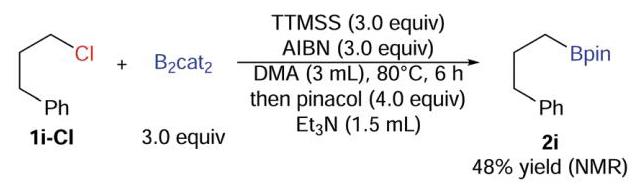
(1)
Given that the transformation of an alkyl chloride into the corresponding alkyl radical is much more difficult than that of an alkyl bromide or iodide, ${}^{34}$ it is quite challenging to achieve this radical borylation goal by means of a metal- and light-free concept. Nevertheless, the current method gave a preliminary positive result. With an increasing amount of reagents, the borylation of 1-chloro-3-phenylpropane (1i-Cl) gave 48% NMR yield of the corresponding product 2i (eqn (1)).
To gain further insight into the mechanism of this silane promoted alkyl bromide borylation reaction, we performed a series of mechanistic investigations. First, when a commonly used radical scavenger, 2,2,6,6-tetramethyl-1-piperidinyloxy (TEMPO), was added under the standard conditions, only a trace amount of 2a was obtained (Fig. 4a). Second, the boryla-tion of cyclopropyl substrate 1ac gave the ring-opened product 2ac in moderate yield (Fig. 4b). Third, when 6-bromo-1-hexene 1ad was used as the substrate, the borylation reaction gave both linear and cyclic products 2ad and 2ae in 23% and 25% NMR yields, respectively. All these mechanistic experiments together indicated the involvement of alkyl radical intermediates in this borylation reaction.
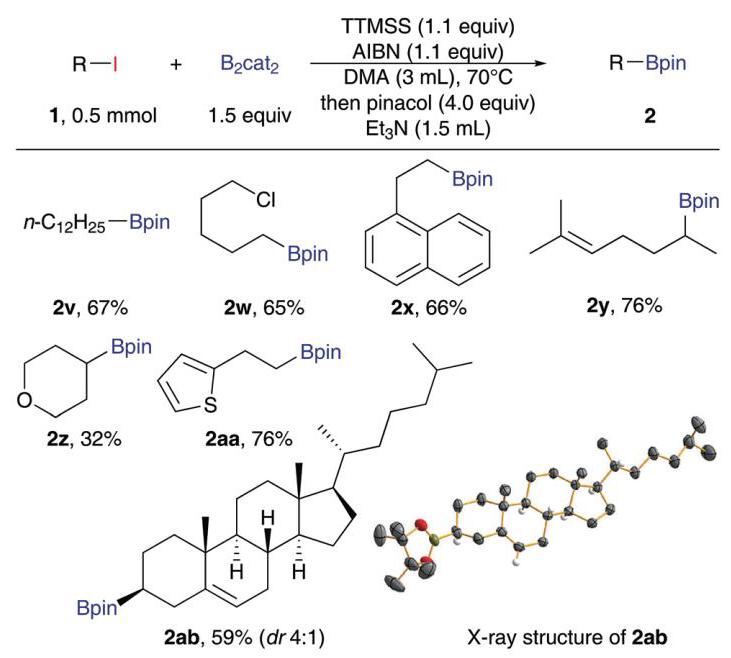
Fig. 3 Substrate scope studies of alkyl iodides.
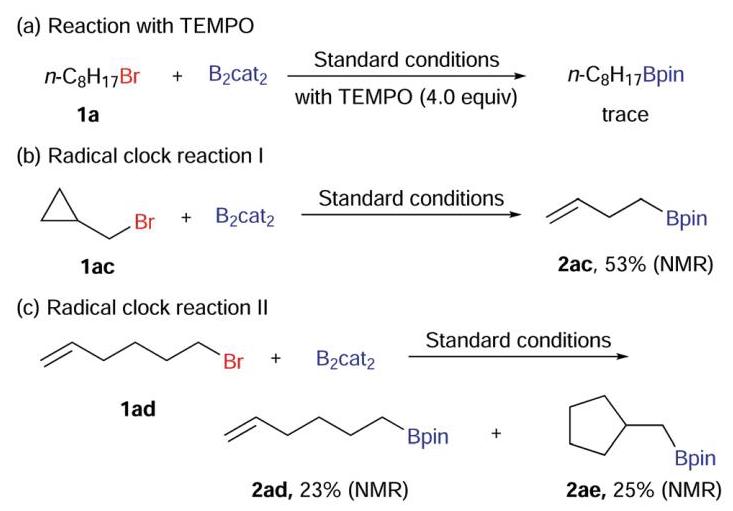
Fig. 4 Mechanistic studies.
Furthermore, we performed density functional theory (DFT) calculations on the potential energy surface of this silane promoted C-B bond formation (Fig. 5, see the ESI† for details). We found that, after the silyl radical ((TMS) ${}_{3}$ Si) is generated, the cleavage of the C-Br bond is favored $\left( {-{15.8}\mathrm{{kcal}}{\mathrm{{mol}}}^{-1}}\right)$ , leading to a carbon-centered radical. Then this alkyl radical adds to ${\mathrm{B}}_{2}{\text{ cat }}_{2}$ to afford INT1. The activation energy of this step is about ${8.8}\mathrm{{kcal}}{\mathrm{{mol}}}^{-1}$ . With the help of DMA, INT1 undergoes decomposition to deliver the final borylated product and DMA-Bcat radical 10. The geometric structures and the key bond lengths of TS1, INT1 and TS2 are shown in Fig. 5. Radical 10 may couple itself to regenerate ${\mathrm{B}}_{2}{\mathrm{{cat}}}_{2}$ and DMA. ${}^{35}$ This process is supported by calculation results, since this step is very thermodynamically favorable $\left( {{\Delta G} = - {46.5}\mathrm{{kcal}}{\mathrm{{mol}}}^{-1}}\right)$ .
On the basis of our combined experimental and computational evidence as well as studies on previously developed radical borylation reactions, ${}^{{35},{36},{37},{38},{39},{40},{41}}$ a plausible mechanism is outlined in Fig. 6. We propose that it is a classical radical-involved substitution process. The silyl radical $\left( {{\left( \mathrm{{TMS}}\right) }_{3}{Si}}\right)$ generated by the initiation process can abstract the bromine atom of the alkyl bromide to give an alkyl radical, which adds to diboron ${\mathrm{B}}_{2}{\text{ cat }}_{2}$ to deliver the final borylation product.
In conclusion, a transition-metal free and light free radical borylation of alkyl bromides and iodides was developed, which works efficiently under simple operation and neutral conditions with good functional group compatibility. A series of mechanism experiments, as well as DFT calculations, showed that the reaction involves a classical radical process.
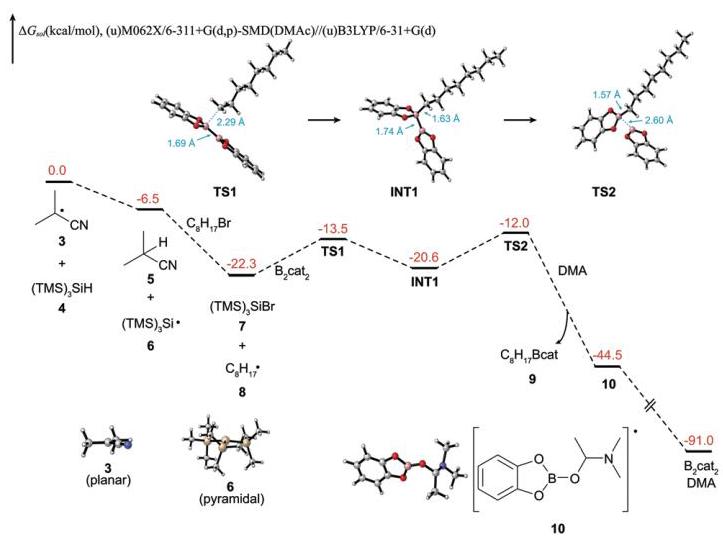
Fig. 5 DFT calculations on the potential energy surface of silane promoted C-B bond formation.
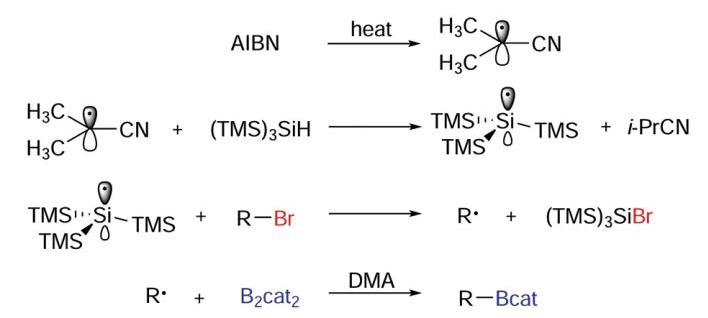
Fig. 6 Proposed mechanism.
Conflicts of interest
There are no conflicts to declare.
Notes and references
1 D. G. Hall, Boronic acids: preparation, applications in organic synthesis and medicine, John Wiley & Sons, 2006.
2 S. R. Chemler, D. Trauner and S. J. Danishefsky, Angew. Chem., Int. Ed., 2001, 40, 4544-4568.
3 H. Doucet, Eur. J. Org. Chem., 2008, 2013-2030.
4 R. Jana, T. P. Pathak and M. S. Sigman, Chem. Rev., 2011, 111, 1417-1492.
5 E. C. Neeve, S. J. Geier, I. A. I. Mkhalid, S. A. Westcott and T. B. Marder, Chem. Rev., 2016, 116, 9091-9161.
6 A. B. Cuenca, R. Shishido, H. Ito and E. Fernández, Chem. Soc. Rev., 2017, 46, 415-430.
7 A. Bej, D. Srimani and A. Sarkar, Green Chem., 2012, 14, 661-667.
8 A. Joshi-Pangu, X. Ma, M. Diane, S. Iqbal, R. J. Kribs, R. Huang, C.-Y. Wang and M. R. Biscoe, J. Org. Chem., 2012, 77, 6629-6633.
9 D. Hemming, R. Fritzemeier, S. A. Westcott, W. L. Santos and P. G. Steel, Chem. Soc. Rev., 2018, 47, 7477-7494.
10 H. Ito and K. Kubota, Org. Lett., 2012, 14, 890-893.
11 C.-T. Yang, Z.-Q. Zhang, H. Tajuddin, C.-C. Wu, J. Liang, J.-H. Liu, Y. Fu, M. Czyzewska, P. G. Steel, T. B. Marder and L. Liu, Angew. Chem., Int. Ed., 2012, 51, 528-532.
12 K. Kubota, E. Yamamoto and H. Ito, J. Am. Chem. Soc., 2013, 135, 2635-2640.
13 J. H. Kim and Y. K. Chung, RSC Adv., 2014, 4, 39755-39758.
14 H. Iwamoto, K. Kubota, E. Yamamoto and H. Ito, Chem. Commun., 2015, 51, 9655-9658.
15 H. Yoshida, Y. Takemoto, S. Kamio, I. Osaka and K. Takaki, Org. Chem. Front., 2017, 4, 1215-1219.
16 S. K. Bose, S. Brand, H. O. Omoregie, M. Haehnel, J. Maier, G. Bringmann and T. B. Marder, ACS Catal., 2016, 6, 8332-8335.
17 X. Lou, Z.-Q. Zhang, J.-H. Liu and X.-Y. Lu, Chem. Lett., 2016, 45, 200-202.
18 A. S. Dudnik and G. C. Fu, J. Am. Chem. Soc., 2012, 134, 10693-10697.
19 J. Yi, J.-H. Liu, J. Liang, J.-J. Dai, C.-T. Yang, Y. Fu and L. Liu, Adv. Synth. Catal., 2012, 354, 1685-1691.
20 S. K. Bose, K. Fucke, L. Liu, P. G. Steel and T. B. Marder, Angew. Chem., Int. Ed., 2014, 53, 1799-1803.
21 T. C. Atack, R. M. Lecker and S. P. Cook, J. Am. Chem. Soc., 2014, 136, 9521-9523.
22 R. B. Bedford, P. B. Brenner, E. Carter, T. Gallagher, D. M. Murphy and D. R. Pye, Organometallics, 2014, 33, 5940-5943.
23 X. Lu, Z.-Q. Zhang, L. Yu, B. Zhang, B. Wang, T.-J. Gong, C.-L. Tian, B. Xiao and Y. Fu, Chin. J. Chem., 2019, 37, 11-18.
24 T. C. Atack and S. P. Cook, J. Am. Chem. Soc., 2016, 138, 6139-6142.
25 W. Yang, X. Gao and B. Wang, Biological and medicinal applications of boronic acids, Wiley Online Library, 2005, pp. 481-582.
26 Y. Cheng, C. Mück-Lichtenfeld and A. Studer, Angew. Chem., Int. Ed., 2018, 57, 16832-16836.
27 L. Zhang, Z.-Q. Wu and L. Jiao, Angew. Chem., Int. Ed., 2020, 59, 2095-2099.
28 C. Wang, L. Zhou, K. Yang, F. Zhang and Q. Song, Chin. J. Chem..
29 Q. Liu, L. Zhang and F. Mo, Acta Chim. Sin., 2020, 78, 1297-1308.
30 Q. Liu, J. Hong, B. Sun, G. Bai, F. Li, G. Liu, Y. Yang and F. Mo, Org. Lett., 2019, 21, 6597-6602.
31 T. V. B. RajanBabu, P. C. Bulman Page and B. R. Buckley, Tri-n-butylstannane, American Cancer Society, 2004.
32 C. Chatgilialoglu, C. Ferreri, Y. Landais and V. I. Timokhin, Chem. Rev., 2018, 118, 6516-6572.
33 C. Chatgilialoglu, Acc. Chem. Res., 1992, 25, 188-194.
34 Y.-R. Luo, Handbook of bond dissociation energies in organic compounds, CRC Press, 2002.
35 A. Fawcett, J. Pradeilles, Y. Wang, T. Mutsuga, E. L. Myers and V. K. Aggarwal, Science, 2017, 357, 283-286.
36 D. Hu, L. Wang and P. Li, Org. Lett., 2017, 19, 2770-2773.
37 J. Hu, G. Wang, S. Li and Z. Shi, Angew. Chem., Int. Ed., 2018, 57, 15227-15231.
38 J. Wu, L. He, A. Noble and V. K. Aggarwal, J. Am. Chem. Soc., 2018, 140, 10700-10704.
39 F. Sandfort, F. Strieth-Kalthoff, F. J. Klauck, M. J. James and F. Glorius, Chem. - Eur. J., 2018, 24, 17210-17214.
40 F. W. Friese and A. Studer, Angew. Chem., Int. Ed., 2019, 58, 9561-9564.
41 J. Wu, R. M. Bär, L. Guo, A. Noble and V. K. Aggarwal, Angew. Chem., Int. Ed., 2019, 58, 18830-18834.