Gold-Catalyzed Halogenation of Aromatics by N-Halosuccinimides
中文 / Bilingual · English version
Fanyang Mo, Jerry Mingtao Yan, Di Qiu, Fei Li, Yan Zhang, and Jianbo Wang*
Halogenation of aromatic compounds is one of the fundamental reactions in organic chemistry. ${}^{\left\lbrack 1\right\rbrack }N$ -Bromo-, $N$ -iodo-, and $N$ -chlorosuccinimide (NBS, NIS, and NCS, respectively) are highly useful halogenating reagents in laboratories in terms of their ease of handling, as well as the generation of relatively inert succinimide as the by-product. Various halogenation systems usingh NXS (X = Br, I, or Cl) have been developed, ${}^{\left\lbrack 2 - 4\right\rbrack }$ but halogenating unactivated aromatics proceeds only in the presence of strong Lewis acids or protonic acids. ${}^{\left\lbrack 3\right\rbrack }$ Moreover, reaction conditions are in general very harsh, such as high catalyst loadings, ${}^{\left\lbrack 3\mathrm{f},\mathrm{i}\right\rbrack }$ high reaction temperatures, ${}^{\left\lbrack 3\mathrm{e}\right\rbrack }$ or considerably acidic solutions. ${}^{\left\lbrack 3\mathrm{c}\right\rbrack }$ Some of these reported catalytic systems proceed under relatively milder reaction conditions. For example, Tanemura et al. reported a method for the halogenation of aromatic rings using NXS in the presence of ${\mathrm{{NH}}}_{4}{\mathrm{{NO}}}_{3}$ or ${\mathrm{{FeCl}}}_{3}$ in $\mathrm{{MeCN}}{.}^{\left\lbrack 3\mathrm{\;g}\right\rbrack }$ The reaction works with unactivated aromatics, but the catalyst loading is high (10-100% mol). Yamamoto et al. reported halogenation with ${\mathrm{{ZrCl}}}_{4}$ as the catalyst, and although the catalyst loading is low $\left( {5\mathrm{\;{mol}}\% }\right)$ the substrate scope is limited to electron-rich aromatic rings. ${}^{\left\lbrack 2q\right\rbrack }$ Moreover, benzylic halogenation occurs when halogenating alkyl-substituted benzene derivatives, which is also a general side reaction in many other halogenation systems. In view of these facts, we still consider it highly desirable to develop milder and more efficient halogenation methods.
The previous studies have focused on the activation of NXS through complexation or protonation of the carbonyl oxygen atom of NXS by acids to enhance the reactivity of the halogenation process (Scheme 1 a). We envisaged that a dual activation of both the aromatic ring and NXS might greatly enhance the reactivity (Scheme 1b). For this purpose, the formation of a ${\mathrm{C}}_{\mathrm{{Ar}}} - \mathrm{M}$ bond through direct metallation of a ${\mathrm{C}}_{\mathrm{{Ar}}} - \mathrm{H}$ bond is required. In principle, the cleavage of a ${\mathrm{C}}_{\mathrm{{Ar}}} - \mathrm{H}$ bond to form ${\mathrm{C}}_{\mathrm{{Ar}}} - \mathrm{M}$ bond proceeds through oxidative addition or electrophilic substitution mechanisms by metal complexes having either low or high oxidation states, respectively. ${}^{\left\lbrack 5\right\rbrack }$
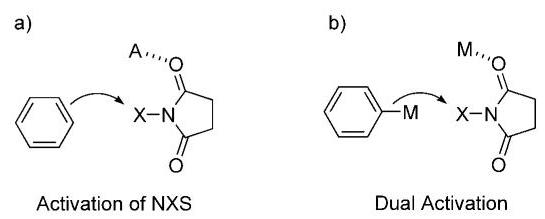
Scheme 1. Halogenation through activation by catalysts. A = acid, $\mathrm{M} =$ metal, and $\mathrm{X} = \mathrm{{Br}},\mathrm{I},\mathrm{{Cl}}$ .
Gold-catalyzed transformations have been hot topics in organic chemistry in recent years. ${}^{\left\lbrack 6\right\rbrack }$ It has been documented that gold(III) can electrophilically metallate ${\mathrm{C}}_{\mathrm{{Ar}}} - \mathrm{H}$ bonds to afford arylgold(III) species. ${}^{\left\lbrack 7,8\right\rbrack }$ In 1931 Kharasch and Isbell reported that ${\mathrm{{AuCl}}}_{3}$ could react with neat benzene to form a phenylgold(III) complex, which could react with hydrogen chloride to form phenyl chloride. ${}^{\left\lbrack 7\mathrm{a}\right\rbrack }$ More recently, He and coworkers reported several ${\mathrm{{AuCl}}}_{3}$ -catalyzed $\mathrm{C} - \mathrm{C}$ bond-forming reactions, in which arylgold(III) species, generated through direct metallation of electron-rich aromatics, are proposed as the key intermediates. ${}^{\left\lbrack 8\mathrm{a} - \mathrm{d}\right\rbrack }{\mathrm{{AuCl}}}_{3}$ -catalyzed $\mathrm{C} - \mathrm{C}$ bond-forming reactions between electron-rich aromatics and alkynes, as well as methyl vinyl ketone are reported by Reetz and Sommer, ${}^{\left\lbrack 8\mathrm{e}\right\rbrack }$ and Hashmi et al. ${}^{\left\lbrack 8\mathrm{f},\mathrm{g}\right\rbrack }$ Although the mechanism of these highly efficient ${\mathrm{{AuCl}}}_{3}$ -catalyzed reactions is still unclear, we were encouraged by these reports and decided to explore the possibility of gold-catalyzed halogenation based on the hypothetical dual activation mode as shown in Scheme 1b. Herein we report a highly efficient and practical ${\mathrm{{AuCl}}}_{3}$ -catalyzed halogenation of aromatics with NXS.
Table 1: Bromination of benzene with NBS using various catalysts in DCE. ${}^{\left\lbrack a\right\rbrack }$

| Entry | Catalyst (mol%) | Yield ${\left\lbrack \% \right\rbrack }^{\left\lbrack b\right\rbrack }$ |
| 1 | ${\mathrm{{AuCl}}}_{3}$ (1) | 99 |
| 2 | ${\mathrm{{FeCl}}}_{3}$ (20) | 27 |
| 3 | ${\mathrm{{FeBr}}}_{3}$ (20) | 25 |
| 4 | ${\mathrm{{BF}}}_{3} \cdot {\mathrm{{OEt}}}_{2}$ (20) | 7 |
| 5 | ${\mathrm{{NH}}}_{4}{\mathrm{{NO}}}_{3}$ (20) | <1 |
| 6 | ${\mathrm{{ZrCl}}}_{4}$ (20) | 5 |
| 7 | Pd(OAc) ${}_{2}$ (20) | 0 |
| 8 | ${\mathrm{{AlCl}}}_{3}$ (20) | <1 |
| 9 | HCl (20) ${}^{\left\lbrack c\right\rbrack }$ | 0 |
| 10 | ${\mathrm{H}}_{2}{\mathrm{{SO}}}_{4}$ (20) | 25 |
[a] Reaction conditions: benzene (1 mmol), NBS (1 mmol), DCE (2 mL), ${80}^{ \circ }\mathrm{C},{24}\mathrm{\;h}$ . [b] Yields determined by using GC/MS methods with $n$ -dodecane as the internal standard. [c] ${4.7}\mathrm{M}$ in dioxane. DCE $= 1,2$ - dichloroethane, NBS $= N$ -bromosuccinimide.
[*] F. Mo, J. M. Yan, D. Qiu, F. Li, Dr. Y. Zhang, Prof. Dr. J. Wang Beijing National Laboratory of Molecular Sciences (BNLMS) and Key Laboratory of Bioorganic Chemistry and Molecular Engineering of Ministry of Education, College of Chemistry
Peking University, Beijing 100871 (China)
Fax: (+ 86) 10-6275-1708
Homepage: http://www.chem.pku.edu.cn/physicalorganic/ home.htm
[**] The project is supported by the NSFC (Grant No. 20832002, 20772003, 20821062), 973 Program (No. 2009CB825300).
Supporting information for this article is available on the WWW under http://dx.doi.org/10.1002/anie.200906699.
First, we compared the efficiency of typical acid catalysts developed for halogenation reaction using NBS. Therefore, the bromination of benzene with NBS was carried out in DCE at ${80}^{ \circ }\mathrm{C}$ for 24 hours (Table 1). To our delight, $1\mathrm{\;{mol}}\%$ of ${\mathrm{{AuCl}}}_{3}$ gave nearly a quantitative yield of bromobenzene (Table 1, entry 1), whereas ${\mathrm{{FeCl}}}_{3}$ and ${\mathrm{{FeBr}}}_{3}$ , widely used as Lewis acid catalyst in this type of reaction, only afforded the product in 27% and 25% yield, respectively, at a 20 mol % catalyst loading, (Table 1, entries 2 and 3). ${\mathrm{{BF}}}_{3} \cdot {\mathrm{{OEt}}}_{2}$ , another strong Lewis acid known for its ability to activate NXS, gave only a 7% yield with the same catalyst loading. ${\mathrm{{NH}}}_{4}{\mathrm{{NO}}}_{3}$ and ${\mathrm{{ZrCl}}}_{4}$ , which have been efficient catalysts in the systems reported by Tanemura et al. ${}^{\left\lbrack 3\mathrm{\;g}\right\rbrack }$ and Yamamoto and coworkers, ${}^{\left\lbrack 2\mathrm{q}\right\rbrack }$ were not efficient in that a less than 5% yield of desired product was observed (Table 1, entries 5 and 6). Pd(OAc), which has been used in direct aromatic $\mathrm{C} - \mathrm{H}$ bond activation, ${}^{\left\lbrack 9\right\rbrack }$ gave no product (Table 1, entry 7). Since reactions between gold(III) trichloride and aryl compounds generates HCl, as indicated in previous literature, ${}^{\left\lbrack 7\mathrm{a}\right\rbrack }$ the possibility exists that in situ generated HCl may catalyze the reaction. However, when ${20}\mathrm{\;{mol}}\%$ of $\mathrm{{HCl}}$ was used as the catalyst under identical conditions, no product was observed (Table 1, entry 9), thereby ruling out the possible HCl catalysis. Finally, the strong acid catalyst ${\mathrm{H}}_{2}{\mathrm{{SO}}}_{4}\left( {{20}\mathrm{\;{mol}}\% }\right)$ could catalyze the reaction but with low efficiency (Table 1, entry 10). These bromination results clearly demonstrate the superb catalytic activity of ${\mathrm{{AuCl}}}_{3}$ as compared with other Lewis acid or protonic acid catalysts.
Next, the scope of this ${\mathrm{{AuCl}}}_{3}$ - catalyzed bromination was examined with a variety of aromatic substrates (Table 2). The results demonstrated wide substrate scope, including some unactivated aromatic substrates. Most substrates were treated with one equivalent of NBS and 0.01 to $1\mathrm{\;{mol}}\%$ of ${\mathrm{{AuCl}}}_{3}$ , affording the corresponding aryl bromides in high yields. Clean conversion
Table 2: ${\mathrm{{AuCl}}}_{3}$ -catalyzed bromination of aromatic rings by ${\mathrm{{NBS}}}^{\left\lbrack \mathrm{a}\right\rbrack }$
| ArH 1a-o + NBS | cat. AuCl ${}_{3}$ DCE | ArBr 2a-o | ||||||
| Entry | ArH | ${\mathrm{{AuCl}}}_{3}$ (mol%) | $T$ [℃] | $t$ [h] | ArBr | Yield [%] | ||
| 1 |  | 1a | 1 | 80 |  |  | 2a | >99 |
| 2 |  | 1b | 1 | RT | 40 |  | 2b, 2b' | >99 o/p=1:2 |
| 3 |  | 1c | 0.5 | RT | 30 |  | 2c | >99 |
| 4 |  | 1d | 0.5 | 60 | 5 |  | 2 d | >99 |
| 5 |  | 1e | 1 | RT | 24 |  | 2e | 93 |
| 6 |  | 1f | 0.1 0.01 | RT 80 | 12 12 |  | 2 f | > 99, (98) > 99 |
| 7 |  | 1 g | 0.1 | 80 | 15 |  | 2 g | > 99, (95) |
| 8 |  | 1 h | 0.1 0.01 | RT 80 | 1 20 |  | 2 h | > 99, (96) > 99 |
| 9 |  | 1i | 0.1 0.01 | RT RT | 1 12 |  | 2i | > 99, (98) > 99 |
| 10 |  | 1j | 0.1 | 80 | 23 |  | 2 j | > 99, (96) |
| 11 |  | 1k | 5 | 80 | 48 |  | 2k | 80 |
| 12 |  | 11 | 1 | 80 | 12 |  | 2l,2l',2l" | >99,0/m/ $p = 7 : 1 : 2$ |
| ${13}^{\left\lbrack c\right\rbrack }$ |  | 1m | 1 | 60 | 11 |  | 2 m | 82 |
| 14 |  | 1n | 1 | 80 | 3 |  | 2n | > 99 |
| 15 |  | 10 | 0.5 | RT | 4 |  | 20 | > 99, (92) |
| 16 |  | 1p | 5 | 80 | 10 |  | 2p | trace |
[a] Reaction conditions: substrate/NBS = 1:1. [b] Yields determined by using GC/MS methods with $n$ -dodecane as the internal standard. Yield of isolated product given within parentheses. [c] 40% ${\mathrm{{BF}}}_{3} \cdot {\mathrm{{OEt}}}_{2}$ was added.
f ${\mathrm{{AuCl}}}_{3}$ , affording the ields. Clean conversion was observed in all cases: GC/MS analysis indicates that only monobromination products are formed. Additionally, ben-
Communications
zylic bromination did not occur when the alkyl-substituted benzene derivatives were subjected to the reaction (Table 2, entries 2-6 and 13). Bromination of electron-rich aromatics, such as anisole (1h) and 1,4-dimethoxybenzene (1i), requires only 0.01 mol% catalyst. A control experiment indicated that no reaction took place in the absence of the ${\mathrm{{AuCl}}}_{3}$ catalyst in these cases. Notably, aromatic rings bearing moderately strong electron-withdrawing substituents can also be brominated, although a higher catalyst loading and longer reaction time are required in such cases (Table 2, entries 11-14). However, for aromatics with strong electron-withdrawing substituents, such as a nitro group, the bromination did not occur with 5 mol% of ${\mathrm{{AuCl}}}_{3}$ at ${80}^{ \circ }\mathrm{C}$ (Table 2, entry 16).
In addition to the low catalyst loading, this halogenation process only uses one equivalent of NBS and the reaction proceeds with high yields. The halogenation is clean with succinimide as the only by-product. These advantages allow the possibility of combining this ${\mathrm{{AuCl}}}_{3}$ -catalyzed halogenation with other transition metal catalyzed transformations such as $\mathrm{C} - \mathrm{N}$ and $\mathrm{C} - \mathrm{C}$ bond-forming reactions. First, we conceived that the in situ produced succinimide could be utilized as a nitrogen source in the sequential $\mathrm{C} - \mathrm{N}$ bond formation. Upon the completion of the halogenation reaction, active copper ${}^{\left\lbrack {10}\right\rbrack }$ was added to the solution and the reaction mixture was set to microwave irradiation for 30 minutes at ${150}^{ \circ }\mathrm{C}{.}^{\left\lbrack {11}\right\rbrack }$ To our delight, the corresponding aryl amides were obtained in good yields (Table 3). Therefore, this two-step transformation constitutes an indirect strategy for converting an aromatic $\mathrm{C} - \mathrm{H}$ bond into a $\mathrm{C} - \mathrm{N}$ bond.
Table 3: Converting arenes into aniline derivatives. ${}^{\left\lbrack a\right\rbrack }$

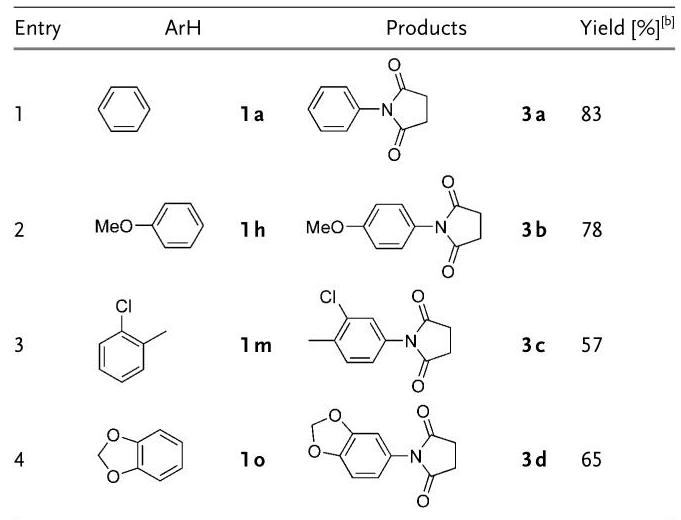
[a] First step: arene (1 mmol), NBS (1 mmol), see Table 2 for the reaction conditions. Second step: Active Cu (5 mmol), DMF 1 mL; MW 150W, Temp 150°C, time 30 min. [b] Yield of isolated product.
Next, we examined the combination of halogenation with palladium-catalyzed transformations, namely the Suzuki-Miyaura cross-coupling, Miyaura borylation, and Sonogashira coupling reactions (Scheme 2a, b, c respectively). All three types of palladium-catalyzed coupling reactions turned out to be compatible with the ${\mathrm{{AuCl}}}_{3}$ -catalyzed halogenation conditions. In a typical procedure, the arene was first converted into the corresponding aryl bromide under the conditions shown in Table 2. Upon completion of bromination, the solvent was removed and the crude product was directly subjected to the palladium-catalyzed coupling reaction without additional purification. The two-step reaction afforded satisfactory yields in all cases.
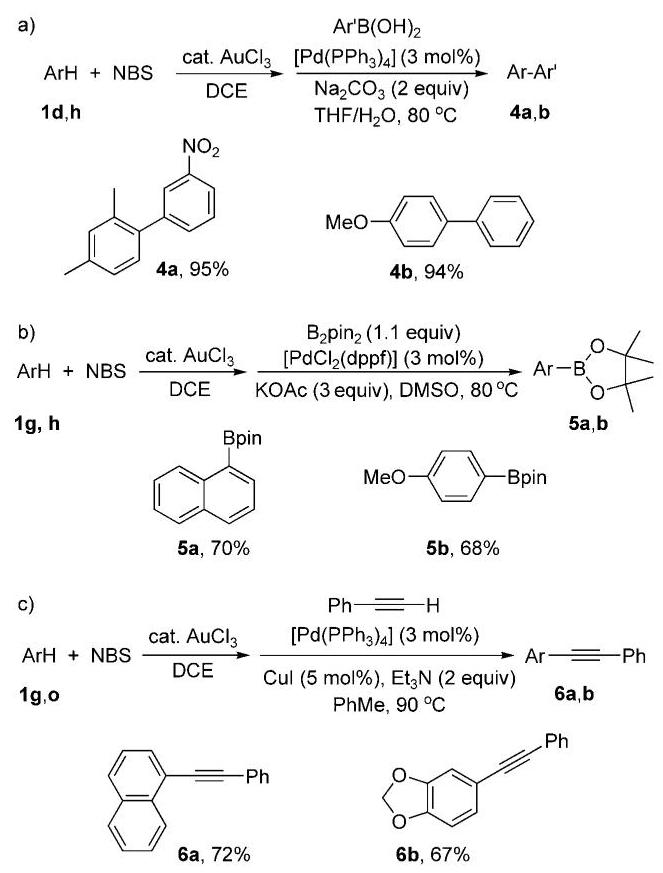
Scheme 2. Sequential transformations: bromination and a) Suzuki-Miyaura cross-coupling, b) Miyaura borylation, and c) Sonogashira coupling.
The extraordinarily high efficiency of the ${\mathrm{{AuCl}}}_{3}$ catalysis in aromatic halogenations raises intriguing questions concerning its reaction mechanism. We hypothesized a dual activation mode with the generation of arylgold(III) species as the key intermediate as shown in Scheme 1b. This hypothesis is based on the following: 1) It has been documented in the literature that simple aromatic groups readily react with ${\mathrm{{AuCl}}}_{3}$ to form arylgold(III) species at room temperature. ${}^{\left\lbrack 7\right\rbrack }$ Moreover, arylgold species have been recently proposed as intermediates in gold-catalyzed transformations; ${}^{\left\lbrack 8\mathrm{a} - \mathrm{d}\right\rbrack }2$ ) Gold catalysts are soft Lewis acids and therefore only weakly bond to a hard Lewis base such as the carbonyl oxygen atom. However, as shown by the results summarized in Table 1, ${\mathrm{{AuCl}}}_{3}$ is far more reactive as compared with other strong Lewis acids such as ${\mathrm{{FeCl}}}_{3},{\mathrm{{FeBr}}}_{3}$ , and ${\mathrm{{AlCl}}}_{3}$ in the bromination reaction with NBS, which implies different activation modes are operative in these reactions. For the normal Lewis acid or protonic acid catalysis, the activation of NBS is realized through coordination of carbonyl oxygen atom. Therefore, in the case of ${\mathrm{{AuCl}}}_{3}$ , a dual activation of both the aromatic substrate and NBS seems likely.
To gain insights into the mechanism, a kinetic isotopic effect (KIE) was measured through intermolecular competitive bromination of benzene and $\left\lbrack {\mathrm{D}}_{6}\right\rbrack$ benzene with NBS as catalyzed by ${\mathrm{{BF}}}_{3} \cdot {\mathrm{{OEt}}}_{2},{\mathrm{{FeBr}}}_{3},{\mathrm{{ZrCl}}}_{4}$ , and ${\mathrm{{AuCl}}}_{3}$ , respectively. When brominations were catalyzed by ${\mathrm{{BF}}}_{3} \cdot {\mathrm{{OEt}}}_{2}$ , FeBr, and ${\mathrm{{ZrCl}}}_{4}$ , the ${k}_{\mathrm{H}}/{k}_{\mathrm{D}}$ values ranged from 0.91-1.13, whereas the ${k}_{\mathrm{H}}/{k}_{\mathrm{D}}$ value is 1.66 in the case of ${\mathrm{{AuCl}}}_{3}$ -catalyzed bromination. In general, electrophilic aromatic substitution does not exhibit primary isotope effect because proton transfer from the $\pi$ -complex intermediate is fast and thus not in the rate-limiting step. ${}^{\left\lbrack {12}\right\rbrack }$ Hence, the lack of primary kinetic isotopic effects for ${\mathrm{{BF}}}_{3} \cdot {\mathrm{{OEt}}}_{2}$ -, FeBr ${}_{3}$ -, and ${\mathrm{{ZrCl}}}_{4}$ -catalyzed bromina-tions are consistent with the activation of NXS as shown in Scheme 1 a. Although the modest value of kinetic isotopic effect observed in ${\mathrm{{AuCl}}}_{3}$ -catalyzed bromination does not provide conclusive information, ${}^{\left\lbrack {13}\right\rbrack }$ it demonstrates that the gold catalysis for bromination is distinct in mechanism from other Lewis acid catalyzed brominations.
In conclusion, we have developed an efficient and mild protocol for the bromination of arenes with NBS under ${\mathrm{{AuCl}}}_{3}$ catalysis. Low catalyst loading, mild reaction conditions, as well as clean transformations (almost quantitative yield of aryl bromides in most cases and inert succinimide as the only byproduct), are the advantages of this new method. Moreover, as demonstrated by several examples, the clean reactions allow the combination of bromination with other transition metal catalyzed reactions to realize functionaliza-tion of aromatic $\mathrm{C} - \mathrm{H}$ bonds in an efficient manner. Finally, this ${\mathrm{{AuCl}}}_{3}$ -catalyzed reaction can also be extended to chlorination and iodination with NCS and NIS, respectively. ${}^{\left\lbrack {14}\right\rbrack }$
Experimental Section
Typical procedure for the ${\mathrm{{AuCl}}}_{3}$ -catalyzed bromination with NBS: NBS ( $3\mathrm{{mmol}},{540}\mathrm{{mg}}$ ) and ${\mathrm{{AuCl}}}_{3}$ ( ${0.003}\mathrm{{mmol}},{0.1}\mathrm{\;{mol}}\% ,1\mathrm{{mg}}$ ) were weighed into a ${25}\mathrm{\;{mL}}$ round bottom flask. DCE (2 mL) and methyl 2-methoxybenzoate $1\mathbf{j}$ (3 mmol, ${498}\mathrm{{mg}}$ ) were then added to the flask in succession. The resulting reaction mixture was stirred for about ${23}\mathrm{\;h}$ at ${80}^{ \circ }\mathrm{C}$ (monitored by GC/MS). The solution was then concentrated under reduced pressure and the residue was purified by flash column chromatography to give methyl 5-bromo-2-methoxy-benzoate $2\mathbf{j}\left( {{703}\mathrm{{mg}},{96}\% }\right)$ .
Received: November 27, 2009
Published online: February 12, 2010
Keywords: aromatic compounds $\cdot \mathrm{C} - \mathrm{H}$ activation $\cdot$ gold $\cdot$ halogenation $\cdot$ synthetic methods
[1] a) R. Taylor, Electrophilic Aromatic Substitution, Wiley, New York, 1990; b) P. B. De La Mare, Electrophilic Halogenation, Cambridge University Press, Cambridge, 1976, chapt. 5.
[2] Halogenation of activated aromatics with NXS: a) R. H. Mitchell, Y. H. Lai, R. V. Williams, J. Org. Chem. 1979, 44, 4733; b) H. M. Gilow, D. E. Burton, J. Org. Chem. 1981, 46, 2221; c) H. Konishi, K. Aritomi, T. Okano, J. Kiji, Bull. Chem. Soc. Jpn. 1989, 62, 591; d) Y. Goldberg, H. Alper, J. Org. Chem. 1993, 58, 3072; e) J. Auerbach, S. A. Weissman, T. J. Blacklock, M. R. Angeles, K. Hoogsteen, Tetrahedron Lett. 1993, 34, 931; f) S. Fujisaki, H. Eguchi, A. Omura, A. Okamoto, A. Nishida, Bull. Chem. Soc. Jpn. 1993, 66, 1576; g) P. Bovonsombat, E. Mcnelis, Synthesis 1993, 237; h) G. J. M. Gruter, O. S. Akkerman, F. Bickelhaupt, J. Org. Chem. 1994, 59, 4473; i) Y. Goldberg, H. Alper, J. Mol. Catal. 1994, 88, 377; j) V. Paul, A. Sudalai, T. Daniel, K. V. Srinivasan, Tetrahedron Lett. 1994, 35, 7055; k) M. C. Carreño, J. L. G. Ruano, G. Sanz, M. A. Toledo, A. Urbano, J. Org. Chem. 1995, 60, 5328; 1) T. Oberhauser, J. Org. Chem. 1997, 62, 4504; m) A. N. Cammidge, K. V. Crepy, M. Fugier, 1997, Synth. Commun. 1997, 27, 4159; n) J. L. Bloomer, W. Zheng, Synth. Commun. 1998, 28, 2087; o) B. Andersh, D. L. Murphy, R. J. Olson, Synth. Commun. 2000, 30, 2091; p) R. Rajagopal, D. V. Jarikote, R. J. Lahoti, T. Daniel, K. V. Srinivasan, Tetrahedron Lett. 2003, 44, 1815; q) Y. Zhang, K. Shibatomi, H. Yamamoto, Synlett 2005, 2837; r) J. S. Yadav, B. V. S. Reddy, P. S. R. Reddy, A. K. Basak, A. V. Narsaiah, Adv. Synth. Catal. 2004, 346, 77; s) M. Bagheri, N. Azizi, M. R. Saidi, Can. J. Chem. 2005, 83, 146; t) N. C. Ganguly, P. De, S. Dutta, Synthesis 2005, 1103; u) E. Zysman-Colman, K. Arias, J. S. Siegel, Can. J. Chem. 2009, 87, 440.
[3] Halogenation of unactivated aromatics with NXS: a) H. Schmid, Helv. Chim. Acta 1946, 29, 1144; b) J. C. Roberts, P. Roffey, J. Chem. Soc. C 1966, 160; c) F. L. Lambert, W. D. Ellis, R. J. Parry, J. Org. Chem. 1965, 30, 304; d) R. S. Coleman, E. B. Grant, J. Org. Chem. 1991, 56, 1357; e) V. Paul, A. Sudalai, T. Daniel, K. V. Srinivasan, Tetrahedron Lett. 1994, 35, 7055; f) A. Zanka, A. Kubota, Synlett 1999, 1984; g) K. Tanemura, T. Suzuki, Y. Nishida, K. Satsumabayashi, T. Horaguchi, Chem. Lett. 2003, 32, 932; h) G. A. Olah, Q. Wang, G. Sandford, G. K. S. Prakash, J. Org. Chem. 1993, 58, 3194; i) G. A. Olah, Q. Wang, G. Sandford, G. K. S. Prakash, J. Org. Chem. 1993, 58, 3194; j) G. K. S. Prakash, T. Mathew, D. Hoole, P. M. Esteves, Q. Wang, G. Rasul, G. A. Olah, J. Am. Chem. Soc. 2004, 126, 15770.
[4] Transition metal catalyzed halogenation with NXS: a) D. Kalyani, A. R. Dick, W. Q. Anani, M. S. Sanford, Org. Lett. 2006, 8, 2523; b) D. Kalyani, A. R. Dick, W. Q. Anani, M. S. Sanford, Tetrahedron 2006, 62, 11483.
[5] G. Dyker, Handbook of C-H Transformations, Wiley-VCH, Weinheim, 2005.
[6] For selected reviews on gold-catalyzed reactions, see: a) S. Ma, S. Yu, Z. Gu, Angew. Chem. 2006, 118, 206; Angew. Chem. Int. Ed. 2006, 45, 200; b) A. S. K. Hashmi, C. J. Hutchings, Angew. Chem. 2006, 118, 8064; Angew. Chem. Int. Ed. 2006, 45, 7896; c) E. Jiménez-Núñez, A. M. Echavarren, Chem. Commun. 2007, 333; d) A. Fürstner, P. W. Davies, Angew. Chem. 2007, 119, 3478; Angew. Chem. Int. Ed. 2007, 46, 3410; e) A. S. K. Hashmi, Chem. Rev. 2007, 107, 3180; f) Z. Li, C. Brouwer, C. He, Chem. Rev. 2008, 108, 3239; g) A. Arcadi, Chem. Rev. 2008, 108, 3266; h) E. Jiménez-Núñnez, A. M. Echavarren, Chem. Rev. 2008, 108, 3326; i) D. J. Gorin, B. B. D. Sherry, F. D. Toste, Chem. Rev. 2008, 108, 3351.
[7] a) M. S. Kharasch, H. S. Isbell, J. Am. Chem. Soc. 1931, 53, 3053; b) K. S. Liddle, C. Perkin, J. Chem. Soc. Chem. Commun. 1972, 26; c) P. W. de Graaf, J. Boersma, G. J. M. van der Kerk, J. Organomet. Chem. 1976, 105, 399; d) Y. Fuchita, Y. Utsunomiya, M. Yasutake, J. Chem. Soc. Dalton Trans. 2001, 2330.
Communications
[8] a) Z. Li, D. A. Capretto, R. O. Rahaman, C. He, J. Am. Chem. Soc. 2007, 129, 12058; b) Z. Shi, C. He, J. Org. Chem. 2004, 69, 3669; c) Z. Shi, C. He, J. Am. Chem. Soc. 2004, 126, 5964; d) Z. Shi, C. He, J. Am. Chem. Soc. 2004, 126, 13596; e) M. T. Reetz, K. Sommer, Eur. J. Org. Chem. 2003, 3485; f) G. Dyker, E. Muth, A. S. K. Hashmi, L. Ding, Adv. Synth. Catal. 2003, 345, 1247; g) A. S. K. Hashmi, L. Schwarz, J. H. Choi, T. M. Frost, Angew. Chem. 2000, 112, 2382; Angew. Chem. Int. Ed. 2000, 39, 2285; h) Y. Luo, C. J. Li, Chem. Commun. 2004, 1930; i) X. Sun, W. Sun, R. Fan, J. Wu, Adv. Synth. Catal. 2007, 349, 2151.
[9] For example, see: C. Jia, D. Piao, J. Oyamada, W. Lu, T. Kitamura, Y. Fujiwara, Science 2000, 287, 1992.
[10] P. H. Gore, G. K. Hughes, J. Chem. Soc. 1959, 1615.
[11] L. D. S. Yadav, B. S. Yadav, V. K. Rai, Synthesis 2006, 1868.
[12] H. Zollinger, Adv. Phys. Org. Chem. 1964, 2, 163.
[13] The KIE data for aromatic auration is not available. For KIE studies on electrophilic aromatic metallation, see: a) J. A. Tunge, L. N. Foresee, Organometallics 2005, 24, 6440; b) W. Lau, J. K. Kochi, J. Am. Chem. Soc. 1986, 108, 6720.
[14] For details, see the Supporting Information.