Carboxylation of Alkenyl Boronic Acids and Alkenyl Boronic Acid Pinacol Esters with CO2 Catalyzed by Cuprous Halide
中文 / Bilingual · English version
Accepted Article
Title: Cuprous halide catalysed carboxylation of alkenyl boronic acids and alkenyl boronic acid pinacol esters with CO2
Authors: Junting Hong, Onkar S. Nayal, and Fanyang Mo
This manuscript has been accepted after peer review and appears as an Accepted Article online prior to editing, proofing, and formal publication of the final Version of Record (VoR). This work is currently citable by using the Digital Object Identifier (DOI) given below. The VoR will be published online in Early View as soon as possible and may be different to this Accepted Article as a result of editing. Readers should obtain the VoR from the journal website shown below when it is published to ensure accuracy of information. The authors are responsible for the content of this Accepted Article.
To be cited as: Eur. J. Org. Chem. 10.1002/ejoc.202000288
Link to VoR: https://doi.org/10.1002/ejoc.202000288
Cuprous halide catalysed carboxylation of alkenyl boronic acids and alkenyl boronic acid pinacol esters with ${\mathrm{{CO}}}_{2}$
Junting Hong, ${}^{\left\lbrack \mathrm{a}\right\rbrack }$ Onkar S. Nayal, ${}^{\left\lbrack \mathrm{a}\right\rbrack }$ and Fanyang Mo ${}^{\star \left\lbrack {\mathrm{a},\mathrm{b}}\right\rbrack }$
[a] Junting Hong, Onkar S. Nayal, Prof. Dr. Fanyang Mo. Department of Energy and Resources Engineering, College of Engineering, Peking University, Beijing, 100871, China. Homepage: http://www2.coe.pku.edu.cn/faculty/mofanyang/index.html
[b] Prof. Dr. Fanyang Mo. Jiangsu Donghai Silicon Industry S&T Innovation Center, Donghai County, Jiangsu 222300, China.
Abstract: A cuprous halide catalysed carboxylation of alkenyl boronic acids and alkenyl boronic acid pinacol esters under ${\mathrm{{CO}}}_{2}$ , affording the corresponding $\alpha ,\beta$ -unsaturated carboxylic acids in good yield, has been developed. The potassium (E)-trifluoro(styryl)borate is also compatible with this reaction. This simple and efficient copper(I) catalytic system showed good functional group tolerance.
Introduction
Carbon dioxide $\left( {\mathrm{{CO}}}_{2}\right)$ is an ideal carboxylative reagent, and it can be fixed into organic substrates to provide carboxylic acids and derivatives. ${}^{\left\lbrack 1\right\rbrack }$ However, ${\mathrm{{CO}}}_{2}$ is a less-reactive electrophile, so this transformation usually required a suitable transition-metal catalyst and a carbon nucleophile. ${}^{\left\lbrack 1f\right\rbrack }$ Recently, organoboronic acids and their derivatives have attracted much attention as the carbon nucleophiles in carboxylation with ${\mathrm{{CO}}}_{2}$ . The earliest work was the rhodium-catalysed carboxylation of aryl- and alkenyl boronic esters with ${\mathrm{{CO}}}_{2}$ reported by Iwasawa in ${2006}.{}^{\left\lbrack 2\right\rbrack }$ Since then, many similar transition metal catalysed carboxylation of organoboronates with ${\mathrm{{CO}}}_{2}$ have been reported using ${\mathrm{{Cu}}}_{,}{}^{\left\lbrack 3\right\rbrack }\mathrm{{Ag}},{}^{\left\lbrack 4\right\rbrack } \; {\mathrm{{Ni}}}^{\left\lbrack 5\right\rbrack }$ catalysts. In almost all of these cases, the $\mathrm{C}\left( {\mathrm{{sp}}}^{2}\right) - \mathrm{B}$ bond was carboxylated with ${\mathrm{{CO}}}_{2}$ , except in one case where the alkyl $\mathrm{C}\left( {\mathrm{{sp}}}^{3}\right)$ - B bond was carboxylated with ${\mathrm{{CO}}}_{2} \cdot {}^{\left\lbrack 3e\right\rbrack }$ In 2010, Lin and Marder ${}^{\left\lbrack 6\right\rbrack }$ disclosed the DFT studies of the carboxylation reactions of arylboronate esters with ${\mathrm{{CO}}}_{2}$ catalysed by (NHC)Cu(I) complexes, affirming the basic mechanistic proposal in Hou’s work ${}^{\left\lbrack 3\mathrm{h}\right\rbrack }$ .
In the carboxylation of $\mathrm{C}\left( {\mathrm{{sp}}}^{2}\right)$ -B bond with ${\mathrm{{CO}}}_{2}$ , alkenyl boronic acid esters are used as substrates, especially alkenyl 5,5- dimethyl-1,3,2-dioxaborinane (-Bneop), ${}^{\left\lbrack 2,3g,3h,4b,5\right\rbrack }$ and only two cases used alkenyl boronic acid pinacol esters (-Bpin) ${}^{\left\lbrack 3c,3f\right\rbrack }$ with only one example each (Scheme 1a). These two reactions aim to afford $\left\lbrack {{}^{11}\mathrm{C}}\right\rbrack$ -labeled carboxylic acids with direct application of $\left\lbrack {{}^{11}\mathrm{C}}\right\rbrack {\mathrm{{CO}}}_{2}$ . And they both proceeded under a micromolar scale, with copper catalysts, and finished within several minutes. However, such catalytic systems have the limits of complex operating conditions, using ligands and additives, trapping $\left\lbrack {{}^{11}\mathrm{C}}\right\rbrack {\mathrm{{CO}}}_{2}$ below $- {10}^{ \circ }\mathrm{C}$ , etc. Furthermore, several works ${}^{\left\lbrack 7\right\rbrack }$ on the synthesis of carboxylic acids from alkenes and terminal alkynes, involves Cu-catalysed carboxylation of in situ formed related boron compounds with ${\mathrm{{CO}}}_{2}$ (Scheme 1b). However, the carboxylation of alkenyl boric acid and alkenyl potassium trifluoroborate with ${\mathrm{{CO}}}_{2}$ have not been developed yet.
On the basis of our previous work, ${}^{\left\lbrack 3b\right\rbrack }$ we further examined the carboxylation of alkenyl boric acids and alkenyl boronic acid pinacol esters to expand the organoboron substrates on the incorporation of ${\mathrm{{CO}}}_{2}$ . Herein, we report a simple and efficient cuprous halide catalysed system for the carboxylation of three kinds of alkenyl boron compounds (Scheme 1c), with the advantage of mild conditions, simple operation, good functional group compatibility, high yields and external ligand free.
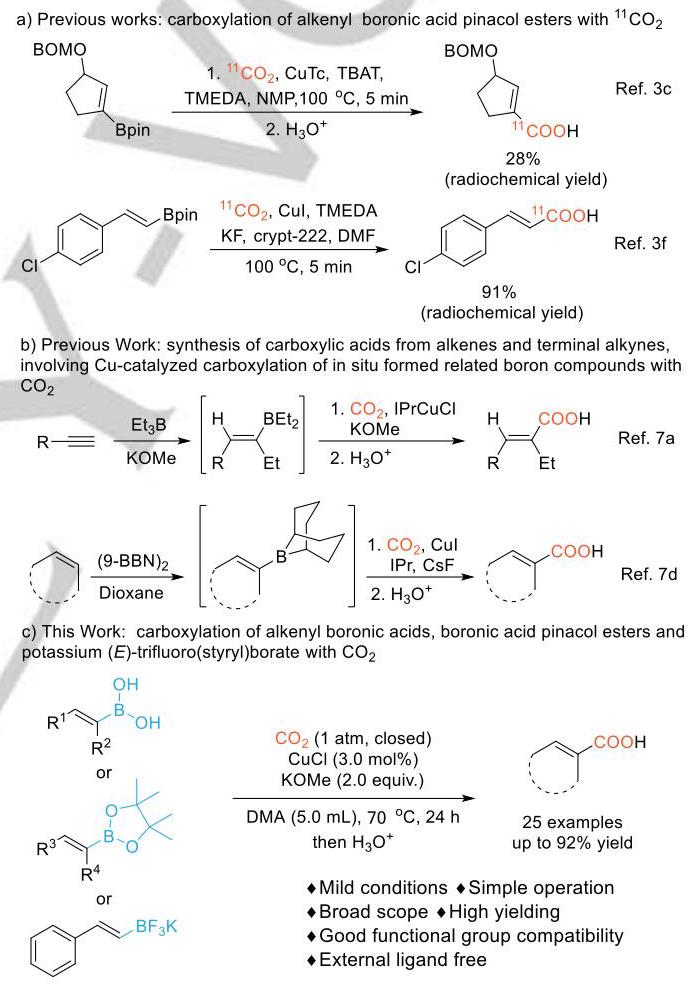
Scheme 1. a) Previous works: carboxylation of alkenyl boronic acid pinacol esters with ${}^{11}{\mathrm{{CO}}}_{2}$ ; b) Previous Work: synthesis of carboxylic acids from alkenes and terminal alkynes, involving Cu-catalysed carboxylation of in situ formed related boron compounds with ${\mathrm{{CO}}}_{2}$ ; c) This Work: carboxylation of alkenyl boronic acids, boronic acid pinacol esters and potassium (E)- trifluoro(styryl)borate with ${\mathrm{{CO}}}_{2}$ .
Results and Discussion
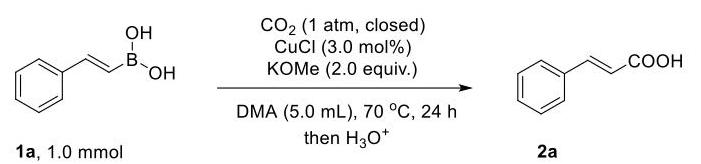
In the optimization study (table 1), we chose (E)-styrylboronic acid 1a as model substrate to react with ${\mathrm{{CO}}}_{2}$ at ambient pressure. After an extensive survey of reaction parameters, we obtained 95%
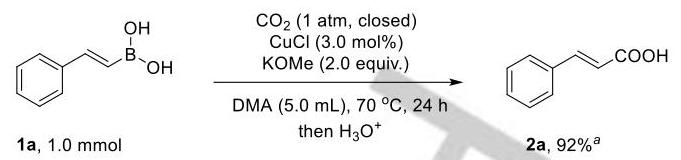
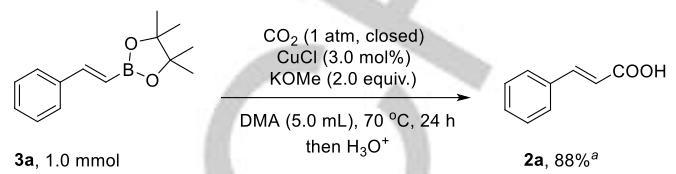
FULL PAPER yield of the desired product by using 3.0 mol% CuCl and 2.0 equiv. KOMe in DMA at ${70}^{ \circ }\mathrm{C}$ for ${24}\mathrm{\;h}$ (entry 1). Other cuprous halides such as Cul, CuBr were relatively less effective (entries 2-3). Further study showed that a smaller amount of CuCl was not conducive to the reaction, and 3 mol% was sufficient (entries 1, 4-5). In addition, the use of other alkoxide bases such as ${\mathrm{{KO}}}^{t}\mathrm{{Bu}}$ , LiOMe showed less effective (entries 6-7). And 2.0 equiv. is the optimal stoichiometry of KOMe (entries 1, 8-9). Other solvents such as DMF, DMSO, MeCN and THF provided low yields of the desired product (entries 10-13). Furthermore, the reaction temperature proved to be crucial. Low temperature would seriously reduce the yield, but it should not either be too high (entries 1, 14-16). Finally, control experiments show that both the catalyst and the base are crucial to the reaction (entries 17-18). While investigating the boron-containing structure in alkenyl boron compounds, we found that in addition to (E)-styrylboronic acid 1a, (E)-4,4,5,5-tetramethyl-2-styryl-1,3,2-dioxaborolane 3a and potassium (E)-trifluoro(styryl)borate 4 also reacted well under identical conditions (Scheme 2). These three boron compounds gave the carboxylated product 2a in 92%, 88%, 83% isolated yields, respectively. We are encouraged that the current method could be adopted to a broad scope of alkenyl boron compounds, especially alkenyl boronic acids and alkenyl boronic acid pinacol esters, since both are commercially available.
Table 1. Optimization of the reaction conditions ${}^{\mathrm{a}}$ .
| Entry | Variation from standard conditions | Yield ${\left( \% \right) }^{b}$ |
| 1 | None | 95 |
| 2 | Cul instead of CuCl | 80 |
| 3 | CuBr instead of CuCl | 86 |
| 4 | With 2.0 mol% CuCl | 79 |
| 5 | With 4.0 mol% CuCl | 95 |
| 6 | KO'Bu instead of KOMe | 60 |
| 7 | LiOMe instead of KOMe | 80 |
| 8 | With 1.5 equiv. KOMe | 83 |
| 9 | With 2.5 equiv. KOMe | 92 |
| 10 | DMF instead of DMA | 41 |
| 11 | DMSO instead of DMA | 34 |
| 12 | MeCN instead of DMA | 21 |
| 13 | THF instead of DMA | 20 |
| 14 | Reaction at room temperature | trace |
| 15 | Reaction at ${50}{}^{ \circ }\mathrm{C}$ | 48 |
| 16 | Reaction at ${100}{}^{ \circ }\mathrm{C}$ | 75 |
| 17 | Without copper catalyst | NR |
| 18 | Without base | NR |
[a] Reaction performed on 1.0 mmol scales. [b] Yields were determined by ${}^{1}\mathrm{H}$ NMR with 1,1,2,2-Tetrachloroethane as an internal standard.
a) The reaction of $\left( E\right)$ -styrylboronic acid 1a with ${\mathrm{{CO}}}_{2}$ in the optimal conditions
b) The reaction of $\left( E\right) - 4,4,5,5$ -tetramethyl-2-styryl-1,3,2-dioxaborolane 3a with ${\mathrm{{CO}}}_{2}$ in the optimal conditions
c) The reaction of potassium $\left( E\right)$ -trifluoro(styryl)borate 4 with ${\mathrm{{CO}}}_{2}$ in the optimal conditions
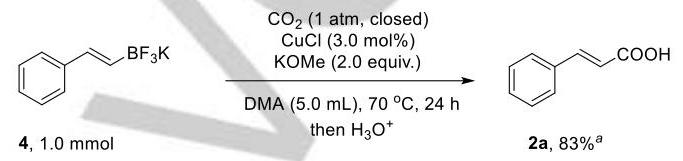
Scheme 2. The reaction of (E)-styrylboronic acid 1a, (E)-4,4,5,5-tetramethyl-2- styryl-1,3,2-dioxaborolane 3a, (E)-trifluoro(styryl)borate 4 with ${\mathrm{{CO}}}_{2}$ in the optimal conditions. ${}^{a}$ Isolated yield.
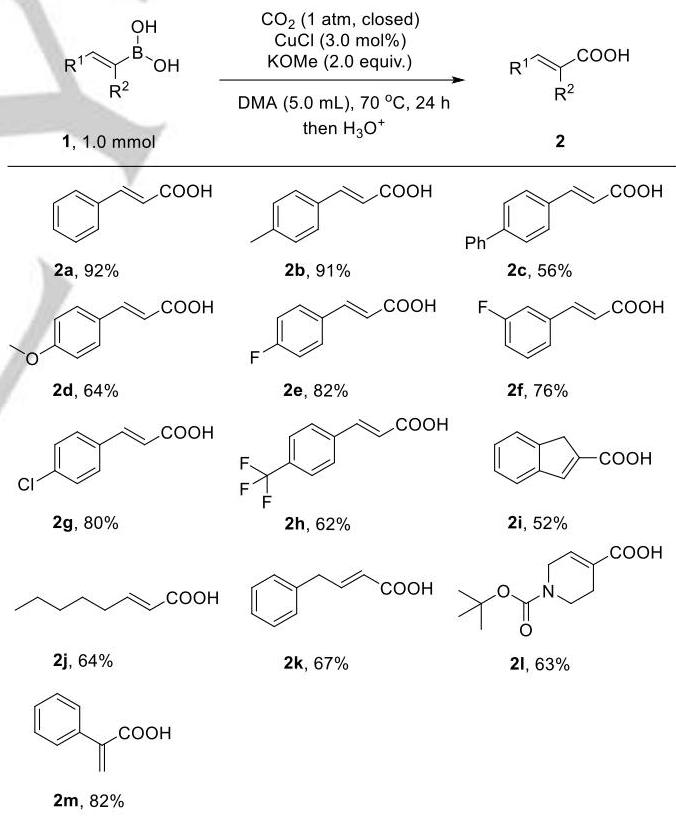
Scheme 3. The substrates scope of alkenyl boron acids. Reactions were carried out by using alkenyl boronic acid 1 (1.0 mmol), cat. CuCl (3.0 mol%), base KOMe (2.0 equiv.) in DMA at ${70}{}^{ \circ }\mathrm{C}$ for ${24}\mathrm{\;h}$ under 1 atm ${\mathrm{{CO}}}_{2}$ . Isolated yields were reported.
We first evaluated the scope of alkenyl boronic acids under the optimal conditions (Scheme 3). When the substituent ${R}^{1}$ was aryl and ${R}^{2}$ was hydrogen, substrates (E)-Styrylboronic acids were successfully converted to the corresponding cinnamic acids (2a-
FULL PAPER
h). The p-methyl-substituted styrylboronic acid gave a high yield (91%, 2b), while p-phenyl-substituted styrylboronic acid and p-methoxy -substituted styrylboronic acid provided obviously lower yields (56%, 2c and 64%, 2d), probably because electronic effect promoted the generation of protodeboronation by-products. Halogen-substituted styrylboronic acids were compatible and gave the corresponding products (2e-h) in moderate to good yields. With the substituent ${R}^{1}$ as hydrogen and ${R}^{2}$ as aryl, the substrate (1-phenylvinyl)boronic acid can also gave the desired product $2\mathrm{\;m}$ in 82% yield. In addition, cyclic alkenyl substrates provided the corresponding products (2i and 2I) in good yields. Also, Boc-protected amines was compatible under the reaction conditions (2I). Moreover, when ${R}^{1}$ was linear alkyl or benzyl, both the substrates underwent the reaction smoothly (2j and 2k). We then focused on the scope of alkenyl boronic acid pinacol esters (Scheme 4). When the substituent ${R}^{3}$ was aryl and ${R}^{4}$ was hydrogen, substrates (E)-Styrylboronic acid pinacol esters provided the desired products (2a and 2v) in good yields. In addition, when the substituent ${R}^{3}$ was ethoxy carbonyl and ${R}^{4}$ was hydrogen, the substrate gave product 2n in 76% yield. And product 2n is an important chemical intermediate, monoethyl fumarate, which can be used to produce preservatives. Again, cyclic alkenyl substrates gave the corresponding products (20-u) in moderate to good yields. Cyclohexenyl boronic acid pinacol esters afforded products (2o-q, 2s) in high yields, except products 2u, possibly because of the effect of secondary amine and steric hindrance. Besides, heterocyclehexenyl boronic acid pinacol esters also provided the desired products (2r, 2l, 2t) in good yields, implying that both oxygen-containing heterocycle and nitrogen-containing heterocycle were compatible under the reaction conditions. Notably, this method is suitable for the synthesis of many unknown acrylic acids (2p-r, 2t-u).
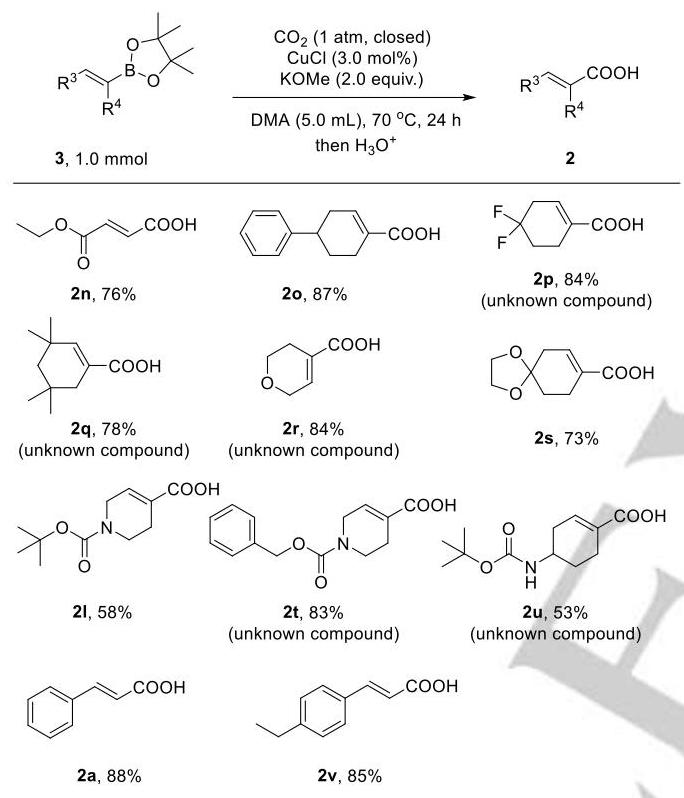
Scheme 4. The substrates scope of alkenyl boronic acid pinacol esters. Reactions were carried out by using alkenyl boronic acid pinacol ester 3 (1.0 mmol), cat. CuCl (3.0 mol%), base KOMe (2.0 equiv.) in DMA at 70 ${}^{ \circ }\mathrm{C}$ for 24 h under 1 atm ${\mathrm{{CO}}}_{2}$ . Isolated yields were reported.
Based on the previous literatures ${}^{\left\lbrack 3g,3h,6,8\right\rbrack }$ and our own study ${}^{\left\lbrack 3b\right\rbrack }$ , a plausible mechanism was proposed (Scheme 5). On one hand, previous reports ${}^{\left\lbrack 8\right\rbrack }$ showed very solid evidence that DMA can work actively as an acido ligand coordinating with copper. On the other hand, due to stability issue and the empty d orbital of copper, organocopper species has to be saturated by being coordinated with substrates, ligands or solvents. As such, the proposed mechanism circle starts with the complex $\mathrm{{Cu}}{\left( \mathrm{{DMA}}\right) }_{n}\mathrm{{Cl}}(\mathrm{n} = 2$ or 3) formed from the coordination between CuCl and DMA. Initially, the complex $\mathrm{{Cu}}{\left( \mathrm{{DMA}}\right) }_{\mathrm{n}}\mathrm{{Cl}}$ exchanges the ligand with KOMe to generate the copper alkoxide $\mathrm{{Cu}}{\left( \mathrm{{DMA}}\right) }_{\mathrm{n}}\left( \mathrm{{OMe}}\right)$ A, which undergoes transmetalation with alkenyl boron acid 1 to form the intermediate B and C. Nucleophilic addition of copper complex C to ${\mathrm{{CO}}}_{2}$ provides copper carboxylate D. $\sigma$ -Metathesis with KOMe generates carboxylic acid potassium salt E and regenerate $\mathrm{{Cu}}{\left( \mathrm{{DMA}}\right) }_{\mathrm{n}}\left( \mathrm{{OMe}}\right)$ A, thereby completing the catalytic cycle.
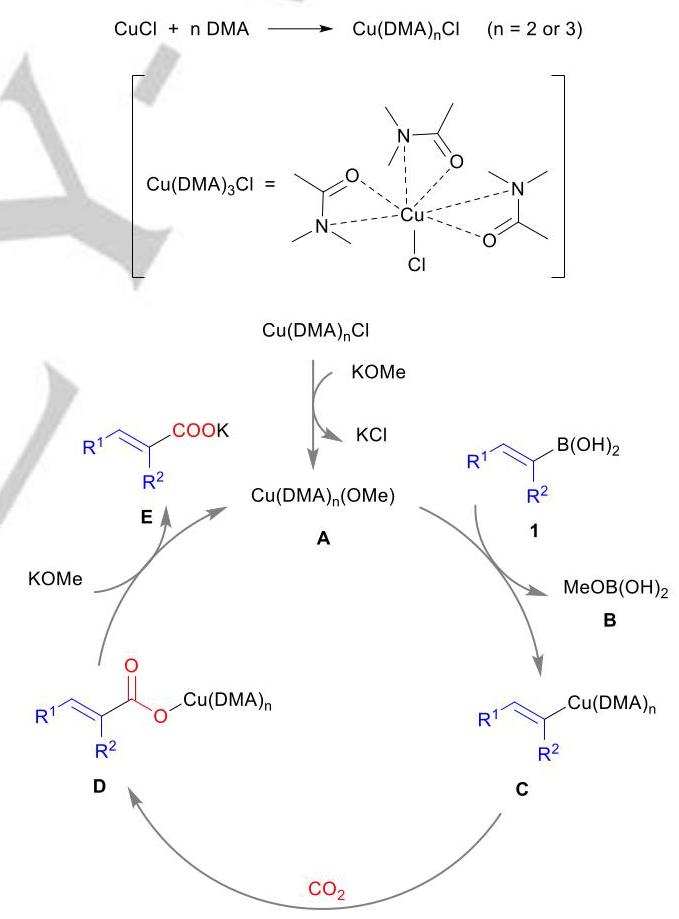
Scheme 5. Proposed mechanism.
Conclusion
In summary, we have succeeded in developing the cuprous halide catalysed carboxylation of alkenyl boronic acids and alkenyl boronic acid pinacol esters with ${\mathrm{{CO}}}_{2}$ . The potassium (E)- trifluoro(styryl)borate can also be carboxylated using this method.
FULL PAPER
A wide range of alkenyl boron compounds were effetively transformed into the corresponding $\alpha ,\beta$ -unsaturated carboxylic acids in moderate to high yield. Good functional group tolerance improve the generality of the reaction. And the use of inexpensive cuprous halides, mild conditions and simple operation expand the utility of the reaction.
Experimental Section
General information: Solvents were purchased from TONGGUANG CHEMICAL, Beijing or BEIJING CHEMICAL, in GR (or CCER). Purification of products was conducted by column chromatography on silica gel (200- 300 mesh, for some cases 300-400 mesh were used, from Qingdao, China). NMR spectra were measured on a Bruker ARX400 ( ${}^{1}\mathrm{H}$ at 400 MHz, ${}^{13}\mathrm{C}$ at 101 MHz, ${}^{19}\mathrm{\;F}$ at 471 MHz) magnetic resonance spectrometer. Chemical shifts (δ) are reported in ppm using tetramethylsilane as internal standard $\left( {s = \text{ singlet }, d = \text{ doublet }, t = \text{ triplet }, q = \text{ quartet },{dd} = \text{ doublet of }}\right)$ doublets, $m =$ multiplet), and coupling constants (J) were reported in Hertz (Hz). The substrates were purchased from commercial sources.
General experimental procedure for the synthesis of (E)-3- phenylacrylic acid (2a): Phenylvinylboronic acid 1a (148.0 mg, 1.0 mmol), KOMe (140.3mg, 2.0 mmol), CuCl (3.0mg, 0.03 mmol) was charged in a ${50}\mathrm{\;{mL}}$ Schlenk tube under ${\mathrm{N}}_{2}$ , followed by $5\mathrm{\;{mL}}$ anhydrous DMA. After that the Schlenk tube was filled with carbon dioxide by applying four-five cycles of evacuation and filling with ${\mathrm{{CO}}}_{2}$ . The Schlenk tube was tightly sealed and stirred at ${70}^{ \circ }\mathrm{C}$ for 24 hours after which it was quenched by careful addition of 1.0 M aq. HCI sol. The reaction mixture was diluted with water and extracted three times with EtOAc. The combined organic phases were washed with brine, dried over anhydrous ${\mathrm{{Na}}}_{2}{\mathrm{{SO}}}_{4}$ and filtered. Then the solvent was removed in vacuo. The crude product was purified by silica gel column chromatography (0-25 % EtOAc in pet-ether) to obtain the desired product 2a 136.2 mg, in 92% yield.
(E)-3-phenylacrylic acid (2a): White solid, 136.2 mg obtained, yield 92% from 1a; 130.3 mg obtained, yield 88% from 3a; 122.9 mg obtained, yield 83% from 4. Rf: 0.7 (PE/EA=3:1). ${}^{1}$ H NMR (400 MHz, DMSO- ${\mathrm{d}}_{6}$ ) δ 12.44 $\left( {s,{1H}}\right) ,{7.73} - {7.65}\left( {m,{2H}}\right) ,{7.61}\left( {d, J = {16.0}\mathrm{\;{Hz}},1\mathrm{H}}\right) ,{7.41}(p, J = {3.5}\mathrm{\;{Hz}}$ , 3H), 6.55 (d, J = 16.0 Hz, 1H). ${}^{13}\mathrm{C}$ NMR (101 MHz, DMSO-6) 6 168.07, 144.41, 134.69, 130.68, 129.36, 128.67, 119.68.
(E)-p-methylcinnamic acid (2b): White solid, 147.5 mg obtained, yield 91%. Rf: 0.4 (PE/EA=3:1). 1H NMR (400 MHz, DMSO-da) 5 12.37 (s, 1H), ${7.62} - {7.51}\left( {\mathrm{\;m},3\mathrm{H}}\right) ,{7.20}\left( {\mathrm{\;d},\mathrm{\;J} = {7.9}\mathrm{\;{Hz}},2\mathrm{H}}\right) ,{6.47}\left( {\mathrm{\;d},\mathrm{\;J} = {16.0}\mathrm{\;{Hz}},1\mathrm{H}}\right)$ , 2.30 (s, 3H). ${}^{13}\mathrm{C}$ NMR (101 MHz, DMSO-d6) δ 168.18, 144.38, 140.56, 131.94, 129.94, 128.61, 118.52, 21.43.[9]
(E)-3-([1,1’-biphenyl]-4-yl)acrylic acid (2c): White solid, 125.5 mg obtained, yield 56%. Rf: 0.4 (PE/EA=3:1). 1H NMR (400 MHz, DMSO-d6) $\delta$ 12.43 (s,1H),7.82 - 7.61 (m,7H),7.49 (t, J = 7.5 Hz,2H),7.40 (t, J = ${7.3}\mathrm{\;{Hz}},1\mathrm{H}),{6.59}\left( {\mathrm{\;d},\mathrm{\;J} = {16.0}\mathrm{\;{Hz}},1\mathrm{H}}\right) {.}^{13}\mathrm{C}$ NMR (101 MHz, DMSO- ${\mathrm{d}}_{6}$ ) $\delta$ 168.07, 143.91, 142.17, 139.70, 133.83, 129.49, 129.33, 128.40, 127.53, 127.15, 119.62.[9]
(E)-3-(4-methoxyphenyl)acrylic acid (2d): White solid, 114.0 mg obtained, yield 64%. Rf: 0.5 (PE/EA=3:1). 1H NMR (400 MHz, DMSO-d6) $\delta = {12.24}\left( {s,{1H}}\right) ,{7.65}\left( {d, J = {8.7Hz},{2H}}\right) ,{7.55}\left( {d, J = {16.0Hz},{1H}}\right) ,{6.97}(d$ , $J = {8.7}\mathrm{\;{Hz}},2\mathrm{\;H}),{6.38}\left( {d, J = {16.0}\mathrm{\;{Hz}},1\mathrm{H}}\right) ,{3.80}\left( {s,3\mathrm{H}}\right) .{}^{13}\mathrm{C}$ NMR $({101}\mathrm{{MHz}}$ , DMSO- ${\mathrm{d}}_{6}$ ) 6 168.31, 161.38, 144.22, 130.42, 127.27, 116.94, 114.80, 55.77.[9]
(E)-4-fluorocinnamic acid (2e): White solid, 136.2 mg obtained, yield 82%. ${\mathrm{R}}_{\mathrm{f}} : {0.6}\left( {\mathrm{{PE}}/\mathrm{{EA}} = 3 : 1}\right) .{}^{1}\mathrm{H}$ NMR $\left( {{400}\mathrm{{MHz}},\text{ DMSO- }{\mathrm{d}}_{6}}\right) \delta$ 12.42 (s,1H), ${7.80} - {7.70}\left( {\mathrm{\;m},2\mathrm{H}}\right) ,{7.60}\left( {\mathrm{\;d},\mathrm{\;J} = {16.0}\mathrm{\;{Hz}},1\mathrm{H}}\right) ,{7.23}\left( {\mathrm{t},\mathrm{J} = {8.8}\mathrm{\;{Hz}},2\mathrm{H}}\right) ,{6.50}$
(d, J = 16.0 Hz, 1H). ${}^{13}$ C NMR (101 MHz, DMSO-d6) δ 167.99, 164.82, 162.36,143.15,131.16 (d, J = 38.4 Hz), 119.55, 116.30 (d, J = 22.2 Hz). ${}^{\left\lbrack 9\right\rbrack }$
(E)-3-fluorocinnamic acid (2f): White solid, 126.2 mg obtained, yield 76%. ${\mathrm{R}}_{\mathrm{f}} : {0.5}\left( {\mathrm{{PE}}/\mathrm{{EA}} = 3 : 1}\right) \cdot {}^{1}\mathrm{H}$ NMR $\left( {{400}\mathrm{{MHz}},\text{ DMSO- }{\mathrm{d}}_{6}}\right) \delta$ 12.53 (s,1H),7.63 $- {7.52}\left( {\mathrm{\;m},2\mathrm{H}}\right) ,{7.50}\left( {\mathrm{\;d},\mathrm{\;J} = {7.8}\mathrm{\;{Hz}},1\mathrm{H}}\right) ,{7.42}\left( {\mathrm{{td}},\mathrm{J} = {7.9},{6.0}\mathrm{\;{Hz}},1\mathrm{H}}\right) ,{7.20}$ (td, $\mathrm{J} = {8.5},{2.5}\mathrm{\;{Hz}},1\mathrm{H}),{6.60}\left( {\mathrm{\;d},\mathrm{\;J} = {16.0}\mathrm{\;{Hz}},1\mathrm{H}}\right) .{}^{13}\mathrm{C}$ NMR (101 MHz, DMSO-d6) $\delta$ 167.85,162.87 $\left( {d, J = {244.4}\mathrm{\;{Hz}}}\right) ,{142.98}\left( {d, J = {3.0}\mathrm{\;{Hz}}}\right)$ , ${137.24}\left( {d, J = {8.1}\mathrm{\;{Hz}}}\right) ,{131.18}\left( {d, J = {8.1}\mathrm{\;{Hz}}}\right) ,{124.99}\left( {d, J = {3.0}\mathrm{\;{Hz}}}\right)$ , ${121.28},{117.26}\left( {\mathrm{\;d},\mathrm{\;J} = {22.2}\mathrm{\;{Hz}}}\right) ,{114.79}\left( {\mathrm{\;d},\mathrm{\;J} = {22.2}\mathrm{\;{Hz}}}\right) {.}^{\left\lbrack {10}\right\rbrack }$
(E)-4-chlorocinnamic acid (2g): White solid, 145.6 mg obtained, yield 80%. Rf: 0.6 (PE/EA=3:1). ${}^{1}\mathrm{H}$ NMR (400 MHz, DMSO- ${\mathrm{d}}_{6}$ ) 5 12.52 (s, 1H), ${7.74}\left( {d, J = {8.3Hz},{2H}}\right) ,{7.61}\left( {d, J = {16.1Hz},{1H}}\right) ,{7.48}\left( {d, J = {8.2Hz},{2H}}\right)$ , ${6.58}\left( {\mathrm{\;d},\mathrm{\;J} = {16.1}\mathrm{\;{Hz}},1\mathrm{H}}\right) .{}^{13}\mathrm{C}\mathrm{{NMR}}\left( {{101}\mathrm{{MHz}},{\mathrm{{DMSO}}}_{2} - {\mathrm{d}}_{6}}\right) {\delta 167.91},{142.97}$ , 135.18, 133.66, 130.37, 129.36, 120.52. ${}^{\left\lbrack 9\right\rbrack }$
(E)-4-(trifluoromethyl)cinnamic acid (2h): White solid, 134.0 mg obtained, yield 62%. ${R}_{f} : {0.3}\left( {{PE}/{EA} = 3 : 1}\right) .{5}^{1}H$ NMR $\left( {{400}\text{ MHz, DMSO-d }{}_{6}}\right) \; \delta$ 12.63 (s,1H),7.88 (d, J = 8.0 Hz,2H),7.71 (d, J = 8.1 Hz,2H),7.66 (d, $\mathrm{J} = {16.0}\mathrm{\;{Hz}},1\mathrm{H}),{6.67}\left( {\mathrm{\;d},\mathrm{\;J} = {16.0}\mathrm{\;{Hz}},1\mathrm{H}}\right) \cdot {}^{13}\mathrm{C}$ NMR (101 MHz, DMSO- ${\mathrm{d}}_{6})\delta$ 167.68,142.50,138.69,130.3 (q, J $= {32.3}\mathrm{\;{Hz}}),{129.20},{126.05}(\mathrm{q},\mathrm{J}$ =4.0 Hz), 124.4 (d, J = 272.7 Hz), 122.57. ${}^{\left\lbrack 9\right\rbrack }$
Indene-2-carboxylic acid (2i): White solid, 83.2 mg obtained, yield 52%. ${\mathrm{R}}_{\mathrm{f}} : {0.5}\left( {\mathrm{{PE}}/\mathrm{{EA}} = 3 : 1}\right) \cdot {}^{1}\mathrm{H}$ NMR $\left( {{400}\mathrm{{MHz}},\text{ DMSO- }{\mathrm{d}}_{6}}\right) \delta$ 12.51 (s,1H),7.69 (s, 1H), 7.62 - 7.52 (m, 2H), 7.38 - 7.32 (m, 2H), 3.63 (s, 2H). ${}^{13}\mathrm{C}$ NMR (101 MHz, DMSO-4b) & 166.16, 145.09, 143.04, 140.61, 138.88, 127.75, 127.22, 124.79, 123.78, 38.56. ${}^{\left\lbrack 9\right\rbrack }$
(E)-oct-2-enoic acid (2j): Yellow oil, 90.9 mg obtained, yield 64%. Rf: 0.6 (PE/EA=20:1). 1H NMR (400 MHz, DMSO-d6): δ 12.13 (s, 1H), 6.87 - 6.75 $\left( {m,{1H}}\right) ,{5.75}\left( {d, J = {15.6}\mathrm{\;{Hz}},1\mathrm{H}}\right) ,{2.16}\left( {q, J = {7.0}\mathrm{\;{Hz}},2\mathrm{H}}\right) ,{1.41}(q, J = {7.2} \; \mathrm{{Hz}},2\mathrm{H}),{1.27}\left( {\mathrm{{tt}},\mathrm{J} = {11.9},{5.4}\mathrm{\;{Hz}},4\mathrm{H}}\right) ,{0.86}\left( {\mathrm{t},\mathrm{J} = {6.9}\mathrm{{Hz}},3\mathrm{H}}\right) .{}^{13}\mathrm{C}$ NMR (101 MHz, DMSO-d6): 5 167.56, 149.22, 122.37, 31.79, 31.26, 27.68, 22.35, 14.28.[11]
(E)-4-phenylbut-2-enoic acid (2k): White solid, 108.6 mg obtained, yield 67%. Rf: 0.3 (PE/EA=5:1). 1H NMR (400 MHz, DMSO- ${\mathrm{d}}_{6}$ ) 5 12.35 (s, 1H), ${7.42}\left( {\mathrm{\;d},\mathrm{\;J} = {7.2}\mathrm{\;{Hz}},2\mathrm{H}}\right) ,{7.33}\left( {\mathrm{t},\mathrm{J} = {7.5}\mathrm{\;{Hz}},2\mathrm{H}}\right) ,{7.24}\left( {\mathrm{t},\mathrm{J} = {7.3}\mathrm{\;{Hz}},1\mathrm{H}}\right)$ , ${6.50}\left( {\mathrm{\;d},\mathrm{\;J} = {16.0}\mathrm{\;{Hz}},1\mathrm{H}}\right) ,{6.31}\left( {\mathrm{{dt}},\mathrm{J} = {16.0},{7.1}\mathrm{\;{Hz}},1\mathrm{H}}\right) ,{3.20}\left( {\mathrm{{dd}},\mathrm{J} = {7.1}}\right)$ , 1.4 Hz, 2H). ${}^{13}$ C NMR (101 MHz, DMSO- ${\mathrm{d}}_{6}$ ) ${}^{13}$ C NMR (101 MHz, DMSO- ${\mathrm{d}}_{6}){\delta 173.13},{137.18},{132.70},{129.10},{127.87},{126.49},{123.66},{38.30}.{}^{\left\lbrack {12}\right\rbrack }$
1-[(tert-butoxy)carbonyl]-1,2,3,6-tetrahydropyridine-4-carboxylic acid (2I): White solid, 143.1 mg obtained, yield 63% from 1I; 131.7 mg obtained, yield ${58}\%$ from 3I. ${R}_{f} : {0.4}\left( {{PE}/{EA} = 3 : 1}\right) .{}^{1}H$ NMR (400 MHz, ${\mathrm{{CDCl}}}_{3}$ ) $\delta$ 11.68 (s,1H),6.98(s,1H),4.08(s,2H),3.50 (t, J $= {5.5}\mathrm{\;{Hz}},2\mathrm{H}$ ), 2.40 – 2.33 (m, 2H), 1.44 (s, 9H). ${}^{13}$ C NMR (101 MHz, CDCl3) δ 170.93, 154.76, 137.50 (d, J = 63.6 Hz), 128.57, 80.28, 43.62 (d, J = 46.5 Hz), 39.90 (d, J = 126.2 Hz), 28.38, 24.09.[13]
2-phenylacrylic acid (2m): Orange solid, 121.4 mg obtained, yield 82%. ${\mathrm{R}}_{\mathrm{f}} : {0.3}\left( {\mathrm{{PE}}/\mathrm{{EA}} = {10} : 1}\right) \cdot {}^{1}\mathrm{H}$ NMR $\left( {{400}\mathrm{{MHz}},\text{ DMSO- }{\mathrm{d}}_{6}}\right) \delta$ 12.86 (s,1H),7.46 - 7.28 (m, 5H), 6.24 (s, 1H), 5.96 (s, 1H). 13C NMR (101 MHz, DMSO-d6) 5 168.22, 141.97, 137.18, 128.57, 128.47, 128.42, 126.53.
(E)-4-ethoxy-4-oxobut-2-enoic acid (2n): White solid, 109.5 mg obtained, yield 76%. Rf: 0.4 (PE/EA=10:1). ${}^{1}\mathrm{H}$ NMR (400 MHz, DMSO- ${\mathrm{d}}_{6}$ ) δ 13.24 $\left( {s,{1H}}\right) ,{6.70}\left( {s,{2H}}\right) ,{4.20}\left( {q, J = {7.1Hz},{2H}}\right) ,{1.25}\left( {t, J = {7.1Hz},{3H}}\right) \cdot {}^{13}C$ NMR (101 MHz, DMSO-da) & 166.18, 165.01, 135.01, 133.10, 61.44, 14.38
4-phenylcyclohex-1-ene-1-carboxylic acid (20): White solid, 175.8 mg obtained, yield 87%. Rf: 0.3 (PE/EA=5:1). ${}^{1}$ H NMR (400 MHz, CDCl3) δ 12.27 (s, 1H), 7.35-7.39 (m, 2H), 7.26-7.28 (m, 4H), 2.92 - 2.80 (m, 1H), 2.56-2.64 (m, 2H), 2.34-2.44 (m, 2H), 2.08-2.13 (m, 1H), 1.73-1.87 (m, 1H).
FULL PAPER
${}^{13}\mathrm{C}$ NMR (101 MHz, CDCIs) δ 173.08,145.88,141.97,129.73,128.59, 126.85, 126.42, 39.06, 33.97, 29.33, 24.48.[16]
4,4-difluorocyclohex-1-ene-1-carboxylic acid (2p): Unknown compound. White solid, 136.1 mg obtained, yield 84%. Rf: 0.5 (PE/EA=5:1). ${}^{1}\mathrm{H}$ NMR (400 MHz, DMSO- ${\mathrm{d}}_{6}$ ): δ 12.50 (s,1H),6.74 - 6.67 (m,1H),2.70- 2.80 (m, 2H), 2.39-2.44 (m, 2H), 1.97-2.11 (m, 2H). ${}^{13}\mathrm{C}$ NMR (101 MHz, DMSO-d6) δ 167.58, 133.87, 129.90, 123.66 (t, J = 239.37 Hz), 34.75 $\left( {t, J = {27.27}\mathrm{\;{Hz}}}\right) ,{29.70}\left( {t, J = {24.24}\mathrm{\;{Hz}}}\right) ,{22.99}\left( {t, J = {5.05}\mathrm{\;{Hz}}}\right) \cdot {}^{19}\mathrm{\;F}$ NMR (471 MHz, DMSO-d, 6 -94.98 (pd, J = 14.6, 3.1 Hz). HRMS: calculated for ${\mathrm{C}}_{7}{\mathrm{H}}_{7}{\mathrm{\;F}}_{2}{\mathrm{O}}_{2}{\left\lbrack \mathrm{M} - \mathrm{H}\right\rbrack }^{ - }{161.041959}$ , found 161.04159.
3,3,5,5-Tetramethyl-cyclohexen-carbonsaeure (2q): Unknown compound. White solid, 142.1 mg obtained, yield 78%. Rf: 0.3 (PE/EA=10:1). ${}^{1}\mathrm{H}$ NMR (400 MHz, DMSO- ${\mathrm{d}}_{6}$ ) δ 12.17 (s, 1H), 6.61 (s, 1H), 1.92 (d, J = 1.7 Hz, 2H), 1.31 (s, 2H), 1.03 (s, 6H), 0.92 (s, 6H). 1'3C NMR (101 MHz, DMSO-d6) δ 169.06, 146.90, 127.02, 49.11, 37.67, 33.37, 30.81, 30.50,29.94. HRMS: calculated for ${\mathrm{C}}_{11}{\mathrm{H}}_{17}{\mathrm{O}}_{2}{\left\lbrack \mathrm{M} - \mathrm{H}\right\rbrack }^{ - }{181.123403}$ , found 181.123380.
3,6-dihydro-2H-pyran-4-carboxylic acid (2r): Unknown compound. White solid, 107.6 mg obtained, yield 84%. Rf: 0.4 (PE/EA=3:1). 1H NMR (400 MHz, DMSO-d6) δ 12.40 (s, 1H), 6.85 (p, J = 2.3 Hz, 1H), 4.18 (q, J $= {2.9}\mathrm{\;{Hz}},2\mathrm{H}),{3.68}\left( {\mathrm{t},\mathrm{J} = {5.5}\mathrm{\;{Hz}},2\mathrm{H}}\right) ,{2.21}\left( {\mathrm{{tq}},\mathrm{J} = {5.2},{2.4}\mathrm{\;{Hz}},2\mathrm{H}}\right) .{}^{13}\mathrm{C}$ NMR (101 MHz, DMSO-d6) & 167.51, 137.82, 128.27, 64.92, 63.64, 24.67. HRMS: calculated for ${\mathrm{C}}_{6}{\mathrm{H}}_{8}{\mathrm{{NaO}}}_{3}{\left\lbrack \mathrm{M} + \mathrm{{Na}}\right\rbrack }^{ + }{151.036565}$ , found 151.03658.
1,4-dioxaspiro[4.5]dec-7-ene-8-carboxylic acid (2s): White solid, 134.4 mg obtained, yield 73%. Rf: 0.3 (PE/EA=3:1). 1H NMR (400 MHz, DMSO- ${\mathrm{d}}_{6})\delta$ 12.23 (s,1H),6.72-6,70 (m,1H),3.89 (s,4H),2.36-2.30 (m,4H),1.68 (t, J = 6.4 Hz, 2H). ${}^{13}$ C NMR (101 MHz, DMSO-d6) δ 168.15, 136.72, 130.15, 106.97, 64.26, 36.04, 30.70, 23.83.[17]
1-benzyloxycarbonyl-1,2,3,6-tetrahydropyridine-4-carboxylic acid (2t): Unknown compound. White solid, 216.7 mg obtained, yield 83%. Rf: 0.2 (PE/EA=3:1). 1H NMR (400 MHz, DMSO-d6) δ 12.50 (s, 1H), 7.38-7.31 $\left( {m,{5H}}\right) ,{6.86} - {6.79}\left( {m,{1H}}\right) ,{5.11}\left( {s,{2H}}\right) ,{4.12} - {4.03}\left( {m,{2H}}\right) ,{3.50}\left( {d, J}\right) \; = {8.1}\mathrm{\;{Hz}},2\mathrm{H}),{2.29} - {2.25}\left( {\mathrm{\;m},2\mathrm{H}}\right) {.}^{13}\mathrm{C}$ NMR (101 MHz, DMSO- ${\mathrm{d}}_{6}$ )5167.57, 154.95, 137.30, 135.50, 135.26, 129.22, 128.89, 128.34, 128.10, 66.76, 43.66,24.32. HRMS: calculated for ${\mathrm{C}}_{14}{\mathrm{H}}_{16}{\mathrm{{NO}}}_{4}{\left\lbrack \mathrm{M} + \mathrm{H}\right\rbrack }^{ + }{262.107384}$ , found 262.107522.
4-((tert-butoxycarbonyl)amino)cyclohex-1-ene-1-carboxylic acid (2u): Unknown compound. White solid, 127.8 mg obtained, yield 53%. Rf: 0.3 (PE/EA=3:1). ${}^{1}$ H NMR (400 MHz, DMSO- ${\mathrm{d}}_{6}$ ) δ 12.18 (s, 1H), 6.87 (d, J = 7.6 Hz, 1H), 6.75-6.73 (m, 1H), 2.41-2.30 (m, 2H), 2.21-1.99 (m, 2H), 1.81- ${1.71}\left( {\mathrm{\;m},1\mathrm{H}}\right) ,{1.45} - {1.39}\left( {\mathrm{\;m},2\mathrm{H}}\right) ,{1.38}\left( {\mathrm{\;s},9\mathrm{H}}\right) \cdot {}^{13}\mathrm{C}$ NMR (101 MHz, DMSO- ${\mathrm{d}}_{6})\delta$ 168.28,155.45,137.43,130.35,78.01,45.48,31.98,28.72,28.55, 23.76. HRMS: calculated for ${\mathrm{C}}_{12}{\mathrm{H}}_{18}{\mathrm{{NO}}}_{4}{\left\lbrack \mathrm{M} - \mathrm{H}\right\rbrack }^{ - }$ 240.124132, found 240.123703.
(E)-4-ethyl cinnamic acid (2v): White solid, 149.7 mg obtained, yield 85%. ${\mathrm{R}}_{\mathrm{f}} : {0.3}\left( {\mathrm{{PE}}/\mathrm{{EA}} = {10} : 1}\right) \cdot {}^{1}\mathrm{H}$ NMR $\left( {{400}\mathrm{{MHz}},\text{ DMSO- }{\mathrm{d}}_{6}}\right) \delta$ 12.38 (s,1H),7.61 $\left( {s,{1H}}\right) ,{7.57}\left( {d, J = {16.0}\mathrm{\;{Hz}},2\mathrm{H}}\right) ,{7.26}\left( {d, J = {7.9}\mathrm{\;{Hz}},2\mathrm{H}}\right) ,{6.48}(d, J = {15.9} \; \mathrm{{Hz}},1\mathrm{H}),{2.62}\left( {\mathrm{q},\mathrm{J} = {7.6}\mathrm{\;{Hz}},2\mathrm{H}}\right) ,{1.18}\left( {\mathrm{t},\mathrm{J} = {7.6}\mathrm{\;{Hz}},3\mathrm{H}}\right) {.}^{13}\mathrm{C}$ NMR (101 MHz, DMSO- ${\mathrm{d}}_{6}$ ) δ 168.19, 146.84, 144.43, 132.22, 128.81, 128.76, 118.61, 28.53, 15.85. ${}^{\left\lbrack {18}\right\rbrack }$
Acknowledgements
The project is supported by the Natural Science Foundation of China (Grant 21772003, 21933001). We also thank Peking University for a start-up fund. This work was partially funded by the BHP-PKU CCUS project supported by BHP Billiton.
Keywords: $\cdot$ Copper catalyst $\cdot$ Carbon dioxide $\cdot$ Carboxylation $\cdot$ Alkenyl boron compounds
References
[1] a) J. Hong, M. Li, J. Zhang, B. Sun, F. Mo, ChemSusChem 2019, 12, 6-39; b) A. Tortajada, F. Juliá- Hernández, M. Börjesson, T. Moragas, R. Martin, Angew. Chem. Int. Ed. 2018, 57, 15948-15982; c) X. Wang, H. Wang, Y. Sun, Chem 2017, 3, 211-228; d) Q. Liu, L. Wu, R. Jackstell, M. Beller, Nat. Commun. 2015, 6, 5933; e) Y. Tsuji, T. Fujihara, Chem. Commun. 2012, 48, 9956-9964; f) K. Huang, C.-L. Sun, Z.-J. Shi, Chem. Soc. Rev. 2011, 40, 2435-2452; g) A. Correa, R. Martín, Angew. Chem. Int. Ed. 2009, 48, 6201-6204.
[2] K. Ukai, M. Aoki, J. Takaya, N. Iwasawa, J. Am. Chem. Soc. 2006, 128, 8706-8707.
[3] a) S.-S. Yan, D.-S. Wu, J.-H. Ye, L. Gong, X. Zeng, C.-K. Ran, Y.-Y. Gui, J. Li, D.-G. Yu, ACS Catal. 2019, 9, 6987- 6992; b) O. S. Nayal, J. Hong, Y. Yang, F. Mo, Org. Chem. Front. 2019, 6, 3673-3677; c) C. H. Jensen, H. D. Hansen, T. Bay, S. B. Vogensen, S. Lehel, L. Thiesen, C. Bundgaard, R. P. Clausen, G. M. Knudsen, M. M. Herth, P. Wellendorph, B. Frolund, ACS Chem. Neurosci. 2017, 8, 22-27; d) W. Wang, G. Zhang, R. Lang, C. Xia, F. Li, Green Chem. 2013, 15, 635-640; e) H. A. Duong, P. B. Huleatt, Q.-W. Tan, E. L. Shuying, Org. Lett. 2013, 15, 4034-4037; f) P. J. Riss, S. Lu, S. Telu, F. I. Aigbirhio, V. W. Pike, Angew. Chem. Int. Ed. 2012, 51, 2698-2702; g) J. Takaya, S. Tadami, K. Ukai, N. Iwasawa, Org. Lett. 2008, 10, 2697-2700; h) T. Ohishi, M. Nishiura, Z. Hou, Angew. Chem. Int. Ed. 2008, 47, 5792-5795.
[4] a) Z. Zhi-Hua, G. Chun-Xiang, X. Jia-Ning, L. Kai-Xuan, H. Liang-Nian, Curr. Org. Synth. 2017, 14, 1185-1192; b) X. Zhang, W.-Z. Zhang, L.-L. Shi, C.-X. Guo, L.-L. Zhang, X.- B. Lu, Chem. Commun. 2012, 48, 6292-6294.
[5]
Y. Makida, E. Marelli, A. M. Z. Slawin, S. P. Nolan, Chem. Commun. 2014, 50, 8010-8013.
[6] L. Dang, Z. Lin, T. B. Marder, Organometallics. 2010, 29, 917-927.
[7] a) K. Kuge, Y. Luo, Y. Fujita, Y. Mori, G. Onodera, M. Kimura, Org. Lett. 2017, 19, 854-857; b) M. Juhl, S. L. R. Laursen, Y. Huang, D. U. Nielsen, K. Daasbjerg, T. Skrydstrup, ACS Catal. 2017, 7, 1392-1396; c) H. Ohmiya, M. Tanabe, M. Sawamura, Org. Lett. 2011, 13, 1086- 1088; d) T. Ohishi, L. Zhang, M. Nishiura, Z. Hou, Angew. Chem. Int. Ed. 2011, 50, 8114-8117.
[8] a) C. Cox, D. Ferraris, N. N. Murthy, T. Lectka, J. Am. Chem. Soc. 1996, 118, 5332-5333; b) A. O. Gorbunov, K. K. Spektor, M. Y. Skripkin, N. A. Tsyrulnikov, Russ. J. Gen. Chem+. 2012, 82, 1053-1057; c) N. A. Bogachev, D. A. Lyubichev, G. L. Starova, A. B. Nikolskii, M. Y. Skripkin, Russ. J. Gen. Chem+. 2018, 88, 617-621; d) N. Basma, P. L. Cullen, A. J. Clancy, M. S. P. Shaffer, N. T. Skipper, T. F. Headen, C. A. Howard, Mol. Phys. 2019, 117, 3353- 3363.
[9] C.-x. Song, P. Chen, Y. Tang, RSC Advances 2017, 7, 11233-11243.
[10] W. Szymanski, B. Wu, B. Weiner, S. de Wildeman, B. L. Feringa, D. B. Janssen, J. Org. Chem. 2009, 74, 9152- 9157.
[11] Y. Zhao, Y. Chen, T. R. Newhouse, Angew. Chem. Int. Ed. 2017, 56, 13122-13125.
[12] N. Hayama, R. Kuramoto, T. Földes, K. Nishibayashi, Y. Kobayashi, I. Pápai, Y. Takemoto, J. Am. Chem. Soc. 2018, 140, 12216-12225.
[13] J. T. Joseph, A. M. Sajith, R. C. Ningegowda, S. Shashikanth, Adv. Synth. Catal. 2017, 359, 419-425.
[14] K. Paridala, S.-M. Lu, M.-M. Wang, C. Li, Chem. Commun. 2018, 54, 11574-11577.
[15] R. Aav, E. Shmatova, I. Reile, M. Borissova, F. Topić, K. Rissanen, Org. Lett. 2013, 15, 3786-3789.
FULL PAPER
[16] K. Nogi, T. Fujihara, J. Terao, Y. Tsuji, J. Org. Chem.
2015, 80, 11618-11623.
[17] A. Ashimori, B. Bachand, L. E. Overman, D. J. Poon, J. Am. Chem. Soc. 1998, 120, 6477-6487.
[18] D. Basavaiah, A. J. Rao, Synthetic. Commun. 2002, 32, 195-201.
FULL PAPER
Entry for the Table of Contents
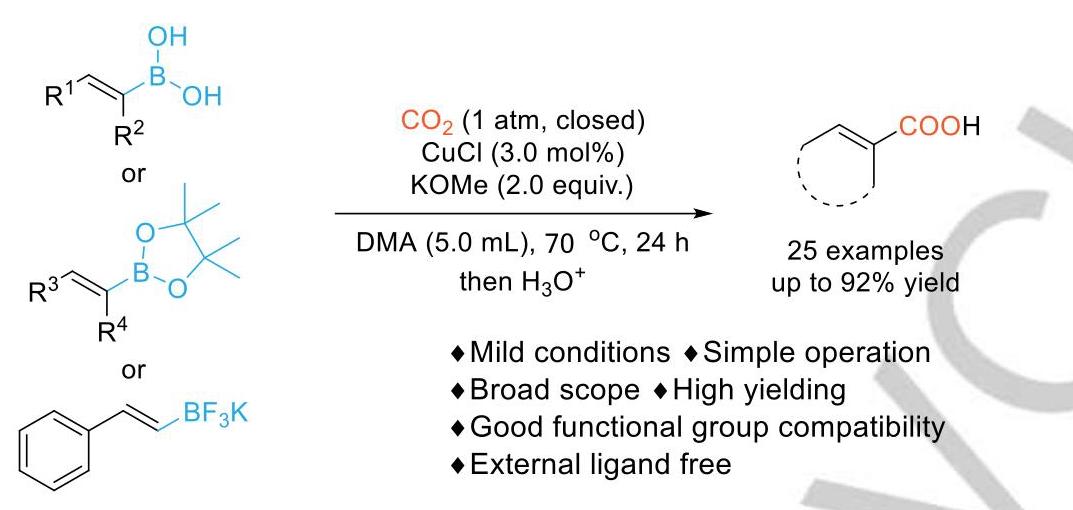
Three kinds of alkenyl boron compounds were effetively transformed into the corresponding a, $\beta$ -unsaturated carboxylic acids in moderate to high yield through cuprous halide-catalysted carboxylation with ${\mathrm{{CO}}}_{2}$ . The advantages of this method include low cost, mild conditions, simple operation, broad scope and external ligand free.