Modification of TiO2 Nanoparticles with Organodiboron Molecules Inducing Stable Surface Ti3+ Complex
中文 / Bilingual · English version
iScience
Modification of TiO ${}_{2}$ Nanoparticles with Organodiboron Molecules Inducing Stable Surface Ti ${}^{3 + }$ Complex
Yang Cao, Peng Zhou, Yongguang Tu, Zheng Liu, Bo-Wei Dong, Aryan Azad, Dongge Ma, Dong Wang, Xu Zhang, Yang Yang, Shang-Da Jiang, Rui Zhu, Shaojun Guo, Fanyang Mo, Wanhong Ma
PII: S2589-0042(19)30362-1
DOI: https://doi.org/10.1016/j.isci.2019.09.024
Reference: ISCI 622
To appear in: ISCIENCE
Received Date: 25 June 2019
Revised Date: 1 September 2019
Accepted Date: 13 September 2019
Please cite this article as: Cao, Y., Zhou, P., Tu, Y., Liu, Z., Dong, B.-W., Azad, A., Ma, D., Wang, D., Zhang, X., Yang, Y., Jiang, S.-D., Zhu, R., Guo, S., Mo, F., Ma, W., Modification of TiO ${}_{2}$ Nanoparticles
with Organodiboron Molecules Inducing Stable Surface Ti ${}^{3 + }$ Complex, ISCIENCE (2019), doi: https:// doi.org/10.1016/j.isci.2019.09.024.
This is a PDF file of an article that has undergone enhancements after acceptance, such as the addition of a cover page and metadata, and formatting for readability, but it is not yet the definitive version of record. This version will undergo additional copyediting, typesetting and review before it is published in its final form, but we are providing this version to give early visibility of the article. Please note that, during the production process, errors may be discovered which could affect the content, and all legal disclaimers that apply to the journal pertain.
© 2019 The Author(s).
Modification of ${\mathrm{{TiO}}}_{2}$ Nanoparticles with Organodiboron Molecules Inducing Stable Surface ${\mathrm{{Ti}}}^{3 + }$ Complex
Yang Cao ${}^{1 \dagger }$ , Peng Zhou ${}^{2 \dagger }$ , Yongguang ${\mathrm{{Tu}}}^{3,4 \dagger }$ , Zheng Liu ${}^{5}$ , Bo-Wei Dong ${}^{5}$ , Aryan Azad ${}^{1}$ , Dongge ${\mathrm{{Ma}}}^{6}$ , Dong Wang ${}^{1}$ , Xu Zhang, ${}^{7}$ Yang Yang, ${}^{8}$ Shang-Da Jiang ${}^{5}$ , Rui Zhu ${}^{3,9}$ , Shaojun Guo ${}^{1,2}$ , Fanyang Mo ${}^{1,{10},{11}, * }$ , Wanhong Ma ${}^{12}$
${}^{1}$ Department of Energy and Resources Engineering, College of Engineering, Peking University, Beijing, 100871, China.
${}^{2}$ Department of Materials Science and Engineering, College of Engineering, Peking University, Beijing, 100871, China.
${}^{3}$ State Key Laboratory for Artificial Microstructure and Mesoscopic Physics, School of Physics, Frontiers Science Center for Nano-optoelectronics & Collaborative Innovation Center of Quantum Matter, Peking University, Beijing, 100871, China.
${}^{4}$ Shaanxi Institute of Flexible Electronics, Northwestern Polytechnical University, Xi’an, Shaanxi 710072, China.
${}^{5}$ Beijing National Laboratory for Molecular Sciences, College of Chemistry and Molecular Engineering, Peking University, Beijing, 100871, China.
${}^{6}$ School of Science, Beijing Technology and Business University, Beijing,100048, China.
${}^{7}$ Department of Physics and astronomy, California State University Northridge, CA 91330 United States.
${}^{8}$ Division of Chemistry and Chemical Engineering California Institute of Technology, Pasadena, CA 91125, United States.
${}^{9}$ Collaborative Innovation Center of Extreme Optics, Shanxi University, Taiyuan, Shanxi 030006, China.
${}^{10}$ Jiangsu Donghai Silicon Industry S&T Innovation Center, Donghai County, Jiangsu 222300, China
${}^{11}$ Lead contact
${}^{11}$ Beijing National Laboratory for Molecular Sciences, Key Laboratory of Photochemistry, CAS Research/Education Center for Excellence in Molecular Sciences, Institute of Chemistry, The Chinese Academy of Sciences, Beijing 100190, China.
*Correspondence to: .
${}^{ \dagger }$ These authors contributed equally.
SUMMARY
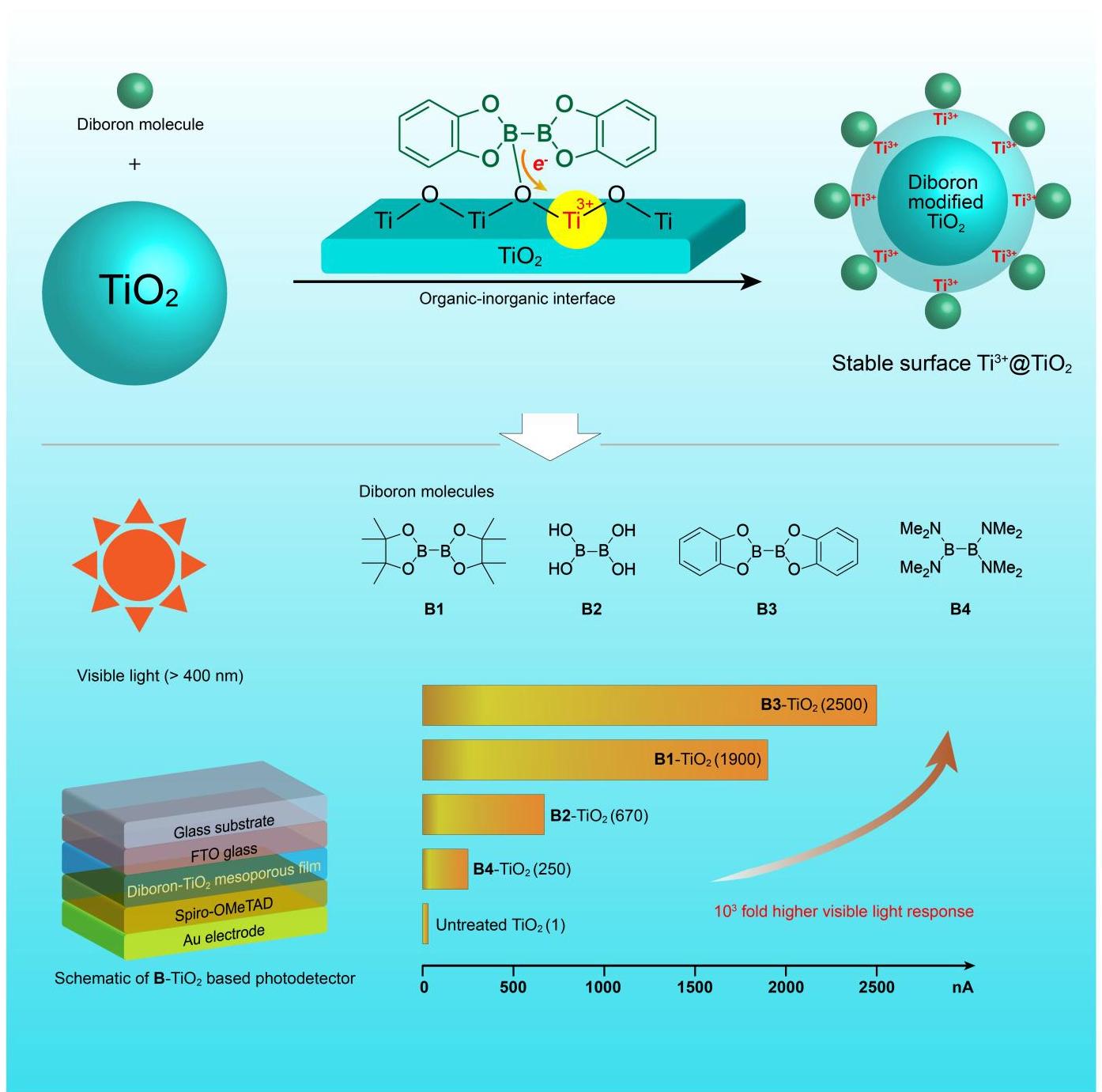
As one of the most promising semiconductor oxide materials, titanium dioxide $\left( {\mathrm{{TiO}}}_{2}\right)$ absorbs ultraviolet (UV) light but not visible light. To address this limitation, the introduction of ${\mathrm{{Ti}}}^{3 + }$ defects represents a common strategy to render ${\mathrm{{TiO}}}_{2}$ visible-light-responsive. Unfortunately, current hurdles in ${\mathrm{{Ti}}}^{3 + }$ generation technologies impeded the widespread application of ${\mathrm{{Ti}}}^{3 + }$ modified materials. Herein, we demonstrate a simple and mechanistically distinct approach to generating abundant surface- ${\mathrm{{Ti}}}^{3 + }$ sites without leaving behind oxygen vacancy and sacrificing one-off electron donors. In particular, upon adsorption of organodiboron reagents onto ${\mathrm{{TiO}}}_{2}$ nanoparticles, spontaneous electron injection from the dibron-bound ${\mathrm{O}}^{2 - }$ site to adjacent ${\mathrm{{Ti}}}^{4 + }$ site leads to an extremely stable blue surface ${\mathrm{{Ti}}}^{3 + } - {\mathrm{O}}^{ - }$ complex. Notably, this defect generation protocol is also applicable to other semiconductor oxides including $\mathrm{{ZnO}},{\mathrm{{SnO}}}_{2},{\mathrm{{Nb}}}_{2}{\mathrm{O}}_{5}$ and ${\mathrm{{In}}}_{2}{\mathrm{O}}_{3}$ . Furthermore, the as-prepared photoelectronic device using this strategy affords ${10}^{3}$ fold higher visible light response, and the fabricated perovskite solar cell shows an enhanced performance.
INTRODUCTION
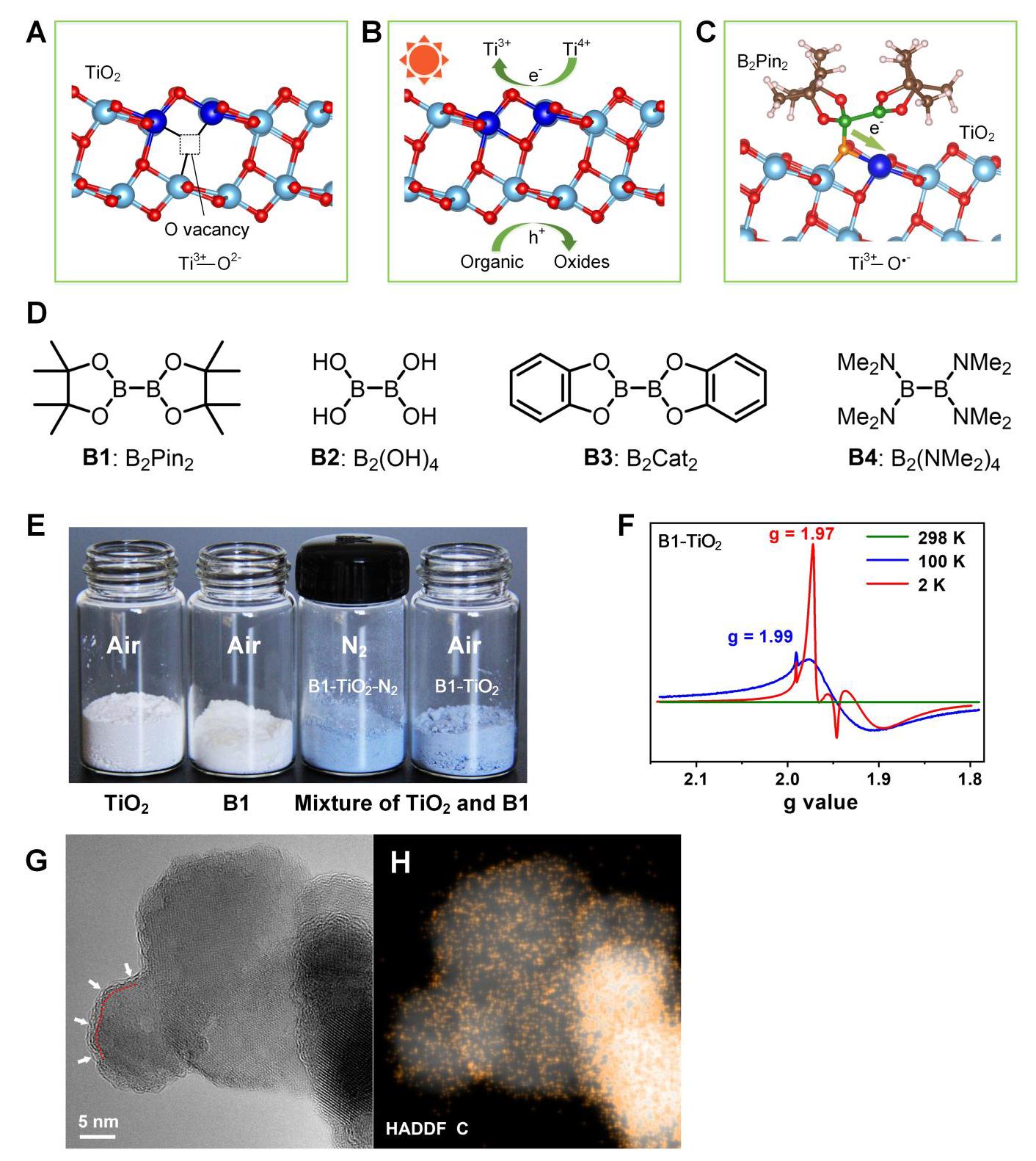
Due to its abundance, nontoxicity and stability, semiconductor oxide $\left( {{\mathrm{{TiO}}}_{2},\mathrm{{ZnO}},{\mathrm{{SnO}}}_{2},\mathrm{{etc}}}\right)$ nanoparticles and films have been widely used as wide-band gap semiconductor photocatalysts for a variety of solar-driven clean energy and environmental technologies, such as photovoltaics and photocatalytic fuel generation.(Chen and Mao, 2007; Grätzel, 2001) However, pristine wide band semiconductor oxides is not an appropriate candidate for practical applications since it only adsorbs UV light. The optical response of ${\mathrm{{TiO}}}_{2}$ nanocrystal has been tuned to visible region using band gap engineering techniques, including metallic (Dahl et al., 2014; Hoffmann et al., 1995) or nonmetallic (Asahi et al., 2014; Asahi et al., 2001; Chen and Burda, 2008; Khan et al., 2002) impurity doping, solid solution formation,(Maeda et al., 2006; Wang et al., 2008) and self-structural modification.(Liu and Chen, 2014) Among various self-modification techniques, in situ formation of self-doped ${\mathrm{{Ti}}}^{3 + }$ in the bulk phase through the introduction of oxygen vacancy at high temperature is an effective strategy for band gap engineering (Figure 1A).(Zuo et al., 2010) Additionally, hydrogenation of ${\mathrm{{TiO}}}_{2}$ nanocrystals can also result in visible-light responsible materials.(Chen et al., 2011) The latest studies show that these low-energy absorption materials arouse utilities in visible light water splitting, microwave and terahertz absorption.(Green et al., 2018a; Green et al., 2019a; Green et al., 2019b; Green et al., 2018b; Guan and Chen, 2018; Tian et al., 2017) Unfortunately, harsh reaction conditions and long-time treatment have limited the practicality of these methods, especially in the context of on-site fabrication and reprocessing of light harvesting devices. Alternatively, UV irradiation of ${\mathrm{{TiO}}}_{2}$ nanoparticles (Schrauben et al., 2012) or visible light irradiation of dye-sensitized systems can also produce visible-light-responsive blue-surface ${\mathrm{{TiO}}}_{2}$ (Figure 1B).(Yan et al.,2017) In both cases, organic sacrificial agents are required, and these agents are irreversibly oxidized by photoinduced holes (e.g., alcohol to aldehyde and ${\mathrm{I}}^{ - }$ to ${\mathrm{I}}_{2}$ ). Moreover, such nascent optically active ${\mathrm{{Ti}}}^{3 + }$ center is highly unstable towards ${\mathrm{O}}_{2}$ due to instantaneous oxidation to ${\mathrm{{Ti}}}^{4 + }$ . To our knowledge, the formation of air-stable surface ${\mathrm{{Ti}}}^{3 + }$ centers using these techniques has not been previously described. We surmise that this is largely due to the difficulty in stabilizing the key ${\mathrm{{Ti}}}^{3 + } - {\mathrm{O}}^{2 - }$ moiety formed in these processes, as such moiety is highly reactive toward ${\mathrm{O}}_{2}$ to afford ${\mathrm{{Ti}}}^{4 + } - \mathrm{O} - {\mathrm{O}}^{ - }$ . In light of these constraints, the ability to access air-stable surface ${\mathrm{{Ti}}}^{3 + }$ defects within ${\mathrm{{TiO}}}_{2}$ would represent a paradigm shift for the field of ${\mathrm{{TiO}}}_{2}$ -based oxide semiconducting materials. In this report, we show that this goal can be accomplished through the simultaneous modification of surface ${\mathrm{O}}^{2 - }$ and ${\mathrm{{Ti}}}^{4 + }$ sites in ${\mathrm{{TiO}}}_{2}$ to afford a persistent, optically active ${\mathrm{{Ti}}}^{3 + } - {\mathrm{O}}^{ - }$ species.
Organodiboron compounds constitute a class of stable and highly versatile reagents commonly used in organic synthesis.(Neeve et al., 2016) Despite their unique reactivity, to date, the use of these diboron species in the modification of inorganic materials remains surprisingly scarce. Herein, we report a new method for the facile generation of ${\mathrm{{Ti}}}^{3 + }$ defects on ${\mathrm{{TiO}}}_{2}$ surface under mild conditions $\left( { < {80}\square }\right)$ enabled by the use of diboron reagents (Figure 1C). In this process, facilitated by the intimate interaction of the diboron reagent’s B center with the surface bridging ${\mathrm{O}}_{2\mathrm{c}}$ of ${\mathrm{{TiO}}}_{2}$ , the adsorption of organodiboron reagents onto ${\mathrm{{TiO}}}_{2}$ nanoparticles leads to spontaneous electron transfer, resulting in a stale, blue surface ${\mathrm{{Ti}}}^{3 + } - {\mathrm{{TiO}}}_{2}$ . Notably, this process does not require complicated synthetic manipulations such as anaerobic photo irradiation or high temperature calcination, which are commonly employed by previously developed techniques.
Previously developed strategies for ${\mathrm{{TiO}}}_{2}$ surface modification have mainly focused on the modification of surface Ti sites with organic nucleophiles (e.g., phenol, alcohol and carboxylic acids). In contrast, surface bridging oxygen $\left( {\mathrm{O}}_{2\mathrm{c}}\right)$ sites have seldom been functionalized with electrophilic organic reagents. We posited that electrophilic organic adsorbates with an appropriate reduction potential might favorably interact with the surface ${\mathrm{O}}_{2\mathrm{c}}$ sites. Importantly, this binding event might overcome the barrier of electron transfer from ${\mathrm{O}}^{2 - }$ sites to adjacent ${\mathrm{{Ti}}}^{4 + }$ sites and further stabilize the primary charge separation state. We were particularly interested in the use of organic diboron reagents due to their unique Lewis acidity and reducing ability (vide supra). Previous work in the area of synthetic organic chemistry showed that upon binding to a Lewis basic oxygen atom, these organic diboron species can function as single electron reducing agents, thus allowing for various important transformations.(Liu et al., 2019; Mo et al., 2010; Mo et al., 2018; Pietsch et al., 2015; Wang et al., 2016; Zhang and Jiao, 2017) Based on these reasons, we envisioned that upon the coordination of such diboron compounds with the surface oxygen atom in metal oxide materials, the formation of surface diboron-oxygen Lewis pair may induce single electron transfer from the ipso- ${\mathrm{O}}_{2\mathrm{c}}$ site to the adjacent Ti site. Furthermore, the interaction of diboron species with the oxygen atom may stabilize the resulting low valent Ti-high valent O pair.
RESULTS AND DISCUSSION
Spectroscopic Characterizations
We use P25 TiO ${}_{2}$ to study the surface modification behavior, for P25 TiO ${}_{2}$ is typical TiO ${}_{2}$ material applied in photochemical applications and shows enhanced performance based on fine nanoparticles and heterointerface between anatase and rutile phase.(Xia et al., 2013; Xia et al., 2014) Mechanical mixing of commercial Degussa ${\mathrm{{TiO}}}_{2}$ P25 and bis(pinacolato)diboron $\left( {{\mathrm{B}}_{2}{\mathrm{{Pin}}}_{2}}\right.$ , B1) in a nitrogen-filled glovebox at room temperature resulted in a rapid color change from white to blue within $1\mathrm{\;{min}}$ (Figure 1E and movie S1). This blue titania, labeled as $\mathrm{B}1 - {\mathrm{{TiO}}}_{2} - {\mathrm{N}}_{2}$ , was highly sensitive to ${\mathrm{O}}_{2}$ and faded immediately upon exposure to air. Unexpectedly, heating B1-TiO2- ${\mathrm{N}}_{2}$ at ${80}\square$ under vacuum for $3\mathrm{\;h}$ resulted in a blue sample that is stable under air, which we labeled as $\mathrm{B}1 - {\mathrm{{TiO}}}_{2}$ . This sample could be stored outside the glovebox for weeks, and the blue color persisted. Similar transformations were observed with three other diboron compounds as shown in Figure 1 & Figure S1. To fully disperse the diboron compound onto the ${\mathrm{{TiO}}}_{2}$ nanoparticles, this heterogeneous reaction was performed in a diboron-soluble solvent, such as methanol or diethyl ether. Same blue samples were obtained after removal of organic solvents under vacuum. On the basis of previous studies,(Iorio et al., 2012) the blue color was indicative of the formation of ${\mathrm{{Ti}}}^{3 + }$ defects. To probe whether B1 was oxidized in this process, the newly prepared blue B1- ${\mathrm{{TiO}}}_{2}$ sample was extracted with ${\mathrm{{CDCl}}}_{3}$ , and B1 was found to be the only boron containing species present in the extract (Figure S2). Additionally, the use of this recovered B1 from the extract for ${\mathrm{{TiO}}}_{2}$ modification also gave rise to the same blue titania. Thus, these experiments suggested that diboron compound B1 is not a one-off sacrifice agent. Based on these findings, a new mechanism must be responsible for the formation of this blue ${\mathrm{{TiO}}}_{2}$ .
To probe the existence of ${\mathrm{{Ti}}}^{3 + }$ species, electron paramagnetic resonance (EPR) spectra (Zuo et al.,2010) of the $\mathrm{B}1 - {\mathrm{{TiO}}}_{2}$ sample were acquired. Low-temperature (2K and ${100}\mathrm{\;K}$ ) EPR data features transitions with $\mathrm{g} = {1.97} - {1.99}$ , while the room temperature EPR is silent (Figure 1F). This behavior is characteristic of ${\mathrm{{Ti}}}^{3 + }$ species as documented by previous studies.(Li et al.,2008) The observed g-values show the presence of a strong anisotropic paramagnetic ${\mathrm{{Ti}}}^{3 + }$ center, indicating that the local symmetry of ${\mathrm{{Ti}}}^{3 + }$ is vastly broken. Furthermore, this ${\mathrm{{Ti}}}^{3 + }$ EPR signal would be split if B replaces the bridging O, or directly bound to Ti.(Gopal et al., 2008) However, in all the cw-EPR measurements, we did not observe the hyperfine coupling originating from the ${}^{10}\mathrm{\;B}$ or ${}^{11}\mathrm{\;B}$ nucleus. This suggests either no or very weak coupling between the B atom and the ${\mathrm{{Ti}}}^{3 + }$ center. Moreover, we find that B3-TiO ${}_{2}$ shows a g signal at 2.003 at room temperature (Figure S3), which could be characteristic of a ${\mathrm{{Ti}}}^{3 + } - {\mathrm{O}}^{ - }$ radical. We also applied the ACTEM method to study the existence and status of diboron molecule on the surface of ${\mathrm{{TiO}}}_{2}$ . In the HRTEM image of B3-TiO ${}_{2}$ (Figure 1G), we find that the surface of ${\mathrm{{TiO}}}_{2}$ nanocrystal is wrapped by an outer layer with $\sim 1\mathrm{\;{nm}}$ thickness. In addition, the EDS mapping of $\mathrm{C}$ element under HADDF model (Figure 1H) shows a carbon-rich surface shell representing adsorbed organic diboron molecule on the ${\mathrm{{TiO}}}_{2}$ surface.
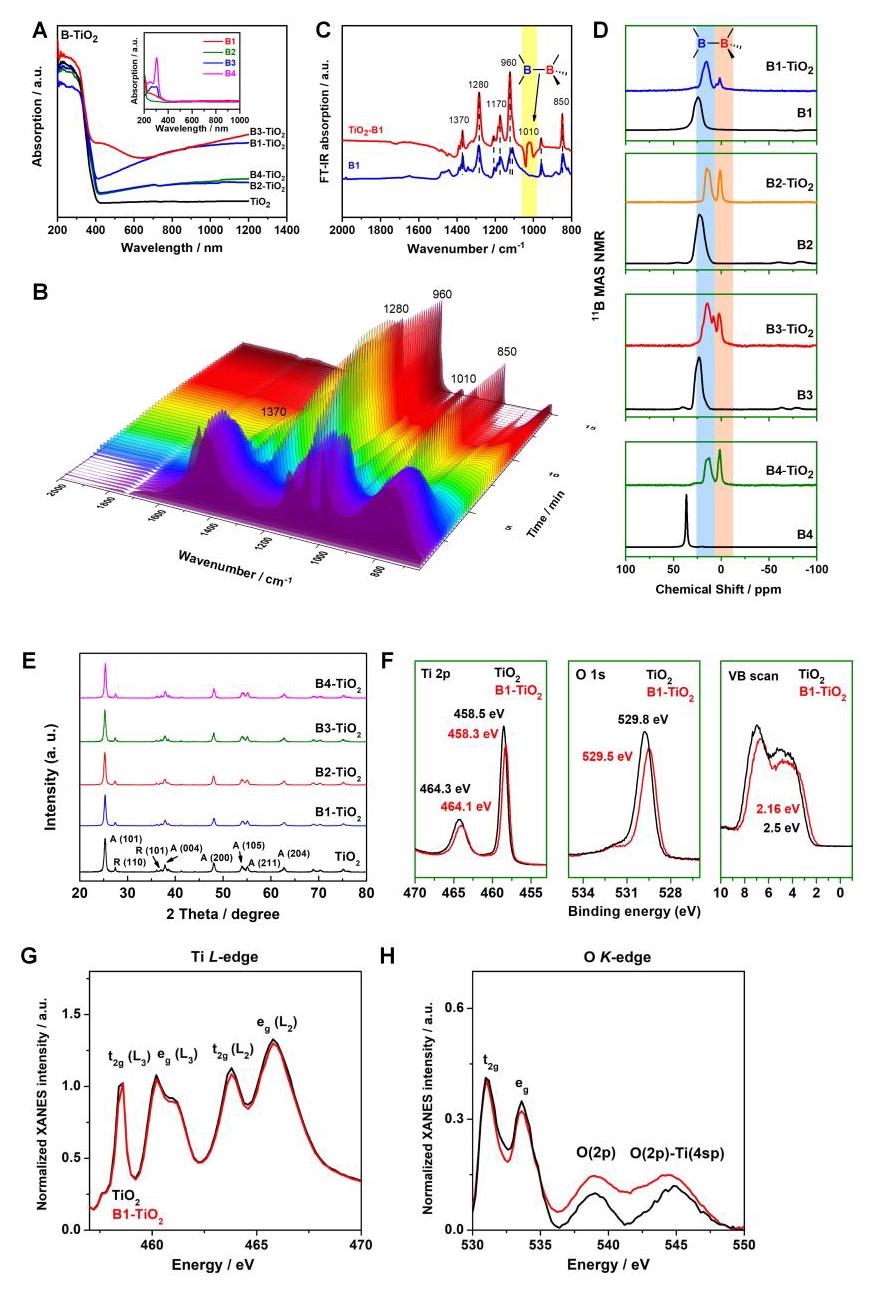
We next investigated the structures and properties of these diboron- ${\mathrm{{TiO}}}_{2}$ nanoparticles with powder X-ray diffraction (PXRD), solid-state UV-Vis spectroscopy (UV-Vis), in situ attenuated total reflectance-Fourier transform infrared spectroscopy (in situ ATR-FTIR) and solid-state ${}^{11}\mathrm{\;B}$ magic angle spinning nuclear magnetic resonance ( ${}^{11}\mathrm{\;B}$ MAS NMR). PXRD analysis (Figure S4) shows that the commercial P25 sample is a mixture of anatase-phase and rutile-phase ${\mathrm{{TiO}}}_{2}$ . The PXRD pattern of ${\mathrm{{TiO}}}_{2}$ remained the same upon adsorption of the diboron reagent, indicating no phase change occurred in this process. Thus, this result suggests that the blue species is likely related to surface engineering rather than bulk phase modification. The solid-state UV-Vis spectra in Figure 2A showed that neither the pristine white ${\mathrm{{TiO}}}_{2}$ nor the diboron compound absorbs visible light $\left( { > {400}\mathrm{\;{nm}}}\right)$ . First, absorption bands beginning at ${400}\mathrm{\;{nm}}$ and steadily growing into the near infrared (NIR) region were observed for all four ${\mathrm{B - {TiO}}}_{2}$ samples. These adsorption bands were different from that arising from metal to ligand charge transfer (MLCT) of the surface complex between ${\mathrm{{Ti}}}^{4 + }$ sites and organic ligands commonly observed in previous work.(Lang et al.,2012) The UV-Vis absorption spectra associated with ${\mathrm{{Ti}}}^{3 + }$ materials can differ between different preparation methods.(Howe and Gratzel, 1985) In our case, the diboron modified ${\mathrm{{TiO}}}_{2}$ samples were found to absorb visible light with higher intensity in the NIR region. This suggested that the ${\mathrm{{Ti}}}^{3 + }$ species in our case is different from the previously reported ${\mathrm{{Ti}}}^{3 + } - {\mathrm{O}}^{2 - }$ structures. In the in situ ATR-FTIR spectra (Figure 2B), the emergence of new signals corresponding to the diboron compound was observed over the time, clearly demonstrating the adsorption process. In the FT-IR spectra (Figure 2C), signals at 1280 and ${1170}{\mathrm{\;{cm}}}^{-1}$ are assigned to two different types of B-O vibration. Based on DFT calculations, the B-B stretching vibration appears at ca. ${1000}{\mathrm{\;{cm}}}^{-1}$ (Figure S5). As shown in Figure 2C, this signal is absent in B1 due to the ${\mathrm{C}}_{2}$ symmetry of this diboron molecule. In contrast, a new peak at ${1010}{\mathrm{\;{cm}}}^{-1}$ corresponding to $\mathrm{B} - \mathrm{B}$ stretching emerged in the $\mathrm{B}1 - {\mathrm{{TiO}}}_{2}$ sample, thereby demonstrating the formation of the oxygen-diboron Lewis pair.
Solid-state ${}^{11}\mathrm{\;B}$ MAS NMR spectroscopy was next used to elucidate the binding details of the diboron reagent with the ${\mathrm{{TiO}}}_{2}$ surface. Upon adsorption, the $\mathrm{B}\left( {\mathrm{{sp}}}^{2}\right) - \mathrm{B}\left( {\mathrm{{sp}}}^{3}\right)$ adducts should exhibit two distinct boron environments in the solid-state NMR spectra. As shown in Figure 2D, in all four cases, new peaks appear and shift upfield, indicating changes in the chemical environment of the two B atoms. Previous studies revealed that the ${}^{11}\mathrm{\;B}$ signal of ${\mathrm{{sp}}}^{3}$ hybridized tetracoordinate boron undergoes an upfield shift relative to the ${\mathrm{{sp}}}^{2}$ hybridized tricoordinate one.(Nöth and Wrackmeyer, 1978) Thus, we attribute the peaks close to 0 ppm to B atom bound to the surface $\mathrm{O}$ atom of ${\mathrm{{TiO}}}_{2}$ nanoparticles. The $\mathrm{X}$ -ray diffraction (XRD) were applied to examine the structure of the ${\mathrm{{TiO}}}_{2}$ by diboron compound modification. According to the XRD results, no change of the lattice was characterized. To further our understanding of the surface interaction between the diboron molecule and ${\mathrm{{TiO}}}_{2}$ nanoparticles, we carried out XPS and SXANES studies. The Ti 2p spectra shows that the peaks were shift for ${0.2}\mathrm{{eV}}$ towards the lower binding energy region, this is also happened in O 1s spectra. The valance band spectra show that the band level shift to lower energy, that shift from ${2.5}\mathrm{{eV}}$ to ${2.16}\mathrm{{eV}}$ . The Ti $2\mathrm{p},\mathrm{O}1\mathrm{\;s}$ spectra change means that the surface modification shows significant influence on the surface electron structure of the ${\mathrm{{TiO}}}_{2}$ . As shown in Figure $2\mathrm{G}$ , the ${\mathrm{t}}_{2\mathrm{\;g}}\left( {\mathrm{\;L}}_{3}\right)$ peak of Ti-L edge shows that the B1- ${\mathrm{{TiO}}}_{2}$ is slight lower than that of pristine ${\mathrm{{TiO}}}_{2}$ , and the peak of ${\mathrm{e}}_{\mathrm{g}}\left( {\mathrm{L}}_{2}\right)$ is shift to higher energy, which can be attributed to the existence of ${\mathrm{{Ti}}}^{3 + }$ .(Kronawitter et al.,2011; Stewart et al.,2006) The O-K edge originates from the hybridization of ${\mathrm{O}}_{2\mathrm{p}}$ ligand-hole states with the coordinating atoms s, p, d states.(Karvonen et al., 2010) In our case, the O-K edge shows that the peaks of B1- ${\mathrm{{TiO}}}_{2}$ that index to Ti-O bond around ${545}\mathrm{{eV}}$ and the O $2\mathrm{p}$ around ${539}\mathrm{{eV}}$ are much higher than that of pristine ${\mathrm{{TiO}}}_{2}$ (Figure 2H), demonstrating more electron location in $\mathrm{O}2\mathrm{p}$ orbital and $\mathrm{{Ti}} - \mathrm{O}$ bond instead of the $\mathrm{O}{\mathrm{e}}_{\mathrm{g}}$ orbitals.(de Groot et al.,1989) Meanwhile, the Ti-K edge line shows no significant change between ${B1} - {\mathrm{{TiO}}}_{2}$ and pristine ${\mathrm{{TiO}}}_{2}$ in the pre-edge region and the EXANE region (Figure S6). The reason is that the diboron compound are bond with surface ipso- ${\mathrm{O}}^{2 - }$ atoms. Moreover, the B 1s XPS also provides consistent results indexing of B species with different binding energies (Figure S7). On the basis of these spectroscopic evidence, we propose that the coordination of diboron compound with surface $\mathrm{O}$ sites on ${\mathrm{{TiO}}}_{2}$ facilitate the electron transfer from the ipso- ${\mathrm{O}}^{2 - }$ to adjacent ${\mathrm{{Ti}}}^{4 + }$ site, and this coordination further stabilize the newly formed ${\mathrm{{Ti}}}^{3 + } - {\mathrm{O}}^{- * }$ species. We note that the activation of inert lattice ${\mathrm{O}}^{2 - }$ and the stabilization of surface ${\mathrm{{Ti}}}^{3 + }$ enabled by the formation of $\equiv \mathrm{B} - {\mathrm{O}}^{ - } - {\mathrm{{Ti}}}^{3 + }$ moiety is a novel process that has not been reported in ${\mathrm{{TiO}}}_{2}$ modification.
DFT calculation results
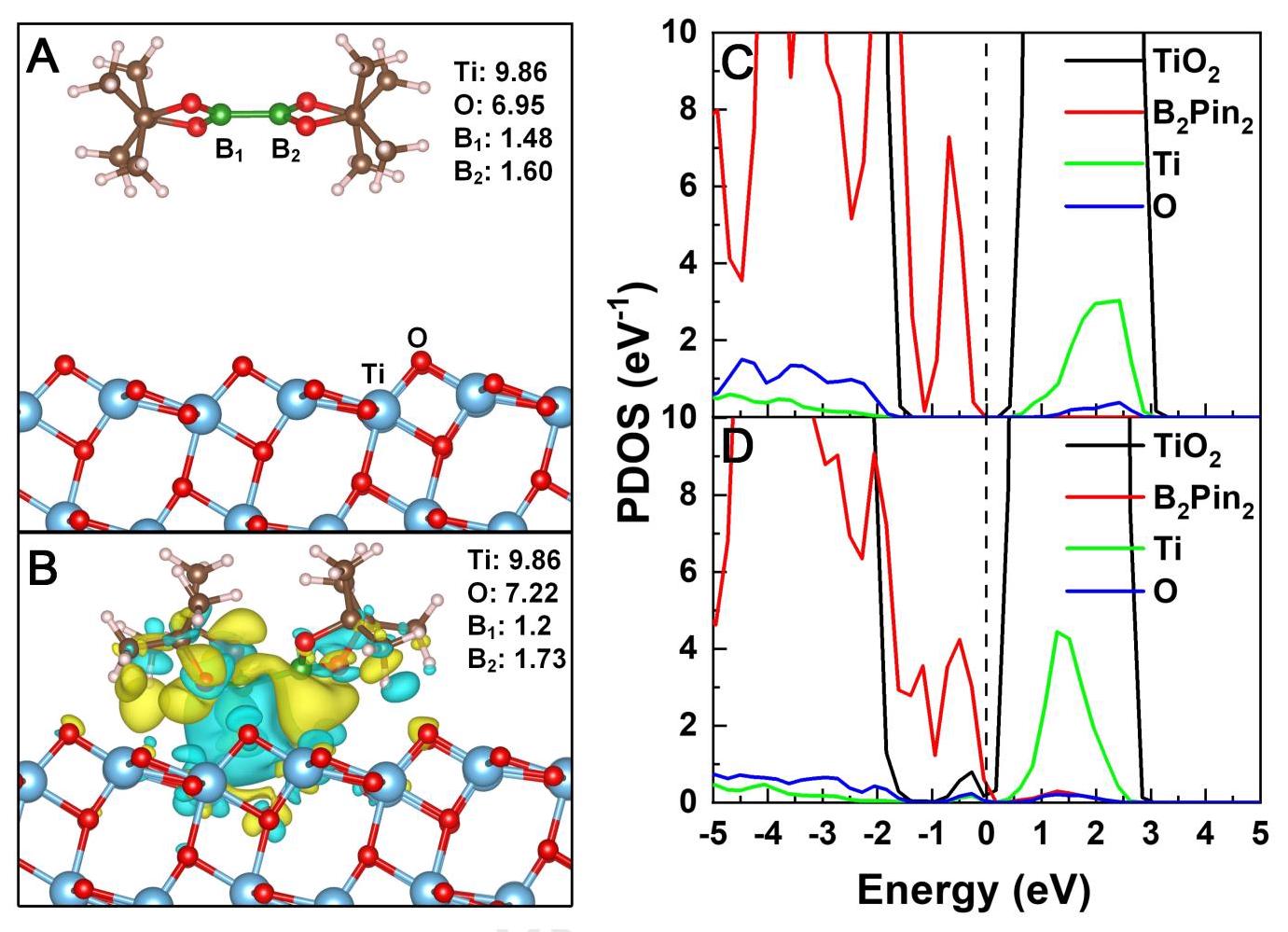
We next investigated the surface ${\mathrm{{Ti}}}^{3 + } - {\mathrm{O}}^{ - }$ structure in the blue ${\mathrm{{TiO}}}_{2}$ nanoparticles by simulating the adsorption of $\mathrm{B}1$ on the ${\mathrm{{TiO}}}_{2}$ surface and the accompanying charge transfer between them using density functional theory (DFT) calculations. According to the literature, the {101} facet in anatase ${\mathrm{{TiO}}}_{2}$ are dominant facet and we set up the adsorption model of anatase ${\mathrm{{TiO}}}_{2}\{ {101}\}$ facet.(Lazzeri et al.,2001) Our calculations showed that the Fermi levels in no adsorption is located in the ${\mathrm{{TiO}}}_{2}$ band gap (Figure 3A and 3C). Importantly, the diboron-adsorbed ${\mathrm{{TiO}}}_{2}$ model shows a clear charge transfer from B1 to the ${\mathrm{{TiO}}}_{2}\{ {101}\}$ surface (Figure 3B). Furthermore, the Bader charge calculation showed substantial electron transfer from the ${\mathrm{B}}_{1}$ atom to the bridging O atom. Furthermore, those electrons (light blue region) are localized between the bridging O atom and the neighbor surface Ti atom according to the calculated charge difference density mapping. The calculated projected density of state (PDOS) plots showed that the Fermi level rises to the bottom of the ${\mathrm{{TiO}}}_{2}$ conduction band which is mainly derived from Ti 3d states (Figure 3D). Some Ti 3d and O 2p states below the Fermi level appear, which are filled with electrons. The filled Ti 3d states indicate the partial reduction of the surface Ti sites, which explains the existence of the ${\mathrm{{Ti}}}^{3 + }$ species observed in our EPR experiments. Moreover, the adsorption model of B2, B3 and B4 on ${\mathrm{{TiO}}}_{2}\{ {101}\}$ surface was also calculated (Figure S8A-C and Figure S9). These data showed that a new electron-filled band-gap state consisting of Ti 3d appears in all the three models (Figure S8D-F and Figure S9). This strongly suggested that the adsorption of organic diboron compounds can lead to the formation of ${\mathrm{{Ti}}}^{3 + }$ species on ${\mathrm{{TiO}}}_{2}$ surface. The adsorption model based on rutile ${\mathrm{{TiO}}}_{2}$ shows the similar results (Figure S10 and Figure S11). The adsorption model of the interface between anatase ${\mathrm{{TiO}}}_{2}$ and rutile ${\mathrm{{TiO}}}_{2}$ was also set up to evaluate the heterojunction in P25 nanoparticles (Figure S12 and S13). To interpret the stability of the surface ${\mathrm{{Ti}}}^{3 + }$ in $\mathrm{B} - {\mathrm{{TiO}}}_{2}$ in the air atmosphere, the oxygen adsorption models were set. The calculation result shows that ${\mathrm{O}}_{2}$ molecule is hesitate to adsorb to the adjacent ${\mathrm{{Ti}}}_{5\mathrm{c}}$ site of the molecule (energy rising process), which represent the protection role of the molecule (Figure S14 and Table S1).
Photodetectors and perovskite solar cells performance
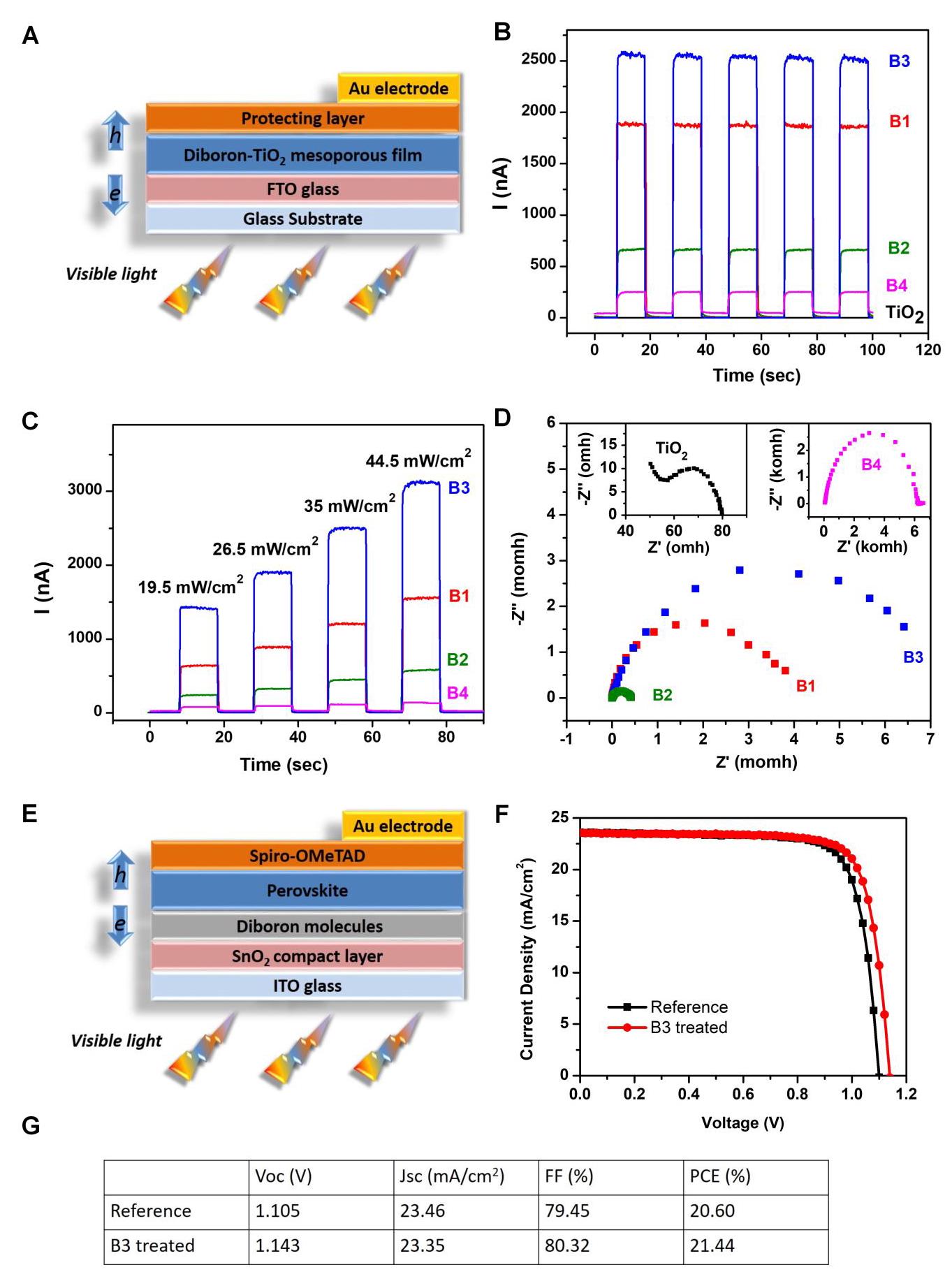
To further explore the optoelectronic properties of this diboron-adsorbed ${\mathrm{{TiO}}}_{2}$ material under visible-light excitation, thin films were then fabricated into photodetectors (denoted as FTO/TiO2/diboron/Spiro-OMeTAD/Au, Figure 4A). The time dependent current curves (I-t) for these diboron-type photodetectors under visible-light illumination (> 400 nm) exhibited excellent on-off switching repetitions through five cycles (interval = 10 s) (Figure 4B). The photocurrent for these four diboron-type detectors increased linearly with the light intensity (Figure 4C, Figure S15 and Table S2). In contrast, the observed photocurrent for ${\mathrm{{TiO}}}_{2}$ without diboron modification did not change regardless of the on/off state, which was ascribed to the intrinsic band gap of anatase ${\mathrm{{TiO}}}_{2}\left( {{3.2}\mathrm{{eV}}}\right)$ . Furthermore, the charge transport process in diboron-modified devices was investigated using electrochemical impedance spectroscopy (EIS) measurements in the dark at $0\mathrm{\;V}$ (Figure 4D). The larger semicircle radius of Nyquist plot in the low-frequency region for the B3 device compared to the B1, B2 and B4 devices indicated less electron recombination.(Kim et al., 2012) This observation agreed well with the highest photocurrent for the B3 device (Figure 4B). The IPCE has also evaluated and the B3-TiO ${}_{2}$ device shows the best performance (Figure S16). The B-TiO ${}_{2}$ photodetectors show good response towards long-time on-off tests compared to the ${\mathrm{{TiO}}}_{2}$ photodetector (Figure S17 and Figure S18) and the response of the photodetectors do not attenuate after stored in a dry air atmosphere for at least 7 months (Figure S19). We also fabricated solar cells based on the diboron molecule interface modulation and the J-V performance of the device were characterized showing an improved solar cell performance (Figure 4E-G). The data shows that the B3 treated device based on B3-SnO ${}_{2}$ interface have a better performance compared to the reference device of ${\mathrm{{SnO}}}_{2}$ based perovskite solar cell.
We note that previously developed solar cells such as dye-sensitized solar cells (DSSCs) and perovskite solar cells (PSCs) inevitably involve the use of expensive dyes and/or toxic and unstable reagents. Thus, our approach to generating visible-light active center via the adsorption of stable and inexpensive diboron compounds holds great advantages over these traditional techniques. Furthermore, a diverse range of diboron compounds can be conveniently synthesized from B4, potentially allowing for the fine-tuning of semiconductor-based materials. More importantly, the present strategy is not limited to ${\mathrm{{TiO}}}_{2}$ . In our studies, we have determined that a broad range of other common semiconducting oxides, including $\mathrm{{ZnO}},{\mathrm{{SnO}}}_{2},{\mathrm{{Nb}}}_{2}{\mathrm{O}}_{5}$ and ${\mathrm{{In}}}_{2}{\mathrm{O}}_{3}$ , were also successfully modified by diboron reagents, thus clearly demonstrating the generality of this method for semiconducting metal oxide modification (Figure S20).
LIMITATIONS OF THE STUDY
In the current study, perovskite solar cells assembled from $\mathrm{B} - {\mathrm{{TiO}}}_{2}$ display relatively poor performance (Figure S21). Many factors such as device fabrication could influence the performance of such device. Additionally, in our present work, mesoporous ${\mathrm{{TiO}}}_{2}$ was used in B- ${\mathrm{{TiO}}}_{2}$ -based devices while planar ${\mathrm{{SnO}}}_{2}$ was used in $\mathrm{B} - {\mathrm{{SnO}}}_{2}$ -based devices. We are uncertain if this deviation led to the contrasting device performance based on $\mathrm{B} - {\mathrm{{TiO}}}_{2}$ and $\mathrm{B} - {\mathrm{{SnO}}}_{2}$ materials. Nonetheless, the three orders of magnitude improvement observed in B-TiO2-based photodetector clearly demonstrates the utility of this diboron-based modification strategy. Currently, we are actively pursuing other applications based on diboron-modified semiconductor oxide materials featuring unique surface defects.
METHODS
All methods can be found in the accompanying Transparent Methods supplemental file.
ACKNOWLEDGEMENT
We thank J. C. Zhao for encouragement; H. J. Yang (Tsinghua University), G. Q. Liu (Peking University), S. L. Wang (Peking University), H. P. Zhou (Peking University) and L. Jiao (Tsinghua University) for insightful discussions; H. Fu (Peking University), H. J. Yang and X. Zhang (Peking University) for assistance with ${}^{11}\mathrm{\;B}$ MAS NMR spectroscopy. A portion of EPR work was performed on the Steady High Magnetic Field Facilities, High Magnetic Field Laboratory of Chinese Academy of Sciences. The authors thank beamline BL08U1A and BL14W1 (Shanghai Synchrotron Radiation Facility) for providing the beam time. This research was supported by the National Natural Science Foundation of China (21772003, 91733301 and
91433203), the 973 Program of China (2015CB932203), ENN Group and BHP-PKU CCUS project.
AUTHOR CONTRIBUTIONS
F. M. conceived the idea. Y. C., P. Z., Y. T., Z. L. and B.-W. D. performed experiments. Y. C., P. Z. and X. Z. conducted the DFT calculation. All authors analyzed data. Y. C., P. Z., Y. T., X. Z., Y. Y., S.-D. J., F. M. and W. M. wrote the manuscript. F. M. directed the whole project.
DECLARATION OF INTERESTS
The authors declare no competing interests.
References and Notes:
Asahi, R., Morikawa, T., Irie, H., and Ohwaki, T. (2014). Nitrogen-Doped Titanium Dioxide as Visible-Light-Sensitive Photocatalyst: Designs, Developments, and Prospects. Chem Rev 114, 9824-9852.
Asahi, R., Morikawa, T., Ohwaki, T., Aoki, K., and Taga, Y. (2001). Visible-Light Photocatalysis in Nitrogen-Doped Titanium Oxides. Science 293, 269-271.
Chen, X., and Burda, C. (2008). The Electronic Origin of the Visible-Light Absorption Properties of C-, N- and S-Doped TiO2 Nanomaterials. J Am Chem Soc 130, 5018-5019.
Chen, X., Liu, L., Yu, P.Y., and Mao, S.S. (2011). Increasing Solar Absorption for Photocatalysis with Black Hydrogenated Titanium Dioxide Nanocrystals. Science 331, 746-750.
Chen, X., and Mao, S.S. (2007). Titanium Dioxide Nanomaterials: Synthesis, Properties, Modifications, and Applications. Chem Rev 107, 2891-2959.
Dahl, M., Liu, Y., and Yin, Y. (2014). Composite Titanium Dioxide Nanomaterials. Chem Rev 114, 9853-9889. de Groot, F.M.F., Grioni, M., Fuggle, J.C., Ghijsen, J., Sawatzky, G.A., and Petersen, H. (1989). Oxygen 1s x-ray-absorption edges of transition-metal oxides. Phys Rev B 40, 5715-5723.
Gopal, N.O., Lo, H.-H., and Ke, S.-C. (2008). Chemical State and Environment of Boron Dopant in B, N-Codoped Anatase TiO2 Nanoparticles: An Avenue for Probing Diamagnetic Dopants in TiO2 by Electron Paramagnetic Resonance Spectroscopy. J Am Chem Soc 130, 2760-2761.
Grätzel, M. (2001). Photoelectrochemical cells. Nature 414, 338.
Green, M., Liu, Z., Xiang, P., Liu, Y., Zhou, M., Tan, X., Huang, F., Liu, L., and Chen, X. (2018a). Doped, conductive SiO2 nanoparticles for large microwave absorption. Light: Science & Applications 7, 87.
Green, M., Van Tran, A.T., Smedley, R., Roach, A., Murowchick, J., and Chen, X. (2019a). Microwave absorption of magnesium/hydrogen-treated titanium dioxide nanoparticles. Nano Materials Science 1, 48-59.
Green, M., Xiang, P., Liu, Z., Murowchick, J., Tan, X., Huang, F., and Chen, X. (2019b). Microwave absorption of aluminum/hydrogen treated titanium dioxide nanoparticles. Journal of Materiomics 5, 133-146.
Green, M.A., Xu, J., Liu, H., Zhao, J., Li, K., Liu, L., Qin, H., Zhu, Y., Shen, D., and Chen, X. (2018b). Terahertz absorption of hydrogenated TiO2 nanoparticles. Materials Today Physics 4, 64-69.
Guan, L., and Chen, X. (2018). Photoexcited Charge Transport and Accumulation in Anatase TiO2. ACS Applied Energy Materials 1, 4313-4320.
Hoffmann, M.R., Martin, S.T., Choi, W., and Bahnemann, D.W. (1995). Environmental Applications of Semiconductor Photocatalysis. Chem Rev 95, 69-96.
Howe, R.F., and Gratzel, M. (1985). EPR observation of trapped electrons in colloidal titanium dioxide. J Phys Chem 89, 4495-4499.
Iorio, Y.D., Aguirre, M.E., Brusa, M.A., and Grela, M.A. (2012). Surface Chemistry Determines Electron Storage Capabilities in Alcoholic Sols of Titanium Dioxide Nanoparticles. A Combined FTIR and Room Temperature EPR Investigation. J Phys Chem C 116, 9646-9652.
Karvonen, L., Valkeapää, M., Liu, R.-S., Chen, J.-M., Yamauchi, H., and Karppinen, M. (2010). O-K and Co-L XANES Study on Oxygen Intercalation in Perovskite SrCoO3-δ. Chem Mater 22, 70-76.
Khan, S.U.M., Al-Shahry, M., and Ingler, W.B. (2002). Efficient Photochemical Water Splitting by a Chemically Modified n-TiO2. Science 297, 2243-2245.
Kim, K.S., Song, H., Nam, S.H., Kim, S.-M., Jeong, H., Kim, W.B., and Jung, G.Y. (2012). Fabrication of an Efficient Light-Scattering Functionalized Photoanode Using Periodically Aligned ZnO Hemisphere Crystals for Dye-Sensitized Solar Cells. Adv Mater 24, 792-798.
Kronawitter, C.X., Bakke, J.R., Wheeler, D.A., Wang, W.-C., Chang, C., Antoun, B.R., Zhang, J.Z., Guo, J., Bent, S.F., Mao, S.S., et al. (2011). Electron Enrichment in 3d Transition Metal Oxide Hetero-Nanostructures. Nano Letters 11, 3855-3861.
Lang, X., Ma, W., Zhao, Y., Chen, C., Ji, H., and Zhao, J. (2012). Visible - Light - Induced Selective Photocatalytic Aerobic Oxidation of Amines into Imines on TiO2. Chem Eur J 18, 2624-2631.
Lazzeri, M., Vittadini, A., and Selloni, A. (2001). Structure and energetics of stoichiometric ${\mathrm{TiO}}_{2}$ anatase surfaces. Phys Rev B 63, 155409.
Li, G., Dimitrijevic, N.M., Chen, L., Nichols, J.M., Rajh, T., and Gray, K.A. (2008). The Important Role of Tetrahedral Ti4+ Sites in the Phase Transformation and Photocatalytic Activity of TiO2 Nanocomposites. J Am Chem Soc 130, 5402-5403.
Liu, L., and Chen, X. (2014). Titanium Dioxide Nanomaterials: Self-Structural Modifications. Chem Rev 114, 9890- 9918.
Liu, Q., Hong, J., Sun, B., Bai, G., Li, F., Liu, G., Yang, Y., and Mo, F. (2019). Transition-Metal-Free Borylation of Alkyl Iodides via a Radical Mechanism. Org Lett 21, 6597-6602.
Maeda, K., Teramura, K., Lu, D., Takata, T., Saito, N., Inoue, Y., and Domen, K. (2006). Photocatalyst releasing hydrogen from water. Nature 440, 295-295.
Mo, F., Jiang, Y., Qiu, D., Zhang, Y., and Wang, J. (2010). Direct Conversion of Arylamines to Pinacol Boronates: A Metal-Free Borylation Process. Angew Chem Int Edit 49, 1846-1849.
Mo, F., Qiu, D., Zhang, Y., and Wang, J. (2018). Renaissance of Sandmeyer-Type Reactions: Conversion of Aromatic C-N Bonds into C-X Bonds (X = B, Sn, P, or CF3). Accounts Chem Res 51, 496-506.
Neeve, E.C., Geier, S.J., Mkhalid, I.A.I., Westcott, S.A., and Marder, T.B. (2016). Diboron(4) Compounds: From Structural Curiosity to Synthetic Workhorse. Chem Rev 116, 9091-9161.
Nöth, H., and Wrackmeyer, B. (1978). 11B NMR of Tetracoordinate Boron. In Nuclear Magnetic Resonance Spectroscopy of Boron Compounds, H. Nöth, and B. Wrackmeyer, eds. (Berlin, Heidelberg: Springer Berlin Heidelberg), pp. 74-101.
Pietsch, S., Neeve, E.C., Apperley, D.C., Bertermann, R., Mo, F., Qiu, D., Cheung, M.S., Dang, L., Wang, J., Radius, U., et al. (2015). Synthesis, Structure, and Reactivity of Anionic sp2-sp3 Diboron Compounds: Readily Accessible Boryl Nucleophiles. Chem Eur J 21, 7082-7098.
Schrauben, J.N., Hayoun, R., Valdez, C.N., Braten, M., Fridley, L., and Mayer, J.M. (2012). Titanium and Zinc Oxide Nanoparticles Are Proton-Coupled Electron Transfer Agents. Science 336, 1298-1301.
Stewart, S.J., Fernández-García, M., Belver, C., Mun, B.S., and Requejo, F.G. (2006). Influence of N-Doping on the Structure and Electronic Properties of Titania Nanoparticle Photocatalysts. The Journal of Physical Chemistry B 110, 16482-16486.
Tian, L., Xu, J., Alnafisah, A., Wang, R., Tan, X., Oyler, N.A., Liu, L., and Chen, X. (2017). A Novel Green TiO2 Photocatalyst with a Surface Charge-Transfer Complex of Ti and Hydrazine Groups. Chem Eur J 23, 5345-5351.
Wang, D., Kako, T., and Ye, J. (2008). Efficient Photocatalytic Decomposition of Acetaldehyde over a Solid-Solution Perovskite (Ag0.75Sr0.25)(Nb0.75Ti0.25)O3 under Visible-Light Irradiation. J Am Chem Soc 130, 2724- 2725.
Wang, G., Zhang, H., Zhao, J., Li, W., Cao, J., Zhu, C., and Li, S. (2016). Homolytic Cleavage of a B-B Bond by the Cooperative Catalysis of Two Lewis Bases: Computational Design and Experimental Verification. Angew Chem Int Edit 55, 5985-5989.
Xia, T., Li, N., Zhang, Y., Kruger, M.B., Murowchick, J., Selloni, A., and Chen, X. (2013). Directional heat dissipation across the interface in anatase-rutile nanocomposites. ACS Appl Mater Interfaces 5, 9883-9890.
Xia, T., Zhang, Y., Murowchick, J., and Chen, X. (2014). Vacuum-treated titanium dioxide nanocrystals: Optical properties, surface disorder, oxygen vacancy, and photocatalytic activities. Catal Today 225, 2-9.
Yan, Y., Shi, W., Yuan, Z., He, S., Li, D., Meng, Q., Ji, H., Chen, C., Ma, W., and Zhao, J. (2017). The Formation of Ti-H Species at Interface Is Lethal to the Efficiency of TiO2-Based Dye-Sensitized Devices. J Am Chem Soc 139, 2083-2089.
Zhang, L., and Jiao, L. (2017). Pyridine-Catalyzed Radical Borylation of Aryl Halides. J Am Chem Soc 139, 607- 610.
Zhang, L., and Jiao, L. (2017). Pyridine-Catalyzed Radical Borylation of Aryl Halides. J Am Chem Soc 139, 607- 610.
Zuo, F., Wang, L., Wu, T., Zhang, Z., Borchardt, D., and Feng, P. (2010). Self-Doped Ti3+ Enhanced Photocatalyst for Hydrogen Production under Visible Light. J Am Chem Soc 132, 11856-11857.
Zuo, F., Wang, L., Wu, T., Zhang, Z., Borchardt, D., and Feng, P. (2010). Self-Doped Ti3+ Enhanced Photocatalyst for Hydrogen Production under Visible Light. J Am Chem Soc 132, 11856-11857.
Figure 1. Conventional methods and present work for the preparation of self-doped ${\mathrm{{Ti}}}^{3 + } - {\mathrm{{TiO}}}_{2}$ materials (A) ${\mathrm{{Ti}}}^{3 + }$ generation as a result of oxygen vacancy formation. High temperature combustion with reductant leads to oxygen vacancy in ${\mathrm{{TiO}}}_{2}$ bulk phase.(Zuo et al.,2010)
(B) ${\mathrm{{Ti}}}^{3 + }$ generation by photo irradiation. By removal of photoinduced holes using organic sacrificial agents, electrons are cumulated at the conduction band of ${\mathrm{{TiO}}}_{2}$ , resulting in the reduction of ${\mathrm{{Ti}}}^{4 + }$ to ${\mathrm{{Ti}}}^{3 + }$ .(Schrauben et al., 2012; Yan et al., 2017)
(C) Present work. Diboron compound $\left( {{\mathrm{B}}_{2}{\mathrm{{Pin}}}_{2}}\right)$ adsorption on the surface of ${\mathrm{{TiO}}}_{2}$ nanoparticles induces spontaneous electron injection for the formation of optically active ${\mathrm{{Ti}}}^{3 + } - {\mathrm{O}}^{ - }$ species. The light blue, blue, red, orange, earth yellow, green and pink balls stand for the ${\mathrm{{Ti}}}^{4 + },{\mathrm{{Ti}}}^{3 + },{\mathrm{O}}^{2 - },{\mathrm{O}}^{ - },\mathrm{C},\mathrm{B}$ and $\mathrm{H}$ atom, respectively.
(D) Four commercially available diboron compounds used in this study: ${\mathrm{B}}_{2}{\mathrm{{Pin}}}_{2}$ (bis(pinacolato)diboron), ${\mathrm{B}}_{2}{\left( \mathrm{{OH}}\right) }_{4}$ (tetrahydroxydiborane), ${\mathrm{B}}_{2}{\mathrm{{Cat}}}_{2}$ (bis(catecholato)diboron) and ${\mathrm{B}}_{2}{\left( {\mathrm{{NMe}}}_{2}\right) }_{4}$ (tetrakis(dimethylamino)diboron).
(E) Photograph comparing ${\mathrm{{TiO}}}_{2}\left( {\mathrm{P}{25}}\right) ,{\mathrm{B}}_{2}{\mathrm{{Pin}}}_{2}\left( {\mathrm{\;B}1}\right) ,\mathrm{B}1 - {\mathrm{{TiO}}}_{2} - {\mathrm{N}}_{2}$ sample under an inert atmosphere (mixture of solid ${\mathrm{{TiO}}}_{2}$ and ${\mathrm{B}}_{2}{\mathrm{{Pin}}}_{2}$ ) and $\mathrm{B}1 - {\mathrm{{TiO}}}_{2}$ under air after heating at ${80}^{ \circ }\mathrm{C}$ under vacuum for $3\mathrm{\;h}$ .
(F) EPR spectra of $\mathrm{B}1 - {\mathrm{{TiO}}}_{2}$ at various temperatures.
(G) HRTEM of B3-TiO ${}_{2}$ . A short-dashed curve is applied to outline a portion of the interface between the crystalline core and the outer layer (marked by white arrows).
(H) The corresponding HADDF-STEM image of B3-TiO ${}_{2}$ with distribution of the C element mapping.
Movie S1. Related to Figure 1E. Mechanical mixing of two fine white powders of commercial Degussa ${\mathrm{{TiO}}}_{2}$ P25 and bis(pinacolato)diboron $\left( {{\mathrm{B}}_{2}{\mathrm{{Pin}}}_{2},\mathrm{\;B}1}\right)$ in a glove box and in air were recorded by a smart phone camera. Samples color change from white to blue within one minute. Please watch the video for detail.
Figure 2. Spectroscopic Characterizations
(A) UV-Vis spectra of the white ${\mathrm{{TiO}}}_{2}$ P25 and diboron-adsorbed ${\mathrm{{TiO}}}_{2}$ P25. The inset shows the UV-Vis spectra of four free diboron compounds.
(B) In situ ATR-FTIR spectrum of B1 onto ${\mathrm{{TiO}}}_{2}$ over ${15}\mathrm{\;{min}}$ .
(C) FT-IR spectra of free B1 and B1- ${\mathrm{{TiO}}}_{2}$ .
(D) Solid-state ${}^{11}$ B MAS NMR of diboron compounds B and B-TiO ${}_{2}$ .
(E) XRD pattern of the diboron compounds modified ${\mathrm{{TiO}}}_{2}$
(F) Ti $2\mathrm{p},\mathrm{O}1\mathrm{\;s}$ and valance band structure $\mathrm{X}$ -ray photoelectron spectroscopy spectra of ${\mathrm{{TiO}}}_{2}$ and $\mathrm{B}1 - {\mathrm{{TiO}}}_{2}$ .
(G) Normalized Ti-L edge XANES spectra of ${\mathrm{{TiO}}}_{2}$ and $\mathrm{B}1 - {\mathrm{{TiO}}}_{2}$ .
(H) Normalized O-K edge XANES spectra of ${\mathrm{{TiO}}}_{2}$ and $\mathrm{B}1 - {\mathrm{{TiO}}}_{2}$ .
Figure 3. DFT calculation results
(A) Optimized geometric structures and charge difference density mappings for no adsorption.
(B) Optimized geometric structures and charge difference density mappings for adsorption of B1 on the ${\mathrm{{TiO}}}_{2}\{ {101}\}$ surface. The numbers in the figure stand for the Bader charges on the various atoms. The isosurfaces of the electron density difference plots are all ${0.001}\mathrm{e}{\text{ Å }}^{-3}$ . The yellow and light blue surfaces represent electron depletion and accumulation. The blue, red, earth yellow, green and pink spheres stands for the Ti, O, C, B and H atoms, respectively.
(C) Projected density of state (PDOS) plots for no adsorption.
(D) Projected density of state (PDOS) plots for adsorption of B1 on the ${\mathrm{{TiO}}}_{2}\{ {101}\}$ surface (the insert on the right are the magnification of the inter band at near the Fermi energy level). The dashed line show the Fermi level.
Figure 4. Photodetectors and perovskite solar cells performance
(A) Schematic of the FTO/TiO ${}_{2}$ /diboron/Spiro-OMeTAD/Au photodetector.
(B) Time dependent current curves for the detectors under light illumination $\left( {\lambda > {400}\mathrm{\;{nm}}}\right)$ with ${10}\mathrm{\;s}$ on/off switching intervals.
(C) Time dependent current curves for these photodetectors under illumination intensities $\left( {\lambda > {400}\mathrm{\;{nm}}}\right)$ of 19.5 $\mathrm{{mW}} \cdot {\mathrm{{cm}}}^{-2},{26.5}\mathrm{{mW}} \cdot {\mathrm{{cm}}}^{-2},{35.0}\mathrm{{mW}} \cdot {\mathrm{{cm}}}^{-2}$ , and ${44.5}\mathrm{{mW}} \cdot {\mathrm{{cm}}}^{-2}$ .
(D) Nyquist plots from the photodetectors in the dark.
(E) Schematic of the ITO/ ${\mathrm{{SnO}}}_{2}$ /diboron/Perovskite/Spiro-OMeTAD/Au solar cell.
(F) Current density-voltage curves (J-V) of the diboron modificated perovskite solar cell.
(G) Photovoltaic parameters of the diboron modificated perovskite solar cell.
Journal Pre-proof
Highlights
Organodiborons are used to reshape the surface electronic state of semiconductor oxides.
Diboron adsorption leads to spontaneous charge transfer and reduced surface metal ions.
Photodetector based on diboron material affords ${10}^{3}$ fold higher visible light response.