Cu-catalysed carboxylation of aryl boronic acids with CO2
中文 / Bilingual · English version
ORGANIC CH
Check for updates
Cite this: Org. Chem. Front., 2019, 6, 3673
Received 18th August 2019, Accepted 17th September 2019
DOI: 10.1039/c9qo01023h
DOI: 10.1039/c9qo01023h
rsc.li/frontiers-organic
rsc.li/frontiers-organic
Cu-Catalysed carboxylation of aryl boronic acids with ${\mathrm{{CO}}}_{2} \dagger$
Onkar S. Nayal, ${}^{a}$ Junting Hong, ${}^{a}$ Yang Yang ${}^{b}$ and Fanyang Mo ${}^{c}{}^{d}{}^{e}{}^{a}$ No ${}^{c}$
A copper/N-heterocyclic carbene (NHC) catalysed carboxylation of aryl boronic acids under one atmospheric pressure of ${\mathrm{{CO}}}_{2}$ has been developed. A wide range of aryl boronic acids was transformed into benzoic acid derivatives in moderate to high yields. The carboxylation method shows excellent functional group compatibility, and sensitive functional groups such as carbonyls, esters, and nitriles were tolerated. Mechanistic studies revealed the vital role of the base in promoting the transmetalation step for this copper-catalysed carboxylation.
Introduction
The efficient conversion and utilisation of carbon dioxide $\left( {\mathrm{{CO}}}_{2}\right)$ , the primary component of greenhouse gases, is of pivotal importance to combat global warming. ${}^{1 - 3}$ In this context, the catalytic carboxylation of organic molecules with carbon dioxide represents a green and sustainable alternative for the synthesis of value-added chemicals. ${}^{4}$ In recent years, ${\mathrm{{CO}}}_{2}$ has been used as the $\mathrm{C}1$ source in various organic transformations. ${}^{5}$ Among these processes, synthesis of carboxylic acids with ${\mathrm{{CO}}}_{2}$ through $\mathrm{C} - \mathrm{C}$ bond formation is particularly attractive, ${}^{6 - 8}$ in part due to the ubiquity of carboxylic acids in various bioactive natural products, ${}^{9}$ agrochemicals ${}^{10}$ and pharmaceuticals. ${}^{{11} - {13}}$ Owing to the kinetic inertness and thermodynamic stability of carbon dioxide, highly reactive and air-sensitive organometallic reagents were usually used as the starting materials for nucleophilic carboxylation in previously developed approaches. ${}^{3}$ However, the relatively low functional group tolerance of these organometallic species hampers their widespread application.
To overcome these challenges, in the past decades, organoboron reagents have been applied as the precursor to carboxylic acids due to their ease of handling, broad availability and functional group compatibility. ${}^{14}$ In this regard, Iwasawa, ${}^{{15},{16}}$ Hou, ${}^{{17},{18}}$ Zhang and Lu, ${}^{19}{\text{ Nolan }}^{20}$ and Riss groups ${}^{21}$ have reported efficient protocols for the synthesis of carboxylic acids from aryl and alkenyl boronic esters with ${\mathrm{{CO}}}_{2}$ . Despite these recent advances, the carboxylation of organo-boronic acids, which constitute the simplest and most broadly available class of organoboron reagents, ${}^{22}$ still remain underdeveloped. ${}^{23}$ Previous efforts ${}^{{24} - {26}}$ in engaging arylboronic acids for the transition-metal-catalysed carboxylation have relied on various carbon dioxide surrogates including oxalic acid, acetyl acetate, and isocyanide (Scheme 1a). To date, the direct use of the most desirable C1 source for carboxylation, namely carbon dioxide, has remained unsuccessful. Herein, we report an efficient and economical approach to utilise ${\mathrm{{CO}}}_{2}$ for the synthesis of benzoic acids from boronic acids using an NHC-supported copper catalyst.
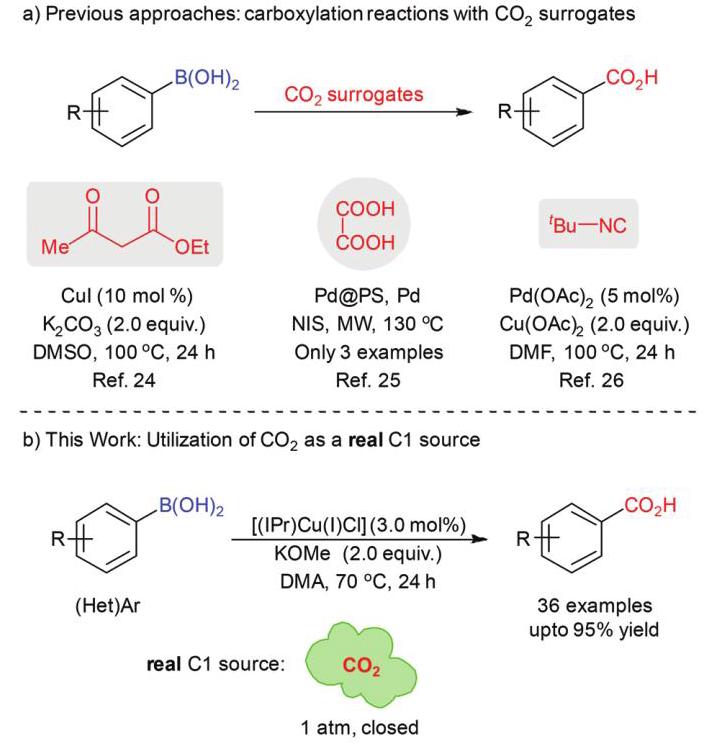
Scheme 1 a) Previous strategies for the carboxylation reaction with various ${\mathrm{{CO}}}_{2}$ surrogates. (b) This work: Utilization of ${\mathrm{{CO}}}_{2}$ as a real C1 source for carboxylation reaction.
${}^{a}$ Department of Energy and Resources Engineering, College of Engineering, Peking University, Beijing, 100871, China.
${}^{b}$ Division of Chemistry and Chemical Engineering, California Institute of Technology, Pasadena, CA 91125, USA
‘Jiangsu Donghai Silicon Industry S&T Innovation Center, Donghai County, Jiangsu 222300, China
†Electronic supplementary information (ESI) available. See DOI: 10.1039/ c9qo01023h
We started our investigation by evaluating a series of catalysts, bases, solvents and reaction temperature to facilitate the conversion of boronic acid (1ah) to carboxylic acid (2ah). After an extensive survey of reaction parameters (for details, see ESI Tables S1-4†), 82% yield of the desired product was obtained using 3.0 mol% [(IPr)Cu(I)Cl] and 2.0 equiv. of KOMe in DMA at ${70}^{ \circ }\mathrm{C}$ (Table 1, entry 1). The use of other alkoxide bases provided low yields of desired product due to incomplete conversion (Table 1, entries 2 and 3). Further evaluation of base stoichiometry revealed that 2.0 equiv. of KOMe to be optimal (Table 1 entries 1, 4 and 5 and see ESI, Table S4†). In addition, lowering the reaction temperature from ${70}^{ \circ }\mathrm{C}$ to ${50}^{ \circ }\mathrm{C}$ resulted in sluggish reaction (Table 1, entry 6), although the yield of the desired product could not be further improved by increasing the temperature (Table 1, entry 7). Moreover, control experiments show that both the catalyst and the base are critical to this transformation (Table 1, entries 8 and 9). Furthermore, trace quantities of water resulted in the undesired protodebor-onation (Table 1, entries 10-12). Among all the solvents studied, DMA was found to be the best for this carboxylation (Table 1, entries 13-15 and see ESI, Table S3†).
We next examined the substrate scope of aryl boronic acids under these reaction conditions (Scheme 2). Electron-deficient substrates were successfully converted to the corresponding carboxylic acids (2a-2l). Halogen-substituted aryl boronic acids were also compatible under optimized reaction conditions (Scheme 2, 2a-2g). A range of sensitive functional groups such as carbonyls, esters, nitriles and carboxylic acids were compatible with our protocol (Scheme 1, 2h-2k). Furthermore, 1,4-phenylenediboronic acid also provided the corresponding dicarboxylated product in excellent yield (Scheme 1, 21).
Table 1 Optimization of the reaction conditions ${}^{a}$
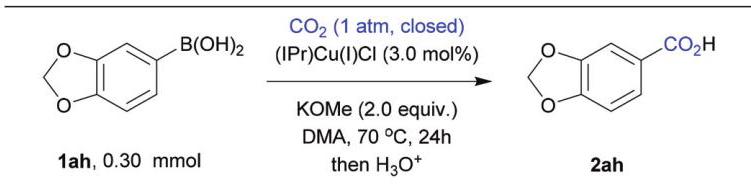
| Entry | Variation from standard conditions | Yield ${}^{b}$ (%) |
| 1 | None | 82 |
| 2 | ${\mathrm{{KO}}}^{t}\mathrm{{Bu}}$ instead of KOMe in THF | 9 |
| 3 | LiOMe instead of KOMe | Trace |
| 4 | With 1.5 equiv. KOMe | 75 |
| 5 | With 1.0 equiv. KOMe | 67 |
| 6 | Reaction at ${50}{}^{ \circ }\mathrm{C}$ | 45 |
| 7 | Reaction at ${100}{}^{ \circ }\mathrm{C}$ | 83 |
| 8 | Without base | NR |
| 9 | Without [(IPr)Cu(1)Cl] | NR |
| 10 | Without anhydrous DMA | 60 |
| 11 | With 0.5 mmol of ${\mathrm{H}}_{2}\mathrm{O}$ as an additive | 58 |
| 12 | With 1.0 mmol of ${\mathrm{H}}_{2}\mathrm{O}$ as an additive | 43 |
| 13 | DMF instead of DMA | 38 |
| 14 | DMSO instead of DMA | 33 |
| 15 | MeCN instead of DMA | 23 |
${}^{a}$ Reaction performed on 0.3 mmol scales. ${}^{b}$ Yields were determined by ${}^{1}\mathrm{H}$ NMR with benzyl alcohol as an internal standard.
Aryl boronic acids possessing an electron-donating group were also excellent substrates for this transformation. Amine substituted aryl boronic acids could be effectively converted to the desired products (Scheme 2, 2m-2n), although free amines were not compatible (see ESI†). Up to 73% yield of the desired carboxylated product was obtained for substrates bearing unprotected phenols and alcohols (Scheme 2, 2o-2p). Moreover, other electron-rich aryl boronic acids with a thioether and ether substituent converted smoothly into respective products with good yields (Scheme 2, 2q-2u). The use of THF as the solvent was found to be important for the effective carboxylation of electron-neutral boronic acids (Scheme 2, 2v-2ag). Finally, oxygen and nitrogen-containing heteroaromatic aryl boronic acids were tolerated and gave the corresponding carboxylated products 2ah, 2ai, and 2aj in 80%, 53%, and 59% isolated yields, respectively. Unfortunately, no product was observed in the case of 2-pyri-dylboronic acid, presumably due to the rapid protodeboryla-tion (Scheme 2, 2ak). ${}^{27}$
To gain further insights into the mechanism of this Cu-cat-alysed carboxylation of aryl boronic acid with ${\mathrm{{CO}}}_{2}$ , stoichiometric studies were carried out. Initially, to find out the role of base in this transformation, we carried out the reaction between the catalyst [(IPr)Cu(I)Cl] and base KOMe in THF at room temperature. This reaction provided 93% yield of the copper alkoxide complex [(IPr)Cu(I)(OMe)] (Scheme 3a, 4 and see ESI† for more details). ${}^{28}$ We next carried out the carboxylation reaction of phenylboronic acid using a catalytic amount of [(IPr)Cu(I)(OMe)]. Although no desired product was obtained in the absence of KOMe (see ESI,† mechanistic study, page no. 28 and 29), the benzoic acid formed in 50% yield using a stoichiometric amount of base (Scheme 3b, 2ae). These results indicate the key role of the base in promoting the carboxylation. Furthermore, the reaction between [(IPr)Cu(I)(OMe)] complex and phenylboronic acid in the presence of KOMe at room temperature afforded 70% yield of the NHC-ligated aryl-copper complex (Scheme 3c, 5 and for more details see ESI,† mechanistic study, page no. 30-32). ${}^{29}$ Stoichiometric reaction using this aryl copper(1) complex and carbon dioxide afforded 80% yield of the carboxylic acid (Scheme 3d, 2ae).
On the basis of these results and previous studies, ${}^{{15} - {21}}$ a catalytic cycle for the carboxylation of aryl boronic with ${\mathrm{{CO}}}_{2}$ is proposed in Scheme 4. Initially, the ligand exchange between [(IPr)Cu(I)Cl] and KOMe generates the copper alkoxide [(IPr)Cu (1)(OMe)] (4), which undergoes transmetalation with phenyl-boronic acid to form the arylcopper(I) complex [(IPr)Cu(I)Ph] (5). Nucleophilic addition of $\left\lbrack {\left( \mathrm{{IPr}}\right) \mathrm{{Cu}}\left( \mathrm{I}\right) \mathrm{{Ph}}}\right\rbrack$ to ${\mathrm{{CO}}}_{2}$ provides carboxylate [(IPr)Cu(I)(OOCPh)] (6). σ-Metathesis with KOMe generates PhCOOK (7) and regenerate [(IPr)Cu(I)(OMe)] (4), thereby completing the catalytic cycle. The hydrolysis of PhCOOK (7) finally furnishes the desired product.
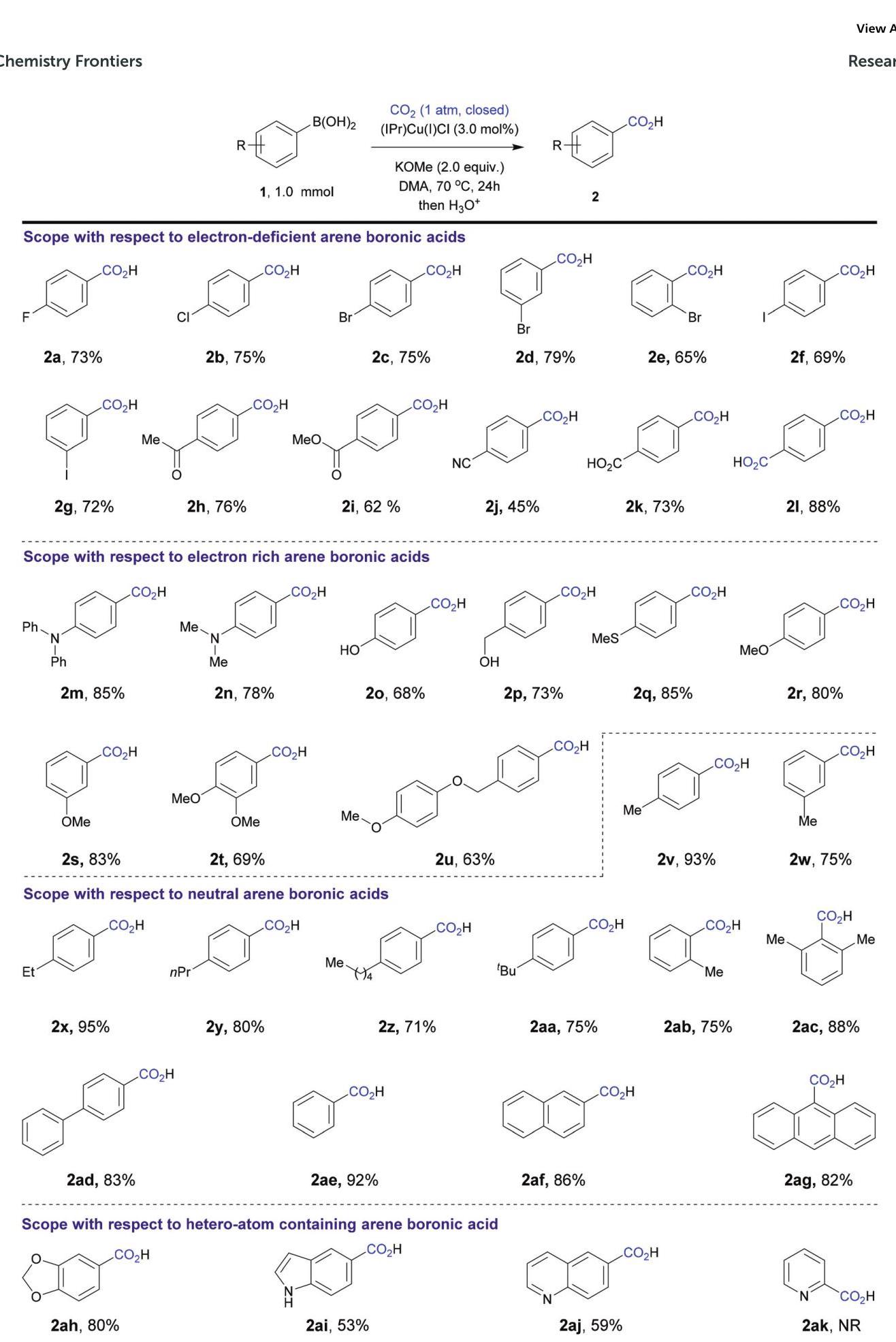
Scheme 2 The substrate scope of aryl boronic acids. Reactions were carried out by using aryl boronic acid (1.0 mmol), cat. [(IPr)Cu(I)Cl] (3.0 mol%), base KOMe (2.0 equiv.) in DMA at 70°C for 24 h under 1 atm ${\mathrm{{CO}}}_{2}$ . Isolated yields were reported. For substrates 1v-1ag, THF was used as solvent.
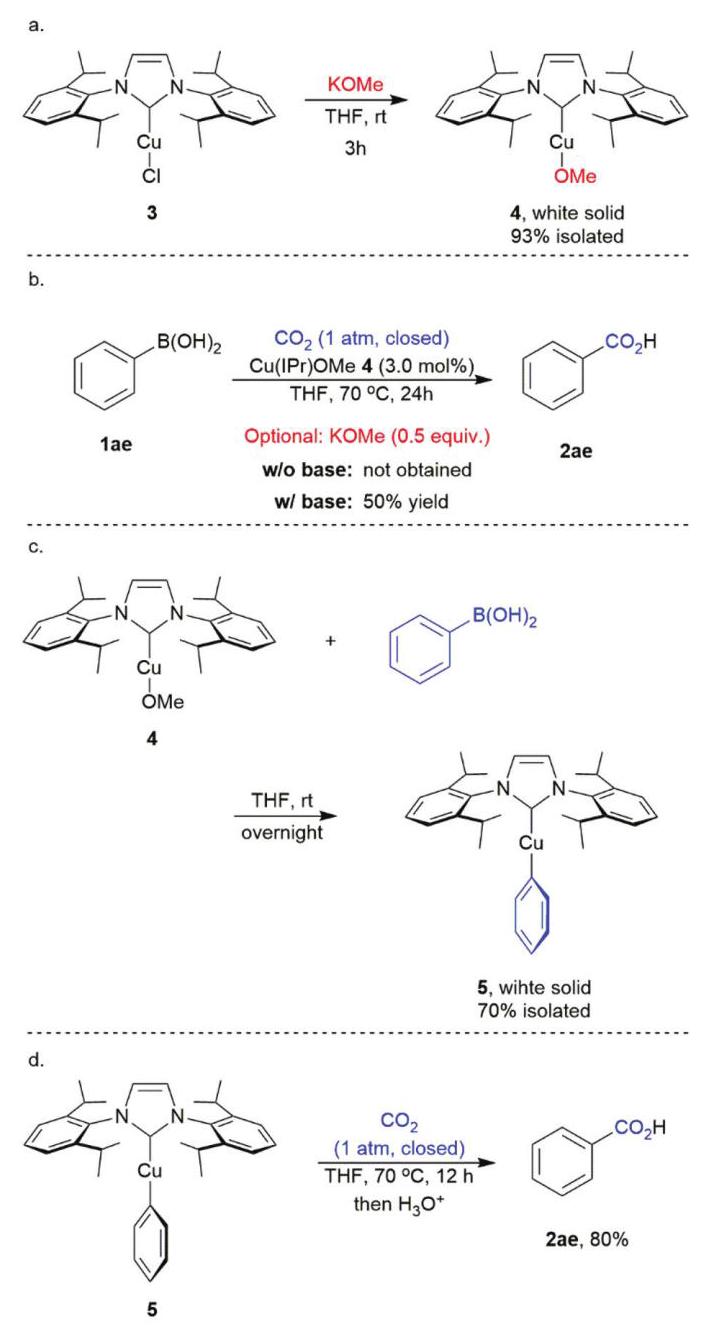
Scheme 3 Control experiments for mechanistic study.
Conclusions
In summary, we have developed a mild and efficient Cu-cata-lysed protocol for the synthesis of aryl carboxylic acid using aryl boronic acids and ${\mathrm{{CO}}}_{2}$ . A wide range of aryl boronic acids were effectively transformed into benzoic acid derivatives. The developed carboxylation method showed excellent functional group tolerance, and a range of sensitive functional groups such as carbonyls, esters, and nitriles were compatible. In addition, stoichiometric studies indicated that the alkoxycop-per(I) [(IPr)Cu(I)(OMe)] (4) and the arylcopper(I) species (5) are involved in this transformation. Further studies on the incorporation of ${\mathrm{{CO}}}_{2}$ into other classes of organic molecules are currently underway in our laboratory.
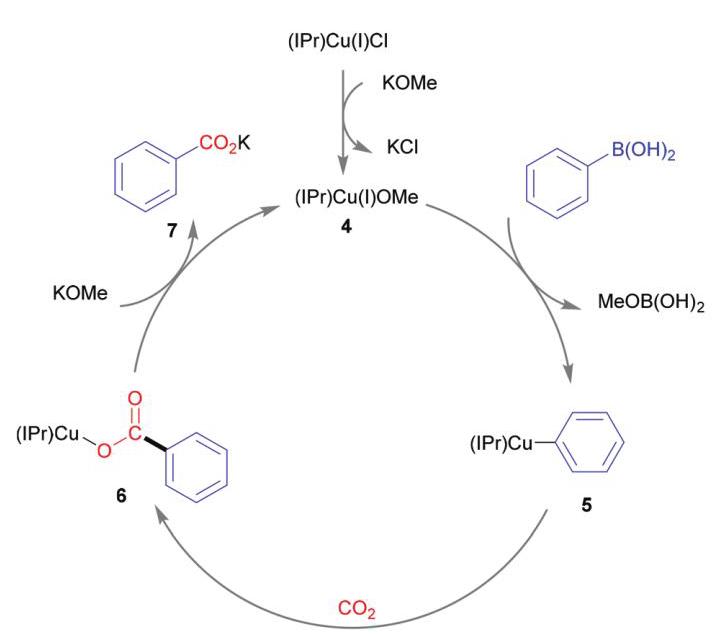
Scheme 4 Proposed mechanistic pathway.
Conflicts of interest
There are no conflicts to declare.
Acknowledgements
O. N. is grateful to Peking University for the Boya Postdoctoral Fellowship. The project is supported by the Natural Science Foundation of China (Grant 21772003). We also thank Peking University for a start-up fund. This work was partially funded by the BHP-PKU CCUS project supported by BHP Billiton.
Notes and references
1 M. Aresta, A. Dibenedetto and A. Angelini, Chem. Rev., 2014, 114, 1709-1742.
2 J. Artz, T. E. Müller, K. Thenert, J. Kleinekorte, R. Meys, A. Sternberg, A. Bardow and W. Leitner, Chem. Rev., 2018, 118, 434-504.
3 T. Sakakura, J.-C. Choi and H. Yasuda, Chem. Rev., 2007, 107, 2365-2387.
4 A. Tortajada, F. Juliá-Hernández, M. Börjesson, T. Moragas and R. Martin, Angew. Chem., Int. Ed., 2018, 57, 15948- 15982.
5 R. Martín and A. W. Kleij, ChemSusChem, 2011, 4, 1259- 1263.
6 K. Huang, C.-L. Sun and Z.-J. Shi, Chem. Soc. Rev., 2011, 40, 2435-2452.
7 Y. Tsuji and T. Fujihara, Chem. Commun., 2012, 48, 9956- 9964.
8 J. Hong, M. Li, J. Zhang, B. Sun and F. Mo, ChemSusChem, 2019, 12, 6-39.
9 T. Patra and D. Maiti, Chem. - Eur. J., 2017, 23, 7382-7401.
Organic Chemistry Frontiers
10 I. G. Morgunov, S. V. Kamzolova, E. G. Dedyukhina, T. I. Chistyakova, J. N. Lunina, A. A. Mironov, N. N. Stepanova, O. N. Shemshura and M. B. Vainshtein, Appl. Microbiol. Biotechnol., 2017, 101, 921-932.
11 P. Chand, Y. S. Babu, S. Bantia, N. Chu, L. B. Cole, P. L. Kotian, W. G. Laver, J. A. Montgomery, V. P. Pathak, S. L. Petty, D. P. Shrout, D. A. Walsh and G. M. Walsh, J. Med. Chem., 1997, 40, 4030-4052.
12 S. Wang and C. Xi, Chem. Soc. Rev., 2019, 48, 382- 404.
13 C. Ballatore, D. M. Huryn and A. B. Smith III, ChemMedChem, 2013, 8, 385-395.
14 J. W. B. Fyfe and A. J. B. Watson, Chem, 2017, 3, 31-55.
15 J. Takaya, S. Tadami, K. Ukai and N. Iwasawa, Org. Lett., 2008, 10, 2697-2700.
16 K. Ukai, M. Aoki, J. Takaya and N. Iwasawa, J. Am. Chem. Soc., 2006, 128, 8706-8707.
17 T. Ohishi, M. Nishiura and Z. Hou, Angew. Chem., Int. Ed., 2008, 47, 5792-5795.
18 T. Ohishi, L. Zhang, M. Nishiura and Z. Hou, Angew. Chem., Int. Ed., 2011, 50, 8114-8117.
19 X. Zhang, W. Z. Zhang, L. L. Shi, C. X. Guo, L. L. Zhang and X. B. Lu, Chem. Commun., 2012, 48, 6292-6294.
20 Y. Makida, E. Marelli, A. M. Slawin and S. P. Nolan, Chem. Commun., 2014, 50, 8010-8013.
21 P. J. Riss, S. Lu, S. Telu, F. I. Aigbirhio and V. W. Pike, Angew. Chem., Int. Ed., 2012, 51, 2698-2702.
22 A. J. J. Lennox and G. C. Lloyd-Jones, Chem. Soc. Rev., 2014, 43, 412-443.
23 W. Zhang and X. Lu, Chin. J. Catal., 2012, 33, 745-756.
24 R. Zheng, Q. Zhou, H. Gu, H. Jiang, J. Wu, Z. Jin, D. Han, G. Dai and R. Chen, Tetrahedron Lett., 2014, 55, 5671-5675.
25 A. K. Shil, S. Kumar, C. B. Reddy, S. Dadhwal, V. Thakur and P. Das, Org. Lett., 2015, 17, 5352-5355.
26 Z.-B. Chen, K. Liu, F.-L. Zhang, Q. Yuan and Y.-M. Zhu, Org. Biomol. Chem., 2017, 15, 8078-8083.
27 K. L. Billingsley and S. L. Buchwald, Angew. Chem., Int. Ed., 2008, 47, 4695-4698.
28 A. Bonet, V. Lillo, J. Ramírez, M. M. Díaz-Requejo and E. Fernández, Org. Biomol. Chem., 2009, 7, 1533-1535.
29 K. Takatsu, R. Shintani and T. Hayashi, Angew. Chem., Int. Ed., 2011, 50, 5548-5552.