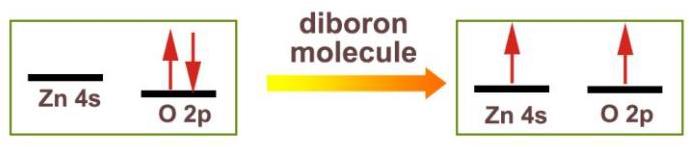
Zn+-O- dual-spin surface states formation by modification of ZnO nanoparticles with diboron compounds
中文 / Bilingual · English version
LANGMUIR
Subscriber access provided by UNIV OF CAMBRIDGE
Interfaces: Adsorption, Reactions, Films, Forces, Measurement Techniques, Charge Transfer, Electrochemistry, Electrocatalysis, Energy Production and Storage
Zn+-O- dual-spin surface states formation by modification of ZnO nanoparticles with diboron compounds
Yang Cao, Yongguang Tu, Peng Zhou, Jianning Zhang, Yuchen Deng, Biao Kong, Xu Zhang, Shaojun Guo, Rui Zhu, Ding Ma, Yang Yang, and Fanyang Mo
Langmuir, Just Accepted Manuscript • DOI: 10.1021/acs.langmuir.9b01955 • Publication Date (Web): 14 Aug 2019 Downloaded from pubs.acs.org on August 18, 2019
Just Accepted
“Just Accepted” manuscripts have been peer-reviewed and accepted for publication. They are posted online prior to technical editing, formatting for publication and author proofing. The American Chemical Society provides “Just Accepted” as a service to the research community to expedite the dissemination of scientific material as soon as possible after acceptance. “Just Accepted” manuscripts appear in full in PDF format accompanied by an HTML abstract. “Just Accepted” manuscripts have been fully peer reviewed, but should not be considered the official version of record. They are citable by the Digital Object Identifier (DOI®). “Just Accepted” is an optional service offered to authors. Therefore, the “Just Accepted” Web site may not include all articles that will be published in the journal. After a manuscript is technically edited and formatted, it will be removed from the “Just Accepted” Web site and published as an ASAP article. Note that technical editing may introduce minor changes to the manuscript text and/or graphics which could affect content, and all legal disclaimers and ethical guidelines that apply to the journal pertain. ACS cannot be held responsible for errors or consequences arising from the use of information contained in these “Just Accepted” manuscripts.
is published by the American Chemical Society. 1155 Sixteenth Street N.W., Washington, DC 20036
Published by American Chemical Society. Copyright © American Chemical Society. However, no copyright claim is made to original U.S. Government works, or works produced by employees of any Commonwealth realm Crown government in the course of their duties.
${\mathrm{{Zn}}}^{ + } - {\mathrm{O}}^{ - }$ dual-spin surface states formation by modification of $\mathrm{{ZnO}}$ nanoparticles with diboron compounds
Yang Cao, ${}^{ \dagger }$ Yongguang Tu, ${}^{ \ddagger }$ Peng Zhou, ${}^{\text{ § }}$ Jianning Zhang, ${}^{ \dagger }$ Yuchen Deng, ${}^{\sharp }$ Biao Kong, ${}^{\sharp }$ Xu Zhang, ${}^{ \bot }$ Shaojun Guo, ${}^{\dagger ,\text{ § }}$ Rui Zhu, ${}^{ \ddagger }$ Ding Ma, ${}^{!}$ Yang Yang ${}^{\text{ ¶ }}$ and Fanyang Mo ${}^{\dagger ,{}^{ * }}$
${}^{ \dagger }$ Department of Energy and Resources Engineering, College of Engineering, Peking University, Beijing 100871, China.
‡State Key Laboratory for Artificial Microstructure and Mesoscopic Physics, School of Physics, Peking University, Beijing, 100871, China.
${}^{\text{ § }}$ Department of Materials Science and Engineering, College of Engineering, Peking University, Beijing,100871, China.
${}^{1}$ College of Chemistry and Molecular Engineering and College of Engineering, Peking University, Beijing,100871, China.
#Collaborative Innovation Center of Chemistry for Energy Materials (iChEM), Department of Chemistry Laboratory of Advanced Materials, Shanghai Key Laboratory of Molecular Catalysis and Innovative Materials, Fudan University, Shanghai, 200433, P. R. China
${}^{\bot }$ Department of Physics and astronomy, California State University Northridge, CA 91330, United States.
${}^{\text{ ¶ }}$ Division of Chemistry and Chemical Engineering, California Institute of Technology, Pasadena, CA 91125, United States.
Supporting Information Placeholder
ABSTRACT: ZnO semiconductor oxides are versatile functional materials that used in photoelectronic, catalysis, sensing, etc. The ${\mathrm{{Zn}}}^{ + } - {\mathrm{O}}^{ - }$ surface electronic states of semiconductor oxides were formed on ZnO’s surface by Zn 4s, $\mathrm{O}2$ p orbitals coupling with the diboron compound’s B 2p orbitals. The formation of spin coupled surface states was based on the spin orbit interaction on the interface, which has not been reported before. It shows that the semiconductor oxide’s spin surface states can be modulated by regulating surface orbital energy. The ${\mathrm{{Zn}}}^{ + } - {\mathrm{O}}^{ - }$ surface electronic states were confirmed by ESR results, which may help expand fundamental research on spintronics modulation and quantum transport.
KEYWORDS: ZnO, Surface state, Spintronics, Diboron compound, Spin-orbit coupling
INTRODUCTION
$\mathrm{{ZnO}}$ are key semiconductor oxide materials for wide applications in optoelectronic devices, ${}^{1,}{}^{2}$ piezoelectronic devices, ${}^{3}$ catalysis, ${}^{4}$ sensing, ${}^{5}$ etc. Surface engineering of zinc oxide have been studied for decades. ${}^{6}$ Surface disorder treatment, ${}^{7,8}$ defects engineering ${}^{9}$ are basically surface states engineering methods. Organic molecule modification method have also been developed to modulate the surface states by charge transfer method to adjust electronic structures and band structures. ${}^{6,{10}}$ According to the previous study, the orbitals on the surface of the nanoparticles are distinct from that bulk and should be sensitive to surface modification, which can induce unique surface states. ${}^{11}$ Surface spin orbitronics are important issues and are mostly studied in transition metal surface, topological insulators, two-dimensional materials. ${}^{12}$ But there exists no similar reference in semiconductor oxide systems. ${\mathrm{{Zn}}}^{ + }\left( {3{\mathrm{d}}^{10}4{\mathrm{\;s}}^{1}}\right)$ systems possess special electronic structure that has been reported and studied in ZnO relate chemistry. ${}^{13}$ Monovalent zinc ions have been prepared under extremely harsh physical conditions, such as $\gamma$ -irradiation, ${}^{14}$ electron impact ionization, ${}^{15}$ glow discharge ${}^{16}$ and laser vaporization. ${}^{17}$ In 2004, the Carmona group reported a landmark discovery of the dimetallic sandwich compound decamethyldizincocene $\left( {{\mathrm{{Zn}}}_{2}{\left( \eta 5 - {\mathrm{C}}_{5}{\mathrm{{Me}}}_{5}\right) }_{2}}\right)$ , containing a central subvalent $\mathrm{{Zn}} - \mathrm{{Zn}}$ bond with both $\mathrm{{Zn}}$ atoms formally in the +1 oxidation state. ${}^{18}$ Chen group recently reported the first example of mononuclear univalent ${\mathrm{{Zn}}}^{ + }$ in solid materials of zeolite. ${}^{{19},{20}}$
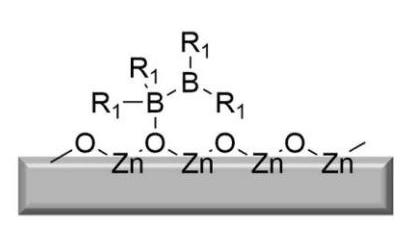
Organodiboron compounds represent a group of stable and highly versatile reagents that are extremely useful in organic synthesis. ${}^{21}$ Despite their widespread use in synthetic chemistry, these diboron(4) species have not been used to modify inorganic materials. We find that surface modification of ZnO nanoparticles with diboron compounds can induce surface ${\mathrm{{Zn}}}^{ + }$ - ${\mathrm{O}}^{ - }$ dual spin states. Based on the experimental characterization as well as the reference that modulate magnetic spin of ${\mathrm{{SrRuO}}}_{3}$ by tuning oxygen coordination environment, ${}^{22}$ we surmise that the spin surface states originated from surface orbital hybridization companied with electron redistribution induced by modulation of oxygen coordination environment. To the best of our knowledge, there is no similar report on forming these dual spin states. A conceptually new method for the facile generation of abundant surface ${\mathrm{{Zn}}}^{ + } - {\mathrm{O}}^{ - }$ surface states on $\mathrm{{ZnO}}$ nanoparticles were developed under mild conditions $\left( { < {80}^{ \circ }\mathrm{C}}\right)$ by means of diboron(4) reagents. In this process, the intimate interaction of the diboron(4) reagent’s B center with the surface bridging ${\mathrm{O}}_{2\mathrm{c}}$ of $\mathrm{{ZnO}}$ facilitates the adsorption of the organodiboron reagents onto the $\mathrm{{ZnO}}$ nanoparticles which lead to spontaneous electron transfer resulting in ${\mathrm{{Zn}}}^{ + } - {\mathrm{O}}^{ - }$ dual-spin surface states (Figure 1b-d). Notably, this process exhibits a facile method to modulate ZnO’s surface states by introducing dual-spin electrons coupled to surface orbitals.
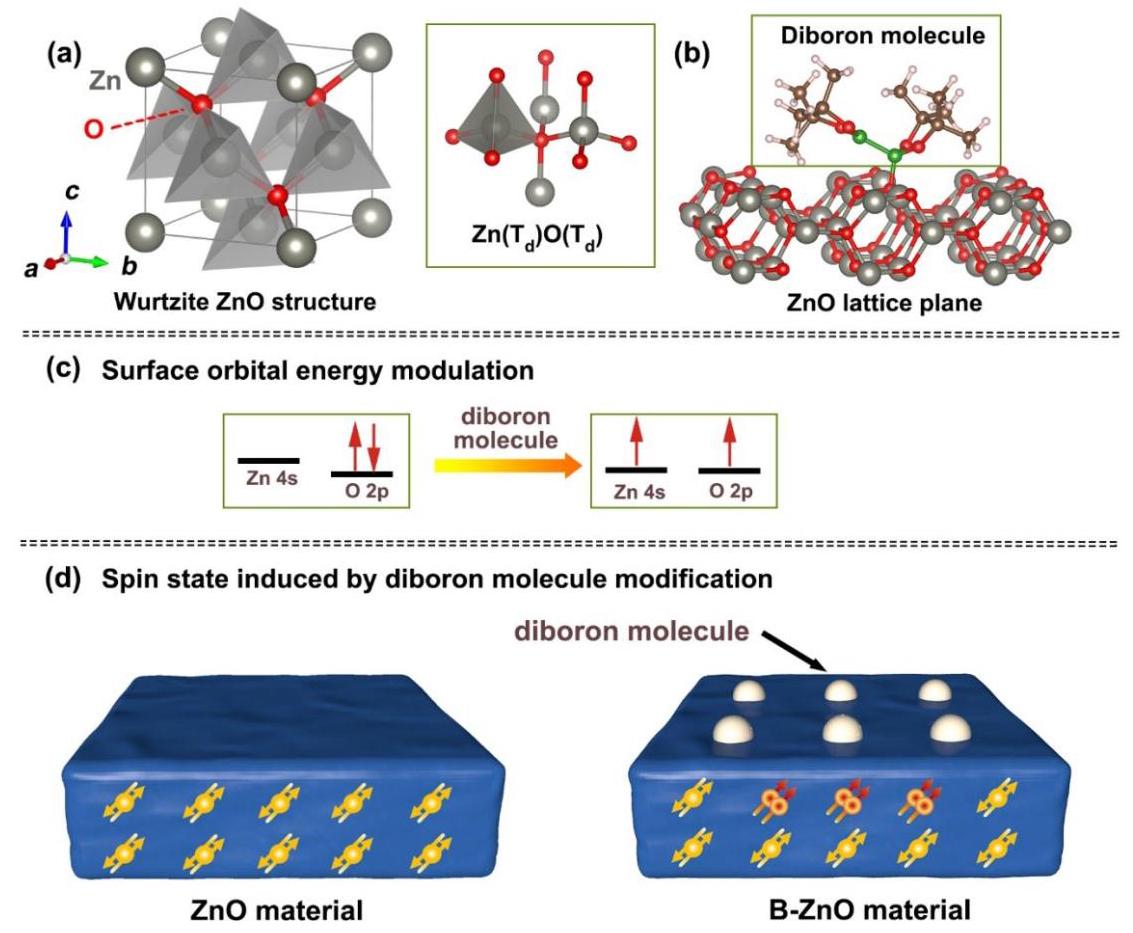
Figure 1. (a) Structure of wurtzite ZnO (b) Adsorption model of the organic diboron compound on ZnO surface. (c) Surface orbital energy modulation induced by diboron compound modification. (d) Schematic diagram of spin states induced in ZnO by diboron molecule.
According to the literature, surface oxygen sites coordination changes can induce electron behaviors like magnetism. ${}^{22}$ We posited that electrophilic organic adsorbates with an appropriate reduction potential might favorably interact with the surface ${\mathrm{O}}_{2\mathrm{c}}$ sites. Importantly, this binding changed the coordination behavior of surface ${\mathrm{O}}_{2\mathrm{c}}$ and affected the surface states. We were particularly interested in the use of organic diboron(4) reagents due to their unique Lewis acidity and reducing ability (vide supra). Previous work in the area of synthetic organic chemistry showed that upon binding to a Lewis basic oxygen atom, these organic diboron(4) species could function as single electron reducing agents; thus, allowing various important transformations. ${}^{{23} - {29}}$ Based on these reasons, we envisioned that the coordination of such diboron(4) compounds with the surface oxygen atom in metal oxide materials may lead to the formation of surface diboron-oxygen Lewis pairs which may induce single electron transfer from the ipso- ${\mathrm{O}}_{2\mathrm{c}}$ site to the adjacent $\mathrm{{Zn}}$ site. Furthermore, the interaction of diboron(4) species with the oxygen atom may stabilize the resulting low valent Zn-high valent O pair (Figure 1b-d).
EXPERIMENTAL DETAILS
B1-ZnO- ${\mathrm{N}}_{2}$ sample: In a glovebox, ${10}\mathrm{{mg}},{20}\mathrm{{mg}}$ or ${50}\mathrm{{mg}}$ B1 $\left( {{\mathrm{B}}_{2}{\mathrm{{Pin}}}_{2}}\right.$ , the molecular structure was depicted in Figure 2a) was dissolved in $2\mathrm{\;{mL}}$ dried ${\mathrm{{CH}}}_{3}\mathrm{{OH}}$ (Energy Chemical Co. Ltd., China). Then ${0.5}\mathrm{\;g}\mathrm{{ZnO}}$ nanoparticles $({30}\mathrm{\;{nm}}$ , Shanghai Macklin Biochemical Co. Ltd) were dispersed in B1 solution and the mixture was stirred at room temperature $\left( { \sim {30}{}^{ \circ }\mathrm{C}}\right)$ for overnight. After evaporation of solvent under vacuum at room temperature for $2\mathrm{\;h}$ , a blue powder of $\mathrm{B}1 - \mathrm{{ZnO}} - {\mathrm{N}}_{2}$ sample was obtained. This sample was sensitive to air and should be stored in an inertia atmosphere.
B1-ZnO sample: In a glovebox, the above $\mathrm{B}1 - \mathrm{{ZnO}} - {\mathrm{N}}_{2}$ sample was heat at ${80}{}^{ \circ }\mathrm{C}$ under vacuum for $3\mathrm{\;h}$ . The redundant B1 molecules were removed under vacuum via volatilization. After heating treatment, the sample become insensitive to air.
Other B-ZnO samples are prepared with the sample procedure by using the corresponding diboron compounds.
RESULTS AND DISCUSSION
The diboron(4) compound could be uniformly dispersed onto the ZnO nanoparticles in a diboron(4)-soluble solvent, such as methanol or ether. Blue samples were obtained after solvent evaporation and heating at ${80}^{ \circ }\mathrm{C}$ under vacuum for $3\mathrm{\;h}$ . These blue samples are tagged as B-ZnO. They can be stored outside of a glovebox for at least 6 months while retaining the blue color. This color change only occurs with diboron(4) compounds. Monoboron compounds, such as methyl borate, are unable to sensitize the $\mathrm{{ZnO}}$ with no color change when mixed with $\mathrm{{ZnO}}$ . We investigated the structures and properties of these diboron(4)-sensitized ZnO nanoparticles with UV-Visible spectroscopy (UV-Vis), X-ray diffraction (XRD), X-ray photoelectron spectroscopy (XPS), transmittance electronic microscopy (TEM), fourier transform infrared spectroscopy (FT-IR) and boron nuclear magnetic resonance ( ${}^{11}\mathrm{\;B}$ NMR). The UV-Visible absorption spectra (Figure 2b and S1) of B-ZnO shows that the sample with the diboron compound modification exhibit enhanced visible light absorption (wavelength $> {400}\mathrm{\;{nm}}$ ). The blue color and the visible light absorption of the B-ZnO samples imply formation of the reduced state of zinc(I). ${}^{30}$
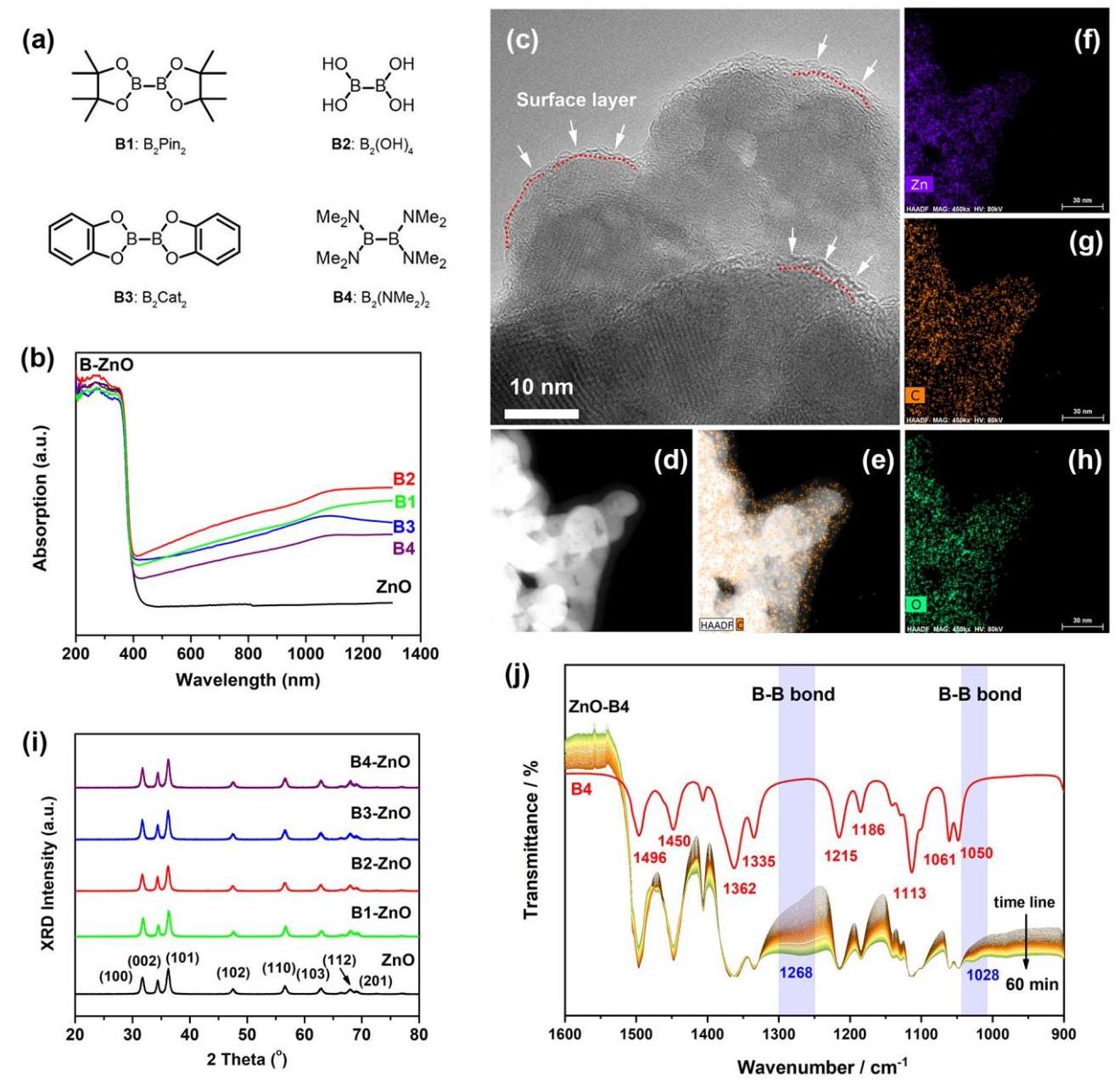
Figure 2. (a) Four commercially available diboron(4) compounds used in this study: ${\mathrm{B}}_{2}{\mathrm{{Pin}}}_{2}$ (bis(pinacolato)diboron), ${\mathrm{B}}_{2}{\left( \mathrm{{OH}}\right) }_{4}$ (tetrahydroxydiborane), ${\mathrm{B}}_{2}{\mathrm{{Cat}}}_{2}$ (bis(catecholato)diboron) and ${\mathrm{B}}_{2}{\left( {\mathrm{{NMe}}}_{2}\right) }_{4}$ (tetrakis(dimethylamino)diboron). (b) UV-Visible spectral absorbance of the white ZnO and B-ZnO samples. (c) HRTEM photo of B1-ZnO sample (The red dotted curve shows the interface of the surface molecule while the white arrow shows the organic molecule layer) (d) HADDF image of B1-ZnO sample (e) the carbon mapping image in the HADDF mode. (f) Zn mapping image of the B1-ZnO sample (g) C mapping image of the B1-ZnO sample (h) O mapping image of the B1-ZnO sample (i) XRD spectra of pristine ZnO and four B-ZnO samples. (j) In situ ATR-FTIR spectrum of B4 on ZnO over 60 min performed at room temperature with a B4 molecule for comparison (in red).
We then performed TEM characterization to explore the surface structure of the material. A thin organic molecule layer (ca. ${0.5} - 2\mathrm{\;{nm}}$ ) on the surface of the material can be seen in the TEM picture (Figure 2c). The corresponding C phase mapping in the HADDF mode (Figure 2e) and the corresponding Zn, C and O element mapping (Figure 2f-h) exhibit C phase mapping distribute over a larger area than $\mathrm{{Zn}},\mathrm{O}$ phase mapping, which means a carbon-containing layer on the surface of $\mathrm{{ZnO}}$ nanoparticle (Figure 2d). The powder X-ray diffraction analysis (Figure 2i) showed that the commercial $\mathrm{{ZnO}}$ and diboron compound modified $\mathrm{{ZnO}}$ samples can be indexed to wurtzite lattice nanoparticles. There were no new peaks after modification which indicate no changes in the crystal structure upon adsorption. The X-ray photoelectron spectroscopy showed that the O 1s and Zn 2p binding energies of B1-ZnO are lower than the pristine ZnO sample. The valance band of B1- $\mathrm{{ZnO}}$ also shifted to a lower energy, which means that the valance band electron was much closer to the Fermi level energy, and electron may be more likely to jump to the conduction band (Figure S2).
The ZnO shows increased visible light absorption based on the surface interaction with the diboron compound. To make a better understanding of the adsorption process, an in-situ FT-IR analysis was used to track the surface bonding behavior. Figure 2j shows the in-situ ATR-FTIR spectra along a 60 min course of the B4 molecule interaction with $\mathrm{{ZnO}}$ nanoparticles. The magnification vibration in ${1600} \sim {900}{\mathrm{\;{cm}}}^{-1}$ shows the fingerprint of the B4 molecule when interacting with ZnO. For comparison, free B4 molecule IR signals were found to agree well with simulations using the Gaussian09 software (Figure S4). The calculated results suggest a B-B bond stretching vibration peak at ca. ${1000}{\mathrm{\;{cm}}}^{-1}$ where the intensity is zero. This conforms to the fact that B4 is a C2 symmetric molecule. The symmetry may be lost when B4 was adsorbed on ZnO resulting in the corresponding B-B bond vibration signals appearance. Indeed, new vibrations at around ${1268}{\mathrm{\;{cm}}}^{-1}$ and ${1028}{\mathrm{\;{cm}}}^{-1}$ appear which can be indexed to the B-B bond vibration. The B-B bond vibration was silent in free B4 molecule which suggests that B4 interacts with the ZnO nanoparticle through the B-B moiety. ATR-FTIR spectra of other B-ZnO samples all show an extra absorption around ${1020}{\mathrm{\;{cm}}}^{-1}$ compared to the free diboron molecule, which was indexed to the asymmetry ${\mathrm{{sp}}}^{2} - {\mathrm{{sp}}}^{3}\mathrm{\;B} - \mathrm{B}$ bond vibration (Figure S5). On the other hand, most typical pure diboron(4) compound absorption peaks have very small changes in the wavenumber in the modified samples, which mean that the main chemical structure of the molecule remains unchanged.
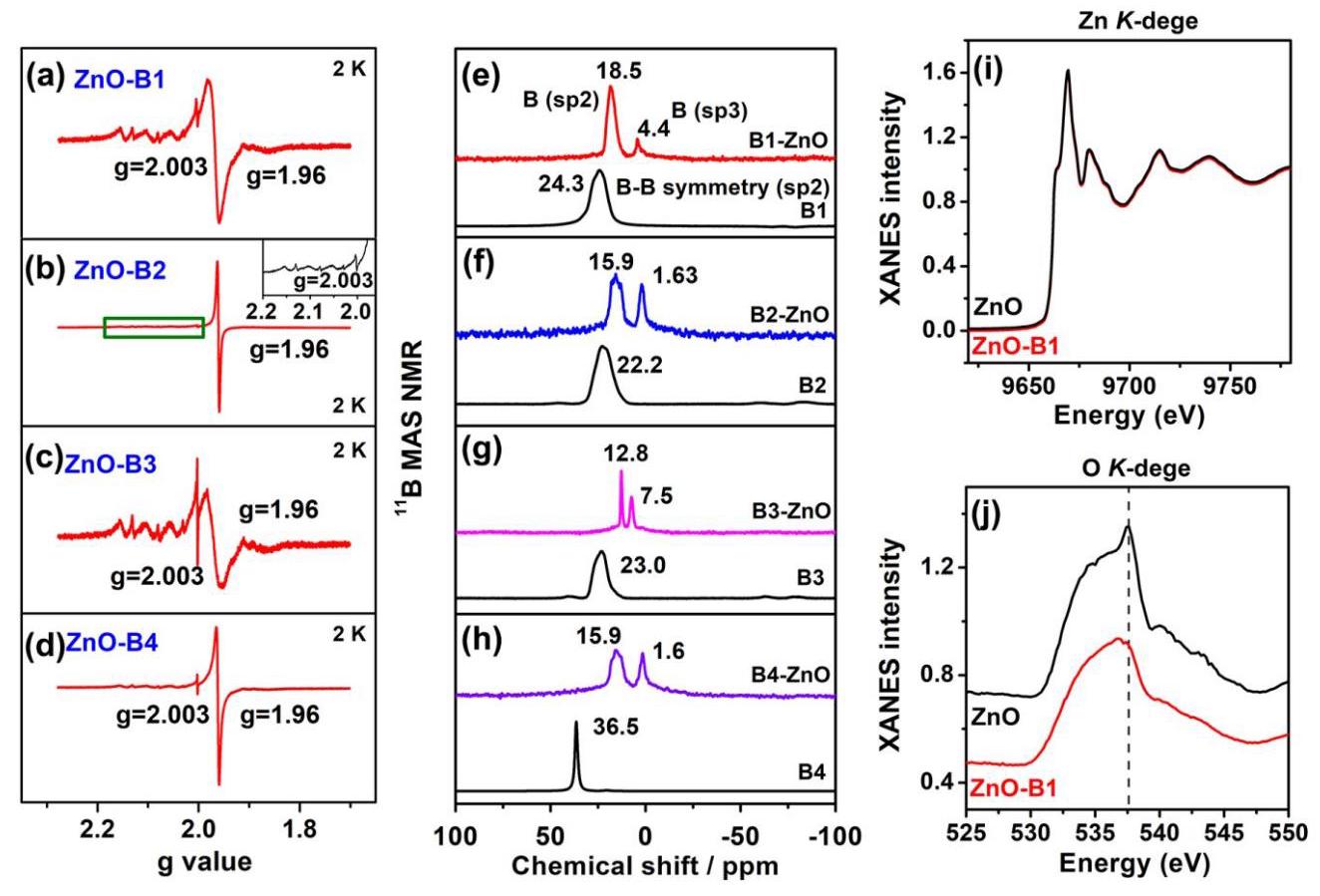
Figure 3. (a-d) EPR spectra of four B-ZnO samples at 2 K. The inset in (b) is magnifications of the green rectangular areas with g values of 2.2~1.99. (e-h) Solid-state boron nuclear magnetic resonance spectra of B1-B4 and four B-ZnO samples. (i) Zn $K$ -edge and (j) O $K$ -edge TEY spectra of B1-ZnO and ZnO.
Then the surface electronic states and the diboron molecule’s structure were characterized by ESR, NMR and XAFS. (Figure 3) The electron paramagnetic resonance (EPR) spectrum of the B1-ZnO sample showed a strong singlet line centered on a $g$ value of 1.960 at $2\mathrm{\;K}$ (Figure 3a). Some $g > {2.0}$ signals were also observed, which could be indexed to the radical state of organic molecule. The observed $g$ values were characteristic of a paramagnetic ${\mathrm{{Zn}}}^{ + }$ center as exemplified in a few reports such as $\mathrm{{ZnO}}$ synthesized by evaporation $\left( {g = {1.96}}\right) ,{}^{31}$ heat treated $\mathrm{{ZnO}}{\left( g = {1.955}\right) }^{32}$ defect-rich ultrathin $\mathrm{{ZnAl}} - \mathrm{{LDH}}{\left( g = {1.99}\right) }^{33}$ and ${\mathrm{{Zn}}}^{ + }$ -doped ZSM-5 molecule sieve $\left( {g = {1.99}}\right) {.}^{34}$
Furthermore, the solid-state boron nuclear magnetic resonance ( ${}^{11}\mathrm{\;B}$ NMR) can be used to elucidate the binding details of the diboron (4) adsorbed on ZnO (Figure 3e-h). The peaks around ${20} \sim {40}\mathrm{{ppm}}$ for the free diboron (4) compounds were assigned to the two identical symmetric boron atoms in the pure B1-B4 molecule. (B1: 24.3 ppm, B2: 22.2 ppm, B3: 23.0 ppm, and B4: 36.5 ppm) In the adsorption samples, the bonding on the boron atom will cause the molecule to lose its symmetry resulting in two distinct chemical environments around the two boron atoms. Thus, a chemical shift was observed at 4.4 ppm for B1-ZnO in the ${}^{11}\mathrm{\;B}$ NMR which was presumably responsible for the complexation mode (B2: 1.63 ppm, B3: 7.5 ppm, and B4: 1.6 ppm). This new peak appeared in the very upfield region compared with that for the free B1 indicating a change in the coordination on the boron atom. Mechanistically, tetracoordinating boron has a higher electron density than the tricoordinating species due to its formal negative charge which results in a chemical shift upfield in the NMR spectrum. ${}^{35}$ Moreover, Marder and co-workers reported a $N$ -heterocyclic carbene (NHC)-B1 adduct with a 0.34 ppm chemical shift which they assigned to the tetracoordinating boron. ${}^{36}$ The peak close to 0 ppm in the present case should be attributed to one of the boron atoms in the diboron(4) molecule coordinating with the bridged oxygen or the hydroxyl group on the $\mathrm{{ZnO}}$ surface.
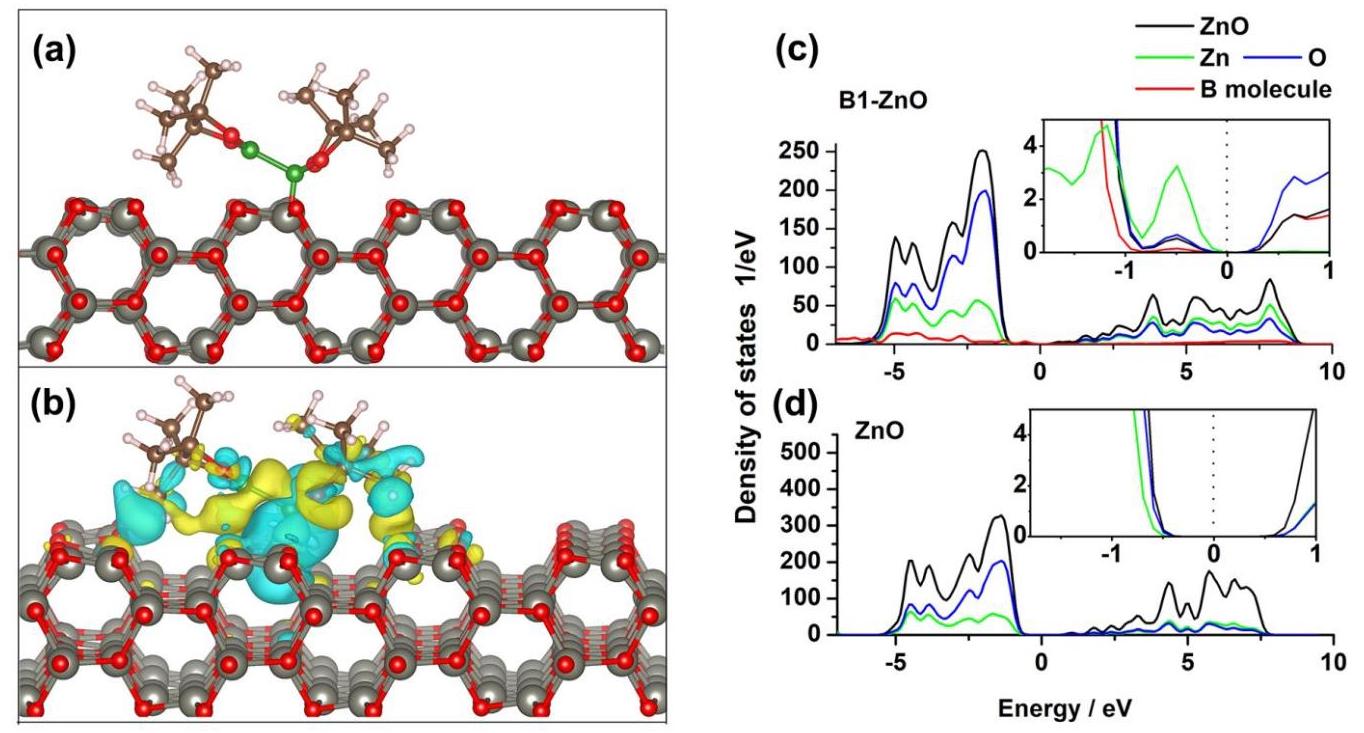
Figure 4. (a) Optimized geometric structures and (b) charge density difference mappings for the B1 adsorption on the ZnO {110} surface. The isosurfaces of the electron density difference plots are all 0.001 e ${\text{ Å }}^{-3}$ . The yellow and light blue surfaces represent electron depletion and accumulation. The silvery gray, red, earth yellow, green and pink spheres are the Zn, O, C, B and H atoms, respectively. The projected density of state (PDOS) plots of (c) B1 molecule adsorption on ZnO {110} plane and (d) pristine ZnO {110} surface calculated by GGA+U. (U=7.5 eV, the insert is a magnification of the PDOS around the Fermi level.
X-ray absorption fine structure (XAFS) spectra were used to investigate this surface complexation. The X-ray absorption near edge structure spectroscopy (XANES) spectra of the $\mathrm{{Zn}}K$ - edge (Figure 3i) showed that B-ZnO and ZnO have little difference, indicating that the diboron (4) compounds only interacted with the surface ZnO layer. The introduction of the diboron compound did not influence the bulk properties of the $\mathrm{{ZnO}}$ substrate, which was in accordance with the Fourier-transformed (FT) ${\mathrm{k}}^{2}$ -weighted extended X-ray absorption fine structure (EXAFS) spectra in Figure S6. The XANES spectra of the O $K$ -edge were measured in the FEY mode, which provided information about the surface $\mathrm{O}$ atoms. ${}^{37}\mathrm{{We}}$ compared ZnO with B4-ZnO to exclude the influence of the O atoms in the diboron compounds. The absorption around 537.6 eV could be ascribed to the hybridization of the Zn 4p and O 2p orbitals. ${}^{{38},{39}}$ The negative shift (-0.4 eV) of the absorption peak to 537.2 eV showed that the surface $\mathrm{O}$ atom shifted to a lower valance state (Figure 3j), due to the formation of a B-O coordination bond that led to the formation of a lower valence state of the ${\mathrm{{Zn}}}^{ + }$ species.
DFT calculations were further used to study the adsorption of the diboron molecule on the $\mathrm{{ZnO}}$ nanoparticle surface. This study focuses on the $\mathrm{{ZnO}}\{ {110}\}$ surface, which is non-polar and contributes up to 80% of the ZnO total surface area. ${}^{40}$ The optimized geometry of the B1 adsorption on the $\mathrm{{ZnO}}$ surface was shown in Figure 4a. The B1 molecule was tightly bound with the surface ${\mathrm{O}}_{2\mathrm{c}}$ atom through the $\mathrm{B} - \mathrm{O}$ coordination bond. The charge density difference plots in Figure 4b showed the charge redistribution around the adsorption site of the ZnO $\{ {110}\}$ surface mainly on $\mathrm{p}$ orbital of $\mathrm{O}$ atoms and $\mathrm{s}$ orbital in surface Zn atoms, and it also exhibited electron redistribution in the organic molecule. This charge redistribution could result in the formation of a ${\mathrm{{Zn}}}^{ + } - {\mathrm{O}}^{ - }$ pair. Next, the projected density of state (PDOS) of the $\mathrm{{ZnO}}$ surface with the adsorption of $\mathrm{B}1$ molecule was shown in Figure 4c. As a comparison, the PDOS of the pristine ZnO {110} surface was shown in Figure 4d. Some intermediate states just below the Fermi level appeared upon the adsorption of the B1 molecule. What’s more, O 2p states in B1- $\mathrm{{ZnO}}$ model showed a density states of ${199}{\mathrm{{eV}}}^{-1}$ at $- {1.4}\mathrm{{eV}}$ , while in pristine $\mathrm{{ZnO}}$ , the relate density was ${204}{\mathrm{{eV}}}^{-1}$ at $- {1.9}\mathrm{{eV}};\mathrm{{Zn}}$ 4s states at $1\mathrm{{eV}}$ was ${1.3}{\mathrm{{eV}}}^{-1}$ in the model of pristine $\mathrm{{ZnO}}\{ {110}\}$ surface, ${1.4}{\mathrm{{eV}}}^{-1}$ at around ${0.66}\mathrm{{eV}}$ in $\mathrm{B}1 - \mathrm{{ZnO}}$ model. It could be concluded that $\mathrm{O}2\mathrm{p}$ states were reduced but $\mathrm{{Zn}}4\mathrm{\;s}$ states were increased in the B1-ZnO model, and the band gap was shrinked. The circumstance showed that the surface adsorption of B1 molecule induce electron redistribution that some states were moved from $\mathrm{O}2\mathrm{p}$ to $\mathrm{{Zn}}4\mathrm{\;s}$ , which is consistent with the formation of the ${\mathrm{{Zn}}}^{ + } - {\mathrm{O}}^{ - }$ pair. The B2, B3, B4 molecule adsorption on the $\mathrm{{ZnO}}\{ {110}\}$ surface were also analyzed (Figure S8). The PDOS plots (Figure S9) showed the presence of electron-filled $\mathrm{{Zn}}4\mathrm{\;s}$ states within the band gap, suggesting that the adsorption of the diboron molecule could lead to the formation of the ${\mathrm{{Zn}}}^{ + }$ species on the $\mathrm{{ZnO}}$ surface. The stability of the newly formed ${\mathrm{{Zn}}}^{ + } - {\mathrm{O}}^{ - }$ pair was examined by calculating the adsorption energy of an ${\mathrm{O}}_{2}$ molecule on the adjacent sites of the ${\mathrm{{Zn}}}^{ + } - {\mathrm{O}}^{ - }$ pair. The adsorption energy is generally positive (Table S1), indicating that it is energetically unstable for the ${\mathrm{O}}_{2}$ molecule to get close to the ${\mathrm{{Zn}}}^{ + } - {\mathrm{O}}^{ - }$ center. This result demonstrated that the organic complexation could prevent further oxidation of the ${\mathrm{{Zn}}}^{ + }$ species by ${\mathrm{O}}_{2}$ molecule, thus stabilize the formed ${\mathrm{{Zn}}}^{ + } - {\mathrm{O}}^{ - }$ pair in the air atmosphere.
CONCLUSIONS
${\mathrm{{Zn}}}^{ + } - {\mathrm{O}}^{ - }$ dual-spin surface states were formed by a surface modification method. The diboron compound successfully induced surface charge redistribution by adjusting the surface orbital energy. Based on changing the coordination environment of ${\mathrm{O}}_{2\mathrm{c}}$ and the unique structure of the diboron compound itself, new spinning surface states constituting Zn 4s, O 2p, and organic molecules’ orbitals were formed. And the spin-orbit coupling was induced by the surface states to form dual-spin ${\mathrm{{Zn}}}^{ + } - {\mathrm{O}}^{ - }$ states.
ASSOCIATED CONTENT
Supporting Information
The Supporting Information is available free of charge on the ACS Publications website.
AUTHOR INFORMATION
Corresponding Author
Notes
The authors declare no competing financial interest.
ACKNOWLEDGMENT
The project was supported by the Natural Science Foundation of China (Grant 21772003). We also thank the “1000-Youth Talents Plan” and Peking University for start-up funds. A portion of the EPR work was performed on the Steady High Magnetic Field Facilities, High Magnetic Field Laboratory of the Chinese Academy of Sciences. The authors thank beamline BL08U1A and BL14W1 (Shanghai Synchrotron Radiation Facility) for providing the beam time. This work was also partially funded by the BHP-PKU CCUS project supported by BHP Billiton. Cao Y., Tu Y., Zhang J. run the experimental work; Cao Y., Zhou P. do the theoretical work; Deng Y. give some help to the experimental work; Zhang X. give some advice to the theoretical work, Kong B., Guo S., Zhu R., Ma D., Yang Y. check the manuscript; Mo F. direct the whole project.
The project was supported by the Natural Science Foundation of China (Grant 21772003). We also thank the “1000-Youth Talents Plan” and Peking University for start-up funds. A portion of the EPR work was performed on the Steady High Magnetic Field Facilities, High Magnetic Field Laboratory of the Chinese Academy of Sciences. The authors thank beamline BL08U1A and BL14W1 (Shanghai Synchrotron Radiation Facility) for providing the beam time. This work was also partially funded by the BHP-PKU CCUS project supported by BHP Billiton. Cao Y., Tu Y., Zhang J. run the experimental work; Cao Y., Zhou P. do the theoretical work; Deng Y. give some help to the experimental work; Zhang X. give some advice to the theoretical work, Kong B., Guo S., Zhu R., Ma D., Yang Y. check the manuscript; Mo F. direct the whole project.
REFERENCES
(1) Ozgur, U.; Hofstetter, D.; Morkoc, H., ZnO devices and applications: a review of current status and future prospects. Proc. IEEE 2010, 98 (7), 1255- 1268.
(2) Djurišić, A.; Ng, A.; Chen, X., ZnO nanostructures for optoelectronics: material properties and device applications. Prog. Quant. Electron. 2010, 34 (4), 191-259.
(3) Wang, X.; Song, J.; Wang, Z. L., Nanowire and nanobelt arrays of zinc oxide from synthesis to properties and to novel devices. J. Mater. Chem. 2007, 17 (8), 711-720.
(4). Kumar, B. V.; Naik, H. S. B.; Girija, D.; Kumar, B. V., ZnO nanoparticle as catalyst for efficient green one-pot synthesis of coumarins through Knoevenagel condensation. J. Chem. Sci. 2011, 123 (5), 615-621.
(5) Wang, L.; Kang, Y.; Liu, X.; Zhang, S.; Huang, W.; Wang, S., ZnO nanorod gas sensor for ethanol detection. Sens. Actuators B Chem. 2012, 162 (1), 237- 243.
(6) Hewlett, R. M.; McLachlan, M. A., Surface Structure Modification of ZnO and the Impact on Electronic Properties. Adv. Mater. 2016, 28 (20), 3893-3921.
(7) Chen, X.; Liu, L.; Peter, Y. Y.; Mao, S. S., Increasing solar absorption for photocatalysis with black hydrogenated titanium dioxide nanocrystals. Science 2011, 331 (6018), 746-750.
(8) Lin, L.; Huang, J.; Li, X.; Abass, M. A.; Zhang, S., Effective surface disorder engineering of metal oxide nanocrystals for improved photocatalysis. Appl. Catal. B-Environ. 2017, 203, 615-624.
(9) Schmidt-Mende, L.; MacManus-Driscoll, J. L., ZnO-nanostructures, defects, and devices. Mater. Today 2007, 10 (5), 40-48.
(10) Zhang, G.; Kim, G.; Choi, W., Visible light driven photocatalysis mediated via ligand-to-metal charge transfer (LMCT): an alternative approach to solar activation of titania. Energy Environ. Sci. 2014, 7 (3), 954-966.
(11) Freund, H. J., Metal oxide surfaces: electronic structure and molecular adsorption. Phys. Status Solidi (b) 1995, 192 (2), 407-440.
(12) Huang, Z.; Zhang, Y.; He, Y.; Song, H.; Yin, C.; Wu, K., A chemist’s overview of surface electron spins. Chem. Soc. Rev. 2017, 46 (7), 1955-1976.
(13) Chen, G.; Zhao, Y.; Shang, L.; Waterhouse, G. I. N.; Kang, X.; Wu, L.-Z.; Tung, C.-H.; Zhang, T., Recent Advances in the Synthesis, Characterization and Application of ${\mathrm{{Zn}}}^{ + }$ -containing Heterogeneous Catalysts. Adv. Sci. 2016,3 (7), 1500424.
(14) Isoya, J.-I.; Fujiwara, S., ESR of Hot Ions: Zn (I), Cd (I), and Hg (I) in $\gamma$ - Irradiated Potassium Tetracyano Zincate (II), Cadmate (II), and Mercurate (II). Bull. Chem. Soc. Jpn. 1972, 45 (7), 2182-2188.
(15) Rogers, W. T.; Stefani, G.; Camilloni, R.; Dunn, G. H.; Msezane, A. Z.; Henry, R. J. W. Electron-impact ionization of ${\mathrm{{Zn}}}^{ + }$ and ${\mathrm{{Ga}}}^{ + }$ . Phys. Rev. A 1982, 25 (2), 737-748.
(16) Weis, P.; Kemper, P. R.; Bowers, M. T., ${\mathrm{{Mn}}}^{ + }\left( {\mathrm{H}}_{2}\right) \mathrm{n}$ and ${\mathrm{{Zn}}}^{ + }{\left( {\mathrm{H}}_{2}\right) }_{\mathrm{n}}$ Clusters: Influence of 3d and 4s Orbitals on Metal- Ligand Bonding. J. Phys. Chem. A 1997, 101 (15), 2809-2816.
(17) Duncan, M. A., Invited review article: laser vaporization cluster sources. Rev. Sci. Instrum. 2012, 83 (4), 041101.
(18) Resa, I.; Carmona, E.; Gutierrez-Puebla, E.; Monge, A., Decamethyldizincocene, a Stable Compound of Zn(I) with a Zn-Zn Bond. Science 2004, 305 (5687), 1136-1138.
(19) Tian, Y.; Li, G.-D.; Chen, J.-S., Chemical formation of mononuclear univalent zinc in a microporous crystalline silicoaluminophosphate. J. Am. Chem. Soc. 2003, 125 (22), 6622-6623.
(20) Li, L.; Li, G. D.; Yan, C.; Mu, X. Y.; Pan, X. L.; Zou, X. X.; Wang, K. X.; Chen, J. S., Efficient Sunlight $\square$ Driven Dehydrogenative Coupling of Methane to Ethane over a ${\mathrm{{Zn}}}^{ + }\square$ Modified Zeolite. Angew. Chem. Int. Ed. 2011,50 (36),8299- 8303.
(21) Neeve, E. C.; Geier, S. J.; Mkhalid, I. A. I.; Westcott, S. A.; Marder, T. B., Diboron(4) Compounds: From Structural Curiosity to Synthetic Workhorse. Chem. Rev. 2016, 116 (16), 9091-9161.
(22) Kan, D.; Aso, R.; Sato, R.; Haruta, M.; Kurata, H.; Shimakawa, Y., Tuning magnetic anisotropy by interfacially engineering the oxygen coordination environment in a transition metal oxide. Nat. Mater. 2016, 15 (4), 432-437.
(23) Mo, F.; Jiang, Y.; Qiu, D.; Zhang, Y.; Wang, J., Direct Conversion of Arylamines to Pinacol Boronates: A Metal-Free Borylation Process. Angew. Chem. Int. Ed. 2010, 49 (10), 1846-1849.
(24) Pietsch, S.; Neeve, E. C.; Apperley, D. C.; Bertermann, R.; Mo, F.; Qiu, D.; Cheung, M. S.; Dang, L.; Wang, J.; Radius, U.; Lin, Z.; Kleeberg, C.; Marder, T. B., Synthesis, Structure, and Reactivity of Anionic sp2-sp3 Diboron Compounds: Readily Accessible Boryl Nucleophiles. Chem. Eur. J. 2015, 21 (19), 7082-7098.
(25) Wang, G.; Zhang, H.; Zhao, J.; Li, W.; Cao, J.; Zhu, C.; Li, S., Homolytic Cleavage of a B-B Bond by the Cooperative Catalysis of Two Lewis Bases: Computational Design and Experimental Verification. Angew. Chem. Int. Ed. 2016, 55 (20), 5985-5989.
(26) Mo, F.; Qiu, D.; Zhang, Y.; Wang, J., Renaissance of Sandmeyer-Type Reactions: Conversion of Aromatic C-N Bonds into C-X Bonds (X = B, Sn, P, or ${\mathrm{{CF}}}_{3}$ ). Acc. Chem. Res. 2018, 51 (2), 496-506.
(27) Wang, G., W.; Zhang, H.; Zhao, J.; Li, W.; Cao, J.; Zhu, C., Z.; Li, S., Homolytic Cleavage of a B-B Bond by the Cooperative Catalysis of Two Lewis Bases: Computational Design and Experimental Verification. Angew. Chem. Int. Ed. 2016, 55 (20), 5985-5989.
(28) Wang, G.; Cao, J.; Gao, L.; Chen, W.; Huang, W.; Cheng, X.; Li, S., Metal-Free Synthesis of C-4 Substituted Pyridine Derivatives Using Pyridine-boryl Radicals via a Radical Addition/Coupling Mechanism: A Combined Computational and Experimental Study. J. Am. Chem. Soc. 2017, 139 (10), 3904-3910.
(29) Zhang, L.; Jiao, L., Super electron donors derived from diboron. Chem. Sci. 2018, 9 (10), 2711-2722.
(30) Schrauben, J. N.; Hayoun, R.; Valdez, C. N.; Braten, M.; Fridley, L.; Mayer, J. M., Titanium and Zinc Oxide Nanoparticles Are Proton-Coupled Electron Transfer Agents. Science 2012, 336 (6086), 1298-1301.
(31) Li, D.; Leung, Y. H.; Djurišić, A. B.; Liu, Z. T.; Xie, M. H.; Shi, S. L.; Xu, S. J.; Chan, W. K., Different origins of visible luminescence in ZnO nanostructures fabricated by the chemical and evaporation methods. Appl. Phys. Lett. 2004, 85 (9), 1601-1603.
(32) Morazzoni, F.; Scotti, R.; Di Nola, P.; Milani, C.; Narducci, D., Electron paramagnetic resonance study of the interaction of the $\mathrm{{ZnO}}$ surface with air and air-reducing gas mixtures. J. Chem. Soc., Faraday Trans. 1992, 88 (12), 1691- 1694.
(33) Zhao, Y.; Chen, G.; Bian, T.; Zhou, C.; Waterhouse, G. I.; Wu, L. Z.; Tung, C. H.; Smith, L. J.; O’Hare, D.; Zhang, T., Defect DRich Ultrathin ZnAl Double Hydroxide Nanosheets for Efficient Photoreduction of ${\mathrm{{CO}}}_{2}$ to CO with Water. Adv. Mater. 2015, 27 (47), 7824-7831.
(34) Li, L.; Li, G. D.; Yan, C.; Mu, X. Y.; Pan, X. L.; Zou, X. X.; Wang, K. X.; Chen, J. S., Efficient Sunlight Driven Dehydrogenative Coupling of Methane to Ethane over a Zn ${}^{ + }$ Modified Zeolite. Angew. Chem. 2011, 123 (36), 8449-8453.
(35) Nöth, H.; Wrackmeyer, B., 1’B NMR of Tetracoordinate Boron. In Nuclear Magnetic Resonance Spectroscopy of Boron Compounds, Nöth, H.; Wrackmeyer, B., Eds. Springer Berlin Heidelberg: Berlin, Heidelberg, 1978; pp 74-101.
(36) Kleeberg, C.; Crawford, A. G.; Batsanov, A. S.; Hodgkinson, P.; Apperley, D. C.; Cheung, M. S.; Lin, Z.; Marder, T. B., Spectroscopic and Structural Characterization of the CyNHC Adduct of ${\mathrm{B}}_{2}{\mathrm{{pin}}}_{2}$ in Solution and in the Solid State. J. Org. Chem. 2012, 77 (1), 785-789.
(37) Kobayashi, H.; Emura, S.; Arachi, Y.; Tatsumi, K., Investigation of inorganic compounds on the surface of cathode materials using Li and O K-edge XANES. J Power Sources 2007, 174 (2), 774-778.
(38) de Groot, F. M. F.; Grioni, M.; Fuggle, J. C.; Ghijsen, J.; Sawatzky, G. A.; Petersen, H., Oxygen 1s x-ray-absorption edges of transition-metal oxides. Phys. Rev. B 1989, 40 (8), 5715-5723.
(39) Dong, C. L.; Persson, C.; Vayssieres, L.; Augustsson, A.; Schmitt, T.; Mattesini, M.; Ahuja, R.; Chang, C. L.; Guo, J. H., Electronic structure of nanostructured $\mathrm{{ZnO}}$ from x-ray absorption and emission spectroscopy and the local density approximation. Phys. Rev. B 2004, 70 (19), 195325.
(40) Vo, C. T.; Huynh, L. K.; Hung, J. Y.; Jiang, J.-C., Methanol adsorption and decomposition on $\mathrm{{ZnO}}\left( {{101}^{ - }0}\right)$ surface: A density functional theory study. Appl. Surf. Sci. 2013, 280, 219-224.
Insert artwork Table of Contents here
ZnO Surface modification
Surface orbital energy modulation