Transition-Metal-Free Borylation of Alkyl Iodides via a Radical Mechanism
中文 / Bilingual · English version
Qianyi Liu, ${}^{ \dagger }$ Junting Hong, ${}^{ \dagger }$ Beiqi Sun, ${}^{ \dagger }$ Guangcan Bai, ${}^{ \ddagger }$ Feng Li, ${}^{ \ddagger }$ Guoquan Liu, ${}^{ \ddagger }$ D Yang Yang, ${}^{ \ddagger }$ O and Fanyang Mo**, I . I . I . I . I . I . I . I . I . I . I . I
${}^{ \dagger }$ Department of Energy and Resources Engineering, College of Engineering, Peking University, Beijing 100871, China
${}^{ \ddagger }$ State Key Laboratory of Natural and Biomimetic Drugs, School of Pharmaceutical Sciences, Peking University, Beijing 100871, China
${}^{\text{ § }}$ Division of Chemistry and Chemical Engineering, California Institute of Technology, Pasadena, California 91125, United States “Donghai High-tech Industrial Development Zone, Donghai County, Jiangsu Province 222000, China
(c) Supporting Information
ABSTRACT: We describe an operationally simple transition-metal-free borylation of alkyl iodides. This method uses commercially available diboron reagents as the boron source and exhibits excellent functional group compatibility. Furthermore, a diverse range of primary and secondary alkyl iodides could be effectively transformed to the corresponding alkylboronates in excellent yield. Mechanistic investigations suggest that this borylation reaction proceeds through a single-electron transfer mechanism featuring the generation of an alkyl radical intermediate.
Alkylboronic acids and esters represent highly versatile building blocks in transition-metal-catalyzed cross-coupling reactions and various functional group transformations. ${}^{1,2}$ Additionally, the alkylboronic acid motif itself is frequently found in clinically important drugs (e.g., bortezomib) ${}^{3}$ as well as agents used in boron neutron capture therapy (BNCT) of cancer. ${}^{4}$ Conventional methods for the preparation of these compounds include electrophilic borylation of organolithium or Grignard reagents, ${}^{5}$ hydroboration of olefins, ${}^{6}$ and transition-metal-catalyzed $\mathrm{C} - \mathrm{H}$ borylation. ${}^{7}$ Despite their synthetic utility, these methods suffer from significant limitations, including low functional group compatibility and/or moderate regioselectivity. In recent years, transition-metal-catalyzed borylation of alkyl halides has emerged as a new approach for the synthesis of alkylboronates. ${}^{8}$ To date, a variety of transition-metal catalysts based on Cu, ${}^{9}\mathrm{{Ni}},{}^{10}\mathrm{{Pd}},{}^{11} \; \mathrm{{Fe}},{}^{12}\mathrm{{Mn}},{}^{13}\mathrm{{Zn}},{}^{14}$ and ${\mathrm{{Ag}}}^{15}$ have been used for the borylation of alkyl halides (Scheme 1a). Although these methods have found many applications, the need to fine-tune the activity of the transition-metal catalyst through a tedious survey of supporting ligands is undesirable. Furthermore, a number of these processes involve the use of air-sensitive catalysts or reagents (e.g., ${\mathrm{{EtMgBr}}}^{{12}\mathrm{a},{13}}$ and $t - {\mathrm{{BuLi}}}^{{12}\mathrm{\;b}}$ ), thereby limiting the further adaptation of these methods by the synthetic community.
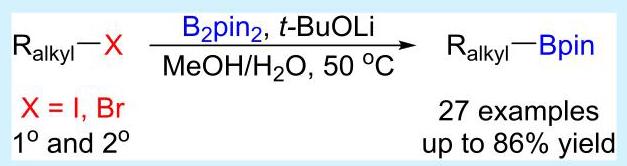
During the past several years, transition-metal-free boryla-tion has been developed as a useful method for the preparation of a wide range of organoboron compounds. ${}^{16}$ Since the pioneering work of Wang in 2010, ${}^{17}$ numerous transition-metal-free aromatic borylation protocols have been developed, allowing for the conversion of anilines, ${}^{18}$ aryl (pseudo)- halides, ${}^{19}$ and aryl carboxylates ${}^{20}$ into aryl boronates. In contrast, transition-metal-free borylation of alkyl substrates remains largely underdeveloped. To date, the scope of aliphatic substrates is limited to carboxylic acid derivatives ${}^{21}$ and amine derivatives. ${}^{22}$ We note that those alkyl substrates have to be “activated” prior to the execution of borylation. Specifically, carboxylic acids are transformed into the corresponding $N$ - hydroxyphthalimide (NHPI) esters, ${}^{21}$ and amines are converted into their Katritzky pyridinium salts in order for the borylation to occur. ${}^{22}$ Thus, the direct use of abundant and easily available alkyl halides for borylation without the need of preactivation is very appealing. Herein, we describe such a protocol for the transition-metal-free borylation of an array of alkyl iodides, including both primary and secondary alkyl substrates. This method operates under mild reaction conditions and uses bench stable, widely available pinacol diboron $\left( {{\mathrm{B}}_{2}{\text{ pin }}_{2}}\right)$ for the borylation of primary alkyl iodides (Scheme 1c). During the preparation of this manuscript, the Studer group disclosed an elegant photochemical protocol for the transition-metal-free borylation of alkyl iodides. ${}^{23}$ In contrast to our method, more expensive catechol diboron $\left( {{\mathrm{B}}_{2}{\mathrm{{cat}}}_{2}}\right)$ was found to be optimal for Studer’s photochemical borylation. Due to the chromatographic instability of catechol boronates, an additional step was required to convert catechol boronates to pinacol boronates for isolation.
Scheme 1. Borylation of Alkyl Halides
(a) Transition-metal catalyzed borylation of alkyl (pseudo)halides
$$ \begin{array}{l} {\mathrm{R}}_{\text{ alkyl }} - \mathrm{X}\;\frac{\mathrm{{Cu}},\mathrm{{Ni}},\mathrm{{Pd}},\mathrm{{Fe}},\mathrm{{Mn}},\mathrm{{Zn}},\mathrm{{Ag}}}{{\mathrm{B}}_{2}{\mathrm{{pin}}}_{2},\text{ base/ligand }}\;{\mathrm{R}}_{\text{ alkyl }} - \mathrm{{Bpin}} \\ \end{array} $$X = CI, Br, I, OTs
X = Cl、Br、I、OTs
(b) Photoinduced borylation of alkyl iodides
$$ {\mathrm{R}}_{\text{ alkyl }} - \mathrm{I}\;\frac{1){\mathrm{B}}_{2}{\mathrm{{cat}}}_{2},\mathrm{{DMF}},\text{ blue LED }}{2){\mathrm{{Et}}}_{3}\mathrm{\;N},\text{ pinacol }}\;{\mathrm{R}}_{\text{ alkyl }} - \mathrm{{Bpin}} $$(c) Base-assisted transition-metal-free borylation of alkyl halides (this work)
$$ \begin{matrix} {\mathrm{R}}_{\text{ alkyl }} - \mathrm{X}\xrightarrow[{\text{ MeOH, }{50}^{ \circ }\mathrm{C}}]{{\mathrm{B}}_{2}{\mathrm{{pin}}}_{2}, t - \mathrm{{BuOLi}}}{\mathrm{R}}_{\text{ alkyl }} - \mathrm{{Bpin}} \\ \end{matrix} $$$$ X = 1,{Br} $$Transition-metal-free, photo-free - Not sensitive to air or moisture
High functional group tolerance - Simple and practical procedure
Received: June 5, 2019
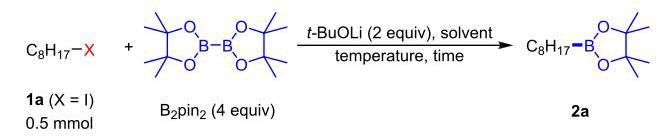
We commenced our study by investigating the borylation of octyl iodide (1a) under transition-metal-free conditions using pinacol diboron $\left( {{\mathrm{B}}_{2}{\mathrm{{pin}}}_{2}}\right)$ as the borylating reagent (Table 1). After extensive optimization, we found that the treatment of 1a with 4 equiv of ${\mathrm{B}}_{2}{\text{ pin }}_{2}$ in the presence of 2 equiv of $t$ -BuOLi in $\mathrm{{MeOH}}\left( {{0.5}\mathrm{M}}\right)$ at ${65}^{ \circ }\mathrm{C}$ for ${12}\mathrm{\;h}$ afforded the corresponding boronate $2\mathrm{a}$ in 70% yield (entry 1). Other solvents such as DMF or ${\mathrm{{CH}}}_{2}{\mathrm{{Cl}}}_{2}$ proved less effective (Table 1, entries 2 and 3, and Table S1). Further study showed that the addition of a small amount of water provided a higher yield (87%) of 2a (entry 4). We postulated that the addition of water overcame the heterogeneity issue of the current process and thus enhanced the yield of the borylation product. Importantly, when carried out strictly in the absence of light, this borylation reaction still provided the same yield of 2a (entry 5), thus completely ruling out the possibility of a photoinduced process. Other bases such as $\mathrm{{MeOLi}},{\mathrm{{Cs}}}_{2}{\mathrm{{CO}}}_{3}$ , and $\mathrm{{LiOH}}$ were less effective (entries 6-8). Additionally, we were able to reduce the amount of ${\mathrm{B}}_{2}{\mathrm{{Pin}}}_{2}$ to 3 equiv without affecting the yield of 2a (entry 9). The use of 2 equiv of ${\mathrm{B}}_{2}{\mathrm{{Pin}}}_{2}$ provided 2a in a slightly lower yield (60%). Furthermore, less reactive octyl bromide could also be borylated in good yields in the presence of a catalytic amount of KI or ${\mathrm{I}}_{2}$ (entries 11 and 12). Octyl chloride, octyl tosylate, and octyl mesylate were also compatible substrates under these conditions, providing borylation product 2a in low to moderate yields (entries 13-15). Finally, the transition-metal-free nature of this borylation reaction was ascertained by carrying out this transformation using reagents of high purity (Aldrich) with trace metal residue (see the Supporting Information for ICP-MS analysis of transition metal residues including Cu, Fe, Pd, Mn, Ni, and Zn in these reagents and other control experiments).
Table 1. Reaction Development
| entry" | X | additive | solvent | $T$ (°C) | time (h) | conv of 1 (%) | yield (%) |
| 1 | I | MeOH | 65 | 12 | 96 | 70 | |
| 2 | I | DMF | 65 | 12 | 100 | 55 | |
| 3 | I | DCM | 65 | 12 | 47 | 15 | |
| 4 | I | ${\mathrm{H}}_{2}\mathrm{O}$ | MeOH | 50 | 48 | 100 | 87 (86) |
| ${5}^{c}$ | I | ${\mathrm{H}}_{2}\mathrm{O}$ | MeOH | 50 | 48 | 100 | 85 |
| ${6}^{d}$ | I | ${\mathrm{H}}_{2}\mathrm{O}$ | MeOH | 50 | 48 | 95 | 64 |
| ${7}^{e}$ | I | ${\mathrm{H}}_{2}\mathrm{O}$ | MeOH | 50 | 48 | 100 | 15 |
| ${8}^{f}$ | I | ${\mathrm{H}}_{2}\mathrm{O}$ | MeOH | 50 | 48 | 92 | 67 |
| ${9}^{g}$ | I | ${\mathrm{H}}_{2}\mathrm{O}$ | MeOH | 50 | 48 | 100 | 84 |
| ${10}^{h}$ | I | ${\mathrm{H}}_{2}\mathrm{O}$ | MeOH | 50 | 48 | 96 | 60 |
| 11 | Br | ${\mathrm{H}}_{2}\mathrm{O}$ , KI | MeOH | 50 | 48 | 81 | 56 |
| 12 | Br | ${\mathrm{H}}_{2}\mathrm{O},{\mathrm{I}}_{2}$ | MeOH | 50 | 48 | 95 | 76 |
| 13 | Cl | ${\mathrm{H}}_{2}\mathrm{O},{\mathrm{I}}_{2}$ | MeOH | 50 | 48 | 10 | 10 |
| 14 | OTs | ${\mathrm{H}}_{2}\mathrm{O},{\mathrm{I}}_{2}$ | MeOH | 50 | 48 | 57 | 18 |
| 15 | OMs | ${\mathrm{H}}_{2}\mathrm{O},{\mathrm{I}}_{2}$ | MeOH | 50 | 48 | 53 | 45 |
${}^{a}$ Entries 1-3, solvent $1\mathrm{\;{mL}}$ ; entries 4-12, solvent ${0.85}\mathrm{\;{mL}},{\mathrm{H}}_{2}\mathrm{O}$ (10 $\mu \mathrm{L}$ ), $\mathrm{{KI}}$ (0.2 equiv), ${\mathrm{I}}_{2}$ (0.2 equiv). ${}^{b}\mathrm{{GC}}$ yield using decane as an internal standard. Isolated yield is shown in parentheses. ${}^{c}$ In the dark. ${}^{d}\mathrm{{MeOLi}}$ as the base. ${}^{e}{\mathrm{{Cs}}}_{2}{\mathrm{{CO}}}_{3}$ as the base. ${}^{f}\mathrm{{LiOH}} \cdot {\mathrm{H}}_{2}\mathrm{O}$ as the base. ${}^{g}{\mathrm{\;B}}_{2}{\mathrm{{pin}}}_{2}$ (3 equiv), $t$ -BuOLi (1.5 equiv). ${}^{h}{\mathrm{\;B}}_{2}{\mathrm{{pin}}}_{2}$ (2 equiv), $t$ -BuOLi (1 equiv).
With the optimized reaction conditions in hand, we next examined the substrate scope of this metal-free-borylation reaction (Scheme 2). A series of unactivated primary and secondary alkyl iodides/bromides were converted to the corresponding alkyl boronates in excellent yields. In general, primary alkyl iodides were more reactive relative to primary alkyl bromides and secondary alkyl iodides. An array of functional groups, including less reactive halides (2i-k), an alcohol (2l), a phenol (2m), ethers (2n and 2o), an amide (2p), an ester (2r), and a sulfonyl group (2t) were compatible with this method. Free alcohol and free phenol containing substrates were challenging in previously developed Cu-, Ni-, ${}^{10}$ Pd-, ${}^{11}$ Fe-, ${}^{12}$ and Mn-catalyzed ${}^{13}$ borylation reactions. Under our metal-free conditions, 1I and 1m were effectively transformed into the corresponding products, suggesting that this metal-free process is complementary to those previously developed ones using transition-metal catalysts. For secondary iodide substrates, the use of ${\mathrm{B}}_{2}{\mathrm{{cat}}}_{2}$ as the borylation agent was more effective than ${\mathrm{B}}_{2}{\mathrm{{pin}}}_{2}$ , affording secondary borylated products in good yields (2u-2y). For these substrates, further treatment with pinacol was carried out for purification.
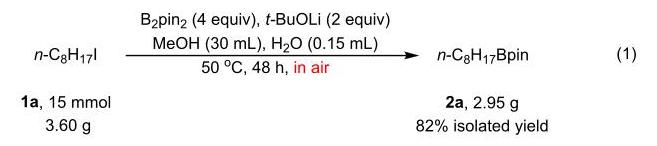
Moreover, we found that when this metal-free borylation reaction was conducted in a capped vial under an atmosphere of air, the yield of the product remained unaffected, thus highlighting the practicality of this process. To further demonstrate the utility of this borylation method, a gram-scale synthesis of octyl pinacol boronate was carried out under air (eq 1). The 15 mmol scale reaction furnished 2a in 82% isolated yield, thereby demonstrating the potential of this method for the large-scale synthesis of valuable alkylboronates.
To gain further insight into the mechanism of this base-promoted borylation reaction, we performed a series of mechanistic investigations. First, when a commonly used radical scavenger, 2,2,6,6-tetramethyl-1-piperidinyloxy (TEMPO), was added under the standard conditions, only 14% of 2a was obtained (Scheme 3a). Moreover, the corresponding TEMPO-trapped product was observed by GC-MS analysis. Second, the borylation of cyclopropyl substrate $1\mathbf{z}$ and $1\mathbf{a}$ a yielded the ring-opened product $2\mathbf{z}$ and 2aa, respectively, indicating the involvement of alkyl radical intermediates in this borylation reaction (Scheme 3b). In these reactions, further borylation of the newly formed alkene took place, ${}^{24}$ and protodeborylation also occurred in the formation of $2\mathbf{z}$ . Third, we found that borylation product selectivity (yield of ${2a}/\left( \right.$ conversion of $\left. {1\mathrm{a}\text{ , yield of }2\mathrm{a}}\right)$ ) correlates well with the amount of ${\mathrm{B}}_{2}{\mathrm{{pin}}}_{2}$ added (Scheme 3c). This observation shows the desired radical borylation using ${\mathrm{B}}_{2}{\mathrm{{pin}}}_{2}$ competes with other side reactions (e.g., $\mathrm{H}$ atom abstraction) of the alkyl radical intermediate.
Scheme 2. Substrate Scope ${}^{a}$
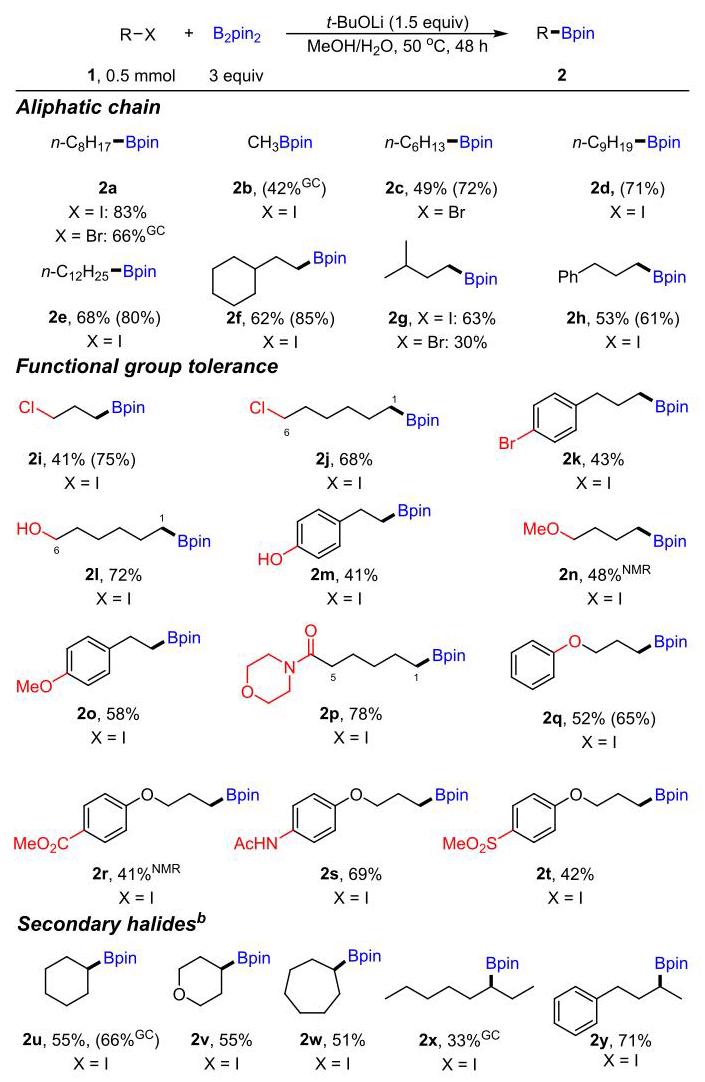
${}^{a}$ Reaction conditions: alkyl halide ${10.5}\mathrm{{mmol}},{\mathrm{B}}_{2}{\mathrm{{pin}}}_{2}{1.5}\mathrm{{mmol}}(3$ equiv), $t$ -BuOLi 0.75 mmol (1.5 equiv), MeOH 0.85 mL, ${\mathrm{H}}_{2}\mathrm{O}{10\mu }\mathrm{L}$ . Isolated yields were reported. The yields in parentheses are referred to the conditions with the use of ${\mathrm{B}}_{2}{\text{ pin }}_{2}\left( {2\mathrm{{mmol}},4\text{ equiv }}\right)$ and $t$ -BuOLi (1 mmol, 2 equiv). The yields with a “GC” superscript are GC yields with decane as an internal standard. The yields with a “NMR” superscript is ${}^{1}\mathrm{H}$ NMR yield with1,1,2,2-tetrachloroethane as an internal standard. ${}^{b}{\mathrm{\;B}}_{2}{\mathrm{{cat}}}_{2}$ (4 equiv), $t$ -BuOLi (2 equiv), MeOH,80 ${}^{ \circ }\mathrm{C},{48}\mathrm{\;h}$ ; then ${\mathrm{{Et}}}_{3}\mathrm{\;N}$ (4 equiv), pinacol (4 equiv), rt,3 h.
To further probe the nature of the radical species formed during the reaction, electron paramagnetic resonance (EPR) studies were next performed (Figure 1). 5,5-Dimethyl-1- pyrroline $N$ -oxide (DMPO) was introduced as a spin-trap, as it is known to react with short-living radicals to furnish more stable and EPR detectable nitroxide radicals. ${}^{25}$ In addition to octyl iodide (1a), we also selected perfluorooctyl iodide (1a- ${\mathbf{F}}_{17}$ ) as a probe due to the very characteristic EPR signals of the resulting DMPO-trapped perfluoroalkyl species. EPR spectra were simulated using the least-squares fitting method with EasySpin (see the Supporting Information for details). On the basis of literature precedents, ${}^{26}$ radicals $\mathbf{A}$ and $\mathbf{B}$ generated by reaction of the alkyl halide substrate with ${\mathrm{B}}_{2}{\mathrm{{pin}}}_{2}, t$ -BuOLi and DMPO in MeOH are assigned to nitroxide radicals shown in Figure 1. As shown in Figure 1a, the reaction of 1a leads to a DMPO-trapped radical species featuring a triplet of doublet
Scheme 3. Preliminary Mechanistic Studies
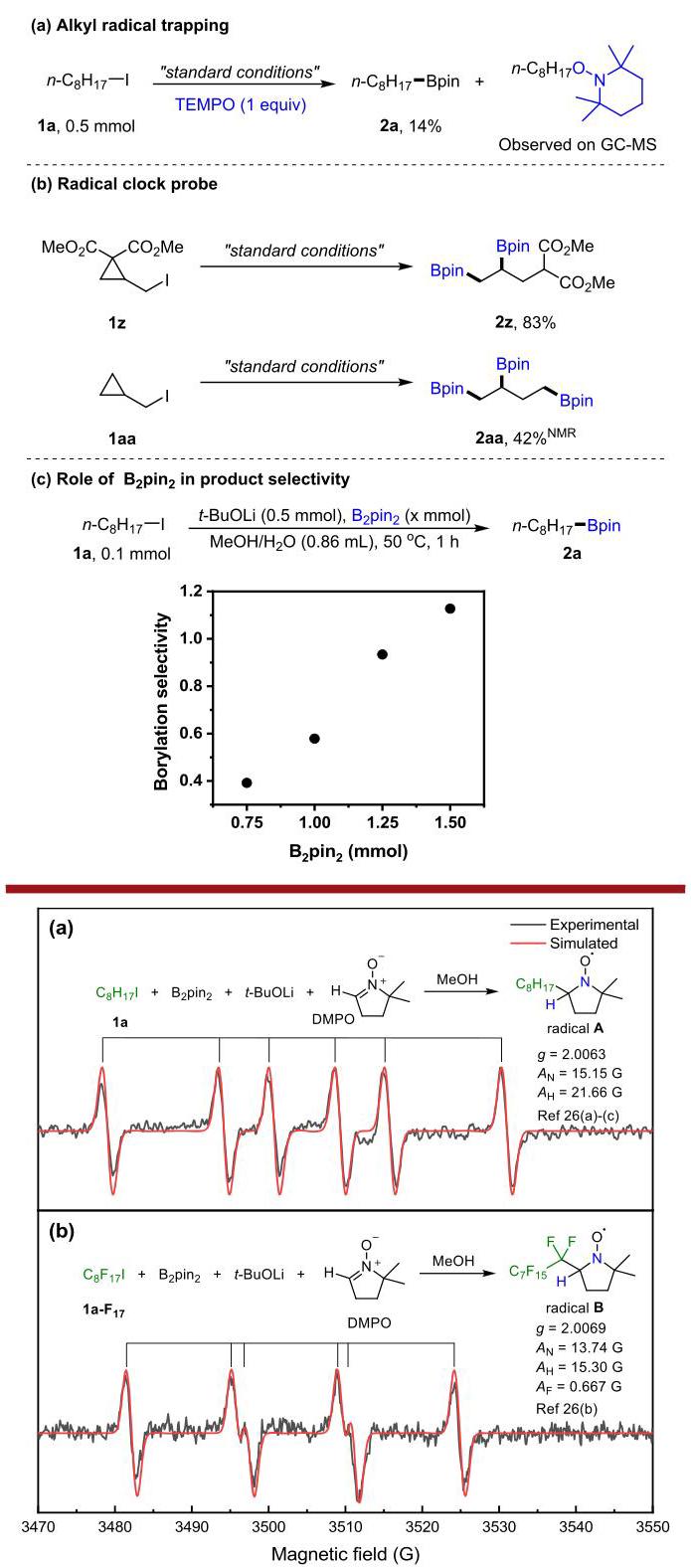
Figure 1. Experimental (black) and simulated EPR spectra (red) of reactions with DMPO in MeOH: (a) $1\mathrm{a} + {\mathrm{B}}_{2}{\mathrm{{pin}}}_{2} + t$ -BuOLi; (b) 1a- ${\mathrm{F}}_{17} + {\mathrm{B}}_{2}{\mathrm{{pin}}}_{2} + t$ -BuOLi.
EPR signal due to the coupling with the adjacent nitrogen and hydrogen atoms highlighted in blue, showing a $g$ value of 2.0063. On the other hand, the reaction of $1\mathrm{a} - {\mathrm{F}}_{17}$ gives rise to a DMPO-trapped radical featuring a quasi-quartet EPR splitting pattern due to the inductive effect caused by the adjacent fluorine substituents. Together, these results confirmed that alkyl iodide reacts with the diboron reagent and $t$ - BuOLi to generate an alkyl radical.
Furthermore, we performed density functional theory (DFT) calculations on the C-B bond formation step (see the Supporting Information for details). Previous study proposed that the Lewis base adduct of the tetraalkoxydiboron compound (ate complex in Figure 2a) is a key intermediate in borylation reactions. ${}^{27}$ We found that, compared with this ate complex, alkyl radical addition to ${\mathrm{B}}_{2}{\text{ pin }}_{2}$ is more facile, leading to INT1. Subsequent B-B bond disassociation of INT1 via TS2 provides the borylation product and the Bpin radical INT2. This boron-centered radical is then trapped by $t - {\mathrm{{BuO}}}^{ - }$ to give the $t$ -BuOBpin radical anion (INT3), which can further reduce alkyl iodide to regenerate the alkyl radical. For secondary alkyl halides, ${\mathrm{B}}_{2}{\mathrm{{cat}}}_{2}$ is more favorable than ${\mathrm{B}}_{2}{\mathrm{{pin}}}_{2}$ in this radical borylation (Figure 2b).
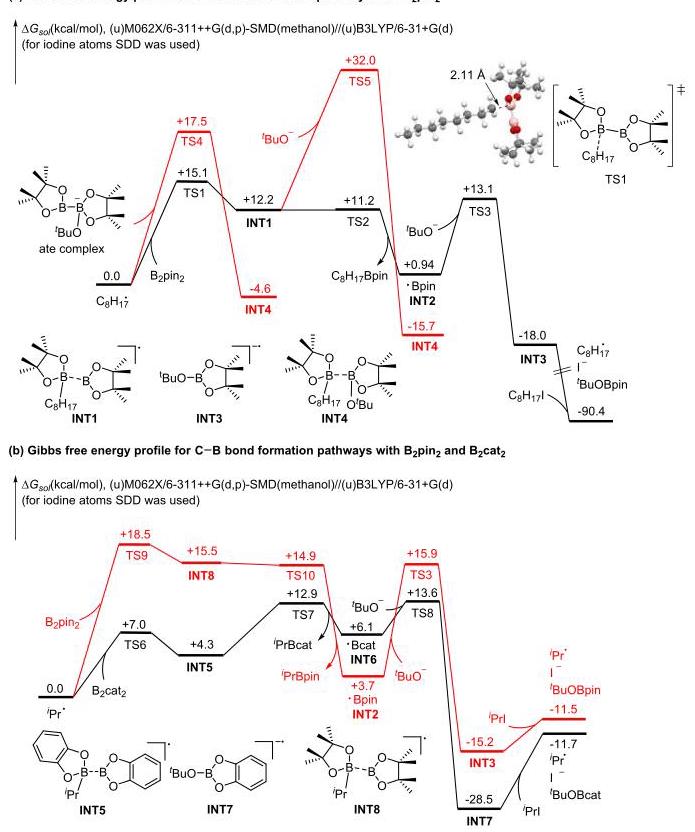
Figure 2. Computed potential energy surface of borylation reaction.
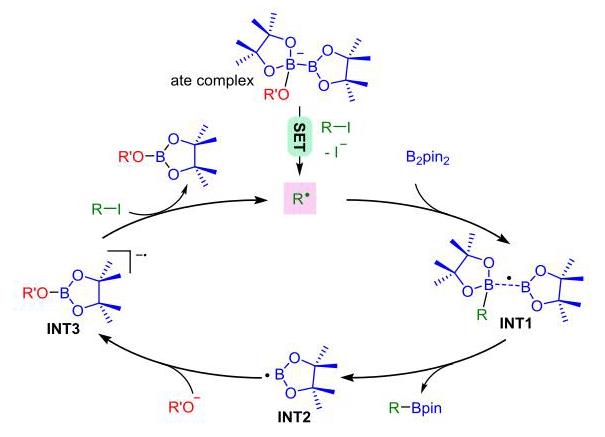
On the basis of our combined experimental and computational evidence as well as studies on previously developed radical borylation reactions, ${}^{{16} - {22}}$ a plausible mechanism is outlined in Scheme 4. We propose that the alkoxide first reacts with ${\mathrm{B}}_{2}{\mathrm{{pin}}}_{2}$ to produce the ate complex. This ate complex then reduces the alkyl iodide through a single-electron transfer (SET) event, affording the key alkyl radical intermediate. Then this alkyl radical adds to a free ${\mathrm{B}}_{2}{\mathrm{{pin}}}_{2}$ to give INT1 via TS1. Subsequent cleavage of the B-B bond of INT1 leads to the boryl radical (INT2) and the borylation product. Finally, INT2 is trapped by an alkoxide to afford ${\mathrm{R}}^{\prime }\mathrm{{OB}}$ pin radical anion INT3, which can also undergo single electron transfer with the alkyl iodide as described above.
Scheme 4. Proposed Mechanism
In summary, we have developed an operationally simple transition-metal-free borylation of alkyl iodides. This transition-metal-free borylation occurs under mild conditions, tolerates a broad range of sensitive functional groups. Moreover, it provides an effective means to convert various primary and secondary alkyl iodides to the corresponding alkyl boronates. Preliminary mechanistic investigations indicated a single-electron-transfer process is likely involved in this transition-metal-free borylation. This study affords a new avenue for generating alkyl radical from easily accessible alkyl halides using simple bases and diboron reagents. Expanding the substrate scope to include other types of alkyl halides, as well as detailed mechanism, are currently underway in our laboratory.
BASSOCIATED CONTENT
Supporting Information
The Supporting Information is available free of charge on the ACS Publications website at DOI: 10.1021/acs.or-glett.9b01951.
Experimental procedures, additional information, and characterization data (PDF)
AUTHOR INFORMATION
Corresponding Author
ORCID ®
Guoquan Liu: 0000-0003-0680-4811
Yang Yang: 0000-0002-4956-2034
Fanyang Mo: 0000-0002-4140-3020
Notes
The authors declare no competing financial interest.
I ACKNOWLEDGMENTS
We thank Prof. Lei Jiao at Tsinghua University for DFT calculation consultation. The project was supported by the Natural Science Foundation of China (Grant 21772003). We also thank Peking University for a start-up fund. This work was also partially funded by the BHP-PKU CCUS project supported by BHP Billiton.
REFERENCES
(1) Boronic Acids: Preparation and Applications in Organic Synthesis and Medicine; Wiley, 2017; p 363.
(2) (a) Chemler, S. R.; Trauner, D.; Danishefsky, S. J. The B-Alkyl Suzuki-Miyaura Cross-Coupling Reaction: Development, Mechanistic Study, and Applications in Natural Product Synthesis. Angew. Chem., Int. Ed. 2001, 40, 4544. (b) Doucet, H. Suzuki-Miyaura Cross-Coupling Reactions of Alkylboronic Acid Derivatives or Alkyltrifluoroborates with Aryl, Alkenyl or Alkyl Halides and Triflates. Eur. J. Org. Chem. 2008, 2008, 2013. (c) Jana, R.; Pathak, T. P.; Sigman, M. S. Advances in Transition Metal (Pd, Ni, Fe)-Catalyzed Cross-Coupling Reactions Using Alkyl-organometallics as Reaction Partners. Chem. Rev. 2011, 111, 1417.
(3) (a) Beenen, M. A.; An, C.; Ellman, J. A. Asymmetric Copper-Catalyzed Synthesis of $\alpha$ -Amino Boronate Esters from N-tert-Butanesulfinyl Aldimines. J. Am. Chem. Soc. 2008, 130, 6910. (b) Einsele, H., Bortezomib. In Small Molecules in Oncology; Martens, U. M., Ed.; Springer: Berlin, Heidelberg, 2010; pp 173.
(4) Barth, R. F.; Mi, P.; Yang, W. Boron delivery agents for neutron capture therapy of cancer. Cancer Communications 2018, 38, 35.
(5) (a) Zweifel, G.; Brown, H. C. Org. React. 1963, 13, 1. (b) Brown, H. C.; Cole, T. E. Organoboranes. 31. A simple preparation of boronic esters from organolithium reagents and selected trialkox-yboranes. Organometallics 1983, 2, 1316.
(6) (a) Transition Metal-Catalyzed Hydroboration of Olefins. In Transition Metals for Organic Synthesis; Wiley, 2004. (b) Burgess, K.; Ohlmeyer, M. J. Transition-metal promoted hydroborations of alkenes, emerging methodology for organic transformations. Chem. Rev. 1991, 91, 1179. (c) Burgess, K.; Van der Donk, W. A.; Westcott, S. A.; Marder, T. B.; Baker, R. T.; Calabrese, J. C. Reactions of catecholborane with Wilkinson’s catalyst: implications for transition metal-catalyzed hydroborations of alkenes. J. Am. Chem. Soc. 1992, 114, 9350. (d) Evans, D. A.; Fu, G. C.; Hoveyda, A. H. Rhodium(I)- and iridium(I)-catalyzed hydroboration reactions: scope and synthetic applications. J. Am. Chem. Soc. 1992, 114, 6671. (e) Crudden, C. M.; Edwards, D. Catalytic Asymmetric Hydroboration: Recent Advances and Applications in Carbon- Carbon Bond-Forming Reactions. Eur. J. Org. Chem. 2003, 2003, 4695. (f) Carroll, A. M.; O’Sullivan, T. P.; Guiry, P. J. The Development of Enantioselective Rhodium-Catalysed Hydroboration of Olefins. Adv. Synth. Catal. 2005, 347, 609.
(7) (a) Mkhalid, I. A. I.; Barnard, J. H.; Marder, T. B.; Murphy, J. M.; Hartwig, J. F. C-H Activation for the Construction of C-B Bonds. Chem. Rev. 2010, 110, 890. (b) Hartwig, J. F. Regioselectivity of the borylation of alkanes and arenes. Chem. Soc. Rev. 2011, 40, 1992. (c) Hartwig, J. F. Borylation and Silylation of C-H Bonds: A Platform for Diverse C-H Bond Functionalizations. Acc. Chem. Res. 2012, 45, 864.
(8) Kubota, K.; Iwamoto, H.; Ito, H. Formal nucleophilic borylation and borylative cyclization of organic halides. Org. Biomol. Chem. 2017, 15, 285.
(9) (a) Ito, H.; Kubota, K. Copper(I)-Catalyzed Boryl Substitution of Unactivated Alkyl Halides. Org. Lett. 2012, 14, 890. (b) Yang, C.- T.; Zhang, Z.-Q.; Tajuddin, H.; Wu, C.-C.; Liang, J.; Liu, J.-H.; Fu, Y.; Czyzewska, M.; Steel, P. G.; Marder, T. B.; Liu, L. Alkylboronic Esters from Copper-Catalyzed Borylation of Primary and Secondary Alkyl Halides and Pseudohalides. Angew. Chem., Int. Ed. 2012, 51, 528. (c) Kubota, K.; Yamamoto, E.; Ito, H. Copper(I)-Catalyzed Borylative exo-Cyclization of Alkenyl Halides Containing Unactivated Double Bond. J. Am. Chem. Soc. 2013, 135, 2635. (d) Kim, J. H.; Chung, Y. K. Copper nanoparticle-catalyzed borylation of alkyl bromides with an organodiboron compound. RSC Adv. 2014, 4, 39755. (e) Iwamoto, H.; Kubota, K.; Yamamoto, E.; Ito, H. Copper(i)-catalyzed carbon-halogen bond-selective boryl substitution of alkyl halides bearing terminal alkene moieties. Chem. Commun. 2015, 51, 9655. (f) Zhou, X.-F.; Wu, Y.-D.; Dai, J.-J.; Li, Y.-J.; Huang, Y.; Xu, H.-J. Borylation of primary and secondary alkyl bromides catalyzed by Cu2O nanoparticles. RSC Adv. 2015, 5, 46672. (g) Bose, S. K.; Brand, S.; Omoregie, H. O.; Haehnel, M.; Maier, J.; Bringmann, G.; Marder, T. B. Highly Efficient Synthesis of Alkylboronate Esters via Cu(II)-Catalyzed Borylation of Unactivated Alkyl Bromides and Chlorides in Air. ACS Catal. 2016, 6, 8332. (h) Lou, X.; Zhang, Z.-Q.; Liu, J.-H.; Lu, X.-Y. Copper-catalyzed Borylation of Primary and Secondary Alkyl Halides with Bis(neopentyl glycolate) Diboron at Room Temperature. Chem. Lett. 2016, 45, 200.
(10) (a) Dudnik, A. S.; Fu, G. C. Nickel-Catalyzed Coupling Reactions of Alkyl Electrophiles, Including Unactivated Tertiary Halides, To Generate Carbon-Boron Bonds. J. Am. Chem. Soc. 2012, 134, 10693. (b) Yi, J.; Liu, J.-H.; Liang, J.; Dai, J.-J.; Yang, C.-T.; Fu, Y.; Liu, L. Alkylboronic Esters from Palladium- and Nickel-Catalyzed Borylation of Primary and Secondary Alkyl Bromides. Adv. Synth. Catal. 2012, 354, 1685.
(11) (a) Bej, A.; Srimani, D.; Sarkar, A. Palladium nanoparticle catalysis: borylation of aryl and benzyl halides and one-pot biaryl synthesis via sequential borylation-Suzuki-Miyaura coupling. Green Chem. 2012, 14, 661. (b) Joshi-Pangu, A.; Ma, X.; Diane, M.; Iqbal, S.; Kribs, R. J.; Huang, R.; Wang, C.-Y.; Biscoe, M. R. Palladium-Catalyzed Borylation of Primary Alkyl Bromides. J. Org. Chem. 2012, 77, 6629.
(12) (a) Atack, T. C.; Lecker, R. M.; Cook, S. P. Iron-Catalyzed Borylation of Alkyl Electrophiles. J. Am. Chem. Soc. 2014, 136, 9521. (b) Bedford, R. B.; Brenner, P. B.; Carter, E.; Gallagher, T.; Murphy, D. M.; Pye, D. R. Iron-Catalyzed Borylation of Alkyl, Allyl, and Aryl Halides: Isolation of an Iron(I) Boryl Complex. Organometallics 2014, 33, 5940.
(13) Atack, T. C.; Cook, S. P. Manganese-Catalyzed Borylation of Unactivated Alkyl Chlorides. J. Am. Chem. Soc. 2016, 138, 6139.
(14) Bose, S. K.; Fucke, K.; Liu, L.; Steel, P. G.; Marder, T. B. Zinc-Catalyzed Borylation of Primary, Secondary and Tertiary Alkyl Halides with Alkoxy Diboron Reagents at Room Temperature. Angew. Chem., Int. Ed. 2014, 53, 1799.
(15) Lu, X.; Zhang, Z.-Q.; Yu, L.; Zhang, B.; Wang, B.; Gong, T.-J.; Tian, C.-L.; Xiao, B.; Fu, Y. Free Radical Pathway Cleavage of C-O Bonds for the Synthesis of Alkylboron Compounds. Chin. J. Chem. 2019, 37, 11.
(16) (a) Chen, K.; Wang, L.; Meng, G.; Li, P. Recent Advances in Transition-Metal-Free Aryl C-B Bond Formation. Synthesis 2017, 49, 4719. (b) Mo, F.; Qiu, D.; Zhang, Y.; Wang, J. Renaissance of Sandmeyer-Type Reactions: Conversion of Aromatic C-N Bonds into C-X Bonds (X = B, Sn, P, or CF3). Acc. Chem. Res. 2018, 51, 496. (c) Yan, G.; Huang, D.; Wu, X. Recent Advances in C-B Bond Formation through a Free Radical Pathway. Adv. Synth. Catal. 2018, 360, 1040.
(17) (a) Mo, F.; Jiang, Y.; Qiu, D.; Zhang, Y.; Wang, J. Direct Conversion of Arylamines to Pinacol Boronates: A Metal-Free Borylation Process. Angew. Chem., Int. Ed. 2010, 49, 1846. (b) Qiu, D.; Jin, L.; Zheng, Z.; Meng, H.; Mo, F.; Wang, X.; Zhang, Y.; Wang, J. Synthesis of Pinacol Arylboronates from Aromatic Amines: A Metal-Free Transformation. J. Org. Chem. 2013, 78, 1923. (c) Qiu, D.; Zhang, Y.; Wang, J. Direct synthesis of arylboronic pinacol esters from arylamines. Org. Chem. Front. 2014, 1, 422.
(18) (a) Yu, J.; Zhang, L.; Yan, G. Metal-Free, Visible Light-Induced Borylation of Aryldiazonium Salts: A Simple and Green Synthetic Route to Arylboronates. Adv. Synth. Catal. 2012, 354, 2625. (b) Zhu, C.; Yamane, M. Transition-Metal-Free Borylation of Aryltriazene Mediated by BF3-OEt2. Org. Lett. 2012, 14, 4560. (c) Erb, W.; Albini, M.; Rouden, J.; Blanchet, J. Sequential One-Pot Access to Molecular Diversity through Aniline Aqueous Borylation. J. Org. Chem. 2014, 79, 10568. (d) Zhao, C.-J.; Xue, D.; Jia, Z.-H.; Wang, C.; Xiao, J. Methanol-Promoted Borylation of Arylamines: A Simple and Green Synthetic Method to Arylboronic Acids and Arylboronates. Synlett 2014, 25, 1577.
(19) (a) Chen, K.; Zhang, S.; He, P.; Li, P. Efficient metal-free photochemical borylation of aryl halides under batch and continuous-flow conditions. Chem. Sci. 2016, 7, 3676. (b) Mfuh, A. M.; Doyle, J. D.; Chhetri, B.; Arman, H. D.; Larionov, O. V. Scalable, Metal- and Additive-Free, Photoinduced Borylation of Haloarenes and Quaternary Arylammonium Salts. J. Am. Chem. Soc. 2016, 138, 2985. (c) Mfuh, A. M.; Nguyen, V. T.; Chhetri, B.; Burch, J. E.; Doyle, J. D.; Nesterov, V. N.; Arman, H. D.; Larionov, O. V. Additive- and Metal-Free, Predictably 1,2- and 1,3-Regioselective, Photoinduced Dual C-H/C-X Borylation of Haloarenes. J. Am. Chem. Soc. 2016, 138, 8408. (d) Mfuh, A. M.; Schneider, B. D.; Cruces, W.; Larionov, O. V. Metal-and additive-free photoinduced borylation of haloarenes. Nat. Protoc. 2017, 12, 604. (e) Pinet, S.; Liautard, V.; Debiais, M.; Pucheault, M. Radical Metal-Free Borylation of Aryl Iodides. Synthesis 2017, 49, 4759. (f) Zhang, J.; Wu, H.-H.; Zhang, J. Cesium Carbonate Mediated Borylation of Aryl Iodides with Diboron in Methanol. Eur. J. Org. Chem. 2013, 2013, 6263. (g) Zhang, L.; Jiao, L. Pyridine-Catalyzed Radical Borylation of Aryl Halides. J. Am. Chem. Soc. 2017, 139, 607. (h) Liu, W.; Yang, X.; Gao, Y.; Li, C.-J. Simple and Efficient Generation of Aryl Radicals from Aryl Triflates: Synthesis of Aryl Boronates and Aryl Iodides at Room Temperature. J. Am. Chem. Soc. 2017, 139, 8621.
(20) Candish, L.; Teders, M.; Glorius, F. Transition-Metal-Free, Visible-Light-Enabled Decarboxylative Borylation of Aryl N-Hydrox-yphthalimide Esters. J. Am. Chem. Soc. 2017, 139, 7440.
(21) (a) Fawcett, A.; Pradeilles, J.; Wang, Y.; Mutsuga, T.; Myers, E. L.; Aggarwal, V. K. Photoinduced decarboxylative borylation of carboxylic acids. Science 2017, 357, 283. (b) Hu, D.; Wang, L.; Li, P. Decarboxylative Borylation of Aliphatic Esters under Visible-Light Photoredox Conditions. Org. Lett. 2017, 19, 2770.
(22) (a) Wu, J.; He, L.; Noble, A.; Aggarwal, V. K. Photoinduced Deaminative Borylation of Alkylamines. J. Am. Chem. Soc. 2018, 140, 10700. (b) Sandfort, F.; Strieth-Kalthoff, F.; Klauck, F. J. R.; James, M. J.; Glorius, F. Deaminative Borylation of Aliphatic Amines Enabled by Visible Light Excitation of an Electron Donor-Acceptor Complex. Chem. - Eur. J. 2018, 24, 17210. (c) Hu, J.; Wang, G.; Li, S.; Shi, Z. Selective C-N Borylation of Alkyl Amines Promoted by Lewis Base. Angew. Chem., Int. Ed. 2018, 57, 15227.
(23) Cheng, Y.; Mück-Lichtenfeld, C.; Studer, A. Metal-Free Radical Borylation of Alkyl and Aryl Iodides. Angew. Chem., Int. Ed. 2018, 57, 16832.
(24) Cuenca, A. B.; Shishido, R.; Ito, H.; Fernández, E. Transition-metal-free B-B and B-interelement reactions with organic molecules. Chem. Soc. Rev. 2017, 46, 415.
(25) Buettner, G. R. Spin Trapping: ESR parameters of spin adducts 1474 1528V. Free Radical Biol. Med. 1987, 3, 259.
(26) (a) Janzen, E. G.; Evans, C. A.; Liu, J. I. P. Factors influencing hyperfine splitting in the ESR spectra of five-membered ring nitroxides. J. Magn. Reson. (1969-1992) 1973, 9, 513. (b) Janzen, E. G.; Liu, J. I. P. Radical addition reactions of 5,5-Dimethyl-1-pyrroline- 1-oxide. ESR spin trapping with a cyclic nitrone. J. Magn. Reson. (1969-1992) 1973, 9, 510. (c) Marriott, P. R.; Perkins, M. J.; Griller, D. Spin trapping for hydroxyl in water: a kinetic evaluation of two popular traps. Can. J. Chem. 1980, 58, 803. (d) Augusto, O.; de Montellano, P. R. O.; Quintanilha, A. Spin-trapping of free radicals formed during microsomal metabolism of ethylhydrazine and acetylhydrazine. Biochem. Biophys. Res. Commun. 1981, 101, 1324. (e) Reszka, K.; Chignell, C. F. Spectroscopic studies of cutaneous photosensitizing agents-IV. The photolysis of benoxaprofen, an antiinflammatory drug with phototoxic properties. Photochem. Photobiol. 1983, 38, 281.
(27) Dewhurst, R. D.; Neeve, E. C.; Braunschweig, H.; Marder, T. B. sp2-sp3 diboranes: astounding structural variability and mild sources of nucleophilic boron for organic synthesis. Chem. Commun. 2015, 51, 9594.