Mn-Mediated Electrochemical Trifluoromethylation/C(sp2)–H Functionalization Cascade for the Synthesis of Azaheterocycles
中文 / Bilingual · English version
Zhenxing Zhang, ${}^{ \dagger }$ Lei Zhang, ${}^{ \dagger }$ O Yang Cao, ${}^{ \dagger }$ Feng Li, ${}^{ \ddagger }$ Guangcan Bai, ${}^{ \ddagger }$ Guoquan Liu, ${}^{\ddagger \circledR }$ Yang Yang, ${}^{\$ \circledR }$ and Fanyang Mo**,
${}^{ \dagger }$ Department of Energy and Resources Engineering, College of Engineering and ${}^{ \ddagger }$ State Key Laboratory of Natural and Biomimetic Drugs, School of Pharmaceutical Sciences, Peking University, Beijing 100871, China
${}^{\text{ § }}$ Division of Chemistry and Chemical Engineering, California Institute of Technology, Pasadena, California 91125, United States
(c) Supporting Information
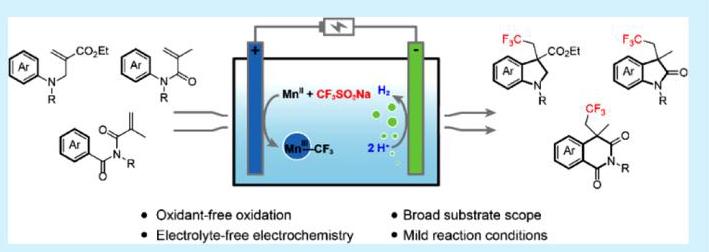
ABSTRACT: A general electrohemical strategy for the combined trifluoromethylation/C $\left( {\mathrm{{sp}}}^{2}\right) - \mathrm{H}$ functionalization using Langlois’ reagent as the ${\mathrm{{CF}}}_{3}$ source under oxidant-free conditions was developed. Using Mn salts as the redox mediator, this method provides an efficient and sustainable means to access a variety of functionalized heterocycles bearing a ${\mathrm{{CF}}}_{3}$ moiety. Detailed mechanistic studies are consistent with the formation of ${\mathrm{{CF}}}_{3}$ -bound high oxidation state $\mathrm{{Mn}}$ species, suggesting a transition-metal-mediated ${\mathrm{{CF}}}_{3}$ transfer mechanism for this trifluoromethylation $/\mathrm{C}\left( {\mathrm{{sp}}}^{2}\right) - \mathrm{H}$ functionalization process.
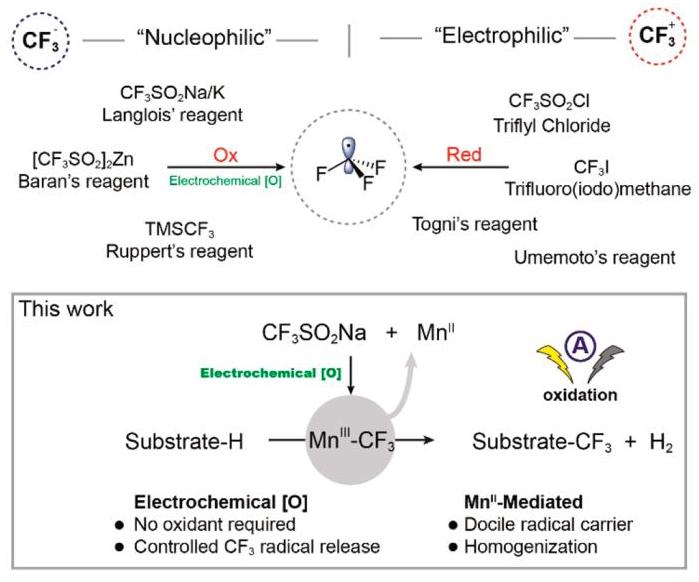
Owing to the prevalence of the trifluoromethyl group in pharmaceuticals, ${}^{1}$ agrochemicals, ${}^{2}$ and functional materials, ${}^{3}$ the development of efficient and sustainable methods for the introduction of the trifluoromethyl group into organic molecules has attracted much attention. ${}^{4}$ Among various means to prepare trifluoromethylated compounds, trifluor-omethylation based on a radical mechanism has been extensively studied and proven highly useful. ${}^{4d}$ Two strategies are commonly used to generate the trifluoromethyl radical, namely, the chemical oxidation of nucleophilic trifluorome-thylation reagents (e.g., Langlois’ reagent and Baran’s reagent) and the single electron reduction of electrophilic trifluor-omethylation reagents (e.g., triflyl chloride, ${\mathrm{{CF}}}_{3}\mathrm{I}$ and Togni’s reagent) (Scheme 1). Despite their synthetic utility, the use of stoichiometric quantities of chemical oxidants or reductants inevitably generates environmentally hazardous waste and greatly reduces the functional group compatibility of these methods.
To address these limitations, organic electrochemistry represents a very attractive alternative to conventional redox transformations, wherein the substrate or reagent can directly undergo redox processes without the use of stoichiometric chemical oxidants/reductants. ${}^{5}$ As a part of our program directed toward the development of novel electrochemical methods for organic synthesis, ${}^{6}$ we recently became interested in using the bench stable and highly inexpensive Langlois’ reagent $\left( {{\mathrm{{CF}}}_{3}{\mathrm{{SO}}}_{2}\mathrm{{Na}}}\right)$ for radical trifluoromethylation under electrochemical conditions. In this approach, cathodic hydrogen evolution balances the oxidative part of the redox cycle, thus making the overall transformation oxidant-free. Addtion-ally, the release of reactive intermediate $\left( {{\mathrm{{CF}}}_{3} \cdot }\right)$ can be easily regulated by electric current, allowing the reaction to proceed in a controlled maner. Moreover, the use of a transition metal redox mediator can benefit the reaction by enabling the key steps of the aimed transformation being conducted homogeneously. Despite these desirable features, electrochemical trifluoromethylation is still rare and has only been applied in a few examples, including the C-H functionalization of electron-rich arenes ${}^{7}$ and heterocycles ${}^{8}$ and olefin difunction-alization. ${}^{9}$
Scheme 1. Conventional and Electrochemical Approaches to the Generation of Trifluoromethyl Radical
Received: December 16, 2018
Oxindole is an important structural motif in numerous natural products and bioactive compounds, and trifluorome-thylated oxindoles and their analogs hold great promise for application in medicinal chemistry. ${}^{10}$ Previous synthetic routes toward these molecules all required the use of stoichiometric quantities of chemical oxidants or reductants to generate the key trifluoromethyl radical species. ${}^{11}$ Herein, we report a general Mn-mediated electrochemical trifluoromethylation for the construction of a variety of trifluoromethyl-containing oxindoles and related heterocycles to bypass the use of stoichiometric chemical oxidants. Notably, a variety of substrates, including those previously unexplored ones, are readily accommodated by this electrochemical process, affording a diverse range of trifluoromethylated heterocycles bearing an all-carbon quaternary center in excellent yield. ${}^{12}$
Using $N$ -methyl- $N$ -phenylmethacrylamide (1a) as the model substrate, we commenced our study on the electrochemical trifluoromethylation/C $\left( {\mathrm{{sp}}}^{2}\right) - \mathrm{H}$ functionalization using Langlois reagent as the ${\mathrm{{CF}}}_{3}$ source. The use of a catalytic amount of redox active transition-metal species was found to be critical for this transformation, and manganese salts proved to be optimal for this process. ${}^{13}$ After extensive optimization, we found that using ${\mathrm{{MnBr}}}_{2}$ as the mediator, ${\mathrm{H}}_{3}{\mathrm{{PO}}}_{4}$ as the sacrificial oxidant, and Pt meshes as the electrodes with a constant electric current of ${10}\mathrm{\;{mA}}$ for $6\mathrm{\;h}$ , the desired trifluoromethyl-substituted oxindole product 2a formed in 67% yield (Table 1, entry 1). Control experiment in the absence of manganese salt only provided 12% yield of 2a (entry 2), thereby demonstrating the pivotal role of the manganase catalyst. We found that ${\mathrm{{MnSO}}}_{4}$ also catalyzed this trifluor-omethylation/C $\left( {\mathrm{{sp}}}^{2}\right) - \mathrm{H}$ functionalization reaction, albeit in lower yield (entry 3). In contrast, other transition metal salts such as ${\mathrm{{NiBr}}}_{2}$ were found to be ineffective (entry 4). Additionally, when the reaction was carried out at room temperature, only a trace amount of product was observed (entry 5). Other polar and water miscible solvents, such as DMA and MeCN, were less efficient (entries 6 and 7). It was found that the use of an acid additive such as ${\mathrm{H}}_{3}{\mathrm{{PO}}}_{4}$ can significantly improve the rate of proton reduction on the Pt electrode, and the yield of 2a was much lower in the absence of ${\mathrm{H}}_{3}{\mathrm{{PO}}}_{4}$ (entry 8). Replacing ${\mathrm{H}}_{3}{\mathrm{{PO}}}_{4}$ with a weaker acid, HOAc, resulted in a similar yield (entry 9). No reaction occurred in the absence of externally applied potential (entry 10). Notably, we were able to avoid the use of electrolytes for this transformation, thus further fulfilling the requirement of green and sustainable chemistry.
Table 1. Reaction Development and Optimization ${}^{a}$

| entry | deviation from the standard conditions | yield ${\% }^{b}$ |
| 1 | none | 69 (67) |
| 2 | no Mn salt | 12 |
| 3 | ${\mathrm{{MnSO}}}_{4}$ instead of ${\mathrm{{MnBr}}}_{2} \cdot 4{\mathrm{H}}_{2}\mathrm{O}$ | 54 |
| 4 | ${\mathrm{{NiBr}}}_{2}$ instead of ${\mathrm{{MnBr}}}_{2} \cdot 4{\mathrm{H}}_{2}\mathrm{O}$ | trace |
| 5 | room temperature | trace |
| 6 | DMA instead of 1,4-dioxane | 53 |
| 7 | MeCN instead of 1,4-dioxane | 58 |
| 8 | no ${\mathrm{H}}_{3}{\mathrm{{PO}}}_{4}$ | 27 |
| 9 | $\mathrm{{AcOH}}$ instead of ${\mathrm{H}}_{3}{\mathrm{{PO}}}_{4}$ | 66 |
| 10 | no electricity | 0 |
${}^{a}$ Reaction conditions: ${0.3}\mathrm{{mmol}}$ scale,1,4-dioxane $3\mathrm{{mL}},{\mathrm{H}}_{2}\mathrm{O}{0.3} \; \mathrm{{mL}}$ , Pt gauze electrodes $\left( {1\mathrm{\;{cm}} \times 1\mathrm{\;{cm}},{52}\text{ meshes }}\right)$ were applied. cc, constant current. 1.5 equiv of ${\mathrm{{CF}}}_{3}{\mathrm{{SO}}}_{2}\mathrm{\;{Na}}$ was added at the beginning. After $3\mathrm{\;h}$ , another1.5equiv of ${\mathrm{{CF}}}_{3}{\mathrm{{SO}}}_{2}\mathrm{{Na}}$ was then added. ${}^{b}$ Yields were determined by ${}^{1}\mathrm{H}$ NMR spectroscopic analysis using 1,3,5- trimethoxybenzene as the internal standard. Isolated yield are shown in parentheses.
With the optimized reaction conditions in hand, we next surveyed the substrate scope of this trifluoromethylation/ $\mathrm{C}\left( {\mathrm{{sp}}}^{2}\right) - \mathrm{H}$ functionalization process (Scheme 2). A wide range of $N$ -arylmethacrylamide derivatives bearing different sub-stituents on aryl ring was found to be excellent substrates. Substrates bearing electron-withdrawing (2c-2i) or electron-donating groups (2b and 2j) afforded the desired products. Notably, this anodic oxidative process tolerated a variety of functional groups, such as an ester (2i), halides (2d-2g), a nitrile (2h), and a free alcohol (2o). Substrates with different protecting groups on the nitrogen atom $\left( {1\mathrm{k} - 1\mathrm{o}}\right)$ were also successfully transformed to the corresponding oxindole derivatives (2k-2o) in good yields (67-77%). Finally, this reaction was also compatible with a fused ring system (2k).
Scheme 2. Oxidant-Free Electrochemical Trifluoromethylation-Initiated Radical Oxidative Annulation towards Oxindoles ${}^{a}$
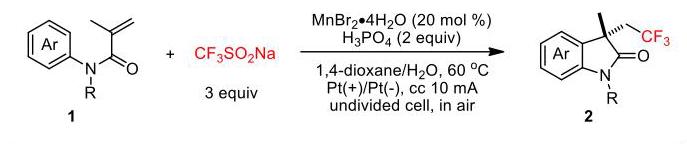
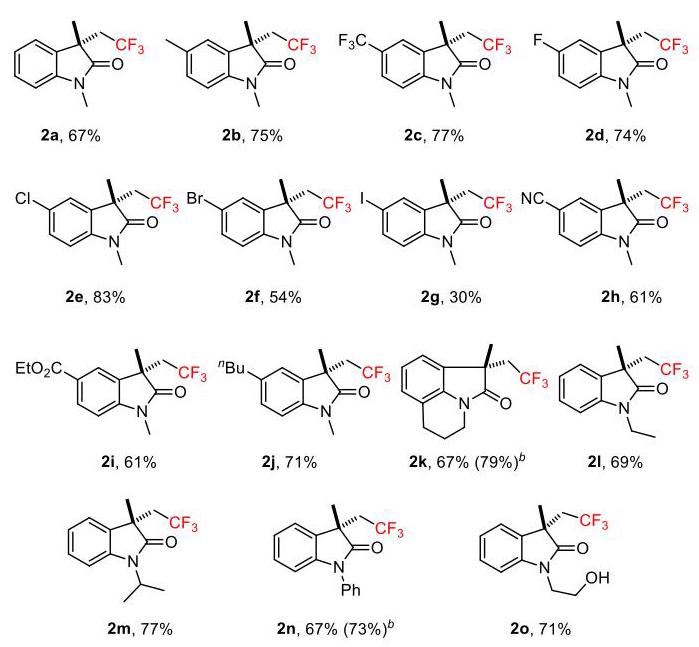
${}^{a}$ Reaction conditions: 1 (0.3 mmol), ${\mathrm{{MnBr}}}_{2}$ (0.06 mmol,0.2 equiv), 1,4-dioxane $3\mathrm{\;{mL}},{\mathrm{H}}_{2}\mathrm{O}{0.3}\mathrm{\;{mL}}$ , Pt gauze electrodes $(1\mathrm{\;{cm}} \times 1\mathrm{\;{cm}},{52}$ meshes) were applied. cc, constant current. 1.5 equiv ${\mathrm{{CF}}}_{3}{\mathrm{{SO}}}_{2}\mathrm{{Na}}$ was added at the beginning. After 3 h, another 1.5 equiv was added. Isolated yields were given. ${}^{b}$ isolated yields from ref 11f were given. Reaction conditions of ref 11f: $1\left( {{0.25}\mathrm{{mmol}}}\right) ,{\mathrm{{CF}}}_{3}{\mathrm{{SO}}}_{2}\mathrm{{Na}}({0.75} \; \mathrm{{mmol}}),{\mathrm{K}}_{2}{\mathrm{\;S}}_{2}{\mathrm{O}}_{8}$ (2 equiv), ${\mathrm{{CH}}}_{3}\mathrm{{CN}}/{\mathrm{H}}_{2}\mathrm{O}$ (2. $5\mathrm{\;{mL}},4/1),{80}^{ \circ }\mathrm{C},{12} - \; {36}\mathrm{\;h}$ , under ${\mathrm{N}}_{2}$ .
Further investigations revealed that the current electrochemical trifluoromethylation $/\mathrm{C}\left( {\mathrm{{sp}}}^{2}\right) - \mathrm{H}$ functionalization is a widely applicable strategy and could be readily applied in the synthesis of ${\mathrm{{CF}}}_{3}$ -substituted indoline derivatives (Scheme 3) and ${\mathrm{{CF}}}_{3}$ -containing hydroisoquinoline-1,3-dione derivatives (Scheme 4). A variety of $N$ -arylamide acrylates 3 and $N$ - methacryloyl- $N$ -methylarylamides 5 could be converted to the corresponding trifluoromethylated indoline and hydroisoqui-noline-1,3-dione derivatives in good yields. Of special note, the trifluoromethylation/C $\left( {\mathrm{{sp}}}^{2}\right) - \mathrm{H}$ functionalization of substrates 3 type of compounds has not been reported before.
Scheme 3. Oxidant-Free Electrochemical Trifluoromethylation-Initiated Radical Oxidative Cyclization towards Indolines ${}^{a}$
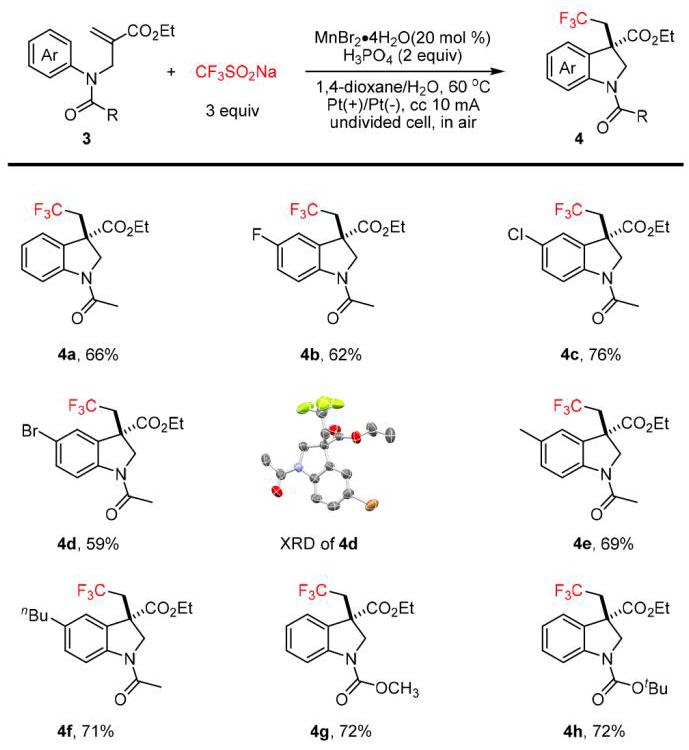
“Reaction conditions: 3 (0.3 mmol), MnBr, (0.06 mmol, 0.2 equiv), 1,4-dioxane $3\mathrm{\;{mL}},{\mathrm{H}}_{2}\mathrm{O}{0.3}\mathrm{\;{mL}}$ , Pt gauze electrodes $(1\mathrm{\;{cm}} \times 1\mathrm{\;{cm}},{52}$ meshes) were applied. cc, constant current. 1.5 equiv ${\mathrm{{CF}}}_{3}{\mathrm{{SO}}}_{2}\mathrm{{Na}}$ was added at the beginning. After $3\mathrm{\;h}$ , another 1.5 equiv was added. Isolated yields were given.
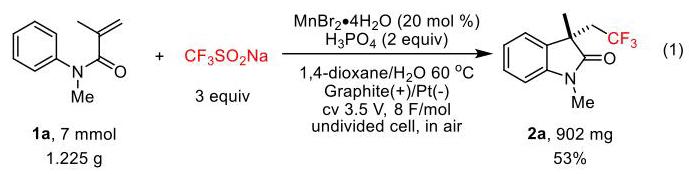
To further demonstrate the utility of this electrochemical protocol, a gram-scale synthesis of oxindole 2a was carried out under air (eq 1). This reaction was performed with graphite as the anode and platinum as the cathode, and furnished in 53% isolated yield.
To probe the mechanism of this electrochemical reaction, we performed a series of polarographic and spectroscopic analysis, including cyclic voltammetry (CV), ${}^{19}\mathrm{\;F}$ NMR, and stoichiometric control experiment. First, we investigated the redox behavior of ${\mathrm{{MnBr}}}_{2},{\mathrm{{CF}}}_{3}{\mathrm{{SO}}}_{2}\mathrm{{Na}}$ , $1\mathrm{a}$ and their combination in solution by cyclic voltammetry (Figure 1).
Scheme 4. Oxidant-Free Electrochemical Trifluoromethylation-initiated Radical Oxidative Cyclization towards Hydroisoquinoline-1,3-diones ${}^{a}$
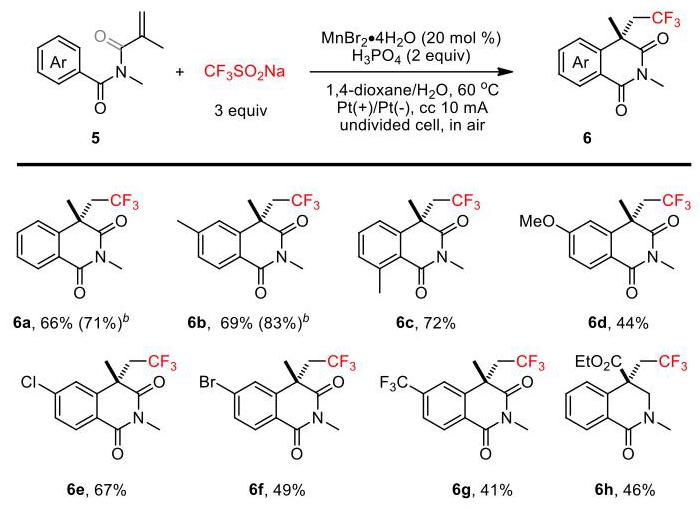
${}^{a}$ Reaction conditions: $5\left( {{0.3}\mathrm{{mmol}}}\right) ,{\mathrm{{MnBr}}}_{2}\left( {{0.06}\mathrm{{mmol}},{0.2}\text{ equiv), }}\right)$ 1,4-dioxane $3\mathrm{\;{mL}},{\mathrm{H}}_{2}\mathrm{O}{0.3}\mathrm{\;{mL}}$ , Pt gauze electrodes $(1\mathrm{\;{cm}} \times 1\mathrm{\;{cm}},{52}$ meshes) were applied. cc, constant current. 1.5 equiv ${\mathrm{{CF}}}_{3}{\mathrm{{SO}}}_{2}\mathrm{{Na}}$ was added at the beginning. After $3\mathrm{\;h}$ , another 1.5 equiv was added. Isolated yields were given. ${}^{b}$ Isolated yields from ref 11i were given. Reaction conditions of ref 11i: 5, ${\mathrm{{CF}}}_{3}{\mathrm{{SO}}}_{2}\mathrm{{Na}}$ (3.0 equiv),1,2,3,5- tetrakis(carbazol-9-yl)-4,6-dicyanobenzene (4CzIPN,2 mol %), ${\mathrm{N}}_{2}$ (with ${0.5}\mathrm{\;{mol}}\%$ of ${\mathrm{O}}_{2}$ ), rt, $c = {0.02}\mathrm{M}$ , DCE, blue LEDs.
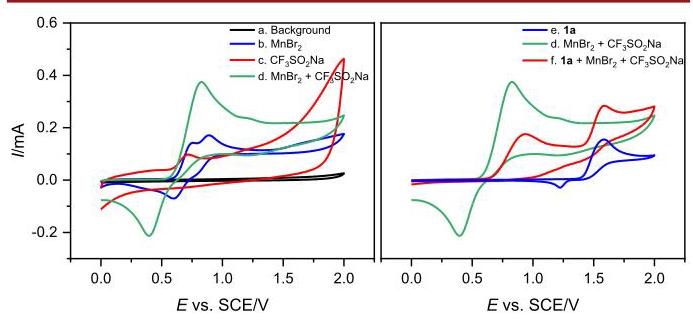
Figure 1. CVs of ${\mathrm{{MnBr}}}_{2},{\mathrm{{CF}}}_{3}{\mathrm{{SO}}}_{2}\mathrm{{Na}}$ , and substrate 1a. Conditions: a L-type glassy carbon working electrode, a saturated calomel electrode (SCE) reference electrode, and a platinum wire counter electrode, ${\mathrm{{LiClO}}}_{4}\left( {{0.10}\mathrm{M}\text{ in MeCN }}\right)$ , TFA $\left( {{60}\mathrm{{mM}}}\right) ,{0.1}\mathrm{\;V}/\mathrm{s}$ with (a) Background; (b) ${\mathrm{{MnBr}}}_{2} \cdot 4{\mathrm{H}}_{2}\mathrm{O}\left( {2\mathrm{{mM}}}\right)$ ; (c) ${\mathrm{{CF}}}_{3}{\mathrm{{SO}}}_{2}\mathrm{{Na}}\left( {8\mathrm{{mM}}}\right)$ ; (d) ${\mathrm{{MnBr}}}_{2} \cdot 4{\mathrm{H}}_{2}\mathrm{O}\left( {2\mathrm{{mM}}}\right)$ and ${\mathrm{{CF}}}_{3}{\mathrm{{SO}}}_{2}\mathrm{{Na}}\left( {8\mathrm{{mM}}}\right)$ ; (e) $1\mathrm{a}\left( {4\mathrm{{mM}}}\right)$ ; (f) 1a ( $4\mathrm{{mM}}$ ), ${\mathrm{{MnBr}}}_{2} \cdot 4{\mathrm{H}}_{2}\mathrm{O}$ ( $2\mathrm{{mM}}$ ) and ${\mathrm{{CF}}}_{3}{\mathrm{{SO}}}_{2}\mathrm{{Na}}$ ( $8\mathrm{{mM}}$ ).
The TFA/MeCN solution of ${\mathrm{{MnBr}}}_{2}$ displays a quasi-reversible anodic wave (line b) of 0.75 and ${0.89}\mathrm{\;V}$ and cathodic wave of ${0.60}\mathrm{\;V}$ versus saturated calomel electrode (SCE), which we attributed to the ${\mathrm{{Mn}}}^{\mathrm{{II}}}/{\mathrm{{Mn}}}^{\mathrm{{III}}}$ redox couple of the bromide-bound complex and the direct oxidation of free ${\mathrm{{Br}}}^{ - }$ . ${\mathrm{{CF}}}_{3}{\mathrm{{SO}}}_{2}\mathrm{{Na}}$ shows an irreversible anodic wave at ${0.71}\mathrm{\;V}$ (line c). Furthermore, the combination of ${\mathrm{{MnBr}}}_{2}$ and ${\mathrm{{CF}}}_{3}{\mathrm{{SO}}}_{2}\mathrm{{Na}}$ exhibits a quasi-reversible anodic CV feature at ${0.83}\mathrm{\;V}$ (line d), which we attributed to the ${\mathrm{{Mn}}}^{\mathrm{{II}}}/{\mathrm{{Mn}}}^{\mathrm{{III}}}$ redox couple of the ${\mathrm{{CF}}}_{3}$ -bound complex. The lower cathodic-to-anodic peak current ratio $\left( {{I}_{\mathrm{c}}/{I}_{\mathrm{a}} = {0.56}}\right)$ reflects the instability and high reactivity of ${\mathrm{{Mn}}}^{\mathrm{{III}}} - {\mathrm{{CF}}}_{3}$ under these conditions. $\mathrm{{CV}}$ of $1\mathrm{a}$ shows a relatively higher oxidation wave larger than ${1.5}\mathrm{\;V}$ , indicating its unlikely interacting with electrodes directly in the presence of Mn salt and Langlois’ reagent. Addition of 1a to a mixture of ${\mathrm{{MnBr}}}_{2}$ and ${\mathrm{{CF}}}_{3}{\mathrm{{SO}}}_{2}\mathrm{{Na}}$ resulted in the appearance of two irreversible anodic waves of 0.94 and ${1.59}\mathrm{\;V}$ (line f), which corresponds to the formation of the putative ${\mathrm{{Mn}}}^{\mathrm{{III}}} - {\mathrm{{CF}}}_{3}$ and the single electron oxidation leading to the formation of the final product (vide infra, Scheme 5).
Scheme 5. Stoichiometric Experiment
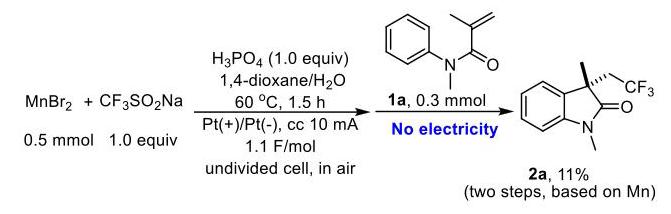
To gain more insight into the mechanism of this Mn-mediated electrochemical trifluoromethylation, the electrochemical reaction of ${\mathrm{{CF}}}_{3}{\mathrm{{SO}}}_{2}\mathrm{{Na}}$ and ${\mathrm{{Mn}}}^{\mathrm{{II}}}$ was studied with ${}^{19}\mathrm{\;F}$ NMR spectroscopy. In accord with literature, free ${\mathrm{{CF}}}_{3}{\mathrm{{SO}}}_{2}\mathrm{{Na}}$ reagent shows a singlet peak at $- {87.5}\mathrm{{ppm}}{.}^{14}$ When electric current of ${1.1}\mathrm{\;F}/\mathrm{{mol}}$ was applied, the ${}^{19}\mathrm{\;F}$ NMR signal of ${\mathrm{{CF}}}_{3}{\mathrm{{SO}}}_{2}\mathrm{{Na}}$ disappeared, indicating its complete consumption upon electrolysis. New peaks around -73.0 ppm appearance indicated new ${\mathrm{{CF}}}_{3}$ species formation (Figure S4).
Moreover, we performed an electrically controlled stoichiometric experiment. We first applied electricity of ${1.1}\mathrm{\;F}/\mathrm{{mol}}$ to the dioxane $/{\mathrm{H}}_{2}\mathrm{O}$ solution of ${\mathrm{{MnBr}}}_{2}$ and ${\mathrm{{CF}}}_{3}{\mathrm{{SO}}}_{2}\mathrm{{Na}}$ and then introduced substrate 1a. The mixture was allowed to react in the absence of external electricity, and this two-step reaction afforded the desired product (2a) in 11% isolated yield. The result showed that the electrochemically generated high oxidation state Mn species can function both as a ${\mathrm{{CF}}}_{3}$ carrier and an oxidant for the trifluoromethylation $/\mathrm{C}\left( {\mathrm{{sp}}}^{2}\right) - \mathrm{H}$ functionalization.
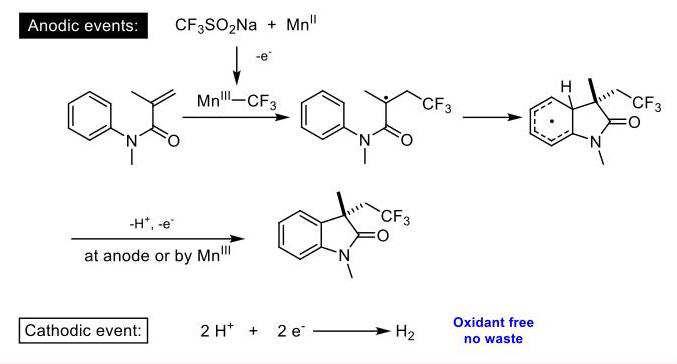
Based on these mechanistic studies, a plausible mechanism for the trifluoromethylation/C $\left( {\mathrm{{sp}}}^{2}\right) - \mathrm{H}$ functionalization is proposed in Scheme 6. At the anode, the ${\mathrm{{Mn}}}^{\mathrm{{III}}} - {\mathrm{{CF}}}_{3}$ species is generated by anodic oxidation of ${\mathrm{{Mn}}}^{\mathrm{{II}}}$ in the presence of Langlois reagent. Subsequently, $\mathrm{{Mn}}$ -assisted delivery of ${\mathrm{{CF}}}_{3}$ - to the olefin moiety provides a transient carbon centered radical. Further radical addition to the aromatic ring followed by either anode or ${\mathrm{{Mn}}}^{\mathrm{{III}}}$ -mediated oxidation furnishes the final $\mathrm{C}\left( {\mathrm{{sp}}}^{2}\right) -$ H functionalization product. At the cathode, reduction of proton to dihydrogen takes place to balance the overall transformation.
Scheme 6. Proposed Reaction Events on Both Electrodes and in Bulk Solvent
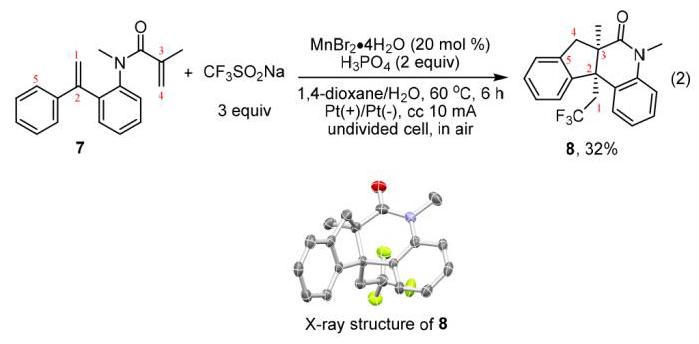
Finally, we found that this electrochemical C-H trifluor-omethylation method could be applied in the rapid construction of complex ring systems. Under the same reaction conditions as described above, trifluoromethlated product 8 featuring bicyclic ring systems could be conveniently synthesized in 32% yield (eq 2). Further extension of this electrochemical trifluoromethylation process to the preparation of other complex polycyclic compounds is currently underway in our laboratory.
In summary, we have developed a general Mn-mediated electrochemical protocol for the trifluoromethylation/C $\left( {\mathrm{{sp}}}^{2}\right) -$ H functionalization process. This method provides a sustainable means for the synthesis of a variety of trifluoromethylated oxindoles and related heterocycles. We expect that these efforts will guide the further development of synthetically useful electrochemical organic transformations.
ASSOCIATED CONTENT
3 Supporting Information
The Supporting Information is available free of charge on the ACS Publications website at DOI: 10.1021/acs.or-glett.8b04010.
Experimental procedures, additional information, and characterization data (PDF)
Accession Codes
CCDC 1885350 and 1890462 contain the supplementary crystallographic data for this paper. These data can be obtained free of charge via www.ccdc.cam.ac.uk/data_request/cif, or by contacting The Cambridge Crystallographic Data Centre, 12 Union Road, Cambridge CB2 1EZ, UK; fax: +44 1223 336033.
AUTHOR INFORMATION
Corresponding Author
ORCID ®
Lei Zhang: 0000-0001-9031-4318
Guoquan Liu: 0000-0003-0680-4811
Yang Yang: 0000-0002-4956-2034
Fanyang Mo: 0000-0002-4140-3020
Present Address
${}^{ \bot }$ Jiangsu Weiming Environmental Protection S&T Co., Itd.
Notes
The authors declare no competing financial interest.
I ACKNOWLEDGMENTS
The project was supported by the Natural Science Foundation of China (Grants 21772003). We also thank the “1000-Youth Talents Plan” and Peking University for start-up funds.
The project was supported by the Natural Science Foundation of China (Grants 21772003). We also thank the “1000-Youth Talents Plan” and Peking University for start-up funds.
R REFERENCES
(1) (a) Müller, K.; Faeh, C.; Diederich, F. Science 2007, 317, 1881. (b) Purser, S.; Moore, P. R.; Swallow, S.; Gouverneur, V. Chem. Soc. Rev. 2008, 37, 320.
(2) Peter, J. ChemBioChem 2004, 5, 570.
(3) (a) Iacono, S. T.; Iyer, S. S., Eds. Handbook of Fluoropolymer Science and Technology; John Wiley & Sons, Inc.: Hoboken, NJ, 2014. (b) Hiyama, T.; Yamamoto, H., Fluorine-Containing Materials. In Organofluorine Compounds: Chemistry and Applications, Yamamoto, H., Ed. Springer Berlin Heidelberg: Berlin, Heidelberg, 2000; pp 183.
(4) (a) Furuya, T.; Kamlet, A. S.; Ritter, T. Nature 2011, 473, 470. (b) Nie, J.; Guo, H.-C.; Cahard, D.; Ma, J.-A. Chem. Rev. 2011, 111, 455. (c) Tomashenko, O. A.; Grushin, V. V. Chem. Rev. 2011, 111, 4475. (d) Studer, A. Angew. Chem., Int. Ed. 2012, 51, 8950. (e) Sebastián, B. V.; Beatriz, L.; Al, P. Chem. - Eur. J. 2014, 20, 16806. (f) Charpentier, J.; Früh, N.; Togni, A. Chem. Rev. 2015, 115, 650. (g) Liu, X.; Xu, C.; Wang, M.; Liu, Q. Chem. Rev. 2015, 115, 683. (h) Wang, L.; Studer, A. Org. Lett. 2017, 19, 5701. (i) Kautzky, J. A.; Wang, T.; Evans, R. W.; MacMillan, D. W. C. J. Am. Chem. Soc. 2018, 140, 6522. (j) Le, C.; Chen, T. Q.; Liang, T.; Zhang, P.; MacMillan, D. W. C. Science 2018, 360, 1010. (k) Lubbesmeyer, M.; Leifert, D.; Schafer, H.; Studer, A. Chem. Commun. 2018, 54, 2240.
(5) (a) Moeller, K. D. Tetrahedron 2000, 56, 9527. (b) Yoshida, J.-i.; Kataoka, K.; Horcajada, R.; Nagaki, A. Chem. Rev. 2008, 108, 2265. (c) Francke, R.; Little, R. D. Chem. Soc. Rev. 2014, 43, 2492. (d) Horn, E. J.; Rosen, B. R.; Baran, P. S. ACS Cent. Sci. 2016, 2, 302. (e) Yan, M.; Kawamata, Y.; Baran, P. S. Chem. Rev. 2017, 117, 13230. (f) Jiang, Y.; Xu, K.; Zeng, C. Chem. Rev. 2018, 118, 4485. (g) Möhle, S.; Zirbes, M.; Rodrigo, E.; Gieshoff, T.; Wiebe, A.; Waldvogel, S. R. Angew. Chem., Int. Ed. 2018, 57, 6018. (h) Tang, S.; Liu, Y.; Lei, A. Chem. 2018, 4, 27. (i) Waldvogel, S. R.; Lips, S.; Selt, M.; Riehl, B.; Kampf, C. J. Chem. Rev. 2018, 118, 6706. (j) Wiebe, A.; Gieshoff, T.; Möhle, S.; Rodrigo, E.; Zirbes, M.; Waldvogel, S. R. Angew. Chem., Int. Ed. 2018, 57, 5594.
(6) (a) Liu, Q.; Sun, B.; Liu, Z.; Kao, Y.; Dong, B.-W.; Jiang, S.-D.; Li, F.; Liu, G.; Yang, Y.; Mo, F. Chem. Sci. 2018, 9, 8731. (b) Zhang, L.; Zhang, Z.; Hong, J.; Yu, J.; Zhang, J.; Mo, F. J. Org. Chem. 2018, 83, 3200. (c) Zhang, L.; Zhang, Z.; Zhang, J.; Li, K.; Mo, F. Green Chem. 2018, 20, 3916.
(7) Tommasino, J.-B.; Brondex, A.; Médebielle, M.; Thomalla, M.; Langlois, B. R.; Billard, T. Synlett 2002, 2002, 1697.
(8) O’Brien, A. G.; Maruyama, A.; Inokuma, Y.; Fujita, M.; Baran, P. S.; Blackmond, D. G. Angew. Chem., Int. Ed. 2014, 53, 11868.
(9) (a) Ye, K.-Y.; Pombar, G.; Fu, N.; Sauer, G. S.; Keresztes, I.; Lin, S. J. Am. Chem. Soc. 2018, 140, 2438. (b) Ye, K.-Y.; Song, Z.; Sauer, G. S.; Harenberg, J. H.; Fu, N.; Lin, S. Chem. - Eur. J. 2018, 24, 12274. (c) Zhang, L.; Zhang, G.; Wang, P.; Li, Y.; Lei, A. Org. Lett. 2018, 20, 7396.
(10) (a) Marti, C.; Carreira, E. M. Eur. J. Org. Chem. 2003, 2003, 2209. (b) Galliford, C. V.; Scheidt, K. A. Angew. Chem., Int. Ed. 2007, 46, 8748. (c) Zhou, F.; Liu, Y.-L.; Zhou, J. Adv. Synth. Catal. 2010, 352, 1381.
(11) (a) Mu, X.; Wu, T.; Wang, H.-y.; Guo, Y.-l.; Liu, G. J. Am. Chem. Soc. 2012, 134, 878. (b) Lin, J.-S.; Liu, X.-G.; Zhu, X.-L.; Tan, B.; Liu, X.-Y. J. Org. Chem. 2014, 79, 7084. (c) Lu, Q.; Liu, C.; Peng, P.; Liu, Z.; Fu, L.; Huang, J.; Lei, A. Asian J. Org. Chem. 2014, 3, 273. (d) Tang, X.-J.; Thomoson, C. S.; Dolbier, W. R. Org. Lett. 2014, 16, 4594. (e) Li, L.; Deng, M.; Zheng, S.-C.; Xiong, Y.-P.; Tan, B.; Liu, X.-Y. Org. Lett. 2014, 16, 504. (f) Wei, W.; Wen, J.; Yang, D.; Liu, X.; Guo, M.; Dong, R.; Wang, H. J. Org. Chem. 2014, 79, 4225. (g) An, Y.; Li, Y.; Wu, J. Org. Chem. Front. 2016, 3, 570. (h) Sakamoto, R.; Kashiwagi, H.; Selvakumar, S.; Moteki, S. A.; Maruoka, K. Org. Biomol. Chem. 2016, 14, 6417. (i) Lu, M.; Liu, Z.; Zhang, J.; Tian, Y.;
Qin, H.; Huang, M.; Hu, S.; Cai, S. Org. Biomol. Chem. 2018, 16, 6564.
(12) During the preparation of this work, a similar work was reported by Zeng. Jiang, Y.-Y.; Dou, G.-Y.; Xu, K.; Zeng, C.-C. Org. Chem. Front. 2018, 5, 2573.
(13) (a) Fu, N.; Sauer, G. S.; Lin, S. J. Am. Chem. Soc. 2017, 139, 15548. (b) Fu, N.; Sauer, G. S.; Saha, A.; Loo, A.; Lin, S. Science 2017, 357, 575.
(14) Langlois, B. R.; Billard, T.; Mulatier, J.-C.; Yezeguelian, C. J. Fluorine Chem. 2007, 128, 851.