Direct Conversion of Arylamines to Pinacol Boronates: A Metal-Free Borylation Process
中文 / Bilingual · English version
Fanyang Mo, Yubo Jiang, Di Qiu, Yan Zhang, and Jianbo Wang*
Arylboronic acids or arylboronates have found widespread applications in transition-metal-catalyzed C-C bond forming reactions, as represented by the Suzuki-Miyaura cross-coupling reaction. ${}^{\left\lbrack 1\right\rbrack }$ These applications have created an increasing demand for various boronic acids and esters. ${}^{\left\lbrack 2\right\rbrack }$ The most commonly utilized method to prepare these boron compounds is the reaction of aryl Grignard reagents or aryllithium reagents with trialkyl borates followed by hydrolytic workup. ${}^{\left\lbrack 3\right\rbrack }$ This traditional approach, although still widely used, suffers some obvious drawbacks such as rigorous anhydrous conditions and narrow functional group compatibility. In 1995, Miyaura and co-workers reported a Pd-catalyzed cross coupling of arylbromides or iodides with a diboron pinacol (pin). ${}^{\left\lbrack 4\right\rbrack }$ The favorable tolerance of this method to a variety of functional groups means that it is now well-established as a complementary route to arylboro-nates. ${}^{\left\lbrack 5 - 8\right\rbrack }$ In addition to these two important methods, it should be mentioned that great efforts have been made in transition-metal-catalyzed direct borylation of aromatic $\mathrm{C} - \mathrm{H}$ bonds. ${}^{\left\lbrack 9,{10}\right\rbrack }$
Arylamines are cheap and abundant starting materials, which are easily available from arenes through nitration and subsequent reduction. The aromatic amino group can be converted into various functional groups by the Sandmeyer reaction. ${}^{\left\lbrack {11}\right\rbrack }$ The standard procedure for converting aryl-amines to arylboronic acids or boronates would need two steps, namely a Sandmeyer reaction to convert the amino group into a halogen group, followed by use of a Grignard reagent or a Pd-catalyzed borylation. Although the two-step procedure is highly reliable and widely used in organic synthesis, the combination of these reactions in the conversion of arylamines to arylboronates is usually not very efficient because of the generally low-yielding and tedious separation procedures required. Moreover, metals that might contaminate the final boron products and cause environmental problems in large-scale production are inevitably involved in these steps. In this context, the direct borylation of arylamines to arylboronates would be highly desirable. Herein, we describe a novel method for the synthesis of arylboronates by the reaction of the diboron pinacol ester ${\mathrm{B}}_{2}{\mathrm{{pin}}}_{2}$ with arylamines in the presence of tert-butyl nitrite. The reaction is metal-free and can be carried out under air at room temperature.
The Sandmeyer reaction is a classic reaction in which an aromatic amino group is replaced with a halogen, ${}^{\left\lbrack {12}\right\rbrack }$ as well as with other groups such as hydrogen, ${}^{\left\lbrack {13}\right\rbrack }$ hydroxy, ${}^{\left\lbrack {14}\right\rbrack }$ cyano, ${}^{\left\lbrack {15}\right\rbrack }$ and azido ${}^{\left\lbrack {16}\right\rbrack }$ groups. Diazonium ions are the common intermediates in these synthetically very useful transformations. In view of the diversity of transformations that occur via diazonium ions, we hypothesized that it might be possible to replace an aromatic amino group with a boron group under Sandmeyer reaction conditions. To the best of our knowledge, this type of transformation has not been reported to date. After some initial attempts, it was concluded that tert-butyl nitrite $\left( {t\mathrm{{BuONO}},\mathbf{3}}\right)$ was a suitable diazotization agent for this transformation. ${}^{\left\lbrack {17}\right\rbrack }$ Thus, a solution of aniline $\mathbf{1}\mathbf{a},{\mathrm{B}}_{2}{\text{ pin }}_{2}\mathbf{2}$ , and $t$ BuONO 3 in acetonitrile was heated at ${60}^{ \circ }\mathrm{C}$ for $1\mathrm{\;h}$ . To our delight, phenylboronate 4a was formed in 40% yield as shown by GC-MS analysis (Table 1, entry 1). Encouraged by this initial result, we further proceeded to optimize the reaction conditions.
Initially, we explored the use of additives that could promote this transformation. Possible additives include KOAc (Table 1, entry 2), which may accelerate trans-boryla-tion of ${\mathrm{B}}_{2}{\mathrm{{pin}}}_{2},{}^{\left\lbrack 4\right\rbrack }$ and metal salts (Table 1, entries 3-6), which may speed up the decomposition of the phenyldiazonium ion. ${}^{\left\lbrack {11}\mathrm{\;b}\right\rbrack }$ However, the reaction was not significantly improved by these additives. Notably, ${\mathrm{{Cu}}}^{\mathrm{I}}$ and ${\mathrm{{Cu}}}^{\mathrm{{II}}}$ salts, which are commonly used in the classic Sandmeyer reaction, afforded 4a in only 8% and 7% yields, respectively (Table 1, entries 3,4). In both cases, diphenylamine was the major product. It was noted that use of $\mathrm{{Fe}}{\left( \mathrm{{OAc}}\right) }_{2}$ significantly improved the yield (Table 1, entry 6). As it is suggested that the Sandmeyer reaction proceeds by a radical mechanism, ${}^{\left\lbrack {11}\mathrm{\;b},{18}\right\rbrack }$ the radical initiators 2,2’-azobisisobutyronitrile (AIBN) and benzoyl peroxide (BPO) were introduced into the reaction mixture in subsequent experiments. It was indeed observed that higher yields could be obtained in the presence of these radical initiators (Table 1, entries 7-13). Furthermore, when BPO was used as an additive, the reaction could be carried out at room temperature with improved yields, although the reaction time was extended from 1 to 3 hours (Table 1, entries 9, 10). The optimized reaction conditions use only 2% of BPO to afford a yield of 77% (Table 1, entry 13). Finally, it was observed that the reaction was marginally affected by solvents (Table 1, entries 14-17).
[*] F. Mo, D. Qiu, Dr. Y. Zhang, Prof. Dr. J. Wang
Beijing National Laboratory of Molecular Sciences (BNLMS) and Key Laboratory of Bioorganic Chemistry and Molecular Engineering of Ministry of Education, College of Chemistry, Peking University Beijing 100871 (China)
Fax: (+ 86) 10-6275-1708
Homepage: http://www.chem.pku.edu.cn/physicalorganic/ home.htm
Y. Jiang
Department of Chemistry, Tongji University
Shanghai 200092 (China)
[**] The project is supported by the NSFC (grant no. 20832002, 20772003, 20821062) and the 973 Program (no. 2009CB825300). The authors greatly appreciate with discussions and suggestions from Profs. Norio Miyaura and Todd B. Marder.
Supporting information for this article is available on the WWW under http://dx.doi.org/10.1002/anie.200905824.
Table 1: Reaction of aniline 1a, ${B}_{2}{\text{ pin }}_{2}$ 2, and $t$ BuONO 3. ${}^{\left\lbrack a\right\rbrack }$
| Ph-Bpin 4a $\mathrm{{Ph}} - {\mathrm{{NH}}}_{2} \; {\mathrm{B}}_{2}{\mathrm{{pin}}}_{2} \; t$ BuONO $\rightarrow$ 1a 2 3 | |||||
| Entry | Ratio (1a/2/3) | Solvent | Additive [mol %] | $T\left\lbrack {{}^{ \circ }\mathrm{C}}\right\rbrack$ | Yield ${\left\lbrack \% \right\rbrack }^{\left\lbrack b\right\rbrack }$ |
| 1 | 1:1:1 | MeCN | none | 60 | 40 |
| 2 | 1:1:1 | MeCN | KOAc (100) | 60 | 30 |
| 3 | 1:1:1 | MeCN | ${\mathrm{{CuPF}}}_{6}{\left( \mathrm{{MeCN}}\right) }_{4}$ (100) | 60 | 8 |
| 4 | 1:1:1.5 | MeCN | $\mathrm{{Cu}}{\left( \mathrm{{OAc}}\right) }_{2}$ (100) | 60 | 7 |
| 5 | 1:1.2:1.5 | MeCN | ${\mathrm{{SnCl}}}_{2}$ (100) | 60 | 29 |
| 6 | 1:1.2:1.5 | MeCN | Fe(OAc) ${}_{2}$ (100) | 60 | 62 |
| 7 | 1:1:1 | MeCN | BPO (10) | 60 | 49 |
| 8 | 1:1:1 | MeCN | AIBN (10) | 60 | 47 |
| 9 | 1:1.2:1.5 | MeCN | BPO (10) | 60 | 57 |
| 10 | 1:1.2:1.5 | MeCN | BPO (10) | RT | 66 |
| 11 | 1:0.5:1.5 | MeCN | BPO (10) | RT | 11 |
| 12 | 1:1.1:1.5 | MeCN | BPO (5) | RT | 70 |
| ${13}^{\left\lbrack c\right\rbrack }$ | 1:1.1:1.5 | MeCN | BPO (2) | RT | 77 |
| 14 | 1:1.1:1.5 | ${\mathrm{{CH}}}_{2}{\mathrm{{Cl}}}_{2}$ | BPO (2) | RT | 49 |
| 15 | 1:1.1:1.5 | dichloroethane | BPO (2) | RT | 65 |
| 16 | 1:1.1:1.5 | toulene | BPO (2) | RT | 65 |
| 17 | 1:1.1:1.5 | EtOAc | BPO (2) | RT | 66 |
[a] Reaction conditions: aniline 1 a (1 mmol), solvent (3 mL). Reaction time: $1\mathrm{\;h}$ for ${60}^{ \circ }\mathrm{C};3\mathrm{\;h}$ for RT. [b] GC-MS yield with mesitylene (1 mmol) as internal standard. [c] The entry in bold represents the optimized reaction conditions.
A series of arylamines were then subjected to the optimized reaction conditions (Table 2). All of the reactions were complete within 2 hours, and afforded the corresponding arylboronates in moderate to good yields. The reaction occurred smoothly with meta- and para-substituted aryl-amines, while the reactions with ortho-substituted arylamines gave lower yields or only trace amounts of product in the case of $o$ -nitroaniline (Table 2, entries 8,11,22). This result might be attributed to steric hindrance of the ortho substituent. In general, substrates with electron-withdrawing groups at the para and meta positions exhibit good reactivity (Table 2, entries $1,3,5,6,9,{10},{13},{14},{20})$ . Substrates with an electron-donating group at the meta position gave trace amounts or even no products. These results indicate that this reaction is significantly affected by steric and electronic effects of the substituents. Finally, it was worth noting that substrates bearing halo substituents could also be employed in this reaction, although the yields were slightly reduced (Table 2, entries 15-19).
The chromatographic separation of arylboronate products is usually tedious and in some cases the boron products are not stable. Therefore, it is desirable to develop procedures that can combine both borylation and the subsequent Suzuki-Miyaura coupling into a one-pot reaction. ${}^{\left\lbrack 9b,{10}u, v\right\rbrack }$ We subse-
Table 2: Reaction of arylamines $1\mathrm{\;b} - \mathrm{w},{\mathrm{B}}_{2}{\mathrm{{pin}}}_{2}2$ , and $t\mathrm{{BuONO}}3$ .
BPO (2 mol%)
${\mathrm{{ArNH}}}_{2} \; 2 + {\mathrm{B}}_{2}{\mathrm{{pin}}}_{2} + t\mathrm{{BuONO}}$
MeCN, RT
Ar-Bpin
Ar - Bpin
1b-w 2 3 4b-w
1b - w 2 3 4b - w
| Entry | $t\left\lbrack \mathrm{h}\right\rbrack$ | Products 4b-w | Yield ${\left\lbrack \% \right\rbrack }^{\left\lbrack a\right\rbrack }$ | |
| 1 | 2 |  4b | 4b | 93 |
| 2 | 2 |  4c | 4c | 70 |
| 3 | 2 |  4d | 4 d | 73 |
| 4 | 2 |  4e | 4e | 72 |
| 5 | 1 |  4f | 4f | 67 |
| 6 | 2 |  4g | 4g | 65 |
| 7 | 1 |  4h | 4 h | 66 |
| 8 | 2 |  4i | 4i | 53 |
| 9 | 1 |  4j | 4 j | 91 |
| 10 | 1 |  4k | 4k | 62 |
| 11 | 1 |  41 | 41 | trace ${}^{\left\lbrack b\right\rbrack }$ |
| ${12}^{\left\lbrack c\right\rbrack }$ | 2 |  4m | 4m | 55 |
| 13 | 2 |  4n | 4n | 75 |
| 14 | 2 |  | 40 | 82 |
| 15 | 2 | 40 4p | 4p | 54 |
| 16 | 2 |  4q | 4q | 54 |
Communications
Table 2: (Continued)
| Entry | t [h] | Products 4b-w | Yield ${\left\lbrack \% \right\rbrack }^{\left\lbrack \mathrm{a}\right\rbrack }$ | |
| ${17}^{\left\lbrack d\right\rbrack }$ | 2 |  4r | 4r | 56 |
| ${18}^{\left\lbrack d\right\rbrack }$ | 2 |  4s | 4s | 30 |
| ${19}^{\left\lbrack d\right\rbrack }$ | 1 |  4t | 4t | 30 |
| 20 | 2 |  4u | 4u | 82 |
| 21 | 1 |  4v | 4v | 41 |
| 22 | 1 |  4w | 4w | 22 |
[a] Yields after isolation by column chromatography. [b] The reaction gave a complex mixture with a trace amount of 4I. [c] Benzidine was used as the substrate with ${\mathrm{B}}_{2}{\mathrm{{pin}}}_{2}$ (2.2 equiv) and tBuONO (3 equiv). [d] Reaction was carried out at ${60}^{ \circ }\mathrm{C}$ with ${10}\%$ BPO and 1.2 equiv of ${\mathrm{B}}_{2}{\mathrm{{pin}}}_{2}$ .
quently investigated the compatibility of our borylation conditions with the conventional Suzuki-Miyaura coupling conditions. As demonstrated by the examples summarized in Scheme 1, the borylation and Pd-catalyzed coupling can be carried out without chromatographic separation of the arylboronate intermediates. In a typical experiment, the arylamine was first converted into the corresponding arylbor-onate under the standard conditions described above. The reaction mixture was then decolorized by addition of activated charcoal and filtered though celite. The crude product was then subjected to the standard Suzuki-Miyaura cross-coupling with iodobenzene. This two-step reaction afforded satisfactory yields.
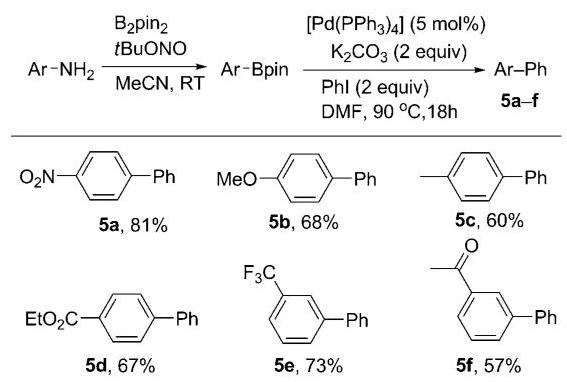
Scheme 1. Sequential borylation and Pd-catalyzed reactions.
The mechanism of this novel metal-free borylation process is not yet clear, but some preliminary observations are included here. ${}^{\left\lbrack {19}\right\rbrack }$ When the borylation was carried out in the presence of 1.5 equivalents of the radical scavenger 2,2,6,6-tetramethyl-1-piperidin-1-oxyl (TEMPO), the reaction became sluggish and phenylboronate was formed in only 8% yield after 4h, thus indicating a possible radical process, as a control experiment demonstrated that TEMPO does not react directly with ${\mathrm{B}}_{2}{\mathrm{{pin}}}_{2}$ under these conditions. To further substantiate the possible radical process, a 1:1 mixture of BPO and ${\mathrm{B}}_{2}{\mathrm{{pin}}}_{2}$ was heated in MeCN at ${100}^{ \circ }\mathrm{C}$ for 1 hour. The phenylboronate was isolated in 37% yield [Eq. (1)]. Since BPO decomposes to give the phenyl radical at temperatures higher than ${100}^{ \circ }\mathrm{C}$ , this experiment provides supportive evidence for radical mechanism.
$$ \begin{array}{l} \text{ PhCOO) }2 + {\mathrm{B}}_{2}{\mathrm{{pin}}}_{2}\;\text{ MeCN } \\ 1\text{ equiv }\;1\text{ equiv } \\ \end{array} \tag{1} $$However, when the phenyl radical was generated in an alternative process (PhI, $n{\mathrm{{Bu}}}_{3}\mathrm{{SnH}}$ , and AIBN), ${}^{\left\lbrack {20}\right\rbrack }$ and was allowed to react with ${\mathrm{B}}_{2}{\mathrm{{pin}}}_{2}$ , the PhBpin product was formed only in 7% yield. Moreover, mechanisms involving direct homolytic substitution (an ${\mathrm{S}}_{\mathrm{H}}2$ process) of the boron compounds by aryl radicals do not seem likely. ${}^{\left\lbrack {21} - {23}\right\rbrack }$ Detailed mechanistic investigations are in progress and will be reported in due course.
In conclusion, we have developed an entirely new approach to the synthesis of arylboronates. The advantages of this method can be summarized as follows: 1) the starting arylamines are inexpensive and readily available; 2) the reaction is metal-free reaction, thus avoiding possible metal contamination of the boron product; 3) the conditions are mild and the reaction can be carried out under air at room temperature; 4) the boronate product can be used in subsequent Pd-catalyzed Suzuki-Miyaura couplings without purification. Consequently, this method serves as an important supplement to the existing methods of arylboronate synthesis.
Experimental Section
Typical procedure for the reaction of aryl amines $1\mathrm{a} - \mathrm{w},{\mathrm{B}}_{2}{\text{ pin }}_{2}2$ , and $t$ BuONO 3: ${\mathrm{B}}_{2}{\mathrm{{pin}}}_{2}\left( {1\mathrm{{mmol}},{254}\mathrm{{mg}}}\right)$ and BPO $\left( {{0.02}\mathrm{{mmol}},5\mathrm{{mg}}}\right)$ were weighed in a ${25}\mathrm{\;{mL}}$ round-bottom flask. MeCN ( $3\mathrm{\;{mL}}$ ), arylamines ( $1\mathrm{\;{mmol}}$ ), and $t\mathrm{{BuONO}}\left( {{1.5}\mathrm{\;{mmol}},{154}\mathrm{{mg}}}\right)$ were then added in succession. The resulting reaction mixture was allowed to stir for $1 - 2\mathrm{\;h}$ at room temperature. The solution was then concentrated under reduced pressure and the residue was purified by flash column chromatography.
Received: October 16, 2009
Revised: January 13, 2010
Published online: February 1, 2010
Keywords: aryl boronates $\cdot$ borylation $\cdot$ cross-coupling $\cdot$ diazo compounds $\cdot$ Sandmeyer reaction
[1] For reviews, see: a) A. Suzuki, Acc. Chem. Res. 1982, 15, 178; b) N. Miyaura, A. Suzuki, Chem. Rev. 1995, 95, 2457; c) A. Suzuki in Metal-Catalyzed Cross-Coupling Reactions (Eds.: F. Diederich, P. J. Stang), Wiley-VCH, Weinheim, 1998, pp. 49-97; d) N. Miyaura, Top. Curr. Chem. 2002, 219, 11; e) S. Kotha, K. Lahiri, D. Kashinath, Tetrahedron 2002, 58, 9633; f) N. Miyaura, J. Organomet. Chem. 2002, 653, 54; g) T. Ishiyama, N. Miyaura, Chem. Rec. 2004, 3, 271; h) N. Miyaura, Bull. Chem. Soc. Jpn. 2008, 81, 1535.
[2] D. G. Hall, Boronic Acids, Wiley, New York, 2005.
[3] a) H. C. Brown, M. Srebnik, T. E. Cole, Organometallics 1986, 5, 2300; b) H. C. Brown, T. E. Cole, Organometallics 1983, 2, 1316.
[4] For a seminal publication, see: a) T. Ishiyama, M. Murata, N. Miyaura, J. Org. Chem. 1995, 60, 7508. For reviews, see: b) T. Ishiyama, N. Miyaura, J. Synth. Org. Chem. Jpn. 1999, 57, 503; c) T. Ishiyama, N. Miyaura, J. Organomet. Chem. 2000, 611, 392; d) N. Miyaura in Catalytic Heterofunctionalization (Eds.: A. Togni, H. Grützmacher), Wiley-VCH, Chichester, 2001, Chapter 3.
[5] a) T. Ishiyama, Y. Itoh, T. Kitano, N. Miyaura, Tetrahedron Lett. 1997, 38, 3447; b) A. Giroux, Y. Han, P. Prasit, Tetrahedron Lett. 1997, 38, 3841; c) D. M. Willis, R. M. Strongin, Tetrahedron Lett. 2000, 41, 8683; d) A. C. Carbonnelle, J. Zhu, Org. Lett. 2000, 2, 3477; e) K. Takahashi, J. Takagi, T. Ishiyama, N. Miyaura, Chem. Lett. 2000, 29, 126; f) M. H. Todd, C. Abell, J. Comb. Chem. 2001, 3, 319; g) T. Ishiyama, K. Ishida, N. Miyaura, Tetrahedron 2001, 57, 9813; h) T. Ishiyama, N. Miyaura, J. Organomet. Chem. 2000, 611, 392; i) A. Fürstner, G. Seidel, Org. Lett. 2002, 4, 541; j) L. Zhu, J. Duquette, M. Zhang, J. Org. Chem. 2003, 68, 3729; k) A. Giroux, Tetrahedron Lett. 2003, 44, 233; 1) K. Billingsley, T. E. Barder, S. L. Buchwald, Angew. Chem. 2007, 119, 5455; Angew. Chem. Int. Ed. 2007, 46, 5359.
[6] For Pd-catalyzed borylation reactions that employ pinacolbor-ane, see: a) M. Murata, S. Watanabe, Y. Masuda, J. Org. Chem. 1997, 62, 6458; b) M. Murata, T. Oyama, S. Watanbe, Y. Masuda, J. Org. Chem. 2000, 65, 164; c) O. Baudoin, D. Guénard, F. Guéritte, J. Org. Chem. 2000, 65, 9268; d) P. E. Broutin, I. Cerna, M. Campaniello, F. Leroux, F. Colobert, Org. Lett. 2004, 6, 4419; e) M. Murata, T. Sambommatsu, S. Watanabe, Y. Masuda, Synlett 2006, 1867.
[7] For a theoretical study, see: M. Sumimoto, N. Iwane, T. Takahama, S. Sakaki, J. Am. Chem. Soc. 2004, 126, 10457.
[8] More recently, a Cu-catalyzed borylation process was reported, see: C. Kleeberg, L. Dang, Z. Lin, T. B. Marder, Angew. Chem. 2009, 121, 5454; Angew. Chem. Int. Ed. 2009, 48, 5350.
[9] For reviews, see: a) T. Ishiyama, N. Miyaura, J. Organomet. Chem. 2003, 680, 3; b) I. A. I. Mkhalid, J. H. Barnard, T. B. Marder, J. C. Murphy, J. F. Hartwig, Chem. Rev. 2010, DOI: 10.1021/cr900206p.
[10] For selected examples, see: a) J. Y. Cho, C. N. Iverson, M. R. Smith III, J. Am. Chem. Soc. 2000, 122, 12868; b) S. Shimada, A. S. Batsanov, J. A. K. Howard, T. B. Marder, Angew. Chem. 2001, 113, 2226; Angew. Chem. Int. Ed. 2001, 40, 2168; c) J. Y. Cho, M. K. Tse, M. R. Smith III, Org. Lett. 2001, 3, 2831; d) J. Y. Cho, M. K. Tse, D. Holmes, R. E. Maleczka, M. R. Smith III, Science 2002, 295, 305; e) J. Takagi, K. Sato, J. F. Hartwig, T. Ishiyama, N. Miyaura, Tetrahedron Lett. 2002, 43, 5649; f) T. Ishiyama, J. Takagi, J. F. Hartwig, N. Miyaura, Angew. Chem. 2002, 114, 3182; Angew. Chem. Int. Ed. 2002, 41, 3056; g) T. Ishiyama, J. Takagi, K. Ishida, N. Miyaura, N. R. Anastasi, J. F. Hartwig, J. Am. Chem. Soc. 2002, 124, 390; h) T. Ishiyama, J. Takagi, Y. Yonekawa, J. F. Hartwig, N. Miyaura, Adv. Synth. Catal. 2003, 345, 1103; i) T. Tagata, M. Nishida, Adv. Synth. Catal. 2004, 346, 1655; j) K. Mertins, A. Zapf, M. Beller, J. Mol. Catal. A 2004, 207, 21; k) T. M. Boller, J. M. Murphy, M. Hapke, T. Ishiyama, N. Miyaura, J. F. Hartwig, J. Am. Chem. Soc. 2005, 127, 14263; 1) G. D. Frey, C. F. Rentzsch, D. V. Preysing, T. Scherg, M. Mühlhofer, E. Herdtweck, W. A. Herrmann, J. Organomet. Chem. 2006, 691, 5725; m) I. A. I. Mkhalid, D. N. Coventry, D. Albesa-Jové, A. S. Batsanov, J. A. K. Howard, R. N. Perutz, T. B. Marder, Angew. Chem. 2006, 118, 503; Angew. Chem. Int. Ed. 2006, 45, 489; n) Y. H. Zhu, K. C. Yan, J. H. Luo, C. S. Hwei, Y. C. Hon, A. Emi, Z. S. Su, M. Winata, N. S. Hosmane, J. A. Maguire, J. Organomet. Chem. 2007, 692, 4244; o) A. D. Finke, J. S. Moore, Org. Lett. 2008, 10, 4851; p) T. A. Boebel, J. F. Hartwig, Tetrahedron 2008, 64, 6824; q) T. A. Boebel, J. F. Hartwig, Organometallics 2008, 27, 6013; r) T. Kikuchi, Y. Nobuta, J. Umeda, Y. Yamamoto, T. Ishiyama, N. Miyaura, Tetrahedron 2008, 64, 4967; s) T. A. Boebel, J. F. Hartwig, J. Am. Chem. Soc. 2008, 130, 7534; t) T. Tagata, M. Nishida, A. Nishida, Tetrahedron Lett. 2009, 50, 6176; u) P. Harrison, J. Morris, P. G. Steel, T. B. Marder, Synlett 2009, 147; v) P. Harrison, J. Morris, T. B. Marder, P. G. Steel, Org. Lett. 2009, 11, 3586; w) N. Iwadate, M. Suginome, J. Organomet. Chem. 2009, 694, 1713; x) T. S. Jo, S. H. Kim, J. Shin, C. Bae, J. Am. Chem. Soc. 2009, 131, 1656; y) S. Kawamorita, H. Ohmiya, K. Hara, A. Fukuoka, M. Sawamura, J. Am. Chem. Soc. 2009, 131, 5058.
[11] For reviews on the Sandmeyer reaction, see; a) H. H. Hodgson, Chem. Rev. 1947, 40, 251; b) C. Galli, Chem. Rev. 1988, 88, 765; c) E. B. Merkushev, Synthesis 1988, 923; d) R. Bohlmann in Comp. Org Synth., Vol. 6 (Eds.: B. M. Trost, I. Fleming), Pergamon, Oxford, 1991, p. 203.
[12] For examples, see: a) D. A. Evans, J. L. Katz, G. S. Peterson, T. Hintermann, J. Am. Chem. Soc. 2001, 123, 12411; b) C. Vergne, M. Bois-Choussy, J. Zhu, Synlett 1998, 1159.
[13] For an example, see: C. Dugave, J. Org. Chem. 1995, 60, 601.
[14] For an example, see: T. Cohen, A. G. Dietz, Jr., J. R. Miser, J. Org. Chem. 1977, 42, 2053.
[15] H. T. Clarke, R. R. Read, Org. Synth. 1941, Vol I, 514.
[16] P. A. S. Smith, B. B. Brown, J. Am. Chem. Soc. 1951, 73, 2438.
[17] a) M. P. Doyle, B. Siegfried, J. F. Dellaria, Jr., J. Org. Chem. 1977, 42, 2426; b) M. P. Doyle, J. F. Dellaria, Jr., B. Siegfried, S. W. Bishop, J. Org. Chem. 1977, 42, 3494.
[18] J. K. Kochi, J. Am. Chem. Soc. 1957, 79, 2942.
[19] See the Supporting Information for details.
[20] B. Giese, Radical in Organic Synthesis: Formation of Carbon-Carbon Bonds, Pergamon, New York, 1986.
[21] C. Ollivier, P. Renaud, Chem. Rev. 2001, 101, 3415.
[22] J. K. Kochi, Free Radicals in Reactive Intermediate in Organic Chemistry, Vol. I, Wiley, New York, 1968, pp. 547-589.
[23] For a rare example of intramolecular homolytic substitution at boron by a carbon-centered radical, see: R. A. Batey, D. V. Smil, Angew. Chem. 1999, 111, 1914; Angew. Chem. Int. Ed. 1999, 38, 1798.