A General Electrochemical Strategy for Sandmeyer Reaction
中文 / Bilingual · English version
Check for updates
Chemical Science
Accepted Manuscript
This article can be cited before page numbers have been issued, to do this please use: Q. Liu, B. Sun, Z. Liu, Y. Kao, B. Dong, S. Jiang, F. Li, G. Liu, Y. Yang and F. Mo, Chem. Sci., 2018, DOI: 10.1039/C8SC03346C.
This is an Accepted Manuscript, which has been through the Royal Society of Chemistry peer review process and has been accepted for publication.
Accepted Manuscripts are published online shortly after acceptance, before technical editing, formatting and proof reading. Using this free service, authors can make their results available to the community, in citable form, before we publish the edited article. We will replace this Accepted Manuscript with the edited and formatted Advance Article as soon as it is available.
You can find more information about Accepted Manuscripts in the author guidelines.
Please note that technical editing may introduce minor changes to the text and/or graphics, which may alter content. The journal’s standard Terms & Conditions and the ethical guidelines, outlined in our author and reviewer resource centre, still apply. In no event shall the Royal Society of Chemistry be held responsible for any errors or omissions in this Accepted Manuscript or any consequences arising from the use of any information it contains.
Chemical Science
A General Electrochemical Strategy for Sandmeyer Reaction
Qianyi Liu, ${}^{a}$ Beiqi Sun, ${}^{a}$ Zheng Liu, ${}^{b}$ Yi Kao, ${}^{b}$ Bo-Wei Dong, ${}^{b}$ Shang-Da Jiang, ${}^{b}$ Feng Li, ${}^{c}$ Guoquan Liu, ${}^{c}$ Yang Yang ${}^{d}$ and Fanyang Mo ${ * }^{a}$
Herein we report a general electrochemical strategy for the Sandmeyer reaction. Using electricity as the driving force, this protocol employs simple and inexpensive halogen source, such as NBS, ${\mathrm{{CBrCl}}}_{3},{\mathrm{{CH}}}_{2}{\mathrm{l}}_{2},{\mathrm{{CCl}}}_{4}$ , LiCl and NaBr for the halogenation of aryl diazonium salts. In addition, we found these electrochemical reactions could be performed using anilines as the starting material in a one-pot fashion. Furthermore, the practicality of this process was demonstrated in the multigram scale synthesis of aryl halides using highly inexpensive graphite as the electrode. A series of detailed mechanism studies has been performed, including radical clock and radical scavenger study, cyclic voltammetry analysis and in situ electron paramagnetic resonance (EPR) analysis.
Received 00th January 20xx, Accepted 00th January 20xx
DOI: 10.1039/x0xx00000x
DOI: 10.1039/x0xx00000x
Introduction
The Sandmeyer reaction represents a fundamentally important method to convert an aryl amine to an aryl halide via the intermediacy of a diazonium salt. ${}^{1}$ Discovered in ${}^{{1884},{}^{2,}{}^{3}}$ this century-old transformation is still being extensively used in modern organic synthesis in both academic and industrial settings. ${}^{4 - 8}$ To date, many synthetically useful variants of Sandmeyer reaction have been reported, including copper metal mediated process (Gattermann reaction), ${}^{9}$ diazotization in organic phases (Doyle diazotization), ${}^{{10},{11}}\mathrm{{Cu}}\left( \mathrm{I}\right)$ -catalyzed process ${}^{12}$ and acetate-facilitated metal-free halogenation. ${}^{13}$ Despite these valuable advances, ${}^{9 - {15}}$ the development of new strategy for Sandmeyer reaction is still of great importance.
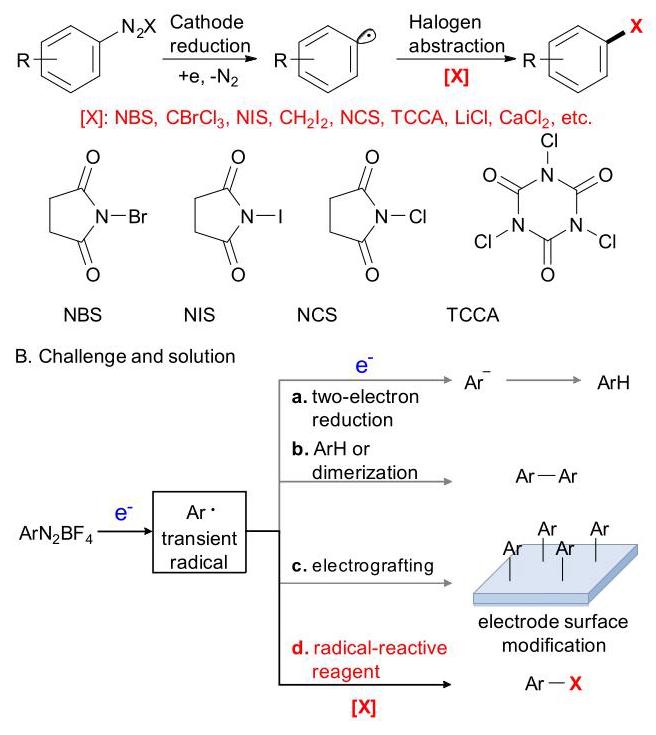
The past decade has witnessed a resurging interest in organic electrochemistry that dramatically improved organic chemists’ ability for green and sustainable synthesis. ${}^{{16} - {29}}$ Our laboratory has been engaged in the development of organic electrochemistry to overcome unmet synthetic challenges. ${}^{{30},{31}}$ In this context, we have recently become interested in electrocatalytic transformations of diazonium salts (Scheme 1A). An efficient electrochemical method for Sandmeyer reaction is hampered by several factors. First, diazonium salts can engage in undesired two-electron reduction, ${}^{{32},} \; {}^{33}$ leading to the formation of an aryl anion that could be easily protonated to give the reduction product (Scheme 1Ba). Second, known as the Gomberg-Bachmann reaction, ${}^{34}$ the transient aryl radical intermediate can react with an arene or another aryl radical to give a biaryl side product (Scheme 1Bb). ${}^{35}$ Third, the well-documented reaction of diazonium salts with the electrode can alter its properties and reduce the efficiency of electrochemical processes (Scheme 1Bc). ${}^{{36} - {38}}$ We envision that the regulation of electric current to control the rate of aryl radical generation and the judicious choice of halogenation reagents to rapidly intercept the nascent aryl radical would be the key to this electrochemical Sandmeyer reaction (Scheme 1Bd). In this report, we demonstrate a general electrochemical strategy for the Sandmeyer halogenation of aryl diazonium salts. Scheme 1 Electrochemical Sandmeyer halogenation reaction.
A. Electrochemical Sandmeyer reaction
a. Department of Energy and Resources Engineering, College of Engineering, Peking University, Beijing 100871, China.
b. Beijing National Laboratory for Molecular Sciences, College of Chemistry and Molecular Engineering, Peking University, Beijing 100871, China.
C. State Key Laboratory of Natural and Biomimetic Drugs, School of Pharmaceutical Sciences, Peking University, Beijing 100871, China.
${}^{d}$ Department of Chemistry, University of California, Berkeley, CA 94720, United States.
Electronic Supplementary Information (ESI) available: [details of any supplementary information available should be included here]. See DOI: 10.1039/x0xx00000x
Results and discussion
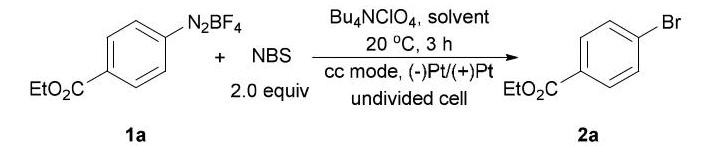
The electrochemical bromination of aryldiazonium tetrafluoroborate 1a was selected as the model reaction with $N$ - bromosuccinimide (NBS) as the halogen source. The results are depicted in Table 1 (entries 1-7). Acetonitrile and DMF were first evaluated due to the good solubility of substrates and electrolytes in these solvents. Under these conditions, the desired product ethyl 4-bromobenzoate (2a) formed in low yields (entry 1-2). The major byproduct was found to be ethyl benzoate as indicated by GC-MS analysis of the crude reaction mixture, showing that protonation or hydrogen abstraction ${}^{11}$ was the major undesired pathway. We then evaluated other solvents, and the use of a mixed solvent system consisting of MeOH and DMF (entries 3-6) provided higher yield of 2a. Under the optimized reaction conditions using a 5:1 (v:v) mixture of MeOH/DMF as the solvent, ${\mathrm{{Bu}}}_{4}{\mathrm{{NClO}}}_{4}$ as the electrolyte and a constant current of ${10}\mathrm{\;{mA}}$ and time of $3\mathrm{\;h}({3.7}\mathrm{\;F}/\mathrm{{mol}}$ electricity), the desired bromination product (2a) formed in 83% yield. Finally, control experiments were conducted without current (entry 7), and significantly lower yield of 2a was observed. This demonstrated that the desired product was predominantly obtained from the electrochemical process.
The iodination of 1a was next examined (entries 8-10). Compared with $N$ -iodosuccinimide (NIS) (entry 8), ${\mathrm{{CH}}}_{2}{\mathrm{I}}_{2}$ was found to be a better iodinating agent in this electrochemical reaction. The desired product (3a) was obtained in 87% isolated yield under the optimized conditions (entry 9). Again, this iodination was unambiguously driven by electricity as revealed by the control experiment (entry 10).
Compared with bromination and iodination, the electrochemical chlorination of diazonium salts was more challenging. Due to the higher electronegativity of chlorine, ${\mathrm{{NCS}}}^{39}$ and ${\mathrm{{TCCA}}}^{40}$ behaved more like oxidants rather than chlorine donors. Inspired by Lin’s recent work on the electrocatalytic chlorination of alkenes, ${}^{{41},{42}}$ we used anodic oxidation to generate chlorine radical from chloride anion. A series of alkali chlorides, cathode materials and solvents were evaluated. Ultimately, LiCI was found to be the optimal chlorine source with nickel as the cathode and acetonitrile as the solvent (entries 13-15).
With the optimal reaction conditions, we then surveyed the substrate scope (Table 2). For bromination using NBS, aryl diazonium salts with an electron-withdrawing group, including an ester (2a-2c), a nitro (2d-2g), a cyano (2h and 2i), a halogen (2j-2l), a trifluoromethyl (2m) and a sulfonyl group (2n), furnished the corresponding brominated products in good to excellent yields. For electron-neutral or electron-rich diazonium salts, the use of NBS led to polybromination as revealed by GC-MS analysis. In these cases, ${\mathrm{{CBrCl}}}_{3}$ proved to be a better brominating agent using DMF as the solvent (2o-2t).
Moreover, under analogous electrochemical conditions, the iodination of aryl diazonium salts bearing an electron-withdrawing group, such as an ester (3a-3c), a cyano (3h and 3i), a halogen (3j- 3I), a trifluoromethyl (3m), a sulfonyl (3n) and an acetyl (3u, 3v), gave good yields (63-96%). Additionally, electron-neutral aryl diazonium salts were also suitable substrates for this procedure (3o-3q, 3s). Last, a range of diazonium salts (4a, 4k, 4m, 4n and 4o)
could be efficiently chlorinated using LiCI as the electrochemical chlorine reagent. For instance, sulfone substituted product 4m was obtained in 64% isolated yield.
Table 1 Reaction development and optimization
| entry | solvent | I (mA) | yield ${\left( \% \right) }^{b}$ |
| 1 | MeCN | 10 | trace |
| 2 | DMF | 10 | 34 |
| 3 | MeOH/DMF 10:1 | 10 | 51 |
| 4 | MeOH/DMF 10:1 | 25 | 73 |
| 5 | MeOH/DMF 10:1 | 50 | 58 |
| 6 | MeOH/DMF 5:1 | 10 | 83 (73) |
| 7 | MeOH/DMF 5:1 | 0 | 20,31 |

| entry | [I] | I (mA) | yield ${\left( \% \right) }^{b}$ |
| 8 | NIS | 10 | 37 |
| 9 | ${\mathrm{{CH}}}_{2}{\mathrm{I}}_{2}$ | 10 | (87) |
| 10 | ${\mathrm{{CH}}}_{2}{\mathrm{I}}_{2}$ | 0 | 14 |

| entry | [Cl] (equiv) | electrolyte | I (mA) | yield ${\left( \% \right) }^{b}$ |
| 11 | NCS (3) | ${\mathrm{{Bu}}}_{4}{\mathrm{{NClO}}}_{4}$ | 10 | 16 |
| 12 | TCCA (3) | Bu4NClO4 | 10 | 18 |
| ${13}^{d}$ | LiCl (6) | ${\mathrm{{LiClO}}}_{4}$ | 20 | 49 |
| ${14}^{d}$ | ${\mathrm{{CaCl}}}_{2}$ (5) | ${\mathrm{{LiClO}}}_{4}$ | 10 | trace |
| ${15}^{d}$ | LiCl (6) | ${\mathrm{{LiClO}}}_{4}$ | 0 | 11 |
${}^{a}$ Reaction conditions: 1a (0.3 mmol), halogenation reagent [X], electrolyte (0.25 mmol,0.83 equiv), solvent (3 mL),20°C,3 h. cc, constant current. Pt mesh electrodes $\left( {1{\mathrm{\;{cm}}}^{2}}\right.$ each, 52 mesh) were used. ${}^{b}$ GC-FID yields using decane as an internal standard. Isolated yields in parentheses. ${}^{c}{15}\mathrm{\;h}.{}^{d}$ MeCN (3 mL) as the solvent and nickel foam $\left( {1{\mathrm{\;{cm}}}^{2}}\right)$ as the cathode.
Anilines are broadly available starting materials for organic synthesis. Thus, it is highly desirable to perform in situ diazotization/electrochemical reaction to directly employ anilines as the precursors for halogenation. As shown in Table 3, a diverse array of aryl amines was successfully transformed to the corresponding halogenated products in good to excellent yields (42- 83%). This one-pot protocol tolerated a number of functional groups, such as a boronic ester (3aa), an amide (3ab-3ad) and an indole (3ae). In general, aryl amines with an electron-withdrawing group gave relatively higher yield. For instance, bromination of 4- cyanoaniline under the one-pot protocol gave 83% GC yield (2h); iodination of N-(4-aminophenyl)acetamide gave 78% isolated yield (3ab). Moreover, it is noteworthy that the aniline derived from Vitamin E was also iodinated in 59% isolated yield (3af).
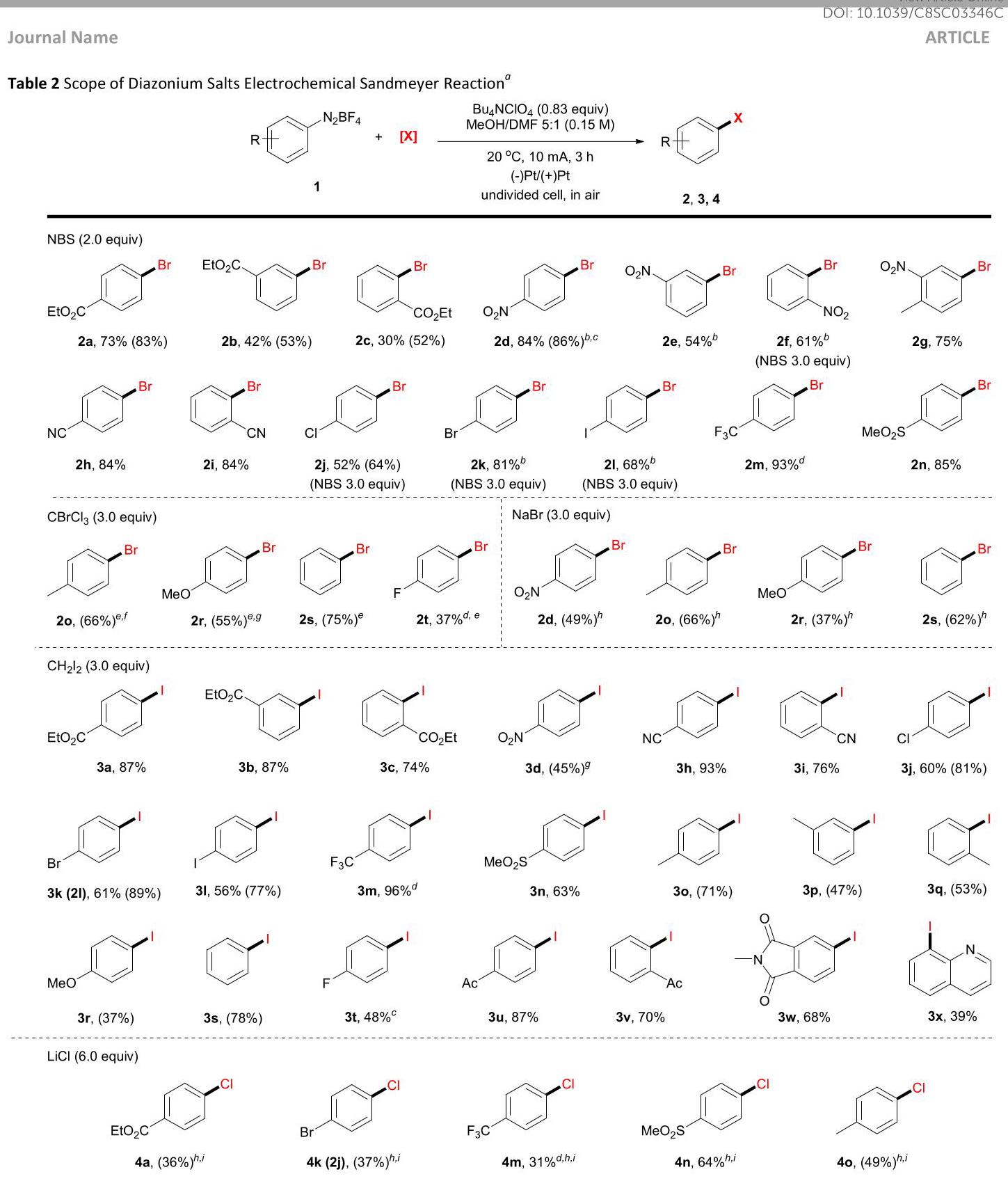
${}^{a}$ Reaction conditions: 1 (0.3 mmol), ${\mathrm{{Bu}}}_{4}{\mathrm{{NClO}}}_{4}$ (0.25 mmol,0.83 equiv), ${\mathrm{{CH}}}_{3}\mathrm{{OH}}$ (2.5 mL), and DMF (0.5 mL), ${20}^{ \circ }\mathrm{C},3\mathrm{\;h}$ , constant current 10 mA. Pt mesh electrodes $\left( {1\mathrm{\;{cm}} \times 1\mathrm{\;{cm}}}\right)$ were used. Isolated yields were given. GC-FID yields in parentheses were given due to either product volatility or difficulty in isolation with by-product (e.g. ArH). ${}^{b}{\mathrm{{CH}}}_{3}\mathrm{{OH}}/\mathrm{{DMF}}{20} : 1$ (total ${3.0}\mathrm{\;{mL}}$ ). ${}^{c}1\mathrm{\;h}$ . ${}^{d19}\mathrm{\;F}$ NMR yields determined using 4- (trifluoromethoxy)anisole as an internal standard. ${}^{e}$ DMF (3 mL). ${}^{f}$ 4.5 h. ${}^{g}$ 2 h. ${}^{h}$ MeCN (3 mL), LiClO ${}_{4}$ (0.5 mmol) as electrolyte. ${}^{i}$ 20 mA, Ni foam cathode.
To further demonstrate the utility of this electrochemical protocol, gram-scale experiments were next carried out. Since the electrochemical reduction of diazonium salts takes place at the cathode, we applied inexpensive graphite plate electrodes with a large size to lower the current density $\left( {J = {2.78}\mathrm{{mA}}/{\mathrm{{cm}}}^{2}}\right)$ . By using the setup shown in Scheme 2, 2h was prepared from 1h on a three-gram scale (15 mmol) in 76% yield. Similarly, 3h was prepared on a three-gram scale in 80% yield.
Table 3 One Pot Diazotization/Electrochemical Reaction. ${}^{a}$
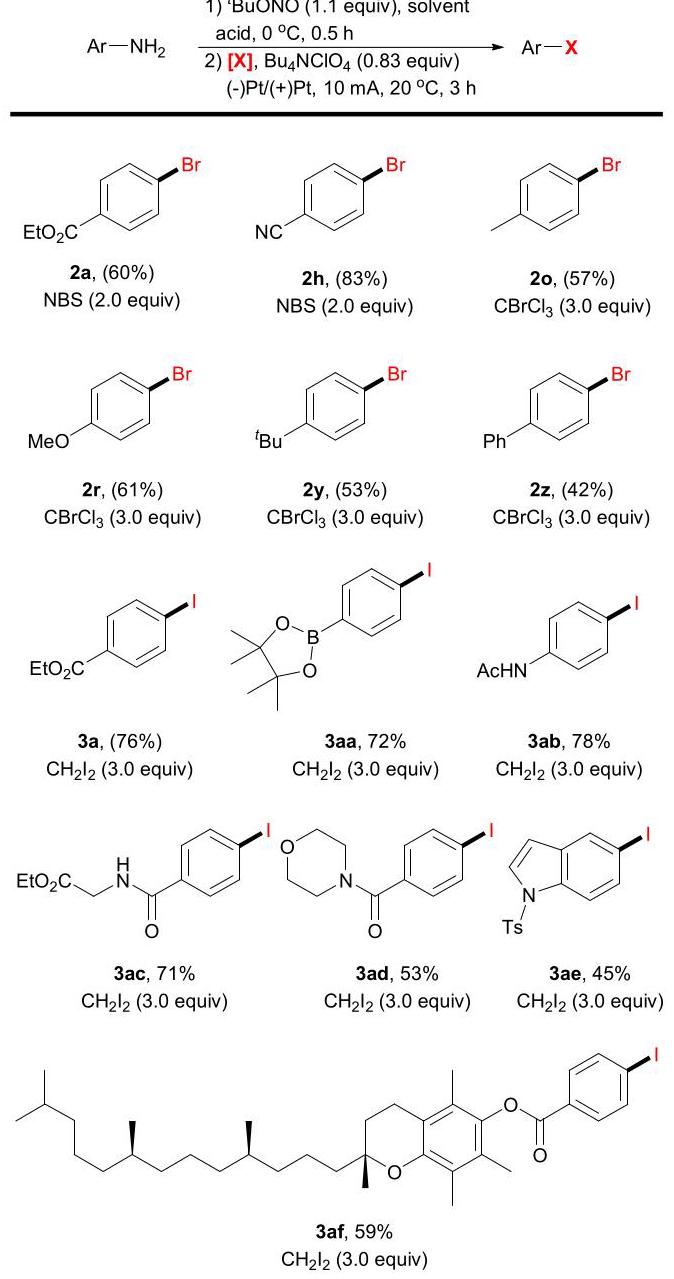
${}^{a}$ Reaction conditions: aryl amine (0.3 mmol), ${}^{t}$ BuONO (0.33 mmol, 1.1 equiv), HCl (5 M in ${\mathrm{{Et}}}_{2}\mathrm{O},{90\mu }\mathrm{L},{0.45}\mathrm{{mmol}},{1.5}$ equiv), ${\mathrm{{CH}}}_{3}\mathrm{{OH}} \; {2.5}\mathrm{\;{mL}}$ , DMF ${0.5}\mathrm{\;{mL}},0{}^{ \circ }\mathrm{C},{0.5}\mathrm{\;h}$ ; then ${\mathrm{{Bu}}}_{4}{\mathrm{{NClO}}}_{4}({0.25}\mathrm{{mmol}},{0.83}$ equiv), [X], 20 ${}^{ \circ }\mathrm{C}$ , 3 h, constant current 10 mA. Pt mesh electrodes (1cm $\times$ 1cm) were used. Isolated yields were given. GC-FID yields were shown in parentheses. For details, see ESI.
To probe this electrically generated aryl radical species, we carried out a range of mechanistic experiments. First, a radical clock experiment was performed by using diazonium salt 5 derived from 2-(allyloxy)aniline as the substrate (Scheme 3A). We obtained only the cyclized product 6 in 37% yield as determined by ${}^{1}\mathrm{H}$ NMR spectroscopy, and the acyclic product was not detected by GC-MS and ${}^{1}\mathrm{H}$ NMR analysis. Next, electrochemical reaction of 1a with 2,2,6,6-tetramethyl-1-piperidinyloxy (TEMPO) was conducted, affording arylated product 7 in 62% isolated yield (Scheme 3B). This is well in accord with the Studer’s report. ${}^{43}$ In their paper, they have demonstrated that TEMPONa is capable of reducing diazonium salt to its aryl radical, thus facilitating the following transformation.
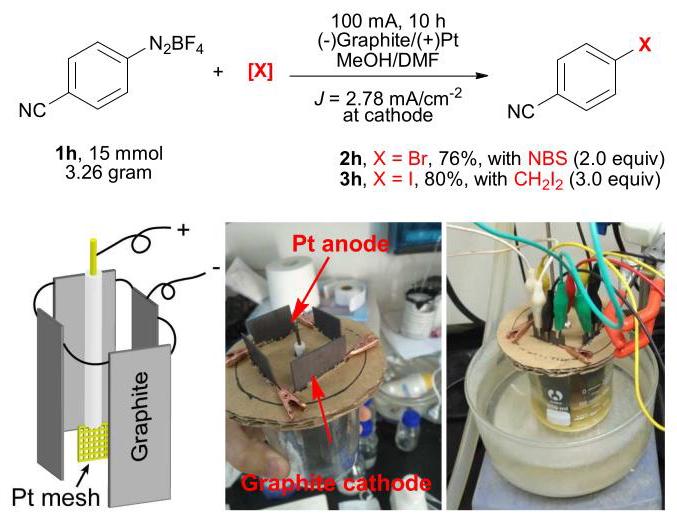
Scheme 2 Gram-Scale Electrochemical Sandmayer Reactions. A Pt mesh electrode $(1\mathrm{\;{cm}} \times 1\mathrm{\;{cm}},{52}$ mesh) as the anode, and 4 graphite plates $(4 \times 3\mathrm{\;{cm}} \times 3\mathrm{\;{cm}}$ immersed in the solution) as the cathodes.
A. Electrochemical clock reaction
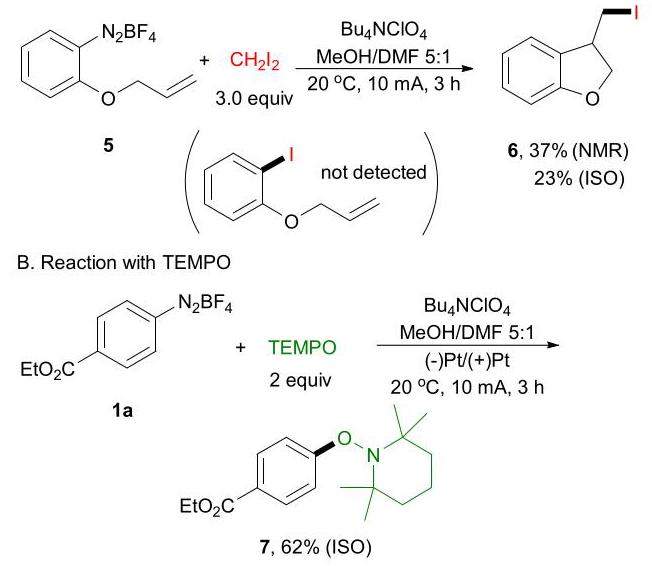
Scheme 3 Control experiments.
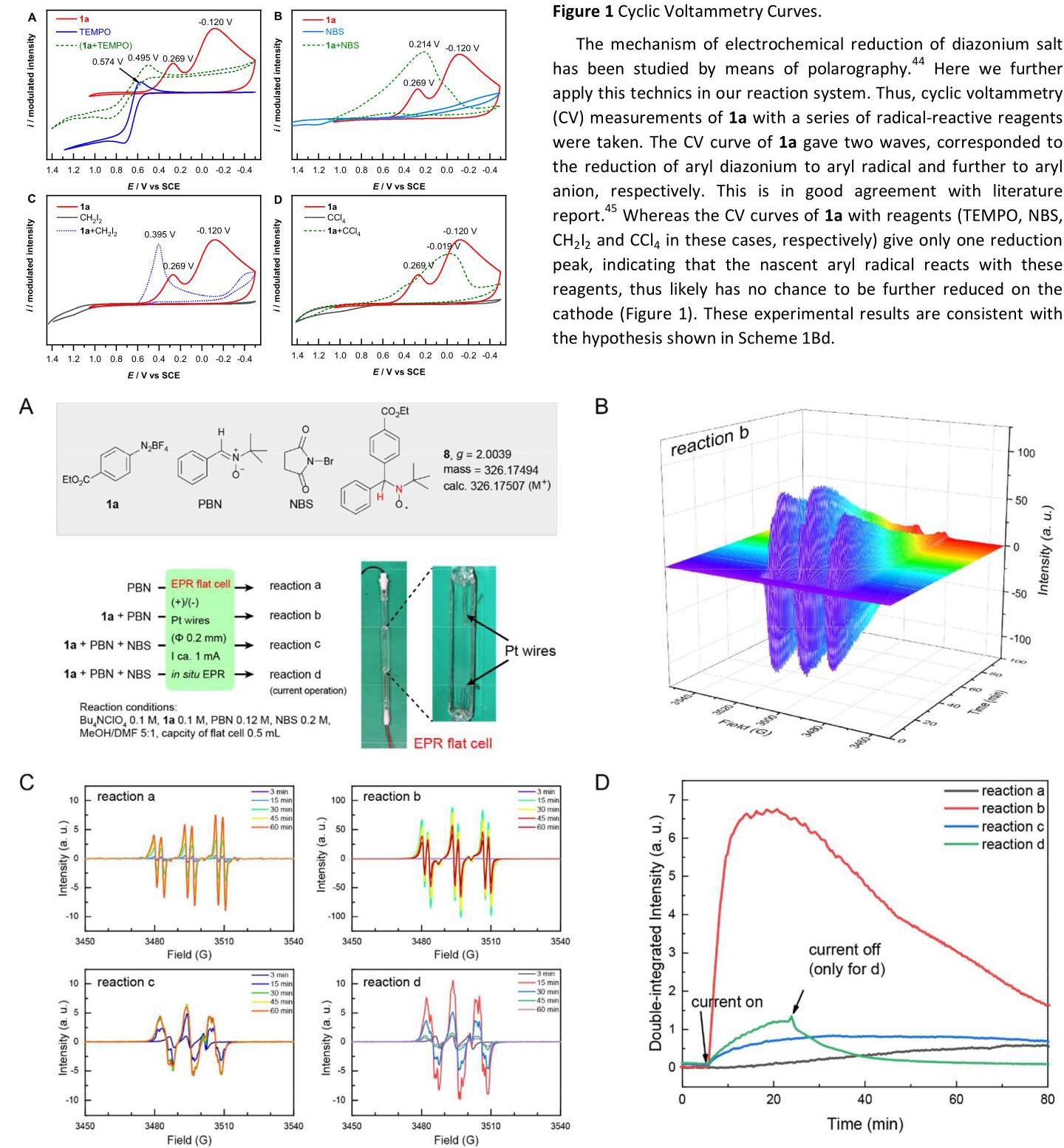
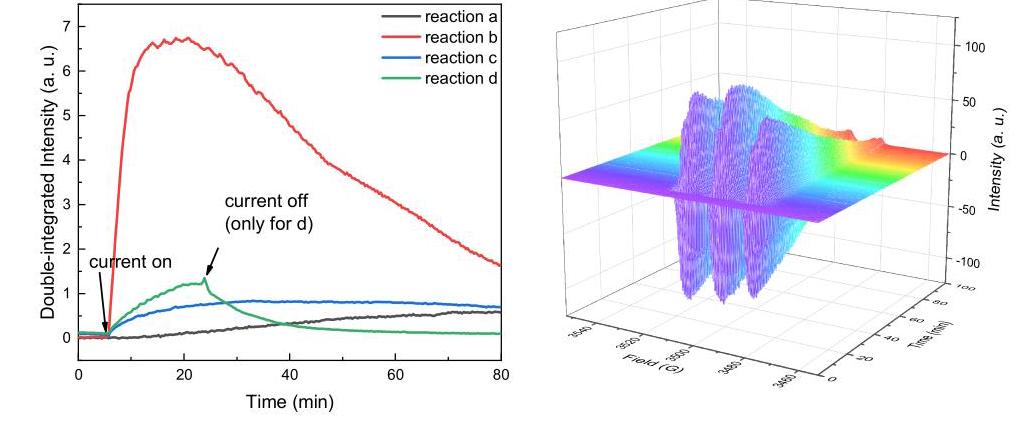
Figure 2 (A) Four in situ EPR electrochemical reactions. Photograph of EPR flat cell with home-made electrolysis setup is shown. (B) Time dependent EPR profile of reaction b. For the EPR profile of reactions a, c and d, see Figure S5 in Electronic Supplementary Information. (C) EPR signal at different time of reactions a-d. (D) Time evolution of double-integrated intensity of the signals of in situ EPR electrochemical reactions a-d. a. u., arbitrary unit.
Electron paramagnetic resonance (EPR) is a spectroscopic technique capable of detecting and identifying paramagnetic species, such as organic radicals, thus providing essential information on the nature of reactive intermediates in single electron transfer reactions. EPR spectroscopy has been extensively utilized to study the electrochemically generating organic radicals. ${}^{46}$ Here, we applied EPR spectroelectrochemistry to study the current electrochemical Sandmeyer reaction. In our setup, we combined a common Bruker Elexsys E580 spectrometer with a Super-high sensitivity probe head $\left( {\omega = {9.80}\mathrm{{GHz}}}\right)$ and a standard flat cell (0.3 mm in depth) with ultrathin Pt wires ( $\Phi$ 0.2 mm) for this in situ study (Figure 2A). Using this setup, electrolysis experiments and in situ EPR measurements were first performed on samples containing diazonium salt 1a and NBS in MeOH/DMF with $n - {\mathrm{{Bu}}}_{4}{\mathrm{{NClO}}}_{4}$ as the electrolyte. EPR signals were not observed, presumably due to the high reactivity and low concentration of these radical intermediates. Consequently, N-benzylidene-tert-butylamine N-oxide (PBN) was introduced to the experiments as a spin-trap. ${}^{47}$ Spin-traps react with short-living radicals and convert them to more stable, EPR detectable radical species. The choice of PBN is based on Bard’s report, ${}^{48}$ where they found that PBN is electroinactive between 1.5 and -2.4 V ( ${vs}$ . SCE). Thus, four electrochemical reactions a-d were followed by in situ EPR spectroscopy using PBN as the spin-trap (Figure 2A). The EPR spectrum was acquired in an interval of ${30}\mathrm{\;s}$ over the course of ${100}\mathrm{\;{min}}$ . These EPR signals were then compiled as a time dependent 2D profile (for reaction b, see Figure 2B; for reactions a, c and d, see Figure S5). Figure 2C shows the EPR signals of these reactions at different reaction time, and figure 2D shows time dependent double-integrated intensity of these in situ EPR signals.
In these reactions, no major EPR signal is observed until electricity is on. The isotropic $g$ factor and hyperfine coupling constants of these radical EPR signals were simulated using the least-squares fitting method with EasySpin’s function garlic (For details, see ESI). As expected, radicals in reactions a, b and c are different and in d resembles c (Figure 2C). The contrasting growth rates of intensity shown in Figure 2D provided valuable mechanistic information. By comparing reaction a and b, a rapid growth observed in reaction b indicated that diazonium salt 1a was rapidly reduced to an aryl radical upon electrolysis. The resulting aryl radical was trapped by PBN to afford an EPR active species. Based on a six-line EPR spectrum $\left( {g = {2.0039},{a}_{\mathrm{N}} = {13.02}\mathrm{G},{a}_{\mathrm{H}} = {2.37}\mathrm{G}}\right) {}^{{47},} \; {}^{48}$ and HRMS data, this radical could be likely attributed as compound 8. In reactions $c$ and $d$ , the intensity grow slowly as compared with reaction b, indicating that the addition of NBS changes the reaction pathway of electrically generated radicals. In reaction d, the intensity rapidly decayed when the current was turned off, also demonstrating an electricity driving radical generation process. These in situ EPR electrochemical experiments and previous cyclic voltammetry studies demonstrated that diazonium salts can readily undergo single electron reduction processes on the cathode, and the resulting aryl radical is a highly reactive species that can be trapped by many radical trapping reagents, such as NBS, ${\mathrm{{CH}}}_{2}{\mathrm{I}}_{2}$ , PBN and TEMPO. Meanwhile, the solvents (e.g. MeOH) can be oxidized on anode ${}^{49}$ to balance the overall transformation (Scheme 4).
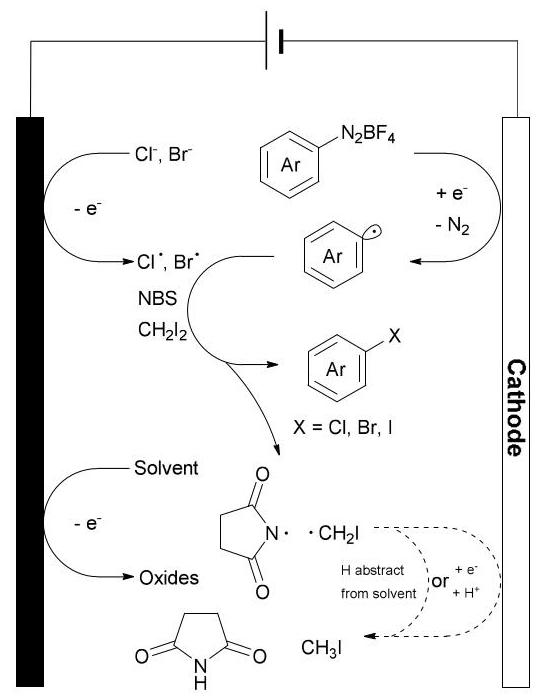
Scheme 4 Proposed reaction events on both electrodes and in solvent bulk.
Conclusion
In summary, we have developed a general electrochemical protocol for the Sandmeyer halogenation process. A diverse range of functional groups were compatible with this electrochemical reaction. Anilines can be directed employed as the starting material, further expanding utility of this method. Moreover, this method is amenable to the large-scale synthesis of aryl halides, and very inexpensive graphite can be employed instead of platinum as the cathode material for these large-scale preparation. Importantly, detailed mechanism studies, including the application of rarely used in situ EPR measurements, supports a single electron reduction mechanism for the halogenation of diazonium salts upon electrolysis. This electrochemical process could be a complementary method for the existing Sandmeyer halogenation reactions, and might inspire other Sandmeyer type transformations (e.g. noble metal free trifluoromethylation ${}^{{50} - {52}}$ ) in the near future.
Conflicts of interest
There are no conflicts to declare.
Acknowledgements
The project is supported by the Natural Science Foundation of China (Grants 21502003 and 21772003). We also thank the “1000-Youth Talents Plan” and Peking University for start-up funds. Y.Y. thanks the Miller Institute for Basic Research in Science at UC Berkeley for a post-doctoral fellowship.
The project is supported by the Natural Science Foundation of China (Grants 21502003 and 21772003). We also thank the “1000-Youth Talents Plan” and Peking University for start-up funds. Y.Y. thanks the Miller Institute for Basic Research in Science at UC Berkeley for a post-doctoral fellowship.
Notes and references
L. Kurti and B. Czakó, Strategic applications of named 36. reactions in organic synthesis, Elsevier, 2005.
T. Sandmeyer, Ber. Dtsch. Chem. Ges., 1884, 17, 1633- 37. 1635.
T. Sandmeyer, Ber. Dtsch. Chem. Ges., 1884, 17, 2650- 2653.
H. H. Hodgson, Chem. Rev., 1947, 40, 251-277.
C. Galli, Chem. Rev., 1988, 88, 765-792.
E. B. Merkushev, Synthesis, 1988, 1988, 923-937.
F. Mo, G. Dong, Y. Zhang and J. Wang, Org. Biomol. Chem., 2013, 11, 1582-1593.
F. Mo, D. Qiu, Y. Zhang and J. Wang, Acc. Chem. Res., 2018, 51, 496-506.
L. Gattermann and A. Cantzler, Ber. Dtsch. Chem. Ges., 1892, 25, 1086-1091.
M. P. Doyle, J. F. Dellaria, B. Siegfried and S. W. Bishop, J. Org. Chem., 1977, 42, 3494-3498.
M. P. Doyle, B. Siegfried and J. F. Dellaria Jr, J. Org. Chem., 1977, 42, 2426-2431.
I. P. Beletskaya, A. S. Sigeev, A. S. Peregudov and P. V. Petrovskii, Synthesis, 2007, 2007, 2534-2538.
D. A. Leas, Y. Dong, J. L. Vennerstrom and D. E. Stack, Org. Lett., 2017, 19, 2518-2521.
J. G. Lee and H. T. Cha, Tetrahedron Lett., 1992, 33, 3167- 3168.
H. Yang, L. Fu, L. Wei, J. Liang and B. P. Binks, J. Am. Chem. Soc., 2015, 137, 1362-1371.
K. D. Moeller, Tetrahedron, 2000, 56, 9527-9554.
J. B. Sperry and D. L. Wright, Chem. Soc. Rev., 2006, 35, 605-621.
A. Jutand, Chem. Rev., 2008, 108, 2300-2347.
J.-i. Yoshida, K. Kataoka, R. Horcajada and A. Nagaki, Chem. Rev., 2008, 108, 2265-2299.
R. Francke and R. D. Little, Chem. Soc. Rev., 2014, 43, 2492-2521.
E. J. Horn, B. R. Rosen and P. S. Baran, ACS Cent. Sci., 2016, 2, 302-308.
R. Feng, J. A. Smith and K. D. Moeller, Acc. Chem. Res., 52. 2017, 50, 2346-2352.
Y. Jiang, K. Xu and C. Zeng, Chem. Rev., 2017, DOI: 10.1021/acs.chemrev.7b00271.
M. Yan, Y. Kawamata and P. S. Baran, Chem. Rev., 2017, 117, 13230-13319.
W. Anton, G. Tile, M. Sabine, R. Eduardo, Z. Michael and W. S. R., Angew. Chem. Int. Ed., 2018, 57, 5594-5619.
M. Sabine, Z. Michael, R. Eduardo, G. Tile, W. Anton and W. S. R., Angew. Chem. Int. Ed., 2018, 57, 6018-6041.
G. S. Sauer and S. Lin, ACS Catal., 2018, 8, 5175-5187.
S. Tang, Y. Liu and A. Lei, Chem, 2018, 4, 27-45.
S. R. Waldvogel, S. Lips, M. Selt, B. Riehl and C. J. Kampf, Chem. Rev., 2018, 118, 6706-6765.
L. Zhang, Z. Zhang, J. Hong, J. Yu, J. Zhang and F. Mo, J. Org. Chem., 2018, 83, 3200-3207.
L. Zhang, Z. Zhang, J. Zhang, K. Li and F. Mo, Green Chem., 2018, 20, 3916-3920.
E. R. Atkinson, C. E. Garland and A. F. Butler, J. Am. Chem. Soc., 1953, 75, 983-984.
J. K. Kochi, J. Am. Chem. Soc., 1955, 77, 3208-3211.
M. Gomberg and W. E. Bachmann, J. Am. Chem. Soc., 1924, 46, 2339-2343.
E. R. Atkinson, C. R. Morgan, H. H. Warren and T. J. Manning, J. Am. Chem. Soc., 1945, 67, 1513-1515.
D. Belanger and J. Pinson, Chem. Soc. Rev., 2011, 40, 3995-4048.
G. L. C. Paulus, Q. H. Wang and M. S. Strano, Acc. Chem. Res., 2013, 46, 160-170.
A. Berisha, M. M. Chehimi, J. Pinson and F. Podvorica, Electroanalytical Chemistry, A Series of Advances, 2015, 26, 115-224.
S. C. Virgil, T. V. Hughes, D. Qiu and J. Wang, in Encyclopedia of Reagents for Organic Synthesis, John Wiley & Sons, Ltd, 2001, DOI: 10.1002/047084289X.rc145.pub3.
G. A. Hiegel, G. Pozzi and AnuMahadevan, in Encyclopedia of Reagents for Organic Synthesis, John Wiley & Sons, Ltd, 2001, DOI: 10.1002/047084289X.rt209.pub3.
N. Fu, G. S. Sauer and S. Lin, J. Am. Chem. Soc., 2017, 139, 15548-15553.
K.-Y. Ye, G. Pombar, N. Fu, G. S. Sauer, I. Keresztes and S. Lin, J. Am. Chem. Soc., 2018, 140, 2438-2441.
M. Hartmann, Y. Li and A. Studer, J. Am. Chem. Soc., 2012, 134, 16516-16519.
R. M. Elofson and F. F. Gadallah, J. Org. Chem., 1969, 34, 854-857.
E. R. Atkinson, H. H. Warren, P. I. Abell and R. E. Wing, J. Am. Chem. Soc., 1950, 72, 915-918.
Peter Rapta, Evgenia Dmitrieva, Alexey A. Popov and L. Dunsch, in Organic Electrochemistry: Revised and Expanded, eds. Ole Hammerich and B. Speiser, CRC Press, 5 edn., 2016, ch. 3, pp. 169-190.
G. R. Buettner, Free. Radical. Bio. Med, 1987, 3, 259-303.
- A. J. Bard, J. C. Gilbert and R. D. Goodin, J. Am. Chem. Soc., 1974, 96, 620-621.
G. Sundholm, Acta Chem. Scand., 1971, 25, 3188-3189.
- X. Wang, Y. Xu, F. Mo, G. Ji, D. Qiu, J. Feng, Y. Ye, S. Zhang, Y. Zhang and J. Wang, J. Am. Chem. Soc., 2013, 135, 10330-10333.
J.-J. Dai, C. Fang, B. Xiao, J. Yi, J. Xu, Z.-J. Liu, X. Lu, L. Liu and Y. Fu, J. Am. Chem. Soc., 2013, 135, 8436-8439.
G. Danoun, B. Bayarmagnai, M. F. Grünberg and L. J. Gooßen, Angew. Chem. Int. Ed., 2013, 52, 7972-7975.

In situ EPR electrochemical experiments