Oxidant-free oxidation of C−H bond by cathodic hydrogen evolution: a phosphonic Kolbe oxidation/cyclization process
中文 / Bilingual · English version
Check for updates
Green Chemistry
Accepted Manuscript
This article can be cited before page numbers have been issued, to do this please use: L. Zhang, Z. Zhang, J. Zhang, K. Li and F. Mo, Green Chem., 2018, DOI: 10.1039/C8GC02026D.
This is an Accepted Manuscript, which has been through the Royal Society of Chemistry peer review process and has been accepted for publication.
Accepted Manuscripts are published online shortly after acceptance, before technical editing, formatting and proof reading. Using this free service, authors can make their results available to the community, in citable form, before we publish the edited article. We will replace this Accepted Manuscript with the edited and formatted Advance Article as soon as it is available.
You can find more information about Accepted Manuscripts in the author guidelines.
Please note that technical editing may introduce minor changes to the text and/or graphics, which may alter content. The journal’s standard Terms & Conditions and the ethical guidelines, outlined in our author and reviewer resource centre, still apply. In no event shall the Royal Society of Chemistry be held responsible for any errors or omissions in this Accepted Manuscript or any consequences arising from the use of any information it contains.
Green Chemistry
COMMUNICATION
Oxidant-free oxidation of C-H bond by cathodic hydrogen evolution: a phosphonic Kolbe oxidation/cyclization process
Lei Zhang, ${}^{a}$ Zhenxing Zhang, ${}^{a}$ Jianning Zhang, ${}^{a}$ Kangle Li ${}^{a}$ and Fanyang Mo* ${}^{a}$
Received 00th January 20xx, Accepted 00th January 20xx
DOI: 10.1039/x0xx00000x
DOI: 10.1039/x0xx00000x
An anodic oxidation/cyclization of 2-(aryl)aryl phosphonic acid monoesters for ethoxy dibenzooxaphosphorin oxides synthesis has been developed. This unprecedented electrochemical oxidation reaction proceeds at room temperature with no oxidant or electrolyte required, and exhibits high atom-economy with ${\mathrm{H}}_{2}$ being the only byproduct. A series of ethoxy dibenzooxaphosphorin oxides were obtained in good yields.
The development of green and sustainable ways for chemical manufacture represents a vital aspect in modern organic synthesis. ${}^{1,2}$ Oxidation reactions are fundamentally important and frequently applied in both academic and industrial settings every day. ${}^{3}$ However, the use of such highly reactive reagents often causes safety issues and generates much waste, leading to poor atom economy. In addition, chemical oxidants can also bring oxidative side reactions. It is quite reasonable that an oxidation reaction requires a stoichiometric amount of oxidant, but this is not always the case. If the fate of hydrogen atoms can be properly handled, for example, in hydrogen gas formation, the oxidant would not be indispensable. In this context, cathodic hydrogen evolution electrochemical oxidation represents one of such ideal oxidant-free oxidation reactions. In this case, protons can be considered as a sacrificial oxidant, since they are forced by electric potential to combine with electrons to form hydrogen gas (Scheme 1A).
The past decade has witnessed a resurging interest in organic electrochemistry that dramatically improved organic chemists’ toolbox for green and sustainable synthesis. ${}^{4 - {15}}$ In terms of $\mathrm{C} - \mathrm{H}$ activation/functionalization, the Ackermann’s, ${}^{{16} - } \; {}^{18}$ the Xu’s, ${}^{{19} - {21}}$ the Zeng’s, ${}^{{22} - {24}}$ the Lei’s, ${}^{{25} - {27}}$ the Mei’s, ${}^{{28},{29}}$ the Sanford’s ${}^{30}$ and the Muñiz’s ${}^{31}$ groups have developed ingenious electrochemical methods in C-X construction, C-C cross-coupling and dehydrogenative annulation recently.
A. Compare traditional oxidation reaction and electrochemical
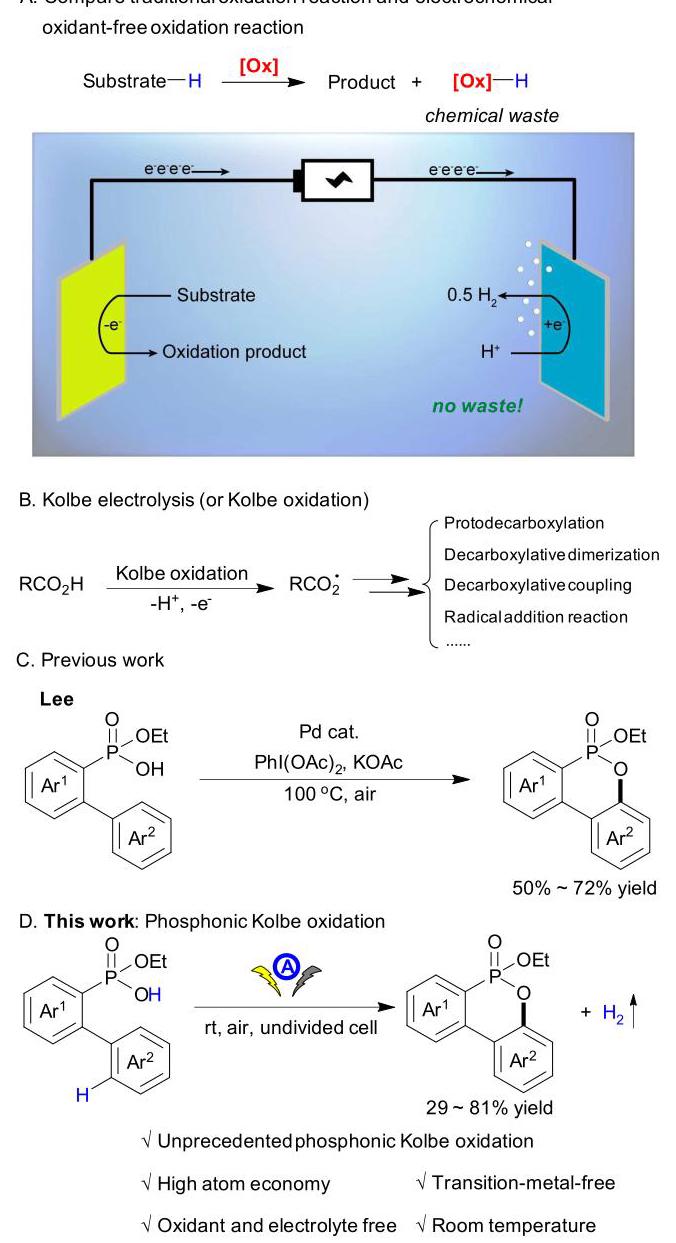
Scheme 1 Kolbe oxidation and phosphonic Kolbe oxidation.
${}^{a}$ Department of Energy and Resources Engineering, College of Engineering, Peking University, Beijing 100871 (China).
† Footnotes relating to the title and/or authors should appear here.
Electronic Supplementary Information (ESI) available: [details of any supplementary information available should be included here]. See DOI: 10.1039/x0xx00000x
We have recently been interested in Kolbe electrolysis. As one of the most well-known organic electrochemical reaction, Kolbe electrolysis can be categorized as such an oxidant-free oxidation reaction. It was first discovered by Faraday in 1834, ${}^{32}$ and then elaborated in detail and utilized in organic synthesis by Kolbe in 1849. ${}^{33}$ Though the Kolbe reaction is a century-old transformation, it is still alive as an important synthetic tool in organic chemistry, and a vast number of studies have been carried out to unveil its synthetic potential (Scheme 1B). ${}^{{34} - {37}}$ In a recent work, we have developed a practical intramolecular Kolbe oxidative cyclization method for the synthesis of dibenzopyranones starting from 2-arylbenzoic acids. ${}^{38}$ In this reaction, the key step is a Kolbe oxidation of aryl benzoic acid affording aroyloxy radicals. Then this radical is trapped intramolecularly by an aromatic ring. Further anodic oxidation of this trapped radical leads to the final cyclized product. In this context, we envision that an analogue of phosphonic Kolbe oxidative cyclization process might be feasible towards the synthesis of ethoxy dibenzooxaphosphorin oxides starting from 2-(aryl)aryl phosphonic acid monoesters.
Organophosphorus compounds have been proved to be valuable and effective in pharmaceuticals, ${}^{39}$ pesticides, ${}^{40}$ materials, ${}^{41}$ catalysis, ${}^{42}$ etc. In this context, it’s essential to develop efficient and practical methods to synthesize these crucial compounds. Previously, facilitated by transition metal catalysis, the Lee’s, ${}^{{43} - {46}}$ the Miura’s ${}^{47}$ and the Glorius’s ${}^{48}$ groups have developed robust methods to realize oxidative cyclization of phosphonic acids or their derivatives. In 2014, the Lee group developed a palladium-catalyzed oxidative cyclization starting from 2-(aryl)aryl phosphonic acid monoesters. A series of ethoxy dibenzooxaphosphorin oxides could be obtained effectively in the presence of Pd catalyst, PhI(OAc) ${}_{2}$ and KOAc under heat (Scheme 1C). ${}^{49}$ Herein we developed a simple electrochemical method to realize this cyclization under transition metal catalyst- and oxidant-free conditions (Scheme 1D). To the best of our knowledge, the anodic oxidation of phosphonic acid has not been disclosed yet.
The starting materials were synthesized according to Lee’s report. ${}^{49}$ A range of 2-(aryl)arylphosphonic acid monoethyl esters were efficiently accessed by sequentially conducting a Suzuki coupling of 2-bromoiodoarenes with arylboronic acids, a Pd-catalyzed phosphorylation of 2-bromobiaryls, and hydrolysis of diethyl 2-(aryl)arylphosphonates by using L-selectride or under basic conditions (see supplementary information).
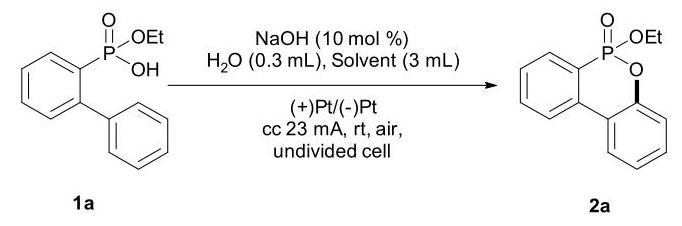
With the starting materials available, we initially studied the anodic oxidation of 2-phenyl phosphonic acid 1a (Table 1). Platinum materials were chosen as the electrodes due to their chemical inertness and low overpotential for hydrogen evolution. Thus, electrolysis of 1a with a constant current of 23 mA for ${2.5}\mathrm{\;h}$ afforded the desired cyclized product $2\mathrm{a}$ in 74% NMR yield and 62% isolated yield in the presence of ${10}\% \mathrm{{NaOH}}$ in a $\mathrm{{MeOH}}/{\mathrm{H}}_{2}\mathrm{O}$ mixed solvent (entry 1). The reaction gave slightly less product when the temperature was kept at $0{}^{ \circ }\mathrm{C}$ (entry 2). We next screened a series of solvents, and found that except DMF, other solvents such as 1,1,1,3,3,3- hexafluoropropanol (HFIP), MeCN, acetone, isopropanol and EtOH proved to be less efficient with longer reaction time required (entry 3-8). Gratifyingly, the use of a mixed solvent MeOH/DMF further increased the yield to 84% (71% isolated yield, entry 9).
Table 1 Optimization of Reaction Conditions ${}^{a}$
Entry Reaction conditions Yield ${\left( \% \right) }^{b}$
1 MeOH, 2.5 h 74 (62) Under air
MeOH, 2.5 h, 0 ${}^{ \circ }\mathrm{C}$ 69
HFIP, 24 h Trace Glass tube
4 DMF, 12 h 76
MeCN 4.6 h 16
Acetone, 12 h 15
0.7 cm
$i$ -PrOH,18 h 23
Pt meshes
EtOH, 5 h 36 Stirring bar
9 MeOH/DMF (9:1), 3 h 84 (71)
${}^{a}$ Reaction conditions: 1a ${0.5}\mathrm{{mmol}}$ , solvent $3\mathrm{\;{mL}},{\mathrm{H}}_{2}\mathrm{O}{0.3}$ mL, Pt mesh electrodes, $1\mathrm{\;{cm}} \times 1\mathrm{\;{cm}},{52}$ mesh. cc constant current. HFIP 1,1,1,3,3,3-hexafluoro-2-propanol. ${}^{b}$ Yield determined by ${}^{1}\mathrm{H}$ NMR using 1,1,2,2-tetrachloroethane as an internal standard. Isolated yield in parentheses.
With the optimized reaction conditions in hand, the substrate scope was then studied with the results depicted in Table 2. A variety of substitutions on both the ${\mathrm{{Ar}}}^{1}$ and ${\mathrm{{Ar}}}^{2}$ rings were examined, and the desired products were obtained readily in moderate to good yields. This electrochemical approach tolerates diverse functional groups, such as halides, ether, trifluoromethyl, trifluoromethoxyl, ketone etc. When the substitution on ${\mathrm{{Ar}}}^{2}$ ring was at the meta position, a mixture of isomers were obtained (2c). Due to solubility issue of 1e-1g substrates, the yields of products 2e-2g were relatively low. This electrochemical oxidation reaction favoured the substrates bearing electron-donating groups on ${\mathrm{{Ar}}}^{2}$ ring, and the corresponding products were obtained in better yields (2b,2d,2j,2o). In regards of substituents on ${\mathrm{{Ar}}}^{1}$ ring (2o-2s), electronic effect does not operate prominently. The desired cyclized products were obtained in a range of 48- 81% yields. Although the yield of product 2n was not satisfactory, ethoxy dibenzooxaphosphorin oxides containing a heterocycle could be synthesized by this anodic oxidation method conveniently.
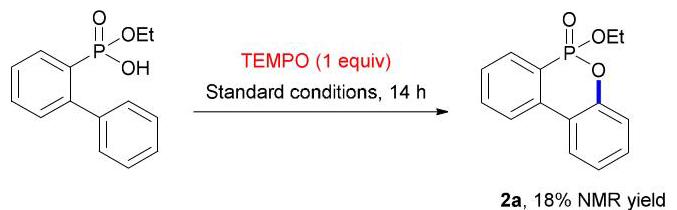
To explore the mechanism of this electrochemical reaction, a free radical scavenger, 2,2,6,6-tetramethyl-1-piperidinyloxy (TEMPO), was introduced as an additive to the standard conditions. The starting material 2-(aryl)aryl phosphonic acid remained largely even after ${14}\mathrm{\;h}$ (Scheme 2), indicating a hindrance of cyclization in the presence of TEMPO and a Table 2 Substrate scope
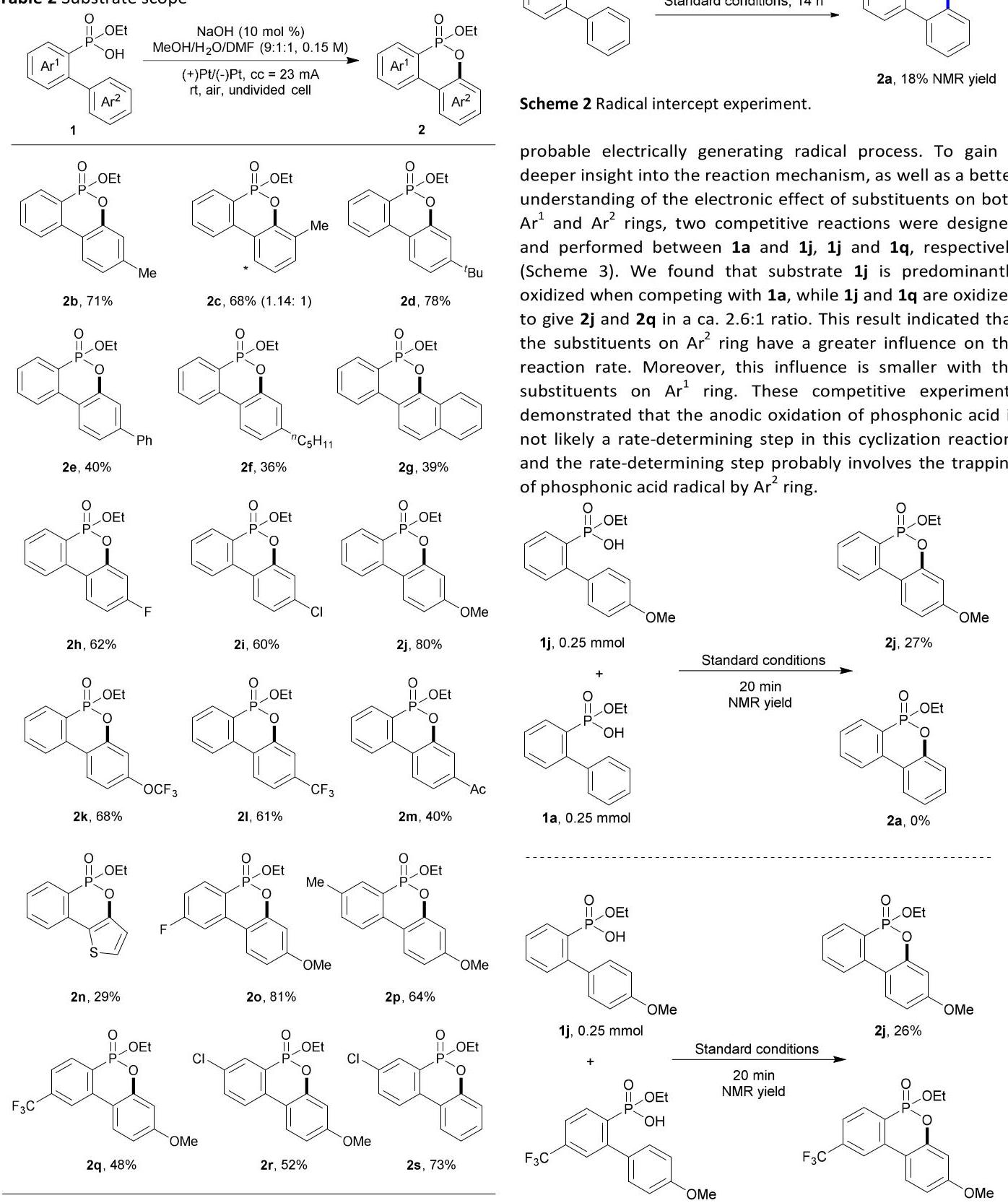
${}^{a}$ Reaction conditions: $1\;{0.5}\mathrm{{mmol}},\mathrm{{NaOH}}2\mathrm{{mg}},\mathrm{{MeOH}}{2.7}\mathrm{{mL}}$ , ${\mathrm{H}}_{2}\mathrm{O}{0.3}\mathrm{\;{mL}}$ , DMF 0.3 mL, Pt net electrodes, $1\mathrm{\;{cm}} \times 1\mathrm{\;{cm}},{52}$ mesh. cc constant current. Isolated yields were reported.
1q, 0.25 mmol 2q, 10%
1q,0.25 mmol 2q,10%
Scheme 3 Competitive reactions between 1a and 1j, 1j and 1q, respectively.
Based on the information above, a plausible reaction mechanism was proposed in Scheme 4. Phosphonic anion resulting from deprotonation by catalytic amount of NaOH was anodically oxidized to afford the phosphonic acid radical intermediate. Then this radical is trapped by the aryl ring intramolecularly, generating an aryl radical. At last, this aryl radical is oxidized at the anode again to deliver the final cyclized product. The two consecutive electron transfers between the electrode and the substrate taking place on the same electrode (double anodic oxidation) favour implementation of the reaction. Meanwhile, cathodic proton reduction to hydrogen gas accurately balanced the redox of the overall reaction.
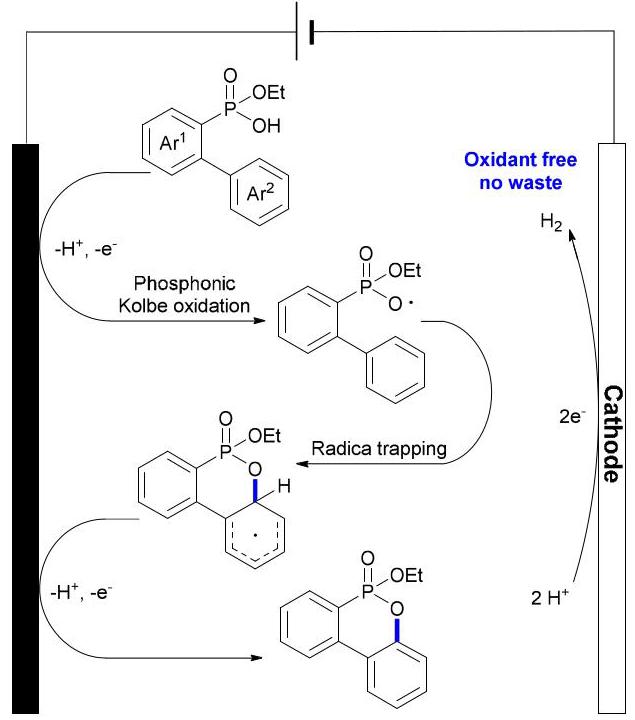
Scheme 4 Proposed mechanism.
In summary, we have developed a general, practical intramolecular phosphonic Kolbe oxidative cyclization method for the synthesis of ethoxy dibenzooxaphosphorin oxides. This method is transition metal- and oxidant-free, does not involve electrolytes, and proceeds at ambient temperature. We expect this electrochemical reaction to find wide application in the synthesis of phosphorus-containing compounds in future synthetic endeavours.
Conflicts of interest
In accordance with our policy on Conflicts of interest please ensure that a conflicts of interest statement is included in your manuscript here. Please note that this statement is required for all submitted manuscripts. If no conflicts exist, please state that “There are no conflicts to declare”.
Notes and references
‡ Footnotes relating to the main text should appear here. These might include comments relevant to but not central to the matter under discussion, limited experimental and spectral data, and crystallographic data.
Uncategorized References
P. T. Anastas and J. C. Warner, Green chemistry: theory and practice, Oxford university press, 2000.
C.-J. Li and B. M. Trost, P. Natl. Acad. Sci. Usa., 2008, 105, 13197-13202.
J.-E. Bäckvall, Modern oxidation methods, John Wiley & Sons, 2011.
K. D. Moeller, Tetrahedron, 2000, 56, 9527-9554.
J. B. Sperry and D. L. Wright, Chem. Soc. Rev., 2006, 35, 605-621.
A. Jutand, Chem. Rev., 2008, 108, 2300-2347.
J.-i. Yoshida, K. Kataoka, R. Horcajada and A. Nagaki, Chem. Rev., 2008, 108, 2265-2299.
B. A. Frontana-Uribe, R. D. Little, J. G. Ibanez, A. Palma and R. Vasquez-Medrano, Green Chem., 2010, 12, 2099- 2119.
H. J. Schäfer, Comptes Rendus Chimie, 2011, 14, 745-765.
R. Francke and R. D. Little, Chem. Soc. Rev., 2014, 43, 2492-2521.
E. J. Horn, B. R. Rosen and P. S. Baran, ACS Cent. Sci., 2016, 2, 302-308.
M. Yan, Y. Kawamata and P. S. Baran, Chem. Rev., 2017, 117, 13230-13319.
Y. Jiang, K. Xu and C. Zeng, Chem. Rev., 2018, 118, 4485- 4540.
S. Tang, Y. Liu and A. Lei, Chem, 2018, 4, 27-45.
Q.-L. Yang, P. Fang and T.-S. Mei, Chinese. J. Chem., 2018, 36, 338-352.
N. Sauermann, R. Mei and L. Ackermann, Angew. Chem. Int. Ed., 2018, 57, 5090-5094.
C. Tian, L. Massignan, T. H. Meyer and L. Ackermann, Angew. Chem. Int. Ed., 2018, 57, 2383-2387.
N. Sauermann, T. H. Meyer, C. Tian and L. Ackermann, J. Am. Chem. Soc., 2017, 139, 18452-18455.
Z.-J. Wu, S.-R. Li, H. Long and H.-C. Xu, Chem. Commun., 2018, 54, 4601-4604.
H. B. Zhao, Z. J. Liu, J. Song and H. C. Xu, Angew. Chem. Int. Ed., 2017, 56, 12732-12735.
Z.-W. Hou, Z.-Y. Mao and H.-C. Xu, Synlett, 2017, 28, 1867- 1872.
M. Y. Lin, K. Xu, Y. Y. Jiang, Y. G. Liu, B. G. Sun and C. C. Zeng, Adv. Synth. Catal., 2018, 360, 1665-1672.
S. Zhang, L. Li, H. Wang, Q. Li, W. Liu, K. Xu and C. Zeng, Org. Lett., 2018, 20, 252-255.
Q.-Q. Wang, K. Xu, Y.-Y. Jiang, Y.-G. Liu, B.-G. Sun and C.-C. Zeng, Org. Lett., 2017, 19, 5517-5520.
L. Zeng, H. Li, S. Tang, X. Gao, Y. Deng, G. Zhang, C.-W. Pao, J.-L. Chen, J.-F. Lee and A. Lei, ACS Catal., 2018, 8, 5448-5453.
K. Liu, S. Tang, P. Huang and A. Lei, Nat. Commun., 2017, 8, 775.
X. Gao, P. Wang, L. Zeng, S. Tang and A. Lei, J. Am. Chem. Soc., 2018, 140, 4195-4199.
Y.-Q. Li, Q.-L. Yang, P. Fang, T.-S. Mei and D. Zhang, Org. Lett., 2017, 19, 2905-2908.
Q.-L. Yang, Y.-Q. Li, C. Ma, P. Fang, X.-J. Zhang and T.-S. Mei, J. Am. Chem. Soc., 2017, 139, 3293-3298.
A. Shrestha, M. Lee, A. L. Dunn and M. S. Sanford, Org. Lett., 2018, 20, 204-207.
S. Herold, D. Bafaluy and K. Muñiz, Green Chem., 2018, 20, 3191-3196.
M. Faraday, Ann. Phys-berlin., 1834, 108, 401-453.
H. Kolbe, Justus Liebigs Ann. Chem., 1849, 69, 257-294.
A. K. Vijh and B. E. Conway, Chem. Rev., 1967, 67, 623- 664.
H.-J. Schäfer, in Electrochemistry IV, ed. E. Steckhan, Springer Berlin Heidelberg, Berlin, Heidelberg, 1990, DOI: 10.1007/BFb0034365, pp. 91-151.
Z. Wang, in Comprehensive Organic Name Reactions and Reagents, John Wiley & Sons, Inc., 2010, DOI: 10.1002/9780470638859.conrr369.
H. Tanaka, M. Kuroboshi and S. Torii, in Organic Electrochemistry, Fifth Edition Revised and Expanded, eds. O. Hammerich and B. Speiser, CRC Press, Boca Raton, 2015, pp. 1267-1307.
L. Zhang, Z. Zhang, J. Hong, J. Yu, J. Zhang and F. Mo, J. Org. Chem., 2018, 83, 3200-3207.
D. E. Corbridge, Phosphorus: chemistry, biochemistry and technology, CRC press, 2016.
M. A. Sogorb and E. Vilanova, Toxicol. Lett., 2002, 128, 215-228.
T. Baumgartner and R. Réau, Chem. Rev., 2006, 106, 4681- 4727.
J.-H. Xie and Q.-L. Zhou, Accounts. Chem. Res., 2008, 41, 581-593.
Y. Park, J. Seo, S. Park, E. J. Yoo and P. H. Lee, Chem. Eur. J., 2013, 19, 16461-16468.
T. Ryu, J. Kim, Y. Park, S. Kim and P. H. Lee, Org. Lett., 2013, 15, 3986-3989.
J. Seo, Y. Park, I. Jeon, T. Ryu, S. Park and P. H. Lee, Org. Lett., 2013, 15, 3358-3361.
P. Youngchul, S. Jungmin, P. Sangjune, Y. E. Jeong and L. P. Ho, Chem. Eur. J., 2013, 19, 16461-16468.
Y. Unoh, K. Hirano, T. Satoh and M. Miura, Angew. Chem. Int. Ed., 2013, 52, 12975-12979.
D. Zhao, C. Nimphius, M. Lindale and F. Glorius, Org. Lett., 2013, 15, 4504-4507.
S. Shin, D. Kang, W. H. Jeon and P. H. Lee, Beilstein J. Org. Chem., 2014, 10, 1220-1227.
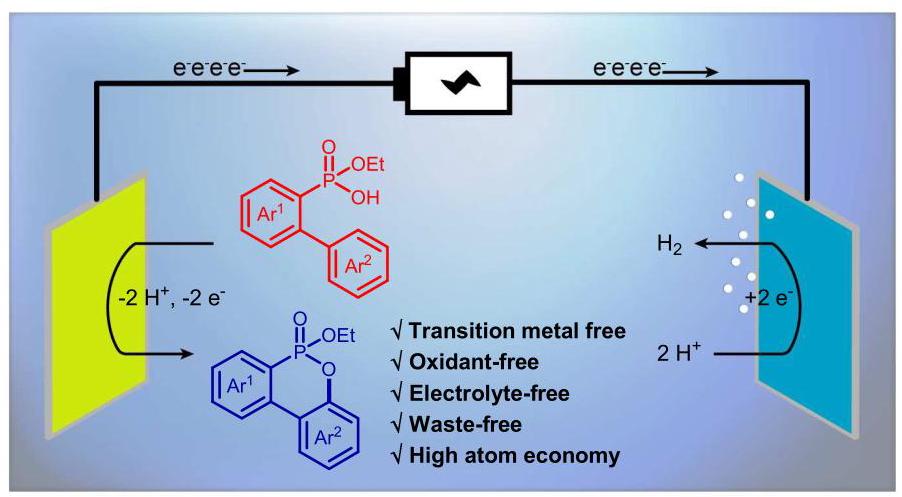
An anodic oxidation/cyclization of 2-(aryl)aryl phosphonic acid monoesters for ethoxy dibenzooxaphosphorin oxides synthesis has been developed.