Addition of Diazo Compounds ipso-C-H bond to Carbon Disulfide: Synthesis of 1,2,3-Thiadiazoles Under Mild Conditions
中文 / Bilingual · English version
Lei Zhang, Beiqi Sun, Qianyi Liu, and Fanyang Mo
J. Org. Chem., Just Accepted Manuscript • DOI: 10.1021/acs.joc.8b00383 • Publication Date (Web): 19 Mar 2018 Downloaded from http://pubs.acs.org on March 19, 2018
Just Accepted
“Just Accepted” manuscripts have been peer-reviewed and accepted for publication. They are posted online prior to technical editing, formatting for publication and author proofing. The American Chemical Society provides “Just Accepted” as a service to the research community to expedite the dissemination of scientific material as soon as possible after acceptance. “Just Accepted” manuscripts appear in full in PDF format accompanied by an HTML abstract. “Just Accepted” manuscripts have been fully peer reviewed, but should not be considered the official version of record. They are citable by the Digital Object Identifier (DOI(R)). “Just Accepted” is an optional service offered to authors. Therefore, the “Just Accepted” Web site may not include all articles that will be published in the journal. After a manuscript is technically edited and formatted, it will be removed from the “Just Accepted” Web site and published as an ASAP article. Note that technical editing may introduce minor changes to the manuscript text and/or graphics which could affect content, and all legal disclaimers and ethical guidelines that apply to the journal pertain. ACS cannot be held responsible for errors or consequences arising from the use of information contained in these “Just Accepted” manuscripts.
ACS Publications
is published by the American Chemical Society. 1155 Sixteenth Street N.W., Washington, DC 20036
Published by American Chemical Society. Copyright © American Chemical Society. However, no copyright claim is made to original U.S. Government works, or works produced by employees of any Commonwealth realm Crown government in the course of their duties.
Addition of Diazo Compounds ipso-C-H bond to Carbon Disulfide: Synthesis of 1,2,3-Thiadiazoles Under Mild Conditions
Lei Zhang, Beiqi Sun, Qianyi Liu and Fanyang Mo*
${}^{ \dagger }$ Department of Energy and Resources Engineering, College of Engineering, Peking University, Beijing 100871, China. Supporting Information Placeholder
ABSTRACT: We describe here an operationally simple and straightforward synthesis method for a series of diverse 4,5- disubstituted 1,2,3-thiadiazoles via the nucleophilic addition of $\alpha$ -diazo carbonyl compounds to carbon disulfide. This method fea-
tures using abundant and inexpensive carbon disulfide with mild reaction conditions.
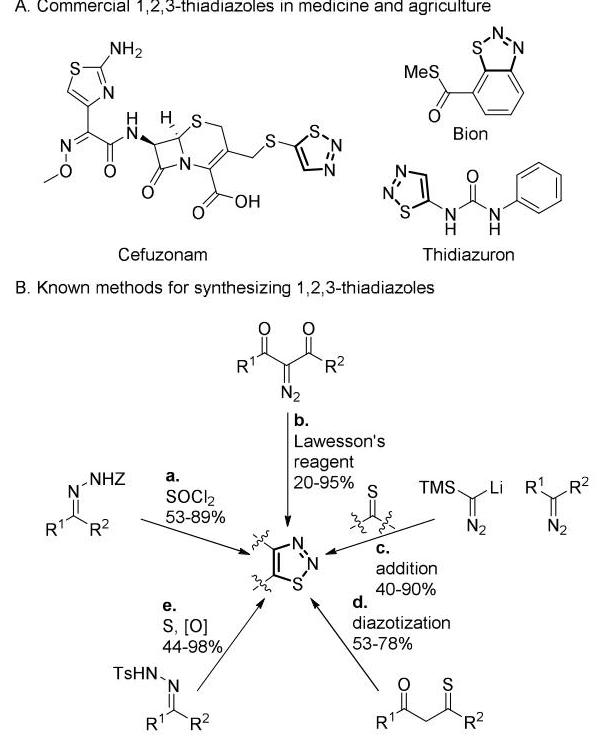
1,2,3-thiadiazoles ${}^{1}$ are versatile heterocycles present in various pharmaceutical molecules. ${}^{2}$ Due to their biological activities, many derivatives of 1,2,3-thiadiazole are important in industry, medicine and agriculture (Scheme 1A). ${}^{3}$ To date, the known methods for synthesizing 1,2,3-thiadiazoles can be summarized as shown in Scheme 1B: a) cyclization of hydra-zones with thionyl chloride (Hurd-Mori synthesis); ${}^{4}$ b) treatment of $\alpha$ -diazo carbonyl compounds with Lawesson’s reagent (Wolff synthesis); ${}^{5}$ c) addition of diazomethane (Pech-mann synthesis) ${}^{6}$ or lithium (trimethylsilyl)diazomethane ${}^{7}$ to thiocarbonyl compounds; d) diazotization of $\alpha$ - enolicdithioesters; ${}^{8}$ and e) oxidative cyclization of $N$ - tosylhydrazones and sulfur. ${}^{9}$ Although these techniques are frequently used, the synthesis of 1,2,3-thiadiazoles remains an active research area.
Scheme 1. Introduction of 1,2,3-Thiadiazoles
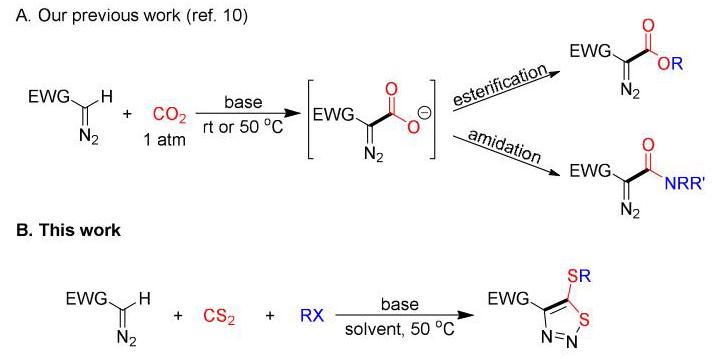
Recently, we have reported transition-metal-free diazo compounds ipso-C-H bond addition to carbon dioxide $\left( {\mathrm{{CO}}}_{2}\right)$ under very mild reaction conditions with the diazo group retained. ${}^{10}$ The resulting $\alpha$ -diazo carboxylate intermediate is readily converted to esters and amides in a one-pot manner (Scheme 2A). ${\mathrm{{CO}}}_{2}$ is a greenhouse gas that has been attracting much attention as an inexpensive, nontoxic, nonflammable, renewable and abundant C1 building block for organic synthesis. ${}^{11}$ Meanwhile, carbon disulfide $\left( {\mathrm{{CS}}}_{2}\right)$ , an analogue of ${\mathrm{{CO}}}_{2}$ , has long been used as a sulfur source for a variety of useful chemicals for agricultural, medicinal, and pharmaceutical applications. ${}^{12}$ As an extension of our previous work, here we report on diazo compound ipso-C-H bond addition to ${\mathrm{{CS}}}_{2}$ for the synthesis of 1,2,3-thiadiazoles under mild conditions (Scheme 2B).
Scheme 2. Diazo Compound ipso-C-H Bond Addition to ${\mathrm{{CO}}}_{2}$ and ${\mathrm{{CS}}}_{2}$
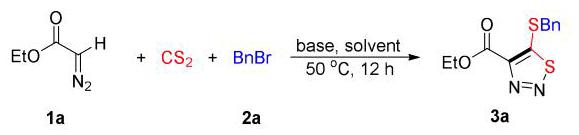
To probe the feasibility of the nucleophilic addition of the diazo group to ${\mathrm{{CS}}}_{2}$ , we initiated our studies with ethyl diazo-acetate (EDA) 1a and benzyl bromide (BnBr) 2a as the standard substrates. Various organic and inorganic bases were examined in the initial studies. As shown in Table 1, with ${\mathrm{{Cs}}}_{2}{\mathrm{{CO}}}_{3}$ as the base, the desired product ethyl 5-(benzylthio)- 1,2,3-thiadiazole-4-carboxylate $3\mathrm{a}$ was obtained with ${38}^{ \circ }$ NMR yield (entry 1). CsF and ${\mathrm{{KO}}}^{\prime }\mathrm{{Bu}}$ turned out to be less effective in this transformation (entries 2 and 3) and organic bases, such as DBU and ${\mathrm{{Et}}}_{3}\mathrm{\;N}$ , were inactive (entries 4 and 5).
This suggested that bases with proper basicity might be a key issue for the desired transformation. Indeed, the yield was slightly improved with the use of KOH as the base (entry 6). 3a was then obtained with 73% yield by switching the solvent from MeCN to DMF (entry 7). Other solvents, such as DMSO, THF and 1,4-dioxane, were less efficient (entries 8-10). Finally, an improved yield (81%) was obtained by using 2.0 equivalent of ${\mathrm{{CS}}}_{2}$ (entry 11). The yield was not further improved by increasing the equivalency of ${\mathrm{{CS}}}_{2}$ to 5.0 (entry 12). However, the product 3a was not very stable during handling and the isolated yield diminished to about 10% compared with the NMR yield.
Table 1. Selected Optimization of Reaction Conditions ${}^{a}$
| entry | base | solvent | equivalency of ${\mathrm{{CS}}}_{2}$ | yield ${\left( \% \right) }^{b}$ |
| 1 | ${\mathrm{{Cs}}}_{2}{\mathrm{{CO}}}_{3}$ | MeCN | 1.5 | 38 |
| 2 | CsF | MeCN | 1.5 | 17 |
| 3 | ${\mathrm{{KO}}}^{\prime }\mathrm{{Bu}}$ | MeCN | 1.5 | 20 |
| 4 | DBU | MeCN | 1.5 | trace |
| 5 | ${\mathrm{{Et}}}_{3}\mathrm{\;N}$ | MeCN | 1.5 | n. d. |
| 6 | KOH | MeCN | 1.5 | 41 |
| 7 | KOH | DMF | 1.5 | 73 |
| 8 | KOH | DMSO | 1.5 | 36 |
| 9 | KOH | THF | 1.5 | 12 |
| 10 | KOH | 1,4-Dioxane | 1.5 | 8 |
| 11 | KOH | DMF | 2.0 | 81 ( ${69}^{ \circ }$ ) |
| 12 | KOH | DMF | 5.0 | 78 |
${}^{a}$ Reaction conditions: EDA (0.5 mmol), BnBr (1.5 equiv), base (1.2 equiv), solvent $\left( {2\mathrm{\;{mL}}}\right)$ , reaction time ${12}\mathrm{\;h}$ , temperature ${50}^{ \circ }\mathrm{C}$ , sealed. n. d., not detected. ${}^{b}$ Yields were determined by ${}^{1}\mathrm{H}$ NMR spectroscopy with 1,1,2,2-tetrachloroethane used as internal standard. ${}^{c}$ Isolated yield.
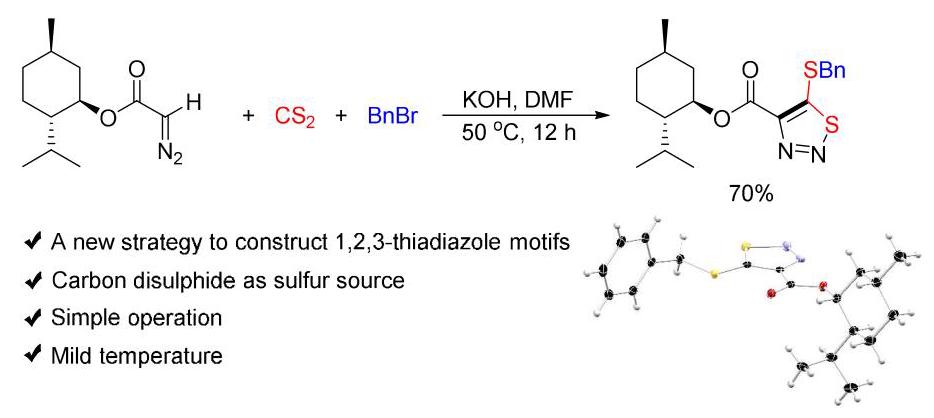
After obtaining the optimal yield for $\mathbf{{3a}}$ , we next conducted substrate scope studies with the results shown in Table 2. Various benzyl bromides were evaluated with various substituent groups for this reaction. Both para- and ortho- substituents (3b-3e) on benzyl bromides were tolerated, giving good yields. Additionally, allyl bromide (3f) was also a good reagent to facilitate the construction of 1,2,3-thiadiazoles. To further demonstrate the expansibility of this methodology, various $\alpha$ -diazo carbonyl compounds were synthesized and tested using this transformation. In general, all these types of diazo substrates were suitable for the reaction with the products obtained with moderate to good yields. Menthyl diazoace-tate was converted to 1,2,3-thiadiazole (3g) with 70% yield. XRD data was obtained for $3\mathrm{\;g}$ . Furthermore, $\alpha$ -diazo alkyl ketones (3h and 3i) also worked well, while $\alpha$ -diazo amides (3j and 3k) gave relatively low yields.
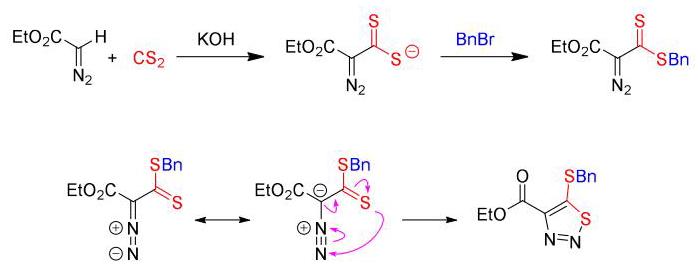
Compared with the known methods shown in Scheme 1B, our synthetic strategy is more close to the catalog c: addition of diazo compounds to $\mathrm{C} = \mathrm{S}$ double bond. In reference 7, Ao-yama suggested a nucleophilic addition/cyclization mechanism for the conversion of lithium (trimethylsi-lyl)diazomethane and carbon disulfide to the 1,2,3-thiadiazole product. Meanwhile, as a good electrophile, carbon disulfide has ready reactivity with a variety of nucleophiles, ranging from carbon-centered nucleophiles (e. g. Grignard reagents) to oxygen-centered nucleophiles (e. g. alkoxy) and amines. ${}^{12c}$ Based on the above, we proposed that our reaction mechanism is also a normal deprotonation-nucleophilic addition/cyclization process (Scheme 3).
Table 2. Substrates Scope ${}^{a}$
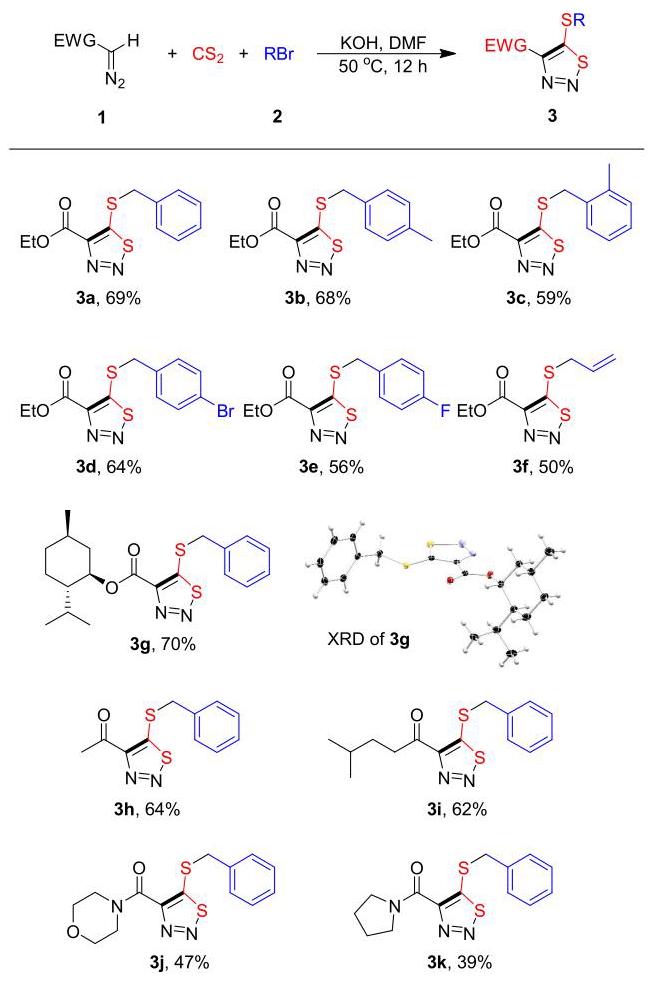
${}^{a}$ Reaction conditions: diazo compound ( ${0.5}\mathrm{{mmol}}$ ), RBr (1.5 equiv), KOH (1.2 equiv), solvent $\left( {2\mathrm{\;{mL}}}\right)$ , reaction time ${12}\mathrm{\;h}$ , temperature ${50}^{ \circ }\mathrm{C}$ , sealed.
Scheme 3. Proposed Reaction Pathway
In summary, we have developed an operationally simple method for the synthesis of 4,5-disubstituted 1,2,3-thiadiazoles via the nucleophilic addition of $\alpha$ -diazo carbonyl compounds to carbon disulfide. This method can be applied as an alternative to traditional synthesis methods of 1,2,3-thiadiazoles with carbon disulfide as the C1 building block with mild reaction conditions.
EXPERIMENTAL SECTION
General Information. All the solvents were purchased from ENERGY CHEMICAL and kept dry by molecular sieves. The products were purified by column chromatography on silica gel (300-400 mesh, from Qingdao, China). NMR spectra were measured on a Bruker ARX400 ( ${}^{1}\mathrm{H}$ at ${400}\mathrm{{MHz}},{}^{13}\mathrm{C}$ at ${100}\mathrm{{MHz}},{}^{19}\mathrm{\;F}$ at ${377}\mathrm{{MHz}}$ ) magnetic resonance spectrometer. The chemical shifts $\left( \delta \right)$ are reported as ppm using tetramethylsilane as the internal standard $(s =$ singlet, $d =$ doublet, $t =$ triplet, $q =$ quartet, ${dd} =$ doublet of doublets, ${dt} =$ doublet of triplets, $\mathrm{m} =$ multiplet) while the coupling constants $\left( J\right)$ were reported in Hertz (Hz). Infrared spectra were recorded on a Thermal Fisher Nicolet iS50 Fourier transform spectrometer (FT-IR) and were reported as wave numbers $\left( {\mathrm{{cm}}}^{-1}\right)$ . The HRMS data was obtained on a VG ZAB-HS mass spectrometer and a Brucker Apex IV FTMS spectrometer. The diazo starting materials were synthesized in the lab. For details, see Supporting Information.
General procedure for the synthesis of 1,2,3-thiadiazoles. In a glove box, charge a $4\mathrm{\;{mL}}$ vial equipped with a stir bar with potassium hydroxide (0.6 mmol, 1.2 equiv), dimethyl formamide $\left( {2\mathrm{\;{mL}}}\right)$ , the diazo compound $\left( {{0.5}\mathrm{{mmol}}}\right)$ , carbon disulfide (1.0 mmol, 2.0 equiv), bromide (0.75 mmol, 1.5 equiv) in succession. Then, seal the vial and stir the mixture at ${50}{}^{ \circ }\mathrm{C}$ for ${12}\mathrm{\;h}$ . Then, wash the reaction mixture with ${20}\mathrm{\;{mL}}$ ethyl acetate and water $\left( {3 \times {20}\mathrm{\;{mL}}}\right)$ . Separate the organic layer and dry over ${\mathrm{{Na}}}_{2}{\mathrm{{SO}}}_{4}$ . After removal of the solvent, purify the residue by column chromatography (silica gel) to afford the desired product.
Ethyl 5-(benzylthio)-1,2,3-thiadiazole-4-carboxylate(3a). ${}^{13}$ Yellowish-green solid, yield ${78}\% \left( {{110}\mathrm{{mg}}}\right) ;\mathrm{{mp}} = {83} - {84}{}^{ \circ }\mathrm{C}$ ; ${\mathrm{R}}_{\mathrm{f}} = {0.25}$ (petroleum ether: EtOAc = 10:1); petroleum ether: EtOAc = 100:1 ~ 50:1 as eluent; ${}^{1}$ H NMR (400 MHz, CDCl ${}_{3}$ ) $\delta = {7.47} - {7.30}\left( {\mathrm{\;m},5\mathrm{H}}\right) ,{4.51}\left( {\mathrm{q}, J = {7.1}\mathrm{\;{Hz}},2\mathrm{H}}\right) ,{4.26}\left( {\mathrm{\;s},2\mathrm{H}}\right)$ , ${1.46}\left( {\mathrm{t}, J = {7.1}\mathrm{\;{Hz}},3\mathrm{H}}\right) ;{}^{13}\mathrm{C}$ NMR (100 MHz, ${\mathrm{{CDCl}}}_{3}$ ) δ 164.4, 160.8, 146.4, 133.6, 129.14, 129.08, 128.6, 62.1, 42.3, 14.4.
Ethyl5-((4-methylbenzyl)thio)-1,2,3-thiadiazole-4- carboxylate (3b). White solid, yield 68% (100 mg); mp = 93- ${94}^{ \circ }\mathrm{C};{\mathrm{R}}_{\mathrm{f}} = {0.25}$ (petroleum ether: EtOAc = 10:1); petroleum ether: EtOAc = 100:1 ~ 50:1 as eluent; 1H NMR (400 MHz, ${\mathrm{{CDCl}}}_{3})\delta = {7.32}\left( {\mathrm{\;d}, J = {8.0}\mathrm{\;{Hz}},2\mathrm{H}}\right) ,{7.17}\left( {\mathrm{\;d}, J = {7.9}\mathrm{\;{Hz}},2\mathrm{H}}\right)$ , ${4.51}\left( {\mathrm{q}, J = {7.1}\mathrm{\;{Hz}},2\mathrm{H}}\right) ,{4.23}\left( {\mathrm{\;s},2\mathrm{H}}\right) ,{2.35}\left( {\mathrm{\;s},3\mathrm{H}}\right) ,{1.46}(\mathrm{t}, J =$ 7.1 Hz, 3H). ${}^{13}\mathrm{C}$ NMR (100 MHz, CDCl ${}_{3}$ ) δ 164.5, 160.8, 146.4, 138.6, 130.5, 129.8, 129.0, 62.1, 42.1, 21.2, 14.4. IR (film) 2984, 2921, 1732, 1701, 1439, 1309, 1271, 1209, 1065, 1021,842. HRMS (ESI): calcd for ${\mathrm{C}}_{13}{\mathrm{H}}_{15}{\mathrm{\;N}}_{2}{\mathrm{O}}_{2}{\mathrm{\;S}}_{2}{}^{ + }{\left\lbrack \mathrm{M} + \mathrm{H}\right\rbrack }^{ + }$ : 295.0569; found: 295.0563.
Ethyl 5-((2-methylbenzyl)thio)-1,2,3-thiadiazole-4- carboxylate (3c). White solid, yield 59% (87 mg); mp = 90- ${91}^{ \circ }\mathrm{C};{\mathrm{R}}_{\mathrm{f}} = {0.25}$ (petroleum ether: EtOAc = 10:1); petroleum ether: EtOAc = 100:1 ~ 50:1 as eluent; ${}^{1}\mathrm{H}$ NMR (400 MHz, ${\mathrm{{CDCl}}}_{3}){\delta 7.41} - {7.15}\left( {\mathrm{\;m},4\mathrm{H}}\right) ,{4.50}\left( {\mathrm{q}, J = {7.1}\mathrm{\;{Hz}},2\mathrm{H}}\right) ,{4.25}(\mathrm{\;s}$ , 2H), 2.43 (s, 3H), 1.45 (t, J = 7.1 Hz, 3H). ${}^{13}\mathrm{C}$ NMR (100 MHz, CDCl3) δ 164.8, 160.8, 146.2, 137.2, 131.6, 131.0, 130.0, 129.0, 126.6, 62.1, 41.0, 19.3, 14.4. IR (film) 2980, 2932, 1730, 1701, 1439, 1310, 1272, 1209, 1065, 1020, 842, 780. HRMS (ESI): calcd for ${\mathrm{C}}_{13}{\mathrm{H}}_{15}{\mathrm{\;N}}_{2}{\mathrm{O}}_{2}{\mathrm{\;S}}_{2}{}^{ + }{\left\lbrack \mathrm{M} + \mathrm{H}\right\rbrack }^{ + }$ : 295.0569; found: 295.0562.
Ethyl5-((4-bromobenzyl)thio)-1,2,3-thiadiazole-4- carboxylate (3d). White solid, yield 64% (115 mg); mp = 93- ${94}^{ \circ }\mathrm{C};{\mathrm{R}}_{\mathrm{f}} = {0.20}$ (petroleum ether: EtOAc = 10:1); petroleum ether: EtOAc = 100:1 ~ 50:1 as eluent; ${}^{1}\mathrm{H}$ NMR (400 MHz, ${\mathrm{{CDCl}}}_{3}){\delta 7.55} - {7.48}\left( {\mathrm{\;m},2\mathrm{H}}\right) ,{7.32}\left( {\mathrm{\;d}, J = {8.5}\mathrm{\;{Hz}},2\mathrm{H}}\right) ,{4.51} \; \left( {\mathrm{q}, J = {7.1}\mathrm{\;{Hz}},2\mathrm{H}}\right) ,{4.21}\left( {\mathrm{\;s},2\mathrm{H}}\right) ,{1.46}\left( {\mathrm{t}, J = {7.1}\mathrm{\;{Hz}},3\mathrm{H}}\right) .{}^{13}\mathrm{C}$ NMR (100 MHz, CDCl3) δ 163.8, 160.7, 146.5, 132.7, 132.3, 130.7, 122.8, 62.2, 41.6, 14.3. IR (film) 2984, 1730, 1700, 1487, 1440, 1310, 1271, 1210, 1066, 1012, 842, 780. HRMS (ESI): calcd for ${\mathrm{C}}_{12}{\mathrm{H}}_{12}{\mathrm{{BrN}}}_{2}{\mathrm{O}}_{2}{\mathrm{\;S}}_{2}^{ + }{\left\lbrack \mathrm{M} + \mathrm{H}\right\rbrack }^{ + }$ : 358.9518; found: 358.9512.
Ethyl5-((4-fluorobenzyl)thio)-1,2,3-thiadiazole-4- carboxylate (3e). White solid, yield ${56}\% \left( {{84}\mathrm{{mg}}}\right)$ ; mp $= {63}$ - ${64}^{ \circ }\mathrm{C};{\mathrm{R}}_{\mathrm{f}} = {0.20}$ (petroleum ether: EtOAc = 10:1); petroleum ether: EtOAc = 100:1 ~ 50:1 as eluent; 1H NMR (400 MHz, ${\mathrm{{CDCl}}}_{3})\delta$ 7.42 $\left( {\mathrm{{dd}}, J = {8.5},{5.2}\mathrm{\;{Hz}},2\mathrm{H}}\right) ,{7.06}(\mathrm{t}, J = {8.5}\mathrm{\;{Hz}}$ , $2\mathrm{H}),{4.51}\left( {\mathrm{q}, J = {7.1}\mathrm{\;{Hz}},2\mathrm{H}}\right) ,{4.24}\left( {\mathrm{\;s},2\mathrm{H}}\right) ,{1.46}(\mathrm{t}, J = {7.1}\mathrm{\;{Hz}}$ , 3H). ${}^{13}\mathrm{C}$ NMR (100 MHz, ${\mathrm{{CDCl}}}_{3}$ ) δ 164.0 (d, $J = {2.1}\mathrm{\;{Hz}}$ ), 161.5,160.8,146.4,130.9 (d, $J = {8.4}\mathrm{\;{Hz}}$ ),129.4 (d, $J = {3.3}$ Hz), 116.2, 116.0, 62.2, 41.6, 14.3. ${}^{19}\mathrm{\;F}$ NMR (377 MHz, CDCl ${}_{3}$ ) δ -112.5 - -112.6 (m). IR (film) 2984,1730,1700, 1508, 1439, 1310, 1271, 1210, 1159, 1064, 1017, 842, 780. HRMS (ESI): calcd for ${\mathrm{C}}_{12}{\mathrm{H}}_{12}{\mathrm{{FN}}}_{2}{\mathrm{O}}_{2}{\mathrm{\;S}}_{2}{}^{ + }{\left\lbrack \mathrm{M} + \mathrm{H}\right\rbrack }^{ + }$ : 299.0319; found: 299.0311.
Ethyl 5-(allylthio)-1,2,3-thiadiazole-4-carboxylate (3f). Yellow oil, yield ${50}\% \left( {{58}\mathrm{{mg}}}\right) ;{\mathrm{R}}_{\mathrm{f}} = {0.25}$ (petroleum ether: EtOAc = 10:1); petroleum ether: EtOAc = 100:1 ~ 50:1 as eluent; ${}^{1}\mathrm{H}$ NMR (400 MHz, CDCl ${}_{3}$ ) δ 5.90 (m,1H),5.50 (dd, $J = {17.0},{0.7}\mathrm{\;{Hz}},1\mathrm{H}),{5.38}\left( {\mathrm{\;d}, J = {10.1}\mathrm{\;{Hz}},1\mathrm{H}}\right) ,{4.52}(\mathrm{q}, J = \; {7.1}\mathrm{\;{Hz}},2\mathrm{H}),{3.71}\left( {\mathrm{\;d}, J = {6.7}\mathrm{{Hz}},2\mathrm{H}}\right) ,{1.47}\left( {\mathrm{t}, J = {7.1}\mathrm{\;{Hz}},3\mathrm{H}}\right)$ . ${}^{13}\mathrm{C}$ NMR (100 MHz, ${\mathrm{{CDCl}}}_{3}$ ) δ 164.3,160.8,146.7,129.9, 121.7, 62.1, 40.6, 14.4. IR (film) 2984, 1730, 1701, 1438, 1307, 1271, 1207, 1063, 1020, 930, 842. HRMS (ESI): calcd for ${\mathrm{C}}_{8}{\mathrm{H}}_{11}{\mathrm{\;N}}_{2}{\mathrm{O}}_{2}{\mathrm{\;S}}_{2}{}^{ + }{\left\lbrack \mathrm{M} + \mathrm{H}\right\rbrack }^{ + }$ : 231.0256; found: 231.0254.
(1S,2R,5S)-2-Isopropyl-5-methylcyclohexyl 5-(benzylthio)- 1,2,3-thiadiazole-4-carboxylate (3g). White solid, yield 70% (136 mg); mp $= {102} - {103}^{ \circ }\mathrm{C};{\mathrm{R}}_{\mathrm{f}} = {0.30}$ (petroleum ether: EtOAc = 20:1); petroleum ether: EtOAc = 100:1 ~ 50:1 as eluent; ${}^{1}\mathrm{H}$ NMR (400 MHz, ${\mathrm{{CDCl}}}_{3}$ ) δ 7.50 - 7.29 (m,5H), 5.08 – 5.01 (m, 1H), 4.25 (s, 2H), 2.23 – 2.11 (m, 1H), 2.07- ${2.00}\left( {\mathrm{\;m},1\mathrm{H}}\right) ,{1.80} - {1.48}\left( {\mathrm{\;m},4\mathrm{H}}\right) ,{1.23}(\mathrm{{dd}}, J = {23.2},{12.0}\mathrm{\;{Hz}}$ , 1H), 1.18-1.07 (m, 1H), 0.92 (dd, J = 10.8, 6.8 Hz, 6H), 0.80 (d, $J = {7.0}\mathrm{\;{Hz}},3\mathrm{H}).{}^{13}\mathrm{C}$ NMR (100 MHz, ${\mathrm{{CDCl}}}_{3}$ ) δ 164.2, 160.4, 146.7, 133.7, 129.1, 129.1, 128.6, 76.5, 46.8, 42.4, 40.8, 34.1, 31.6, 26.2, 23.4, 22.0, 20.8, 16.3. IR (film) 2954, 2926, 2869, 1729, 1698, 1436, 1311, 1272, 1214, 1064, 980, 837, 704. HRMS (ESI): calcd for ${\mathrm{C}}_{20}{\mathrm{H}}_{27}{\mathrm{\;N}}_{2}{\mathrm{O}}_{2}{\mathrm{\;S}}_{2}{}^{ + }{\left\lbrack \mathrm{M} + \mathrm{H}\right\rbrack }^{ + } : {391.1508}$ ; found: 391.1502.
1-(5-(Benzylthio)-1,2,3-thiadiazol-4-yl)ethan-1-one (3h). Yellow solid, yield ${64}\% \left( {{80}\mathrm{{mg}}}\right) ;\mathrm{{mp}} = {100} - {101}^{ \circ }\mathrm{C};{\mathrm{R}}_{\mathrm{f}} = {0.20}$ (petroleum ether: EtOAc = 20:1); petroleum ether: EtOAc = 100:1 as eluent; ${}^{1}\mathrm{H}$ NMR (400 MHz, ${\mathrm{{CDCl}}}_{3}$ ) δ 7.39 m,5H), 4.23 (s, 2H), 2.85 (s, 3H). ${}^{13}\mathrm{C}$ NMR (100 MHz, CDC1 ${}_{3}$ ) δ 192.4, 164.1, 154.0, 133.6, 129.2, 129.1, 128.6, 42.8, 28.8. IR (film) 3063, 3032, 2915, 1672, 1413, 1273, 1175, 1066, 910, 790,705,604. HRMS (ESI): calcd for ${\mathrm{C}}_{11}{\mathrm{H}}_{11}{\mathrm{\;N}}_{2}{\mathrm{{OS}}}_{2}{}^{ + }{\left\lbrack \mathrm{M} + \mathrm{H}\right\rbrack }^{ + }$ : 251.0307; found: 251.0308.
1-(5-(Benzylthio)-1,2,3-thiadiazol-4-yl)-4-methylpentan-1- one (3i). Yellow oil, yield ${62}\% \left( {{95}\mathrm{{mg}}}\right) ;{\mathrm{R}}_{\mathrm{f}} = {0.20}$ (petroleum ether: EtOAc = 40:1); petroleum ether: EtOAc = 100:1 as eluent; ${}^{1}\mathrm{H}$ NMR (400 MHz, CDC ${\mathrm{l}}_{3}$ ) δ 7.48 - 7.28 (m,5H),4.23 $\left( {\mathrm{s},2\mathrm{H}}\right) ,{3.28}\left( {\mathrm{t}, J = {7.2}\mathrm{\;{Hz}}2\mathrm{H}}\right) ,{1.68}\left( {\mathrm{\;m},3\mathrm{H}}\right) ,{0.95}(\mathrm{\;d}, J = {6.4}$ Hz, 6H). ${}^{13}\mathrm{C}$ NMR (100 MHz, CDCl ${}_{3}$ ) δ 195.4, 164.0, 153.7, 133.7, 129.2, 129.0, 128.6, 42.7, 39.3, 32.9, 27.8, 22.4. IR
(5-(Benzylthio)-1,2,3-thiadiazol-4-
yl)(morpholino)methanone (3j). White solid, yield 47% (75 mg); mp = 96-97°C; ${\mathrm{R}}_{\mathrm{f}} = {0.50}$ (petroleum ether: EtOAc = 1:1); petroleum ether: EtOAc $= {10} : 1 \sim 5 : 1$ as eluent; ${}^{1}\mathrm{H}$ NMR (400 MHz, CDCl ${}_{3}$ ) 6 7.45 - 7.29 (m, 5H), 4.23 (s, 2H), 4.08 (s, 2H), ${3.79}\left( {\mathrm{\;m}, J = {25.0}\mathrm{\;{Hz}},6\mathrm{H}}\right) ;{}^{13}\mathrm{C}$ NMR $\left( {{100}\mathrm{{MHz}},{\mathrm{{CDCl}}}_{3}}\right) \delta$ 162.6, 160.2, 150.1, 134.2, 129.2, 129.0, 128.5, 67.2, 66.9, 48.0, 43.3, 42.2. IR (film) 2964, 2913, 2859, 1616, 1472, 1443, 1302, 1269, 1218, 1114, 1076, 1030, 968, 705. HRMS (ESI): calcd for ${\mathrm{C}}_{14}{\mathrm{H}}_{16}{\mathrm{\;N}}_{3}{\mathrm{O}}_{2}{\mathrm{\;S}}_{2}^{ + }{\left\lbrack \mathrm{M} + \mathrm{H}\right\rbrack }^{ + } : {322.0678}$ ; found: 322.0671.
(5-(Benzylthio)-1,2,3-thiadiazol-4-yl)(pyrrolidin-1-
yl)methanone (3k). White solid, yield 39% (60mg); mp = 124- ${125}^{ \circ }\mathrm{C};{\mathrm{R}}_{\mathrm{f}} = {0.60}$ (petroleum ether: EtOAc = 1:1); petroleum ether: EtOAc = 10:1 ~ 5:1 as eluent; 1H NMR (400 MHz, ${\mathrm{{CDCl}}}_{3})\delta$ 7.43 $\left( {\mathrm{m},2\mathrm{H}}\right) ,{7.38} - {7.28}\left( {\mathrm{\;m},3\mathrm{H}}\right) ,{4.21}\left( {\mathrm{\;s},2\mathrm{H}}\right) ,{4.02} \; \left( {\mathrm{t}, J = {6.6}\mathrm{\;{Hz}},2\mathrm{H}}\right) ,{3.72}\left( {\mathrm{t}, J = {6.7}\mathrm{\;{Hz}},2\mathrm{H}}\right) ,{2.08} - {1.85}(\mathrm{\;m}$ , 4H). ${}^{13}\mathrm{C}$ NMR (100 MHz, ${\mathrm{{CDCl}}}_{3}$ ) δ 163.0,159.8,150.6,134.3, 129.2, 128.9, 128.3, 49.4, 47.2, 42.3, 26.6, 23.9. IR (film) 2970, 2875, 1610, 1468, 1454, 1374, 1256, 1079, 843, 710. HRMS (ESI): calcd for ${\mathrm{C}}_{14}{\mathrm{H}}_{16}{\mathrm{\;N}}_{3}{\mathrm{{OS}}}_{2}^{ + }{\left\lbrack \mathrm{M} + \mathrm{H}\right\rbrack }^{ + }$ : 306.0729; found: 306.0729.
ASSOCIATED CONTENT
Supporting Information
Preparation of substrates, NMR spectra, and X-ray single crystal structure of compound $3\mathbf{g}$ .
AUTHOR INFORMATION
Corresponding Author
Notes
The authors declare no competing financial interest.
ACKNOWLEDGMENT
The project was supported by the Natural Science Foundation of China (Grants 21502003 and 21772003). We also thank the “1000-Youth Talents Plan”, Peking University for start-up funds.
The project was supported by the Natural Science Foundation of China (Grants 21502003 and 21772003). We also thank the “1000-Youth Talents Plan”, Peking University for start-up funds.
REFERENCES
(1) Bakulev, V. A.; Dehaen, W.: The Chemistry of 1,2,3- Thiadiazoles; John Wiley & Sons, Inc., 2004.
(2) (a) Li, Z.; Wu, Z.; Luo, F. Synthesis and Antifungal Activities of Alkyl N-(1,2,3-Thiadiazole-4-Carbonyl) Carbamates and S-Alkyl N-(1,2,3-Thiadiazole-4-Carbonyl) Carbamothioates. J. Agric. Food Chem. 2005, 53, 3872-3876; (b) Hayat, F.; Salahuddin, A.; Zargan, J.; Azam, A. Synthesis, Characterization, Antiamoebic Activity and Cytotoxicity of Novel 2-(Quinolin-8- Yloxy) Acetohydrazones and Their Cyclized Products (1,2,3- Thiadiazole and 1,2,3-Selenadiazole Derivatives). Eur. J. Med. Chem. 2010, 45, 6127-6134; (c) Wang, Z.-H.; Guo, Y.-Z.; Zhang, J.; Ma, L.; Song, H.-B.; Fan, Z.-J. Synthesis and Biological Activity of Organotin 4-Methyl-1,2,3-Thiadiazole-5-Carboxylates and Benzo[1,2,3]Thiadiazole-7-Carboxylates. J. Agric. Food Chem. 2010, 58, 2715-2719; (d) Zheng, Q.; Mi, N.; Fan, Z.; Zuo, X.; Zhang, H.; Wang, H.; Yang, Z. 5-Methyl-1,2,3-ThiadiazolesSynthesized Via Ugi Reaction and Their Fungicidal and Antiviral Activities. J. Agric. Food Chem. 2010, 58, 7846-7855; (e) Fan, R. Z.; Wang, D.; Fan, Z. J.; Wang, S. X.; Hua, X. W.; Ji, X. T.; Huang, Y.; Song, H. B. Synthesis, Crystal Structure, and Biological Activity of N-((1-Cyclohexyl-1h-Tetrazol-5-Yl)(5- Methyl-1,2,3-Thiadiazol-4-Yl)Methyl) -4-Nitrobenzenamine. Jiegou Huaxue 2012, 31, 803-808.
(3) (a) Yasuda, M.; Nakashita, H.; Yoshida, S. Tiadinil, a Novel Class of Activator of Systemic Acquired Resistance, Induces Defense Gene Expression and Disease Resistance in Tobacco. J. Pestic. Sci. 2004, 29, 46-49; (b) Fan, Z.; Shi, Z.; Zhang, H.; Liu, X.; Bao, L.; Ma, L.; Zuo, X.; Zheng, Q.; Mi, N. Synthesis and Biological Activity Evaluation of 1,2,3-Thiadiazole Derivatives as Potential Elicitors with Highly Systemic Acquired Resistance. J. Agric. Food Chem. 2009, 57, 4279-4286; (c) Morzherin, Y.; Prokhorova, P. E.; Musikhin, D. A.; Glukhareva, T. V.; Fan, Z. 2- Hydroxypropyl Derivatives of 1,2,3-Thiadiazole and 1,2,3- Triazole: Synthesis and Antifungal Activity. Pure Appl. Chem. 2011, 83, 715-722; (d) Du, Q.; Zhu, W.; Zhao, Z.; Qian, X.; Xu, Y. Novel Benzo-1,2,3-Thiadiazole-7-Carboxylate Derivatives as Plant Activators and the Development of Their Agricultural Applications. J. Agric. Food Chem. 2012, 60, 346-353; (e) Flygare, J. A.; Beresini, M.; Budha, N.; Chan, H.; Chan, I. T.; Cheeti, S.; Cohen, F.; Deshayes, K.; Doerner, K.; Eckhardt, S. G.; Elliott, L. O.; Feng, B.; Franklin, M. C.; Reisner, S. F.; Gazzard, L.; Halladay, J.; Hymowitz, S. G.; La, H.; LoRusso, P.; Maurer, B.; Murray, L.; Plise, E.; Quan, C.; Stephan, J.-P.; Young, S. G.; Tom, J.; Tsui, V.; Um, J.; Varfolomeev, E.; Vucic, D.; Wagner, A. J.; Wallweber, H. J. A.; Wang, L.; Ware, J.; Wen, Z.; Wong, H.; Wong, J. M.; Wong, M.; Wong, S.; Yu, R.; Zobel, K.; Fairbrother, W. J. Discovery of a Potent Small-Molecule Antagonist of Inhibitor of Apoptosis (Iap) Proteins and Clinical Candidate for the Treatment of Cancer (Gdc-0152). J. Med. Chem. 2012, 55, 4101-4113; (f) Xu, J.; Li, Z.; Luo, J.; Yang, F.; Liu, T.; Liu, M.; Qiu, W.-W.; Tang, J. Synthesis and Biological Evaluation of Heterocyclic Ring-Fused Betulinic Acid Derivatives as Novel Inhibitors of Osteoclast Differentiation and Bone Resorption. J. Med. Chem. 2012, 55, 3122-3134; (g) Krishnaraj, T.; Muthusubramanian, S. Synthesis of Biologically Important N-Heteroaryl-2-(Heteroarylthio)Acetamides. J. Heterocycl. Chem. 2014, 51, 1012-1019.
(4) Hurd, C. D.; Mori, R. I. On Acylhydrazones and 1,2,3- Thiadiazoles. J. Am. Chem. Soc. 1955, 77, 5359-5364.
(5) (a) Wolff, L. Ueber 1,2,3-Thiodiazole. Justus Liebigs Ann. Chem. 1904, 333, 1-21; (b) Caron, M. Convenient Preparation of 5-Alkyl-4-Carbalkoxy-1,2,3-Thiadiazoles. J. Org. Chem. 1986, 51, 4075-4077.
(6) v. Pechmann, H.; Nold, A. Ueber Die Einwirkung Von Diazomethan Auf Phenylsenföl. Ber. Dtsch. Chem. Ges. 1896, 29, 2588-2593.
(7) Aoyama, T.; Iwamoto, Y.; Shioiri, T. New Methods and Reagents in Organic Synthesis. 59. Lithium Trimethylsilydiazomethane: A New Synthon for the Preparation of 5-Substituted 1,2,3-Thiadiazoles. Heterocycles 1986, 24, 589- 592.
(8) (a) Singh, M. S.; Nagaraju, A.; Verma, G. K.; Shukla, G.; Verma, R. K.; Srivastava, A.; Raghuvanshi, K. Eco-Efficient, Regioselective and Rapid Access to 4,5-Disubstituted 1,2,3- Thiadiazoles Via [3 + 2] Cycloaddition of [Small Alpha]- Enolicdithioesters with Tosyl Azide under Solvent-Free Conditions. Green Chem. 2013, 15, 954-962; (b) Nagaraju, A.; Ramulu, B. J.; Shukla, G.; Srivastava, A.; Verma, G. K.; Raghuvanshi, K.; Singh, M. S. A Facile and Straightforward Synthesis of 1,2,3-Thiadiazoles from A-Enolicdithioesters Via Nitrosation/Reduction/Diazotization/Cyclization Cascade in One-Pot. Tetrahedron Lett. 2014, 55, 2430-2433.
(9) Chen, J.; Jiang, Y.; Yu, J.-T.; Cheng, J. Tbai-Catalyzed Reaction between N-Tosylhydrazones and Sulfur: A procedure toward 1,2,3-Thiadiazole. J. Org. Chem. 2016, 81, 271-275.
(10) Liu, Q.; Li, M.; Xiong, R.; Mo, F. Direct Carboxylation of the Diazo Group Ipso-C(Sp2)-H Bond with Carbon Dioxide: Access to Unsymmetrical Diazomalonates and Derivatives. Org. Lett. 2017, 19, 6756-6759.
(11) Aresta, M.; Dibenedetto, A.; Angelini, A. Catalysis for the Valorization of Exhaust Carbon: From Co2 to Chemicals, Materials, and Fuels. Technological Use of Co2. Chem. Rev. 2014, 114, 1709-1742.
(12) (a) Yokoyama, M.; Imamoto, T. Organic Reactions of Carbon Disulfide. Synthesis 1984, 1984, 797-824; (b) Tominaga, Y. Synthesis of Heterocyclic Compounds Using Carbon Disulfide and Their Products. J. Heterocycl. Chem. 1989, 26, 1167-1204; (c) Schmitt, C.; Murai, T.: Carbon Disulfide. In Encyclopedia of Reagents for Organic Synthesis; John Wiley & Sons, Ltd, 2001; (d) Ho, T.-L.; Fieser, M.; Fieser, L.; Fieser, L. F.; Fieser, M.; Ho, T.-L.: Carbon Disulfide. In Fieser and Fieser’s Reagents for Organic Synthesis; John Wiley & Sons, Ltd, 2006.
(13) Hinz, W.; Just, G. The Synthesis of 4-Carbalkoxy-5- Thioalkyl-1,2,3-Thiadiazoles. Synth. Commun. 1986, 16, 917-927.