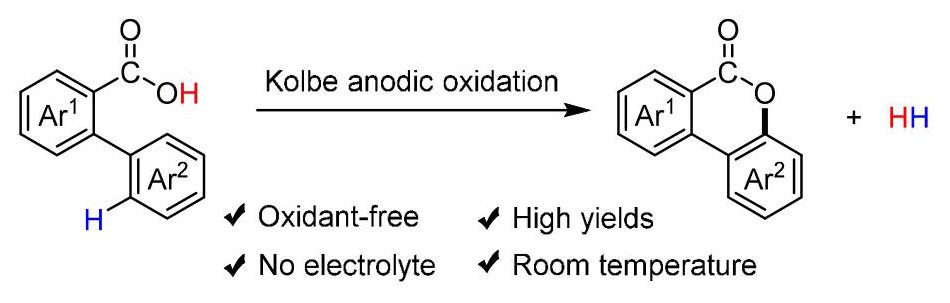
Oxidant-Free C(sp2)−H Functionalization/C−O Bond Formation: A Kolbe Oxidative Cyclization Process
中文 / Bilingual · English version
Lei Zhang, Zhenxing Zhang, Junting Hong, Jian Yu, Jianning Zhang, and Fanyang Mo
J. Org. Chem., Just Accepted Manuscript • DOI: 10.1021/acs.joc.8b00089 • Publication Date (Web): 23 Feb 2018 Downloaded from http://pubs.acs.org on February 23, 2018
Just Accepted
“Just Accepted” manuscripts have been peer-reviewed and accepted for publication. They are posted online prior to technical editing, formatting for publication and author proofing. The American Chemical Society provides “Just Accepted” as a service to the research community to expedite the dissemination of scientific material as soon as possible after acceptance. “Just Accepted” manuscripts appear in full in PDF format accompanied by an HTML abstract. “Just Accepted” manuscripts have been fully peer reviewed, but should not be considered the official version of record. They are citable by the Digital Object Identifier (DOI®). “Just Accepted” is an optional service offered to authors. Therefore, the “Just Accepted” Web site may not include all articles that will be published in the journal. After a manuscript is technically edited and formatted, it will be removed from the “Just Accepted” Web site and published as an ASAP article. Note that technical editing may introduce minor changes to the manuscript text and/or graphics which could affect content, and all legal disclaimers and ethical guidelines that apply to the journal pertain. ACS cannot be held responsible for errors or consequences arising from the use of information contained in these “Just Accepted” manuscripts.
ACS Publications
The Journal of Organic Chemistry is published by the American Chemical Society.
Published by American Chemical Society. Copyright © American Chemical Society. However, no copyright claim is made to original U.S. Government works, or works produced by employees of any Commonwealth realm Crown government in the course
Oxidant-Free C(sp ${}^{2}$ )-H Functionalization/C-O Bond Formation: A Kolbe Oxidative Cyclization Process
Lei Zhang, ${}^{ \dagger }$ Zhenxing Zhang, ${}^{ \dagger }$ Junting Hong, Jian Yu, Jianning Zhang, Fanyang Mo*
Department of Energy and Resources Engineering, College of Engineering, Peking University, Beijing 100871, China
ABSTRACT: An anodic oxidation/cyclization of 2-arylbenzoic acids for dibenzopyranones synthesis has been developed. The reaction proceeds at room temperature with no oxidant or electrolyte required, and exhibits high atom-economy as ${\mathrm{H}}_{2}$ being the only by-product. A series of dibenzopyranones were obtained in good to excellent yields. Urolithin A, B and C are formally synthesized by adopting this method as a key step to demonstrate its synthetic utility.
INTRODUCTION
Oxygen-containing heterocycles are privileged motifs found in numerous bioactive natural products, organic materials, agro-chemicals, and pharmaceuticals. ${}^{1}$ The traditional approaches for constructing such heterocyclic scaffolds mainly rely on the addition of a nucleophile to a carbonyl group, to a halide or other leaving groups, electrocyclic reactions, etc. ${}^{2}$ However, most of these approaches involve the use of expensive reagents, harsh conditions, and generate large amounts of waste. Although much progress has been made in recent decades in the transition metal-catalyzed cyclization of acyclic substrates for heterocycles synthesis, ${}^{3}$ the high cost, toxicity, and air/moisture sensitivity of some catalysts are major concerns. Consequently, new compatible and more sustainable synthetic approaches are urgently needed for the synthesis of heterocy-cles.
The prosperous development of organic electrochemistry has dramatically expanded chemists’ toolboxes that provide a variety of opportunities to solve synthetic challenges in unique ways. ${}^{4}$ For example, intramolecular anodic oxidative $\mathrm{C} - \mathrm{O}$ bond formation can serve as a powerful tool for the construction of oxygen-containing heterocycles (Scheme 1A). Moeller and coworkers pioneered a series of intramolecular anodic cyclization of electron-rich olefins with alcohols. ${}^{5}$ Intramolecular electrochemical nucleophilic attack of oxygen nucleo-philes on Schiff bases reported by Zeng and other groups also provide straightforward routes to constructing oxygen-containing heterocycles. ${}^{6}$ The Okimoto and Lee groups described the anodic oxidation of amides or tertiary amines to generate reactive $N$ -acyliminium cations or iminium cations which were trapped by alcohol nucleophiles to afford cyclic $N, O$ -acetals. ${}^{7}$ Very recently, the Waldvogel and Xu groups reported on the intramolecular anodic dehydrogenative coupling of aromatic $\mathrm{C} - \mathrm{H}$ bonds and amide groups for the synthesis of benzoxazoles and benzoxazines, respectively. ${}^{8}$
The anodic oxidation of carboxylic acid, also known as Kolbe electrolysis (or Kolbe oxidation, Kolbe dimerization) has a long history of development since its discovery in 1849. ${}^{9}$ The coupling reaction of alkyl radicals generated from elec-trodecarboxylation of alkyl carboxylates $\left( {{\mathrm{{RCO}}}_{2}{}^{ - }}\right)$ gives the dation) favor implementation of the reaction. Finally, the concomitant cathodic proton reduction to hydrogen gas exactly balances the redox of the overall reaction. In this paper, we report a Kolbe electrolysis for the lactonization of 2- arylbenzoic acids at room temperature in an oxidant-free manner (Scheme 1C).
Kolbe dimer R-R. However, aryl carboxylates (ArCO2) cannot be applied in Kolbe dimerization due to the challenging
Scheme 1. Intramolecular Anodic Oxidative C-O Bond Formation and Kolbe Electrolysis
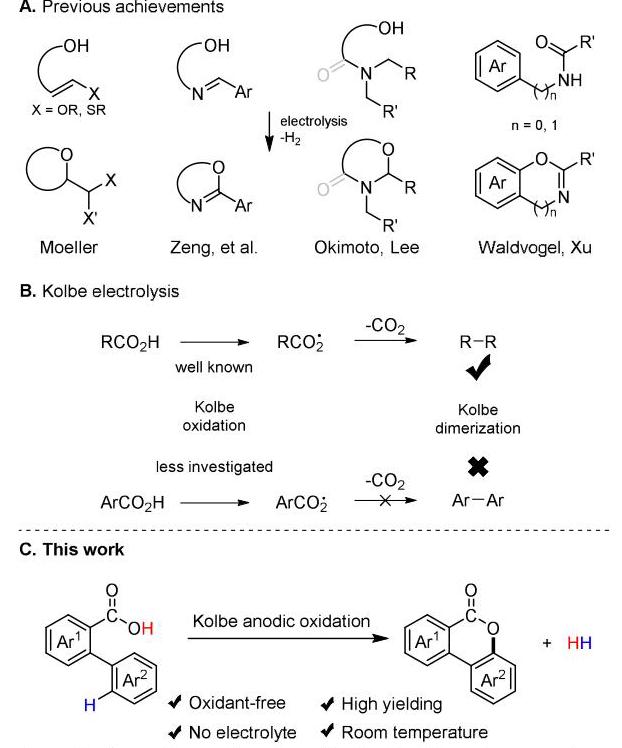
decarboxylation of aroyloxy radicals. In fact, Barton has categorized ${\mathrm{{ArCO}}}_{2}$ - as “nondecarboxylating acyloxy radicals”, noting that it does not decarboxylate at temperatures below ${120} - {130}^{ \circ }\mathrm{C}.{}^{10}$ Thus, compared with alkyl carboxylic acids, there have been far fewer investigations of aryl carboxylic acids for the Kolbe oxidation reaction (Scheme 1B). These previous results give four reasons that the preparation of ben-zolactones is an ideal process for the use of Kolbe electrolysis of 2-arylbenzoic acids. First, although this has been less investigated, anodic oxidation of aromatic carboxylic acid is feasible. ${}^{11}$ Second, the formed aroyloxy radical does not undergo decarboxylation at ambient temperature. Third, the two consecutive electron transfer between the electrode and the substrate taking place on the same electrode (double anodic oxi-
RESULTS AND DISCUSSION
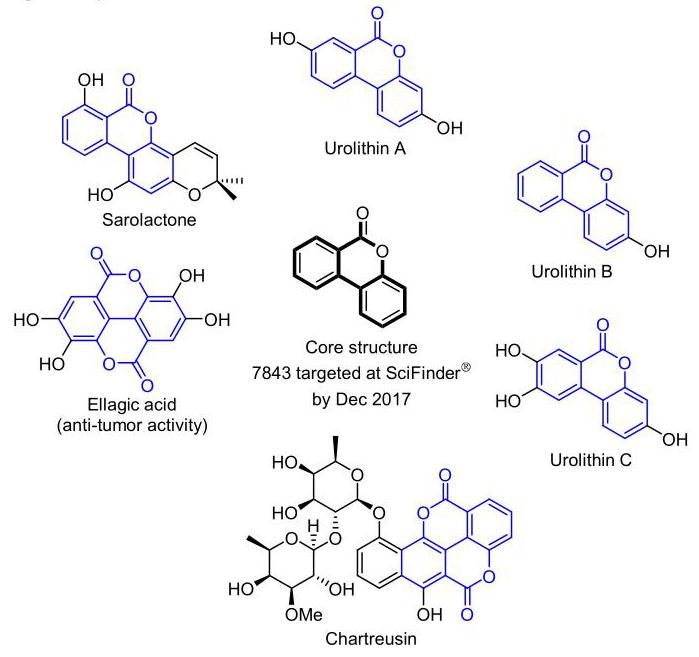
Biaryl lactones and their derivatives are common structure motifs found in a wide variety of bioactive molecules ranging from natural products to drugs (Scheme 2). ${}^{12}$ They also serve as versatile building blocks for the synthesis of various pharmaceuticals, as well as agrochemicals, fragrances, and materials. ${}^{13}$ In light of the importance of these biaryl lactone compounds, a variety of methods have been developed for their synthesis.
Scheme 2. Natural Products and Pharmaceuticals Containing Biaryl Lactones
Among those methods, the oxidative cyclization of 2- arylbenzoic acids via a C-H bond activation/C-O bond formation process is a commonly used cyclization method. ${}^{14}$ For example, Togo and Yokoyama reported on (diacetoxy-iodo)arene and iodine co-mediated cyclization of 2-aryl (or alkyl) benzoic acids under photo irradiation. ${}^{{14b} - d}$ In 2013, Martin and co-workers reported on Cu-catalyzed C-H functionali-zation/C-O bond formation assisted by carboxylic acids with dibenzoyl peroxide as the oxidant. ${}^{{14}\mathrm{e}}$ Later, they also reported on the iodine (III)-catalyzed cyclization of 2-arylbenzoic acid with peroxyacetic acid as the terminal oxidant. ${}^{{14}\mathrm{i}}$ Wang and co-workers developed a Pd-catalysis for the same transformation using $\mathrm{{PhI}}{\left( \mathrm{{OAc}}\right) }_{2}$ as the oxidant. ${}^{{14}\mathrm{f}}$ Gevorgyan reported a Cu(II)-catalyzed title transformation using tert-butyl perox-ybenzoate as the oxidant. ${}^{{14}\mathrm{\;g}}\mathrm{{Xu}}$ also achieved the same goal using a $\mathrm{{Ag}}\left( \mathrm{I}\right)$ catalyst with ${\left( {\mathrm{{NH}}}_{4}\right) }_{2}{\mathrm{\;S}}_{2}{\mathrm{O}}_{8}$ as the oxidant. ${}^{{14}\mathrm{j}}$ In addition, the Wei group demonstrated visible light-induced cyclization of 2-arylbenzoic acids with $N$ -iodosuccinimide as the oxidant, ${}^{{14}\mathrm{\;h}}$ whereas the Gonzalez-Gomez group reported on the metal-free dehydrogenative lactonization of 2- arylbenzoic acids at room temperature under visible light irradiation with $\left\lbrack {{\mathrm{{Acr}}}^{ + }\text{ -Mes] as the photocatalyst and }{\left( {\mathrm{{NH}}}_{4}\right) }_{2}{\mathrm{\;S}}_{2}{\mathrm{O}}_{8}}\right\rbrack$ as the oxidant. ${}^{{14}\mathrm{k}}$ Very recently, the Luo group ${}^{{14}\mathrm{l}}$ and the Zhu group ${}^{{14}\mathrm{\;m}}$ independently reported a photoredox and cobalt co-catalyzed $\mathrm{C}\left( {\mathrm{{sp}}}^{2}\right) - \mathrm{H}$ functionalization $/\mathrm{C} - \mathrm{O}$ bond formation reaction towards biaryl lactone synthesis with no oxidant involved. However, the catalysis system is somewhat complicated. The most known methods use stoichiometric oxidants, since the overall process involves the removal of two hydrogens from the substrate. This will cause excessive waste generation and poor atom economy. We envisage that oxidant-free conditions might be possible if the two hydrogens can be properly handled. In this case, the generation of hydrogen gas $\left( {\mathrm{H}}_{2}\right)$ gives an ideal solution for the two hydrogen atoms (Scheme 3).
Scheme 3. Rationale of Kolbe Electrolysis for Cyclization of 2-Arylbenzoic Acid
A. Literature known methods for cyclization of 2-aryl benzoic acid (ref. 14)
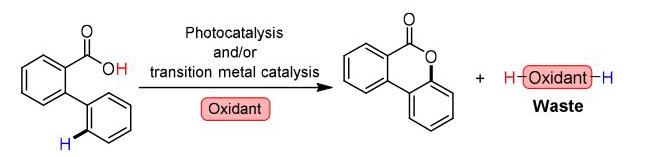
B. Rationale of this work
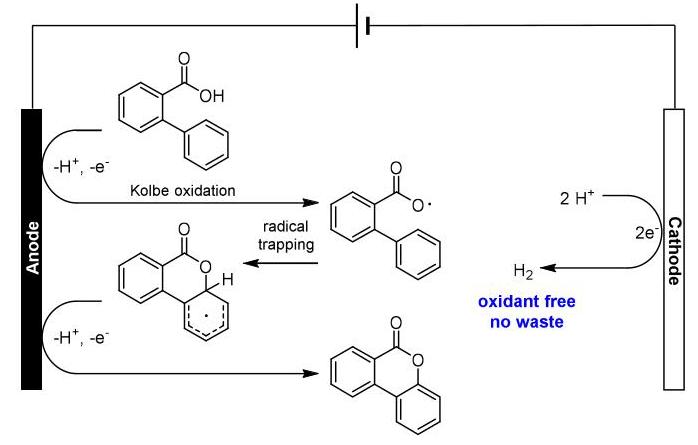
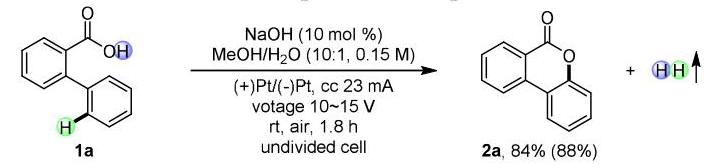
Table 1. Reaction development and optimization
| entry | deviation from the standard conditions | yield ${}^{b}\left( \% \right)$ |
| 1 | MeCN instead of MeOH, 2.8 h | 69 |
| 2 | Acetone instead of MeOH, 2.8 h | 52 |
| 3 | DMF instead of MeOH, 11 h | 34 |
| 4 | THF instead of MeOH, 7 h | 32 |
| 5 | ${}^{i}\mathrm{{PrOH}}$ instead of $\mathrm{{MeOH}},4\mathrm{\;h}$ | 34 |
| 6 | HFIP instead of $\mathrm{{MeOH}},3\mathrm{\;h}$ | 79 |
| 7 | Under ${\mathrm{N}}_{2},{1.8}\mathrm{\;h}$ | 80 (86) |
| 8 | 1 mmol scale, 0.3 M conc., 3.3 h | 76 |
| 9 | ${50}^{ \circ }\mathrm{C},{16}\mathrm{\;h}$ | 76 |
| 10 | cc 10 mA, 5 h | 76 |
| 11 | w/o NaOH, cv 60V, current ca. $3 \sim 7\mathrm{\;{mA}},2\mathrm{\;d}$ | 76 |
| 12 | No electricity, 2 d | 0 |
${}^{a}$ Reaction conditions: 1a ${0.5}\mathrm{{mmol}},\mathrm{{MeOH}}3\mathrm{\;{mL}},{\mathrm{H}}_{2}\mathrm{O}{0.3}\mathrm{\;{mL}}$ , Pt net electrode, $1\mathrm{\;{cm}} \times 1\mathrm{\;{cm}}$ , 52 mesh. cc constant current, cv constant voltage. HFIP 1,1,1,3,3,3-hexafluoro-2-propanol. Reaction time varies in each entry. The completion of the reaction is monitored by TLC and voltage. ${}^{b}$ Yield determined by ${}^{1}\mathrm{H}$ NMR using 1,3,5-trimethoxybenzene. Isolated yield in parentheses.
We initially studied the anodic oxidation of 2- phenylbenzoic acid (Table 1). The reaction conditions were optimized to give the desired cyclization product $\mathbf{{2a}}$ with ${84}\%$ NMR yield and 88% isolated yield in the presence of 10% $\mathrm{{NaOH}}$ in a $\mathrm{{MeOH}}/{\mathrm{H}}_{2}\mathrm{O}$ mixed solvent. Platinum was used as the electrode with the reaction using the constant current mode with a current of ${23}\mathrm{\;{mA}}$ . The Kolbe reaction is usually performed with constant current density with the anode potential seldom needing to be controlled by a potentiostat. ${}^{9e}$ The reaction proceeds quite fast as monitored by TLC and the voltage variations with the voltage starting at ${10} \sim {15}\mathrm{\;V}$ and rising to over ${20}\mathrm{\;V}$ on completion of the reaction. Other solvents, such as MeCN, acetone, and DMF, proved to be less efficient (entries 1-5), while HFIP gave a comparable yield (entry 6). The reaction is not sensitive to air or concentration (entries 7 and 8). Normally, the reaction temperature is slightly higher than room temperature, since the reaction is exothermic. Interestingly, the reaction still works well, but slower at ${50}^{ \circ }\mathrm{C}$ (entry 9). An applied current of ${10}\mathrm{\;{mA}}$ required a longer reaction time with a good yield (entry 10). The reaction media became less conductive $\left( {{60}\mathrm{\;V},3 - 7\mathrm{\;{mA}}}\right)$ when no base was added. The yield did not drop much after two days’ electrolysis (entry 11). The results show that the reaction is unambiguously driven by the electrical current (entry 12).
Table 2. Kolbe Anodic Cyclization via C(sp ${}^{2}$ )-H Functionalization/C-O Formation ${}^{a}$
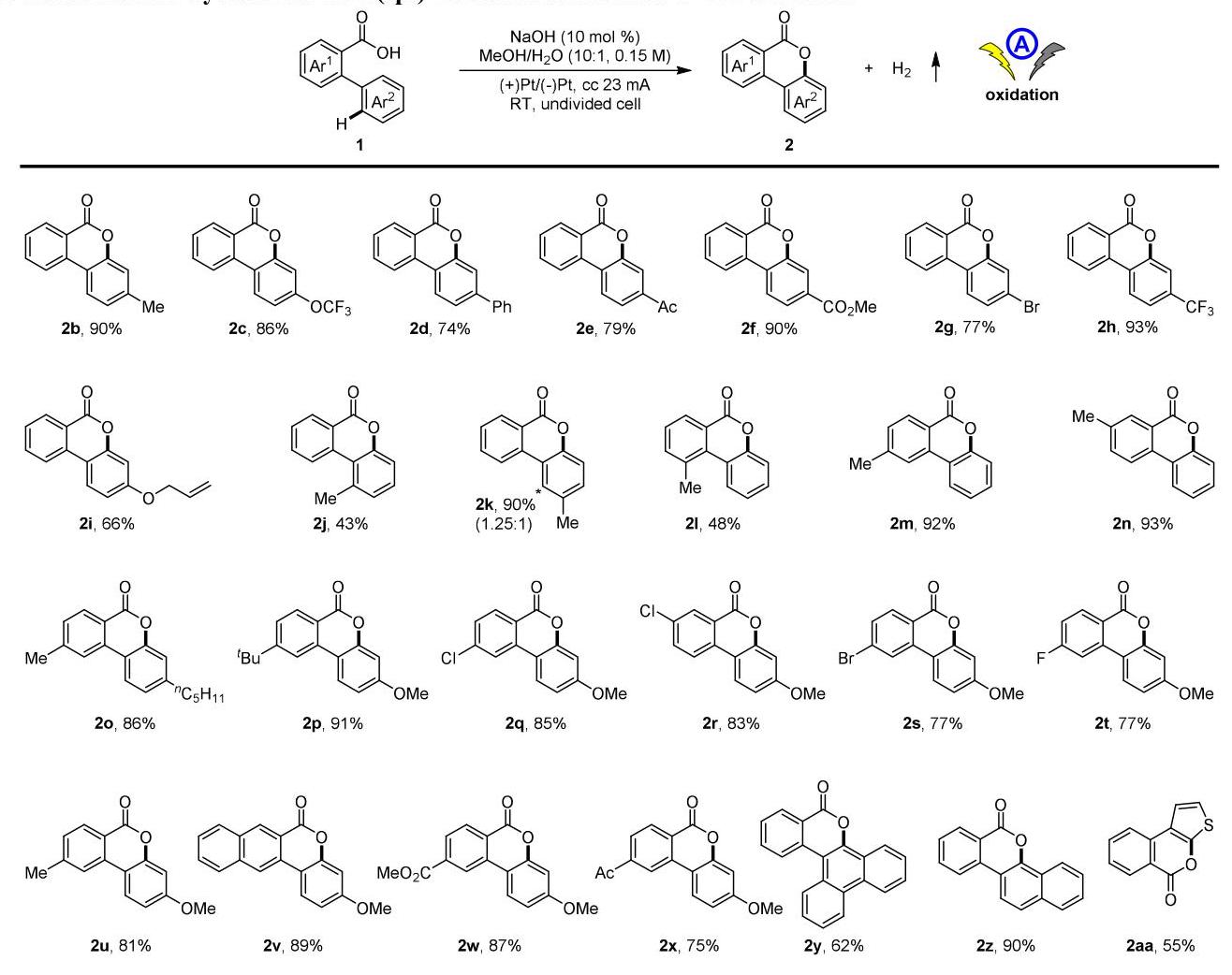
${}^{a}$ Reaction conditions: 1a ${0.5}\mathrm{{mmol}},\mathrm{{MeOH}}3\mathrm{{mL}},{\mathrm{H}}_{2}\mathrm{O}{0.3}\mathrm{{mL}}$ , Pt net electrode, $1\mathrm{\;{cm}} \times 1\mathrm{\;{cm}},{52}\mathrm{{mesh}}$ . cc constant current. Isolated yield are reported.
The optimal reaction conditions were then used for substrate scope studies with the results shown in Table 2. A series of benzoic acid substrates bearing substitutions on both the ${\mathrm{{Ar}}}^{1}$ and ${\mathrm{{Ar}}}^{2}$ rings were examined with the corresponding cyclization products isolated with good to excellent yields. This anodic oxidation reaction tolerates a variety of functional groups, such as ketone, ester, ether, alkene, halides, trifluoromethyl, and trifluoromethoxyl groups. Both electron-donating and - withdrawing substituents worked well on both aromatic rings. Substituents in the ortho position to the targeted $\mathrm{C} - \mathrm{H}$ bond hindered the reaction, providing $2\mathbf{j}$ in relatively low yield. meta-substitution on ${\mathrm{{Ar}}}^{2}$ ring cause site selectivity, as shown in the case of $2\mathbf{k}$ . The reaction gave a roughly 1.25:1 mixure of isomers in 90% total yield. In another example, a single isomer $2\mathbf{z}$ was obtained with the naphthalene backbone. Het-erocycles could also be accommodated under our electrochemical condition as exemplified by 2aa. ning the reaction at a ${60}\mathrm{{mmol}}$ scale with larger electrodes in a higher concentration $\left( {{0.5}\mathrm{M}}\right)$ in constant voltage mode $\left( {{60}\mathrm{\;V}}\right)$ gave 2a with 75% isolated yield (Scheme 4).
Scheme 4. Comparison of 10 Gram Scale with 0.1 Gram Scale Reactions
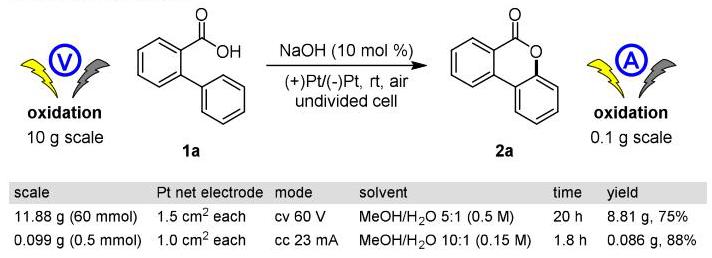
Furthermore, a 10 gram-scale experiment was conducted to examine the scalability of this electrochemical protocol. Run-
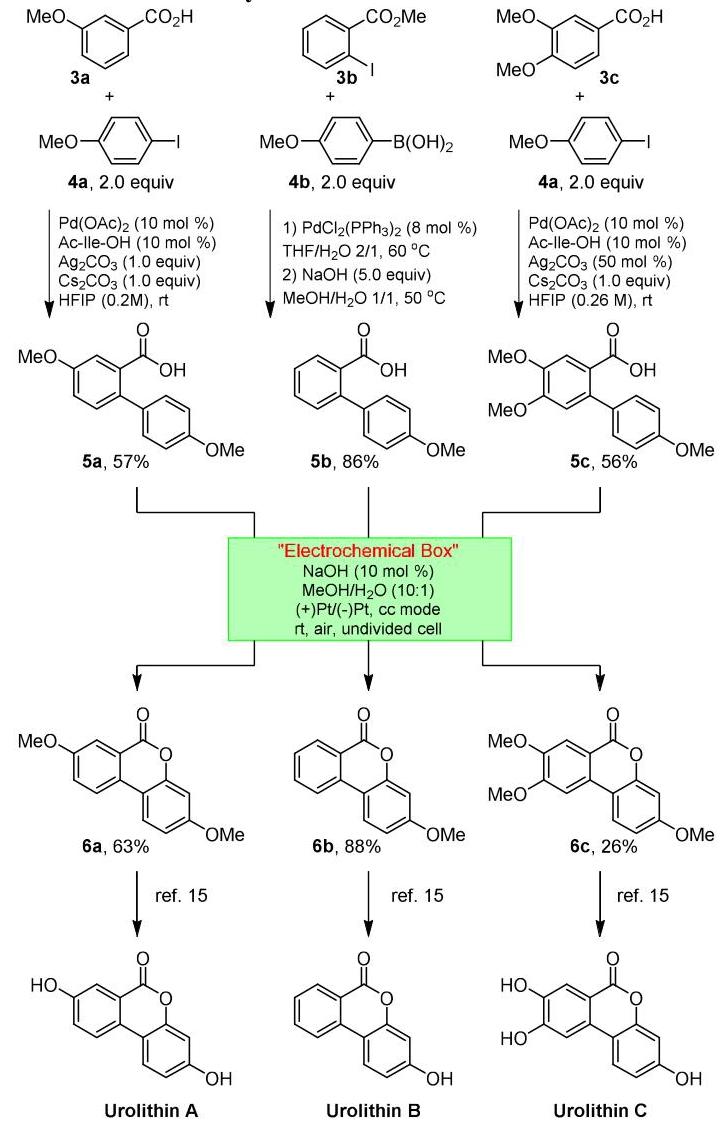
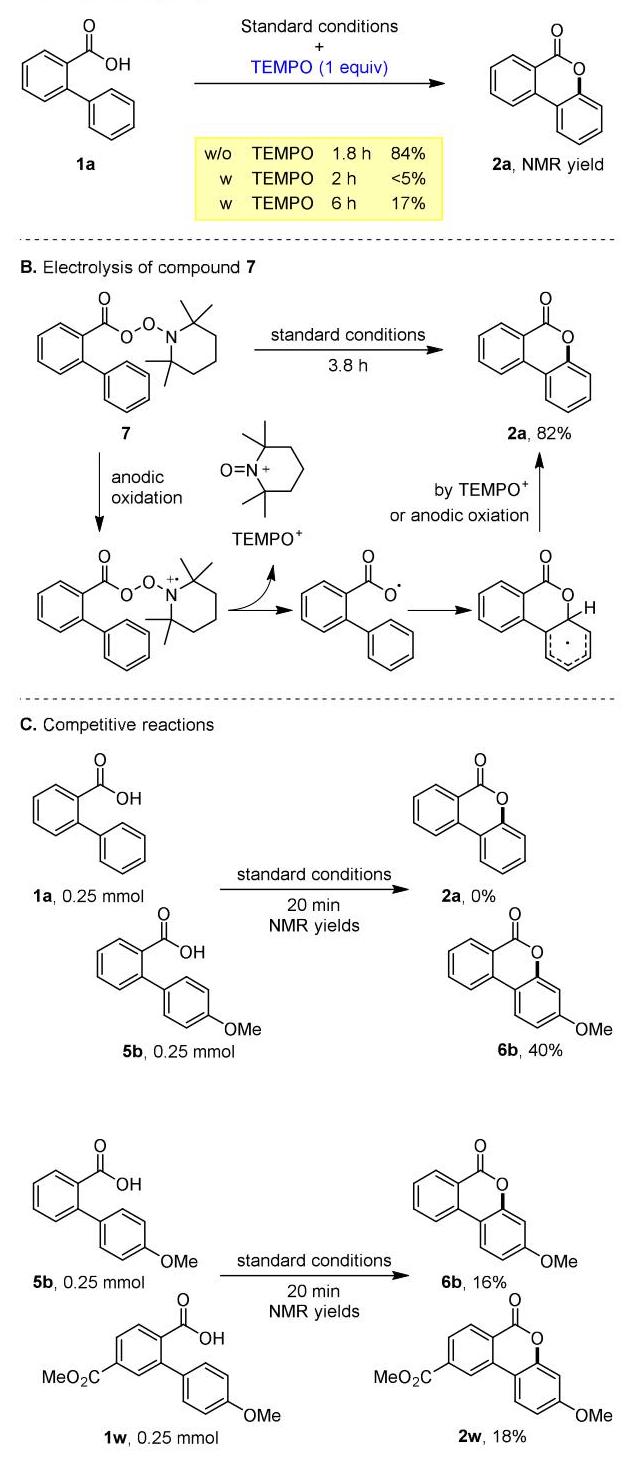
Three compounds in the Urolithin family are suitable targets for demonstrating the synthetic utility of this Kolbe oxidative cyclization reaction. Starting from the easily available substituted benzoic acid or ester, the electrochemical precursors are obtained by means of a Pd-catalyzed cross coupling reaction or the $\mathrm{C} - \mathrm{H}$ arylation reaction. An electrochemical technique was then applied to convert compounds 5 to cyclized products 6. Finally, compounds 6a, 6b and 6c can be easily transformed to Urolithin A, B and C following a reported procedure (Scheme 5). ${}^{15}$ a radical cation. Homolytic cleavage of this radical cation affords 2-phenylbenzoic acid radical and TEMPO cation. The compound $\mathbf{{2a}}$ can be formed by subsequent radical trapping and re-oxidation either by TEMPO ${}^{ + }$ or the anode. At the cathode, reduction of TEMPO ${}^{ + }$ back to TEMPO and hydrogen evolution are two possible reactions to balance the overall transformation. To get more insight into this reaction, we have also performed two competitive reactions between 1a and 5b, 5b and 1w, respectively (Scheme 6C). It was shown that 5b is predominantly oxidized when competing with $1\mathbf{a}$ , while 5b and $1\mathbf{w}$ are equally oxidized to give $\mathbf{{6b}}$ and $2\mathbf{w}$ in a ca. 1:1 ratio. These competitive experiments demonstrated that the Kolbe oxidation of benzoic acid is not likely a rate-determining step.
Scheme 5. Kolbe Oxidative Cyclization for the Synthesis of the Urolithin Family of Natural Products
To probe the mechanism of this reaction, 2,2,6,6- tetramethyl-1-piperidinyloxy (TEMPO), a free radical scavenger, was introduced as an additive to the standard reaction. We found that the reaction was suppressed to a great extent. As shown in Scheme 6A, product 2a was formed with less than 5% yield in $2\mathrm{\;h}$ and ${17}\%$ yield in $6\mathrm{\;h}$ . These results support the Kolbe oxidation mechanism. Interestingly, the compound 7, which was synthesized by adopting a procedure reported by Zeng, ${}^{16}$ can be converted to the cyclized product $\mathbf{{2a}}$ in a decent yield under the standard conditions (Scheme 6B). We proposed that compound 7 be oxidized at the anode first to deliver
Scheme 6. Control Experiments
A. Radical intercept experiment
CONCLUSION
In summary, we have developed a general, practical intramolecular Kolbe oxidative cyclization method for the synthesis of dibenzopyranones. ${}^{25}$ This method is oxidant-free, does not involve electrolytes, has high yields, works at ambient temperature and is scalable. Urolithins are formally synthesized by adopting this method as a key step to demonstrate its synthetic utility.
EXPERIMENTAL SECTION
General Information. Unless otherwise noted, chemicals and solvents were purchased with the highest purity grade available and were used without further purification. Purification of products was conducted by column chromatography on silica gel (200-300 mesh, from Qingdao, China). NMR spectra were measured on a Bruker ARX400 ( ${}^{1}\mathrm{H}$ at ${400}\mathrm{{MHz}},{}^{13}\mathrm{C}$ at 101 MHz) magnetic resonance spectrometer. Chemical shifts (δ) are reported in ppm using tetramethylsilane as internal standard $(s =$ singlet, $d =$ doublet, $t =$ triplet, $q =$ quartet, ${dd} =$ doublet of doublets, $t\mathrm{\;d} =$ triplet of doublets, $d\mathrm{t} =$ doublet of triplets, ddd $=$ doublet of doublet of doublets, $\mathrm{m} =$ multiplet), and coupling constants $\left( J\right)$ were reported in Hertz (Hz). Infrared spectra were recorded on a Thermal Fisher Nicolet iS50 Fourier transform spectrometer (FT-IR) and were reported in wave numbers $\left( {\mathrm{{cm}}}^{-1}\right)$ . HRMS data were obtained on a VG ZAB-HS mass spectrometer, Brucker Apex IV FTMS spectrometer.
Characterization Data. General Procedure for the electrochemical experiments: To a ${15}\mathrm{\;{mL}}$ test tube with a stir bar was charged with ${0.5}\mathrm{{mmol}}2$ -arylbenzoic acid 1, followed by $3\mathrm{\;{mL}} \; \mathrm{{MeOH}}$ and ${0.3}\mathrm{\;{mL}}$ aqueous $\mathrm{{NaOH}}$ solution $\left( {{0.167}\mathrm{M}\text{ , }}\right)$ 0.05mmol). Two platinum net electrodes $\left( {{1.0}\mathrm{\;{cm}} \times {1.0}\mathrm{\;{cm}}}\right)$ were set up in the tube. Make sure that the electrodes be totally immersed. The resulting mixture was electrolyzed at constant current mode with a current of ${23}\mathrm{{mA}}$ under ambient temperature. The reaction was monitored by TLC or GC. Upon completion, the reaction mixture was concentrated under reduced pressure. The residue was chromatographed through silica gel eluting with PE/EA to give the desired product 2.
General Procedure for the 10 gram scale electrochemical experiment: To a 150 mL conical flask with a stir bar was charged with ${60}\mathrm{{mmol}}2$ -arylbenzoic acid $1\mathrm{a}$ , followed by 100 mL MeOH and ${20}\mathrm{\;{mL}}$ aqueous NaOH solution $({0.3}\mathrm{M},6$ mmol). Two platinum net electrodes $\left( {{1.5}\mathrm{\;{cm}} \times {1.0}\mathrm{\;{cm}}}\right)$ were set up in the conical flask. Make sure that the electrodes be totally immersed. The resulting mixture was electrolyzed at constant potential mode with a potential of ${60}\mathrm{\;V}$ under ambient temperature. Note, the reaction is exothermic. Ice water bath was used to maintain reaction temperature between ${15} \sim {30}^{ \circ }\mathrm{C}$ . The reaction was monitored by TLC. Upon completion, the reaction mixture was poured into saturated ${\mathrm{{Na}}}_{2}{\mathrm{{CO}}}_{3}$ aqueous solution. Large amount of solid product precipitated out. The solid product was filtered and washed by water. The residue was dried under heating and vacuum to give analytical pure product 2a, 8.81 g, 75% yield.
Electrolysis of compound 7: The compound 7 was synthesized by adopting a procedure reported by Zeng. ${}^{16}$ To a ${15}\mathrm{\;{mL}}$ test tube with a stir bar was charged with 0.66 mmol 2,2,6,6- tetramethylpiperidin-1-yl [1,1’-biphenyl]-2-carboperoxoate 7, followed by $3\mathrm{\;{mL}}\mathrm{{MeOH}}$ and ${0.3}\mathrm{\;{mL}}$ aqueous $\mathrm{{NaOH}}$ solution
6H-benzo[c]chromen-6-one (2a). ${}^{{14}\mathrm{f}}$ White solid, using PE/EA $\left( {{10} : 1\mathrm{v}/\mathrm{v}}\right)$ as eluent. Isolated yield: ${88}\% \left( {{86}\mathrm{{mg}}}\right)$ ; mp 90-91 °C $\left( {{\text{ lit }}^{{14}\mathrm{e}}{88} - {89}^{ \circ }\mathrm{C}}\right) .{}^{1}\mathrm{H}$ NMR (400 MHz, ${\mathrm{{CDCl}}}_{3}$ ): δ 8.39 (d, $1\mathrm{H}, J \; = {7.9}\mathrm{\;{Hz}}),{8.10}\left( {\mathrm{\;d},1\mathrm{H}, J = {8.1}\mathrm{\;{Hz}}}\right) ,{8.04}\left( {\mathrm{\;d},1\mathrm{H}, J = {7.9}\mathrm{\;{Hz}}}\right)$ , ${7.81}\left( {\mathrm{t},1\mathrm{H}, J = {7.7}\mathrm{\;{Hz}}}\right) ,{7.57}\left( {\mathrm{t},1\mathrm{H}, J = {7.6}\mathrm{\;{Hz}}}\right) ,{7.47}(\mathrm{t},1\mathrm{H}, J \; = {7.7}\mathrm{\;{Hz}}),{7.35}\left( {\mathrm{\;d},1\mathrm{H}, J = {6.5}\mathrm{\;{Hz}}}\right) ,{7.33}(\mathrm{t},1\mathrm{H}, J = {8.1}$ Hz). ${}^{13}\mathrm{C}\;\mathrm{{NMR}}\left( {{101}\mathrm{{MHz}},{\mathrm{{CDCl}}}_{3}}\right) : {161.1},{151.2},{134.8},{134.6}$ , 130.4, 130.4, 128.8, 124.5, 122.7, 121.6, 121.1, 117.9, 117.6.
3-Methyl-6H-benzo[c]chromen-6-one (2b). ${}^{{14}\mathrm{f}}$ White solid, using PE/EA (10:1 v/v) as eluent. Isolated yield: 90% (95 mg); mp 129-130 °C (lit ${}^{16}$ 125-126 °C). ${}^{1}\mathrm{H}$ NMR (400 MHz, ${\mathrm{{CDCl}}}_{3}) : \delta$ 8.38 (d, $1\mathrm{H}, J = {7.9}\mathrm{\;{Hz}}$ ),8.07 (d, $1\mathrm{H}, J = {8.1}\mathrm{\;{Hz}}$ ), ${7.93}\left( {\mathrm{\;d},1\mathrm{H}, J = {8.0}\mathrm{\;{Hz}}}\right) ,{7.79}\left( {\mathrm{\;{dd}},1\mathrm{H}, J = {3.9}\mathrm{\;{Hz}}, J = {11.4}}\right. \; \mathrm{{Hz}}),{7.54}\left( {\mathrm{t},1\mathrm{H}, J = {7.6}\mathrm{\;{Hz}}}\right) ,{7.17}\left( {\mathrm{\;s},1\mathrm{H}}\right) ,{7.15}(\mathrm{\;d},1\mathrm{H}, J = {8.2}$ Hz), 2.45 (s, 3H). ${}^{13}\mathrm{C}$ NMR (101 MHz, CDCl ${}_{3}$ ): δ 161.4, 151.3, 141.3, 135.0, 134.7, 130.6, 128.4, 125.6, 122.5, 121.4, 121.0, 117.9, 115.5, 21.4.
3-(Trifluoromethoxy)-6H-benzo[c]chromen-6-one (2c). ${}^{{14}\mathrm{\;g}}$ White solid, using PE/EA (10:1 v/v) as eluent. Isolated yield: 86% (120 mg); mp 77-78°C (lit ${}^{17}$ 86-87°C). ${}^{1}$ H NMR (400 MHz, CDCl ${}_{3}$ ): δ 8.41 (dd, 1H, J = 7.9, 1.4 Hz), 8.09 (dd, 2H, J $= {8.5},{2.3}\mathrm{\;{Hz}}),{7.86}$ (ddd, $1\mathrm{H}, J = {8.2},{7.3},{1.4}\mathrm{\;{Hz}}),{7.62}$ (ddd, $1\mathrm{H}, J = {8.2},{7.4},{1.1}\mathrm{\;{Hz}}),{7.26} - {7.17}\left( {\mathrm{\;m},2\mathrm{H}}\right) \cdot {}^{13}\mathrm{C}$ NMR (101 MHz, CDCl3): δ 160.5, 151.8, 150.2, 135.2, 133.8, 130.8, 129.4,124.2,121.8,120.9,120.4 (q, $J = {259}\mathrm{\;{Hz}}$ ), 117.0, 116.8, 110.2.
3-Phenyl-6H-benzo[c]chromen-6-one (2d). ${}^{{14}\mathrm{j}}$ White solid, using PE/EA (10:1 v/v) as eluent. Isolated yield: 74% (100 mg); mp 84-86 ${}^{ \circ }\mathrm{C}$ . ${}^{1}\mathrm{H}$ NMR (400 MHz, ${\mathrm{{CDCl}}}_{3}$ ): δ 8.42 (dd, $J \; = {7.9},{1.4}\mathrm{\;{Hz}},1\mathrm{H}),{8.13}\left( {\mathrm{{dd}}, J = {10.7},{8.5}\mathrm{\;{Hz}},2\mathrm{H}}\right) ,{7.84}(\mathrm{{td}}, J \; = {7.7},{1.4}\mathrm{\;{Hz}},1\mathrm{H}),{7.66}\left( {\mathrm{\;d}, J = {7.1}\mathrm{\;{Hz}},2\mathrm{H}}\right) ,{7.63} - {7.56}(\mathrm{\;m}$ , $3\mathrm{H}),{7.49}\left( {\mathrm{t}, J = {7.5}\mathrm{\;{Hz}},2\mathrm{H}}\right) ,{7.42}\left( {\mathrm{t}, J = {7.3}\mathrm{\;{Hz}},1\mathrm{H}}\right) .{}^{13}\mathrm{C}$ NMR (101 MHz, CDCl ${}_{3}$ ): δ 161.2, 151.6, 143.4, 139.2, 134.8, 134.6, 130.6, 129.1, 128.8, 128.3, 127.0, 123.3, 123.2, 121.7, 121.1, 116.9, 115.7.
3-Acetyl-6H-benzo[c]chromen-6-one (2e). ${}^{{14}\mathrm{f}}$ White solid, using PE/EA (10:1 v/v) as eluent. Isolated yield: ${79}\% \left( {{94}\mathrm{{mg}}}\right)$ ; mp 189-191 °C. ${}^{1}$ H NMR (400 MHz, CDCl ${}_{3}$ ): δ 8.46 (dd, $J = \; {7.9},{1.4}\mathrm{\;{Hz}},1\mathrm{H}),{8.18}\left( {\mathrm{t}, J = {8.4}\mathrm{\;{Hz}},2\mathrm{H}}\right) ,{7.97} - {7.92}\left( {\mathrm{\;m},2\mathrm{H}}\right)$ , 7.90 (ddd, $J = {8.2},{7.4},{1.4}\mathrm{\;{Hz}},1\mathrm{H}),{7.72} - {7.65}\left( {\mathrm{\;m},1\mathrm{H}}\right) ,{2.68}$ (s, 3H). ${}^{13}\mathrm{C}$ NMR (101 MHz, CDCl3): δ 196.5, 160.6, 151.2, 138.4, 135.1, 133.7, 130.9, 130.1, 123.9, 123.2, 122.4, 122.0, 121.8, 118.0, 26.8.
Methyl 6-oxo-6H-benzo[c]chromene-3-carboxylate (2f). White solid, using PE/EA (10:1 v/v) as eluent. Isolated yield: 90% (114 mg); mp 160-162 °C. ${}^{1}$ H NMR (400 MHz, CDCl ${}_{3}$ ): $\delta$ 8.43 (dd, $1\mathrm{H}, J = {7.9},{1.3}\mathrm{\;{Hz}}$ ),8.17 (d, $1\mathrm{H}, J = {8.1}\mathrm{\;{Hz}}$ ),8.13 $\left( {\mathrm{d},1\mathrm{H}, J = {8.3}\mathrm{\;{Hz}}}\right) ,{7.99}\left( {\mathrm{\;d},2\mathrm{H}, J = {7.6}\mathrm{\;{Hz}}}\right) ,{7.91} - {7.84}(\mathrm{\;m}$ , 1H), ${7.69} - {7.63}\left( {\mathrm{\;m},1\mathrm{H}}\right) ,{3.98}\left( {\mathrm{\;s},3\mathrm{H}}\right) {.}^{13}\mathrm{C}$ NMR (101 MHz, ${\mathrm{{CDCl}}}_{3}) : \delta$ 165.8,160.6,151.0,135.1,133.7,131.9,130.8, 130.0, 125.3, 122.9, 122.4, 121.9, 121.8, 119.1, 52.6. IR: $v =$ 2948,1735,1717,1606,1304,1267,1097,751 ${\mathrm{{cm}}}^{-1}$ . HRMS (ESI): calcd for ${\mathrm{C}}_{15}{\mathrm{H}}_{11}{\mathrm{O}}_{4}^{ + }\;{\left\lbrack \mathrm{M} + \mathrm{H}\right\rbrack }^{ + }$ : 255.0652; found: 255.0646.
3-Bromo-6H-benzo[c]chromen-6-one (2g). ${}^{{14}\mathrm{f}}$ White solid, using PE/EA (10:1 v/v) as eluent. Isolated yield: 77% (105 mg); mp 134-136 °C (lit ${}^{16}$ 136-138 °C). ${}^{1}\mathrm{H}$ NMR (400 MHz, ${\mathrm{{CDCl}}}_{3}) : \delta$ 8.39 (dd, $1\mathrm{H}, J = {8.0},{1.4}\mathrm{\;{Hz}}$ ),8.11 - 8.04 (m,1H), 7.91 (d, 1H, J = 8.5 Hz), 7.84 (ddd, 1H, J = 8.2, 7.4, 1.5 Hz), ${7.61}\left( {\mathrm{{ddd}},1\mathrm{H}, J = {8.2},{7.3},{1.1}\mathrm{\;{Hz}}}\right) ,{7.53}\left( {\mathrm{\;d},1\mathrm{H}, J = {2.0}\mathrm{\;{Hz}}}\right)$ , 7.46 (dd, $1\mathrm{H}, J = {8.5},{2.0}\mathrm{\;{Hz}}$ ). ${}^{13}\mathrm{C}$ NMR (101 MHz, ${\mathrm{{CDCl}}}_{3}$ ): $\delta$ 160.5, 151.5, 135.1, 134.0, 130.8, 129.3, 127.9, 124.0, 123.7, 121.7, 121.0, 120.9, 117.1.
3-(Trifluoromethyl)-6H-benzo[c]chromen-6-one (2h). ${}^{{14}\mathrm{f}}$ White solid, using PE/EA (10:1 v/v) as eluent. Isolated yield: 93% $\left( {{123}\mathrm{{mg}}}\right)$ ; mp 127-129 ${}^{ \circ }\mathrm{C}\left( {{\text{ lit }}^{{14}\mathrm{e}}{123.1} - {124.1}{}^{ \circ }\mathrm{C}}\right) {}^{1}\mathrm{H}$ NMR $\left( {{400}\mathrm{{MHz}},{\mathrm{{CDCl}}}_{3}}\right) : \delta$ 8.45 $\left( {\mathrm{d},1\mathrm{H}, J = {7.9}\mathrm{\;{Hz}}}\right)$ ,8.18 $(\mathrm{t},2\mathrm{H}, J = \; {8.1}\mathrm{\;{Hz}}),{7.89}\left( {\mathrm{t},1\mathrm{H}, J = {7.7}\mathrm{\;{Hz}}}\right) ,{7.68}\left( {\mathrm{t},1\mathrm{H}, J = {7.6}\mathrm{\;{Hz}}}\right) ,{7.63} \; \left( {\mathrm{s},1\mathrm{H}}\right) ,{7.59}\left( {\mathrm{\;d},1\mathrm{H}, J = {8.4}\mathrm{\;{Hz}}}\right) .{}^{13}\mathrm{C}$ NMR $({101}\mathrm{{MHz}}$ , ${\mathrm{{CDCl}}}_{3}) : \delta$ 160.2,151.0,135.2,133.4,132.4,132.1,130.9, 130.1, 124.6, 123.6, 122.2, 122.0, 121.7, 121.2, 121.11, 121.08, 121.0, 115.3, 115.3, 115.24, 115.20.
3-(Allyloxy)-6H-benzo[c]chromen-6-one (2i). ${}^{{14}\mathrm{j}}$ White solid, using PE/EA (10:1v/v) as eluent. Isolated yield: ${66}\% \left( {{83}\mathrm{{mg}}}\right)$ ; mp 93-94 °C. ${}^{1}\mathrm{H}$ NMR (400 MHz, CDCl ${}_{3}$ ): δ 8.31 (dd,1H, $J = \; {7.9},{1.3}\mathrm{\;{Hz}}),{7.98} - {7.92}\left( {\mathrm{\;m},1\mathrm{H}}\right) ,{7.88}\left( {\mathrm{\;d},1\mathrm{H}, J = {8.8}\mathrm{\;{Hz}},1\mathrm{H}}\right)$ , ${7.75}\left( {\mathrm{{ddd}},1\mathrm{H}, J = {8.4},{7.3},{1.5}\mathrm{\;{Hz}}}\right) ,{7.47}(\mathrm{{ddd}},1\mathrm{H}, J = {8.2},{7.3}$ , ${1.1}\mathrm{\;{Hz}}),{6.90}\left( {\mathrm{{dd}},1\mathrm{H}, J = {8.8},{2.6}\mathrm{\;{Hz}}}\right) ,{6.82}(\mathrm{\;d},1\mathrm{H}, J = {2.6} \; \mathrm{{Hz}}),{6.06}\left( {\mathrm{{ddt}},1\mathrm{H}, J = {17.3},{10.5},{5.3}\mathrm{\;{Hz}}}\right) ,{5.45}(\mathrm{{dq}},1\mathrm{H}, J = \; {17.2},{1.6}\mathrm{\;{Hz}}),{5.34}\left( {\mathrm{{dq}},1\mathrm{H}, J = {10.5},{1.4}\mathrm{\;{Hz}}}\right) ,{4.58}(\mathrm{{dt}},2\mathrm{H}J =$ 5.3, 1.6 Hz). ${}^{13}\mathrm{C}$ NMR (101 MHz, CDC1, 3): δ 161.4, 160.4, 152.5, 135.1, 134.8, 132.4, 130.5, 127.7, 123.7, 121.0, 119.9, 118.4, 112.9, 111.2, 102.5, 69.2.
1-Methyl-6H-benzo[c]chromen-6-one (2j). ${}^{{14}\mathrm{f}}$ White solid, using PE/EA (10:1v/v) as eluent. Isolated yield: ${43}\% \left( {{45}\mathrm{{mg}}}\right)$ ; mp 159-161 °C (lit ${}^{18}$ 161 °C). ${}^{1}$ H NMR (400 MHz, ${\mathrm{{CDCl}}}_{3}$ ): δ ${8.50}\left( {\mathrm{\;d},1\mathrm{H}, J = {7.9}\mathrm{\;{Hz}}}\right) ,{8.39}\left( {\mathrm{\;d},1\mathrm{H}, J = {8.4}\mathrm{\;{Hz}}}\right) ,{7.83}(\mathrm{t},1\mathrm{H}$ , $J = {7.8}\mathrm{\;{Hz}}),{7.60}\left( {\mathrm{t},1\mathrm{H}, J = {7.6}\mathrm{\;{Hz}}}\right) ,{7.36}\left( {\mathrm{t},1\mathrm{H}, J = {7.8}\mathrm{\;{Hz}}}\right)$ , ${7.28}\left( {\mathrm{\;d},1\mathrm{H}, J = {8.5}\mathrm{\;{Hz}}}\right) ,{7.17}\left( {\mathrm{\;d},1\mathrm{H}, J = {7.4}\mathrm{\;{Hz}}}\right) ,{2.90}\left( {\mathrm{\;s},3\mathrm{H}}\right)$ . ${}^{13}\mathrm{C}$ NMR (101 MHz, ${\mathrm{{CDCl}}}_{3}$ ): $\delta$ 161.3,152.2,136.2,136.1, 134.2, 130.8, 129.3, 128.8, 128.1, 126.2, 122.2, 117.5, 116.2, 25.5.
2-Methyl-6H-benzo[c]chromen-6-one (2k). ${}^{{14}\mathrm{\;g}}$ White solid, using PE/EA (10:1 v/v) as eluent. Isolated ${53}\mathrm{{mg}}$ ; mp 124-125 ${}^{ \circ }\mathrm{C}\left( {{\text{ lit }}^{19}{126}^{ - }{128}{}^{ \circ }\mathrm{C}}\right) .{}^{1}\mathrm{H}$ NMR $\left( {{400}\mathrm{{MHz}},{\mathrm{{CDCl}}}_{3}}\right) : {\delta 8.36}(\mathrm{\;d}$ , $1\mathrm{H}, J = {7.9}\mathrm{\;{Hz}}),{8.05}\left( {\mathrm{\;d},1\mathrm{H}, J = {8.1}\mathrm{\;{Hz}}}\right) ,{7.78}\left( {\mathrm{\;m},2\mathrm{H}}\right) ,{7.54} \; \left( {\mathrm{t},1\mathrm{H}, J = {7.6}\mathrm{\;{Hz}}}\right) ,{7.23}\left( {\mathrm{\;m},2\mathrm{H}}\right) ,{2.44}\left( {\mathrm{\;s},3\mathrm{H}}\right) .{}^{13}\mathrm{C}\mathrm{{NMR}}({101}$ MHz, CDCl3): δ 161.3, 149.3, 134.8, 134.7, 134.1, 131.3, 130.5, 128.7, 122.7, 121.6, 121.2, 117.6, 117.4, 77.4, 77.1, 76.8, 21.1.
4-Methyl-6H-benzo[c]chromen-6-one (2k’). ${}^{14}\mathrm{g}$ Isolated ${42}\mathrm{{mg}}$ , white solid; mp 120-122 °C (lit ${}^{19}$ 132-134 °C). ${}^{1}$ H NMR (400 MHz, CDCl ${}_{3}$ ): δ 8.37 (d, 1H, J = 7.9 Hz), 8.07 (d, 1H, J = 8.1 $\mathrm{{Hz}}),{7.85}\left( {\mathrm{\;d},1\mathrm{H}, J = {7.9}\mathrm{\;{Hz}}}\right) ,{7.78}(\mathrm{{dt}},1\mathrm{H}, J = {1.2}\mathrm{\;{Hz}}, J = {7.8} \; \mathrm{{Hz}}),{7.54}\left( {\mathrm{t},1\mathrm{H}, J = {7.6}\mathrm{\;{Hz}}}\right) ,{7.30}\left( {\mathrm{\;d},1\mathrm{H}, J = {7.3}\mathrm{\;{Hz}}}\right) ,{7.19}(\mathrm{t}$ , 1H, $\left. {J = {7.7}\mathrm{\;{Hz}}}\right) ,{2.47}\left( {\mathrm{\;s},3\mathrm{H}}\right) .{}^{13}\mathrm{C}$ NMR $\left( {{101}\mathrm{{MHz}},{\mathrm{{CDCl}}}_{3}}\right) \delta$ 161.2, 149.6, 135.1, 134.7, 131.8, 130.4, 128.6, 127.0, 124.0, 121.8, 121.1, 120.4, 117.6, 77.4, 77.1, 76.8, 16.0.
10-Methyl-6H-benzo[c]chromen-6-one (21). ${}^{{14}\mathrm{f}}$ White solid, using PE/EA (10:1 v/v) as eluent. Isolated yield: ${46}\% \left( {{48}\mathrm{{mg}}}\right)$ ; mp 119-120 °C (lit ${}^{{14}\mathrm{h}}$ 122-124 °C). ${}^{1}\mathrm{H}$ NMR (400 MHz, ${\mathrm{{CDCl}}}_{3}) : \delta$ 8.38 (d, $J = {7.8}\mathrm{\;{Hz}},1\mathrm{H}),{8.32}$ (d, $J = {8.3}\mathrm{\;{Hz}},1\mathrm{H}$ ), ${7.65}\left( {\mathrm{\;d}, J = {7.5}\mathrm{\;{Hz}},1\mathrm{H}}\right) ,{7.48}\left( {\mathrm{t}, J = {7.6}\mathrm{\;{Hz}},2\mathrm{H}}\right) ,{7.41}(\mathrm{\;d}, J =$
${8.0}\mathrm{\;{Hz}},1\mathrm{H}),{7.34}\left( {\mathrm{t}, J = {7.6}\mathrm{\;{Hz}},1\mathrm{H}}\right) ,{2.91}\left( {\mathrm{\;s},3\mathrm{H}}\right) .{}^{13}\mathrm{C}\mathrm{{NMR}}$ (101 MHz, CDCl ${}_{3}$ ): δ 151.2, 139.1, 135.0, 133.6, 129.6, 129.2, 128.3, 127.2, 124.0, 122.8, 119.7, 118.0, 25.4.
9-Methyl-6H-benzo[c]chromen-6-one (2m). ${}^{{14}\mathrm{f}}$ White solid, using PE/EA (10:1 v/v) as eluent. Isolated yield: 92% (97 mg); mp 84-86 ${}^{ \circ }\mathrm{C}\left( {{\text{ lit }}^{16}\text{ 86-88 }{}^{ \circ }\mathrm{C}}\right)$ . ${}^{1}\mathrm{H}$ NMR (400 MHz, ${\mathrm{{CDCl}}}_{3}$ ): δ ${8.26}\left( {\mathrm{\;d},1\mathrm{H}, J = {8.1}\mathrm{\;{Hz}}}\right) ,{8.02}\left( {\mathrm{{dd}},1\mathrm{H}, J = {7.9},{1.5}\mathrm{\;{Hz}}}\right) ,{7.91} - \; {7.85}\left( {\mathrm{\;m},1\mathrm{H}}\right) ,{7.46}\left( {\mathrm{{ddd}},1\mathrm{H}, J = {8.5},{7.2},{1.6}\mathrm{\;{Hz}}}\right) ,{7.37}(\mathrm{{ddd}}$ , 1H, $J = {8.2},{1.6},{0.7}\mathrm{\;{Hz}}),{7.35} - {7.33}\left( {\mathrm{\;m},1\mathrm{H}}\right) ,{7.33} - {7.29}(\mathrm{\;m}$ , 1H), 2.55 (s, 3H). ${}^{13}\mathrm{C}$ NMR (101 MHz, CDCl ${}_{3}$ ): δ161.2, 151.4, 145.9, 134.6, 130.4, 130.2, 130.1, 124.4, 122.7, 121.8, 118.7, 118.0, 117.6, 22.2.
8-Methyl-6H-benzo[c]chromen-6-one (2n). ${}^{{14}\mathrm{f}}$ White solid, using PE/EA (10:1 v/v) as eluent. Isolated yield: 90% (95 mg); mp 128-129 °C (lit ${}^{16}$ 114-115 °C). ${}^{1}\mathrm{H}$ NMR (400 MHz, ${\mathrm{{CDCl}}}_{3}$ ): ${8.11}\left( {\mathrm{\;s},1\mathrm{H}}\right) ,{7.99} - {7.87}\left( {\mathrm{\;m},2\mathrm{H}}\right) ,{7.56}(\mathrm{{dd}}, J = {8.2}$ , ${2.1}\mathrm{\;{Hz}},1\mathrm{H}),{7.46} - {7.36}\left( {\mathrm{\;m},1\mathrm{H}}\right) ,{7.28}\left( {\mathrm{t}, J = {8.1}\mathrm{\;{Hz}},2\mathrm{H}}\right) ,{2.44}$ (s, 3H). ${}^{13}\mathrm{C}$ NMR (101 MHz, CDCl ${}_{3}$ ): δ 150.9, 139.2, 136.0, 132.1, 130.2, 129.8, 124.4, 122.5, 121.6, 121.0, 118.1, 117.6, 21.3.
9-Methyl-3-pentyl-6H-benzo[c]chromen-6-one (2o). ${}^{{14}\mathrm{f}}$ White solid, using PE/EA (10:1 v/v) as eluent. Isolated yield: ${86}\%$ (120mg); mp 60-61 ${}^{ \circ }\mathrm{C}$ (lit ${}^{16}$ 61-63 ${}^{ \circ }\mathrm{C}$ ). ${}^{1}\mathrm{H}$ NMR (400 MHz, ${\mathrm{{CDCl}}}_{3}) : \delta$ 8.24 (dd,1H, $J = {8.1},{2.1}\mathrm{\;{Hz}}$ ),7.91 (dd,1H, $J = {8.0}$ , ${2.3}\mathrm{\;{Hz}}),{7.83}\left( {\mathrm{\;s},1\mathrm{H}}\right) ,{7.33}\left( {\mathrm{{dt}},1\mathrm{H}, J = {8.0},{1.5}\mathrm{\;{Hz}}}\right) ,{7.13}(\mathrm{{dd}}$ , $2\mathrm{H}, J = {9.6},{1.6}\mathrm{\;{Hz}}),{2.68}\left( {\mathrm{t},2\mathrm{H}, J = {7.7}\mathrm{\;{Hz}}}\right) ,{2.53}\left( {\mathrm{\;s},3\mathrm{H}}\right)$ , ${1.66}\left( {\mathrm{\;m},2\mathrm{H}}\right) ,{1.40} - {1.30}\left( {\mathrm{\;m},4\mathrm{H}}\right) ,{0.94} - {0.86}\left( {\mathrm{\;m},3\mathrm{H}}\right) .{}^{13}\mathrm{C}$ NMR (101 MHz, CDCl ${}_{3}$ ): δ 161.5, 151.5, 146.1, 145.8, 130.5, 129.6, 124.8, 122.4, 121.6, 118.4, 117.2, 115.6, 35.7, 31.4, 30.7, 22.5, 22.3, 14.0.
9-tert-Butyl-3-methoxy-6H-benzo[c]chromen-6-one (2p). White solid, using PE/EA (10:1 v/v) as eluent. Isolated yield: 91% (128 mg); mp 150-151 °C. ${}^{1}$ H NMR (400 MHz, CDCl ${}_{3}$ ): $\delta = {8.28}\left( {\mathrm{\;d},1\mathrm{H}, J = {8.4}\mathrm{\;{Hz}}}\right) ,{7.99}\left( {\mathrm{{dd}},2\mathrm{H}, J = {5.3},{3.5}\mathrm{\;{Hz}}}\right) ,{7.56} \; \left( {\mathrm{{dd}},1\mathrm{H}, J = {8.4},{1.8}\mathrm{\;{Hz}}}\right) ,{6.92}\left( {\mathrm{{dd}},1\mathrm{H}, J = {8.8},{2.6}\mathrm{\;{Hz}}}\right) ,{6.86} \; \left( {\mathrm{d},1\mathrm{H}, J = {2.5}\mathrm{\;{Hz}}}\right) ,{3.88}\left( {\mathrm{\;s},3\mathrm{H}}\right) ,{1.43}\left( {\mathrm{\;s},9\mathrm{H}}\right) .{}^{13}\mathrm{C}$ NMR (101 MHz, CDCl3): δ 161.6, 161.3, 158.8, 152.8, 134.9, 130.4, 125.7, 123.6, 117.5, 117.3, 112.4, 111.6, 101.6, 55.7, 35.6, 31.1. IR: $v = {2961},{2908},{1727},{1612},{1409},{1277},{1106},{1040}$ , 776,692 ${\mathrm{{cm}}}^{-1}$ . HRMS (ESI): calcd for ${\mathrm{C}}_{18}{\mathrm{H}}_{19}{\mathrm{O}}_{3}{}^{ + }{\left\lbrack \mathrm{M} + \mathrm{H}\right\rbrack }^{ + }$ : 283.1329; found: 283.1329.
9-Chloro-3-methoxy-6H-benzo[c]chromen-6-one (2q). ${}^{20}$ White solid, using PE/EA (10:1v/v) as eluent. Isolated yield: 85% (110 mg); mp 190-192 °C. ${}^{1}$ H NMR (400 MHz, CDCl ${}_{3}$ ): $\delta$ 8.28 $\left( {\mathrm{d}, J = {8.5}\mathrm{\;{Hz}},1\mathrm{H}}\right) ,{7.96}\left( {\mathrm{\;d}, J = {2.1}\mathrm{\;{Hz}},1\mathrm{H}}\right) ,{7.87}(\mathrm{\;d}, J \; = {8.9}\mathrm{\;{Hz}},1\mathrm{H}),{7.45}\left( {\mathrm{\;{dd}}, J = {8.5},{2.0}\mathrm{\;{Hz}},1\mathrm{H}}\right) ,{6.93}(\mathrm{{dd}}, J = {8.9}$ , ${2.6}\mathrm{\;{Hz}},1\mathrm{H}),{6.86}\left( {\mathrm{\;d}, J = {2.6}\mathrm{\;{Hz}},1\mathrm{H}}\right) ,{3.89}\left( {\mathrm{\;s},3\mathrm{H}}\right) .{}^{13}\mathrm{C}$ NMR (101 MHz, CDCl ${}_{3}$ ): δ 162.1, 160.7, 153.0, 141.8, 136.7, 132.2, 128.1, 123.9, 121.1, 118.2, 112.7, 110.0, 101.7, 55.8.
8-Chloro-3-methoxy-6H-benzo[c]chromen-6-one (2r). White solid, using PE/EA (10:1 v/v) as eluent. Isolated yield: ${83}\%$ (108 mg); mp 160-161 °C. ${}^{1}\mathrm{H}$ NMR (400 MHz, ${\mathrm{{CDCl}}}_{3}$ ): δ ${8.31}\left( {\mathrm{\;d}, J = {2.3}\mathrm{\;{Hz}},1\mathrm{H}}\right) ,{7.94}\left( {\mathrm{\;d},1\mathrm{H}, J = {8.6}\mathrm{\;{Hz}}}\right) ,{7.89}(\mathrm{\;d},1\mathrm{H}$ , $J = {8.9}\mathrm{\;{Hz}}),{7.72}\left( {\mathrm{\;{dd}},1\mathrm{H}, J = {8.6},{2.3}\mathrm{\;{Hz}}}\right) ,{6.92}(\mathrm{\;{dd}},1\mathrm{H}, J = \; {8.8},{2.6}\mathrm{\;{Hz}}),{6.86}\left( {\mathrm{\;d},1\mathrm{H}, J = {2.6}\mathrm{\;{Hz}}}\right) ,{3.89}\left( {\mathrm{\;s},3\mathrm{H}}\right) .{}^{13}\mathrm{C}$ NMR (101 MHz, CDCl ${}_{3}$ ): δ 161.8, 160.4, 152.5, 135.2, 133.6, 130.0, 123.8,122.8,121.2,112.8,110.4,101.7,55.8.IR: $v = {2939}$ , 2839,1728,1623,1604,1474,1263,1168,775 ${\mathrm{{cm}}}^{-1}$ . HRMS (ESI): calcd for ${\mathrm{C}}_{14}{\mathrm{H}}_{10}{\mathrm{{ClO}}}_{3}^{ + }{\left\lbrack \mathrm{M} + \mathrm{H}\right\rbrack }^{ + }$ :261.0313; found: 261.0312.
9-Bromo-3-methoxy-6H-benzo[c]chromen-6-one (2s). White solid, using PE/EA (10:1 v/v) as eluent. Isolated yield: 77% (117 mg); mp 188-190 °C. ${}^{1}\mathrm{H}$ NMR (400 MHz, ${\mathrm{{CDCl}}}_{3}$ ): δ ${8.18}\left( {\mathrm{\;d},1\mathrm{H}, J = {8.5}\mathrm{\;{Hz}}}\right) ,{8.10}\left( {\mathrm{\;d},1\mathrm{H}, J = {1.8}\mathrm{\;{Hz}}}\right) ,{7.84}(\mathrm{\;d},1\mathrm{H}$ , $J = {8.9}\mathrm{\;{Hz}}),{7.59}\left( {\mathrm{{dd}},1\mathrm{H}, J = {8.5},{1.8}\mathrm{\;{Hz}}}\right) ,{6.90}(\mathrm{{dd}},1\mathrm{H}, J = \; {8.8},{2.6}\mathrm{\;{Hz}}),{6.83}\left( {\mathrm{\;d},1\mathrm{H}, J = {2.6}\mathrm{\;{Hz}}}\right) ,{3.89}\left( {\mathrm{\;s},3\mathrm{H}}\right) .{}^{13}\mathrm{C}$ NMR (101 MHz, CDCl ${}_{3}$ ): δ 162.1, 160.8, 153.0, 136.7, 132.2, 131.0, 130.6, 124.2, 123.9, 118.6, 112.7, 109.9, 101.7, 55.8. IR: $v =$ 2918,1731,1625, ${1600},{1590},{1277},{1169},{1034},{768}{\mathrm{\;{cm}}}^{-1}$ . HRMS (ESI): calcd for ${\mathrm{C}}_{14}{\mathrm{H}}_{10}{\mathrm{{BrO}}}_{3}{}^{ + }{\left\lbrack \mathrm{M} + \mathrm{H}\right\rbrack }^{ + }{304.9808}$ ; found: 304.9809.
9-Fluoro-3-methoxy-6H-benzo[c]chromen-6-one (2t). White solid, using PE/EA (10:1 v/v) as eluent. Isolated yield: 77% (94mg); mp 188-189 ${}^{ \circ }\mathrm{C}$ . ${}^{1}\mathrm{H}$ NMR (400 MHz, ${\mathrm{{CDCl}}}_{3}$ ): δ 8.38 (dd, $1\mathrm{H}, J = {8.8},{5.8}\mathrm{\;{Hz}}$ ), ${7.84}\left( {\mathrm{\;d},1\mathrm{H}, J = {8.9}\mathrm{\;{Hz}}}\right) ,{7.61}(\mathrm{{dd}}$ , $1\mathrm{H}, J = {9.9},{2.4}\mathrm{\;{Hz}}),{7.19}\left( {\mathrm{{td}},1\mathrm{H}, J = {8.5},{2.4}\mathrm{\;{Hz}}}\right) ,{6.92}(\mathrm{{dd}}$ , $1\mathrm{H}, J = {8.9},{2.6}\mathrm{\;{Hz}}),{6.86}\left( {\mathrm{\;d},1\mathrm{H}, J = {2.5}\mathrm{\;{Hz}}}\right) ,{3.89}\left( {\mathrm{\;s},3\mathrm{H}}\right) .{}^{13}\mathrm{C}$ NMR (101 MHz, CDCl3): δ 167.1 (d, J = 256.1 Hz), 162.1, 160.6, 153.1, 138.2 (d, $J = {10.7}\mathrm{\;{Hz}}$ ), 133.9 (d, $J = {10.3}\mathrm{\;{Hz}}$ ), 124.0,116.4 $\left( {\mathrm{d}, J = {2.5}\mathrm{\;{Hz}}}\right) ,{115.9}\left( {\mathrm{\;d}, J = {23.4}\mathrm{\;{Hz}}}\right) ,{112.7}$ , 110.5 (d, $J = {2.9}\mathrm{\;{Hz}}$ ),107.4 (d, $J = {23.5}\mathrm{\;{Hz}}$ ),101.7,55.8. IR: $v \; = {2957},{2849},{1746},{1614},{1600},{1278},{1267},{1193},{1099},{832}, \; {619}{\mathrm{\;{cm}}}^{-1}$ . HRMS (ESI): calcd for ${\mathrm{C}}_{14}{\mathrm{H}}_{10}{\mathrm{{FO}}}_{3}^{ + }{\left\lbrack \mathrm{M} + \mathrm{H}\right\rbrack }^{ + }$ : 245.0608; found: 245.0607.
3-Methoxy-9-methyl-6H-benzo[c]chromen-6-one (2u). White solid, using PE/EA (10:1 v/v) as eluent. Isolated yield: 81% (97 mg); mp 155-157 °C. ${}^{1}$ H NMR (400 MHz, CDCl ${}_{3}$ ): δ 8.24 $\left( {\mathrm{d},1\mathrm{H}, J = {8.1}\mathrm{\;{Hz}}}\right) ,{7.94}\left( {\mathrm{\;{dd}},1\mathrm{H}, J = {8.9},{1.0}\mathrm{\;{Hz}}}\right) ,{7.79}\left( {\mathrm{\;s},1\mathrm{H}}\right)$ , ${7.36} - {7.29}\left( {\mathrm{\;m},1\mathrm{H}}\right) ,{6.91}\left( {\mathrm{{ddd}},1\mathrm{H}, J = {8.8},{2.6},{0.7}\mathrm{\;{Hz}}}\right) ,{6.86}$ (dd, 1H, J = 2.6, 0.9Hz), 3.88 (s, 3H), 2.54 (s, 3H). ${}^{13}\mathrm{C}$ NMR (101 MHz, CDCl3): δ 161.6, 161.4, 152.8, 145.9, 135.2, 130.6, 129.1, 123.7, 121.2, 117.6, 112.3, 111.2, 101.6, 55.7, 22.3. IR: $v = {3007},{2943},{1736},{1616},{1279},{1265},{1198},{1038},{831},{771} \; {\mathrm{{cm}}}^{-1}$ . HRMS (ESI): calcd for ${\mathrm{C}}_{15}{\mathrm{H}}_{13}{\mathrm{O}}_{3}{}^{ + }{\left\lbrack \mathrm{M} + \mathrm{H}\right\rbrack }^{ + } : {241.0859}$ ; found: 241.0858.
3-Methoxy-6H-naphtho[2,3-c]chromen-6-one (2v). White solid, using PE/EA (10:1 v/v) as eluent. Isolated yield: 89% (123 mg); mp 181-183 °C. ${}^{1}\mathrm{H}$ NMR (400 MHz, CDCl ${}_{3}$ ): δ ${8.90}\left( {\mathrm{\;s},1\mathrm{H}}\right) ,{8.32}\left( {\mathrm{\;s},1\mathrm{H}}\right) ,{8.03}\left( {\mathrm{\;d},1\mathrm{H}, J = {8.8}\mathrm{\;{Hz}}}\right) ,{7.94}(\mathrm{{dd}}$ , 2H, $J = {12.7},{8.3}\mathrm{\;{Hz}}),{7.63}\left( {\mathrm{{ddd}},1\mathrm{H}, J = {8.3},{6.8},{1.3}\mathrm{\;{Hz}}}\right)$ , ${7.52}\left( {\mathrm{{ddd}},1\mathrm{H}, J = {8.1},{6.8},{1.1}\mathrm{\;{Hz}}}\right) ,{6.91}(\mathrm{{dd}},1\mathrm{H}, J = {8.8},{2.6} \; \mathrm{{Hz}}),{6.81}\left( {\mathrm{\;d},1\mathrm{H}, J = {2.5}\mathrm{\;{Hz}}}\right) ,{3.87}\left( {\mathrm{\;s},3\mathrm{H}}\right) .{}^{13}\mathrm{C}$ NMR (101 MHz, CDCl ${}_{3}$ ): δ 161.7, 161.2, 152.0, 136.4, 132.8, 131.8, 130.0, 129.5, 129.5, 127.8, 126.6, 123.9, 119.5, 118.5, 112.4, 111.3,101.8,55.6. IR: $v = {2841},{1728},{1628},{1301},{1288}$ , 1273,1165,771,470 ${\mathrm{{cm}}}^{-1}$ . HRMS (ESI): calcd for ${\mathrm{C}}_{18}{\mathrm{H}}_{13}{\mathrm{O}}_{3}{}^{ + } \; {\left\lbrack \mathrm{M} + \mathrm{H}\right\rbrack }^{ + }$ : 277.0859; found: 277.0859.
Methyl 3-methoxy-6-oxo-6H-benzo[c]chromene-9- carboxylate (2w). White solid, using PE/EA (10:1 v/v) as eluent. Isolated yield: ${87}\% \left( {{123}\mathrm{{mg}}}\right)$ ; mp 128-130 ${}^{ \circ }\mathrm{C}$ . ${}^{1}\mathrm{H}$ NMR $\left( {{400}\mathrm{{MHz}},{\mathrm{{CDCl}}}_{3}}\right) : \delta$ 8.68 $\left( {\mathrm{d},1\mathrm{H}, J = {1.5}\mathrm{\;{Hz}}}\right) ,{8.42}(\mathrm{\;d},1\mathrm{H}, J \; = {8.2}\mathrm{\;{Hz}}),{8.10}\left( {\mathrm{{dd}},1\mathrm{H}, J = {8.2},{1.5}\mathrm{\;{Hz}}}\right) ,{8.05}\left( {\mathrm{\;d},1\mathrm{H}, J = {8.9}}\right) \; \mathrm{{Hz}}),{6.96}\left( {\mathrm{{dd}},1\mathrm{H}, J = {8.8},{2.6}\mathrm{\;{Hz}}}\right) ,{6.89}\left( {\mathrm{\;d},1\mathrm{H}, J = {2.5}\mathrm{\;{Hz}}}\right)$ , 4.02 (s, 3H), 3.90 (s, 3H). ${}^{13}\mathrm{C}$ NMR (101 MHz, ${\mathrm{{CDCl}}}_{3}$ ): δ 166.0, 162.0, 160.8, 152.8, 135.7, 135.4, 130.9, 127.8, 124.2, 122.9,122.8,112.8,110.7,101.7,55.8,52.8 IR: $v = {2959}$ , 1732,1629,1422,1302,1281,1253,1107,1040,751 ${\mathrm{\;{cm}}}^{-1}$ . HRMS (ESI): calcd for ${\mathrm{C}}_{16}{\mathrm{H}}_{13}{\mathrm{O}}_{5}{}^{ + }{\left\lbrack {\mathrm{M}}^{ + }\mathrm{H}\right\rbrack }^{ + }$ : 285.0758; found: 285.0756.
9-Acetyl-3-methoxy-6H-benzo[c]chromen-6-one (2x). White solid, using PE/EA (10:1 v/v) as eluent. Isolated yield: 75%
$\left( {{100}\mathrm{{mg}}}\right)$ ; mp 220-222 ${}^{ \circ }\mathrm{C}$ . ${}^{1}\mathrm{H}$ NMR $\left( {{400}\mathrm{{MHz}},{\mathrm{{CDCl}}}_{3}}\right) : \delta \; {8.56}\left( {\mathrm{\;d},1\mathrm{H}, J = {1.5}\mathrm{\;{Hz}}}\right) ,{8.45}\left( {\mathrm{\;d},1\mathrm{H}, J = {8.2}\mathrm{\;{Hz}}}\right) ,{8.05}(\mathrm{\;d},1\mathrm{H}$ , $J = {8.9}\mathrm{\;{Hz}}),{8.00}\left( {\mathrm{{dd}},1\mathrm{H}, J = {8.2},{1.6}\mathrm{\;{Hz}}}\right) ,{6.96}(\mathrm{{dd}},1\mathrm{H}, J = \; {8.9},{2.6}\mathrm{\;{Hz}}),{6.88}\left( {\mathrm{\;d},1\mathrm{H}, J = {2.5}\mathrm{\;{Hz}}}\right) ,{3.90}(\mathrm{\;s},3\mathrm{H}),{2.74}(\mathrm{\;s}$ , 3H). ${}^{13}\mathrm{C}$ NMR (101 MHz, ${\mathrm{{CDCl}}}_{3}$ ): $\delta$ 197.4,162.0,160.7, 152.8, 141.6, 135.6, 131.2, 126.7, 124.1, 122.9, 121.0, 112.8, 110.7,101.8,55.8,27.1. IR: $v = {3075},{2841},{1734},{1684},{1611}$ , ${1420},{1282},{1270},{1235},{1038}{\mathrm{\;{cm}}}^{-1}$ . HRMS (ESI): calcd for ${\mathrm{C}}_{16}{\mathrm{H}}_{13}{\mathrm{O}}_{4}^{ + }{\left\lbrack {\mathrm{M}}^{ + }\mathrm{H}\right\rbrack }^{ + } : {269.0808}$ ; found: 269.0808.
10H-tribenzo[c, f, h]chromen-10-one(2y). White solid, using PE/EA (10:1 v/v) as eluent. Isolated yield: 62% (92 mg); mp 154-156 ${}^{ \circ }\mathrm{C}$ . ${}^{1}\mathrm{H}$ NMR (400 MHz, CDCl ${}_{3}$ ): δ 8.70 (dd, $1\mathrm{H}, J = \; {3.4},{6.2}\mathrm{\;{Hz}}),{8.67}\left( {\mathrm{{dd}},1\mathrm{H}, J = {3.4},{6.2}\mathrm{\;{Hz}}}\right) ,{8.63}(\mathrm{\;d},2\mathrm{H}, J = \; {8.2}\mathrm{\;{Hz}}),{8.55}\left( {\mathrm{\;d},1\mathrm{H}, J = {8.3}\mathrm{\;{Hz}}}\right) ,{8.51}\left( {\mathrm{\;d},1\mathrm{H}, J = {7.9}\mathrm{\;{Hz}}}\right)$ , ${7.86}\left( {\mathrm{{dt}},1\mathrm{H}, J = {1.1},{7.7}\mathrm{\;{Hz}}}\right) ,{7.75}\left( {\mathrm{\;m},1\mathrm{H}}\right) ,{7.72}(\mathrm{{dd}},1\mathrm{H}, J =$ 5.7,6.5 Hz), 7.66 (m, 2H), 7.62 (m, 1H). 13C NMR (101 MHz, ${\mathrm{{CDCl}}}_{3}) : \delta$ 161.2,146.7,135.5,134.2,131.3,130.6,128.9, 128.92, 128.89, 127.7, 127.6, 127.1, 126.5, 126.1, 126.0, 123.7,123.1,122.51,122.49,110.1. IR: $v = {3066},{1735},{1496}$ , 1479,1312,1200,1113,1084,763,699 ${\mathrm{{cm}}}^{-1}$ . HRMS (ESI): calcd for ${\mathrm{C}}_{21}{\mathrm{H}}_{13}{\mathrm{O}}_{2}{}^{ + }{\left\lbrack \mathrm{M} + \mathrm{H}\right\rbrack }^{ + }$ : 297.0910; found: 297.0909.
6H-dibenzo[c, h]chromen-6-one (2z). ${}^{{14}\mathrm{\;g}}$ White solid, using PE/EA (10:1 v/v) as eluent. Isolated yield: ${90}\% \left( {{111}\mathrm{{mg}}}\right)$ ; mp ${182} - {184}{}^{ \circ }\mathrm{C}\left( {{\text{ lit }}^{{14}\mathrm{e}}{181} - {182}{}^{ \circ }\mathrm{C}}\right) \cdot {}^{1}\mathrm{H}$ NMR (400 MHz, ${\mathrm{{CDCl}}}_{3}$ ): $\delta \; {8.61}\left( {\mathrm{{dd}},1\mathrm{H}, J = {8.1},{1.7}\mathrm{\;{Hz}}}\right) ,{8.48}\left( {\mathrm{{dd}},1\mathrm{H}, J = {7.9},{1.3}\mathrm{\;{Hz}}}\right)$ , ${8.21}\left( {\mathrm{\;d},1\mathrm{H}, J = {8.1}\mathrm{\;{Hz}}}\right) ,{8.08}\left( {\mathrm{\;d},1\mathrm{H}, J = {8.8}\mathrm{\;{Hz}}}\right) ,{7.88}(\mathrm{{td}},2\mathrm{H}$ , $J = {7.6},{1.4}\mathrm{\;{Hz}}),{7.78}\left( {\mathrm{\;d},1\mathrm{H}, J = {8.7}\mathrm{\;{Hz}}}\right) ,{7.67} - {7.58}\left( {\mathrm{\;m},3\mathrm{H}}\right)$ . ${}^{13}\mathrm{C}$ NMR (101 MHz, ${\mathrm{{CDCl}}}_{3}$ ): $\delta$ 161.2,147.2,135.3,134.9, 134.2, 130.6, 128.6, 127.8, 127.6, 127.1, 124.5, 123.8, 122.3, 122.0,121.1,119.1,113.0.
5H-thieno[2,3-c]isochromen-5-one (2aa). White solid, using PE/EA (10:1 v/v) as eluent. Isolated yield: 55% (56 mg); mp 116-117 °C. ${}^{1}\mathrm{H}$ NMR (400 MHz, CDCl ${}_{3}$ ): δ 8.35 (dd,1H, J= ${0.6},{8.0}\mathrm{\;{Hz}}),{7.80}$ (ddd, $1\mathrm{H}, J = {1.3},{7.0},{8.3}\mathrm{\;{Hz}}),{7.75}\left( {\mathrm{\;m},1\mathrm{H}}\right)$ , ${7.51}\left( {\mathrm{{ddd}},1\mathrm{H}, J = {1.4},{7.1},{8.4}\mathrm{\;{Hz}}}\right) ,{7.31}\left( {\mathrm{\;d},1\mathrm{H}, J = {5.9}\mathrm{\;{Hz}}}\right)$ , 6.99 (d, $1\mathrm{H}, J = {5.9}\mathrm{\;{Hz}}$ ). ${}^{13}\mathrm{C}$ NMR (101 MHz, ${\mathrm{{CDCl}}}_{3}$ ): $\delta$ 161.7, 156.1, 135.3, 134.4, 131.1, 127.6, 122.2, 119.2, 118.3, 117.0,116.0. IR: $v = {2921},{2850},{1736},{1610},{1305},{1200}$ , 1014,710 ${\mathrm{{cm}}}^{-1}$ . HRMS (ESI): calcd for ${\mathrm{C}}_{11}{\mathrm{H}}_{7}{\mathrm{O}}_{2}{\mathrm{\;S}}^{ + }{\left\lbrack \mathrm{M} + \mathrm{H}\right\rbrack }^{ + }$ : 203.0161; found: 203.0161.
4,4’-Dimethoxybiphenyl-2-carboxylic acid (5a). This compound was synthesized following the procedure as reported by Su. ${}^{21}$ Isolated yield: ${57}\%$ ; mp 155-156 ${}^{ \circ }\mathrm{C}\left( {{\text{ lit }}^{22}{156}{}^{ \circ }\mathrm{C}}\right)$ . ${}^{1}\mathrm{H}$ NMR (400 MHz, CDCl ${}_{3}$ ): δ 7.44 (d, J = 2.8 Hz, 1H), 7.29 - ${7.19}\left( {\mathrm{\;m},3\mathrm{H}}\right) ,{7.08}\left( {\mathrm{{dd}}, J = {8.5},{2.8}\mathrm{\;{Hz}},1\mathrm{H}}\right) ,{6.90}(\mathrm{\;d}, J = {8.6} \; \mathrm{{Hz}},2\mathrm{H}),{3.86}\left( {\mathrm{\;s},3\mathrm{H}}\right) ,{3.83}\left( {\mathrm{\;s},3\mathrm{H}}\right) .{}^{13}\mathrm{C}$ NMR (101 MHz, ${\mathrm{{CDCl}}}_{3}$ ): $\delta$ 173.5,158.8,158.3,135.6,133.1,132.5,130.0, 129.7, 118.6, 115.1, 113.6, 55.6, 55.3.
4’-methoxybiphenyl-2-carboxylic acid (5b). This compound was synthesized following the procedure as reported by Wang. ${}^{{14}\mathrm{f}}$ Isolated yield: ${86}\%$ ; mp 146-147 ${}^{ \circ }\mathrm{C}$ (lit ${}^{23}$ 146- ${148}^{ \circ }\mathrm{C}).{}^{1}\mathrm{H}$ NMR (400 MHz, ${\mathrm{{CDCl}}}_{3}$ ): $\delta$ 7.92 (dd, $J = {7.8},{1.4} \; \mathrm{{Hz}},1\mathrm{H}),{7.54}\left( {\mathrm{{td}}, J = {7.5},{1.5}\mathrm{\;{Hz}},1\mathrm{H}}\right) ,{7.43} - {7.37}\left( {\mathrm{\;m},1\mathrm{H}}\right)$ , ${7.37} - {7.33}\left( {\mathrm{\;m},1\mathrm{H}}\right) ,{7.30} - {7.26}\left( {\mathrm{\;m},2\mathrm{H}}\right) ,{6.97} - {6.89}\left( {\mathrm{\;m},2\mathrm{H}}\right)$ , 3.84 (s, 3H). ${}^{13}\mathrm{C}$ NMR (101 MHz, CDCl ${}_{3}$ ): δ 173.4, 159.1, 142.9, 133.4, 132.0, 131.2, 130.7, 129.7, 129.4, 126.9, 113.6, 55.3.
4,4’,5-trimethoxybiphenyl-2-carboxylic acid (5c). This compound was synthesized following the procedure as reported by Su. ${}^{21}$ Isolated yield: ${56}\%$ ; mp 198-199 ${}^{ \circ }\mathrm{C}$ . ${}^{1}\mathrm{H}$ NMR (400 MHz, ${\mathrm{{CDCl}}}_{3}) : \delta = {7.52}\left( {\mathrm{\;s},1\mathrm{H}}\right) ,{7.24}\left( {\mathrm{\;d}, J = {8.6}\mathrm{\;{Hz}},2\mathrm{H}}\right) ,{6.92}(\mathrm{\;d}, J = \; {8.7}\mathrm{\;{Hz}},2\mathrm{H}),{6.76}\left( {\mathrm{\;s},1\mathrm{H}}\right) ,{3.95}\left( {\mathrm{\;s},3\mathrm{H}}\right) ,{3.92}\left( {\mathrm{\;s},3\mathrm{H}}\right) ,{3.85}(\mathrm{\;s}$ , 3H). ${}^{13}\mathrm{C}$ NMR (101 MHz, ${\mathrm{{CDCl}}}_{3}$ ): $\delta$ 172.4,158.9,151.9, 147.5, 138.3, 133.7, 129.8, 120.3, 114.0, 113.6, 113.4, 56.2, 56.1, 55.3.
3,8-Dimethoxy-6H-benzo[c]chromen-6-one (6a). ${}^{15}$ White solid, using PE/EA (10:1 v/v) as eluent. Isolated yield: 63% (81mg); mp 147-148 ${}^{ \circ }\mathrm{C}\left( {{\text{ lit }}^{15}{156}^{ \circ }\mathrm{C}}\right)$ . ${}^{1}\mathrm{H}$ NMR (400 MHz, ${\mathrm{{CDCl}}}_{3}) : \delta = {7.93}\left( {\mathrm{\;d}, J = {8.9}\mathrm{\;{Hz}},1\mathrm{H}}\right) ,{7.87}\left( {\mathrm{\;d}, J = {8.8}\mathrm{\;{Hz}},1\mathrm{H}}\right)$ , ${7.77}\left( {\mathrm{\;d}, J = {2.8}\mathrm{\;{Hz}},1\mathrm{H}}\right) ,{7.37}\left( {\mathrm{\;{dd}}, J = {8.8},{2.8}\mathrm{\;{Hz}},1\mathrm{H}}\right) ,{6.91} \; \left( {\mathrm{{dd}}, J = {8.7},{2.6}\mathrm{\;{Hz}},1\mathrm{H}}\right) ,{6.87}\left( {\mathrm{\;d}, J = {2.5}\mathrm{\;{Hz}},1\mathrm{H}}\right) ,{3.93}\left( {\mathrm{\;s},3\mathrm{H}}\right)$ , 3.88 (s, 3H). ${}^{13}\mathrm{C}$ NMR (101 MHz, CDCl3): $\delta$ 161.6, 160.7, 159.2, 151.7, 128.7, 124.5, 123.2, 122.8, 121.0, 112.4, 111.3, 111.0, 101.6, 55.8, 55.7.
3-Methoxy-6H-benzo[c]chromen-6-one (6b). ${}^{15}$ White solid, using PE/EA (10:1 v/v) as eluent. Isolated yield: ${88}\% \left( {{99}\mathrm{{mg}}}\right)$ ; mp 128-130 °C (lit ${}^{16}$ 133-135 °C). ${}^{1}\mathrm{H}$ NMR (400 MHz, ${\mathrm{{CDCl}}}_{3}) : \delta$ 8.34 $\left( {\mathrm{d}, J = {8.0}\mathrm{\;{Hz}},1\mathrm{H}}\right) ,{7.98}\left( {\mathrm{\;d}, J = {8.1}\mathrm{\;{Hz}},1\mathrm{H}}\right)$ , ${7.92}\left( {\mathrm{\;d}, J = {8.8}\mathrm{\;{Hz}},1\mathrm{H}}\right) ,{7.77}\left( {\mathrm{t}, J = {7.6}\mathrm{\;{Hz}},1\mathrm{H}}\right) ,{7.49}(\mathrm{t}, J = \; {7.6}\mathrm{\;{Hz}},1\mathrm{H}),{6.90}\left( {\mathrm{\;{dd}}, J = {8.5},{2.0}\mathrm{\;{Hz}},1\mathrm{H}}\right) ,{6.84}\left( {\mathrm{\;s},1\mathrm{H}}\right) ,{3.88}$ (s, 3H). ${}^{13}\mathrm{C}$ NMR (101 MHz, CDCl3): δ 161.5, 161.4, 152.7, 135.2, 134.8, 130.6, 127.7, 123.8, 121.0, 120.0, 112.4, 111.2, 101.7, 55.7.
3,8,9-trimethoxy-6H-benzo[c]chromen-6-one (6c). ${}^{15}$ White solid, using PE/EA (10:1 v/v) as eluent. Isolated yield: 26% (37mg); mp 176-177 ${}^{ \circ }\mathrm{C}$ (lit ${}^{24}$ 178 ${}^{ \circ }\mathrm{C}$ ). ${}^{1}\mathrm{H}$ NMR (400 MHz, ${\mathrm{{CDCl}}}_{3}) : \delta \cdot {7.82}\left( {\mathrm{\;d}, J = {8.8}\mathrm{\;{Hz}},1\mathrm{H}}\right) ,{7.68}\left( {\mathrm{\;s},1\mathrm{H}}\right) ,{7.31}\left( {\mathrm{\;s},1\mathrm{H}}\right)$ , ${6.89}\left( {\mathrm{{dd}}, J = {8.8},{2.6}\mathrm{\;{Hz}},1\mathrm{H}}\right) ,{6.84}\left( {\mathrm{\;d}, J = {2.6}\mathrm{\;{Hz}},1\mathrm{H}}\right) ,{4.08}\left( {\mathrm{\;s}\text{ , }}\right)$ 3H),3.99 $\left( {\mathrm{s},3\mathrm{H}}\right) ,{3.88}\left( {\mathrm{\;s},3\mathrm{H}}\right) \cdot {}^{13}\mathrm{C}$ NMR $\left( {{101}\mathrm{{MHz}},{\mathrm{{CDCl}}}_{3}}\right) : \delta$ 161.4, 160.9, 155.2, 152.3, 149.3, 130.5, 123.1, 113.0, 112.3, 111.2, 110.4, 102.1, 101.5, 56.3, 56.2, 55.7.
ASSOCIATED CONTENT
Supporting Information
Copies of ${}^{1}\mathrm{H}$ and ${}^{13}\mathrm{C}$ NMR spectra
AUTHOR INFORMATION
Corresponding Author
Author Contributions
${}^{ \dagger }$ These authors contributed equally.
Notes
The authors declare no competing financial interest.
ACKNOWLEDGMENT
The project was supported by the Natural Science Foundation of China (Grant Nos. 21502003 and 21772003). We also thank the “1000-Youth Talents Plan” and Peking University for startup funds.
The project was supported by the Natural Science Foundation of China (Grant Nos. 21502003 and 21772003). We also thank the “1000-Youth Talents Plan” and Peking University for startup funds.
REFERENCES
(1) (a) Bioactive Heterocyclic Compound Classes: Agrochemicals. Wiley-VCH Verlag GmbH & Co. KGaA: 2012; (b) Bioactive Heterocyclic Compound Classes: Pharmaceuticals. Wiley-VCH Verlag GmbH & Co. KGaA: 2013.
(2) Heterocyclic Chemistry. Wiley-Blackwell: Hoboken: 2010.
(3) Transition Metal-Catalyzed Heterocycle Synthesis via C-H Activation. Wiley-VCH Verlag GmbH & Co. KGaA: 2016.
(4) (a) Moeller, K. D. Tetrahedron 2000, 56, 9527; (b) Jutand, A. Chem. Rev. 2008, 108, 2300; (c) Yoshida, J.-i.; Kataoka, K.; Horcajada, R.; Nagaki, A. Chem. Rev. 2008, 108, 2265; (d) Francke, R.; Little, R. D. Chem. Soc. Rev. 2014, 43, 2492; (e) Horn, E. J.; Rosen, B. R.; Baran, P. S. ACS Cent. Sci. 2016, 2, 302; (f) Jiang, Y.; Xu, K.; Zeng, C. Chem. Rev. 10.1021/acs.chemrev.7b00271; (g) Yan, M.; Kawamata, Y.; Baran, P. S. Angew. Chem. Int. Ed., 10.1002/anie.201707584; (h) Yan, M.; Kawamata, Y.; Baran, P. S. Chem. Rev. 2017, 117, 13230.
(5) For seminal, see: (a) Sutterer, A.; Moeller, K. D. J. Am. Chem. Soc. 2000, 122, 5636; For recent, see: (b) Redden, A.; Perkins, R. J.; Moeller, K. D. Angew. Chem. Int. Ed. 2013, 52, 12865; (c) Smith, J. A.; Moeller, K. D. Org. Lett. 2013, 15, 5818; (d) Campbell, J. M.; Smith, J. A.; Gonzalez, L.; Moeller, K. D. Tetrahedron Lett. 2015, 56, 3595.
(6) (a) Li, W.-C.; Zeng, C.-C.; Hu, L.-M.; Tian, H.-Y.; Little, R. D. Adv. Synth. Catal. 2013, 355, 2884; (b) Shih, Y.; Ke, C.; Pan, C.; Huang, Y. RSC Advances 2013, 3, 7330; (c) Gao, W.-J.; Li, W.-C.; Zeng, C.-C.; Tian, H.-Y.; Hu, L.-M.; Little, R. D. J. Org. Chem. 2014, 79, 9613; (d) Singh, S.; Sharma, L. K.; Saraswat, A.; Srivastava, M. K.; Siddiqui, I. R.; Singh, R. K. P. Chemistry of Heterocyclic Compounds 2014, 49, 1508; (e) Xiao, H.-L.; Zeng, C.-C.; Tian, H.-Y.; Hu, L.-M.; Little, R. D. J. Electroanal. Chem. 2014, 727, 120; (f) Röse, P.; Emge, S.; Yoshida, J.-i.; Hilt, G. Beilstein J. Org. Chem. 2015, 11, 174; (g) Kang, L.-S.; Xiao, H.- 1.; Zeng, C.-C.; Hu, L.-M.; Little, R. D. J. Electroanal. Chem. 2016, 767, 13.
(7) (a) Okimoto, M.; Yoshida, T.; Hoshi, M.; Hattori, K.; Komata, M.; Numata, K.; Tomozawa, K. Heterocycles 2006, 68, 2563; (b) Lee, D.-S. Tetrahedron: Asymmetry 2009, 20, 2014; (c) Okimoto, M.; Ohashi, K.; Yamamori, H.; Nishikawa, S.; Hoshi, M.; Yoshida, T. Synthesis 2012, 44, 1315.
(8) (a) Gieshoff, T.; Kehl, A.; Schollmeyer, D.; Moeller, K. D.; Waldvogel, S. R. Chem. Commun. 2017, 53, 2974; (b) Gieshoff, T.; Kehl, A.; Schollmeyer, D.; Moeller, K. D.; Waldvogel, S. R. J. Am. Chem. Soc. 2017, 139, 12317; (c) Xu, F.; Qian, X.-Y.; Li, Y.- J.; Xu, H.-C. Org. Lett. 2017, 19, 6332.
(9) (a) Kolbe, H. Justus Liebigs Ann. Chem. 1849, 69, 257; (b) Vijh, A. K.; Conway, B. E. Chem. Rev. 1967, 67, 623; (c) Schäfer, H.-J., Recent contributions of kolbe electrolysis to organic synthesis. In Electrochemistry IV, Steckhan, E., Ed. Springer Berlin Heidelberg: Berlin, Heidelberg, 1990; pp 91; (d) Wang, Z., Kolbe Electrolysis. In Comprehensive Organic Name Reactions and Reagents, John Wiley & Sons, Inc.: 2010; (e) Tanaka, H.; Kuroboshi, M.; Torii, S., Oxidation of Carboxylic Acids and Derivatives. In Organic Electrochemistry, Fifth Edition Revised and Expanded, Hammerich, O.; Speiser, B., Eds. CRC Press: Boca Raton, 2015; pp 1267.
(10) (a) H.R. Barton, D.; Lacher, B.; Zard, S. Z. Tetrahedron 1987, 43, 4321; (b) Barton, D. H. R.; Ramesh, M. Tetrahedron Lett. 1990, 31, 949.
(11) (a) Bunyan, P. J.; Hey, D. H. J. Chem. Soc. (Resumed) 1960, 3787; (b) Wilshire, J. Aust. J. Chem. 1963, 16, 432; (c) Kikuhiko, K.; Kunihisa, Y.; Shigeru, T. Bull. Chem. Soc. Jpn. 1966, 39, 516.
(12) (a) Ishiguro, K.; Yamaki, M.; Kashihara, M.; Takagi, S.; Isoi, K. Phytochemistry. 1990, 29, 1010; (b) Koch, K.; Podlech, J.; Pfeiffer, E.; Metzler, M. J. Org. Chem. 2005, 70, 3275; (c) Weissman, K. Chem. Biol. 2005, 12, 512; (d) Tibrewal, N.; Pahari, P.; Wang, G.; Kharel, M. K.; Morris, C.; Downey, T.; Hou, Y.; Bugni, T. S.; Rohr, J. J. Am. Chem. Soc. 2012, 134, 18181; (e) Lazo, J. S.; Sharlow, E. R.; Epperly, M. W.; Lira, A.; Leimgruber, S.; Skoda, E. M.; Wipf, P.; Greenberger, J. S. J. Pharmacol. Exp. Ther 2013, 347, 669.
(13) (a) Edwards, J. P.; West, S. J.; Marschke, K. B.; Mais, D. E.; Gottardis, M. M.; Jones, T. K. J. Med. Chem. 1998, 41, 303; (b) Ku, Y.-Y.; Grieme, T.; Raje, P.; Sharma, P.; King, S. A.; Morton, H. E. J. Am. Chem. Soc. 2002, 124, 4282; (c) Schmidt, J. M.; Tremblay, G. B.; Pagé, M.; Mercure, J.; Feher, M.; Dunn-Dufault, R.; Peter, M. G.; Redden, P. R. J. Med. Chem. 2003, 46, 1289; (d) Abe, H.; Nishioka, K.; Takeda, S.; Arai, M.; Takeuchi, Y.; Harayama, T. Tetrahedron Lett. 2005, 46, 3197; (e) Fletcher, S. P.; Dumur, F.; Pollard, M. M.; Feringa, B. L. Science 2005, 310, 80; (f) Sun, W.; Cama, L. D.; Birzin, E. T.; Warrier, S.; Locco, L.; Mosley, R.; Hammond, M. L.; Rohrer, S. P. Bioorg. Med. Chem. Lett 2006, 16, 1468.
(14) (a) Glover, S. A.; Golding, S. L.; Goosen, A.; McCleland, C. W. J. Chem. Soc., Perkin Trans. 1 1981, 842; (b) Togo, H.; Muraki, T.; Yokoyama, M. Tetrahedron Lett. 1995, 36, 7089; (c) Togo, H.; Muraki, T.; Hoshina, Y.; Yamaguchi, K.; Yokoyama, M. J. Chem. Soc., Perkin Trans. 1 1997, 787; (d) Muraki, T.; Togo, H.; Yokoyama, M. J. Chem. Soc., Perkin Trans. 1 1999, 1713; (e) Gallardo-Donaire, J.; Martin, R. J. Am. Chem. Soc. 2013, 135, 9350; (f) Li, Y.; Ding, Y.-J.; Wang, J.-Y.; Su, Y.-M.; Wang, X.-S. Org. Lett. 2013, 15, 2574; (g) Wang, Y.; Gulevich, A. V.; Gevorgyan, V. Chem. Eur. J. 2013, 19, 15836; (h) Gao, P.; Wei, Y. Synthesis 2014, 46, 343; (i) Wang, X.; Gallardo-Donaire, J.; Martin, R. Angew. Chem. Int. Ed. 2014, 53, 11084; (j) Dai, J.- J.; Xu, W.-T.; Wu, Y.-D.; Zhang, W.-M.; Gong, Y.; He, X.-P.; Zhang, X.-Q.; Xu, H.-J. J. Org. Chem. 2015, 80, 911; (k) Ramirez, N. P.; Bosque, I.; Gonzalez-Gomez, J. C. Org. Lett. 2015, 17, 4550; (l) Yang, Q.; Jia, Z.; Li, L.; Zhang, L.; Luo, S. Org. Chem. Front. 2018, 5, 237; (m) Zhang, M.; Ruzi, R.; Li, N.; Xie, J.; Zhu, C. Org. Chem. Front. 2018, 10.1039/C7Q000795G.
(15) Nealmongkol, P.; Tangdepnaisal, K.; Sitthimonchai, S.; Ruchirawat, S.; Thasana, N. Tetrahedron 2013, 69, 9277.
(16) Zhang, S.; Li, L.; Wang, H.; Li, Q.; Liu, W.; Xu, K.; Zeng, C. Org. Lett. 2018, 20, 252.
(17) Zhang, J.; Shi, D.; Zhang, H.; Xu, Z.; Bao, H.; Jin, H.; Liu, Y. Tetrahedron 2017, 73, 154.
(18) Grundmann, C.; Litten, E. Chemische Berichte 1952, 85, 261.
(19) Suarez-Meneses, J. V.; Oukhrib, A.; Gouygou, M.; Urrutigoity, M.; Daran, J. C.; Cordero-Vargas, A.; Ortega-Alfaro, M. C.; Lopez-Cortes, J. G. Dalton Trans. 2016, 45, 9621.
(20) Hart, D. J.; Kim, A.; Krishnamurthy, R.; Merriman, G. H.; Waltos, A.-M. Tetrahedron 1992, 48, 8179.
(21) Zhu, C. L.; Zhang, Y. F.; Kan, J.; Zhao, H. Q.; Su, W. P. Org. Lett. 2015, 17, 3418.
(22) Horner, L.; Baston, D. W. Justus Liebigs Ann. Chem. 1973, 1973, 910.
(23) Brown, P. M.; Russell, J.; Thomson, R. H.; Wylie, A. G. Journal of the Chemical Society C: Organic 1968, 842.
(24) Young, D. A.; Ferreira, D.; Roux, D. G. J. Chem. Soc., Perkin Trans. 1 1983, 2031.
(25) While the manuscript was under preparation, a similar work was reported, see ref 16.
Insert Table of Contents artwork here