Cu(I)-Catalyzed Asymmetric Cross-Coupling of N-Tosylhydrazones and Trialkylsilylethynes: Enantioselective Construction of C(sp)-C(sp3) Bonds
中文 / Bilingual · English version
Wen-Dao Chu, ${}^{a, b}$ Fangfang Guo, ${}^{b}$ Lefei Yu, ${}^{b}$ Junting Hong, ${}^{b}$ Qianyi Liu, ${}^{b}$ Fanyang Mo, ${}^{b}$ Yan Zhang ${}^{b}$ and Jianbo Wang*, b
${}^{a}$ Chemical Synthesis and Pollution Control Key Laboratory of Sichuan Province, College of Chemistry &Chemical Engineering, China West Normal University, Nanchong 637002 (China)
${}^{b}$ Beijing National Laboratory of Molecular Sciences (BNLMS) and Key Laboratory of Bioorganic Chemistry and Molecular Engineering of Ministry of Education, College of Chemistry, Peking University, Beijing 100871 (China)
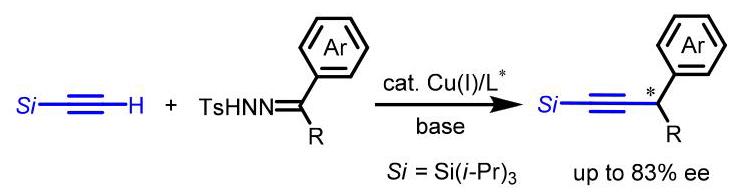
The first catalytic enantioselective C(sp)-C(sp ${}^{3}$ ) cross-coupling reaction between $N$ -tosylhydrazones and trialkylsi-lylethynes in the presence of $\mathrm{{Cu}}\left( \mathrm{I}\right)$ salts and chiral phosphoramidite ligands was developed. A series of synthetically interesting, functionalized alkynes were obtained with moderate to good enantioselectivities (up to 83% ee). Cu(II) carbene migratory insertion is proposed to be the enantio-determining step.
Keywords C(sp)-C(sp ${}^{3}$ ) cross-coupling, metal carbene, asymmetric catalysis, Cu(I) catalysts, $N$ -tosylhydrazones
Introduction
Alkynes are versatile intermediates in the syntheses of natural products, biologically active molecules, and functional materials. ${}^{\left\lbrack 1\right\rbrack }$ Sonogashira coupling is a classical and powerful method for the synthesis of alkynes containing aryl $\mathrm{C}\left( {\mathrm{{sp}}}^{2}\right) - \mathrm{C}\left( \mathrm{{sp}}\right)$ bonds. ${}^{\left\lbrack 2\right\rbrack }$ However, it has been a challenge to construct alkyl $\mathrm{C}\left( {\mathrm{{sp}}}^{3}\right) - \mathrm{C}\left( \mathrm{{sp}}\right)$ bonds because of competing oxidative addition and $\beta$ -hydride elimination process. Significant progress has been made in this area in the last decade. Fu and co-workers reported the Sonogashira coupling of primary alkyl halides by employing a palladium/ $N$ -heterocyclic carbene catalyst system. ${}^{\left\lbrack 3\right\rbrack }$ Other groups have also developed efficient catalytic systems. ${}^{\left\lbrack 4\right\rbrack }$ Recently novel coupling reactions toward C(sp)-C(s ${\mathrm{p}}^{3}$ ) bond formation have also been extensively explored, such as radical-mediated alkylation, ${}^{\left\lbrack 5\right\rbrack }$ oxidative coupling, ${}^{\left\lbrack 6\right\rbrack }$ inter- or intramolecular decarboxylative cross-coupling ${}^{\left\lbrack 7\right\rbrack }$ and those involving organometallic reagents. ${}^{\left\lbrack 8\right\rbrack }$
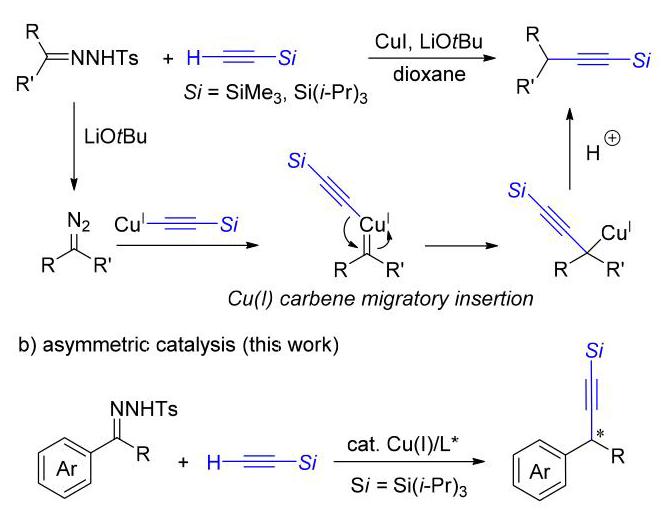
Regardless of the significant progress, only few examples of catalytic asymmetric $\mathrm{C}\left( {\mathrm{{sp}}}^{3}\right) - \mathrm{C}\left( \mathrm{{sp}}\right)$ bond formation have been reported. ${}^{\left\lbrack 9\right\rbrack }$ The groups of Sarandeses ${}^{\left\lbrack {10}\mathrm{a}\right\rbrack }$ and ${\mathrm{{Zhou}}}^{\left\lbrack {10}\mathrm{\;b}\right\rbrack }$ independently reported nickel-catalyzed enantioselective cross-coupling reactions between racemic secondary benzyl bromides and trialkynylindium or alkynylaluminum reagents. Recently, Sigman and coworkers developed an enantioselec-tive redox-relay Heck alkynylation of alkenols to conformation. However, the catalytic asymmetric version of the reaction has so far not been achieved. Therefore, it is of great significance to develop an asymmetric catalytic methodology for the asymmetric synthesis of $\mathrm{C}\left( \mathrm{{sp}}\right) - \mathrm{C}\left( {\mathrm{{sp}}}^{3}\right)$ bond with this novel carbene coupling method. Herein, we report the first catalytic asymmetric $\mathrm{C}\left( \mathrm{{sp}}\right) - \mathrm{C}\left( {\mathrm{{sp}}}^{3}\right)$ cross-coupling reaction between $N$ -tosylhydrazones and trialkylsilylethynes in the presence of $\mathrm{{Cu}}\left( \mathrm{I}\right)$ salts and chiral phosphoramidite ligands (Scheme 1b).
Scheme 1 Cross-coupling of $N$ -tosylhydrazone with terminal alkyne
a) our previous work (ref. 12)
struct $\beta$ -alkynyl carbonyl compounds in the presence of a Pd(II)/chiral pyridine oxazoline complex. ${}^{\left\lbrack {11}\right\rbrack }$
We have recently developed a straightforward method for the formation of $\mathrm{C}\left( \mathrm{{sp}}\right) - \mathrm{C}\left( {\mathrm{{sp}}}^{3}\right)$ bonds starting from $N$ -tosylhydrazones and trialkylsilylethynes, with CuI as the catalyst (Scheme 1a). ${}^{\left\lbrack {12},{13}\right\rbrack }$ The reaction proceeds through carbene formation and migratory insertion. ${}^{\left\lbrack {14}\right\rbrack }$ These coupling reactions represent a highly efficient and practical approach for $\mathrm{C}\left( \mathrm{{sp}}\right) - \mathrm{C}\left( {\mathrm{{sp}}}^{3}\right)$ bond
This article has been accepted for publication and undergone full peer review but has not been through the copyediting, typesetting, pagination and proofreading process, which may lead to differences between this version and the Version of Record. Please cite this article as doi: 10.1002/cjoc.201700633
Experimental
General
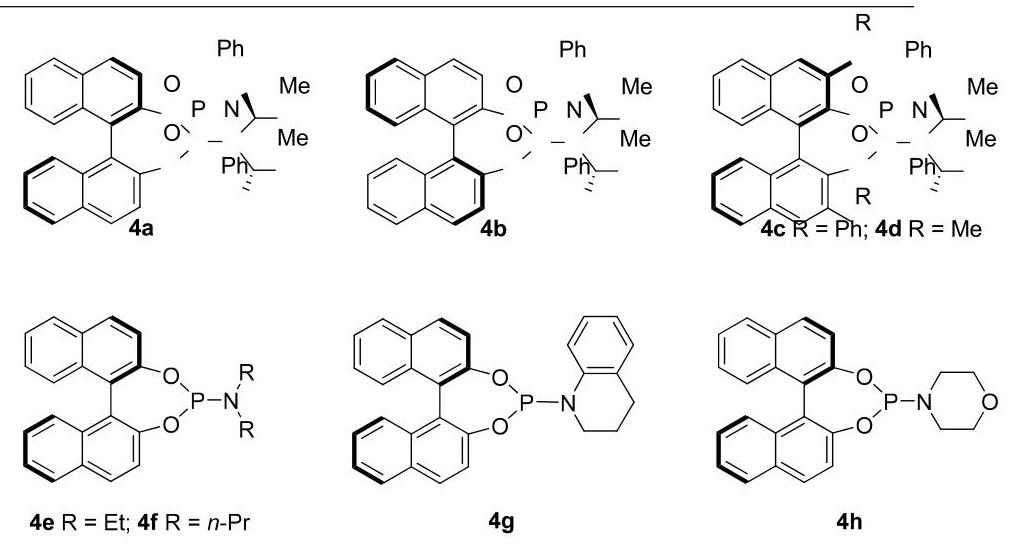
All the reactions were performed under nitrogen atmosphere in a ${10}\mathrm{\;{mL}}$ Schlenk tube. All solvents were distilled prior to use. Dioxane was dried over ${\mathrm{{CaH}}}_{2}$ . For chromatography, 200-300 mesh silica gel (Qingdao, China) was employed. ${}^{1}\mathrm{H}$ NMR and ${}^{13}\mathrm{C}$ NMR spectra were recorded on Brucker ARX 400 spectrometer in ${\mathrm{{CDCl}}}_{3}$ solution and the chemical shifts were reported in parts per million (δ) relative to internal standard TMS (0 ppm). IR spectra were recorded on Nicolet iS10 in wave numbers, ${\mathrm{{cm}}}^{-1}$ . For HRMS measurements, the mass analyzer is FT-ICR. Optical rotations were measured at PerkinElmer Model 341LC Polarimeter and concentrations (c) were reported in $\mathrm{g} \times {\left( {100}\mathrm{\;{mL}}\right) }^{-1}$ . HPLC analysis was performed at Agilent Technologies 1200 apparatus with Chiracel column. Ligand 4a-b and 4e-h were purchased from DAICEL CHIRAL TECHNOLOGIES (CHINA) CO. LTD. Ligand $4\mathrm{c}$ and $4\mathbf{d}$ were synthesized by following the literatures. ${}^{\left\lbrack {15},{16}\right\rbrack }$
General Experimental Procedure for the Synthesis of N-Tosylhydrazones
The $N$ -tosylhydrazones 1a-k and 1l-s were prepared according to the literature procedures. ${}^{\left\lbrack {17},{18}\right\rbrack }$ The ketone (20 mmol) was added to the methanolic solution (30 mL) of $p$ -toluenesulfonhydrazide (20 mmol). The reaction mixture was refluxed for ${0.5} - 2\mathrm{\;h}$ . Then the mixture was allowed to cool to room temperature and the product precipitated. The crystalline product was collected by filtration and washed thoroughly with cold ether.
Typical Procedure for the Cu(I)/L*-Catalyzed Cou- pling Reaction
Condition A. In an oven dried ${10}\mathrm{\;{mL}}$ Schlenk tube equipped with a stirring bar, $\mathrm{{Cu}}{\left( \mathrm{{MeCN}}\right) }_{4}{\mathrm{{PF}}}_{6}({3.7}\mathrm{{mg}}$ , 0.01 mmol, 5 mol%), ligand 4a (11.8 mg, 0.022 mmol, 11 mol%) were added into dioxane $\left( {{2.0}\mathrm{\;{mL}}}\right)$ under nitrogen atmosphere. The mixture was stirred for two hours at room temperature. Then ethynyltriiso-propylsilane 1 (0.2 mmol), $N$ -tosylhydrazones 2 (0.3 mmol) and ${\mathrm{{Cs}}}_{2}{\mathrm{{CO}}}_{3}$ (0.6 mmol,195 mg) were added to the tube under nitrogen atmosphere. The reaction mixture was stirred for ${24}\mathrm{\;h}$ at ${70}^{ \circ }\mathrm{C}$ . Then the mixture was purified by silica gel column chromatography (eluted by petroleum ether) to afford the coupling product 3.
Condition B. In an oven dried ${10}\mathrm{\;{mL}}$ Schlenk tube equipped with a stirring bar, $\mathrm{{Cu}}{\left( \mathrm{{MeCN}}\right) }_{4}{\mathrm{{PF}}}_{6}({3.7}\mathrm{{mg}}$ , 0.01 mmol, 5 mol%), ligand 4f (9.4 mg, 0.022 mmol, 11 mol%) were added into dioxane (2.0 mL) under nitrogen atmosphere. The mixture was stirred for $2\mathrm{\;h}$ at room temperature. Then ethynyltriisopropylsilane $1({0.2}$ mmol), $N$ -tosylhydrazone $2\left( {{0.3}\mathrm{{mmol}}}\right)$ and ${\mathrm{{Cs}}}_{2}{\mathrm{{CO}}}_{3}({0.6}$ mmol, 195 mg) were added to the tube under nitrogen atmosphere. The reaction mixture was stirred for ${24}\mathrm{\;h}$ at ${70}^{ \circ }\mathrm{C}$ . Then the mixture was purified by silica gel column chromatography (eluted by petroleum ether) to afford the coupling product 3.
Triisopropyl(3-(3-methoxyphenyl)but-1-yn-1-yl)
silane (3a). The title compound was obtained according to condition A: Colorless oil; yield 72% (45.5 mg). The ee was determined by HPLC analysis using Daicel Chi-ralpak OD-H column, conditions: $n$ -hexane $/i$ -PrOH = 100:0, 0.5 mL/min, 220 nm; t (major) = 11.8 min, t (minor) $= {11.0}\mathrm{\;{min}},{83}\%$ ee; ${\left\lbrack \alpha \right\rbrack }_{\mathrm{D}}^{20} = + {2.0}(c = {0.2}$ , ${\mathrm{{CHCl}}}_{3}).{}^{1}\mathrm{H}$ NMR (400 MHz, ${\mathrm{{CDCl}}}_{3}$ ) $\delta = {7.22}$ (t, $J = {8.0} \; \mathrm{{Hz}},1\mathrm{H}),{7.03} - {7.01}\left( {\mathrm{\;m},1\mathrm{H}}\right) ,{6.96}\left( {\mathrm{\;d}, J = {8.0}\mathrm{\;{Hz}},1\mathrm{H}}\right)$ , ${6.79} - {6.75}\left( {\mathrm{\;m},1\mathrm{H}}\right) ,{3.81}\left( {\mathrm{q}, J = {6.8}\mathrm{\;{Hz}},1\mathrm{H}}\right) ,{3.80}\left( {\mathrm{\;s},3\mathrm{H}}\right)$ , ${1.50}\left( {\mathrm{\;d}, J = {6.8}\mathrm{\;{Hz}},3\mathrm{H}}\right) ,{1.10} - {1.07}\left( {\mathrm{\;m},{21}\mathrm{H}}\right) ;{}^{13}\mathrm{C}$ NMR $\left( {{100}\mathrm{{MHz}},{\mathrm{{CDCl}}}_{3}}\right) \delta = {159.7},{144.9},{129.3},{119.3}$ , 112.3, 112.2, 111.1, 82.4, 55.1, 33.0, 25.1, 18.6, 11.3. IR: $v = {2945},{2868},{2162},{1606},{1473},{1256},{1126},{1018}$ , 864,749,663 ${\mathrm{{cm}}}^{-1}$ ; HRMS (ESI): $m/z$ calcd for ${\left\lbrack \mathrm{M} + \mathrm{H}\right\rbrack }^{ + } \; {\mathrm{C}}_{20}{\mathrm{H}}_{33}\mathrm{{OSi}}$ : 317.2295; found: 317.2294.
Triisopropyl(3-phenylbut-1-yn-1-yl)silane (3b). ${}^{\left\lbrack {19}\right\rbrack }$ The title compound was obtained according to condition A: Colorless oil; yield 70% (40.0 mg). Chiral GC analysis of the product: Chirasil Dex CB column; method: ${100}{}^{ \circ }\mathrm{C} \rightarrow {130}{}^{ \circ }\mathrm{C}$ @ ${10}{}^{ \circ }\mathrm{C}/\mathrm{{min}}$ , hold ${10}\mathrm{\;{min}}$ , then $\rightarrow {170}{}^{ \circ }\mathrm{C}$ @ $9{}^{ \circ }\mathrm{C}/\mathrm{{min}}$ , hold 5 min; flow rate 0.5 mL/min; retention times: 35.7 min (major), 35.8 min (minor), ${75}\%$ ee; ${\left\lbrack \alpha \right\rbrack }_{\mathrm{D}}^{20} = + {3.0}\left( {c = {0.2},{\mathrm{{CHCl}}}_{3}}\right) \cdot {}^{1}\mathrm{H}$ NMR (400 MHz, CDCl1) 5 = 7.42-7.39 (m, 2H), 7.34-7.29 (m, 2H), 7.24-7.18 (m, 1H), 3.81 (q, J = 7.2 $\mathrm{{Hz}},1\mathrm{H}),{1.50}\left( {\mathrm{\;d}, J = {7.2}\mathrm{\;{Hz}},3\mathrm{H}}\right) ,{1.10} - {1.06}\left( {\mathrm{\;m},{21}\mathrm{H}}\right)$ ; ${}^{13}\mathrm{C}$ NMR (100 MHz, ${\mathrm{{CDCl}}}_{3}$ ) $\delta = {143.3},{128.4},{126.9}$ , 126.5, 111.2, 82.3, 32.9, 25.1, 18.6, 11.3.
Triisopropyl(3-(4-methoxyphenyl)but-1-yn-1-yl)
silane (3c). ${}^{\left\lbrack {19}\right\rbrack }$ The title compound was prepared according to condition A: Colorless oil; yield 80% (50.5 mg). The ee was determined by HPLC analysis using Daicel Chiralpak 2xOD-H column, conditions: $n$ -hexane/i-PrOH = 100:0, 0.5 mL/min, 220 nm; t (major) $= {23.9}\mathrm{\;{min}},\mathrm{t}\left( \mathrm{{minor}}\right) = {23.0}\mathrm{\;{min}},{70}\%$ ee; ${\left\lbrack \alpha \right\rbrack }_{\mathrm{D}}^{20} = \; + {8.0}\left( {c = {0.2},{\mathrm{{CHCl}}}_{3}}\right) \cdot {}^{1}\mathrm{H}$ NMR $\left( {{400}\mathrm{{MHz}},{\mathrm{{CDCl}}}_{3}}\right) \delta = \; {7.34} - {7.30}\left( {\mathrm{\;m},2\mathrm{H}}\right) ,{6.89} - {6.83}\left( {\mathrm{\;m},2\mathrm{H}}\right) ,{3.79}\left( {\mathrm{\;s},3\mathrm{H}}\right) ,{3.76} \; \left( {\mathrm{q}, J = {7.2}\mathrm{\;{Hz}},1\mathrm{H}}\right) ,{1.48}\left( {\mathrm{\;d}, J = {7.2}\mathrm{\;{Hz}},3\mathrm{H}}\right) ,{1.10} - {1.06} \; \left( {\mathrm{m},{21}\mathrm{H}}\right) ;{}^{13}\mathrm{C}\mathrm{{NMR}}\left( {{100}\mathrm{{MHz}},{\mathrm{{CDCl}}}_{3}}\right) \delta = {158.2},{135.5}$ , 127.8, 113.7, 111.6, 82.0, 55.2, 32.1, 25.2, 18.6, 11.3.
(3-([1,1’-Biphenyl]-4-yl)but-1-yn-1-yl)triisoprop ylsilane (3d). The title compound was obtained according to condition A: Colorless oil; yield 40% (28.9 mg). The ee was determined by HPLC analysis using
Daicel Chiralpak 2xOD-H column, conditions: $n$ -hexane $/i$ -PrOH = 100:0, ${0.5}\mathrm{\;{mL}}/\mathrm{{min}},{220}\mathrm{\;{nm}}$ ; t (major) $= {45.5}\mathrm{\;{min}},\mathrm{t}\left( \mathrm{{minor}}\right) = {57.0}\mathrm{\;{min}},{79}\%$ ee; ${\left\lbrack \alpha \right\rbrack }_{\mathrm{D}}^{20} = \; + {1.5}\left( {c = {0.2},{\mathrm{{CHCl}}}_{3}}\right) \cdot {}^{1}\mathrm{H}$ NMR $\left( {{400}\mathrm{{MHz}},{\mathrm{{CDCl}}}_{3}}\right) \delta = \; {7.63} - {7.55}\left( {\mathrm{\;m},4\mathrm{H}}\right) ,{7.52} - {7.42}\left( {\mathrm{\;m},4\mathrm{H}}\right) ,{7.38} - {7.32}(\mathrm{\;m}$ , 1H), ${3.88}\left( {\mathrm{q}, J = {7.2}\mathrm{\;{Hz}},1\mathrm{H}}\right) ,{1.56}\left( {\mathrm{\;d}, J = {7.2}\mathrm{{Hz}},3\mathrm{H}}\right)$ , 1.13-1.10 $\left( {\mathrm{m},{21}\mathrm{H}}\right) ;{}^{13}\mathrm{C}$ NMR $\left( {{100}\mathrm{{MHz}},{\mathrm{{CDCl}}}_{3}}\right) \delta =$ 142.4, 140.9, 139.4, 128.7, 127.3, 127.2, 127.1, 127.0, 111.1, 82.4, 32.6, 25.1, 18.7, 11.3. IR: v= 2942, 2868, 2159, 1460, 1262, 1114, 996, 817, 768 cm ${}^{-1}$ ; HRMS (EI): $m/z$ calcd for ${\left\lbrack \mathrm{M}\right\rbrack }^{ + }{\mathrm{C}}_{25}{\mathrm{H}}_{34}\mathrm{{Si}} : {362.2424}$ ; found: 362.2425.
(3-(4-Bromophenyl)but-1-yn-1-yl)triisopropylsila
ne (3e). The title compound was obtained according to condition A: Colorless oil; yield ${74}\% \left( {{54.0}\mathrm{{mg}}}\right) .{\left\lbrack \alpha \right\rbrack }_{\mathrm{D}}^{20} = \; + {2.0}\left( {c = {0.2},{\mathrm{{CHCl}}}_{3}}\right) \cdot {}^{1}\mathrm{H}$ NMR $\left( {{400}\mathrm{{MHz}},{\mathrm{{CDCl}}}_{3}}\right) \delta =$ 7.46-7.42 (m, 2H), 7.30-7.27 (m, 2H), 3.77 (q, J = 7.2 $\mathrm{{Hz}},1\mathrm{H}),{1.47}\left( {\mathrm{\;d}, J = {7.2}\mathrm{{Hz}},3\mathrm{H}}\right) ,{1.09} - {1.06}\left( {\mathrm{\;m},{21}\mathrm{H}}\right)$ ; ${}^{13}\mathrm{C}$ NMR (100 MHz, ${\mathrm{{CDCl}}}_{3}$ ) $\delta = {142.3},{131.5},{128.7}$ , 120.3, 110.5, 82.8, 32.5, 24.9, 18.6, 11.3; IR: v= 2939, 2864, 2172, 1488, 1461, 1266, 1012, 824, 678 cm ${}^{-1}$ ; HRMS (EI): $m/z$ calcd for ${\left\lbrack \mathrm{M}\right\rbrack }^{ + }{\mathrm{C}}_{19}{\mathrm{H}}_{29}\mathrm{{BrSi}} : {364.1216}$ ; found: 364.1213.
1-Bromo-4-(but-3-yn-2-yl)benzene (3e’). The title compound was obtained by removal of the TIPS group of 3e with tetrabutylammonium fluoride in THF (1.0 M): Colorless oil; yield 75% (31.3 mg). The ee was determined by HPLC analysis using Daicel Chiralpak 2xOD-H column, conditions: $n$ -hexane $/i$ -PrOH $= {100} : 0$ , ${0.5}\mathrm{\;{mL}}/\mathrm{{min}},{220}\mathrm{\;{nm}};\mathrm{t}\left( \mathrm{{major}}\right) = {28.5}\mathrm{\;{min}},\mathrm{t}\left( \mathrm{{minor}}\right) = \; {26.3}\mathrm{\;{min}},{63}\%$ ee; ${\left\lbrack \alpha \right\rbrack }_{\mathrm{D}}^{20} = - {3.0}\left( {c = {0.2},{\mathrm{{CHCl}}}_{3}}\right) .{}^{1}\mathrm{H}$ NMR (400 MHz, CDCl3) δ = 7.47-7.43 (m, 2H), 7.28-7.27 (m, 2H), 3.88 (dq, J = 2.4, 7.2 Hz, 1H), 2.27 $\left( {\mathrm{d}, J = {2.4}\mathrm{\;{Hz}},1\mathrm{H}}\right) ,{1.48}\left( {\mathrm{\;d}, J = {7.2}\mathrm{\;{Hz}},3\mathrm{H}}\right) ;{}^{13}\mathrm{C}\mathrm{{NMR}} \; \left( {{100}\mathrm{{MHz}},{\mathrm{{CDCl}}}_{3}}\right) \delta = {141.6},{131.6},{128.6},{120.5},{86.4}$ , 70.5,31.1,24.1; IR: $v = {2929},{2852},{2360},{1643},{1362}$ , 1062,848,789 ${\mathrm{{cm}}}^{-1}$ ; HRMS (EI): $m/z$ calcd for ${\left\lbrack \mathrm{M}\right\rbrack }^{ + } \; {\mathrm{C}}_{10}{\mathrm{H}}_{9}\mathrm{{Br}}$ 207.9882; found: 207.9878.
Triisopropyl(3-(3,4,5-trimethoxyphenyl)but-1-yn- 1-yl)silane (3f). The title compound was obtained according to condition A: Colorless oil; yield 45% (33.8 mg). The ee was determined by HPLC analysis using Daicel Chiralpak 2xOD-H column, conditions: $n$ -hexane/i-PrOH = 98:2, 0.5 mL/min, 220 nm; t (major) $= {19.0}\mathrm{\;{min}},\mathrm{t}\left( \mathrm{{minor}}\right) = {20.4}\mathrm{\;{min}},{74}\%$ ee; ${\left\lbrack \alpha \right\rbrack }_{\mathrm{D}}^{20} = + {5.0} \; \left( {c = {0.2},{\mathrm{{CHCl}}}_{3}}\right) \cdot {}^{1}\mathrm{H}$ NMR (400 MHz, ${\mathrm{{CDCl}}}_{3}$ ) $\delta = {6.66} \; \left( {\mathrm{s},2\mathrm{H}}\right) ,{3.85}\left( {\mathrm{\;s},6\mathrm{H}}\right) ,{3.83}\left( {\mathrm{\;s},3\mathrm{H}}\right) ,{3.76}(\mathrm{q}, J = {7.2}\mathrm{\;{Hz}}$ , $1\mathrm{H}),{1.49}\left( {\mathrm{\;d}, J = {7.2}\mathrm{\;{Hz}},3\mathrm{H}}\right) ,{1.10} - {1.06}\left( {\mathrm{\;m},{21}\mathrm{H}}\right) ;{}^{13}\mathrm{C}$ NMR (100 MHz, CDCl3) δ = 153.0, 138.9, 136.3, 111.0, 103.7, 82.5, 60.7, 55.9, 33.2, 25.3, 18.6, 11.2; IR: v= 2933, 2864, 2169, 1590, 1463, 1235, 1130, 1006, 876, ${718},{656}{\mathrm{\;{cm}}}^{-1}$ ; HRMS (ESI): $m/z$ calcd for ${\left\lbrack \mathrm{M} + \mathrm{H}\right\rbrack }^{ + } \; {\mathrm{C}}_{22}{\mathrm{H}}_{37}{\mathrm{O}}_{3}\mathrm{{Si}} : {377.2506}$ ; found: 377.2515.
Triisopropyl(3-(naphthalen-1-yl)but-1-yn-1-yl)
silane (3g). ${}^{\left\lbrack {19}\right\rbrack }$ The title compound was obtained according to condition A: Colorless oil; yield 52% (34.9 mg). The ee was determined by HPLC analysis using Daicel Chiralpak 2xAD-H column, conditions: $n$ -hexane $/i$ -PrOH = 100:0, ${0.5}\mathrm{\;{mL}}/\mathrm{{min}},{220}\mathrm{\;{nm}}$ ; t (major) $= {16.0}\mathrm{\;{min}},\mathrm{t}\left( \mathrm{{minor}}\right) = {16.9}\mathrm{\;{min}},{52}\%$ ee; ${\left\lbrack \alpha \right\rbrack }_{\mathrm{D}}^{20} = \; + {1.9}\left( {c = {0.2},{\mathrm{{CHCl}}}_{3}}\right) ;{}^{1}\mathrm{H}$ NMR (400 MHz, ${\mathrm{{CDCl}}}_{3}$ ) $\delta =$ 8.14-8.10 (m, 1H), 7.90-7.82 (m, 2H), 7.78-7.74 (m, 1H), 7.55-7.45 (m, 3H), 4.59 (q, J = 7.2 Hz, 1H), 1.66 $\left( {\mathrm{d}, J = {7.2}\mathrm{\;{Hz}},3\mathrm{H}}\right) ,{1.13} - {1.10}\left( {\mathrm{\;m},{21}\mathrm{H}}\right) ;{}^{13}\mathrm{C}$ NMR (100 MHz, CDC1, 5 = 138.9, 133.9, 130.5, 128.9, 127.3, 125.9, 125.6, 125.4, 124.3, 123.2, 111.5, 82.7, 29.7, 23.9, 18.7, 11.3.
Triisopropyl(3-(naphthalen-2-yl)but-1-yn-1-yl)
silane (3h). The title compound was obtained according to condition A: Colorless oil; yield 60% (40.3 mg). The ee was determined by HPLC analysis using Daicel Chi-ralpak OD-H column, conditions: $n$ -hexane $/i$ -PrOH = 100:0, 0.5 mL/min, 220 nm; t (major) = 12.7 min, t (minor) = 14.4 min, 79% ee; ${\left\lbrack \alpha \right\rbrack }_{\mathrm{D}}^{{20}^{ \circ }} = + {1.8}(c = {0.2}$ , $\left. {\mathrm{{CHCl}}}_{3}\right) \cdot {}^{1}\mathrm{H}$ NMR (400 MHz, ${\mathrm{{CDCl}}}_{3}$ ) $\delta = {7.96}\left( {\mathrm{\;S},1\mathrm{H}}\right)$ , ${7.88} - {7.83}\left( {\mathrm{\;m},3\mathrm{H}}\right) ,{7.57}\left( {\mathrm{{dd}}, J = {1.6},{8.4}\mathrm{\;{Hz}},1\mathrm{H}}\right)$ , ${7.54} - {7.46}\left( {\mathrm{\;m},2\mathrm{H}}\right) ,{4.03}\left( {\mathrm{q}, J = {7.2}\mathrm{{Hz}},1\mathrm{H}}\right) ,{1.64}(\mathrm{\;d}, J = \; {7.2}\mathrm{\;{Hz}},3\mathrm{H}),{1.20} - {1.15}\left( {\mathrm{\;m},{21}\mathrm{H}}\right) ;{}^{13}\mathrm{C}$ NMR (100 MHz, ${\mathrm{{CDCl}}}_{3})\delta = {140.7},{133.5},{132.3},{128.1},{127.7},{127.6}$ , 126.0, 125.6, 125.5, 125.2, 111.2, 82.6, 33.1, 24.9, 18.6, 11.3; IR: $v = {2976},{2895},{2169},{1402},{1265},{1061},{891}$ , 836,740,653 ${\mathrm{{cm}}}^{-1}$ ; HRMS (EI): $m/z$ calcd for ${\left\lbrack \mathrm{M}\right\rbrack }^{ + } \; {\mathrm{C}}_{23}{\mathrm{H}}_{32}\mathrm{{Si}}$ : 336.2267; found: 336.2264.
Triisopropyl(3-(6-methoxynaphthalen-2-yl)but
-1-yn-1-yl)silane (3i). The title compound was obtained according to condition A: Colorless oil; yield 50% (36.7 mg). The ee was determined by HPLC analysis using Daicel Chiralpak 2xOD-H column, conditions: $n$ -hexane $/i$ -PrOH $= {100} : 0,{0.5}\mathrm{\;{mL}}/\mathrm{{min}}$ , 220 nm; t (major) $= {67.9}\mathrm{\;{min}},\mathrm{t}$ (minor) $= {58.6}\mathrm{\;{min}}$ , 55% ee; ${\left\lbrack \alpha \right\rbrack }_{\mathrm{D}}^{20} = + {1.8}\left( {c = {0.2},{\mathrm{{CHCl}}}_{3}}\right) \cdot {}^{1}\mathrm{H}$ NMR (400 MHz, ${\mathrm{{CDCl}}}_{3})\delta = {7.84}\left( {\mathrm{\;s},1\mathrm{H}}\right) ,{7.72} - {7.69}\left( {\mathrm{\;m},2\mathrm{H}}\right)$ , 7.51-7.45 $\left( {\mathrm{m},1\mathrm{H}}\right) ,{7.17} - {7.12}\left( {\mathrm{\;m},2\mathrm{H}}\right) ,{3.95}\left( {\mathrm{q}, J = {7.2}}\right) \; \mathrm{{Hz}},1\mathrm{H}),{3.92}\left( {\mathrm{\;s},3\mathrm{H}}\right) ,{1.58}\left( {\mathrm{\;d}, J = {7.2}\mathrm{\;{Hz}},3\mathrm{H}}\right)$ , 1.15-1.10 (m, 21H) ppm. ${}^{13}\mathrm{C}$ NMR (100 MHz, ${\mathrm{{CDCl}}}_{3}$ ) $\delta = {157.4},{138.4},{133.4},{129.2},{128.9},{126.9},{126.1}$ , 125.0, 118.8, 111.4, 105.6, 82.4, 55.3, 32.9, 24.9, 18.7,11.3 ppm. IR: $v = {2982},{2905},{2175},{1618},{1405}$ , 1238,1052,907,873,727 ${\mathrm{{cm}}}^{-1}$ ; HRMS (ESI): $m/z$ calcd for ${\left\lbrack \mathrm{M} + \mathrm{H}\right\rbrack }^{ + }{\mathrm{C}}_{24}{\mathrm{H}}_{35}\mathrm{{OSi}} : {367.2451}$ ; found: 367.2450.
Triisopropyl(3-(4-methoxyphenyl)pent-1-yn-1-yl)
silane (3j). The title compound was obtained according to condition A: Colorless oil; yield 76% (50.2 mg). The ee was determined by HPLC analysis using Daicel Chi-ralpak 2xOD-H column, conditions: n-hexane/i-PrOH = 100:0, 0.5 mL/min, 220 nm; t (major) = 21.0 min, t (minor) $= {19.7}\mathrm{\;{min}},{46}\%$ ee; ${\left\lbrack \alpha \right\rbrack }_{\mathrm{D}}^{{20}^{ \circ }} = + {3.0}\left( {c = {0.2}}\right.$ , ${\mathrm{{CHCl}}}_{3}).{}^{1}\mathrm{H}$ NMR (400 MHz, ${\mathrm{{CDCl}}}_{3}$ ) $\delta = {7.33} - {7.29}(\mathrm{\;m}$ , 2H), 6.89-6.85 (m, 2H), 3.81 (s, 3H), 3.65-3.60 (m, 1H), 1.90-1.66 (m, 2H), 1.15-1.10 (m, 21H), 1.02 (t, J = 7.2 Hz, 3H); ${}^{13}\mathrm{C}$ NMR (100 MHz, CDCl3) $\delta = {158.2},{134.1}$ , 128.4, 113.6, 110.2, 82.9, 55.2, 39.5, 32.1, 18.7, 11.6, 11.3 ppm. IR: $v = {2967},{2864},{2165},{1519},{1250},{1046}$ , ${882},{805},{663}{\mathrm{\;{cm}}}^{-1}$ ; HRMS (ESI): $m/z$ calcd for ${\left\lbrack \mathrm{M} + \mathrm{H}\right\rbrack }^{ + } \; {\mathrm{C}}_{21}{\mathrm{H}}_{35}\mathrm{{OSi}}$ : 331.2451; found: 331.2453.
(3-(Benzo[d][1,3]dioxol-5-yl)hex-1-yn-1-yl)triisopr opylsilane (3k). The title compound was obtained according to condition A: Colorless oil; yield 60% (43.0 mg). The ee was determined by HPLC analysis using Daicel Chiralpak 2xOD-H column, conditions: $n$ -hexane/i-PrOH = 100:0, 0.5 mL/min, 220 nm; t (major) $= {22.4}\mathrm{\;{min}},\mathrm{t}\left( \mathrm{{minor}}\right) = {23.2}\mathrm{\;{min}},{42}\%$ ee; ${\left\lbrack \alpha \right\rbrack }_{\mathrm{D}}^{20} = \; + {7.0}\left( {c = {0.2},{\mathrm{{CHCl}}}_{3}}\right) \cdot {}^{1}\mathrm{H}$ NMR $\left( {{400}\mathrm{{MHz}},{\mathrm{{CDCl}}}_{3}}\right) \delta =$ 6.92-6.89 (m, 1H), 6.85-6.80 (m, 1H), 6.77-6.73 (m, 1H), 5.95-5.93 (m, 2H), 3.66-3.61 (m, 1H), 1.72-1.63 $\left( {\mathrm{m},2\mathrm{H}}\right) ,{1.54} - {1.40}\left( {\mathrm{\;m},2\mathrm{H}}\right) ,{1.11} - {1.08}\left( {\mathrm{\;m},{21}\mathrm{H}}\right) ,{0.92}(\mathrm{t}$ , $J = {7.2}\mathrm{\;{Hz}},3\mathrm{H});{}^{13}\mathrm{C}\mathrm{{NMR}}\left( {{100}\mathrm{{MHz}},{\mathrm{{CDCl}}}_{3}}\right) \delta = {147.5}$ , 146.0, 136.3, 120.4, 110.2, 108.0, 107.9, 100.9, 83.0, 41.4, 38.3, 20.4, 18.6, 13.7, 11.3; IR: $v = {2945},{2862}$ , 2163,1492,1250,1052,885,675 ${\mathrm{{cm}}}^{-1}$ ; HRMS (ESI): $m/z$ calcd for ${\left\lbrack \mathrm{M} + \mathrm{H}\right\rbrack }^{ + }{\mathrm{C}}_{22}{\mathrm{H}}_{35}{\mathrm{O}}_{2}\mathrm{{Si}} : {359.2400}$ ; found: 359.2401.
Triisopropyl((1,2,3,4-tetrahydronaphthalen-1-yl)
ethynyl)silane (3l). The title compound was obtained according to condition B: Colorless oil; yield 80% (49.9 mg). The ee was determined by HPLC analysis using Daicel Chiralpak 2xOD-H column, conditions: $n$ -hexane $/i$ -PrOH = 100:0, ${0.5}\mathrm{\;{mL}}/\mathrm{{min}},{220}\mathrm{\;{nm}}$ ; t (major) $= {17.6}\mathrm{\;{min}},\mathrm{t}\left( \mathrm{{minor}}\right) = {16.6}\mathrm{\;{min}},{82}\%$ ee; ${\left\lbrack \alpha \right\rbrack }_{\mathrm{D}}^{20} = \; + {4.9}\left( {c = {0.2},{\mathrm{{CHCl}}}_{3}}\right) \cdot {}^{1}\mathrm{H}$ NMR $\left( {{400}\mathrm{{MHz}},{\mathrm{{CDCl}}}_{3}}\right) \delta =$ 7.55-7.50 (m, 1H), 7.19-7.11 (m, 2H), 7.08-7.05 (m, 1H), 3.84 (dd, J = 5.2, 8.4 Hz, 1H), 2.90-2.70 (m, 2H), 2.20-2.10 (m, 1H), 2.05-1.95 (m, 1H), 1.94-1.84 (m, 1H), 1.81-1.70 (m, 1H), 1.08-1.04 (m, 21H); ${}^{13}\mathrm{C}$ NMR $\left( {{100}\mathrm{{MHz}},{\mathrm{{CDCl}}}_{3}}\right) \delta = {136.4},{136.0},{129.0},{128.9}$ , 126.3, 125.8, 111.6, 81.0, 32.6, 30.6, 29.1, 21.4, 18.6, 11.3; IR: $v = {2939},{2864},{2169},{1457},{1074},{1018},{876}$ , ${746},{669}{\mathrm{\;{cm}}}^{-1}$ ; HRMS (EI): $m/z$ calcd for ${\left\lbrack \mathrm{M}\right\rbrack }^{ + }{\mathrm{C}}_{21}{\mathrm{H}}_{32}\mathrm{{Si}}$ : 312.2267; found: 312.2267.
((7-Bromo-1,2,3,4-tetrahydronaphthalen-1-yl)eth ynyl)triisopropylsilane (3m). The title compound was obtained according to condition B: Colorless oil; yield 82% (64.1 mg). The ee was obtained by HPLC analysis using Daicel Chiralpak 2xOD-H column, conditions: $n$ -hexane $/i$ -PrOH = 100:0, ${0.5}\mathrm{\;{mL}}/\mathrm{{min}},{220}\mathrm{\;{nm}}$ ; t (major) $= {20.1}\mathrm{\;{min}},\mathrm{t}\left( \mathrm{{minor}}\right) = {18.3}\mathrm{\;{min}},{72}\%$ ee; ${\left\lbrack \alpha \right\rbrack }_{\mathrm{D}}^{20} = \; + {2.0}\left( {c = {0.2},{\mathrm{{CHCl}}}_{3}}\right) \cdot {}^{1}\mathrm{H}$ NMR $\left( {{400}\mathrm{{MHz}},{\mathrm{{CDCl}}}_{3}}\right) \delta = \; {7.69}\left( {\mathrm{\;d}, J = {1.2}\mathrm{\;{Hz}},1\mathrm{H}}\right) ,{7.26} - {7.22}\left( {\mathrm{\;m},1\mathrm{H}}\right) ,{6.92}(\mathrm{\;d}, J = \; {8.4}\mathrm{\;{Hz}},1\mathrm{H}),{3.77}\left( {\mathrm{{dd}}, J = {5.2},{8.8}\mathrm{\;{Hz}},1\mathrm{H}}\right) ,{2.80} - {2.65} \; \left( {\mathrm{m},2\mathrm{H}}\right) ,{2.18} - {2.10}\left( {\mathrm{\;m},1\mathrm{H}}\right) ,{2.03} - {1.94}\left( {\mathrm{\;m},1\mathrm{H}}\right)$ , 1.89-1.80 (m, 1H), 1.78-1.66 (m, 1H), 1.08-1.04 (m, 21H); ${}^{13}\mathrm{C}$ NMR (100 MHz, ${\mathrm{{CDCl}}}_{3}$ ) $\delta = {138.6},{134.9}$ , 131.8, 130.5, 129.4, 119.3, 110.6, 82.0, 32.6, 30.1, 28.5, 21.2,18.6,11.3; IR: $v = {2945},{2856},{2163},{1594},{1476}$ , 1000,889,805,678 ${\mathrm{{cm}}}^{-1}$ ; HRMS (EI): $m/z$ calcd for ${\left\lbrack \mathrm{M}\right\rbrack }^{ + }{\mathrm{C}}_{21}{\mathrm{H}}_{31}\mathrm{{BrSi}} : {390.1372}$ ; found: 390.1370.
Triisopropyl((7-methyl-1,2,3,4-tetrahydronaphth-alen-1-yl)ethynyl)silane (3n). The title compound was obtained according to condition B: Colorless oil; yield 65% (42.4 mg). The ee was determined by HPLC analysis using Daicel Chiralpak 2xOD-H column, conditions: n-hexane/i-PrOH = 100:0, 0.5 mL/min, 220 nm; t (major) $= {17.6}\mathrm{\;{min}}, t$ (minor) $= {15.8}\mathrm{\;{min}},{67}\%$ ee; ${\left\lbrack \alpha \right\rbrack }_{\mathrm{D}}^{20} \; = + {6.7}\left( {c = {0.2},{\mathrm{{CHCl}}}_{3}}\right) \cdot {}^{1}\mathrm{H}$ NMR (400 MHz, ${\mathrm{{CDCl}}}_{3}$ ) δ $= {7.40}\left( {\mathrm{\;s},1\mathrm{H}}\right) ,{6.96}\left( {\mathrm{\;d}, J = {0.8}\mathrm{\;{Hz}},2\mathrm{H}}\right) ,{3.81}(\mathrm{{dd}}, J =$ 5.2, ${8.8}\mathrm{\;{Hz}},1\mathrm{H}),{2.84} - {2.68}\left( {\mathrm{\;m},2\mathrm{H}}\right) ,{2.32}\left( {\mathrm{\;s},3\mathrm{H}}\right)$ , 2.20-2.12 $\left( {\mathrm{m},1\mathrm{H}}\right) ,{2.04} - {1.95}\left( {\mathrm{\;m},1\mathrm{H}}\right) ,{1.93} - {1.83}(\mathrm{\;m}$ , 1H), 1.78-1.68 (m, 1H), 1.12-1.05 (m, 21H); ${}^{13}\mathrm{C}$ NMR (100 MHz, CDCl1) 5 = 136.1, 135.2, 132.9, 129.6, 128.8, 127.2, 111.8, 80.9, 32.7, 30.6, 28.7, 21.7, 20.9, 18.6,11.3; IR: $v = {2942},{2861},{2169},{1662},{1467},{1262}$ , 1006,888,793 ${\mathrm{{cm}}}^{-1}$ ; HRMS (ESI): $m/z$ calcd for ${\left\lbrack \mathrm{M} + \mathrm{H}\right\rbrack }^{ + }{\mathrm{C}}_{22}{\mathrm{H}}_{35}\mathrm{{Si}} : {327.2502}$ ; found: 327.2502.
((6-Fluoro-1,2,3,4-tetrahydronaphthalen-1-yl)ethy nyl)triisopropylsilane (30). The title compound was prepared according to condition B: Colorless oil; yield 45% (29.7 mg). The ee was determined by HPLC analysis using Daicel Chiralpak 2xOD-H column, conditions: n-hexane/i-PrOH = 100:0, 0.5 mL/min, 220 nm; t (major) $= {16.9}\mathrm{\;{min}},\mathrm{t}\left( \mathrm{{minor}}\right) = {16.1}\mathrm{\;{min}},{66}\%$ ee; ${\left\lbrack \alpha \right\rbrack }_{\mathrm{D}}^{20} \; = + {3.0}\left( {c = {0.2},{\mathrm{{CHCl}}}_{3}}\right) \cdot {}^{1}\mathrm{H}$ NMR (400 MHz, ${\mathrm{{CDCl}}}_{3}$ ) $\delta \; = {7.48} - {7.43}\left( {\mathrm{\;m},1\mathrm{H}}\right) ,{6.88} - {6.81}\left( {\mathrm{\;m},1\mathrm{H}}\right) ,{6.77} - {6.73}(\mathrm{\;m}$ , 1H), 3.80-3.75 (m, 1H), 2.86-2.68 (m, 2H), 2.16-2.09 $\left( {\mathrm{m},1\mathrm{H}}\right) ,{2.03} - {1.92}\left( {\mathrm{\;m},1\mathrm{H}}\right) ,{1.91} - {1.83}\left( {\mathrm{\;m},1\mathrm{H}}\right)$ , 1.78-1.68 (m, 1H), 1.07-1.03 (m, 21H); ${}^{13}\mathrm{C}$ NMR (100 MHz, CDC1s) δ = 162.5, 160.1, 138.1, 138.0, 132.05, 132.02, 130.5, 130.4, 115.1, 114.9, 113.0, 112.7, 111.4, 81.3, 32.1, 30.5, 29.2, 21.1, 18.6, 11.3 ppm. IR: v= 2945, 2868, 2181, 1618, 1497, 1250, 1009, 879, 662 ${\mathrm{{cm}}}^{-1}$ ; HRMS (EI): $m/z$ calcd for ${\left\lbrack \mathrm{M}\right\rbrack }^{ + }{\mathrm{C}}_{21}{\mathrm{H}}_{31}\mathrm{{FSi}}$ : 330.2173; found: 330.2171.
((6-Chloro-1,2,3,4-tetrahydronaphthalen-1-yl)eth
ynyl)triisopropylsilane (3p). The title compound was prepared according to condition B: Colorless oil; yield 75% (52.1 mg). The ee was determined by HPLC analysis using Daicel Chiralpak 2xOD-H column, conditions: n-hexane/i-PrOH = 100:0, 0.5 mL/min, 220 nm; t (major) $= {16.9}\mathrm{\;{min}},\mathrm{t}\left( \mathrm{{minor}}\right) = {16.4}\mathrm{\;{min}},{67}\%$ ee; ${\left\lbrack \alpha \right\rbrack }_{\mathrm{D}}^{20} \; = + {4.2}\left( {c = {0.2},{\mathrm{{CHCl}}}_{3}}\right) \cdot {}^{1}\mathrm{H}$ NMR $\left( {{400}\mathrm{{MHz}},{\mathrm{{CDCl}}}_{3}}\right) \delta \; = {7.42}\left( {\mathrm{\;d},\mathrm{\;J} = {7.2}\mathrm{\;{Hz}},1\mathrm{H}}\right) ,{7.11}\left( {\mathrm{\;{dd}}, J = {2.4},{8.4}\mathrm{\;{Hz}},1\mathrm{H}}\right)$ , ${7.04}\left( {\mathrm{\;d}, J = {2.0}\mathrm{\;{Hz}},1\mathrm{H}}\right) ,{3.79} - {3.74}\left( {\mathrm{\;m},1\mathrm{H}}\right) ,{2.82} - {2.68} \; \left( {\mathrm{m},2\mathrm{H}}\right) ,{2.15} - {2.08}\left( {\mathrm{\;m},1\mathrm{H}}\right) ,{2.03} - {1.92}\left( {\mathrm{\;m},1\mathrm{H}}\right)$ , 1.91-1.83 (m, 1H), 1.78-1.68 (m, 1H), 1.09-1.01 (m, 21H); ${}^{13}\mathrm{C}$ NMR (100 MHz, ${\mathrm{{CDCl}}}_{3}$ ) $\delta = {137.9},{134.9}$ , 131.8, 130.4, 128.6, 126.0, 111.0, 81.5, 32.1, 30.4, 29.0, 21.1,18.6,11.2; IR: $v = {2979},{2902},{2178},{1396},{1269}$ , 1056,904,870,786,675 ${\mathrm{{cm}}}^{-1}$ ; HRMS (EI): $m/z$ calcd for ${\left\lbrack \mathrm{M} - {\mathrm{C}}_{3}{\mathrm{H}}_{7}\right\rbrack }^{ + }{\mathrm{C}}_{18}{\mathrm{H}}_{24}\mathrm{{ClSi}} : {303.1330}$ ; found:303.1328.
Triisopropyl((6-methoxy-1,2,3,4-tetrahydronaph-thalen-1-yl)ethynyl)silane (3q). The title compound was obtained according to condition B: Colorless oil; yield 70% (47.9 mg). The ee was determined by HPLC analysis using Daicel Chiralpak 2xOD-H column, conditions: $n$ -hexane $/i$ -PrOH = 100:0, ${0.5}\mathrm{\;{mL}}/\mathrm{{min}},{220}\mathrm{\;{nm}}$ ; t (major) $= {42.8}\mathrm{\;{min}},\mathrm{t}$ (minor) $= {38.2}\mathrm{\;{min}},{53}\%$ ee; ${\left\lbrack \alpha \right\rbrack }_{\mathrm{D}}^{20} \; = + {7.2}\left( {c = {0.2},{\mathrm{{CHCl}}}_{3}}\right) \cdot {}^{1}\mathrm{H}$ NMR $\left( {{400}\mathrm{{MHz}},{\mathrm{{CDCl}}}_{3}}\right) \delta \; = {7.42}\left( {\mathrm{\;d},\mathrm{\;J} = {8.4}\mathrm{\;{Hz}},1\mathrm{H}}\right) ,{6.72}\left( {\mathrm{\;{dd}}, J = {2.8},{8.4}\mathrm{\;{Hz}},1\mathrm{H}}\right)$ , ${6.59}\left( {\mathrm{\;d}, J = {2.8}\mathrm{\;{Hz}},1\mathrm{H}}\right) ,{3.80} - {3.75}\left( {\mathrm{\;m},4\mathrm{H}}\right) ,{2.85} - {2.68} \; \left( {\mathrm{m},2\mathrm{H}}\right) ,{2.17} - {2.08}\left( {\mathrm{\;m},1\mathrm{H}}\right) ,{2.02} - {1.92}\left( {\mathrm{\;m},1\mathrm{H}}\right)$ , 1.90-1.81 (m, 1H), 1.78-1.65 (m, 1H), 1.09-1.03 (m, 21H); ${}^{13}\mathrm{C}$ NMR (100 MHz, ${\mathrm{{CDCl}}}_{3}$ ) $\delta = {158.0},{137.2}$ , 130.0, 128.6, 113.4, 112.0, 111.9, 80.7, 55.2, 31.9, 30.8, 29.4, 21.5, 18.6, 11.3; IR: v = 2932, 2908, 2131, 1565, 1510,1250,1049,817,752,666 cm ${}^{-1}$ ; HRMS (ESI): $m/z$ calcd for ${\left\lbrack \mathrm{M} + \mathrm{H}\right\rbrack }^{ + }{\mathrm{C}}_{22}{\mathrm{H}}_{35}\mathrm{{OSi}} : {343.2451}$ ; found: 343.2450.
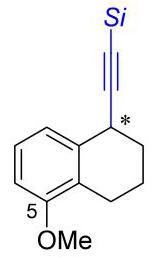
Triisopropyl((5-methoxy-1,2,3,4-tetrahydronaph-thalen-1-yl)ethynyl)silane (3r). The title compound was prepared according to condition B: Colorless oil; yield 61% (41.7 mg). The ee was determined by HPLC analysis using Daicel Chiralpak 2xOD-H column, conditions: $n$ -hexane $/i$ -PrOH $= {100} : 0,{0.5}\mathrm{\;{mL}}/\mathrm{{min}},{220}\mathrm{\;{nm}}$ ; $\mathrm{t}$ (major) $= {27.2}\mathrm{\;{min}},\mathrm{t}$ (minor) $= {21.4}\mathrm{\;{min}},{79}\%$ ee; ${\left\lbrack \alpha \right\rbrack }_{\mathrm{D}}^{20} \; = + {3.9}\left( {c = {0.2},{\mathrm{{CHCl}}}_{3}}\right) ;{}^{1}\mathrm{H}$ NMR (400 MHz, ${\mathrm{{CDCl}}}_{3}$ ) $\delta \; = {7.18} - {7.12}\left( {\mathrm{\;m},2\mathrm{H}}\right) ,{6.70}\left( {\mathrm{{dd}}, J = {1.6},{7.2}\mathrm{\;{Hz}},1\mathrm{H}}\right)$ , 3.86-3.81 (m, 4H), 2.75-2.60 (m, 2H), 2.13-1.98 (m, 2H), 1.93-1.83 (m, 1H), 1.78-1.68 (m, 1H), 1.10-1.05 $\left( {\mathrm{m},{21}\mathrm{H}}\right) ;{}^{13}\mathrm{C}$ NMR $\left( {{100}\mathrm{{MHz}},{\mathrm{{CDCl}}}_{3}}\right) \delta = {157.0},{137.5}$ , 125.9, 125.0, 121.2, 111.7, 107.5, 80.9, 55.2, 32.8, 30.2, 22.9,20.9,18.6,11.3; IR: $v = {2954},{2868},{2172},{1587}$ , 1467,1259,1009,882,792,678 ${\mathrm{{cm}}}^{-1}$ ; HRMS (ESI): $m/z$ calcd for ${\left\lbrack \mathrm{M} + \mathrm{H}\right\rbrack }^{ + }{\mathrm{C}}_{22}{\mathrm{H}}_{35}\mathrm{{OSi}} : {343.2452}$ ; found: 343.2458.
(Chroman-4-ylethynyl)triisopropylsilane (3s). The title compound was prepared according to condition B. Colorless oil; yield 41% (25.7 mg). The ee was determined by HPLC analysis using Daicel Chiralpak 2xOD-H column, conditions: $n$ -hexane $/i$ -PrOH = 100:0, ${0.5}\mathrm{\;{mL}}/\mathrm{{min}},{220}\mathrm{\;{nm}};\mathrm{t}\left( \mathrm{{major}}\right) = {11.8}\mathrm{\;{min}},\mathrm{t}\left( \mathrm{{minor}}\right) =$ 12.7 min,57% ee; ${\left\lbrack \alpha \right\rbrack }_{\mathrm{D}}^{20} = + {6.0}\left( {c = {0.2},{\mathrm{{CHCl}}}_{3}}\right) ;{}^{1}\mathrm{H}$ NMR (400 MHz, CDCl3) $\delta = {7.38}\left( {\mathrm{\;d}, J = {7.6}\mathrm{\;{Hz}},1\mathrm{H}}\right)$ , 7.15-7.09 $\left( {\mathrm{m},1\mathrm{H}}\right) ,{6.91} - {6.85}\left( {\mathrm{\;m},1\mathrm{H}}\right) ,{6.80} - {6.76}(\mathrm{\;m}$ , 1H), ${4.38} - {4.31}\left( {\mathrm{\;m},1\mathrm{H}}\right) ,{4.20} - {4.12}\left( {\mathrm{\;m},1\mathrm{H}}\right) ,{3.89}(\mathrm{t}, J = \; {6.4}\mathrm{\;{Hz}},1\mathrm{H}),{2.28} - {2.08}\left( {\mathrm{\;m},2\mathrm{H}}\right) ,{1.08} - {1.02}\left( {\mathrm{\;m},{21}\mathrm{H}}\right) ;{}^{13}\mathrm{C}$ NMR (100 MHz, CDCl3) δ = 153.7, 129.7, 128.2, 121.9, 120.4, 116.8, 109.8, 82.1, 64.4, 29.3, 28.5, 18.6, 11.2; IR: $v = {2960},{2861},{2178},{1581},{1491},{1222},{1003},{882}$ , 752,663 ${\mathrm{{cm}}}^{-1}$ ; HRMS (ESI): $m/z$ calcd for ${\left\lbrack \mathrm{M} + \mathrm{H}\right\rbrack }^{ + } \; {\mathrm{C}}_{20}{\mathrm{H}}_{31}\mathrm{{OSi}}$ : 315.2139; found: 315.2145.
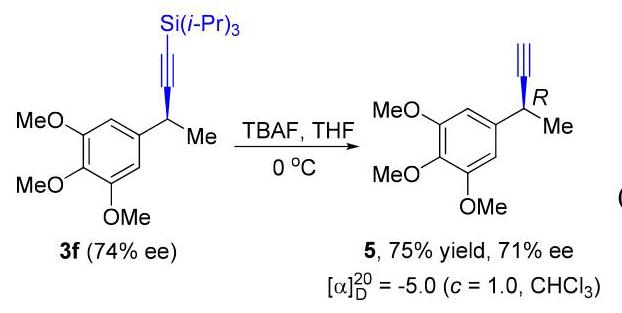
Removal of the TIPS Group from 3f. The transformation was referred to the known procedure. ${}^{\left\lbrack {19}\right\rbrack }$ A 10-mL Schlenk tube was charged with the product 3f (75.2 mg,0.2 mmol) and THF (2 mL), and filled with nitrogen. To the solution cooled to $0{}^{ \circ }\mathrm{C}$ was added a solution of tetrabutylammonium fluoride (1.0 M solution in THF; 0.21 mL, 0.21 mmol) dropwise via syringe over 2 min. After $6\mathrm{\;h}$ , the reaction was quenched with water $\left( {2\mathrm{\;{mL}}}\right)$ . The layers were separated, and the aqueous layer was extracted with diethyl ether ( $3 \times {20}\mathrm{\;{mL}}$ ). The combined organic layers were washed with brine $\left( {{50}\mathrm{\;{mL}}}\right)$ , dried over ${\mathrm{{Na}}}_{2}{\mathrm{{SO}}}_{4}$ , filtered, and concentrated. Then the mixture was purified by silica gel column chromatography (eluted with petroleum ether) to afford the desilylation product 5 as oil (33.0mg, 75%). The ee was determined by HPLC analysis using Daicel Chi-ralpak OJ-H column, conditions: n-hexane/i-PrOH = 98:2, 1.0 mL/min, 220 nm; t (major) = 16.2 min, t (minor) $= {18.4}\mathrm{\;{min}};{75}\%$ ee; ${\left\lbrack \alpha \right\rbrack }_{\mathrm{D}}^{20} = - {5.0}\left( {c = {1.0},{\mathrm{{CHCl}}}_{3}}\right)$ ; ${}^{1}\mathrm{H}$ NMR (400 MHz, ${\mathrm{{CDCl}}}_{3}$ ) $\delta = {6.61}\left( {\mathrm{\;s},2\mathrm{H}}\right) ,{3.87}(\mathrm{\;s}$ , 6H), 3.83 (s, 3H), 3.70 (dq, J = 2.4, 7.2 Hz, 1H), 2.28 (d, $J = {2.4}\mathrm{\;{Hz}},1\mathrm{H}),{1.50}\left( {\mathrm{\;d}, J = {7.2}\mathrm{\;{Hz}},3\mathrm{H}}\right) ;{}^{13}\mathrm{C}$ NMR $\left( {{100}\mathrm{{MHz}},{\mathrm{{CDCl}}}_{3}}\right) \delta = {153.2},{138.3},{136.8},{103.9},{87.0}$ , 70.3,60.8,56.1,31.9,24.2 ppm. IR: $v = {2926},{2360}$ , 1587,1460,1064,820,743 ${\mathrm{{cm}}}^{-1}$ ; The absolute configuration (R) of 5 was established by the comparison of its optical rotation with the same compound of known configuration reported in the literature. ${}^{\left\lbrack {20}\right\rbrack }$
Results and Discussion
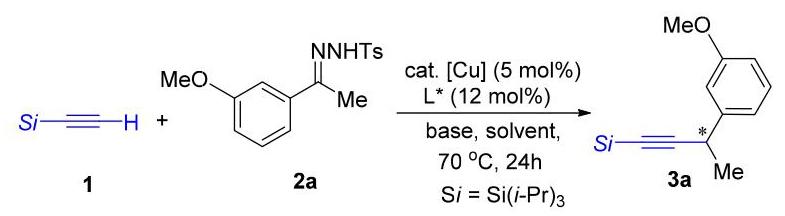
We began our investigation by examining the Cu(I)-catalyzed cross-coupling reaction between triiso-propylsilylethyne 1 and $N$ -tosylhydrazones 2a (Table 1). Chiral phosphoramidite ligand 4a was used to compare the reactivity of various Cu catalysts. It was found that the reactions catalyzed by CuOAc, CuCl, CuBr, CuI, ${\mathrm{{CuCl}}}_{2},\mathrm{{Cu}}{\left( \mathrm{{MeCN}}\right) }_{4}{\mathrm{{PF}}}_{6}$ and $\mathrm{{Cu}}{\left( \mathrm{{MeCN}}\right) }_{4}{\mathrm{{BF}}}_{4}$ all afforded the product $3\mathbf{a}$ in moderate yield (entries 1-7), however, $\mathrm{{Cu}}{\left( \mathrm{{MeCN}}\right) }_{4}{\mathrm{{PF}}}_{6}$ gave the optimal enantioselectivity (83% ee). Next, base and solvent effects were examined. ${\mathrm{{Cs}}}_{2}{\mathrm{{CO}}}_{3}$ and dioxane were identified as the best combination (entries 7-16). The ratio of the ligand $\mathbf{{4a}}$ to the $\mathrm{{Cu}}{\left( \mathrm{{MeCN}}\right) }_{4}{\mathrm{{PF}}}_{6}$ was also investigated (entries 17,18). The results indicated that more than 2 equiv of the chiral ligand is required to obtain high enantioselectivity. Presumably one Cu(I) needs to coordinate with two phos-phoramidite ligands in order to achieve high selectivity. At last, the effect of ligand was studied in order to improve the enantioselectivity, however, the phospho-ramidite ligands $4\mathbf{b} - \mathbf{h}$ gave inferior results as compared with $4\mathbf{a}$ under the similar conditions (entries 7,19-25).
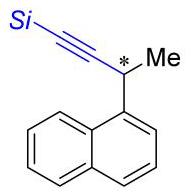
With the optimal reaction conditions, the reaction scope was then evaluated. A series of $N$ -tosylhydrazones 2a-i (R = Me) bearing electron-neutral, -deficient or -rich aromatic substituents were smoothly reacted with triisopropylsilylethyne 1 to give the corresponding coupling product 3a-i in 55-83% ee and 40-80% yield (Scheme 2). ${}^{21}$ Compared with $N$ -tosylhydrazone 3c, increasing the alkyl chain length at R led to decreased ee (3j, 3k). The scope of the coupling reaction could also be extended to $N$ -tosylhydrazones derived from tetralone. The reactions of both 7- and 6-subsituted te-tralone-derived hydrazones (2I-q) proceeded with moderate to good yields and enantioselectivity (45-82% yield, 53-82% ee, 31-q). 5-Methoxyl-1-tetralone-derived hydrazone was a good substrate, and it readily reacted with triisopropylsilylethyne to deliver the products in 61% yield with 79% ee (3r). Finally, the chroma-none-derived hydrazone (2s) furnished alkyne product 3s in 41% yield and 57% ee.
(1)
The products could be converted to a useful synthetic intermediate by removal of the TIPS group. Treatment of $3\mathbf{f}$ with tetrabutylammonium fluoride in THF (1.0 M) afforded the desilylated terminal alkyne 5 in 75% yield without noticeable loss of the ee value (eq 1). The absolute configuration $\left( R\right)$ of5was established by the comparison of its optical rotation with the same compound of known configuration reported in the literature. ${}^{\left\lbrack {20}\right\rbrack }$
Table 1. Optimization of reaction conditions ${}^{a}$
| entry | cat. $\left\lbrack \mathrm{{Cu}}\right\rbrack$ | base | solvent | L* | 3a,%b | 3a, ee%° |
| 1 | CuOAc | ${\mathrm{{Cs}}}_{2}{\mathrm{{CO}}}_{3}$ | dioxane | 4a | 69 | 67 |
| 2 | CuCl | ${\mathrm{{Cs}}}_{2}{\mathrm{{CO}}}_{3}$ | dioxane | 4a | 65 | 70 |
| 3 | CuBr | ${\mathrm{{Cs}}}_{2}{\mathrm{{CO}}}_{3}$ | dioxane | 4a | 70 | 68 |
| 4 | CuI | ${\mathrm{{Cs}}}_{2}{\mathrm{{CO}}}_{3}$ | dioxane | 4a | 60 | 79 |
| 5 | ${\mathrm{{CuCl}}}_{2}$ | ${\mathrm{{Cs}}}_{2}{\mathrm{{CO}}}_{3}$ | dioxane | 4a | 71 | 72 |
| 6 | $\mathrm{{Cu}}{\left( \mathrm{{MeCN}}\right) }_{4}{\mathrm{{BF}}}_{4}$ | ${\mathrm{{Cs}}}_{2}{\mathrm{{CO}}}_{3}$ | dioxane | 4a | 55 | 70 |
| 7 | $\mathrm{{Cu}}{\left( \mathrm{{MeCN}}\right) }_{4}{\mathrm{{PF}}}_{6}$ | ${\mathrm{{Cs}}}_{2}{\mathrm{{CO}}}_{3}$ | dioxane | 4a | 72 | 83 |
| 8 | $\mathrm{{Cu}}{\left( \mathrm{{MeCN}}\right) }_{4}{\mathrm{{PF}}}_{6}$ | ${\mathrm{K}}_{2}{\mathrm{{CO}}}_{3}$ | dioxane | 4a | 6 | 13 |
| 9 | $\mathrm{{Cu}}{\left( \mathrm{{MeCN}}\right) }_{4}{\mathrm{{PF}}}_{6}$ | LiOtBu | dioxane | 4a | 16 | 0 |
| 10 | $\mathrm{{Cu}}{\left( \mathrm{{MeCN}}\right) }_{4}{\mathrm{{PF}}}_{6}$ | $\mathrm{{NaH}}$ | dioxane | 4a | 24 | 0 |
| 11 | $\mathrm{{Cu}}{\left( \mathrm{{MeCN}}\right) }_{4}{\mathrm{{PF}}}_{6}$ | ${\mathrm{K}}_{3}{\mathrm{{PO}}}_{4}$ | dioxane | 4a | trace | ${\mathrm{{ND}}}^{d}$ |
| 12 | $\mathrm{{Cu}}{\left( \mathrm{{MeCN}}\right) }_{4}{\mathrm{{PF}}}_{6}$ | ${\mathrm{{Et}}}_{3}\mathrm{\;N}$ | dioxane | 4a | trace | ${\mathrm{{ND}}}^{d}$ |
| 13 | $\mathrm{{Cu}}{\left( \mathrm{{MeCN}}\right) }_{4}{\mathrm{{PF}}}_{6}$ | ${\mathrm{{Cs}}}_{2}{\mathrm{{CO}}}_{3}$ | THF | 4a | 53 | 61 |
| 14 | $\mathrm{{Cu}}{\left( \mathrm{{MeCN}}\right) }_{4}{\mathrm{{PF}}}_{6}$ | ${\mathrm{{Cs}}}_{2}{\mathrm{{CO}}}_{3}$ | ${\mathrm{{ClCH}}}_{2}{\mathrm{{CH}}}_{2}\mathrm{{Cl}}$ | 4a | trace | ${\mathrm{{ND}}}^{d}$ |
| 15 | $\mathrm{{Cu}}{\left( \mathrm{{MeCN}}\right) }_{4}{\mathrm{{PF}}}_{6}$ | ${\mathrm{{Cs}}}_{2}{\mathrm{{CO}}}_{3}$ | toluene | 4a | trace | ${\mathrm{{ND}}}^{d}$ |
| 16 | $\mathrm{{Cu}}{\left( \mathrm{{MeCN}}\right) }_{4}{\mathrm{{PF}}}_{6}$ | ${\mathrm{{Cs}}}_{2}{\mathrm{{CO}}}_{3}$ | ${\mathrm{{CH}}}_{3}\mathrm{{CN}}$ | 4a | 15 | 30 |
| 17 | $\mathrm{{Cu}}{\left( \mathrm{{MeCN}}\right) }_{4}{\mathrm{{PF}}}_{6}$ | ${\mathrm{{Cs}}}_{2}{\mathrm{{CO}}}_{3}$ | dioxane | 4a ${}^{e}$ | 49 | 43 |
| 18 | $\mathrm{{Cu}}{\left( \mathrm{{MeCN}}\right) }_{4}{\mathrm{{PF}}}_{6}$ | ${\mathrm{{Cs}}}_{2}{\mathrm{{CO}}}_{3}$ | dioxane | 4a ${}^{f}$ | 72 | 52 |
| 19 | $\mathrm{{Cu}}{\left( \mathrm{{MeCN}}\right) }_{4}{\mathrm{{PF}}}_{6}$ | ${\mathrm{{Cs}}}_{2}{\mathrm{{CO}}}_{3}$ | dioxane | 4b | 69 | ${63}^{g}$ |
| 20 | $\mathrm{{Cu}}{\left( \mathrm{{MeCN}}\right) }_{4}{\mathrm{{PF}}}_{6}$ | ${\mathrm{{Cs}}}_{2}{\mathrm{{CO}}}_{3}$ | dioxane | 4c | 51 | 4 |
| 21 | $\mathrm{{Cu}}{\left( \mathrm{{MeCN}}\right) }_{4}{\mathrm{{PF}}}_{6}$ | ${\mathrm{{Cs}}}_{2}{\mathrm{{CO}}}_{3}$ | dioxane | 4d | 60 | 4 |
| 22 | $\mathrm{{Cu}}{\left( \mathrm{{MeCN}}\right) }_{4}{\mathrm{{PF}}}_{6}$ | ${\mathrm{{Cs}}}_{2}{\mathrm{{CO}}}_{3}$ | dioxane | 4e | 71 | 74 |
| 23 | $\mathrm{{Cu}}{\left( \mathrm{{MeCN}}\right) }_{4}{\mathrm{{PF}}}_{6}$ | ${\mathrm{{Cs}}}_{2}{\mathrm{{CO}}}_{3}$ | dioxane | 4f | 66 | 73 |
| 24 | $\mathrm{{Cu}}{\left( \mathrm{{MeCN}}\right) }_{4}{\mathrm{{PF}}}_{6}$ | ${\mathrm{{Cs}}}_{2}{\mathrm{{CO}}}_{3}$ | dioxane | 4g | 58 | 71 |
| 25 | $\mathrm{{Cu}}{\left( \mathrm{{MeCN}}\right) }_{4}{\mathrm{{PF}}}_{6}$ | ${\mathrm{{Cs}}}_{2}{\mathrm{{CO}}}_{3}$ | dioxane | 4h | 42 | 65 |
${}^{a}$ Reaction was run under the following conditions: a solution of $\mathbf{1}\left( {{0.2}\mathrm{{mmol}}}\right) ,\mathbf{{2a}}\left( {{0.3}\mathrm{{mmol}}}\right)$ , base $\left( {{0.6}\mathrm{{mmol}}}\right)$ , cat. [Cu] (5 mol%), and chiral ligand (12 mol%) in anhydrous solvent (2 mL) was stirred at ${70}^{ \circ }\mathrm{C}$ under nitrogen atmosphere for ${24}\mathrm{\;h} \cdot {}^{b}$ Yields refer to isolated products. ${}^{c}$ Determined by HPLC analysis using a chiral stationary phase. ${}^{d}$ Not determined. ${}^{e}5\mathrm{\;{mol}}\%$ chiral ligand $4\mathrm{a}$ was used. ${}^{f}6\mathrm{\;{mol}}\%$ chiral ligand $4\mathrm{a}$ was used. ${}^{g}$ The major enantiomer has opposite configuration.
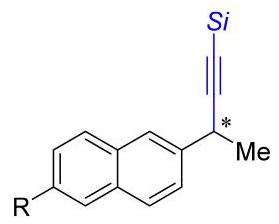
$3\mathrm{\;h}\mathrm{R} = \mathrm{H}{\left( {60}\% \text{ yield, }{79}\% \mathrm{{ee}}\right) }^{a}$ 3i $\mathrm{R} =$ OMe (50% yield, ${55}\% \mathrm{{ee}}{)}^{a}$
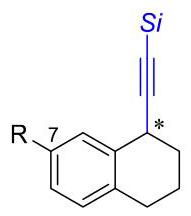
31 R = H (80% yield, 82% ee)
3m R = Br (82% yield, 72% ee)
3n R = Me (65% yield, 67% ee)
doctor
Scheme 2. Substrate scope for $N$ -tosylhydrazones

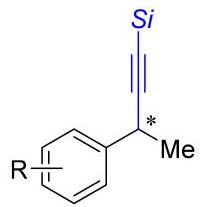
3a $\mathrm{R} = m - \mathrm{{OMe}}{\left( {72}\% \text{ yield, }{83}\% \text{ ee }\right) }^{a}$
$3\mathrm{\;b}\mathrm{R} = \mathrm{H}{\left( {70}\% \text{ yield },{75}\% \text{ ee }\right) }^{a}$ (52% yield, 69% ee) ${}^{a}$
3c R = p-OMe (80% yield, 70% ee) ${}^{a}$
$3\mathrm{\;d}\mathrm{R} = p - \mathrm{{Ph}}{\left( {40}\% \text{ yield, }{79}\% \mathrm{{ee}}\right) }^{a}$
3e $\mathrm{R} = p - \mathrm{{Br}}{\left( {74}\% \text{ yield, }{63}\% \mathrm{{ee}}\right) }^{a}$
3f $R = 3,4,5 - {\mathrm{{OMe}}}_{3}{\left( {45}\% \text{ yield, }{74}\% \mathrm{{ee}}\right) }^{a}$
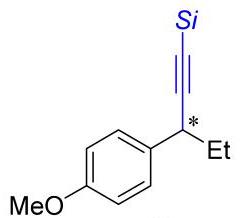
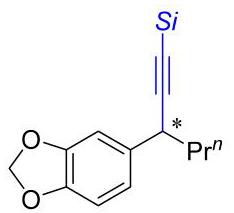
3j 3k
(76% yield, 46% ee) (60% yield, 42% ee)
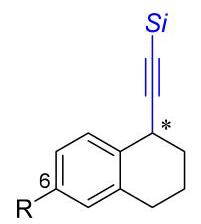
3o R = F (45% yield, 66% ee)
3p R = CI (75% yield, 67% ee)
3q R = OMe (70% yield, 53% ee)
Si
3r
(61% yield, 79% ee) (41% yield, 57% ee) ${}^{a}$ Reaction conditions: a solution of $\mathbf{1}\left( {{0.2}\mathrm{{mmol}}}\right) ,\mathbf{2}\left( {{0.3}\mathrm{{mmol}}}\right) ,{\mathrm{{Cs}}}_{2}{\mathrm{{CO}}}_{3}\left( {{0.6}\mathrm{{mmol}}}\right) ,\mathrm{{Cu}}\left( \mathrm{{MeCN}}\right) {}_{4}{\mathrm{{PF}}}_{6}\left( {5\mathrm{{mol}}\% }\right)$ , and 4a (12 mol%) in dioxane (2 mL) was stirred at ${70}^{ \circ }\mathrm{C}$ under nitrogen atmosphere for ${24}\mathrm{\;h}.{}^{b}{12}\mathrm{\;{mol}}\% \mathbf{{4f}}$ was used. The yields refer to isolated products. The ee values were determined by chiral HPLC analysis.
Conclusions
In summary, we have reported the first enantioselec-tive Cu(I)-catalyzed C(sp)-C(sp ${}^{3}$ ) cross-coupling reaction between triisopropylsilylethyne and $N$ -tosylhydrazones with chiral phosphoramidite as the ligand. A series of synthetically interesting, functionalized alkynes were obtained with moderate to good enantioselectivities. This methodology provides an method to achieve catalytic asymmetric construction of $\mathrm{C}\left( \mathrm{{sp}}\right) - \mathrm{C}\left( {\mathrm{{sp}}}^{3}\right)$ bonds. The results may further motivate the investigation of $N$ -tosylhydrazones in asymmetric catalysis.
Acknowledgement
The project is supported by the National Basic Research Program of China (973 Program, No. 2015CB856600), the Natural Science Foundation of China (Grant 21472004, 21332002) and the China Postdoctoral Science Foundation Funded Project (2015M580911).
References
[1] (a) The Chemistry of Triple-Bonded Functional Groups; Ed. S. Patai, Wiley, New York, 1994. (b) Modern Acetylene Chemistry; Stang, P. J.; Diederich, F.; Eds.; VCH, Weinheim, Germany, 1995; (c) Liu, J.; Lam, J. W. Y.; Tang, B. Z. Chem. Rev. 2009, 109, 5799-5867.
[2] (a) Chinchilla, R.; Nájera, C. Chem. Rev. 2007, 107, 874-922. (b) Chinchilla, R.; Nájera, C. Chem. Soc. Rev. 2011, 40, 5084-5121. (c) Wang, D.; Gao, S. Org. Chem. Front. 2014, 1, 556-566. (d) Thomas, A. M.; Sujatha, A.; Anilkumar, G. RSC Adv. 2014, 4, 21688-21698. (e) Karak, M.; Barbosa, L. C. A.; Hargaden, G. C. RSC Adv. 2014, 4, 53442-53466.
[3] Eckhardt, M.; Fu, G. C. J. Am. Chem. Soc. 2013, 135, 3387-3390.
[4] (a) Altenhoff, G.; Würtz, S.; Glorius, F. Tetrahedron Lett. 2006, 47, 2925-2928. (b) Vechorkin, O.; Barmaz, D.; Proust, V.; Hu, X. J. Am. Chem. Soc. 2009, 131, 12078-12079. (c) Ano, Y.; Tobisu, M.; Chatani, N. J. Am. Chem. Soc. 2011, 133, 12984-12986. (d) Yi, J.; Lu, X.; Sun, Y.-Y.; Xiao, B.; Liu, L. Angew. Chem. Int. Ed. 2013, 52, 12409-12413. (e) He, J.; Wasa, M.; Chan, K. S. L.; Yu, J.-Q. J. Am. Chem. Soc. 2013, 135, 3387-3390. (f) García, P. M. P.; Ren, P.; Scopelliti, R.; Hu, X. ACS Catal. 2015, 5, 1164-1171; (g) Luo, F.-X.; Xu, X.; Wang, D.; Cao, Z.-C.; Zhang, Y.-F.; Shi, Z.-J. Org. Lett. 2016, 18, 2040-2043.
[5] (a) Schaffner, A.-P.; Darmency, V.; Renaud, P. Angew. Chem. Int. Ed. 2006, 45, 5847-5849. (b) Huang, H.; Zhang, G.; Gong, L.; Zhang, S.; Chen, Y. J. Am. Chem. Soc. 2014, 136, 2280-2283. (c) Xie, J.; Shi, S.; Zhang, T.; Mehrkens, N.; Rudolph, M.; Hashmi, A. S. K. Angew. Chem. Int. Ed. 2015, 54, 6046-6050. (d) Liu, W.; Li, L.; Li, C.-J. Nat. Commun. 2015, 6, 6526-6531.
[6] (a) Tang, S.; Wang, P.; Li, H.; Lei, A. Nat. Commun. 2016, 7, 11676-11683. (b) Luo, F.-X.; Cao, Z.-C.; Zhao, H.-W.; Wang, D.; Zhang, Y.-F.; Xu, X.; Shi, Z.-J. Organometallics 2017, 36, 18-21.
[7] (a) Rayabarapu, D. K.; Tunge, J. A. J. Am. Chem. Soc. 2005, 127, 13510-13511. (b) Bi, H.-P.; Zhao, L.; Liang, Y.-M.; Li, C.-J. Angew. Chem. Int. Ed. 2009, 48, 792-795. (c) Zhang, W.-W.; Zhang, X.-G.; Li, J.-H. J. Org. Chem. 2010, 75, 5259-5264. (d) Zhang, C.; Seidel, D. J. Am. Chem. Soc. 2010, 132, 1798-1799. (e) Liu, X.; Wang, Z.; Cheng, X.; Li, C. J. Am. Chem. Soc. 2012, 134, 14330-14333. (f) Feng, Y.-S.; Xu, Z.-Q.; Mao, L.; Zhang, F.-F.; Xu, H.-J. Org. Lett. 2013, 15, 1472-1475. (g) Vaillant, F. L.; Courant, T.; Waser, J. Angew. Chem. Int. Ed. 2015, 54, 11200-11204. (h) Zhang, H.; Zhang, P.; Jiang, M.; Yang, H.; Fu, H. Org. Lett. 2017, 19, 1016-1019.
[8] (a) Yang, L.-M.; Huang, L.-F.; Luh, T. -Y. Org. Lett. 2004, 6, 1461-1463. (b) Zhao, Y.; Wang, H.; Hou, X.; Hu, Y.; Lei, A.; Zhang, H.; Zhu, L. J. Am. Chem. Soc. 2006, 128, 15048-15049. (c) Ohmiya, H.; Yorimitsu, H.; Oshima, K. Org. Lett. 2006, 8, 3093-3096. (d) Cahiez, G.; Gager, O.; Buendia, J. Angew. Chem. Int. Ed. 2010, 49, 1278-1281. (e) Chen, M.; Zheng, X.; Li, W.; He, J.; Lei, A. J. Am. Chem. Soc. 2010, 132, 4101-4103. (f) Thaler, T.; Guo, L.-N.; Mayer, P.; Knochel, P. Angew. Chem. Int. Ed. 2011, 50, 2174-2177. (g) Hatakeyama, T.; Okada, Y.; Yoshimoto, Y.; Nakamura, M. Angew. Chem. Int. Ed. 2011, 50, 10973-10976. (h) Vechorkin, O.; Godinat, A.; Scopelliti, R.; Hu, X. Angew. Chem. Int. Ed. 2011, 50, 11777-11781. (i) Cheung, C.W.; Ren, P.; Hu, X. Org. Lett. 2014, 16, 2566-2569.
[9] Chirality transfer from enantiomerically enriched acetylides: Mendis, S. N.; Tunge, J. A. Org. Lett. 2015, 17, 5164-5167.
10 Caeiro, J.; Sestelo, J. P.; Sarandeses, L. A. Chem. Eur. J. 2008, 14, 741-746. (b) Fang, H.; Yang, Z.; Zhang, L.; Wang, W.; Li, Y.; Xu, X.; Zhou, S. Org. Lett. 2016, 18, 6022-6025.
[11]Chen, Z.-M.; Nervig, C. S.; DeLuca, R. J.; Sigman, M. S. Angew. Chem. Int. Ed. 2017, 56, 6651-6654.
[12]Ye, F.; Ma, X.; Xiao, Q.; Li, H.; Zhang, Y.; Wang, J. J. Am. Chem. Soc. 2012, 134, 5742-5745.
13 Suárez, A.; Fu, G. C. Angew. Chem. Int. Ed. 2004, 43, 3580-3582. (b) Liu, C.-B.; Meng, W.; Li, F.; Wang, S.; Nie, J.; Ma, J.-A. Angew. Chem. Int. Ed. 2012, 51, 6227-6230.
14 Zhang, Y.; Wang, J. Eur. J. Org. Chem. 2011, 1015-1026. (b) Barluenga, J.; Valdés, C. Angew. Chem. Int. Ed. 2011, 50, 7486-7500. (c) Shao, Z.; Zhang, H. Chem. Soc. Rev. 2012, 41, 560-572. (d) Xia, Y.; Zhang, Y.; Wang, J. ACS Catal. 2013, 3, 2586-2598. (e) Liu, Z.; Wang, J. J. Org. Chem. 2013, 78, 10024-10030. (f) Xiao, Q.; Zhang, Y.; Wang, J. Acc. Chem. Res. 2013, 46, 236-247. (g) Hu, F.; Xia, Y.; Ma, C.; Zhang, Y.; Wang, J. Chem. Commun. 2015, 51, 7986-7995. (h) Jadhav, A. P.; Ray, D.; Rao, V. U. B.; Singh, R. P. Eur. J. Org. Chem. 2016, 2369-2382. (i) Xia, Y.; Wang, J. Chem. Soc. Rev. 2017, 46, 2306-2362.
[15] Mercier, A.; Yeo, W. C.; Chou, J.; Chaudhuri, P. D.; Bernardinelli, G.; Kündig, E. P. Chem. Commun. 2009, 45, 5227-5229.
[16] Rimkus, A.; Sewald, N. Org. Lett. 2003, 5, 79-80.
[17] Zhao, X.; Jing, J.; Lu, K.; Zhang, Y.; Wang, J. Chem. Commun. 2010, 46, 1724-1726.
[18] Feng, J.; Li, B.; He, Y.; Gu, Z. Angew. Chem. Int. Ed. 2016, 55, 2186-2190.
[19] Shirakura, M.; Suginome, M. Org. Lett. 2009, 11, 523-526.
[20] Smith, S. W.; Fu, G. C. J. Am. Chem. Soc. 2008, 130, 12645-12647.
[21]The ee value of 3e could not be determined by HPLC analysis, so the triisopropylsilyl group was removed to determine the enanti-oselectivity.
Entry for the Table of Contents
Page No.
Cu(I)-Catalyzed Asymmetric Cross-Coupling of N-Tosylhydrazones and Trialkylsilylethynes: Enantiose-lective Construction of C(sp)-C(sp3) Bonds
Wen-Dao Chu, Fangfang Guo, Lefei Yu, Junting Hong, Qianyi Liu, Fanyang Mo, Yan Zhang and Jianbo Wang*
The first catalytic enantioselective $\mathrm{C}\left( \mathrm{{sp}}\right) - \mathrm{C}\left( {\mathrm{{sp}}}^{3}\right)$ cross-coupling reaction between $N$ -tosylhydrazones and trialkylsilylethynes has been developed. With $\mathrm{{Cu}}\left( \mathrm{I}\right)$ salt and chiral phosphoramidite ligands, coupling products were obtained with moderate to good enantioselectivities (up to 83% ee).