Enantioselective synthesis of condensed and transannular ring skeletons containing pyrrolidine moiety
中文 / Bilingual · English version
Fanyang Mo ${}^{a}$ , Fei Li ${}^{a}$ , Di Qiu ${}^{a}$ , Jianbo Wang ${}^{a, b, * }$
${}^{\mathrm{a}}$ Beijing National Laboratory of Molecular Sciences (BNLMS) and Key Laboratory of Bioorganic Chemistry and Molecular Engineering of Ministry of Education, College of Chemistry, Peking University, Beijing 100871, China
${}^{\mathrm{b}}$ State Key Laboratory of Organometallic Chemistry, Chinese Academy of Sciences, Shanghai 200032, China
A R T I C L E I N F O
Article history:
Received 4 October 2009
Received in revised form 29 November 2009
Accepted 4 December 2009
Available online 26 December 2009
Keywords:
Enantioselective synthesis
Diazo compounds
Nucleophilic addition
Pyrrolidine
Ring-closing olefin metathesis
A B S T R A C T
A new approach toward condensed and transannular ring structures containing pyrrolidine unit has been developed, based on diastereoselective nucleophilic addition of lithium enolate of $\alpha$ -diazoacetoacetate to chiral $N$ -sulfinyl imine and ring-closing metathesis.
© 2009 Elsevier Ltd. All rights reserved.
1. Introduction
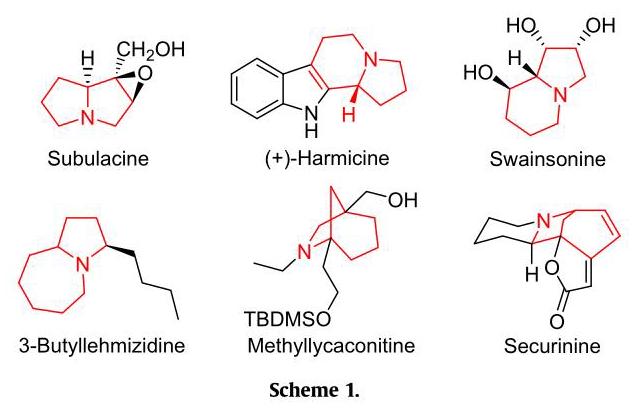
The enantioselective construction of pyrrolidine skeletons, a frequently observed structural unit in various alkaloid type natural products, pharmaceutical molecules, etc., is of current interest. ${}^{1,2}$ Among the various pyrrolidine-containing structures, condensed and transannluar ring skeletons are important structural subunits present in many alkaloids and are common scaffolds in biologically active and pharmaceutically significant compounds. ${}^{3}$ For example, (+)-harmicine was extracted from the Malaysian plant Kopsia griffithii by Kam and Sim and showed strong anti-Leishmania activity. ${}^{4}$ Polyhydroxylated pyrrolizidines and indolizidines (related to iminosugars) such as Swainsonine have increasingly gained attention because of their ability to inhibit glycosidases (Scheme 1). ${}^{5}$
Besides the classical total synthesis approach to complex structures, particularly attractive is the development of synthetic methodologies that allow for the preparation of a large number of structurally similar analogs from limited few common intermediates. ${}^{6}$ As a part of our program for the development of novel synthetic methodology based on diazo compounds, we have recently developed a concise and efficient method to construct
5-substituted 2-oxo and 3-oxo pyrrolidines with high enantiomeric purity. ${}^{7}$ Here we report the further application of this methodology to the enantioselective synthesis of condensed and transannular ring skeletons containing pyrrolidine units.
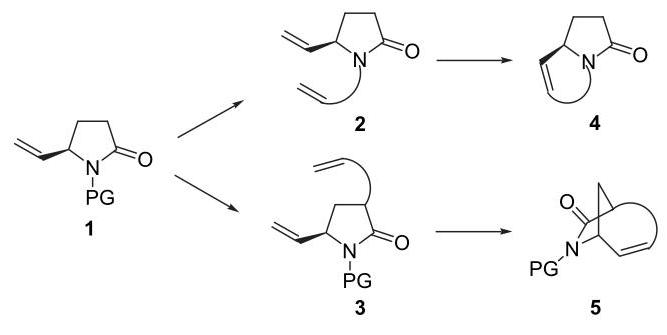
This new approach to condensed and transannular ring skeletons is outlined in Scheme 2. With the reactions that have been reported previously, we can easily prepare 2-oxo-5-vinyl-pyrrolidine 1. Introducing the side chains that contain olefin moiety to either N or C3 position affords key intermediates 2 and 3, respectively. Ring-closing metathesis (RCM), ${}^{8}$ which has emerged as powerful tool to construct ring system through intramolecular $\mathrm{C} = \mathrm{C}$ bond formation, is applied to 2 and 3 to afford condensed and transannular ring systems4and ${\mathbf{5}}^{9}$
- Corresponding author. Fax: +86 10 6275 1708.
(J. Wang).
(J. Wang)。
Scheme 2.
1.1. Results and discussions
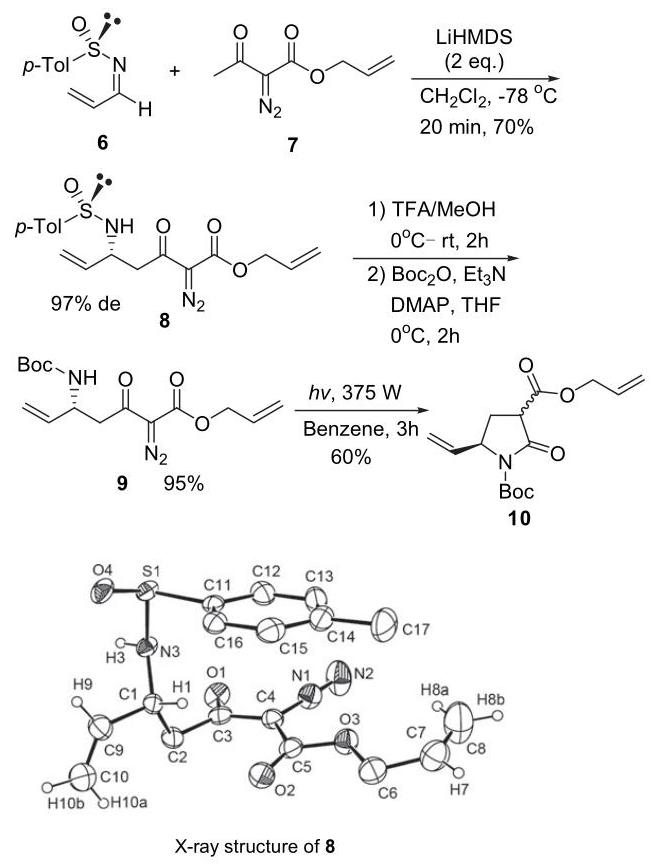
The investigation began with the preparation of chiral pyrrolidine 10 (Scheme 3). First, diastereoselective addition of lithium enolate of $\alpha$ -diazoacetoacetate 7 to chiral $N$ -sulfinyl imine 6 afforded $\delta - N$ -sulfinylamino $\alpha$ -diazo $\beta$ -ketoester 8 in 70% yield. HPLC analysis showed compound 8 with 97% de. The absolute configuration of the newly generated chiral center in $\beta$ -ketoester 8 was established by X-ray analysis of its single crystal. ${}^{10}$ The absolute configuration is also confirmed by converting 8 into known compounds (vide infra). When the chiral center of sulfur has $S$ configuration, the newly formed chiral center has $R$ configuration. This stereochemical outcome is consistent with the previous reports of the addition of enolates derived from esters or ketones to chiral N-sulfinyl imines. ${}^{{11},{12}}$
Scheme 3.
Our previous study has shown that $N$ -sulfinyl group is liable to decompose in the Wolff rearrangement reaction, which is under irradiation conditions. Thus, the N-sulfinyl group is replaced by $N$ -Boc group in two steps. First, $\beta$ -ketoester8was treated with 5 equiv of TFA in MeOH to remove the $N$ -sulfinyl auxiliary, giving the free amine as the trifluoroacetate salt. Being neutralized with 6 equiv of ${\mathrm{{Et}}}_{3}\mathrm{\;N}$ , the amine was treated with ${\mathrm{{Boc}}}_{2}\mathrm{O}$ and catalytic amount of DMAP, affording N-Boc protected diazo compound9in 95% yield. Irradiation of diazo compound9with high-pressure $\mathrm{{Hg}}$ lamp $\left( {\lambda > {300}\mathrm{\;{nm}}}\right)$ in a Pyrex tube gave $\left( {5R}\right)$ -2-oxo-3-allyloxy-carbonyl-5-vinylpyrrolidine 10 in 60% isolated yield. ${}^{7,{13}}$
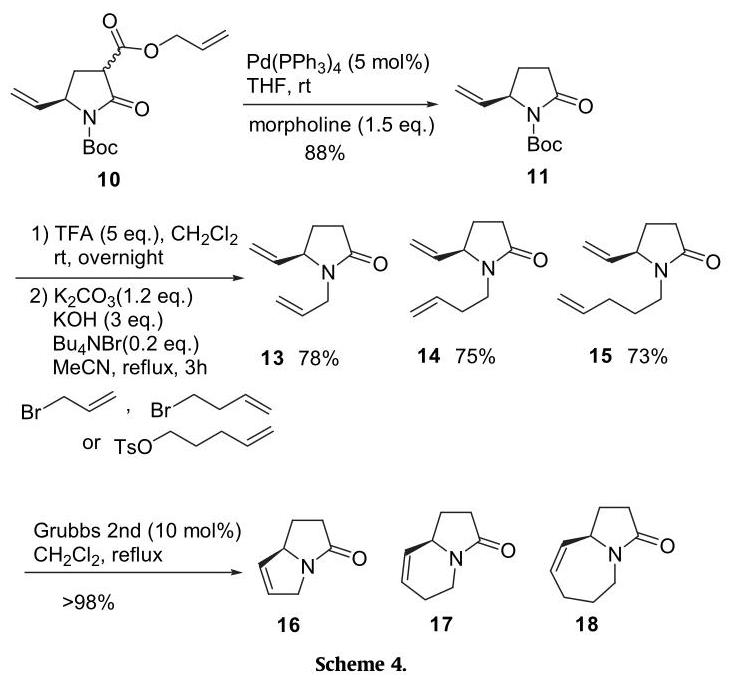
With 10 in hand, we next proceeded to build the condensed rings based on the strategy summarized in Scheme 2. The condensed alkaloid structure can be built from 10 through N-alkylation and ring-closing metathesis. Thus, $\mathrm{{Pd}}{\left( {\mathrm{{PPh}}}_{3}\right) }_{4}$ -catalyzed deal-lyloxycarbonylation ${}^{14}$ in the presence of morpholine afforded (5R)- N-Boc-2-oxo-5-vinylpyrrolidine 11 in 88% yield. Removal of the nitrogen protecting group with 5 equiv of TFA in ${\mathrm{{CH}}}_{2}{\mathrm{{Cl}}}_{2}$ gave $\left( R\right) - 2 -$ oxo-5-vinylpyrrolidine in nearly quantitative yield. $\left( R\right) - 2 -$ Oxo-5- vinylpyrrolidine was then reacted with allyl bromide, homoallyl bromide, and pent-4-enyl 4-methylbenzenesulfonate, respectively, in the presence of base to give the products 13, 14, and 15 as the precursors for the next RCM reaction. Finally, the pyrrolidines 13, 14, and 15 were subjected to the RCM reaction by using second generation Grubbs catalyst. The expected ring-closing products 16, 17, and 18 were obtained in nearly quantitative yields (Scheme 4). Products 16, 17, and 18 are potentially valuable chiral building blocks for enantioselective synthesis of polysubstituted pyrrolizi-dines and indolizidines. ${}^{15}$
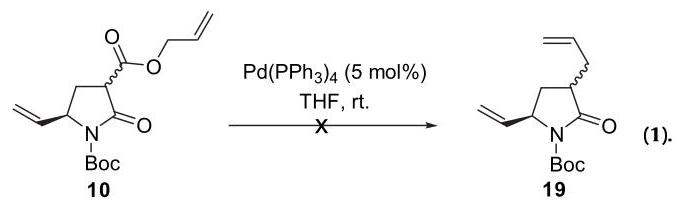
Next, we conceived the further application of pyrrolidine 10 in the construction of transannular ring structures. As shown in Scheme 2, by introducing an alkene moiety on C3 of pyrolidine ring, the transannular ring structures could be built by the same RCM strategy. First, the pyrrolidine 10 was subjected to Pd-catalyzed decarboxylative allylic alkylation, with the expectation that C3 allylation might occur simultaneously. However, the desired intramolecular allylic alkylation process did not occur when 10 was catalyzed by $\mathrm{{Pd}}{\left( {\mathrm{{PPh}}}_{3}\right) }_{4}$ using THF as solvent (Eq. 1). Changing solvent and Pd catalyst were attempted, but all efforts proved to be fruitless.
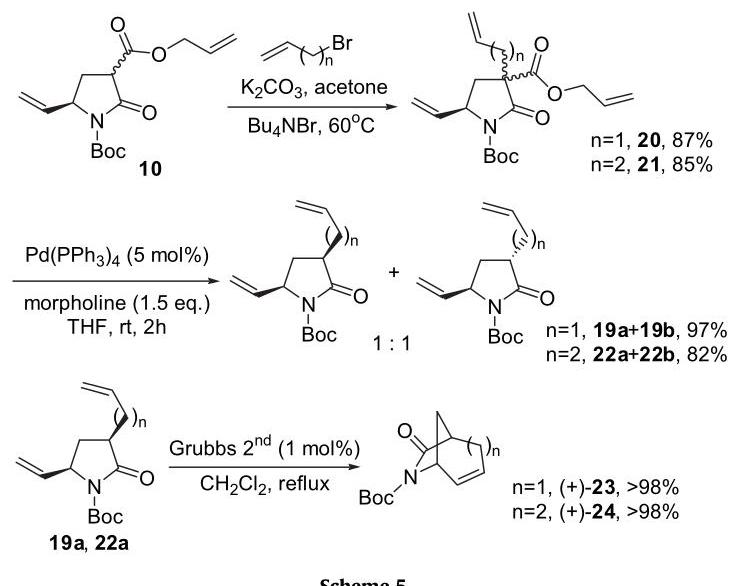
We then attempted a different approach, which was direct allylic alkylation of 10 followed by deallyloxycarbonylation. As outlined in Scheme 5, treatment of 10 in acetone with allyl bromide and ${\mathrm{K}}_{2}{\mathrm{{CO}}}_{3}$ at ${60}^{ \circ }\mathrm{C}$ for $3\mathrm{\;h}$ furnished a pair of diastereoisomers20in 87% yield, which was subjected to the Pd-catalyzed deal-lyloxycarbonylation to afford two products 19a and 19b in 1:1 ratio. Compounds 19a and 19b could be separated with chromatography column and their structure could be assigned by NOE experiments. The cis isomer 19a was then subjected to RCM reaction with Grubbs second catalyst, affording the ring-closing product (+)-23 in nearly quantitative yield.
Scheme 5.
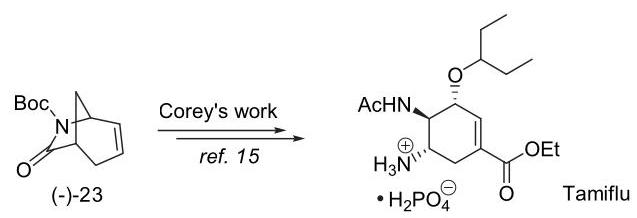
Compound (-)-23 is a key intermediate in the total synthesis of an anti-influenza neuramidase inhibitor Oseltamivir (Tamiflu) reported by Corey and co-workers (Scheme 6). ${}^{16}$
Scheme 6.
With the same approach, [4.2.1] bicyclic system (+)-24 could be synthesized by easily changing allyl bromide to homoallyl bromide in the alkylation of10and then following the same subsequent steps as for the synthesis of $\left( +\right) - \mathbf{{23}}$ .
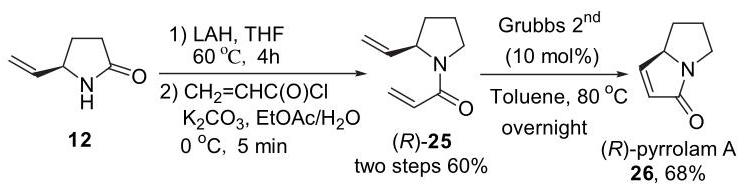
Finally, total synthesis of $\left( R\right)$ -Pyrrolam ${\mathrm{A}}^{17}$ has been achieved with this methodology (Scheme 7). RCM precursor (R)-25 was obtained from 12 via simple reduction and acylation with a yield of 60% and then (R)-25 was subjected to RCM reaction catalyzed by 10 mol % of Grubbs second catalyst to give (R)-Pyrolam A 26 in 68% isolated yield.
Scheme 7.
2. Conclusions
In summary, we have developed versatile routes to condensed and transannular ring structures containing pyrrolidine unit. These products may be potential scaffolds for the synthesis of alkaloids of biological and pharmaceutical interests. In addition, (R)-Pyrolam A was synthesized enantioselectively, further exhibiting application flexibility of this methodology. Efforts to apply this chemistry to the synthesis of alkaloids of more structural complexity are underway in our laboratory.
3. Experimental section
3.1. General
Caution: diazo compounds are generally toxic and potentially explosive. They should be handled with care in a well-ventilated fume hood.
3.1.1. (R)-Allyl 2-diazo-5-((S)-4-methylphenylsulfinamido)-3-oxo-hept-6-enoate (8). To a solution of ${\mathbf{6}}^{18}\left( {{193}\mathrm{{mg}},1\mathrm{{mmol}}}\right)$ in ${\mathrm{{CH}}}_{2}{\mathrm{{Cl}}}_{2} \; \left( {{25}\mathrm{\;{mL}}}\right)$ was added LiHMDS $(2\mathrm{{mmol}},{1.0}\mathrm{M}$ in hexane) at $- {78}^{ \circ }\mathrm{C}$ and then 7 (252mg,1.5 mmol) in ${\mathrm{{CH}}}_{2}{\mathrm{{Cl}}}_{2}\left( {5\mathrm{\;{mL}}}\right)$ was dropped in the solution in 5 min. After stirring for another ${10} - {15}\mathrm{\;{min}}$ , the reaction was quenched with saturated aqueous ${\mathrm{{NH}}}_{4}\mathrm{{Cl}}$ at $- {78}^{ \circ }\mathrm{C}$ and then warmed quickly to room temperature. The organic layer was separated and the aqueous layer was extracted with ${\mathrm{{CH}}}_{2}{\mathrm{{Cl}}}_{2}\left( {2 \times {15}\mathrm{\;{mL}}}\right)$ . The organic layers were combined and dried over ${\mathrm{{Na}}}_{2}{\mathrm{{SO}}}_{4}$ . Then the solvent was removed under reduced pressure and the resulting crude product was purified by column chromatography (petroleum ether/ethyl acetate 3:1) to give the addition products $\mathbf{8}\left( {{252}\mathrm{{mg}},{70}\% \text{ yield }}\right)$ . IR (film) 3208, 2137, 1714, 1649, 1371, 1304, 1090, 1057, 1016, 923, 813, ${746}{\mathrm{\;{cm}}}^{-1};{}^{1}\mathrm{H}\mathrm{{NMR}}\left( {{300}\mathrm{{MHz}},{\mathrm{{CDCl}}}_{3}}\right) {\delta 7.57}\left( {\mathrm{\;d}, J = {7.8}\mathrm{\;{Hz}},2\mathrm{H}}\right) ,{7.28}(\mathrm{\;d}$ , $J = {7.8}\mathrm{\;{Hz}},2\mathrm{\;H}),{6.02} - {5.87}\left( {\mathrm{\;m},2\mathrm{H}}\right) ,{5.37} - {5.21}\left( {\mathrm{\;m},4\mathrm{H}}\right) ,{4.82}(\mathrm{\;d}, J = {7.2}\mathrm{\;{Hz}}$ , 1H), 4.70-4.67 (m, 2H), 4.31 (qd, J=6.1, 7.2 Hz, 1H), 3.19 (dd, J=4.5, ${16.5}\mathrm{\;{Hz}},1\mathrm{H}),{3.08}\left( {\mathrm{{dd}}, J = {7.1},{16.5}\mathrm{\;{Hz}},1\mathrm{H}}\right) ,{2.40}\left( {\mathrm{\;s},3\mathrm{H}}\right) ;{}^{13}\mathrm{C}$ NMR (75 MHz, CDCl3) 6 190.1, 160.6, 141.7, 141.1, 138.1, 131.1, 129.3, 125.4, 119.2,116.6,65.8,53.1,45.6,21.2; EIMS $(m/z$ , relative intensity): 361 (4), 243 (3), 222 (25), 194 (9), 171 (7), 155 (7), 139 (100), 123 (17), 108 (16), 91 (58), 77 (13), 65 (23), 41 (100), 27 (16). HRMS (EI) calcd for ${\mathrm{C}}_{17}{\mathrm{H}}_{19}{\mathrm{\;N}}_{3}{\mathrm{O}}_{4}\mathrm{\;S}$ 361.1096, found ${361.1095}.{\left\lbrack \alpha \right\rbrack }_{\mathrm{D}}^{20} + {127.0}\left( {{c0.8},{\mathrm{{CHCl}}}_{3}}\right)$ .
3.1.2. (R)-Allyl 5-(tert-butoxycarbonylamino)-2-diazo-3-oxo-hept-6- enoate (9). The addition product $8\left( {{1.083}\mathrm{\;g},3\mathrm{{mmol}}}\right)$ was treated with TFA $({1.710}\mathrm{\;g},{15}\mathrm{{mmol}},{5.0}$ equiv) in $\mathrm{{MeOH}}\left( {{20}\mathrm{\;{mL}}}\right)$ at ${0}^{ \circ }\mathrm{C}$ . The reaction was monitored by TLC and the sulfinyl group in 8 was removed in about $2\mathrm{\;h}$ to give the corresponding trifluoroacetate salt. The solution was concentrated, and then was dissolved in THF $\left( {{20}\mathrm{\;{mL}}}\right)$ . The solution was treated with ${\mathrm{{Boc}}}_{2}\mathrm{O}({770}\mathrm{{mg}},{3.6}\mathrm{{mmol}}$ , 1.2 equiv), ${\mathrm{{Et}}}_{3}\mathrm{\;N}$ (1.818 g,18 mmol,6 equiv) and a catalytic amount of DMAP ( ${18}\mathrm{{mg}},{0.15}\mathrm{{mmol}},{0.05}$ equiv) at $0{}^{ \circ }\mathrm{C}$ . After stirred for about $2\mathrm{\;h}$ at this temperature, the solution was concentrated and purified by flash chromatography (petroleum ether/ethyl acetate 10:1) to give the $N$ -Boc protected diazo product $\mathbf{9}({920}\mathrm{{mg}}$ , yield 95%) as a yellow oil. IR (film) 3374, 2974, 2135, 1712, 1650, 1366, 1308,1169,922,743 ${\mathrm{{cm}}}^{-1}$ ; ${}^{1}\mathrm{H}$ NMR (300 MHz, CDCl ${}_{3}$ ) $\delta$ 6.01-5.81 $\left( {m,{2H}}\right) ,{5.39} - {5.29}\left( {m,{2H}}\right) ,{5.23} - {5.09}\left( {m,{3H}}\right) ,{4.73}(d,{2H}$ , $J = {5.7}\mathrm{\;{Hz}}),{4.60}\left( {\mathrm{\;s},1\mathrm{H}}\right) ,{3.21} - {3.14}\left( {\mathrm{\;m},2\mathrm{H}}\right) ,{1.43}\left( {\mathrm{\;s},9\mathrm{H}}\right) ;{}^{13}\mathrm{C}\mathrm{{NMR}}$ (75 MHz, CDCl3) δ 190.4, 160.8, 155.0, 137.6, 131.2, 119.2, 114.8, 79.3, 65.9,49.5, 44.3, 28.2; EIMS $\left( {m/z\text{ , relative intensity): 323 (1), 267 }}\right)$ (23), 250 (8), 154 (9), 136 (10), 100 (25), 57 (100), 41 (49), 29 (7). HRMS (EI) calcd for ${\mathrm{C}}_{15}{\mathrm{H}}_{21}{\mathrm{\;N}}_{3}{\mathrm{O}}_{5}{323.1481}$ , found ${323.1485}.{\left\lbrack \alpha \right\rbrack }_{\mathrm{D}}^{20} \; - {36.4}\left( {{c1.4},{\mathrm{{CHCl}}}_{3}}\right)$ .
3.1.3. (R)-3-Allyl 1-tert-butyl 2-oxo-5-vinylpyrrolidine-1,3-dicarboxylate (10). A solution of $\mathbf{9}\left( {{920}\mathrm{{mg}},{2.85}\mathrm{{mmol}}}\right)$ in benzene $\left( {{200}\mathrm{\;{mL}}}\right)$ in a Pyrex tube was irradiated with a 500 W high-pressure Hg lamp with a water-cooled tube inserted into the solvent. The reaction temperature was kept at about ${35}^{ \circ }\mathrm{C}$ . The reaction was complete in about $3\mathrm{\;h}$ (monitored by IR and TLC). The solution was concentrated under reduced pressure to give the crude product, which was purified by flash chromatography (petroleum ether/ethyl acetate 8:1) to give the diastereomeric mixture of the corresponding 3-allyl-oxycarbonyl-2-oxo pyrrolidines 10 (504 mg, yield 60%) as a yellowy oil. The diastereomeric mixture could not be separated by column chromatography. IR (film) 2977, 1786, 1731, 1368, 1298, 1251, 1150, 970,925 ${\mathrm{{cm}}}^{-1}$ ; ${}^{1}\mathrm{H}$ NMR (300 MHz, ${\mathrm{{CDCl}}}_{3}$ ) $\delta$ 6.00-5.79 (m,2H), 5.42-5.17 (m, 4H), 4.75-4.51 (m, 3H), 3.67-3.53 (m, 1H), 2.70-2.66 $\left( {\mathrm{m},1\mathrm{H}}\right) ,{2.26} - {2.03}\left( {\mathrm{\;m},1\mathrm{H}}\right) ,{1.50}\left( {\mathrm{\;s},9\mathrm{H}}\right) ;{}^{13}\mathrm{C}$ NMR (75 MHz, ${\mathrm{{CDCl}}}_{3}$ ) $\delta$ 168.5, 168.2, 149.2, 137.5, 136.0, 131.3, 131.2, 118.9, 118.8, 116.5, 115.8, 83.4, 66.4, 66.3, 59.0, 57.6, 49.0, 48.3, 28.2, 27.8; EIMS $(m/z$ , relative intensity): 295 (3), 280 (5), 239 (40), 195 (20), 154 (100), 136 (95), 110 (98), 67 (46), 57 (52), 41 (66). HRMS (EI) calcd for ${\mathrm{C}}_{15}{\mathrm{H}}_{21}{\mathrm{{NO}}}_{5}$ 295.1420, found 295.1422.
3.1.4. (R)-tert-Butyl 2-oxo-5-vinylpyrrolidine-1-carboxylate (11) Compound ${10}\left( {{183}\mathrm{{mg}},{0.62}\mathrm{{mmol}}}\right)$ was dissolved in THF ${\left( {10}\mathrm{{mL}}\right) }_{\Delta }$ , and then morpholine $({81}\mathrm{{mg}},{0.93}\mathrm{{mmol}},{1.5}$ equiv) and $\mathrm{{Pd}}{\left( {\mathrm{{PPh}}}_{3}\right) }_{4}$ (36 mg, 0.031 mmol, 5 mol%) were added in room temperature. When the reaction was complete as monitored by TLC, the solution was concentrated under reduced pressure and purified by flash column chromatography (petroleum ether/ethyl acetate 5:1) to give the pyrrolidine derivative 11 (115 mg, yield 88%) as a yellow oil. IR (film) 2981,1782,1750,1717,1367,1305,1255,1153,1020,850 ${\mathrm{{cm}}}^{-1}$ ; ${}^{1}\mathrm{H}$ NMR $\left( {{300}\mathrm{{MHz}},{\mathrm{{CDCl}}}_{3}}\right) {\delta 5.91} - {5.80}\left( {\mathrm{\;m},1\mathrm{H}}\right) ,{5.20} - {5.15}\left( {\mathrm{\;m},2\mathrm{H}}\right) ,{4.67} - \; {4.62}\left( {\mathrm{\;m},1\mathrm{H}}\right) ,{2.64} - {2.52}\left( {\mathrm{\;m},1\mathrm{H}}\right) ,{2.47} - {2.37}\left( {\mathrm{\;m},1\mathrm{H}}\right) ,{2.30} - {2.17}\left( {\mathrm{\;m},1\mathrm{H}}\right)$ , ${1.86} - {1.77}\left( {\mathrm{\;m},1\mathrm{H}}\right) ,{1.50}\left( {\mathrm{\;s},9\mathrm{H}}\right) ;{}^{13}\mathrm{C}\mathrm{{NMR}}\left( {{75}\mathrm{{MHz}},{\mathrm{{CDCl}}}_{3}}\right) {\delta 174.2},{149.5}$ , 136.4,115.0,82.6,59.4,30.8,27.7,24.0; ${\left\lbrack \alpha \right\rbrack }_{\mathrm{D}}^{20} + {27.7}\left( {{c0.95},{\mathrm{{CHCl}}}_{3}}\right)$ .
3.1.5. (R)-2-Oxo-5-vinylpyrrolidine ${\left( {12}\right) }^{19}$ . TFA $\left( {{684}\mathrm{{mg}},6\mathrm{{mmol}}}\right)$ in 5 equiv) was added to a solution of ${11}\left( {{252}\mathrm{{mg}},{1.2}\mathrm{{mmol}}}\right)$ in ${\mathrm{{CH}}}_{2}{\mathrm{{Cl}}}_{2}\left( {{10}\mathrm{\;{mL}}}\right)$ at $0{}^{ \circ }\mathrm{C}$ and then the reaction was allowed to continue in room temperature overnight. When being completed as monitored by TLC, the reaction was neutralized by saturated ${\mathrm{{NaHCO}}}_{3}$ to $\mathrm{{pH}} \approx 7$ . The organic layer was separated and the aqueous layer was extracted with ${\mathrm{{CH}}}_{2}{\mathrm{{Cl}}}_{2}\left( {2 \times {15}\mathrm{\;{mL}}}\right)$ . The organic layers were then combined and dried over ${\mathrm{{Na}}}_{2}{\mathrm{{SO}}}_{4}$ . The solution was concentrated under reduced pressure and purified by flash column chromatography (petroleum ether/ethyl acetate 1:1) to give the title compound ${12}\left( {{131}\mathrm{{mg}}}\right)$ in nearly quantitative yield as a yellow oil. ${}^{1}\mathrm{H}$ NMR (300 MHz, CDCl ${}_{3}$ ) $\delta$ 7.20 (s,1H),5.81 (ddd, $J = {6.7},{10.1},{16.9}\mathrm{\;{Hz}},1\mathrm{H}),{5.26} - {5.10}\left( {\mathrm{\;m},2\mathrm{H}}\right) ,{4.23} - {4.17}\left( {\mathrm{\;m},1\mathrm{H}}\right) ,{2.45} -$ 2.27 (m, 3H), 1.90-1.78 (m, 1H); ${}^{13}\mathrm{C}$ NMR (75 MHz, CDCl3) δ 178.8, 138.4,115.4,56.6,29.8,27.7; ${\left\lbrack \alpha \right\rbrack }_{\mathrm{D}}^{20} - {39.2}\left( {{c1},{\mathrm{{CHCl}}}_{3}}\right)$ .
3.1.6. (R)-1-Substituted-5-vinylpyrrolidin-2-ones 13, 14, and 15. The title compounds were obtained from 12 according to literature procedure. ${}^{20}$
3.1.7. (R)-1-Allyl-2-oxo-5-vinylpyrrolidine (13). IR (film) 2980, 1687, 1643,1406,1278,1253,1189,1128,992,923,844,726 ${\mathrm{{cm}}}^{-1};{}^{1}\mathrm{H}$ NMR (300 MHz, CDC1, $\delta$ 5.76-5.59 (m, 2H), 5.24-5.09 (m, 4H), 4.29 (ddt, $J = {15.3},{4.8},{1.5}\mathrm{\;{Hz}},1\mathrm{H}),{4.05}$ (dt, $J = {8.1},{5.4}\mathrm{\;{Hz}},1\mathrm{H}),{3.41}(\mathrm{{dq}}$ , $J = {7.5},{1.2}\mathrm{\;{Hz}},1\mathrm{\;H}),{2.52} - {2.32}\left( {\mathrm{\;m},2\mathrm{H}}\right) ,{2.30} - {2.18}\left( {\mathrm{\;m},1\mathrm{H}}\right) ,{1.83} - {1.72} \; \left( {\mathrm{m},1\mathrm{H}}\right) ;{}^{13}\mathrm{C}\mathrm{{NMR}}\left( {{75}\mathrm{{MHz}},{\mathrm{{CDCl}}}_{3}}\right) {\delta 174.6},{137.4},{132.3},{117.9},{117.6}$ , 60.6, 42.8, 29.8, 25.2; EIMS $\left( {m/z\text{ , relative intensity): 151 (37), 136 }}\right) \; \left( {31}\right) ,{124}\left( {55}\right) ,{96}\left( {19}\right) ,{84}\left( {11}\right) ,{67}\left( {41}\right) ,{54}\left( {28}\right) ,{41}\left( {100}\right) ,{39}\left( {60}\right) ,{27}$ (35); HRMS (ESI) calcd for ${\mathrm{C}}_{9}{\mathrm{H}}_{13}\mathrm{{NONa}}\left( {\mathrm{M} + \mathrm{{Na}}}\right) {174.0889}$ , found 174.0887. ${\left\lbrack \alpha \right\rbrack }_{\mathrm{D}}^{20} - {165.1}\left( {{c1.3},{\mathrm{{CHCl}}}_{3}}\right)$ .
3.1.8. (R)-1-(But-3-enyl)-2-oxo-5-vinylpyrrolidine ${\left( \mathbf{{14}}\right) }^{21}$ . IR (film) 2974,1687,1415,1256,993,920 ${\mathrm{{cm}}}^{-1}$ ; ${}^{1}\mathrm{H}$ NMR (300 MHz, CDC ${\mathrm{l}}_{3}$ ) $\delta$ 5.82-5.61 $\left( {\mathrm{m},2\mathrm{H}}\right) ,{5.30} - {5.01}\left( {\mathrm{\;m},4\mathrm{H}}\right) ,{4.09} - {4.02}\left( {\mathrm{\;m},1\mathrm{H}}\right) ,{3.71} -$ 3.41 (m, 1H), 2.99-2.90 (m, 1H), 2.47-2.33 (m, 2H), 2.30-2.15 (m, 3H), 1.88-1.56 (m, 1H); ${}^{13}\mathrm{C}$ NMR (75 MHz, CDCl3) $\delta$ 174.8, 137.7, 135.2, 117.7, 116.6, 61.2, 39.7, 31.7, 30.0, 25.4; ${\left\lbrack \alpha \right\rbrack }_{\mathrm{D}}^{20} - {58.2}(c$ 0.85, ${\mathrm{{CHCl}}}_{3}$ ).
3.1.9. (R)-1-(Pent-4-enyl)-2-oxo-5-vinylpyrrolidine ${\left( \mathbf{{15}}\right) }^{21} \cdot {}^{1}\mathrm{H}$ NMR $\left( {{300}\mathrm{{MHz}},{\mathrm{{CDCl}}}_{3}}\right) \delta$ 5.86-5.74 $\left( {\mathrm{m},1\mathrm{H}}\right) ,{5.72} - {5.60}\left( {\mathrm{\;m},1\mathrm{H}}\right) ,{5.27} - {5.19} \; \left( {\mathrm{m},2\mathrm{H}}\right) ,{5.05} - {4.94}\left( {\mathrm{\;m},2\mathrm{H}}\right) ,{4.08} - {4.00}\left( {\mathrm{\;m},1\mathrm{H}}\right) ,{3.59} - {3.49}\left( {\mathrm{\;m},1\mathrm{H}}\right)$ , 2.95-2.86 (m, 1H), 2.48-2.34 (m, 2H), 2.30-2.16 (m, 1H), 2.036 (q, $J = {7.5}\mathrm{\;{Hz}},2\mathrm{H}),{1.80} - {1.69}\left( {\mathrm{\;m},1\mathrm{H}}\right) ,{1.67} - {1.46}\left( {\mathrm{\;m},2\mathrm{H}}\right) ;{}^{13}\mathrm{C}$ NMR (75 MHz, CDCl3) δ 174.8, 137.8, 137.6, 117.7, 114.8, 61.3, 40.1, 30.9, 30.0,26.3,25.4; ${\left\lbrack \alpha \right\rbrack }_{\mathrm{D}}^{20} - {62.6}\left( {{c0.95},{\mathrm{{CHCl}}}_{3}}\right)$ .
3.2. General procedure for the RCM reaction
Compound 13,14 or 15 (0.08 mmol) was dissolved in dry ${\mathrm{{CH}}}_{2}{\mathrm{{Cl}}}_{2}$ (100 mL) under nitrogen atmosphere. Second generation Grubbs catalyst (24 mg, 10 mol%) was added. The resulting mixture was heated at reflux temperature (monitored by TLC). After completion of the reaction, the solvent was then evaporated, and the residual oil was purified by flash chromatography on silica gel (petroleum ether/ethyl acetate 5:1) to give the ring-closing product 16, 17 or 18 in nearly quantitative yields.
3.2.1. (R)-5,7a-Dihydro-1H-pyrrolizin-3(2H)-one (16) ${}^{{21},{22}}{.}^{1}\mathrm{H}$ NMR $\left( {{300}\mathrm{{MHz}},{\mathrm{{CDCl}}}_{3}}\right) {\delta 5.92} - {5.86}\left( {\mathrm{\;m},2\mathrm{H}}\right) ,{4.71} - {4.63}\left( {\mathrm{\;m},1\mathrm{H}}\right) ,{4.43} - {4.36} \; \left( {\mathrm{m},1\mathrm{H}}\right) ,{3.71} - {3.64}\left( {\mathrm{\;m},1\mathrm{H}}\right) ,{2.79} - {2.67}\left( {\mathrm{\;m},1\mathrm{H}}\right) ,{2.46} - {2.30}\left( {\mathrm{\;m},2\mathrm{H}}\right)$ , ${1.89} - {1.75}\left( {\mathrm{\;m},1\mathrm{H}}\right) ;{}^{13}\mathrm{C}\mathrm{{NMR}}\left( {{75}\mathrm{{MHz}},{\mathrm{{CDCl}}}_{3}}\right) {\delta 177.9},{130.5},{128.1}$ , 67.4, 49.6, 34.0, 29.5; IR (film) 3474, 2917, 1681, 1459, 1391, 1280, ${1190},{990},{769}{\mathrm{\;{cm}}}^{-1}$ ; EIMS ( $m/z$ , relative intensity): ${123}\left( {50}\right) ,{122}$ (17), 94 (6), 80 (8), 67 (100), 55 (52), 39 (52), 32 (13), 27 (32); HRMS (ESI) calcd for ${\mathrm{C}}_{7}{\mathrm{H}}_{9}\mathrm{{NONa}}\left( {\mathrm{M} + \mathrm{{Na}}}\right) {146.0576}$ , found ${146.0571}.{\left\lbrack \alpha \right\rbrack }_{\mathrm{D}}^{20} \; - {19.5}\left( {c\;{0.5},{\mathrm{{CHCl}}}_{3}}\right)$ .
3.2.2. (R)-1,2,5,6-Tetrahydroindolizin-3(8aH)-one (17) ${}^{{21},{23}}$ . ${}^{1}\mathrm{H}$ NMR $\left( {{300}\mathrm{{MHz}},{\mathrm{{CDCl}}}_{3}}\right) {\delta 5.28} - {5.67}\left( {\mathrm{\;m},2\mathrm{H}}\right) ,{4.24} - {4.15}\left( {\mathrm{\;m},2\mathrm{H}}\right) ,{2.90} - {2.81} \; \left( {\mathrm{m},1\mathrm{H}}\right) ,{2.55} - {2.39}\left( {\mathrm{\;m},2\mathrm{H}}\right) ,{2.30} - {2.20}\left( {\mathrm{\;m},2\mathrm{H}}\right) ,{2.11} - {2.02}\left( {\mathrm{\;m},1\mathrm{H}}\right)$ , ${1.67} - {1.53}\left( {\mathrm{\;m},1\mathrm{H}}\right) ;{}^{13}\mathrm{C}\mathrm{{NMR}}\left( {{75}\mathrm{{MHz}},{\mathrm{{CDCl}}}_{3}}\right) {\delta 172.9},{128.1},{124.8}$ , 54.8, 36.1, 31.5, 26.2, 24.4; IR (film) 2919, 1685, 1437, 1421, 1363, 1306,1265,841 ${\mathrm{{cm}}}^{-1};{\left\lbrack \alpha \right\rbrack }_{\mathrm{D}}^{20} + {94.0}\left( {{c0.8},{\mathrm{{CHCl}}}_{3}}\right)$ .
3.2.3. (R)-5,6,7,9a-Tetrahydro-1H-pyrrolo[1,2-a]azepin-3(2H)-one ${\left( \mathbf{{18}}\right) }^{21} \cdot {}^{1}\mathrm{H}$ NMR (300 MHz, CDCl ${}_{3}$ ) $\delta$ 5.80-5.72 (m,1H),5.49 (ddd, J=1.8, 3.7, 11.4 Hz, 1H), 4.37-4.31 (m, 1H), 4.12-4.03 (m, 1H), 3.05- 2.97 (m, 1H), 2.50-1.74 (m, 8H); ${}^{13}\mathrm{C}$ NMR (75 MHz, CDCl3) Å 174.6, 131.8,131.4,58.3,42.6,29.9,27.5,26.7,26.2; ${\left\lbrack \alpha \right\rbrack }_{\mathrm{D}}^{20} - {7.9}$ (c 1.35, ${\mathrm{{CHCl}}}_{3}$ ).
3.2.4. (5R)-3-Allyl 1-tert-butyl 3-allyl-2-oxo-5-vinylpyrrolidine-1,3- dicarboxylate (20). To a solution of10(118 mg,0.4 mmol) in acetone $\left( {9\mathrm{\;{mL}}}\right)$ were successively added ${\mathrm{K}}_{2}{\mathrm{{CO}}}_{3}({66}\mathrm{{mg}},{0.48}\mathrm{{mmol}}$ , 1.2 equiv), ${\mathrm{{Bu}}}_{4}\mathrm{{NBr}}$ (26 mg,0.08 mmol,0.2 equiv), and allyl bromide (145 mg, 1.2 mmol, 3 equiv). The resulting mixture was heated at ${60}^{ \circ }\mathrm{C}$ for $3\mathrm{\;h}$ (monitored by TLC). After cooled to room temperature, the mixture was concentrated under reduced pressure. The residue was purified by flash column chromatography (petroleum ether/ethyl acetate 7:1) to give the title compound as a yellow oil $\left( {{117}\mathrm{{mg}},{87}\% }\right) .{}^{1}\mathrm{H}$ NMR $\left( {{300}\mathrm{{MHz}},{\mathrm{{CDCl}}}_{3}}\right) \; \delta$ 5.96-5.63 $\left( {\mathrm{m},3\mathrm{H}}\right) ,{5.38} - {5.31}\left( {\mathrm{\;m},6\mathrm{H}}\right) ,{4.66} - {4.61}\left( {\mathrm{\;m},2\mathrm{H}}\right) ,{4.56} - \; {4.49}\left( {\mathrm{\;m},1\mathrm{H}}\right) ,{2.88} - {2.51}\left( {\mathrm{\;m},2\mathrm{H}}\right) ,{2.39} - {2.25}\left( {\mathrm{\;m},{1.5}\mathrm{H}}\right) ,{1.80} - {1.70}$ (m, 0.5H), 1.50 (s, 9H); ${}^{13}$ C NMR (75 MHz, CDCl, 119.9, 118.9, 118.6, 169.7, 138.3, 137.2, 132.3, 131.9, 131.2, 120.1, 119.9, 118.9, 118.6, 116.3, 115.9, 115.7, 83.5, 83.3, 76.5, 66.3, 66.3, 58.0, 57.3, 56.4, 56.1, 39.4,38.3,33.2,32.6,27.8; EIMS ( $m/z$ , relative intensity): 335 (5), 279 (18), 235 (12), 194 (55), 176 (25), 150 (100), 136 (45), 108 (20), 79 (25), 57 (35), 41 (44); HRMS (EI) calcd for ${\mathrm{C}}_{18}{\mathrm{H}}_{25}{\mathrm{{NO}}}_{5}$ 335.1733, found 335.1735.
3.2.5. (5R)-tert-Butyl 3-allyl-2-oxo-5-vinylpyrrolidine-1-carboxyl-ates (19a and 19b). Compound 20 (117 mg, 0.35 mmol) was dissolved in THF (8 mL), and then morpholine (46 mg, 0.524 mmol, 1.5 equiv) and $\mathrm{{Pd}}{\left( {\mathrm{{PPh}}}_{3}\right) }_{4}$ (20 mg,0.0175 mmol,5 mol%) were added at room temperature. After the reaction was complete, the solution was concentrated under reduced pressure and purified by flash column chromatography (petroleum ether/ethyl acetate 7:1) to give ${19}\mathrm{a}\left( {{42}\mathrm{{mg}}}\right)$ and ${19}\mathrm{b}\left( {{41}\mathrm{{mg}}}\right)$ , both as a yellow oil. Compound 19a: ${R}_{f} = {0.6}$ (petroleum ether/EtOAc 3:1). IR (film) 2954,2924, 2853,1783,1725,1458,1368,1299,1255,1154,916 ${\mathrm{\;{cm}}}^{-1};{}^{1}\mathrm{H}$ NMR $\left( {{300}\mathrm{{MHz}},{\mathrm{{CDCl}}}_{3}}\right) \delta$ 5.84-5.70 $\left( {\mathrm{m},2\mathrm{H}}\right) ,{5.23} - {5.06}\left( {\mathrm{\;m},4\mathrm{H}}\right) ,{4.45}(\mathrm{{dd}}$ , $J = {9.0},{6.0}\mathrm{\;{Hz}},1\mathrm{H}),{2.69} - {2.53}\left( {\mathrm{\;m},2\mathrm{H}}\right) ,{2.39} - {2.29}\left( {\mathrm{\;m},1\mathrm{H}}\right) ,{2.24} - {2.14} \; \left( {\mathrm{m},1\mathrm{H}}\right) ,{1.57} - {1.52}\left( {\mathrm{\;m},1\mathrm{H}}\right) ,{1.50}\left( {\mathrm{\;s},9\mathrm{H}}\right) ;{}^{13}\mathrm{C}\mathrm{{NMR}}\left( {{75}\mathrm{{MHz}},{\mathrm{{CDCl}}}_{3}}\right)$ 6 175.6, 149.9, 138.9, 134.9, 117.2, 115.5, 82.9, 58.6, 42.2, 35.2, 30.2, 27.8; EIMS $(m/z$ , relative intensity): 251 (28),236 (4),195 (100),151 (92), 109 (95), 79 (83), 67 (92), 56 (85), 41 (84); HRMS (EI) calcd for ${\mathrm{C}}_{14}{\mathrm{H}}_{21}{\mathrm{{NO}}}_{3}{251.1521}$ , found ${251.1523}.{\left\lbrack \alpha \right\rbrack }_{\mathrm{D}}^{20} - {17.1}\left( {{c0.96},{\mathrm{{CHCl}}}_{3}}\right)$ . Compound 19b: ${R}_{f} = {0.7}$ (petroleum ether/EtOAc 3:1). IR (film) 2954, 2924,2845,1783,1717,1461,1299,1255,1154,912 ${\mathrm{{cm}}}^{-1}$ ; ${}^{1}\mathrm{H}$ NMR $\left( {{300}\mathrm{{MHz}},{\mathrm{{CDCl}}}_{3}}\right) \delta$ 5.91-5.69 $\left( {\mathrm{m},2\mathrm{H}}\right) ,{5.19} - {5.05}\left( {\mathrm{\;m},4\mathrm{H}}\right) ,{4.62} - {4.57} \; \left( {\mathrm{m},1\mathrm{H}}\right) ,{2.72} - {2.60}\left( {\mathrm{\;m},2\mathrm{H}}\right) ,{2.23} - {2.12}\left( {\mathrm{\;m},1\mathrm{H}}\right) ,{2.01} - {1.86}\left( {\mathrm{\;m},2\mathrm{H}}\right)$ , 1.50 (s,9H); ${}^{13}\mathrm{C}$ NMR (75 MHz, ${\mathrm{{CDCl}}}_{3}$ ) δ 175.0,149.7,136.3,134.8, 117.2,115.1,82.7,57.3,40.7,34.2,30.4,27.8; EIMS $\left( {m/z}\right.$ , relative intensity): 251 (30), 236 (6), 195 (100), 151 (90), 109 (93), 79 (82), 67 (90), 56 (84), 41 (82); HRMS (EI) calcd for ${\mathrm{C}}_{14}{\mathrm{H}}_{21}{\mathrm{{NO}}}_{3}{251.1521}$ , found 251.1523; ${\left\lbrack \alpha \right\rbrack }_{D}^{20} + {33.5}\left( {c\text{ 1.1, CHC }{\mathrm{l}}_{3}}\right)$ .
3.2.6. (1R,5R)-tert-Butyl 7-oxo-6-azabicyclo[3.2.1]oct-3-ene-6-carboxylate ${\left( \left( +\right) - {23}\right) }^{16}$ . Compound 19a (20 mg,0.08 mmol) was dissolved in dry ${\mathrm{{CH}}}_{2}{\mathrm{{Cl}}}_{2}\left( {{40}\mathrm{\;{mL}}}\right)$ under nitrogen atmosphere. Second generation Grubbs catalyst ( $1\mathrm{{mg}},1\mathrm{{mol}}\%$ ) was added. The resulting mixture was heated at reflux temperature for ${0.5}\mathrm{\;h}$ (monitored by TLC). The solvent was then evaporated, and the residual oil was purified by flash chromatography on silica gel (petroleum ether/ethyl acetate 5:1) to give the ring-closing product (+)-23 (18 mg, quant.) as a pale yellow oil. IR (film) 2978, 2929, 1782, 1751, 1707, 1345, 1309, 1252,1160,1138,911,784,676 ${\mathrm{{cm}}}^{-1};{}^{1}\mathrm{H}$ NMR (300 MHz, ${\mathrm{{CDCl}}}_{3}$ ) $\delta = {6.34} - {6.29}\left( {\mathrm{\;m},1\mathrm{H}}\right) ,{5.72} - {5.66}\left( {\mathrm{\;m},1\mathrm{H}}\right) ,{4.36} - {4.33}\left( {\mathrm{\;m},1\mathrm{H}}\right) ,{2.85} - {2.84} \; \left( {m,{1H}}\right) ,{2.52} - {2.36}\left( {m,{2H}}\right) ,{2.31} - {2.24}\left( {m,{1H}}\right) ,{2.00}({dd}, J = 9,{12Hz}$ , 1H,),1.52 (s,9H); ${}^{13}\mathrm{C}\;\mathrm{{NMR}}\left( {{75}\;\mathrm{{MHz}},{\mathrm{{CDCl}}}_{3}}\right) \delta \;{176.3},{149.4},{130.7},{127.8}$ , 82.5,52.5,41.5,31.7,28.6,28.0; ${\left\lbrack \alpha \right\rbrack }_{\mathrm{D}}^{20} = {121.0}\left( {{c0.92},{\mathrm{{CHCl}}}_{3}}\right)$ .
3.2.7. (R)-3-Allyl 1-tert-butyl 3-(but-3-enyl)-2-oxo-5-vinylpyrro-lidine-1,3-dicarboxylate (21). The title compound was obtained as a yellow oil (85%), following the method we employed for the preparation of 20. IR (film) 2982, 1785, 1728, 1303, 1199, 1153, ${918}{\mathrm{\;{cm}}}^{-1};{}^{1}\mathrm{H}$ NMR (300 MHz, CDCl ${}_{3}$ ) $\delta$ 5.96-5.70 (m,3H),5.37-5.12 $\left( {\mathrm{m},4\mathrm{H}}\right) ,{5.06} - {4.95}\left( {\mathrm{\;m},2\mathrm{H}}\right) ,{4.66} - {4.52}\left( {\mathrm{\;m},3\mathrm{H}}\right) ,{2.75}(\mathrm{\;{dd}}, J = {7.8}$ , 13.5 Hz, 0.4H), 2.47 (dd, J=2.7, 13.5 Hz, 0.6H), 2.32-1.96 (m, 3.5H), 1.92-1.78 (m, 1H), 1.72-1.65 (m, 0.5H), 1.50-1.49 (d, 9H); ${}^{13}\mathrm{C}$ NMR (75 MHz, CDCl3) δ 171.1, 171.0, 170.3, 169.8, 149.4, 138.3, 137.1, 137.0, 136.9, 131.2, 118.9, 118.6, 116.3, 115.8, 115.8, 115.3, 83.4, 83.2, 76.4, 66.2, 66.2, 58.0, 57.2, 57.1, 56.6, 56.0, 34.6, 34.2, 33.6, 33.5, 28.8, 28.5, 27.8; EIMS $(m/z$ , relative intensity): 293 (12),276 (4),249 (16),239 (46), 208 (8), 195 (57), 57 (86), 41 (100), 28 (21). Anal. Calcd for ${\mathrm{C}}_{19}{\mathrm{H}}_{27}{\mathrm{{NO}}}_{5}$ : C, 65.31; H, 7.79; N, 4.01. Found: C, 65.19; H, 7.81; N, 4.03.
3.2.8. (5R)-tert-Butyl 3-(but-3-enyl)-2-oxo-5-vinylpyrrolidine-1- carboxylates (22a and 22b). Compound 21 (200 mg, 0.57 mmol) was dissolved in THF $\left( {8\mathrm{\;{mL}}}\right)$ , and then morpholine $({75}\mathrm{{mg}}$ , 0.86 mmol, 1.5 equiv), Pd(PPh3)4 (33 mg, 0.0286 mmol, 5 mol%) were added at room temperature. The resulting mixture was stirred for about $2\mathrm{\;h}$ (monitored by TLC). After the reaction was complete, the solution was concentrated under reduced pressure and purified by flash column chromatography (petroleum ether/ethyl acetate 7:1) to give 22a (61mg) and 22b (63mg) both as a yellow oil. Compound 22a: ${R}_{f} = {0.6}$ (petroleum ether/EtOAc 3:1). ${}^{1}\mathrm{H}$ NMR (300 MHz, CDCl3) δ 5.85-5.72 (m, 2H), 5.31-5.13 (m, 3H), 5.07-4.98 $\left( {\mathrm{m},2\mathrm{H}}\right) ,{4.43}\left( {\mathrm{q}, J = {7.3}\mathrm{\;{Hz}},1\mathrm{H}}\right) ,{2.54} - {2.33}\left( {\mathrm{\;m},2\mathrm{H}}\right) ,{2.24} - {1.97}\left( {\mathrm{\;m},3\mathrm{H}}\right)$ , 1.50 (s,9H),1.47-1.40 (m,1H); ${}^{13}\mathrm{C}$ NMR (75 MHz, CDCl ${}_{3}$ ) $\delta$ 176.2, 149.9, 138.9, 137.4, 115.5, 115.4, 82.9, 58.7, 41.9, 31.2, 30.3, 27.8; IR (film) 2980, 1782, 1746, 1721, 1367, 1299, 1256, 1152, 914 c ${\mathrm{m}}^{-1}$ ; EIMS $\left( {m/z\text{ , relative intensity }}\right) : {209}\left( {17}\right) ,{192}\left( 4\right) ,{165}\left( {10}\right) ,{155}\left( {56}\right) ,{111}$ (28), 84 (34), 67 (25), 57 (100), 49 (53), 41 (50), 29 (28). Anal. Calcd for ${\mathrm{C}}_{15}{\mathrm{H}}_{23}{\mathrm{{NO}}}_{3}$ : C, 67.90; H, 8.74; N, 5.28. Found: C, 67.81; H, 8.66; N, 5.06. ${\left\lbrack \alpha \right\rbrack }_{\mathrm{D}}^{20} + {0.7}\left( {{c1.2},{\mathrm{{CHCl}}}_{3}}\right)$ . Compound 22b: ${R}_{f} = {0.7}$ (petroleum ether/EtOAc 3:1). ${}^{1}\mathrm{H}$ NMR (300 MHz, ${\mathrm{{CDCl}}}_{3}$ ) δ 5.91-5.72 (m,2H), 5.19-5.13 (m, 2H), 5.07-4.97 (m, 2H), 4.62-4.57 (m, 1H), 2.62-2.51 $\left( {m,{1H}}\right) ,{2.21} - {1.99}\left( {m,{4H}}\right) ,{1.91} - {1.80}\left( {m,{1H}}\right) ,{1.50}\left( {d,{9H}}\right) ,{1.45} - {1.37} \; \left( {\mathrm{m},1\mathrm{H}}\right) ;{}^{13}\mathrm{C}\mathrm{{NMR}}\left( {{75}\mathrm{{MHz}},{\mathrm{{CDCl}}}_{3}}\right) {\delta 175.7},{149.7},{137.5},{136.3},{115.3}$ , 115.1, 82.6, 57.3, 40.4, 31.1, 31.0, 29.2, 27.8; IR (film) 2980, 1782, 1748,1718,1306,1199,1152,913 ${\mathrm{\;{cm}}}^{-1}$ ; EIMS $(m/z$ , relative intensity): 209 (65), 192 (11), 165 (20), 155 (100), 137 (11), 121 (11), 111 (50), 94 (29), 67 (26), 57 (86), 41 (33), 29 (37); Anal. Calcd for ${\mathrm{C}}_{15}{\mathrm{H}}_{23}{\mathrm{{NO}}}_{3}$ : C, 67.90; H, 8.74; N, 5.28. Found: C, 67.83; H, 8.72; N, 5.38. ${\left\lbrack \alpha \right\rbrack }_{\mathrm{D}}^{20} + {17.6}\left( {{c0.4},{\mathrm{{CHCl}}}_{3}}\right)$ .
3.2.9. (1R,6R)-tert-Butyl 8-oxo-7-azabicyclo[4.2.1]non-4-ene-7-carboxylate (24). The title compound was obtained as a pale yellow oil in nearly quantitative yield, following the method we employed for the preparation of (+)-23. Compound 24: IR (film) 2977, 2934, 1781, 1746,1713,1366,1304,1273,1255,1146,1011,840,781 ${\mathrm{\;{cm}}}^{-1};{}^{1}\mathrm{H}$ NMR (400 MHz, CDCl, ${}_{3}$ ) 6 6.06 (ddd, J=3.0, 6.5, 11.0 Hz, 1H), 5.87 (ddd, $J = {3.2},{8.4},{11.3}\mathrm{\;{Hz}},1\mathrm{H}),{4.52}\left( {\mathrm{t}, J = {7.1}\mathrm{\;{Hz}},1\mathrm{H}}\right) ,{2.93} - {2.89}\left( {\mathrm{\;m},1\mathrm{H}}\right) ,{2.43} - \; {2.16}\left( {\mathrm{\;m},4\mathrm{H}}\right) ,{1.86} - {1.78}\left( {\mathrm{\;m},1\mathrm{H}}\right) ,{1.74}\left( {\mathrm{\;d}, J = {12.1}\mathrm{\;{Hz}},1\mathrm{H}}\right) ,{1.51}\left( {\mathrm{\;s},9\mathrm{H}}\right)$ ; ${}^{13}\mathrm{C}\;\mathrm{{NMR}}\left( {{100}\;\mathrm{{MHz}},{\mathrm{{CDCl}}}_{3}}\right) \delta \;{177.2},{149.7},{133.2},{132.5},{82.6},{56.1},{44.2}$ , 33.2, 32.0, 28.0, 24.7; EIMS $(m/z$ , relative intensity): 237 (7), 181 (36), 164 (24), 137 (39), 121 (13), 109 (12), 93 (36), 79 (28), 57 (100), 41 (45), 29 (19), 27 (12). Anal. Calcd for ${\mathrm{C}}_{13}{\mathrm{H}}_{19}{\mathrm{{NO}}}_{3}$ : C, 65.80; H, 8.07; N, 5.90. Found: C, 65.83; H, 8.02; N, 5.78. [α] ${}_{\mathrm{D}}^{20} + {6.0}\left( {{c1.0},{\mathrm{{CHCl}}}_{3}}\right)$ .
3.2.10. (R)-1-(2-Vinylpyrrolidin-1-yl)prop-2-en-1-one ((R)-25) ${}^{24} \; {\mathrm{{LiAlH}}}_{4}\left( {{40}\mathrm{{mg}},{1.05}\mathrm{{mmol}},{1.2}\text{ equiv) was added to a stirred solution }}\right)$ of ${12}\left( {{98}\mathrm{{mg}},{0.88}\mathrm{{mmol}}}\right)$ in THF $\left( {5\mathrm{\;{mL}}}\right)$ at $0{}^{ \circ }\mathrm{C}$ under a nitrogen atmosphere. After $5\mathrm{\;{min}}$ the reaction mixture was allowed to reflux for about $4\mathrm{\;h}$ (monitored by TLC). After cooling to room temperature, the reaction mixture was quenched with saturated aqueous potassium sodium tartrate tetrahydrate and stirred for another $2\mathrm{\;h}$ . Then the mixture was extracted with ethyl acetate $\left( {{10}\mathrm{\;{mL}} \times 3}\right)$ . The combined organic layers were dried $\left( {{\mathrm{{Na}}}_{2}{\mathrm{{SO}}}_{4}}\right)$ and evaporated in vacuo. The resulting residue was used in next step without further purification. To this residue were added $2\mathrm{\;{mL}}$ EtOAc, $2\mathrm{\;{mL}}$ water, and ${\mathrm{K}}_{2}{\mathrm{{CO}}}_{3}$ (242 mg,1.76 mmol,2 equiv) and then cooled to $0{}^{ \circ }\mathrm{C}$ , and then acryloyl chloride (119mg, 1.32 mmol, 1.5 equiv) was added dropwise to this mixture. This acylation reaction proceeded very fast. After about $5\mathrm{\;{min}}$ the reaction mixture was extracted with ethyl acetate $\left( {5\mathrm{\;{mL}} \times 3}\right)$ and combined organic layers were dried over ${\mathrm{{Na}}}_{2}{\mathrm{{SO}}}_{4}$ . Concentration in vacuo followed by flash chromatography on a column of silica gel (petroleum ether/EtOAc 2:1), afforded the desired product 25 (80 mg, 60% yield) as a yellow oil. ${}^{1}\mathrm{H}$ NMR (200 MHz, ${\mathrm{{CDCl}}}_{3}$ ) $\delta$ 6.57-6.26 (m, $2\mathrm{H}$ ),5.90-5.70 (m, 1H), 5.67-5.58 (m, 1H), 5.20-5.03 (m, 2H), 4.51-4.44 (m, 1H), 3.71- ${3.50}\left( {\mathrm{\;m},2\mathrm{H}}\right) ,{2.23} - {1.71}\left( {\mathrm{\;m},4\mathrm{H}}\right) ;{}^{13}\mathrm{C}\mathrm{{NMR}}\left( {{50}\mathrm{{MHz}},{\mathrm{{CDCl}}}_{3}}\right) {\delta 165.0}$ , 138.1, 136.9, 128.8, 128.6, 127.6, 127.1, 115.2, 114.1, 59.2, 58.5, 46.7, 46.1,32.3,30.2,23.5,21.4; ${\left\lbrack \alpha \right\rbrack }_{\mathrm{D}}^{20} + {23.2}\left( {{c1.13},{\mathrm{{CHCl}}}_{3}}\right)$ .
3.2.11. (R)-Pyrrolam $A{\left( \mathbf{{26}}\right) }^{17}$ . Second generation Grubbs catalyst $\left( {{24}\mathrm{{mg}},{10}\mathrm{{mol}}\% }\right)$ was added to a solution of $\mathbf{{25}}\left( {{42}\mathrm{{mg}},{0.28}\mathrm{{mmol}}}\right)$ in dry toluene ${100}\mathrm{\;{mL}}$ under nitrogen atmosphere. The resulting mixture was heated at ${80}^{ \circ }\mathrm{C}$ for ${12}\mathrm{\;h}$ (monitored by TLC). The solvent was then evaporated, and the residual oil was purified by flash chromatography on silica gel (petroleum ether/ethyl acetate 1:1) to give the ring-closing product 26 (23 mg, 68% yield) as a white solid. ${}^{1}\mathrm{H}$ NMR (200 MHz, CDCl ${}_{3}$ ) 7.20 (dd, $J = {1.7}$ ,5.8 Hz,1H),6.04 (dd, $J = {1.5},{5.7}\mathrm{\;{Hz}},1\mathrm{H}),{4.30} - {4.22}\left( {\mathrm{\;m},1\mathrm{H}}\right) ,{3.55} - {3.41}\left( {\mathrm{\;m},1\mathrm{H}}\right) ,{3.33} - {3.20} \; \left( {\mathrm{m},1\mathrm{H}}\right) ,{2.37} - {2.24}\left( {\mathrm{\;m},2\mathrm{H}}\right) ,{2.20} - {2.04}\left( {\mathrm{\;m},1\mathrm{H}}\right) ,{1.23} - {0.96}\left( {\mathrm{\;m},1\mathrm{H}}\right)$ ; ${}^{13}\mathrm{C}\;\mathrm{{NMR}}\left( {{50}\;\mathrm{{MHz}},{\mathrm{{CDCl}}}_{3}}\right) \;\delta \;$ 175.6,148.7,128.4,67.7,41.8,29.8,28.9; ${\left\lbrack \alpha \right\rbrack }_{\mathrm{D}}^{20} - {25.9}\left( c\right. {0.7}$ in $\left. {\mathrm{{CHCl}}}_{3}\right)$ .
Acknowledgements
The project is generously supported by NSFC (Grant No. 20832002, 20772003, 20821062), the Ministry of Education of China, and National Basic Research Program of China (973 Program, No. 2009CB825300).
Supplementary data
Supplementary data associated with this article can be found in the online version, at doi:10.1016/j.tet.2009.12.013.
References and notes
For some reviews, see: (a) Enders, D.; Thiebes, C. Pure Appl. Chem. 2001, 73, 573- 578; (b) O’hagan, D. Nat. Prod. Rep. 2000, 17, 435-446; (c) Pinder, A. R. Nat. Prod. Rep. 1992, 9, 17-23; (d) Massiot, G.; Ddelaude, C. In Alkaloids; Brossi, A., Ed.; Academic: New York, NY, 1996; Vol. 27, p 269.
(a) Felpin, F.-X.; Lebreton, J. Eur. J. Org. Chem. 2003, 3693-3712; (b) O’Hagan, B. Nat. Prod. Rep. 2000, 17, 435-446; (c) Moreno-Clavijo, E.; Carmona, A. T.; Vera-Ayoso, Y.; Moreno-Vargas, A. J.; Bello, C.; Vogel, P.; Robina, I. Org. Biomol. Chem. 2009, 7, 1192-1202; (d) Ribes, C.; Falomir, E.; Murga, J.; Carda, M.; Marco, J. A. Org. Biomol. Chem. 2009, 7, 1355-1360; (e) Cheng, X.-C.; Wang, Q.; Fang, H.; B. V. J. Org. Chem. 2007, 72, 2224-2227; (g) Zhang, S.; Xu, L.; Miao, L.; Shu, H.; Trudell, M. L. J. Org. Chem. 2007, 72, 3133-3136; (h) Santarem, M.; Vanucci-Bacqué, C.; Lhommet, G. J. Org. Chem. 2008, 73, 6466-6469; (i) Ribes, C.; Falomir, E.; Carda, M.; Marco, J. A. J. Org. Chem. 2008, 73, 7779-7782; (j) Dougherty, A. M.; McDonald, F. E.; Liotta, D. C.; Moody, S. J.; Pallas, D. C.; Pack, C. D.; Merrill, A. H. Org. Lett. 2006, 8, 649-652.
Michael, J. P. Nat. Prod. Rep. 2008, 25, 139-165.
Kam, T. S.; Sim, K. M. Phytochemistry 1998, 47, 145-147.
(a) Asano, N. Glycosidase-Inhibiting Alkaloids: Isolation, Structure, and Application In Modern Alkaloids; Fattorusso, E., Taglialatela-Scafati, O., Eds.; Wiley-VCH: Weinheim, 2008; Chapter 5, pp 111-138; (b) Asano, N.; Nash, R. J.; Molyneux, R. J.; Fleet, G. W. J. Tetrahedron: Asymmetry 2000, 11, 1645-1680.
Wilson, R. M.; Danishefsky, S. J. J. Org. Chem. 2006, 71, 8329-8351.
Dong, C.; Mo, F.; Wang, J. J. Org. Chem. 2008, 73, 1971-1974.
For review: (a) Pandit, U. K.; Overkleeft, H. S.; Borer, B. C.; Bieräugel, H. Eur. J. Org. Chem. 1999, 959-968; For examples: (b) Fuerstner, A.; Korte, A. Chem. Asian J. 2008, 3, 310-318; (c) Muroni, D.; Mucedda, M.; Saba, A. Tetrahedron Lett. 2008, 49, 2373-2376; (d) Wakamatsu, H.; Sato, Y.; Fujita, R. o; Mori, M. Adv. Synth. Catal. 2007, 349, 1231-1246; (e) Sletten, E. M.; Liotta, L. J. J. Org. Chem. 2006, 71, 1335-1343; (f) Chang, M.-Y.; Hsu, R.-T.; Tseng, T.-W.; Sun, P.-P.; Chang, N.-C. Tetrahedron 2004, 60, 5545-5550; (g) Ahn, J.-B.; Yun, C.-S.; Kim, K. H.; Ha, D.-C. J. Org. Chem. 2000, 65, 9249-9251; (h) White, J. D.; Hrnciar, P. J. Org. Chem. 2000, 65, 9129-9142; (i) Overkleeft, H. S.; Burggeman, P.; Pandit, U. K. Tetrahedron Lett. 1998, 39, 3869-3872; (j) Martin, S. F.; Chen, H.-J.; Courtney, A. K.; Liao, Y.; Pätzel, M.; Ramser, M. N.; Wagmzan, A. S. Tetrahedron 1996, 52, 7251-7264; (k) Fürstner, A.; Langemann, K. Synthesis 1997, 792-803.
Similar strategy for constructing 9-azabicyclo[4.2.1]nonane skeleton has been reported by Martin and co-workers, see: (a) Washburn, D. G.; Heidebrecht, R. W., Jr.; Martin, S. F. Org. Lett. 2003, 5, 3523-3525; (b) Brenneman, J. B.; Martin, S. F. Org. Lett. 2004, 6, 1329-1331; (c) Brenneman, J. B.; Machauer, R.; Martin, S. F. Tetrahedron 2004, 60, 7301-7314.
CCDC-746178 contains the supplementary crystallographic data for this paper. These data can be obtained free of charge from The Cambridge Crystallographic Data Center via http://www.ccdc.cam.ac.uk/data_request/cif.
For reviews, see: (a) Ellman, J. A.; Owens, T. D.; Tang, T. P. Acc. Chem. Res. 2002, 35, 984-995; (b) Zhou, P.; Chen, B. C.; Davis, F. A. Tetrahedron 2004, 60, 8003-8030; (c) Morton, D.; Stockman, R. A. Tetrahedron 2006, 62, 8869- 8905; (d) Davis, F. A. J. Org. Chem. 2006, 71, 8993-9003.
(a) Davis, F. A.; Reddy, R. E.; Szewczyk, J. M. J. Org. Chem. 1995, 60, 7037-7039; (b) Davis, F. A.; Yang, B. J. Am. Chem. Soc. 2005, 127, 8398-8407; (c) Davis, F. A.; Ramachandar, T.; Chai, J.; Skucas, E. Tetrahedron Lett. 2006, 47, 2743-2746; (d) Davis, F. A.; Zhang, Y.; Li, D. Tetrahedron Lett. 2007, 48, 7838-7840; (e) Davis, F. A.; Ramachandar, T. Tetrahedron Lett. 2008, 49, 870-872.
(a) Wang, J.; Hou, Y. J. Chem. Soc., Perkin Trans. 1 1998, 1919-1924; (b) Wang, J.; Hou, Y.; Wu, P.; Qu, Z.; Chan, A. S. C. Tetrahedron: Asymmetry 1999, 10, 4553- 4561; (c) Lee, D. J.; Kim, K.; Park, Y. J. Org. Lett. 2002, 4, 873-876.
Pd catalyzed deallyloxycarbonylation examples: (a) Georgiades, S. N.; Clardy, J. Bioorg. Med. Chem. Lett. 2008, 18, 3117-3121; (b) Tsuji, J.; Nisar, M.; Shimizu, I. J. Org. Chem. 1985, 50, 3416-3417; (c) Jeffrey, P. D.; McCombie, S. W. J. Org. Chem. 1982, 47, 587-590; (d) Tanaka, S.; Saburi, H.; Murase, T.; Yoshimura, M.; Kita-mura, M. J. Org. Chem. 2006, 71, 4682-4684.
For examples: (a) Khatri, N. A.; Schmitthenner, H. F.; Shringarpure, J.; Weinreb, S. M. J. Am. Chem. Soc. 1981, 103, 6387-6393; (b) Weinreb, S. M.; Khatri, N. A.; Shringarpure, J. J. Am. Chem. Soc. 1979, 101, 5073-5074.
Yeung, Y.-Y.; Hong, S.; Corey, E. J. J. Am. Chem. Soc. 2006, 128, 6310-6311.
(a) Grote, R.; Zeeck, A.; Stümpfel, J.; Zähner, H. Liebigs Ann. Chem. 1990, 525-530 For the recent examples of syntheses: (b) Watson, R. T.; Gore, V. K.; Chandu-patla, K. R.; Dieter, R. K.; Snyder, J. P. J. Org. Chem. 2004, 69, 6105-6114; (c) Majik, M. S.; Shet, J.; Tilve, S. G.; Parameswaran, P. S. Synthesis 2007, 5, 663-665; (d) Schobert, R.; Wicklein, A. Synthesis 2007, 10, 1499-1502.
Preparation of 6: Davis, F. A.; Zhang, Y.; Andemichael, Y.; Fang, T.; Fanelli, D. L.; Zhang, H. J. Org. Chem. 1999, 64, 1403-1406.
(a) Wei, Z. Y.; Knaus, E. E. Org. Prep. Proced. Int. 1993, 25, 255-258; (b) Silverman, R. B.; Bichler, K. A.; Leon, A. J. J. Am. Chem. Soc. 1996, 118, 1241-1252.
Arjona, O.; Csákỳ, A. G.; Medel, R.; Plumet, J. J. Org. Chem. 2002, 67, 1380-1383.
(a) Sattely, E. S.; Cortez, G. A.; Moebius, D. C.; Schrock, R. R.; Hoveyda, A. H. J. Am. Chem. Soc. 2005, 127, 8526-8533; (b) Martin, S. F.; Chen, H. J.; Courtney, A. K.; Liao, Y.; Päitzel, M.; Ramser, M. N.; Wagman, A. S. Tetrahedron 1996, 52, 7251- 7264; (c) Martin, S. F.; Liao, Y.; Chen, H. J.; Ramser, M. N. Tetrahedron Lett. 1994, 35, 6005-6008.
Andersson, P. G.; Baeckvall, J. E. J. Am. Chem. Soc. 1992, 114, 8696-8698.
Flann, C.; Malone, T. C.; Overman, L. E. J. Am. Chem. Soc. 1987, 109, 6097-6107.
(a) Arisawa, M.; Takahashi, M.; Takezawa, E.; Yamaguchi, T. Y.; Torisawa, Nishida, A.; Nakagawa, M. Chem. Pharm. Bull. 2000, 48, 1593-1596; (b) Ari-sawa, M.; Takezawa, E.; Nishida, A.; Mori, M.; Nakagawa, M. Synlett 1997, 1179-1180.