Rhodium(I)-Catalyzed C−C Bond Activation of Siloxyvinylcyclopropanes with Diazoesters
中文 / Bilingual · English version
German Edition:
Rhodium(I)-Catalyzed C-C Bond Activation of Siloxyvinylcyclopropanes with Diazoesters
Sheng Feng, Fanyang Mo, Ying Xia, Zhenxing Liu, Zhen Liu, Yan Zhang, and Jianbo Wang*
Abstract: The rhodium(I)-catalyzed $C - C$ bond activation reaction of siloxyvinylcyclopropanes with diazoesters demonstrates a novel mode of $C - C$ bond cleavage of siloxyivnivyl-cyclopanes. The alkene products were obtained as single E-configured isomers in good yields. A $\sigma ,{\eta }^{3}$ -allyl rhodium complex, which has been previously proposed as the key intermediate in rhodium(I)-catalyzed cycloaddition of vinyl-cyclopropanes, has been isolated and characterized by X-ray crystallography.
Transition metal catalyzed cycloaddition reactions of vinyl-cyclopropanes (VCPs) and $\pi$ -systems have been established as powerful tools for the construction of all-carbon rings. ${}^{\left\lbrack 1\right\rbrack }$ First reported by Wender et al. in 1995, ${}^{\left\lbrack 2\right\rbrack }$ the rhodium-catalyzed [5+2] cycloadditions of VCPs with alkynes, alkenes, and allenes work both intra- and intermolecularly to form seven-membered rings. ${}^{\left\lbrack 3\right\rbrack }$ By alternating the structure of the VCP-ene typically employed in [5+2] intramolecular cyclo-additions, Yu and co-workers developed various rhodium(I)- catalyzed [3+2] cycloaddition reactions of unactivated VCP-enes. ${}^{\left\lbrack 4\right\rbrack }$ In addition to two-carbon $\pi$ -systems, CO was found to be a versatile coupling partner in both $\left\lbrack {5 + 2}\right\rbrack$ and $\left\lbrack {3 + 2}\right\rbrack$ cycloaddition systems, thus facilitating the reductive elimination step and meanwhile introducing a ketone moiety to the cycloadduct. ${}^{\left\lbrack 5\right\rbrack }$ DFT calculations suggest that rhodium(I)- catalyzed cycloaddition of VCPs with $\pi$ -systems uniformly proceeds through the formation of the $\sigma ,{\eta }^{3}$ -allyl rhodium species $\mathbf{A}$ , which is followed by alkyne and/or CO insertion and subsequent reductive elimination (Scheme 1a, b). ${}^{\left\lbrack 6\right\rbrack }$
In contrast, diazo compounds have recently emerged as a new type of cross-coupling partner in transition metal catalyzed reactions. ${}^{\left\lbrack 7\right\rbrack }$ In particular, the integration of transition metal induced C-C bond cleavage with a carbene migratory insertion process has captured our attention. We have previously demonstrated a rhodium(I)-catalyzed formal carbene insertion into the $\mathrm{C}\left( {\mathrm{{sp}}}^{2}\right) - \mathrm{C}\left( {\mathrm{{sp}}}^{3}\right)$ bond of benzo-cyclobutenol. ${}^{\left\lbrack 8\right\rbrack }$ The reaction involves a sequence of $\mathrm{C} - \mathrm{C}$ bond cleavage to form ${\mathrm{{Rh}}}^{\mathrm{I}}$ intermediate/ ${\mathrm{{Rh}}}^{\mathrm{I}}$ carbene formation/carbene migratory insertion/intramolecular aldol reaction. As a continuation of our interest in transition metal catalyzed transformations involving metal carbenes, we envisioned a reaction of siloxyvinycyclopropanes with diazo-esters under rhodium(I) catalysis, with the expectation of the formation of a [5+1] cycloadduct (Scheme 1c). However, contrary to our expectations, the expected cycloadducts were not observed. Instead, the C-C bond cleavage occurred between C2 and C3 to afford methyl-branched acyclic products (Scheme 1d). To the best of our knowledge, the cleavage of the C2-C3 bond of VCPs in transition metal catalyzed reactions has not been documented previously. Herein we describe the details of the investigation.
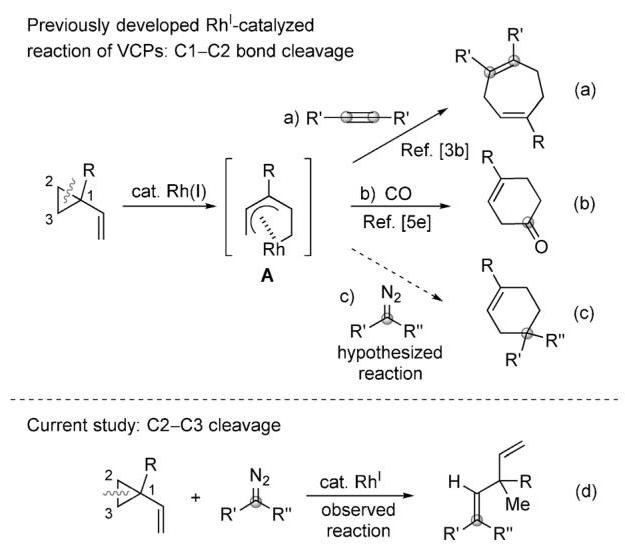
Scheme 1. Rhodium (I)-catalyzed reaction of VCPs through C-C bond cleavage.
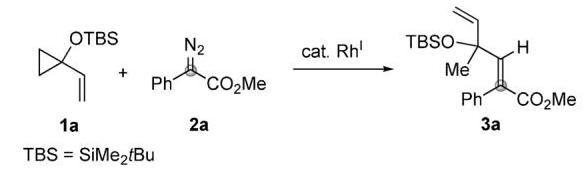
At the outset of the study, the siloxyvinycyclopropane 1a and $\alpha$ -diazoester $2\mathbf{a}$ were chosen as the substrates. With $\left\lbrack {\left\{ \mathrm{{Rh}}{\left( \mathrm{{CO}}\right) }_{2}\mathrm{{Cl}}\right\} }_{2}\right\rbrack$ as the catalyst and DCE as the solvent, the reaction was carried out at ${80}^{ \circ }\mathrm{C}$ for 4 hours, thus affording $3\mathbf{a}$ in 21% yield (Table 1, entry 1). With the initial result in hand, we proceeded to optimize the reaction conditions. In our first attempt (entry 1), we found that the low yield was due to the dimerization of $\mathbf{{2a}}$ , and $\mathbf{{1a}}$ largely remained unchanged. With slow addition of the diazoester, the yield was increased to 59% (entry 2). Switching to other solvents failed to significantly promote the reaction, and only 1,4-dioxane could give a slightly higher yield (entries 3-5). We then explored the effectiveness of other rhodium(I) catalysts. With Wilkinson’s catalyst, which has been typically employed in intramolecular [5+2] cycloaddition, ${}^{\left\lbrack 2\right\rbrack }$ 3a could also be obtained in comparable yields (entries 6 and 7). Gratifyingly, when [{Rh- (cod)Cl}2] was employed, 3a was isolated in 88% yield (entry 8). Lowering or elevating the reaction temperature did not show significant effect on the reaction (entries 9 and 10). Finally, under the optimized reaction conditions, if all the diazoester is added at once the yield fell to 11% (entry 11).
[*] S. Feng, Prof. F. Mo, Dr. Y. Xia, Z. Liu, Z. Liu, Prof. Y. Zhang, Prof. J. Wang
Beijing National Laboratory of Molecular Sciences (BNLMS) and
Key Laboratory of Bioorganic Chemistry and Molecular
Engineering of Ministry of Education
College of Chemistry, Peking University
Beijing 100871 (China)
Prof. F. Mo
Department of Energy and Resources Engineering
College of Engineering, Peking University
Beijing 100871 (China)
- Supporting information for this article can be found under: http://dx.doi.org/10.1002/anie.201609642.
Table 1: Optimization experiments for the rhodium(I)-catalyzed reaction of $1\mathrm{a}$ and $2\mathrm{a}{.}^{\left\lbrack \mathrm{a}\right\rbrack }$
| Entry | Cat. ${\mathrm{{Rh}}}^{1}$ | Solvent (mL) | $T\left\lbrack {{}^{ \circ }\mathrm{C}}\right\rbrack$ | Yield ${\left\lbrack \% \right\rbrack }^{\left\lbrack b\right\rbrack }$ |
| ${1}^{\left\lbrack c\right\rbrack }$ | $\left\lbrack {\left\{ \mathrm{{Rh}}{\left( \mathrm{{CO}}\right) }_{2}\mathrm{{Cl}}\right\} }_{2}\right\rbrack$ | DCE (0.5) | 80 | 21[d] |
| 2 | $\left\lbrack {\left\{ \mathrm{{Rh}}{\left( \mathrm{{CO}}\right) }_{2}\mathrm{{Cl}}\right\} }_{2}\right\rbrack$ | DCE (0.1) | 80 | 59 |
| 3 | $\left\lbrack {\left\{ \mathrm{{Rh}}{\left( \mathrm{{CO}}\right) }_{2}\mathrm{{Cl}}\right\} }_{2}\right\rbrack$ | toluene (0.1) | 80 | 37 |
| 4 | $\left\lbrack {\left\{ \mathrm{{Rh}}{\left( \mathrm{{CO}}\right) }_{2}\mathrm{{Cl}}\right\} }_{2}\right\rbrack$ | 1,4-dioxane (0.1) | 80 | 61 |
| 5 | $\left\lbrack {\left\{ \mathrm{{Rh}}{\left( \mathrm{{CO}}\right) }_{2}\mathrm{{Cl}}\right\} }_{2}\right\rbrack$ | THF (0.1) | 80 | 50 |
| 6 | [Rh ${\left( {\mathrm{{PPh}}}_{3}\right) }_{3}\mathrm{{Cl}}$ ] | 1,4-dioxane (0.1) | 80 | 39 |
| 7 | [Rh ${\left( {\mathrm{{PPh}}}_{3}\right) }_{3}\mathrm{{Cl}}$ ] | ${\mathrm{{CDCl}}}_{3}$ (0.1) | 80 | 50 |
| 8 | [\{Rh(cod)Cl\}2] | 1,4-dioxane (0.1) | 80 | 89 (88) |
| 9 | [\{Rh(cod)Cl\}2] | 1,4-dioxane (0.1) | 70 | 80[d] |
| 10 | $\left\lbrack {\{ \mathrm{{Rh}}\left( \mathrm{{cod}}\right) \mathrm{{Cl}}{\} }_{2}}\right\rbrack$ | 1,4-dioxane (0.1) | 90 | 85[d] |
| 11 [C] | $\left\lbrack {\{ \mathrm{{Rh}}\left( \mathrm{{cod}}\right) \mathrm{{Cl}}{\} }_{2}}\right\rbrack$ | 1,4-dioxane (0.45) | 80 | 11 |
[a] If not otherwise noted, the reaction was carried out under the following reaction conditions: 1a (0.10 mmol) and cat. rhodium(I) (5 mol%) were dissolved in the solvent and the solution was stirred at the indicated temperature. To the solution was added dropwise over ${1.5}\mathrm{\;h}$ the solution of $2\mathrm{a}\left( {{0.15}\mathrm{{mmol}}}\right)$ dissolved in the same solvent $\left( {{0.35}\mathrm{\;{mL}}}\right)$ . The solution was stirred for another ${2.5}\mathrm{\;h}$ . [b] The yield was determined by ${}^{1}\mathrm{H}$ NMR spectroscopy if not otherwise noted. [c] 2 a was directly mixed with $1\mathrm{a}$ in solution. [d] Yield of isolated product.
With the optimized reaction conditions established, we then examined the substrate scope of this reaction (Scheme 2). A series of diazoesters (2a-t) were tested with 1a under the standard reaction conditions. To our delight, para- (2b-i), meta- (2j-m), ortho- (2n), and multisubstituted aryl diazoesters (2o) could all smoothly participate in this ring-opening reaction, thus affording the corresponding products 3b-o in good to excellent yields. Moreover, a naphthyl diazoester (2p) was also an efficient coupling partner. Replacing the carbomethoxy group in $\mathbf{{2a}}$ with more bulky ester groups (2q-s) had little effect on the efficiency of this reaction. When an optically pure diazoester (2t) was subjected to the reaction, equal amounts of the diastereoisomers were obtained. If the vinyl group is substituted by a butyl group, the butyl substituent remains on the vinyl group in the product (3u), thus indicating that the vinyl moiety in the product comes from the vinyl substituent instead of from the ethidene group in the VCP.
When a triisopropylsilyl substituted VCP (2v) was employed, the corresponding product was also formed, despite the lower yield. Next, the reaction of alkyl diazoesters $\left( {2\mathbf{w} - \mathbf{x}}\right)$ with $1\mathbf{a}$ was examined, and these diazoesters also proved to be good reaction partners. Notably, for all the reactions the stereoselectivity for the double bond in the products is excellent but in most cases the isolated products contain a trivial amount of isomers as judged by GC-MS and NMR analysis. The structure of two of the products $3\mathbf{h}$ and $3\mathbf{i}$ were unambiguously determined, by X-ray crystallography, as having an $E$ configuration. ${}^{\left\lbrack 9\right\rbrack }$ The configurations of all the other products are assigned as $E$ based on their ${}^{1}\mathrm{H}$ NMR spectra.
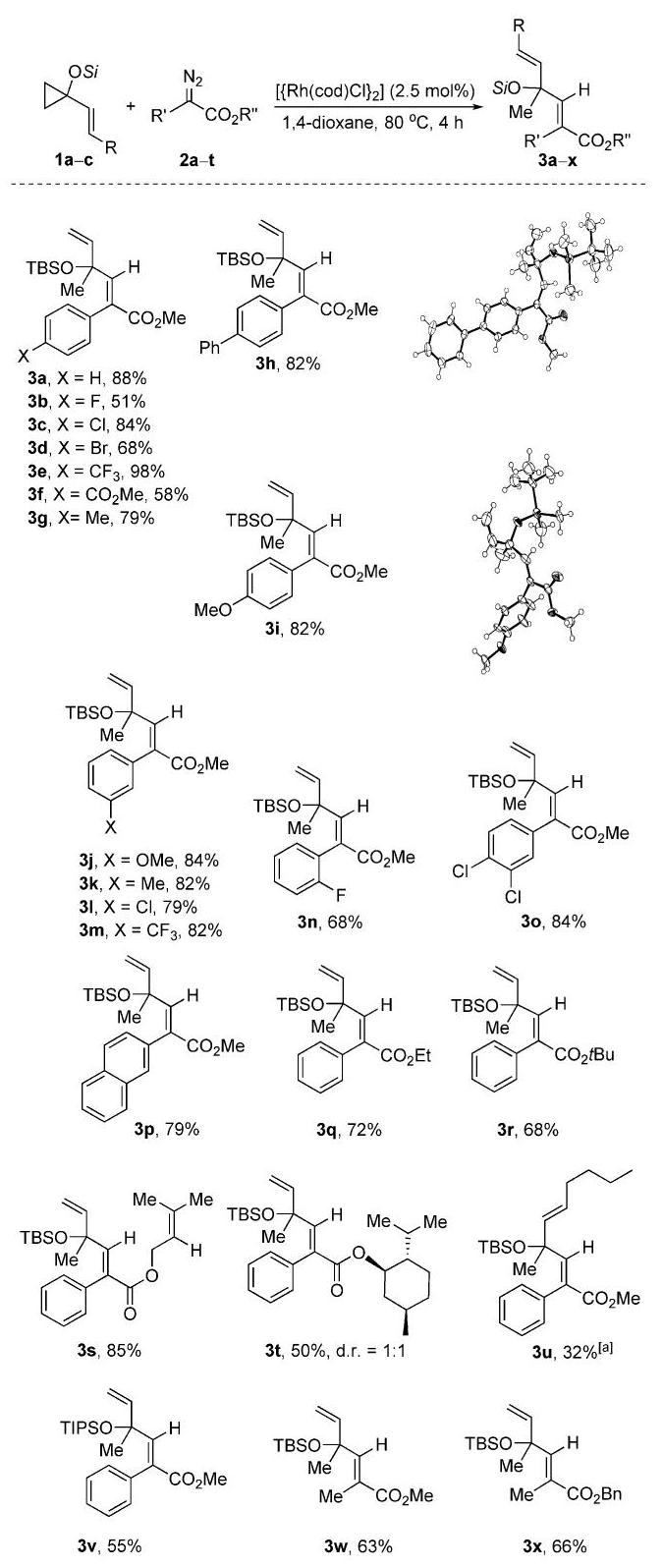
Scheme 2. Reaction scope. Unless otherwise noted, the reaction conditions are those described in entry 8 of Table 1. [a] The reaction was carried out at ${100}^{ \circ }\mathrm{C}$ . Thermal ellipsoids shown at ${30}\%$ probability for the X-ray structures of $3\mathrm{\;h}$ and $3\mathrm{i}$ . TBS $= {\mathrm{{SiMe}}}_{2}t\mathrm{{Bu}}$ , TIPS $= {\mathrm{{SiPr}}}_{3}$ .
To gain insight into the reaction mechanism, a stoichiometric reaction between $\left\lbrack {\mathrm{{Rh}}{\left( {\mathrm{{PPh}}}_{3}\right) }_{3}\mathrm{{Cl}}}\right\rbrack$ and $\mathbf{{1a}}$ was carried out at ${80}^{ \circ }\mathrm{C}$ for 30 minutes, and the $\sigma ,{\eta }^{3}$ -allyl rhodium species 4 was isolated in 44% yield (Scheme 3a). Its structure was determined by single-crystal X-ray analysis (Figure 1). ${}^{\left\lbrack 9\right\rbrack }$ Such a $\sigma ,{\eta }^{3}$ -allyl rhodium complex has been proposed as the key intermediate in rhodium(I)-catalyzed cycloaddition reactions of VCPs and $\pi$ -systems, however, isolation and characterization of such a complex is scarce. Bleeke and co-workers reported the single-crystal X-ray structure of [(2-tert-butyl- 1,3,4,5-η-pentenediyl) $\mathrm{{Fe}}{\left( {\mathrm{{PEt}}}_{3}\right) }_{2}{\left( \mathrm{{CNCMe}}\right) }_{3}$ ], but this complex was generated from deprotonation of $\left\lbrack \left( {\eta }^{5}\right. \right.$ -pentadienyl $)$ Fe- $\left. {\left( {\mathrm{{PMe}}}_{3}\right) }^{ + }\right\rbrack$ instead of from the reaction of iron catalyst with VCP. ${}^{\left\lbrack {10}\mathrm{a}\right\rbrack }$ Brown and co-workers synthesized the tetramer of a $\sigma ,{\eta }^{3}$ -allyl rhodium complex by reacting exo-6-vinylbicyclo- [3.1.0]hex-2-ene with $\left\lbrack {\left\{ \mathrm{{Rh}}{\left( {\mathrm{C}}_{2}{\mathrm{H}}_{4}\right) }_{2}\left( \text{ hfacac }\right) \right\} }_{2}\right\rbrack$ and confirmed its structure through X-ray diffraction. ${}^{\left\lbrack {10}\mathrm{\;b}\right\rbrack }$ A bipyridine ligated $\sigma ,{\eta }^{3}$ -allyl rhodium complex was reported by Jun and co-workers, ${}^{\left\lbrack {10}\mathrm{c}\right\rbrack }$ however, bipyridine has never been demonstrated to be an effective ligand in rhodium(I)-catalyzed cycloaddition reactions involving VCPs. Furthermore, they did not provide evidence on the structure of such a complex. To date, structural information for a monomer of $\sigma ,{\eta }^{3}$ -allyl rhodium complex obtained from the reaction of VCP derivatives with rhodium(I) catalysts is still lacking. Therefore, our finding provides valuable structural information for the investigation on the mechanism of rhodium(I)-catalyzed cycloaddition reactions involving VCPs.
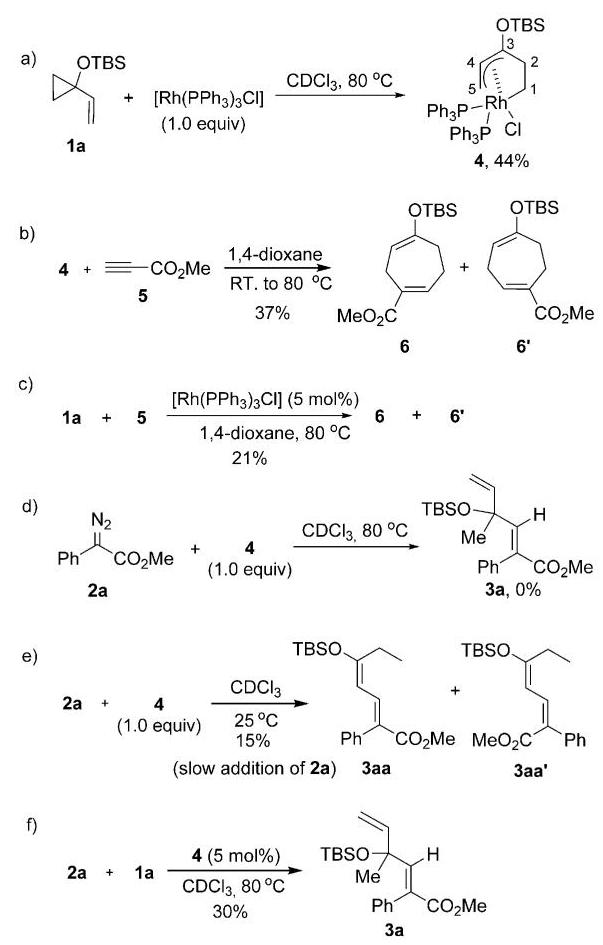
Scheme 3. Experiments for mechanistic understanding.
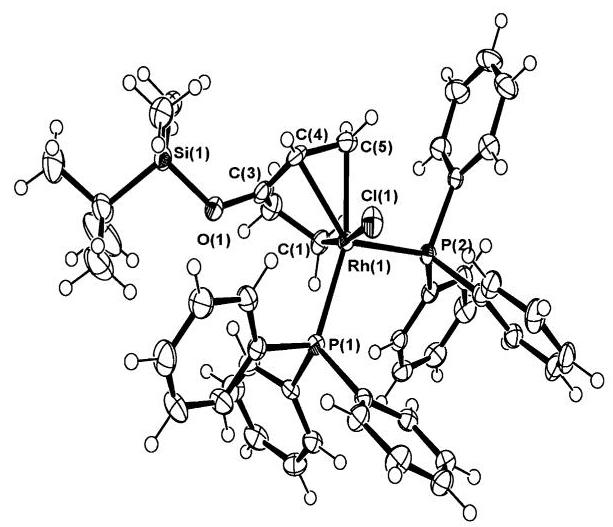
Figure 1. X-ray structure of the σ, ${\eta }^{3}$ -allyl rhodium complex 4. Thermal ellipsoids shown at 30% probability. Selected bond lengths [Å]: Rh-C(1) 2.079, Rh-C(3) 2.436, Rh-C(4) 2.215, Rh-C(5) 2.105, C(1)-C(2) 1.521, C(2)-C(3) 1.501, C(3)-C(4) 1.374, C(4)-C(5) 1.430.
With the rhodium complex 4 in hand, we proceeded to investigate its properties. Interestingly, we found that 4 in solution decomposes at elevated temperature to form [{Rh- $\left. {{\left( {\mathrm{{PPh}}}_{3}\right) }_{2}\mathrm{{Cl}}{\} }_{2}}\right\rbrack$ and other unidentified compounds, but4was regenerated with the treatment of silica gel. ${}^{\left\lbrack {11}\right\rbrack }$ Moreover,4 was found to react with the alkyne 5 to give the [5+2] cycloadducts 6 and ${6}^{\prime }$ in 37% yield (Scheme 3b), while the corresponding catalytic reaction between $1\mathrm{a}$ and5afforded 6 and ${6}^{\prime }$ in 21% yield (Scheme 3c). These results provide direct experimental support for the previously proposed mechanism of rhodium(I)-catalyzed reaction between VCPs and alkynes.
To find out whether4is also the key intermediate in reactions between VCPs and diazoesters,4was subjected to the reaction with $2\mathbf{a}$ at ${80}^{ \circ }\mathrm{C}$ . However, the formation of $3\mathbf{a}$ was not observed as judged by GC-MS and ${}^{1}\mathrm{H}$ NMR spectra, and 4 decomposed completely (Scheme 3d). Furthermore, with slow addition of $\mathbf{{2a}}$ into the solution of4at ${25}^{ \circ }\mathrm{C}$ , two isomers (3aa and 3aa’) of 3a were obtained in low yields, but 3a was not formed under such reaction conditions (Scheme 3e). The formation of $\mathbf{{3aa}}$ and ${\mathbf{{3aa}}}^{\prime }$ can be rationalized by the rhodium carbene formation from the reaction of $\mathbf{{2a}}$ with 4, followed by migratory insertion, $\beta$ -H elimination, and reductive elimination. Interestingly, 3a could be obtained in 30% yield when $\mathbf{{1a}}$ was reacted with $\mathbf{{2a}}$ at ${80}^{ \circ }\mathrm{C}$ with4as the catalyst (Scheme 3 f).
We also investigated the reactivity of VCP with other rhodium(I) catalysts which were found to be capable of catalyzing this reaction. In stoichiometric reactions between 1a and $\left\lbrack {\left\{ \mathrm{{Rh}}\left( \mathrm{{cod}}\right) \mathrm{{Cl}}\right\} }_{2}\right\rbrack$ at both room temperature as well as ${80}^{ \circ }\mathrm{C}$ , we found that $\mathbf{{1a}}$ completely remained unchanged and no sign of the $\sigma ,{\eta }^{3}$ -allyl rhodium complex was observed in the ${}^{1}$ H NMR spectra. ${}^{\left\lbrack {11}\right\rbrack }$ In contrast to this, the stoichiometric reaction between $1\mathrm{a}$ and $\left\lbrack {\left\{ \mathrm{{Rh}}{\left( \mathrm{{CO}}\right) }_{2}\mathrm{{Cl}}\right\} }_{2}\right\rbrack$ proceeded very quickly at room temperature to afford a mixture which supposedly consisted of $\sigma ,{\eta }^{3}$ -allyl and $\sigma ,{\eta }^{1}$ -allyl rhodium species. ${}^{\left\lbrack 3b\right\rbrack }$ After the mixture was heated at ${80}^{ \circ }\mathrm{C}$ for 30 minutes, these two complexes did not decompose though their ratio changed, and about 5% of VCP still remained. Therefore we can conclude that the reaction between VCP and $\left\lbrack {\left\{ \mathrm{{Rh}}{\left( \mathrm{{CO}}\right) }_{2}\mathrm{{Cl}}\right\} }_{2}\right\rbrack$ is fast and reversible. The solid extracted from this solution was also used to catalyze the standard reaction, and the product was obtained in 35% yield. ${}^{\left\lbrack {11}\right\rbrack }$
These results lead us to conclude that the widely accepted $\sigma ,{\eta }^{3}$ -allyl rhodium intermediate in VCP-involved rhodium-catalyzed reactions may not be a key intermediate in the catalytic cycle of this reaction. Instead, it more likely serves as a resting state for the catalyst in the cases of $\left\lbrack {\mathrm{{Rh}}{\left( {\mathrm{{PPh}}}_{3}\right) }_{3}\mathrm{{Cl}}}\right\rbrack$ and $\left\lbrack {\left\{ \mathrm{{Rh}}{\left( \mathrm{{CO}}\right) }_{2}\mathrm{{Cl}}\right\} }_{2}\right\rbrack$ catalysis. Since the diazo substrate is slowly added by peristaltic pump to the reaction solution, the fast reaction between VCP and $\left\lbrack {\mathrm{{Rh}}{\left( {\mathrm{{PPh}}}_{3}\right) }_{3}\mathrm{{Cl}}}\right\rbrack$ or $\lbrack \{ \mathrm{{Rh}} - \; \left. {{\left( \mathrm{{CO}}\right) }_{2}\mathrm{{Cl}}{\} }_{2}}\right\rbrack$ may reach an equilibrium at ${80}^{ \circ }\mathrm{C}$ . As the diazoester enters the solution, in comparison with 4 , the sterically less hindered rhodium(I) species, which is in equilibrium with the former, readily reacts with the diazo substrate to generate rhodium carbene intermediate. Since the formation of rhodium carbene is irreversible, the consumption of the rhodium(I) species will cause the equilibrium between ${\mathrm{{Rh}}}^{\mathrm{I}}$ and $\sigma ,{\eta }^{3}$ -allyl ${\mathrm{{Rh}}}^{\mathrm{{III}}}$ to shift. Thus,4 only serves as a resting state for the active catalyst.
Based on the above rationalization, a plausible mechanism is proposed (Scheme 4). First, the rhodium(I) carbene $\mathbf{A}$ is formed from the reaction of $\mathbf{{2a}}$ with a rhodium(I) species. The formation of the rhodium(I) carbene dramatically increases the steric hindrance around the rhodium center. Because of the bulky siloxy group on C1 of $\mathbf{{1a}}$ , it is difficult for the rhodium carbene to approach the C1-C2 bond of the VCP and thus the cleavage of this bond is hampered. Instead, the rhodium carbene inserts into the less crowded C2-C3 bond of VCP to generate the cyclic rhodium(III) complex B. Subsequently, $\mathbf{B}$ undergoes migratory insertion, $\beta$ -H elimination, and reductive elimination to afford the product and regenerate the catalyst. ${}^{\left\lbrack {12}\right\rbrack }$ To probe the role of vinyl and siloxy groups of VCPs in this reaction, other cyclopropane derivatives were synthesized and subjected to the standard reaction conditions. ${}^{\left\lbrack {11}\right\rbrack }$
In conclusion, we have demonstrated the first example of transition metal induced, selective cleavage of the C2-C3 bond of VCPs. Increasing the steric hindrance around the rhodium center, by forming rhodium carbene, is proposed to be the rationale for this process. This finding highlights the possibility that by ligating the transition-metal center with bulky ligands, regioselective cleavage of C2-C3 bond in VCPs might occur to afford a four-membered metallocyclic species. If such a process is achieved, its combination with a $\pi$ -system insertion process can open up new chemistry in the field of developing VCPs-involved cycloaddition reactions. Furthermore, we have isolated and characterized a $\sigma ,{\eta }^{3}$ -allyl rhodium complex and it proved to be the key intermediate in the rhodium(I)-catalyzed reactions of VCPs and alkynes.
Acknowledgments
The project is supported by the National Basic Research Program of China (973 Program, No. 2015CB856600) and NSFC (Grant 21472004 and 21332002). F.M. and Y.X. contributed equally to this work. We greatly appreciate Prof. Wenxiong Zhang and Dr. Nengdong Wang (Peking University) for the assistance in obtaining X-ray crystallographic structures. We also thank Prof. Zhixiang Yu and Mr. Yi Wang (Peking University) for mechanistic discussions.
Keywords: C-C activation $\cdot$ carbenes $\cdot$ diazo compounds $\cdot$ rhodium $\cdot$ small ring systems
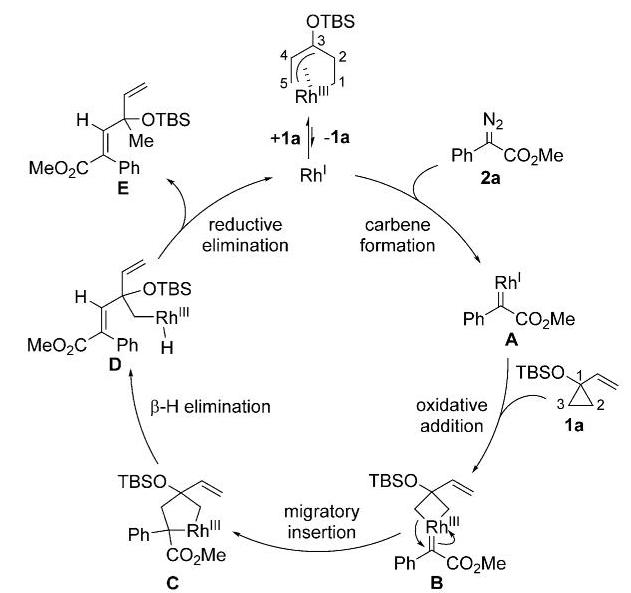
Scheme 4. Proposed mechanism.
4
[1] For reviews, see: a) M. Rubin, M. Rubina, V. Gevorgyan, Chem. Rev. 2007, 107, 3117-3179; b) K. E. O. Ylijoki, J. M. Stryker, Chem. Rev. 2013, 113, 2244-2266; c) L. Jiao, Z. Yu, J. Org. Chem. 2013, 78, 6842-6848; d) Y. Wang, Z. Yu, Acc. Chem. Res. 2015, 48, 2288-2296.
[2] P. A. Wender, H. Takahashi, B. Witulski, J. Am. Chem. Soc. 1995, 117, 4720-4721.
[3] For selected examples of [5+2] cycloadditions, see: a) P. A. Wender, C. O. Husfeld, E. Langkopf, J. A. Love, J. Am. Chem. Soc. 1998, 120, 1940-1941; b) P. A. Wender, H. Rieck, M. Fuji, J. Am. Chem. Soc. 1998, 120, 10976-10977; c) P. A. Wender, T. M. Pedersen, M. J. C. Scanio, J. Am. Chem. Soc. 2002, 124, 15154- 15155; d) H. A. Wegner, A. Meijere, P. A. Wender, J. Am. Chem. Soc. 2005, 127, 6530-6531.
[4] For [3+2] cycloadditions, see: a) L. Jiao, S. Ye, Z. Yu, J. Am. Chem. Soc. 2008, 130, 7178-7179; b) L. Jiao, M. Lin, Z. Yu, Chem. Commun. 2010, 46, 1059-1061; c) Q. Li, G. Jiang, L. Jiao, Z. Yu, Org. Lett. 2010, 12, 1332-1335; d) M. Lin, G. Y. Kang, Y. A. Guo, Z. Yu, J. Am. Chem. Soc. 2012, 134, 398-405.
[5] For [5+2+1]/[3+2+1]/[5+1] cycloadditions, see: a) P. A. Wender, G. G. Gamber, R. D. Hubbard, L. Zhang, J. Am. Chem. Soc. 2002, 124, 2876-2877; b) Y. Wang, J. Wang, J. Su, F. Huang, L. Jiao, Y. Liang, D. Yang, S. Zhang, P. A. Wender, Z. Yu, J. Am. Chem. Soc. 2007, 129, 10060-10061; c) L. Jiao, M. Lin, L. Zhuo, Z. Yu, Org. Lett. 2010, 12, 2528-2531; d) M. Lin, F. Li, L. Jiao, Z. Yu, J. Am. Chem. Soc. 2011, 133, 1690-1693; e) G. Jiang, X. Fu, Q. Li, Z. Yu, Org. Lett. 2012, 14, 692-695.
[6] For mechanistic studies, see: a) Z. Yu, P. A. Wender, K. N. Houk, J. Am. Chem. Soc. 2004, 126, 9154-9155; b) P. Liu, L. E. Sirois, P. H. Cheong, Z. Yu, I. V. Hartung, H. Rieck, P. A. Wender, K. N. Houk, J. Am. Chem. Soc. 2010, 132, 10127-10135; c) L. Jiao, M. Lin, Z. Yu, J. Am. Chem. Soc. 2011, 133, 447-461; d) M. C. Melcher, H. Wachenfeldt, A. Sundin, D. Strand, Chem. Eur. J. 2015, 21, 531-535.
[7] For reviews, see: a) J. Barluenga, C. Valdés, Angew. Chem. Int. Ed. 2011, 50, 7486-7500; Angew. Chem. 2011, 123, 7626-7640; b) Z. Shao, H. Zhang, Chem. Soc. Rev. 2012, 41, 560-572; c) Q. Xiao, Y. Zhang, J. Wang, Acc. Chem. Res. 2013, 46, 236-247; d) Z. Liu, J. Wang, J. Org. Chem. 2013, 78, 10024-10030; e) Y. Xia, Y. Zhang, J. Wang, ACS Catal. 2013, 3, 2586-2598.
[8] Y. Xia, Z. Liu, Z. Liu, R. Ge, F. Ye, M. Hossain, Y. Zhang, J. Wang, J. Am. Chem. Soc. 2014, 136, 3013-3015.
[9] CCDC 1494934, 1494935 and 1494936 contain the supplementary crystallographic data for $3\mathbf{h},3\mathbf{i}$ , and4, respectively. These data can be obtained free of charge from The Cambridge Crystallographic Data Centre via www.ccdc.cam.ac.uk/data_request/cif.
[10] a) R. J. Bleeke, R. J. Wittenbrink, T. W. Clayton, M. Y. Chiang, J. Am. Chem. Soc. 1990, 112, 6539-6545; b) N. W. Alcock, J. M. Brown, J. A. Conneely, D. H. Williamson, J. Chem. Soc. Perkin Trans. 2 1979, 962-971; c) C. Jun, J. Kang, Y. Lim, Tetrahedron Lett. 1995, 36, 277-280.
[11] For details, see the Supporting Information.
[12] As suggested by one of the referees, an alternative mechanism which involves an $\alpha$ -hydride elimination from the intermediate B to generate a metallocyclobutene intermediate with two carbene ligands on the rhodium center, followed by carbene dimerization and reductive elimination to form the $\mathrm{C} - \mathrm{H}$ bond, is also possible. Further computational and experimental studies to unambiguously elucidate the mechanism are currently under way and the results will be reported in due course.
Received: October 2, 2016
Published online:
Communications
Communications
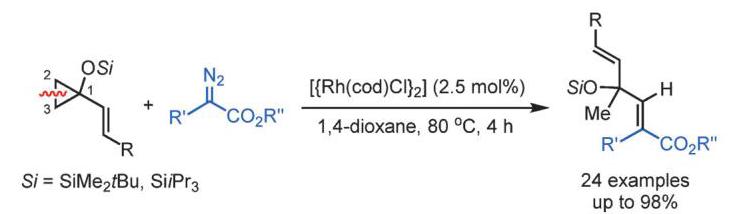
plex, which has been previously proposed
Break of a different kind: The title reaction demonstrates a novel mode of $\mathrm{C} - \mathrm{C}$ bond cleavage of siloxyvinylcyclopro-as the key intermediate in rhodium(I)-
catalyzed cycloaddition of vinylcyclopro-
panes. In the study of the reaction panes, has been isolated and character-
mechanism, a $\sigma ,{\eta }^{3}$ -allyl rhodium com-ized by X-ray crystallography.
Diazo Compounds
S. Feng, F. Mo, Y. Xia, Z. Liu, Z. Liu,
Y. Zhang, J. Wang* ___ IIII-III
Rhodium (I)-Catalyzed C-C Bond Activation of Siloxyvinylcyclopropanes with Diazoesters