Metal-Free Aromatic Carbon–Phosphorus Bond Formation via a Sandmeyer-Type Reaction
中文 / Bilingual · English version
Shuai Wang, Di Qiu, Fanyang Mo, Yan Zhang, and Jianbo Wang
J. Org. Chem., Just Accepted Manuscript • DOI: 10.1021/acs.joc.66b01820 • Publication Date (Web): 28 Oct 2016 Downloaded from http://pubs.acs.org on October 28, 2016
Just Accepted
“Just Accepted” manuscripts have been peer-reviewed and accepted for publication. They are posted online prior to technical editing, formatting for publication and author proofing. The American Chemical Society provides “Just Accepted” as a free service to the research community to expedite the dissemination of scientific material as soon as possible after acceptance. “Just Accepted” manuscripts appear in full in PDF format accompanied by an HTML abstract. “Just Accepted” manuscripts have been fully peer reviewed, but should not be considered the official version of record. They are accessible to all readers and citable by the Digital Object Identifier (DOI®). “Just Accepted” is an optional service offered to authors. Therefore, the “Just Accepted” Web site may not include all articles that will be published in the journal. After a manuscript is technically edited and formatted, it will be removed from the “Just Accepted” Web site and published as an ASAP article. Note that technical editing may introduce minor changes to the manuscript text and/or graphics which could affect content, and all legal disclaimers and ethical guidelines that apply to the journal pertain. ACS cannot be held responsible for errors or consequences arising from the use of information contained in these “Just Accepted” manuscripts.
ACS Publications
The Journal of Organic Chemistry is published by the American Chemical Society.
Published by American Chemical Society. Copyright © American Chemical Society. However, no copyright claim is made to original U.S. Government works, or works produced by employees of any Commonwealth realm Crown government in the course
Metal-Free Aromatic Carbon-Phosphorus Bond Formation via a Sandmeyer-Type Reaction
Shuai Wang, Di Qiu, Fanyang Mo, Yan Zhang and Jianbo Wang*
Beijing National Laboratory of Molecular Sciences (BNLMS), Key Laboratory of Bioorganic
Chemistry and Molecular Engineering of Ministry of Education, College of Chemistry, Peking
University, Beijing 100871, China
RECEIVED DATE (to be automatically inserted after your manuscript is accepted if required according to the journal that you are submitting your paper to)
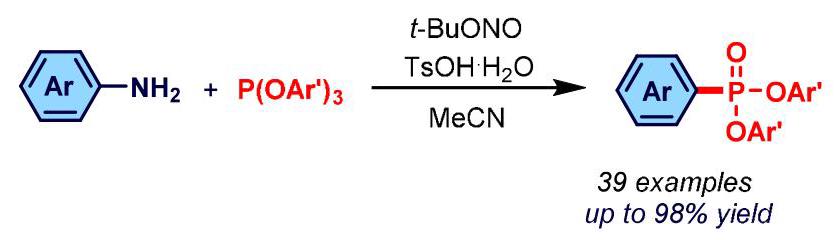
ABSTRACT. An efficient metal-free phosphorylation process based on a Sandmeyer-type transformation with arylamines as the starting materials is developed. The transformation proceeds smoothly at room temperature without the exclusion of moisture or air. This phosphorylation reaction tolerates wide range of functional groups and affords the phosphorylation products in moderate to good yields, thus providing a valuable method for the formation of aromatic carbon-phosphorus bonds.
INTRODUCTION
Aryl phosphonates belong to an important class of organophosphorus compounds due to their applications in medicinal chemistry, ${}^{1}$ material sciences, ${}^{2}$ and organic synthesis, ${}^{3}$ which makes the synthesis of this type of compounds of significant importance. The traditional methods to construct the aromatic carbon-phosphorus bonds in these compounds involve nucleophilic substitution reaction of organometallic reagent with electrophilic phosphine reagent (Scheme 1a), ${}^{4}$ Michaelis-Arbuzov reaction ${}^{5}$ and Friedel-Crafts reaction. ${}^{6}$ Additionally, the transition-metal-catalyzed cross-coupling reaction of aryl (pseudo)halides or some other compounds, such as aryltriflates, tosylates, boronic acids and hydrazine with phosphorus(III) compounds has been explored extensively since Hirao and co-workers’ pioneering work in ${1980}.{}^{7,8}$ Due to the excellent efficiency and remarkable functional group tolerance, the transition-metal-catalyzed coupling strategy has been widely utilized in carbon-phosphorus bond formation (Scheme 1b). Despite of the significant progresses, these methods still suffer from some limitations, such as the use of metal reagents and the requirement of relatively high temperature. Further efforts were made to construct aromatic carbon-phosphorus bonds under mild conditions, for example, Xiao and co-workers have recently reported that the employment of visible-light-induced photoredox catalysis achieves the nickel-catalyzed cross-coupling of aryl halide with diarylphosphine oxides at room temperature; ${}^{9}$ Toste and co-workers reported that, by employing dual gold and photoredox catalysis, aryldiazonium salts could react with $H$ -phosphonates at room temperature to form carbon-phosphorus bonds. ${}^{10}$ In spite of these remarkable improvements, highly efficient approaches for the construction of aromatic carbon-phosphorus bond under metal-free mild conditions, which could be served as alternative and supplementary methods for the synthesis of aryl phosphonate compounds, is still limited.
Scheme 1. Synthetic Methods for the Construction of Aromatic Carbon-Phosphorus Bonds
The common C-P bond forming methods
$$ \begin{array}{l} \mathrm{{Ar}} - \mathrm{M}\;\text{ Ar-M } \\ \text{ (M = Mg, Li, Zn) } \\ \text{ (M = Mg, Li, Zn) } \\ \end{array} $$(a)
$$ \mathrm{{Ar}} - \mathrm{X}\;\frac{\text{ cat. }\mathrm{{Pd}}/\mathrm{{Ni}}/\mathrm{{Cu}}\ldots }{\mathrm{H} - \mathrm{P}\left( \mathrm{O}\right) {\mathrm{R}}_{2}}\;\mathrm{{Ar}} = \overset{\begin{matrix} \mathrm{O} \\ \mathrm{I} \\ \mathrm{P} - \mathrm{R} \end{matrix}}{\mathrm{P}} \tag{b} $$(X = halogen, OTf, B(OH)2, etc.; R = alkyl, aryl, alkoxy, aryloxy)
Metal-free approach: this work
$$ {\mathrm{{Ar} - {NH}}}_{2}\xrightarrow[{\mathrm{P}{\left( {\mathrm{{OAr}}}^{\prime }\right) }_{3}}]{t - \mathrm{{BuONO}}}\mathrm{{Ar}} = \underset{{\mathrm{{OAr}}}^{\prime }}{\overset{\mathrm{O}}{\mathrm{P}}} - {\mathrm{{OAr}}}^{\prime } \tag{c} $$On the other hand, the transformation of aryldiazonium salts into various functional groups, such as halogen, hydroxyl group, cyano group, and sulfonates groups, known as Sandmeyer-type reactions, has been applied broadly both in laboratory research and industrial production. ${}^{11}$ The aryldiazonium salt intermediates, which could be in situ generated from aromatic amines, ${}^{12}$ has been recently explored in several new transformations. ${}^{{13},{14}}$ We have recently reported new approaches for the synthesis of arylboronic pinacol esters, arylstannane compounds, and trifluoromethylated arenes by using readily available arylamines as the starting materials. ${}^{14}$ Aryldiazonium salts have been previously reported to react with phosphorus trihalides since ${1950}\mathrm{\;s},{}^{15}$ but these transformations often suffer from poor yields and limited functional group tolerance. In view of the importance of aryl phosphonates compounds and our continued interest in the development of the transformations with aryldiazonium salts, we report herein an efficient approach for the metal-free C-P Bond formation through a similar Sandmeyer-type transformation. The important feature of this method is the use of triarylphosphites, which are stable and easy to handle, rather than the air-sensitive phosphorus trihalides, as the phosphorylation reagents.
RESULTS AND DISCUSSIONS
We began the study of the phosphorylation reaction with ethyl 4-aminobenzoate (1a) as the starting material. The arylamine 1a was firstly reacted with $t$ -BuONO (tert-butyl nitrite) in MeCN to form the corresponding aryldiazonium salt at $0{}^{ \circ }\mathrm{C}$ , and then trimethyl phosphite (2a) was added in sequence. To our delight, the expected phosphorylation product 3aa was obtained in a yield of 44% (Table 1, entry 1). As detected by GC-MS, the major by-products were ethyl benzoate, which was generated by the reduction of aryldiazonium salt species, and trimethyl phosphate. Since our previous study has indicated that acid can promote the generation of diazonium intermediate, ${}^{14c}$ we thus proceed to study the effect of acid additives. Indeed, the reaction proceeded more efficiently when TsOH was added (Table 1, entry 2), however, $\mathrm{{HCl}}$ and ${\mathrm{H}}_{2}{\mathrm{{SO}}}_{4}$ were found not suitable for this transformation (Table 1, entries 3 and 4), and the reaction failed to give 3aa when typical Lewis acid ${\mathrm{{BF}}}_{3}{\mathrm{{Et}}}_{2}\mathrm{O}$ was added (Table 1, entry 5). The product 3aa was formed in a lower yield when the reaction was carried out in DCM (dichloromethane) or DCE (dichloroethane) (Table 1, entries 6 and 7). No apparent improvement was observed when the reaction temperature was raised to ${80}{}^{ \circ }\mathrm{C}$ (Table 1, entry 8). Some other phosphorylation reagents were then explored. Triethyl phosphite (2b) gave only trace amount of the corresponding product 3ab (detected by GC-MS, Table 1, entry 9). Besides, only trace amount of ethyl benzoate was observed, because aryldiazonium salt was mainly transformed into some non-volatile species under this condition. To our delight, when triphenyl phosphite (2c) was employed as the phosphorus source, the corresponding product 3ac was produced in a yield of 78% (Table 1, entry 10). The increase of concentration showed almost no influence on the transformation (Table 1, entry 11). A low loading of $t$ -BuONO and $2\mathrm{c}$ led to the diminish of the yields of 3ac (Table 1, entries 12 and 13). The yield of 3ac could be further improved with a higher loading of 2c (Table 1, entry 14). One likely explanation for this result is that the higher equivalent of $3\mathrm{c}$ accelerates the phosphorylation process so that the generation of ethyl benzoate is inhibited.
Table 1. Optimization of Reaction Conditions ${}^{a}$
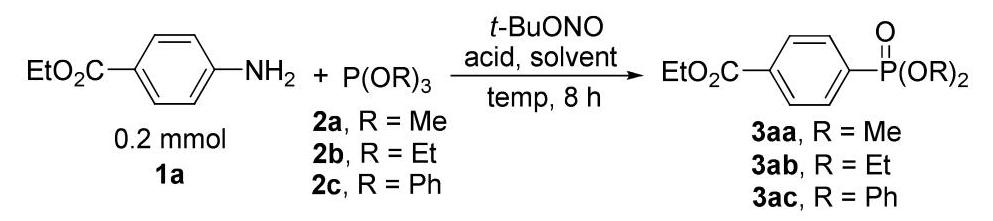
| entry | acid | solvent | temp | 2, R | 3, yield ${\left( \% \right) }^{b}$ |
| 1 | - | MeCN | 0°C-rt | $\mathbf{{2a}},\mathrm{{Me}}$ | 3aa, 44 |
| 2 | ${\mathrm{{TsOH}}}^{ \cdot }{\mathrm{H}}_{2}\mathrm{O}$ | MeCN | 0°C-rt | $\mathbf{{2a}},\mathrm{{Me}}$ | 3aa, 54 |
| 3 | HCl | MeCN | 0 °C-rt | $\mathbf{{2a}},\mathrm{{Me}}$ | 3aa, 16 |
| 4 | ${\mathrm{H}}_{2}{\mathrm{{SO}}}_{4}$ | MeCN | $0{}^{ \circ }\mathrm{C}$ -rt | $\mathbf{{2a}},\mathrm{{Me}}$ | 3aa, 20 |
| 5 | BF ${}_{3}$ Et ${}_{2}$ O | MeCN | $0{}^{ \circ }\mathrm{C}$ -rt | $\mathbf{{2a}},\mathrm{{Me}}$ | 3aa, -- |
| 6 | TsOH ${\mathrm{H}}_{2}\mathrm{O}$ | DCM | $0{}^{ \circ }\mathrm{C}$ -rt | 2a, Me | 3aa, 44 |
| 7 | TsOH ${\mathrm{H}}_{2}\mathrm{O}$ | DCE | $0{}^{ \circ }\mathrm{C}$ -rt | 2a, Me | 3aa, 17 |
| 8 | TsOH ${\mathrm{H}}_{2}\mathrm{O}$ | MeCN | ${0.80}^{ \circ }\mathrm{C}$ | 2a, Me | 3aa, 54 |
| 9 | TsOH ${\mathrm{H}}_{2}\mathrm{O}$ | MeCN | 0 °C-rt | 2b, Et | 3ab, trace |
| 10 | TsOH ${\mathrm{H}}_{2}\mathrm{O}$ | MeCN | $0{}^{ \circ }\mathrm{C}$ -rt | 2c, Ph | 3ac, 78 |
| ${11}^{c}$ | TsOH ${\mathrm{H}}_{2}\mathrm{O}$ | MeCN | $0{}^{ \circ }\mathrm{C}$ -rt | 2c, Ph | 3ac, 79 |
| ${12}^{d}$ | TsOH ${\mathrm{H}}_{2}\mathrm{O}$ | MeCN | $0{}^{ \circ }\mathrm{C}$ -rt | 2c, Ph | 3ac, 62 |
| ${13}^{e}$ | TsOH ${\mathrm{H}}_{2}\mathrm{O}$ | MeCN | $0{}^{ \circ }\mathrm{C}$ -rt | 2c, Ph | 3ac, 51 |
| ${14}^{f}$ | TsOH ${\mathrm{H}}_{2}\mathrm{O}$ | MeCN | $0{}^{ \circ }\mathrm{C}$ -rt | 2c, Ph | 3ac, 94 |
${}^{a}$ Unless otherwise noted, the reaction conditions are as following: arylamine ( ${0.2}\mathrm{{mmol}}$ ), $t$ -BuONO
(0.3 mmol), P(OR)3 (0.4 mmol), acid (0.24 mmol), solvent (1.0 mL). Arylamine firstly reacted with
$t$ -BuONO and acid at $0{}^{ \circ }\mathrm{C}$ for ${15}\mathrm{\;{min}}$ , and then the reaction system was allowed to warm to room temperature and $\mathrm{P}{\left( \mathrm{{OR}}\right) }_{3}$ was added. ${}^{b}$ Isolated yield. ${}^{c}{0.5}\mathrm{\;{mL}}$ solvent was used. ${}^{d}{0.3}\mathrm{{mmol}}\mathrm{P}{\left( \mathrm{{OR}}\right) }_{3}$ was added. ${}^{e}{0.24}\mathrm{{mmol}}t$ -BuONO was added. ${}^{f}{0.6}\mathrm{{mmol}}\mathrm{P}{\left( \mathrm{{OR}}\right) }_{3}$ was added.
With the optimized reaction conditions in hand, we then examined the substrate scope of this transformation with a series of functionalized arylamines using $2\mathbf{c}$ as the phosphorylation reagent (Scheme 2). The phosphorylation process has shown good functional group tolerance to both electron-withdrawing and electron-donating groups on the aromatic ring, including nitro (3b), cyano (3c), methyl (3d), halogen (3e and 3f), phenyl (3g), methylthio (3h), methoxy (3ic), acetyl (3j), alkynyl (3ra and 3rb), alkenyl (3w), azo group (3v), hydrogen (3z). In all the cases, the corresponding products were obtained in 40-98% yields. It is noteworthy that the tolerance of bromo and chloro groups, which is normally not compatible in transition-metal-catalyzed C-P bond construction approaches, makes possible of further transformation of the products with cross-coupling reactions.
Scheme 2. Substrate Scope of the Aniline Derivatives
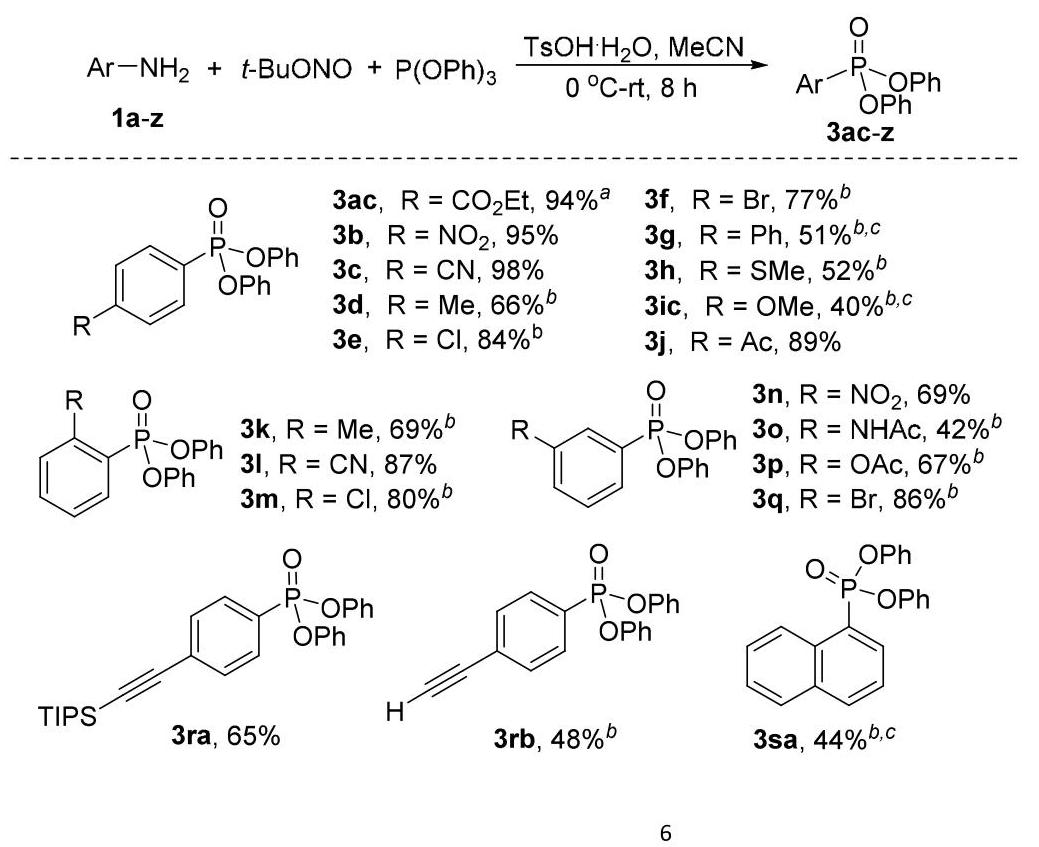
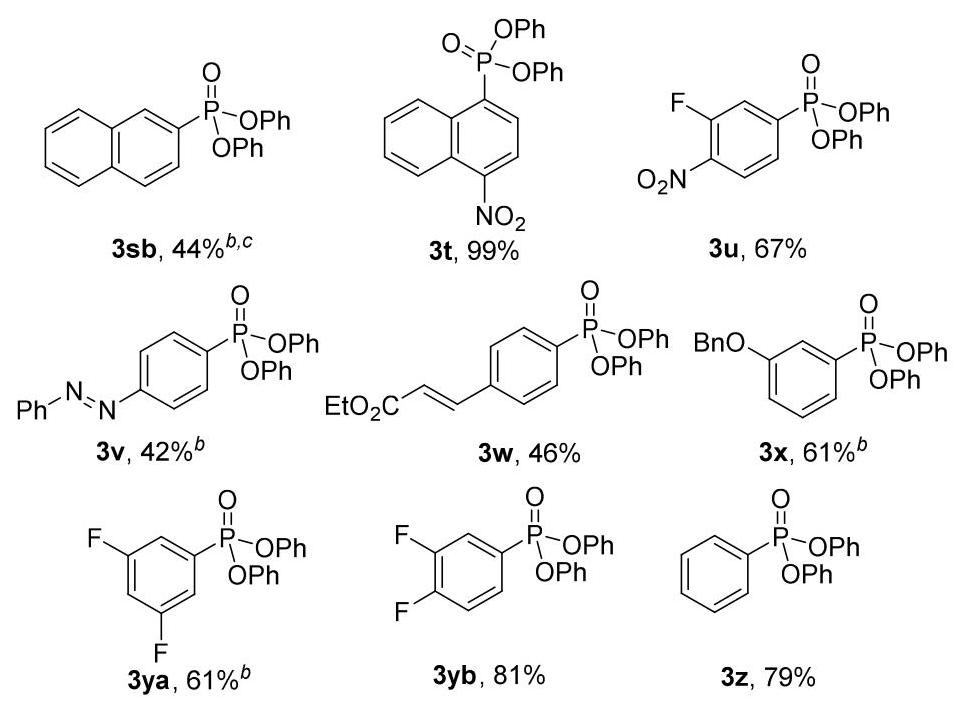
Reaction conditions: arylamine (0.2 mmol), t-BuONO (0.3 mmol), P(OPh)3 (0.6 mmol), TsOH ${\mathrm{H}}_{2}\mathrm{O} \; \left( {{0.24}\mathrm{{mmol}}}\right)$ , MeCN $\left( {{1.0}\mathrm{\;{mL}}}\right)$ . Arylamine was first reacted with $t$ -BuONO and acid at $0{}^{ \circ }\mathrm{C}$ for 15 min, and then the reaction system was warmed to room temperature and $\mathrm{P}{\left( \mathrm{{OPh}}\right) }_{3}$ was added. ${}^{a}$ Isolated yield after column chromatography. ${}^{b}$ The reaction of arylamine with $t$ -BuONO was carried out at room temperature for ${10}\mathrm{\;{min}}.{}^{c}{3.0}\mathrm{\;{mL}}$ MeCN was added.
The para-substituted aryl amines with electron-withdrawing groups could gave relatively higher yields; while the substrate with electron-donating para-methyl substituent afforded a moderate yield of 66% (3d). The $p$ -OMe substituted aniline gave a low yield of 40% (3ic). Similar yield could be achieved with ortho- and meta-substituted anilines (3k-q), indicating that the phosphorylation is not sensitive to the steric effect. For the naphthylamine 1sa and 1sb, the diminished yield might be attributed to the poor solubility of the corresponding diazonium salts.
We then expended the substrate scope of this phosphorylation reaction to the aromatic heterocyclic amine derivatives. The results shown in Scheme 3 indicate that the phosphorylation of some aromatic heterocyclic amine derivatives also works, but giving the phosphorylation products in low yields (5a-e). However, the phosphorylation reaction with some other aromatic heterocyclic amine derivatives did not occur (5f-h).
Scheme 3. Substrate Scope of Aromatic Heterocyclic Amine Derivatives
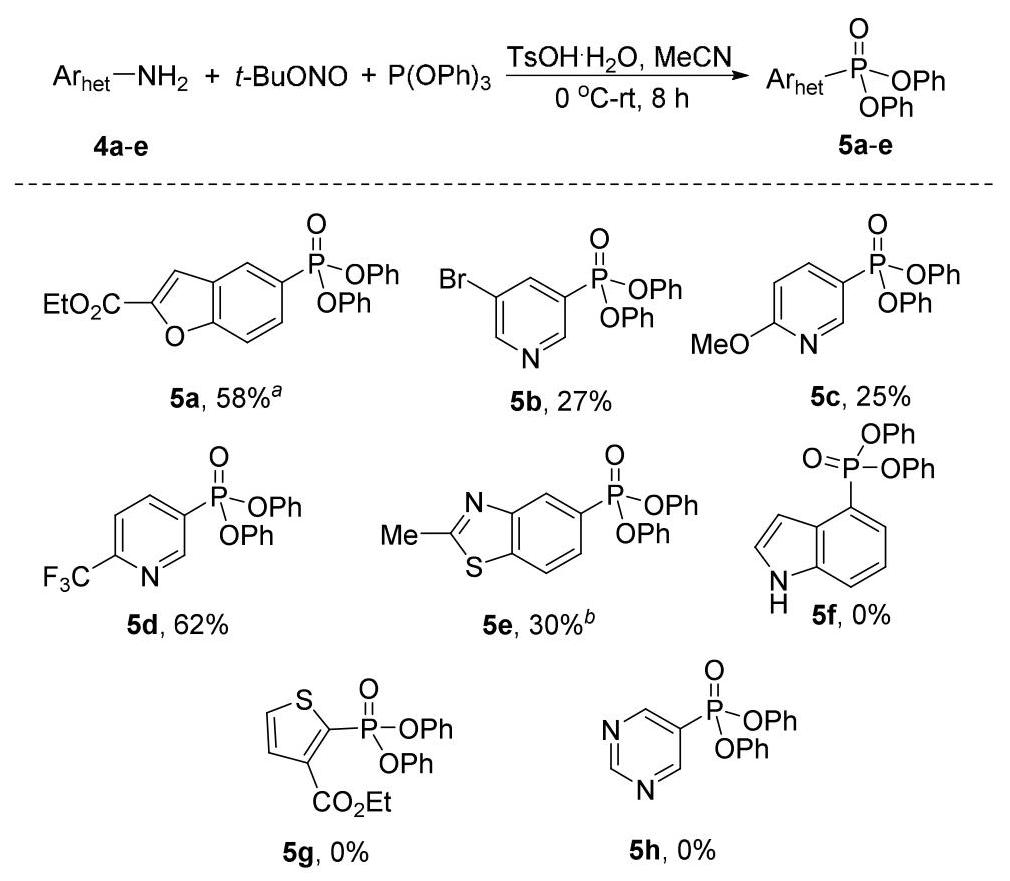
Unless otherwise noted, the reaction conditions are as following: arylamine ( ${0.2}\mathrm{{mmol}}$ ), t-BuONO $\left( {{0.3}\mathrm{{mmol}}}\right) ,\mathrm{P}{\left( \mathrm{{OPh}}\right) }_{3}\left( {{0.6}\mathrm{{mmol}}}\right) ,{\mathrm{{TsOH}}}_{2}\mathrm{O}\left( {{0.24}\mathrm{{mmol}}}\right)$ , MeCN $\left( {{1.0}\mathrm{\;{mL}}}\right)$ . Arylamine firstly reacted with $t$ -BuONO and acid at $0{}^{ \circ }\mathrm{C}$ for ${15}\mathrm{\;{min}}$ , and then the reaction system was warmed to room temperature and $\mathrm{P}{\left( \mathrm{{OPh}}\right) }_{3}$ was added. ${}^{a}$ Isolated yield with column chromatography. ${}^{b}$ The reaction of arylamine with $t$ -BuONO was carried out at room temperature for ${10}\mathrm{\;{min}}$ .
Next, the scope of a series of substituted triaryl phosphites (6a-d) was investigated and the results are summarized in Scheme 4. Good yields were achieved for the chloro- (7a) and bromo- (7b) substituted products, which could be convenient for further modifications. The tert-butyl substituted phosphite also gave a good yield of ${89}\% \left( {7\mathbf{d}}\right)$ , but the reaction with methoxy substituted substrate gave only diminished yield (7c).
Scheme 4. Substrate Scope of the Triaryl Phosphites
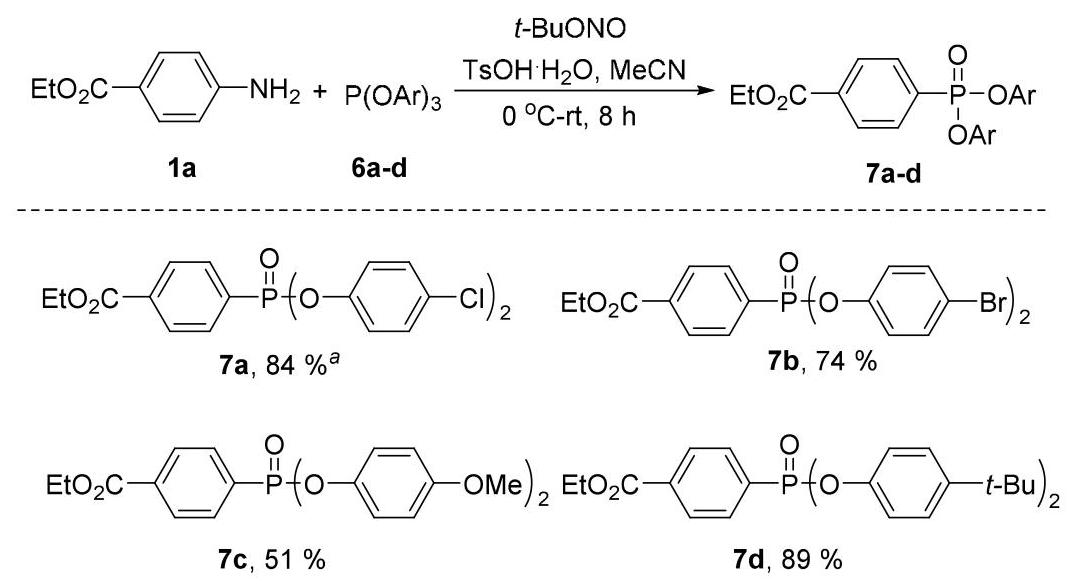
Reaction conditions: arylamine $\left( {{0.2}\mathrm{{mmol}}}\right) , t$ -BuONO $\left( {{0.3}\mathrm{{mmol}}}\right) ,\mathrm{P}{\left( \mathrm{{OAr}}\right) }_{3}\left( {{0.6}\mathrm{{mmol}}}\right) ,{\mathrm{{TsOH}}}_{2}\mathrm{O} \; \left( {{0.24}\mathrm{{mmol}}}\right) ,\mathrm{{MeCN}}\left( {{1.0}\mathrm{\;{mL}}}\right)$ . Arylamine firstly reacted with $t$ -BuONO and acid at $0{}^{ \circ }\mathrm{C}$ for 15 minutes, and then the reaction system was warmed to room temperature and $\mathrm{P}{\left( \mathrm{{OPh}}\right) }_{3}$ was added. ${}^{a}$ Isolated yield after column chromatography.
For a further demonstration of the practical application of this method, the phosphorylation reaction of three substrates was carried out in 20 mmol-scale for the gram-scale synthesis of products 3ac, 3d, and 3ic, as shown in Scheme 5. To our delight, the reaction offered the corresponding products with comparable yields.
Scheme 5. Gram-Scale Synthesis
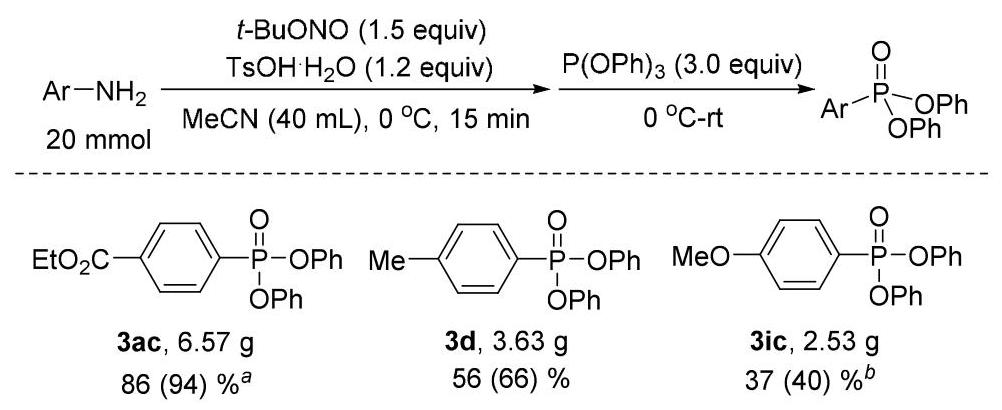
${}^{a}$ Isolated yield, the numbers in the brackets are the yields for the reaction carried out in 0.2 mmol-scale. ${}^{b}$ The reaction of arylamine with $t$ -BuONO was carried out at room temperature for 10 min.
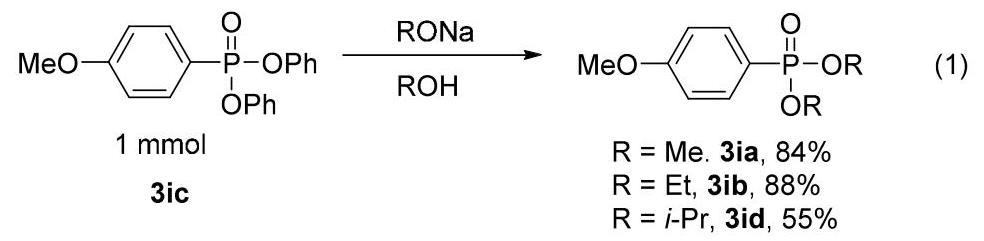
It is worth mentioning that the reaction using trialkyl phosphite (Table 1, 2a, b) as the phosphorylation reagent could only give a low yield, which might be a potential limit for the practical usefulness of this phosphorylation reaction. However, it was shown that the diphenyl phosphonates could be easily transferred to various dialkyl phosphonates through ester exchange as demonstrated by the example shown in eq 1, ${}^{16}$ which could circumvent such limitation.
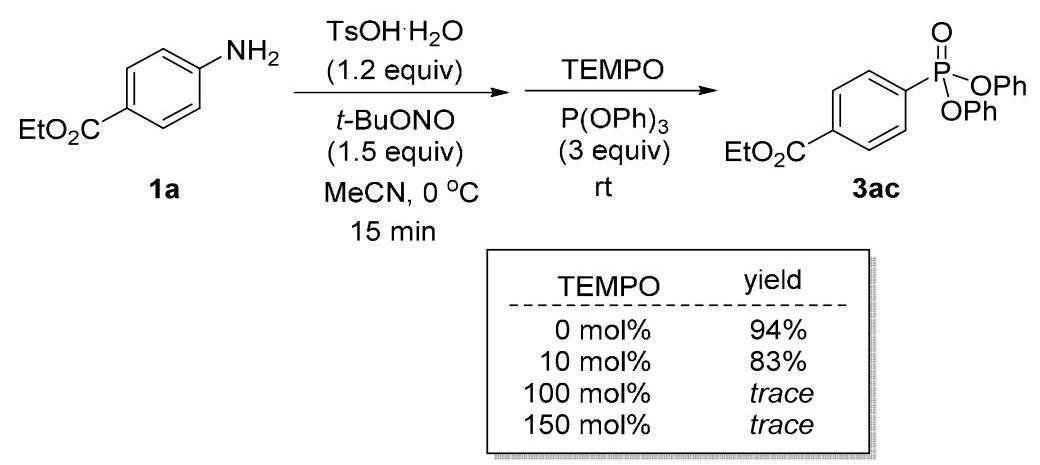
The mechanism of the reaction between arenediazonium salts and some phosphorus (III) compounds was previously investigated by Yasui and co-workers in ${1995.}^{17}$ In their study, it was reported that a small amount of arylphosphonate was formed via a phosphonium ion intermediate when arenediazonium salts were reacted with trialkyl phosphites in an alcoholic solvent under an argon atmosphere at ${20}{}^{ \circ }\mathrm{C}$ . Interestingly, according to the report 4-nitrobenzenediazonium fluoroborate gave a lower yield of arylphosphonate than 4-methylbenzenediazonium fluoroborate, which showed an opposite electronic preference as compared with our phosphorylation reaction. Also, the addition of acetonitrile, which is the best solvent in our phosphorylation reaction, was reported to make the coupling of aryl radical generated from arenediazonium salts with phosphorus species less favorable in Yasui’s work. The observation of the opposite results indicates that our phosphorylation reaction may proceed with a different pathway. To gain insights into the mechanistic details of our transformation, the reaction of 1a in the presence of radical scavenger TEMPO (2,2,6,6-tetramethylpiperidine-1-oxyl) was carried out (Scheme 6). When 10 mol% of TEMPO was added, the yield of 3ac dropped from 94% to 83%. Moreover, the reaction was almost blocked completely when 100 mol% or 150 mol% of TEMPO was added. These results indicate the possibility that a radical process may be involved in this transformation.
Scheme 6. Radical Trapping Experiments
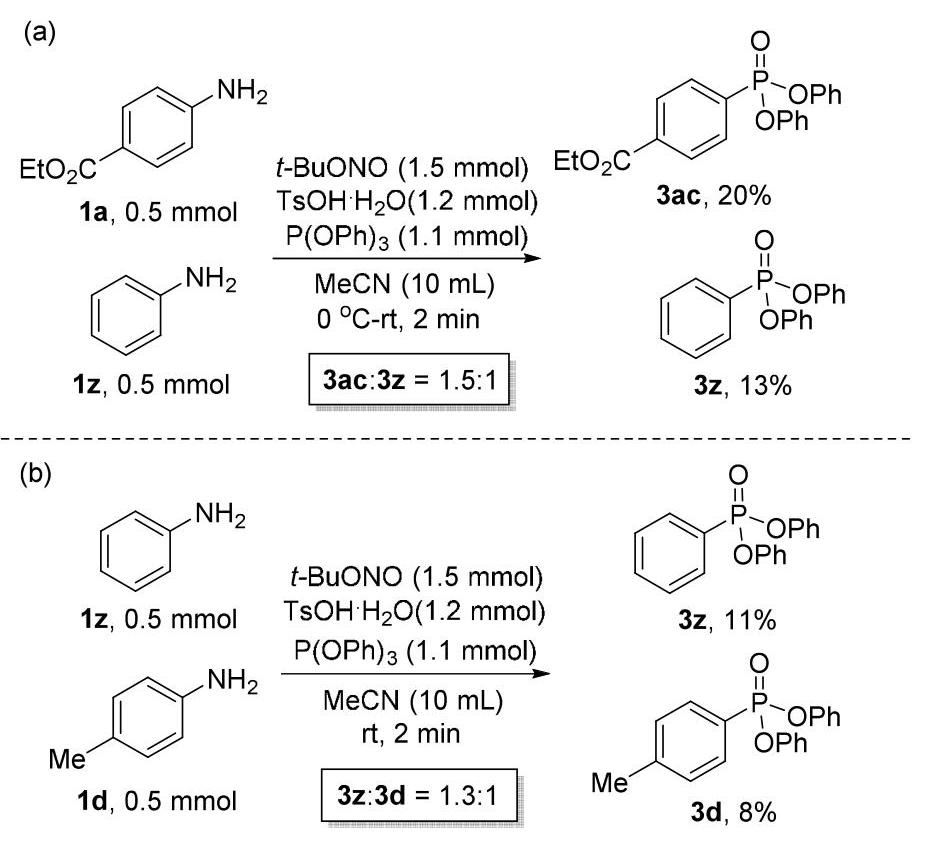
Furthermore, experiments were carried out in order to reveal the influence of electronic effects of the reaction. Thus, a 1:1 mixture of electron-withdrawing group substituted aniline 1a and aniline 1z was reacted under the optimized conditions and the reaction was stopped in 2 min in order to keep the reaction at low conversion of aryl amines. A 1.5:1 ratio of $3\mathbf{{ac}}$ and $3\mathbf{z}$ was observed (Scheme 7a), indicating that the electron-deficient $\mathbf{{1a}}$ was more reactive. A 1.3:1 ratio of $\mathbf{{3z}}$ and $\mathbf{{3i}}$ was observed in the similar competition experiment of $\mathbf{{1z}}$ and methyl-substituted aniline $\mathbf{{1d}}$ (Scheme 7b). The electronic preferences suggest that the decrease of positive charge on the active center occurs during the transformation, which is in accordance with the generation of a radical species from a cationic intermediate.
Scheme 7. Studies on Electronic Effects
Based on the general understanding on Sandmeyer-type reaction, ${}^{18}$ and our previous mechanistic investigation on Sandmeyer-type borylation and stannylation, ${}^{14}$ we have proposed a mechanism as shown in Scheme 8. First, arylamine reacts with $t$ -BuONO to generate diazonium salt intermediate $\mathbf{A}$ . Then single electron transfer (SET) between $\mathbf{A}$ and triphenyl phosphite generates radical anion species $\mathbf{B}$ and radical cation species $\mathbf{C}$ . Subsequently, phosphorous radical $\mathbf{D}$ is formed from $\mathbf{C}$ , followed by the reaction with $\mathbf{B}$ to afford the final phosphorylation product, along with the release of nitrogen.
Scheme 8.Proposed Reaction Mechanism
$$ \mathrm{{Ar}} - {\mathrm{{NH}}}_{2}\xrightarrow[\begin{matrix} \text{ - }{\mathrm{H}}_{2}\mathrm{O} \\ \text{ - }{\mathrm{H}}_{2}\mathrm{O} \end{matrix}]{\begin{matrix} \mathrm{{TsOH}} \\ \text{ - }\mathrm{{BuONO}} \end{matrix}}\overset{ \oplus }{\mathrm{{Ar}} - {\mathrm{N}}_{2} \cdot \mathrm{{OTs}}} \tag{a} $$$$ \mathrm{A} + \mathrm{P}{\left( \mathrm{{OAr}}\right) }_{3} \rightarrow \mathrm{{Ar}} - {\mathrm{N}}_{2} \cdot \mathrm{{OTs}}{}^{ - } + {\mathrm{{Ar}}}^{\prime }{\mathrm{O}}^{ - }{\overset{\prime - }{\overline{\mathrm{P}}}}_{\mathrm{{OAr}}}{\mathrm{{OAr}}}^{\prime } \tag{b} $$${\mathrm{{Ar}}}^{\prime }\mathrm{O}\overset{+ \cdot }{\overset{\mathrm{P} - {\mathrm{{OAr}}}^{\prime } + {\mathrm{H}}_{2}\mathrm{O}}{\mathrm{{OAr}}{}^{\prime }}} \rightarrow \overset{\mathrm{O} \rightarrow }{\mathrm{{OAr}}{}^{\prime }} + {\mathrm{{Ar}}}^{\prime } - \mathrm{{OH}} + {\mathrm{H}}^{ \oplus }$(c)
$\mathrm{{Ar}} - {\mathrm{N}}_{2} \cdot \mathrm{O}\overrightarrow{{\mathrm{{Ts}}}^{\prime }} + \cdot \overset{\mathrm{O}}{\overbrace{\overset{1 - }{\mathrm{P}} - \mathrm{{OA}{r}^{\prime }}}} \rightarrow \mathrm{{Ar}} - \overset{\mathrm{O}}{\overbrace{\mathrm{P} - \mathrm{{OA}{r}^{\prime }}}} + {\mathrm{N}}_{2} + \mathrm{O}{\mathrm{{Ts}}}^{\prime }$(d)
CONCLUSION
In summary, we have developed a Sandmeyer-type phosphorylation method to synthesize aryl phosphonates from easily available aryl amines. This metal-free transformation can be conducted under mild conditions without the exclusion of moisture or air. The reaction tolerates wide range of functional groups and affords the phosphorylation products in moderate to good yields. In view of the importance of aryl phosphonate compounds, we expect that this novel phosphorylation method will find practical applications in the synthesis of these compounds and will be a supplementary method for the construction of aromatic carbon-phosphorus bond. Detailed mechanistic study and further expansion of the substrate scope are currently under investigation in our laboratory.
EXPERIMENTAL SECTION
General Methods. P(OMe) ${}_{3}$ , P(OEt) ${}_{3}$ , P(OPh) ${}_{3}$ and the aniline derivatives were purchased from commercial suppliers and were used without further purifications. The solvents were all distilled prior to use. 200-300 mesh silica gels for the chromatography were used. Chemical shifts for ${}^{1}\mathrm{H}$ NMR (400 MHz) and ${}^{13}\mathrm{{CNMR}}$ (100 MHz) are reported relative to the chemical shift of tetramethylsilane (TMS): chemical shifts $\left( \delta \right)$ were reported in ppm, and coupling constants $\left( J\right)$ are in Hertz (Hz). For ${}^{31}\mathrm{P}$ NMR (162 MHz) spectra 85% phosphoric acid $\left( {\delta = 0}\right)$ was served as external standard. IR spectra are reported in wave numbers, ${\mathrm{{cm}}}^{-1}$ . For HRMS measurements, the mass analyzer is FT-ICR. The substituted triaryl phosphites (6a-d) were prepared following the literature procedure. ${}^{19}$
General procedure for the phosphorylation reaction.Arylamine $\left( {{0.2}\mathrm{{mmol}}}\right)$ and ${\mathrm{{TsOH} \cdot H}}_{2}\mathrm{O}$ (46 mg, 0.24 mmol) were added into a ${10}\mathrm{\;{mL}}$ reaction tube. After the addition of MeCN ( ${1.0}\mathrm{\;{mL}}$ ), the turbid solution was stirred at ${0}^{ \circ }\mathrm{C}$ . $t$ -BuONO (31 mg, ${0.3}\mathrm{{mmol}}$ ) was then added and the reaction solution was stirred at ${0}^{ \circ }\mathrm{C}$ for ${15}\mathrm{\;{min}}$ , followed by the addition of $\mathrm{P}{\left( \mathrm{{OR}}\right) }_{3}\left( {{0.6}\mathrm{{mmol}}}\right)$ , the resulting reaction solution was stirred for $8\mathrm{\;h}$ at room temperature (around ${25}^{ \circ }\mathrm{C}$ ). The solution was then concentrated under reduced pressure, and the crude residue was purified by silica gel column chromatography to afford the pure products.
General procedure for gram scale phosphorylation reaction. Arylamine (1a, 1d, or 1i, 20 mmol) and $\mathrm{{TsOH}} \cdot {\mathrm{H}}_{2}\mathrm{O}\left( {{4.56}\mathrm{\;g},{24}\mathrm{{mmol}}}\right)$ were added into a ${200}\mathrm{\;{mL}}$ reaction bulb. After the addition of $\mathrm{{MeCN}}\left( {{40}\mathrm{\;{mL}}}\right)$ , the turbid solution was stirred at ${0}^{ \circ }\mathrm{C}$ . t-BuONO (3.09 g,30 mmol) was then added dropwise and the reaction solution was stirred at $0{}^{ \circ }\mathrm{C}$ for ${15}\mathrm{\;{min}}$ , followed by the addition of $\mathrm{P}{\left( \mathrm{{OPh}}\right) }_{3}\left( {{18.06}\mathrm{\;g},{60}\mathrm{{mmol}}}\right)$ , the resulting reaction solution was stirred for $8\mathrm{\;h}$ at room temperature $\left( {{25}^{ \circ }\mathrm{C}}\right)$ . The solution was then concentrated under reduced pressure, and the crude residue was purified by silica gel column chromatography to afford the pure product.
The ester exchange experiment. ${}^{16}$ The solution of sodium ( ${{130}\mathrm{{mg}}},{5.7}\mathrm{{mmol}}$ ) dissolved in ${3.0}\mathrm{\;{mL}}$ ethanol was added into a solution of $3\mathrm{{ic}}\left( {{340}\mathrm{{mg}},{1.0}\mathrm{{mmol}}}\right)$ dissolved in $3\mathrm{\;{mL}}$ ethanol, the reaction solution was stirred at room temperature for $2\mathrm{\;h}$ . Then the mixture was transferred into a ${125}\mathrm{\;{mL}}$ separating funnel and ${40}\mathrm{\;{mL}}$ diethyl ether was added. The solution was washed by $1\mathrm{M}\mathrm{{NaOH}}$ (40 $\mathrm{{mL}}$ ), and then the water phase was extracted with ${20}\mathrm{\;{mL}}$ ethanol. The organic phase was then washed by brine $\left( {{30}\mathrm{\;{mL}}}\right)$ . After drying by ${\mathrm{{Na}}}_{2}{\mathrm{{SO}}}_{4}$ and evaporation, the product 3ib was obtained (215 mg, 88%) as an orange liquid.
3ia was obtained as an orange liquid (205 mg, 84%) by using methanol as solvent under similar conditions. For 3id (orange liquid, 134 mg, 55%), i-PrOH was used instead of ethanol and the reaction was carried out at ${60}^{ \circ }\mathrm{C}$ for $2\mathrm{\;h}$ .
The competition experiment. Arylamine 1a ( ${{83}\mathrm{{mg}}},\;{{0.5}\mathrm{{mmol}}}$ ), $\mathbf{{1z}}\left( {{47}\mathrm{{mg}},\;{0.5}\mathrm{{mmol}}}\right)$ and $\mathrm{{TsOH}} \cdot {\mathrm{H}}_{2}\mathrm{O}\left( {{228}\mathrm{{mg}},{1.2}\mathrm{{mmol}}}\right)$ were added into a ${50}\mathrm{\;{mL}}$ reaction bulb. After the addition of MeCN $\left( {{10}\mathrm{\;{mL}}}\right)$ , the turbid solution was stirred at ${0}^{ \circ }\mathrm{C}$ . $t$ -BuONO (155 mg, ${1.5}\mathrm{\;{mmol}}$ ) was then added and the reaction solution was stirred at ${0}^{ \circ }\mathrm{C}$ for ${15}\mathrm{\;{min}}$ , followed by the addition of $\mathrm{P}{\left( \mathrm{{OPh}}\right) }_{3}({341}\mathrm{{mg}},{1.1}$ mmol). The resulting reaction solution was stirred for $2\mathrm{\;{min}}$ at room temperature $\left( {{25}^{ \circ }\mathrm{C}}\right)$ . The reaction was quenched by filtering the mixture through a short column of silica gel (eluent: ethyl acetate). The solution was then concentrated under reduced pressure, and the crude residue was purified by silica gel column chromatography to afford the pure product 3ac (38mg, 20%) and 3z (20 mg, 13%).
Ethyl 4-(dimethoxyphosphoryl)benzoate (3aa). ${}^{20}$ Flash chromatography (silica gel, petroleum ether:ethyl acetate $= 2 : 1)$ afforded 3aa (28 mg,54%); yellow oil. ${}^{1}\mathrm{H}$ NMR (400 MHz, ${\mathrm{{CDCl}}}_{3}$ ) $\delta \; {8.16} - {8.13}\left( {\mathrm{\;m},2\mathrm{H}}\right) ,{7.91} - {7.86}\left( {\mathrm{\;m},2\mathrm{H}}\right) ,{4.41}\left( {\mathrm{q}, J = {7.1}\mathrm{\;{Hz}},2\mathrm{H}}\right) ,{3.79}\left( {\mathrm{\;d}, J = {11.1}\mathrm{\;{Hz}},6\mathrm{H}}\right) ,{1.42}(\mathrm{t}, J =$
7.1 Hz, 3H); ${}^{13}\mathrm{C}$ NMR (100 MHz, CDCl3) $\delta$ 165.7, 134.1 (d, $J = {3.4}\mathrm{\;{Hz}}$ ), 131.9 (d, $J = {9.9}\mathrm{\;{Hz}}$ ), 131.6 (d, $J = {187.2}\mathrm{\;{Hz}}$ ),129.4 (d, $J = {15.2}\mathrm{\;{Hz}}$ ),61.5,52.9 (d, $J = {5.6}\mathrm{\;{Hz}}$ ),14.3; ${}^{31}\mathrm{P}$ NMR (CDCl, 162 MHz) $\delta$ 20.6; IR (film): 1721,1273,1104,1020,830,763 ${\mathrm{\;{cm}}}^{-1}$ ; EI-MS ( $m/z$ , relative intensity): ${257}\left( {20}\right) ,{230}\left( {24}\right) ,{213}\left( {100}\right) ,{185}\left( {26}\right) ,{136}\left( {20}\right) ,{91}\left( {16}\right) ;$ HRMS (ESI) calcd for ${\mathrm{C}}_{11}{\mathrm{H}}_{16}{\mathrm{O}}_{5}\mathrm{P} \; {\left\lbrack {\mathrm{M}}^{ + }\mathrm{H}\right\rbrack }^{ + }$ 259.0730; found 259.0728.
Ethyl 4-(diphenoxyphosphoryl)benzoate (3ac). ${}^{21}$ Flash chromatography (silica gel, petroleum ether:ethyl acetate $= 5 : 1)$ afforded 3ac $\left( {{72}\mathrm{{mg}},{94}\% }\right)$ ; yellow oil. ${}^{1}\mathrm{H}$ NMR $\left( {{400}\mathrm{{MHz}},{\mathrm{{CDCl}}}_{3}}\right) \delta \; {8.17} - {8.14}\left( {\mathrm{\;m},2\mathrm{H}}\right) ,{8.07} - {8.01}\left( {\mathrm{\;m},2\mathrm{H}}\right) ,{7.31} - {7.26}\left( {\mathrm{\;m},4\mathrm{H}}\right) ,{7.19} - {7.14}\left( {\mathrm{\;m},6\mathrm{H}}\right) ,{4.41}\left( {\mathrm{q}, J = {7.1}\mathrm{\;{Hz}}}\right)$ , 2H), 1.39 (t, $J = {7.1}\mathrm{\;{Hz}},3\mathrm{H}$ ); ${}^{13}\mathrm{C}$ NMR (100 MHz, ${\mathrm{{CDCl}}}_{3}$ ) ${\delta 165.5},{150.1}$ (d, $J = {7.7}\mathrm{\;{Hz}}$ ), 134.7 (d, $J = {3.19}\mathrm{\;{Hz}}),{132.3}\left( {\mathrm{\;d}, J = {10.6}\mathrm{\;{Hz}}}\right) ,{131.3}\left( {\mathrm{\;d}, J = {192.93}\mathrm{\;{Hz}}}\right) ,{129.8},{129.6},{129},5,{120.6}(\mathrm{\;d}, J = {4.6}$ Hz), 61.6, 14.3; ${}^{31}\mathrm{P}$ NMR (CDCl3, 162 MHz) δ 10.6; IR (film): 1721, 1489, 1272, 1186, 1103, 932, 762 cm ${}^{-1}$ ; EI-MS ( $m/z$ , relative intensity): 381 (100),337 (15),289 (35),242 (24),170 (17),77 (76); HRMS (ESI) calcd for ${\mathrm{C}}_{21}{\mathrm{H}}_{20}{\mathrm{O}}_{5}\mathrm{P}{\left\lbrack \mathrm{M} + \mathrm{H}\right\rbrack }^{ + }$ 383.1043; found 383.1043.
Diphenyl (4-nitrophenyl)phosphonate (3b). ${}^{16}$ Flash chromatography (silica gel, petroleum ether:ethyl acetate $= {10} : 1)$ afforded $\mathbf{{3b}}\left( {{68}\mathrm{{mg}},{95}\% }\right)$ ; yellow liquid. ${}^{1}\mathrm{H}$ NMR (400 MHz, ${\mathrm{{CDCl}}}_{3}$ ) $\delta$ 8.35-8.32 $\left( {\mathrm{m},2\mathrm{H}}\right) ,{8.19} - {8.14}\left( {\mathrm{\;m},2\mathrm{H}}\right) ,{7.34} - {7.30}\left( {\mathrm{\;m},4\mathrm{H}}\right) ,{7.19} - {7.18}\left( {\mathrm{\;m},6\mathrm{H}}\right) ;{}^{13}\mathrm{C}$ NMR $\left( {{100}\mathrm{{MHz}},{\mathrm{{CDCl}}}_{3}}\right) \delta$ 150.7 (d, $J = {4.0}\mathrm{\;{Hz}}$ ), ${149.9}\left( {\mathrm{\;d}, J = {7.6}\mathrm{\;{Hz}}}\right) ,{133.8}\left( {\mathrm{\;d}, J = {191.8}\mathrm{\;{Hz}}}\right) ,{133.6}\left( {\mathrm{\;d}, J = {11.1}\mathrm{\;{Hz}}}\right) ,{130.0}$ , 125.7,123.6 $\left( {\mathrm{d}, J = {16.2}\mathrm{\;{Hz}}}\right) ,{120.5}\left( {\mathrm{\;d}, J = {4.6}\mathrm{\;{Hz}}}\right) ;{}^{31}\mathrm{P}$ NMR (CDC ${\mathrm{l}}_{3},{162}\mathrm{{MHz}}$ ) $\delta$ 8.2; IR (film): 1589,1516,1267,1187,945,932,777 ${\mathrm{\;{cm}}}^{-1}$ ; EI-MS $\left( {m/z}\right.$ , relative intensity): ${354}\left( {89}\right) ,{308}\left( {14}\right) ,{262}$ (14),215 (34),170 (16),94 (19),77 (100); HRMS (ESI) calcd for ${\mathrm{C}}_{18}{\mathrm{H}}_{15}{\mathrm{{NO}}}_{5}\mathrm{P}{\left\lbrack \mathrm{M} + \mathrm{H}\right\rbrack }^{ + }$ 356.0682; found 356.0682.
Diphenyl (4-cyanophenyl)phosphonate (3c). ${}^{16}$ Flash chromatography (silica gel, petroleum ether:ethyl acetate $= {10} : 1)$ afforded $3\mathrm{c}\left( {{66}\mathrm{{mg}},{98}\% }\right)$ ; red liquid. ${}^{1}\mathrm{H}$ NMR $\left( {{400}\mathrm{{MHz}},{\mathrm{{CDCl}}}_{3}}\right) \delta$ 8.11-8.05 (m, 2H), 7.80-7.77 (m, 2H), 7.33-7.26 (m, 4H), 7.20-7.16 (m, 6H); ${}^{13}\mathrm{C}\mathrm{{NMR}}$ (100 MHz, ${\mathrm{{CDCl}}}_{3})\delta$ 149.9 $\left( {\mathrm{d}, J = {7.8}\mathrm{\;{Hz}}}\right) ,{132.8}\left( {\mathrm{\;d}, J = {10.4}\mathrm{\;{Hz}}}\right) ,{132.2}\left( {\mathrm{\;d}, J = {15.8}\mathrm{\;{Hz}}}\right) ,{132.0}(\mathrm{\;d}, J = {192.4}$ Hz), 130.0, 125.6, 120.5 (d, J = 4.6 Hz), 117.6, 116.9 (d, J = 3.68 Hz); ${}^{31}\mathrm{P}$ NMR (CDC1, 162 MHz) $\delta$ 8.4; IR (film): 2233,1590,1489,1271,1185,935,767 ${\mathrm{\;{cm}}}^{-1}$ ; EI-MS $\left( {m/z}\right.$ , relative intensity): 334 (91), 242 (19), 195 (42), 170 (18), 94 (20), 77 (100); HRMS (ESI) calcd for ${\mathrm{C}}_{19}{\mathrm{H}}_{15}{\mathrm{{NO}}}_{3}\mathrm{P}{\left\lbrack \mathrm{M} + \mathrm{H}\right\rbrack }^{ + }$ 336.0784; found 336.0786.
Diphenyl p-tolylphosphonate (3d). ${}^{16}$ Flash chromatography (silica gel, petroleum ether:ethyl acetate $= {20} : 1)$ afforded $\mathbf{{3d}}\left( {{43}\mathrm{{mg}},{66}\% }\right)$ ; yellow liquid. ${}^{1}\mathrm{H}$ NMR $\left( {{400}\mathrm{{MHz}},{\mathrm{{CDCl}}}_{3}}\right) {\delta 7.87} - {7.82}\left( {\mathrm{\;m},2\mathrm{H}}\right)$ , 7.30-7.25 (m, 6H), 7.19-7.17 (m, 4H), 7.14-7.11 (m, 2H), 2.40 (s, 3H); ${}^{13}\mathrm{C}$ NMR (100 MHz, CDCl3) $\delta$ 150.5 $\left( {\mathrm{d}, J = {7.4}\mathrm{\;{Hz}}}\right) ,{144.0}\left( {\mathrm{\;d}, J = {3.1}\mathrm{\;{Hz}}}\right) ,{132.3}\left( {\mathrm{\;d}, J = {10.9}\mathrm{\;{Hz}}}\right) ,{129.7},{129.4}\left( {\mathrm{\;d}, J = {16.4}\mathrm{\;{Hz}}}\right)$ , 125.1,123.5 $\left( {\mathrm{d}, J = {195.1}\mathrm{\;{Hz}}}\right) ,{120.7}\left( {\mathrm{\;d}, J = {4.5}\mathrm{\;{Hz}}}\right) ,{21.8};{}^{31}\mathrm{P}$ NMR $\left( {{\mathrm{{CDCl}}}_{3},{162}\mathrm{{MHz}}}\right) {\delta 12.48}$ ; IR (film): 1592,1490,1269,1188,1129,926,769 ${\mathrm{{cm}}}^{-1}$ ; EI-MS $\left( {m/z\text{ , relative intensity): 323 (100),231 }}\right)$ (77),213 (13),184 (22),170 (20),77 (77); HRMS (ESI) calcd for ${\mathrm{C}}_{19}{\mathrm{H}}_{18}{\mathrm{O}}_{3}\mathrm{P}{\left\lbrack \mathrm{M} + \mathrm{H}\right\rbrack }^{ + }$ 325.0988; found 325.0994.
Diphenyl (4-chlorophenyl)phosphonate (3e). ${}^{16}$ Flash chromatography (silica gel, petroleum ether:ethyl acetate $= {30} : 1)$ afforded 3e ( ${59}\mathrm{{mg}},{86}\%$ ); yellow liquid. ${}^{1}\mathrm{H}$ NMR (400 MHz, ${\mathrm{{CDCl}}}_{3}$ ) $\delta$ 7.92-7.87 (m, 2H), 7.50-7.47 (m, 2H), 7.35-7.26 (m, 4H), 7.21-7.14 (m, 6H); ${}^{13}\mathrm{C}$ NMR (100 MHz, ${\mathrm{{CDCl}}}_{3})\delta$ 150.2 (d, $J = {7.5}\mathrm{\;{Hz}}),{140.0}$ (d, $J = {4.2}\mathrm{\;{Hz}}),{133.7}$ (d, $J = {11.4}\mathrm{\;{Hz}}),{129.8},{129.1}$ (d, $J = \; {16.6}\mathrm{\;{Hz}}$ ), ${125.4}\left( {\mathrm{\;d}, J = {195.9}\mathrm{\;{Hz}}}\right) ,{125.4},{120.6}\left( {\mathrm{\;d}, J = {4.5}\mathrm{\;{Hz}}}\right) ;{}^{31}\mathrm{P}\mathrm{{NMR}}\left( {{\mathrm{{CDCl}}}_{3},{162}\mathrm{{MHz}}}\right) \delta$ 11.1; IR (film): 1590,1489,1280,1187,1088,930,772 ${\mathrm{{cm}}}^{-1}$ ; EI-MS $(m/z$ , relative intensity): 343 (78), 251 (33), 233 (7), 204 (25), 170 (22), 77(100); HRMS (ESI) calcd for ${\mathrm{C}}_{18}{\mathrm{H}}_{15}{\mathrm{{ClO}}}_{3}\mathrm{P}{\left\lbrack \mathrm{M} + \mathrm{H}\right\rbrack }^{ + }$ 345.0442; found 345.0444.
Diphenyl (4-bromophenyl)phosphonate (3f). Flash chromatography (silica gel, petroleum ether:ethyl acetate $= {30} : 1)$ afforded $\mathbf{{3f}}\left( {{60}\mathrm{{mg}},{77}\% }\right)$ ; yellow liquid. ${}^{1}\mathrm{H}$ NMR (400 MHz, CDCl ${}_{3}$ ) δ 7.84-7.79 (m, 2H), 7.65-7.62 (m, 2H), 7.31-7.27 (m, 4H), 7.18-7.13 (m, 6H); ${}^{13}\mathrm{C}$ NMR (100 MHz, CDCl ${}_{3}$ ) δ 150.2 $\left( {\mathrm{d}, J = {7.6}\mathrm{\;{Hz}}}\right) ,{133.8}\left( {\mathrm{\;d}, J = {11.2}\mathrm{\;{Hz}}}\right) ,{132.1}\left( {\mathrm{\;d}, J = {16.4}\mathrm{\;{Hz}}}\right) ,{129.8},{128.6}\left( {\mathrm{\;d}, J = {4.2}\mathrm{\;{Hz}}}\right) ,{125.9}(\mathrm{\;d}$ , $J = {195.3}\mathrm{\;{Hz}}),{125.3},{120.6}\left( {\mathrm{\;d}, J = {4.5}\mathrm{\;{Hz}}}\right) ;{}^{31}\mathrm{P}$ NMR (CDCl3,162 MHz) $\delta$ 11.4; IR (film) 1581, 1483,1266,1186,1162,930,771 ${\mathrm{{cm}}}^{-1}$ ; EI-MS $\left( {m/z\text{ , relative intensity }}\right) : {389}\left( {63}\right) ,{295}\left( {29}\right) ,{248}\left( {16}\right)$ , 170 (21), 77 (100), 51 (16); HRMS (ESI) calcd for ${\mathrm{C}}_{18}{\mathrm{H}}_{15}{\mathrm{{BrO}}}_{3}\mathrm{P}{\left\lbrack \mathrm{M} + \mathrm{H}\right\rbrack }^{ + }$ 388.9937; found 388.9939. Diphenyl [1,1’-biphenyl]-4-ylphosphonate (3g). ${}^{22}$ Flash chromatography (silica gel, petroleum ether:ethyl acetate $= {20} : 1)$ afforded $3\mathbf{g}\left( {{39}\mathrm{{mg}},{51}\% }\right)$ ; yellow liquid. ${}^{1}\mathrm{H}$ NMR $\left( {{400}\mathrm{{MHz}},{\mathrm{{CDCl}}}_{3}}\right) \delta \; {8.06} - {8.00}\left( {\mathrm{\;m},2\mathrm{H}}\right) ,{7.73} - {7.70}\left( {\mathrm{\;m},2\mathrm{H}}\right) ,{7.62}\left( {\mathrm{\;d}, J = {7.4}\mathrm{\;{Hz}},2\mathrm{H}}\right) ,{7.49} - {7.45}\left( {\mathrm{\;m},2\mathrm{H}}\right) ,{7.42} - {7.39}(\mathrm{m}$ , 1H), 7.32-7.29 (m, 4H), 7.23-7.21 (m, 4H), 7.17-7.13 (m, 2H); ${}^{13}\mathrm{C}$ NMR (100 MHz, CDCl ${}_{3}$ ) δ 150.4 $\left( {\mathrm{d}, J = {7.6}\mathrm{\;{Hz}}}\right) ,{146.0}\left( {\mathrm{\;d}, J = {3.4}\mathrm{\;{Hz}}}\right) ,{139.7},{132.8}\left( {\mathrm{\;d}, J = {10.8}\mathrm{\;{Hz}}}\right) ,{129.8},{129.0},{128.4},{127.3}$ , ${127.3}\left( {\mathrm{\;d}, J = {16.1}\mathrm{\;{Hz}}}\right) ,{125.3}\left( {J = {194.7}\mathrm{\;{Hz}}}\right) ,{125.2},{120.7}\left( {\mathrm{\;d}, J = {4.5}\mathrm{\;{Hz}}}\right) ;{}^{31}\mathrm{P}\mathrm{{NMR}}\left( {{\mathrm{{CDCl}}}_{3},{162}}\right)$ MHz) $\delta$ 12.6; IR (film): ${1591},{1488},{1274},{1188},{1133},{928},{761}{\mathrm{\;{cm}}}^{-1}$ ; HRMS (ESI) calcd for ${\mathrm{C}}_{24}{\mathrm{H}}_{20}{\mathrm{O}}_{3}\mathrm{P}{\left\lbrack \mathrm{M} + \mathrm{H}\right\rbrack }^{ + }{387.1145}$ ; found 387.1146.
Diphenyl (4-(methylthio)phenyl)phosphonate (3h). Flash chromatography (silica gel, petroleum ether:ethyl acetate = 20:1) afforded 3h (37 mg, 52%); yellow liquid. ${}^{1}\mathrm{H}$ NMR (400 MHz, ${\mathrm{{CDCl}}}_{3}$ ) $\delta \; {7.86} - {7.80}\left( {\mathrm{\;m},2\mathrm{H}}\right) ,{7.30} - {7.26}\left( {\mathrm{\;m},6\mathrm{H}}\right) ,{7.19} - {7.12}\left( {\mathrm{\;m},6\mathrm{H}}\right) ,{2.45}\left( {\mathrm{\;s},3\mathrm{H}}\right) ;{}^{13}\mathrm{C}$ NMR $\left( {{100}\mathrm{{MHz}},{\mathrm{{CDCl}}}_{3}}\right) \; \delta$ 150.4 $\left( {\mathrm{d}, J = {7.5}\mathrm{\;{Hz}}}\right) ,{146.2}\left( {\mathrm{\;d}, J = {3.6}\mathrm{\;{Hz}}}\right) ,{132.5}\left( {\mathrm{\;d}, J = {11.1}\mathrm{\;{Hz}}}\right) ,{129.8},{125.2},{125.1}(\mathrm{\;d}, J = {16.1} \; \mathrm{{Hz}}),{122.0}\left( {\mathrm{\;d}, J = {197.5}\mathrm{\;{Hz}}}\right) ,{120.6}\left( {\mathrm{\;d}, J = {4.7}\mathrm{\;{Hz}}}\right) ,{14.6};{}^{31}\mathrm{P}$ NMR $\left( {{\mathrm{{CDCl}}}_{3},{162}\mathrm{{MHz}}}\right) \delta$ 12.7; IR (film): 1589, 1489, 1278, 1187, 1085, 927, 773 cm ${}^{-1}$ ; EI-MS $(m/z$ , relative intensity): 356 (100), 263 (94), 216 (23), 170 (12), 139 (9), 77 (68); HRMS (ESI) calcd for ${\mathrm{C}}_{19}{\mathrm{H}}_{18}{\mathrm{O}}_{3}\mathrm{{PS}}{\left\lbrack \mathrm{M} + \mathrm{H}\right\rbrack }^{ + }$ 357.0709; found 357.0708.
Dimethyl (4-methoxyphenyl)phosphonate (3ia) ${}^{10}$ Orange liquid (205 mg,84%). ${}^{1}\mathrm{H}$ NMR (400 MHz, ${\mathrm{{CDCl}}}_{3}$ ) $\delta$ 7.74 (dd, $J = {12.7},{8.7}\mathrm{\;{Hz}},2\mathrm{H}$ ),6.98 (dd, $J = {8.7},{3.3}\mathrm{\;{Hz}},2\mathrm{H}$ ),3.85 (s,3H),3.74 (d, $J =$ 11.1 Hz, 6H); ${}^{13}\mathrm{C}$ NMR (100 MHz, CDCl ${}_{3}$ ) δ 163.0 (d, $J = {3.5}\mathrm{\;{Hz}}$ ), 133.9 (d, $J = {11.2}\mathrm{\;{Hz}}$ ), 117.9 (d, $J = {196.1}\mathrm{\;{Hz}}),{114.1}\left( {\mathrm{\;d}, J = {16.1}\mathrm{\;{Hz}}}\right) ,{55.3},{52.5}\left( {\mathrm{\;d}, J = {5.5}\mathrm{\;{Hz}}}\right) ;{}^{31}\mathrm{P}$ NMR (CDC ${\mathrm{l}}_{3},{162}\mathrm{{MHz}}$ ) $\delta$ 23.1IR (film): 2955,1600,1507,1244,1132,1024,812 ${\mathrm{\;{cm}}}^{-1}$ ;EI-MS ( $m/z$ , relative intensity): 77 (15), 108 (30), 121 (69), 171 (80), 185 (24), 216 (100).
Diethyl (4-methoxyphenyl)phosphonate (3ib). ${}^{16}$ Orange liquid (215 mg,88%). ${}^{1}\mathrm{H}$ NMR (400 MHz, ${\mathrm{{CDCl}}}_{3}$ ) $\delta$ 7.78-7.72 $\left( {\mathrm{m},2\mathrm{H}}\right) ,{6.98} - {6.95}\left( {\mathrm{m},2\mathrm{H}}\right) ,{4.17} - {4.00}\left( {\mathrm{m},4\mathrm{H}}\right) ,{3.85}\left( {\mathrm{\;s},3\mathrm{H}}\right) ,{1.31}(\mathrm{t}, J = {7.0}\mathrm{\;{Hz}}$ , 6H); ${}^{13}\mathrm{C}$ NMR (100 MHz, ${\mathrm{{CDCl}}}_{3}$ ) $\delta$ 162.8 (d, $J = {3.3}\mathrm{\;{Hz}}$ ),133.7(d, $J = {11.3}\mathrm{\;{Hz}}$ ), ${119.5}(\mathrm{\;d}, J = {195.0}$ Hz), 114.0 (d, $J = {16.1}\mathrm{\;{Hz}}),{61.9}$ (d, $J = {5.3}\mathrm{\;{Hz}}),{55.3},{16.3}$ (d, $J = {6.6}\mathrm{\;{Hz}});{}^{31}\mathrm{P}$ NMR (CDCl ${}_{3},{162}$ MHz) $\delta$ 20.3; IR (film): 1600,1243,1132,1022,962,807 ${\mathrm{\;{cm}}}^{-1}$ ; EI-MS $\left( {m/z\text{ , relative intensity): 244 }}\right)$ (39),216 (43),188 (100),171 (54),135 (24),108 (59); HRMS (ESI) calcd for ${\mathrm{C}}_{11}{\mathrm{H}}_{18}{\mathrm{O}}_{4}\mathrm{P}{\left\lbrack \mathrm{M} + \mathrm{H}\right\rbrack }^{ + }$ 245.0937; found 245.0930.
Diphenyl (4-methoxyphenyl)phosphonate (3ic). ${}^{16}$ Flash chromatography (silica gel, petroleum ether:ethyl acetate $= {10} : 1)$ afforded 3ic (27 mg,40%); orange liquid. ${}^{1}\mathrm{H}$ NMR (400 MHz, CDC ${\mathrm{l}}_{3}$ ) $\delta \; {7.88}\left( {\mathrm{{dd}}, J = {13.4},{8.8}\mathrm{\;{Hz}},2\mathrm{H}}\right) ,{7.30} - {7.26}\left( {\mathrm{\;m},4\mathrm{H}}\right) ,{7.19} - {7.11}\left( {\mathrm{\;m},6\mathrm{H}}\right) ,{6.98}\left( {\mathrm{{dd}}, J = {8.8},{3.8}\mathrm{\;{Hz}},2\mathrm{H}}\right)$ , ${3.85}\left( {\mathrm{\;s},3\mathrm{H}}\right) {;}^{13}\mathrm{C}\mathrm{{NMR}}\left( {{100}\mathrm{{MHz}},{\mathrm{{CDCl}}}_{3}}\right) {\delta 163.5}\left( {\mathrm{\;d}, J = {3.6}\mathrm{\;{Hz}}}\right) ,{150.5}\left( {\mathrm{\;d}, J = {7.4}\mathrm{\;{Hz}}}\right) ,{134.4}(\mathrm{\;d}, J =$ 11.9 Hz), 129.7, 125.0, 120.7 (d, J = 4.5 Hz), 117.8 (d, J = 200.4 Hz), 114.2 (d, J = 16.9 Hz), 55.3; ${}^{31}\mathrm{P}$ NMR (CDCl ${}_{3},{162}\mathrm{{MHz}}$ ) $\delta$ 13.3; IR (film): 1597,1489,1257,1187,1130,926,770 ${\mathrm{\;{cm}}}^{-1}$ ; EI-MS $\left( {m/z\text{ , relative intensity }}\right) : {339}\left( {72}\right) ,{247}\left( {100}\right) ,{229}\left( 8\right) ,{200}\left( {16}\right) ,{170}\left( {18}\right) ,{77}\left( {67}\right)$ ; HRMS (ESI) calcd for ${\mathrm{C}}_{19}{\mathrm{H}}_{18}{\mathrm{O}}_{4}\mathrm{\;P}{\left\lbrack \mathrm{M} + \mathrm{H}\right\rbrack }^{ + }{341.0937}$ ; found 341.0943.
Diisopropyl (4-methoxyphenyl)phosphonate (3id) ${}^{10}$ Orange liquid (134 mg,55%). ${}^{1}$ H NMR (400 MHz, CDCl ${}_{3}$ ) $\delta$ 7.75 (dd, $J = {12.5},{8.6}\mathrm{\;{Hz}},2\mathrm{H}$ ), 8.96-8.94 (m, 2H), 4.69-4.61 (m, 2H), 3.84 (s, 3H), ${1.36}\left( {\mathrm{\;d}, J = {6.0}\mathrm{\;{Hz}},6\mathrm{H}}\right) ,{1.21}\left( {\mathrm{\;d}, J = {6.0}\mathrm{\;{Hz}},6\mathrm{H}}\right) ;{}^{13}\mathrm{C}$ NMR $\left( {{100}\mathrm{{MHz}},{\mathrm{{CDCl}}}_{3}}\right) {\delta 162.6}(\mathrm{\;d}, J = {3.2}$ Hz), 133.7 (d, $J = {11.4}\mathrm{\;{Hz}}$ ), 121.2 (d, $J = {195.3}\mathrm{\;{Hz}}$ ), 113.8 (d, $J = {16.1}\mathrm{\;{Hz}}$ ), 70.4 (d, $J = {5.3}\mathrm{\;{Hz}}$ ), 55.3, 23.9 (dd, $J = {24.1},{3.9}\mathrm{\;{Hz}}$ ); ${}^{31}\mathrm{P}$ NMR (CDCl ${}_{3},{162}\mathrm{{MHz}}$ ) $\delta$ 18.0; IR (film): 2979,2923,1601, 1242,1133,1016,979 ${\mathrm{\;{cm}}}^{-1}$ ; EI-MS $\left( {m/z}\right.$ , relative intensity $) : {77}\left( {14}\right) ,{108}\left( {37}\right) ,{171}\left( {55}\right) ,{188}\left( {100}\right)$ , 230 (24), 272 (16).
Diphenyl (4-acetylphenyl)phosphonate (3j). Flash chromatography (silica gel, petroleum ether:ethyl acetate = 5:1) afforded 3j (62 mg, 89%); orange liquid. ${}^{1}$ H NMR (400 MHz, CDCl3) δ 8.08-8.05 (m, 4H), 7.32-7.28 (m, 4H), 7.19-7.16 (m, 6H), 2.64 (s, 3H); ${}^{13}\mathrm{C}$ NMR (100 MHz, CDCl3) δ 197.3, ${150.1}\left( {\mathrm{\;d}, J = {7.5}\mathrm{\;{Hz}}}\right) ,{140.4}\left( {\mathrm{\;d}, J = {3.1}\mathrm{\;{Hz}}}\right) ,{132.7}\left( {\mathrm{\;d}, J = {10.4}\mathrm{\;{Hz}}}\right) ,{131.6}\left( {\mathrm{\;d}, J = {191.0}\mathrm{\;{Hz}}}\right) ,{129.8}$ , ${128.2}\left( {\mathrm{\;d}, J = {16.0}\mathrm{\;{Hz}}}\right) ,{125.4},{120.6}\left( {\mathrm{\;d}, J = {4.6}\mathrm{\;{Hz}}}\right) ,{26.8};{}^{31}\mathrm{P}$ NMR $\left( {{\mathrm{{CDCl}}}_{3},{162}\mathrm{{MHz}}}\right) {\delta 10.5};\mathrm{{IR}}$ (film): 1691,1590,1489,1263,1186,930,764 ${\mathrm{\;{cm}}}^{-1}$ ; EI-MS $\left( {m/z\text{ , relative intensity): 353 (100),337 }}\right)$ (17),259 (39),212 (17),170 (15),77 (94); HRMS (ESI) calcd for ${\mathrm{C}}_{20}{\mathrm{H}}_{18}{\mathrm{O}}_{4}\mathrm{P}{\left\lbrack \mathrm{M} + \mathrm{H}\right\rbrack }^{ + }$ 353.0937; found 353.0939.
Diphenyl o-tolylphosphonate (3k). ${}^{16}$ Flash chromatography (silica gel, petroleum ether:ethyl acetate $= {30} : 1)$ afforded $3\mathbf{k}\left( {{45}\mathrm{{mg}},{69}\% }\right)$ ; yellow liquid. ${}^{1}\mathrm{H}$ NMR $\left( {{400}\mathrm{{MHz}},{\mathrm{{CDCl}}}_{3}}\right) {\delta 8.08}\left( {\mathrm{{dd}}, J = {15.2}}\right)$ , ${7.6}\mathrm{\;{Hz}},1\mathrm{H}),{7.52} - {7.28}\left( {\mathrm{\;m},1\mathrm{H}}\right) ,{7.34} - {7.27}\left( {\mathrm{\;m},6\mathrm{H}}\right) ,{7.23} - {7.12}\left( {\mathrm{\;m},6\mathrm{H}}\right) ,{2.76}\left( {\mathrm{\;s},3\mathrm{H}}\right) ;{}^{13}\mathrm{C}$ NMR (100 MHz, ${\mathrm{{CDCl}}}_{3}$ ) $\delta$ 149.3 (d, $J = {7.9}\mathrm{\;{Hz}}),{141.1}$ (d, $J = {10.7}\mathrm{\;{Hz}}),{133.5}$ (d, $J = {11.1}\mathrm{\;{Hz}}$ ),132.3 (d, $J = \; {3.1}\mathrm{\;{Hz}}),{130.5}\left( {\mathrm{\;d}, J = {15.9}\mathrm{\;{Hz}}}\right) ,{128.7},{124.7}\left( {\mathrm{\;d}, J = {15.8}\mathrm{\;{Hz}}}\right) ,{124.5}\left( {\mathrm{\;d}, J = {188.7}\mathrm{\;{Hz}}}\right) ,{124.1},{119.4} \; \left( {\mathrm{d}, J = {4.7}\mathrm{\;{Hz}}}\right) ,{20.5}\left( {\mathrm{\;d}, J = {3.6}\mathrm{\;{Hz}}}\right) ;{}^{31}\mathrm{P}\mathrm{N}\mathrm{{MR}}\left( {{\mathrm{{CDCl}}}_{3},{162}\mathrm{{MHz}}}\right) {\delta 13.1};\mathrm{{IR}}$ (film): 1593,1490, 1187,1163,1025,928,757 ${\mathrm{{cm}}}^{-1}$ ; EI-MS $\left( {m/z\text{ , relative intensity }}\right) : {324}\left( {100}\right) ,{288}\left( {19}\right) ,{231}\left( {22}\right) ,{212}$ (29), 165 (22), 94 (27), 77 (72); HRMS (ESI) calcd for ${\mathrm{C}}_{19}{\mathrm{H}}_{18}{\mathrm{O}}_{3}\mathrm{P}{\left\lbrack \mathrm{M} + \mathrm{H}\right\rbrack }^{ + }$ 325.0988; found 325.0988.
Diphenyl (2-cyanophenyl)phosphonate (3l). Flash chromatography (silica gel, petroleum ether:ethyl acetate = 5:1) afforded 31 (58 mg, 87%); yellow liquid. ${}^{1}\mathrm{H}$ NMR (400 MHz, CDCl3) δ 8.30-8.24 (m, 1H), 7.91-7.87 (m, 1H), 7.74-7.71 (m, 2H), 7.33-7.28 (m, 8H), 7.20-7.14 (m, 2H); ${}^{13}\mathrm{C}$ NMR (100 MHz, CDC ${\mathrm{D}}_{1}$ ) $\delta$ 150.0 (d, $J = {8.0}\mathrm{\;{Hz}}),{135.7}$ (d, $J = {9.4}\mathrm{\;{Hz}}),{134.8}$ (d, $J = {11.6}\mathrm{\;{Hz}}),{133.4}$ (d, $J = {2.6}$ Hz), 132.5 (d, J = 14.8 Hz), 129.9 (d, J = 192.9 Hz), 129.9, 125.6, 120.6 (d, J = 4.6 Hz), 117.0 (d, J $= {5.9}\mathrm{\;{Hz}}),{114.9}\left( {\mathrm{\;d}, J = {4.6}\mathrm{\;{Hz}}}\right) ;{}^{31}\mathrm{P}$ NMR (CDC ${\mathrm{l}}_{3},{162}\mathrm{{MHz}}$ ) $\delta$ 6.1; IR (film): 2231,1589,1489, 1278,1184,944,764 ${\mathrm{{cm}}}^{-1}$ ; EI-MS (m/z, relative intensity): 335 (100),242 (39),224 (22),195 (62), 170 (20), 77 (97); HRMS (ESI) calcd for ${\mathrm{C}}_{19}{\mathrm{H}}_{15}{\mathrm{{NO}}}_{3}\mathrm{P}{\left\lbrack \mathrm{M} + \mathrm{H}\right\rbrack }^{ + }$ 336.0784; found 336.0787.
Diphenyl (2-chlorophenyl)phosphonate (3m). Flash chromatography (silica gel, petroleum ether:ethyl acetate $= {30} : 1)$ afforded $3\mathbf{m}\left( {{55}\mathrm{{mg}},{80}\% }\right)$ ; yellow liquid. ${}^{1}\mathrm{H}$ NMR $\left( {{400}\mathrm{{MHz}},{\mathrm{{CDCl}}}_{3}}\right) \delta \; {8.17} - {8.11}\left( {\mathrm{\;m},1\mathrm{H}}\right) ,{7.54} - {7.50}\left( {\mathrm{\;m},2\mathrm{H}}\right) ,{7.39} - {7.32}\left( {\mathrm{\;m},1\mathrm{H}}\right) ,{7.31} - {7.23}\left( {\mathrm{\;m},8\mathrm{H}}\right) ,{7.16} - {7.12}\left( {\mathrm{\;m},2\mathrm{H}}\right) {;}^{13}\mathrm{C}$ NMR (100 MHz, CDCl ${}_{3}$ ) $\delta$ 150.2 (d, $J = {7.4}\mathrm{\;{Hz}}$ ),137.0,136.9 (d, $J = {8.8}\mathrm{\;{Hz}}$ ),134.6,131.1 (d, $J = \; {10.6}\mathrm{\;{Hz}}),{129.8},{126.7}\left( {\mathrm{\;d}, J = {14.7}\mathrm{\;{Hz}}}\right) ,{125.9}\left( {\mathrm{\;d}, J = {196.4}\mathrm{\;{Hz}}}\right) ,{125.3},{120.6}\left( {\mathrm{\;d}, J = {4.5}\mathrm{\;{Hz}}}\right) ;{}^{31}\mathrm{P}$ NMR (CDCl3,162 MHz) $\delta$ 8.2; IR (film): 1587,1489,1268,1186,1052,940,757 ${\mathrm{\;{cm}}}^{-1}$ ; EI-MS (m/z, relative intensity): 344 (100), 309 (71), 251 (21), 215 (83), 168 (37), 77 (88); HRMS (ESI) calcd for ${\mathrm{C}}_{18}{\mathrm{H}}_{15}{\mathrm{{ClO}}}_{3}\mathrm{P}{\left\lbrack \mathrm{M} + \mathrm{H}\right\rbrack }^{ + }{345.0442}$ ; found 345.0441.
Diphenyl (3-nitrophenyl)phosphonate (3n). ${}^{23}$ Flash chromatography (silica gel, petroleum ether:ethyl acetate $= {20} : 1)$ afforded $\mathbf{{3n}}\left( {{59}\mathrm{{mg}},{69}\% }\right)$ ; yellow liquid. ${}^{1}\mathrm{H}$ NMR $\left( {{400}\mathrm{{MHz}},{\mathrm{{CDCl}}}_{3}}\right) {\delta 8.82}(\mathrm{\;d}, J = \; {13.3}\mathrm{\;{Hz}},1\mathrm{H}),{8.46}\left( {\mathrm{\;d}, J = {8.3}\mathrm{\;{Hz}},1\mathrm{H}}\right) ,{8.29}\left( {\mathrm{\;{dd}}, J = {13.2},{7.6}\mathrm{\;{Hz}},1\mathrm{H}}\right) ,{7.76} - {7.70}\left( {\mathrm{\;m},1\mathrm{H}}\right) ,{7.34} - {7.30} \; \left( {\mathrm{m},4\mathrm{H}}\right) ,{7.21} - {7.17}\left( {\mathrm{\;m},6\mathrm{H}}\right) ;{}^{13}\mathrm{C}\mathrm{{NMR}}\left( {{100}\mathrm{{MHz}},{\mathrm{{CDCl}}}_{3}}\right) {\delta 149.9}\left( {\mathrm{\;d}, J = {7.9}\mathrm{\;{Hz}}}\right) ,{148.1}(\mathrm{\;d}, J = {19.1}$ Hz), 138.0 (d, J = 10.3 Hz), 130.1 (d, J = 16.5 Hz), 130.0, 129.5 (d, J = 196.5 Hz), 127.8 (d, J $= {2.9}$ Hz),127.2 (d, $J = {12.1}\mathrm{\;{Hz}}$ ),125.7,120.5 (d, $J = {4.7}\mathrm{\;{Hz}}$ ); ${}^{31}\mathrm{P}$ NMR (CDCl ${}_{3},{162}\mathrm{{MHz}}$ ) δ 8.1; IR (film): 1590, 1532, 1489, 1362, 1185, 936, 762 cm ${}^{-1}$ ; EI-MS (m/z, relative intensity): 355 (100), 338 (17), 308 (308 (47), 170 (25), 94 (17), 77 (89); HRMS (ESI) calcd for ${\mathrm{C}}_{18}{\mathrm{H}}_{15}{\mathrm{{NO}}}_{5}\mathrm{P}{\left\lbrack \mathrm{M} + \mathrm{H}\right\rbrack }^{ + }$ 356.0682; found 356.0685.
Diphenyl (3-acetamidophenyl)phosphonate (30). Flash chromatography (silica gel, petroleum ether:ethyl acetate $= 2 : 1)$ afforded ${30}\left( {{31}\mathrm{{mg}},{42}\% }\right)$ ; orange liquid. ${}^{1}\mathrm{H}$ NMR $\left( {{400}\mathrm{{MHz}},{\mathrm{{CDCl}}}_{3}}\right) \delta \; {9.30}\left( {\mathrm{\;s},1\mathrm{H}}\right) ,{8.41}\left( {\mathrm{\;d}, J = {8.2}\mathrm{\;{Hz}},1\mathrm{H}}\right) ,{7.92}\left( {\mathrm{\;d}, J = {15.9}\mathrm{\;{Hz}},1\mathrm{H}}\right) ,{7.59}\left( {\mathrm{\;{dd}}, J = {13.4},{7.6}\mathrm{\;{Hz}},1\mathrm{H}}\right)$ , ${7.48} - {7.43}\left( {\mathrm{\;m},1\mathrm{H}}\right) ,{7.26} - {7.21}\left( {\mathrm{\;m},4\mathrm{H}}\right) ,{7.14} - {7.10}\left( {\mathrm{\;m},6\mathrm{H}}\right) ,{1.82}\left( {\mathrm{\;s},3\mathrm{H}}\right) ;{}^{13}\mathrm{C}\mathrm{{NMR}}\left( {{100}\mathrm{{MHz}},{\mathrm{{CDCl}}}_{3}}\right) \; {\delta 169.4},{150.0}\left( {\mathrm{\;d}, J = {7.7}\mathrm{\;{Hz}}}\right) ,{139.7}\left( {\mathrm{\;d}, J = {20.2}\mathrm{\;{Hz}}}\right) ,{129.8},{129.6},{126.3}\left( {\mathrm{\;d}, J = {194.0}\mathrm{\;{Hz}}}\right) ,{126.2}\left( {\mathrm{\;d},}\right) \; J = {8.6}\mathrm{\;{Hz}}),{125.5},{124.5}\left( {\mathrm{\;d}, J = {3.0}\mathrm{\;{Hz}}}\right) ,{123.2}\left( {\mathrm{\;d}, J = {13.6}\mathrm{\;{Hz}}}\right) ,{120.7}\left( {\mathrm{\;d}, J = {4.3}\mathrm{\;{Hz}}}\right) ,{24.0};{}^{31}\mathrm{P}$ NMR (CDCl3,162 MHz) $\delta$ 12.8; IR (film): 3295,2926,1549,1488,1185,935,771 cm ${}^{-1}$ ; HRMS (ESI) calcd for ${\mathrm{C}}_{20}{\mathrm{H}}_{19}{\mathrm{{NO}}}_{4}\mathrm{P}{\left\lbrack \mathrm{M} + \mathrm{H}\right\rbrack }^{ + }{368.1046}$ ; found 368.1051.
3-(Diphenoxyphosphoryl)phenyl acetate (3p). Flash chromatography (silica gel, petroleum ether:ethyl acetate = 10:1) afforded 3p (59 mg,81%); yellow liquid. ${}^{1}\mathrm{H}$ NMR (400 MHz, ${\mathrm{{CDCl}}}_{3}$ ) $\delta \; {7.82}\left( {\mathrm{{dd}}, J = {13.6},{7.6}\mathrm{\;{Hz}},1\mathrm{H}}\right) ,{7.72}\left( {\mathrm{\;d}, J = {15.1}\mathrm{\;{Hz}},1\mathrm{H}}\right) ,{7.54} - {7.49}\left( {\mathrm{\;m},1\mathrm{H}}\right) ,{7.36} - {2.28}\left( {\mathrm{\;m},5\mathrm{H}}\right)$ , ${7.19} - {7.13}\left( {\mathrm{\;m},6\mathrm{H}}\right) ,{2.31}\left( {\mathrm{\;s},3\mathrm{H}}\right) ;{}^{13}\mathrm{C}$ NMR $\;\left( {{100}\mathrm{{MHz}},{\mathrm{{CDCl}}}_{3}}\right) \delta$ 169.0,150.7 $\left( {\mathrm{d}, J = {21.3}\mathrm{\;{Hz}}}\right)$ , ${150.2}\left( {\mathrm{\;d}, J = {7.8}\mathrm{\;{Hz}}}\right) ,{130.0}\left( {\mathrm{\;d}, J = {18.1}\mathrm{\;{Hz}}}\right) ,{129.8},{129.6}\left( {\mathrm{\;d}, J = {9.8}\mathrm{\;{Hz}}}\right) ,{128.6}\left( {\mathrm{\;d}, J = {194.5}\mathrm{\;{Hz}}}\right)$ , 126.7 (d, $J = {3.4}\mathrm{\;{Hz}}$ ),125.4 (d, $J = {11.1}\mathrm{\;{Hz}}$ ),125.3,120.6 (d, $J = {4.5}\mathrm{\;{Hz}}$ ),21.1; ${}^{31}\mathrm{P}$ NMR (CDC ${\mathrm{l}}_{3}$ , ${162}\mathrm{{MHz}})\delta$ 10.6; IR (film): 1770,1590,1489,1277,1187,933,771 ${\mathrm{\;{cm}}}^{-1}$ ; EI-MS $(m/z$ , relative intensity): 368 (14), 326 (100), 233 (14), 186 (7), 170 (9), 94 (6), 77 (29); HRMS (ESI) calcd for ${\mathrm{C}}_{20}{\mathrm{H}}_{18}{\mathrm{O}}_{5}\mathrm{P}{\left\lbrack \mathrm{M} + \mathrm{H}\right\rbrack }^{ + }$ 369.0886; found 369.0889.
Diphenyl (3-bromophenyl)phosphonate (3q). Flash chromatography (silica gel, petroleum ether:ethyl acetate $= {30} : 1)$ afforded ${3q}$ ( ${67}\mathrm{{mg}},{86}\%$ ); yellow liquid. ${}^{1}\mathrm{H}$ NMR (400 MHz, ${\mathrm{{CDCl}}}_{3}$ ) $\delta$ 8.11 (d, $J = \; {14.3}\mathrm{\;{Hz}},1\mathrm{H}),{7.89}\left( {\mathrm{{dd}}, J = {13.6},{7.6}\mathrm{\;{Hz}},1\mathrm{H}}\right) ,{7.74} - {7.32}\left( {\mathrm{\;m},1\mathrm{H}}\right) ,{7.41} - {7.37}\left( {\mathrm{\;m},1\mathrm{H}}\right) ,{7.33} - {7.29}(\mathrm{\;m}$ , 4H), 7.19- 7.15 (m, 6H); ${}^{13}\mathrm{C}$ NMR (100 MHz, CDCl3) δ 150.1 (d, $J = {7.7}\mathrm{\;{Hz}}$ ), 136.3 (d, $J = {2.9}\mathrm{\;{Hz}}$ ), 135.0 (d, $J = {11.1}\mathrm{\;{Hz}}$ ), ${130.7}\left( {\mathrm{\;d}, J = {9.7}\mathrm{\;{Hz}}}\right) ,{130.3}\left( {\mathrm{\;d}, J = {16.9}\mathrm{\;{Hz}}}\right) ,{129.9},{129.4}\left( {\mathrm{\;d}, J = {192.7}\mathrm{\;{Hz}}}\right)$ , 125.4,123.0 $\left( {\mathrm{d}, J = {20.7}\mathrm{\;{Hz}}}\right) ,{120.6}\left( {\mathrm{\;d}, J = {4.6}\mathrm{\;{Hz}}}\right) ;{}^{31}\mathrm{P}$ NMR (CDCl3,162 MHz) $\delta$ 9.6; IR (film): 1590,1488,1275,1186,1137,932,763 ${\mathrm{{cm}}}^{-1}$ ; EI-MS $(m/z$ , relative intensity): 389 (56),310 (16), 295 (24), 248 (16), 170 (28), 77 (100); HRMS (ESI) calcd for ${\mathrm{C}}_{18}{\mathrm{H}}_{15}{\mathrm{{BrO}}}_{3}\mathrm{P}{\left\lbrack \mathrm{M} + \mathrm{H}\right\rbrack }^{ + }$ 388.9937; found 388.9936.
Diphenyl (4-((triisopropylsilyl)ethynyl)phenyl)phosphonate (3ra). Flash chromatography (silica gel, petroleum ether:ethyl acetate = 50:1) afforded 3ra (64 mg, 65%); yellow liquid. ${}^{1}\mathrm{H}$ NMR (400 MHz, ${\mathrm{{CDCl}}}_{3}$ ) $\delta$ 7.89 (d, $J = {13.8},{8.1}\mathrm{\;{Hz}},2\mathrm{H}$ ),7.59-7.56 (m,2H),7.31-7.27 (m,4H),7.18-7.13 (m,6H), ${1.13}\left( {\mathrm{\;s},{21}\mathrm{H}}\right) {;}^{13}\mathrm{C}\mathrm{{NMR}}\left( {{100}\mathrm{{MHz}},{\mathrm{{CDCl}}}_{3}}\right) {\delta 150.2}\left( {\mathrm{\;d}, J = {7.3}\mathrm{\;{Hz}}}\right) ,{132.2}\left( {\mathrm{\;d}, J = {6.6}\mathrm{\;{Hz}}}\right) ,{132.0}(\mathrm{\;d}, J \; = {12.2}\mathrm{\;{Hz}}),{129.8},{128.5}\left( {\mathrm{\;d}, J = {3.7}\mathrm{\;{Hz}}}\right) ,{126.3}\left( {\mathrm{\;d}, J = {193.4}\mathrm{\;{Hz}}}\right) ,{125.3},{120.6}\left( {\mathrm{\;d}, J = {4.6}\mathrm{\;{Hz}}}\right) ,{105.7}$ , 95.0, 18.6, 11.3; ${}^{31}\mathrm{P}$ NMR (CDCl3, 162 MHz) δ 11.5; IR (film): 2943, 2866, 1596, 1490, 1187, 1127, 932 cm ${}^{-1}$ ; EI-MS ( $m/z$ , relative intensity): 490 (3),447 (100),419 (24),405 (26),391 (33),377 (44), 77 (26); HRMS (ESI) calcd for ${\mathrm{C}}_{29}{\mathrm{H}}_{36}{\mathrm{O}}_{3}\mathrm{{PSi}}{\left\lbrack \mathrm{M} + \mathrm{H}\right\rbrack }^{ + }$ 491.2166; found 491.2165.
Diphenyl (4-ethynylphenyl)phosphonate (3rb). Flash chromatography (silica gel, petroleum ether:ethyl acetate $= {20} : 1)$ afforded 3rb $\left( {{32}\mathrm{{mg}},{48}\% }\right)$ ; pale yellow liquid. ${}^{1}\mathrm{H}$ NMR $({400}\mathrm{{MHz}}$ , ${\mathrm{{CDCl}}}_{3}){\delta 7.87} - {7.81}\left( {\mathrm{\;m},2\mathrm{H}}\right) ,{7.54} - {7.51}\left( {\mathrm{\;m},2\mathrm{H}}\right) ,{7.24} - {7.18}\left( {\mathrm{\;m},4\mathrm{H}}\right) ,{7.11} - {7.06}\left( {\mathrm{\;m},6\mathrm{H}}\right) ,{3.17}\left( {\mathrm{\;s},1\mathrm{H}}\right)$ ; ${}^{13}\mathrm{C}$ NMR $\left( {{100}\mathrm{{MHz}},{\mathrm{{CDCl}}}_{3}}\right) {\delta 150.2}\left( {\mathrm{\;d}, J = {7.5}\mathrm{\;{Hz}}}\right) ,{132.3}\left( {\mathrm{\;d}, J = {2.3}\mathrm{\;{Hz}}}\right) ,{132.1}\left( {\mathrm{\;d}, J = {3.0}\mathrm{\;{Hz}}}\right)$ , ${129.8},{127.2}\left( {\mathrm{\;d}, J = {3.7}\mathrm{\;{Hz}}}\right) ,{127.2}\left( {\mathrm{\;d}, J = {193.6}\mathrm{\;{Hz}}}\right) ,{125.3},{120.6}\left( {\mathrm{\;d}, J = {4.5}\mathrm{\;{Hz}}}\right) ,{82.4},{80.5};{}^{31}\mathrm{P}$ NMR (CDCl3,162 MHz) $\delta$ 11.1; IR (film): 1593,1489,1186,1125,930,767 cm ${}^{-1}$ ; EI-MS (m/z, relative intensity): 333 (100), 241 (60), 223 (16), 194 (46), 170 (20), 77 (97); HRMS (ESI) calcd for ${\mathrm{C}}_{20}{\mathrm{H}}_{16}{\mathrm{O}}_{3}\mathrm{P}{\left\lbrack \mathrm{M} + \mathrm{H}\right\rbrack }^{ + }{335.0832}$ ; found 335.0840.
Diphenyl naphthalen-1-ylphosphonate (3sa). Flash chromatography (silica gel, petroleum ether:ethyl acetate $= {20} : 1)$ afforded 3sa (25 mg, 35%); red liquid. ${}^{1}\mathrm{H}$ NMR (400 MHz, ${\mathrm{{CDCl}}}_{3}$ ) δ 8.78 (d, $J = {8.6} \; \mathrm{{Hz}},1\mathrm{H}),{8.40} - {8.34}\left( {\mathrm{\;m},1\mathrm{H}}\right) ,{8.09}\left( {\mathrm{\;d}, J = {8.3}\mathrm{\;{Hz}},1\mathrm{H}}\right) ,{7.94}\left( {\mathrm{\;d}, J = {8.2}\mathrm{\;{Hz}},1\mathrm{H}}\right) ,{7.74} - {7.69}\left( {\mathrm{\;m},1\mathrm{H}}\right)$ , ${7.63} - {7.59}\left( {\mathrm{\;m},1\mathrm{H}}\right) ,{7.56} - {7.51}\left( {\mathrm{\;m},1\mathrm{H}}\right) ,{7.31} - {7.24}\left( {\mathrm{\;m},4\mathrm{H}}\right) ,{7.20} - {7.16}\left( {\mathrm{\;m},4\mathrm{H}}\right) ,{7.14} - {7.10}\left( {\mathrm{\;m},2\mathrm{H}}\right) ;{}^{13}\mathrm{C}$ NMR (100 MHz, CDCl ${}_{3}$ ) $\delta$ 150.4 (d, $J = {7.6}\mathrm{\;{Hz}}$ ), 135.8 (d, $J = {10.0}\mathrm{\;{Hz}}$ ), 134.6 (d, $J = {3.6}\mathrm{\;{Hz}}$ ), 133.6 $\left( {\mathrm{d}, J = {13.6}\mathrm{\;{Hz}}}\right) ,{132.5}\left( {\mathrm{\;d}, J = {11.1}\mathrm{\;{Hz}}}\right) ,{129.7},{129.1},{128.0},{126.7},{126.5}\left( {\mathrm{\;d}, J = {4.3}\mathrm{\;{Hz}}}\right) ,{125.2}, \; {124.6}\left( {\mathrm{\;d}, J = {17.6}\mathrm{\;{Hz}}}\right) ,{123.2}\left( {\mathrm{\;d}, J = {187.8}\mathrm{\;{Hz}}}\right) ,{120.6}\left( {\mathrm{\;d}, J = {4.8}\mathrm{\;{Hz}}}\right) ;{}^{31}\mathrm{P}\mathrm{{NMR}}\left( {{\mathrm{{CDCl}}}_{3},{162}\mathrm{{MHz}}}\right) \delta$ 12.7; IR (film): 1591,1489,1272,1187,996,928,774 ${\mathrm{{cm}}}^{-1}$ ; EI-MS $\left( {m/z}\right.$ , relative intensity): 360 (99),267 (100),249 (42),202 (26),173 (26),127 (28),77 (59); HRMS (ESI) calcd for ${\mathrm{C}}_{22}{\mathrm{H}}_{18}{\mathrm{O}}_{3}\mathrm{P} \; {\left\lbrack \mathrm{M} + \mathrm{H}\right\rbrack }^{ + }$ 361.0988; found 361.0990.
Diphenyl naphthalen-2-ylphosphonate (3sb). Flash chromatography (silica gel, petroleum ether:ethyl acetate = 20:1) afforded 3sb (32 mg,44%); orange solid, m.p. = 84-85°C. ${}^{1}\mathrm{H}$ NMR (400 MHz, ${\mathrm{{CDCl}}}_{3}){\delta 8.57}\left( {\mathrm{\;d}, J = {16.4}\mathrm{\;{Hz}},1\mathrm{H}}\right) ,{7.95} - {7.87}\left( {\mathrm{\;m},4\mathrm{H}}\right) ,{7.64} - {7.55}\left( {\mathrm{\;m},2\mathrm{H}}\right) ,{7.30} - {7.21}\left( {\mathrm{\;m},8\mathrm{H}}\right) ,{7.14} - \; {7.11}\left( {\mathrm{\;m},2\mathrm{H}}\right) {;}^{13}\mathrm{{CNMR}}\left( {{100}\mathrm{{MHz}},{\mathrm{{CDCl}}}_{3}}\right) {\delta 150.4}\left( {\mathrm{\;d}, J = {7.5}\mathrm{\;{Hz}}}\right) ,{135.3}\left( {\mathrm{\;d}, J = {2.8}\mathrm{\;{Hz}}}\right) ,{135.2}(\mathrm{\;d}, J \; = {11.0}\mathrm{\;{Hz}}),{132.3}\left( {\mathrm{\;d}, J = {17.7}\mathrm{\;{Hz}}}\right) ,{129.8},{129.2},{128.8},{128.6}\left( {\mathrm{\;d}, J = {15.0}\mathrm{\;{Hz}}}\right) ,{127.9},{127.2},{126.4}(\mathrm{\;d}$ , $J = {10.2}\mathrm{\;{Hz}}$ ),125.2 (d, $J = {1.0}\mathrm{\;{Hz}}$ ),123.8 (d, $J = {193.1}\mathrm{\;{Hz}}$ ),120.7 (d, $J = {4.5}\mathrm{\;{Hz}}$ ); ${}^{31}\mathrm{P}$ NMR (CDC ${\mathrm{l}}_{3}$ , ${162}\mathrm{{MHz}})\delta$ 12.6; IR (film): 1589,1489,1277,1187,1085,926,771 ${\mathrm{{cm}}}^{-1}$ ; EI-MS $(m/z$ , relative intensity): 360 (100), 267 (73), 220 (22), 204 (21), 170 (11), 127 (28), 77 (67); HRMS (ESI) calcd for ${\mathrm{C}}_{22}{\mathrm{H}}_{18}{\mathrm{O}}_{3}\mathrm{P}{\left\lbrack \mathrm{M} + \mathrm{H}\right\rbrack }^{ + }{361.0988}$ ; found 361.0984.
Diphenyl (4-nitronaphthalen-1-yl)phosphonate(3t). Flash chromatography (silica gel, petroleum ether:ethyl acetate = 10:1) afforded 3t (81 mg, 99%); yellow solid, m. p. = 106-109 °C. ${}^{1}\mathrm{H}$ NMR $\left( {{400}\mathrm{{MHz}},{\mathrm{{CDCl}}}_{3}}\right) {\delta 8.94}\left( {\mathrm{\;d}, J = {8.1}\mathrm{\;{Hz}},1\mathrm{H}}\right) ,{8.49} - {8.40}\left( {\mathrm{\;m},2\mathrm{H}}\right) ,{8.05}\left( {\mathrm{\;{dd}}, J = {7.6},{3.3}\mathrm{\;{Hz}},1\mathrm{H}}\right)$ , 7.88-7.80 (m, 2H), 7.31-7.21 (m, 4H), 7.19-7.14 (m, 6H); ${}^{13}\mathrm{C}$ NMR (100 MHz, CDCl3) δ 151.1 (d, J $= {4.4}\mathrm{\;{Hz}}),{150.0}\left( {\mathrm{\;d}, J = {7.4}\mathrm{\;{Hz}}}\right) ,{134.1}\left( {\mathrm{\;d}, J = {10.0}\mathrm{\;{Hz}}}\right) ,{133.9}\left( {\mathrm{\;d}, J = {12.0}\mathrm{\;{Hz}}}\right) ,{130.0},{129.6},{129.6} \; \left( {\mathrm{d}, J = {186.5}\mathrm{\;{Hz}}}\right) ,{129.3},{127.1}\left( {\mathrm{\;d}, J = {4.3}\mathrm{\;{Hz}}}\right) ,{125.6},{124.9}\left( {\mathrm{\;d}, J = {13.9}\mathrm{\;{Hz}}}\right) ,{123.6},{120.9},(\mathrm{d}, J =$ 18.0 Hz), 120.4 (d, J = 4.7 Hz); ${}^{31}\mathrm{P}$ NMR (CDCl3, 162 MHz) δ 9.5; IR (film): 1590,1257,1489, 1278,1184,937,766,689 ${\mathrm{{cm}}}^{-1}$ ; HRMS (ESI) calcd for ${\mathrm{C}}_{22}{\mathrm{H}}_{17}{\mathrm{{NO}}}_{5}\mathrm{P}{\left\lbrack \mathrm{M} + \mathrm{H}\right\rbrack }^{ + }$ 406.0839; found 406.0844.
Diphenyl (3-fluoro-4-nitrophenyl)phosphonate (3u). Flash chromatography (silica gel, petroleum ether:ethyl acetate = 10:1) afforded 3u (50 mg, 67%); yellow solid, m.p. = 81-84°C. ${}^{1}$ H NMR (400 MHz, CDCl3) δ 8.18-8.13 (m, 1H), 7.94-7.87 (m, 2H), 7.36-7.32 (m, 4H), 7.22-7.10 (m, 6H); ${}^{13}\mathrm{C}$ NMR (100 MHz, CDCl ${}_{3}$ ) δ 154.9 (dd, J = 269.0, 22.82 Hz), 149.7 (d, J = 7.8 Hz), 140.2 (dd, J = 4.5, ${2.2}\mathrm{\;{Hz}}),{135.3}\left( {\mathrm{{dd}}, J = {185.9},{6.6}\mathrm{\;{Hz}}}\right) ,{130.1},{128.3}\left( {\mathrm{{dd}}, J = {9.5},{5.0}\mathrm{\;{Hz}}}\right) ,{126.5}(\mathrm{{dd}}, J = {17.7},{2.7}$ Hz), 125.9 (d, J = 0.9 Hz), 122.6 (dd, J = 22.2, 11.5 Hz), 120.4 (d, J = 4.5 Hz); ${}^{31}\mathrm{P}$ NMR (CDCl3, ${162}\mathrm{{MHz}})\delta$ 5.1; IR (film): ${1597},{1533},{1489},{1279},{1184},{942},{737}{\mathrm{\;{cm}}}^{-1}$ ; EI-MS $(m/z$ , relative intensity): ${373}\left( {98}\right) ,{326}\left( {20}\right) ,{280}\left( 8\right) ,{233}\left( {35}\right) ,{170}\left( {20}\right) ,{77}\left( {97}\right)$ ; HRMS (ESI) calcd for ${\mathrm{C}}_{18}{\mathrm{H}}_{14}{\mathrm{{FNO}}}_{5}\mathrm{P}{\left\lbrack \mathrm{M} + \mathrm{H}\right\rbrack }^{ + }{374.0588}$ ; found 374.0592.
Diphenyl (E)-(4-(phenyldiazenyl)phenyl)phosphonate (3v). Flash chromatography (silica gel, petroleum ether:ethyl acetate $= {30} : 1)$ afforded $3\mathbf{v}\left( {{35}\mathrm{{mg}},{42}\% }\right)$ ; red liquid. ${}^{1}\mathrm{H}$ NMR $({400}\mathrm{{MHz}}$ , ${\mathrm{{CDCl}}}_{3}){\delta 8.15}$ - ${8.09}\left( {\mathrm{\;m},2\mathrm{H}}\right) ,{8.01} - {7.94}\left( {\mathrm{\;m},4\mathrm{H}}\right) ,{7.55} - {7.52}\left( {\mathrm{\;m},3\mathrm{H}}\right) ,{7.34} - {7.28}\left( {\mathrm{\;m},4\mathrm{H}}\right) ,{7.23} - {7.14}(\mathrm{\;m}$ , 6H); ${}^{13}\mathrm{C}$ NMR (100 MHz, ${\mathrm{{CDCl}}}_{3}$ ) $\delta$ 155.2 (d, $J = {3.9}\mathrm{\;{Hz}}$ ),152.5,150.3 (d, $J = {7.5}\mathrm{\;{Hz}}$ ),133.4 (d, $J = \; {11.0}\mathrm{\;{Hz}}),{132.0},{129.8},{129.2},{128.9}\left( {\mathrm{\;d}, J = {202.1}\mathrm{\;{Hz}}}\right) ,{125.3},{123.2},{122.8}\left( {\mathrm{\;d}, J = {16.4}\mathrm{\;{Hz}}}\right) ,{120.6}(\mathrm{\;d}$ , $J = {4.5}\mathrm{\;{Hz}});{}^{31}\mathrm{P}\mathrm{{NMR}}\left( {{\mathrm{{CDCl}}}_{3},{162}\mathrm{{MHz}}}\right) \delta$ 11.0; IR (film): 1593,1489,1274,1187,1125,931,769 ${\mathrm{{cm}}}^{-1}$ ; HRMS (ESI) calcd for ${\mathrm{C}}_{24}{\mathrm{H}}_{20}{\mathrm{\;N}}_{2}{\mathrm{O}}_{3}\mathrm{P}{\left\lbrack \mathrm{M} + \mathrm{H}\right\rbrack }^{ + }{415.1206}$ ; found 415.1212.
Ethyl (E)-3-(4-(diphenoxyphosphoryl)phenyl)acrylate (3w). Flash chromatography (silica gel, petroleum ether:ethyl acetate $= {10} : 1)$ afforded $3\mathbf{w}\left( {{41}\mathrm{{mg}},{50}\% }\right)$ ; red liquid. ${}^{1}\mathrm{H}$ NMR (400 MHz, ${\mathrm{{CDCl}}}_{3}$ ) $\delta$ 8.00-7.95 $\left( {\mathrm{m},2\mathrm{H}}\right) ,{7.70} - {7.62}\left( {\mathrm{m},3\mathrm{H}}\right) ,{7.32} - {7.26}\left( {\mathrm{m},4\mathrm{H}}\right) ,{7.20} - {7.14}\left( {\mathrm{\;m},6\mathrm{H}}\right) ,{6.53}\left( {\mathrm{d}, J = }\right) \; {16.0}\mathrm{\;{Hz}},1\mathrm{H}),{4.28}\left( {\mathrm{q}, J = {7.1}\mathrm{\;{Hz}},2\mathrm{H}}\right) ,{1.34}\left( {\mathrm{t}, J = {7.0}\mathrm{\;{Hz}},3\mathrm{H}}\right) ;{}^{13}\mathrm{C}\mathrm{{NMR}}\left( {{100}\mathrm{{MHz}},{\mathrm{{CDCl}}}_{3}}\right) \delta \; {166.4},{150.2}\left( {\mathrm{\;d}, J = {7.8}\mathrm{\;{Hz}}}\right) ,{142.8},{139.0}\left( {\mathrm{\;d}, J = {3.5}\mathrm{\;{Hz}}}\right) ,{132.8}\left( {\mathrm{\;d}, J = {10.6}\mathrm{\;{Hz}}}\right) ,{129.8},{128.4}(\mathrm{\;d}, J =$ 193.7 Hz), 128.0 (d, J = 16.1 Hz), 125.3, 121.3, 120.6 (d, J = 4.6 Hz), 60.8, 14.3; ${}^{31}\mathrm{P}$ NMR (CDCl3, 162 MHz) $\delta$ 11.3; IR (film): 2923,1713,1489,1276,1184,936,771,681 cm ${}^{-1}$ ; HRMS (ESI) calcd for ${\mathrm{C}}_{23}{\mathrm{H}}_{22}{\mathrm{O}}_{5}\mathrm{P}{\left\lbrack \mathrm{M} + \mathrm{H}\right\rbrack }^{ + }{409.1199}$ ; found 409.1197.
Diphenyl (3-(benzyloxy)phenyl)phosphonate (3x). Flash chromatography (silica gel, petroleum ether:ethyl acetate = 20:1) afforded 3x (51 mg, 61%); yellow liquid. ${}^{1}\mathrm{H}$ NMR (400 MHz, ${\mathrm{{CDCl}}}_{3}$ ) $\delta$ 7.58-7.53 (m, 2H), 7.43-7.34 (m, 6H), 7.31-7.27 (m, 4H), 7.21-7.13 (m, 7H), 5.08 (s, 2H); ${}^{13}\mathrm{C}$ NMR $\left( {{100}\mathrm{{MHz}},{\mathrm{{CDCl}}}_{3}}\right) {\delta 158.6}\left( {\mathrm{\;d}, J = {20.1}\mathrm{\;{Hz}}}\right) ,{150.4}\left( {\mathrm{\;d}, J = {7.5}\mathrm{\;{Hz}}}\right) ,{136.3},{130.0}\left( {\mathrm{\;d}, J = {18.7}\mathrm{\;{Hz}}}\right)$ , 129.8,128.7,128.2,128.0 $\left( {\mathrm{d}, J = {191.9}\mathrm{\;{Hz}}}\right) ,{127.6},{125.2},{124.8}\left( {\mathrm{\;d}, J = {9.7}\mathrm{\;{Hz}}}\right) ,{120.6}(\mathrm{\;d}, J = {4.5} \; \mathrm{{Hz}}),{120.5}\left( {\mathrm{\;d}, J = {3.2}\mathrm{\;{Hz}}}\right) ,{117.8}\left( {\mathrm{\;d}, J = {12.0}\mathrm{\;{Hz}}}\right) ,{70.3};{}^{31}\mathrm{P}$ NMR $\left( {{\mathrm{{CDCl}}}_{3},{162}\mathrm{{MHz}}}\right) {\delta 12.1}$ ; IR (film): ${1592},{1488},{1230},{1185},{1025},{938},{755}{\mathrm{\;{cm}}}^{-1}$ ; HRMS (ESI) calcd for ${\mathrm{C}}_{25}{\mathrm{H}}_{22}{\mathrm{O}}_{4}\mathrm{P}{\left\lbrack \mathrm{M} + \mathrm{H}\right\rbrack }^{ + }$ 417.1250; found 417.1248.
Diphenyl (3,5-difluorophenyl)phosphonate (3ya). Flash chromatography (silica gel, petroleum ether:ethyl acetate = 30:1) afforded 3ya (42 mg, 61%); yellow liquid. ${}^{1}\mathrm{H}$ NMR (400 MHz, ${\mathrm{{CDCl}}}_{3}$ ) ${\delta 7.52} - {7.46}\left( {\mathrm{\;m},2\mathrm{H}}\right) ,{7.34} - {7.30}\left( {\mathrm{\;m},4\mathrm{H}}\right) ,{7.20} - {7.16}\left( {\mathrm{\;m},6\mathrm{H}}\right) ,{7.07} - {7.02}\left( {\mathrm{\;m},1\mathrm{H}}\right) ;{}^{13}\mathrm{C}$ NMR (100 MHz, ${\mathrm{{CDCl}}}_{3}$ ) $\delta$ 162.9 (ddd, $J = {253.8},{26.8},{8.9}\mathrm{\;{Hz}}),{150.0}\left( {\mathrm{\;d}, J = {7.7}\mathrm{\;{Hz}}}\right) ,{130.8}\left( {\mathrm{\;d}, J = {196.2}\mathrm{\;{Hz}}}\right) ,{129.9}$ , ${125.6},{120.5}\left( {\mathrm{\;d}, J = {4.5}\mathrm{\;{Hz}}}\right) ,{115.3}\left( {\mathrm{\;{dd}}, J = {26.6},{10.5}\mathrm{\;{Hz}}}\right) ,{108.9}\left( {\mathrm{{dt}}, J = {24.8},{2.5}\mathrm{\;{Hz}}}\right) ;{}^{31}\mathrm{P}$ NMR $\left( {{\mathrm{{CDCl}}}_{3},{162}\mathrm{{MHz}}}\right) \delta$ 8.2; IR (film): ${1593},{1489},{1430},{1304},{1185},{936},{768}{\mathrm{\;{cm}}}^{-1}$ ; EI-MS (m/z, relative intensity): 345 (100), 253 (18), 206 (34), 170 (20), 94 (15), 77 (86); HRMS (ESI) calcd for ${\mathrm{C}}_{18}{\mathrm{H}}_{14}{\mathrm{\;F}}_{2}{\mathrm{O}}_{3}\mathrm{P}{\left\lbrack \mathrm{M} + \mathrm{H}\right\rbrack }^{ + }{347.0643}$ ; found 347.0641.
Diphenyl (3,4-difluorophenyl)phosphonate (3yb). Flash chromatography (silica gel, petroleum ether:ethyl acetate = 20:1) afforded 3yb (56 mg, 81%); yellow solid, m.p. = 89-90 ${}^{ \circ }\mathrm{C}$ . ${}^{1}\mathrm{H}$ NMR (400 MHz, CDCl ${}_{3}$ ) $\delta$ 7.82-7.70 $\left( {\mathrm{m},2\mathrm{H}}\right) ,{7.32} - {7.28}\left( {\mathrm{\;m},5\mathrm{H}}\right) ,{7.19} - {7.14}\left( {\mathrm{\;m},6\mathrm{H}}\right) ;{}^{13}\mathrm{C}$ NMR (100 MHz, ${\mathrm{{CDCl}}}_{3})\delta$ 153.7 (ddd, $J = {257.5},{12.5},{3.8}\mathrm{\;{Hz}}$ ),150.4 (ddd, $J = {253.1},{24.0},{12.7}\mathrm{\;{Hz}}$ ),150.1 (d, $J = \; {7.5}\mathrm{\;{Hz}}),{129.9},{129.6}\left( {\mathrm{{ddd}}, J = {10.3},{7.4},{4.1}\mathrm{\;{Hz}}}\right) ,{125.5},{124.1}\left( {\mathrm{{dt}}, J = {198.3},{4.5}\mathrm{\;{Hz}}}\right) ,{121.7}(\mathrm{{ddd}}, J \; = {18.4},{11.9},{1.2}\mathrm{\;{Hz}}),{120.5}\left( {\mathrm{\;d}, J = {4.5}\mathrm{\;{Hz}}}\right) ,{118.3}\left( {\mathrm{t}, J = {18.3}\mathrm{\;{Hz}}}\right) ;{}^{31}\mathrm{P}\mathrm{{NMR}}\left( {{\mathrm{{CDCl}}}_{3},{162}\mathrm{{MHz}}}\right) \delta$ 9.1; IR (film): 1590, 1489, 1278, 1186, 1093, 934, 769 cm ${}^{-1}$ ; EI-MS ( $m/z$ , relative intensity): 345 (95),254 (29),206 (30),170 (22),77 (100),51 (19); HRMS (ESI) calcd for ${\mathrm{C}}_{18}{\mathrm{H}}_{14}{\mathrm{\;F}}_{2}{\mathrm{O}}_{3}\mathrm{P}{\left\lbrack \mathrm{M} + \mathrm{H}\right\rbrack }^{ + }$ 347.0643; found 347.0647.
Diphenyl phenylphosphonate (3z). ${}^{16}$ Flash chromatography (silica gel, petroleum ether:ehtyl acetate = 20:1) afforded 3z (49 mg,79%); yellow solid, m.p. = 70-72°C. ${}^{1}\mathrm{H}$ NMR (400 MHz, ${\mathrm{{CDCl}}}_{3}$ ) $\delta \; {8.00} - {7.94}\left( {\mathrm{\;m},2\mathrm{H}}\right) ,{7.62} - {7.59}\left( {\mathrm{\;m},1\mathrm{H}}\right) ,{7.52} - {7.49}\left( {\mathrm{\;m},2\mathrm{H}}\right) ,{7.31} - {7.27}\left( {\mathrm{\;m},4\mathrm{H}}\right) ,{7.20} - {7.12}\left( {\mathrm{\;m},6\mathrm{H}}\right) ;{}^{13}\mathrm{C}$ NMR (100 MHz, CDCl ${}_{3}$ ) δ 150.4 (d, J = 7.5 Hz), 133.2 (d, J = 3.2 Hz), 132.3 (d, J = 10.4 Hz), 129.7, 128.7 (d, $J = {15.9}\mathrm{\;{Hz}}$ ),126.9 (d, $J = {192.8}\mathrm{\;{Hz}}$ ),125.1,120.6 (d, $J = {4.5}\mathrm{\;{Hz}}$ ); ${}^{31}\mathrm{P}$ NMR (CDCl ${}_{3},{162}$ MHz) $\delta$ 12.3; IR (film): 1591,1489,1270,1187,1131,926,773,689 ${\mathrm{{cm}}}^{-1}$ ; EI-MS $(m/z$ , relative intensity): 309 (100), 217 (43), 199 (11), 170 (34), 152 (8), 77(57); HRMS (ESI) calcd for ${\mathrm{C}}_{18}{\mathrm{H}}_{16}{\mathrm{O}}_{3}\mathrm{P}{\left\lbrack \mathrm{M} + \mathrm{H}\right\rbrack }^{ + }$ 311.0832; found 311.0827.
Ethyl 5-(diphenoxyphosphoryl)benzofuran-2-carboxylate (5a). Flash chromatography (silica gel, petroleum ether:ethyl acetate $= 5 : 1)$ afforded $\mathbf{{5a}}\left( {{49}\mathrm{{mg}},{58}\% }\right)$ ; orange liquid. ${}^{1}\mathrm{H}$ NMR (400 MHz, ${\mathrm{{CDCl}}}_{3}$ ) $\delta$ 8.38(d, $J = {14.63}\mathrm{\;{Hz}},1\mathrm{H}$ ),8.06-8.00 (m,1H),7.74-7.70 (m,1H),7.58 (s,1H),7.31-7.26 $\left( {\mathrm{m},4\mathrm{H}}\right) ,{7.20} - {7.13}\left( {\mathrm{\;m},6\mathrm{H}}\right) ,{4.46}\left( {\mathrm{q}, J = {7.1}\mathrm{\;{Hz}},2\mathrm{H}}\right) ,{1.43}\left( {\mathrm{t}, J = {7.1}\mathrm{\;{Hz}},3\mathrm{H}}\right) ;{}^{13}\mathrm{C}\mathrm{{NMR}}\left( {{100}\mathrm{{MHz}}}\right.$ , ${\mathrm{{CDCl}}}_{3})\delta$ 159.0,157.8,150.3 (d, $J = {7.5}\mathrm{\;{Hz}}$ ),147.3,130.7 (d, $J = {12.2}\mathrm{\;{Hz}}$ ),129.8,128.8 (d, $J = {12.1} \; \mathrm{{Hz}}),{127.2}\left( {\mathrm{\;d}, J = {10.0}\mathrm{\;{Hz}}}\right) ,{125.3},{122.4}\left( {\mathrm{\;d}, J = {195.5}\mathrm{\;{Hz}}}\right) ,{120.6}\left( {\mathrm{\;d}, J = {4.5}\mathrm{\;{Hz}}}\right) ,{113.6},{113.1}(\mathrm{\;d}, J \; = {16.9}\mathrm{\;{Hz}}),{61.9},{14.3};{}^{31}\mathrm{P}\mathrm{{NMR}}\left( {{\mathrm{{CDCl}}}_{3},{162}\mathrm{{MHz}}}\right) \delta$ 12.3; IR (film): 1728,1590,1489,1186,1087, 932,767 ${\mathrm{\;{cm}}}^{-1}$ ; EI-MS $(m/z$ , relative intensity): 421 (100),377 (9),329 (58),207 (11),170 (12),77 (60); HRMS (ESI) calcd for ${\mathrm{C}}_{23}{\mathrm{H}}_{20}{\mathrm{O}}_{6}\mathrm{P}{\left\lbrack \mathrm{M} + \mathrm{H}\right\rbrack }^{ + }{423.0992}$ ; found 423.0996.
Diphenyl (5-bromopyridin-3-yl)phosphonate (5b). Flash chromatography (silica gel, petroleum ether:ethyl acetate = 15:1) afforded 5b (21 mg, 27%); white solid, m.p. = 138-141 °C. ${}^{1}$ H NMR (400 MHz, CDCl ${}_{3}$ ) $\delta$ 9.03 (d, $J = {5.6}\mathrm{\;{Hz}},1\mathrm{H}),{8.88}$ (s,1H),8.31(d, $J = {14.2}\mathrm{\;{Hz}},1\mathrm{H}),{7.35} - {7.31}$ (m,4H), 7.20-7.18 (m,6 H); ${}^{13}\mathrm{C}$ NMR (100 MHz, CDCl ${}_{3}$ ) δ 154.9,150.5 (d, $J = {11.8}\mathrm{\;{Hz}}$ ),149.8 (d, $J = {7.7} \; \mathrm{{Hz}}),{142.1}\left( {\mathrm{\;d}, J = {9.1}\mathrm{\;{Hz}}}\right) ,{130.0},{125.7},{125.3}\left( {\mathrm{\;d}, J = {191.7}\mathrm{\;{Hz}}}\right) ,{121.1}\left( {\mathrm{\;d}, J = {14.9}\mathrm{\;{Hz}}}\right) ,{120.5}(\mathrm{\;d}, J \; = {4.5}\mathrm{\;{Hz}});{}^{31}\mathrm{P}\mathrm{{NMR}}\left( {{\mathrm{{CDCl}}}_{3},{162}\mathrm{{MHz}}}\right) {\delta 6.8};\mathrm{{IR}}$ (film): 1589,1488,1265,1185,1160,943,770 ${\mathrm{{cm}}}^{-1}$ ; EI-MS (m/z, relative intensity): 389 (56),310 (31),296 (36),251 (8),170 (16),77 (100); HRMS (ESI) calcd for ${\mathrm{C}}_{17}{\mathrm{H}}_{14}{\mathrm{{BrNO}}}_{3}\mathrm{P}{\left\lbrack \mathrm{M} + \mathrm{H}\right\rbrack }^{ + }$ 389.9889; found 389.9892.
Diphenyl (6-methoxypyridin-3-yl)phosphonate (5c). Flash chromatography (silica gel, petroleum ether:ethyl acetate = 10:1) afforded 5c (17 mg, 25%); yellow oil. ${}^{1}$ H NMR (400 MHz, CDC1 ${}_{3}$ ) δ 8.72 $\left( {\mathrm{{dd}}, J = {7.0},{1.9}\mathrm{\;{Hz}},1\mathrm{H}}\right) ,{8.02}\left( {\mathrm{{ddd}}, J = {12.2},{8.6},{2.2}\mathrm{\;{Hz}},1\mathrm{H}}\right) ,{7.33} - {7.29}\left( {\mathrm{\;m},4\mathrm{H}}\right) ,{7.21} - {7.14}\left( {\mathrm{\;m},6\mathrm{H}}\right)$ , ${6.82}\left( {\mathrm{\;{dd}}, J = {8.6},{2.9}\mathrm{\;{Hz}},1\mathrm{H}}\right) ,{3.99}\left( {\mathrm{\;s},3\mathrm{H}}\right) ;{}^{13}\mathrm{C}\mathrm{{NMR}}\left( {{100}\mathrm{{MHz}},{\mathrm{{CDCl}}}_{3}}\right) {\delta 167.0},{152.4}(\mathrm{\;d}, J = {15.4}$ Hz), 150.2 (d, $J = {7.5}\mathrm{\;{Hz}}$ ), 141.7 (d, $J = {10.4}\mathrm{\;{Hz}}$ ), 129.8, 125.3, 120.6 (d, $J = {4.7}\mathrm{\;{Hz}}$ ), 115.3 (d, $J =$ 201.5 Hz), 111.3 (d, J = 13.3 Hz), 54.0; ${}^{31}\mathrm{P}$ NMR (CDCl3, 162 MHz) δ 11.2; IR (film) 1592, 1488, 1275,1187,1024,929,770,689 cm ${}^{-1}$ ; EI-MS (m/z, relative intensity): 340 (100),325 (9), 248 (75), 207 (12),170 (14),77 (46); HRMS (ESI) calcd for ${\mathrm{C}}_{18}{\mathrm{H}}_{17}{\mathrm{{NO}}}_{4}\mathrm{P}{\left\lbrack \mathrm{M} + \mathrm{H}\right\rbrack }^{ + }{342.0890}$ ; found 342.0893. Diphenyl (6-(trifluoromethyl)pyridin-3-yl)phosphonate (5d). Flash chromatography (silica gel, petroleum ether:ethyl acetate = 15:1) afforded 5d (47 mg,63%); white solid, m.p. = 129-132 °C. ${}^{1}\mathrm{H}$ NMR (400 MHz, CDCl3) ${\delta 9.17}\left( {\mathrm{\;d}, J = {5.7}\mathrm{\;{Hz}},1\mathrm{H}}\right) ,{8.37}\left( {\mathrm{\;{dd}}, J = {13.4},{8.1}\mathrm{\;{Hz}},1\mathrm{H}}\right) ,{7.75}(\mathrm{\;{dd}}, J =$
7.8,2.5Hz,1H),7.28-7.24 (m,4H),7.13-7.11 (m,6H); ${}^{13}\mathrm{C}$ NMR (100 MHz, ${\mathrm{{CDCl}}}_{3}$ ) $\delta$ 152.7 (d, $J =$ 12.9 Hz), 149.7 (d, J = 7.7 Hz), 141.9 (d, J = 9.4 Hz), 130.1, 127.0 (d, J = 193.2 Hz), 125.8, 120.9 (q, $J = {276.6}\mathrm{\;{Hz}}),{120.4}\left( {\mathrm{\;d}, J = {4.7}\mathrm{\;{Hz}}}\right) ,{120.3}\left( {\mathrm{\;d}, J = {9.9}\mathrm{\;{Hz}}}\right) ;{}^{31}\mathrm{P}$ NMR (CDCl3,162 MHz) $\delta$ 6.6; IR (film): 2928,1590,1485,1335,1184,1160,1078,945 ${\mathrm{{cm}}}^{-1}$ ; EI-MS $(m/z$ , relative intensity): 378 (100), 286 (33), 239 (20), 170 (12), 94 (9), 77 (68); HRMS (ESI) calcd for ${\mathrm{C}}_{18}{\mathrm{H}}_{14}{\mathrm{\;F}}_{3}{\mathrm{{NO}}}_{3}\mathrm{P}{\left\lbrack \mathrm{M} + \mathrm{H}\right\rbrack }^{ + }$ 380.0658; found 380.0658.
Diphenyl (2-methylbenzo[d]thiazol-5-yl)phosphonate (5e). Flash chromatography (silica gel, petroleum ether:ethyl acetate $= 5 : 1)$ afforded $\mathbf{{5e}}\left( {{23}\mathrm{{mg}},{30}\% }\right)$ ; orange solid, m.p. $= {102} - {105}^{ \circ }\mathrm{C} \cdot {}^{1}\mathrm{H}$ NMR (400 MHz, CDCl ${}_{3}$ ) $\delta$ 8.54 (d, $J = {15.3}\mathrm{\;{Hz}},1\mathrm{H}$ ), 7.97-7.88 (m, 2H), 7.30-7.26 (m, 4H), 7.22-7.18 (m,4H),7.16-7.12 (m,2H),2.87 (s,3H); ${}^{13}\mathrm{C}$ NMR (100 MHz, CDCl ${}_{3}$ ) $\delta$ 168.9,153.0 (d, $J = {21.1}\mathrm{\;{Hz}}),{150.3}\left( {\mathrm{\;d}, J = {7.6}\mathrm{\;{Hz}}}\right) ,{141.1},{129.8},{127.5}\left( {\mathrm{\;d}, J = {11.7}\mathrm{\;{Hz}}}\right) ,{126.8}\left( {\mathrm{\;d}, J = {11.1}\mathrm{\;{Hz}}}\right)$ , 125.2,124.4 $\left( {\mathrm{d}, J = {195.0}\mathrm{\;{Hz}}}\right) ,{122.0}\left( {\mathrm{\;d}.J = {18.1}\mathrm{\;{Hz}}}\right) ,{120.6}\left( {\mathrm{\;d}, J = {4.6}\mathrm{\;{Hz}}}\right) ,{20.3};{}^{31}\mathrm{P}\mathrm{N}\mathrm{{MR}}\left( {\mathrm{C}{\mathrm{{DCl}}}_{3}}\right.$ , 162 MHz) $\delta$ 12.1; IR (film): ${1592},{1489},{1274},{1187},{1059},{931},{772},{689}{\mathrm{\;{cm}}}^{-1}$ ; HRMS (ESI) calcd for ${\mathrm{C}}_{20}{\mathrm{H}}_{17}{\mathrm{{NO}}}_{3}\mathrm{{PS}}{\left\lbrack \mathrm{M} + \mathrm{H}\right\rbrack }^{ + }{382.0661}$ ; found 382.0663.
Ethyl 4-(bis(4-chlorophenoxy)phosphoryl)benzoate (7a). Flash chromatography (silica gel, petroleum ether:ethyl acetate = 15:1) afforded 7a (66 mg, 73%); yellow oil. ${}^{1}\mathrm{H}$ NMR (400 MHz, ${\mathrm{{CDCl}}}_{3}$ ) $\delta$ 8.19-8.16 (m,2H),8.04-7.99 (m,2H),7.27-7.55 (m,4H),7.13-7.11 (m,4H),4.42 (q, $J = \; {7.1}\mathrm{\;{Hz}},2\mathrm{H}),{1.41}\left( {\mathrm{t}, J = {7.1}\mathrm{\;{Hz}},3\mathrm{H}}\right) ;{}^{13}\mathrm{C}$ NMR $\left( {{100}\mathrm{{MHz}},{\mathrm{{CDCl}}}_{3}}\right) {\delta 165.4},{148.5}\left( {\mathrm{\;d}, J = {7.6}\mathrm{\;{Hz}}}\right)$ , ${135.0}\left( {\mathrm{\;d}, J = {3.5}\mathrm{\;{Hz}}}\right) ,{132.3}\left( {\mathrm{\;d}, J = {10.8}\mathrm{\;{Hz}}}\right) ,{131.0},{130.4}\left( {\mathrm{\;d}, J = {191.1}\mathrm{\;{Hz}}}\right) ,{129.9},{129.7}(\mathrm{\;d}, J =$ 15.96 Hz), 121.9 (d, J = 4.6 Hz), 61.7, 14.3; ${}^{31}$ P NMR (CDCl3, 162 MHz) δ 11.2; IR (film): 1724, 1486,1273,1192,1102,926 ${\mathrm{{cm}}}^{-1}$ ; HRMS (ESI) calcd for ${\mathrm{C}}_{21}{\mathrm{H}}_{18}{\mathrm{{Cl}}}_{2}{\mathrm{O}}_{5}\mathrm{P}{\left\lbrack \mathrm{M} + \mathrm{H}\right\rbrack }^{ + }$ 451.0263; found 451.0258. Ethyl 4-(bis(4-bromophenoxy)phosphoryl)benzoate (7b). Flash chromatography (silica gel, petroleum ether:ethyl acetate $= {30} : 1)$ afforded $7\mathbf{b}\left( {{80}\mathrm{{mg}},{74}\% }\right)$ ; yellow liquid. ${}^{1}\mathrm{H}$ NMR (400 MHz, ${\mathrm{{CDCl}}}_{3}$ ) $\delta$ 8.19-8.16 $\left( {\mathrm{m},2\mathrm{H}}\right) ,{8.04} - {7.98}\left( {\mathrm{\;m},2\mathrm{H}}\right) ,{7.42} - {7.40}\left( {\mathrm{m},4\mathrm{H}}\right) ,{7.08} - {7.05}\left( {\mathrm{\;m},4\mathrm{H}}\right) ,{4.42}(\mathrm{q}, J = \; {7.1}\mathrm{\;{Hz}},2\mathrm{H}),{1.41}\left( {\mathrm{t}, J = {7.1}\mathrm{\;{Hz}},3\mathrm{H}}\right) ;{}^{13}\mathrm{C}$ NMR $\left( {{100}\mathrm{{MHz}},{\mathrm{{CDCl}}}_{3}}\right) {\delta 165.4},{149.0}\left( {\mathrm{\;d}, J = {7.4}\mathrm{\;{Hz}}}\right)$ , 135.1 (d, $J = {3.3}\mathrm{\;{Hz}}$ ), ${132.9},{132.3}\left( {\mathrm{\;d}, J = {10.7}\mathrm{\;{Hz}}}\right) ,{130.3}\left( {\mathrm{\;d}, J = {191.0}\mathrm{\;{Hz}}}\right) ,{129.7}\left( {\mathrm{\;d}, J = {16.0}\mathrm{\;{Hz}}}\right)$ , 122.3 (d, $J = {4.7}\mathrm{\;{Hz}}$ ),118.6,61.7,14.3; ${}^{31}\mathrm{P}$ NMR (CDCl3,162 MHz) $\delta$ 10.8; IR (film): 1721,1482, 1273,1191,1012,926,830,759 ${\mathrm{{cm}}}^{-1}$ ; HRMS (ESI) calcd for ${\mathrm{C}}_{21}{\mathrm{H}}_{18}{\mathrm{{Br}}}_{2}{\mathrm{O}}_{5}\mathrm{P}{\left\lbrack \mathrm{M} + \mathrm{H}\right\rbrack }^{ + }$ 538.9253; found 538.9248.
Ethyl 4-(bis(4-methoxyphenoxy)phosphoryl)benzoate (7c). Flash chromatography (silica gel, petroleum ether:ethyl acetate $= {20} : 1)$ afforded $7\mathbf{c}\left( {{45}\mathrm{{mg}},{51}\% }\right)$ ; pale yellow liquid. ${}^{1}\mathrm{H}$ NMR (400 MHz, CDCl ${}_{3}$ ) δ 8.17-8.14 (m, 2H), 8.07-8.01 (m, 2H), 7.20-7.16 (m, 2H), 6.80-6.69 (m, 6H), 4.41 (q, $J = {7.1}\mathrm{\;{Hz}},2\mathrm{H}),{3.74}\left( {\mathrm{\;s},6\mathrm{H}}\right) ,{1.41}\left( {\mathrm{t}, J = {7.1}\mathrm{\;{Hz}},3\mathrm{H}}\right) ;{}^{13}\mathrm{C}$ NMR $\left( {{100}\mathrm{{MHz}},{\mathrm{{CDCl}}}_{3}}\right) {\delta 165.5},{160.7}$ , ${151.0}\left( {\mathrm{\;d}, J = {7.6}\mathrm{\;{Hz}}}\right) ,{134.6}\left( {\mathrm{\;d}, J = {3.3}\mathrm{\;{Hz}}}\right) ,{132.3}\left( {\mathrm{\;d}, J = {10.5}\mathrm{\;{Hz}}}\right) ,{131.3}\left( {\mathrm{\;d}, J = {191.6}\mathrm{\;{Hz}}}\right) ,{129.5}(\mathrm{\;d}$ , $J = {15.7}\mathrm{\;{Hz}}),{112.6}\left( {\mathrm{\;d}, J = {4.4}\mathrm{\;{Hz}}}\right) ,{111.3},{61.6},{55.4},{14.3};{}^{31}\mathrm{P}$ NMR $\left( {{\mathrm{{CDCl}}}_{3},{162}\mathrm{{MHz}}}\right) \delta$ 10.1; IR (film): ${1722},{1607},{1490},{1270},{1133},{961},{858}{\mathrm{\;{cm}}}^{-1}$ ; HRMS (ESI) calcd for ${\mathrm{C}}_{23}{\mathrm{H}}_{24}{\mathrm{O}}_{7}\mathrm{P}{\left\lbrack \mathrm{M} + \mathrm{H}\right\rbrack }^{ + }$ 443.1254; found 443.1263.
Ethyl 4-(bis(4-(tert-butyl)phenoxy)phosphoryl)benzoate (7d). Flash chromatography (silica gel, petroleum ether:ethyl acetate = 50:1) afforded 7d (88 mg, 89%); pale yellow liquid. ${}^{1}\mathrm{H}$ NMR (400 MHz, CDCl ${}_{3}$ ) δ 8.17-8.14 (m, 2H), 8.08-8.02 (m, 2H), 7.30-7.28 (m, 4H), 7.10-7.08 (m, 4H), 4.41 (q, $J = {7.1}\mathrm{\;{Hz}},2\mathrm{H}),{1.41}$ (t, $J = {7.1}\mathrm{\;{Hz}},3\mathrm{H}),{1.27}$ (s,18H); ${}^{13}\mathrm{C}$ NMR (100 MHz, CDCl ${}_{3}$ ) δ 165.6,148.2, ${147.8}\left( {\mathrm{\;d}, J = {7.6}\mathrm{\;{Hz}}}\right) ,{134.5}\left( {\mathrm{\;d}, J = {3.2}\mathrm{\;{Hz}}}\right) ,{132.4}\left( {\mathrm{\;d}, J = {10.5}\mathrm{\;{Hz}}}\right) ,{131.7}(\mathrm{\;d}, J = {191.1}\mathrm{\;{Hz}}),{129.5}(\mathrm{\;d}$ , $J = {15.7}\mathrm{\;{Hz}}),{126.7},{119.9}\left( {\mathrm{\;d}, J = {4.4}\mathrm{\;{Hz}}}\right) ,{61.6},{34.4},{31.4},{14.3};{}^{31}\mathrm{P}$ NMR (CDC ${\mathrm{l}}_{3},{162}\mathrm{{MHz}}$ ) ${\delta 10.8}$ ; IR (film): ${2963},{1724},{1508},{1272},{1169},{947}{\mathrm{\;{cm}}}^{-1}$ ; HRMS (ESI) calcd for ${\mathrm{C}}_{29}{\mathrm{H}}_{36}{\mathrm{O}}_{5}\mathrm{P}{\left\lbrack \mathrm{M} + \mathrm{H}\right\rbrack }^{ + }$
495.2295, found 495.2310.
ASSOCIATED CONTENT
Supporting Information
Copies of ${}^{1}\mathrm{H}$ and ${}^{13}\mathrm{C}$ spectra for all the products. This material is available free of charge via the Internet at http://pubs.acs.org.
AUTHOR INFORMATION
Corresponding Author
Notes
The authors declare no competing financial interest.
ACKNOWLEDGMENTS
We are grateful to National Basic Research Program of China (973 Program, No. 2015CB856600) and Natural Science Foundation of China (Grant 21472004 and 21332002) for the financial support.
REFERENCES
(1) (a) Sawa, M.; Kiyoi, T.; Kurokawa, K.; Kumihara, H.; Yamamoto, M.; Miyasaka, T.; Ito, Y.; Hirayama, R.; Inoue, T.; Kirii, Y.; Nishiwaki, E.; Ohmoto, H.; Maeda, Y.; Ishibushi, E.; Inoue, Y.; Yoshino, K.; Kondo, H. J. Med. Chem. 2002, 45, 919. (b) Nagarajan, B.; Pratt, R. F. Biochemistry 2004, 43, 9664. (c) Chen, X.; Kopecky, D. J.; Mihalic, J.; Jeffries, S.; Min, X.; Heath, J.; Deignan, J.; Lai, S.; Fu, Z.; Guimaraes, C.; Shen, S.; Li, S.; Johnstone, S.; Thibault, S.;
Xu, H.; Cardozo, M.; Shen, W.; Walker, N.; Kayser, F.; Wang, Z. J. Med. Chem. 2012, 55, 3837. (d) Lassaux, P.; Hamel, M.; Gulea, M.; Delbrück, H.; Mercuri, P. S.; Horsfall, L.; Dehareng, D.; Kupper, M.; Frère, J.-M.; Hoffmann, K.; Galleni, M.; Bebrone, C. J. Med. Chem. 2010, 53, 4862. (e) Dang, Q.; Liu, Y.; Cashion, D. K.; Kasibhatla, S. R.; Jiang, T.; Taplin, F.; Jacintho, J. D.; Li, H.; Sun, Z.; Fan, Y.; DaRe, J.; Tian, F.; Li, W.; Gibson, T.; Lemus, R.; van Poelje, P. D.; Potter, S. C.; Erion, M. D. J. Med. Chem. 2011, 54, 153.
(2) (a) Naik, A.; Meina, L.; Zabel, M.; Reiser, O. Chem. Eur. J. 2010, 16, 1624. (b) Inoue, A.; Shinokubo, H.; Oshima, K. J. Am. Chem. Soc. 2003, 125, 1484.
(3) (a) Yebeutchou, R. M.; Tancini, F.; Demitri, N.; Geremia, S.; Mendichi, R.; Dalcanale, E. Angew. Chem. Int. Ed. 2008, 47, 4504. (b) Jiménez-García, L.; Kaltbeitzel, A.; Pisula, W.; Gutmann, J. S.; Klapper, M.; Müllen, K. Angew. Chem. Int. Ed. 2009, 48, 9951. (c) Spampinato, V.; Tuccitto, N.; Quici, S.; Calabrese, V.; Marletta, G.; Torrisi, A.; Licciardello, A. Langmuir 2010, 26, 8400. (d) Zang, L.; Wagner, S.; Ciesielski, M.; Müller, P.; Döring, M. Polym. Adv. Technol. 2011, 22, 1182. (e) Queffélec, C.; Petit, M.; Janvier, P.; Knight, D. A.; Bujoli, B. Chem. Rev. 2012, 112, 3777.
(4) (a) Langer, F.; Knochel, P. Tetrahedron Lett. 1995, 36, 4591. (b) Langer, F.; Püntener, K.; Stürmer, R.; Knochel, P. Tetrahedron: Asymm. 1997, 8, 715. (c) Peer, M.; de Jong, J. C.; Kiefer, M.; Langer, T.; Rieck, H.; Schell, H.; Sennhenn, P.; Sprinz, J.; Steinhagen, H.; Wiese, B.; Helmchen, G. Tetrahedron 1996, 52, 7547.
(5) (a) Bhattacharya, A. K.; Thyagarajan, G. Chem. Rev. 1981, 81, 415. (b) Renard, P. -Y.; Vayron, P.; Leclerc, E.; Valleix, A.; Mioskowski, C. Angew. Chem. Int. Ed. 2003, 42, 2389. (c) Renard, P. -Y.; Vayron, P.; Mioskowski, C. Org. Lett. 2003, 5, 1661.
(6) (a) Buchner, B.; Lickhart, L. B., Jr. J. Am. Chem. Soc. 1951, 73, 755. (b) Dessert, A. M.;
(7) (a) Hirao, T.; Masunaga, T.; Yamada, T.; Ohshiro, Y.; Agawa, T. Bull. Chem. Soc. Jpn. 1982, 55, 909. (b) Hirao, T.; Masunaga, T.; Ohshiro, Y.; Agawa, T. Synthesis1981, 56.
(8) For a review, see: (a) Schwan, A. L. Chem. Soc. Rev. 2004, 33, 218. For recent selected examples, see: (b) Wang, T.; Sang, S.; Liu, L.; Qiao, H.; Gao, Y.; Zhao, Y. J. Org. Chem. 2014, 79, 608. (c) Xu, W.; Hu, G.; Xu, P.; Gao, Y.; Yin, Y.; Zhao, Y. Adv. Synth. Catal. 2014, 356, 2948. (d) Fu, T.; Qiao, H.; Peng, Z.; Hu, G.; Wu, X.; Gao, Y.; Zhao, Y. Org. Biomol. Chem. 2014, 12, 2895. (e) Yang, J.; Xiao, J.; Chen, T.; Han, L. -B. J. Org. Chem. 2016, 81, 3911. (f) Huang, C.; Tang, X.; Fu, H.; Jiang, Y.; Zhao, Y. J. Org. Chem. 2006, 71, 5020.
(9) Xuan, J.; Zeng, T. -T.; Chen, J. - R.; Lu, L. -Q.; Xiao, W. -J. Chem. Eur. J. 2015, 21, 4962.
(10)He, Y.; Wu, H.; Toste, F. D. Chem. Sci. 2015, 6, 1194.
(11)For reviews on Sandmeyer reaction, see: (a) Hodgson, H. H. Chem. Rev. 1947, 40, 251. (b) Galli, C. Chem. Rev. 1988, 88, 765. (c) Merkushev, E. B. Synthesis1988, 923. (d) Bohlmann, R. in Comp. Org. Synth. Trost, B. M.; Fleming, I. Eds.; Pergamon, Oxford, 1991; 6, 203. (e) Balz, G.; Schiemann, G. Ber.1927, 60B, 1186.
(12) (a) Doyle, M. P.; Siegfried, B.; Dellaria, J. F., Jr., J. Org. Chem. 1977, 42, 2426. (b) Doyle, M. P.; Dellaria, J. F., Jr.; Siegfried, B.; Bishop, S. W. J. Org. Chem. 1977, 42, 3494.
(13)For reviews, see: (a) Mo, F.; Dong, G.; Zhang, T.; Wang, J. Org. Biomol. Chem. 2013, 11, 1582. (b) He, L.; Qiu, G.; Gao, Y.; Wu, J. Org. Biomol. Chem. 2014, 12, 6965. For selected examples, see: (c) Danoun, G.; Bayarmagnai, B.; Grünberg, M. F.; Gooßen, L. J. Angew. Chem. Int. Ed. 2013, 52, 7972. (d) Wang, X.; Cuny, G. D.; Noël, T. Angew. Chem. Int. Ed. 2013, 52, 7860. (e)
Dai, J. -J.; Feng, C.; Xiao, B.; Yi, J.; Xu, J.; Xu, Z. -J.; Liu, Z. -J.; Lu, X.; Liu, L.; Fu, Y. J. Am. Chem. Soc. 2013, 135, 8436. (f) Xia, Z.; Huang, J.; He, Y.; Zhao, J.; Lei, J.; Zhu, Q. Org. Lett. 2014, 16, 2546. (g) Matheis, C.; Wagner, V.; Goossen, L. J. Chem. Eur. J. 2016, 22, 79.
(14)(a) Mo, F.; Jiang, Y.; Qiu, D.; Zhang, Y.; Wang, J. Angew. Chem. Int. Ed. 2010, 49, 1846. (b) Qiu, D.; Jin, L.; Zheng, Z.; Meng, H.; Mo, F.; Wang, X.; Zhang, Y.; Wang, J. J. Org. Chem. 2013, 78, 1923. (c) Qiu, D.; Meng, H.; Jin, L.; Wang, S.; Tang, S.; Wang, X.; Mo, F.; Zhang, Y.; Wang, J. Angew. Chem. Int. Ed. 2013, 52, 11581. (d) Wang, X.; Xu, Y.; Mo, F.; Ji, G.; Qiu, D.; Feng, J.; Ye, Y.; Zhang, S.; Zhang, Y.; Wang, J. J. Am. Chem. Soc. 2013, 135, 10330.
(15)For a review, see: (a) Freedman, L. D.; Doak, G. O. Chem. Rev. 1957, 57, 479. For selected reports, see: (b) Doak, G. O.; Freedman, L. D. J. Am. Chem. Soc. 1951, 73, 5658. (c) Freedman, L. D.; Doak, G. O. J. Am. Chem. Soc. 1953, 75, 4905. (d) Doak, G. O.; Freedman, L. D. J. Am. Chem. Soc. 1953, 75, 683. (e) Quin, L. D.; Humphrey, J. S., Jr. J. Am. Chem. Soc. 1961, 83, 4124.
(16)Kohler, M. C.; Stockland, R. A.; Rath, N. P. Organometallics 2006, 25, 5746.
(17)Yasui, S.; Shioji, K.; Ohno, A. Heteroatom. Chem. 1995, 6, 223.
(18)For a mechanistic study on Sandmeyer reaction, see: Kochi, J. K. J. Am. Chem. Soc. 1957, 79, 2942.
(19)Sellergren, B.; Karmalkar, R. N.; Shea, K. J. J. Org. Chem. 2000, 65, 4009.
(20)Picha, J.; Cibulka, R.; Liška, F.; Parík, P.; Pytela, O. Collect. Czech. Chem. Commun. 2004, 69, 2239.
(21)Yao, Q.; Lecchik, S. Tetrahedron Lett. 2006, 47, 277.
(22)Berger, O.; Montchamp, J. -L. Chem. Eur. J. 2014, 20, 12385.
(23)Cates, L. A.; Li, V. -S.; Yakshe, C. C.; Fadeyi, M. O.; Andree, T. H.; Karbon, E. W.; Enna, S. J. J.
Med. Chem. 1984, 27, 654.