Enantioselective Synthesis of Trisubstituted Allenes via Cu(I)-Catalyzed Coupling of Diazoalkanes with Terminal Alkynes
中文 / Bilingual · English version
Wen-Dao Chu, Lei Zhang, Zhikun Zhang, Qi Zhou, Fanyang Mo, Yan Zhang, and Jianbo Wang
J. Am. Chem. Soc., Just Accepted Manuscript - Publication Date (Web): 27 Oct 2016 Downloaded from http://pubs.acs.org on October 27, 2016
Just Accepted
“Just Accepted” manuscripts have been peer-reviewed and accepted for publication. They are posted online prior to technical editing, formatting for publication and author proofing. The American Chemical Society provides “Just Accepted” as a free service to the research community to expedite the dissemination of scientific material as soon as possible after acceptance. “Just Accepted” manuscripts appear in full in PDF format accompanied by an HTML abstract. “Just Accepted” manuscripts have been fully peer reviewed, but should not be considered the official version of record. They are accessible to all readers and citable by the Digital Object Identifier (DOI(R)). “Just Accepted” is an optional service offered to authors. Therefore, the “Just Accepted” Web site may not include all articles that will be published in the journal. After a manuscript is technically edited and formatted, it will be removed from the “Just Accepted” Web site and published as an ASAP article. Note that technical editing may introduce minor changes to the manuscript text and/or graphics which could affect content, and all legal disclaimers and ethical guidelines that apply to the journal pertain. ACS cannot be held responsible for errors or consequences arising from the use of information contained in these “Just Accepted” manuscripts.
ACS Publications
Journal of the American Chemical Society is published by the American Chemical Society. 1155 Sixteenth Street N.W., Washington, DC 20036
Published by American Chemical Society. Copyright © American Chemical Society. However, no copyright claim is made to original U.S. Government works, or works produced by employees of any Commonwealth realm Crown government in the course
Enantioselective Synthesis of Trisubstituted Allenes via Cu(I)- Catalyzed Coupling of Diazoalkanes with Terminal Alkynes
Wen-Dao Chu, ${}^{ \dagger }$ Lei Zhang, ${}^{ \dagger }$ Zhikun Zhang, ${}^{ \dagger }$ Qi Zhou, ${}^{ \dagger }$ Fanyang Mo, ${}^{ \dagger }$ Yan Zhang ${}^{ \dagger }$ and Jianbo Wang ${}^{*,\dagger , \ddagger }$
Beijing National Laboratory of Molecular Sciences (BNLMS), Key Laboratory of Bioorganic Chemistry and Molecular Engineering of Ministry of Education, College of Chemistry, Peking University, Beijing 100871, China, and State Key Laboratory of Organometallic Chemistry, Chinese Academy of Sciences, Shanghai 200032, China
Supporting Information Placeholder
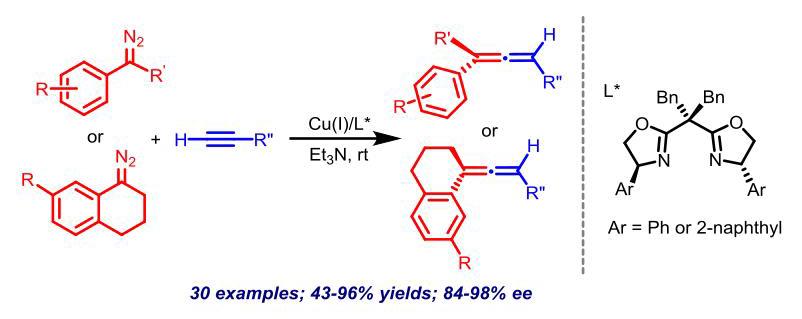
ABSTRACT: A highly enantioselective synthesis of trisubstituted allenes has been achieved through Cu(I)-catalyzed cross-coupling of aryldiazoalkanes and terminal aklynes with chiral bisoxazoline ligands. Alkynyl migratory insertion of Cu(I) carbene is proposed as the key step for the construction of axial chirality.
Due to their unique structure feature and reactivities, allenes have attracted significant attentions in the fields of organic synthesis, natural product chemistry and material sciences. ${}^{1,2}$ In particular, chiral allenes are a type of fascinating molecules possessing axial chirality and have found many applications as useful building blocks in organic synthesis. ${}^{2}$ Accordingly, substantial efforts have been made toward the stereoselective synthesis of axially chiral allenes. ${}^{3}$ Early successful examples relied on the resolution of racemic allenes, ${}^{4}$ and the reactions involving chirality transfer from enantiomerically enriched propargylic derivatives. ${}^{5}$ The construction of axial chirality of allenes through asymmetric catalysis remains a substantially challenging problem. Recently, some progresses have been made in catalytic asymmetric synthesis of chiral allenes, which include nucleophilic addition to enynes, ${}^{6}\beta$ -hydride elimination of enol triflates, ${}^{7}$ enantioselective functionalization of racemic allenes, ${}^{8}$ sigmatropic rearrangements of alkynes, ${}^{9}$ isomerization of 3-alkynes, ${}^{10}$ and Mukaiyama aldol reactions. ${}^{11}$ Despite all these successful catalytic systems, there are still limitations with the existing methods such as the need to use expensive metals, complex substrates, limited scopes, and the possible formation of homo-propargylic alcohols as the byproducts in some cases.
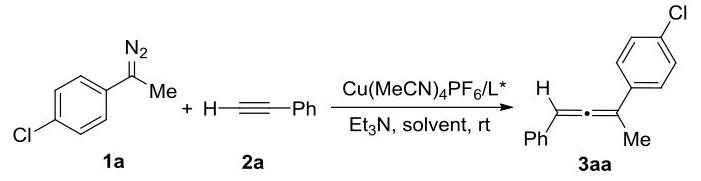
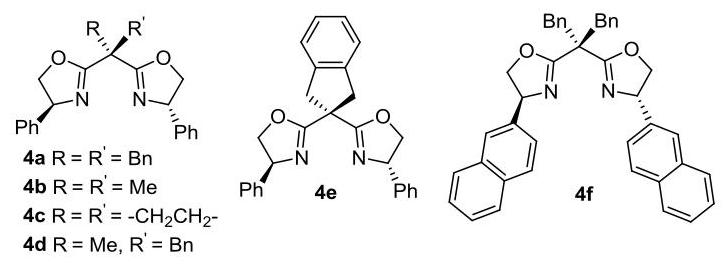
As a part of our research program on carbene-based coupling reaction, ${}^{12}$ we have previously developed a straightforward method for the synthesis of substituted allenes through Cu(I)-catalyzed cross-coupling of terminal alkynes and N-tosylhydrazones (Scheme 1a). ${}^{13}$ The related Cu(I)-catalyzed cross-coupling of terminal alkynes and diazo compounds has also been documented. ${}^{14}$ These coupling reactions may follow common reaction pathway involving alkynyl migratory insertion of $\mathrm{{Cu}}\left( \mathrm{I}\right)$ carbene species. In terms of efficiency and versatility, these direct coupling methods are attractive because they can construct the core structure of allenes from two readily available fragments. Thus, desired allene product 3aa in 69% yield and 71% ee (entry 1). Encouraged by this result, we then proceeded to optimize the reaction by firstly evaluating the effect of solvents (entries 2-7). It was found that the reaction in ${\mathrm{{CHCl}}}_{3},{\mathrm{{CH}}}_{2}{\mathrm{{Cl}}}_{2},{\mathrm{{ClCH}}}_{2}{\mathrm{{CH}}}_{2}\mathrm{{Cl}}$ , THF and dioxane all afforded the product 3aa in comparatively high ee (entries 2-7), but the yields varied significantly and the reaction in ${\mathrm{{CHCl}}}_{3}$ afforded the highest yield. A subsequent investigation of ligands confirmed that 4a provided higher ee than other bisoxazo-line ligands 4b-e (entries 8-11). Subsequently, a substantial increase in both yield and enantioselectivity was observed by replacing bisoxazoline ligand 4a with 4f, in which the phenyl sub-stituents are replaced by 2-naphthyl groups (entry 12). To further improve the enantioselectivity, a mixed solvent of ${\mathrm{{CH}}}_{2}{\mathrm{{Cl}}}_{2}$ and ${\mathrm{{CHCl}}}_{3}$ (1:1) was employed. Under the optimized conditions, the reaction could afford the allene product with ${90}\%$ ee and ${93}\%$ yield (entry 13).
Scheme 1. Allene Synthesis through Cu(I)-Catalyzed Carbene Coupling with Terminal Alkynes
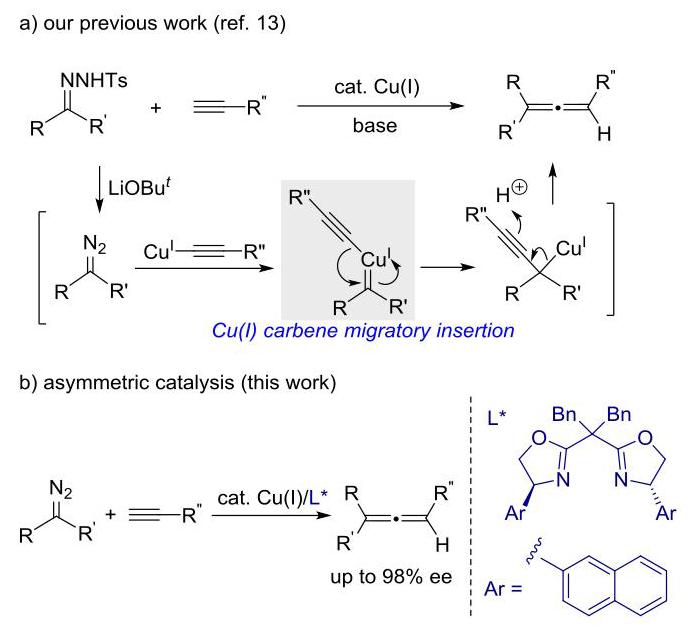
the development of catalytic asymmetric version of these reactions is highly desirable. However, such direct build-up of axial chirality under catalytic asymmetric conditions is not known until very recently. In 2015, the group of Liu and Feng reported the first catalytic asymmetric coupling for the highly enantioselective synthesis of allenoates with chiral cationic guanidinium salts/Cu(I) as the catalyst. ${}^{15}$ While the work represents a significant breakthrough, the reaction is limited to $\alpha$ -diazoesters, which leads to the formation of 2,4-disubstituted allenoates. Thus, further development of catalytic asymmetric coupling for allene synthesis with non-stabilized diazo alkanes is highly demanded. Herein, we report a Cu(I)-catalyzed coupling of non-stabilized diazo compounds for the highly enantioselective synthesis of trisubstituted allenes with a newly designed chiral bisoxazoline ligand (Scheme 1b).
We began our investigation by examining the $\mathrm{{Cu}}\left( \mathrm{I}\right)$ -catalyzed cross coupling reaction between 1-(p-chlorophenyl)-1- diazoethane 1a and phenylacetylene 2a (Table 1). Gratifyingly, the initial experiment with $\mathrm{{Cu}}{\left( \mathrm{{MeCN}}\right) }_{4}{\mathrm{{PF}}}_{6}$ and commercially available chiral bisoxazoline ligand 4a in toluene afforded the
Table 1. Optimization of the Reaction Conditions ${}^{a}$
| entry | L* | solvent | yield, ${\% }^{\mathrm{b}}$ | ee, %c |
| 1 | 4a | toluene | 69 | 71 |
| 2 | 4a | CHCl3 | 90 | 75 |
| 3 | 4a | ${\mathrm{{CH}}}_{2}{\mathrm{{Cl}}}_{2}$ | 30 | 83 |
| 4 | 4a | ${\mathrm{{ClCH}}}_{2}{\mathrm{{CH}}}_{2}\mathrm{{Cl}}$ | 18 | 81 |
| 5 | 4a | THF | 40 | 80 |
| 6 | 4a | MeCN | trace | - |
| 7 | 4a | 1,4-dioxane | 20 | 73 |
| 8 | 4b | ${\mathrm{{CHCl}}}_{3}$ | 85 | 34 |
| 9 | 4c | ${\mathrm{{CHCl}}}_{3}$ | 60 | 61 |
| 10 | 4d | ${\mathrm{{CHCl}}}_{3}$ | 90 | 39 |
| 11 | 4e | ${\mathrm{{CHCl}}}_{3}$ | 50 | 18 |
| 12 | 4f | ${\mathrm{{CHCl}}}_{3}$ | 98 | 88 |
| 13 | 4f | ${\mathrm{{CH}}}_{2}{\mathrm{{Cl}}}_{2} : {\mathrm{{CHCl}}}_{3}$ (1:1) | 93 | 90 |
${}^{a}$ Reaction was run under the following conditions: a solution of 1a (0.2 mmol), 2a (0.1 mmol), Et ${}_{3}\mathrm{\;N}$ (0.1 mmol), Cu(MeCN) ${}_{4}{\mathrm{{PF}}}_{6}$ (10 mol%), and chiral ligand (11 mol%) in anhydrous solvent (1 mL) was stirred at ${25}^{ \circ }\mathrm{C}$ under nitrogen atmosphere for ${60}\mathrm{\;{min}}$ . ${}^{\mathrm{b}}\mathrm{Y}$ - ields refer to isolated products. CDetermined by HPLC analysis using a chiral stationary phase.
With the optimized reaction conditions, the reaction scope was then evaluated. A series of aryldiazoalkanes 1a-j $\left( {{\mathrm{R}}^{\prime } = \mathrm{{Me}}}\right)$ bearing electron-neutral, -deficient or -rich aromatic substituents were smoothly reacted with phenylacetylene 2a to give the corresponding trisubstituted allenes Заа-ja in 84-95% ee and 75-96% yield. The absolute configuration (R) of 3ia was established by the comparison of its optical rotation with the same compound of known configuration reported in the literature. ${}^{16}$ The absolute configuration (R) was further confirmed by X-ray crystallographic analysis of a single crystal of 3ja. The assignment was extended to other allene products based on the assumption that all the reactions followed the same reaction pathway. It is worth mentioning that when the ${\mathrm{R}}^{\prime }$ group was changed to ${\mathrm{{CF}}}_{3}$ , ligand $4\mathrm{a}$ was proved to be the most efficient one, albeit affording the desired product 3ka in only ${50}\%$ yield and ${72}\%$ ee. To further expand the scope of the reaction, tetralone-derived diazo compounds 11-n were then examined. For these diazo substrates, the best results were obtained with 20 mol% of 4a as the ligand, affording the corresponding allene products 3la-na in 92-96% ee and 85-95% yield.
Table 2. The Substrate Scope for Aryldiazoalkanes
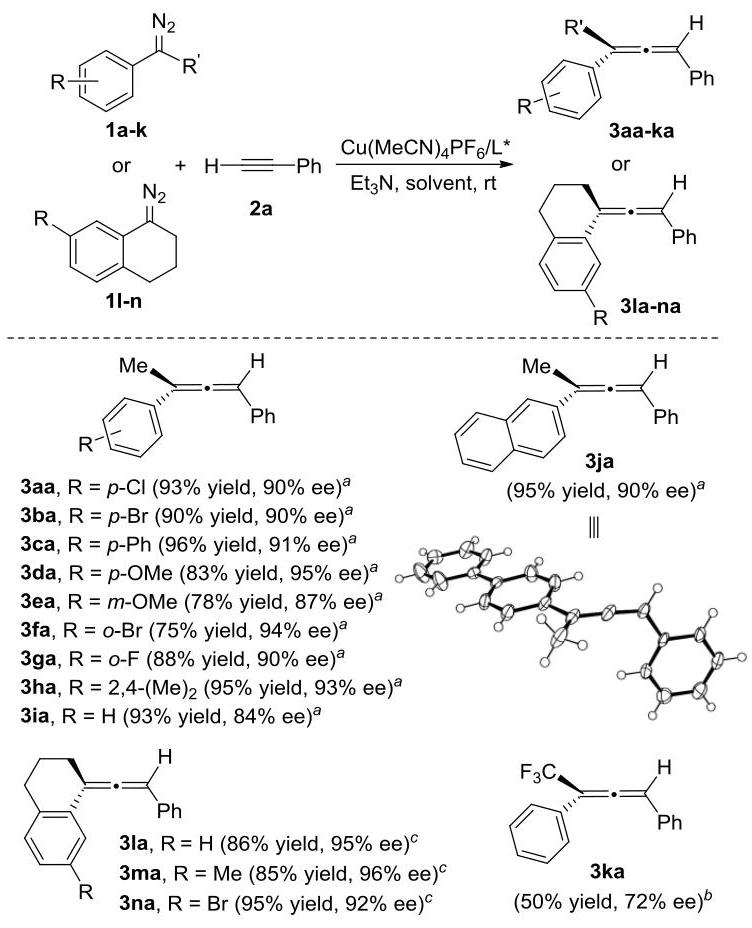
${}^{a}$ Reaction conditions: a solution of 1a-j (0.2 mmol),2a (0.1 $\mathrm{{mmol}}),{\mathrm{{Et}}}_{3}\mathrm{\;N}\left( {{0.1}\mathrm{{mmol}}}\right) ,\mathrm{{Cu}}{\left( \mathrm{{MeCN}}\right) }_{4}{\mathrm{{PF}}}_{6}\left( {{10}\mathrm{\;{mol}}\% }\right)$ , and $4\mathrm{f}({11} \; \mathrm{{mol}}\% )$ in ${\mathrm{{CH}}}_{2}{\mathrm{{Cl}}}_{2}\left( {{0.5}\mathrm{\;{mL}}}\right)$ and ${\mathrm{{CHCl}}}_{3}\left( {{0.5}\mathrm{\;{mL}}}\right)$ was stirred at 25 ${}^{ \circ }\mathrm{C}$ under ${\mathrm{N}}_{2}$ atmosphere for ${70}\mathrm{\;{min}}$ . ${}^{\mathrm{b}}{20}\mathrm{\;{mol}}\% \mathrm{{Cu}}{\left( \mathrm{{MeCN}}\right) }_{4}{\mathrm{{PF}}}_{6}$ , and ${22}\mathrm{\;{mol}}\%$ of $4\mathrm{a}$ were used. ${}^{ \circ }\mathrm{R}$ eaction conditions: a solution of 11-n (0.2 mmol), 2a (0.1 mmol), Et ${}_{3}\mathrm{\;N}$ (0.1 mmol), $\mathrm{{Cu}}{\left( \mathrm{{MeCN}}\right) }_{4}{\mathrm{{PF}}}_{6}\left( {{20}\mathrm{\;{mol}}\% }\right)$ , and $4\mathrm{a}\left( {{22}\mathrm{\;{mol}}\% }\right)$ in ${\mathrm{{CHCl}}}_{3}\left( {{1.0}\mathrm{\;{mL}}}\right)$ was stirred at ${25}^{ \circ }\mathrm{C}$ under ${\mathrm{N}}_{2}$ atmosphere for ${70}\mathrm{\;{min}}$ . The yields refer to isolated products, and the ee values were determined by chiral HPLC analysis.
Next, the scope of the reaction was extended by conducting the reaction with various terminal alkynes. To facilitate the determination of ee values by HPLC, 1h was selected as the representative aryldiazoalkanes (Table 3). When the standard condition was employed for the reactions between $1\mathrm{\;h}$ and $2\mathrm{\;b} - \mathrm{j}$ , moderate ee values were observed. We speculated that the background reactions were more severe when these alkynes were used. Further optimization of the reaction parameters showed that by changing the ratio of $1\mathrm{\;h}$ and alkynes from 2 to 0.5, the reactions provided excellent ee values, albeit with lower yields. A series of terminal alkynes could react smoothly with $1\mathrm{\;h}$ , affording the corresponding trisubstituted allenes 3hb-hi in moderate yields and excellent enantioselectivities, regardless of the electronic nature of the sub-stituents on the aromatic ring of the alkyne substrates 2b-i.
It is also noteworthy that the reaction with benzyl-substituted alkyne 2j also gave the coupling product $3\mathrm{\;h}$ jin ${46}\%$ yield and 92% ee. Furthermore, tetralone-derived diazoalkane 11 was also chosen as the model diazo substrate to study the scope of terminal alkynes. The reaction with alkyne substrates bearing various sub-stituents on the aromatic ring all proceeded smoothly to afford the corresponding allene products 3lb-li in excellent yields and enan-tioselectivities. Finally, the reaction could also be extended to benzyl substituent, the corresponding trisubstituted allenes 31j could be obtained in 96% ee and 93% yield.
Table 3. The Substrate Scope for Terminal Alkynes
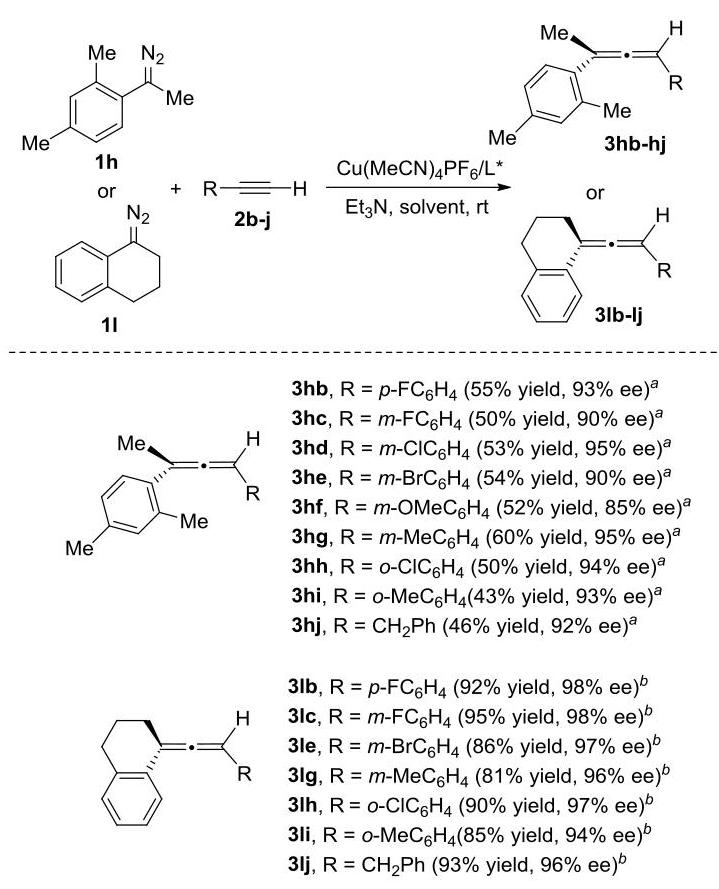
${}^{a}$ Reaction conditions: a solution of $1\mathrm{\;h}\left( {{0.1}\mathrm{{mmol}}}\right) ,2\mathrm{\;b} - \mathrm{j}({0.2} \; \mathrm{{mmol}}),{\mathrm{{Et}}}_{3}\mathrm{\;N}\left( {{0.2}\mathrm{{mmol}}}\right) ,\mathrm{{Cu}}{\left( \mathrm{{MeCN}}\right) }_{4}{\mathrm{{PF}}}_{6}\left( {{10}\mathrm{\;{mol}}\% }\right)$ , and $4\mathrm{f}({11} \; \mathrm{{mol}}\% )$ in ${\mathrm{{CH}}}_{2}{\mathrm{{Cl}}}_{2}\left( {{0.5}\mathrm{\;{mL}}}\right)$ and ${\mathrm{{CHCl}}}_{3}\left( {{0.5}\mathrm{\;{mL}}}\right)$ was stirred at 25 ${}^{ \circ }\mathrm{C}$ under ${\mathrm{N}}_{2}$ atmosphere for ${70}\mathrm{\;{min}}$ . ${}^{\mathrm{b}}$ Reaction conditions: a solution of ${11}\left( {{0.2}\mathrm{{mmol}}}\right) ,2\mathrm{\;b} - \mathrm{j}\left( {{0.1}\mathrm{{mmol}}}\right) ,{\mathrm{{Et}}}_{3}\mathrm{\;N}\left( {{0.1}\mathrm{{mmol}}}\right)$ , $\mathrm{{Cu}}{\left( \mathrm{{MeCN}}\right) }_{4}{\mathrm{{PF}}}_{6}\left( {{20}\mathrm{\;{mol}}\% }\right)$ , and $4\mathrm{a}\left( {{22}\mathrm{\;{mol}}\% }\right)$ in ${\mathrm{{CHCl}}}_{3}\left( {{1.0}\mathrm{\;{mL}}}\right)$ was stirred at ${25}^{ \circ }\mathrm{C}$ under ${\mathrm{N}}_{2}$ atmosphere for ${70}\mathrm{\;{min}}$ . All the yields refer to isolated products. The ee values were determined by chiral HPLC analysis.
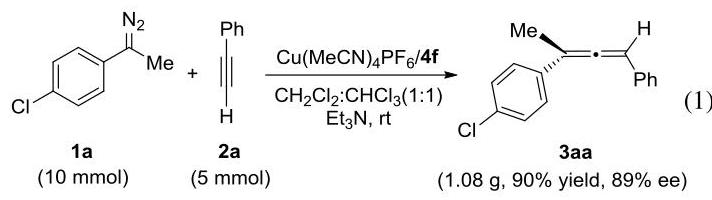
To show the synthetic potential of this strategy, we have carried out a gram scale synthesis of 3aa (eq 1). Under the optimized reaction conditions, the reaction with 5 mmol of 2a proceeded smoothly with 2 equivalents of 1a, affording 1.08 g of 3aa (90% yield) with 89% ee.
A stereocontrol model was tentatively proposed to explain the enantioselection in the present reaction (Figure 1). Based on previous studies, ${}^{{13},{14}}$ the $\mathrm{{Cu}}\left( \mathrm{I}\right)$ -catalyzed coupling reaction follows a pathway involving $\mathrm{{Cu}}\left( \mathrm{I}\right)$ carbene formation, alkynyl migratory insertion and protonation (Scheme 1a). In this mechanism, the alkynyl migratory insertion generates the C(sp)-C(sp ${}^{3}$ ) bond and this step is enantio-determining. Therefore, for this step two competing structures A and B are proposed to lead to the allene products with (R) and (S) configurations, respectively. Because of the steric repulsion existed in B between the phenyl group of the carbene and the naphthyl group of the chiral skeleton of the bisoxa-zoline, A is energetically more favored than B, leading to the formation of (R)-configured allene as the major product.
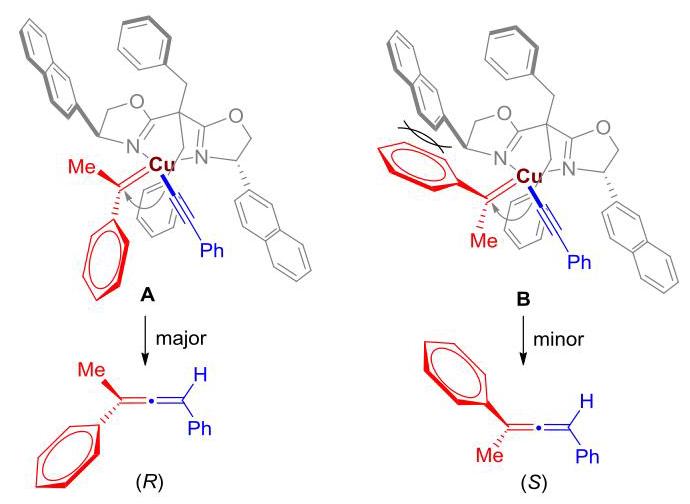
Figure 1. Rationale for Enantioselection.
In summary, we have developed a highly enantioselective Cu(I)-catalyzed coupling reaction between aryldiazoalkanes and terminal alkynes with chiral bisoxazoline as the ligand. A series of trisubstituted allenes were obtained with moderate to high yields (up to 96%) and excellent enantioselectivities (up to 98% ee). Further investigations on the related Cu(I)-catalyzed enantioselec-tive carbene coupling reaction is current under way in our laboratory.
ASSOCIATED CONTENT
Supporting Information. Experimental procedure, characterization data, copies of ${}^{1}\mathrm{H}$ and ${}^{13}\mathrm{C}$ NMR spectra. This material is available free of charge via the Internet at http://pubs.acs.org.
AUTHOR INFORMATION
${}^{ \dagger }$ Peking University
${}^{ \ddagger }$ Chinese Academy of Sciences
Corresponding Author
ACKNOWLEDGMENT
The project is supported by the National Basic Research Program of China (973 Program, No. 2015CB856600) and the Natural Science Foundation of China (Grant 21472004, 21332002).
REFERENCES
(1) Reviews on allenes in natural products: (a) Hoffmann-Röder, A.; Krause, N. Angew. Chem. Int. Ed. 2004, 43, 1196. Allenes in organic materials: (b) Rivera-Fuentes, P.; Diederich, F. Angew. Chem. Int. Ed. 2012, 51, 2818-2828.
(2) For selected recent reviews, see: (a) Modern Allene Chemistry; Krause, N., Hashmi, A. S. K., Eds.; Wiley-VCH: Weinheim, Germany, 2004; Vols. 1 and 2. (b) Hoffmann-Röder, A.; Krause, N. Angew. Chem. Int. Ed. 2004, 43, 1196-1216. (c) Ma, S. Palladium-Catalyzed Two- or Three-Component Cyclization of Functionalized Allenes in Palladium in Organic Synthesis; Tsuji, J., Ed.; Springer: Berlin, 2005; pp 183-210. (d) Brandsma, L.; Ne-dolya, N. A. Synthesis 2004, 735-745. (e) Ma, S. Chem. Rev. 2005, 105, 2829-2871. (f) Ma, S. Aldrichimica Acta 2007, 40, 91-102. (g) Kim, H.; Williams, L. J. J. Curr. Opin. Drug Discovery Dev. 2008, 11, 870-894. (h) Brasholz, M.; Reissig, H. U.; Zimmer, R. Acc. Chem. Res. 2009, 42, 45-56. (i) Ma, S. Acc. Chem. Res. 2009, 42, 1679-1688. (j) Aubert, C.; Fensterbank, L.; Garcia, P.; Malacria, M.; Simonneau, A. Chem. Rev. 2011, 111, 1954-1993. (k) Yu, S.; Ma, S. Angew. Chem. Int. Ed. 2012, 51, 3074-3112. (1) Ye, J.; Ma, S. Acc. Chem. Res. 2014, 47, 989- 1000.
(3) For recent reviews on asymmetric synthesis of allenes, see: (a) Ogasawara, M. Tetrahedron: Asymm. 2009, 20, 259-271. (b) Neff, R. K.; Frantz, D. E. ACS Catal. 2014, 4, 519-528. (c) Ye, J.; Ma. S. Org. Chem. Front. 2014, 1, 1210-1224.
(4) For selected examples, see: (a) Yu, J.; Chen, W.-J.; Gong, L.-Z. Org. Lett. 2010, 12, 4050-4053. (b) Sapu, C. M.; Bäckvall, J.-E.; Deska, J. Angew. Chem. Int. Ed. 2011, 50, 9731-9734. (c) In-okuma, T.; Furukawa, M.; Suzuki, Y.; Kimachi, T.; Kobayashi, Y.; Takemoto, Y. ChemCatChem 2012, 4, 983-985.
(5) For selected recent examples, see: (a) Zelder, C.; Krause, N. Eur. J. Org. Chem. 2004, 3968-3971. (b) Sherry, B. D.; Toste, F. D. J. Am. Chem. Soc. 2004, 126, 15978-15979. (c) Pu, X.; Ready, J. M. J. Am. Chem. Soc. 2008, 130, 10874-10875. (d) Lo, V. K. Y.; Wong, M. K.; Che, C. M. Org. Lett. 2008, 10, 517-519. (e) Lo, V. K.-Y.; Zhou, C.-Y.; Wong, M.-K.; Che, C.-M. Chem. Com-mun. 2010, 46, 213-215. (f) Ohmiya, H.; Yokobori, U.; Makida, Y.; Sawamura, M. Org. Lett. 2011, 13, 6312-6315. (g) Uehling, M. R.; Marionni, S. T.; Lalic, G. Org. Lett. 2012, 14, 362-365. (h) Yang, M.; Yokokawa, N.; Ohmiya, H.; Sawamura, M. Org. Lett. 2012, 14, 816-819. (i) Tang, X.; Huang, X.; Cao, T.; Han, Y.; Jiang, X.; Lin, W.; Tang, Y.; Zhang, J.; Yu, Q.; Fu, C.; Ma, S. Org. Chem. Front. 2015, 2, 688-691. (j) Huang, X.; Xue, C.; Fu, C.; Ma, S. Org. Chem. Front. 2015, 2, 1040-1044. (k) Huang, X.; Cao, T.; Han, Y.; Jiang, X.; Lin, W.; Zhang, J.; Ma, S. Chem. Commun. 2015, 51, 6956-6959. (l) S. Wu, X. Huang, W. Wu, P. Li, C. Fu, S. Ma, Nat. Comm. 2015, 6, 7946.
(6) (a) Matsumoto, Y.; Naito, M.; Uozumi, Y.; Hayashi, T. J. Chem. Soc. Chem. Commun. 1993, 1468-1469. (b) Han, J. W.; Tokuna-ga, N.; Hayashi, T. J. Am. Chem. Soc. 2001, 123, 12915-12916. (c) Hayashi, T.; Tokunaga, N.; Inoue, K. Org. Lett. 2004, 6, 305-307. (d) Nishimura, T.; Makino, H.; Nagaosa, M.; Hayashi, T. J. Am. Chem. Soc. 2010, 132, 12865-12867. (e) Zhang, W.; Zheng, S. Q.; Liu, N.; Werness, J. B.; Guzei, I. A.; Tang, W. P. J. Am. Chem. Soc. 2010, 132, 3664-3665. (f) Qian, H.; Yu, X.; Zhang, J.; Sun, J. J. Am. Chem. Soc. 2013, 135, 18020-18023. (g) Wang, M.; Liu, Z.-L.; Zhang, X.; Tian, P.-P.; Xu, Y.-H.; Loh, T.-P. J. Am. Chem. Soc. 2015, 137, 14830-14833. (h) Yao, Q.; Liao, Y.; Lin, L.; Lin, X.; Ji, J.; Liu, X.; Feng, X. Angew. Chem., Int. Ed. 2016, 55, 1859-1863.
(7) Crouch, I. T.; Neff, R. K.; Frantz, D. E. J. Am. Chem. Soc. 2013, 135, 4970-4973.
(8) (a) Imada, Y.; Nishida, M.; Kutsuwa, K.; Murahashi, S.-I.; Nao-ta, T. Org. Lett. 2005, 7, 5837-5839. (b) Boutier, A.; Kammerer-Pentier, C.; Krause, N.; Prestat, G.; Poli, G. Chem. Eur. J. 2012, 18, 3840-3844. (c) Hashimoto, T.; Sakata, K.; Tamakuni, F.; Dutton, M. J.; Maruoka, K. Nat. Chem. 2013, 5, 240-244. (d) Wan, B.; Ma, S. Angew. Chem. Int. Ed. 2013, 52, 441-445. (e) Mbofana, C. T.; Miller, S. J. J. Am. Chem. Soc. 2014, 136, 3285- 3292. (f) Wang, G.; Liu, X.; Chen, Y.; Yang, J.; Li, J.; Lin, L.; Feng, X. ACS Catal. 2016, 6, 2482-2486.
(9) (a) Li, Z.; Boyarskikh, V.; Hansen, J. H.; Autschbach, J.; Mu-saev, D.; Davies, H. M. L. J. Am. Chem. Soc. 2012, 134, 15497- 15504. (b) Wang, Y.; Zhang, W.; Ma, S. J. Am. Chem. Soc. 2013, 135, 11517-11520. (c) Liu, Y.; Hu, H.; Zheng, H.; Xia, Y.; Liu, X.; Lin, L.; Feng, X. Angew. Chem. Int. Ed. 2014, 53, 11579- 11582. (d) Liu, Y.; Liu, X.; Hu, H.; Guo, J.; Xia, Y.; Lin, L.; Feng, X. Angew. Chem. Int. Ed. 2016, 55, 4054-4058.
(10) (a) Liu, H.; Leow, D.; Huang, K.-W.; Tan, C.-H. J. Am. Chem. Soc. 2009, 131, 7212-7213. (b) Huang, D.; Qin, S.; Hu, C. Org. Biomol. Chem. 2011, 9, 6034-6039. (c) Inokuma, T.; Furukawa, M.; Uno, T.; Suzuki, Y.; Yoshida, K.; Yano, Y.; Matsuzaki, K.; Takemoto, Y. Chem. -Eur. J. 2011, 17, 10470-10477. (d) Xiao, H.; Kobayashi, Y.; Takemoto, Y.; Morokuma, K. ACS Catal. 2016, 6, 2988-2996.
(11) Tap, A.; Blond, A.; Wakchaure, V. N.; List, B. Angew. Chem. Int. Ed. 2016, 55, 8962-8965.
(12) Xiao, Q.; Zhang, Y.; Wang, J. Acc. Chem. Res. 2013, 46, 236- 247.
(13) (a) Xiao, Q.; Xia, Y.; Li, H.; Zhang, Y.; Wang, J. Angew. Chem. Int. Ed. 2011, 50, 1114-1117. (b) Ye, F.; Hossain, M. L.; Xu, Y.; Ma, X.; Xiao, Q.; Zhang, Y.; Wang, J. Chem. Asian J. 2013, 8, 1404-1407. (c) Hossain, M. L.; Ye, F.; Zhang, Y.; Wang, J. J. Org. Chem. 2013, 78, 1236-1241. (d) Ye, F.; Wang, C.; Ma, X; Hossain, M. L.; Xia, Y.; Zhang, Y.; Wang, J. J. Org. Chem. 2015, 80, 647-652.
(14) For related coupling with diazo compounds, see: (a) Hassink, M.; Liu, X.; Fox, J. M. Org. Lett. 2011, 13, 2388-2391. (b) Mondal, S.; Nechab, M.; Campolo, D.; Vanthuyne, N.; Bertrand, M. P. Adv. Synth. Catal. 2012, 354, 1987-2000. (c) Poh, J.-S.; Tran, D. N.; Battilocchio, C.; Hawkins, J. M.; Ley, S. V. Angew. Chem. Int. Ed. 2015, 54, 7920-7923. (d) Wu, C.; Hu, F.; Liu, Z.; Deng, G.; Ye, F.; Zhang, Y.; Wang, J. Tetrahedron 2015, 71, 9196- 9201.
(15) Tang, Y.; Chen, Q.; Liu, X.; Wang, G.; Lin, L.; Feng, X. Angew. Chem. Int. Ed. 2015, 54, 9512-9516.
(16) Periasamy, M.; Reddy, P. O.; Satyanarayana, I.; Mohan, L.; Edu-kondalu, A. J. Org. Chem. 2016, 81, 987-999.