Bi-functional Ligand-assisted Catalytic Ketone α-Alkenylation with Internal Alkynes: Controlled Synthesis of Enones and Mechanistic Studies
中文 / Bilingual · English version
Fanyang Mo, Hee Nam Lim, and Guangbin Dong
J. Am. Chem. Soc., Just Accepted Manuscript • DOI: 10.1021/jacs.5b10466 • Publication Date (Web): 13 Nov 2015 Downloaded from http://pubs.acs.org on November 13, 2015
Just Accepted
“Just Accepted” manuscripts have been peer-reviewed and accepted for publication. They are posted online prior to technical editing, formatting for publication and author proofing. The American Chemical Society provides “Just Accepted” as a free service to the research community to expedite the dissemination of scientific material as soon as possible after acceptance. “Just Accepted” manuscripts appear in full in PDF format accompanied by an HTML abstract. “Just Accepted” manuscripts have been fully peer reviewed, but should not be considered the official version of record. They are accessible to all readers and citable by the Digital Object Identifier (DOI(R)). “Just Accepted” is an optional service offered to authors. Therefore, the “Just Accepted” Web site may not include all articles that will be published in the journal. After a manuscript is technically edited and formatted, it will be removed from the “Just Accepted” Web site and published as an ASAP article. Note that technical editing may introduce minor changes to the manuscript text and/or graphics which could affect content, and all legal disclaimers and ethical guidelines that apply to the journal pertain. ACS cannot be held responsible for errors or consequences arising from the use of information contained in these “Just Accepted” manuscripts.
ACS Publications
Journal of the American Chemical Society is published by the American Chemical Society. 1155 Sixteenth Street N.W., Washington, DC 20036
Published by American Chemical Society. Copyright © American Chemical Society. However, no copyright claim is made to original U.S. Government works, or works produced by employees of any Commonwealth realm Crown government in the course
Bi-functional Ligand-assisted Catalytic Ketone α-Alkenylation with Internal Alkynes: Controlled Synthesis of Enones and Mechanistic Studies
Fanyang Mo, ${}^{1,2}$ Hee Nam Lim ${}^{1}$ and Guangbin Dong ${}^{1 * }$
${}^{1}$ Department of Chemistry, University of Texas at Austin, Austin, TX 78712, United States
${}^{2}$ Department of Energy and Resources Engineering, College of Engineering, Peking University, Beijing 100871, China
Supporting Information
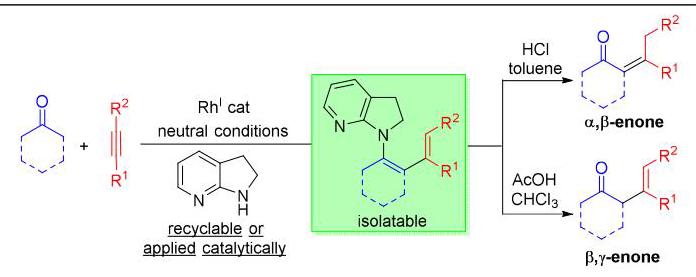
ABSTRACT: Here we describe a detailed study of the rhodium(I)-catalyzed, bi-functional ligand-assisted ketone α-C-H alkenyla-tion using internal alkynes. Through controlling the reaction conditions, conjugated enamines, $\alpha ,\beta$ - or $\beta ,\gamma$ -unsaturated ketones can be selectively accessed. Both aromatic and aliphatic alkynes can be employed as coupling partners. The reaction conditions also tolerate a broad range of functional groups, including carboxylic esters, malonates, secondary amides, thioethers and free alcohols. In addition, excellent $E$ -selectivity was observed for the tetra-substituted alkene when forming the $\alpha ,\beta$ -unsaturated ketone products. The mechanism of this transformation was explored through control experiments, kinetic monitoring, synthesizing the rhodium-hydride intermediates and their reactions with alkynes, deuterium-labeling experiments and identification of the resting states of the catalyst.
INTRODUCTION
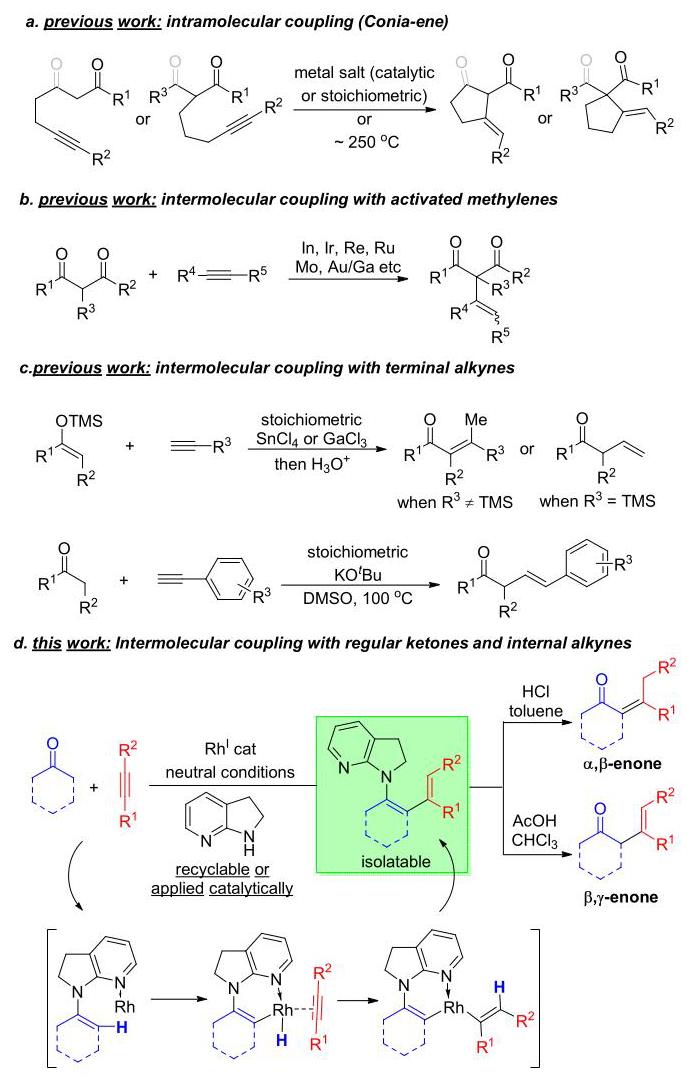
Unsaturated ketones (also known as enones), typically those bearing $\alpha ,\beta$ - or $\beta ,\gamma$ -C-C double bonds, have rich biological and chemical properties. They are often observed in bioactive compounds and frequently employed as synthetic intermediates. ${}^{1,2}$ Undoubtedly, numerous methods have been developed to date for enone synthesis. ${}^{3 - 5}$ However, direct $\mathrm{C} - \mathrm{C}$ coupling between a ketone and an alkyne represents one of the most attractive approaches due to the atom/redox-efficiency of the reaction and the wide availability of both starting materials. ${}^{6,7}$ For example, the intramolecular ketone-alkyne cyclization, also known as “Conia-ene” reaction, represents a distinct way to synthesize cyclic enones, which can be catalyzed/mediated by a range of metals or enabled by thermal conditions (Scheme 1a). ${}^{8 - {38}}$ In contrast, the intermolecular ketone-alkyne coupling is primarily known with activated methylene compounds as the substrates (Scheme 1b). ${}^{{39} - {53}}$ To date, only two approaches are available for intermolecular coupling of a regular ketones and an alkyne. One seminal work by Yamaguchi involves addition of silyl enol ethers into mono-substituted alkynes mediated by stoichiometric Lewis acids, such as Ga(III) and Sn(IV) salts. ${}^{{54} - {57}}$ Recently, Trofimov and coworkers developed a strong base-promoted addition of potassium enolates into aryl terminal acetylenes (Scheme 1c). ${}^{{58},{59}}$
To the best of our knowledge, the intermolecular coupling between a regular ketone and an internal alkyne remained an unknown transformation. Towards our long-term goal of developing byproduct-free ketone/unsaturate couplings under $\mathrm{{pH}}$ and redox-neutral conditions, ${}^{60}$ here we describe our detailed development of a catalytic ketone $\alpha$ -alkenylation reaction with unactivated disubstituted alkynes, which is enabled by a bi-functional ligand and a low-valent transition-metal catalyst (Scheme 1d).
The transition-metal-catalyzed addition of $s{p}^{2}\mathrm{C} - \mathrm{H}$ bonds across unactivated alkynes has recently emerged a powerful strategy to synthesize substituted alkenes in a byproduct-free fashion. ${}^{{61},{62}}$ For example, Murai and co-workers reported the first directed hydroarylation of alkynes using a ruthenium catalyst. ${}^{{62}\mathrm{c}}$ The related alkyne hydrovinylation was first established by Trost and co-workers. ${}^{{62}\mathrm{\;d}}$ Later, Lim and Kang developed an rhodium-catalyzed ortho-alkenylation of 2-phenylpyridines with internal alkynes. ${}^{{62}\mathrm{\;h}}$ Besides through a metal-hydride reaction pathway, more recently Schipper and Fagnou demonstrated a Rh(III)- catalyzed intermolecular hydroarylation of alkynes via aryl-metalation followed by protonation. ${}^{62o}$ In addition, Jun and coworkers have achieved a novel metal-organic cooperative approach in the rhodium-catalyzed hydroacylation of alkynes, in which an aldehyde was masked as an imine that can undergo directed $\mathrm{C} - \mathrm{H}$ activation. ${}^{{61}\mathrm{a},{62}\mathrm{k}}$ These seminal works offer a solid foundation and important inspiration for our targeted catalytic ketone $\alpha$ -alkenylation with unactivated alkynes.
Our laboratory recently developed a regioselective ketone $\alpha$ - alkylation reaction with unactivated $\alpha$ -olefins, wherein the vinyl $\mathrm{C} - \mathrm{H}$ bond of the enamine generated from the ketone and an amine bi-functional catalyst can be activated by $\mathrm{{Rh}}$ metal and added across olefins to deliver an alkylated enamine, which upon hydrolysis furnished the alkylation product and regenerate the bifunctional catalyst. ${}^{60}$ Accordingly, we envisioned a protocol for formal ketone $\alpha$ -alkenylation with internal alkynes wherein a conjugated enamine is formed as the key intermediate that can undergo hydrolysis to give either $\alpha ,\beta$ - or $\beta ,\gamma$ -enones (Scheme 1d). Compared to the $\alpha$ -alkylation reaction, the challenges of the $\alpha$ - alkenylation reactions with internal alkynes are three-fold. First, assisted by low valent metals, alkynes can undergo facile homo-couplings to give dimer or trimer products. ${}^{{63},{64}}$ Second, due to their low steric hindrance, more than one alkyne can coordinate to a single metal center, which often generates multiple-insertion products. ${}^{65}$ Third, chemo- and stereo-selective hydrolysis of the proposed conjugated enamine intermediate is expected to be nontrivial (Scheme 1d). ${}^{66}$ Particularly, control of the geometry for the newly formed tetra-substituted-alkene in the $\alpha ,\beta$ -enone products can be a significant concern.
Scheme 1. C-C Couplings between Ketones and Alkynes.
RESULTS AND DISCUSSION
Reaction Condition Optimization. To probe the feasibility of the ketone-alkyne coupling, we initiated our studies with cyclopentanone 1a and diphenylacetylene 2a as the standard substrates. First, the effect of the bi-functional ligands was examined. Eight secondary and primary amine compounds (L1 to L8 in Table 1) containing an adjacent directing group were subjected to the reaction conditions (5 mol % of Wilkinson’s catalyst and 10 mol % of ${\mathrm{{TsOH}}}_{4}{\mathrm{H}}_{2}\mathrm{O}$ in toluene at ${130}{}^{ \circ }\mathrm{C}$ for ${12}\mathrm{\;h}$ ). In accord with our previous study, ${}^{60}$ 7-azaindoline (L1) exhibited unique and high catalytic activity, whereas other directing ligands were inactive. As a preliminary result, with 100 mol % loading of L1, the reaction gave 46% of conjugated enamine product 3a, 26% of its isomer (3a’) and 17% of the conjugated enone 4a (Table 1, entry 1). All these products were isolated and fully characterized by ${}^{1}\mathrm{H}/{}^{13}\mathrm{C}$ NMR, infrared (IR), and high-resolution mass spectrometry (HRMS). The structures of 3a and 4a’s hydrazone derivatives were further unambiguously confirmed by X-ray crystallography (vide infra).
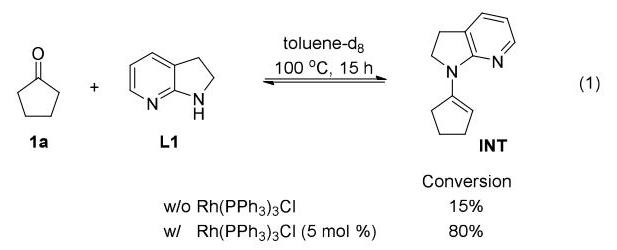
With an active bi-functional ligand L1 in hand, we continued our studies by investigating other reaction parameters shown in Table 2. First, we found that the absence of $\mathrm{{TsOH}} \cdot {\mathrm{H}}_{2}\mathrm{O}$ led to an increased yield of $3\mathrm{a}$ with no 4a formed (Table 2, entry 1). In contrast to our study with alkene couplings, ${}^{60}\mathrm{{TsOH}} \cdot {\mathrm{H}}_{2}\mathrm{O}$ , previously proposed to promote enamine formation, is not necessary in this ketone/alkyne coupling reaction. Two control experiments (without the alkyne) revealed that Wilkinson’s catalyst can significantly accelerate the condensation between ketone 1a and L1 to form the enamine intermediate (eq 1). Consequently, in the absence of this protic acid, the conjugated enmaine products (3a/3a’) are stable under the reaction conditions.
Table 1. Evaluation of Bi-functional Ligands for Rh(I)-catalyzed Coupling of Cyclopentanone and Diphenylacetylene ${}^{a}$
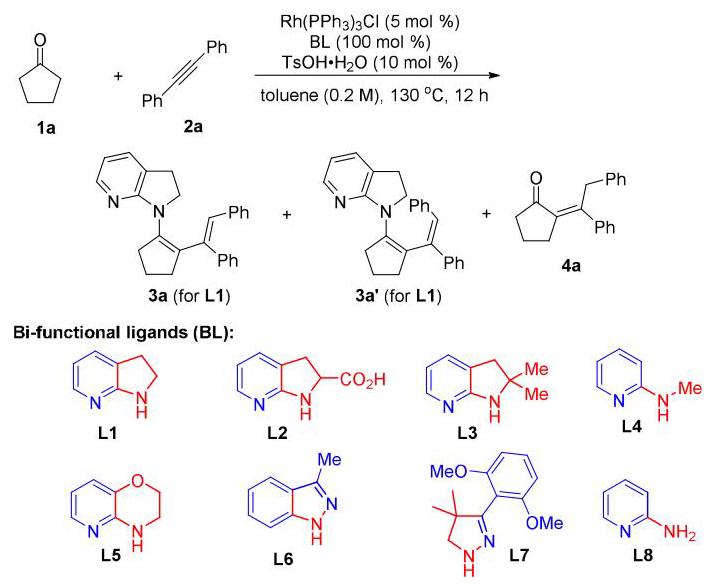
| Entry | Bi-functional ligand | Yields of Products ${}^{1}$ |
| 1 | L1 | 3a 46%, 3a' 26%, 4a 17% |
| 2 | L2 | all together < 5% |
| 3 | L3 | all together < 5% |
| 4 | L4 | all together < 5% |
| 5 | L5 | all together < 5% |
| 6 | L6 | all together < 5% |
| 7 | L7 | all together < 5% |
| 8 | L8 | all together < 5% |
${}^{a}$ Conditions: cyclopentanone 1a (0.2 mmol), diphenylacetylene 2a (0.2 mmol). ${}^{b}$ Yields were determined by ${}^{1}\mathrm{H}$ NMR using 1,1,2,2- tetrachloroethane as the internal standard.
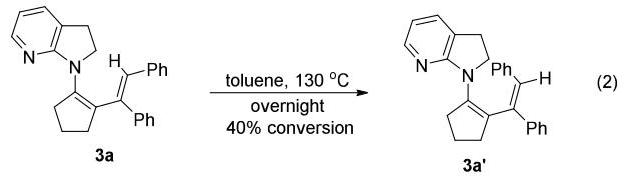
${\left\lbrack \mathrm{{Rh}}{\left( \mathrm{{CO}}\right) }_{2}\mathrm{{Cl}}\right\rbrack }_{2}$ and ${\left\lbrack \mathrm{{Rh}}{\left( \mathrm{{coe}}\right) }_{2}\mathrm{{Cl}}\right\rbrack }_{2}$ also delivered the desired products albeit giving lower yields than Wilkinson’s catalyst (entries 2 and 3). Different phosphine ligands other than ${\mathrm{{PPh}}}_{3}$ were also evaluated, whereas both electron-rich and deficient ones gave much lower yields (entries 4 and 5). ${}^{67}$ Use of 2 equivalents of cyclopentanone led to a full conversion of L1 with 64% yield of 3a and 31% yield of 3a’ (entry 6). It is noteworthy that under the conditions giving low yields (e.g. entries 4 and 5), 3a’ was not detected in the reaction mixture. We rationalized that 3a was likely the initial product formed, and 3a’ is the isomerized product of 3a. Indeed, when pure $3\mathrm{a}$ was heated at ${130}{}^{ \circ }\mathrm{C}$ overnight,40% conversion to 3a’ was observed (eq 2). The 3a/3a’ ratio was higher when the reaction was conducted at ${100}{}^{ \circ }\mathrm{C}$ instead of ${130}{}^{ \circ }\mathrm{C}$ (entry 7), without losing reactivity. We further discovered that
Table 2. Reaction Condition Screening ${}^{a}$

| Entry | Rh(I) (mmol %) | Ratio (1a : 2a : L1) | Temperature $\left( {{}^{ \circ }\mathrm{C}}\right)$ | Additives (mol %) | Yields of Products (%) ${}^{b}$ | |||
| 3a | 3a' | 4a | 5a | |||||
| Optimization for conjugated enamine product 3a | ||||||||
| 1 | $\mathrm{{Rh}}{\left( {\mathrm{{PPh}}}_{3}\right) }_{3}\mathrm{{Cl}}\left( 5\right)$ | $1 : 1 : 1$ | 130 | - | 59 | 22 | 0 | 0 |
| 2 | ${\left\lbrack \mathrm{{Rh}}{\left( \mathrm{{CO}}\right) }_{2}\mathrm{{Cl}}\right\rbrack }_{2}\left( {2.5}\right)$ | $1 : 1 : 1$ | 130 | - | 17 | 12 | 0 | 0 |
| 3 | ${\left\lbrack \mathrm{{Rh}}{\left( \mathrm{{coe}}\right) }_{2}\mathrm{{Cl}}\right\rbrack }_{2}\left( {2.5}\right)$ | $1 : 1 : 1$ | 130 | - | 22 | 12 | 0 | 0 |
| 4 | ${\left\lbrack \mathrm{{Rh}}\left( \mathrm{{coe}}\right) 2\mathrm{{Cl}}\right\rbrack }_{2}\left( 5\right) + {\mathrm{{PCy}}}_{3}$ (20) | $1 : 1 : 1$ | 130 | - | 13 | 0 | 0 | 0 |
| 5 | ${\left\lbrack \mathrm{{Rh}}\left( \mathrm{{Coe}}\right) 2\mathrm{{Cl}}\right\rbrack }_{2}\left( 5\right) + \mathrm{P}{\left( {\mathrm{C}}_{6}{\mathrm{\;F}}_{5}\right) }_{3}\left( {20}\right)$ | $1 : 1 : 1$ | 130 | - | 15 | 0 | 0 | 0 |
| 6 | $\mathrm{{Rh}}{\left( {\mathrm{{PPh}}}_{3}\right) }_{3}\mathrm{{Cl}}\left( 5\right)$ | $2 : 1 : 1$ | 130 | - | 64 | 31 | 0 | 0 |
| 7 | $\mathrm{{Rh}}{\left( {\mathrm{{PPh}}}_{3}\right) }_{3}\mathrm{{Cl}}\left( 5\right)$ | $2 : 1 : 1$ | 100 | - | 73 | 26 | 0 | 0 |
| 8 | $\mathrm{{Rh}}{\left( {\mathrm{{PPh}}}_{3}\right) }_{3}\mathrm{{Cl}}\left( 1\right)$ | $2 : 1 : 1$ | 100 | - | 31 | 0 | 0 | 0 |
| 9° | Rh(PPh3) ${}_{3}\mathrm{{Cl}}\left( 2\right)$ | $2 : 1 : 1$ | 100 | - | 84 | 11 | 4 | 0 |
| Optimization for conjugated ketone product 4a | ||||||||
| 10 | $\mathrm{{Rh}}{\left( {\mathrm{{PPh}}}_{3}\right) }_{3}\mathrm{{Cl}}\left( 5\right)$ | 2 : 1 : 1 | 130 | $\mathrm{{TsOH}} \cdot {\mathrm{H}}_{2}\mathrm{O}\left( {10}\right)$ | 30 | 51 | 18 | 0 |
| 11 | $\mathrm{{Rh}}{\left( {\mathrm{{PPh}}}_{3}\right) }_{3}\mathrm{{Cl}}\left( 5\right)$ | 2 : 1 : 1 | 130 | ${\mathrm{{PhCO}}}_{2}\mathrm{H}\left( {10}\right)$ | 55 | 40 | 4 | 0 |
| ${12}^{\mathrm{d}}$ | Rh(PPh ${}_{3}$ ) ${}_{3}$ Cl (5) | 2 : 1 : 0.5 | 130 | TsOH·H ${}_{2}$ O (10) | 7 | 0 | 64 | 9 |
| 13 | - | 2 : 1 : 1 | 130 | $\mathrm{{TsOH}} \cdot {\mathrm{H}}_{2}\mathrm{O}$ (10) | 0 | 0 | 0 | 0 |
| 14 | $\mathrm{{Rh}}{\left( {\mathrm{{PPh}}}_{3}\right) }_{3}\mathrm{{Cl}}$ (5) | 2:1:0 | 130 | ${\mathrm{{TsOH}}}^{ \bullet }{\mathrm{H}}_{2}\mathrm{O}$ (10) | - | - | 0 | 0 |
${}^{a}$ General conditions: 0.5 mmol scale, toluene 2.5 mL. ${}^{b}$ Yields were determined by ${}^{1}$ H NMR using 1,1,2,2-tetrachloroethane as the internal standard. ${}^{c}{48}\mathrm{\;h}.{}^{d} \; {24}\mathrm{\;h}$ . After the reaction, $\mathrm{{HCl}}$ (conc. ${40}\mathrm{{OL}}$ ) was added; the reaction was further heated at ${130}^{ \circ }\mathrm{C}$ for ${0.5}\mathrm{\;h}$ .
lowering the catalyst loading to 1 mol % resulted in almost no isomerization, but 3a was formed in only 31% yield, due to the relatively low reaction rate (entry 8). However, by using 2 mol % of Wilkinson’s catalyst at ${100}{}^{ \circ }\mathrm{C}$ for 48 hours, a full conversion with 84% yield of product 3a was obtained (entry 9).
With an optimal yield for conjugate enamine 3a in hand, we next optimized the yield for enone 4a through adding an acid as a co-catalyst. Tosylic acid monohydrate and benzoic acid both showed comparable conversions. However, formation of 4a was more favorable when tosylic acid monohydrate was used (entries 10 and 11). In principle, L1 can be employed in a catalytic amount for in situ hydrolysis of 3a would liberate L1. However, due to the high stability of the conjugated enamine product 3a (3a’), 50 mol % of L1 was used to ensure the reaction rate. At the end of the reaction, simple workup with a small amount of HCl aqueous solution for half an hour (to hydrolyze any remaining conjugated enamines) afforded an acceptable yield of 4a along with a small amount of vinyl ketone 5a (entry 12). Finally, control experiments showed that the rhodium catalyst and bifunctional ligand L1 are both pivotal to this transformation (entries 13 and 14). Another potential pathway to form 4a is aldol reaction between ketone 1a and 2-phenylacetophenone, which can possibly come from the hydration of alkyne 2a. However, as indicated in a control experiment, replacing alkyne 2a with 2- phenylacetophenone led to no desired coupling products, which excluded the hydration passway. ${}^{68}$
The Scope of Conjugated Enamine Products. The scope of forming conjugated enamines (from ketones, alkynes and L1) is illustrated in Chart 1. As expected, the nature of the ketones and alkynes influenced the yields of these reactions, thus the reaction conditions, such as catalyst loading, temperature and concentration, were slightly varied in each cases (see supporting information for details). In general, the five membered-ring ketones were normally run at 100 to ${120}^{ \circ }\mathrm{C}$ with 2 mol %Rh-catalyst loading, whereas the six membered-ring ketones need a relatively higher temperature $\left( {{150}^{ \circ }\mathrm{C}}\right)$ and $5\mathrm{\;{mol}}\%$ of catalyst to enhance the enamine condensation and further coupling with alkynes. In this study, one equivalent of the ketone substrate was used except simple cyclopentanone and cyclohexanone. Regarding the alkyne partners, aliphatic alkynes normally exhibit higher reactivity than aromatic ones, thus requiring relatively lower temperatures and dilute concentration. In addition, we found when the aliphatic alkynes were run at the standard concentration (0.2 M), multiple alkyne insertions took place, giving a complex mixture which was not observed when the reaction was conducted at ${0.1}\mathrm{M}$ concentration.
A series of symmetrical diarylacetylenes were examined first, and the corresponding conjugated enamine products were isolated in good to excellent yields (3a-3f). Thiophene and naphthalene were tolerated under the reaction conditions (3e and 3f). Next, we tested unsymmetrical alkynes containing one alkyl and one aryl substituents, namely 1-phenyl-propyne and 1-phenyl-1-hexyne (3g and 3h). It is interesting to observe that both substrates prefer to form C-C bond at the aryl site. While the selectivity is moderate, ${}^{69}$ the major isomers can be cleanly isolated in synthetically useful yields. Symmetrical aliphatic alkynes (3i and 3j) also worked well when running at ${0.1}\mathrm{M}$ concentration. It was exciting to find that electron-deficient phenylpropiolic dimethyl amide was also a suitable substrate giving a high selectivity for the “reverse conjugate addition” product (3k) confirmed by the X-ray crystallography. Since propiolic acid derivatives are known as good Michael acceptors, the lack of normal conjugate addition supports a metal hydride-involved mechanism (vide infra). ${}^{70}$ Chemoselec-tivity of this transformation was further demonstrated by the compatibility of unprotected alcohols. Phenylproparyl alcohol can be directly coupled to give the enamine-allyl-alcohol product (31) with good regioselectivity. Mono-substituted alkynes were found not suitable under the current reaction conditions, as the hydroam-ination with $\mathbf{L}\mathbf{1}$ was the major side reaction.
Chart 1. Synthesis of Conjugated Enamine Products ${}^{a}$
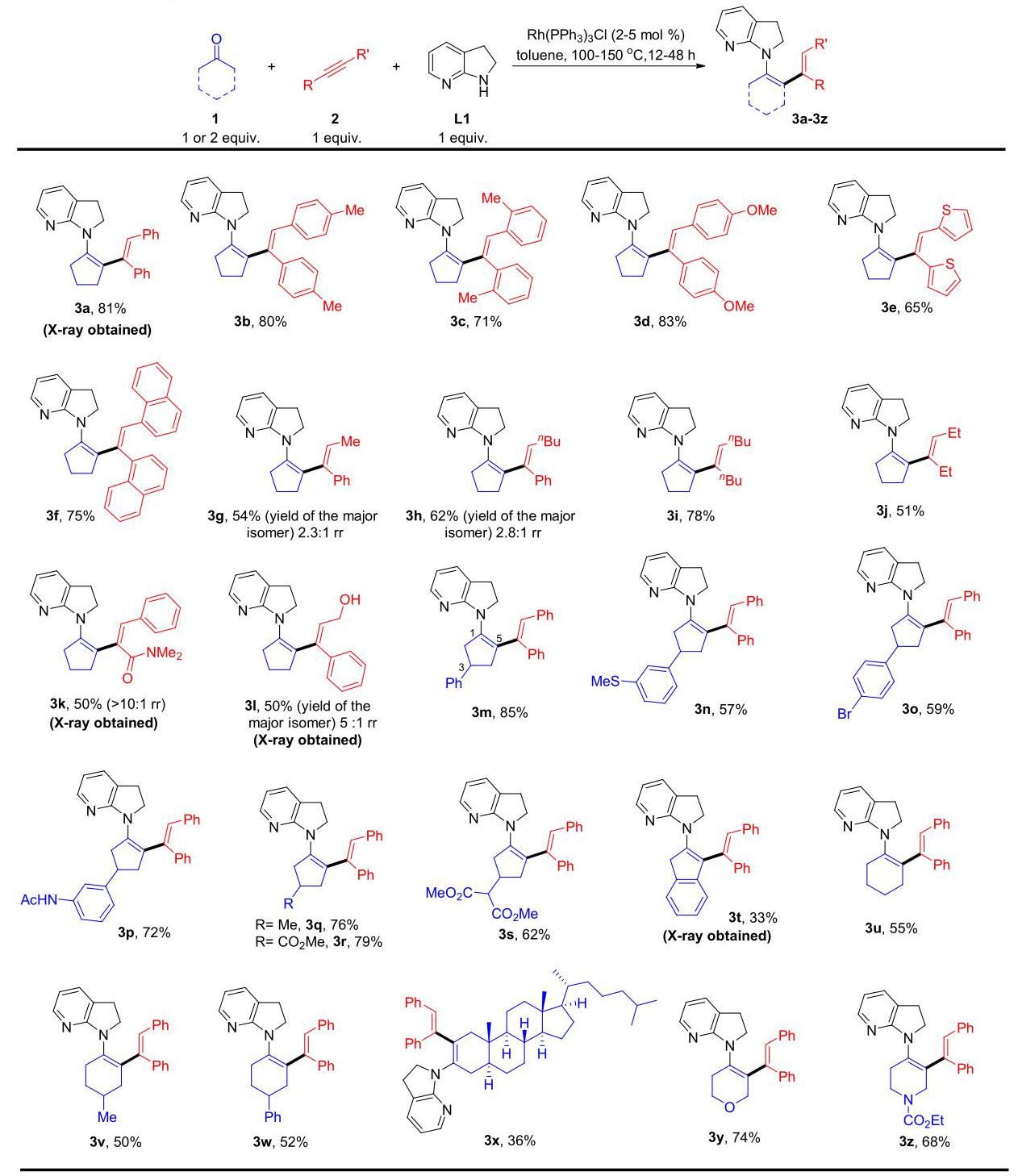
${}^{a}$ For unsubstituted cyclopentanones and cyclohexanones,2 equivalents of the ketone were employed; for other ketones,1 equivalent of the ketone was employed. For detailed conditions, see supporting information. All the yields are isolated yields. rr: regioisomer ratio.
Subsequently, the scope of the ketones was investigated (also see Charts 2 and 3). A range of 3-substituted cyclopentanones were first utilized to examine the site-selectivity (for the ketone) and functional group tolerance. To our delight, the alkenylation occurred exclusively at the less hindered C5 position of the ketones (3m-s). Substrates containing acidic C-H bonds, such as those $\alpha$ to a carboxylic ester (3r) and a malonate group (3s), were well tolerated. Thioethers (3n), aryl bromides (3o) and amides (3p) were compatible as well. The high chemoselectivity can be attributed to the ${pH}$ and redox-neutral conditions. 2-Indanone can also couple to give the desired product $3\mathbf{t}$ in a moderate yield. Although of lower reactivity, six-membered cyclic ketones (3u-z) were suitable substrates at an elevated temperature. Cholesterol-derived substrates gave the desired vinylation product (3x) selectively at the less hindered site of the ketone albeit in a lower yield. Heterocyclic ketones also underwent efficient couplings to give the corresponding enamines (3y and 3z). Acyclic ketones, e.g. acetophenone, also reacted; however, the pure form of the conjugated enamine product (observed from the crude NMR and Mass Spec) proved to be difficult to isolate due to its lability (for a one-pot alkenylation with acetophenone, see Chart 3). It is not surprising that, compared to cyclic ketones, acyclic ketones showed significantly diminished reactivity due to their increased difficulty to form enamines. ${}^{71}$ Thus, the general trend of reactivity is in an order of 5-membered cyclic ketones>6-membered cyclic ketones>linear ketones.
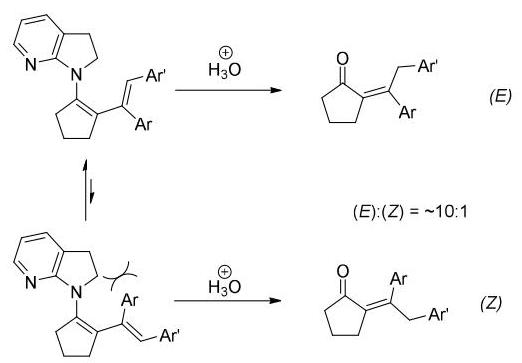
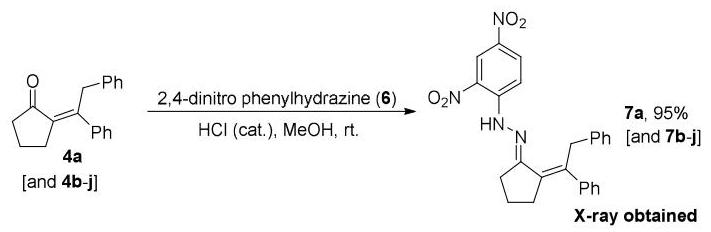
Scope of Conjugated Enone Products. The scope of directly forming conjugated enones was next investigated (Chart 2). Under the previously optimized conditions (vide supra, Table 1, entry 12), a variety of $\alpha ,\beta$ -unsaturated ketones were synthesized in 50- 70% yields. This coupling also tolerated a number of functional groups. Given the challenge of forming geometrically defined tetra-substituted alkenes, it is particularly interesting to note that all reactions with cyclic ketones gave $E$ enone as the predominate products $\left( {E : Z \sim {10} : 1}\right)$ . The high selectivity is likely controlled by the preferred conformation of the conjugated-enamine intermediate during the hydrolysis step, in which the 1,3-diene would adopt an $s$ -cis conformation to avoid the steric repulsion between the 7- azaindoline and the aryl group (Scheme 2). Most of the enone products were derivatized to the corresponding 2,4-dinitrophenyl hydrozones, and their structures were confirmed through X-ray crystallography.
Chart 2. Synthesis of Conjugated Enones ${}^{\mathrm{a}}$
Rh(PPh)3Cl (5 mol %)
TsOH•H ${}_{2}$ O (10 mol %)
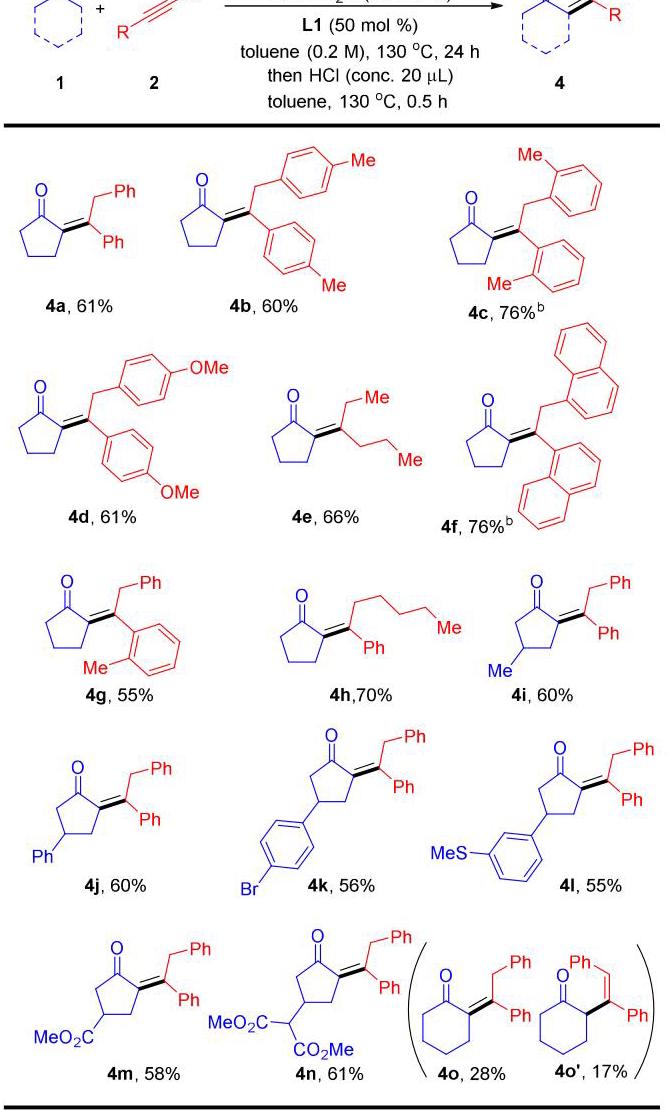
${}^{a}$ Reaction conditions: ${0.2}\mathrm{{mmol}}$ scale, toluene $1\mathrm{\;{mL}}$ . All the yields are isolated yields of the major $E$ isomer. $E/Z$ ratio is around 10:1. ${}^{b}$ With 100 mol $\%$ L1.
Scheme 2. Rationalization of the alkene geometry
Scheme 3. Derivatization of Enone Products
Scope of Vinyl Ketone Products. Undoubtedly, the $\alpha ,\beta$ - unsaturated enones are the thermodynamically more favorable products during the enamine hydrolysis, thus it would be difficult to obtain the less stable vinyl ketones ( $\beta ,\gamma$ -unsaturated enones) selectively using the in situ hydrolysis protocol. ${}^{66}$ However, the problem can be solved via a mild hydrolysis protocol (e.g. relatively low temperature) of the conjugate enamine intermediates (3) to acquire the kinetic products. By carefully tuning the hydrolysis conditions, the vinyl ketone products $\left( {\beta ,\gamma }\right.$ -unsaturated enones $)$ can be accessed selectively with retention of the geometry of the vinyl group (Chart 3). We found that a weak acid, such as acetic acid, in chloroform at room temperature gave the highest selectivity for the vinyl ketone. A number of conjugated enamines obtained from the ketone/alkyne/L1 coupling were subjected to these conditions. In general, the $\beta ,\gamma$ -enones products were formed predominantly, and the geometry of the vinyl group was conserved during the hydrolysis. In the case of 3-phenylcyclopentanone (5g), only one diastereoisomer was observed and the stereochemistry was revealed by 2D NMR analysis showing that the phenyl and vinyl substituents are in a cis relationship. In contrast, a pair of diaster-eoisomers was isolated for the six-membered ring substrates (5i and 5j). Linear ketones such as acetophenone, also participated in this transformation. Interestingly, using a one-pot procedure, the vinyl ketone products (5k and 5k’) were isolated as the major products instead of the conjugated enones.
Furthermore, a larger scale experiment was conducted to examine the scalability of the reaction. Running the reaction at a 5 mmol scale with $2\mathrm{\;{mol}}\% \mathrm{{Rh}}$ catalyst at ${100}{}^{ \circ }\mathrm{C}$ for ${40}\mathrm{\;h}$ gave $\mathbf{{5a}}$ in 65% yield after mild hydrolysis. The directing ligand L1 was recovered in 76% yield, showing that it can be recycled (eq 3).
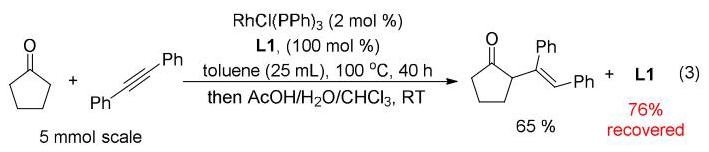
Chart 3. Synthesis of Vinyl Ketone Products ${}^{a}$
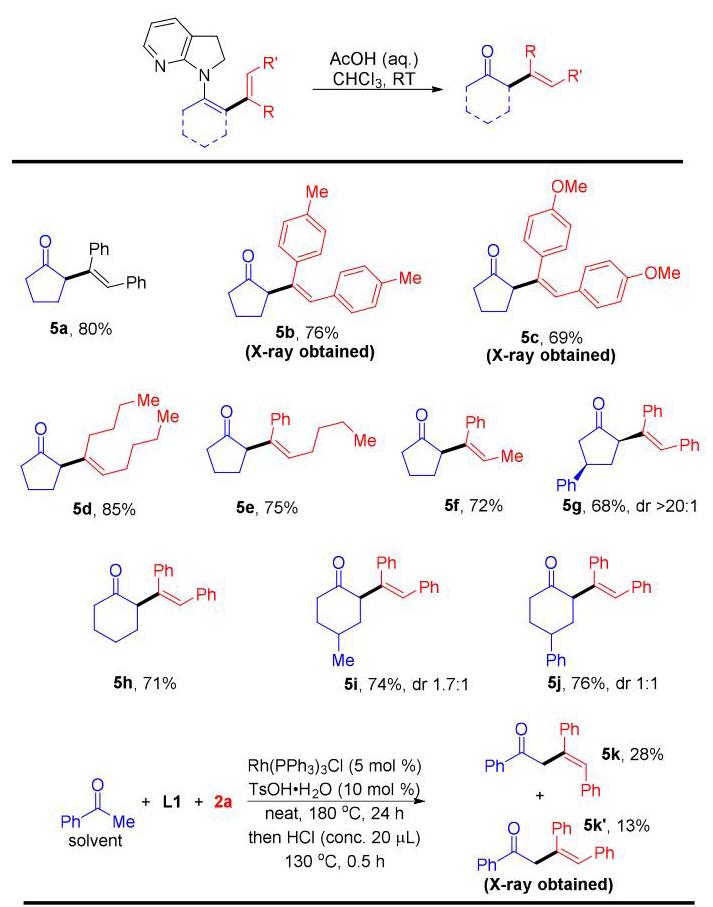
${}^{a}$ Reaction conditions: 0.2 mmol scale. $1\mathrm{\;{mL}}{\mathrm{{CHCl}}}_{3}$ and $1\mathrm{\;{mL}}{10}\% \; \left( {\mathrm{v}/\mathrm{v}}\right)$ aqueous acetic acid. All the yields are isolated yields.
Proposed Mechanism. While other possible mechanisms cannot be excluded at this stage, ${}^{72}$ based on our previous work with alkene insertion ${}^{60}$ and the aforementioned control experiments, a plausible catalytic cycle of the ketone $\alpha - \mathrm{C} - \mathrm{H}$ alkenylation is illustrated in Scheme 4. The reaction begins with the condensation of the secondary amine L1 with the ketone to form an enamine intermediate $\mathbf{I}$ (step A). During this step, the ketone $\alpha {\mathrm{{sp}}}^{3}\mathrm{C} - \mathrm{H}$ bond is converted into a ${\mathrm{{sp}}}^{2}\mathrm{C} - \mathrm{H}$ bond, thus enhancing the reactivity towards oxidative addition by a low-valent transition metal. ${}^{{73},{74}}$ Meanwhile, the adjacent pyridine group to the amine domain facilitates insertion of the rhodium(I) species into the resulting enamine vinyl C-H bond giving a rhodium-hydride species II (Rh-H, step B). Upon alkyne coordination with the metal, subsequent Rh-H migratory insertion (step D) or Rh-vinyl migratory insertion (not drawn) and reductive elimination (step E) would provide the final alkenylated conjugated enamine product. The following efforts have been conducted to explore the feasibility of the proposed mechanism.
Kinetic Monitoring. The reaction progress for forming the conjugate enamines (3a and 3a’) was monitored by ${}^{1}\mathrm{H}$ NMR (Figure 1). The enamine adduct between the ketone and L1 (INT, vide supra, eq 1) was observed at $1\mathrm{\;h}$ and disappeared at $3\mathrm{\;h}$ , suggesting that it was a reactive intermediate during the reaction. The reaction was completed at $5\mathrm{\;h}$ with full consumption of the bifunctional ligand L1. The profile after $3\mathrm{\;h}$ clearly showed that the conjugated enamine product 3a started to isomerize to 3a’, which ultimately reached an equilibrium with a ratio of 3a/3a’ about 2:1.
Scheme 4. Proposed Catalytic Cycle.
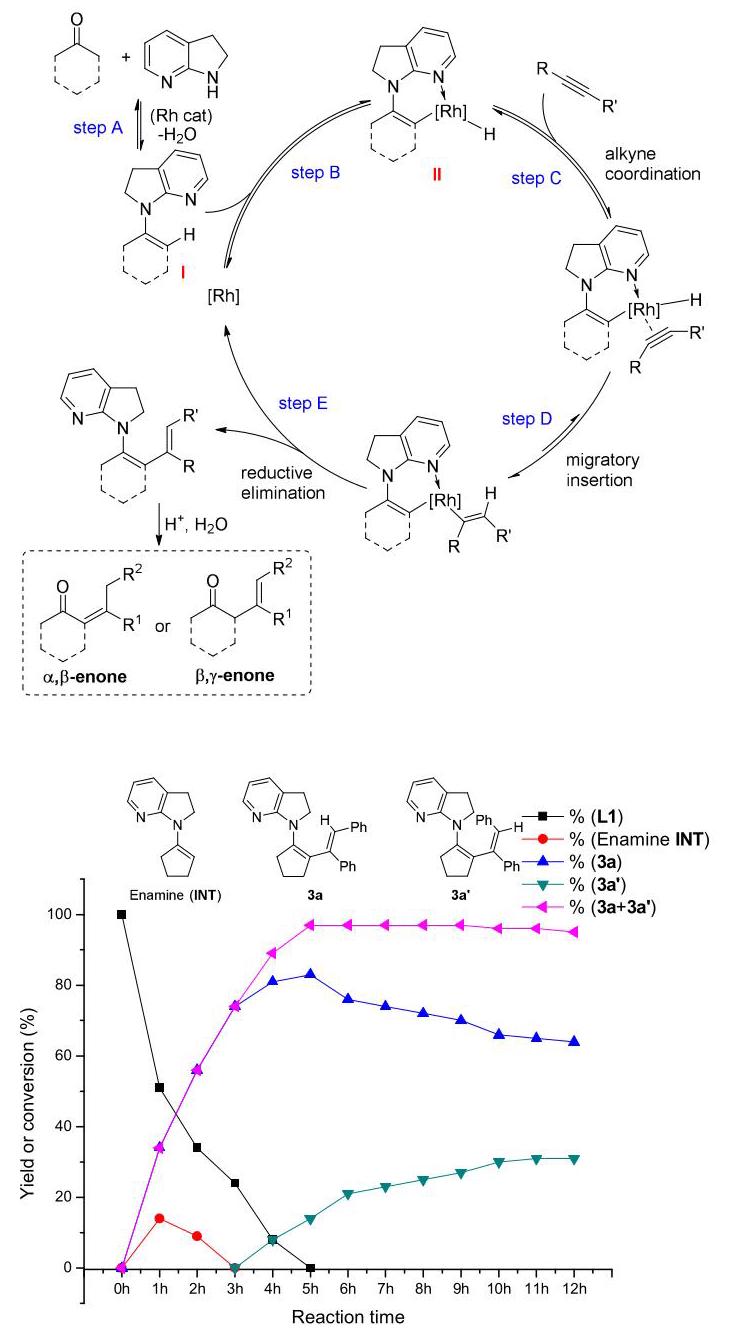
Figure 1. The reaction progress profile for conjugated enamine formation monitored by ${}^{1}\mathrm{H}$ NMR. The reaction was conducted with 5 mol % Wilkinson’s catalyst at ${130}^{ \circ }\mathrm{C}$ .
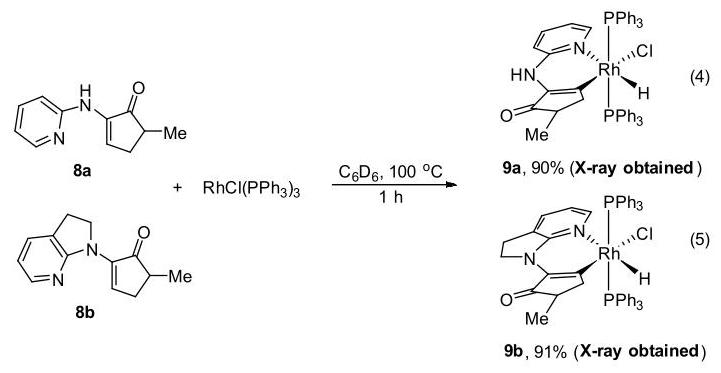
Identification, Synthesis and Characterization of Rhodium-Hydride Complexes. Low valent transition metals, such as $\mathrm{{Ru}}\left( 0\right) ,\mathrm{{Rh}}\left( \mathrm{I}\right)$ and $\mathrm{{Ir}}\left( \mathrm{I}\right)$ , are known to undergo oxidative addition into C-H bonds to give metal-hydride species. ${}^{75}$ However, metal-hydride complexes are challenging to be captured and isolated particularly during a $\mathrm{C} - \mathrm{H}$ activation reaction, due to their high reactivity and lability. ${}^{69}$ Thus, we first explore the feasibility to synthesize Rh-H species with more stable enamine substrates. Previously, we have demonstrated the 1,2-diketone-derived enamines can undergo C-H coupling with alkenes and alkynes. ${}^{{76},{77}}$ To our delight, treatment of enamines $\mathbf{{8a}}$ and $\mathbf{{8b}}$ with $\mathrm{{Rh}}{\left( {\mathrm{{PPh}}}_{3}\right) }_{3}\mathrm{{Cl}}$ in ${\mathrm{C}}_{6}{\mathrm{D}}_{6}$ for 1 hour afforded the desired $\mathrm{{Rh}} - \mathrm{H}$ species $\mathbf{{9a}}$ and $\mathbf{{9b}}$ respectively (eqs 4 and 5), which were unambiguously characterized by NMR, IR, HRMS and X-ray crystallography. From the X-ray structures, the two PPh ${}_{3}$ ligands adopt a trans geometry. Surprisingly, these rhodium(III) hydride species can be isolated in high yields via bench-top flash chromatography, and they were stable in the air for several hours. The high efficiency of these C-H oxidative addition reactions is likely due to
the strong electron-withdrawing nature of the conjugated carbonyl group, which may stabilize the Rh-H intermediates.
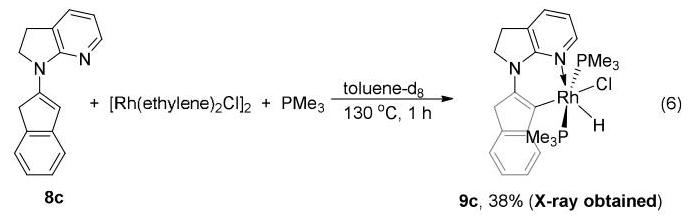
Encouraged by these results, we continued our study with the mono-ketone derived enamine (8c). In this case, Wilkinson’s catalyst did not yield any detectable metal-hydride species monitored by in situ ${}^{1}\mathrm{H}$ NMR analysis. Failure to capture a stable metal-hydride species does not necessarily mean that Wilkinson’s catalyst lacks the reactivity to insert into the $\mathrm{C} - \mathrm{H}$ bond. We hypothesized that due to the bulkiness and $\pi$ -accepting nature of the triphenylphosphine ligand, the reverse reaction (C-H reductive elimination) would be more favorable during the activation of enamine 8c. Consequently, the Rh-H species derived from the normal ketone enamine 8c could possibly be a high energy transient intermediate. To test this hypothesis, a less bulky but more electron-rich ligand, i.e. trimethylphosphine, was employed (eq 6), which should help to facilitate the $\mathrm{C} - \mathrm{H}$ oxidative addition and stabilize the Rh(III) intermediate by disfavoring the reductive elimination. Indeed, after heating ${\left\lbrack \mathrm{{Rh}}{\left( \text{ ethylene }\right) }_{2}\mathrm{{Cl}}\right\rbrack }_{2},\mathbf{{8c}}$ and ${\mathrm{{PMe}}}_{3}$ at ${130}^{ \circ }\mathrm{C}$ for $1\mathrm{\;h}$ , a rhodium-hydride complex $\left( {9\mathrm{c}}\right)$ is formed, which was found more sensitive to air than complexes 9a and $\mathbf{{9b}}{.}^{78}$ Nevertheless, we were able to isolate complex $\mathbf{{9c}}$ and characterize the structure via the X-ray crystallography. This Rh-H complex holds a distorted octahedral geometry with two phosphorus groups at the axial positions, and the Rh-H bond length is ${1.505\text{ Å }}$ . To the best of our knowledge, this represents the first example of insertion of a low-valent transition metal into a regular enamine vinyl $\mathrm{C} - \mathrm{H}$ bonds via oxidative addition.
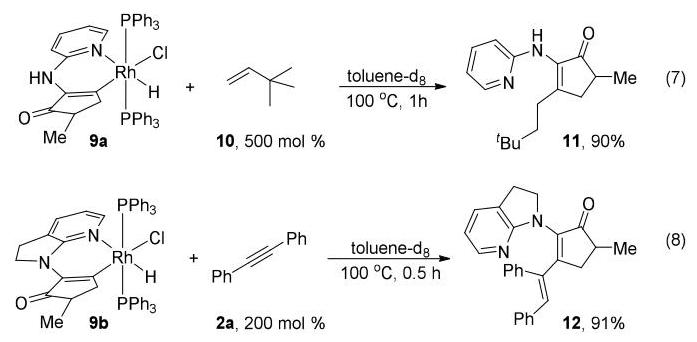
Reactivity of Rhodium-Hydride Complexes with Alkenes and Alkynes. Having examined the feasibility of the oxidative addition into the vinyl C-H bond (step B, Scheme 4), we next investigated the C-C bond forming step through ${2\pi }$ -insertion with the rhodium-hydride intermediate (migratory insertion and reductive elimination, steps D and E). Rhodium-hydride complexes 9a and $\mathbf{{9b}}$ were employed initially (eqs 7 and 8). Treatment of $\mathbf{{9a}}$ with 5 equivalents of 3,3-dimethylbutene (10) provided the desired alkylation product 11 in 90% yield. Through monitoring the reaction at different temperatures, no significant conversion was observed below ${100}{}^{ \circ }\mathrm{C}$ . However, when $\mathbf{{9b}}$ reacted with 2 equivalents of diphenylacetylene 2a, the metal-hydride peak disappeared in less than ${10}\mathrm{\;{min}}$ at ${50}^{ \circ }\mathrm{C}$ , suggesting a much higher reactivity with alkynes. The alkenylation product (12) was obtained in 91% yield at ${100}{}^{ \circ }\mathrm{C}$ within 0.5h. These observations are consistent with our previously proposed rhodium-hydride-involved mechanism for alkylation and alkenylation of 1,2- diketone-derived enamines. ${}^{{76},{77}}$
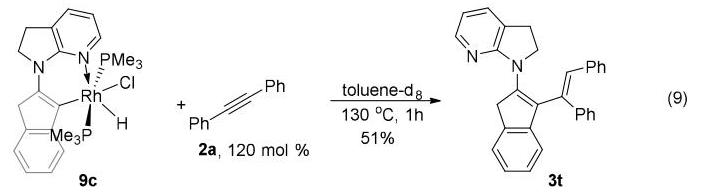
The reaction between the mono-ketone-derived rhodium-hydride complex (9c) and diphenylacetylene was tested subsequently (eq 9). While showing almost no reactivity with alkenes, 9c reacted with the alkyne to give the corresponding conjugated enamine (3t) in 51% yield at ${130}^{ \circ }\mathrm{C}$ .
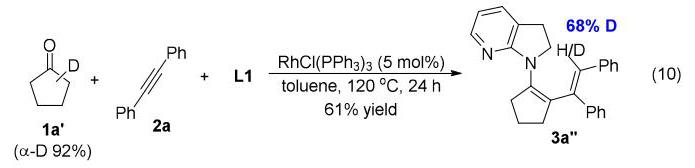
Deuterium-Labeling Experiments. In the proposed cycle (Scheme 4), metal-hydride migratory insertion and reductive elimination will transfer a ketone $\alpha$ -proton to the terminal vinyl position of the conjugated enamine product. Indeed, when deuter-ated cyclopentanone 1a’ ( $\alpha$ and $\alpha$ ‘-deuterated 92%) was allowed to react under the standard conditions, the NMR analysis of the product 3a" revealed 68% incorporation of deuterium at the terminal vinyl position (eq 10). ${}^{78}$ The erosion in deuterium incorporation for enone 3a" is likely caused by an proton exchange between the $\alpha$ -hydrogens of $1{a}^{\prime }$ and the NH hydrogen of L1. In addition, the resulting $E$ olefin geometry in the product supports a syn-migratory insertion pathway.
Identification of the Resting States of the Catalyst. To gain a better understanding of the catalytic cycle, we continued to identify the resting states of the catalyst. When monitoring the standard reaction of forming conjugated enamine 3a in toluene- ${\mathrm{d}}_{8}$ at 130 ${}^{ \circ }\mathrm{C}$ , we observed two sets of discrete phosphine-ligated rhodium species, which should correlate to the resting states of the catalyst (Figure 2A). ${}^{79}$ A doublet at ${36.8}\mathrm{{ppm}}$ with a ${J}_{\mathrm{{Rh}} - \mathrm{P}}$ value of ${126}\mathrm{\;{Hz}}$ and two doublets of doublets at ${59.3}\mathrm{{ppm}}$ and ${52.4}\mathrm{{ppm}}$ with ${J}_{\mathrm{{Rh}} - \mathrm{P}}$ values of ${200}\mathrm{\;{Hz}}$ and ${166}\mathrm{\;{Hz}}$ respectively were found in the ${}^{31}\mathrm{P}$ NMR spectrum.
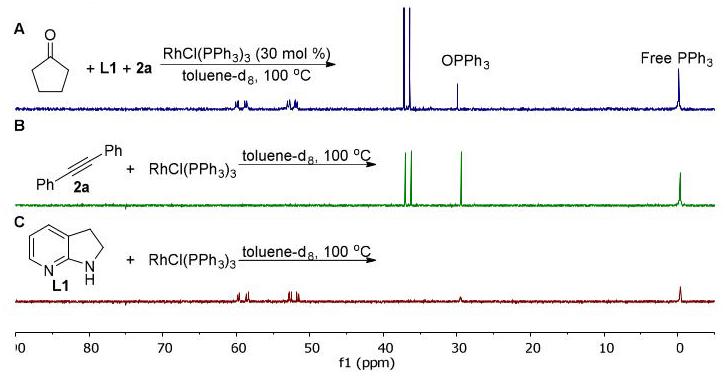
Figure 2. ${}^{31}\mathrm{P}$ NMR of mechanistic studies.
(11)
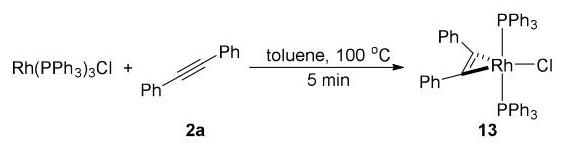
To identify these rhodium species, we carried out control experiments by mixing $\mathrm{{Rh}}{\left( {\mathrm{{PPh}}}_{3}\right) }_{3}\mathrm{{Cl}}$ with each reagent one at a time. We discovered that the doublet at ${36.8}\mathrm{{ppm}}$ in ${}^{31}\mathrm{P}$ NMR spectrum appeared when Wilkinson’s catalyst and diphenylacetylene were mixed and heated together (Figure 2B and eq 11). Fortunately, a crystal was obtained from this reaction and the X-ray structure was shown below as an alkyne-coordinated complex (13). This complex exhibits a pseudo-trigonal bipyramidal geometry in which the distorted diphenylacetylene and chloride form the triangle base and the two phosphorus groups occupy the axial positions. The bond distance between the rhodium and one of the alkynyl carbon is ${2.075\text{ Å }}$ and the C-Rh-C angle is ${35.6}^{ \circ }$ .
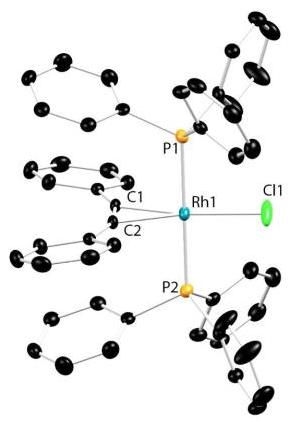
Figure 3. Crystal structure of complex 13 at 50% probability level. Hydrogen atoms are omitted for clarity. Selected bond lengths (Å): $\mathrm{{Rh}}1 - \mathrm{P}1 = {2.342},\mathrm{{Rh}}1 - \mathrm{P}2 = {2.342},\mathrm{{Rh}}1 - \mathrm{C}1 = {2.072},\mathrm{{Rh}}1 - \mathrm{C}2 =$ 2.072, Rh1-Cl1 = 2.341. Selected bond angle (deg): C2-Rh1-C1 $= {35.6}$ .
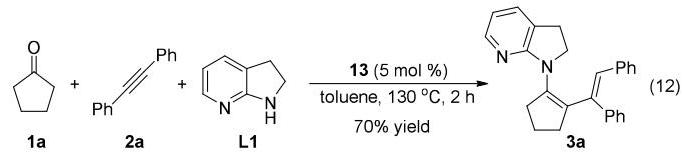
Later, we found that the synthesis of complex 13 was first reported by Wilkinson in 1966, ${}^{80}$ albeit that no structure was defined at that time. In accord with Wilkinson’s discovery, we also observed that complex 13 dissociates when dissolved in solution and cannot be recrystallized. This phenomenon implies that complex 13 is not stable without excess alkynes and phosphine ligands in solution, and thus may hold high catalytic activity. Indeed, when complex 13 (5 mol%) was used as the catalyst instead of $\mathrm{{Rh}}{\left( {\mathrm{{PPh}}}_{3}\right) }_{3}\mathrm{{Cl}}$ , the reaction gave 70% yield of $\mathbf{{3a}}$ within 2 hours (eq 12). All together, we anticipate that complex 13 is one of the resting states of the catalyst.
Regarding the other Rh complex observed during the catalytic reaction, the identical doublets of doublets at 59.3 ppm and 52.4 ppm in ${}^{31}\mathrm{P}$ NMR were observed when just heating Wilkinson’s catalyst and L1 together (Figure 2C). While attempts to isolate a pure complex for further characterization remained unfruitful, we are confident that the other resting state of the catalyst should contain rhodium, triphenylphosphine and the bi-functional ligand (L1).
CONCLUSIONS
In summary, we have developed a rhodium(I)-catalyzed bifunctional ligand-assisted ketone alkenylation using unactivated di-substituted alkynes as the coupling partner. Through controlling the reaction conditions, selective synthesis of conjugated enamines, $\alpha ,\beta$ -and $\beta ,\gamma$ -unsaturated ketones can be achieved. While both cyclic and acyclic ketones can be used as the substrates, cyclic ketones are more reactive. The intermolecular coupling of ketones with internal alkynes shows high site-, chemo- and stere-oselectivity. This transformation can also tolerate a range of functional groups due to its near $\mathrm{{pH}}$ and redox-neutral conditions. Finally, the proposed reaction mechanism was carefully explored through control experiments, kinetic monitoring, preparation of the rhodium-hydride intermediates and their reactions with alkynes, deuterium-labeling experiments and identification of the resting states of the catalyst. We expect this detailed study would shed light on the scope and potential of the dual activation strategy for catalytic ketone-unsaturate couplings. Expansion to the coupling of other types of unsaturated hydrocarbons, e.g. allenes and 1,3-dienes, is ongoing in our laboratory.
ASSOCIATED CONTENT
Text, figures, tables, and CIF files giving experimental procedures, kinetics data, and crystallographic information. This material is available free of charge via the Internet at http://pubs.acs.org.
AUTHOR INFORMATION
Corresponding Author
Author Contributions
The manuscript was written through contributions of all authors. All authors have given approval to the final version of the manuscript.
Notes
The authors declare no competing financial interest.
ACKNOWLEDGMENT
We thank Cancer Prevention and Research Institute of Texas (R1118) for a start-up fund and the Welch Foundation (F-1781) and NSF (CAREER: CHE-1254935) for research grants. Dr. Lynch is acknowledged for X-ray crystallography. We thank B. A. Shoulders, S. Sorey, and A. Spangenberg for NMR advice; Johnson Matthey for a donation of Rh salts. We also thank Dr. M.C. Young for proofreading the manuscript.
REFERENCES
(1) Escher, I.; Glorious, F. Sci. Synth. 2007, 25, 733.
(2) Radin, N. S. Drug Dev. Res. 2008, 69, 15.
(3) Patai, S.; Rappoport, Z. Eds.; The Chemistry of Enones: Volume 1 and 2, John Wiley & Sons, 1989.
(4) Buckle, D. R.; Pinto, I. L. In Comprehensive Organic Synthesis; Trost, B. M., Fleming, I., Eds.; Pergamon Press: Oxford, U.K., 1991; Vol. 7, pp 119-149.
(5) Larock, R. C. In Comprehensive Organic Transformations; John Wiley & Sons: New York, 1999; pp 251-256.
(6) Dénès, F.; Pérez-Luna, A.; Chemla, F. Chem. Rev. 2010, 110, 2366.
(7) Patil, N. T.; Kavthe, R. D.; Shinde, V. S. Tetrahedron 2012, 68, 8079.
(8) For stoichiometric metal salts promoted “Conia-ene” reactios, see ref 6, section 4.1.
(9) Bloch, R.; Le Perchec, P.; Conia, J. M. Tetrahedron 1968, 24, 5971.
(10) Conia, J. M.; Le Perchec, P. Synthesis 1975, 1.
(11) Drouin, J.; Leyendecker, F.; Conia, J. M. Tetrahedron 1980, 36, 1203.
(12) Mandville, G.; Conia, J. M. Nouv. J. Chim. 1981, 5, 137.
(13) Boaventura, M. A.; Drouin, J.; Conia, J. M. Synthesis 1983, 801.
(14) Kennedy-Smith, J. J.; Staben, S. T.; Toste, F. D. J. Am. Chem. Soc. 2004, 126, 4526.
(15) Staben, S. T.; Kennedy-Smith, J. J.; Toste, F. D. Angew. Chem. Int. Ed. 2004, 43, 5350.
(16) Ochida, A.; Ito, H.; Sawamura, M. J. Am. Chem. Soc. 2006, 128, 16486.
(17) Ito, H.; Makida, Y.; Ochida, A.; Ohmiya, H.; Sawamura, M. Org. Lett. 2008, 10, 5051.
(18) Pan, J.-H.; Yang, M.; Gao, Q.; Zhu, N.-Y.; Yang, D. Synthesis 2007, 2539.
(19) Gao, Q.; Zheng, B.-F.; Li, J.-H.; Yang, D. Org. Lett. 2005, 7, 2185.
(20) Deng, C.-L.; Song, R.-J.; Liu, Y.-L.; Li, J.-H. Adv. Synth. Catal. 2009, 351, 3096.
(21) Deng, C.-L.; Zou, T.; Wang, Z.-Q.; Song, R.-J.; Li, J.-H. J. Org. Chem. 2009, 74, 412.
(22) Montel, S.; Bouyssi, D.; Balme, G. Adv. Synth. Catal. 2010, 352, 2315.
(23) Deng, C.-L.; Song, R.-J.; Guo, S.-M.; Wang, Z.-Q.; Li, J.-H. Org. Lett. 2007, 9, 5111.
(24) Liu, Y.; Song, R.-J.; Li, J.-H. Synthesis 2010, 3663.
(25) Davies, P. W.; Detty-Mambo, C. Org. Bimol. Chem. 2010, 8, 2918.
(26) Chernyak, N.; Gorelsky, S. I.; Gevorgyan, V. Angew. Chem. Int. Ed. 2011, 50, 2342.
(27) Corkey, B. K.; Toste, F. D. J. Am. Chem. Soc. 2005, 127, 17168.
(28) Yang, T.; Ferrali, A.; Sladojevich, F.; Campbell, L.; Dixon, D. J. J. Am. Chem. Soc. 2009, 131, 9140.
(29) Matsuzawa, A.; Mashiko, T.; Kumagai, N.; Shibasaki, M. An-gew. Chem. Int. Ed. 2011, 50, 7616.
(30) Phillips, E. M.; Roberts, J. M.; Scheidt, K. A. Org. Lett. 2010, 12, 2830.
(31) Tsuji, H.; Yamagata, K.-i.; Itoh, Y.; Endo, K.; Nakamura, M.; Nakamura, E. Angew. Chem. Int. Ed. 2007, 46, 8060.
(32) Itoh, H.; Tsuji, H.; Yamagata, K.-i.; Endo, K.; Tanaka, I.; (32) Nakamura, M.; Nakamura, E. J. Am. Chem. Soc. 2008, 130, 17161.
(33) Tsuji, H.; Yamagata, K.-i.; Fujimoto, T.; Nakamura, E. J. Am. Chem. Soc. 2008, 130, 7792.
(34) Peng, W.; Lee, C.-S. Synlett 2008, 142.
(35) Jackson, W. P.; Ley, S. V. J. Chem. Soc., Perkin Trans. 1 1981, 1516.
(36) McDonald, F. E.; Olson, T. C. Tetrahedron Lett. 1997, 38, 7691.
(37) Chan, L. Y.; Kim, S.; Park, Y.; Lee, P. H. J. Org. Chem. 2012, 77, 5239.
(38) Shaw, S.; White, J. D. J. Am. Chem. Soc. 2014, 136, 13578.
(39) Nakamura, M.; Endo, K.; Nakamura, E. J. Am. Chem. Soc. 2003, 125, 13002.
(40) Nakamura, M.; Endo, K.; Nakamura, E. Org. Lett. 2005, 7, 3279.
(41) Nakamura, M.; Endo, K.; Nakamura, E. Adv. Synth. Catal. 2005, 347, 1681.
(42) Kuninobu, Y.; Kawata, A.; Takai, K. Org. Lett. 2005, 7, 4823.
(43) Nakamura, M. Pure Appl. Chem. 2006, 78, 425.
(44) Endo, K.; Hatakeyama, T.; Nakamura, M.; Nakamura, E. J. Am. Chem. Soc. 2007, 129, 5264.
(45) Tsuji, H.; Fujimoto, T.; Endo, K.; Nakamura, N.; Nakamura, E. Org. Lett. 2008, 10, 1219.
(46) Fujimoto, T.; Endo, K.; Tsuji, H.; Nakamura, M.; Nakamura, E. J. Am. Chem. Soc. 2008, 130, 4492.
(47) Kuninobu, Y.; Nishi, M.; Yudha, S.; Takai, K. Org. Lett. 2008, 10, 3009.
(48) Tsuji, H.; Tanaka, I.; Endo, K.; Yamagata, K.-i.; Nakamura, M.; Nakamura, E. Org. Lett. 2009, 11, 1845.
(49) Onodera, G.; Kato, M.; Kawano, R.; Kometani, Y.; Takeuchi, R. Org. Lett. 2009, 11, 5038.
(50) Murahashi, S.; Naota, T.; Nakano, Y. Synlett 2009, 20, 3355.
(51) Cheung, H. W.; So, C. M.; Pun, K. H.; Zhou, Z.; Lau, C. P. Adv. Synth. Catal. 2011, 353, 411.
(52) Pennington-Boggio, M. K.; Conley, B. L.; Williams, T. J. J. Organomet. Chem. 2012, 716, 6.
(53) Xi, Y.; Wang, D.; Ye, X.; Akhmedov, N. G.; Petersen, J. L.; Shi, X. Org. Lett. 2013, 16, 306.
(54) Yamaguchi, M.; Hayashi, A.; Hirama, M. J. Am. Chem. Soc. 1993, 115, 3362.
(55) Yamaguchi, M.; Sehata, M.; Hayashi, A.; Hirama, M. J. Chem. Soc., Chem. Commun. 1993, 1708.
(56) Hayashi, Y.; Yamaguchi, M.; Hirama, M. Synlett 1995, 51.
(57) Yamaguchi, M.; Tsukagoshi, T.; Arisawa, M. J. Am. Chem. Soc. 1999, 121, 4074.
(58) Trofimov, B. A.; Schmidt, E. Y.; Ushakov, I. A.; Zorina, N. V.; Skital’tseva, E. V.; Protsuk, N. I.; Mikhaleva, A. b. I. Chem. -Eur. J. 2010, 16, 8516.
(59) Trofimov, B. A.; Schmidt, E. Y.; Zorina, N. V.; Ivanova, E. V.; Ushakov, I. A. J. Org. Chem. 2012, 77, 6880.
(60) For a preliminary report of our ketone-olefin couplings, see: Mo, F.; Dong, G. Science 2014, 345, 68.
(61) For reviews of ${\mathrm{{sp}}}^{2}\mathrm{C} - \mathrm{H}/$ alkyne couplings, see: (a) Park, Y.; Park, J.-W.; Jun, C.-H. Acc. Chem. Res. 2008, 41, 222. (b) Kitamura, T.
Eur. J. Org. Chem. 2009, 1111. (c) Wang, X.; Zhou, L.; Lu, W. Cur.
Org. Chem. 2010, 14, 289. (d) Colby, D. A.; Tsai, A. S.; Bergman, R. G.; Ellman, J. A. Acc. Chem. Res. 2012, 45, 814. (e) Yang, L.; Huang, H. Chem. Rev. 2015, 9, 3468.
(62) For representative examples, see: (a) Hong, P.; Cho, B.-R.; Yamazaki, H. Chem. Lett. 1980, 507. (b) Yamazaki, H.; Hong, P. J. Mol. Catal. A 1983, 21, 133. (c) Kakiuchi, F.; Yamamoto, Y.; Chatani, N.; Murai, S. Chem. Lett. 1995, 681. (d) Trost, B. M.; Imi, K.; Davies, I. W. J. Am. Chem. Soc. 1995, 117, 5371. (e) Auluwurm, U. R.; Melchinger, J. U.; Kisch, H. Organometallics 1995, 14, 3385. (f) Kakiuchi, F.; Yamamoto, Y.; Chatani, N.; Murai, S. Chem. Lett. 1995, 24, 681. (g) Dürr, U.; Kisch, H. Synlett 1997, 12, 1335. (h) Lim, Y.-G.; Lee, K.-H.; Koo, B. T.; Kang, J.-B. Tetrahedron Lett. 2001, 42, 7609.
(i) Jun, C.-H.; Lee, H.; Hong, J.-B.; Kwon, B.-I. Angew. Chem. Int. Ed. 2002, 41, 2146. (j) Kakiuchi, F.; Uetsuhara, T.; Tanaka, Y.; Chatani, N.; Murai, S. J. Mol. Catal. A: Chem. 2002, 182, 511. (k) Jun, C.-H.; Lee, H.; Hong, J.-B.; Kwon, B.-I. Angew. Chem., Int. Ed.
2002, 41, 2146. (1) Colby, D. A.; Bergman, R. G.; Ellman, J. A. J. Am.
Chem. Soc. 2006, 128, 5604. (m) Tsuchikama, K.; Kasagawa, M.;
Hashimoto, Y.-K.; Endo, K.; Shibata, T. J. Organomet. Chem. 2008,
693, 3939. (n) Katagiri, T.; Mukai, T.; Satoh, T.; Hirano, K.; Miura,
M. Chem. Lett. 2009, 38, 118. (o) Schipper, D. J.; Hutchinson, M.;
Fagnou, K. J. Am. Chem. Soc. 2010, 132, 6910. (p) Gao, K.; Lee, P.-
S.; Fujita, T.; Yoshikai, N. J. Am. Chem. Soc. 2010, 132, 12249. (q)
Kanyiva, K. S.; Kashihara, N.; Nakao, Y.; Hiyama T.; Ohashi M.;
Ogoshi S. Dalton Trans. 2010, 39, 10483. (r) Lee, P.-S.; Fujita, T.;
Yoshikai, N. J. Am. Chem. Soc. 2011, 133, 17283. (s) Nakao, Y.;
Morita E.; Idei H.; Hiyama T. J. Am. Chem. Soc. 2011, 133, 3264.
(63) Ito, J.-i.; Kitase, M.; Nishiyama, H. Organometallics 2007, 26, 6412.
(64) Katagiri, T.; Tsurugi, H.; Satoh, T.; Miura, M. Chem. Commun. 2008, 3405.
(65) Umeda, N.; Hirano, K.; Satoh, T.; Shibata, N.; Sato, H.; Miura, M. J. Org. Chem. 2011, 76, 13.
(66) For a recent seminal work on selective hydrolysis of conjugated enamines, see: Duttwyler, S.; Chen, S.; Takase, M. K.; Wiberg, K. B.; Bergman, R. G.; Ellman, J. A. Science 2013, 339, 678.
(67) Use of the IMes NHC ligand, which gave the optimal yield for the alkene insertion, gave no desired coupling product with alkyne 2a.
(68) A control reaction showed that no 4a formed when heating 1a with 2-phenylacetophenone under the standard conditions:

(69) For a similar regioselectivity observed on C-H/alkyne couplings, see: Colby, D. A.; Bergman, R. G.; Ellman, J. A. J. Am. Chem. Soc. 2008, 130, 3645.
(70) A control experiment showed that in the absence of the rhodium catalyst no reaction with $3\mathbf{k}$ was observed.
(71) Sánchez, D.; Bastida, D.; Burés, J.; Isart, C.; Pineda, O.; Vilarra-sa, J. Org. Lett. 2012, 14, 536.
(72) For an alternative mechanism that cannot be excluded at this stage, see SI page S22.
(73) Lewis, L. N.; Smith, J. F. J. Am. Chem. Soc. 1986, 108, 2728.
(74) Colby, D. A.; Bergman, R. G.; Ellman, J. A. Chem. Rev. 2010, 110, 624.
(75) Labinger, J. A.; Bercaw, J. E. Nature 2002, 417, 507.
(76) Wang, Z.; Reinus, B. J.; Dong, G. J. Am. Chem. Soc. 2012, 134, 13954.
(77) Wang, Z.; Reinus, B. J.; Dong, G. Chem. Commun. 2014, 50, 5230.
(78) A portion of these results have been described in our previous communication, see ref 60.
(79) For recent examples of identifying catalyst resting states, see: (a) Cheng, C.; Hartwig, J. F. J. Am. Chem. Soc. 2014, 136, 12064. (b)
Sevov, C. S.; Zhou, J.; Hartwig, J. F. J. Am. Chem. Soc. 2014, 136, 3200. (c) Feller, M.; Diskin-Posner, Y.; Leitus, G.; Shimon, L. J. W.; Milstein, D. J. Am. Chem. Soc. 2013, 135, 11040.
(80) Mague, J. T.; Wilkinson, G. Journal of the Chemical Society A: Inorganic, Physical, Theoretical 1966, 1736.