Synthesis, Structure, and Reactivity of Anionic sp2–sp3 Diboron Compounds: Readily Accessible Boryl Nucleophiles
中文 / Bilingual · English version
Boron |Hot Paper
Synthesis, Structure, and Reactivity of Anionic ${\mathrm{{sp}}}^{2} - {\mathrm{{sp}}}^{3}$ Diboron Compounds: Readily Accessible Boryl Nucleophiles
Sabrina Pietsch, ${}^{\left\lbrack \mathrm{a}\right\rbrack }$ Emily C. Neeve, ${}^{\left\lbrack \mathrm{a}\right\rbrack }$ David C. Apperley, ${}^{\left\lbrack \mathrm{b}\right\rbrack }$ Rüdiger Bertermann, ${}^{\left\lbrack \mathrm{a}\right\rbrack }$ Fanyang Mo, ${}^{\left\lbrack \mathrm{e}\right\rbrack }$ Di Qiu, ${}^{\left\lbrack \mathrm{e}\right\rbrack }$ Man Sing Cheung, ${}^{\left\lbrack \mathrm{c}\right\rbrack }$ Li Dang, ${}^{\left\lbrack \mathrm{c}\right\rbrack }$ Jianbo Wang, ${}^{\left\lbrack \mathrm{e}\right\rbrack }$ Udo Radius, ${}^{\left\lbrack \mathrm{a}\right\rbrack }$ Zhenyang Lin, ${}^{*\left\lbrack \mathrm{c}\right\rbrack }$ Christian Kleeberg, ${}^{*\left\lbrack {\mathrm{b},\mathrm{d}}\right\rbrack }$ and Todd B. Marder ${}^{*\left\lbrack {\mathrm{a},\mathrm{b}}\right\rbrack }$
Abstract: Lewis base adducts of tetra-alkoxy diboron compounds, in particular bis(pinacolato)diboron $\left( {{\mathrm{B}}_{2}{\mathrm{{pin}}}_{2}}\right)$ , have been proposed as the active source of nucleophilic boryl species in metal-free borylation reactions. We report the isolation and detailed structural characterization (by solid-state and solution NMR spectroscopy and X-ray crystallography) of a series of anionic adducts of ${B}_{2}{\text{ pin }}_{2}$ with hard Lewis bases, such as alkoxides and fluoride. The study was extended to alternative Lewis bases, such as acetate, and other di-boron reagents. The $B\left( {\mathrm{{sp}}}^{2}\right) - B\left( {\mathrm{{sp}}}^{3}\right)$ adducts exhibit two dis-
tinct boron environments in the solid-state and solution NMR spectra, except for ${\left\lbrack \left( 4 - t{\mathrm{{BuC}}}_{6}{\mathrm{H}}_{4}\mathrm{O}\right) {\mathrm{B}}_{2}{\mathrm{{pin}}}_{2}\right\rbrack }^{ - }$ , which shows rapid site exchange in solution. DFT calculations were performed to analyze the stability of the adducts with respect to dissociation. Stoichiometric reaction of the isolated adducts with two representative series of organic electro-philes-namely, aryl halides and diazonium salts-demonstrate the relative reactivities of the anionic diboron compounds as nucleophilic boryl anion sources.
Introduction
Boronic acids and boronate esters have become exceptionally valuable reagents for organic synthesis. ${}^{\left\lbrack 1\right\rbrack }$ However, the potential of boron-based nucleophiles was not realized until 2006, when Yamashita and Nozaki published their seminal work with regards to a stable boryl anion. ${}^{\left\lbrack 2\right\rbrack }$ Their isolated lithium boryl species had a highly polarized B-Li bond, which provided an anionic boron moiety with nucleophilic characteristics that displayed good reactivity with a range of organic electrophiles and could be used to prepare novel metal-boryl species. ${}^{\left\lbrack 2,3\right\rbrack }$ However, use of the lithium boryl species is still relatively limited due its sensitivity to moisture and oxygen and its difficult synthesis. ${}^{\left\lbrack 3,4\right\rbrack }$
${\mathrm{{sp}}}^{2} - {\mathrm{{sp}}}^{3}$ Tetra-alkoxy diboron compounds have attracted considerable attention over the past few years as an apparent source of nucleophilic boryl moieties due to the readily available and easy-to-handle diboron reagents from which they can be prepared. Thus, relatively mild bases can be utilized to prepare proposed synthetically useful borylborates from ${\mathrm{B}}_{2}{\mathrm{{pin}}}_{2}$ (1; pin $= {\mathrm{{OCMe}}}_{2}{\mathrm{{CMe}}}_{2}\mathrm{O}$ ). Such compounds are involved in enhancing transmetalation in transition-metal-catalyzed borylation reactions, such as diboration of or conjugate addition to unsaturated organic reagents, or are proposed as reactive nucleo-philes themselves in metal-free borylation processes (Scheme 1). ${}^{\left\lbrack 5 - {10}\right\rbrack }$
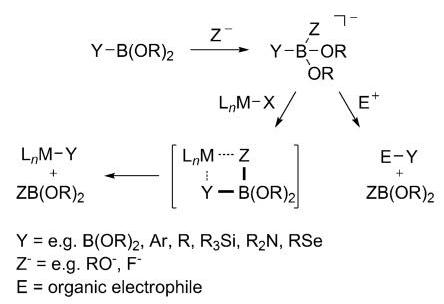
Scheme 1. Generic reactions of the organoborates with an organic electro-phile or with a metal complex.
In the copper-catalyzed $\beta$ -borylation of $\alpha ,\beta$ -unsaturated compounds, Miyaura et al. postulated that a copper-boryl complex, formed in situ by reaction of ${1}^{\left\lbrack {11}\right\rbrack }$ and a copper salt under basic conditions, transferred a boryl moiety to the elec-trophile. ${}^{\left\lbrack 5\right\rbrack }$ More recently, Santos et al. demonstrated that a neutral, preactivated ${\mathrm{{sp}}}^{2} - {\mathrm{{sp}}}^{3}$ diboron adduct, in the absence of a base, enhances the rate of transmetalation of an ${\mathrm{{sp}}}^{2}$ boryl moiety to the copper salt in the Cu-catalyzed $\beta$ -borylation of $\alpha ,\beta$ -unsaturated carbonyl compounds (Scheme 2). ${}^{\left\lbrack 9b\right\rbrack }$
DFT investigations of the mechanism of copper-catalyzed borylation of unsaturated carbonyl compounds and alkenes using diboron(4) reagents were conducted by Lin, Marder and co-workers. ${}^{\left\lbrack {12}\right\rbrack }$ It was discovered that during the catalytic cycle the hybridization of one of the two boron moieties changes from ${\mathrm{{sp}}}^{2}$ to ${\mathrm{{sp}}}^{3}$ in a short-lived intermediate when the diboron compound associates to the model copper-alkoxide complex [Cu(NHC)OMe] (NHC=N-heterocyclic carbene). ${}^{\left\lbrack {12}\right\rbrack }$ Subsequent metathesis affords a copper-boryl complex, which facilitates transfer of the boryl group to the organic electrophile giving the desired organoboronate ester. ${}^{\left\lbrack 7\right\rbrack }$ An analogous ${\mathrm{{sp}}}^{2} - {\mathrm{{sp}}}^{3}$ di-boron intermediate, in which the diboron reagent is bound to a nickel alkoxide, was observed in NMR studies by Mindiola et al. in the reaction of ${\mathrm{B}}_{2}{\mathrm{{cat}}}_{2}{\left( \mathrm{{cat}} = {\mathrm{O}}_{2}{\mathrm{C}}_{6}{\mathrm{H}}_{4}\right) }^{\left\lbrack {13}\right\rbrack }$ with $\left\lbrack {\mathrm{{Ni}}\left( {\mathrm{O}t\mathrm{{Bu}}}\right) }\right.$ - (PNP)] (PNP $= \mathrm{N}\left\lbrack {2 - \mathrm{P}{\left\{ {\mathrm{{CHMe}}}_{2}\right\} }_{2} - 4\text{ -methylphenyl] }{}_{2}{}^{ - }}\right\rbrack$ . ${}^{\left\lbrack {14}\right\rbrack }$
[a] S. Pietsch, ${}^{ + }$ Dr. E. C. Neeve, ${}^{ + }$ Dr. R. Bertermann, Prof. Dr. U. Radius, Prof. Dr. T. B. Marder
Institut für Anorganische Chemie
Julius-Maximilians-Universität Würzburg
Am Hubland, 97074 Würzburg (Germany)
[b] Dr. D. C. Apperley, Dr. C. Kleeberg, Prof. Dr. T. B. Marder
Department of Chemistry
Durham University
South Road, Durham, DH1 3LE (UK)
[c] Dr. M. S. Cheung, Dr. L. Dang, Prof. Dr. Z. Lin
Department of Chemistry
The Hong Kong University of Science and Technology
Clear Water Bay, Kowloon, Hong Kong (P. R. China)
[d] Dr. C. Kleeberg
Institut für Anorganische und Analytische Chemie
Technische Universität Carolo-Wilhelmina zu Braunschweig
Hagenring 30, 38106 Braunschweig (Germany)
ch.kleeberg@tu - braunschweig.de
[e] Dr. F. Mo, D. Qiu, Prof. Dr. J. Wang
Beijing National Laboratory of Molecular Sciences (BNLMS)
and Key Laboratory of Bioorganic Chemistry
and Molecular Engineering of Ministry of Education
College of Chemistry, Peking University
Beijing 100871 (P. R. China)
[†] These authors contributed equally to this work.
Supporting information for this article is available on the WWW under http://dx.doi.org/10.1002/chem.201500235.
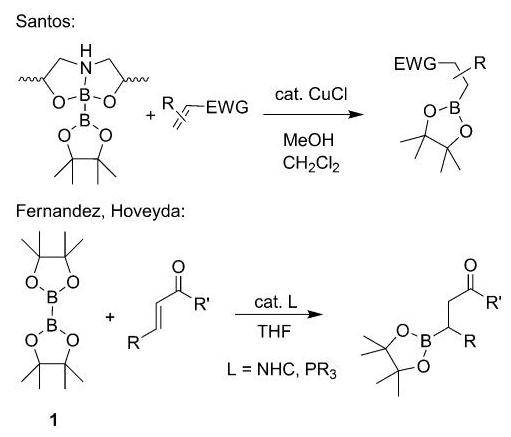
Scheme 2. Examples of reported reactions of ${\mathrm{{sp}}}^{2} - {\mathrm{{sp}}}^{3}$ or ${\mathrm{{sp}}}^{2} - {\mathrm{{sp}}}^{2}$ diboron compounds. ${}^{\left\lbrack 5 - {10}\right\rbrack }$ EWG = electron-withdrawing group, NHC = N-heterocyclic carbene.
The in situ quaternization of one of the boron atoms to form a borylborate was also proposed to enhance direct transfer of the boryl moiety to an organic electrophile. Fernández and co-workers proposed that an ${\mathrm{{sp}}}^{2} - {\mathrm{{sp}}}^{3}$ adduct of 1, formed when 1 reacts with base in the presence of methanol, was generated in situ and facilitated the transition-metal-free boryl-ation of unsaturated compounds (Scheme 2). ${}^{\left\lbrack {10}\right\rbrack }$ A similar situation applies to B-heteroatom systems, such as $B - {\mathrm{{Si}}}^{\left\lbrack {15}\right\rbrack }$ B-N, ${}^{\left\lbrack {10}\mathrm{\;m},{16}\right\rbrack }$ and B-Se, ${}^{\left\lbrack {17}\right\rbrack }$ for which the nucleophilicity of the heteroatom is enhanced by complexation of a Lewis base to the B atom. Furthermore, related base adducts of organo-boronate esters are frequently discussed as intermediates in the Suzuki-Miyaura cross-coupling reaction, and intramolecular Lewis base adducts of organoboronate esters have been explored as the active boryl species by Miyaura and others. ${}^{\left\lbrack {18}\right\rbrack }$
Literature reports of the structure and reactivity of isolated examples of Lewis base adducts of 1 are relatively limited, and the isolation and full characterization of only one neutral ${\mathrm{B}}_{2}{\mathrm{{pin}}}_{2}$ (NHC) adduct are reported. ${}^{\left\lbrack 8a, b,{19}\right\rbrack }$ This was originally proposed by Hoveyda ${}^{\left\lbrack 8a, b\right\rbrack }$ to be the intermediate responsible for promotion of metal-free $\beta$ borylation of $\alpha ,\beta$ -unsaturated carbonyl compounds; the exact nature of the adduct was reported based on detailed experimental and theoretical studies by Marder and co-workers. ${}^{\left\lbrack {19}\right\rbrack }$ However, there have been previous reports about the isolation and characterization of several related adducts of more Lewis acidic diboron compounds. ${}^{\left\lbrack {20}\right\rbrack }$ Marder, Norman et al. studied ${\mathrm{{sp}}}^{2} - {\mathrm{{sp}}}^{3}$ Lewis base adducts of bis(catecholato)diboron (Figure 1) and bis(thio-catecholato)di-boron in considerable detail, ${}^{\left\lbrack {20}\mathrm{\;b},\mathrm{\;d} - \mathrm{f}\right\rbrack }$ and Braunschweig and coworkers recently isolated and characterized various Lewis base adducts of 1,2-dihalodiboranes. ${}^{\left\lbrack {20}\mathrm{\;g} - \mathrm{j}\right\rbrack }$ Furthermore, an alkoxide adduct of an unsymmetrical ${\mathrm{{sp}}}^{2} - {\mathrm{{sp}}}^{2}$ diboron compound has recently been reported. ${}^{\left\lbrack {21}\right\rbrack }$
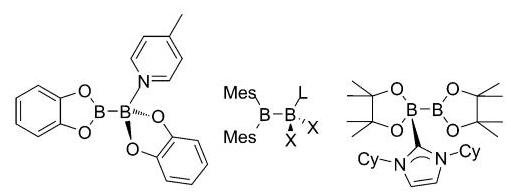
Figure 1. Examples of isolated Lewis base adducts of diboron compounds. ${}^{\left\lbrack {19},{20}\mathrm{\;b},\mathrm{\;d} - \mathrm{j}\right\rbrack }$ Mes = mesityl, $\mathrm{{Cy}} =$ cyclohexyl, $\mathrm{X} =$ halide.
Our attention was again drawn to ${\mathrm{{sp}}}^{2} - {\mathrm{{sp}}}^{3}$ adducts of di-boron compounds during our study of the copper-catalyzed borylation of aryl halides. ${}^{\left\lbrack {22}\right\rbrack }$ We found that an ${\mathrm{{sp}}}^{2} - {\mathrm{{sp}}}^{3}$ adduct of 1 with KOtBu was formed under the reaction conditions. The adduct was proposed to be responsible for the uncata-lyzed background reaction, which give arylboronate esters in trace quantities. ${}^{\left\lbrack {22}\right\rbrack }$ One of our groups has reported several protocols for the transition-metal-free borylation of aryl amines by the in situ formation of aryl diazonium salts and their reaction with ${1}^{\left\lbrack {23}\mathrm{a} - \mathrm{e}\right\rbrack }$ Similar systems were recently studied by Blanchet et al. ${}^{\left\lbrack {23}\mathrm{f},\mathrm{g}\right\rbrack }$ and Xue et al. ${}^{\left\lbrack {23}\mathrm{h}\right\rbrack }$ Because this reaction takes place in the presence of an alkoxide formed in situ from the reaction of tBuONO with the aryl amine, the reaction of an activated ${\mathrm{{sp}}}^{2} - \; {\mathrm{{sp}}}^{3}$ derivative of 1 with the very electrophilic diazonium salt has to be considered as a possible reaction pathway (see below) for the synthesis of useful aryl boronates. ${}^{\left\lbrack {22} - {24}\right\rbrack }$
To improve our understanding of the role of these postulated adducts in borylation reactions and to promote development of the chemistry of ${\mathrm{{sp}}}^{2} - {\mathrm{{sp}}}^{3}$ diboron compounds, we set out to synthesize and fully characterize a series of ${\mathrm{{sp}}}^{2} - {\mathrm{{sp}}}^{3}$ adducts of diboron compounds such as 1 with different anionic Lewis bases and to study the reactivity of the isolated adducts in stoichiometric borylation reactions with aryl electrophiles. ${}^{\left\lbrack {25}\right\rbrack }$
Results and Discussion
Synthesis
As previously mentioned, 1 reacts with KOtBu in THF to form a colorless, microcrystalline precipitate. ${}^{\left\lbrack {22}\right\rbrack }$ The composition of this precipitate was determined by elemental analysis and is in agreement with the formula $\mathrm{K}\left\lbrack {{\mathrm{B}}_{2}{\mathrm{{pin}}}_{2}\mathrm{O}t\mathrm{{Bu}}}\right\rbrack$ (2). Further characterization of this adduct by solid-state and solution ( $\left\lbrack {\mathrm{D}}_{7}\right\rbrack$ DMF) NMR spectroscopy and single-crystal X-ray diffraction confirmed an ${\mathrm{{sp}}}^{2} - {\mathrm{{sp}}}^{3}$ diboron compound that consisted of infinite chains of 2 in the solid state. Following this initial finding, 1 was allowed to react with other anionic Lewis bases $\left( {{\mathrm{{MeO}}}^{ - }\text{ , }}\right. \; \left. {t{\mathrm{{BuO}}}^{ - },\left( {4 - t{\mathrm{{BuC}}}_{6}{\mathrm{H}}_{4}}\right) {\mathrm{O}}^{ - },{\mathrm{F}}^{ - }}\right)$ to synthesize a series of related ${\mathrm{{sp}}}^{2} - \; {\mathrm{{sp}}}^{3}$ diboron compounds (Scheme 3).
The solubility of these adducts was improved by the addition of a stoichiometric amount of 18-crown-6 (18-C-6) to the reaction of equimolar amounts of 1 and KOtBu to obtain a monomeric adduct. Instead,[K(18-crown-6)(thf) ${}_{2}$ ] $\left\lbrack {\mathrm{K}{\left( {\mathrm{B}}_{2}{\mathrm{{pin}}}_{2}\mathrm{O}t\mathrm{{Bu}}\right) }_{2}}\right\rbrack$ (3), which consisted of a potassium-bridged dimer of two ${\left\lbrack {\mathrm{B}}_{2}{\mathrm{{pin}}}_{2}\mathrm{O}t\mathrm{{Bu}}\right\rbrack }^{ - }$ moieties with ${\left\lbrack \mathrm{K}\left( {18}\text{ -crown-6 }\right) {\left( \mathrm{{thf}}\right) }_{2}\right\rbrack }^{ + }$ as the counterion, was isolated as the sole product. Thus, only half of the potassium cations were complexed by the crown ether. Increasing the amount of 18-crown-6 led to isolation of the mononuclear adduct [K(18-crown-6)][B ${}_{2}$ pin ${}_{2}$ OtBu] (4) in low yield. However, obtaining material of this specific composition was not readily reproducible. In contrast, substitution of KOtBu with KOMe led to reproducible isolation of the analogous salt [K(18-crown-6)][B ${}_{2}{\text{ pin }}_{2}$ OMe] (5) in good yield. The reaction of the phenolate $\mathrm{{KO}}\left( {4 - t{\mathrm{{BuC}}}_{6}{\mathrm{H}}_{4}}\right)$ with 1 led to isolation of $\mathrm{K}\left\lbrack {{\mathrm{B}}_{2}{\mathrm{{pin}}}_{2}\mathrm{O}\left( {4 - t{\mathrm{{BuC}}}_{6}{\mathrm{H}}_{4}}\right) }\right\rbrack$ (6), whereas no adduct was isolated or observed by ${}^{11}\mathrm{\;B}\left\{ {{}^{1}\mathrm{H}}\right\}$ and ${}^{1}\mathrm{H}$ NMR spectroscopy for the sterically more-demanding phenolate $\mathrm{{KO}}\left( {4 - \mathrm{{Me}} - 2,6 - t{\mathrm{{BuC}}}_{6}{\mathrm{H}}_{4}}\right)$ . ${}^{\left\lbrack {26}\right\rbrack }$ Similarly, the reaction with less Lewis basic carboxylates ${\mathrm{{KO}}}_{2}\mathrm{{CPh}}$ and $\left\lbrack {n{\mathrm{{Bu}}}_{4}\mathrm{P}}\right\rbrack \left\lbrack \mathrm{{OAc}}\right\rbrack {\left( \mathrm{{TBPE}}\right) }^{\left\lbrack {27}\right\rbrack }$ did not lead to the isolation of any adducts, nor were any detected by ${}^{11}\mathrm{\;B}\left\{ {{}^{1}\mathrm{H}}\right\}$ and ${}^{1}\mathrm{H}$ NMR spectroscopy. ${}^{\left\lbrack {26}\right\rbrack }$ In contrast, the analogous reactions of $\left\lbrack {n{\mathrm{{Bu}}}_{4}\mathrm{\;N}}\right\rbrack \mathrm{F} \cdot 3{\mathrm{H}}_{2}\mathrm{O}$ or ${\mathrm{{Me}}}_{4}\mathrm{\;N}\mathrm{\;F}$ with 1 furnished the adducts $\left\lbrack {n{\mathrm{{Bu}}}_{4}\mathrm{\;N}}\right\rbrack \left\lbrack {{\mathrm{B}}_{2}{\mathrm{{pin}}}_{2}\mathrm{\;F}}\right\rbrack$ (7) and $\left\lbrack {{\mathrm{{Me}}}_{4}\mathrm{\;N}}\right\rbrack \left\lbrack {{\mathrm{B}}_{2}{\mathrm{{pin}}}_{2}\mathrm{\;F}}\right\rbrack \left( \mathbf{8}\right)$ , respectively, in good yields. For 7 and 8 only monoadduct was isolated despite the presence of excess Lewis base, indicating that there was limited, if any, binding of a second equivalent of the base to obtain a di-anionic ${\mathrm{{sp}}}^{3} - {\mathrm{{sp}}}^{3}$ adduct. This may be rationalized by the unfavorable accumulation of negative charge in a potential bis-adduct and the reduced Lewis acidity of 1 compared with that of the catechol or thiocatechol analogues, which have been shown to form bis-adducts with neutral Lewis bases. ${}^{\left\lbrack {20}\mathrm{\;b},\mathrm{\;d} - \mathrm{f}\right\rbrack }$ However, the reaction of 1 with neutral Lewis bases, such as ${\mathrm{{PMe}}}_{3}$ , pyridine,4-dimethylaminopyridine (DMAP), or pyrrolidine, gave no adduct formation (analyzed by ${}^{1}\mathrm{H}$ and ${}^{11}\mathrm{\;B}\left\{ {{}^{1}\mathrm{H}}\right\}$ NMR spectroscopy), even in the presence of excess base.
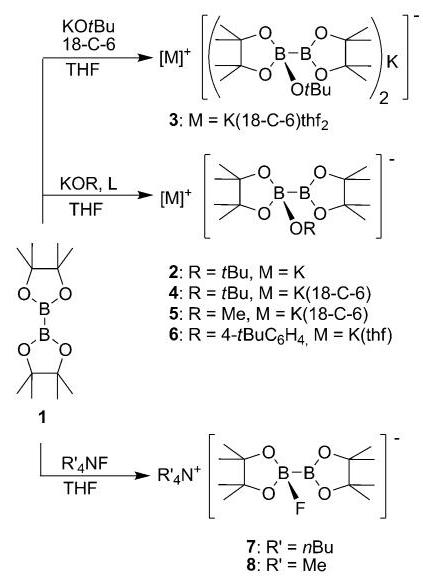
Scheme 3. Formation of intermolecular adducts of 1.
The investigations were also extended to incorporate other related diboron compounds. Attempts to synthesize and isolate anionic adducts of ${\mathrm{B}}_{2}{\mathrm{{neop}}}_{2}{}^{\left\lbrack {28}\right\rbrack }$ (neop $= {\mathrm{{OCH}}}_{2}{\mathrm{{CMe}}}_{2}{\mathrm{{CH}}}_{2}\mathrm{O}$ ) and ${\mathrm{B}}_{2}{\mathrm{{cat}}}_{2}$ with bases such as ${\mathrm{{RO}}}^{ - }$ and ${\mathrm{F}}^{ - }$ have been unsuccessful and are subject to ongoing research. However, when ${\mathrm{B}}_{2}{\mathrm{{dmeda}}}_{2}{}^{\left\lbrack {29}\right\rbrack }$ (dmeda=MeNCH ${}_{2}{\mathrm{{CH}}}_{2}\mathrm{{NMe}}$ ) was treated with KOMe (1 equiv) in the presence of 18-crown-6 the only product isolated was [K(18-crown-6)][dmedaB-B(OMe) ${}_{3}$ ] (9; Scheme 4), which was obtained in 62% yield with respect to the limiting reagent, KOMe. The formation of this mononuclear product implies that as the Lewis base binds to one of the [B(dmeda)] moieties, the B-N π-bonding system is disrupted, promoting the addition of further ${\mathrm{{MeO}}}^{ - }$ and the removal of the dmeda to form 9.
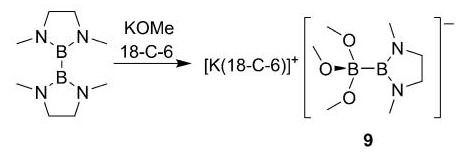
Scheme 4. Formation of the Lewis base adduct 9.
NMR spectroscopy
For the ${\mathrm{{sp}}}^{2} - {\mathrm{{sp}}}^{3}$ adducts, there should be two distinct signals in the ${}^{11}\mathrm{\;B}\left\{ {{}^{1}\mathrm{H}}\right\}$ NMR spectra, which is comparable to the ${\mathrm{B}}_{2}{\mathrm{{pin}}}_{2}$ (NHC) adduct isolated previously by the Marder group (Figure 1): ${}^{\left\lbrack {19}\right\rbrack }$ one with $\delta < {20}\mathrm{{ppm}}$ , which arises from the tetrahedral boron site, and one with $\delta > {20}\mathrm{{ppm}}$ , which represents the trigonal boron site. The line shapes of these signals should also differ significantly. In solution, the lower-symmetry trigonal site should show a larger peak width than the higher-symmetry tetrahedral site. However, in the solid state we expect a more complex line shape for the signal resulting from the trigonal site. A comparison of the ${}^{11}\mathrm{\;B}\left\{ {{}^{1}\mathrm{H}}\right\}$ NMR spectra in solution and the solid state allows further conclusions to be drawn about the molecular structures of the adducts in solution in relation to their solid-state structures. This is especially the case for 6 because the typical ${}^{11}\mathrm{\;B}\left\{ {{}^{1}\mathrm{H}}\right\}$ NMR spectral pattern for ${\mathrm{{sp}}}^{2} - \; {\mathrm{{sp}}}^{3}$ diboron compounds was not detected in the solution NMR spectrum (Figure 2). ${}^{\left\lbrack {30}\right\rbrack }$
Only one signal at $\delta = {22.1}\mathrm{{ppm}}$ was observed in the solution-state ${}^{11}\mathrm{\;B}\left\{ {{}^{1}\mathrm{H}}\right\}$ NMR spectrum of 6 at ${20}^{ \circ }\mathrm{C}$ , whereas in the solid-state spectrum two separate signals are clearly visible. The line shape and chemical shift of these signals in the solid-state NMR spectrum are indicative of a lower-symmetry trigonal boron site and a higher-symmetry tetrahedral boron site. The isotropic chemical shift $\left( {\delta }_{\text{ iso }}\right)$ values of these signals were estimated by simulation of the spectrum to ${36.5}\left( {\pm {1.5}}\right)$ and ${4.7}\left( {\pm {1.7}}\right) \mathrm{{ppm}}$ (Figure 2). The ${}^{11}\mathrm{\;B}\left\{ {{}^{1}\mathrm{H}}\right\}$ NMR spectra in solution and the solid state are explained by the presence of a dynamic mutual exchange of the boron sites in solution, leading to an averaged signal and chemical shift. This is in good agreement with the observation of a low barrier for the exchange of the pinacol methyl groups observed by ${}^{1}\mathrm{H}$ NMR spectroscopy. When the ${}^{11}\mathrm{\;B}\left\{ {{}^{1}\mathrm{H}}\right\}$ NMR spectrum was obtained at lower temperatures two signals were not observed; instead, one signal disappeared altogether at $- {10}^{ \circ }\mathrm{C}$ and below $- {30}^{ \circ }\mathrm{C}$ a single broad signal appeared at $\delta = {6.6}\mathrm{{ppm}}\left( {-{55}^{ \circ }\mathrm{C}}\right)$ , which correlates to the assigned ${\mathrm{{sp}}}^{3}$ boron site. This suggests an ${\mathrm{{sp}}}^{2} - {\mathrm{{sp}}}^{3}$ diboronic structure for 6 in solution similar to that detected in the solid state, rather than a possible alternative bridging coordination of the phenolate ligand in solution. The missing signal of the ${\mathrm{{sp}}}^{2}$ boron site at $- {55}^{ \circ }\mathrm{C}$ may be explained by the line width of the signal being similar to the line width of the background signal, thus the signal is removed as an effect of the backward linear prediction. ${}^{\left\lbrack {30}\right\rbrack }$
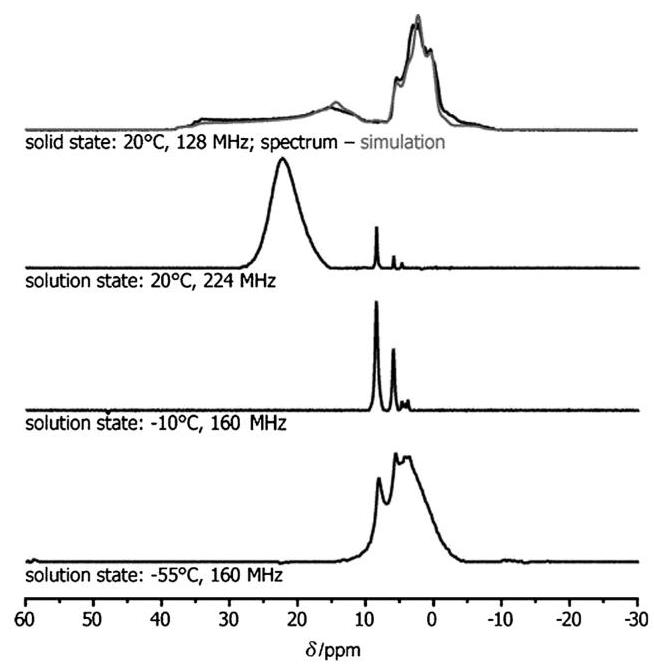
Figure 2. ${}^{11}\mathrm{\;B}\left\{ {{}^{1}\mathrm{H}}\right\}$ VT-NMR spectra of 6(thf) in $\left\lbrack {\mathrm{D}}_{7}\right\rbrack$ DMF and ${}^{11}\mathrm{\;B}\left\{ {{}^{1}\mathrm{H}}\right\}$ solid-state NMR spectrum (black) and simulation (gray) of 6.
In addition to the ${}^{11}\mathrm{\;B}\left\{ {{}^{1}\mathrm{H}}\right\}$ NMR signals of 6 already discussed, three extremely sharp signals $\left( {\delta = {8.9},{6.4}\text{ , and }{5.2}\mathrm{{ppm}}}\right)$ of low intensity $\left( { < 3\% \text{ relative to the signal at }\delta = {22.1}\mathrm{{ppm}}\text{ at }{20}^{ \circ }\mathrm{C}}\right)$ were observed due to impurities (Figure 2). Moreover, a signal at a similar chemical shift was observed frequently in solutions of 5 and 7, indicating a common decomposition pathway for these adducts. ${}^{\left\lbrack {26}\right\rbrack }$ The narrow line shape and the chemical shift value suggest the presence of a highly symmetric borate, such as ${\left\lbrack {\text{ Bpin }}_{2}\right\rbrack }^{ - }$ . This is in agreement with a signal observed at $\delta = \; {8.9}\mathrm{{ppm}}$ in the ${}^{11}\mathrm{\;B}\left\{ {{}^{1}\mathrm{H}}\right\}$ NMR spectrum of tetra- $n$ -butyl-phosphonium dipinacolatoborate in $\left\lbrack {\mathrm{D}}_{7}\right\rbrack$ DMF, suggesting that this borate is indeed the major impurity. ${}^{\left\lbrack {19},{26},{27}\right\rbrack }$ Furthermore, we found crystallographic evidence that the decomposition of 5 and 7 leads to products containing the borate ion [Bpin2] ${}^{ - }$ . ${}^{\left\lbrack {26}\right\rbrack }$ Therefore, it can be concluded that the formation of [Bpin2] presents a common decomposition pathway for a number of Lewis base adducts of 1.
The simulations to determine ${\delta }_{\text{ iso }}$ were complicated, not only in the case of 6 , but also in the case of the adducts 2, 5, 7, and 8, due to the presence of magnetically inequivalent, but chemically equivalent, boron sites. Therefore, up to three boron sites per chemically equivalent site (trigonal or tetrahedral) had to be considered in the simulation. To ensure that these sites originated from a single (chemical) species and were not caused by the presence of impurities, only high-purity (determined by elemental analysis) samples were used. Additionally, ${}^{13}\mathrm{C}\left\{ {{}^{1}\mathrm{H}}\right\}$ magic angle spinning (MAS) NMR spectra were obtained for 5, 6(thf), 6(dmf), 7, and 8 to prove their purity and exact identity; these spectra only feature additional signals, relative to the spectra obtained in solution, that are in agreement with the reduced symmetry in the solid state. This indicates both the purity of the samples used and the similarity of the structures of the species present in solution and the solid state.
Table 1. ${}^{11}\mathrm{\;B}\left\{ {{}^{1}\mathrm{H}}\right\}$ NMR spectroscopic data for complexes 1-9.
| Complex | $\delta$ | Solution temp. | Solvent | Solid state ${}^{\left\lbrack \mathrm{a}\right\rbrack }{\delta }_{\text{ iso }}$ [species] |
| 1 | 30.5 | rt | [D3]MeCN | 30.0(±0.0) |
| 2 | 37.7, 4.8 | rt | [D7]DMF | 36.5(±1.5), 4.7(±1.7) |
| 3 | 41.4, 8.1 | rt | [D8]THF | - |
| 5 | 37.7, 5.8 | rt | [D8]THF | 36.0(±3.0), 4.8(±2.0) |
| 6 | 22.1 | rt | [D, ]DMF | 36.5(±1.5), 4.7(±1.7) [6(thf)] |
| 7 | 31.4, 5.1 | rt | [D,]THF | 35.0(±0.0), 5.0(±0.0) |
| 8 | 33.9, 5.7 | rt | [D,3]MeCN | 37.5(±0.5), 5.5(±0.0) |
| 9 | 35.9, 4.3 | rt | $\left\lbrack {\mathrm{D}}_{8}\right\rbrack$ THF | - |
[a] The given data were determined by simulation and are weighted and averaged values from up to three different ${}^{11}\mathrm{\;B}$ sites. All spectra were obtained at ambient temperature. Complex 2, 6(dmf), and 6(thf) show a similar ${}^{11}\mathrm{\;B}\left\{ {{}^{1}\mathrm{H}}\right\}$ solid-state NMR spectrum and were simulated with the same set of parameters. For all solid-state NMR and simulated spectra, see section 2 of the Supporting Information. ${}^{\left\lbrack {26}\right\rbrack }$
A comparison of the ${}^{11}\mathrm{\;B}\left\{ {{}^{1}\mathrm{\;H}}\right\}$ NMR spectroscopic data for adducts (2, 3, and 5-9; Table 1) shows that the general expectation to find two signals for two distinctly different boron sites-trigonal and tetrahedral-is confirmed for all diboron adducts, apart from 6 (see above). The signal of the trigonal boron site typically has a significantly higher chemical shift than in 1 and is in agreement with similar ${}^{11}\mathrm{\;B}\left\{ {{}^{1}\mathrm{H}}\right\}$ NMR shifts observed for metal-boryl complexes that contain the Bpin fragment. ${}^{\left\lbrack {19},{31}\right\rbrack }$ Furthermore, in general, the chemical shift of the tetrahedral boron atom is similar to the value found for aryl-trialkoxyboronate anions. ${}^{\left\lbrack {18}a,{32}\right\rbrack }$ This indicates polarization of the B-B bond and could be described, as a limiting case, as a trigonal boryl anion coordinated to a trialkoxyborane.
The solid-state ${}^{11}\mathrm{\;B}\left\{ {{}^{1}\mathrm{H}}\right\}$ NMR data are essentially comparable to the solution NMR data, indicating similar ${\mathrm{{sp}}}^{2} - {\mathrm{{sp}}}^{3}$ diboron (sub)structures in solution and the solid state. Dissolving adducts 2 and 6 induces a significant structural change (i.e. degree of aggregation), but this does not lead to a significant change in the ${}^{11}\mathrm{\;B}\left\{ {{}^{1}\mathrm{H}}\right\}$ NMR data (solid state versus in solution). The chemical shifts in the ${}^{11}\mathrm{\;B}\left\{ {{}^{1}\mathrm{H}}\right\}$ NMR spectra appear to be rather insensitive to changes to the overall structure of the adducts. This can also be concluded from small variances of the signals in the ${}^{11}\mathrm{\;B}\left\{ {{}^{1}\mathrm{H}}\right\}$ NMR spectra, especially for the solid-state data (Table 1). Hence, no information can be obtained from this data regarding the degree of association of the cation and anion in solution.
A ${}^{1}$ H NMR spectroscopic study was also undertaken to analyze adducts 2,3, and 5-8. In solution, the ${}^{1}\mathrm{H}$ NMR spectra displayed similar splitting patterns for the pinacol methyl groups, even if the temperature dependence and, therefore, the dynamics in solution were different (Table 2).
The splitting of the pinacol methyl groups into three signals with an intensity ratio of 12:6:6 is in agreement with structures of these compounds in solution that resemble the monomeric solid-state structures. The ${\mathrm{{sp}}}^{3}$ -Bpin moiety gives rise to two signals because, on the NMR timescale, its five-membered ring is perpendicular to the mirror plane parallel to the B-B bond. Therefore, two signals of equal intensity, each arising from two methyl groups either syn or anti to the coordinated Lewis base, are observed. The ${\mathrm{{sp}}}^{2}$ -Bpin moiety gives rise to only one signal, which integrates to 12, due to rapid interconversion of different conformers of this moiety. In contrast, for 6 no splitting of the pinacol methyl signals was detected; only a broadened singlet was observed, indicating rapid exchange even at $- {55}^{ \circ }\mathrm{C}$ (Table 2). ${}^{\left\lbrack {26}\right\rbrack }$
Table 2. ${}^{1}\mathrm{H}$ NMR shifts of the pinacol groups in 2,3, and 5-8.
| Complex | ${\mathrm{{sp}}}^{2} - \mathrm{B}$ | sp ${}^{3} - B$ | $T$ | Solvent |
| 2 | 1.13 (12H) | 1.06 (6H), 0.94 (6H) | rt | [D7]DMF |
| 3 | 1.15 (12H) | 1.07 (6H), 0.96 (6H) | rt | [D8]THF |
| 5 | 1.06 (24H) | - | rt | $\left\lbrack {\mathrm{D}}_{8}\right\rbrack$ THF |
| 1.08 (12H) | 1.03 (6H), 0.98 (6H) | $- {55}^{ \circ }\mathrm{C}$ | $\left\lbrack {\mathrm{D}}_{8}\right\rbrack$ THF | |
| 6 | 1.05 (24H) | - | rt | $\left\lbrack {\mathrm{D}}_{7}\right\rbrack$ DMF |
| 1.04 (24H) | - | $- {55}^{ \circ }\mathrm{C}$ | $\left\lbrack {\mathrm{D}}_{7}\right\rbrack$ DMF | |
| 7 | 1.08 (24H) | - | rt | $\left\lbrack {\mathrm{D}}_{8}\right\rbrack$ THF |
| 1.11 (12H) | 1.04 (6H), 1.00 (6H) | $- {40}^{ \circ }\mathrm{C}$ | [Da]THF | |
| 8 | 1.03 (24H) | - | rt | $\left\lbrack {\mathrm{D}}_{3}\right\rbrack \mathrm{{MeCN}}$ |
| 1.04 (12H) | 0.88 (6H), 0.96 (6H) | $- {30}^{ \circ }\mathrm{C}$ | $\left\lbrack {\mathrm{D}}_{3}\right\rbrack \mathrm{{MeCN}}$ | |
DFT calculations
To gain information regarding the stability of these isolated adducts, we performed DFT calculations using both the B3LYP and MPW1K functionals to obtain thermochemical data for several cases of the Lewis acid/base reactions (Table 3).
The Lewis acid/base reactions involve two-to-one transformations; therefore, entropy is expected to be important. Consistent with this, the ${\Delta H}$ values are always much more negative than the Gibbs free energy $\left( {\Delta G}\right)$ values. Consequently, it is more appropriate to use ${\Delta G}$ values for the reactions to discuss the adduct stabilities. Interestingly, the $\Delta {G}_{\text{ gas }}$ values calculated by using the B3LYP functional are, in general, smaller than those calculated by using the tighter-binding MPW1K functional. However, after solvation energy corrections, the $\Delta {G}_{\text{ sol }}$ values calculated with both functionals do not differ significantly. Table 3 shows that the solvation-corrected ${\Delta G}$ values of the reactions were calculated to be in the range of -2 to $- {10}\mathrm{{kcal}} \; {\mathrm{{mol}}}^{-1}$ , with adduct 5 having the most negative calculated $\Delta {G}_{\text{ sol }}$ values (-9 to $- {10}\mathrm{{kcal}}{\mathrm{{mol}}}^{-1}$ ).
Table 3. Thermochemical data [electronic energies $\left( {\Delta E}\right)$ , enthalpies $\left( {\Delta H}\right)$ , and Gibbs free energies $\left( {\Delta G}\right)$ ] calculated for the formation of 4,5, and 7 (all values in $\mathrm{{kcal}}{\mathrm{{mol}}}^{-1}$ ).
| B3LYP | MPW1K | |||||
| $\Delta {E}_{\text{ gas }} \; \left( {\Delta {E}_{\text{ solv }}}\right)$ | $\Delta {H}_{\text{ gas }} \; {\left( \Delta {H}_{\text{ solv }}\right) }^{\left\lbrack \mathrm{a}\right\rbrack }$ | $\Delta {G}_{\text{ gas }} \; {\left( \Delta {G}_{\text{ solv }}\right) }^{\left\lbrack \mathrm{b}\right\rbrack }$ | $\Delta {E}_{\text{ gas }} \; \left( {\Delta {E}_{\text{ solv }}}\right)$ | $\Delta {H}_{\text{ gas }} \; {\left( \Delta {H}_{\text{ solv }}\right) }^{\left\lbrack \mathrm{a}\right\rbrack }$ | $\Delta {G}_{\text{ gas }} \; {\left( \Delta {G}_{\text{ solv }}\right) }^{\left\lbrack \mathrm{b}\right\rbrack }$ | |
| 4 | -26.8 (-20.7) | -25.0 (-18.9) | -8.5 (-2.4) | -33.0 (-22.0) | -31.2 (-20.2) | -15.3 (-4.3) |
| 5 | -37.2 (-27.8) | -35.2 (-25.7) | -18.9 (-9.5) | -43.6 (-27.6) | -41.6 (-25.6) | -25.7 (-9.7) |
| 7 | -27.1 (-18.6) | -25.9 (-17.4) | -13.2 (-4.7) | -32.2 (-18.5) | -31.1 (-17.4) | -18.5 (-4.8) |
[a] $\Delta {H}_{\text{ solv }} = \Delta {H}_{\text{ gas }} + \left( {\Delta {E}_{\text{ solv }} - \Delta {E}_{\text{ gas }}}\right)$ . [b] $\Delta {G}_{\text{ solv }} = \Delta {G}_{\text{ gas }} + \left( {\Delta {E}_{\text{ solv }} - \Delta {E}_{\text{ gas }}}\right)$ .
[a] $\Delta {H}_{\text{ solv }} = \Delta {H}_{\text{ gas }} + \left( {\Delta {E}_{\text{ solv }} - \Delta {E}_{\text{ gas }}}\right)$ 。[b] $\Delta {G}_{\text{ solv }} = \Delta {G}_{\text{ gas }} + \left( {\Delta {E}_{\text{ solv }} - \Delta {E}_{\text{ gas }}}\right)$ 。
The $\Delta {G}_{\text{ sol }}$ values calculated for the adduct 4 are less negative by $2 - 4\mathrm{{kcal}}{\mathrm{{mol}}}^{-1}$ than those for 5, a result of steric effects of the bulkier $t{\mathrm{{BuO}}}^{ - }$ group. For the fluoride adduct 7, the $\Delta {G}_{\text{ gas }}$ values are also appreciably negative, and are comparable to those calculated for 5. However, the large solvation energies for both ${\mathrm{F}}^{ - }$ and $n{\mathrm{{Bu}}}_{4}{\mathrm{\;N}}^{ + }$ make the $\Delta {G}_{\text{ sol }}$ values (about -5 kcal ${\mathrm{{mol}}}^{-1}$ ) less negative than expected, based on the known affinity of boron for fluorine.
Crystal structure
To explore the exact structure of the Lewis base adducts, single-crystal structure analysis was performed for complexes 2-9. ${}^{\left\lbrack {26}\right\rbrack }$ Single crystals of 2 were obtained by diffusion of solutions of 1 and KOtBu in THF at ${0}^{ \circ }\mathrm{C}$ . This reactive crystallization approach only gave crystals of poor quality, despite several attempts at improvement (variation of the temperature, concentrations, and the geometry of the vessels employed).
Due to the poor quality of the diffraction data, a detailed discussion of the molecular structure of 2 is not feasible (Table 4; Tables S3-S5 in the Supporting Information). However, some principle features can be stated. Compound 2 exists as infinite chains parallel to the $c$ axis formed by connecting ${\left\lbrack {\mathrm{B}}_{2}{\mathrm{{pin}}}_{2}\mathrm{O}t\mathrm{\;{Bu}}\right\rbrack }^{ - }$ units with potassium atoms. ${}^{\left\lbrack {26}\right\rbrack }$ The potassium atoms are coordinated by five oxygen atoms of the ${\left\lbrack {\mathrm{B}}_{2}{\mathrm{{pin}}}_{2}\mathrm{O}t\mathrm{\;{Bu}}\right\rbrack }^{ - }$ moieties (Figure 3). A possible sixth interaction, O(5)–K(1), is very long (4.460(4) Å) and is not significant. The $t{\mathrm{{BuO}}}^{ - }$ group coordinates via the oxygen atom to one boron atom, leading to an ${\mathrm{{sp}}}^{2} - {\mathrm{{sp}}}^{3}$ diboron compound. The geometry of the ${\mathrm{{sp}}}^{2}$ boron atom B(1) remains essentially unchanged compared to that in 1, whereas B(2) is now ${\mathrm{{sp}}}^{3}$ -hybridized.
Crystallization of 2 from DMF/Et ${}_{2}\mathrm{O}$ led to the isolation of the adduct ${\left( \mathbf{2}\right) }_{2}\left( \mathrm{{dmf}}\right)$ , containing half a molecule of DMF per molecule of 2 (Figure 4). The structure of ${\left( 2\right) }_{2}\left( \mathrm{{dmf}}\right)$ is derived from the structure of 2, being assembled from infinite chains of alternating ${\left\lbrack {\mathrm{B}}_{2}{\mathrm{{pin}}}_{2}\mathrm{O}t\mathrm{{Bu}}\right\rbrack }^{ - }$ moieties and potassium atoms. However, in this compound, every second potassium atom is additionally coordinated by a molecule of DMF and this results in two different environments for the potassium atoms. ${}^{\left\lbrack {26}\right\rbrack }$ One of them, K(1), situated on a center of inversion, is sixfold coordinated by the oxygen atoms of the ${\mathrm{{sp}}}^{2} - {\mathrm{{sp}}}^{3}$ diboron moiety, forming a distorted octahedron. The other potassium atom, K(2), is fivefold coordinated by four pinacolate oxygen atoms and one oxygen atom of a (disordered) DMF molecule (O(6)…K(2) 2.664(6) Å; Figure 4). ${}^{\left\lbrack {26}\right\rbrack }$ Compared with 2, the K(1) atoms are situated in a more saturated coordination environment, whereas the K(2) atoms remain coordinatively unsaturated. Any comparison with 2 must be done with considerable care because the errors in the determined structure of 2 are especially large. However, the geometry of the ${\mathrm{{sp}}}^{2} - {\mathrm{{sp}}}^{3}$ diboron unit in ${\left( 2\right) }_{2}\left( \mathrm{{dmf}}\right)$ (Table 4) is similar to that in 2; the changes can be attributed to a twist around the B(1)-B(2) bond to maximize the oxygen-potassium interactions.
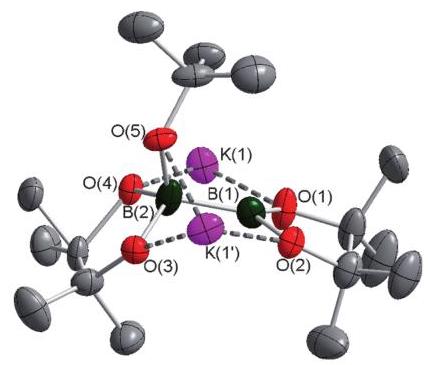
Figure 3. Perspective view of a section of the structure of 2. The bonds between the anionic and cationic part of the structure are drawn in dashed gray lines; thermal ellipsoids are drawn at the 30% probability level; disorder and hydrogen atoms are omitted for clarity.
Table 4. Comparison of selected distances [Å] and angles [°] for 2, (2)(dmf), 3, 4, 5 , and 6(dmf).
| 2 | (2) (dmf) | 3 | 4 | 5 | 6(dmf) | |
| B(1)–B(2) | 1.71(1) | 1.733(5) | 1.729(4) | 1.759(11) | 1.753(2) | 1.738(4) |
| O(1)–B(1) | 1.394(7) | 1.386(4) | 1.384(3) | 1.384(9) | 1.400(2) | 1.384(3) |
| O(2)–B(1) | 1.373(8) | 1.389(4) | 1.394(3) | 1.345(10) | 1.377(4) | 1.382(3) |
| O(3)–B(2) | 1.452(8) | 1.489(4) | 1.526(5) | 1.502(13) | 1.500(2) | 1.480(3) |
| O(4)–B(2) | 1.467(8) | 1.508(4) | 1.482(4) | 1.49(2) | 1.506(2) | 1.479(3) |
| O(5)–B(2) | 1.554(9) | 1.489(4) | 1.492(3) | 1.51(2) | 1.498(2) | 1.527(3) |
| $\Delta \mathrm{B}\left( 1\right) ,\mathrm{B}\left( 2\right) ,\mathrm{O}\left( 1\right) ,\mathrm{O}{\left( 2\right) }^{\left\lbrack \mathrm{b}\right\rbrack }$ | 0.068(7) | 0.063(3) | 0.012(2) | 0.048(2) | 0.003(2) | 0.020(2) |
| O(3)-B(2)-O(4) | 104.5(6) | 103.2(2) | 102.0(2) | 103.7(13) | 103.9(1) | 104.9(2) |
| O(3)-B(2)-O(5) | 101.1(4) | 115.8(2) | 109.6(2) | 113.5(9) | 112.2(1) | 114.0(2) |
| O(4)-B(2)-O(5) | 112.7(5) | 103.0(2) | 113.7(2) | 104.9(6) | 104.1(1) | 103.3(2) |
| O(3)-B(2)-B(1) | 113.6(5) | 114.1(2) | 101.6(2) | 110.2(6) | 109.6(3) | 111.8(2) |
| O(4)-B(2)-B(1) | 114.5(5) | 106.7(2) | 117.7(2) | 109.2(9) | 114.8(1) | 113.4(2) |
| O(5)-B(2)-B(1) | 109.8(6) | 112.5(3) | 110.8(2) | 114.9(12) | 111.9(1) | 109.3(2) |
| O(1)-K[c] | 2.668(4) (K(1)) | 2.776(2) (K(1)) | 2.718(2) (K(1)) | |||
| O(2)-K[c] | 2.783(4) (K(1’)) | 2.798(2) (K(2)) | 2.794(2) (K(1)) | 4.306(8) (K(1)) | 4.429(2) (K(1)) | 2.765(1) (K(2)) |
| O(3)-K[c] | 2.596(4) (K(1’)) | 2.664(2) (K(2)) | 2.729(3) (K(1)) | 2.762(1) (K(1)) | ||
| O(4)-K[c] | 2.620(4) (K(1)) | 2.647(2) (K(1)) | 2.690(6) (K(1)) | 2.776(1) (K(1)) | 2.814(2) (K(2)) | |
| O(5)-K[c] | 2.766(4) (K(1′)) | 2.696(2) (K(1)) | 2.674(2) (K(1)) | 2.799(6) (K(1)) | 2.684(1) (K(1)) | 2.827(2) (K(2)) |
[a] Unified labelling scheme. [b] ${\Delta }_{\mathrm{{AB}},\mathrm{C},\mathrm{D}}$ is the maximum deviation of one of the atoms A, B, C, or D from the mean plane defined by A, B, C, and D. [c] The respective potassium atom is given in parentheses.
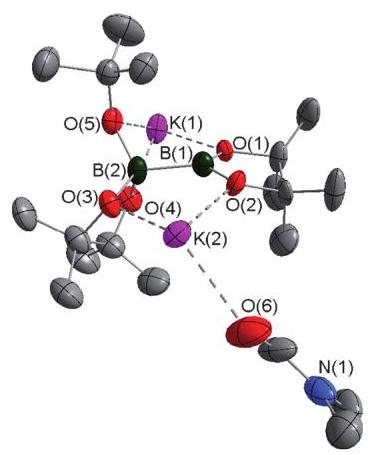
Figure 4. Perspective view of the asymmetric unit of the structure of ${\left( 2\right) }_{2}\left( \mathrm{{dmf}}\right)$ . The bonds between the anion and cation are drawn in dashed gray lines; thermal ellipsoids are drawn at the 50% probability level; disorder and hydrogen atoms are omitted for clarity.
The structure of the dimeric compound 3 can be easily derived from the polymeric structure of ${\left( 2\right) }_{2}\left( \mathrm{{dmf}}\right)$ . The infinite chains of ${\left( 2\right) }_{2}\left( \mathrm{{dmf}}\right)$ are broken apart into ion pairs by coordination of K(2) by one molecule of 18-crown-6 and two molecules of THF, leaving K(1) six-coordinated by two ${\left\lbrack {\mathrm{B}}_{2}{\mathrm{{pin}}}_{2}\mathrm{O}t\mathrm{\;{Bu}}\right\rbrack }^{ - }$ moieties (Figure 5). Remarkably, 3 is formed despite the presence of excess 18-crown-6 and THF as solvent, indicating the coordination capabilities of the anionic ${\left\lbrack {\mathrm{B}}_{2}{\mathrm{{pin}}}_{2}{\mathrm{{OtBu}}}^{ - }\right\rbrack }^{ - }$ fragment. The binding of the potassium atom to this fragment benefits from the chelating, tridentate binding mode, the facial geometry, and coulombic interactions. The close structural relationship between ${\left( 2\right) }_{2}\left( \mathrm{{dmf}}\right)$ and 3 is also apparent in the similar local symmetry (in both cases, K(1) is situated on a center of inversion), bond lengths, and angles within these structures (Table 4).
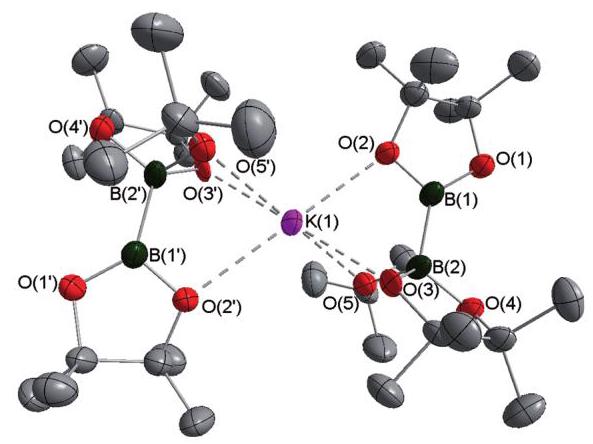
Figure 5. Perspective view of the ${\left\lbrack \mathrm{K}{\left( {\mathrm{B}}_{2}{\mathrm{{pin}}}_{2}\mathrm{O}t\mathrm{{Bu}}\right) }_{2}\right\rbrack }^{ - }$ subunit of 3. Thermal ellipsoids are drawn at the ${50}\%$ probability level; the disorder, the counterion ${\left\lbrack \mathrm{K}\left( {18}\text{ -crown-6 }\right) {\left( \mathrm{{thf}}\right) }_{2}\right\rbrack }^{ + }$ , and hydrogen atoms are omitted for clarity. The bonds between the anionic and cationic part of the structure are drawn in dashed gray lines.
The monomeric compounds 4 and 5 are discussed together because their molecular structures are very similar, apart from the significant difference in packing observed between the two adducts.
In the crystal structure of 4, the atoms $\mathrm{K}\left( 1\right) ,\mathrm{B}\left( 1\right) ,\mathrm{C}\left( 1\right)$ , and C(2) are situated on a mirror plane (Figure 6), which accounts for extensive disorder within the molecular structure. ${}^{\left\lbrack {26}\right\rbrack }$ It appears that the similar steric properties of the $t{\mathrm{{BuO}}}^{ - }$ group and the $\mathrm{C} - {\mathrm{{CMe}}}_{2}$ substructure of the pinacol moiety are responsible for this disorder, a problem which was not encountered with the methoxy derivative 5 (Figure 7). It was possible to refine a reasonable split-atom model for the ${\left\lbrack {\mathrm{B}}_{2}{\mathrm{{pin}}}_{2}\mathrm{O}t\mathrm{\;{Bu}}\right\rbrack }^{ - }$ substructure of 4; however, it was not possible to refine an adequate model of the 18-crown-6 part of the structure. Hence, the electron density attributed to the 18-crown-6 moiety was partially removed from the data set by using the SQUEEZE function provided by the PLATON ${}^{\left\lbrack {33}\right\rbrack }$ program. The remaining electron-density maxima were interpreted, due to their geometry, as a set of partially occupied oxygen atoms of the 18-crown-6 substructure and were refined isotropically. This inadequate modeling of the disorder is, together with the disorder in the crystal itself, responsible for the low quality of the X-ray structure determination of 4. Refinement of this structure as pseudo-merohedrically twinned in the monoclinic crystal system did not lead to an increase in the quality of the refinement, nor did it resolve the disorder.
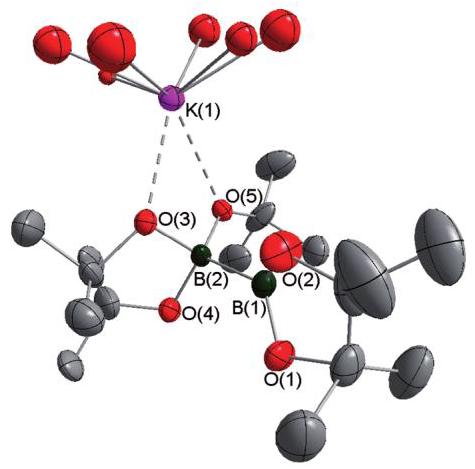
Figure 6. Perspective view of 4. Thermal ellipsoids are drawn at the 30% probability level; hydrogen atoms are omitted for clarity; the ${\mathrm{{CH}}}_{2}$ groups of 18-crown-6 could not be refined due to extensive disorder (see text); a unified labeling scheme is used. The bonds between the anionic and cationic parts of the structure are drawn in dashed gray lines.
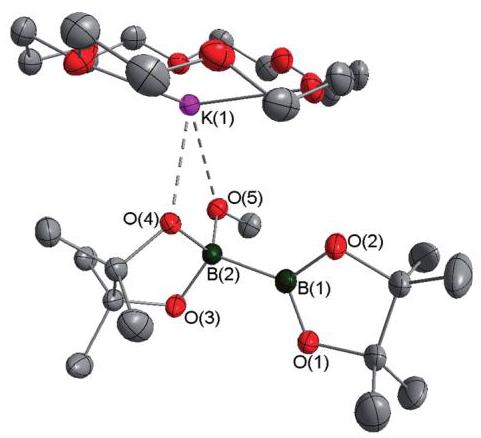
Figure 7. Perspective view of 5. Thermal ellipsoids are drawn at the 50% probability level; disorder and hydrogen atoms are omitted for clarity. The bonds between the anionic and cationic part of the structure are drawn in dashed gray lines.
Because the quality of the structure determination of the methoxy adduct 5 is much higher it is discussed representatively in detail. However, a brief discussion of 4 is essential to reveal the structural development from an infinite chain in 2 to a monomeric structure in 4. ${}^{\left\lbrack {26}\right\rbrack }$
Interestingly, despite the use of THF as the solvent, no THF ligands are present in the crystals of 4 or 5 and the potassium atom is coordinated by the boron-bound oxygen atoms O(4) and O(5) as well as the crown ether moiety. This indicates the effective chelation of these oxygen atoms and is attributed, at least partially, to the attractive coulombic interaction between the ${\left\lbrack {\mathrm{B}}_{2}{\mathrm{{pin}}}_{2}\mathrm{{OR}}\right\rbrack }^{ - }$ and the [(18-crown-6)K] ${}^{ + }$ fragments. This feature is also observed for the related 1,1-diamino-2,2,2-trialkoxy adduct, 9 (Figure S25 in the Supporting Information). ${}^{\left\lbrack {26}\right\rbrack }$ The fact that the ${\mathrm{{sp}}}^{3}$ and not the ${\mathrm{{sp}}}^{2}$ boron-bound oxygen atoms are coordinated to $\mathrm{K}\left( 1\right)$ may indicate the smaller donor capabilities of the latter oxygen atoms (they are involved in $\pi$ donation to a boron atom) and the increased donor capabilities of the formally, partially charged oxygen atoms bound to the ${\mathrm{{sp}}}^{3}$ boron atom. The geometries at the boron atoms in the ${\mathrm{{sp}}}^{2} - {\mathrm{{sp}}}^{3}$ diboron substructures of 5 (and also 4, within error) are basically similar to those in the other adducts; however, the B-B bond length in both 4 and 5 are at the long end of the range (Table 4). This may be attributed to the lack of bridging coordination by the potassium atom between both boron sites, which may be favored by slightly shorter B-B bond lengths in the other adducts.
The phenoxy derivative 6, isolated as (6)thf after reaction in THF, crystallizes from a solution in DMF/Et ${}_{2}$ O as solvated complex 6(dmf). The asymmetric unit contains three independent units of 6(dmf), but as the difference in the geometry between the ${\mathrm{{sp}}}^{2} - {\mathrm{{sp}}}^{3}$ diboron substructures is negligible, one formula unit is discussed representatively (Table 4, Figure 8). ${}^{\left\lbrack {26}\right\rbrack }$ The individual formula units of ${\mathrm{K\lbrack B}}_{2}{\mathrm{{pin}}}_{2}\mathrm{{OR}\rbrack \left( {dmf}\right) }$ form infinite chains parallel to the $b$ axis of alternating $\mathrm{K}\left( \mathrm{{dmf}}\right)$ and ${\left\lbrack {\mathrm{B}}_{2}{\mathrm{{pin}}}_{2}\mathrm{{OR}}\right\rbrack }^{ - }$ units, similar to those in 2 or ${\left( 2\right) }_{2}\left( \mathrm{{dmf}}\right)$ . However, in 6(dmf), all the potassium atoms exhibit a heavily distorted octahedral coordination environment and the exact geometries differ significantly, causing the reduced symmetry of this crystal structure. The differences between the geometry of the ${\mathrm{{sp}}}^{2} - {\mathrm{{sp}}}^{3}$ diboron substructure relative to the other ${\left\lbrack {\mathrm{B}}_{2}{\mathrm{{pin}}}_{2}\mathrm{{OR}}\right\rbrack }^{ - }$ compounds, especially ${\left( 2\right) }_{2}\left( \mathrm{{dmf}}\right)$ , are only small, except for the longer B(2)- O(5) bond length (Table 4). This is an indication of the weaker donor capabilities of the phenoxy group relative to an alkoxy group. The O-B-O and O-B-B angles and the B-O bond lengths (Table 4) appear to be susceptible to small, but significant, variations throughout the series of ${\mathrm{{sp}}}^{2} - {\mathrm{{sp}}}^{3}$ diboron compounds. These variations do not appear to be caused by changes in the B-O interactions, but instead optimize the interactions with the coordinated potassium atom (e.g. O(3), O(4), and O(5) in (2), (dmf), 3, and 5).
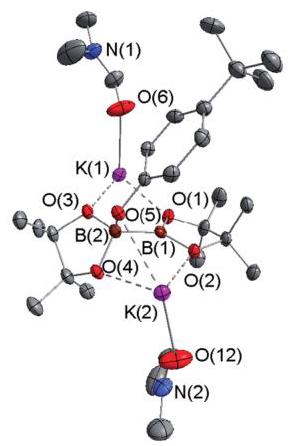
Figure 8. Perspective view of a section of the structure of 6(dmf). The bonds between the anionic and cationic part of the structure are drawn in dashed gray lines; thermal ellipsoids are drawn at the 50% probability level; disorder and hydrogen atoms are omitted for clarity; a unified labeling scheme is used.
The fluoride adducts [nBu ${}_{4}$ N][B ${}_{2}$ pin ${}_{2}$ F] 7 and [Me ${}_{4}$ N][B ${}_{2}$ pin ${}_{2}$ F] 8 are substantially different from the adducts discussed so far; they are not derived from an alkoxide base and contain a non-Lewis acidic cation ${\mathrm{R}}_{4}{\mathrm{\;N}}^{ + }$ as the counterion. Compound 7 crystallizes with an ionic structure in an orthorhombic lattice. For 7, columns of alternating units of $n{\mathrm{{Bu}}}_{4}{\mathrm{\;N}}^{ + }$ and ${\left\lbrack {\mathrm{B}}_{2}{\mathrm{{pin}}}_{2}\mathrm{\;F}\right\rbrack }^{ - }$ extend along the $b$ axis (Figure S24 in the Supporting Information). ${}^{\left\lbrack {26}\right\rbrack }$ For comparison to 7, adduct 8 was synthesized from 1 and ${\mathrm{{Me}}}_{4}\mathrm{{NF}}$ to exchange the counterion and use the anhydrous fluorinated base ${\mathrm{{Me}}}_{4}\mathrm{\;N}\mathrm{F}$ , instead of $n{\mathrm{{Bu}}}_{4}\mathrm{{NF}} - 3{\mathrm{H}}_{2}\mathrm{O}$ . Initial attempts to refine a crystal structure of 8 were unsuccessful due to the extreme disorder in the system. However, crystallization by slow cooling of a solution in THF gave well-developed needles of 8(thf) suitable for XRD analysis (Figure 9).
The structure of the anion in 8 is similar to those of the alkoxy adducts. Boron atom B(1) is essentially planar, whereas B(2) is tetrahedral (Figure 9). The B-B bond length is slightly shorter than those found in the molecular alkoxy adducts, such as 5. The longer B-F bond of 1.478(3) Å compared to those in simple ${\mathrm{{BF}}}_{4}{}^{ - }$ salts (1.369(5) Å on average) ${}^{\left\lbrack {34}\right\rbrack }$ suggests weaker bonding of the fluoride ion due to the increased donor capability of the alkoxy group relative to fluoride. The B-O bond lengths are essentially comparable to those discussed earlier for the alkoxy adducts. The angles F(1)-B(2)-O(3) and F(1)-B(2)-O(4) are more similar than the respective O(5)-B(2)- O(3) and O(5)-B(2)-O(4) angles in the alkoxy adducts because they are not influenced by coordination to a potassium cation. However, the O-B-O angle at the tetrahedral boron atom is again influenced by the bidentate binding mode of the pinacolate group. All bond lengths and angles are comparable with those of adduct 7 (for more details see the Supporting Information). ${}^{\left\lbrack {26}\right\rbrack }$
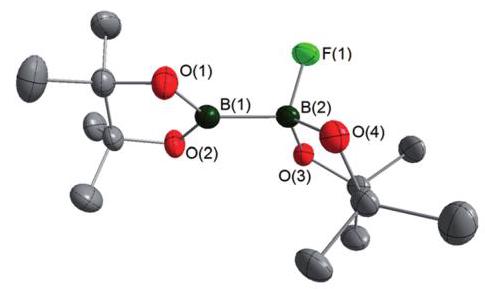
Figure 9. Perspective view of the anionic part of 8 in from 8(thf). Thermal ellipsoids are drawn at the 50% probability level; hydrogen atoms and the counterion are omitted for clarity. Selected bond lengths [Å] and angles [°]: $B\left( 1\right) - B\left( 2\right) {1.736}\left( 8\right) , O\left( 1\right) - B\left( 1\right) {1.389}\left( 2\right) , O\left( 2\right) - B\left( 1\right) {1.394}\left( 2\right) , O\left( 3\right) - B\left( 2\right) {1.472}\left( 2\right)$ , $O\left( 4\right) - B\left( 2\right) {1.468}\left( 2\right) , F\left( 1\right) - B\left( 2\right) {1.478}\left( 2\right) ;O\left( 3\right) - B\left( 2\right) - O\left( 4\right) {105.55}\left( {13}\right) , O\left( 3\right) - B\left( 2\right) - F\left( 1\right)$ 108.99(13), O(4)-B(2)-F(1) 106.79(13), O(3)-B(2)-B(1) 112.33(14), O(4)-B(2)-B(1) 115.50(14), F(1)-B(2)-B(1) 107.42(13).
The increase in the B-B bond length in the anionic intermolecular adducts 2-9 of typically 0.024-0.049 Å is attributed to the change of hybridization of one of the boron atoms. The B-B bond lengths and elongations relative to the parent ${\mathrm{{sp}}}^{2} - {\mathrm{{sp}}}^{2}$ diboron compounds are in the typical range found for related neutral adducts of tetra-alkoxy diboron, bis(catecholato)dibor-on, or bis(thio-catecholato)diboron compounds. ${}^{\left\lbrack {35}\right\rbrack }$ Generally, the Bpin moiety tends to provide disorder. For 2-5 and 8, this disorder, essentially represented by two envelope conformations of the five-membered ring, was refined successfully by employing a split-atom model and, if necessary, appropriate restraints and constraints. ${}^{\left\lbrack {26}\right\rbrack }$
Reactivity of the ${\mathrm{{sp}}}^{2} - {\mathrm{{sp}}}^{3}$ adducts toward aryl electrophiles
The reactions of selected isolated ${\mathrm{{sp}}}^{2} - {\mathrm{{sp}}}^{3}$ diboron compounds with electrophiles were studied by in situ NMR spectroscopy to observe the ability of the compounds to act as sources of nucleophilic boryl anions. Additionally, a potential acetate adduct of 1 was tested, however, it could not be isolated, therefore an equimolar mixture of 1 and TBPE ([nBu ${}_{4}$ P][OAc]) or KOAc was employed in the reactions. ${}^{\left\lbrack {27},{36}\right\rbrack }$ Both electrophilic aryl iodides and aryl diazonium salts were investigated as reaction partners due to their relevance in synthetically useful reactions (Scheme 5). ${}^{\left\lbrack {22},{23}\mathrm{a} - \mathrm{e}\right\rbrack }$
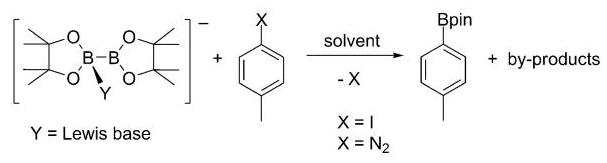
Scheme 5. Reaction of ${\mathrm{{sp}}}^{2} - {\mathrm{{sp}}}^{3}$ diboron compounds with the aryl electro-philes 4-methylphenyl diazonium tetrafluoroborate and 4-methylphenyl iodide.
Reactivity of aryl iodides
During our studies of the copper-catalyzed borylation of aryl halides, we observed a background reaction that gave the desired aryl-boronate ester in low yield. An ${\mathrm{{sp}}}^{2} - {\mathrm{{sp}}}^{3}$ anionic dibor-on species, formed in situ, was detected. This species could be the active nucleophile source and facilitate transfer of a boron moiety to the aryl iodide without the necessity for a metal complex. ${}^{\left\lbrack {22}\right\rbrack }$ Furthermore, Wu and Zhang recently reported the transition-metal-free borylation of aryl iodides with ${\mathrm{B}}_{2}{\mathrm{{pin}}}_{2}$ (1) or ${\mathrm{B}}_{2}{\mathrm{{neop}}}_{2}$ in pure methanol, with ${\mathrm{{Cs}}}_{2}{\mathrm{{CO}}}_{3}$ as the base, albeit with a limited substrate scope. ${}^{\left\lbrack {37}\right\rbrack }$ This reaction was tested and verified by our group and we proposed that a similar anionic adduct was likely to form in situ, which could facilitate the synthesis of the aryl-boronate esters. Initial studies $\left( {{}^{11}\mathrm{\;B}\left\{ {{}^{1}\mathrm{H}}\right\} }\right.$ or ${}^{1}\mathrm{H}$ NMR spectroscopy) by our group did not detect the formation of an adduct of 1 with ${\mathrm{{Cs}}}_{2}{\mathrm{{CO}}}_{3}$ . However, the presence of $\mathrm{{MeOH}}$ in the reaction could promote formation of a similar adduct to 5, as proposed previously by Fernández et al. ${}^{\left\lbrack {10}\mathrm{a} - \mathrm{c},\mathrm{e},\mathrm{j},\mathrm{l}\right\rbrack }$ Using DFT calculations, they suggested that ${\mathrm{{Cs}}}_{2}{\mathrm{{CO}}}_{3}$ deproto-nates MeOH present in the reaction mixture to afford a methoxy species, which then generates the adduct ${\left\lbrack {\mathrm{B}}_{2}{\mathrm{{pin}}}_{2}\mathrm{{OMe}}\right\rbrack }^{ - }$ in situ.
To investigate the stoichiometric reaction of the adducts with aryl iodides, the isolated ${\mathrm{{sp}}}^{2} - {\mathrm{{sp}}}^{3}$ diboron compounds (2, 5, and 7) were treated with 4-methylphenyl iodide in deuterat-ed THF at ${60}^{ \circ }\mathrm{C}$ . These reactions could be conveniently monitored by in situ NMR spectroscopy (Figure 10). ${}^{\left\lbrack {38}\right\rbrack }$
It is evident from the data shown that the borylation of aryl iodides proceeds very slowly (if at all) and only under increased reaction temperatures in this solvent $\left( {{60}^{ \circ }\mathrm{C}}\right)$ . The most efficient source of a boryl nucleophile appears to be the methoxy adduct 5 (Figure 10). In the case of 7, only traces of 4-Me- ${\mathrm{C}}_{6}{\mathrm{H}}_{4}\mathrm{\;B}$ pin were observed by ${}^{1}\mathrm{H}$ NMR spectroscopy after 5 days at ${60}^{ \circ }\mathrm{C}$ . However, extending the reaction time did not lead to further formation of the aryl-boronate ester because, at this point, adduct 7 had decomposed (determined by ${}^{11}\mathrm{\;B}\left\{ {{}^{1}\mathrm{H}}\right\} ,{}^{19}\mathrm{\;F}$ , and ${}^{1}\mathrm{H}$ NMR spectroscopy). In the spectrum of the reaction mixture, all characteristic signals of 7 had disappeared, with concomitant detection of 1. ${}^{\left\lbrack {26}\right\rbrack }$
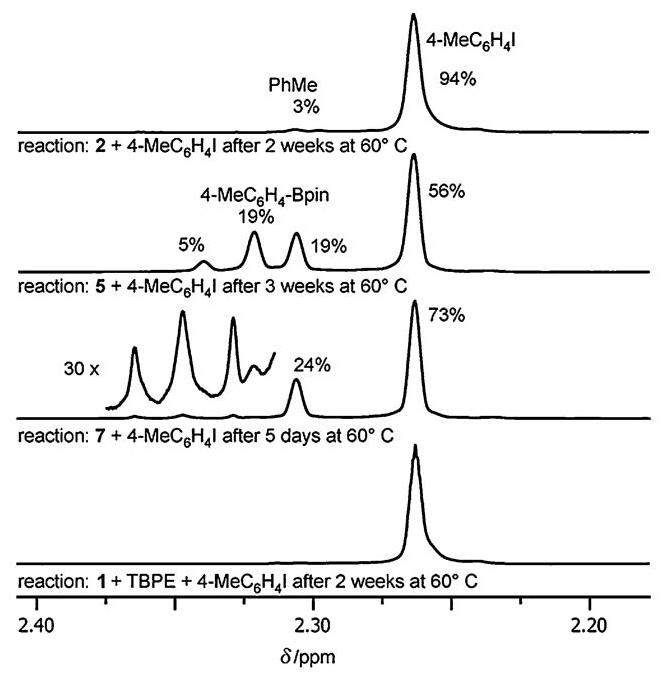
Figure 10. In situ ${}^{1}\mathrm{H}$ NMR (400 MHz,[D8]THF) spectra (benzylic region) of the reaction of $4 - \mathrm{{Me}} - {\mathrm{C}}_{6}{\mathrm{H}}_{4}\mathrm{I}$ with ${\mathrm{{sp}}}^{2} - {\mathrm{{sp}}}^{3}$ diboron compounds (percentage with respect to all signals in the region shown. All signals are assumed to be methyl groups; signals with less than 3% intensity are not given.
In comparison to 7, 8 was also treated with 4-methylphenyl iodide (in $\left\lbrack {\mathrm{D}}_{3}\right\rbrack \mathrm{{MeCN}}$ ), but no product was observed at room temperature. When the reaction mixture was heated to ${70}^{ \circ }\mathrm{C}$ , adduct 8 decomposed after several hours to give what we believe to be ${\left\lbrack {\mathrm{{BpinF}}}_{2}\right\rbrack }^{ - }$ , observed by NMR spectroscopy (Figures S32 and S33 in the Supporting Information). ${}^{\left\lbrack {26}\right\rbrack }$
In the cases of the potential acetate adduct (1+TBPE) and adduct 2, no reaction was observed after two weeks at ${60}^{ \circ }\mathrm{C}$ . Adduct 2 was far-less effective than the closely related complex 5, which could be explained by the very low solubility of 2 under the reaction conditions. However, when the reaction of 2 was repeated in the presence of methanol (either as the pure solvent or by addition of a drop of methanol to the reaction in $\left\lbrack {\mathrm{D}}_{3}\right\rbrack \mathrm{{MeCN}}$ ), the solubility of the adducts increased and a small amount of product was observed by GC-MS. This slight improvement in reactivity and the results from many reported transition-metal-free borylation reactions indicate that methanol is required to facilitate the formation of organoboronate esters and further research is ongoing into the dependence of transition-metal-free borylation systems on methanol. ${}^{\left\lbrack {23},{37},{39}\right\rbrack }$
In all cases, toluene was formed as the major byproduct and the GC-MS data suggests that, additionally, a biphenyl derivative ${\left( {\mathrm{C}}_{7}{\mathrm{H}}_{7}\right) }_{2}$ is formed. The synthesis of the byproducts may be rationalized by the production of an aryl radical and subsequent hydrogen-atom abstraction or dimerization. ${}^{\left\lbrack {40}\right\rbrack }$
The fate of the second Bpin moiety was analyzed for the reaction of 5 and all data ( ${}^{1}\mathrm{H}$ and ${}^{11}\mathrm{B}\left\{ {{}^{1}\mathrm{H}}\right\}$ NMR, GC-MS) supported the formation of MeOBpin. ${}^{\left\lbrack {26}\right\rbrack }$ Additionally, in the cases of 5 and 7 a singlet resonance was observed in the ${}^{11}\mathrm{\;B}\left\{ {{}^{1}\mathrm{H}}\right\}$ NMR spectrum at $\delta = {8.6}\mathrm{{ppm}}$ , which may indicate the formation of a small amount of the dipinacolatoborate ion ( ${\left\lbrack {\mathrm{{Bpin}}}_{2}\right\rbrack }^{ - }$ or a mixed methoxypinacolatoboron anion). ${}^{\left\lbrack {19}\right\rbrack }$
Reactivity of aryl diazonium salts
Previously, we reported a versatile method for the synthesis of aryl-boronate esters from aryl amines, in the presence of benzoyl peroxide (BPO). ${}^{\left\lbrack {23}\mathrm{a} - \mathrm{e}\right\rbrack }$ It was proposed that the reaction may proceed via a diazonium salt, formed in situ, as well as a postulated ${\mathrm{{sp}}}^{2} - {\mathrm{{sp}}}^{3}$ diboron compound. To verify this hypothesis, the relatively stable diazonium salt $\left\lbrack {{\mathrm{C}}_{6}{\mathrm{H}}_{5}{\mathrm{\;N}}_{2}}\right\rbrack \left\lbrack {\mathrm{{BF}}}_{4}\right\rbrack$ was prepared and its reaction with 1 was examined (Table 5).
The diazonium salt $\left\lbrack {{\mathrm{C}}_{6}{\mathrm{H}}_{5}{\mathrm{\;N}}_{2}}\right\rbrack \left\lbrack {\mathrm{{BF}}}_{4}\right\rbrack$ did not react with 1 at room temperature in the presence or absence of BPO (Table 5, entries 1 and 3). When the reaction temperature was increased to ${70}^{ \circ }\mathrm{C}$ for ${10}\mathrm{\;h}$ , the formation of PhBpin was observed by GC-MS, but in a very low yield (Table 5, entry 2). Several metal alkoxides, as well as potassium acetate, were introduced into the reaction system and, in all cases, PhBpin was formed after 10 min at room temperature (Table 5, entries 5-9). Addition of KOtBu resulted in the highest yield of 40% (see below), which is comparable to our earlier report for in situ formation of the diazonium salt from tert-butyl nitrite and aniline. ${}^{\left\lbrack {23}\mathrm{a} - \mathrm{e}\right\rbrack }$
Table 5. Reaction of1with $\left\lbrack {{\mathrm{C}}_{6}{\mathrm{H}}_{5}{\mathrm{\;N}}_{2}}\right\rbrack \left\lbrack {\mathrm{{BF}}}_{4}\right\rbrack$ in the presence of different bases. ${}^{\left\lbrack a\right\rbrack }$
| Entry | $\left\lbrack {\mathrm{{PhN}}}_{2}\right\rbrack \left\lbrack {\mathrm{{BF}}}_{4}\right\rbrack$ + | MeCN ${\mathrm{B}}_{2}{\mathrm{{pin}}}_{2}$ Ph-Bpin 1 | ||
| Additive [mol%] | T | $t$ | Yield ${\left\lbrack \% \right\rbrack }^{\left\lbrack b\right\rbrack }$ | |
| 1 | none | rt | 10 h | 0 |
| 2 | none | ${70}^{ \circ }\mathrm{C}$ | 10 h | 3 |
| 3 | BPO (10) ${}^{\left\lbrack c\right\rbrack }$ | rt | 10 h | 0 |
| 4 | BPO (10) | 70°C | 10 h | 5 |
| 5 | KOtBu (100) | rt | 10 min | 40 |
| 6 | NaOtBu (100) | rt | 10 min | 7 |
| 7 | NaOMe (100 | rt | 10 min | 15 |
| 8 | NaOEt (100) | rt | 10 min | 33 |
| 9 | KOAc (100) | rt | 10 min | 38 |
[a] Reaction conditions: 1:1 $1/\left\lbrack {{\mathrm{C}}_{6}{\mathrm{H}}_{5}{\mathrm{\;N}}_{2}}\right\rbrack \left\lbrack {\mathrm{{BF}}}_{4}\right\rbrack$ . [b] GC-MS yield with mesitylene as an internal standard. [c] BPO = benzoyl peroxide.
To further analyze the reactivity of the ${\mathrm{{sp}}}^{2} - {\mathrm{{sp}}}^{3}$ adducts, several aryl diazonium salts were synthesized and their reactions with2,5,7, and the potential acetate adduct of1were studied by in situ NMR spectroscopy in $\left\lbrack {\mathrm{D}}_{3}\right\rbrack \mathrm{{MeCN}}$ at room temperature (Figure 11; Figure S45 in the Supporting Information). In all reactions, equimolar amounts of the ${\mathrm{{sp}}}^{2} - {\mathrm{{sp}}}^{3}$ diboron compound and the electrophile were employed. Immediately upon mixing solutions of the starting materials, vigorous evolution of gas was observed, which lasted a few seconds and indicated an almost instantaneous reaction. This very fast reaction justifies the use of MeCN as the solvent because initial decomposition studies indicated a limited lifetime of a few hours for 5 and a few days for the diazonium salt in MeCN. ${}^{\left\lbrack {26}\right\rbrack }$ This difference in reactivity may reflect the increased electrophilicity of diazonium salts relative to aryl iodides.
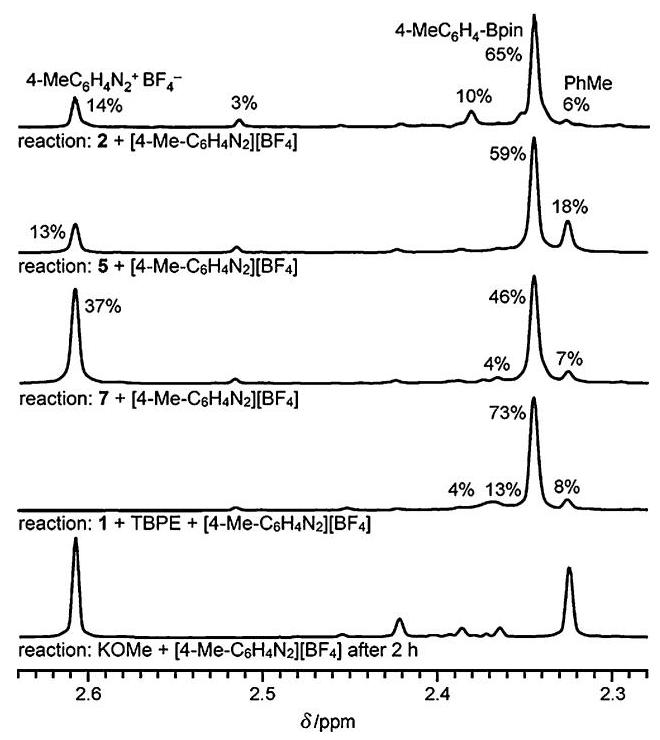
Figure 11. In situ ${}^{1}\mathrm{H}$ NMR (400 MHz, $\left\lbrack {\mathrm{D}}_{3}\right\rbrack \mathrm{{MeCN}}$ ) spectra (benzylic region) of the reaction of $\left\lbrack {4 - {\mathrm{{Me}}}^{ - }{\mathrm{C}}_{6}{\mathrm{H}}_{4}{\mathrm{\;N}}_{2}}\right\rbrack \left\lbrack {\mathrm{{BF}}}_{4}\right\rbrack$ with ${\mathrm{{sp}}}^{2} - {\mathrm{{sp}}}^{3}$ diboron compounds and KOMe after ${30}\mathrm{\;{min}}$ at ambient temperature (percentage with respect to all signals in the region shown; all signals are assumed to be methyl groups; signals with less than $3\%$ intensity are not given).
The spectra clearly show that the main reaction, in each case, was the conversion of the diazonium salt [4-Me- ${\mathrm{C}}_{6}{\mathrm{H}}_{4}{\mathrm{\;N}}_{2}$ ] $\left\lbrack {\mathrm{{BF}}}_{4}\right\rbrack$ to the aryl-boronate ester (Figure 11). Complete consumption of $\left\lbrack {4 - {\mathrm{{Me}}}^{ - }{\mathrm{C}}_{6}{\mathrm{H}}_{4}{\mathrm{\;N}}_{2}}\right\rbrack \left\lbrack {\mathrm{{BF}}}_{4}\right\rbrack$ was only observed in the case of the potential acetate adduct of 1 , whereas in all other cases a considerable amount of unreacted starting material was detected. Similar reactivity of 1 with an acetoxy moiety had been observed in the reaction of 1 with $\left\lbrack {{\mathrm{C}}_{6}{\mathrm{H}}_{5}{\mathrm{\;N}}_{2}}\right\rbrack \left\lbrack {\mathrm{{BF}}}_{4}\right\rbrack$ in the presence of KOAc (Table 5, entry 9). This may indicate the presence of a small amount of an acetate adduct formed in equilibrium, despite the fact that no evidence for such an adduct was observed spectroscopically. The formation of an acetate adduct of 1 in the reaction would provide further evidence to support the adduct originally proposed by Miyaura et al. ${}^{\left\lbrack 5\right\rbrack }$
As was the case in the reaction of 4-methylphenyl iodide with adducts 2, 5, 7, and 8, during the course of the reaction variable amounts of byproducts were formed; however, the only byproduct identified by ${}^{1}\mathrm{H}$ NMR spectroscopy was toluene. GC-MS analysis of the reaction mixtures suggested that azobenzene and biphenyl derivative ${\left( {\mathrm{C}}_{7}{\mathrm{H}}_{7}\right) }_{2}$ were among the minor byproducts. Remarkably, in all four reactions, essentially the same byproducts were formed in a similar distribution, which indicated the close mechanistic relationship of the reactions. ${}^{\left\lbrack {26}\right\rbrack }$
In the control reaction of the diazonium salt with either KOMe, KOtBu or NMe ${}_{4}$ F, byproducts, in particular toluene, were formed, which indicates that their formation does not involve either the diboron compounds or the aryl-boronate ester (Figure 11). Furthermore, reactions performed between an aryl-boronate ester and KOMe or an aryl-boronate ester and the diazonium salt (in the absence and presence of KOMe) gave neither product nor byproduct.
Yamane and Zhu’s study of the transition-metal-free boryla-tion of aryl triazenes showed that an aryl diazonium salt could be borylated by 1 at room temperature in methanol. ${}^{\left\lbrack {39}\right\rbrack }$ We verified Yamane and Zhu’s yield of about ${40}\%$ for the reaction of $\left\lbrack {4 - {\mathrm{{MeO}}}^{ - }{\mathrm{C}}_{6}{\mathrm{H}}_{4}{\mathrm{\;N}}_{2}}\right\rbrack \left\lbrack {\mathrm{{BF}}}_{4}\right\rbrack$ and1in MeOH. However, only a trace of aryl-boronate ester was formed after four days from the reaction between 1 and the diazonium salt in $\left\lbrack {\mathrm{D}}_{3}\right\rbrack \mathrm{{MeCN}}$ or $\left\lbrack {\mathrm{D}}_{6}\right\rbrack$ acetone at ambient temperature. ${}^{\left\lbrack {26}\right\rbrack }$ When a drop of methanol was introduced to the system, the respective product was observed to form more rapidly, albeit still at a reduced rate relative to the reaction in pure methanol. ${}^{\left\lbrack {26},{39}\right\rbrack }$ Thus, it is possible that ${\left\lbrack {\mathrm{B}}_{2}{\mathrm{{pin}}}_{2}\mathrm{\;F}\right\rbrack }^{ - }$ is formed from 1 and ${\mathrm{{BF}}}_{4}{}^{ - }$ in $\mathrm{{MeOH}}$ , as suggested by Yamane and Zhu. Reaction of8with $\left\lbrack {4 - {\mathrm{{MeO}}}^{ - }{\mathrm{C}}_{6}{\mathrm{H}}_{4}{\mathrm{\;N}}_{2}}\right\rbrack \; \left\lbrack {\mathrm{{BPh}}}_{4}\right\rbrack$ in $\left\lbrack {\mathrm{D}}_{3}\right\rbrack \mathrm{{MeCN}}$ was also examined, and a similar product ratio was obtained to that found when the diazonium salt with a ${\left\lbrack {\mathrm{{BF}}}_{4}\right\rbrack }^{ - }$ cation was used. Therefore, in the absence of methanol, it is necessary to preform the adduct in the reaction with diazonium salts to facilitate the reaction and, in this case, ${\mathrm{{BF}}}_{4}$ does not act as a source of ${\mathrm{F}}^{ - }$ to form the adduct in situ.
As with the aryl iodides, we were interested in the fate of the other Bpin moiety after the reaction of the isolated adducts and aryl diazonium salts. According to all the available data ( ${}^{1}\mathrm{H}$ and ${}^{11}\mathrm{\;B}\left\{ {{}^{1}\mathrm{H}}\right\}$ NMR spectroscopy, GC-MS), the moiety was converted to a single product of the type X-Bpin (X=OMe or OtBu). These experimental observations are in agreement with the relevant literature data and authentic samples. ${}^{\left\lbrack {26},{31}\mathrm{c},{41}\right\rbrack }$

Scheme 6. A postulated equilibrium involved in the reaction between 8 and FBpin.
Further reactivity studies were conducted for the reactions of different para-substituted aryl diazonium salts with the ${\mathrm{{sp}}}^{2} - {\mathrm{{sp}}}^{3}$ adducts. Adduct 2 reacted with 4-me-thoxyphenyl diazonium tetrafluoroborate and gave full conversion of the starting material, but consistent data could not be obtained due to the low solubility of the adduct. ${}^{\left\lbrack {26}\right\rbrack }$ Therefore, the fluoride adduct 8 was used because it was easier to handle on a larger scale and was more soluble in the relevant solvents relative to many of the alkoxide adducts. The previously used adduct 7 was ruled out on the grounds of a possible negative influence of water on the reaction due to water present in $n{\mathrm{{Bu}}}_{4}\mathrm{{NF}} \cdot 3{\mathrm{H}}_{2}\mathrm{O}$ . Initially,8 was treated with stoichiometric amounts of $\left\lbrack {4 - \mathrm{R} - {\mathrm{C}}_{6}{\mathrm{H}}_{4}{\mathrm{\;N}}_{2}}\right\rbrack \left\lbrack {\mathrm{{BF}}}_{4}\right\rbrack \left( {\mathrm{R} = \mathrm{H},\mathrm{{Me}},\mathrm{{OMe}},{\mathrm{{NO}}}_{2},\mathrm{{Br}}}\right)$ in a 1:1 electrophile/adduct ratio, but only approximately 70% of the starting material was converted, however, if the ratio was increased to 1:1.4 the conversion of starting material increased to 100%.
All the aryl-boronate esters were isolated in good yields (Table 6). Interestingly, in all cases, FBpin was not observed as the major byproduct for the second Bpin moiety. Instead, the corresponding signals in the ${}^{1}\mathrm{H},{}^{11}\mathrm{B}\left\{ {{}^{1}\mathrm{H}}\right\}$ , and ${}^{19}\mathrm{\;F}$ NMR spectroscopic data are consistent with the formation of $\left\lbrack {\mathrm{{NMe}}}_{4}\right\rbrack \; \left\lbrack {\mathrm{{BpinF}}}_{2}\right\rbrack \cdot {}^{\left\lbrack {26}\right\rbrack }$ The ${\left\lbrack {\mathrm{{BpinF}}}_{2}\right\rbrack }^{ - }$ anion was also observed in nonstoi-chiometric reactions of8with diazonium salts; in these cases only one sharp signal at $\delta \approx 5\mathrm{{ppm}}$ was observed in the ${}^{11}\mathrm{\;B}\left\{ {{}^{1}\mathrm{H}}\right\}$ NMR spectra. ${}^{\left\lbrack {26}\right\rbrack }$ The abstraction of ${\mathrm{F}}^{ - }$ from 8 by FBpin to give ${\left\lbrack {\mathrm{{BpinF}}}_{2}\right\rbrack }^{ - }$ may explain that an excess of the adduct was required to convert the starting material into the product because ${\mathrm{F}}^{ - }$ abstraction may be faster than formation of the aryl-boronate ester. Formation of ${\left\lbrack {\mathrm{{BpinF}}}_{2}\right\rbrack }^{ - }$ could also account for the presence of 1 at the end of the reaction (Scheme 6). It appears that FBpin-a better fluoride acceptor than 1-depletes 8 competitively by its reaction with the diazonium salt, thus inhibiting the borylation reaction as the concentration of FBpin increases.
Table 6. Reaction of ${\mathrm{{sp}}}^{2} - {\mathrm{{sp}}}^{3}$ diboron compound 8 with aryl diazonium
| tetrafluoroborates. | |
| 8 (1.4 equiv) |  MeCN RT $- {\mathrm{N}}_{2}$ $+ \left\lbrack {\mathrm{{NMe}}}_{4}\right\rbrack \left\lbrack {\mathrm{{BF}}}_{4}\right\rbrack + \left\lbrack {\mathrm{{NMe}}}_{4}\right\rbrack \left\lbrack {\mathrm{{pinBF}}}_{2}\right\rbrack$ |
| Product (R) | Conversion of ${\mathrm{{SM}}}^{\left\lbrack \mathrm{a}\right\rbrack }\left\lbrack \% \right\rbrack$ Isolated yield [%] ${}^{11}\mathrm{\;B}\left\{ {{}^{1}\mathrm{H}}\right\}$ [ppm] |
| H | 100 42 29.9 |
| Me | 100 66 30.7 |
| OMe | 100 40 29.7 |
| ${\mathrm{{NO}}}_{2}$ | 100 59 29.7 |
| Br | 100 72 29.7 |
| [a] SM = starting material. | |
Conclusion
We have investigated anionic adducts of ${\mathrm{{sp}}}^{2} - {\mathrm{{sp}}}^{2}$ diboron species with different Lewis bases, such as ${\mathrm{{RO}}}^{ - }$ and ${\mathrm{F}}^{ - }$ . The main focus of our study was the isolation, characterization, and reactivity of the adducts formed from the reaction of 1 with $t{\mathrm{{BuO}}}^{ - },{\mathrm{{MeO}}}^{ - },\left( {4 - t{\mathrm{{BuC}}}_{6}{\mathrm{H}}_{4}}\right) {\mathrm{O}}^{ - }$ , and ${\mathrm{F}}^{ - }$ to afford the adducts 2-8. These compounds have been characterized by NMR spectroscopy and X-ray crystallography. A structure with repeating units of ${\left\lbrack {\mathrm{B}}_{2}{\mathrm{{pin}}}_{2}\mathrm{O}t\mathrm{{Bu}}\right\rbrack }^{ - }$ connected by potassium ions was observed for adduct 2. In an attempt to form the mononuclear species, one equivalent of 18-crown-6 was added to the reaction of KOtBu and 1. Under these conditions, adduct 3 was synthesized, which had a similar supramolecular structure to 2. However, the mononuclear adduct 4 was eventually formed in the presence of an excess of 18-crown-6. An extended-chain structure, with the repeating unit $\left\lbrack {\mathrm{K}\left( \mathrm{{dmf}}\right) }\right\rbrack \left\lbrack {{\mathrm{B}}_{2}{\mathrm{{pin}}}_{2}\mathrm{O}\left( {4 - t{\mathrm{{BuC}}}_{6}{\mathrm{H}}_{4}}\right) }\right\rbrack$ was observed for adduct 6; however, adducts 5, 7, and 8 were found to be monomeric in the solid state. When bulky bases, such as $\mathrm{{KO}}\left( {4 - {\mathrm{{Me}}}^{ - }2,6 - t{\mathrm{{BuC}}}_{6}{\mathrm{H}}_{4}}\right)$ , or neutral Lewis bases, such as ${\mathrm{{PMe}}}_{3}$ , were used no adducts were isolated or observed spectroscopically. The reaction of ${\mathrm{B}}_{2}{\mathrm{{dmeda}}}_{2}$ with KOMe in the presence of 18-crown-6 led to the isolation of adduct 9.
Solution and solid-state NMR spectroscopy showed similarities between the structures of the complexes regardless of the nature of the Lewis base or degree of aggregation found in the crystal structures. The ${}^{11}\mathrm{\;B}\left\{ {{}^{1}\mathrm{H}}\right\}$ NMR spectra of each the different adducts displayed a broad resonance between $\delta = {37.5}$ and ${35}\mathrm{{ppm}}$ for the ${\mathrm{{sp}}}^{2}$ trigonal boron site and a sharper resonance between $\delta = {5.5}$ and ${4.7}\mathrm{{ppm}}$ for the ${\mathrm{{sp}}}^{3}$ tetrahedral site. In contrast to the alkoxide and fluoride adducts, the phenoxide adduct 6 showed dynamic behavior in solution.
The importance of these adducts in the formation of aryl-boronate esters from the reactions with both aryl diazonium salts and an aryl iodide was investigated. The increase in reactivity of the aryl diazonium salts relative to 4-methylphenyl iodide is likely due to the increased electrophilicity of the former. Although no spectroscopic evidence for adduct formation between 1 and an acetoxy moiety was observed, the combination reacted cleanly with aryl diazonium salts to give the respective aryl-boronate esters. The isolated adducts were shown to serve as effective sources of nucleophilic boryl moieties in reactions with aryl electrophiles.
Experimental Section
General
Unless otherwise noted, all manipulations were performed by using standard Schlenk or glovebox (Innovative Technology Inc.) techniques under an atmosphere of dry nitrogen or argon. Reagent grade solvents (Fisher Scientific and J. T. Baker) were saturated with nitrogen gas, then dried and deoxygenated with an Innovative Technology Inc. Pure-Solv 400 Solvent Purification System, and further deoxygenated by the freeze-pump-thaw method. $\left\lbrack {\mathrm{D}}_{8}\right\rbrack \mathrm{{THF}},\left\lbrack {\mathrm{D}}_{3}\right\rbrack \mathrm{{MeCN}},\left\lbrack {\mathrm{D}}_{7}\right\rbrack \mathrm{{DMF}},\left\lbrack {\mathrm{D}}_{4}\right\rbrack \mathrm{{MeOH}}$ , and $\left\lbrack {\mathrm{D}}_{1}\right\rbrack \mathrm{{MeOH}}$ were obtained from Cambridge Isotope Laboratories or EURISOTOP and dried over potassium/benzophenone, ${\mathrm{{CaH}}}_{2}$ , or thoroughly dried 4 Å molecular sieves, then deoxygenated by the freeze-pump-thaw method. ${\mathrm{B}}_{2}{\mathrm{{dmeda}}}_{2},\left\lbrack {4 - {\mathrm{{MeO}}}_{ - }{\mathrm{C}}_{6}{\mathrm{H}}_{4}{\mathrm{\;N}}_{2}}\right\rbrack \left\lbrack {\mathrm{{BF}}}_{4}\right\rbrack ,\left\lbrack {4 - {\mathrm{{NO}}}_{2} - {\mathrm{C}}_{6}{\mathrm{H}}_{4}{\mathrm{\;N}}_{2}}\right\rbrack \left\lbrack {\mathrm{{BF}}}_{4}\right\rbrack$ , $\left\lbrack {4 - {\mathrm{{Me}}}^{ - }{\mathrm{C}}_{6}{\mathrm{H}}_{4}{\mathrm{\;N}}_{2}}\right\rbrack \left\lbrack {\mathrm{{BF}}}_{4}\right\rbrack ,\left\lbrack {{\mathrm{C}}_{6}{\mathrm{H}}_{5}{\mathrm{\;N}}_{2}}\right\rbrack \left\lbrack {\mathrm{{BF}}}_{4}\right\rbrack$ , and $\left\lbrack {4 - {\mathrm{{MeO}}}^{ - }{\mathrm{C}}_{6}{\mathrm{H}}_{4}{\mathrm{\;N}}_{2}}\right\rbrack \left\lbrack {\mathrm{{BPh}}}_{4}\right\rbrack$ were prepared according to literature procedures. ${}^{\left\lbrack {29},{42}\right\rbrack }{\mathrm{{KO}}}_{2}\mathrm{{CPh}},\mathrm{{KO}}(4 - \; t{\mathrm{{Bu}}}_{ - }{\mathrm{C}}_{6}{\mathrm{H}}_{4}$ ), and $\mathrm{{KO}}\left( {2,6 - t{\mathrm{{Bu}}}_{2} - 4 - \left( {\mathrm{{CH}}}_{3}\right) {\mathrm{C}}_{6}{\mathrm{H}}_{4}}\right)$ were prepared from $\mathrm{{KO}}t{\mathrm{{Bu}}}_{ - }$ and the respective acid or phenol in dry ${\mathrm{{Et}}}_{2}\mathrm{O}$ under nitrogen and were checked for purity by elemental analysis. All other reagents were purchased from commercial sources, checked for purity by GC-MS, elemental analysis, and/or NMR spectroscopy, then used as received (if appropriate, the reagents were stored over thoroughly dried ${4\text{ Å }}$ molecular sieves). ${\mathrm{B}}_{2}{\mathrm{{pin}}}_{2}$ was kindly provided by Ally-Chem Co. Ltd. (Dalian, China). NMR spectra in solution were recorded with a Bruker Avance ${200}\left( {{}^{1}\mathrm{H} : {200}\mathrm{{MHz}},{}^{13}\mathrm{C} : {50}\mathrm{{MHz}},{}^{19}\mathrm{F} : }\right. \; {188}\mathrm{{MHz}},{}^{11}\mathrm{\;B}$ : ${64}\mathrm{{MHz}}$ ), Avance III HD ${300}\left( {{}^{1}\mathrm{H} : {300}\mathrm{{MHz}},{}^{13}\mathrm{C} : }\right. \; {75}\mathrm{{MHz}},{}^{11}\mathrm{\;B}$ : ${96}\mathrm{{MHz}}$ ), Varian Mercury-400 (1H: 400 MHz, ${}^{13}\mathrm{C}$ : ${100}\mathrm{{MHz}},{}^{19}\mathrm{\;F} : {376}\mathrm{{MHz}},{}^{31}\mathrm{P} : {162}\mathrm{{MHz}}$ ), Bruker Avance ${400}\left( {{}^{1}\mathrm{H} : }\right. \; {400}\mathrm{{MHz}},{}^{13}\mathrm{C} : {100}\mathrm{{MHz}},{}^{11}\mathrm{\;B} : {128}\mathrm{{MHz}}$ ), Varian Inova- ${500}\left( {{}^{1}\mathrm{H} : }\right)$ 500 MHz, ${}^{13}\mathrm{C}$ : 125 MHz, ${}^{19}\mathrm{F}$ : 470 MHz, ${}^{11}\mathrm{B}$ : 160 MHz), Bruker Avance 500 ( ${}^{1}\mathrm{H}$ : 500 MHz, ${}^{13}\mathrm{C}$ : 125 MHz, ${}^{19}\mathrm{F}$ : 470 MHz, ${}^{11}\mathrm{B}$ : 160 MHz), or Varian VNMR 700 ( ${}^{1}\mathrm{H}$ : 700 MHz, ${}^{13}\mathrm{C}$ : 175 MHz, ${}^{19}\mathrm{\;F}$ : 658 MHz, ${}^{11}\mathrm{\;B}$ : 224 MHz) spectrometer. ${}^{1}\mathrm{H}$ NMR chemical shifts are reported relative to TMS and referenced to residual proton resonances of the deuterated solvent $\left( {\left\lbrack {\mathrm{D}}_{8}\right\rbrack \mathrm{{THF}} : \delta = {1.73}}\right.$ ,3.58 ppm, $\left\lbrack {\mathrm{D}}_{3}\right\rbrack \mathrm{{MeCN}} : \delta = {1.94}\mathrm{{ppm}},\left\lbrack {\mathrm{D}}_{7}\right\rbrack \mathrm{{DMF}} : \delta = {8.03}\mathrm{{ppm}},\left\lbrack {\mathrm{D}}_{4}\right\rbrack \mathrm{{MeOH}} : \delta =$ 3.31 ppm, $\left\lbrack {\mathrm{D}}_{1}\right\rbrack \mathrm{{MeOH}} : \delta = {3.08}\mathrm{{ppm}}$ ); ${}^{13}\mathrm{C}$ NMR spectra are reported relative to TMS and referenced to the carbon signals of the deuter-ated solvent ( $\left\lbrack {\mathrm{D}}_{8}\right\rbrack$ THF: $\delta = {67.5},{25.3}\mathrm{{ppm}},\left\lbrack {\mathrm{D}}_{7}\right\rbrack$ DMF: $\delta = {34.8}\mathrm{{ppm}}$ ). ${}^{11}\mathrm{\;B},{}^{31}\mathrm{P}$ , and ${}^{19}\mathrm{\;F}$ NMR chemical shifts are reported relative to external ${\mathrm{{BF}}}_{3} \cdot {\mathrm{{Et}}}_{2}\mathrm{O},{\mathrm{H}}_{3}{\mathrm{{PO}}}_{4}$ , and ${\mathrm{{CFCl}}}_{3}$ , respectively. All ${}^{13}\mathrm{C},{}^{31}\mathrm{P}$ , and ${}^{11}\mathrm{B}$ NMR spectra were recorded with ${}^{1}\mathrm{H}$ decoupling. Air-sensitive NMR samples were handled under nitrogen or argon in WILMAD NMR tubes equipped with J. Young valves. Solid-state MAS NMR (SS-NMR) spectra (2-7, and 9) were recorded with a Varian VNMRS spectrometer $\left( {{}^{11}\mathrm{\;B} : {128}\mathrm{{MHz}},{}^{1}\mathrm{H} : {400}\mathrm{{MHz}},{}^{13}\mathrm{C} : {100}\mathrm{{MHz}}}\right.$ equipped with a MAS probe [4 mm rotor outside diameter (o.d.)]. The spectra were referenced to external ${\mathrm{{BF}}}_{3} \cdot {\mathrm{{Et}}}_{2}\mathrm{O}$ . Isotropic chemical shifts $\left( {\delta }_{\text{ iso }}\right)$ were estimated by simulation of the observed spectrum by using the Varian STARS program. The SS-NMR spectrum of 8 was recorded with a Bruker DSX-400 spectrometer $\left( {{}^{11}\mathrm{\;B} : {128}\mathrm{{MHz}},{}^{1}\mathrm{H} : }\right. \; {400}\mathrm{{MHz}},{}^{13}\mathrm{C}$ : 100 MHz) equipped with a MAS probe ( $4\mathrm{\;{mm}}$ rotor o.d.). Chemical shifts were calibrated by using adamantane as an external standard $\left( {\delta = {38.48}\mathrm{{ppm}}}\right) {.}^{\left\lbrack {26}\right\rbrack }$ Isotropic chemical shifts were estimated by simulation of the observed spectrum by using the Solid Line-Shape Analysis 2.2.4 (SOLA) programme. Elemental analysis was performed with an Exeter Analytical Inc. CE 440 elemental analyzer or ELEMENTAR Vario Micro Cube (Elementar Analysensys-teme GmbH). Melting points were determined with a Sanyo Gallen-kamp apparatus in flame-sealed capillary tubes filled with nitrogen. Automated flash chromatography was performed on silica gel with a Biotage Isolera Four system (Biotage SNAP cartridge KP-Sil 10 g and KP-Sil 25 g) obtained from Biotage. Precoated TLC plates (Polygram Sil G/UV254) were purchased from Machery-Nagel.
Synthesis
K[(B2pin2)OtBu] (2): Bulk material: Under a nitrogen atmosphere, KOtBu (77 mg, 686 μmol) and 1 (175 mg, 689 μmol) were separately dissolved in dry THF (3 mL each). The two solutions were combined and a colorless precipitate separated immediately. After stirring at rt (2.5 h), the precipitate was collected by centrifugation or filtration, washed with dry THF (2×3 mL), and dried under vacuum to give 2 (191 mg, 521 μmol, 76%) as a colorless solid. Crystals for XRD: A tube [3.5 mm internal diameter (i.d.)] was placed in a vial (1 cm i.d.). The outer vial was filled with a solution of KOtBu (20 mg) in dry THF (3 mL), the inner tube was filled with a solution of 1 $\left( {{45}\mathrm{{mg}}}\right)$ in dry THF $\left( {{0.5}\mathrm{\;{mL}}}\right)$ . Both vessels were carefully filled with THF until the inner tube was submerged. After several days at ${0}^{ \circ }\mathrm{C}$ , crystals of 2 suitable for XRD analysis were deposited on the inner wall of the inner tube. In addition, crystals of (2),(dmf) suitable for XRD analysis were obtained by diffusion of diethyl ether into a solution of 2 in DMF at ${0}^{ \circ }\mathrm{C}$ . M.p. $> {300}^{ \circ }\mathrm{C};{}^{1}\mathrm{H}$ NMR $\left( {{700}\mathrm{{MHz}},\left\lbrack {\mathrm{D}}_{7}\right\rbrack \mathrm{{DMF}},{25}^{ \circ }\mathrm{C}}\right) : \delta = {1.17}\left( {\mathrm{\;s},9\mathrm{H};t\mathrm{{Bu}}}\right) ,{1.13}$ (brs,12H; $\left. {\mathrm{C}\left( {\mathrm{{CH}}}_{3}\right) }\right) ,{1.06}$ (brs, $6\mathrm{H},\mathrm{C}\left( {\mathrm{{CH}}}_{3}\right) ),{0.94}\mathrm{{ppm}}$ (brs, $6\mathrm{H};\mathrm{C}\left( {\mathrm{{CH}}}_{3}\right) );{}^{13}\mathrm{C}$ NMR (175 MHz, [D ${}_{7}$ ]DMF, 25°C): $\delta = {80.9},{77.5},{67.4},{33.6},{27.6},{27.2}$ , 25.9 ppm; ${}^{11}$ B NMR (224 MHz,[D7]DMF, rt): $\delta = {37.7}$ (vbrs),4.8 ppm (brs); elemental analysis calcd (%) for ${\mathrm{C}}_{16}{\mathrm{H}}_{33}{\mathrm{O}}_{5}{\mathrm{\;B}}_{2}\mathrm{\;K}$ : C 52.48, H 9.08, N 0.00; found: C 52.54, H 9.10, N 0.00.
[K(18-crown-6)thf ${}_{2}$ ][K((B ${}_{2}$ pin ${}_{2}$ )OtBu) ${}_{2}$ ] (3): Bulk material: Under a nitrogen atmosphere, KOtBu (38 mg, 344 μmol) and 18-crown-6 (91mg, 344 μmol) were dissolved in dry THF (2mL), then 1 (87 mg, 344 μmol) was added. After a few seconds, a colorless precipitate started to separate, which was isolated after $2\mathrm{\;h}$ , washed with THF/n-hexane (1:2, $2 \times 2\mathrm{\;{mL}}$ ), and dried under vacuum to give analytically pure 3 (71 mg, 62 μmol, 36%). Crystals for XRD analysis: A solution of KOtBu ( ${19}\mathrm{{mg}},{172\mu }\mathrm{{mol}}$ ) and 18- crown-6 (45 mg, 172 μmol) in THF (4 mL) was placed in a vial (23 mm i.d.). A second, smaller vial (10 mm o.d.) that contained 1 (44 mg, 172 μmol) in THF (4 mL) was immersed in this solution. The solvent level was carefully adjusted to be slightly higher than the height of the inner vial. After 3 d, well-developed crystals of 3 formed. M.p. ${65}^{ \circ }\mathrm{C}$ (decomp.); ${}^{1}\mathrm{H}$ NMR (700 MHz, $\left\lbrack {\mathrm{D}}_{8}\right\rbrack$ THF, ${25}^{ \circ }\mathrm{C}$ ): $\delta = {3.64}\left( {\mathrm{\;s},{24}\mathrm{H};{\mathrm{{OCH}}}_{2}}\right) ,{3.62}\left( {\mathrm{\;s},8\mathrm{H};\mathrm{{THF}}}\right) ,{1.78}\left( {\mathrm{\;s},8\mathrm{H};\mathrm{{THF}}}\right) ,{1.17}(\mathrm{\;s}$ , ${18}\mathrm{H}$ ; tBu), ${1.15}\left( {\mathrm{\;s},{24}\mathrm{H};\mathrm{C}\left( {\mathrm{{CH}}}_{3}\right) }\right) ,{1.07}\left( {\mathrm{\;s},{12}\mathrm{H};\mathrm{C}\left( {\mathrm{{CH}}}_{3}\right) }\right) ,{0.96}\mathrm{{ppm}}(\mathrm{s}$ , 12H; $\mathrm{C}{\left( {\mathrm{{CH}}}_{3}\right) }_{3}{\mathrm{\;K}}_{3}\mathrm{{CNMR}}\left( {{175}\mathrm{{MHz}},\left\lbrack {\mathrm{D}}_{8}\right\rbrack \mathrm{{THF}},{25}^{ \circ }\mathrm{C}}\right) : \delta = {80.9},{77.6}$ , 71.0,33.6,27.6,27.2 ppm, four signals (THF, $\mathrm{C}{\left( {\mathrm{{CH}}}_{3}\right) }_{3}$ ), and $\mathrm{C}{\left( {\mathrm{{CH}}}_{3}\right) }_{3}$ ) could not be separated from the solvent signals; ${}^{11}\mathrm{\;B}$ NMR (224 MHz, $\left\lbrack {\mathrm{D}}_{8}\right\rbrack$ THF, ${25}^{ \circ }\mathrm{C}$ ): $\delta = {41.1}$ (vbrs),8.1 ppm (brs); elemental analysis calcd (%) for ${\mathrm{C}}_{52}{\mathrm{H}}_{106}{\mathrm{O}}_{18}{\mathrm{\;B}}_{4}{\mathrm{\;K}}_{2}$ : C 54.75, H 9.37, N 0.00; found: C 54.71, H 9.42, N 0.00.
[K(18-crown-6)][(B2pin2)OtBu] (4): Under a nitrogen atmosphere, KOtBu (38 mg, 339 μmol, 1 equiv), 18-crown-6 (272 mg, 1.03 mmol, 3 equiv), and 1 (86 mg, 339 μmol, 1 equiv) were dissolved in dry THF (3 mL), assisted by stirring. After 2 h, n-hexane (10 mL) was added to the clear solution and the precipitate formed was crystallized by diffusion of $n$ -hexane into a solution of the precipitate in THF at rt. After several days, some irregular crystals were deposited, along with microcrystalline powder. The crystals were collected (8 mg, 13 μmol, 4%) under an optical microscope and subjected to single-crystal X-ray diffraction. The crystals were washed with $n$ - hexane and dried under vacuum, then subjected to elemental analysis. Several attempts to reproduce the isolation of 4 were unsuccessful. Attempts to obtain 4 under somewhat altered reaction conditions (reactive crystallization, different solvents, different concentrations, and different stoichiometries) were unsuccessful and only 3 was isolated after crystallization. Elemental analysis calcd (%) for ${\mathrm{C}}_{28}{\mathrm{H}}_{57}{\mathrm{O}}_{11}{\mathrm{\;B}}_{2}\mathrm{\;K}$ : C 53.34, $\mathrm{H}{9.11},\mathrm{\;N}{0.00}$ ; found: C 53.48, $\mathrm{H}{9.01}$ , N 0.00.
[K(18-crown-6)][(B ${}_{2}$ pine ${}_{2}$ )OMe] (5): Under a nitrogen atmosphere, KOMe $({33}\mathrm{{mg}},{470\mu }\mathrm{{mol}}$ ,2 equiv) and 18-crown-6 $({125}\mathrm{{mg}}$ , 473 μmol, 2 equiv) were dissolved in dry THF (3 mL), aided by stirring. After about ${10}\mathrm{\;{min}}$ of stirring,1 (60 mg, ${236\mu }\mathrm{{mol}}$ ,1 equiv) was added and the resulting clear solution was stirred overnight at rt. After concentration under reduced pressure to a volume of approximately $1\mathrm{\;{mL}}$ , the residue was layered with $n$ -hexane and crystallized at $- {20}^{ \circ }\mathrm{C}$ to give $5\left( {{129}\mathrm{{mg}},{220\mu }\mathrm{{mol}},{93}\% }\right)$ as colorless crystals, suitable for X-ray crystallography. M.p. ${84} - {87}{}^{ \circ }\mathrm{C}$ ; ${}^{1}\mathrm{H}$ NMR $\left( {{500}\mathrm{{MHz}},\left\lbrack {\mathrm{D}}_{8}\right\rbrack \mathrm{{THF}},{25}^{ \circ }\mathrm{C}}\right) : \delta = {3.62}\left( {\mathrm{\;s},{24}\mathrm{H};{\mathrm{{OCH}}}_{2}}\right) ,{3.11}(\mathrm{\;s},3\mathrm{H}$ ; ${\mathrm{{OCH}}}_{3}),{1.06}\mathrm{{ppm}}$ (brs, ${24}\mathrm{H};\mathrm{C}\left( {\mathrm{{CH}}}_{3}\right) );{}^{1}\mathrm{H}$ NMR $\left( {{500}\mathrm{{MHz}},\left\lbrack {\mathrm{D}}_{8}\right\rbrack \mathrm{{THF}}}\right)$ , $- {55}^{ \circ }\mathrm{C}) : \delta = {3.64}\left( {\mathrm{\;s},{24}\mathrm{H};{\mathrm{{OCH}}}_{2}}\right) ,{3.16}\left( {\mathrm{\;s},3\mathrm{H};{\mathrm{{OCH}}}_{3}}\right) ,{1.08}(\mathrm{\;s},{12}\mathrm{H}; \; \left. {\mathrm{C}\left( {\mathrm{{CH}}}_{3}\right) }\right) ,{1.03}\left( {\mathrm{\;s},6\mathrm{H};\mathrm{C}\left( {\mathrm{{CH}}}_{3}\right) }\right) ,{0.98}\mathrm{{ppm}}\left( {\mathrm{s},6\mathrm{H};\mathrm{C}\left( {\mathrm{{CH}}}_{3}\right) }\right) ;{}^{13}\mathrm{C}$ NMR $\left( {{125}\mathrm{{MHz}},\left\lbrack {\mathrm{D}}_{8}\right\rbrack \mathrm{{THF}},{25}^{ \circ }\mathrm{C}}\right) : \delta = {80.1},{77.3},{71.0},{50.6},{27.4},{27.0},$ 25.9 ppm; ${}^{11}\mathrm{B}$ NMR (160 MHz, $\left\lbrack {\mathrm{D}}_{8}\right\rbrack$ THF, ${25}^{ \circ }\mathrm{C}$ ): $\delta = {37.5}$ (vbrs), 5.8 ppm (brs); ${}^{11}\mathrm{\;B}$ NMR (160 MHz, $\left\lbrack {\mathrm{D}}_{8}\right\rbrack$ THF, $- {55}^{ \circ }\mathrm{C}$ ): $\delta = {6.4}\mathrm{{ppm}}$ (brs); ${}^{13}\mathrm{C}$ SS-NMR (100 MHz, ${25}^{ \circ }\mathrm{C}$ ): $\delta = {80.1},{77.8},{77.6},{70.9}$ (br), 51.5, 29.9, 27.7, 27.0, 26.8, 26.1, 25.6 ppm; elemental analysis calcd (%) for ${\mathrm{C}}_{25}{\mathrm{H}}_{51}{\mathrm{O}}_{11}{\mathrm{\;B}}_{2}\mathrm{\;K} : \mathrm{C}{51.03},\mathrm{H}{8.74},\mathrm{\;N}{0.00}$ ; found: $\mathrm{C}{51.24},\mathrm{H}$ 8.76, N 0.00.
$\mathrm{K}\left\lbrack {{\mathrm{B}}_{2}{\mathrm{{pin}}}_{2}\mathrm{O}\left( {4 - t{\mathrm{{BuC}}}_{6}{\mathrm{H}}_{4}}\right) }\right\rbrack$ (6): Under a nitrogen atmosphere, KO- $\left( {t{\mathrm{{BuC}}}_{6}{\mathrm{H}}_{4}}\right) \left( {{148}\mathrm{{mg}},{790\mu }\mathrm{{mol}}}\right)$ and $\mathbf{1}\left( {{200}\mathrm{{mg}},{790\mu }\mathrm{{mol}}}\right)$ were combined in dry THF (6 mL). After ${16}\mathrm{\;h}$ of stirring at rt, the precipitate was collected by centrifugation, washed with dry THF $\left( {2 \times 3\mathrm{\;{mL}}}\right)$ , and dried under vacuum to give (6)thf (302 mg, 586 μmol, 74%) as a colorless solid. M.p. >240°C (decomp.); ${}^{1}\mathrm{H}$ NMR (700 MHz, $\left\lbrack {\mathrm{D}}_{7}\right\rbrack \mathrm{{DMF}},{25}^{ \circ }\mathrm{C}) : \delta = {6.97}\;\left( {\mathrm{\;d},{}^{3}\mathrm{\;J}\left( {\mathrm{H},\mathrm{H}}\right) = 9\mathrm{\;{Hz}},2\mathrm{H};\mathrm{{CH}}}\right) ,{6.74}(\mathrm{\;d}$ , ${}^{3}J\left( {\mathrm{H},\mathrm{H}}\right) = 9\mathrm{\;{Hz}},2\mathrm{H};\mathrm{{CH}}),{3.65} - {3.62}\left( {\mathrm{\;m},4\mathrm{\;H};\mathrm{{THF}}}\right) ,{1.80} - {1.78}(\mathrm{\;m},4\mathrm{H}$ ; THF), 1.21 (s, 9 H; tBu), 1.05 ppm (s, 24 H; C(CH ${}_{3}$ )); ${}^{1}\mathrm{H}$ NMR $\left( {{500}\mathrm{{MHz}},\left\lbrack {\mathrm{D}}_{7}\right\rbrack \mathrm{{DMF}}, - {55}^{ \circ }\mathrm{C}}\right) : \delta = {7.01}\left( {\mathrm{{brd}},{}^{3}J\left( {\mathrm{H},\mathrm{H}}\right) = {10}\mathrm{\;{Hz}},2\mathrm{\;H};\mathrm{{CH}}}\right)$ , 6.80 (brs, 2H; CH), 3.67-3.63 (m, 4H; THF), 1.82-1.76 (m, 4H; THF), ${1.21}\left( {\mathrm{\;s},9\mathrm{H};t\mathrm{{Bu}}}\right) ,{1.04}\mathrm{{ppm}}\left( {\mathrm{{brs}},{24}\mathrm{H};\mathrm{C}\left( {\mathrm{{CH}}}_{3}\right) }\right) ;{}^{13}\mathrm{C}\mathrm{{NMR}}({125}\mathrm{{MHz}}$ , $\left\lbrack {\mathrm{D}}_{7}\right\rbrack \mathrm{{DMF}},{25}^{ \circ }\mathrm{C}) : \delta = {161.9},{137.2},{125.7},{118.8},{80.4},{68.4},{34.4},{32.6}$ (br), 26.4, 26.2 ppm; ${}^{11}\mathrm{\;B}$ NMR (224 MHz, [D7]DMF, 25°C): $\delta =$ 22.1 ppm (brs); ${}^{11}\mathrm{\;B}$ NMR (224 MHz, [D ${}_{7}$ ]DMF, -55°C): $\delta = {5.7}\mathrm{{ppm}}$ (brs); ${}^{13}\mathrm{C}$ SS-NMR (100 MHz, ${25}^{ \circ }\mathrm{C}$ ): $\delta = {159.9},{139.4},{125.1}$ (br), 118.5 (br), 81.9, 79.1, 77.7, 68.5, 34.2, 32.5, 27.5, 27.0, 26.4, 25.7, 25.4 ppm; elemental analysis calcd (%) for ${\mathrm{C}}_{22}{\mathrm{H}}_{37}{\mathrm{O}}_{5}{\mathrm{\;B}}_{2}\mathrm{\;K} \cdot {\mathrm{C}}_{4}{\mathrm{H}}_{5}\mathrm{O}$ : $\mathrm{C}$ 60.71, H 8.82, N 0.00; found: C 60.75, H 8.90, N 0.00. Crystals of 6(dmf) suitable for XRD analysis were obtained by diffusion of diethyl ether into a solution of (6)thf in DMF at ${0}^{ \circ }\mathrm{C}$ . M.p. $> {240}^{ \circ }\mathrm{C}$ (decomp.); ${}^{13}\mathrm{C}$ SS-NMR (100 MHz, ${25}^{ \circ }\mathrm{C}$ ): $\delta = {161.8},{160.3},{139.4}$ , 125.2 (br), 119.6 (br), 81.6, 78.4, 77.4, 36.7, 34.1, 32.1, 30.6, 27.2, 26.7, 26.1, 25.3 ppm; elemental analysis calcd (%) for ${\mathrm{C}}_{22}{\mathrm{H}}_{37}{\mathrm{O}}_{5}{\mathrm{\;B}}_{2}\mathrm{\;K} \cdot {\mathrm{C}}_{3}{\mathrm{H}}_{7}\mathrm{{ON}} : \mathrm{C}{58.27},\mathrm{H}{8.61},\mathrm{\;N}{2.72}$ ; found: $\mathrm{C}{58.37},\mathrm{H}$ 8.60, N 2.77.
$\left\lbrack {n{\mathrm{{Bu}}}_{4}\mathrm{\;N}}\right\rbrack \left\lbrack {{\mathrm{B}}_{2}{\mathrm{{pin}}}_{2}\mathrm{\;F}}\right\rbrack$ (7): Under a nitrogen atmosphere, $n{\mathrm{{Bu}}}_{4}\mathrm{\;N} \cdot 3{\mathrm{H}}_{2}\mathrm{O}$ (429 mg, 1.35 mmol, 2 equiv) and 1 (180 mg, 702 μmol, 1 equiv) were combined in dry THF (5 mL). After ${16}\mathrm{\;h}$ stirring at rt, the mixture was concentrated under vacuum until turbid, then crystallized at $- {20}^{ \circ }\mathrm{C}$ to give crystals suitable for XRD analysis. The solvent was decanted and the crystals were washed with $n$ -hexane (3 $\times$ 2 mL) and dried under vacuum to give 7 (239 mg, 463 μmol, 66%) as a colorless solid. M.p. 125-128°C; ${}^{1}\mathrm{H}$ NMR (700 MHz, $\left\lbrack {\mathrm{D}}_{8}\right\rbrack$ THF, ${25}^{ \circ }\mathrm{C}) : \delta = {3.53}\left( {\mathrm{\;m},{}^{3}J\left( {\mathrm{H},\mathrm{H}}\right) = 8\mathrm{\;{Hz}},8\mathrm{H};\mathrm{{NC}}{\mathrm{H}}_{2}{\mathrm{{CH}}}_{2}{\mathrm{{CH}}}_{2}{\mathrm{{CH}}}_{3}}\right) ,{1.76} - {1.67}$ (overlapping with THF, 8H; NCH ${}_{2}{\mathrm{{CH}}}_{2}{\mathrm{{CH}}}_{2}{\mathrm{{CH}}}_{3}$ ), 1.47 (apparent sextet, ${}^{3}J\left( {\mathrm{H},\mathrm{H}}\right) = 7\mathrm{{Hz}},8\mathrm{H};{\mathrm{{NCH}}}_{2}{\mathrm{{CH}}}_{2}{\mathrm{{CH}}}_{2}{\mathrm{{CH}}}_{3}),{1.08}$ (brs, ${24}\mathrm{H};\mathrm{C}\left( {\mathrm{{CH}}}_{3}\right)$ ), ${1.00}\mathrm{{ppm}}\;\left( {\mathrm{t},{}^{3}\mathrm{\;J}\left( {\mathrm{H},\mathrm{H}}\right) = 7\mathrm{{Hz}},\;{12}\mathrm{H};\;{\mathrm{{NCH}}}_{2}{\mathrm{{CH}}}_{2}{\mathrm{{CH}}}_{2}{\mathrm{{CH}}}_{3}}\right) ;{}^{1}\mathrm{H}$ NMR $\left( {{700}\mathrm{{MHz}},\left\lbrack {\mathrm{D}}_{8}\right\rbrack \mathrm{{THF}}, - {40}^{ \circ }\mathrm{C}}\right) : \delta = {3.55}$ (brs,8 H; ${\mathrm{{NCH}}}_{2}{\mathrm{{CH}}}_{2}{\mathrm{{CH}}}_{2}{\mathrm{{CH}}}_{3}$ ), 1.70 (brs,8 H; ${\mathrm{{NCH}}}_{2}{\mathrm{{CH}}}_{2}{\mathrm{{CH}}}_{2}{\mathrm{{CH}}}_{2}{\mathrm{N}}_{3}$ ),1.48-1.41 (brm,8 H; ${\mathrm{{NCH}}}_{2}{\mathrm{{CH}}}_{2}{\mathrm{{CH}}}_{2}{\mathrm{{CH}}}_{3}$ ),1.11 (s,12 H; C(C ${\mathrm{H}}_{3}$ )),1.04 (s,6 H; C(C ${\mathrm{H}}_{3}$ )),1.00 (t, ${}^{3}J\left( {\mathrm{H},\mathrm{H}}\right) = 7\mathrm{{Hz}},{12}\mathrm{H};{\mathrm{{NCH}}}_{2}{\mathrm{{CH}}}_{2}{\mathrm{{CH}}}_{2}{\mathrm{{CH}}}_{3}$ ),0.94 ppm (s,6H; $\mathrm{C}\left( {\mathrm{{CH}}}_{3}\right)$ ); ${}^{13}\mathrm{C}$ NMR (175 MHz, $\left\lbrack {\mathrm{D}}_{8}\right\rbrack$ THF, ${25}^{ \circ }\mathrm{C}$ ): $\delta = {80.4}$ (br),77.9 (br),58.9,26.5 (br), 25.3 (overlapping with THF signal), 20.8, 14.6 ppm; ${}^{11}$ B NMR (224 MHz, [D8]THF, 25°C): δ =31.4 (vbrs), 5.1 ppm (brs); ${}^{19}$ F NMR (658 MHz, $\left\lbrack {\mathrm{D}}_{8}\right\rbrack$ THF, ${25}^{ \circ }\mathrm{C}$ ): $\delta = - {129.5}\mathrm{{ppm}}$ (s); ${}^{13}\mathrm{C}$ SS-NMR (100 MHz, 25°C): δ =80.4, 77.9, 76.9, 58.4, 58.9, 27.9, 27.5, 26.1, 25.6, 25.2, 24.4, 24.0, 21.2, 19.9, 19.7, 15.0, 14.4, 13.5 ppm; ${}^{19}$ F SS-NMR (658 MHz, ${25}^{ \circ }\mathrm{C}$ ): $\delta = - {127.3}\mathrm{{ppm}}$ ; elemental analysis calcd (%) for ${\mathrm{C}}_{28}{\mathrm{H}}_{60}{\mathrm{O}}_{4}{\mathrm{{NB}}}_{2}\mathrm{\;F}$ : $\mathrm{C}{65.25},\mathrm{H}{11.73},\mathrm{\;N}{2.72}$ ; found: $\mathrm{C}{65.10},\mathrm{H}$ 11.55, N 2.92.
$\left\lbrack {{\mathrm{{Me}}}_{4}\mathrm{\;N}}\right\rbrack \left\lbrack {{\mathrm{B}}_{2}{\mathrm{{pin}}}_{2}\mathrm{\;F}}\right\rbrack$ (8): Under a nitrogen atmosphere, $\left\lbrack {{\mathrm{{Me}}}_{4}\mathrm{\;N}}\right\rbrack \mathrm{F}$ (257 mg, 2.76 mmol) and 1 (700 mg, 2.76 μmol) were combined in dry THF (60 mL). After ${16}\mathrm{\;h}$ stirring at ${70}^{ \circ }\mathrm{C}$ , the precipitate was collected by filtration and washed with dry THF $\left( {2 \times 5\mathrm{\;{mL}}}\right)$ . The residue was crystallized from acetonitrile to give 8 (565 mg, 163 μmol, 60%) as a colorless crystalline solid. Recrystallization from THF by somewhat elaborate conditions [flame-sealed ampoule, heating to ${100}^{ \circ }\mathrm{C}$ over $2\mathrm{\;h}$ , holding at ${100}^{ \circ }\mathrm{C}$ for $4\mathrm{\;h}$ , and finally slow cooling to rt (150 h)] gave well-developed needles of 8(thf). ${}^{1}\mathrm{H}$ NMR $\left( {{500}\mathrm{{MHz}},\left\lbrack {\mathrm{D}}_{3}\right\rbrack \mathrm{{MeCN}},{25}^{ \circ }\mathrm{C}}\right) : \delta = {1.03}\left( {\mathrm{\;s},{24}\mathrm{H};\mathrm{C}\left( {\mathrm{{CH}}}_{3}\right) }\right) ,{3.14}\mathrm{{ppm}}(\mathrm{t}$ , ${}^{3}J\left( {\mathrm{\;N},\mathrm{H}}\right) = {0.6}\mathrm{\;{Hz}},\;{12}\mathrm{H};{\mathrm{N({CH}}}_{3}{)}_{4});{}^{1}\mathrm{H}\mathrm{{NMR}}\;({200}\mathrm{{MHz}},\;\left\lbrack {\mathrm{D}}_{3}\right\rbrack \mathrm{{MeCN}}$ , $- {30}^{ \circ }\mathrm{C}) : \delta = {3.10}$ (s, ${12}\mathrm{\;H};\mathrm{N}{\left( {\mathrm{{CH}}}_{3}\right) }_{4}),{1.04}$ (s, ${12}\mathrm{\;H};\mathrm{C}\left( {\mathrm{{CH}}}_{3}\right) ),{0.96}$ (s, $6\mathrm{H};\mathrm{C}\left( {\mathrm{{CH}}}_{3}\right) ),{0.88}\mathrm{{ppm}}$ (s, $6\mathrm{H};\mathrm{C}\left( {\mathrm{{CH}}}_{3}\right) );{56.1}$ (t, ${}^{1}\mathrm{J}\left( {\mathrm{N},\mathrm{C}}\right) = 4\mathrm{{Hz}}$ , $\left\lbrack {\mathrm{D}}_{3}\right\rbrack \mathrm{{MeCN}},{25}^{ \circ }\mathrm{C}) : \delta = {78.9}$ (br, $C\left( {\mathrm{{CH}}}_{3}\right)$ ),56.1(t, ${}^{1}\mathrm{J}\left( {\mathrm{N},\mathrm{C}}\right) = 4\mathrm{{Hz}}$ , $\mathrm{N}{\left( {\mathrm{{CH}}}_{3}\right) }_{4}),{26.2}\mathrm{{ppm}}\left( {\mathrm{C}\left( {\mathrm{{CH}}}_{3}\right) }\right) ;{}^{11}\mathrm{B}\mathrm{{NMR}}\left( {{160}\mathrm{{MHz}},\left\lbrack {\mathrm{D}}_{3}\right\rbrack \mathrm{{MeCN}},{25}^{ \circ }\mathrm{C}}\right)$ : $\delta = {33.9}$ ,(vbrs),5.7 ppm (brs); ${}^{19}\mathrm{\;F}$ NMR (188 MHz, $\left\lbrack {\mathrm{D}}_{3}\right\rbrack \mathrm{{MeCN}},{25}^{ \circ }\mathrm{C}$ ): $\delta = - {125.6}\mathrm{{ppm}}\left( \mathrm{s}\right) ;{}^{13}\mathrm{C}$ SS-NMR $\left( {{100}\mathrm{{MHz}},{25}^{ \circ }\mathrm{C}}\right) : \delta = {80.2}$ (br, $\left. {C\left( {\mathrm{{CH}}}_{3}\right) }\right) ,{77.0}\left( {\mathrm{{lbr}};C\left( {\mathrm{{CH}}}_{3}\right) }\right) ,{54.9}\left( {\mathrm{\;N}{\left( {\mathrm{{CH}}}_{3}\right) }_{4}}\right) ,{25.9}\mathrm{{ppm}}\left( {\mathrm{{lbr}};\mathrm{C}\left( {\mathrm{{CH}}}_{3}\right) }\right)$ ; ${}^{19}\mathrm{F}$ SS-NMR (376 MHz, ${25}^{ \circ }\mathrm{C}$ ): $\delta = - {130.6}\mathrm{{ppm}}$ ; elemental analysis calcd (%) for ${\mathrm{C}}_{16}{\mathrm{H}}_{36}{\mathrm{O}}_{4}{\mathrm{{NB}}}_{2}\mathrm{\;F}$ : C 55.37, $\mathrm{H}{10.45},\mathrm{\;N}{4.04}$ ; found: $\mathrm{C}$ 55.24, H 10.67, N 4.35.
[K(18-crown-6)][dmedaB-B(OMe) ${}_{3}$ ] (9): Under a nitrogen atmosphere, KOMe (35 mg, 499 μmol, 1 equiv), 18-crown-6 (140 mg, ${530\mu }\mathrm{{mol}}$ ,1.1 equiv), and ${\mathrm{B}}_{2}{\text{ dmeda }}_{2}$ (51 mg, ${490\mu }\mathrm{{mol}}$ ,1 equiv) were dissolved in dry THF (4 mL), aided by stirring. After 16 h, the cloudy solution was filtered through a pad of Celite, concentrated under vacuum to a volume of approximately 2 mL, and layered with $n$ -hexane ( $7\mathrm{\;{mL}}$ ). After crystallization at $- {20}^{ \circ }\mathrm{C}$ , colorless crystals suitable for XRD analysis were obtained and dried under vacuum to give 9(thf) (52mg, 103 μmol, 62% with KOMe as the stoichiometrically limiting starting material). M.p. 68-72°C; ${}^{1}\mathrm{H}$ NMR (500 MHz; $\left\lbrack {\mathrm{D}}_{8}\right\rbrack$ THF, ${25}^{ \circ }\mathrm{C}$ ): $\delta = {3.60}$ (s,26H; ${\mathrm{{CH}}}_{2}\mathrm{O}$ (18-crown-6, THF)), 3.03 (s, 9H; 3×OMe), 2.98 (s, 4H; NCH2), 2.88 (s, 6H; NMe), ${1.78}\mathrm{{ppm}}\left( {\mathrm{s},2\mathrm{H};\mathrm{{THF}}}\right) ;{}^{13}\mathrm{C}\mathrm{{NMR}}\left( {{125}\mathrm{{MHz}},\left\lbrack {\mathrm{D}}_{8}\right\rbrack \mathrm{{THF}},{25}^{ \circ }\mathrm{C}}\right) : \delta = {71.4}$ , 67.5,54.2,48.9,36.6,26.6 ppm; ${}^{11}\mathrm{B}$ NMR (160 MHz, $\left\lbrack {\mathrm{D}}_{8}\right\rbrack \mathrm{{THF}},{25}^{ \circ }\mathrm{C}$ ): $\delta = {35.9}$ (vbrs), ${4.3}\mathrm{{ppm}}$ (brs); elemental analysis calcd (%) for ${\mathrm{C}}_{19}{\mathrm{H}}_{43}{\mathrm{O}}_{9}{\mathrm{\;N}}_{2}{\mathrm{\;B}}_{2}{\mathrm{\;K}}^{\cdot 1}/{}_{2}{\mathrm{C}}_{4}{\mathrm{H}}_{8}\mathrm{O} : \mathrm{C}{46.68},\mathrm{H}{8.77},\mathrm{\;N}{5.18}$ ; found: $\mathrm{C}{46.61},\mathrm{H}$ 8.71, N 4.92.
Procedure for the reaction of $4 - {\mathrm{{MeC}}}_{6}{\mathrm{H}}_{4}\mathrm{I}$ with Lewis base adducts: The reactions were performed by mixing freshly prepared solutions $\left( {{0.15}\mathrm{\;{mL}}}\right.$ each) of $4 - {\mathrm{{MeC}}}_{6}{\mathrm{H}}_{4}\mathrm{I}\;\left( {{46\mu }\mathrm{{mol}}}\right)$ and adduct (46 μmol) in the required solvent in a J. Young NMR tube and addition of more solvent to give a total volume of 0.6 mL). Only analytically pure compounds (determined by CHN analysis) were used and the preparation took place in a nitrogen-filled glovebox with appropriately dried and degassed NMR solvents. The progress of the reaction was monitored by in situ NMR spectroscopy and GC-MS analysis.
Procedure for the reaction of diazonium salts with Lewis base adducts: The reactions were performed by mixing freshly prepared diazonium salt with the respective adduct or 1 (1 equiv) and base (1 equiv) in $\left\lbrack {\mathrm{D}}_{3}\right\rbrack \mathrm{{MeCN}}\left( {{0.6}\mathrm{\;{mL}}}\right)$ . Only analytically pure compounds (determined by CHN analysis) were used and the preparation took place under inert conditions in a glovebox. All NMR solvents were dried and degassed. The progress of the reaction was monitored by in situ NMR spectroscopy and GC-MS analysis.
Procedure for the reaction of 8 with diazonium salts: Under an atmosphere of argon, 8 (0.865 mmol, 300 mg, 1.4 equiv) and freshly prepared diazonium salt (0.618 mmol, 1 equiv) were combined in dry acetonitrile $\left( {{20}\mathrm{\;{mL}}}\right)$ to give a dark-red solution. Afterwards, the reaction mixture was quenched with ${\mathrm{{Et}}}_{2}\mathrm{O}\left( {{10}\mathrm{\;{mL}}}\right)$ and the solution was filtered to remove the precipitate. The solvent was evaporated under vacuum and the residue was re-dissolved in $n$ - hexane (20 mL). The solution was filtered to remove any insoluble material and the product was purified by automated flash chromatography (n-hexane $/{\mathrm{{Et}}}_{2}\mathrm{O}$ ).
X-ray crystallography
The crystals were obtained as specified for the individual compounds (see above). The single crystals were coated with per-fluoropolyether oil, mounted on a human hair at ambient temperature (or, in the cases for which the crystals were obtained at $- {20}^{ \circ }\mathrm{C}$ , under cooling with dry ice), and frozen in the cold nitrogen gas stream on the goniometer. More than a hemisphere of data were collected with a Bruker SMART 1000 or SMART 6000 diffractometer $\left( \omega \right.$ scans, ${0.3}^{ \circ }$ width) by using ${\mathrm{{Mo}}}_{\mathrm{K}\alpha }$ radiation $(\lambda =$ 0.71073Å). In the case of 7 and 8(thf), ${\mathrm{{Cu}}}_{\mathrm{K}\alpha }$ radiation $(\lambda =$ 1.54184 Å) was used and an Oxford Diffraction Gemini Ultra or Oxford Diffraction Nova A instrument was employed, respectively ( $\omega$ scans). The data were reduced (SAINT, ${}^{\left\lbrack {43}\mathrm{a}\right\rbrack }$ CrysAlisPro) ${}^{\left\lbrack {43}\mathrm{\;b}\right\rbrack }$ and, in the case of 1, (2), (dmf), 4, 5, 6(dmf), 7, and 9, corrected for absorption (SADABS, ${}^{\left\lbrack {43}\mathrm{c}\right\rbrack }$ SCALE3 ABSPACK). ${}^{\left\lbrack {43}\mathrm{\;d}\right\rbrack }$ The structures were solved by direct methods and refined by the full-matrix least-squares method on all ${F}^{2}$ data (SHELX). ${}^{\left\lbrack {43}\mathrm{e}\right\rbrack }$ Unless specified, ${}^{\left\lbrack {26}\right\rbrack }$ all non-hydrogen atoms were refined with anisotropic displacement parameters and hydrogen atoms were included in the calculated positions and refined by using a riding model. Refinement, analysis of the structures, and the preparation of graphics were performed by using the SHELX, ${}^{\left\lbrack {43}\mathrm{e}\right\rbrack }$ ORTEP 3, ${}^{\left\lbrack {43}\mathrm{f}\right\rbrack }$ MERCURY, ${}^{\left\lbrack {43}\mathrm{g}\right\rbrack }$ DIAMOND, ${}^{\left\lbrack {43}\mathrm{h}\right\rbrack }$ WinGX, ${}^{\left\lbrack {43}\mathrm{i}\right\rbrack }$ or PLATON ${}^{\left\lbrack {33}\right\rbrack }$ programmes.
Computational details
The structures of all the species were optimized by DFT calculations without constraints at the B3LYP level of theory, ${}^{\left\lbrack {44}\right\rbrack }$ by using the related X-ray crystal structures as the starting geometries, including the relevant cations. Frequency calculations at the same level of theory were also performed to identify all stationary points as minima and to obtain enthalpies and free energies at ${298.15}\mathrm{\;K}$ . The 6-311G* Pople basis ${\text{ set }}^{\left\lbrack {45}\right\rbrack }$ was used for boron, oxygen, and fluorine atoms involved in the dative bonds of the acid/base adducts. The standard 6-31G basis set was used for all other atoms. We also estimated the solvation energies by performing single-point self-consistent reaction field (SCRF) calculations based on the polarizable continuum model (PCM) ${}^{\left\lbrack {46}\right\rbrack }$ with “scfvac” as the keyword and THF as the solvent. The estimated solvation energies were used to correct the thermochemical data obtained from the gas-phase calculations. We also employed DFT functional MPW1K ${}^{\left\lbrack {47}\right\rbrack }$ for the geometry optimization calculations to examine whether a different DFT functional would produce significantly different results. All of the DFT calculations were performed with the Gaussian 03 package. ${}^{\left\lbrack {48}\right\rbrack }$
Acknowledgements
C.K. thanks the Deutsche Forschungsgemeinschaft (DFG) for a postdoctoral fellowship. T.B.M. thanks AllyChem Co. Ltd. for the generous gift of ${\mathrm{B}}_{2}{\mathrm{{pin}}}_{2}$ , Lei Liu for the TBPE, Maik Finze for the ${\mathrm{{Me}}}_{4}\mathrm{{NF}}$ salt, the Royal Society for a Wolfson Research Merit Award, the Alexander von Humboldt Foundation for a Research Award, the EPSRC for an Overseas Research Travel Grant, the Royal Society of Chemistry for a Journals Grant for International Authors and the DFG (Ma4471/1-1) for financial support. Z.L. thanks the Research Grants Council of Hong Kong for support (HKUST 603313). We thank the EPSRC National Solid-State NMR Research Service (Durham) for recording the solid-state NMR spectra and for valuable discussions and J. Magee (Durham) for performing elemental analyses.
Keywords: boron - boronic acids - cross-coupling - Lewis bases $\cdot$ metal-free borylation
[1] a) Boronic Acids: Preparation and Applications in Organic Synthesis and Medicine (Ed.: D. G. Hall), Wiley-VCH, Weinheim, 2005; b) N. Miyaura, A. Suzuki, Chem. Rev. 1995, 95, 2457-2483; c) I. A. I. Mkhalid, J. H. Barnard, T. B. Marder, J. M. Murphy, J. F. Hartwig, Chem. Rev. 2010, 110, 890-931; d) A. Ros, R. Fernandez, J. M. Lassaletta, Chem. Soc. Rev. 2014, 43, 3229- 3243; e) J. Takaya, N. Iwasawa, ACS Catal. 2012, 2, 1993-2006; f) T. B. Marder, N. C. Norman, Top. Catal. 1998, 5, 63-73; g) G. Stavber, Z. Časar, ChemCatChem 2014, 6, 2162-2174.
[2] Y. Segawa, M. Yamashita, K. Nozaki, Science 2006, 314, 113-115.
[3] a) M. Yamashita, K. Nozaki, Pure Appl. Chem. 2008, 80, 1187-1194; b) Y. Segawa, Y. Suzuki, M. Yamashita, K. Nozaki, J. Am. Chem. Soc. 2008, 130, 16069-16079; c) Y. Segawa, M. Yamashita, K. Nozaki, Angew. Chem. Int. Ed. 2007, 46, 6710-6713; Angew. Chem. 2007, 119, 6830-6833; d) T. Ka-jiwara, T. Terabayashi, M. Yamashita, K. Nozaki, Angew. Chem. Int. Ed. 2008, 47, 6606-6610; Angew. Chem. 2008, 120, 6708-6712; e) Y. Hayashi, Y. Segawa, M. Yamashita, K. Nozaki, Chem. Commun. 2011, 47, 5888-5890; f) Y. Okuno, M. Yamashita, K. Nozaki, Eur. J. Org. Chem. 2011, 3951-3958; g) M. Yamashita, Angew. Chem. Int. Ed. 2010, 49, 2474-2475; Angew. Chem. 2010, 122, 2524-2526; h) N. Dettenrieder, Y. Aramaki, B. M. Wolf, C. Maichle-Mössmer, X. Zhao, M. Yamashita, K. Nozaki, R. Anwander, Angew. Chem. Int. Ed. 2014, 53, 6259-6262; Angew. Chem. 2014, 126, 6373-6377; i) K. Nozaki, Y. Aramaki, M. Yamashita, S. H. Ueng, M. Malacria, E. Lacôte, D. P. Curran, J. Am. Chem. Soc. 2010, 132, 11449-11451; j) T. B. Marder, Science 2006, 314, 69-70; k) H. Braunschweig, Angew. Chem. Int. Ed. 2007, 46, 8071-8073; Angew. Chem. 2007, 119, 8217-8219; I) see also: M. Wagner, N. J. R. van Eikema Hommes, H. Nöth, P. von Ragué Schleyer, Inorg. Chem. 1995, 34, 607- 614.
[4] a) M. S. Cheung, T. B. Marder, Z. Lin, Organometallics 2011, 30, 3018- 3028; b) H. Braunschweig, C. W. Chiu, K. Radacki, T. Kupfer, Angew. Chem. Int. Ed. 2010, 49, 2041-2044; Angew. Chem. 2010, 122, 2085- 2088; c) K. Nozaki, Nature 2010, 464, 1136-1137.
[5] a) K. Takahashi, T. Ishiyama, N. Miyaura, J. Organomet. Chem. 2001, 625, 47-53; b) K. Takahashi, T. Ishiyama, N. Miyaura, Chem. Lett. 2000, 29, 982-983.
[6] a) H. Ito, H. Yamanaka, J. Tateiwa, A. Hosomi, Tetrahedron Lett. 2000, 41, 6821-6825; b) K. Kubota, E. Yammato, H. Ito, J. Am. Chem. Soc. 2013, 135, 2635-2640.
[7] a) S. Mun, J. E. Lee, J. Yun, Org Lett. 2006, 8, 4887-4889; b) X. Feng, J. Yun, Chem. Eur. J. 2010, 16, 13609-13612; c) H. Y. Jung, J. Yun, Org. Lett. 2012, 14, 2606-2609; d) H. S. Sim, X. Feng, J. Yun, Chem. Eur. J. 2009, 15, 1939-1943; e) H. R. Kim, J. Yun, Chem. Commun. 2011, 47, 2943- 2945; f) H. Y. Jung, X. Feng, H. Kim, J. Yun, Tetrahedron 2012, 68, 3444- 3449; g) J. E. Lee, J. Kwon, J. Yun, Chem. Commun. 2008, 773-774; h) X. Feng, J. Yun, Chem. Commun. 2009, 6577-6579.
[8] a) K. Lee, A. R. Zhugralin, A. H. Hoveyda, J. Am. Chem. Soc. 2009, 131, 7253-7255; b) K. Lee, A. R. Zhugralin, A. H. Hoveyda, J. Am. Chem. Soc. 2010, 132, 12766; c) J. M. O’Brien, K. S. Lee, A. H. Hoveyda, J. Am. Chem. Soc. 2010, 132, 10630-10633; d) F. Gao, A. H. Hoveyda, J. Am. Chem. Soc. 2010, 132, 10961-10963; e) H. Wu, S. Radomkit, J. M. O’Brien, A. H. Hoveyda, J. Am. Chem. Soc. 2012, 134, 8277-8285; f) F. Meng, H. Jang, B. Jung, A. H. Hoveyda, Angew. Chem. Int. Ed. 2013, 52, 5046-5051; Angew. Chem. 2013, 125, 5150-5155; g) F. Meng, H. Jang, A. H. Hovey-da, Chem. Eur. J. 2013, 19, 3204-3214; h) F. Meng, B. Jung, F. Haeffner, A. H. Hoveyda, Org. Lett. 2013, 15, 1414-1417; i) S. Radomkit, A. H. Hov-eyda, Angew. Chem. 2014, 126, 3455-3459; Angew. Chem. Int. Ed. 2014, 53, 3387-3391.
[9] a) M. Gao, S. B. Thorpe, W. L. Santos, Org. Lett. 2009, 11, 3478-3481; b) M. Gao, S. B. Thorpe, C. Kleeberg, C. Slebodnick, T. B. Marder, W. L. Santos, J. Org. Chem. 2011, 76, 3997-4007; c) S. B. Thorpe, X. Guo, W. L. Santos, Chem. Commun. 2011, 47, 424-426.
[10] a) X. Sanz, G. M. Lee, C. Pubill-Ulldemolins, A. Bonet, H. Gulyás, S. A. Westcott, C. Bo, E. Fernández, Org. Biomol. Chem. 2013, 11, 7004-7010; b) A. Bonet, C. Solé, H. Gulyás, E. Fernández, Org. Biomol. Chem. 2012, 10, 6621-6623; c) C. Pubill-Ulldemolins, A. Bonet, C. Bo, H. Gulyás, E. Fernández, Chem. Eur. J. 2012, 18, 1121-1126; d) A. Bonet, C. Pubill-Ull-demolins, C. Bo, H. Gulyás, E. Fernández, Angew. Chem. Int. Ed. 2011, 50, 7158-7161; Angew. Chem. 2011, 123, 7296-7299; e) A. Bonet, H. Gulyás, E. Fernández, Angew. Chem. Int. Ed. 2010, 49, 5130-5134; Angew. Chem. 2010, 122, 5256-5260; f) V. Lillo, A. Bonet, E. Fernández, Dalton Trans. 2009, 2899-2908; g) A. Bonet, C. Solé, H. Gulyás, E. Fernández, Chem. Asian J. 2011, 6, 1011 -1014; h) C. Pubill-Ulldemolins, A. Bonet, H. Gulyás, C. Bo, E. Fernández, Org. Biomol. Chem. 2012, 10, 9677-9682; i) J. Cid, J. J. Carbó, E. Fernández, Chem. Eur. J. 2012, 18, 12794-12802; j) J. Cid, H. Gulyás, J. J. Carbó, E. Fernández, Chem. Soc. Rev. 2012, 41, 3558-3570; k) C. Solé, H. Gulyás, E. Fernández, Chem. Commun. 2012, 48, 3769-3771; I) H. Gulyás, A. Bonet, C. Pubill-Ullde-molins, C. Solé, J. Cid, E. Fernández, Pure Appl. Chem. 2012, 84, 2219- 2231; m) J. Cid, J. J. Carbó, E. Fernández, Chem. Eur. J. 2014, 20, 3616- 3620.
[11] a) W. Biffar, H. Noth, H. Pommerening, B. Wrackmeyer, Chem. Ber. 1980, 113, 333-341; b) T. Ishiyama, M. Murata, T. Ahiko, N. Miyaura, Org. Synth. 2000, 77, 176.
[12] a) L. Dang, Z. Lin, T. B. Marder, Chem. Commun. 2009, 3987-3995; b) L. Dang, Z. Lin, T. B. Marder, Organometallics 2008, 27, 4443-4454; c) H. Zhao, L. Dang, T. B. Marder, Z. Lin, J. Am. Chem. Soc. 2008, 130, 5586- 5594; d) H. Zhao, Z. Lin, T. B. Marder, J. Am. Chem. Soc. 2006, 128, 15637; e) T. B. Marder, Organomet. Chem. 2008, 37, 46-57; f) L. Dang, H. T. Zhao, Z. Y. Lin, T. B. Marder, Organometallics 2008, 27, 1178-1186.
[13] C. N. Welch, S. G. Shore, Inorg. Chem. 1968, 7, 225-230.
[14] B. L. Tran, D. Adhikari, H. Fan, M. Pink, D. J. Mindiola, Dalton Trans. 2010, 39, 358-360.
[15] For selected B-Si examples see: a) J. M. O’Brien, A. H. Hoveyda, J. Am. Chem. Soc. 2011, 133, 7712-7715; b) H. Ito, Y. Horita, E. Yamamoto, Chem. Commun. 2012, 48, 8006-8008; c) E. Yamamoto, K. Izumi, Y. Horita, H. Ito, J. Am. Chem. Soc. 2012, 134, 19997-20000; d) C. Kleeberg, C. Borner, Eur. J. Inorg. Chem. 2013, 2799-2806; e) C. Kleeberg, M. S. Cheung, Z. Lin, T. B. Marder, J. Am. Chem. Soc. 2011, 133, 19060-19063; f) K. Oshima, T. Ohmura, M. Suginome, Chem. Commun. 2012, 48, 8571 - 8573; g) J. A. Calderone, W. L. Santos, Org. Lett. 2012, 14, 2090-2093.
[16] C. Solé, E. Fernández, Angew. Chem. Int. Ed. 2013, 52, 11351-11355; Angew. Chem. 2013, 125, 11561 -11565.
[17] X. Sanz, C. M. Vogels, A. Decken, C. Bo, S. A. Westcott, E. Fernández, Chem. Commun. 2014, 50, 8420-8423.
[18] a) Y. Yamamoto, M. Takizawa, X. Q. Yu, N. Miyaura, Angew. Chem. Int. Ed. 2008, 47, 928-931; Angew. Chem. 2008, 120, 942-945; b) F. Sakurai, K. Kondo, T. Aoyama, Tetrahedron Lett. 2009, 50, 6001-6003; c) X. Q. Yu, Y. Yamamoto, N. Miyaura, Chem. Asian J. 2008, 3, 1517-1522; d) X. Q. Yu, N. Miyaura, Synlett 2009, 6, 994-998; e) N. Miyaura, Bull. Chem. Soc. Jpn. 2008, 81, 1535-1553.
[19] C. Kleeberg, A. G. Crawford, A. S. Batsanov, P. Hodgkinson, D. C. Apper-ley, M. S. Cheung, Z. Y. Lin, T. B. Marder, J. Org. Chem. 2012, 77, 785- 789.
[20] a) R. A. Bowie, O. C. Musgrave, H. R. Goldschmid, J. Chem. Soc. C 1970, 2228-2229; b) P. Nguyen, C. Dai, N. J. Taylor, W. P. Power, T. B. Marder, N. L. Pickett, N. C. Norman, Inorg. Chem. 1995, 34, 4290-4291; c) W. J. Grigsby, P. Power, Chem. Eur. J. 2006, 3, 368-375; d) W. Clegg, C. Dai, F. J. Lawlor, T. B. Marder, P. Nguyen, N. C. Norman, N. L. Pickett, W. P. Power, A. J. Scott, J. Chem. Soc. Dalton Trans. 1997, 839-846; e) C. Dai, S. M. Johnson, F. J. Lawlor, P. Lightfoot, T. B. Marder, N. C. Norman, A. G. Orpen, N. L. Pickett, M. J. Quayle, C. R. Rice, Polyhedron 1998, 17, 4139- 4141; f) W. Clegg, T. B. Marder, S. Nlate, A. J. Scott, Acta Crystallogr. 2007, C63, o603-o605; g) P. Bissinger, H. Braunschweig, A. Damme, R. D. Dewhurst, T. Kupfer, K. Radacki, K. Wagner, J. Am. Chem. Soc. 2011, 133, 19044-19047; h) H. Braunschweig, A. Damme, J. O. C. Jimenez-Halla, T. Kupfer, K. Radacki, Angew. Chem. Int. Ed. 2012, 51, 10034- 10037; Angew. Chem. 2012, 124, 10177-10180; i) H. Braunschweig, A. Damme, T. Kupfer, Chem. Commun. 2013, 49, 2774-2776; j) H. Braunschweig, A. Damme, R. D. Dewhurst, T. Kramer, T. Kupfer, K. Ra-dacki, E. Siedler, A. Trumpp, K. Wagner, C. Werner, J. Am. Chem. Soc. 2013,135,8702-8707; k) For a comprehensive overview of ${\mathrm{{sp}}}^{2} - {\mathrm{{sp}}}^{3}$ di-boron compounds, see: R. D. Dewhurst, E. C. Neeve, H. Braunschweig, T. B. Marder, Chem. Commun. (Feature Article in preparation); I) S. Pos-piech, S. Brough, M. Bollte, H.-W. Lerner, H. F. Bettinger, M. Wagner, Chem. Commun. 2012, 48, 5886-5888.
[21] C. Borner, C. Kleeberg, Eur. J. Inorg. Chem. 2014, 2486-2489.
[22] C. Kleeberg, L. Dang, Z. Lin, T. B. Marder, Angew. Chem. Int. Ed. 2009, 48, 5350-5354; Angew. Chem. 2009, 121, 5454-5458.
[23] a) D. Qiu, S. Wang, S. Tang, H. Meng, L. Jin, F. Mo, Y. Zhang, J. Wang, J. Org. Chem. 2014, 79, 1979-1988; b) D. Qiu, Y. Zhang, J. Wang, Org. Chem. Front. 2014, 1, 422-425; c) D. Qiu, H. Meng, L. Jin, S. Tang, S. Wang, F. Mo, Y. Zhang, J. Wang, Org. Synth. 2014, 91, 106; d) D. Qiu, L. Jin, Z. Zheng, H. Meng, F. Mo, X. Wang, Y. Zhang, J. Wang, J. Org. Chem. 2013, 78, 1923-1933; e) F. Mo, Y. Jiang, D. Qiu, Y. Zhang, J. Wang, Angew. Chem. Int. Ed. 2010, 49, 1846-1849; Angew. Chem. 2010, 122, 1890-1893; f) W. Erb, A. Hellal, M. Albini, J. Rouden, J. Blanchet, Chem. Eur. J. 2014, 20, 6608-6612; g) W. Erb, M. Albini, J. Rouden, J. Blanchet, J. Org. Chem. 2014, 79, 10568-10580; h) C.-J. Zhao, D. Xue, Z.-H. Jia, C. Wang, J. Xiao, Synlett 2014, 25, 1431.
[24] See, for example: a) V. Lillo, A. Prieto, A. Bonet, M. Mar Diaz-Requejo, J. Ramírez, P. J. Pérez, E. Fernández, Organometallics 2009, 28, 659-662; b) T. Ishiyama, M. Murata, N. Miyaura, J. Org. Chem. 1995, 60, 7508- 7510; c) W. K. Chow, O. Y. Yuen, P. Y. Choy, C. M. So, C. P. Lau, W. T. Wong, F. Y. Kwong, RSC Adv. 2013, 3, 12518-12539.
[25] This work was presented in part at the following international conferences: T. B. Marder, Euroboron 5, Edinburgh, U. K., September 2010, C. Kleeberg, IMEboron XIV, Niagara Falls, Canada, September 2011 and E. C. Neeve, IMEboron XV, Prague, Czech Republic, August 2014.
[26] See the Supporting Information for details.
[27] C. T. Yang, Y. Fu, Y. B. Huang, J. Yi, Q. X. Guo, L. Liu, Angew. Chem. Int. Ed. 2009, 48, 7398-7401; Angew. Chem. 2009, 121, 7534-7537.
[28] P. Nguyen, G. Lesley, N. J. Taylor, T. B. Marder, N. L. Pickett, W. Clegg, M. R. J. Elsegood, N. C. Norman, Inorg. Chem. 1994, 33, 4623-4624.
[29] M. P. Brown, A. E. Dann, D. W. Hunt, H. B. Silver, J. Chem. Soc. 1962, 4648-4652.
[30] For a comprehensive discussion of the peculiarities of ${}^{11}\mathrm{\;B}\left\{ {{}^{1}\mathrm{H}}\right\}$ NMR spectroscopy in a related system see reference [19].
[31] For selected examples see: a) D. S. Laitar, P. Müller, J. P. Sadighi, J. Am. Chem. Soc. 2005, 127, 17196-17197; b) C. S. Wei, C. A. Jiménez-Hoyos, M. F. Videa, J. F. Hartwig, M. B. Hall, J. Am. Chem. Soc. 2010, 132, 3078- 3091; c) T. Braun, M. Ahijado-Salomon, K. Altenhöner, M. Teltewskoi, S. Hinze, Angew. Chem. Int. Ed. 2009, 48, 1818-1822; Angew. Chem. 2009, 121, 1850-1854; d) M. V. Câmpian, J. L. Harris, N. Jasim, R. N. Perutz, T. B. Marder, A. C. Whitwood, Organometallics 2006, 25, 5093-5104; e) P. L. Callaghan, R. Fernández-Pacheco, N. Jasim, S. Lachaize, T. B. Marder, R. N. Perutz, E. Rivaltaa, S. Sabo-Etienne, Chem. Commun. 2004, 242-243; f) T. Ishiyama, J. Takagi, K. Ishida, N. Miyaura, N. R. Anastasi, J. F. Hartwig, J. Am. Chem. Soc. 2002, 124, 390-391.
[32] See, for example: A. N. Cammidge, V. H. M. Goddard, H. Gopee, N. L. Harrison, D. L. Hughes, C. J. Schubert, B. M. Sutton, G. L. Watts, A. J. Whitehead, Org. Lett. 2006, 8, 4071-4074.
[33] a) P. van der Sluis, A. L. Spek, Acta Crystallogr. A 1990, 46, 194-201; b) A. L. Spek, Acta Crystallogr. A 1990, 46, C34-40.
[34] See, for example: a) K. M. Anderson, A. E. Goeta, K. S. B. Hancock, J. W. Steed, Chem. Commun. 2006, 2138-2140; b) K. Gotoh, R. Ishikawa, H. Ishida, Acta Crystallogr. E 2005, 61, o4016-o4017.
[35] For a compilation of selected B-B bond lengths in a number of B-B compounds see references [9b, 20b, d-f].
[36] TBPE was preferred versus KOAc due to the increase in solubility that this organic ionic base provided.
[37] J. Zhang, H. H. Wu, J. Zhang, Eur. J. Org. Chem. 2013, 6263-6266.
[38] All NMR spectroscopic results discussed are in agreement with the data obtained by GC-MS analysis of the samples.
[39] C. Zhu, H. Yamane, Org. Lett. 2012, 14, 4560-4563.
[40] a) S. Yanagisawa, K. Ueda, T. Taniguchi, K. Itami, Org. Lett. 2008, 10, 4673-4676; b) G. Deng, K. Ueda, S. Yanagisawa, K. Itami, C. J. Li, Chem. Eur. J. 2009, 15, 333-337.
[41] a) R. Wada, K. Oisaki, M. Kanai, M. Shibasaki, J. Am. Chem. Soc. 2004, 126, 8910-8911; b) O. Baron, P. Knochel, Angew. Chem. Int. Ed. 2005, 44, 3133-3135; Angew. Chem. 2005, 117, 3193-3195.
[42] a) P. Hanson, J. R. Jones, A. B. Taylor, P. H. Walton, A. W. Timms, J. Chem. Soc. Perkin Trans. 2 2002, 1135-1150; b) M. Svobodová, P. Šimůnek, V. Macháček, L. Štruncová, A. Růžička, Tetrahedron 2012, 68, 2052-2060.
[43] a) SAINT 7.46 A, Bruker AXS, Inc., Madison, Wisconsin, USA, 2007; b) Cry-sAlisPro Version 1.171.33.41 or 1.171.36.28, Oxford Diffraction Ltd., 2009/2013; c) G. M. Sheldrick, SADABS 2006/1, Bruker AXS, Inc., Madison, Wisconsin, USA, 2006; d) SCALE3 ABSPACK, An Oxford Diffraction program, Oxford Diffraction Ltd., 2005; e) G. M. Sheldrick, Acta Crystal-logr. A 2008, 64, 112-122; f) L. J. Farrugia, J. Appl. Crystallogr. 1997, 30, 565-566; g) C. F. Macrae, I. J. Bruno, J. A. Chisholm, P. R. Edgington, P. McCabe, E. Pidcock, L. Rodriguez-Monge, R. Taylor, J. van de Streek, P. A. Wood, J. Appl. Crystallogr. 2008, 41, 466-470; h) K. Brandenburg, Crystal Impact GbR, Diamond 3.2i, Bonn, Germany, 1997; i) L. J. Farrugia, J. Appl. Crystallogr. 1999, 32, 837-838.
[44] a) A. D. Becke, J. Chem. Phys. 1993, 98, 5648-5652; b) B. Miehlich, A. Savin, H. Stoll, H. Preuss, Chem. Phys. Lett. 1989, 157, 200-206; c) C. Lee, W. Yang, G. Parr, Phys. Rev. B 1988, 37, 785-789; d) P. J. Stephens, F. J. Devlin, C. F. Chabalowski, J. Phys. Chem. 1994, 98, 11623-11627.
[45] R. Krishnan, J. S. Binkley, R. Seeger, J. A. Pople, J. Chem. Phys. 1980, 72, 650-654.
[46] a) V. Barone, M. Cossi, J. Phys. Chem. A 1998, 102, 1995-2001; b) M. Cossi, N. Rega, G. Scalmani, V. Barone, J. Comput. Chem. 2003, 24, 669- 681; c) J. Tomasi, B. Mennucci, R. Cammi, Chem. Rev. 2005, 105, 2999- 3094.
[47] B. J. Lynch, P. L. Fast, M. Harris, D. G. Truhlar, J. Phys. Chem. A 2000, 104, 4811-4815.
[48] Gaussian 03, Revision B.05, M. J. Frisch, G. W. Trucks, H. B. Schlegel, G. E. Scuseria, M. A. Robb, J. R. Cheeseman, J. A. Montgomery, Jr., T. Vreven, K. N. Kudin, J. C. Burant, J. M. Millam, S. S. Iyengar, J. Tomasi, V. Barone, B. Mennucci, M. Cossi, G. Scalmani, N. Rega, G. A. Petersson, H. Nakatsu-ji, M. Hada, M. Ehara, K. Toyota, R. Fukuda, J. Hasegawa, M. Ishida, T. Na-kajima, Y. Honda, O. Kitao, H. Nakai, M. Klene, X. Li, J. E. Knox, H. P. Hratchian, J. B. Cross, V. Bakken, C. Adamo, J. Jaramillo, R. Gomperts, R. E. Stratmann, O. Yazyev, A. J. Austin, R. Cammi, C. Pomelli, J. W. Och-terski, P. Y. Ayala, K. Morokuma, G. A. Voth, P. Salvador, J. J. Dannenberg, V. G. Zakrzewski, S. Dapprich, A. D. Daniels, M. C. Strain, O. Farkas, D. K. Malick, A. D. Rabuck, K. Raghavachari, J. B. Foresman, J. V. Ortiz, Q. Cui, A. G. Baboul, S. Clifford, J. Cioslowski, B. B. Stefanov, G. Liu, A. Liashenko, P. Piskorz, I. Komaromi, R. L. Martin, D. J. Fox, T. Keith, M. A. Al-Laham, C. Y. Peng, A. Nanayakkara, M. Challacombe, P. M. W. Gill, B. Johnson, W. Chen, M. W. Wong, C. Gonzalez, J. A. Pople, Gaussian, Inc., Pittsburgh, PA, 2003.
Received: January 19, 2015
Published online on April 15, 2015