Cholate-Based Synthesis of Size-Tunable Cage Compounds
中文 / Bilingual · English version
Qinghai Zhang
J. Org. Chem., Just Accepted Manuscript • Publication Date (Web): 23 Dec 2014
Downloaded from http://pubs.acs.org on December 24, 2014
Just Accepted
“Just Accepted” manuscripts have been peer-reviewed and accepted for publication. They are posted online prior to technical editing, formatting for publication and author proofing. The American Chemical Society provides “Just Accepted” as a free service to the research community to expedite the dissemination of scientific material as soon as possible after acceptance. “Just Accepted” manuscripts appear in full in PDF format accompanied by an HTML abstract. “Just Accepted” manuscripts have been fully peer reviewed, but should not be considered the official version of record. They are accessible to all readers and citable by the Digital Object Identifier (DOI®). “Just Accepted” is an optional service offered to authors. Therefore, the “Just Accepted” Web site may not include all articles that will be published in the journal. After a manuscript is technically edited and formatted, it will be removed from the “Just Accepted” Web site and published as an ASAP article. Note that technical editing may introduce minor changes to the manuscript text and/or graphics which could affect content, and all legal disclaimers and ethical guidelines that apply to the journal pertain. ACS cannot be held responsible for errors or consequences arising from the use of information contained in these “Just Accepted” manuscripts.
Published by American Chemical Society. Copyright © American Chemical Society. However, no copyright claim is made to original U.S. Government works, or works produced by employees of any Commonwealth realm Crown government in the course
This document is confidential and is proprietary to the American Chemical Society and its authors. Do not copy or disclose without written permission. If you have received this item in error, notify the sender and
Cholate-based synthesis of size-tunable cage compounds
| Journal: | The Journal of Organic Chemistry |
| Manuscript ID: | jo-2014-023734.R1 |
| Manuscript Type: | Note |
| Date Submitted by the Author: | 18-Dec-2014 |
| Complete List of Authors: | Peng, Lingling; The Scripps Research Institute, Mo, Fanyang; The Scripps Research Institute, Zhang, Qinghai; The Scripps Research Institute, Department of Integrative Structural and Computational Biology |
Cholate-based Synthesis of Size-tunable Cage Compounds
Lingling Peng, Fanyang Mo and Qinghai Zhang*
Department of Integrative Structural and Computational Biology, The Scripps Research
Institute, La Jolla, California 92037, United States
Table of Contents
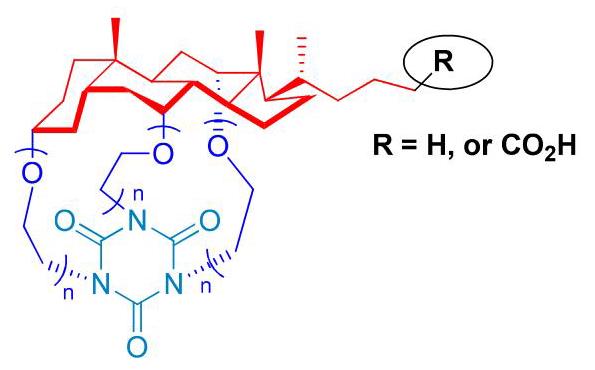
Abstract: We describe cholate-based cage amphiphiles with a unique architecture that combines elements of structural rigidity and flexibility. The cage compounds are built by extending and bridging three polar chains underneath the concave steroid rings of cholate, and capping with another rigid, symmetrically trifunctionalized cyanuric acid moiety. The connecting chains are varied to include, for instance, oligo(ethylene glycol) or chains containing 1,2,3-triazole units, to present flexibility in the chemical and structural space and potentially deliver functional molecules for molecular recognition applications. Cholic acid is a principal component of bile acids found in the bile of mammals and other vertebrates that emulsify dietary fats to promote their digestion and absorption. A representative of facial amphiphiles, cholate features three small $\alpha$ -hydroxy groups positioned on one side of the rigid, slightly concave steroid surface. Natural bile acids and their analog molecules have long been used pharmacologically for the dissolution of gallstones, ${}^{1,2}$ and in membrane biochemistry for their capacity to partition into cellular membranes and to solubilize lipids and membrane proteins. ${}^{3,4}$ Additionally, considerable interest has focused on the design of bile acid-templated “smart materials”, in forms such as tandem oligomers or dendrimers, for the purpose of delivering biologics, drugs, and other guest molecules in solution or across cell membranes. ${}^{5 - {17}}$ Of these designs, macrocyclic architectures of cholic/deoxycholic acid have been created via connections through the terminal 24-carboxylate and the hydroxyl groups (or modifier groups). There is a case report in which small cage compounds are built through cyclodimerization of chenodeoxycholic acid. ${}^{18}$
While many molecular designs based on bile acids take advantage of their unique facial amphiphilicity and assembly properties, novel compounds can also be conceived by appending additional polar groups beneath the steroid scaffold to increase facial amphiphilicity and introduce additional functions. ${}^{{19} - {22}}$ We report here the synthesis of size-tunable cage compounds starting from a single cholate molecule and bridging three polar chains that extend from the ${3\alpha },{7\alpha },{12\alpha }$ -OH groups (Figure 1). Our exploration of such a molecular design originated with our study of facial amphiphiles for membrane protein structural biology applications. Our group has recently developed new steroid-and peptide-based facial amphiphiles to sequester the hydrophobic surfaces of integral membrane proteins. ${}^{{23} - {25}}$ Variation of polar segments of the cholate-based amphiphiles significantly impacts membrane protein crystal growth, potentially by mediating surface contacts of protein-detergent complexes (PDCs). To diversify the polar functionalities of facial amphiphiles and in an attempt to restrict the flexibility of these polar segments which may favor ordered PDC assembly during crystal growth, we set out to investigate the possibility of bridging all three flexible polar chains of cholate-derived amphiphiles in cage-like macrocycles. To our knowledge this type of structure has not been explored in the literature.
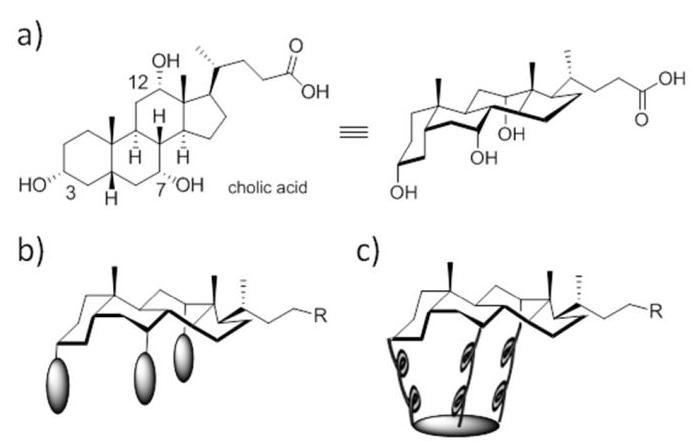
Figure 1. Drawings of (a) cholic acid structure, (b) cholic acid-derived facial amphiphiles, with three introduced polar side chains, and (c) a new cage compound design in which the flexible side chains underneath the steroid ring of cholate are bridged.
To cyclize the polar residues attached to -OH positions of cholate, we attempted a strategy of joining the chains in one step using a trifunctionalized moiety, such as cyanuric acid (Figure 2a). Initial success was achieved by treatment of the bromide substituent of cholane precursor 1, which we used in previous amphiphile synthesis, ${}^{24}$ with 4 equiv of DBU and 15 equiv of cyanuric acid. The desired cage molecule 2 was isolated in 23% yield, along with 18% of a di-cyanuric substituted byproduct 3 in which two chains were joined with one cyanuric unit (judged by mass and NMR spectroscopic analyses). The exact structure of this byproduct was not assigned, being inessential to the present report. We did not detect tri-cyanuric acid-substituted product in this reaction by mass spectroscopic analysis of the crude products, suggesting that intramolecular ${\mathrm{S}}_{\mathrm{N}}2$ attack of bromo-chain by the firstly attached cyanuric acid moiety can effectively compete with intermolecular reactions. Decreasing the stoichiometry of cyanuric acid to 1.5 equiv suppressed the formation of 3, and slightly increased the yield of 2 (26%). The identity of 2 was confirmed by molecular mass, NMR spectroscopic analyses, and its X-ray crystal structure (Figure 2a), which shows extreme rigidity due to the constraint of the short linkers between the top steroid and bottom cyanuric ring structures. Layered scaffold interactions in the crystal packing of 2 were observed, with one layer contributed by head-to-tail hydrophobic interaction between steroid moieties, and the other layer from stacking of apposing cyanuric moieties (Figure 2b).
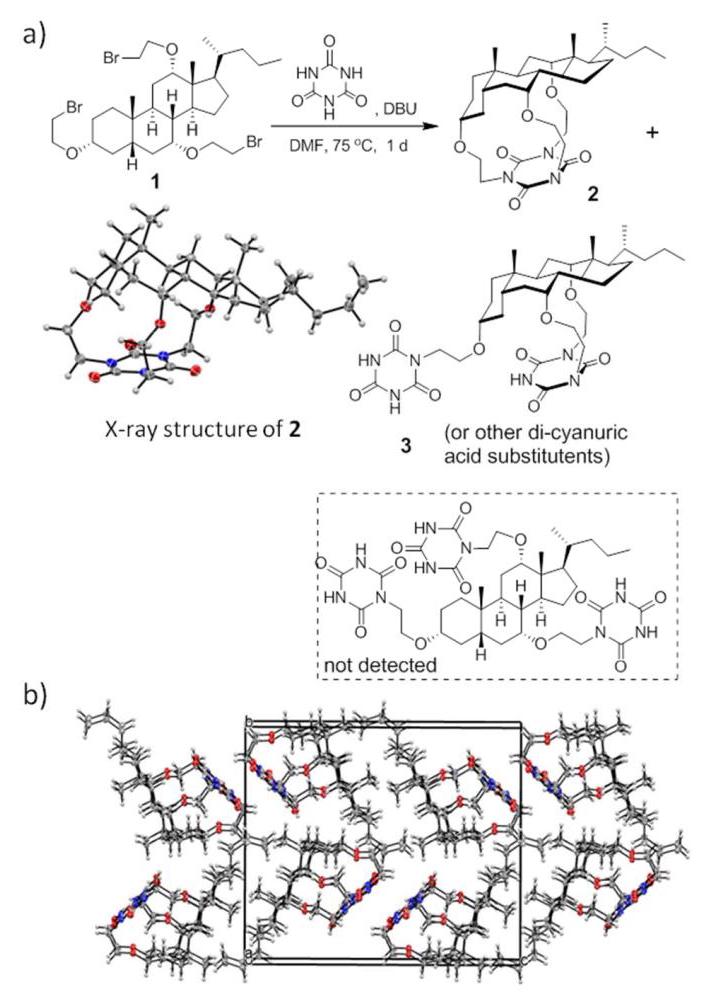
Figure 2. (a) Synthesis of cage compound 2 by bridging the three flexible side chains on the steroid rings of cholate with cyanuric acid in one step. Ball-and-stick drawing of the X-ray crystal structure of 2 is shown with $\mathrm{C}$ atoms in grey, $\mathrm{O}$ atoms in red, and $\mathrm{N}$ atoms in blue. (b) Crystal packing of 2 viewed along the a-axis of the unit cells (black box), displaying hydrophobic steroid-steroid interactions as well as interactions between cyanuric acid moieties.
Although typically difficult to synthesize, covalent cage compounds are fascinating molecules with many unique applications such as in molecular recognition, controlled substrate binding/release, and use as nano reaction vessels. ${}^{{26} - {37}}$ Given the extreme structural rigidity of compound 2 and its very small cage cavity, it is an intriguing idea that larger cage compounds might be readily built from cholate for adaptable cage size. Here we extended the synthesis of cholate-templated cages by attaching oligo(ethylene glycol) (PEG) chains to make molecules analogous to 2 and to cryptands ${}^{{38},{39}}$ (Scheme 1). We started the synthesis from the ${3\alpha },{7\alpha },{12\alpha }$ -tri(2-hydroxyethoxy)cholane 4, which was conveniently prepared from cholic acid in three steps. ${}^{24}$ Universal tosylation of the OH groups gave 5. The reaction of 5 with NaH-deprotonated ethylene glycol, diethylene glycol or triethylene glycol elongated the PEG chains in specific manner. After conversion of triols 6 to tribromides 7, treatment with cyanuric acid in the presence of DBU was successful in giving the cyclized cage products 8 in 25-64% yield. We note that the cyclization yield was highest for linkers containing two ethylene glycol units (compound 8a), possibly due to relieved strain for cage formation compared to cyclization of 2, and the more favorable proximity of the three chains compared to cyclization of larger cage compounds (8b and 8c). This series of cage compounds showed a range of internal cavity volumes, thus conferring suitability for potential encapsulation of guest molecules of different sizes (Figure 3).
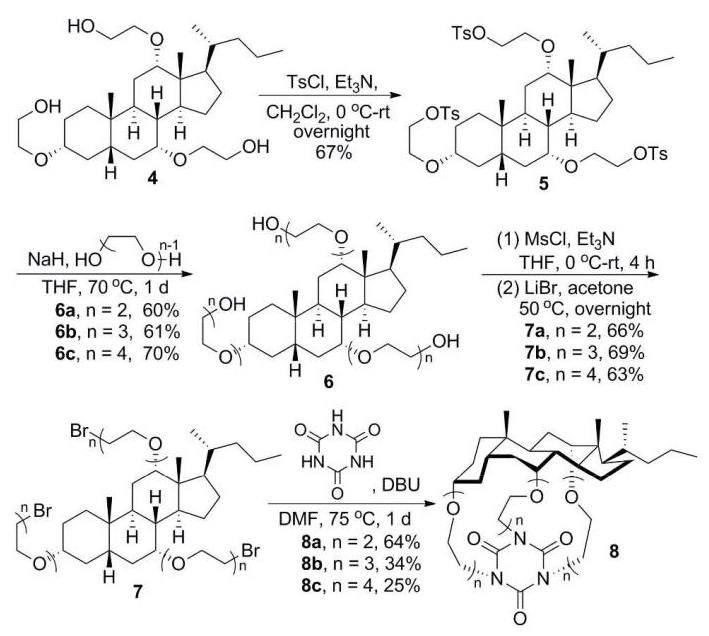
Scheme 1. Synthesis of PEG-linked cage compounds.
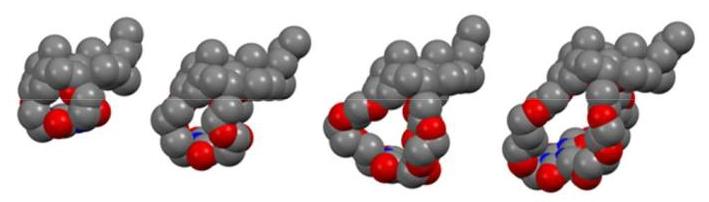
Figure 3. Computational space-filled structures of 2, 8a-c (from left to right), showing increasing volume of the cage cavity along with decreased structural rigidity.
The above cage compounds were barely soluble in water, although they could be effectively solubilized in mixed detergent solutions for potential studies in aqueous solutions. Removal of the 24-caboxylate group in these molecules, following our previous design of facial amphiphiles, obviously contributed to their water insolubility. We envision that it may be desirable to retain the terminal carboxylic acid to alleviate solubility concerns, and to serve as an additional functionalization site. For these reasons, we synthesized compound 17 as well (Scheme 2). Briefly, allylation of the three hydroxyl groups of cholic acid and the subsequent reduction of carboxylic acid to hydroxyl were carried out in one pot to give 9 in 95% yield. After benzyl protection of the 24-OH group (10), ozonolysis of the alkenes and ${\mathrm{{NaBH}}}_{4}$ reduction of the resulting aldehydes were performed to give 11 in a combined yield of 93%. Subsequent transformations from 11 to 15 were similar to the route described in Scheme 1. Finally, benzyl deprotection (16) by hydrogenation and oxidation of the resulting OH group to restore the carboxylic acid (17) using Jones reagent were conducted. Like cholate, the salt form of compound 17 exhibited the expected solubility in ${\mathrm{H}}_{2}\mathrm{O}$ (up to 5% w/v) and formed micelles. Its critical micelle concentration (CMC) was determined as ${0.52}\mathrm{{mM}}\left( {{0.054}\% \mathrm{w}/\mathrm{v}}\right)$ using a hydrophobic dye (orange OT) solubilization assay. ${}^{40}$
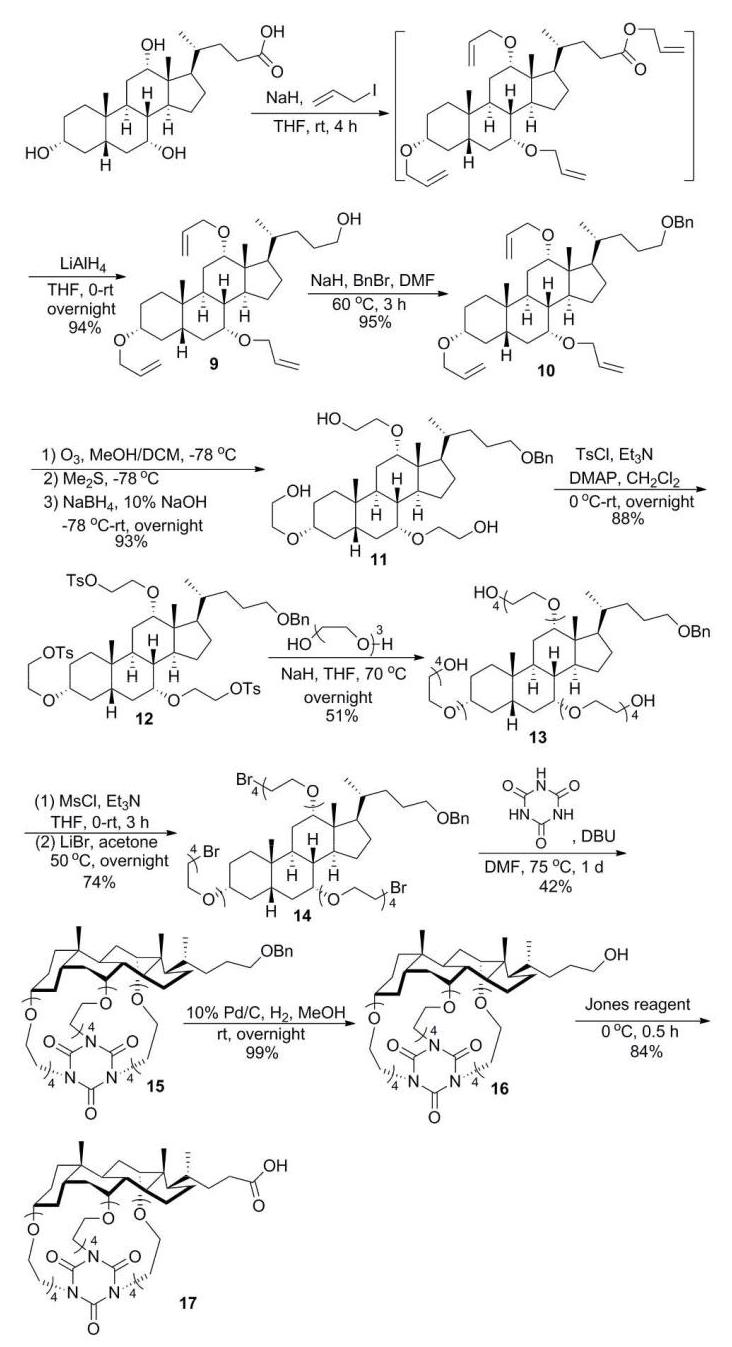
Scheme 2. Synthesis of cage 17 bearing the terminal carboxylic acid group.
To further illustrate the versatility of cholate-templated cage synthesis and possibly deliver different functional molecules, we also used the popular Cu(I)-catalyzed azide-alkyne Huisgen cycloaddition, the so-called click chemistry, ${}^{41}$ for efficient linker conjugation. The corresponding 1,2,3-triazole units have been documented to function as H-bond donors and acceptors, ${}^{42}$ bind halide anions, ${}^{{43},{44}}$ and act as metal-binding ligands. ${}^{45}$ From the previous trimesylate intermediate 18 described in scheme 1, we conveniently made the tri-azide fragments19by reaction with ${\mathrm{{NaN}}}_{3}$ . These azides $\mathbf{{19a}}$ -c, respectively containing one, two and three ethylene glycol units, were coupled with tri-propargyl-substituted cyanuric acid 20 in the presence of ${\mathrm{{CuSO}}}_{4}$ and the Cu(II)-reducing sodium ascorbate. As a result, all click reactions led to the corresponding cage products 21 in good yields (66-74%).
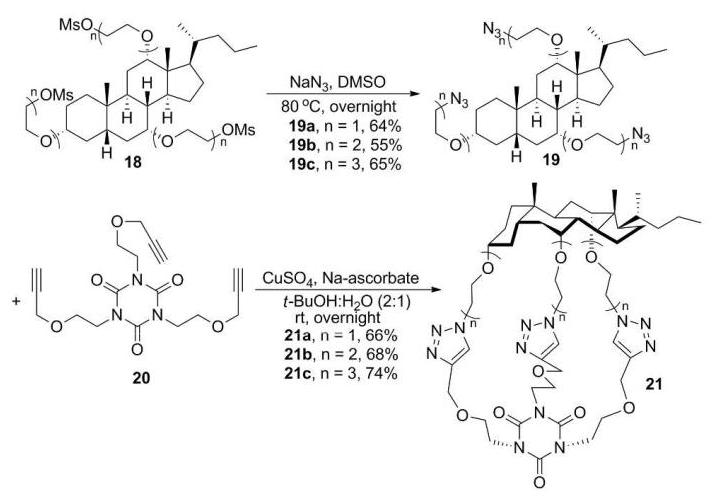
Scheme 3. Synthesis of triazole-linked cage compounds by click chemistry.
Finally, we show that these cage compounds, depending on the functional groups in the linker region, can bind different substrates. For example, addition of ${\mathrm{{KPF}}}_{6}$ to a solution of $\mathbf{{8a}}$ or $\mathbf{{8b}}$ in ${d}_{6}$ -acetone led to ${}^{1}\mathrm{H}$ NMR chemical shifts in a region ( $\sim 3 - 4\mathrm{{ppm}}$ ) inclusive of proton signals for the PEG linkers (Figure 4a and 4b). In contrast, titration of ${\mathrm{{KPF}}}_{6}$ to the smallest cage 2 solution had no effect on its NMR spectrum. These results support the binding of ${\mathrm{K}}^{ + }$ in the medium sized cage cavity in 8a or 8b, but not in 2. Similarly, we observed apparent chemical shifts on the ${}^{1}\mathrm{H}$ NMR spectra of the triazole-containing cage 21a upon addition of fluoride, chloride, bromide or iodide anions in the forms of tetrabutylammonium salt in ${d}_{6}$ -acetone. We showed in Figure 4c the singlet proton peaks on each triazole ring of ${21}\mathbf{a}$ , which are well separated from all other upfield peaks (<5 ppm). The degree of chemical shift changes also varied in each case, roughly following an order of ${\mathrm{{Cl}}}^{ - } > {\mathrm{{Br}}}^{ - } > {\mathrm{F}}^{ - }/{\mathrm{I}}^{ - }$ , likely indicative of a level of selectivity. Future investigations of the selectivity and binding modes and affinities of this class of compounds for different substrates are warranted.
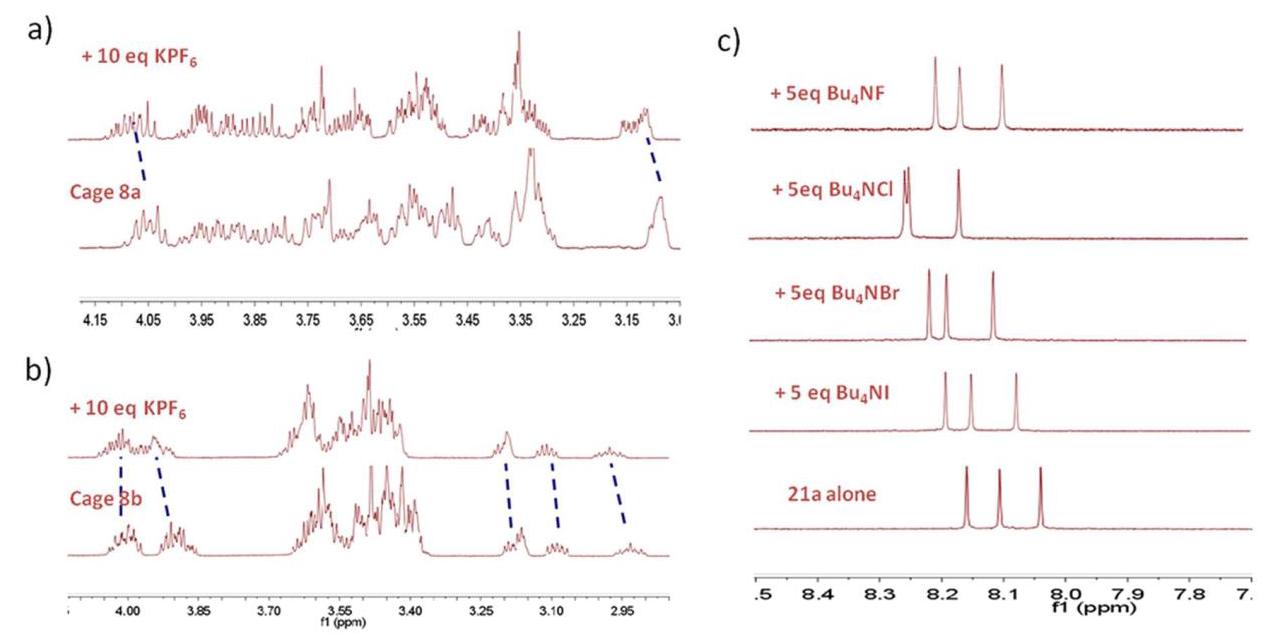
Figure 4. ${}^{1}\mathrm{H}$ NMR spectra in ${d}_{6}$ -acetone showing that cage compounds (a) 8a,(b) 8b and (c) 21a bind potassium $\left( {{\mathrm{{KPF}}}_{6},{10}}\right.$ equiv in a and b) and halide $\left( {{\mathrm{{Bu}}}_{4}\mathrm{{NX}}}\right.$ salt,5 equiv in c) ions, respectively.
In summary, we synthesized a series of novel cage molecules based on the facial amphiphilic cholate template. Structural diversity was achieved by selecting linkers with different functional groups and at various lengths. These cage compounds could be made soluble in aqueous solution to enhance their functional utility. Preliminary studies have demonstrated that these cage molecules could bind metal or halide ions. We envision that novel cage compounds can also be prepared with other linkers and/or different cap molecules other than the cyanuric acid unit employed herein. Thus, the cholic acid platform provides a versatile and easily accessible platform for generating a new class of covalent cage amphiphiles to potentially recognize a variety of substrates, beyond the scope of ionic compounds studied herein.
Experimental Section
Synthesis of 3a,7a,12a-Tri-(2-bromoethoxy)-cholane (1). To a solution of 3α,7α,12α-Tri-(2-hydroxyethoxy)-cholane ${}^{24}$ (4,2.0 g,3.91 mmol) in dry THF (20 mL) was added triethylamine (3.95 mL, 27.37 mmol) with stirring. Methanesulfonyl chloride (1.81 mL,23.46 mmol) was then added to the mixture dropwise at $0{}^{ \circ }\mathrm{C}$ . The reaction was continued with stirring at rt, and completed in $4\mathrm{\;h}$ as judged by TLC analysis. Water was added to quench the reaction and the solution was extracted with EtOAc $\left( {{50}\mathrm{\;{mL}} \times 3}\right)$ . The combined organic phases were washed with brine, dried over ${\mathrm{{Na}}}_{2}{\mathrm{{SO}}}_{4}$ , filtered, and then concentrated in vacuo. The residue, without purification, was dissolved in acetone (20 mL). LiBr (3.4 g, 39.1 mmol) was then added at rt and the suspension was heated at 50 ${}^{ \circ }\mathrm{C}$ overnight. After simple workup, the mixture was purified by silica gel chromatography (eluent: hexanes/EtOAc = 20:1 to 10:1) to give 1 as a pale yellowish solid (1.64 g, 60% over two steps). ${}^{1}\mathrm{H}$ NMR (600 MHz, CDCl3) δ 3.86-3.82 (m, 2H), ${3.78} - {3.76}\left( {\mathrm{\;m},2\mathrm{H}}\right)$ , ${3.57} - {3.55}\left( {\mathrm{\;m},1\mathrm{H}}\right) ,{3.50} - {3.43}\left( {\mathrm{\;m},8\mathrm{H}}\right) ,{3.34} - {3.32}\left( {\mathrm{\;m},1\mathrm{H}}\right) ,{3.17} - {3.13} \; \left( {\mathrm{\;m},1\mathrm{H}}\right) ,{2.24} - {2.18}\left( {\mathrm{\;m},1\mathrm{H}}\right) ,{2.11} - {2.08}\left( {\mathrm{\;m},2\mathrm{H}}\right) ,{1.99} - {1.94}\left( {\mathrm{\;m},1\mathrm{H}}\right) ,{1.85} - {1.79}\left( {\mathrm{\;m},2\mathrm{H}}\right)$ , 1.73-1.65 (m, 5H), 1.57-1.53 (m, 1H), 1.49-1.45 (m, 1H), 1.39-1.14 (m, 8H), 1.06-0.84 $\left( {\mathrm{m},{12}\mathrm{H}}\right) ,{0.65}\left( {\mathrm{\;s},3\mathrm{H}}\right) ;{}^{13}\mathrm{C}$ NMR $\left( {{150}\mathrm{{MHz}},{\mathrm{{CDCl}}}_{3}}\right) \delta \;{81.5},{80.3},{76.6},{69.1},{68.7},{68.2}$ , 46.38, 46.36, 42.4, 41.9, 39.7, 38.4, 35.8, 35.3, 35.2, 35.0, 31.3, 31.2, 31.0, 29.4, 28.0, 27.8, 27.6, 23.5, 23.4, 23.0, 19.4, 18.1, 14.7, 12.6; HRMS (ESI-TOF) calcd for ${\mathrm{C}}_{30}{\mathrm{H}}_{51}{\mathrm{{Br}}}_{3}{\mathrm{O}}_{3}{\left\lbrack \mathrm{M} + \mathrm{{Na}}\right\rbrack }^{ + }{719.1280}$ , found 719.1281.
General Procedure for the Preparation of Cage Compounds 2 and 8a-c. To a solution of 1 (200 mg, 0.29 mmol) and cyanuric acid (56 mg, 0.43 mmol) in dry DMF was added DBU (132mg,0.87 mmol) at rt. The reaction was heated at ${75}^{ \circ }\mathrm{C}$ with stirring for 1 day. The mixture was concentrated to dryness directly in vacuo. The residue was purified by silica gel column chromatography (eluent: hexanes/EtOAc = 4:1 to 2:1) to give 2 as a white solid $\left( {{43.0}\mathrm{{mg}},{26}\% }\right)$ . Crystals of 2 for crystallography were grown in about a week in DMSO solution open to air, allowing water absorption. ${}^{1}\mathrm{H}$ NMR (500 MHz, CDCl ${}_{3}$ ) δ ${4.56} - {4.50}\left( {\mathrm{\;m},1\mathrm{H}}\right) ,{4.44} - {4.40}\left( {\mathrm{\;m},1\mathrm{H}}\right) ,{4.31} - {4.26}\left( {\mathrm{\;m},1\mathrm{H}}\right) ,{4.05} - {3.92}\left( {\mathrm{\;m},4\mathrm{H}}\right) ,{3.73} - {3.67} \; \left( {\mathrm{m},4\mathrm{H}}\right) ,{3.48} - {3.43}\left( {\mathrm{\;m},1\mathrm{H}}\right) ,{3.41} - {3.39}\left( {\mathrm{\;m},1\mathrm{H}}\right) ,{3.37} - {3.35}\left( {\mathrm{\;m},1\mathrm{H}}\right) ,{3.21} - {3.18}\left( {\mathrm{\;m},1\mathrm{H}}\right)$ , ${2.41} - {2.35}\left( {\mathrm{\;m},1\mathrm{H}}\right) ,{2.02} - {1.78}\left( {\mathrm{\;m},4\mathrm{H}}\right) ,{1.65} - {1.62}\left( {\mathrm{\;m},4\mathrm{H}}\right) ,{1.54} - {1.03}\left( {\mathrm{\;m},{14}\mathrm{H}}\right) ,{0.96} - {0.83} \; \left( {\mathrm{m},{10}\mathrm{H}}\right) ,{0.59}\left( {\mathrm{\;s},3\mathrm{H}}\right) ;{}^{13}\mathrm{C}\mathrm{{NMR}}\left( {{125}\mathrm{{MHz}},{\mathrm{{CDCl}}}_{3}}\right) {\delta 150.0},{149.3},{149.2},{77.8},{75.8}$ , 74.2,64.2,61.6,60.1,46.7,45.8,43.9,43.7,41.8,40.1,39.7,39.3,38.4,35.4,34.9,34.8, 34.7, 29.8, 29.0, 28.3, 27.8, 23.8, 21.7, 20.4, 19.6, 18.4, 14.7, 12.0; HRMS (ESI-TOF) calcd for ${\mathrm{C}}_{33}{\mathrm{H}}_{51}{\mathrm{\;N}}_{3}{\mathrm{O}}_{6}{\left\lbrack \mathrm{M} + \mathrm{H}\right\rbrack }^{ + }{586.3850}$ , found 586.3850.
8a: white solid; ${}^{1}\mathrm{H}$ NMR (500 MHz, ${\mathrm{{CDCl}}}_{3}$ ) δ 4.25-4.21 (m,1H),4.16-4.07 (m,4H), ${3.95} - {3.86}\left( {\mathrm{\;m},4\mathrm{H}}\right) ,{3.79} - {3.36}\left( {\mathrm{\;m},{15}\mathrm{H}}\right) ,{3.18} - {3.15}\left( {\mathrm{\;m},2\mathrm{H}}\right) ,{2.99} - {2.94}\left( {\mathrm{\;m},1\mathrm{H}}\right) ,{2.14} - {1.82} \; \left( {\mathrm{m},5\mathrm{H}}\right) ,{1.74} - {1.11}\left( {\mathrm{\;m},{16}\mathrm{H}}\right) ,{1.03} - {0.95}\left( {\mathrm{\;m},2\mathrm{H}}\right) ,{0.86} - {0.83}\left( {\mathrm{\;m},{10}\mathrm{H}}\right) ,{0.61}\left( {\mathrm{\;s},3\mathrm{H}}\right) ;{}^{13}\mathrm{C}$ NMR (125 MHz, CDCl3) δ 149.17, 149.15, 149.08, 81.8, 80.3, 76.5, 71.4, 71.12, 71.06, 70.6, 70.0, 68.8, 68.7, 67.7, 67.2, 46.7, 46.4, 42.8, 42.6, 42.0, 41.7, 39.5, 38.3, 35.6, 35.3, 35.2, 34.9, 28.9, 28.4, 27.7, 27.2, 23.8, 23.4, 23.0, 19.4, 18.3, 14.6, 12.7; HRMS (ESI-TOF) calcd for ${\mathrm{C}}_{39}{\mathrm{H}}_{63}{\mathrm{\;N}}_{3}{\mathrm{O}}_{9}{\left\lbrack \mathrm{M} + \mathrm{H}\right\rbrack }^{ + }{718.4637}$ , found 718.4638.
8b: white solid; ${}^{1}\mathrm{H}$ NMR (500 MHz, CDCl ${}_{3}$ ) δ 4.23-4.14 (m,3H),4.09-4.01 (m,3H), ${3.85} - {3.51}\left( {\mathrm{\;m},{28}\mathrm{H}}\right) ,{3.45} - {3.43}\left( {\mathrm{\;m},1\mathrm{H}}\right) ,{3.27} - {3.17}\left( {\mathrm{\;m},3\mathrm{H}}\right) ,{3.07} - {3.02}\left( {\mathrm{\;m},1\mathrm{H}}\right) ,{2.16} - {2.02} \; \left( {\mathrm{m},3\mathrm{H}}\right) ,{1.92} - {1.68}\left( {\mathrm{m},1\mathrm{H}}\right) ,{1.81} - {1.12}\left( {\mathrm{\;m},{17}\mathrm{H}}\right) ,{1.04} - {0.90}\left( {\mathrm{m},2\mathrm{H}}\right) ,{0.86} - {0.83}\left( {\mathrm{\;m},{10}\mathrm{H}}\right)$ , ${0.62}\left( {\mathrm{\;s},3\mathrm{H}}\right) ;{}^{13}\mathrm{C}$ NMR $\left( {{125}\mathrm{{MHz}},{\mathrm{{CDCl}}}_{3}}\right) {\delta 149.24},{149.19},{80.8},{79.2},{76.3},{71.38}$ , 71.35,71.1,71.0,70.73,70.67,70.6,70.3,68.5,68.2,67.8,67.6,67.5,67.3,46.8,46.1, 42.5, 42.2, 42.11, 42.07, 41.8, 39.7, 38.4, 35.4, 35.3, 35.0, 34.9, 28.8, 27.9, 27.6, 27.3, 23.2,22.8,22.7,19.3,18.0,14.7,12.4; HRMS (ESI-TOF) calcd for ${\mathrm{C}}_{45}{\mathrm{H}}_{75}{\mathrm{\;N}}_{3}{\mathrm{O}}_{12}{\left\lbrack \mathrm{M} + \mathrm{H}\right\rbrack }^{ + }$ 850.5423, found 850.5421.
8c: colorless oil; ${}^{1}\mathrm{H}$ NMR (600 MHz, ${\mathrm{{CDCl}}}_{3}$ ) δ 4.18-4.06 (m,7H),3.78-3.56 (m,39H), ${3.46} - {3.44}\left( {\mathrm{\;m},1\mathrm{H}}\right) ,{3.31} - {3.30}\left( {\mathrm{\;m},1\mathrm{H}}\right) ,{3.24} - {3.21}\left( {\mathrm{\;m},2\mathrm{H}}\right) ,{3.07} - {3.04}\left( {\mathrm{\;m},1\mathrm{H}}\right) ,{2.16} - {2.06} \; \left( {\mathrm{\;m},3\mathrm{H}}\right) ,{1.93} - {1.88}\left( {\mathrm{\;m},1\mathrm{H}}\right) ,{1.79} - {1.60}\left( {\mathrm{\;m},7\mathrm{H}}\right) ,{1.52} - {1.15}\left( {\mathrm{\;m},{10}\mathrm{H}}\right) ,{1.01} - {0.97}\left( {\mathrm{\;m},2\mathrm{H}}\right)$ , ${0.92} - {0.84}\left( {\mathrm{\;m},{10}\mathrm{H}}\right) ,{0.63}\left( {\mathrm{\;s},3\mathrm{H}}\right) ;{}^{13}\mathrm{C}\mathrm{{NMR}}\left( {{150}\mathrm{{MHz}},{\mathrm{{CDCl}}}_{3}}\right) {\delta 149.21},{149.19},{81.2}$ , 80.0,76.4,71.2,71.0,70.9,70.84,70.79,70.78,70.69,70.67,70.6,70.44,70.39,70.37, 68.7,68.5,67.6,67.4,46.8,46.2,42.7,42.04,41.98,41.95,39.7,38.4,35.6,35.4,35.2, 35.0, 29.0, 28.0, 27.7, 27.4, 23.3, 23.00, 22.95, 19.4, 18.0, 14.7, 12.5; HRMS (ESI-TOF) calcd. for ${\mathrm{C}}_{51}{\mathrm{H}}_{87}{\mathrm{\;N}}_{3}{\mathrm{O}}_{15}{\left\lbrack \mathrm{M} + \mathrm{H}\right\rbrack }^{ + }{982.6210}$ , found982.6200.
Synthesis of ${3\alpha },{7\alpha },{12\alpha }$ -Tri-(2-tosylateethoxy)-cholane (5). To a solution of $4({1.0}\mathrm{\;g},{1.96}$ mmol) in dry ${\mathrm{{CH}}}_{2}{\mathrm{{Cl}}}_{2}\left( {{60}\mathrm{\;{mL}}}\right)$ were added triethylamine $\left( {{2.72}\mathrm{\;{mL}},{19.6}\mathrm{{mmol}}}\right)$ and 4-dimethylaminopyridine $\left( {{50}\mathrm{{mg}},{0.4}\mathrm{{mmol}}}\right)$ at ${0}^{ \circ }\mathrm{C}$ . 4-Toluenesulfonyl chloride $({1.87}\mathrm{\;g}$ , 9.8 mmol) was then added in portions. The reaction temperature was allowed to increase overnight to rt. The reaction was quenched with saturated ${\mathrm{{NH}}}_{4}\mathrm{{Cl}}$ solution, and extracted with ${\mathrm{{CH}}}_{2}{\mathrm{{Cl}}}_{2}\left( {{30}\mathrm{\;{mL}} \times 3}\right)$ . The combined organic phases were washed with brine, dried over ${\mathrm{{Na}}}_{2}{\mathrm{{SO}}}_{4}$ , filtered, and concentrated in vacuo. The residue was purified by silica gel chromatography (eluent: hexanes/EtOAc = 5:1 to 3:1) to give 5 as an orange-colored solid $\left( {{1.28}\mathrm{\;g},{67}\% }\right)$ . ${}^{1}\mathrm{H}$ NMR $\left( {{500}\mathrm{{MHz}},{\mathrm{{CDCl}}}_{3}}\right) \delta$ 7.78-7.74 $\left( {\mathrm{m},6\mathrm{H}}\right) ,{7.34} - {7.29}\left( {\mathrm{\;m},6\mathrm{H}}\right)$ , 4.18-4.00 (m, 6H), 3.73-3.60 (m, 4H), 3.49-3.47 (m, 1H), 3.40-3.32 (m, 2H), 3.28-3.27 $\left( {\mathrm{m},1\mathrm{H}}\right) ,{3.06} - {3.02}\left( {\mathrm{\;m},1\mathrm{H}}\right) ,{2.42} - {2.41}\left( {\mathrm{\;m},9\mathrm{H}}\right) ,{2.06} - {1.90}\left( {\mathrm{\;m},3\mathrm{H}}\right) ,{1.81} - {1.09}\left( {\mathrm{\;m},{18}\mathrm{H}}\right)$ , 0.99-0.81 (m, 12H), 0.61 (s, 3H); ${}^{13}\mathrm{C}$ NMR (125 MHz, CDCl ${}_{3}$ ) δ 144.9, 144.82, 144.81, 133.2, 133.1, 133.0, 130.01, 129.93, 129.90, 128.1, 128.01, 127.98, 81.7, 80.1, 76.7, 70.0, 69.6, 69.4, 66.4, 66.2, 65.4, 46.5, 46.3, 42.5, 41.7, 39.5, 38.3, 35.6, 35.1, 34.9, 34.6, 28.9, 28.0, 27.7, 27.4, 23.14, 23.09, 22.9, 21.7, 19.4, 17.8, 14.7, 12.5; HRMS (ESI-TOF) calcd for ${\mathrm{C}}_{51}{\mathrm{H}}_{72}{\mathrm{O}}_{12}{\mathrm{\;S}}_{3}{\left\lbrack \mathrm{M} + \mathrm{H}\right\rbrack }^{ + }$ 973.4264, found 973.4259.
Synthesis of 6a-c. To a solution of ethylene glycol (0.86 ml, 15.5 mmol) in dry THF (5 mL) was slowly added NaH (60% in mineral oil, 124 mg, 3.1 mmol) at rt. The suspension was heated at ${70}^{ \circ }\mathrm{C}$ for ${0.5}\mathrm{\;h}$ before being cooled to rt. 5 (300 mg,0.31 mmol) was added, and then the reaction was continued with stirring at ${70}^{ \circ }\mathrm{C}$ for 1 day. The reaction was then quenched with saturated ${\mathrm{{NH}}}_{4}\mathrm{{Cl}}$ solution, and extracted with EtOAc $\left( {{20}\mathrm{\;{mL}} \times 3}\right)$ . The combined organic phases were washed with brine, dried over ${\mathrm{{Na}}}_{2}{\mathrm{{SO}}}_{4}$ , filtered, and concentrated in vacuo. The residue was purified by silica gel chromatography (eluent: ${\mathrm{{CH}}}_{2}{\mathrm{{Cl}}}_{2}/\mathrm{{MeOH}} = {20} : 1$ to 10:1) to give 6a as a yellow oil $\left( {{118}\mathrm{{mg}},{60}\% }\right)$ . ${}^{1}\mathrm{H}$ NMR (500 MHz, CDCl ${}_{3}$ ) δ 3.78-3.54 (m, 25H), 3.47-3.45 (m, 1H), 3.29-3.21 (m, 3H), 3.12-3.08 (m, 1H), 2.30-2.22 (m, 1H), 2.13-2.04 (m, 2H), 1.91-1.59 (m, 8H), 1.48-1.09 (m, 10H), 1.01-0.81 (m, 12H), 0.62 (s, 3H); ${}^{13}\mathrm{C}$ NMR (125 MHz, CDCl3) δ 81.0, 80.7, 76.4, 73.0, 72.8, 70.8, 70.7, 70.5, 68.4, 68.3, 67.6, 61.7, 61.63, 61.56, 46.8, 46.1, 42.4, 42.0, 39.5, 38.3, 35.4, 35.3, 35.2, 34.9, 28.8, 27.9, 27.6, 26.8, 23.3, 22.8, 19.3, 18.1, 14.6, 12.5; MS (ESI) calcd for ${\mathrm{C}}_{36}{\mathrm{H}}_{66}{\mathrm{O}}_{9}{\left\lbrack \mathrm{M} + \mathrm{{Na}}\right\rbrack }^{ + }{665.5}$ , found 665.5.
6b: yellow oil; ${}^{1}\mathrm{H}$ NMR (600 MHz, ${\mathrm{{CDCl}}}_{3}$ ) δ 3.77-3.55 (m,37H),3.49-3.47 (m,1H), 3.34-3.31 (m, 1H), 3.28-3.25 (m, 2H), 3.11-3.07 (m, 1H), 2.20-2.13 (m, 1H), 2.08-2.03 $\left( {\mathrm{m},2\mathrm{H}}\right) ,{1.92} - {1.87}\left( {\mathrm{\;m},1\mathrm{H}}\right) ,{1.82} - {1.60}\left( {\mathrm{\;m},7\mathrm{H}}\right) ,{1.55} - {1.12}\left( {\mathrm{\;m},{10}\mathrm{H}}\right) ,{1.02} - {0.97}\left( {\mathrm{\;m},2\mathrm{H}}\right)$ , 0.93-0.84 (m, 10H), 0.63 (s, 3H); ${}^{13}\mathrm{C}$ NMR (150 MHz, CDCl ${}_{3}$ ) δ 81.4, 80.3, 76.4, 72.72, 72.71, 72.66, 71.0, 70.92, 70.91, 70.8, 70.73, 70.71, 70.63, 70.62, 70.4, 68.2, 68.1, 67.2, 61.83, 61.78, 46.8, 46.2, 42.7, 42.0, 39.7, 38.4, 35.6, 35.4, 35.1, 35.0, 29.0, 28.0, 27.7, 27.4,23.3,23.0,19.4,18.0,14.7,12.6; HRMS (ESI-TOF) calcd for ${\mathrm{C}}_{42}{\mathrm{H}}_{78}{\mathrm{O}}_{12}{\left\lbrack {\mathrm{M}}^{ + }\mathrm{H}\right\rbrack }^{ + }$ 775.5572, found 775.5566.
6c: yellow oil; ${}^{1}\mathrm{H}$ NMR (500 MHz, CDCl ${}_{3}$ ) δ 3.69-3.55 (m,47H),3.45-3.43 (m,1H), ${3.31} - {3.21}\left( {\mathrm{\;m},3\mathrm{H}}\right) ,{3.09} - {3.03}\left( {\mathrm{\;m},3\mathrm{H}}\right) ,{2.14} - {2.07}\left( {\mathrm{\;m},1\mathrm{H}}\right) ,{2.03} - {1.96}\left( {\mathrm{\;m},2\mathrm{H}}\right) ,{1.89} - {1.83} \; \left( {\mathrm{m},1\mathrm{H}}\right) ,{1.78} - {1.08}\left( {\mathrm{\;m},{17}\mathrm{H}}\right) ,{0.99} - {0.93}\left( {\mathrm{\;m},2\mathrm{H}}\right) ,{0.90} - {0.80}\left( {\mathrm{\;m},{10}\mathrm{H}}\right) ,{0.59}\left( {\mathrm{\;s},3\mathrm{H}}\right) ;{}^{13}\mathrm{C}$ NMR (125 MHz, CDC1, 3) & 81.3, 80.1, 76.2, 72.7, 72.6, 70.9, 70.8, 70.72, 70.70, 70.66, 70.62, 70.60, 70.55, 70.5, 70.39, 70.37, 70.3, 68.01, 67.95, 67.1, 61.7, 46.6, 46.2, 42.6, 41.9, 39.6, 38.4, 35.5, 35.3, 35.0, 34.9, 28.9, 28.0, 27.7, 27.4, 23.2, 23.0, 22.9, 19.3, 17.8, 14.6,12.5; HRMS (ESI-TOF) calcd for ${\mathrm{C}}_{48}{\mathrm{H}}_{90}{\mathrm{O}}_{15}{\left\lbrack \mathrm{M} + \mathrm{H}\right\rbrack }^{ + }$ 907.6358, found 907.6352.
Compounds 7a-c were prepared using a procedure similar to the synthesis of 1. 7a: colorless oil; ${}^{1}\mathrm{H}$ NMR (600 MHz, ${\mathrm{{CDCl}}}_{3}$ ) δ 3.94-3.90 (m,1H),3.84-3.80 (m,5H), ${3.73} - {3.57}\left( {m,{10H}}\right) ,{3.54} - {3.44}\left( {m,{7H}}\right) ,{3.34} - {3.24}\left( {m,{3H}}\right) ,{3.12} - {3.09}\left( {m,{1H}}\right) ,{2.19} - {2.13} \; \left( {\mathrm{m},1\mathrm{H}}\right) ,{2.08} - {2.03}\left( {\mathrm{\;m},2\mathrm{H}}\right) ,{1.94} - {1.81}\left( {\mathrm{\;m},1\mathrm{H}}\right) ,{1.84} - {1.13}\left( {\mathrm{\;m},{17}\mathrm{H}}\right) ,{1.04} - {0.97}\left( {\mathrm{\;m},2\mathrm{H}}\right)$ , 0.93-0.84 (m, 10H), 0.64 (s, 3H); ${}^{13}\mathrm{C}$ NMR (150 MHz, CDCl3) δ 81.2, 80.2, 76.4, 71.6, 71.4, 71.3, 71.0, 70.9, 70.7, 68.20, 68.18, 67.3, 46.8, 46.2, 42.6, 42.0, 39.7, 38.4, 35.6, 35.4, 35.1, 35.0, 31.1, 30.8, 30.6, 28.9, 28.0, 27.8, 27.3, 23.3, 23.0, 22.9, 19.4, 18.0, 14.7,
12.5; HRMS (ESI-TOF) calcd for ${\mathrm{C}}_{36}{\mathrm{H}}_{63}{\mathrm{{Br}}}_{3}{\mathrm{O}}_{6}{\left\lbrack \mathrm{M} + \mathrm{{Na}}\right\rbrack }^{ + }{851.2067}$ , found851.2067. 7b: yellow oil; ${}^{1}\mathrm{H}$ NMR $\left( {{500}\mathrm{{MHz}},{\mathrm{{CDCl}}}_{3}}\right) {\delta 3.80} - {3.77}\left( {\mathrm{\;m},6\mathrm{H}}\right) ,{3.72} - {3.53}\left( {\mathrm{\;m},{22}\mathrm{H}}\right)$ , 3.47-3.43 (m, 7H), 3.34-3.29 (m, 1H), 3.28-3.23 (m, 2H), 3.09-3.05 (m, 1H), 2.17-2.09 $\left( {\mathrm{m},1\mathrm{H}}\right) ,{2.05} - {1.97}\left( {\mathrm{\;m},2\mathrm{H}}\right) ,{1.91} - {1.85}\left( {\mathrm{\;m},1\mathrm{H}}\right) ,{1.80} - {1.11}\left( {\mathrm{\;m},{17}\mathrm{H}}\right) ,{1.01} - {0.82}\left( {\mathrm{\;m},{12}\mathrm{H}}\right)$ , ${0.61}\left( {\mathrm{\;s},3\mathrm{H}}\right) ;{}^{13}\mathrm{C}$ NMR $\left( {{125}\mathrm{{MHz}},{\mathrm{{CDCl}}}_{3}}\right) \delta$ 81.4,80.2,76.2,71.3,71.2,71.1,70.9,70.8, 70.74,70.71,70.69,70.65,70.59,68.0,67.9,67.2,46.6,46.2,42.6,42.0,39.6,38.4,35.6, 35.4, 35.04, 34.96, 30.5, 30.4, 28.9, 28.0, 27.7, 27.5, 23.2, 23.00, 22.97, 19.4, 17.8, 14.7, 12.5; HRMS (ESI-TOF) calcd for ${\mathrm{C}}_{42}{\mathrm{H}}_{75}{\mathrm{{Br}}}_{3}{\mathrm{O}}_{9}{\left\lbrack \mathrm{M} + \mathrm{H}\right\rbrack }^{ + }{961.3034}$ , found961.3036.
7c: yellow oil; ${}^{1}\mathrm{H}$ NMR (500 MHz, CDCl ${}_{3}$ ) δ 3.80-3.77 (m,6H),3.68-3.54 (m,35H), 3.47-3.44 (m, 6H), 3.33-3.24 (m, 3H), 3.10-3.05 (m, 1H), 2.17-2.10 (m, 1H), 2.05-1.97 $\left( {\mathrm{m},2\mathrm{H}}\right) ,{1.91} - {1.85}\left( {\mathrm{\;m},1\mathrm{H}}\right) ,{1.79} - {1.13}\left( {\mathrm{\;m},{17}\mathrm{H}}\right) ,{1.01} - {0.95}\left( {\mathrm{\;m},2\mathrm{H}}\right) ,{0.92} - {0.83}\left( {\mathrm{\;m},{10}\mathrm{H}}\right)$ , ${0.62}\left( {\mathrm{\;s},3\mathrm{H}}\right) ;{}^{13}\mathrm{C}\mathrm{{NMR}}\left( {{125}\mathrm{{MHz}},{\mathrm{{CDCl}}}_{3}}\right) \delta$ 81.4,80.3,76.3,71.3,71.0,70.9,70.79, 70.75,70.74,70.68,70.6,67.9,67.8,67.3,46.6,46.2,42.7,42.0,39.7,38.4,35.6,35.4 35.04, 35.01, 30.4, 29.0, 28.0, 27.8, 27.5, 23.2, 23.1, 23.0, 19.4, 17.8, 14.7, 12.6; HRMS (ESI-TOF) calcd for ${\mathrm{C}}_{48}{\mathrm{H}}_{87}{\mathrm{{Br}}}_{3}{\mathrm{O}}_{12}{\left\lbrack \mathrm{M} + \mathrm{H}\right\rbrack }^{ + }$ 1093.3820, found 1093.3824.
Synthesis of compound ${\mathbf{9}}^{46}$ . To a solution of cholic acid (10 g,24.5 mmol) in dry THF $\left( {{150}\mathrm{\;{mL}}}\right)$ was slowly added $\mathrm{{NaH}}\left( {{60}\% \text{ in mineral oil,14.7 g,37.5 mol) at }0{}^{ \circ }\mathrm{C}\text{ . The }}\right)$ reaction was stirred at rt for ${0.5}\mathrm{\;h}$ before allyl iodide ( ${22.4}\mathrm{\;{mL}},{245}\mathrm{{mmol}}$ ) was added. The reaction was continued at rt for $4\mathrm{\;h}$ , then again cooled to ${0}^{ \circ }\mathrm{C}$ , and an additional 50 mL of dry THF was added. To this solution was slowly added LiAl ${\mathrm{H}}_{4}\left( {{2.8}\mathrm{\;g},{73.5}\mathrm{{mmol}}}\right)$ in portions. The reaction temperature was allowed to increase to rt and stirred overnight. The reaction was carefully quenched by the addition of $3\mathrm{\;{mL}}{\mathrm{H}}_{2}\mathrm{O}$ at ${0}^{ \circ }\mathrm{C}$ , followed by the addition of $6\mathrm{\;{mL}}{10}\% \mathrm{{NaOH}}$ and $9\mathrm{\;{mL}}{\mathrm{H}}_{2}\mathrm{O}$ . The solid precipitate was filtered and washed with EtOAc. The organic solution was concentrated in vacuo, and the residue was purified by silica gel chromatography (eluent: hexanes/EtOAc = 5:1 to 2.5:1) to give9as a white solid $\left( {{11.8}\mathrm{\;g},{94}\% }\right)$ . ${}^{1}\mathrm{H}$ NMR $\left( {{500}\mathrm{{MHz}},{\mathrm{{CDCl}}}_{3}}\right) {\delta 5.96} - {5.84}\left( {\mathrm{\;m},3\mathrm{H}}\right)$ ,5.29-5.17 $\left( {\mathrm{m},3\mathrm{H}}\right) ,{5.12} - {5.04}\left( {\mathrm{m},3\mathrm{H}}\right) ,{4.07} - {4.03}\left( {\mathrm{\;m},2\mathrm{H}}\right) ,{3.98} - {3.97}\left( {\mathrm{\;m},2\mathrm{H}}\right) ,{3.77} - {3.73}\left( {\mathrm{\;m},1\mathrm{H}}\right)$ , ${3.70} - {3.66}\left( {\mathrm{\;m},1\mathrm{H}}\right) ,{3.61} - {3.54}\left( {\mathrm{\;m},2\mathrm{H}}\right) ,{3.53} - {3.51}\left( {\mathrm{\;m},1\mathrm{H}}\right) ,{3.30} - {3.29}\left( {\mathrm{\;m},1\mathrm{H}}\right) ,{3.15} - {3.09} \; \left( {\mathrm{\;m},1\mathrm{H}}\right) ,{2.28} - {2.21}\left( {\mathrm{\;m},1\mathrm{H}}\right) ,{2.19} - {2.11}\left( {\mathrm{\;m},2\mathrm{H}}\right) ,{2.02} - {1.96}\left( {\mathrm{\;m},1\mathrm{H}}\right) ,{1.83} - {0.94}\left( {\mathrm{\;m},{19}\mathrm{H}}\right)$ , ${0.91} - {0.90}\left( {\mathrm{\;m},4\mathrm{H}}\right) ,{0.87}\left( {\mathrm{\;s},3\mathrm{H}}\right) ,{0.64}\left( {\mathrm{\;s},3\mathrm{H}}\right) ;{}^{13}\mathrm{C}\mathrm{{NMR}}\left( {{125}\mathrm{{MHz}},{\mathrm{{CDCl}}}_{3}}\right) \delta$ 136.1, 35.7, 35.4, 35.0, 31.8, 29.5, 28.9, 28.1, 27.7, 27.5, 23.3, 23.0, 17.8, 12.6; MS (ESI) calcd 35.7, 35.4, 35.0, 31.8, 29.5, 28.9, 28.1, 27.7, 27.5, 23.3, 23.0, 17.8, 12.6; MS (ESI) calcd for ${\mathrm{C}}_{33}{\mathrm{H}}_{54}{\mathrm{O}}_{4}{\left\lbrack \mathrm{M} + \mathrm{{Na}}\right\rbrack }^{ + }{537.4}$ , found 537.4.
Synthesis of compound 10. To a solution of $\mathbf{9}\left( {3\mathrm{\;g},{5.82}\mathrm{{mmol}}}\right)$ in dry DMF ( ${15}\mathrm{\;{mL}}$ ) was added NaH (60% in mineral oil,702mg,17.46 mmol) at $0{}^{ \circ }\mathrm{C}$ . The mixture was stirred at rt for ${0.5}\mathrm{\;h}$ . Then benzyl bromide $\left( {{1.08}\mathrm{\;{mL}},{8.76}\mathrm{{mmol}}}\right)$ was added to the solution at $0{}^{ \circ }\mathrm{C}$ . The reaction was heated at ${60}^{ \circ }\mathrm{C}$ with stirring for $3\mathrm{\;h}$ . The reaction was quenched with saturated ${\mathrm{{NH}}}_{4}\mathrm{{Cl}}$ after being cooled to ${0}^{ \circ }\mathrm{C}$ . The solution was extracted with EtOAc (60 $\mathrm{{mL}} \times 3)$ . The combined organic phases were washed with brine, dried over ${\mathrm{{Na}}}_{2}{\mathrm{{SO}}}_{4}$ , filtered, and concentrated in vacuo. The residue was purified by silica gel chromatography (eluent: hexanes/EtOAc = 5: 1 to 1:4) to give 10 as a yellow oil (3.9 g, 95%). ${}^{1}\mathrm{H}$ NMR (500 MHz, CDCl ${}_{3}$ ) δ 7.32-7.31 (m,4H),7.26-7.23 (m,1H),5.96-5.85 (m, 3H), 5.30-5.18 (m, 3H), 5.13-5.04 (m, 3H), 4.48 (s, 2H), 4.08-4.03 (m, 2H), 3.99-3.97 (m, 2H), 3.78-3.74 (m, 1H), 3.71-3.67 (m, 1H), 3.53-3.51 (m, 1H), 3.42 (t, J = 5.0 Hz, 2H), 3.31-3.30 (m, 1H), 3.15-3.09 (m, 1H), 2.29-2.13 (m, 3H), 2.03-1.97 (m, 1H), 1.84-0.94 $\left( {\mathrm{m},{19}\mathrm{H}}\right) ,{0.91} - {0.90}\left( {\mathrm{\;m},4\mathrm{H}}\right) ,{0.87}\left( {\mathrm{\;s},3\mathrm{H}}\right) ,{0.64}\left( {\mathrm{\;s},3\mathrm{H}}\right) ;{}^{13}\mathrm{C}\mathrm{{NMR}}\left( {{125}\mathrm{{MHz}},{\mathrm{{CDCl}}}_{3}}\right) : \delta \; = {138.8},{136.04},{136.03},{135.9},{128.4},{127.6},{127.4},{116.2},{115.5},{80.8},{79.2},{74.9},{72.8}$ , 71.2,69.4,69.3,68.7,46.5,46.4,42.6,42.0,39.8,35.6,35.4,35.1,35.0,32.3,28.9,28.0, 27.7,27.5,26.5,23.3,23.0,17.8,12.6; HRMS (ESI-TOF) calcd for ${\mathrm{C}}_{40}{\mathrm{H}}_{60}{\mathrm{O}}_{4}{\left\lbrack \mathrm{M} + \mathrm{H}\right\rbrack }^{ + }$ 605.4570, found 605.4564.
Synthesis of compound 11. Ozone was bubbled into a solution of 10 (3.9 g, 6.45 mmol) in ${\mathrm{{CH}}}_{2}{\mathrm{{Cl}}}_{2}\left( {{50}\mathrm{\;{mL}}}\right)$ and $\mathrm{{MeOH}}\left( {{25}\mathrm{\;{mL}}}\right)$ at $- {78}^{ \circ }\mathrm{C}$ until blue color persisted. Excess ozone was removed with oxygen flow till the blue color disappeared. ${\mathrm{{Me}}}_{2}\mathrm{\;S}({2.4}\mathrm{\;{mL}},{32.25}$ mmol) was then added. The solution was stirred for another ${10}\mathrm{\;{min}}$ before the addition of ${\mathrm{{NaBH}}}_{4}\left( {{1.47}\mathrm{\;g},{38.7}\mathrm{{mmol}}}\right)$ in ${10}\mathrm{\;{mL}}$ of ${10}\% \mathrm{{NaOH}}$ solution. The reaction was allowed to slowly increase to rt. Upon completion, the reaction was carefully quenched with 10% $\mathrm{{HCl}}$ solution (to $\mathrm{{pH}}5 - 6$ ) at ${0}^{ \circ }\mathrm{C}$ to eliminate excess ${\mathrm{{NaBH}}}_{4}$ . The mixture was extracted with ${\mathrm{{CH}}}_{2}{\mathrm{{Cl}}}_{2}\left( {{100}\mathrm{\;{mL}} \times 3}\right)$ . The combined organic phases were dried over ${\mathrm{{Na}}}_{2}{\mathrm{{SO}}}_{4}$ , filtered and concentrated in vacuo. The residue was purified by silica gel chromatography (eluent: ${\mathrm{{CH}}}_{2}{\mathrm{{Cl}}}_{2}/\mathrm{{MeOH}} = {25} : 1$ to ${12} : 1$ ) to give 11 as a colorless oil $\left( {{3.7}\mathrm{\;g},{93}\% }\right)$ . ${}^{1}\mathrm{H}$ NMR (500 MHz, CDCl ${}_{3}$ ) δ 7.30-7.29 (m, 4H), 7.24-7.22 (m, 1H), 4.46 (s, 2H), 3.74-3.51 (m, 14H), ${3.40}\left( {\mathrm{t}, J = {5.0}\mathrm{\;{Hz}},2\mathrm{H}}\right) ,{3.30} - {3.28}\left( {\mathrm{\;m},2\mathrm{H}}\right) ,{3.18} - {3.09}\left( {\mathrm{\;m},2\mathrm{H}}\right) ,{2.22} - {2.14}\left( {\mathrm{\;m},1\mathrm{H}}\right)$ , ${2.12} - {2.05}\left( {\mathrm{\;m},2\mathrm{H}}\right) ,{1.94} - {1.88}\left( {\mathrm{\;m},1\mathrm{H}}\right) ,{1.85} - {1.60}\left( {\mathrm{\;m},8\mathrm{H}}\right) ,{1.54} - {1.16}\left( {\mathrm{\;m},9\mathrm{H}}\right) ,{1.09} - {0.97} \; \left( {\mathrm{m},2\mathrm{H}}\right) ,{0.93} - {0.89}\left( {\mathrm{\;m},4\mathrm{H}}\right) ,{0.86}\left( {\mathrm{\;s},3\mathrm{H}}\right) ,{0.63}\left( {\mathrm{\;s},3\mathrm{H}}\right) ;{}^{13}\mathrm{C}\mathrm{{NMR}}\left( {{125}\mathrm{{MHz}},{\mathrm{{CDCl}}}_{3}}\right) \delta$ 138.7, 128.2, 127.5, 127.4, 80.9, 79.6, 76.3, 72.8, 70.9, 70.2, 69.6, 69.1, 62.0, 61.9, 61.8, 46.6, 46.2, 42.5, 41.7, 39.5, 35.4, 35.1, 34.9, 34.7, 32.2, 28.8, 27.8, 27.5, 27.0, 26.3, 23.2, 22.9,22.7,18.0,12.5; HRMS (ESI-TOF) calcd for ${\mathrm{C}}_{37}{\mathrm{H}}_{60}{\mathrm{O}}_{7}{\left\lbrack \mathrm{M} + \mathrm{H}\right\rbrack }^{ + }$ 617.4412, found 617.4414.
Compound 12 was prepared from 11 similarly to the synthesis of 5. 12: white solid; ${}^{1}\mathrm{H}$ NMR (500 MHz, CDCl3) δ 7.77-7.73 (m, 6H), 7.33-7.23 (m, 11H), 4.50 (s, 2H), ${4.14} - {4.00}\left( {\mathrm{\;m},6\mathrm{H}}\right) ,{3.70} - {3.61}\left( {\mathrm{\;m},4\mathrm{H}}\right) ,{3.50} - {3.48}\left( {\mathrm{\;m},1\mathrm{H}}\right) ,{3.44}\left( {\mathrm{t}, J = {5.0}\mathrm{\;{Hz}},2\mathrm{H}}\right)$ , ${3.39} - {3.33}\left( {\mathrm{\;m},2\mathrm{H}}\right) ,{3.29} - {3.27}\left( {\mathrm{\;m},1\mathrm{H}}\right) ,{3.06} - {3.02}\left( {\mathrm{\;m},1\mathrm{H}}\right) ,{2.40} - {2.37}\left( {\mathrm{\;m},9\mathrm{H}}\right) ,{2.07} - {1.92} \; \left( {\mathrm{m},3\mathrm{H}}\right) ,{1.85} - {1.13}\left( {\mathrm{\;m},{18}\mathrm{H}}\right) ,{1.06} - {0.95}\left( {\mathrm{\;m},2\mathrm{H}}\right) ,{0.93} - {0.85}\left( {\mathrm{\;m},7\mathrm{H}}\right) ,{0.62}\left( {\mathrm{\;s},3\mathrm{H}}\right) ;{}^{13}\mathrm{C}$ NMR (125 MHz, CDCl3) δ 144.7, 144.65, 144.63, 138.6, 132.9, 132.8, 132.7, 129.82, 129.76, 129.7, 128.2, 127.82, 127.75, 127.7, 127.5, 127.3, 81.4, 79.8, 76.5, 72.6, 70.9, 69.8, 69.4, 69.3, 66.2, 66.0, 65.1, 46.2, 46.1, 42.4, 41.4, 39.3, 35.4, 34.9, 34.6, 34.4, 32.0, 28.6, 27.8, 27.4, 27.2, 26.2, 22.9, 22.7, 21.5, 21.4, 17.6, 12.3; HRMS (ESI-TOF) calcd for ${\mathrm{C}}_{58}{\mathrm{H}}_{78}{\mathrm{O}}_{13}{\mathrm{\;S}}_{3}{\left\lbrack \mathrm{M} + \mathrm{H}\right\rbrack }^{ + }$ 1079.4683, found 1079.4678.
Compound 13 was prepared from 12 similarly to the synthesis of 6a-c. 13: yellow oil; ${}^{1}\mathrm{H}$ NMR (500 MHz, CDCl ${}_{3}$ ): $\delta = {7.28} - {7.26}\left( {\mathrm{\;m},4\mathrm{H}}\right) ,{7.24} - {7.19}\left( {\mathrm{\;m},1\mathrm{H}}\right) ,{4.44}\left( {\mathrm{\;s},2\mathrm{H}}\right)$ , ${3.66} - {3.52}\left( {\mathrm{\;m},{45}\mathrm{H}}\right) ,{3.44} - {3.42}\left( {\mathrm{\;m},1\mathrm{H}}\right) ,{3.40} - {3.37}\left( {\mathrm{\;m},2\mathrm{H}}\right) ,{3.31} - {3.20}\left( {\mathrm{\;m},4\mathrm{H}}\right) ,{3.13} - {3.02} \; \left( {\mathrm{m},4\mathrm{H}}\right) ,{2.14} - {2.06}\left( {\mathrm{\;m},1\mathrm{H}}\right) ,{2.02} - {1.96}\left( {\mathrm{\;m},2\mathrm{H}}\right) ,{1.90} - {1.84}\left( {\mathrm{\;m},1\mathrm{H}}\right) ,{1.78} - {0.91}\left( {\mathrm{\;m},{19}\mathrm{H}}\right)$ , 0.90-0.86 $\left( {\mathrm{m},4\mathrm{H}}\right) ,{0.82}\left( {\mathrm{\;s},3\mathrm{H}}\right) ,{0.58}\left( {\mathrm{\;s},3\mathrm{H}}\right) ;{}^{13}\mathrm{C}\mathrm{{NMR}}\left( {{125}\mathrm{{MHz}},{\mathrm{{CDCl}}}_{3}}\right) : \delta = {138.7}$ , 128.3, 127.6, 127.4, 81.2, 80.0, 76.1, 72.8, 72.58, 72.55, 71.0, 70.9, 70.7, 70.64, 70.62, 70.59,70.54,70.52,70.48,70.47,70.31,70.30,70.26,67.9,67.8,67.0,61.6,46.5,46.1, 42.5, 41.8, 39.5, 35.4, 35.2, 34.9, 34.8, 32.2, 28.8, 27.9, 27.6, 27.3, 26.4, 23.0, 22.90, 22.86,17.7,12.4; HRMS (ESI-TOF) calcd for ${\mathrm{C}}_{55}{\mathrm{H}}_{96}{\mathrm{O}}_{16}{\left\lbrack {\mathrm{M}}^{ + }\mathrm{H}\right\rbrack }^{ + }$ 1013.6771, found 1013.6775.
Compound 14 was prepared from 13 similarly to the synthesis of 7a-c. 14: yellow oil; ${}^{1}\mathrm{H}$ NMR (500 MHz, CDCl3) δ 7.34-7.31 (m, 4H), 7.28-7.23 (m, 1H), 4.48 (s, 2H), 3.80-3.77 $\left( {\mathrm{m},6\mathrm{H}}\right) ,{3.66} - {3.56}\left( {\mathrm{m},{34}\mathrm{H}}\right) ,{3.47} - {3.41}\left( {\mathrm{\;m},9\mathrm{H}}\right) ,{3.34} - {3.25}\left( {\mathrm{\;m},3\mathrm{H}}\right) ,{3.11} - {3.05}\left( {\mathrm{\;m},1\mathrm{H}}\right)$ , 2.18-2.10 (m, 1H), 2.06-1.98 (m, 2H), 1.94-1.88 (m, 1H), 1.82-0.94 (m, 19H), 0.91-0.90 $\left( {\mathrm{m},4\mathrm{H}}\right) ,{0.86}\left( {\mathrm{\;s},3\mathrm{H}}\right) ,{0.62}\left( {\mathrm{\;s},3\mathrm{H}}\right) ;{}^{13}\mathrm{C}\mathrm{N}\mathrm{M}\mathrm{R}\left( {{125}\mathrm{{MHz}},{\mathrm{{CDCl}}}_{3}}\right) \delta$ 138.8,128.4,127.6, 127.5, 81.4, 80.2, 76.2, 72.9, 71.3, 71.2, 71.0, 70.83, 70.77, 70.73, 70.66, 70.6, 67.85, 67.80, 67.2, 46.6, 46.2, 42.6, 42.0, 39.7, 35.6, 35.4, 35.03, 34.98, 32.3, 30.42, 30.40, 29.0, 28.0, 27.7, 27.5, 26.5, 23.2, 23.1, 23.0, 17.8, 12.6; HRMS (ESI-TOF) calcd for ${\mathrm{C}}_{55}{\mathrm{H}}_{93}{\mathrm{{Br}}}_{3}{\mathrm{O}}_{13}{\left\lbrack \mathrm{M} + \mathrm{H}\right\rbrack }^{ + }$ 1199.4245, found 1199.4241.
Compound 15 was prepared from the reaction of cyanuric acid and 14 similarly to the synthesis of 2 and 8a-c. 15: yellow oil; ${}^{1}\mathrm{H}$ NMR (500 MHz, ${\mathrm{{CDCl}}}_{3}$ ) δ 7.32-7.28 (m,4H), 7.26-7.21 (m, 1H), 4.46 (s, 2H), 4.14-4.01 (m, 5H), 3.75-3.52 (m, 41H), 3.41-3.39 (m, 3H), 3.31-3.17 (m, 3H), 3.04-2.99 (m, 1H), 2.15-2.00 (m, 3H), 1.92-1.86 (m, 1H), 1.78-0.92 (m, 19H), 0.89-0.86 (m, 4H), 0.83 (s, 3H), 0.60 (s, 3H); ${}^{13}\mathrm{C}$ NMR (125 MHz, ${\mathrm{{CDCl}}}_{3})\delta$ 149.08,149.06,138.7,128.3,127.6,127.4,81.0,79.8,76.3,72.8,71.1,71.0, 70.9,70.8,70.7,70.64,70.62,70.53,70.50,70.3,70.25,70.22,68.5,68.4,67.5,67.2, 46.6, 46.0, 42.5, 41.9, 41.83, 41.81, 39.5, 35.4, 35.3, 35.1, 34.8, 32.2, 28.9, 27.9, 27.6, 27.3, 26.4, 23.1, 22.9, 22.8, 17.9, 12.4; MS (ESI) calcd for ${\mathrm{C}}_{58}{\mathrm{H}}_{93}{\mathrm{\;N}}_{3}{\mathrm{O}}_{16}{\left\lbrack \mathrm{M} + \mathrm{H}\right\rbrack }^{ + }$ 1088.7, found 1088.7.
Synthesis of 16. Hydrogenation of $\mathbf{{15}}\left( {{240}\mathrm{{mg}},{0.22}\mathrm{{mmol}}}\right)$ in the presence of ${10}\% \mathrm{{Pd}}/\mathrm{C}$ catalyst was conducted in MeOH ( $5\mathrm{\;{mL}}$ ), giving 16 as a white solid ( ${219}\mathrm{{mg}},{99}\%$ ). ${}^{1}\mathrm{H}$ NMR (500 MHz, CDCl3) δ 4.05-4.01 (m, 6H), 3.65-3.49 (m, 42H), 3.39-3.37 (m, 1H), ${3.23} - {3.17}\left( {\mathrm{\;m},3\mathrm{H}}\right) ,{3.00} - {2.96}\left( {\mathrm{\;m},1\mathrm{H}}\right) ,{2.08} - {1.98}\left( {\mathrm{\;m},3\mathrm{H}}\right) ,{1.90} - {1.84}\left( {\mathrm{\;m},1\mathrm{H}}\right) ,{1.71} - {0.91} \; \left( {\mathrm{m},{19}\mathrm{H}}\right) ,{0.83} - {0.82}\left( {\mathrm{\;m},4\mathrm{H}}\right) ,{0.79}\left( {\mathrm{\;s},3\mathrm{H}}\right) ,{0.56}\left( {\mathrm{\;s},3\mathrm{H}}\right) ;{}^{13}\mathrm{C}\mathrm{{NMR}}\left( {{125}\mathrm{{MHz}},{\mathrm{{CDCl}}}_{3}}\right) \delta$ 149.01,148.97,80.9,79.6,76.0,70.9,70.7,70.6,70.54,70.50,70.44,70.41,70.36,70.21, 70.19,70.1,68.4,68.1,67.44,67.38,67.0,63.3,46.2,46.0,42.5,41.79,41.75,41.7,39.4, 35.2, 35.1, 34.9, 34.7, 31.7, 29.1, 28.7, 27.8, 27.5, 27.2, 23.0, 22.8, 22.7, 17.8, 12.3; MS (ESI) calcd for ${\mathrm{C}}_{51}{\mathrm{H}}_{87}{\mathrm{\;N}}_{3}{\mathrm{O}}_{16}{\left\lbrack \mathrm{M} + \mathrm{H}\right\rbrack }^{ + }{998.6}$ , found 998.6.
Synthesis of 17. To a solution of ${16}\left( {{200}\mathrm{{mg}},{0.2}\mathrm{{mmol}}}\right)$ in acetone $\left( {5\mathrm{\;{mL}}}\right)$ was added Jones reagent $\left( {{2.7}\mathrm{M},{0.22}\mathrm{{mL}},{0.6}\mathrm{{mmol}}}\right)$ . The reaction was stirred at ${0}^{ \circ }\mathrm{C}$ for ${0.5}\mathrm{\;h}$ before quenching with isopropanol. The solution was filtered through celite, washed with acetone, and then concentrated in vacuo. The residue was purified by silica gel chromatography (eluent: ${\mathrm{{CH}}}_{2}{\mathrm{{Cl}}}_{2}/\mathrm{{MeOH}} = {20} : 1$ to 10:1) to give 17 as a white solid (170 mg, 84%). 1H NMR (600 MHz, CDCl3) 5 4.11-4.05 (m, 6H), 3.75-3.55 (m, 40H), 3.44-3.42 (m, 1H), 3.28-3.20 (m, 3H), 3.06-3.02 (m, 1H), 2.39-2.36 (m, 1H), 2.25-2.21 $\left( {\mathrm{m},1\mathrm{H}}\right) ,{2.14} - {2.02}\left( {\mathrm{\;m},3\mathrm{H}}\right) ,{1.95} - {1.90}\left( {\mathrm{\;m},1\mathrm{H}}\right) ,{1.81} - {1.17}\left( {\mathrm{\;m},{17}\mathrm{H}}\right) ,{1.00} - {0.89}\left( {\mathrm{\;m},4\mathrm{H}}\right)$ , ${0.85}\left( {\mathrm{\;s},3\mathrm{H}}\right) ,{0.62}\left( {\mathrm{\;s},3\mathrm{H}}\right) ;{}^{13}\mathrm{C}\mathrm{{NMR}}\left( {{150}\mathrm{{MHz}},{\mathrm{{CDCl}}}_{3}}\right) {\delta 179.2},{149.18},{149.15},{81.0}$ , 79.9,76.2,71.1,70.9,70.79,70.75,70.72,70.69,70.64,70.63,70.58,70.34,70.32,68.5, 68.4,67.58,67.57,67.3,46.2,46.1,42.6,42.0,41.94,41.91,41.87,39.6,35.3,35.1,34.9, 30.8, 28.9, 28.0, 27.5, 27.4, 23.2, 23.0, 22.9, 17.6, 12.5; HRMS (ESI-TOF) calcd for ${\mathrm{C}}_{51}{\mathrm{H}}_{85}{\mathrm{\;N}}_{3}{\mathrm{O}}_{17}{\left\lbrack \mathrm{M} + \mathrm{H}\right\rbrack }^{ + }{1012.5951}$ , found 1012.5959.
Synthesis of triazide compounds 19a-c. To a solution of $\mathbf{{18a}}\left( {{4.6}\mathrm{\;g},{6.17}\mathrm{{mmol}}}\right)$ in DMSO $\left( {{20}\mathrm{\;{mL}}}\right)$ was added ${\mathrm{{NaN}}}_{3}\left( {{2.4}\mathrm{\;g},{37.02}\mathrm{{mmol}}}\right)$ . The reaction was heated at ${80}^{ \circ }\mathrm{C}$ overnight with stirring. After cooling, water was added and the solution was extracted with ${\mathrm{{CH}}}_{2}{\mathrm{{Cl}}}_{2}\left( {{100}\mathrm{\;{mL}} \times 3}\right)$ . The combined organic phases were washed with brine, dried over ${\mathrm{{Na}}}_{2}{\mathrm{{SO}}}_{4}$ , filtered, and concentrated in vacuo. The residue was purified by silica gel chromatography (eluent: hexanes/EtOAc = 20:1 to 6:1) to give 19a as a colorless oil (2.3 g, 64%). ${}^{1}\mathrm{H}$ NMR (500 MHz, CDCl ${}_{3}$ ) δ 3.75-3.71 (m, 1H), 3.66-3.60 (m, 3H), 3.53-3.51 $\left( {\mathrm{m},1\mathrm{H}}\right) ,{3.38} - {3.11}\left( {\mathrm{\;m},{10}\mathrm{H}}\right) ,{2.27} - {2.12}\left( {\mathrm{\;m},3\mathrm{H}}\right) ,{2.01} - {1.95}\left( {\mathrm{\;m},1\mathrm{H}}\right) ,{1.87} - {1.62}\left( {\mathrm{\;m},7\mathrm{H}}\right)$ , 1.55-1.45 $\left( {\mathrm{m},2\mathrm{H}}\right) ,{1.39} - {1.11}\left( {\mathrm{\;m},8\mathrm{H}}\right) ,{1.05} - {0.88}\left( {\mathrm{m},9\mathrm{H}}\right) ,{0.84} - {0.81}\left( {\mathrm{\;m},3\mathrm{H}}\right) ,{0.64}\left( {\mathrm{\;s},3\mathrm{H}}\right)$ ; ${}^{13}\mathrm{C}$ NMR (125 MHz, ${\mathrm{{CDCl}}}_{3}$ ) δ 91.1,90.0,87.5,87.2,87.0,86.6,61.5,61.3,61.1,56.5, 56.1, 52.1, 51.8, 49.6, 48.3, 45.6, 45.3, 44.9, 44.7, 38.9, 37.8, 37.7, 37.3, 33.4, 32.88, 32.86,29.3,27.9,24.7,22.4; HRMS (ESI-TOF) calcd for ${\mathrm{C}}_{30}{\mathrm{H}}_{51}{\mathrm{\;N}}_{9}{\mathrm{O}}_{3}{\left\lbrack \mathrm{M} + \mathrm{H}\right\rbrack }^{ + }{586.4187}$ , found 586.4176.
19b: yellow oil; ${}^{1}\mathrm{H}$ NMR (500 MHz, ${\mathrm{{CDCl}}}_{3}$ ) δ 3.77-3.73 (m,1H), 3.71-3.55 (m,15 H), 3.50-3.48 (m, 1H), 3.45-3.25 (m, 9H), 3.13-3.07 (m, 1H), 2.20-2.12 (m, 1H), 2.09-2.01 $\left( {\mathrm{m},2\mathrm{H}}\right) ,{1.93} - {1.87}\left( {\mathrm{\;m},1\mathrm{H}}\right) ,{1.83} - {1.11}\left( {\mathrm{\;m},{17}\mathrm{H}}\right) ,{1.03} - {0.94}\left( {\mathrm{\;m},2\mathrm{H}}\right) ,{0.91} - {0.84}\left( {\mathrm{\;m},{10}\mathrm{H}}\right)$ , ${0.63}\left( {\mathrm{\;s},3\mathrm{H}}\right) ;{}^{13}\mathrm{C}$ NMR (125 MHz, ${\mathrm{{CDCl}}}_{3}$ ) δ 81.3,80.3,76.4,71.2,71.0,70.8,70.2,70.1, 70.0,68.10,68.07,67.4,51.0,50.9,50.8,46.7,46.2,42.6,42.0,39.7,38.4,35.6,35.4 35.1, 35.0, 28.9, 28.0, 27.7, 27.4, 23.2, 22.9, 19.4, 17.9, 14.7, 12.5; HRMS (ESI-TOF) calcd for ${\mathrm{C}}_{36}{\mathrm{H}}_{63}{\mathrm{\;N}}_{9}{\mathrm{O}}_{6}{\left\lbrack \mathrm{M} + \mathrm{H}\right\rbrack }^{ + }{718.4974}$ , found 718.4973.
19c: yellow oil; ${}^{1}\mathrm{H}$ NMR (500 MHz, ${\mathrm{{CDCl}}}_{3}$ ) δ 3.68-3.51 (m, ${28}\mathrm{H}$ ), 3.45-3.43 (m,1H), ${3.36} - {3.21}\left( {\mathrm{\;m},9\mathrm{H}}\right) ,{3.08} - {3.02}\left( {\mathrm{\;m},1\mathrm{H}}\right) ,{2.15} - {2.07}\left( {\mathrm{\;m},1\mathrm{H}}\right) ,{2.03} - {1.96}\left( {\mathrm{\;m},2\mathrm{H}}\right) ,{1.89} - {1.83} \; \left( {\mathrm{m},1\mathrm{H}}\right) ,{1.76} - {1.09}\left( {\mathrm{\;m},{17}\mathrm{H}}\right) ,{0.99} - {0.89}\left( {\mathrm{\;m},2\mathrm{H}}\right) ,{0.86} - {0.80}\left( {\mathrm{\;m},{10}\mathrm{H}}\right) ,{0.59}\left( {\mathrm{\;s},3\mathrm{H}}\right) ;{}^{13}\mathrm{C}$ NMR (125 MHz, CDCl3) δ 81.3, 80.1, 76.2, 71.0, 70.81, 70.75, 70.73, 70.69, 70.65, 70.63, 70.59, 69.98, 69.96, 67.9, 67.8, 67.1, 50.65, 50.63, 46.5, 46.1, 42.6, 41.9, 39.6, 38.3, 35.5, 35.3, 34.94, 34.87, 28.8, 27.9, 27.6, 27.4, 23.1, 22.92, 22.87, 19.2, 17.7, 14.6, 12.4; HRMS (ESI-TOF) calcd for ${\mathrm{C}}_{42}{\mathrm{H}}_{75}{\mathrm{\;N}}_{9}{\mathrm{O}}_{9}{\left\lbrack \mathrm{M} + \mathrm{H}\right\rbrack }^{ + } : {850.5760}$ , found 850.5757.
Typical Procedure for the Preparation of Cage Compounds 21a-c. Azide 19a (100 mg, 0.17 mmol) and alkyne ${20}^{47}\left( {{77}\mathrm{{mg}},{0.20}\mathrm{{mmol}}}\right)$ were mixed in $4\mathrm{\;{mL}}t - \mathrm{{BuOH}}$ and $2\mathrm{\;{mL}} \; {\mathrm{H}}_{2}\mathrm{O}$ . To the mixture was added ${\mathrm{{CuSO}}}_{4}\left( {{17}\mathrm{{mg}},{0.10}\mathrm{{mmol}}}\right)$ and sodium ascorbate (51.0 mg, 0.26 mmol). The reaction was stirred overnight at rt. After concentration in vacuo to remove most $t$ -BuOH, water was added and the solution was extracted using EtOAc (20 $\mathrm{{mL}} \times 3)$ . The combined organic phases were dried over ${\mathrm{{Na}}}_{2}{\mathrm{{SO}}}_{4}$ , filtered, and concentrated in vacuo. The residue was purified by silica gel chromatography (eluent: ${\mathrm{{CH}}}_{2}{\mathrm{{Cl}}}_{2}/\mathrm{{MeOH}}$ = 20:1 to 10:1) to give 21a as a colorless oil (108 mg, 66%). ${}^{1}\mathrm{H}$ NMR (500 MHz, ${\mathrm{{CDCl}}}_{3}$ ) $\delta \sim {7.89}\left( {\mathrm{\;s},1\mathrm{H}}\right) ,{7.78}\left( {\mathrm{\;s},1\mathrm{H}}\right) ,{7.73}\left( {\mathrm{\;s},1\mathrm{H}}\right) ,{4.62} - {4.35}\left( {\mathrm{\;m},{12}\mathrm{H}}\right) ,{4.22} - {4.16}\left( {\mathrm{\;m},6\mathrm{H}}\right)$ , ${3.96} - {3.94}\left( {\mathrm{\;m},1\mathrm{H}}\right) ,{3.82} - {3.68}\left( {\mathrm{\;m},3\mathrm{H}}\right) ,{3.57} - {3.48}\left( {\mathrm{\;m},7\mathrm{H}}\right) ,{3.42} - {3.38}\left( {\mathrm{\;m},2\mathrm{H}}\right) ,{3.16} - {3.14} \; \left( {\mathrm{m},1\mathrm{H}}\right) ,{2.85} - {2.81}\left( {\mathrm{\;m},1\mathrm{H}}\right) ,{1.80} - {1.70}\left( {\mathrm{\;m},3\mathrm{H}}\right) ,{1.60} - {1.10}\left( {\mathrm{\;m},{15}\mathrm{H}}\right) ,{1.06} - {0.96}\left( {\mathrm{\;m},2\mathrm{H}}\right)$ , ${0.84} - {0.74}\left( {\mathrm{\;m},{10}\mathrm{H}}\right) ,{0.58}\left( {\mathrm{\;d}, J = {10.0}\mathrm{\;{Hz}},3\mathrm{H}}\right) ,{0.49}\left( {\mathrm{\;s},3\mathrm{H}}\right) ;{}^{13}\mathrm{C}\mathrm{{NMR}}\left( {{125}\mathrm{{MHz}},{\mathrm{{CDCl}}}_{3}}\right) \; \delta = {158.3},{158.2},{142.3},{142.1},{142.0},{124.3},{124.2},{123.8},{81.0},{80.2},{76.6},{67.1},{66.7},{66.4},$ 62.0,61.9,50.71,50.66,50.5,46.8,45.9,44.4,44.3,44.2,42.5,41.4,39.41,39.37,39.2, 38.0, 35.1, 34.8, 34.7, 34.6, 28.6, 27.8, 27.4, 27.1, 22.8, 22.7, 19.3, 17.6, 14.3, 12.2; HRMS (ESI-TOF) calcd for ${\mathrm{C}}_{48}{\mathrm{H}}_{72}{\mathrm{\;N}}_{12}{\mathrm{O}}_{9}{\left\lbrack \mathrm{M} + \mathrm{H}\right\rbrack }^{ + }{961.5618}$ , found 961.5612.
21b: colorless oil; ${}^{1}\mathrm{H}$ NMR ( ${500}\mathrm{{MHz}},{\mathrm{{CDCl}}}_{3}$ ) δ 7.75 (s,2H),7.71 (s,1H),4.52-4.40 (m, ${12}\mathrm{H}),{4.27} - {4.24}\left( {\mathrm{\;m},6\mathrm{H}}\right) ,{4.01} - {3.97}\left( {\mathrm{\;m},1\mathrm{H}}\right) ,{3.87} - {3.77}\left( {\mathrm{\;m},3\mathrm{H}}\right) ,{3.73}$ (t, $J = {5.0}\mathrm{\;{Hz}},2\mathrm{H}$ ), ${3.64} - {3.59}\left( {\mathrm{\;m},9\mathrm{H}}\right) ,{3.55} - {3.44}\left( {\mathrm{\;m},8\mathrm{H}}\right) ,{3.30} - {3.26}\left( {\mathrm{\;m},2\mathrm{H}}\right) ,{3.23} - {3.19}\left( {\mathrm{\;m},1\mathrm{H}}\right) ,{3.09} - {3.05} \; \left( {\mathrm{m},1\mathrm{H}}\right) ,{2.16} - {2.09}\left( {\mathrm{\;m},1\mathrm{H}}\right) ,{2.05} - {1.98}\left( {\mathrm{\;m},2\mathrm{H}}\right) ,{1.87} - {1.60}\left( {\mathrm{\;m},8\mathrm{H}}\right) ,{1.48} - {1.44}\left( {\mathrm{\;m},2\mathrm{H}}\right)$ , 1.35-1.09 (m, 8H), 1.00-0.91 (m, 2H), 0.86-0.80 (m, 10H), 0.62 (s, 3H); ${}^{13}\mathrm{C}$ NMR (125 MHz, CDCl3) δ 158.4, 142.5, 123.9, 123.8, 81.1, 80.1, 76.4, 70.9, 70.8, 70.7, 69.7, 69.3, 69.2, 68.1, 67.7, 67.1, 62.11, 62.09, 50.6, 50.4, 50.2, 46.9, 46.1, 44.7, 44.64, 44.61, 42.6, 41.7, 39.5, 39.4, 38.4, 35.4, 35.25, 35.17, 34.9, 28.8, 28.0, 27.6, 27.3, 23.2, 22.79, 22.75, 19.3,18.0,14.6,12.5; HRMS (ESI-TOF) calcd for ${\mathrm{C}}_{54}{\mathrm{H}}_{84}{\mathrm{\;N}}_{12}{\mathrm{O}}_{12}{\left\lbrack \mathrm{M} + \mathrm{H}\right\rbrack }^{ + }$ 1093.6404, found 1093.6408.
21c: colorless oil; ${}^{1}\mathrm{H}$ NMR (500 MHz, CDCl3) δ 7.74 (s,3H),4.47-4.43 (m,12H), 4.23-4.20 (m, 6H), 3.80-3.77 (m, 6H), 3.58-3.48 (m, 29H), 3.26-3.17 (m, 3H), 3.03-2.99 $\left( {\mathrm{m},1\mathrm{H}}\right) ,{2.08} - {2.00}\left( {\mathrm{\;m},1\mathrm{H}}\right) ,{1.97} - {1.89}\left( {\mathrm{\;m},2\mathrm{H}}\right) ,{1.81} - {1.76}\left( {\mathrm{\;m},1\mathrm{H}}\right) ,{1.72} - {1.35}\left( {\mathrm{\;m},9\mathrm{H}}\right)$ , 1.28-1.03 (m, 8H), 0.95-0.86 (m, 2H), 0.84-0.74 (m, 10H), 0.55 (s, 3H); ${}^{13}\mathrm{C}$ NMR (125 MHz, CDCl3) δ 158.30, 158.28, 142.4, 123.8, 81.2, 80.0, 76.0, 70.8, 70.6, 70.5, 70.44, 70.41,70.35,70.3,70.2,69.1,67.8,67.6,67.0,62.0,50.2,46.5,46.0,44.4,42.6,41.7, 39.4, 39.24, 39.22, 38.2, 35.3, 35.1, 34.9, 34.8, 28.7, 27.9, 27.5, 27.3, 22.9, 22.85, 22.78, 19.1,17.7,14.4,12.4; HRMS (ESI-TOF) calcd for ${\mathrm{C}}_{60}{\mathrm{H}}_{96}{\mathrm{\;N}}_{12}{\mathrm{O}}_{15}{\left\lbrack \mathrm{M} + \mathrm{H}\right\rbrack }^{ + }{1225.7191}$ , found 1225.7192.
Supporting Information
${}^{1}\mathrm{H}$ and ${}^{13}\mathrm{C}$ NMR spectra, and crystallographic information file (CIF) of compound 2. This material is available free of charge via the Internet at http://pubs.acs.org.
Notes
The authors declare no competing financial interests.
Acknowledgments
We thank Drs. J. Rebek and D. Ajami for helpful discussions, and Dr. C. Moore at the UCSD X-ray crystallography facility for collecting crystal diffraction data. The work is supported by National Institutes of Health grant R01 GM098538.
References
(1) Hofmann, A. F. Hepatology 2009, 49, 1403.
(2) Mikov, M.; Fawcett, J. P.; Kuhajda, K.; Kevresan, S. Eur. J. Drug Metab. Pharmacokinet. 2006, 31, 237.
(3) Hjelmeland, L. M. Proc. Natl. Acad. Sci. USA 1980, 77, 6368.
(4) Hjelmeland, L. M. Methods Enzymol. 1986, 124, 135.
(5) Cho, H.; Widanapathirana, L.; Zhao, Y. J. Am. Chem. Soc. 2011, 133, 141.
(6) Cho, H. K.; Zhao, Y. Chem. Commun. 2011, 47, 8970.
(7) Ryu, E. H.; Yan, J.; Zhong, Z.; Zhao, Y. J. Org. Chem. 2006, 71, 7205.
(8) Ryu, E. H.; Zhao, Y. Organic Lett. 2004, 6, 3187.
(9) Zhao, Y.; Zhong, Z. Q. J. Am. Chem. Soc. 2005, 127, 17894.
(10)Zhong, Z. Q.; Li, X. S.; Zhao, Y. J. Am. Chem. Soc. 2011, 133, 8862.
(11)Zhong, Z. Q.; Zhao, Y. Organic Lett. 2007, 9, 2891.
(12)Janout, V.; Lanier, M.; Regen, S. L. J. Am. Chem. Soc. 1997, 119, 640.
(13)Janout, V.; Regen, S. L. Bioconjugate Chem. 2009, 20, 183.
(14)Virtanen, E.; Kolehmainen, E. Eur. J. Org. Chem. 2004, 3385.
(15)Zhu, X. X.; Nichifor, M. Acc. Chem. Res. 2002, 35, 539.
(16)Gao, H. W.; Dias, J. R. Org. Prep. Proced. Int. 1999, 31, 145.
(17) Shawaphun, S.; Janout, V.; Regen, S. L. J. Am. Chem. Soc. 1999, 121, 5860.
(18)Bai, X.; Barnes, C.; Pascal, R. A., Jr.; Chen, X.; Dias, J. R. Organic Lett. 2011, 13, 3064.
(19)Natarajan, R.; Magro, G.; Bridgland, L. N.; Sirikulkajorn, A.; Narayanan, S.; Ryan, L. E.; Haddow, M. F.; Orpen, A. G.; Charmant, J. P. H.; Hudson, A. J.; Davis, A. P. Angew Chem. Int. Ed. 2011, 50, 11386.
(20) Sirikulkajorn, A.; Tuntulani, T.; Ruangpornvisuti, V.; Tomapatanaget, B.; Davis,
A. P. Tetrahedron 2010, 66, 7423.
(21)Wang, H.; Chan, W. H. Org. Biomol. Chem. 2008, 6, 162.
(22)Walker, S.; Sofia, M. J.; Kakarla, R.; Kogan, N. A.; Wierichs, L.; Longley, C. B.; Bruker, K.; Axelrod, H. R.; Midha, S.; Babu, S.; Kahne, D. Proc. Natl. Acad. Sci. USA 1996, 93, 1585.
(23)Zhang, Q.; Ma, X.; Ward, A.; Hong, W. X.; Jaakola, V. P.; Stevens, R. C.; Finn, M. G.; Chang, G. Angew. Chem. Int. Ed. Engl. 2007, 46, 7023.
(24)Lee, S. C.; Bennett, B. C.; Hong, W. X.; Fu, Y.; Baker, K. A.; Marcoux, J.; Robinson, C. V.; Ward, A. B.; Halpert, J. R.; Stevens, R. C.; Stout, C. D.; Yeager, M. J.; Zhang, Q. Proc. Natl. Acad. Sci. USA 2013, 110, E1203.
(25)Tao, H.; Lee, S. C.; Moeller, A.; Roy, R. S.; Siu, F. Y.; Zimmermann, J.; Stevens, R. C.; Potter, C. S.; Carragher, B.; Zhang, Q. Nat. Methods 2013, 10, 759.
(26)Jin, Y. H.; Voss, B. A.; Jin, A.; Long, H.; Noble, R. D.; Zhang, W. J. Am. Chem. Soc. 2011, 133, 6650.
(27)Mal, P.; Breiner, B.; Rissanen, K.; Nitschke, J. R. Science 2009, 324, 1697.
(28)Mastalerz, M. Angew Chem. Int. Ed. 2010, 49, 5042.
(29)Yoshizawa, M.; Klosterman, J. K.; Fujita, M. Angew Chem. Int. Ed. 2009, 48, 3418.
(30)Asadi, A.; Ajami, D.; Rebek, J. Chem. Sci. 2013, 4, 1212.
(31)Asadi, A.; Ajami, D.; Rebek, J. Chem. Commun. 2014, 50, 533.
(32)Lin, Z. H.; Sun, J. L.; Efremovska, B.; Warmuth, R. Chem.-Eur. J. 2012, 18, 12864.
(33)Zhang, Z.; Luo, Y.; Chen, J.; Dong, S.; Yu, Y.; Ma, Z.; Huang, F. Angew. Chem.
Int. Ed. Engl. 2011, 50, 1397.
(34) Yu, G.; Han, C.; Zhang, Z.; Chen, J.; Yan, X.; Zheng, B.; Liu, S.; Huang, F. J. Am. Chem. Soc. 2012, 134, 8711.
(35)Zhang, M.; Xu, D.; Yan, X.; Chen, J.; Dong, S.; Zheng, B.; Huang, F. Angew. Chem. Int. Ed. Engl. 2012, 51, 7011.
(36) Yu, G.; Zhou, X.; Zhang, Z.; Han, C.; Mao, Z.; Gao, C.; Huang, F. J. Am. Chem. Soc. 2012, 134, 19489.
(37)Ji, X.; Dong, S.; Wei, P.; Xia, D.; Huang, F. Adv. Mater. 2013, 25, 5725.
(38)Kang, S. O.; Llinares, J. M.; Day, V. W.; Bowman-James, K. Chem. Soc. Rev. 2010, 39, 3980.
(39)Zhang, M. M.; Zhu, K. L.; Huang, F. H. Chem. Commun. 2010, 46, 8131.
(40)Roda, A.; Hofmann, A. F.; Mysels, K. J. J. Biol. Chem. 1983, 258, 6362.
(41)Kolb, H. C.; Finn, M. G.; Sharpless, K. B. Angew. Chem. Int. Ed. Engl. 2001, 40, 2004.
(42)Grimster, N. P.; Stump, B.; Fotsing, J. R.; Weide, T.; Talley, T. T.; Yamauchi, J. G.; Nemecz, A.; Kim, C.; Ho, K. Y.; Sharpless, K. B.; Taylor, P.; Fokin, V. V. J. Am. Chem. Soc. 2012, 134, 6732.
(43)Chhatra, R. K.; Kumar, A.; Pandey, P. S. J. Org. Chem. 2011, 76, 9086.
(44)Li, W. N.; Xu, Q.; Li, Y.; Zhu, W.; Cui, J. C.; Ju, Y.; Li, G. T. Tetrahedron Lett. 2013, 54, 3868.
(45)Presolski, S. I.; Hong, V.; Cho, S. H.; Finn, M. G. J Am Chem Soc 2010, 132, 14570.
(46)Li, H. G.; Wang, L. X. Org. Biomol. Chem. 2003, 1, 3507.
(47)Piron, F.; Oprea, C.; Cismas, C.; Terec, A.; Roncali, J.; Grosu, I. Synthesis 2010,