Synthesis of Trimethylstannyl Arylboronate Compounds by Sandmeyer-Type Transformations and Their Applications in Chemoselective Cross-Coupling Reactions
中文 / Bilingual · English version
Di Qiu, ${}^{ \dagger }$ Shuai Wang, ${}^{ \dagger }$ Shengbo Tang, ${}^{ \dagger }$ He Meng, ${}^{ \dagger }$ Liang Jin, ${}^{ \dagger }$ Fanyang Mo, ${}^{ \dagger }$ Yan Zhang, ${}^{ \dagger }$ and Jianbo Wang*, ${}^{\dagger , \ddagger }$
${}^{ \dagger }$ Beijing National Laboratory of Molecular Sciences (BNLMS), Key Laboratory of Bioorganic Chemistry and Molecular Engineering of Ministry of Education, College of Chemistry, Peking University, Beijing 100871, China
${}^{ \ddagger }$ State Key Laboratory of Organometallic Chemistry, Chinese Academy of Sciences, Shanghai 200032, China
S Supporting Information
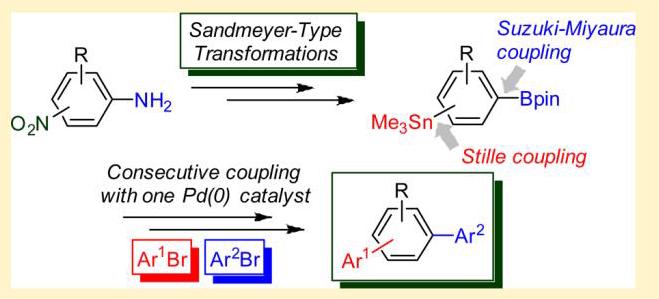
ABSTRACT: A synthetic method based on Sandmeyer-type reactions to access both tin- and boron-substituted arenes from nitroaniline derivatives is described. This transformation can be applied to the synthesis of a series of functionalized trimethylstannyl arylboronates. In addition, the chemoselective reaction of the Stille and Suzuki-Miyaura cross-coupling reactions is explored, and a series of $m$ - and $p$ -terphenyl derivatives have been synthesized by conducting consecutive one-pot Stille and Suzuki-Miyaura cross-coupling reactions.
I INTRODUCTION
The transition-metal-catalyzed cross-coupling reaction has been well-established as a powerful method for the formation of $\mathrm{C} -$ C bonds. ${}^{1}$ In particular, the Stille ${}^{2}$ and Suzuki-Miyaura ${}^{3}$ cross-coupling reactions have shown widespread applications in natural product synthesis, medicinal chemistry, organic materials, and other fields. To further explore the synthetic applications of transition-metal-catalyzed coupling reactions, the iterative cross-coupling reactions have attracted attention in recent years. This strategy, which explores the different reactivities of electrophilic and nucleophilic cross-coupling partners, allows for multiple C-C bond formations in a “controlled” manner to rapidly construct functional molecules with complex structures. ${}^{4}$
In general, the relative reactivity of different electrophilic coupling partners decreases in the order of I > OTf > Br ≫ Cl. ${}^{3\mathrm{c}}$ Based on this order, some electrophile-selective cross-coupling reactions have been reported. ${}^{5}$ In contrast, nucleophile-selective cross-coupling reactions have rarely been developed, presumably due to the difficulty in accessimg the substrates containing multiple nucleophilic coupling sites. ${}^{6}$ To date, there are only a few examples in which the synthesis of aryl compounds containing both tin and boron substituents in the same aromatic ring and their applications in stepwise chemoselective cross-coupling reactions have been reported. ${}^{6a}$ Consequently, the development of a practical synthetic method for stannyl arylboronates is the linchpin in this area.
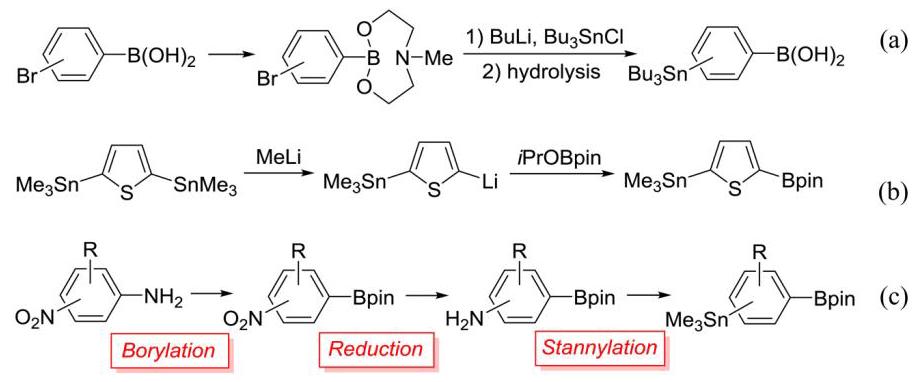
The reported synthetic methods for both tin- and boron-substituted benzene and thiophene start from bromophenyl boronic acid ${}^{6\mathrm{a}}$ and bis(stannyl) thiophene, ${}^{6\mathrm{\;b},\mathrm{\;d}}$ respectively (Scheme 1, paths a and b). Both of these routes involve lithiation under cryogenic reaction conditions, followed by nucleophilic attack to tin or boron electrophiles. The drawbacks of these two methods are (1) the use of much valued starting materials, (2) the need for protection and deprotection steps in some cases, and (3) the use of lithium reagents, which results in low functional-group compatibility. Inspired by our recently reported metal-free approaches toward arylboronate and arylstannane syntheses, ${}^{7,8}$ we envisaged that stannyl arylboro-nates could be accessed by simple combination of two Sandmeyer-type transformations ${}^{9,{10}}$ by starting from diamino arenes or their surrogates. In view of the operational simplicity, we chose nitro-substituted anilines as the starting materials, which are in many cases inexpensive and commercially available. Our previous study has shown that the conversion of the amino group of nitro-substituted aniline into a boronate group is highly efficient. ${}^{7}$ Moreover, the reaction conditions for nitro reduction are expected compatible with boronate substituents. Thus, a new synthetic scenario has been conceived as shown in Scheme 1(c).
I RESULTS AND DISCUSSION
We started our investigation by first converting a series of nitro anilines into nitro arylboronates by our previously reported methodology. ${}^{7\mathrm{a},\mathrm{b}}$ As shown in Scheme 2, the metal-free borylation proceeded smoothly at room temperature in moderate to good yields (49-86%) on gram scale. A broad range of functional groups, including halogen and cyano groups, which are not compatible with the lithium reagent in previously reported lithiation-based methods, ${}^{6}$ are tolerated in this transformation. In addition, it is noteworthy to point out that the yield of some ortho-substituted anilines was improved as compared to our previous studies, ${}^{7\mathrm{a},\mathrm{b}}$ most likely due to the nitro group substituted on the para position (2c-g).
Received: November 25, 2013
Published: February 13, 2014
Scheme 1. Synthesis of Tin- and Boron-Substituted Arenes
Scheme 2. Metal-Free Borylation of Nitro Anilines ${}^{a}$
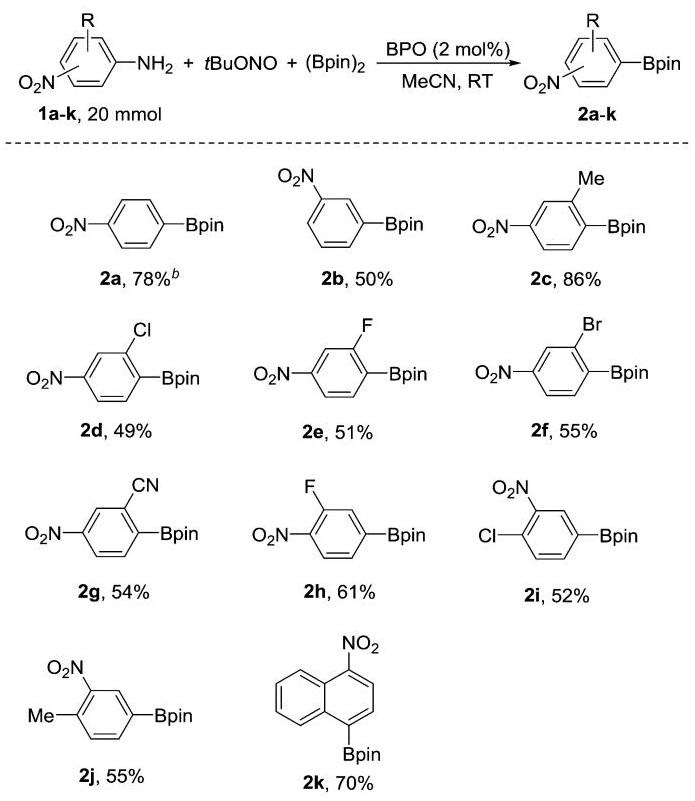
${}^{a}$ Reaction conditions: arylamine (20 mmol), $t$ -BuONO (30 mmol,1.5 equiv), (Bpin) ${}_{2}$ (20 mmol,1 equiv), BPO (0.4 mmol,2 mol %), $\mathrm{{MeCN}}\left( {{50}\mathrm{\;{mL}}}\right)$ , room temperature, $4\mathrm{\;h}.{}^{b}$ Isolated yield.
The purified nitro arylboronates $2\mathbf{a} - \mathbf{k}$ were then converted to the amino-substituted arylboronates by Pd-catalyzed hydrogenation (Scheme 3). In general, the amino-substituted arylboronates were isolated in good to excellent yields. Low yields observed for bromo- or chloro-substituted substrates (3d, f, i) in the hydrogenation reaction could be improved by changing the solvent to DCE (1,2-dichloroethane). Under the hydrogenation conditions, the reduction of the cyano group was observed, which resulted in a lower yield of product 3g.
Subsequently, typical Sandmeyer-type stannylation conditions converted the boron-substituted aniline derivatives 3a-k to the corresponding stannylation products $4\mathbf{a} - \mathbf{k}$ in moderate to good yields (Scheme 4). Compared with $p$ -boron-substituted anilines, the meta-substituted substrate afforded the stannyla-tion product in slightly lower yield (4b). The low yield of 4i might be due to the steric bulkiness of the $o$ -chloro substituent. Similarly, the substrate with methyl in the ortho position (3j) only gave a trace of stannylation product. In the case of $3\mathrm{k}$ , the hydrodeamination occurred and the expected product was not produced. Thus, in these cases, instead of the stannylation we have carried out borylation, and the corresponding diboronates were obtained in moderate yields (4i’, j, k).
Scheme 3. Reduction of Nitro-Substituted Arylboronic Esters ${}^{a}$
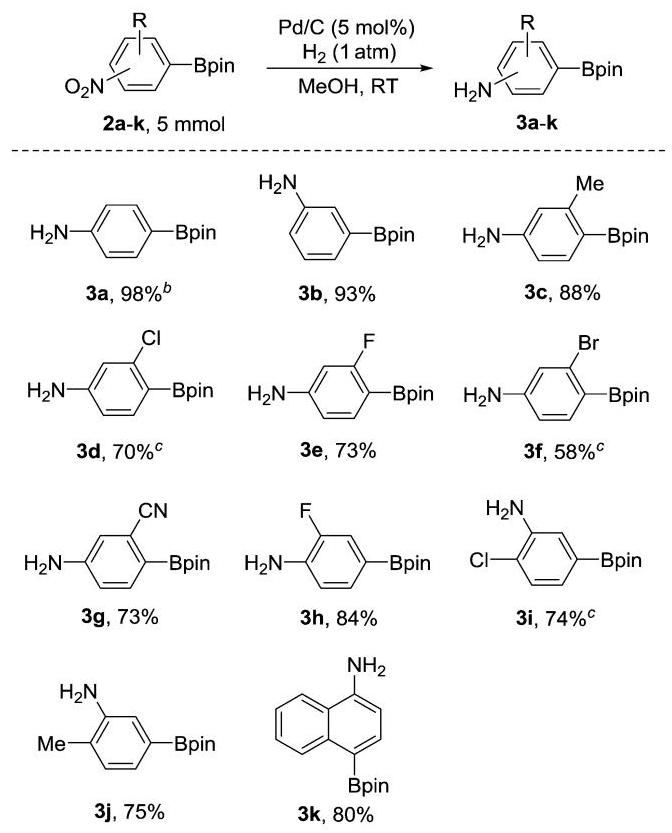
${}^{a}$ Reaction conditions: nitro arylboronates $2\mathrm{a} - \mathrm{k}\left( {5\mathrm{{mmol}}}\right) ,\mathrm{{Pd}}/\mathrm{C}$ (0.25 mmol, 5 mol %), ${\mathrm{H}}_{2}$ (1 atm, balloon), MeOH (25 mL), room temperature,4 h. ${}^{b}$ Isolated yield. ${}^{c}$ 1,2-Dichloroethane used as the solvent $\left( {{25}\mathrm{\;{mL}}}\right)$ .
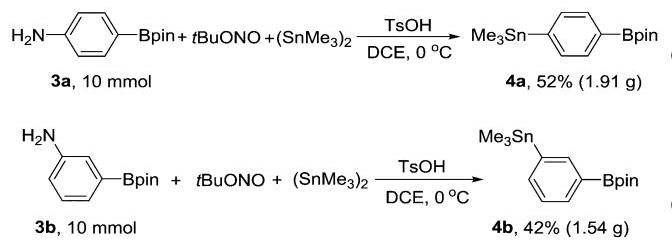
To demonstrate the practical application of this synthetic method, we have conducted gram-scale experiments, with substrates 3a and 3b as examples. As shown in eqs 1 and 2, the
Scheme 4. Stannylation and Borylation of Boron-Substituted Aniline Derivatives $3\mathrm{a} - {\mathrm{k}}^{a, b}$
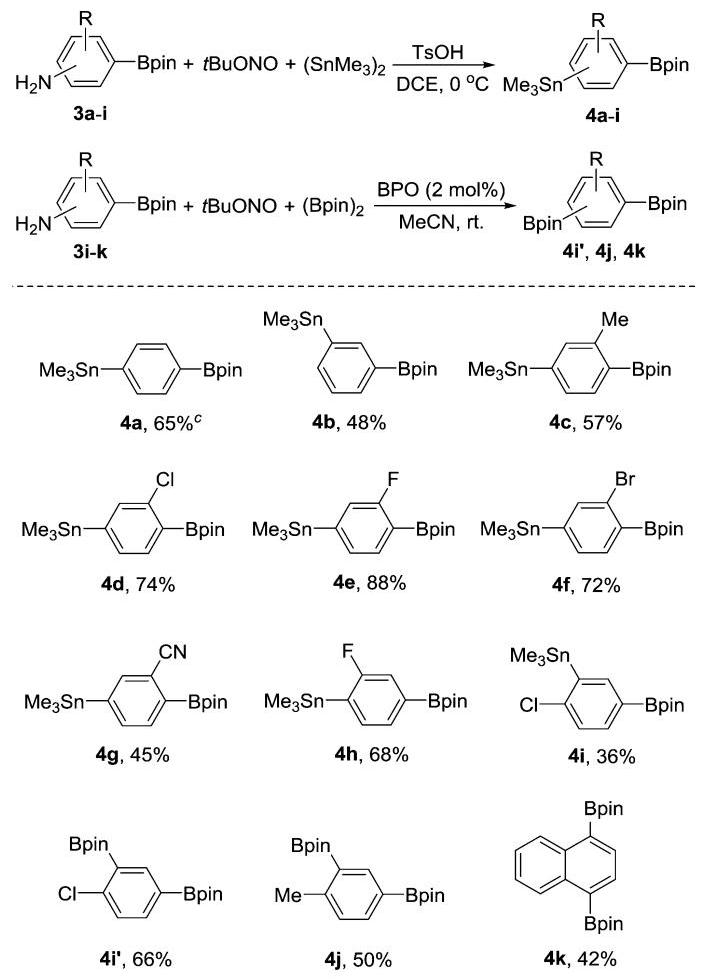
${}^{a}$ For stannylation reaction conditions: boron-substituted arylamine (0.3 mmol), t-BuONO (0.36 mmol, 1.2 equiv), (SnMe ${}_{3}$ ), (0.33 mmol, 1.1 equiv), TsOH (0.36 mmol, 1.2 equiv), DCE (1.5 mL), 0°C, 4 h. ${}^{b}$ For borylation reaction conditions: boron-substituted arylamine (0.3 mmol), t-BuONO (0.45 mmol, 1.5 equiv), (Bpin) (0.33 mmol, 1.1 equiv), BPO (0.006 mmol, 2 mol %), MeCN (1 mL), room temperature, $4\mathrm{\;h}$ . ZIsolated yield.
gram-scale stannylation reactions afforded the corresponding products $4\mathbf{a}$ and $4\mathbf{b}$ in moderate yields, respectively.
(1) (2)
With these stannyl arylboronate compounds in hand, we then turned our attention to investigate the chemoselective reactivity of 4a under Stille cross-coupling reaction conditions. By using a series of aryl bromides as electrophilic coupling partners, the corresponding biphenyl boronates were obtained in good to excellent yields (Scheme 5). This coupling reaction has good tolerance to both electron-donating (5f) and electron-withdrawing groups (5a-e) on the aromatic rings of aryl bromides. Furthermore, heteroaromatic halides were also subjected to this reaction with good results (5i, j).
Scheme 5. Stille Cross-Coupling Reaction with $4{\mathrm{a}}^{a}$
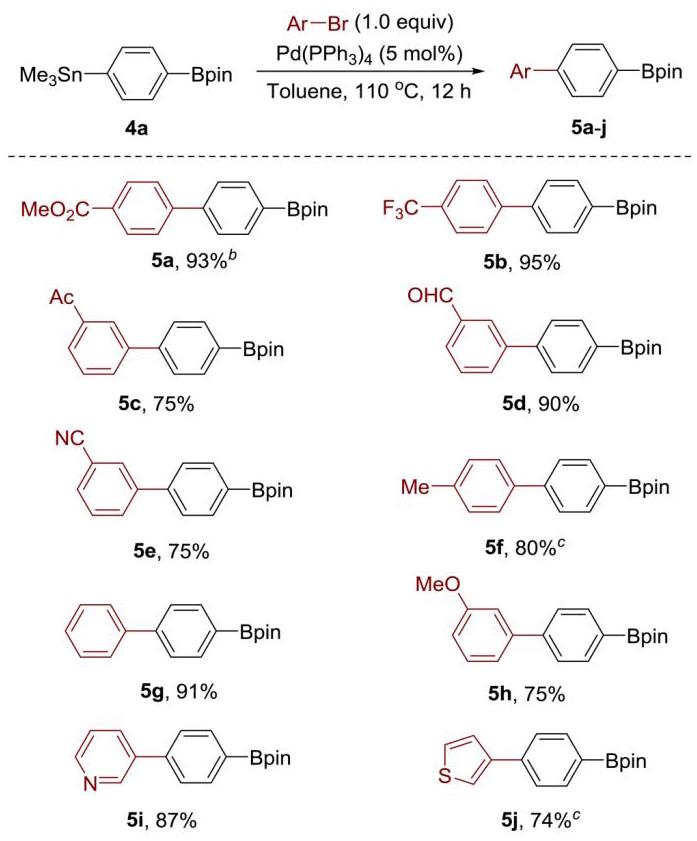
${}^{a}$ Reaction condition: 4a (0.5 mmol), ArBr (0.5 mmol,1.0 equiv), $\mathrm{{Pd}}{\left( {\mathrm{{PPh}}}_{3}\right) }_{4}\left( {{0.025}\mathrm{{mmol}},5\mathrm{\;{mol}}\% }\right)$ , toluene $\left( {3\mathrm{\;{mL}}}\right) ,{110}{}^{ \circ }\mathrm{C},{12}\mathrm{\;h}$ . ${}^{b}$ Isolated yield. ${}^{c}$ Reaction condition: 4a ( ${0.5}\mathrm{{mmol}}$ ), $\mathrm{{ArBr}}$ ( ${0.5}\mathrm{{mmol}}$ , 1.0 equiv), $\mathrm{{Pd}}{\left( \mathrm{{OAc}}\right) }_{2}\left( {{0.025}\mathrm{{mmol}},5\mathrm{\;{mol}}\% }\right) ,\mathrm{P}{\left( o\text{ -tol }\right) }_{3}({0.1}\mathrm{{mmol}},{20}$ mol %), toluene $\left( {3\mathrm{\;{mL}}}\right) ,{110}^{ \circ }\mathrm{C},{12}\mathrm{\;h}$ .
Similarly, we have taken $m$ -tin-substituted arylboronate 4b as the substrate and performed the chemoselective Stille cross-coupling reaction with aryl bromides (Scheme 6). In all cases of aryl (6a-c), thiophenic (6d), and pyridine halides (6e), the coupling reaction afforded the corresponding biphenyl products in high yields, with the retention of the boron group.
Finally, to further demonstrate the usefulness of stannyl arylboronates, we carried out consecutive one-pot cross-coupling reactions to synthesize $m$ -terphenyl and $p$ -terphenyl compounds by using 4a and 4b as the coupling partners (Scheme 7). ${}^{7c}$ Thus, the Stille cross-coupling was first performed with $\mathrm{{Pd}}{\left( {\mathrm{{PPh}}}_{3}\right) }_{4}$ catalyst and ArBr. Upon completion of the Stille coupling, Suzuki-Miyaura coupling was performed with ${\mathrm{{Ar}}}^{\prime }\mathrm{{Br}}$ and the same $\mathrm{{Pd}}\left( 0\right)$ catalyst, without purification of the intermediates. This one-pot coupling reaction afforded $m$ - terphenyl (7a-e) and p-terphenyl derivatives (7f-j) in moderate to good yields (Scheme 7).
CONCLUSION
In summary, we have developed a synthetic method for arene derivatives bearing both tin and boron substituents by a two sequential Sandmeyer-type transformations. This approach is under transition-metal-free conditions and affords highly functionalized building blocks for cross-coupling reactions in three steps from commercially available starting materials. These stannyl arylboronates can be subjected to chemoselective Stille coupling reactions with good to excellent yields. As shown by the one-pot synthesis of $p$ -terphenyl and $m$ -terphenyl derivatives bearing various functional groups, the stannyl arylboronates are highly useful in organic synthesis.
Scheme 6. Stille Cross-Coupling Reaction with $4{\mathrm{\;b}}^{a}$
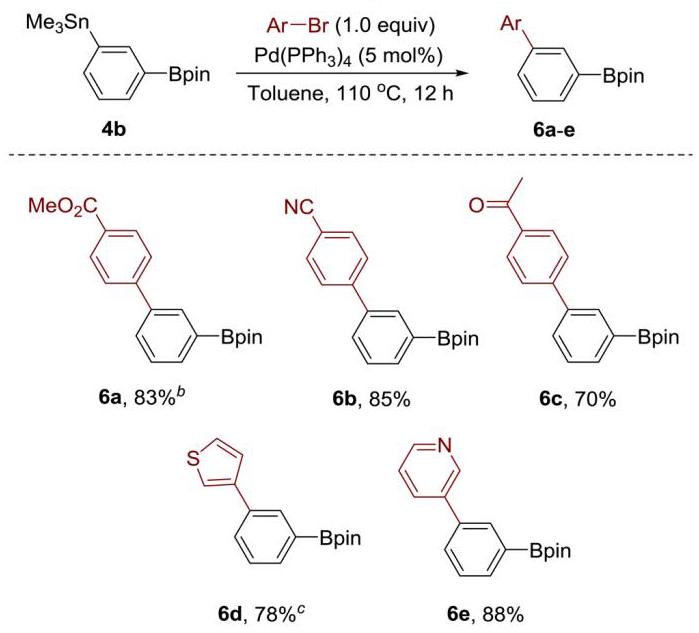
${}^{a}$ Reaction conditions: 4b (0.5 mmol), ArBr (0.5 mmol,1.0 equiv), $\mathrm{{Pd}}{\left( {\mathrm{{PPh}}}_{3}\right) }_{4}\left( {{0.025}\mathrm{{mmol}},5\mathrm{\;{mol}}\% }\right)$ , toluene $\left( {3\mathrm{\;{mL}}}\right) ,{110}{}^{ \circ }\mathrm{C},{12}\mathrm{\;h}$ . ${}^{b}$ Isolated yield. ${}^{c}$ Reaction conditions: 4a (0.5 mmol), ArBr (0.5 mmol, 1.0 equiv), $\mathrm{{Pd}}{\left( \mathrm{{OAc}}\right) }_{2}\left( {{0.025}\mathrm{{mmol}},5\mathrm{\;{mol}}\% }\right) ,\mathrm{P}{\left( o - \mathrm{{tol}}\right) }_{3}({0.1}\mathrm{{mmol}},{20}$ mol %), toluene (3 mL), 110 °C, 12 h.
EXPERIMENTAL SECTION
General Methods. The solvents were all distilled prior to use. MeCN, DCE, and toluene were distilled from calcium hydride. For flash column chromatography, 200-300 mesh silica gels were used. Chemical shifts for ${}^{1}\mathrm{H}$ NMR (400 MHz) and ${}^{13}\mathrm{C}$ NMR (100 MHz) spectra are reported relative to the chemical shift of tetramethylsilane (TMS). IR spectra are reported in wavenumbers, ${\mathrm{{cm}}}^{-1}$ . For HRMS measurements, the mass analyzer is FT-ICR.
Typical Procedure for the Borylation Reactions. 4-Nitroaniline (1a, 2.76 g, 20 mmol), (Bpin) ${}_{2}\left( {{20}\mathrm{{mmol}},{5.08}\mathrm{\;g}}\right)$ , and BPO (0.4 mmol, 97 mg) were weighed in a 250 mL round-bottom flask. MeCN $\left( {{60}\mathrm{\;{mL}}}\right)$ and $t$ -BuONO $\left( {{30}\mathrm{\;{mmol}},{3.09}\mathrm{\;g}}\right)$ were then added in succession. The resulting clear reaction mixture was allowed to stir for $4\mathrm{\;h}$ at room temperature (nitrogen gas evolution completed within 1 h). The mixture was then concentrated under reduced pressure, and the crude residue was purified by silica gel flash column chromatography (petroleum ether/EtOAc = 500:1) and afforded 4,4,5,5-tetramethyl-2-(4-nitrophenyl)-1,3,2-dioxaborolane (2a) (3.88 g,78%) as a yellow solid: ${}^{7\mathrm{a}}\mathrm{{mp}} = {109} - {110}{}^{ \circ }\mathrm{C};{}^{1}\mathrm{H}$ NMR (400 MHz, ${\mathrm{{CDCl}}}_{3}$ ) $\delta$ 8.19 (d, $J = {8.8}\mathrm{\;{Hz}},2\mathrm{H}$ ),7.96 (d, $J = {8.8}\mathrm{\;{Hz}},2\mathrm{H}$ ),1.37 (s, 12H); ${}^{13}\mathrm{C}$ NMR (100 MHz, ${\mathrm{{CDCl}}}_{3}$ ) $\delta$ 149.8,135.6,122.3,84.6,24.8; IR (film) 2975,1788,1518,1363,1349,1147,860,851,697 ${\mathrm{{cm}}}^{-1}$ ; EI-MS $(m/z$ , relative intensity) 249 (M ${}^{ + }$ ,18),234 (100),163 (85),150 (43), 149 (22), 104 (22), 85 (23), 58 (46), 43 (46), 42 (59).
4,4,5,5-Tetramethyl-2-(3-nitrophenyl)-1,3,2-dioxaborolane (2b). ${}^{a}$ The typical procedure was followed, and flash column chromatography (silica gel, petroleum ether/EtOAc = 500:1) afforded 2b (2.49 g, 50%): yellow solid; mp = 74-76 °C; ${}^{1}\mathrm{H}$ NMR (400 MHz, ${\mathrm{{CDCl}}}_{3})\delta$ 8.64 $\left( {\mathrm{d}, J = {1.8}\mathrm{\;{Hz}},1\mathrm{H}}\right) ,{8.31} - {8.28}\left( {\mathrm{\;m},1\mathrm{H}}\right) ,{8.10}(\mathrm{\;d}, J = {7.6} \; \mathrm{{Hz}},1\mathrm{H}),{7.56} - {7.52}\left( {\mathrm{\;m},1\mathrm{H}}\right) ,{1.37}\left( {\mathrm{\;s},{12}\mathrm{H}}\right) ;{}^{13}\mathrm{C}\mathrm{{NMR}}\left( {{100}\mathrm{{MHz}},}\right) \; {\mathrm{{CDCl}}}_{3}$ ) $\delta$ 147.8, 140.6, 129.4, 128.7, 125.8, 84.6, 24.9; IR (film) 2980, 1530,1362,1344,1145,1123,852,694 ${\mathrm{{cm}}}^{-1}$ ; EI-MS $(m/z$ , relative intensity) 249 (M ${}^{ + }$ , 8), 234 (100), 163 (35), 150 (85), 147 (46), 121 (75), 85 (30), 57 (26).
4,4,5,5-Tetramethyl-2-(2-methyl-4-nitrophenyl)-1,3,2-dioxaboro-lane (2c). ${}^{11}$ The typical procedure was followed, and flash column chromatography (silica gel, petroleum ether/EtOAc = 100:1) afforded 2c (4.52 g, 86%) as a yellow solid: mp = 56-57°C; ${}^{1}$ H NMR (400 MHz, CDCl ${}_{3}$ ) $\delta$ 7.99 (s,1H),7.97 (d, $J = {8.2}\mathrm{\;{Hz}},1\mathrm{H}),{7.89}$ (d, $J = {8.2} \; \mathrm{{Hz}},1\mathrm{H}),{2.63}\left( {\mathrm{\;s},3\mathrm{H}}\right) ,{1.37}\left( {\mathrm{\;s},{12}\mathrm{H}}\right) ;{}^{13}\mathrm{C}$ NMR (100 MHz, ${\mathrm{{CDCl}}}_{3}$ ) $\delta$ 149.2, 146.5, 136.6, 123.8, 119.2, 84.1, 24.8, 22.0; IR (film) 2980, ${1520},{1338},{1288},{1143},{1064},{814},{721}{\mathrm{\;{cm}}}^{-1}$ . EI-MS $(m/z$ , relative intensity) 263 (M ${}^{ + }$ , 4), 248 (100), 206 (79), 177 (13), 164 (69), 117 (22), 59 (23).
Scheme 7. Consecutive One-Pot Stille and Suzuki-Miyaura Cross-Coupling Reactions ${}^{a}$
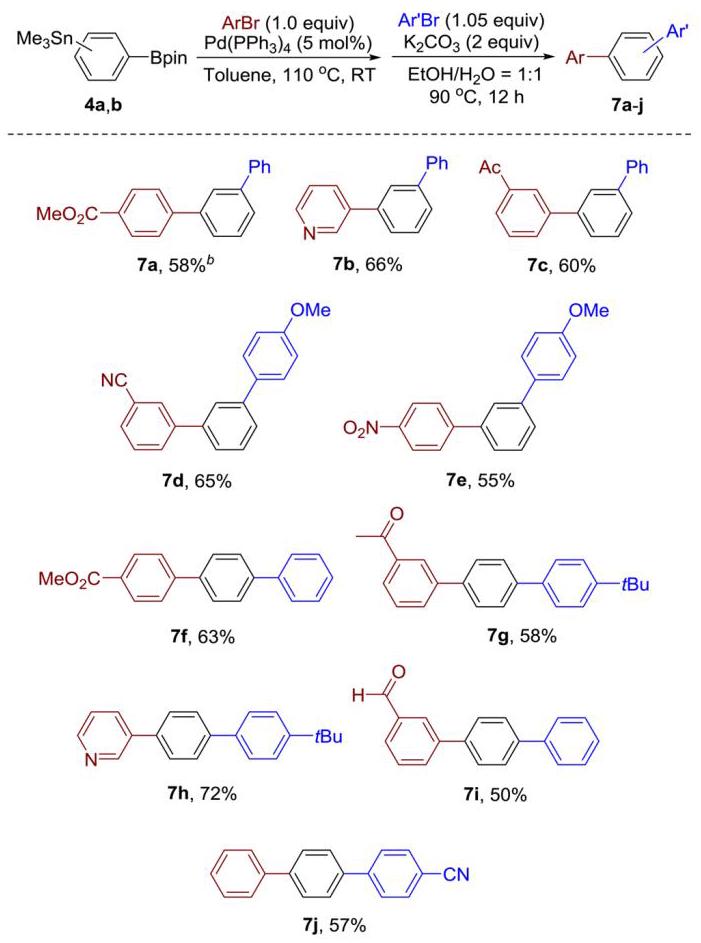
${}^{a}$ Reaction conditions for the first step: 4a or 4b (0.5 mmol), ArBr (0.5 mmol, 1.0 equiv), Pd(PPh ${}_{3}{)}_{4}\left( {{0.025}\mathrm{{mmol}},5\mathrm{\;{mol}}\% }\right)$ , toluene (3 mL), ${110}^{ \circ }\mathrm{C},{12}\mathrm{\;h}$ ; second step: Ar’Br (0.525 mmol,1.05 equiv), ${\mathrm{K}}_{2}{\mathrm{{CO}}}_{3}$ (1.0 mmol,2 equiv), $\mathrm{{EtOH}}/{\mathrm{H}}_{2}\mathrm{O}\left( {1\mathrm{\;{mL}}/1\mathrm{\;{mL}}}\right) ,{90}^{ \circ }\mathrm{C},{12}\mathrm{\;h}.{}^{b}$ Isolated yield.
2-(2-Chloro-4-nitrophenyl)-4,4,5,5-tetramethyl-1,3,2-dioxaboro-lane (2d). The typical procedure was followed, and flash column chromatography (silica gel, petroleum ether/EtOAc = 200:1) afforded 2d (2.80 g, 49%) as a yellow solid:mp =66-67°C; ${}^{1}\mathrm{H}$ NMR (400 MHz, CDCl ${}_{3}$ ) $\delta$ 8.20 (d, $J = {2.0}\mathrm{\;{Hz}},1\mathrm{H}$ ), 8.06 (dd, $J = {2.0},{8.2}\mathrm{\;{Hz}}$ , 1H), 7.85 (d, J = 8.2 Hz, 1H), 1.39 (s, 12H); ${}^{13}\mathrm{C}$ NMR (100 MHz, CDCl ${}_{3}$ ) δ 149.7, 140.5, 137.0, 124.1, 120.4, 84.9, 24.8; IR (film) 2981, 1525,1384,1341,1143,1037,890,732 ${\mathrm{{cm}}}^{-1}$ ; EI-MS $(m/z$ , relative intensity) ${283}\left( {{\mathrm{M}}^{ + },2}\right) ,{268}\left( {29}\right) ,{248}\left( {100}\right) ,{206}\left( {42}\right) ,{184}\left( {26}\right) ,{85}$ (15),59 (14); HRMS (ESI) calcd for ${\mathrm{C}}_{12}{\mathrm{H}}_{16}{\mathrm{\;B}}^{35}{\mathrm{{ClNO}}}_{4}{\left\lbrack \mathrm{M} + \mathrm{H}\right\rbrack }^{ + }$ 284.0858, found 284.0859.
2-(2-Fluoro-4-nitrophenyl)-4,4,5,5-tetramethyl-1,3,2-dioxaboro-lane (2e). ${}^{12}$ The typical procedure was followed, and flash column chromatography (silica gel, petroleum ether/EtOAc = 500:1) afforded 2e (2.72 g, 51%) as a yellow solid: mp = ${63} - {64}^{ \circ }\mathrm{C};{}^{1}\mathrm{H}$ NMR (400 MHz, CDCl ${}_{3}$ ) $\delta$ 8.00 (dd, $J = {2.0},{8.2}\mathrm{\;{Hz}},1\mathrm{H}$ ), 7.92 (dd, $J = {5.7},{8.2} \; \mathrm{{Hz}},1\mathrm{H}),{7.88}\left( {\mathrm{{dd}}, J = {2.0},{8.7}\mathrm{\;{Hz}},1\mathrm{H}}\right) ,{1.38}\left( {\mathrm{\;s},{12}\mathrm{H}}\right) ;{}^{13}\mathrm{C}\mathrm{{NMR}}({100}$ MHz, CDCl ${}_{3}$ ) $\delta$ 166.6 $\left( {\mathrm{d}, J = {255.5}\mathrm{\;{Hz}}}\right) ,{150.9}\left( {\mathrm{\;d}, J = {9.0}\mathrm{\;{Hz}}}\right) ,{137.7} \; \left( {\mathrm{d}, J = {8.7}\mathrm{\;{Hz}}}\right) ,{118.3}\left( {\mathrm{\;d}, J = {3.6}\mathrm{\;{Hz}}}\right) ,{110.9}\left( {\mathrm{\;d}, J = {29.4}\mathrm{\;{Hz}}}\right) ,{84.7}$ , 24.8; IR (film) 1726, 1529, 1416, 1346, 1143, 817, 733 cm ${}^{-1}$ ; EI-MS $\left( {m/z\text{ , relative intensity) }{267}\left( {{\mathrm{M}}^{ + },8}\right) ,{252}\left( {100}\right) ,{208}\left( {25}\right) ,{205}\left( {19}\right) }\right)$ , 183 (15), 168 (17), 121 (17), 85 (18), 59 (21).
2-(2-Bromo-4-nitrophenyl)-4,4,5,5-tetramethyl-1,3,2-dioxaboro-lane (2f). The typical procedure was followed, and flash column chromatography (silica gel, petroleum ether/EtOAc = 200:1) afforded 2f (3.64 g, 55%) as a yellow solid: mp = 61-63 ${}^{ \circ }\mathrm{C}$ ; ${}^{1}\mathrm{H}$ NMR (400 MHz, ${\mathrm{{CDCl}}}_{3}$ ) $\delta$ 8.39 (d, $J = {2.0}\mathrm{\;{Hz}},1\mathrm{H}$ ),8.11 (dd, $J = {2.0},{8.2}\mathrm{\;{Hz}}$ , 1H), ${7.77}\left( {\mathrm{\;d}, J = {8.2}\mathrm{\;{Hz}},1\mathrm{H}}\right) ,{1.40}\left( {\mathrm{\;s},{12}\mathrm{H}}\right) ;{}^{13}\mathrm{C}$ NMR (100 MHz, ${\mathrm{{CDCl}}}_{3}$ ) $\delta$ 149.4,136.8,128.1,127.2,120.8,85.1,24.8; IR (film) 2981, 1524,1373,1340,1143,1124,850,731 ${\mathrm{{cm}}}^{-1}$ ; EI-MS $\left( {m/z}\right.$ , relative intensity) 328 (M ${}^{ + }$ , 5), 312 (21), 248 (100), 228 (25), 206 (70), 160 (22),85 (22),75 (24); HRMS (ESI) calcd for ${\mathrm{C}}_{12}{\mathrm{H}}_{16}{\mathrm{\;B}}^{79}{\mathrm{{BrNO}}}_{4}$ [M + H] ${}^{ + }$ 328.0353, found 328.0363.
5-Nitro-2-(4,4,5,5-tetramethyl-1,3,2-dioxaborolan-2-yl)- benzonitrile (2g). The typical procedure was followed, and flash column chromatography (silica gel, petroleum ether/EtOAc = 100:1) afforded $2\mathrm{\;g}\left( {{2.96}\mathrm{\;g},{54}\% }\right)$ as a yellow oil: ${}^{1}\mathrm{H}$ NMR $({400}\mathrm{{MHz}}$ , ${\mathrm{{CDCl}}}_{3}){\delta 8.54}\left( {\mathrm{\;s},1\mathrm{H}}\right) ,{8.49}\left( {\mathrm{\;d}, J = {8.4}\mathrm{\;{Hz}},1\mathrm{H}}\right) ,{8.02}(\mathrm{\;d}, J = {8.4}\mathrm{\;{Hz}}$ , 1H), 1.26 (s, 12H); ${}^{13}\mathrm{C}$ NMR (100 MHz, CDCl3) δ 148.2, 137.5, 127.5, 127.2, 116.5, 114.1, 83.4, 25.0; IR (film) 2980, 2232, 1533, 1352,1143,1124,1059,909,734 ${\mathrm{{cm}}}^{-1}$ ; EI-MS $(m/z$ , relative intensity) 274 (M ${}^{ + }$ , 13), 259 (100), 233 (84), 216 (66), 186 (18), 175 (47), 129 (42), 102 (43), 59 (47); HRMS (ESI) calcd for ${\mathrm{C}}_{13}{\mathrm{H}}_{16}{\mathrm{{BN}}}_{2}{\mathrm{O}}_{4}{\left\lbrack \mathrm{M} + \mathrm{H}\right\rbrack }^{ + }{275.1200}$ , found 275.1198.
2-(3-Fluoro-4-nitrophenyl)-4,4,5,5-tetramethyl-1,3,2-dioxaboro-lane (2h). The typical procedure was followed, and flash column chromatography (silica gel, petroleum ether/EtOAc = 100:1, then 50:1) afforded $2\mathrm{\;h}\left( {{3.26}\mathrm{\;g},{61}\% }\right)$ as a yellow solid:mp $= {85} - {87}^{ \circ }\mathrm{C};{}^{1}\mathrm{H}$ NMR (400 MHz, CDCl, 5 Å 801 (t, J = 7.6 Hz, 1H), 7.70-7.69 (m, 1H), ${7.67}\left( {\mathrm{\;s},1\mathrm{H}}\right) ,{1.36}\left( {\mathrm{\;s},{12}\mathrm{H}}\right) ;{}^{13}\mathrm{C}$ NMR (100 MHz, ${\mathrm{{CDCl}}}_{3}$ ) $\delta$ 154.8 (d, $J = {265.4}\mathrm{\;{Hz}}$ ),139.0 (d, $J = {7.3}\mathrm{\;{Hz}}$ ),130.5 (d, $J = {4.4}\mathrm{\;{Hz}}$ ), 125.1 (d, $J = {2.9}\mathrm{\;{Hz}}$ ),124.1 (d, $J = {19.1}\mathrm{\;{Hz}}$ ),84.9,24.8; IR (film) 2981,1728,1595,1527,1410,1348,1143,837 ${\mathrm{{cm}}}^{-1}$ . EI-MS $(m/z$ , relative intensity) 267 (M ${}^{ + }$ , 8), 252 (100), 224 (12), 181 (73), 168 (13), 151 (10), 122 (16), 57 (20); HRMS (ESI) calcd for ${\mathrm{C}}_{12}{\mathrm{H}}_{15}{\mathrm{{BFNNaO}}}_{4}{\left\lbrack \mathrm{M} + \mathrm{{Na}}\right\rbrack }^{ + }$ 290.0973, found 290.0973.
2-(4-Chloro-3-nitrophenyl)-4,4,5,5-tetramethyl-1,3,2-dioxaboro-lane (2i). ${}^{7b}$ The typical procedure was followed, and flash column chromatography (silica gel, petroleum ether/EtOAc = 200:1, then 100:1) afforded 2i (2.95 g,52%) as a yellow liquid: ${}^{1}\mathrm{H}$ NMR (400 MHz, CDCl ${}_{3}$ ) $\delta$ 8.25 (d, $J = {1.3}\mathrm{\;{Hz}},1\mathrm{H}$ ),7.89 (dd, $J = {1.3},{8.0}\mathrm{\;{Hz}}$ , 1H), 7.54 (d, J = 8.0 Hz, 1H), 1.35 (s, 12H); ${}^{13}\mathrm{C}$ NMR (100 MHz, CDCl3) δ 147.8, 138.9, 131.3, 131.2, 129.5, 84.8, 24.8; IR (film) 2980, 2922, 1538, 1390, 1349, 1143, 1097, 852, 732 cm ${}^{-1}$ . EI-MS (m/z, relative intensity) ${283}\left( {{\mathrm{M}}^{ + },8}\right) ,{268}\left( {85}\right) ,{223}\left( {27}\right) ,{197}\left( {36}\right) ,{181}$ (77), 155 (100), 137 (31), 85 (42), 75 (39), 58 (50).
4,4,5,5-Tetramethyl-2-(4-methyl-3-nitrophenyl)-1,3,2-dioxaboro-lane (2j). The typical procedure was followed, and flash column chromatography (silica gel, petroleum ether/EtOAc = 200:1) afforded 2j (2.89 g, 55%) as a yellow solid: mp = 71-73°C; ${}^{1}$ H NMR (400 MHz, CDCl ${}_{3}$ ) δ 8.36 (s, 1H), 7.88 (d, J = 7.5 Hz, 1H), 7.33 (d, J = 7.5 Hz, 1H), 2.61 (s, 3H), 1.35 (s, 12H); ${}^{13}$ C NMR (100 MHz, CDCl3) $\delta$ 149.2, 138.8, 136.2, 132.2, 130.6, 84.4, 24.8, 20.5; IR (film) 2980, 1620, 1530, 1362, 1346, 1149, 1109, 853, 732 cm ${}^{-1}$ . EI-MS (m/z, relative intensity) 263 (M ${}^{ + }$ , 19), 248 (78), 203 (27), 177 (27), 164 (100), 147 (27), 135 (63), 117 (71); HRMS (ESI) calcd for ${\mathrm{C}}_{13}{\mathrm{H}}_{19}{\mathrm{{BNO}}}_{4}{\left\lbrack \mathrm{M} + \mathrm{H}\right\rbrack }^{ + }$ 264.1404, found 264.1398.
4,4,5,5-Tetramethyl-2-(4-nitronaphthalen-1-yl)-1,3,2-dioxaboro-lane (2k). The typical procedure was followed, and flash chromatography (silica gel, petroleum ether/EtOAc = 200:1, then 50:1) afforded 2k (4.20 g, 70%) as a orange solid: mp = 166-168 °C; ${}^{1}\mathrm{H}$ NMR (400 MHz, CDCl ${}_{3}$ ) δ 8.87 (dd, $J = {2.0},{7.5}\mathrm{\;{Hz}},1\mathrm{H}$ ),8.42 $\left( {\mathrm{{dd}}, J = {2.0},{7.6}\mathrm{\;{Hz}},1\mathrm{H}}\right) ,{8.11}\left( {\mathrm{\;d}, J = {7.6}\mathrm{\;{Hz}},1\mathrm{H}}\right) ,{8.07}(\mathrm{\;d}, J = {7.6}\mathrm{\;{Hz}}$ , 1H), 7.69-7.65 (m, 2H), 1.44 (s, 12H); ${}^{13}\mathrm{C}$ NMR (100 MHz, CDCl ${}_{3}$ ) δ 149.1, 138.0, 133.5, 128.9, 128.6, 127.6, 124.4, 122.8, 121.8, 84.5, 24.9; IR (film) 2981, 1765, 1518, 1346, 1329, 1141, 765 cm ${}^{-1}$ . EI-MS $\left( {m/z}\right.$ , relative intensity) 299 $\left( {{\mathrm{M}}^{ + },}\right.$ 100 $),{284}\left( {32}\right) ,{255}\left( {24}\right)$ , 213 (34), 196 (38), 153 (66), 141 (51), 83 (57); HRMS (ESI) calcd for ${\mathrm{C}}_{16}{\mathrm{H}}_{19}{\mathrm{{BNO}}}_{4}{\left\lbrack \mathrm{M} + \mathrm{H}\right\rbrack }^{ + }$ 300.1405, found 300.1403.
Typical Procedure for the Pd/C-Catalyzed Hydrogenation Reactions. 4,4,5,5-Tetramethyl-2-(4-nitrophenyl)-1,3,2-dioxaboro-lane (2a,5 mmol,1.245 g) and Pd/C (265 mg,0.25 mmol,[Pd/C] 10 wt %) were weighed in a ${100}\mathrm{\;{mL}}$ reaction tube. MeOH (25 mL) was then added in succession. The resulting reaction solution was stirred for $4\mathrm{\;h}$ at room temperature with a ${\mathrm{H}}_{2}$ balloon (1 atm). The reaction system was filtered through silica gel eluting with dichloromethane, and then the reaction mixture was concentrated under reduced pressure. The crude residue was purified by silica gel flash column chromatography (PE/EA = 15:1) to give 4-(4,4,5,5- tetramethyl-1,3,2-dioxaborolan-2-yl)aniline ${\left( 3a\right) }^{7b}$ in 98% isolated yield (1.071 g) as a pale yellow solid: $\mathrm{{mp}} = {148} - {150}{}^{ \circ }\mathrm{C};{}^{1}\mathrm{H}$ NMR $\left( {{400}\mathrm{{MHz}},{\mathrm{{CDCl}}}_{3}}\right) \delta$ 7.62 $\left( {\mathrm{d}, J = {7.8}\mathrm{\;{Hz}},2\mathrm{H}}\right) ,{6.65}(\mathrm{\;d}, J = {7.8}\mathrm{\;{Hz}}$ , 2H), 3.83 (br, 2H), 1.32 (s, 12H); ${}^{13}\mathrm{C}$ NMR (100 MHz, CDCl ${}_{3}$ ) 6 149.3, 136.4, 114.0, 83.2, 24.8; IR (film) 3450, 3358, 2927, 1628, 1359, ${1182},{1143},{860},{738}{\mathrm{\;{cm}}}^{-1}$ ; EI-MS $(m/z$ , relative intensity) ${219}\left( {\mathrm{M}}^{ + }\right.$ , 65), 204 (16), 161 (13), 133 (22), 120 (77), 119 (100).
3-(4,4,5,5-Tetramethyl-1,3,2-dioxaborolan-2-yl)aniline (3b). ${}^{13}$ The typical procedure was followed, and flash column chromatography (silica gel, petroleum ether/EtOAc = 15:1, then 5:1) afforded 3b (1.02 g, 93%) as a white solid:mp $= {89} - {91}{}^{ \circ }\mathrm{C};{}^{1}\mathrm{H}$ NMR (400 MHz, ${\mathrm{{CDCl}}}_{3}$ ) $\delta$ 7.22-7.16 $\left( {\mathrm{m},2\mathrm{H}}\right) ,{7.13}\left( {\mathrm{\;m},1\mathrm{H}}\right) ,{6.79} - {6.76}\left( {\mathrm{m},1\mathrm{H}}\right) ,{3.62}$ (br, 2H), 1.33 (s, 12H); ${}^{13}\mathrm{C}$ NMR (100 MHz, CDCl ${}_{3}$ ) δ 145.7, 128.7, 124.8, 121.0, 117.9, 83.6, 24.8; IR (film) 3466, 3377, 2981, 1628, 1444, 1359,1142,852,706 ${\mathrm{{cm}}}^{-1}$ ; EI-MS $(m/z$ , relative intensity) 219 $\left( {{\mathrm{M}}^{ + }\text{ , }}\right.$ 85), 204 (19), 146 (11), 133 (37), 119 (100), 92 (13).
3-Methyl-4-(4,4,5,5-tetramethyl-1,3,2-dioxaborolan-2-yl)aniline (3c). The typical procedure was followed, and flash column chromatography (silica gel, petroleum ether/EtOAc = 20:1, then 10:1) afforded 3c (1.03 g, 88%) as a yellow solid: mp $= {56} - {57}^{ \circ }\mathrm{C};{}^{1}\mathrm{H}$ NMR (400 MHz, CDCl3) δ 7.59 (d, J = 8.6 Hz, 1H), 6.46-6.44 (m, 2H), 3.73 (br, 2H), 2.45 (s, 3H), 1.30 (s, 12H); ${}^{13}\mathrm{C}$ NMR (100 MHz, ${\mathrm{{CDCl}}}_{3}$ ) $\delta$ 148.9,146.9,137.8,116.1,111.3,82.8,24.8,22.2; IR (film) 3375,2977,1601,1380,1348,1310,1146,1128,1061,860 ${\mathrm{{cm}}}^{-1}$ ; EI-MS $\left( {m/z\text{ , relative intensity) }{233}\left( {{\mathrm{M}}^{ + },{67}}\right) ,{218}\left( 9\right) ,{175}\left( {13}\right) ,{160}}\right)$ (12), 148 (10), 133 (100), 106 (10); HRMS (ESI) calcd for ${\mathrm{C}}_{13}{\mathrm{H}}_{21}{\mathrm{{BNO}}}_{2}{\left\lbrack \mathrm{M} + \mathrm{H}\right\rbrack }^{ + }{234.1662}$ , found 234.1656.
3-Chloro-4-(4,4,5,5-tetramethyl-1,3,2-dioxaborolan-2-yl)aniline (3d). The typical procedure was followed, and flash column chromatography (silica gel, petroleum ether/EtOAc = 20:1, then 10:1) afforded ${3d}\left( {{887}\mathrm{{mg}},{70}\% }\right)$ as a yellow solid: $\mathrm{{mp}} = {108} - {110}^{ \circ }\mathrm{C}$ ; ${}^{1}\mathrm{H}$ NMR (400 MHz, ${\mathrm{{CDCl}}}_{3}$ ) $\delta$ 7.52 (d, $J = {8.2}\mathrm{\;{Hz}},1\mathrm{H}$ ), ${6.63}(\mathrm{\;d}, J = \; {1.7}\mathrm{\;{Hz}},1\mathrm{H}),{6.49}\left( {\mathrm{\;{dd}}, J = {1.7},{8.2}\mathrm{\;{Hz}},1\mathrm{H}}\right) ,{3.89}\left( {\mathrm{{br}},2\mathrm{H}}\right) ,{1.33}(\mathrm{\;s}$ , 12H); ${}^{13}\mathrm{C}$ NMR (100 MHz, ${\mathrm{{CDCl}}}_{3}$ ) $\delta$ 149.9,141.1,138.2,115.3, 112.3, 83.4, 24.7; IR (film) 3381, 2979, 2925, 1601, 1352, 1311, 1142, 1107,907,732 ${\mathrm{{cm}}}^{-1}$ . EI-MS $\left( {m/z}\right.$ , relative intensity $){253}\left( {{\mathrm{M}}^{ + },{41}}\right)$ , 238 (11), 217 (25), 153 (100), 118 (8), 91 (13); HRMS (ESI) calcd for ${\mathrm{C}}_{12}{\mathrm{H}}_{18}{\mathrm{\;B}}^{35}{\mathrm{{ClNO}}}_{2}{\left\lbrack \mathrm{M} + \mathrm{H}\right\rbrack }^{ + }{254.1116}$ , found 254.1114.
3-Fluoro-4-(4,4,5,5-tetramethyl-1,3,2-dioxaborolan-2-yl)aniline (3e). ${}^{14}$ The typical procedure was followed, and flash column chromatography (silica gel, petroleum ether/EtOAc = 20:1, then 10:1) afforded 3e (861 mg, 73%) as a pale yellow solid: mp = 134- ${135}^{ \circ }\mathrm{C};{}^{1}\mathrm{H}$ NMR (400 MHz, ${\mathrm{{CDCl}}}_{3}$ ) ${\delta 7.50}\left( {\mathrm{t}, J = {7.5}\mathrm{\;{Hz}},1\mathrm{H}}\right) ,{6.40} \; \left( {\mathrm{d}, J = {8.1}\mathrm{\;{Hz}},1\mathrm{H}}\right) ,{6.29}\left( {\mathrm{\;d}, J = {11.4}\mathrm{\;{Hz}},1\mathrm{H}}\right) ,{3.95}\left( {\mathrm{{br}},2\mathrm{H}}\right) ,{1.32}(\mathrm{\;s}$ , 12H); ${}^{13}\mathrm{C}$ NMR (100 MHz, ${\mathrm{{CDCl}}}_{3}$ ) $\delta$ 168.8 (d, $J = {248.9}\mathrm{\;{Hz}}$ ),151.6 $\left( {\mathrm{d}, J = {11.5}\mathrm{\;{Hz}}}\right) ,{137.9}\left( {\mathrm{\;d}, J = {10.6}\mathrm{\;{Hz}}}\right) ,{110.2}\left( {\mathrm{\;d}, J = {1.9}\mathrm{\;{Hz}}}\right) ,{101.0}$ (d, $J = {27.6}\mathrm{\;{Hz}}$ ),83.2,24.7; IR (film) 1629,1442,1357,1329,1133, ${908},{731}{\mathrm{\;{cm}}}^{-1}$ . EI-MS $\left( {m/z}\right.$ , relative intensity $){237}\left( {\mathrm{M}}^{ + }\right.$ ,37),222 (10), 177 (10), 164 (8), 152 (11), 137 (100), 92 (9); HRMS (ESI) calcd for ${\mathrm{C}}_{12}{\mathrm{H}}_{18}{\mathrm{{BFNO}}}_{2}{\left\lbrack \mathrm{M} + \mathrm{H}\right\rbrack }^{ + }{238.1411}$ , found 238.1409.
3-Bromo-4-(4,4,5,5-tetramethyl-1,3,2-dioxaborolan-2-yl)aniline (3f). The typical procedure was followed, and flash column chromatography (silica gel, petroleum ether/EtOAc = 20:1, then 10:1) afforded 3f (860 mg, 58%) as a yellow solid: mp $= {76} - {77}^{ \circ }\mathrm{C}$ ; ${}^{1}\mathrm{H}$ NMR (400 MHz, ${\mathrm{{CDCl}}}_{3}$ ) $\delta$ 7.46 $\left( {\mathrm{d}, J = {8.1}\mathrm{\;{Hz}},1\mathrm{H}}\right) ,{6.85}(\mathrm{\;d}, J = \; {1.6}\mathrm{\;{Hz}},1\mathrm{H}),{6.54}\left( {\mathrm{{dd}}, J = {1.6},{8.1}\mathrm{\;{Hz}},1\mathrm{H}}\right) ,{3.85}\left( {\mathrm{{br}},2\mathrm{H}}\right) ,{1.33}(\mathrm{\;s}$ , 12H); ${}^{13}\mathrm{C}$ NMR (100 MHz, ${\mathrm{{CDCl}}}_{3}$ ) $\delta$ 149.7,138.2,129.6,118.7, 112.8, 83.6, 24.7; IR (film) 3372, 2979, 1599, 1352, 1310, 1142, 1104, ${733}{\mathrm{\;{cm}}}^{-1}$ ; EI-MS $\left( {m/z\text{ , relative intensity }}\right) {297}\left( {{\mathrm{M}}^{ + },{47}}\right) ,{282}\left( {12}\right) ,{218}$ (31), 197 (100), 176 (25), 118 (45), 91 (44), 57 (33); HRMS (ESI) calcd for ${\mathrm{C}}_{12}{\mathrm{H}}_{18}{\mathrm{\;B}}^{79}{\mathrm{{BrNO}}}_{2}{\left\lbrack \mathrm{M} + \mathrm{H}\right\rbrack }^{ + }{298.0610}$ , found 298.0607.
5-Amino-2-(4,4,5,5-tetramethyl-1,3,2-dioxaborolan-2-yl)- benzonitrile (3g). The typical procedure was followed, and flash column chromatography (silica gel, petroleum ether/EtOAc = 20:1, then 5:1) afforded $3\mathbf{g}\left( {{891}\mathrm{{mg}},{73}\% }\right)$ as a yellow oil: ${}^{1}\mathrm{H}$ NMR (400 MHz, CDCl ${}_{3}$ ) $\delta$ 7.65 (d, $J = {8.2}\mathrm{{Hz}},1\mathrm{H}$ ),6.93 (d, $J = {2.3}\mathrm{\;{Hz}},1\mathrm{H}$ ), ${6.80}\left( {\mathrm{{dd}}, J = {2.3},{8.2}\mathrm{\;{Hz}},1\mathrm{H}}\right) ,{4.14}\left( {\mathrm{{br}},2\mathrm{H}}\right) ,{1.35}\left( {\mathrm{\;s},{12}\mathrm{H}}\right) ;{}^{13}\mathrm{C}$ NMR (100 MHz, CDCl ${}_{3}$ ) δ 149.1, 137.5, 119.2, 118.8, 118.4, 117.4, 84.1, 24.7; IR (film) 3369, 2980, 2232, 1602, 1452, 1355, 1330, 1145, 1121, ${853}{\mathrm{\;{cm}}}^{-1}$ ; EI-MS $\left( {m/z\text{ , relative intensity }}\right) {244}\left( {{\mathrm{M}}^{ + },{50}}\right) ,{229}\left( {18}\right) ,{201}$ (65), 186 (10), 144 (100), 118 (22), 91 (17); HRMS (ESI) calcd for ${\mathrm{C}}_{13}{\mathrm{H}}_{18}{\mathrm{{BN}}}_{2}{\mathrm{O}}_{2}{\left\lbrack \mathrm{M} + \mathrm{H}\right\rbrack }^{ + }{245.1458}$ , found 245.1454.
2-Fluoro-4-(4,4,5,5-tetramethyl-1,3,2-dioxaborolan-2-yl)aniline (3h). The typical procedure was followed, and flash column chromatography (silica gel, petroleum ether/EtOAc = 20:1, then 10:1) afforded $3\mathbf{h}\left( {{995}\mathrm{{mg}},{84}\% }\right)$ as a pale yellow solid:mp $= {96} - {98} \; {}^{ \circ }\mathrm{C}$ ; ${}^{1}\mathrm{H}$ NMR (400 MHz, ${\mathrm{{CDCl}}}_{3}$ ) $\delta$ 7.41-7.39 (m, $2\mathrm{H}$ ),6.74 (t, $J = \; {8.3}\mathrm{\;{Hz}},1\mathrm{H}),{3.91}$ (br, $2\mathrm{H}),{1.32}$ (s, ${12}\mathrm{H});{}^{13}\mathrm{C}$ NMR (100 MHz, ${\mathrm{{CDCl}}}_{3}$ ) $\delta$ 151.1 (d, $J = {239.2}\mathrm{\;{Hz}}$ ),137.5 (d, $J = {12.8}\mathrm{\;{Hz}}$ ),131.5 (d, $J =$ 3.0 Hz), 121.0 (d, J = 16.4 Hz), 115.9 (d, J = 3.0 Hz), 83.6, 24.8; IR (film) 3376,2979,1629,1428,1353,1313,1142,855,730 ${\mathrm{{cm}}}^{-1}$ ; EI-MS $\left( {m/z\text{ , relative intensity) }{237}\left( {\mathrm{M}+,{53}}\right) ,{222}\left( {18}\right) ,{151}\left( {20}\right) ,{138}}\right)$ (50),137 (100),136 (20); HRMS (ESI) calcd for ${\mathrm{C}}_{12}{\mathrm{H}}_{18}{\mathrm{{BFNO}}}_{2}$ [M + H]* 238.1411, found 238.1405.
2-Chloro-5-(4,4,5,5-tetramethyl-1,3,2-dioxaborolan-2-yl)aniline (3i). The typical procedure was followed, and flash column chromatography (silica gel, petroleum ether/EtOAc = 20:1, then 10:1) afforded 3i (938 mg,74%) as a yellow oil: ${}^{1}\mathrm{H}$ NMR (400 MHz, ${\mathrm{{CDCl}}}_{3})\delta$ 7.24 $\left( {\mathrm{d}, J = {7.9}\mathrm{\;{Hz}},1\mathrm{H}}\right) ,{7.20}\left( {\mathrm{\;s},1\mathrm{H}}\right) ,{7.11}(\mathrm{\;d}, J = {7.9}\mathrm{\;{Hz}}$ , 1H), 4.00 (br, 2H), 1.33 (s, 12H); ${}^{13}\mathrm{C}$ NMR (100 MHz, CDCl3) $\delta$ 142.3, 128.8, 125.2, 122.0, 115.3, 83.9, 24.8; IR (film) 3380, 2980, 1615,1418,1356,1144,1090,853,732 ${\mathrm{{cm}}}^{-1}$ ; EI-MS $\left( {m/z\text{ , relative }}\right)$ intensity) ${253}\left( {{\mathrm{M}}^{ + },{46}}\right) ,{238}\left( {12}\right) ,{167}\left( {25}\right) ,{153}\left( {100}\right) ,{117}\left( {10}\right) ,{91}$ (15), 65 (10), 57 (14); HRMS (ESI) calcd for ${\mathrm{C}}_{12}{\mathrm{H}}_{18}{\mathrm{\;B}}^{35}{\mathrm{{ClNO}}}_{2}$ [M + H] ${}^{ + }$ 254.1116, found 254.1109.
2-Methyl-5-(4,4,5,5-tetramethyl-1,3,2-dioxaborolan-2-yl)aniline (3j). The typical procedure was followed, and flash column chromatography (silica gel, petroleum ether/EtOAc = 20:1, then 10:1) afforded ${3j}\left( {{874}\mathrm{{mg}},{75}\% }\right)$ as a pale yellow solid:mp $= {107} - {108} \; {}^{ \circ }\mathrm{C};{}^{1}\mathrm{H}$ NMR (400 MHz, ${\mathrm{{CDCl}}}_{3}$ ) $\delta$ 7.16 (d, $J = {7.3}\mathrm{\;{Hz}},1\mathrm{H}$ ),7.11 (s, 1H), 7.06 (d, J = 7.3 Hz, 1H), 3.46 (br, 2H), 2.17 (s, 3H), 1.32 (s, 12H); ${}^{13}\mathrm{C}$ NMR (100 MHz, ${\mathrm{{CDCl}}}_{3}$ ) $\delta$ 144.0,129.9,125.8,125.2, 121.0, 83.5, 24.8, 17.5; IR (film) 3422, 3353, 2978, 1380, 1353, 1140, 856,686 ${\mathrm{{cm}}}^{-1}$ ; EI-MS $\left( {m/z}\right.$ , relative intensity $){233}\left( {{\mathrm{M}}^{ + },{100}),{218}}\right.$ (14), 174 (10), 160 (20), 147 (36), 133 (95), 132 (70), 106 (12); HRMS (ESI) calcd for ${\mathrm{C}}_{13}{\mathrm{H}}_{21}{\mathrm{{BNO}}}_{2}{\left\lbrack \mathrm{M} + \mathrm{H}\right\rbrack }^{ + }{234.1662}$ , found 234.1655.
4-(4,4,5,5-Tetramethyl-1,3,2-dioxaborolan-2-yl)naphthalen-1- amine (3k). The typical procedure was followed, and flash column chromatography (silica gel, petroleum ether/EtOAc = 20:1, then 10:1) afforded 3k (1.08 g, 80%) as a pink solid: mp = 142-143 °C; ${}^{1}\mathrm{H}$ NMR (400 MHz, CDCl ${}_{3}$ ) $\delta$ 8.80 (d, $J = {8.4}\mathrm{\;{Hz}},1\mathrm{H}$ ),7.93 (d, $J = {7.5} \; \mathrm{{Hz}},1\mathrm{H}),{7.76}\left( {\mathrm{\;d}, J = {8.4}\mathrm{\;{Hz}},1\mathrm{H}}\right) ,{7.50}\left( {\mathrm{t}, J = {7.5}\mathrm{\;{Hz}},1\mathrm{H}}\right) ,{7.41}(\mathrm{t}, J =$ 7.5 Hz, 1H), 6.73 (d, J = 7.5 Hz, 1H), 4.32 (br, 2H), 1.38 (s, 12H); ${}^{13}\mathrm{C}$ NMR (100 MHz, ${\mathrm{{CDCl}}}_{3}$ ) δ 145.4,138.2,137.2,129.2,126.4, 124.4, 123.0, 120.5, 108.6, 83.2, 24.9; IR (film) 3379, 2979, 1335, 1291,1271,1125,856,762 ${\mathrm{{cm}}}^{-1}$ ; EI-MS $(m/z$ , relative intensity) 269 $\left( {{\mathrm{M}}^{ + },{100}}\right) ,{254}\left( 3\right) ,{210}\left( {10}\right) ,{196}\left( {40}\right) ,{184}\left( 8\right) ,{169}\left( {85}\right) ,{141}\left( {23}\right) , \; {127}\left( {14}\right) ,{115}\left( {23}\right)$ ; HRMS (ESI) calcd for ${\mathrm{C}}_{16}{\mathrm{H}}_{21}{\mathrm{{BNO}}}_{2}{\left\lbrack \mathrm{M} + \mathrm{H}\right\rbrack }^{ + }$ 270.1663, found 270.1660.
Typical Procedure for the Stannylation Reactions. Under a nitrogen atmosphere, 4-(4,4,5,5-tetramethyl-1,3,2-dioxaborolan-2-yl)- aniline (3a,0.3 mmol,66 mg) and $\mathrm{{TsOH}} \cdot {\mathrm{H}}_{2}\mathrm{O}\left( {{0.36}\mathrm{{mmol}},{68}\mathrm{{mg}}}\right)$ were weighed in a ${10}\mathrm{\;{mL}}$ reaction tube. DCE (1.5 mL), $t$ -BuONO $\left( {{0.36}\mathrm{{mmol}},{37}\mathrm{{mg}}}\right)$ , and ${\left( {\mathrm{{SnMe}}}_{3}\right) }_{2}\left( {{0.33}\mathrm{{mmol}},{108}\mathrm{{mg}},{68\mu }\mathrm{L}}\right)$ were then added in succession. The resulting reaction solution was stirred for $4\mathrm{\;h}$ at $0{}^{ \circ }\mathrm{C}$ . The reaction mixture was then concentrated under reduced pressure, and the crude residue was purified by flash chromatography (PE/EA = 100:1). Trimethyl(4-(4,4,5,5-tetramethyl- 1,3,2-dioxaborolan-2-yl)phenyl)stannane ${\left( 4a\right) }^{7c}$ was obtained $({71}\mathrm{{mg}}$ , 65%) as a pale yellow oil: ${}^{1}\mathrm{H}$ NMR (400 MHz, CDCl3) $\delta$ 7.76 (d, $J = \; {7.5}\mathrm{\;{Hz}},2\mathrm{H}),{7.51}\left( {\mathrm{\;d}, J = {7.6}\mathrm{\;{Hz}},2\mathrm{H}}\right) ,{1.34}\left( {\mathrm{\;s},{12}\mathrm{H}}\right) ,{0.28}\left( {\mathrm{\;s},9\mathrm{H}}\right) ;{}^{13}\mathrm{C}$ NMR (100 MHz, CDCl3) δ 146.6, 135.2, 134.0, 83.6, 24.8, -9.6; IR (film) 2980,1594,1359,1144,1056,908,859,732 ${\mathrm{{cm}}}^{-1}$ ; EI-MS $(m/z$ , relative intensity) 368 $\left( {{\mathrm{M}}^{ + },1}\right) ,{353}\left( {100}\right) ,{352}\left( {59}\right) ,{351}\left( {82}\right) ,{350}$ (48), 349 (50), 323 (11), 253 (10), 223 (11).
Trimethyl(3-(4,4,5,5-tetramethyl-1,3,2-dioxaborolan-2-yl)- phenyl)stannane (4b). The typical procedure was followed, and flash column chromatography (silica gel, petroleum ether/EtOAc = 100:1) afforded 4b ( ${53}\mathrm{{mg}},{48}\%$ ) as a yellow liquid: ${}^{1}\mathrm{H}$ NMR (400 MHz, ${\mathrm{{CDCl}}}_{3}){\delta 7.93}\left( {\mathrm{\;s},1\mathrm{H}}\right) ,{7.76}\left( {\mathrm{\;d}, J = {7.4}\mathrm{\;{Hz}},1\mathrm{H}}\right) ,{7.59}(\mathrm{\;d}, J = {7.4}\mathrm{\;{Hz}}$ , 1H), 7.37-7.33 (m, 1H), 1.35 (s, 12H), 0.29 (s, 9H); ${}^{13}\mathrm{C}$ NMR (100 MHz, CDCl ${}_{3}$ ) $\delta$ 142.1, 141.4, 138.7, 134.7, 127.4, 83.7, 24.8, -9.5; IR (film) 2980, 2361, 1588, 1354, 1310, 1145, 1096, 910, 862, 753 cm ${}^{-1}$ ; EI-MS $\left( {m/z\text{ , relative intensity) 368 (M }{}^{ + },2}\right) ,{353}$ (100),351 (80),349 (48), 323 (12), 265 (5), 253 (11), 237 (5), 223 (13); HRMS (ESI) calcd for ${\mathrm{C}}_{14}{\mathrm{H}}_{22}{\mathrm{{BO}}}_{2}{}^{120}\mathrm{{Sn}}{\left\lbrack \mathrm{M} - {\mathrm{{CH}}}_{3}\right\rbrack }^{ + }$ 353.0734, found 353.0729.
Trimethyl(3-methyl-4-(4,4,5,5-tetramethyl-1,3,2-dioxaborolan-2- yl)phenyl)stannane (4c). The typical procedure was followed, and flash column chromatography (silica gel, petroleum ether, then petroleum ether/EtOAc = 100:1) afforded 4c (65 mg, 57%) as a yellow solid: $\mathrm{{mp}} = {92} - {94}^{ \circ }\mathrm{C};{}^{1}\mathrm{H}$ NMR (400 MHz, ${\mathrm{{CDCl}}}_{3}$ ) $\delta$ 7.72 (d, $J = {7.3}\mathrm{\;{Hz}},1\mathrm{H}),{7.31} - {7.29}\left( {\mathrm{\;m},2\mathrm{H}}\right) ,{2.53}\left( {\mathrm{\;s},3\mathrm{H}}\right) ,{1.33}\left( {\mathrm{\;s},{12}\mathrm{H}}\right) ,{0.27}$ (s, 9H); ${}^{13}\mathrm{C}$ NMR (100 MHz, CDCl ${}_{3}$ ) δ 145.9, 144.0, 137.3, 135.1, 132.2, 83.3, 24.9, 22.2, -9.7; IR (film) 2979, 1587, 1373, 1344, 1313, 1145,1060,909,792 ${\mathrm{{cm}}}^{-1}$ ; EI-MS $\left( {m/z\text{ , relative intensity }}\right) {367}(\lbrack \mathrm{M} -$ 15] ${}^{ + }$ ,100),337 (13),267 (15),235 (17),207 (6),134 (10),117 (8), 57 (9); HRMS (ESI) calcd for ${\mathrm{C}}_{16}{\mathrm{H}}_{27}{\mathrm{{BNaO}}}_{2}{}^{120}\mathrm{{Sn}}{\left\lbrack \mathrm{M} + \mathrm{{Na}}\right\rbrack }^{ + }$ 405.1024, found 405.1013.
(3-Chloro-4-(4,4,5,5-tetramethyl-1,3,2-dioxaborolan-2-yl)- phenyl)trimethylstannane (4d). The typical procedure was followed, and flash column chromatography (silica gel, petroleum ether, then petroleum ether/EtOAc = 50:1) afforded 4d (89 mg, 74%) as a yellow solid: $\mathrm{{mp}} = {67} - {69}^{ \circ }\mathrm{C};{}^{1}\mathrm{H}$ NMR (400 MHz, ${\mathrm{{CDCl}}}_{3}$ ) ${\delta 7.65}\left( {\mathrm{\;d}, J = {7.1}}\right. \; \mathrm{{Hz}},1\mathrm{H}),{7.47}\left( {\mathrm{\;s},1\mathrm{H}}\right) ,{7.35}\left( {\mathrm{\;d}, J = {7.1}\mathrm{\;{Hz}},1\mathrm{H}}\right) ,{1.39}\left( {\mathrm{\;s},{12}\mathrm{H}}\right) ,{0.32}(\mathrm{\;s}$ , 9H); ${}^{13}\mathrm{C}$ NMR (100 MHz, ${\mathrm{{CDCl}}}_{3}$ ) $\delta$ 148.0,139.5,136.2,135.7, 133.0, 84.0, 24.8, -9.5; IR (film) 2980, 1583, 1366, 1344, 1320, 1143, 1037,908,733 ${\mathrm{{cm}}}^{-1}$ ; EI-MS $\left( {m/z}\right.$ , relative intensity $){387}({\left\lbrack \mathrm{M} - {15}\right\rbrack }^{ + }$ , 100), 385 (75), 384 (38), 287 (10), 257 (7), 165 (7), 135 (8); HRMS (ESI) calcd for ${\mathrm{C}}_{15}{\mathrm{H}}_{24}{\mathrm{\;B}}^{35}{\mathrm{{ClNaO}}}_{2}{}^{120}\mathrm{{Sn}}{\left\lbrack \mathrm{M} + \mathrm{{Na}}\right\rbrack }^{ + }{425.0470}$ , found 425.0481.
(3-Fluoro-4-(4,4,5,5-tetramethyl-1,3,2-dioxaborolan-2-yl)phenyl)- trimethylstannane (4e). The typical procedure was followed, and flash column chromatography (silica gel, petroleum ether/EtOAc = 50:1) afforded 4e (102 mg,88%) as a yellow solid: $\mathrm{{mp}} = {64} - {65}{}^{ \circ }\mathrm{C}$ ; ${}^{1}\mathrm{H}$ NMR (400 MHz, ${\mathrm{{CDCl}}}_{3}$ ) $\delta$ 7.73-7.70 (m,1H),7.27 (d, $J = {7.6} \; \mathrm{{Hz}},1\mathrm{H}),{7.19}\left( {\mathrm{\;d}, J = {8.6}\mathrm{\;{Hz}},1\mathrm{H}}\right) ,{1.38}\left( {\mathrm{\;s},{12}\mathrm{H}}\right) ,{0.33}\left( {\mathrm{\;s},9\mathrm{H}}\right) ;{}^{13}\mathrm{C}$ NMR (100 MHz, CDCl ${}_{3}$ ) δ 166.7 (d, J = 255.4 Hz), 150.0 (d, J = 3.8 $\mathrm{{Hz}}),{135.9}\left( {\mathrm{\;d}, J = {6.6}\mathrm{\;{Hz}}}\right) ,{130.9}\left( {\mathrm{\;d}, J = {3.2}\mathrm{\;{Hz}}}\right) ,{122.1}(\mathrm{\;d}, J = {20.5}$ Hz), 83.8, 24.8, -9.5; IR (film) 2980, 1728, 1605, 1384, 1352, 1137, ${1054},{908},{733}{\mathrm{\;{cm}}}^{-1}$ ; EI-MS $(m/z$ , relative intensity) ${371}\left( {\left\lbrack \mathrm{M} - {15}\right\rbrack }^{ + }\right.$ , 100), 341 (9), 271 (10), 241 (10), 165 (9), 134 (11); HRMS (ESI) calcd for ${\mathrm{C}}_{15}{\mathrm{H}}_{25}{\mathrm{{BFO}}}_{2}{}^{120}\mathrm{{Sn}}{\left\lbrack \mathrm{M} + \mathrm{H}\right\rbrack }^{ + }$ 387.0953, found 387.0961.
(3-Bromo-4-(4,4,5,5-tetramethyl-1,3,2-dioxaborolan-2-yl)- phenyl)trimethylstannane (4f). The typical procedure was followed, and flash column chromatography (silica gel, petroleum ether/EtOAc = 50:1) afforded 4f (96mg,72%) as a yellow solid: mp = 70-71 °C; ${}^{1}\mathrm{H}$ NMR (400 MHz, ${\mathrm{{CDCl}}}_{3}$ ) $\delta$ 7.66 (s,1H),7.58 (d, $J = {7.1}\mathrm{\;{Hz}},1\mathrm{H}$ ), ${7.40}\left( {\mathrm{\;d}, J = {7.1}\mathrm{\;{Hz}},1\mathrm{H}}\right) ,{1.39}\left( {\mathrm{\;s},{12}\mathrm{H}}\right) ,{0.32}\left( {\mathrm{\;s},9\mathrm{H}}\right) ;{}^{13}\mathrm{C}\mathrm{{NMR}}$ (100 MHz, CDCl3) δ 148.2, 139.3, 135.7, 133.4, 128.6, 84.2, 24.8, -9.5; IR (film) 2980, 1578, 1363, 1344, 1319, 1144, 1027, 859, 771 cm ${}^{-1}$ ; EI-MS $\left( {m/z\text{ , relative intensity) 446 }\left( {{\mathrm{M}}^{ + },2}\right) ,{431}\left( {100}\right) ,{401}\left( 6\right) ,{331}}\right)$ (13), 301 (7), 199 (11), 165 (9), 135 (8); HRMS (ESI) calcd for ${\mathrm{C}}_{15}{\mathrm{H}}_{25}{\mathrm{\;B}}^{79}{\mathrm{{BrO}}}_{2}{}^{120}\mathrm{{Sn}}{\left\lbrack \mathrm{M} + \mathrm{H}\right\rbrack }^{ + }{447.0142}$ , found447.0155.
2-(4,4,5,5-Tetramethyl-1,3,2-dioxaborolan-2-yl)-5- (trimethylstannyl)benzonitrile (4g). The typical procedure was followed, and flash column chromatography (silica gel, petroleum ether/EtOAc = 50:1) afforded 4g (53 mg, 45%) as a yellow liquid: ${}^{1}\mathrm{H}$ NMR (400 MHz, CDCl ${}_{3}$ ) $\delta$ 7.81-7.79 (m, 2H), 7.67 (d, J = 7.9 Hz, 1H), 1.38 (s, 12H), 0.33 (s, 9H); ${}^{13}\mathrm{C}$ NMR (100 MHz, CDCl3) $\delta$ 147.3, 140.5, 138.8, 134.6, 116.7, 84.6, 24.8, -9.5; IR (film) 2930, 2228,1373,1288,1138,909,734 ${\mathrm{{cm}}}^{-1}$ ; EI-MS $(m/z$ , relative intensity) ${393}\left( {{\mathrm{M}}^{ + },2}\right) ,{378}\left( {100}\right) ,{376}\left( {75}\right) ,{374}\left( {46}\right) ,{278}\left( {10}\right) ,{245}$ (10),134 (9); HRMS (ESI) calcd for ${\mathrm{C}}_{16}{\mathrm{H}}_{25}{\mathrm{{BNO}}}_{2}{}^{120}\mathrm{{Sn}}{\left\lbrack \mathrm{M} + \mathrm{H}\right\rbrack }^{ + }$ 394.1000, found 394.1003.
(2-Fluoro-4-(4,4,5,5-tetramethyl-1,3,2-dioxaborolan-2-yl)phenyl)- trimethylstannane (4h). The typical procedure was followed, and flash column chromatography (silica gel, petroleum ether/EtOAc = 50:1) afforded 4h ( ${79}\mathrm{{mg}},{68}\%$ ) as a yellow solid: $\mathrm{{mp}} = {90} - {91}^{ \circ }\mathrm{C};{}^{1}\mathrm{H}$ NMR (400 MHz, CDCl3) δ 7.56-7.53 (m, 1H), 7.42-7.40 (m, 2H), ${1.34}\left( {\mathrm{\;s},{12}\mathrm{H}}\right) ,{0.34}\left( {\mathrm{\;s},9\mathrm{H}}\right) ;{}^{13}\mathrm{C}$ NMR (100 MHz, CDCl ${}_{3}$ ) $\delta$ 165.2 (d, $J = {234.1}\mathrm{\;{Hz}}),{131.0}\left( {\mathrm{\;d}, J = {26.5}\mathrm{\;{Hz}}}\right) ,{136.3}\left( {\mathrm{\;d}, J = {14.0}\mathrm{\;{Hz}}}\right) ,{130.1}(\mathrm{\;d}$ , $J = {2.4}\mathrm{\;{Hz}}),{119.6}\left( {\mathrm{\;d}, J = {25.6}\mathrm{\;{Hz}}}\right) ,{84.0},{24.8}, - {9.2}$ ; IR (film) 2980, 1727,1389,1355,1144,908,734 ${\mathrm{{cm}}}^{-1}$ ; EI-MS $\left( {m/z}\right.$ , relative intensity) 371 ([M - 15]*, 100), 369 (79), 368 (46), 269 (13), 225 (15),169 (13),135 (21); HRMS (ESI) calcd for ${\mathrm{C}}_{15}{\mathrm{H}}_{24}{\mathrm{{BFNaO}}}_{2}{}^{120}\mathrm{{Sn}} \; {\left\lbrack \mathrm{M} + \mathrm{{Na}}\right\rbrack }^{ + }$ 409.0772, found 409.0780.
(2-Chloro-5-(4,4,5,5-tetramethyl-1,3,2-dioxaborolan-2-yl)- phenyl)trimethylstannane (4i). The typical procedure was followed, and flash column chromatography (silica gel, petroleum ether/EtOAc = 50:1) afforded 4i (43 mg, 36%) as a yellow liquid: ${}^{1}\mathrm{H}$ NMR (400 MHz, CDCl ${}_{3}$ ) $\delta$ 7.81 (d, $J =$ 1.4 Hz, 1H), 7.68 (dd, $J =$ 1.4, 7.9 Hz, 1H), 7.32 (d, $J = {7.9}\mathrm{\;{Hz}},1\mathrm{H}$ ), 1.33 (s, 12H), 0.37 (s, 9H); ${}^{13}\mathrm{C}$ NMR $\left( {{100}\mathrm{{MHz}},{\mathrm{{CDCl}}}_{3}}\right) {\delta 146.0},{143.3},{141.8},{136.5},{127.6},{83.9},{24.8}$ , -8.3; IR (film) 2982, 1597, 1394, 1360, 1145, 1095, 734 cm ${}^{-1}$ ; EI-MS $\left( {m/z\text{ , relative intensity) }{387}\left( {{\left\lbrack \mathrm{M} - {15}\right\rbrack }^{ + },{100}}\right) ,{287}\left( {22}\right) ,{255}({17}}\right)$ , 217 (30), 185 (52), 155 (35), 135 (26), 59 (33); HRMS (ESI) calcd for ${\mathrm{C}}_{15}{\mathrm{H}}_{24}{\mathrm{\;B}}^{35}{\mathrm{{ClNaO}}}_{2}{}^{120}\mathrm{{Sn}}{\left\lbrack \mathrm{M} + \mathrm{{Na}}\right\rbrack }^{ + }{425.0470}$ , found425.0487.
2,2’-(4-Chloro-1,3-phenylene)bis(4,4,5,5-tetramethyl-1,3,2-dioxa-borolane) (4i’). The typical procedure of borylation was followed, and flash column chromatography (silica gel, petroleum ether/EtOAc = 200:1, then 50:1) afforded $4{i}^{\prime }\left( {{72}\mathrm{{mg}},{66}\% }\right)$ as a yellow solid: $\mathrm{{mp}} =$ 70-71 °C; ${}^{1}\mathrm{H}$ NMR (400 MHz, CDCl ${}_{3}$ ) $\delta$ 8.09 (d, $J = {1.7}\mathrm{\;{Hz}},1\mathrm{H}$ ), ${7.75}\left( {\mathrm{{dd}}, J = {1.7},{8.0}\mathrm{\;{Hz}},1\mathrm{H}}\right) ,{7.34}\left( {\mathrm{\;d}, J = {8.0}\mathrm{\;{Hz}},1\mathrm{H}}\right) ,{1.37}\left( {\mathrm{\;s},{12}\mathrm{H}}\right)$ , 1.34 (s, 12H); ${}^{13}\mathrm{C}$ NMR (100 MHz, CDCl ${}_{3}$ ) δ 142.8, 142.6, 138.1, 128.7, 84.1, 83.9, 24.8; IR (film) 2980, 1593, 1358, 1328, 1143, 1113, ${848},{732}{\mathrm{\;{cm}}}^{-1}$ ; EI-MS $\left( {m/z}\right.$ , relative intensity $){364}\left( {{\mathrm{M}}^{ + },{15}),{349}}\right.$ (28), 329 (100), 265 (51), 249 (30), 165 (34), 83 (36), 59 (46); HRMS (ESI) calcd for ${\mathrm{C}}_{18}{\mathrm{H}}_{28}{\mathrm{\;B}}_{2}{}^{35}{\mathrm{{ClO}}}_{4}{\left\lbrack \mathrm{M} + \mathrm{H}\right\rbrack }^{ + }{365.1864}$ , found 365.1858.
2,2’-(4-Methyl-1,3-phenylene)bis(4,4,5,5-tetramethyl-1,3,2-dioxa-borolane) (4j). The typical procedure of borylation was followed, and flash column chromatography (silica gel, petroleum ether/EtOAc = 500:1, then 100:1) afforded 4j (52 mg, 50%) as a white solid: mp = ${102} - {103}^{ \circ }\mathrm{C};{}^{1}\mathrm{H}$ NMR (400 MHz, ${\mathrm{{CDCl}}}_{3}$ ) $\delta$ 8.19 (s,1H),7.75 (d, $J = \; {7.5}\mathrm{\;{Hz}},1\mathrm{H}),{7.16}\left( {\mathrm{\;d}, J = {7.5}\mathrm{\;{Hz}},1\mathrm{H}}\right) ,{2.54}\left( {\mathrm{\;s},3\mathrm{H}}\right) ,{1.34}\left( {\mathrm{\;s},{24}\mathrm{H}}\right) ;{}^{13}\mathrm{C}$ NMR (100 MHz, CDCl ${}_{3}$ ) δ 148.2, 142.3, 137.3, 129.2, 83.6, 83.4, 24.9, 24.8, 22.5; IR (film) 2918, 1603, 1361, 1323, 1142, 908, 732 cm ${}^{-1}$ ; EI-MS $\left( {m/z\text{ , relative intensity) 344 (M }{}^{ + }\text{ ,37),329 (49),287 (100),258 }}\right)$ (31), 245 (78), 229 (57), 145 (64), 83 (41), 59 (41); HRMS (ESI) calcd for ${\mathrm{C}}_{19}{\mathrm{H}}_{31}{\mathrm{\;B}}_{2}{\mathrm{O}}_{4}{\left\lbrack \mathrm{M} + \mathrm{H}\right\rbrack }^{ + }$ 345.2409, found 345.2416.
1,4-Bis(4,4,5,5-tetramethyl-1,3,2-dioxaborolan-2-yl)naphthalene (4k). The typical procedure of borylation was followed, and flash column chromatography (silica gel, petroleum ether/EtOAc = 200:1, then 100:1) afforded 4k (48 mg, 42%) as an orange solid:mp = 162- ${163}^{ \circ }\mathrm{C};{}^{1}\mathrm{H}$ NMR (400 MHz, CDCl ${}_{3}$ ) δ 8.75 (dd, $J = {3.4},{6.4}\mathrm{\;{Hz}},2\mathrm{H}$ ), ${8.02}\left( {\mathrm{\;s},2\mathrm{H}}\right) ,{7.51}\left( {\mathrm{\;{dd}}, J = {3.4},{6.4}\mathrm{\;{Hz}},2\mathrm{H}}\right) ,{1.42}\left( {\mathrm{\;s},{24}\mathrm{H}}\right) ;{}^{13}\mathrm{C}$ NMR (100 MHz, CDCl3) δ 136.5, 134.3, 128.6, 125.8, 83.8, 24.9; IR (film) 2978, 2925, 1726, 1461, 1339, 1260, 1135, 909, 733 cm ${}^{-1}$ ; EI-MS (m/ $z$ , relative intensity) ${380}\left( {{\mathrm{M}}^{ + },{100}}\right) ,{365}\left( {13}\right) ,{295}\left( {14}\right) ,{280}\left( {24}\right) ,{265}$ (22), 194 (19), 180 (28), 101 (23), 83 (30), 59 (40); HRMS (ESI) calcd for ${\mathrm{C}}_{22}{\mathrm{H}}_{31}{\mathrm{\;B}}_{2}{\mathrm{O}}_{4}{\left\lbrack \mathrm{M} + \mathrm{H}\right\rbrack }^{ + }$ 381.2410, found 381.2408.
Typical Procedure for the Chemoselective Stille Cross-Coupling Reactions. Under a nitrogen atmosphere, trimethyl(4- (4,4,5,5-tetramethyl-1,3,2-dioxaborolan-2-yl)phenyl)stannane (4a, 0.5 mmol, 184 mg), methyl 4-bromobenzoate (0.5 mmol, 108 mg), $\mathrm{{Pd}}{\left( {\mathrm{{PPh}}}_{3}\right) }_{4}\left( {{0.025}\mathrm{{mmol}},{29}\mathrm{{mg}}}\right)$ , and toluene $\left( {3\mathrm{\;{mL}}}\right)$ were weighed in a ${10}\mathrm{\;{mL}}$ round-bottom flask. The reaction mixture was stirred for ${12}\mathrm{\;h}$ at ${110}^{ \circ }\mathrm{C}$ . The solution was then cooled down to room temperature and concentrated under reduced pressure. The crude residue was purified by silica gel flash column chromatography (petroleum ether/ EtOAc = 50:1) to give methyl 4’-(4,4,5,5-tetramethyl-1,3,2-dioxabor-olan-2-yl)biphenyl-4-carboxylate (5a) in 93% isolated yield (158 mg) as a white solid: mp 123-124 °C; ${}^{1}\mathrm{H}$ NMR (400 MHz, ${\mathrm{{CDCl}}}_{3}$ ) δ 8.10 $\left( {\mathrm{d}, J = {8.2}\mathrm{\;{Hz}},2\mathrm{H}}\right) ,{7.91}\left( {\mathrm{\;d}, J = {8.0}\mathrm{\;{Hz}},2\mathrm{H}}\right) ,{7.68}\left( {\mathrm{\;d}, J = {8.2}\mathrm{\;{Hz}},2\mathrm{H}}\right)$ , ${7.63}\left( {\mathrm{\;d}, J = {8.1}\mathrm{\;{Hz}},2\mathrm{H}}\right) ,{3.94}\left( {\mathrm{\;s},3\mathrm{H}}\right) ,{1.36}\left( {\mathrm{\;s},{12}\mathrm{H}}\right) ;{}^{13}\mathrm{C}$ NMR (100 MHz, CDCl ${}_{3}$ ) $\delta$ 166.9, 145.4, 142.5, 135.3, 130.1, 129.1, 127.1, 126.5, 83.9, 52.1, 24.9; IR (film) 2976, 1718, 1610, 1361, 1288, 1273, 1148, 1093,737 ${\mathrm{{cm}}}^{-1}$ ; EI-MS $\left( {m/z}\right.$ , relative intensity $){338}\left( {{\mathrm{M}}^{ + },{100}}\right) ,{323}$ (45), 307 (15), 252 (79), 239 (78), 207 (58), 178 (27), 152 (20); HRMS (ESI) calcd for ${\mathrm{C}}_{20}{\mathrm{H}}_{24}{\mathrm{{BO}}}_{4}{\left\lbrack \mathrm{M} + \mathrm{H}\right\rbrack }^{ + }$ 339.1766, found 339.1762.
4,4,5,5-Tetramethyl-2-(4’-(trifluoromethyl)biphenyl-4-yl)-1,3,2-di-oxaborolane (5b). The typical procedure was followed, and flash column chromatography (silica gel, petroleum ether/EtOAc = 200:1, then 50:1) afforded 5b (165 mg, 95%) as a white solid: mp = 96-98 ${}^{ \circ }\mathrm{C};{}^{1}\mathrm{H}$ NMR (400 MHz, ${\mathrm{{CDCl}}}_{3}$ ) $\delta$ 7.83 (d, $J = {8.1}\mathrm{\;{Hz}},2\mathrm{H}$ ),7.62- ${7.59}\left( {\mathrm{\;m},4\mathrm{H}}\right) ,{7.52}\left( {\mathrm{\;d}, J = {8.1}\mathrm{\;{Hz}},2\mathrm{H}}\right) ,{1.28}\left( {\mathrm{\;s},{12}\mathrm{H}}\right) ;{}^{13}\mathrm{C}$ NMR (100 MHz, ${\mathrm{{CDCl}}}_{3}$ ) $\delta$ 144.5,142.3,135.4,129.6 $\left( {\mathrm{q}, J = {32.4}\mathrm{\;{Hz}}}\right)$ ,127.5, 126.5,125.7 $\left( {\mathrm{q}, J = {3.7}\mathrm{\;{Hz}}}\right) ,{124.0}\left( {\mathrm{q}, J = {270}\mathrm{\;{Hz}}}\right) ,{83.9},{24.9}$ ; IR (film) 2980,1361,1325,1144,1126,1071,824 ${\mathrm{{cm}}}^{-1}$ ; EI-MS $(m/z$ , relative intensity) 348 (M ${}^{ + }$ , 63), 333 (48), 262 (78), 248 (100), 229 (13), 201 (9), 178 (9), 153(8); HRMS (ESI) calcd for ${\mathrm{C}}_{19}{\mathrm{H}}_{21}{\mathrm{{BF}}}_{3}{\mathrm{O}}_{2} \; {\left\lbrack \mathrm{M} + \mathrm{H}\right\rbrack }^{ + }$ 349.1585, found 349.1592.
1-(4’-(4,4,5,5-Tetramethyl-1,3,2-dioxaborolan-2-yl)biphenyl-3- yl)ethanone (5c). The typical procedure was followed, and flash column chromatography (silica gel, petroleum ether/EtOAc = 100:1, then 15:1) afforded 5c (121 mg,75%) as a yellow oil: ${}^{1}\mathrm{H}$ NMR (400 MHz, CDCl ${}_{3}$ ) δ 8.20 (s, 1H), 7.94-7.90 (m, 3H), 7.80 (d, J = 7.7 Hz, 1H), ${7.63}\left( {\mathrm{\;d}, J = {8.0}\mathrm{\;{Hz}},2\mathrm{H}}\right) ,{7.53}\left( {\mathrm{t}, J = {7.7}\mathrm{\;{Hz}},1\mathrm{H}}\right) ,{2.65}\left( {\mathrm{\;s},3\mathrm{H}}\right)$ , ${1.36}\left( {\mathrm{\;s},{12}\mathrm{H}}\right) ;{}^{13}\mathrm{C}$ NMR $\left( {{100}\mathrm{{MHz}},{\mathrm{{CDCl}}}_{3}}\right) {\delta 197.9},{142.7},{141.5}$ , 137.6, 135.3, 131.7, 129.0, 127.4, 126.9, 126.4, 83.8, 26.7, 24.8; IR (film) 2979, 1686, 1610, 1397, 1360, 1234, 1144, 1093, 733 cm ${}^{-1}$ ; EI-MS $\left( {m/z\text{ , relative intensity) }{322}\left( {{\mathrm{M}}^{ + },{100}}\right) ,{307}\left( {57}\right) ,{236}\left( {88}\right) ,{223}}\right)$ (64), 207 (77), 179 (34), 152 (22); HRMS (ESI) calcd for ${\mathrm{C}}_{20}{\mathrm{H}}_{24}{\mathrm{{BO}}}_{3} \; {\left\lbrack \mathrm{M} + \mathrm{H}\right\rbrack }^{ + }$ 323.1817, found 323.1822.
4’-(4,4,5,5-Tetramethyl-1,3,2-dioxaborolan-2-yl)biphenyl-3-car-baldehyde (5d). The typical procedure was followed, and flash column chromatography (silica gel, petroleum ether/EtOAc = 100:1, then 25:1) afforded 5d (139 mg,90%) as a yellow oil: ${}^{1}\mathrm{H}$ NMR (400 MHz, ${\mathrm{{CDCl}}}_{3})\delta$ 10.08 (s,1H),8.11 (s,1H),7.92 (d, $J = {8.1}\mathrm{\;{Hz}},2\mathrm{H}),{7.88} - \; {7.85}\left( {\mathrm{\;m},2\mathrm{H}}\right) ,{7.64}\left( {\mathrm{\;d}, J = {8.1}\mathrm{\;{Hz}},2\mathrm{H}}\right) ,{7.60}\left( {\mathrm{t}, J = {7.7}\mathrm{\;{Hz}},1\mathrm{H}}\right) ,{1.37}$ (s, 12H); ${}^{13}\mathrm{C}$ NMR (100 MHz, CDCl, 3) 6 192.2, 142.2, 141.9, 136.9, 135.4, 133.0, 129.5, 128.8, 128.2, 126.3, 83.9, 24.8; IR (film) 2978, 1700,1610,1398,1360,1144,1093,859 ${\mathrm{{cm}}}^{-1}$ ; EI-MS $(m/z$ , relative intensity) 308 (M ${}^{ + }$ , 100), 293 (52), 222 (100), 209 (81), 208 (81), 207 (67), 179 (31), 152 (24); HRMS (ESI) calcd for ${\mathrm{C}}_{19}{\mathrm{H}}_{22}{\mathrm{{BO}}}_{3}$ [M + H]* 309.1660, found 309.1661.
4’-(4,4,5,5-Tetramethyl-1,3,2-dioxaborolan-2-yl)biphenyl-3-car-bonitrile (5e). The typical procedure was followed, and flash column chromatography (silica gel, petroleum ether/EtOAc = 100:1, then 40:1) afforded 5e (115 mg,75%) as a yellow oil: ${}^{1}\mathrm{H}$ NMR (400 MHz, ${\mathrm{{CDCl}}}_{3}$ ) $\delta$ 7.92 $\left( {\mathrm{\;d}, J = {8.1}\mathrm{\;{Hz}},2\mathrm{H}}\right) ,{7.88}\left( {\mathrm{\;s},1\mathrm{H}}\right) ,{7.83}(\mathrm{\;d}, J = {7.9}\mathrm{\;{Hz}}$ , 1H), 7.63 (d, J = 7.8 Hz, 1H), 7.57 (d, J = 8.1 Hz, 2H), 7.55-7.52 (m, 1H), 1.37 (s, 12H); ${}^{13}\mathrm{C}$ NMR (100 MHz, CDCl, 3) 6 142.2, 141.3, 135.5, 131.5, 130.9, 130.7, 129.6, 126.3, 118.7, 113.0, 84.0, 24.8; IR (film) 2979, 2231, 1728, 1611, 1361, 1144, 1093, 733 cm ${}^{-1}$ ; EI-MS $\left( {m/z,\text{ relative intensity) }{305}\left( {{\mathrm{M}}^{ + },{63}}\right) ,{290}\left( {62}\right) ,{219}\left( {88}\right) ,{205}\left( {100}\right) ,}\right)$ 177 (19), 151 (11), 85 (10), 59 (100); HRMS (ESI) calcd for ${\mathrm{C}}_{19}{\mathrm{H}}_{21}{\mathrm{{BNO}}}_{2}{\left\lbrack \mathrm{M} + \mathrm{H}\right\rbrack }^{ + }{306.1663}$ , found 306.1668.
2-(Biphenyl-4-yl)-4,4,5,5-tetramethyl-1,3,2-dioxaborolane (5f). ${}^{7b}$ The typical procedure was followed, and flash column chromatography (silica gel, petroleum ether/EtOAc = 500:1, then 50:1) afforded 5f $\left( {{128}\mathrm{{mg}},{91}\% }\right)$ as a yellow solid:mp $= {104} - {106}^{ \circ }\mathrm{C};{}^{1}\mathrm{H}$ NMR (400 MHz, ${\mathrm{{CDCl}}}_{3}$ ) $\delta$ 7.89 (d, $J = {7.3}\mathrm{\;{Hz}},2\mathrm{\;H}$ ), ${7.61}\left( {\mathrm{\;d}, J = {7.0}\mathrm{\;{Hz}},4\mathrm{H}}\right)$ , ${7.43}\left( {\mathrm{t}, J = {7.2}\mathrm{\;{Hz}},2\mathrm{H}}\right) ,{7.35}\left( {\mathrm{t}, J = {7.1}\mathrm{\;{Hz}},1\mathrm{H}}\right) ,{1.36}\left( {\mathrm{\;s},{12}\mathrm{H}}\right) ;{}^{13}\mathrm{C}$ NMR (100 MHz, CDCl ${}_{3}$ ) δ 143.9, 141.0, 135.2, 128.7, 127.5, 127.2, 126.4, 83.8, 24.9; IR (film) 2978, 1609, 1398, 1360, 1144, 1092, 766, ${697}{\mathrm{\;{cm}}}^{-1}$ ; EI-MS $\left( {m/z\text{ , relative intensity) }{280}\left( {{\mathrm{M}}^{ + },{67}}\right) ,{265}\left( {21}\right) ,{194}}\right)$ (60), 181 (74), 180 (100), 152 (18).
4,4,5,5-Tetramethyl-2-(4’-methylbiphenyl-4-yl)-1,3,2-dioxaboro-lane (5g). The typical procedure was followed, and flash column chromatography (silica gel, petroleum ether/EtOAc = 500:1, then 200:1) afforded 5g (117 mg, 80%) as a pale yellow solid:mp = 93-95 ${}^{ \circ }\mathrm{C};{}^{1}\mathrm{H}$ NMR (400 MHz, CDCl ${}_{3}$ ) $\delta$ 7.87 (d, $J = {8.0}\mathrm{\;{Hz}},2\mathrm{H}$ ),7.59 (d, $J \; = {7.9}\mathrm{\;{Hz}},2\mathrm{H}),{7.52}\left( {\mathrm{\;d}, J = {7.9}\mathrm{\;{Hz}},2\mathrm{H}}\right) ,{7.24}\left( {\mathrm{\;d}, J = {7.9}\mathrm{\;{Hz}},2\mathrm{H}}\right) ,{2.39}$ (s, 3H), 1.36 (s, 12H); ${}^{13}\mathrm{C}$ NMR (100 MHz, CDCl ${}_{3}$ ) δ 143.8, 138.1, 137.3, 135.2, 129.4, 127.0, 126.2, 83.7, 24.8, 21.0; IR (film) 2978, 1609,1399,1360,1145,1092,810 ${\mathrm{{cm}}}^{-1}$ ; EI-MS $(m/z$ , relative intensity) 294 $\left( {{\mathrm{M}}^{ + },{100}}\right) ,{279}\left( {22}\right) ,{208}\left( {50}\right) ,{195}\left( {72}\right) ,{194}\left( {89}\right) ,{165}$ (22), ${152}\left( {11}\right)$ ; HRMS (ESI) calcd for ${\mathrm{C}}_{19}{\mathrm{H}}_{24}{\mathrm{{BO}}}_{2}{\left\lbrack \mathrm{M} + \mathrm{H}\right\rbrack }^{ + }$ 295.1867, found 295.1864.
2-(3’-Methoxybiphenyl-4-yl)-4,4,5,5-tetramethyl-1,3,2-dioxabor-olane (5h). The typical procedure was followed, and flash column chromatography (silica gel, petroleum ether/EtOAc = 500:1, then 100:1) afforded 5h (116mg,75%) as a white solid:mp $= {38} - {40}^{ \circ }\mathrm{C}$ ; ${}^{1}\mathrm{H}$ NMR (400 MHz, CDC ${\mathrm{I}}_{3}$ ) $\delta$ 7.88 (d, $J = {8.0}\mathrm{\;{Hz}},2\mathrm{H}$ ),7.60 (d, $J = \; {8.0}\mathrm{\;{Hz}},2\mathrm{H}),{7.35}\left( {\mathrm{t}, J = {7.9}\mathrm{\;{Hz}},1\mathrm{H}}\right) ,{7.20}\left( {\mathrm{\;d}, J = {7.9}\mathrm{\;{Hz}},1\mathrm{H}}\right) ,{7.15}(\mathrm{\;d}$ , $J = {2.1}\mathrm{\;{Hz}},1\mathrm{H}),{6.90}\left( {\mathrm{\;{dd}}, J = {2.4},{8.0}\mathrm{\;{Hz}},1\mathrm{H}}\right) ,{3.86}\left( {\mathrm{\;s},3\mathrm{H}}\right) ,{1.36}(\mathrm{\;s}$ , 12H); ${}^{13}\mathrm{C}$ NMR (100 MHz, ${\mathrm{{CDCl}}}_{3}$ ) $\delta$ 159.9,143.7,142.5,135.2, 129.7, 126.5, 119.7, 113.0, 112.9, 83.8, 55.3, 24.9; IR (film) 2978, 2360, 1607, 1396, 1360, 1213, 1144, 1092, 733 cm ${}^{-1}$ ; EI-MS (m/z, relative intensity) 310 (M ${}^{ + }$ , 100), 295 (21), 224 (47), 211 (72), 210 (89), 209 (19), 180 (13), 167 (17), 141 (13); HRMS (ESI) calcd for ${\mathrm{C}}_{19}{\mathrm{H}}_{24}{\mathrm{{BO}}}_{3}{\left\lbrack \mathrm{M} + \mathrm{H}\right\rbrack }^{ + }$ 311.1816, found 311.1822.
3-(4-(4,4,5,5-Tetramethyl-1,3,2-dioxaborolan-2-yl)phenyl)- pyridine (5i). ${}^{15}$ The typical procedure was followed, and flash column chromatography (silica gel, petroleum ether/EtOAc = 50:1, then 5:1) afforded 5i (123 mg, 87%) as a yellow liquid: ${}^{1}\mathrm{H}$ NMR (400 MHz, ${\mathrm{{CDCl}}}_{3}$ ) $\delta$ 8.85 $\left( {\mathrm{s},1\mathrm{H}}\right) ,{8.58}\left( {\mathrm{\;d}, J = {4.4}\mathrm{\;{Hz}},1\mathrm{H}}\right) ,{7.93}(\mathrm{\;d}, J = {7.9}\mathrm{\;{Hz}}$ , 2H), 7.89 (d, J = 8.0 Hz, 1H), 7.59 (d, J = 7.9 Hz, 2H), 7.36 (m, 1H), 1.36 (s, 12H); ${}^{13}\mathrm{C}$ NMR (100 MHz, CDCl3) δ 148.4, 148.1, 140.2, 136.5, 135.4, 134.4, 126.3, 123.5, 83.9, 24.8; IR (film) 2979, 1610, 1360,1144,1093,859,732 ${\mathrm{{cm}}}^{-1}$ ; EI-MS $\left( {m/z\text{ , relative intensity }}\right) {281} \; \left( {{\mathrm{M}}^{ + },{75}}\right) ,{266}\left( {38}\right) ,{195}\left( {67}\right) ,{182}\left( {81}\right) ,{181}\left( {100}\right) ,{180}\left( {40}\right) ,{154}$ (16),128 (11); HRMS (ESI) calcd for ${\mathrm{C}}_{17}{\mathrm{H}}_{21}{\mathrm{{BNO}}}_{2}{\left\lbrack \mathrm{M} + \mathrm{H}\right\rbrack }^{ + }$ 282.1663, found 282.1656.
4,4,5,5-Tetramethyl-2-(4-(thiophen-3-yl)phenyl)-1,3,2-dioxaboro-lane (5j). ${}^{16}$ The typical procedure was followed, and flash column chromatography (silica gel, petroleum ether/EtOAc = 500:1, then 200:1) afforded 5j (106 mg, 74%) as a pale yellow solid: mp = 90-92 ${}^{ \circ }\mathrm{C};{}^{1}\mathrm{H}$ NMR (400 MHz, ${\mathrm{{CDCl}}}_{3}$ ) δ 7.84 (d, $J = {8.1}\mathrm{\;{Hz}},2\mathrm{H}$ ),7.60 (d, $J \; = {8.1}\mathrm{\;{Hz}},2\mathrm{H}),{7.50}\left( {\mathrm{{dd}}, J = {1.3},{2.8}\mathrm{\;{Hz}},1\mathrm{H}}\right) ,{7.41}(\mathrm{{dd}}, J = {1.3},{5.0}\mathrm{\;{Hz}}$ , 1H), ${7.37}\left( {\mathrm{{dd}}, J = {2.8},{5.0}\mathrm{\;{Hz}},1\mathrm{H}}\right) ,{1.35}\left( {\mathrm{\;s},{12}\mathrm{H}}\right) ;{}^{13}\mathrm{C}$ NMR (100 MHz, CDCl3) δ 142.2, 138.4, 135.3, 126.3, 126.2, 125.6, 120.9, 83.8, 24.9; IR (film) 2979, 1609, 1359, 1268, 1144, 1093, 860, 738 cm ${}^{-1}$ ; EI-MS $(m/z$ , relative intensity) 286 $\left( {{\mathrm{M}}^{ + },{68}}\right) ,{271}\left( {19}\right) ,{200}\left( {41}\right) ,{187}$ (65), 186 (100), 185 (22), 141 (14).
Methyl 3’-(4,4,5,5-Tetramethyl-1,3,2-dioxaborolan-2-yl)biphenyl- 4-carboxylate (6a). The typical procedure was followed, and flash column chromatography (silica gel, petroleum ether/EtOAc = 100:1, then 60:1) afforded 6a ( ${140}\mathrm{{mg}},{83}\%$ ) as a yellow solid: $\mathrm{{mp}} = {107} -$ 109 °C; ${}^{1}$ H NMR (400 MHz, CDCl, ${}_{3}$ ) δ 8.10-8.07 (m,3H),7.84 (d, $J \; = {7.4}\mathrm{\;{Hz}},1\mathrm{H}),{7.73} - {7.68}\left( {\mathrm{\;m},3\mathrm{H}}\right) ,{7.47}\left( {\mathrm{t}, J = {7.4}\mathrm{\;{Hz}},1\mathrm{H}}\right) ,{3.94}(\mathrm{\;s}$ , 3H), 1.36 (s, 12H); ${}^{13}\mathrm{C}$ NMR (100 MHz, CDCl ${}_{3}$ ) δ 167.0, 145.6, 139.3, 134.5, 133.5, 130.0, 123.0, 128.8, 128.3, 127.1, 83.9, 52.0, 24.9; IR (film) 1724,1609,1358,1276,1140,1105,771,733,708 ${\mathrm{\;{cm}}}^{-1}$ ; EI-MS $\left( {m/z}\right.$ , relative intensity) 338 $\left( {{\mathrm{M}}^{ + },{98}),{323}\left( {{34}),{307}\left( {12}\right) ,{252}}\right. }\right.$ (100), 239 (77), 207 (62), 178 (29), 152 (22); HRMS (ESI) calcd for ${\mathrm{C}}_{20}{\mathrm{H}}_{24}{\mathrm{{BO}}}_{4}{\left\lbrack \mathrm{M} + \mathrm{H}\right\rbrack }^{ + }$ 339.1766, found 339.1762.
3’-(4,4,5,5-Tetramethyl-1,3,2-dioxaborolan-2-yl)biphenyl-4-car-bonitrile (6b). The typical procedure was followed, and flash column chromatography (silica gel, petroleum ether/EtOAc = 100:1, then 50:1) afforded 6b (130mg, 85%) as a yellow solid: mp = 88-90°C; ${}^{1}\mathrm{H}$ NMR (400 MHz, ${\mathrm{{CDCl}}}_{3}$ ) δ 8.04 (s,1H),7.86 (d, $J = {7.4}\mathrm{\;{Hz}},1\mathrm{H}$ ), ${7.71}\left( {\mathrm{\;s},4\mathrm{H}}\right) ,{7.68} - {7.66}\left( {\mathrm{\;m},1\mathrm{H}}\right) ,{7.48}\left( {\mathrm{t}, J = {7.5}\mathrm{\;{Hz}},1\mathrm{H}}\right) ,{1.36}(\mathrm{\;s}$ , 12H); ${}^{13}\mathrm{C}$ NMR (100 MHz, ${\mathrm{{CDCl}}}_{3}$ ) $\delta$ 145.6,138.4,135.0,133.5, 132.4, 129.9, 128.4, 127.7, 118.9, 110.8, 84.0, 24.8; IR (film) 2978, 2228,1727,1607,1359,1143,846,707 ${\mathrm{{cm}}}^{-1}$ ; EI-MS $(m/z$ , relative intensity) ${305}\left( {{\mathrm{M}}^{ + },{62}}\right) ,{290}\left( {48}\right) ,{219}\left( {100}\right) ,{206}\left( {80}\right) ,{205}\left( {82}\right) ,{177}$ (15), 151 (10), 85 (10); HRMS (ESI) calcd for ${\mathrm{C}}_{19}{\mathrm{H}}_{21}{\mathrm{{BNO}}}_{2}$ [M + H] ${}^{ + }$ 306.1663, found 306.1665.
1-(3′-(4,4,5,5-Tetramethyl-1,3,2-dioxaborolan-2-yl)biphenyl-3- yl)ethanone (6c). The typical procedure was followed, and flash column chromatography (silica gel, petroleum ether/EtOAc = 100:1, then 50:1) afforded 6c (113 mg, 70%) as a yellow solid:mp = 83-85 ${}^{ \circ }\mathrm{C};{}^{1}\mathrm{H}$ NMR (400 MHz, ${\mathrm{{CDCl}}}_{3}$ ) δ 8.20 (s,1H),8.06 (s,1H),7.92 (d, $J = {7.8}\mathrm{\;{Hz}},1\mathrm{H}),{7.83}\left( {\mathrm{t}, J = {6.5}\mathrm{\;{Hz}},2\mathrm{H}}\right) ,{7.72} - {7.70}\left( {\mathrm{\;m},1\mathrm{H}}\right) ,{7.52}(\mathrm{t}, J \; = {7.8}\mathrm{\;{Hz}},1\mathrm{H}),{7.48}\left( {\mathrm{t}, J = {7.8}\mathrm{\;{Hz}},1\mathrm{H}}\right) ,{2.66}\left( {\mathrm{\;s},3\mathrm{H}}\right) ,{1.37}\left( {\mathrm{\;s},{12}\mathrm{H}}\right)$ ; ${}^{13}\mathrm{C}$ NMR (100 MHz, ${\mathrm{{CDCl}}}_{3}$ ) $\delta$ 198.1,141.7,139.5,137.6,134.2, 133.5, 131.9, 130.0, 128.9, 128.3, 127.1, 127.0, 83.9, 26.8, 24.9; IR (film) 2979,1687,1357,1144,908,732 ${\mathrm{{cm}}}^{-1}$ ; EI-MS $(m/z$ , relative intensity) 322 $\left( {{\mathrm{M}}^{ + },{100}}\right) ,{307}\left( {48}\right) ,{236}\left( {87}\right) ,{223}\left( {39}\right) ,{207}\left( {61}\right) ,{179}$ (26), ${152}\left( {17}\right)$ ; HRMS (ESI) calcd for ${\mathrm{C}}_{20}{\mathrm{H}}_{24}{\mathrm{{BO}}}_{3}{\left\lbrack \mathrm{M} + \mathrm{H}\right\rbrack }^{ + }$ 323.1817, found 323.1816.
4,4,5,5-Tetramethyl-2-(3-(thiophene-3-yl)phenyl)-1,3,2-dioxabor-olane (6d). The typical procedure was followed, and flash column chromatography (silica gel, petroleum ether/EtOAc = 500:1, then 250:1) afforded 6d (111 mg, 78%) as a yellow solid: mp = 84-86 ${}^{ \circ }\mathrm{C}$ ; ${}^{1}\mathrm{H}$ NMR (400 MHz, ${\mathrm{{CDCl}}}_{3}$ ) $\delta$ 8.05 (s,1H), ${7.74}\left( {\mathrm{\;d}, J = {7.3}\mathrm{\;{Hz}},1\mathrm{H}}\right)$ , ${7.69}\left( {\mathrm{\;d}, J = {7.8}\mathrm{\;{Hz}},1\mathrm{H}}\right) ,{7.48}\left( {\mathrm{\;m},1\mathrm{H}}\right) ,{7.44} - {7.40}\left( {\mathrm{\;m},2\mathrm{H}}\right) ,{7.38} - {7.35} \; \left( {\mathrm{m},1\mathrm{H}}\right) ,{1.36}\left( {\mathrm{\;s},{12}\mathrm{H}}\right) ;{}^{13}\mathrm{C}$ NMR $\left( {{100}\mathrm{{MHz}},{\mathrm{{CDCl}}}_{3}}\right) {\delta 142.3},{135.2}$ , 133.5, 132.8, 129.3, 128.2, 126.5, 126.0, 120.4, 83.9, 24.9; IR (film) 2979,1372,1350,1143,855,776,707 ${\mathrm{{cm}}}^{-1}$ ; EI-MS $(m/z$ , relative intensity) ${286}\left( {{\mathrm{M}}^{ + },{100}}\right) ,{271}\left( {20}\right) ,{200}\left( {65}\right) ,{187}\left( {67}\right) ,{186}\left( {93}\right) ,{185}$ (27),141 (13); HRMS (ESI) calcd for ${\mathrm{C}}_{16}{\mathrm{H}}_{20}{\mathrm{{BO}}}_{2}\mathrm{\;S}{\left\lbrack \mathrm{M} + \mathrm{H}\right\rbrack }^{ + }$ 287.1275, found 287.1269.
3-(3-(4,4,5,5-Tetramethyl-1,3,2-dioxaborolan-2-yl)phenyl)- pyridine (6e). ${}^{17}$ The typical procedure was followed, and flash column chromatography (silica gel, petroleum ether/EtOAc = 100:1, then 5:1) afforded 6e (124 mg,88%) as a yellow solid: $\mathrm{{mp}} = {89} - {91}^{ \circ }\mathrm{C};{}^{1}\mathrm{H}$ NMR (400 MHz, CDCl, δ 8.86 (s, 1H), 8.58 (s, 1H), 8.03 (s, 1H), ${7.92}\left( {\mathrm{\;d}, J = {7.9}\mathrm{\;{Hz}},1\mathrm{H}}\right) ,{7.86}\left( {\mathrm{\;d}, J = {7.5}\mathrm{\;{Hz}},1\mathrm{H}}\right) ,{7.67}(\mathrm{\;d}, J = {7.6}\mathrm{\;{Hz}}$ , $1\mathrm{H}),{7.49}\left( {\mathrm{t}, J = {7.6}\mathrm{\;{Hz}},1\mathrm{H}}\right) ,{7.36}\left( {\mathrm{\;m},1\mathrm{H}}\right) ,{1.37}\left( {\mathrm{\;s},{12}\mathrm{H}}\right) ;{}^{13}\mathrm{C}$ NMR $\left( {{100}\mathrm{{MHz}},{\mathrm{{CDCl}}}_{3}}\right) {\delta 148.1},{137.1},{134.7},{134.6},{134.5},{133.5},{129.9}$ , 128.4, 123.5, 84.0, 24.8; IR (film) 2979, 1357, 1143, 908, 864, 794, 731 ${\mathrm{{cm}}}^{-1}$ ; EI-MS $\left( {m/z\text{ , relative intensity) }{281}\left( {{\mathrm{M}}^{ + },{96}}\right) ,{266}\left( {48}\right) ,{238}}\right)$ (10), 224 (10), 195 (100), 182 (100), 181 (97), 154 (18), 128 (14).
Typical Procedure for the One-Pot Stille and Suzuki-Miyaura Cross-Coupling Reactions. Under a nitrogen atmosphere, trimethyl(3-(4,4,5,5-tetramethyl-1,3,2-dioxaborolan-2yl)phenyl)- stannane (4b, 0.5 mmol, 184 mg), methyl 4-bromobenzoate (0.5 mmol, 108 mg), Pd(PPh ${ }_{3}{\text{ ) }}_{4}$ (0.025 mmol, 29 mg), and toluene (3 mL) were weighed in a ${25}\mathrm{\;{mL}}$ round-bottom flask. The resulting reaction solution was stirred for ${12}\mathrm{\;h}$ at ${110}{}^{ \circ }\mathrm{C}$ . Then under nitrogen atmosphere, ${\mathrm{K}}_{2}{\mathrm{{CO}}}_{3}\left( {{138}\mathrm{{mg}},1\mathrm{{mmol}}}\right) ,\mathrm{{EtOH}} - {\mathrm{H}}_{2}\mathrm{O}\left( {1\mathrm{{mL}}/1\mathrm{{mL}}}\right)$ , and PhBr ( ${86}\mathrm{{mg}},{0.55}\mathrm{{mmol}}$ ) were directly added in succession. The reaction mixture was stirred for ${12}\mathrm{\;h}$ at ${90}^{ \circ }\mathrm{C}$ . The reaction system was then cooled and filtered through a short silica gel column eluting with dichloromethane. The solution was concentrated under reduced pressure to leave a crude residue, which was purified by silica gel flash column chromatography (petroleum ether/EtOAc = 500:1) to give methyl $m$ -terphenyl-4-carboxylate ${\left( 7a\right) }^{18}$ in 58% isolated yield (84 mg) as a white solid:mp $= {115} - {117}^{ \circ }\mathrm{C};{}^{1}\mathrm{H}$ NMR (400 MHz, ${\mathrm{{CDCl}}}_{3}$ ) $\delta$ 8.12 $\left( {\mathrm{d}, J = {8.3}\mathrm{\;{Hz}},2\mathrm{H}}\right) ,{7.82}\left( {\mathrm{\;s},1\mathrm{H}}\right) ,{7.70}\left( {\mathrm{\;d}, J = {8.3}\mathrm{\;{Hz}},2\mathrm{H}}\right) ,{7.63} \; \left( {\mathrm{d}, J = {7.3}\mathrm{\;{Hz}},2\mathrm{H}}\right) ,{7.60}\left( {\mathrm{t}, J = {7.9}\mathrm{\;{Hz}},2\mathrm{H}}\right) ,{7.52}\left( {\mathrm{t}, J = {7.6}\mathrm{\;{Hz}},1\mathrm{H}}\right)$ , ${7.46}\left( {\mathrm{t}, J = {7.6}\mathrm{\;{Hz}},2\mathrm{H}}\right) ,{7.37}\left( {\mathrm{t}, J = {7.3}\mathrm{\;{Hz}},1\mathrm{H}}\right) ,{3.93}\left( {\mathrm{\;s},3\mathrm{H}}\right) ;{}^{13}\mathrm{C}$ NMR (100 MHz, CDCl ${}_{3}$ ) δ 166.9, 145.5, 142.0, 140.9, 140.5, 130.1, 129.3, 129.0, 128.8, 127.5, 127.2, 127.1, 127.1, 126.9, 126.2, 52.1; IR (film) 2989, 1719, 1282, 1109, 1066, 756, 701 cm ${}^{-1}$ ; EI-MS (m/z, relative intensity) 288 (M ${}^{ + }$ , 100), 277 (6), 257 (73), 228 (28), 207 (25), 129 (14), 114 (10).
3-([1,1’-Biphenyl]-3-yl)pyridine (7b). ${}^{19}$ The typical procedure was followed, and flash column chromatography (silica gel, petroleum ether/EtOAc = 100:1, then 15:1) afforded 7b (76 mg, 66%) as a pale yellow liquid: ${}^{1}\mathrm{H}$ NMR (400 MHz, ${\mathrm{{CDCl}}}_{3}$ ) $\delta$ 8.91 (d, $J = {1.9}\mathrm{\;{Hz}},1\mathrm{H}$ ), ${8.62}\left( {\mathrm{{dd}}, J = {1.3},{4.8}\mathrm{\;{Hz}},1\mathrm{H}}\right) ,{7.93}\left( {\mathrm{\;m},1\mathrm{H}}\right) ,{7.78}\left( {\mathrm{\;s},1\mathrm{H}}\right) ,{7.65} - {7.63} \; \left( {\mathrm{m},3\mathrm{H}}\right) ,{7.56} - {7.54}\left( {\mathrm{\;m},2\mathrm{H}}\right) ,{7.47}\left( {\mathrm{t}, J = {7.5}\mathrm{\;{Hz}},2\mathrm{H}}\right) ,{7.40} - {7.36}(\mathrm{\;m}$ , 2H); ${}^{13}\mathrm{C}$ NMR (100 MHz, ${\mathrm{{CDCl}}}_{3}$ ) $\delta$ 148.5,148.3,142.2,140.8, 138.4, 136.7, 134.6, 129.5, 128.9, 127.6, 127.3, 127.0, 126.1, 126.1, 123.6; IR (film) 2926, 1726, 1599, 1469, 1286, 1075, 1024, 907, 757 ${\mathrm{{cm}}}^{-1}$ ; EI-MS $\left( {m/z}\right.$ , relative intensity $){231}\left( {{\mathrm{M}}^{ + },{100}),{230}\left( {24}\right) ,{202}}\right.$ (12), 152 (10).
1-([1,1’:3’,1"-Terphenyl]-3-yl)ethan-1-one (7c). The typical procedure was followed, and flash column chromatography (silica gel, petroleum ether/EtOAc = 200:1, then 100:1) afforded 7c (82 mg, 60%) as a pale yellow oil: ${}^{1}\mathrm{H}$ NMR (400 MHz, CDCl ${}_{3}$ ) δ 8.22 (s,1H), ${7.94}\left( {\mathrm{\;d}, J = {7.8}\mathrm{\;{Hz}},1\mathrm{H}}\right) ,{7.84} - {7.81}\left( {\mathrm{\;m},2\mathrm{H}}\right) ,{7.64}\left( {\mathrm{\;d}, J = {7.8}\mathrm{\;{Hz}},2\mathrm{H}}\right)$ , ${7.59}\left( {\mathrm{t}, J = {7.3}\mathrm{\;{Hz}},2\mathrm{H}}\right) ,{7.54}\left( {\mathrm{t}, J = {7.6}\mathrm{\;{Hz}},2\mathrm{H}}\right) ,{7.46}(\mathrm{t}, J = {7.6}\mathrm{\;{Hz}}$ , $2\mathrm{H}),{7.37}\left( {\mathrm{t}, J = {7.3}\mathrm{\;{Hz}},1\mathrm{H}}\right) ,{2.65}\left( {\mathrm{\;s},3\mathrm{H}}\right) ;{}^{13}\mathrm{C}$ NMR $({100}\mathrm{{MHz}}$ , CDCl ${}_{3}$ ) $\delta$ 198.0,142.0,141.7,140.9,140.7,137.7,131.8,129.3,129.1, 128.8, 127.5, 127.3, 127.2, 127.0, 126.6, 126.1, 26.7; IR (film) 1684, 1598,1356,1268,1226,908,758 ${\mathrm{{cm}}}^{-1}$ ; EI-MS $\left( {m/z}\right.$ , relative intensity) ${272}\left( {{\mathrm{M}}^{ + },{92}}\right) ,{257}\left( {100}\right) ,{229}\left( {38}\right) ,{228}\left( {37}\right) ,{202}\left( {15}\right) ,{152}$ (10),113 (10); HRMS (ESI) calcd for ${\mathrm{C}}_{20}{\mathrm{H}}_{17}\mathrm{O}{\left\lbrack \mathrm{M} + \mathrm{H}\right\rbrack }^{ + }{273.1274}$ , found 273.1268.
4″-Methoxy[1,1′:3′,1″-terphenyl]-3-carbonitrile (7d). The typical procedure was followed, and flash chromatography (silica gel, petroleum ether/EtOAc = 250:1) afforded 7d (93 mg, 65%) as a yellow oil: ${}^{1}\mathrm{H}$ NMR (400 MHz, CDCl ${}_{3}$ ) $\delta$ 7.89 (s,1H),7.84 (d, $J = \; {7.9}\mathrm{\;{Hz}},1\mathrm{H}),{7.70}\left( {\mathrm{\;s},1\mathrm{H}}\right) ,{7.63}\left( {\mathrm{\;d}, J = {7.8}\mathrm{\;{Hz}},1\mathrm{H}}\right) ,{7.59} - {7.57}(\mathrm{\;m}$ 2H), 7.56-7.54 (m, 2H), 7.52-7.46 (m, 2H), 7.00 (d, J = 8.6 Hz, 2H), 3.85 (s, 3H); ${}^{13}\mathrm{C}$ NMR (100 MHz, CDCl, δ 159.4, 142.4, 141.8, 139.3, 133.1, 131.5, 130.7, 129.6, 129.5, 128.2, 126.7, 125.5, 125.3, 118.8, 114.3, 112.9, 55.3; IR (film) 2230, 1610, 1517, 1291, 1246,1181,908,778,732 ${\mathrm{{cm}}}^{-1}$ ; EI-MS $(m/z$ , relative intensity) 285 $\left( {{\mathrm{M}}^{ + },{100}}\right) ,{270}\left( {21}\right) ,{242}\left( {22}\right) ,{240}\left( {13}\right) ,{227}\left( {10}\right) ,{214}\left( 5\right) ,{143}\left( 6\right) ;$ HRMS (ESI) calcd for ${\mathrm{C}}_{20}{\mathrm{H}}_{16}\mathrm{{NO}}{\left\lbrack \mathrm{M} + \mathrm{H}\right\rbrack }^{ + }{286.1226}$ , found 286.1224.
4-Methoxy-4"-nitro-1,1’:3’,1"-terphenyl (7e). The typical procedure was followed, and flash chromatography (silica gel, petroleum ether/EtOAc = 250:1, then 100:1) afforded 7e (83 mg, 55%) as a pale yellow solid: $\mathrm{{mp}} = {128} - {130}{}^{ \circ }\mathrm{C};{}^{1}\mathrm{H}$ NMR (400 MHz, CDCl ${}_{3}$ ) δ 8.29 $\left( {\mathrm{d}, J = {8.8}\mathrm{\;{Hz}},2\mathrm{H}}\right) ,{7.77} - {7.75}\left( {\mathrm{\;m},3\mathrm{H}}\right) ,{7.56} - {7.57}\left( {\mathrm{\;m},1\mathrm{H}}\right) ,{7.57}(\mathrm{\;d}, J \; = {8.8}\mathrm{\;{Hz}},2\mathrm{H}),{7.53} - {7.52}\left( {\mathrm{\;m},2\mathrm{H}}\right) ,{7.00}\left( {\mathrm{\;d}, J = {8.7}\mathrm{\;{Hz}},2\mathrm{H}}\right) ,{3.86}(\mathrm{\;s}$ , 3H); ${}^{13}\mathrm{C}$ NMR (100 MHz, ${\mathrm{{CDCl}}}_{3}$ ) $\delta$ 159.5,147.6,147.1,141.8, 139.3, 133.0, 129.5, 128.2, 127.9, 127.2, 125.8, 125.6, 124.1, 114.3, 55.3; IR (film) 1597, 1519, 1347, 1256, 1018, 906, 797, 730 cm ${}^{-1}$ ; EI-MS $\left( {m/z\text{ , relative intensity) 305 (M }{}^{ + }\text{ ,100),290 (14),275 (7),262 }}\right)$ (7),215 (21),189 (7),95 (5); HRMS (ESI) calcd for ${\mathrm{C}}_{19}{\mathrm{H}}_{16}{\mathrm{{NO}}}_{3}$ [M + H]* 306.1125, found 306.1122.
Methyl [1,1’:4’,1"-Terphenyl]-4-carboxylate (7f). The typical procedure was followed, and flash chromatography (petroleum ether, then petroleum ether-EtOAc = 20:1) afforded 7f (91 mg, 63%) as a yellow solid: $\mathrm{{mp}} = {188} - {190}{}^{ \circ }\mathrm{C};{}^{1}\mathrm{H}$ NMR (400 MHz, ${\mathrm{{CDCl}}}_{3}$ ) δ 8.13 $\left( {d, J = {8.4}\mathrm{\;{Hz}},2\mathrm{H}}\right) ,{7.73} - {7.71}\left( {\mathrm{\;m},6\mathrm{H}}\right) ,{7.66} - {7.64}\left( {\mathrm{\;m},2\mathrm{H}}\right) ,{7.47}(\mathrm{t}, J \; = {7.6}\mathrm{\;{Hz}},2\mathrm{H}),{7.38}\left( {\mathrm{t},\mathrm{J} = {7.3}\mathrm{\;{Hz}},1\mathrm{H}}\right) ,{3.95}\left( {\mathrm{\;s},3\mathrm{H}}\right) ;{}^{13}\mathrm{C}\mathrm{{NMR}}\left( {100}\right)$ MHz, CDCl3) δ 167.0, 145.1, 141.0, 140.4, 138.8, 132.3, 130.9, 130.1, 128.8, 127.6, 127.5, 127.0, 126.9, 52.1; IR (film) 2927, 2855, 1720, ${1282},{1114},{907},{758}{\mathrm{\;{cm}}}^{-1}$ ; EI-MS $(m/z$ , relative intensity) ${288}\left( {\mathrm{M}}^{ + }\right.$ , 100), 257 (62), 228 (33), 202 (15), 152 (14); HRMS (ESI) calcd for ${\mathrm{C}}_{20}{\mathrm{H}}_{17}{\mathrm{O}}_{2}{\left\lbrack \mathrm{M} + \mathrm{H}\right\rbrack }^{ + }{289.1223}$ , found 289.1220.
1-(4″-tert-Butyl[1,1′:4′,1″-terphenyl]-3-yl)ethan-1-one (7g). The typical procedure was followed, and flash column chromatography (petroleum ether, then petroleum ether-EtOAc = 100:1) afforded 7g (95 mg, 58%) as a white solid:mp = 136-138 °C; ${}^{1}\mathrm{H}$ NMR (400 MHz, ${\mathrm{{CDCl}}}_{3}$ ) $\delta$ 8.22 (s,1H),7.92 (d, $J = {7.8}\mathrm{\;{Hz}},1\mathrm{H}),{7.82}(\mathrm{\;d}, J = {7.8} \; \mathrm{{Hz}},1\mathrm{H}),{7.68}\left( {\mathrm{\;s},4\mathrm{H}}\right) ,{7.58}\left( {\mathrm{\;d}, J = {8.4}\mathrm{\;{Hz}},2\mathrm{H}}\right) ,{7.53}(\mathrm{t}, J = {7.7}\mathrm{\;{Hz}}$ , 1H), ${7.48}\left( {\mathrm{\;d}, J = {8.4}\mathrm{\;{Hz}},2\mathrm{\;H}}\right) ,{2.65}\left( {\mathrm{\;s},3\mathrm{H}}\right) ,{1.37}\left( {\mathrm{\;s},9\mathrm{H}}\right) ;{}^{13}\mathrm{C}$ NMR $\left( {{100}\mathrm{{MHz}},{\mathrm{{CDCl}}}_{3}}\right) \delta$ 197.9,150.5,141.2,140.5,138.6,137.6,137.5, 131.5, 129.0, 127.4, 127.1, 126.7, 126.6, 125.7, 34.5, 31.3, 26.7; IR (film) 2964,1679,1599,1356,1238,908,731 ${\mathrm{\;{cm}}}^{-1}$ ; EI-MS $(m/z$ , relative intensity) 328 (M ${}^{ + }$ , 55), 314 (27), 313 (100), 285 (13), 226 (10),149 (10); HRMS (ESI) calcd for ${\mathrm{C}}_{24}{\mathrm{H}}_{25}\mathrm{O}{\left\lbrack \mathrm{M} + \mathrm{H}\right\rbrack }^{ + }$ 329.1900, found 329.1906.
3-(4’-tert-Butyl[1,1’-biphenyl]-4-yl)pyridine (7h). The typical procedure was followed, and flash column chromatography (petroleum ether-ethyl acetate =100:1, then petroleum ether-EtOAc = 20:1) afforded $7\mathbf{h}\left( {{103}\mathrm{{mg}},{72}\% }\right)$ as a pale yellow solid: $\mathrm{{mp}} = {144} - {146} \; {}^{ \circ }\mathrm{C};{}^{1}\mathrm{H}$ NMR (400 MHz, ${\mathrm{{CDCl}}}_{3}$ ) ${\delta 8.91}\left( {\mathrm{\;s},1\mathrm{H}}\right) ,{8.59}(\mathrm{\;d}, J = {3.6}\mathrm{\;{Hz}}$ , 1H), 7.91 (d, J = 7.9 Hz, 1H), 7.70 (d, J = 8.2 Hz, 2H), 7.64 (d, J = 8.2 $\mathrm{{Hz}},2\mathrm{H}),{7.58}\left( {\mathrm{\;d}, J = {8.3}\mathrm{\;{Hz}},2\mathrm{H}}\right) ,{7.49}\left( {\mathrm{\;d}, J = {8.3}\mathrm{\;{Hz}},2\mathrm{H}}\right) ,{7.38} - {7.35} \; \left( {\mathrm{m},1\mathrm{H}}\right) ,{1.37}\left( {\mathrm{\;s},9\mathrm{H}}\right) ;{}^{13}\mathrm{C}$ NMR $\left( {{100}\mathrm{{MHz}},{\mathrm{{CDCl}}}_{3}}\right) {\delta 150.6},{148.2}$ , 147.9, 140.8, 137.3, 136.2, 134.2, 127.5, 127.3, 126.6, 125.7, 123.5, 34.5, 31.3; IR (film) 2956, 1728, 1475, 1391, 1277, 1238, 908, 731 ${\mathrm{{cm}}}^{-1}$ ; EI-MS (m/z, relative intensity) ${287}\left( {{\mathrm{M}}^{ + },{52}}\right) ,{272}\left( {100}\right) ,{244}$ (17),231 (10),122 (15); HRMS (ESI) calcd for ${\mathrm{C}}_{21}{\mathrm{H}}_{22}\mathrm{\;N}{\left\lbrack \mathrm{M} + \mathrm{H}\right\rbrack }^{ + }$ 288.1747, found 288.1740.
[1,1’:4’,1"-Terphenyl]-3-carbaldehyde (7i). The typical procedure was followed, and flash column chromatography (silica gel, petroleum ether, then petroleum ether/EtOAc = 100:1) afforded 7i (65 mg, 50%) as a white solid: mp = ${148} - {149}{}^{ \circ }\mathrm{C}$ ; ${}^{1}\mathrm{H}$ NMR (400 MHz, ${\mathrm{{CDCl}}}_{3}$ ) $\delta$ 10.09 (s,1H),8.14 (s,1H),7.90-7.85 (m,2H),7.70 (s, 4H), 7.65-7.59 (m, 3H), 7.46 (t, J = 7.6 Hz, 2H), 7.37 (t, J = 7.3 Hz, 1H); ${}^{13}\mathrm{C}$ NMR (100 MHz, ${\mathrm{{CDCl}}}_{3}$ ) $\delta$ 192.2,141.6,140.9,140.4, 138.5, 137.0, 132.8, 129.5, 128.8, 128.7, 128.0, 127.7, 127.5, 127.5, 127.0; IR (film) 2927,1703,1585,1481,1379,1183,908 ${\mathrm{{cm}}}^{-1}$ ; EI-MS $\left( {m/z\text{ , relative intensity) }{258}\left( {{\mathrm{M}}^{ + },{100}}\right) ,{257}\left( {16}\right) ,{229}\left( {22}\right) ,{228}({27}}\right)$ , ${152}\left( {11}\right) ,{113}\left( {10}\right) ;$ HRMS (ESI) calcd for ${\mathrm{C}}_{19}{\mathrm{H}}_{15}\mathrm{O}{\left\lbrack \mathrm{M} + \mathrm{H}\right\rbrack }^{ + }$ 259.1117, found 259.1118.
[1,1’:4’,1"-Terphenyl]-4-carbonitrile (7j): ${}^{20}$ The typical procedure was followed, and flash chromatography (silica gel, petroleum ether/ EtOAc = 100:1, then 20:1) afforded 7j (73 mg, 57%) as a white solid: mp $= {188} - {190}{}^{ \circ }\mathrm{C};{}^{1}\mathrm{H}$ NMR (400 MHz, CDCl ${}_{3}$ ) $\delta$ 7.71-7.62 (m, ${10}\mathrm{H}),{7.46}\left( {\mathrm{t}, J = {7.4}\mathrm{\;{Hz}},2\mathrm{H}}\right) ,{7.38}\left( {\mathrm{t}, J = {7.4}\mathrm{\;{Hz}},1\mathrm{H}}\right) ;{}^{13}\mathrm{C}$ NMR $\left( {{100}\mathrm{{MHz}},{\mathrm{{CDCl}}}_{3}}\right) {\delta 145.1},{141.5},{140.1},{137.9},{132.6},{128.9},{127.7}$ , 127.7, 127.5, 127.5, 127.0, 118.9, 110.9; IR (film) 2925, 2231, 1603, ${1483},{1435},{1104},{907}{\mathrm{\;{cm}}}^{-1}$ ; EI-MS $(m/z$ , relative intensity) ${255}\left( {\mathrm{M}}^{ + }\right.$ , 100), 254 (12), 253 (11), 152 (10), 113 (8).
A ASSOCIATED CONTENT
⑤ Supporting Information
Copies of ${}^{1}\mathrm{H}$ and ${}^{13}\mathrm{C}$ spectra for all products. This material is available free of charge via the Internet at http://pubs.acs.org.
A AUTHOR INFORMATION
Corresponding Author
Notes
The authors declare no competing financial interest.
ACKNOWLEDGMENTS
This project was supported by the National Basic Research Program of China (973 Program, 2012CB821600) and the National Natural Science Foundation of China (Grant Nos. 21272010 and 21332002).
REFERENCES
(1) (a) Suzuki, A. Angew. Chem., Int. Ed. 2011, 50, 6722. (b) Diederich, F.; de Meijere, A. Metal-Catalyzed Cross-Coupling Reactions, 2nd ed.; Wiley-VCH: Weinheim, 2004. (c) Johansson Seechurn, C. C. C.; Kitching, M. O.; Colacot, T. J.; Snieckus, V. Angew. Chem., Int. Ed. 2012, 51, 5062. (d) Magano, J.; Dunetz, J. R. Chem. Rev. 2011, 111, 2177.
(2) (a) Stille, J. K. Angew. Chem., Int. Ed. Engl. 1986, 25, 508. (b) Farina, V. Pure Appl. Chem. 1996, 68, 73. (c) Kosugi, M.; Fugami, K. Handbook of Organopalladium Chemistry for Organic Synthesis; Negishi, E., Ed.; Wiley: New York, 2002; p 263. (d) Hassan, J.; Sevignon, M.; Gozzi, C.; Schulz, E.; Lemaire, M. Chem. Rev. 2002, 102, 1359. (e) Espinet, P.; Echavarren, A. M. Angew. Chem., Int. Ed. 2004, 43, 4704.
(3) (a) Hall, D. G. Boronic Acids: Preparation and Applications in Organic Synthesis, Medicine and Materials, 2nd ed.; Wiley-VCH: Weinheim, 2011. (b) Suzuki, A. Acc. Chem. Res. 1982, 15, 178. (c) Miyaura, N.; Suzuki, A. Chem. Rev. 1995, 95, 2457. (d) Suzuki, A. In Metal-Catalyzed Cross-Coupling Reactions; Diederich, F., Stang, P. J., Eds.; Wiley-VCH: Weinheim, 1998; pp 49-97. (e) Miyaura, N. Top. Curr. Chem. 2002, 219, 11. (f) Kotha, S.; Lahiri, K.; Kashinath, D. Tetrahedron 2002, 58, 9633. (g) Miyaura, N. J. Organomet. Chem. 2002, 653, 54. (h) Miyaura, N. Bull. Chem. Soc. Jpn. 2008, 81, 1535. (i) Merino, P.; Tejero, T. Angew. Chem., Int. Ed. 2010, 49, 7164.
(4) (a) Tobisu, M.; Chatani, N. Angew. Chem., Int. Ed. 2009, 48, 3565. (b) Wang, C.; Glorius, F. Angew. Chem., Int. Ed. 2009, 48, 5240. (5) (a) Wu, X.-F.; Anbarasan, P.; Neumann, H.; Beller, M. Angew. Chem., Int. Ed. 2010, 49, 7316. (b) Lou, S.; Fu, G. C. J. Am. Chem. Soc. 2010, 132, 1264. (c) Martin, R.; Rivero, M. R.; Buchwald, S. L. Angew. Chem., Int. Ed. 2006, 45, 7079. (d) Mosrin, M.; Knochel, P. Chem.- Eur. J. 2009, 15, 1468. (e) Aranyos, A.; Old, D. W.; Kiyomori, A.; Wolfe, J. P.; Sadighi, J. P.; Buchwald, S. L. J. Am. Chem. Soc. 1999, 121, 4369. (f) Bonnamour, J.; Piedrafita, M.; Bolm, C. Adν. Synth. Catal. 2010, 352, 1577. (g) Cho, G. Y.; Rémy, P.; Jansson, J.; Moessner, C.; Bolm, C. Org. Lett. 2004, 6, 3293. (h) Shen, Q.; Hartwig, J. F. J. Am. Chem. Soc. 2007, 129, 7734. (i) Kienle, M.; Unsinn, A.; Knochel, P. Angew. Chem., Int. Ed. 2010, 49, 4751.
(6) (a) Yamamoto, Y.; Seko, T.; Nemoto, H. J. Org. Chem. 1989, 54, 4734. (b) Linshoeft, J.; Heinrich, A. C. J.; Segler, S. A. W.; Gates, P. J.; Staubitz, A. Org. Lett. 2012, 14, 5644. (c) Elmalem, E.; Kiriy, A.; Huck, W. T. S. Macromolecules 2011, 44, 9057. (d) Heinrich, A. C. J.; Thiedemann, B.; Gates, P. J.; Staubitz, A. Org. Lett. 2013, 15, 4666.
(7) (a) Mo, F.; Jiang, Y.; Qiu, D.; Zhang, Y.; Wang, J. Angew. Chem., Int. Ed. 2010, 49, 1846. (b) Qiu, D.; Jin, L.; Zheng, Z.; Meng, H.; Mo, F.; Wang, X.; Zhang, Y.; Wang, J. J. Org. Chem. 2013, 78, 1923. (c) Qiu, D.; Meng, H.; Jin, L.; Wang, S.; Tang, S.; Wang, X.; Mo, F.; Zhang, Y.; Wang, J. Angew. Chem., Int. Ed. 2013, 52, 11581.
(8) For a related reaction, see: Zhu, C.; Yamane, M. Org. Lett. 2012, 14, 4560.
(9) (a) Doyle, M. P.; Siegfried, B.; Dellaria, J. F., Jr. J. Org. Chem. 1977, 42, 2426. (b) Doyle, M. P.; Dellaria, J. F., Jr.; Siegfried, B.; Bishop, S. W. J. Org. Chem. 1977, 42, 3494.
(10) For reviews on the Sandmeyer reaction, see: (a) Hodgson, H. H. Chem. Rev. 1947, 40, 251. (b) Galli, C. Chem. Rev. 1988, 88, 765. (c) Merkushev, E. B. Synthesis 1988, 923. (d) Bohlmann, R. In Comprehensive Organic Synthesis; Trost, B. M., Fleming, I., Eds.; Pergamon: Oxford, 1991; Vol. 6, p 203. (e) Balz, G.; Schiemann, G. Ber. 1927, 60B, 1186. For recent reviews on the application of aryldiazonium salts in organic synthesis, see: (f) Felpin, F. X.; Nassar-Hardy, L.; Le Callonnec, F.; Fouquet, E. Tetrahedron 2011, 67, 2815. (g) Taylor, J. G.; Moro, A. V.; Correia, C. R. D. Eur. J. Org. Chem. 2011, 1403. (h) Mo, F.; Dong, G.; Zhang, Y.; Wang, J. Org. Biomol. Chem. 2013, 11, 1582. (i) Hari, D. P.; König, B. Angew. Chem., Int. Ed. 2013, 52, 4734.
(11) Cao, S.; Christiansen, R.; Peng, X. Chem.-Eur. J. 2013, 19, 9050.
(12) Reid, C. S.; Farahat, A. A.; Zhu, X.; Pandharkar, T.; Boykin, D. W.; Werbovetz, K. A. Bioorg. Med. Chem. Lett. 2012, 22, 6806.
(13) Vogels, C. M.; Wellwood, H. L.; Biradha, K.; Zaworotko, M. J.; Westcott, S. A. Can. J. Chem. 1999, 77, 1196.
(14) Birch, A. M.; Groombridge, S.; Law, R.; Leach, A. G.; Mee, C. D.; Schramm, C. J. Med. Chem. 2012, 55, 3923.
(15) Su, S.-J.; Tanaka, D.; Li, Y.-J.; Sasabe, H.; Takeda, T.; Kido, J. Org. Lett. 2008, 10, 941.
(16) O’Connell, D. P.; LeBlanc, D. F.; Cromley, D.; Billheimer, J.; Rader, D. J.; Bachovchina, W. W. Bioorg. Med. Chem. Lett. 2012, 22, 1397.
(17) Trokowski, R.; Akine, S.; Nabeshima, T. Chem. Commun. 2008, 889.
(18) Catellani, M.; Motti, E. New J. Chem. 1998, 22, 759.
(19) Wakabayashi, S.; Sugihara, Y.; Takakura, K.; Murata, S.; Tomioka, H.; Ohnishi, S.; Tatsumi, K. J. Org. Chem. 1999, 64, 6999.
(20) Ho, J.-S.; Lin, Y.-C.; Chou, L.-T.; Chen, Y.-Z.; Liu, W.-Q.; Chuang, C.-L. Tetrahedron Lett. 2013, 54, 1991.