AuPPh3Cl/AgOTf-catalyzed reaction of terminal alkynes: nucleophilic addition to activated CO bond
中文 / Bilingual · English version
Changkun Li, Fanyang Mo, Weibin Li, Jianbo Wang*
Beijing National Laboratory of Molecular Sciences (BNLMS), and Key Laboratory of Bioorganic Chemistry and Molecular Engineering of Ministry of Education, College of Chemistry, Peking University, Beijing 100871, China
The State Key Laboratory of Organometallic Chemistry, Shanghai Institute of Organic Chemistry, Chinese Academy of Sciences, 354 Fenglin Lu, Shanghai 200032, China
A R T I C L E I N F O
Article history:
Received 28 July 2009
Revised 14 August 2009
Accepted 18 August 2009
Available online 20 August 2009
Keywords:
Au-catalyzed reaction
Three-component reaction
Terminal alkyne
Propargyl ether
A B S T R A C T
Terminal alkynes, under Au-catalyzed conditions, react with aromatic aldehyde diethyl acetals, affording propargylation products through C=O bond addition. Furthermore, AuPPh ${}_{3}\mathrm{{Cl}}/\mathrm{{AgO}}\mathrm{{Tf}}$ -catalyzed three-component reaction of aldehydes, alkynes, and triethyl orthoformate is developed. Gold alkynilides are supposed to be reactive intermediates in these reactions.
© 2009 Elsevier Ltd. All rights reserved.
Development of catalytic reactions that lead to $\mathrm{C} - \mathrm{C}$ bond formation is of fundamental importance in modern synthetic organic chemistry. In this regard, metalated terminal alkynes are versatile nucleophiles that can react with a wide variety of electrophiles. ${}^{1}$ Traditionally, metalated terminal alkynes are generated by the reaction with organolithium or organomagnesium reagents through deprotonation. In these cases, the metalated terminal alkynes must be generated in a separate step due to the strong nucleophilicity of organolithium or organomagnesium reagents. Obviously, catalytic processes that can lead to the generation of metal alkynilides under mild conditions are highly desirable. Car-reira and co-workers have reported an efficient catalytic in situ generation of $\mathrm{{Zn}}$ (II)-alkynilides that add to $\mathrm{C} = \mathrm{N}$ bond efficiently. The catalytic asymmetric version has also been subsequently developed by the same group. ${}^{{1c},2}$ Terminal alkyne additions that are catalyzed by $\ln {,}^{3}\mathrm{{Ru}}{,}^{4}\mathrm{{Rh}}{,}^{5}\mathrm{{Ir}}{,}^{6}\mathrm{{Cu}}{,}^{7}\mathrm{{Fe}}{,}^{8}\mathrm{{Ag}}{,}^{9}\mathrm{{Hg}}{,}^{10}$ and ${\mathrm{{Au}}}^{11}$ complexes have appeared subsequently. In most of these reactions, metal alkynilides are suggested as reactive intermediates (Scheme 1).
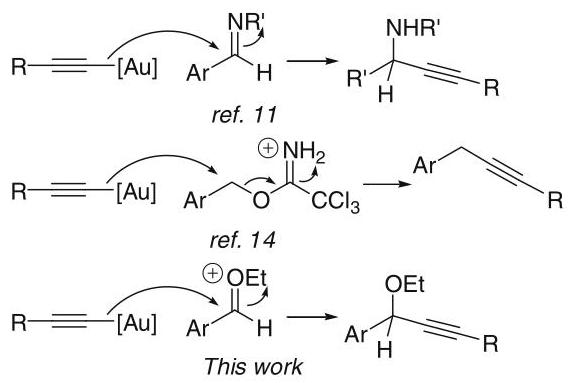
Among these reactions, Au-catalyzed nucleophilic additions have attracted attentions. Recently, Au complexes have emerged as efficient catalysts for a wide variety of transformations involving alkynes, allenes, and alkenes. ${}^{12}$ The research activities in this field so far have been mostly concentrated on the reaction of gold-activated alkynes functioning as electron-deficient species to accept nucleophilic attack. The process that gold-alkyne species function as nucleophile has been much less developed except simple protonation or elimination. Wei and Li have reported a gold-catalyzed three-component coupling reaction of aldehydes, alkynes, and amines. A gold acetylide species, which adds to $\mathrm{C} = \mathrm{N}$ bond of imin-ium ion, is proposed as the reactive intermediate. ${}^{11}$ a Wang and Zhang have reported a Au(III)-catalyzed acyl migration of propargylic esters in which the intramolecular attack of nucleophilic Au(III)-C( ${\mathrm{{sp}}}^{2}$ ) to C=O bond is supposed as the key step in the reaction mechanism. ${}^{{11}\mathrm{\;d},{13}}$ These results indicate that the nucleophilicity of Au-C bond can be exploited in the formation of C-C bond.
In this context, we have reported a ${\mathrm{{AuCl}}}_{3}/\mathrm{{CuBr}}$ -catalyzed three-component reaction of aldehydes, amines, and alkynes. The reaction gives quinoline derivatives through a sequential catalytic process, involving initial formation of propargyl amine via nucleophilic addition of gold alkynilide intermediate to $\mathrm{C} = \mathrm{N}$ bond (Eq. 1). ${}^{{11}\mathrm{f}}$ Furthermore, we have recently reported Au-catalyzed reaction of terminal alkynes and benzyl trichloroacetimidates, which leads to benzylacetylene products through nucleophilic substitution by gold acetylide (Eq. 2). ${}^{14}$ As a continuation of our research program aiming at $\mathrm{C} - \mathrm{H}$ activation of terminal alkynes with transition metal catalysis, we proceeded to study the nucleophilic addition of gold acetylide to $\mathrm{C} = \mathrm{O}$ bond in similar catalytic system (Eq. 3). Herein we report a Au-catalyzed three-component reaction of aldehyde, alkyne, and triethyl orthoformate, which affords prop-argylation products in good yields.
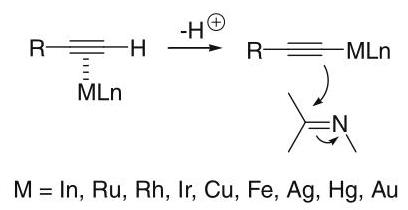
Scheme 1. Metal-catalyzed reaction of terminal alkyne.
- Corresponding author.
(J. Wang).
(1) (2) (3)
On the outset of this investigation, we have attempted the nucleophilic addition of terminal alkyne to aldehyde by gold catalyst. The reaction failed to give any $\mathrm{C} = \mathrm{O}$ bond addition products. The failure might be attributed to the low reactivity of aldehyde carbonyl group toward nucleophiles. We then examined the oxocarbenium ion, which can be generated from benzaldehyde diethyl acetal. ${}^{15}$ We were delighted to find that addition of terminal alkyne occurs with ${\mathrm{{AuPPh}}}_{3}\mathrm{{Cl}}/\mathrm{{AgOTf}}$ catalyst (Scheme 2).
Several other metal complexes have also been examined and the results are summarized in Table 1. ${\mathrm{{AuCl}}}_{3}/\mathrm{{AgOTf}}$ was less effective to afford 3a in 66% yield (entry 1). Without AgOTf as co-catalyst, ${\mathrm{{AuPPh}}}_{3}\mathrm{{Cl}}$ or ${\mathrm{{AuCl}}}_{3}$ gave very low yields of $3\mathrm{a}$ (entries 2 and 3). However, AgOTf alone afforded the product in the yield similar to the reaction with ${\mathrm{{AuCl}}}_{3}/\mathrm{{AgOTf}}$ (entry 4). It was also noted that base additive completely shut down the reaction (entry 5). Other metal catalysts, such as ${\mathrm{{PtCl}}}_{2}$ , CuI, $\mathrm{{Cu}}{\left( {\mathrm{{CH}}}_{3}\mathrm{{CN}}\right) }_{4}{\mathrm{{PF}}}_{6}$ , and $\mathrm{{Zn}}{\left( \mathrm{{OTf}}\right) }_{2}$ , all failed to catalyze this reaction.
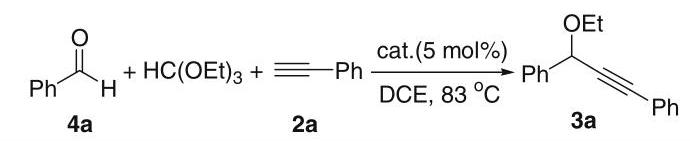
During the course of this investigation, we observed that ${\mathrm{{AuPPh}}}_{3}\mathrm{{Cl}}/\mathrm{{AgOTf}}$ could efficiently catalyze the formation of benzaldehyde diethyl acetal from benzaldehyde and triethyl orthofor-mate. This observation led us to conceive that a three-component reaction of aldehydes, alkynes, and triethyl orthoformate might be catalyzed by the same catalytic system. To test this hypothesis, benzaldehyde, phenylacetylene, and triethyl orthoformate were subjected to the reaction with catalytic ${\mathrm{{AuPPh}}}_{3}\mathrm{{Cl}}/\mathrm{{AgOTf}}$ . Upon refluxing in 1,2-dichloroethane (DCE) for $1\mathrm{\;h}$ , product $3\mathrm{a}$ could be isolated in 87% yield (Table 2, entry 1). Other catalytic systems were also examined. For the gold catalyst, co-catalyst AgOTf was found necessary (entries 2 and 5). ${\mathrm{{AuCl}}}_{3}$ and $\mathrm{{AuCl}}$ were also found to catalyze the formation of 3a when AgOTf was used as co-catalyst, albeit in much lower yields (entries 3 and 4). Control experiment showed that AgOTf alone failed to catalyze the reaction (entry 6). Solvent has marginal effect, as seen by the similar result obtained with benzene (entry 7). However, water can completely shut down the reaction (entry 8).
Other metal complexes, such as ${\mathrm{{PtCl}}}_{2}$ , Cul, $\mathrm{{Cu}}{\left( {\mathrm{{CH}}}_{3}\mathrm{{CN}}\right) }_{4}{\mathrm{{PF}}}_{6},{\mathrm{{ZnI}}}_{2}$ , and $\mathrm{{Zn}}{\left( \mathrm{{OTf}}\right) }_{2}$ , all failed to catalyze the reaction (entries 9-13). Interestingly, strong protic acid TfOH could catalyze the reaction, albeit in low yield (entry 14). Very recently, highly efficient TfOH-catalyzed reaction of alkenes and alkynes has been documented. ${}^{16}$ Thus, for the current Au-catalyzed reaction the possibility existed that small amount of TfOH could be generated in situ, which catalyzed the three-component reaction. However, this should not be the major reaction pathway in view of the fact that TfOH-catalyzed reaction gave much lower yield of the product as compared with ${\mathrm{{AuPPh}}}_{3}\mathrm{{Cl}}/\mathrm{{AgOTf}}$ -catalyzed reaction.
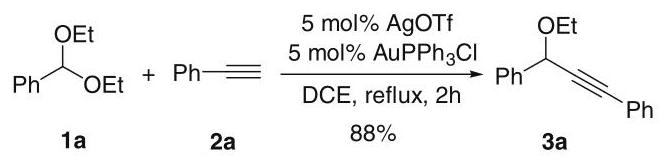
Scheme 2. Au-catalyzed reaction of 1a and 2a.
Table 1
Reactions of 1a and 2a under various catalytic conditions ${}^{a}$
| Entry | Cat. (5 mol %) | $t\left( \mathrm{\;h}\right)$ | Yieldb (%) |
| 1 | ${\mathrm{{AuCl}}}_{3}/\mathrm{{AgOTf}}$ | 6 | 66 |
| 2 | ${\mathrm{{AuPPh}}}_{3}\mathrm{{Cl}}$ | 12 | Trace |
| 3 | ${\mathrm{{AuCl}}}_{3}$ | 48 | 9 |
| 4 | AgOTf | 24 | 59 |
| 5 | ${\mathrm{{AuCl}}}_{3}/\mathrm{{AgOTf}}/{\mathrm{{DIPEA}}}^{\mathrm{c}}$ | 24 | 0 |
| 6 | ${\mathrm{{PtCl}}}_{2}$ | 24 | Trace |
| 7 | Cul | 18 | Trace |
| 8 | $\mathrm{{Cu}}{\left( {\mathrm{{CH}}}_{3}\mathrm{{CN}}\right) }_{4}{\mathrm{{PF}}}_{6}$ | 24 | Trace |
| 9 | $\mathrm{{Zn}}{\left( \mathrm{{OTf}}\right) }_{2}$ | 24 | Trace |
a Reaction was carried out in refluxing DCE.
b Isolated yield.
C DIPEA: Diisopropylethylamine.
Table 2
Three-component reactions under various catalytic conditions
| Entry | Cat. (5 mol %) | t (h) | Yield ${}^{a}$ (%) |
| 1 | ${\mathrm{{AuPPh}}}_{3}\mathrm{{Cl}}/\mathrm{{AgOTf}}$ | 1 | 87 |
| 2 | ${\mathrm{{AuPPh}}}_{3}\mathrm{{Cl}}$ | 24 | 0 |
| 3 | AuCl/AgOTf | 24 | 31 |
| 4 | ${\mathrm{{AuCl}}}_{3}/\mathrm{{AgOT}{f}^{b}}$ | 1 | 32 |
| 5 | ${\mathrm{{AuCl}}}_{3}$ | 24 | 0 |
| 6 | AgOTf | 24 | Trace |
| 7° | ${\mathrm{{AuPPh}}}_{3}\mathrm{{Cl}}/\mathrm{{AgOTf}}$ | 2 | 84 |
| ${8}^{\mathrm{d}}$ | ${\mathrm{{AuPPh}}}_{3}\mathrm{{Cl}}/\mathrm{{AgOTf}}$ | 2 | 0 |
| 9 | ${\mathrm{{PtCl}}}_{2}$ | 12 | 0 |
| 10 | CuI | 12 | 0 |
| 11 | $\mathrm{{Cu}}{\left( {\mathrm{{CH}}}_{3}\mathrm{{CN}}\right) }_{4}{\mathrm{{PF}}}_{6}$ | 12 | Trace |
| 12 | ${\mathrm{{Znl}}}_{2}$ | 12 | Trace |
| 13 | Zn(OTf) ${}_{2}$ | 12 | 0 |
| 14 | TfOH | 3 | 24 |
a Isolated yield.
b 15 mol % AgOTf.
b 15 mol% AgOTf。
c Benzene as solvent.
d Water as solvent.
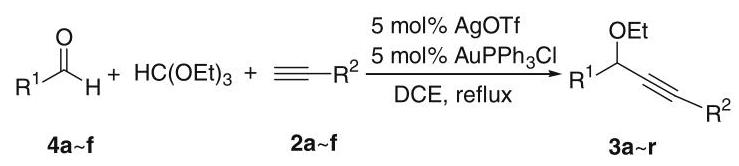
With ${\mathrm{{AuPPh}}}_{3}\mathrm{{Cl}}/\mathrm{{AgOTf}}$ catalytic system, the scope of the three-component reaction was examined by a series of aldehydes and alkynes, and triethyl orthoformate. The results are summarized in Table 3. For a wide range of aromatic aldehydes and alkynes, the reaction afforded the addition products in moderate to good yields. 1-Naphthaldehyde and 2-naphthaldehyde gave similar results (entries 10 and 11). Secondary cyclohexanecarbaldehyde could react with aromatic alkyne smoothly and give moderate yield (entry 16). The electron-donating group makes the reaction faster than the electron-withdrawing groups. $p$ -Nitrobenzaldehyde and basic pyridinecarbaldehyde failed to react.
To account for the three-component reaction, two possible reaction mechanisms are considered (Scheme 3). The first mechanism (path a) involves the generation of gold alkynilide $\mathbf{B}$ , which adds to the $\mathrm{C} = \mathrm{O}$ bond of oxocarbenium ion $\mathbf{D}$ , as proposed previously. In view of the fact that TfOH could also catalyze the reaction, the second possible mechanism (path b), which involves a Prins-type reaction, ${}^{18}$ is suggested. In this case, the oxocarbenium ion D is added to the alkyne directly to give vinyl cation E. The Au catalyst may function as Lewis acid to promote the generation of D.
Table 3
The scope of the three-component reaction ${}^{17}$
| Entry | 4, ${\mathrm{R}}^{1}$ | 2, ${\mathrm{R}}^{2}$ | $t\left( \mathrm{\;h}\right)$ | Yielda |
| 1 | a, ${\mathrm{C}}_{6}{\mathrm{H}}_{5}$ | a, ${\mathrm{C}}_{6}{\mathrm{H}}_{5}$ | 1 | 3a, 87 |
| 2 | b, o-CH ${}_{3}{\mathrm{C}}_{6}{\mathrm{H}}_{4}$ | a, ${\mathrm{C}}_{6}{\mathrm{H}}_{5}$ | 2 | 3b, 82 |
| 3 | c, o-AllylOC ${}_{6}{\mathrm{H}}_{4}$ | a, ${\mathrm{C}}_{6}{\mathrm{H}}_{5}$ | 2 | 3c, 55 |
| 4 | d, $m - {\mathrm{{BrC}}}_{6}{\mathrm{H}}_{4}$ | a, ${\mathrm{C}}_{6}{\mathrm{H}}_{5}$ | 4 | 3d, 80 |
| 5 | e, $m - {\mathrm{{CH}}}_{3}{\mathrm{{OC}}}_{6}{\mathrm{H}}_{4}$ | a, ${\mathrm{C}}_{6}{\mathrm{H}}_{5}$ | 3 | 3e, 81 |
| 6 | $\mathbf{f}, m - {\mathrm{{CF}}}_{3}{\mathrm{C}}_{6}{\mathrm{H}}_{4}$ | a, ${\mathrm{C}}_{6}{\mathrm{H}}_{5}$ | 6 | 3f, 76 |
| 7 | g, $p - {\mathrm{{BrC}}}_{6}{\mathrm{H}}_{4}$ | a, ${\mathrm{C}}_{6}{\mathrm{H}}_{5}$ | 2 | 3g, 87 |
| 8 | h, $p - {\mathrm{{ClC}}}_{6}{\mathrm{H}}_{4}$ | a, ${\mathrm{C}}_{6}{\mathrm{H}}_{5}$ | 2 | 3h, 82 |
| 9 | i, $p - {\mathrm{C}}_{6}{\mathrm{H}}_{5}{\mathrm{C}}_{6}{\mathrm{H}}_{4}$ | a, ${\mathrm{C}}_{6}{\mathrm{H}}_{5}$ | 15 | 3i, 87 |
| 10 | j, 1-Naphthyl | a, ${\mathrm{C}}_{6}{\mathrm{H}}_{5}$ | 3 | 3j, 88 |
| 11 | k, 2-Naphthyl | a, ${\mathrm{C}}_{6}{\mathrm{H}}_{5}$ | 15 | 3k, 80 |
| 12 | a, ${\mathrm{C}}_{6}{\mathrm{H}}_{5}$ | b, $p - {\mathrm{{BrC}}}_{6}{\mathrm{H}}_{4}$ | 2 | 31, 66 |
| 13 | a, ${\mathrm{C}}_{6}{\mathrm{H}}_{5}$ | c, $p - {\mathrm{{PhC}}}_{6}{\mathrm{H}}_{4}$ | 2 | 3m, 71 |
| 14 | a, ${\mathrm{C}}_{6}{\mathrm{H}}_{5}$ | e, $p - {\mathrm{{NO}}}_{2}{\mathrm{C}}_{6}{\mathrm{H}}_{4}$ | 4 | 3n, 38 |
| 15 | a, ${\mathrm{C}}_{6}{\mathrm{H}}_{5}$ | f, 2-Naphthyl | 1 | 30, 76 |
| 16 | 1, ${\mathrm{C}}_{6}{\mathrm{H}}_{11}$ | b, $p - {\mathrm{{BrC}}}_{6}{\mathrm{H}}_{4}$ | 12 | 3p, 51 |
| 17 | $\mathbf{m}, p - {\mathrm{{CH}}}_{3}{\mathrm{{OC}}}_{6}{\mathrm{H}}_{4}$ | a, ${\mathrm{C}}_{6}{\mathrm{H}}_{5}$ | 4 | 3q, 30b |
| 18 | n, trans- ${\mathrm{C}}_{6}{\mathrm{H}}_{5}\mathrm{{CH}} = {\mathrm{{CHC}}}_{6}{\mathrm{H}}_{4}$ | a, ${\mathrm{C}}_{6}{\mathrm{H}}_{5}$ | 2 | 3r, 32° |
a Isolated yield.
b 1,5-Diphenyl-3-(p-methoxyphenyl) pent-1,4-diyne was isolated in 52%.
c The product was 1:1 mixture of $\mathbf{{3r}}$ and trans-1-Methoxy-3,5-diphenyl-1- pen-ten-4-yne.
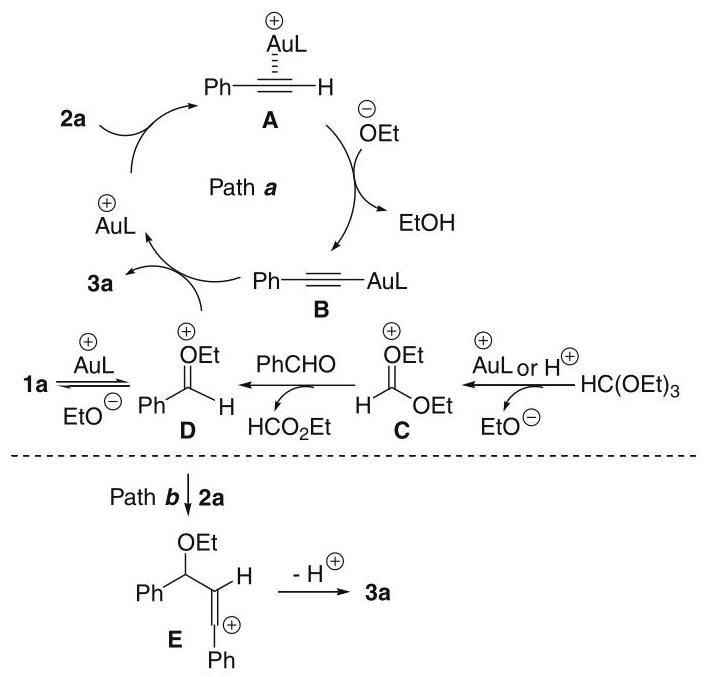
Scheme 3. Mechanistic rationale.
Several experiments were carried out in order to differentiate the two reaction pathways. First, Prins-type reaction might occur when phenyl acetylene is replaced by styrene. However, no reaction occurred under the same conditions with styrene. Second, it was observed that when the reaction was carried out in benzene, possible Friedel-Crafts reaction with benzene was not detected, and the reaction gave three-component reaction product in similar yield. All these observations were not in favor of the Prins-type reaction mechanism (path b).
Gold alkynilide species has been previously synthesized and characterized in stoichiometric reaction. ${}^{17}$ These species have also been suggested in the reaction mechanism of Au-catalyzed reactions of terminal alkynes. ${}^{{11},{14}}$ Based on these reports and our own observation in this study, we consider that the mechanism path a, which involves nucleophilic addition of gold alkynilide B, is most plausible.
In summary, we have developed an AuPPh ${}_{3}\mathrm{{Cl}}/\mathrm{{AgOTf}}$ -catalyzed three-component reaction of terminal alkyne, aldehyde, and amine. The three-component reaction is highly efficient, providing propargyl ether in good yields. ${}^{19}$ The reaction may involve gold alkynilide intermediates, which add to the activated $\mathrm{C} = \mathrm{O}$ bond. The catalytic processes are carried out under mild conditions to provide propargyl ethers in good yields.
Acknowledgments
The project is generously supported by Natural Science Foundation of China (Grant No. 20832002, 20772003, 20821062), the Ministry of Education of China, and National Basic Research Program of China (973 Program, No. 2009CB825300).
Supplementary data
Supplementary data (characterization data, ${}^{1}\mathrm{H}$ and ${}^{13}\mathrm{C}$ NMR spectra for all new compounds, these materials are available free of charge via the Internet) associated with this article can be found, in the online version, at doi:10.1016/j.tetlet.2009.08.049.
References and notes
For selected reviews, see: (a) Brandsma, L. Preparative Acetylene Chemistry, 2nd ed.; Elsevier: Amsterdam, 1988; (b)Modern Acetylene Chemistry; Stang, P. J., Diederich, F., Eds.; VCH: Weinheim, 1995; (c) Frantz, D. E.; Fässler, R.; Tomooka, C. S.; Carreira, E. M. Acc. Chem. Res. 2000, 33, 373-381; (d) Negishi, E.-i.; Anastasia, L. Chem. Rev. 2003, 103, 1979-2017; (e)Handbook of C-H Transformations; Dyker, G., Ed.; Wiley-VCH: Weinheim, 2005; Vol. 1, pp 31-78.
(a) Frantz, D. E.; Fässler, R.; Carreira, E. M. J. Am. Chem. Soc. 1999, 121, 11245- 11246; (b) Anand, N. K.; Carreira, E. M. J. Am. Chem. Soc. 2001, 123, 9687-9688.
(a) Takita, R.; Fukuta, Y.; Tsuji, R.; Ohshima, T.; Shibasaki, M. Org. Lett. 2005, 7, 1363-1366; (b) Takita, R.; Yakura, K.; Ohshima, T.; Shibasaki, M. J. Am. Chem. Soc. 2005, 127, 13760-13761; (c) Zhang, Y.; Li, P.; Wang, M.; Wang, L. J. Org.
(a) Wei, C.; Li, C.-]. Green Chem. 2002, 4, 39-41; (b) Li, C.-].; Wei, C. Chem. Commun. 2002, 268-269.
Dhondi, P. K.; Chisholm, J. D. Org. Lett. 2006, 8, 67-69.
Fischer, C.; Carreira, E. M. Org. Lett. 2001, 3, 4319-4321.
(a) Koradin, C.; Polborn, K.; Knochel, P. Angew. Chem., Int. Ed. 2002, 41, 2535- 2538; (b) Gommermann, N.; Koradin, C.; Polborn, K.; Knochel, P. Angew. Chem., Int. Ed. 2003, 42, 5763-5766; (c) Wei, C.; Li, C.-]. J. Am. Chem. Soc. 2002, 124, 5638-5639; (d) Asano, Y.; Hara, K.; Ito, H.; Sawamura, M. Org. Lett. 2007, 9, 3901-3904; (e) Motoki, R.; Kanai, M.; Shibasaki, M. Org. Lett. 2007, 9, 2997- 3000; (f) Shi, L.; Tu, Y.-Q.; Wang, M.; Zhang, F.-M.; Fan, C.-A. Org. Lett. 2004, 6, 1001-1003; (g) Choudary, B. M.; Sridhar, C.; Kantam, M. L.; Sreedhar, B. Tetrahedron Lett. 2004, 45, 7319-7321; (h) Wang, M.; Li, P.; Wang, L. Eur. J. Org. Chem. 2008, 2255-2261; (i) Kantam, M. L.; Yadav, J.; Laha, S.; Jha, S. Synlett 2009, 1791-1794.
Li, P.; Zhang, Y.; Wang, L. Chem. Eur. J. 2009, 15, 2045-2049.
(a) Yao, X.; Li, C.-J. Org. Lett. 2005, 7, 4395-4398; (b) Dodda, R.; Zhao, C.-G. Org. Lett. 2007, 9, 165-167; (c) Wei, C.; Li, Z.; Li, C.-J. Org. Lett. 2003, 5, 4473-4475; (d) Li, P.; Wang, L.; Zhang, Y.; Wang, M. Tetrahedron Lett. 2008, 49, 6650-6654. 10. Li, P.; Wang, L. Chin. J. Chem. 2005, 23, 1076-1080.
(a) Wei, C.; Li, C.-J. J. Am. Chem. Soc. 2003, 125, 9584-9585; (b) Lo, V. K.-Y.; Liu, Y.; Wong, M.-K.; Che, C.-M. Org. Lett. 2006, 8, 1529-1532; (c) Huang, B.; Yao, X.; Li, C.-J. Adv. Synth. Catal. 2006, 348, 1528-1532; (d) Yao, X.; Li, C.-J. Org. Lett. 2006, 8, 1953-1955; (e) Skouta, R.; Li, C.-J. Angew. Chem., Int. Ed. 2007, 46, 1117-1119; (f) Xiao, F.; Chen, Y.; Liu, Y.; Wang, J. Tetrahedron 2008, 64, 2755- 2761; (g) Zhang, X.; Corma, A. Angew. Chem., Int. Ed. 2008, 47, 4358-4361.
For selected recent reviews on Au-catalyzed reactions, see: (a) Dyker, G. Angew. Chem., Int. Ed. 2000, 39, 4237-4239; (b) Hashmi, A. S. K. Gold Bull. 2004, 37, 51-65; (c) Hashmi, A. S. K. Angew. Chem., Int. Ed. 2005, 44, 6990-6993; (d) Hoffmann-Röder, A.; Krause, N. Org. Biomol. Chem. 2005, 3, 387-391; (e) Bruneau, C. Angew. Chem., Int. Ed. 2005, 44, 2328-2334; (f) Fürstner, A.; Davies, P. W. Angew. Chem., Int. Ed. 2007, 46, 3410-3449; (g) Hashmi, A. S. K. Chem. Rev. 2007, 107, 3180-3211; (h) Li, Z.; Brouwer, C.; He, C. Chem. Rev. 2008, 108, 3239-3265; (i) Arcadi, A. Chem. Rev. 2008, 108, 3266-3325; (j) Jiménez-Núñnez, E.; Echavarren, A. M. Chem. Rev. 2008, 108, 3326-3350; (k) Gorin, D. J.; Sherry, B. B. D.; Toste, F. D. Chem. Rev. 2008, 108, 3351-3378.
(a) Wang, S.; Zhang, L. J. Am. Chem. Soc. 2006, 128, 8414-8415; (b) Dubé, P.; Toste, F. D. J. Am. Chem. Soc. 2006, 128, 12062-12063; (c) Wang, S.; Zhang, L. J. Am. Chem. Soc. 2006, 128, 14274-14275.
Li, C.; Li, W.; Wang, J. Tetrahedron Lett. 2009, 50, 2536-2539.
(a) Howk, B. W.; Sauer, J. C. J. Am. Chem. Soc. 1958, 80, 4607-4609; (b) Sakurai, H.; Sasaki, K.; Hosomi, A. Tetrahedron Lett. 1981, 22, 745-748.
(a) Anderson, L. L.; Arnold, J.; Bergman, R. G. J. Am. Chem. Soc. 2005, 127, 14542-14543; (b) Sun, J.; Kozmin, S. A. J. Am. Chem. Soc. 2005, 127, 13512-13513; (c) Li, Z.; Zhang, J.; Brouwer, C.; Yang, C.-G.; Reich, N. W.; He, C. Org. Lett. 2006, 19, 4175-4178; (d) Rosenfeld, D. C.; Shekhar, S.; Takemiya, A.; Utsunomiya, M.; Hartwig, J. F. Org. Lett. 2006, 19, 4179- 4182; (e) Rozenman, M. M.; Kanan, M. W.; Liu, D. R. J. Am. Chem. Soc. 2007, 129, 14933-14938.
General procedure for the gold-catalyzed three-component reaction of aldehydes, alkynes, and triethyl orthoformate: To a ${25}\mathrm{\;{mL}}$ round-bottomed flask was added ${\mathrm{{AuClPPh}}}_{3}$ (12.4mg,0.05 equiv), $\mathrm{{AgOTf}}$ (6.4mg,0.05 equiv), and $3\mathrm{\;{mL}}$ 1,2- dichloroethane. The solution was stirred at room temperature for $5\mathrm{\;{min}}$ . Phenylacetylene 2a (61 mg, 1.2 equiv), benzaldehyde 4a (53 mg, 1.0 equiv), and $\mathrm{{HC}}{\left( \mathrm{{OEt}}\right) }_{3}$ ( ${88}\mathrm{{mg}},{1.2}$ equiv) were added to the solution. The resulting mixture was heated to reflux and monitored by TLC and GC-MS. When the reaction was complete, the solvent was removed in vacuo and the crude product was purified by column chromatography on silica gel with petroleum and ethyl acetate (100:1) to give 3-ethoxy-1,3-diphenylprop-1-yne (103 mg, 87% yield) as a yellow oil.
Vicente, J.; Chicote, M.-T.; Abrisqueta, M.-D. J. Chem. Soc., Dalton Trans. 1995, 497-498.
Selected reviews on multicomponent reactions, see: (a) For multicomponent reactions, see: Multicomponent Reactions; Zhu, J., Bienayme, H., Eds.; Wiley: Weinheim, 2005. (b) Armstrong, R. W.; Combs, A. P.; Tempest, P. A.; Brown, S. D.; Keating, T. A. Acc. Chem. Res. 1996, 29, 123-131.