Synthesis of Aryl Trimethylstannanes from Aryl Amines: A Sandmeyer-Type Stannylation Reaction
中文 / Bilingual · English version
Di Qiu, He Meng, Liang Jin, Shuai Wang, Shengbo Tang, Xi Wang, Fanyang Mo, Yan Zhang,* and Jianbo Wang*
The cross-coupling reaction with organotin reagents, namely the Stille coupling reaction, has been well-established as a powerful C-C bond forming method in organic synthesis. ${}^{\left\lbrack 1,2\right\rbrack }$ Moreover, the Ar-Sn bond can also be employed in various functional-group transformations, such as $\mathrm{C} - \mathrm{N},\mathrm{C} - \mathrm{F}$ , and $\mathrm{C} - {\mathrm{{OCF}}}_{3}$ bond formation. ${}^{\left\lbrack 3\right\rbrack }$ The wide application of Stille coupling has created considerable need for the easy access to aryl stannane compounds. However, the methods for the synthesis of functionalized aryl stannane compounds are still very limited. The traditional method for preparing aryl stannane compounds is by the reaction of aryl magnesium, -lithium, or -zinc reagents with trialkyl tin chloride (Scheme 1a). ${}^{\left\lbrack 4\right\rbrack }$ A different strategy is the nucleophilic substitution between aryl halides or aryl ammonium salts and trialkyl stannyl anion (Scheme 1b). ${}^{\left\lbrack 5\right\rbrack }$ Moreover, palladium-catalyzed direct stannylation from aryl halides/ArOTf has also been reported, which uses hexaalkyl distannane as the tin source (Scheme 1c). ${}^{\left\lbrack 6\right\rbrack }$
The Sandmeyer-type transformation is a classical and valuable approach in which the amino group can be converted into various functional groups, such as halogen, cyano, hydroxy, and sulfonate groups. ${}^{\left\lbrack 7\right\rbrack }$ These transformations have been routinely applied both in the research laboratory and in industrial production. The common reaction intermediates in these transformations are aryl diazonium salts, which have been recently explored in various new transformations. ${}^{\left\lbrack 8 - {10}\right\rbrack }$ We have recently reported a new approach towards aryl boronic pinacol esters with aromatic amines as starting materials. ${}^{\left\lbrack 9\right\rbrack }$ This transformation, which is a novel metal-free borylation, is under the Sandmeyer-type reaction conditions by using alkyl nitrite as diazotizing reagent. ${}^{\left\lbrack {11}\right\rbrack }$ In view of the importance of aryl stannane compounds and also as a continuation of our interest in this type of diazonium salt-based transformation, we have proceeded to develop a new route to aryl stannane compounds through similar Sandmeyer-type transformation (Scheme 1d).
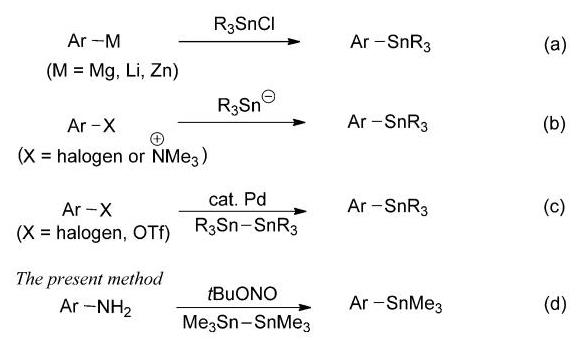
Scheme 1. Synthetic methods for aryl triaryl stannanes.
At the outset, we carried out the stannylation under the reaction conditions similar to our previously reported Sand-meyer-type borylation with MeCN as solvent. ${}^{\left\lbrack 9\right\rbrack }$ To our disappointment, we could only observe trace expected stannylation product 2a (Table 1, entry 1). Most starting material (1a) remained unchanged under these conditions. The yield of $\mathbf{{2a}}$ could be significantly improved when excess tert-butyl nitrite was employed and the solvent was switched to DCE (Table 1, entry 2). Notably, the yield of 2a was diminished when extending the reaction time or raising the reaction temperature. It was then confirmed that the product
Table 1: Optimization of reaction conditions. ${}^{\left\lbrack a\right\rbrack }$

| Entry | Additive (equiv) | Yield ${\left\lbrack \% \right\rbrack }^{\left\lbrack b\right\rbrack }$ |
| 1 | none | trace ${}^{\left\lbrack c\right\rbrack }$ |
| 2 | none | ${38}^{\left\lbrack d\right\rbrack }$ |
| 3 | ${\mathrm{{BF}}}_{3} \cdot {\mathrm{{OEt}}}_{2}$ (1) | 62 |
| 4 | TsOH (1) | 72 |
| 5 | ${\mathrm{{AlCl}}}_{3}$ (1) | 66 |
| 6 | AcOH (1) | 40 |
| 7 | TsOH (1.2) | 76 |
[a] Unless otherwise noted, the reaction conditions are as follows: aryl amine (0.3 mmol), tBuONO (1.5 equiv), (SnM ${\mathrm{e}}_{3}{)}_{3}$ (1.1 equiv),
1,2-dichloroethane (DCE; 1.5 mL), 4 h. [b] Yield of isolated product.
[c] The reaction was carried out in MeCN; 1 a was recovered unchanged. [d] The reaction was carried out in DCE with 10 equivalents of tBuONO.
[*] D. Qiu, H. Meng, L. Jin, S. Wang, S. Tang, X. Wang, F. Mo, Dr. Y. Zhang, Prof. Dr. J. Wang
Beijing National Laboratory of Molecular Sciences (BNLMS) and Key Laboratory of Bioorganic Chemistry and Molecular Engineering of Ministry of Education, College of Chemistry, Peking University Beijing 100871 (China)
Prof. Dr. J. Wang
The State Key Laboratory of Organometallic Chemistry
Shanghai Institute of Organic Chemistry
Chinese Academy of Sciences
354 Fenglin Lu, Shanghai 200032 (China)
[**] The project is supported by the 973 Program (No. 2012CB821600) and NSFC (Grant No. 21272010).
Supporting information for this article is available on the WWW under http://dx.doi.org/10.1002/anie.201304579.
2a was not stable at high temperature and the aryl stannane product could react with alkyl nitrite under these conditions. We then decided to carry out the reaction at ${0}^{ \circ }\mathrm{C}$ , and we also reasoned that adding an acidic additive should facilitate the diazotization process. To our delight, the reaction was significantly improved by adding 1 equivalent of ${\mathrm{{BF}}}_{3} \cdot {\mathrm{{OEt}}}_{2}$ (Table 1, entry 3). Other acids were then subsequently examined, and $p$ -toluenesulfonic acid (TsOH) was shown to provide optimal results (Table 1, entries 4,7).
With the optimized reaction conditions in hand, we then proceeded to expand the scope of substrates to a series of functionalized aniline derivatives (Scheme 2). Moderate to good yields were obtained under the reaction conditions. The stannylation has shown excellent tolerance to both electron-withdrawing and electron-donating groups on the aromatic ring, including nitro (2b), methyl (2c), cyano (2d), halogen (2e, 2f, 2g), formyl (2h), acetyl (2i), methoxy/BocO- (2j, 2k), methylthio (2l), trifluoromethyl (2m), and azo groups (2o). Along with the para-substituted anilines, more complicated substrates, such as those substituted by alkenyl (2t), alkynyl (2u), and amido (2z) groups, were subjected to this reaction, and moderate yields were obtained. In the case of 2s and $2\mathbf{v}$ , the diminished yields were presumably due to steric effects. For the fluoro- and trifluoromethyl-substituted anilines, the diminished yields were attributed to the low boiling points of the products (2v, 2w and 2y), which resulted in the loss of products in the purification. Notably, the side-products of the reaction, which are mostly hydrodeamination products and $t{\mathrm{{BuOSnMe}}}_{3}$ , can be easily removed from the desired stannylation products.
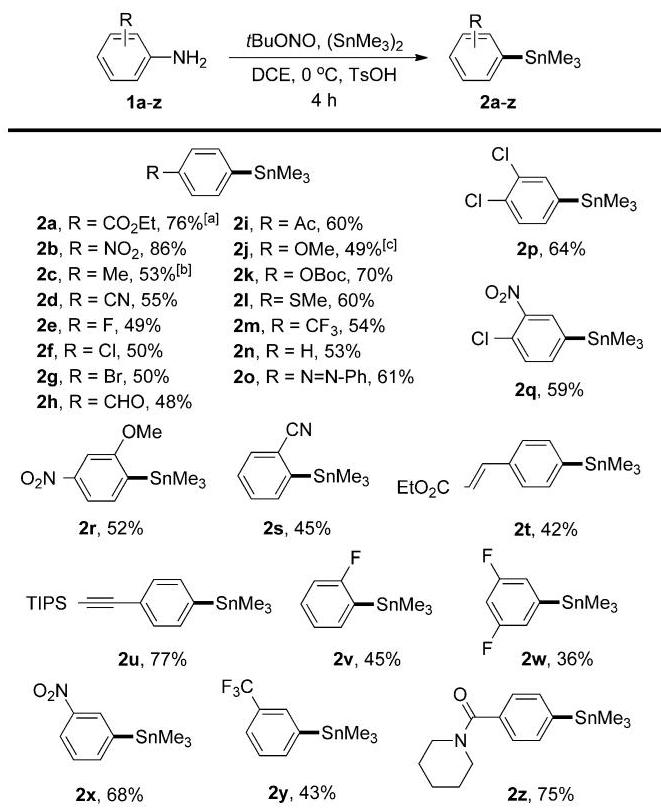
Scheme 2. Scope of aniline derivatives. Reaction conditions: aryl amine (0.3 mmol), tBuONO (0.6 mmol), (SnMe ${}_{3}$ ) (0.33 mmol), TsOH (0.36 mmol), DCE (1.5 mL), 4 h. [a] Yield of isolated product after column chromatography. [b] Room temperature. [c] The reaction was carried out for ${12}\mathrm{\;h}$ at room temperature.
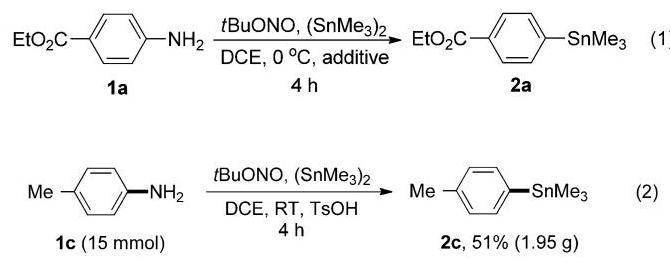
To demonstrate the practical usefulness of this method, the stannylation reaction has been carried out on a gram scale for two substrates $\mathbf{{1b}}$ and $\mathbf{{1c}}$ , as shown in Equation (1) and Equation (2). The corresponding stannylation products 2b and $2\mathbf{c}$ were obtained in acceptable yields on about a 2 gram scale.
Heterocyclic aryl stannane compounds have also been found great importance in organic synthesis, especially for pharmaceuticals. Thus, we expanded the scope of this stannylation to the synthesis of aromatic heterocyclic amine derivatives. The results shown in Scheme 3 indicate that stannylation of electron-deficient rings affords relatively high yields under the standard conditions (4a-e). However, longer time is required for the diazotization process of these substrates. In the case of $4\mathbf{e}$ , the diminished yield may be attributed to the steric effects of the chloride substituent. As for the amine substrates bearing electron-rich substituents, the corresponding stannylation products could only be isolated in low yield owing to the easy oxidation of the substrates (4h).
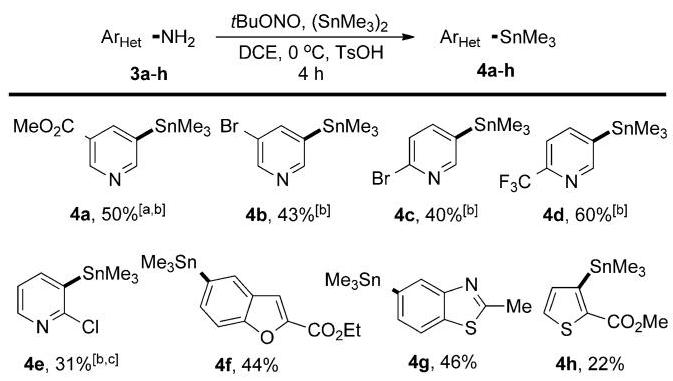
Scheme 3. Scope of heterocyclic amine derivatives. If not otherwise noted, the reaction conditions are as follows: aryl amine (0.3 mmol), tBuONO (0.6 mmol), (SnMe ${}_{3}$ ), (0.33 mmol), TsOH (0.36 mmol), DCE (1.5 mL), 4 h. [a] Yield of isolated product after column chromatography. [b] The reaction was carried out for ${24}\mathrm{\;h}$ . [c] TsOH (0.45 mmol) was used.
Since purification of aryl stannane compounds is tedious and some aryl stannanes are not stable on a silica gel column, it is thus desirable to perform the cross-coupling reaction without purification of the crude aryl stannane products. The sequential Sandmeyer-type stannylation and Pd-catalyzed Stille coupling reaction was then explored. Upon completion of the stannylation, the reaction system was filtered to remove the insoluble precipitates, followed by removing the DCE solvent in vacuum. The crude product was then subjected to the Stille reaction to afford the coupling products in moderate to high yields (Scheme 4).
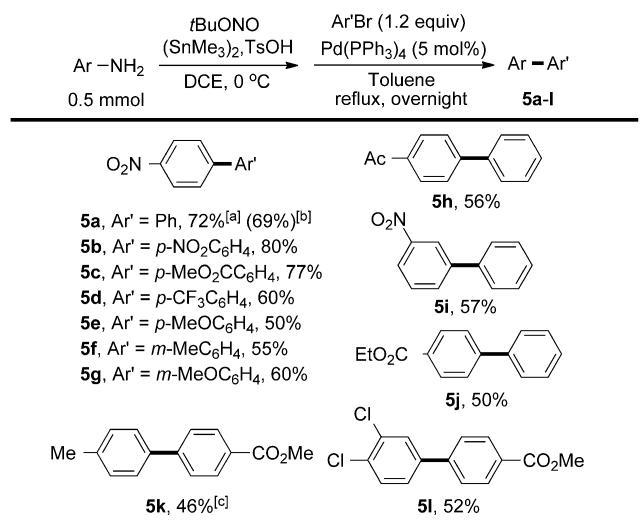
Scheme 4. Sequential stannylation and Pd-catalyzed Stille cross-coupling reactions. Reaction conditions for the first step: aryl amine (0.5 mmol), tBuONO (1.0 mmol), (SnMe ${}_{3}$ ), (0.55 mmol), TsOH (0.60 mmol), DCE (2 mL), 4 h; second step: Ar’Br (1.2 equiv), [Pd ${\left( {\mathrm{{PPh}}}_{3}\right) }_{4}$ ] (5 mol %), toluene (3 mL). [a] Yield of isolated final product after column chromatography. [b] The yield in bracket refers to the reaction using PhI for the second step. [c] Reaction for the first step was carried out at room temperature.
Further demonstration of the usefulness of this Sand-meyer-type stannylation is the concise synthesis of $p$ -terphenyl derivatives $\mathbf{{9a} - e}$ from $p$ -aminoaniline6(Scheme 5). One of the two amino groups of $p$ -aminoaniline6was first converted into a boron group with our previously established metal-free borylation method. ${}^{\left\lbrack 9b\right\rbrack }$ Subsequently, the stannyla-tion converted the remaining amino group into a trimethyl-stannyl group. With the aromatic substrate 8 bearing both boron and tin groups, consecutive cross-couplings were carried out by first performing a Stille cross-coupling with $\left\lbrack {\mathrm{{Pd}}{\left( {\mathrm{{PPh}}}_{3}\right) }_{4}}\right\rbrack$ catalyst and ArBr. Upon completion of the Stille coupling, ${\mathrm{{Ar}}}^{\prime }\mathrm{{Br}},{\mathrm{K}}_{2}{\mathrm{{CO}}}_{3}$ , and $\mathrm{{EtOH}} - {\mathrm{H}}_{2}\mathrm{O}$ were added and reflux was continued for $6\mathrm{\;h}$ . The consecutive cross-coupling afforded $p$ -terphenyl derivatives $\mathbf{{9a} - e}$ in moderately good yields.
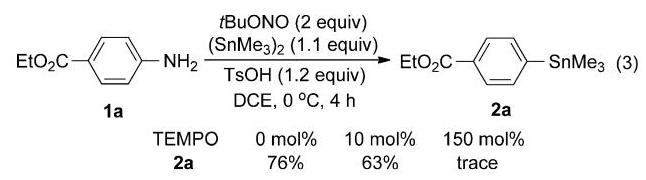
To gain insights into the reaction mechanism, we have carried out the reaction in the presence of radical scavenger TEMPO (2,2,6,6-tetramethylpiperidine-1-oxyl) [Eq. (3)]. When 10 mol% TEMPO was used, the yield of 2a dropped from 76% to 63%. The reaction was completely blocked if excess TEMPO (150 mol%) was added. This experiment indicates the involvement of radical intermediates in the reaction mechanism.
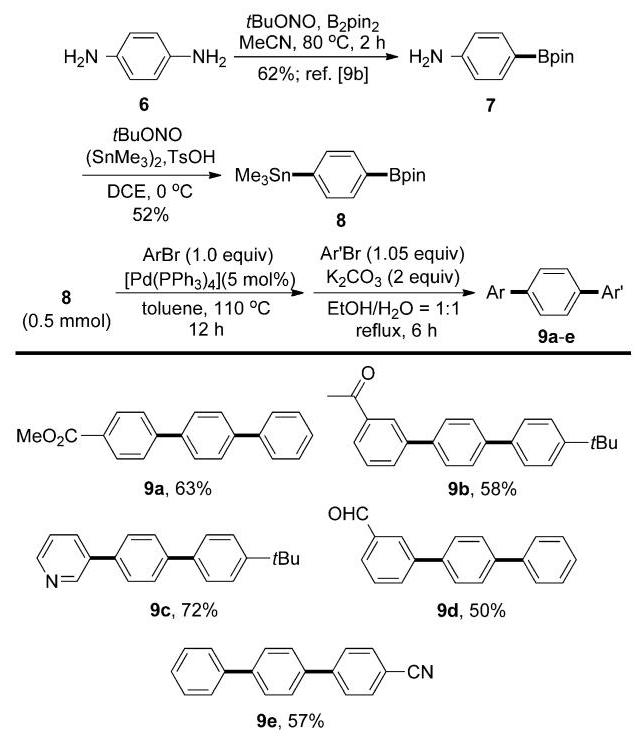
Scheme 5. Synthesis of $p$ -terphenyl derivatives from $p$ -aminoaniline.
A radical mechanism has been proposed to account for this stannylation reaction (Scheme 6). ${}^{\left\lbrack {12},{13}\right\rbrack }$ First, diazotization of the amino group with $t$ BuONO generates diazonium salt $\mathbf{A}$ (Scheme 6a). This is followed by single electron transfer (SET) from ${\left( {\mathrm{{Me}}}_{3}\mathrm{{Sn}}\right) }_{2}$ to $\mathbf{A}$ , generating radical anion species $\mathbf{B}$ and radical anion species $\mathbf{C}$ (Scheme 6b). ${}^{\left\lbrack {14}\right\rbrack }$ From $\mathbf{B}$ , aryl radical $\mathbf{D}$ is formed, while $\mathbf{C}$ reacts with tert-butoxide anion to generate trimethylstannyl radical $\mathbf{E}$ (Scheme 6c and d). Reaction of the aryl radical $\mathbf{D}$ with ${\left( {\mathrm{{Me}}}_{3}\mathrm{{Sn}}\right) }_{2}$ affords the stannylation product and trimethylstannyl radical E
$$ {\mathrm{{Ar} - {NH}}}_{2}\xrightarrow[{-{\mathrm{H}}_{2}\mathrm{O}}]{t\mathrm{{BuONO}}}\overset{ \oplus }{\mathrm{{Ar}} - {\mathrm{N}}_{2} \cdot \mathrm{O}t\mathrm{{Bu}}} $$(a)
$$ \mathrm{A} + {\mathrm{{Me}}}_{3}{\mathrm{{SnSnMe}}}_{3}\xrightarrow[]{{\mathrm{{SET}}}^{ - }}{\mathrm{{Ar} - N}}_{2} \cdot \mathrm{O}\xrightarrow[]{{\mathrm{{He}}}_{3}}{\mathrm{{SnSnMe}}}_{3}\xrightarrow[]{{\mathrm{O}}_{2}}\mathrm{C} $$(b)
$$ \mathrm{B} \rightarrow \mathrm{{Ar}} \cdot + t{\mathrm{{BuO}}}^{ \ominus } + {\mathrm{N}}_{2} \tag{c} $$$$ \mathrm{C} + t{\mathrm{{BuO}}}^{ \ominus } \rightarrow {\mathrm{{Me}}}_{3}\mathrm{{SnO}}t\mathrm{{Bu}} + {\mathrm{{Me}}}_{3}\mathrm{{Sn}} \cdot \tag{d} $$$$ \mathrm{{Ar}}\xrightarrow[]{\mathrm{{Ar}} \uparrow }{\mathrm{{Me}}}_{3}\mathrm{{Sn}} - {\mathrm{{SnMe}}}_{3} \rightarrow \mathrm{{Ar}} - {\mathrm{{SnMe}}}_{3} + {\mathrm{{Me}}}_{3}\mathrm{{Sn}} \cdot \tag{e} $$Ar SnMe ${}_{3}$ Ar-SnMe ${}_{3}$
Ar SnMe ${}_{3}$ Ar - SnMe ${}_{3}$(f)
D E
Scheme 6. Proposed reaction mechanism.
(Scheme 6e). ${}^{\left\lbrack {15}\right\rbrack }$ An alternative pathway to stannylation product is direct combination of radical $\mathbf{D}$ and $\mathbf{E}$ (Scheme 6f).
In conclusion, we have developed a Sandmeyer-type stannylation reaction to synthesize aryl trimethylstannane derivatives. The reaction is under mild conditions and affords the stannylation products in moderate to good yields in most cases. The reaction tolerates a wide range of functional groups. In view of the importance of arylstannane compounds in cross-coupling reactions, we expect that this novel stannyl-ation method will find applications in organic synthesis. Further expansion of the substrate scope as well as the detailed mechanistic study is currently underway in our laboratory, and the results will be reported in due course.
Received: May 28, 2013
Revised: July 13, 2013
Published online: September 6, 2013
Keywords: aryl stannanes $\cdot$ cross-coupling $\cdot$ diazonium salts Sandmeyer reaction $\cdot$ Stille coupling reaction
[4] a) S. M. Moerlein, J. Organomet. Chem. 1989, 319, 29; b) J. A. Soderquist, A. Hassner, J. Am. Chem. Soc. 1980, 102, 1577; c) T. Hayashi, M. Ishigedani, Tetrahedron 2001, 57, 2589; d) P. Knochel, R. D. Singer, Chem. Rev. 1993, 93, 2117.
[5] a) M. Gielen, B. de Poorter, Rev. Silicon Germanium Tin Lead Compd. 1977, 3, 9; b) M. Gielen, Rev. Silicon Germanium Tin Lead Compd. 1981, 5, 6; c) A. B. Chopa, M. T. Lockhart, G. Silbestri, Organometallics 2001, 20, 3358; d) G. F. Silbestri, M. T. Lockhart, A. B. Chopa, Arkivoc 2011, 210.
[6] a) D. Azarian, S. S. Dua, C. Eaborn, D. R. M. Walton, J. Organomet. Chem. 1976, 117, C55; b) H. Azizian, C. E. Eaborn, A. Pidcock, J. Organomet. Chem. 1981, 215, 49; c) A. N. Kashin, I. G. Bumagina, N. A. Bumagin, V. N. Bakunin, I. P. Beletskaya, J. Org. Chem. USSR 1981, 17, 789; d) N. A. Bumagin, I. G. Bumagina, I. P. Beletskaya, Dokl. Akad. Nauk SSSR 1984, 274, 1103; e) W. D. Wulff, G. A. Peterson, W. E. Bauta, K. Chan, K. L. Faron, S. R. Gilbertson, R. W. Kaesler, D. C. Yang, C. K. Murray, J. Org. Chem. 1986, 51, 277; f) M. Lautens, T. Rovis, Tetrahedron 1999, 55, 8967; g) E. B. Corcoran, A. B. Williams, R. N. Hanson, Org. Lett. 2012, 14, 4630; h) C. Gosmini, J. Périchon, Org. Biomol. Chem. 2005, 3, 216. For a report on catalytic aromatic C-H bond stannylation, see: i) M. E. Doster, J. A. Hatnean, T. Jeftic, S. Modi, S. A. Johnson, J. Am. Chem. Soc. 2010, 132, 11923.
[7] For reviews on the Sandmeyer reaction, see: a) H. H. Hodgson, Chem. Rev. 1947, 40, 251; b) C. Galli, Chem. Rev. 1988, 88, 765; c) E. B. Merkushev, Synthesis 1988, 923; d) R. Bohlmann in Comp. Org. Synth., Vol. 6 (Eds.: B. M. Trost, I. Fleming), Pergamon, Oxford, 1991, p. 203; e) G. Balz, G. Schiemann, Ber. Dtsch. Chem. Ges. B 1927, 60, 1186.
[8] For recent reviews on the application of aryldiazonium salts in organic synthesis, see: a) F. X. Felpin, L. Nassar-Hardy, F. Le Callonnec, E. Fouquet, Tetrahedron 2011, 67, 2815; b) J. G. Taylor, A. V. Moro, C. R. D. Correia, Eur. J. Org. Chem. 2011, 1403; c) F. Mo, G. Dong, Y. Zhang, J. Wang, Org. Biomol. Chem. 2013, 11, 1582; d) D. P. Hari, B. König, Angew. Chem. 2013, 125, 4832; Angew. Chem. Int. Ed. 2013, 52, 4734.
[9] a) F. Mo, Y. Jiang, D. Qiu, Y. Zhang, J. Wang, Angew. Chem. 2010, 122, 1890; Angew. Chem. Int. Ed. 2010, 49, 1846; b) D. Qiu, L. Jin, Z. Zheng, H. Meng, F. Mo, X. Wang, Y. Zhang, J. Wang, J. Org. Chem. 2013, 78, 1923.
[10] For a related reaction, see: C. Zhu, M. Yamane, Org. Lett. 2012, 14, 4560.
[11] a) M. P. Doyle, B. Siegfried, J. F. Dellaria, Jr., J. Org. Chem. 1977, 42, 2426; b) M. P. Doyle, Jr., J. F. Dellaria, B. Siegfried, S. W. Bishop, J. Org. Chem. 1977, 42, 3494.
[12] For a mechanistic study on Sandmeyer reaction, see: J. K. Kochi, J. Am. Chem. Soc. 1957, 79, 2942.
[13] A. G. Davies, Radical Chemistry of Tin in Chemistry of Tin (Ed.: P. G. Harrison), Blackie & Son, Glasgow, 1989, p. 294.
[14] For reports of single electron transfer from ${\mathrm{R}}_{3}{\mathrm{{SnSnR}}}_{3}$ , see: a) S. Fukuzumi, T. Kitano, K. Mochida, J. Am. Chem. Soc. 1990, 112, 3246; b) T. Maruyama, S. Suga, J.-i. Yoshida, J. Am. Chem. Soc. 2005, 127, 7324; c) T. Maruyama, S. Suga, J.-i. Yoshida, Tetrahedron 2006, 62, 6519.
[15] D. Seyferth, K. V. Darragh, J. Organomet. Chem. 1968, 11, P9.
[1] For reviews, see: a) J. K. Stille, Angew. Chem. 1986, 98, 504; Angew. Chem. Int. Ed. Engl. 1986, 25, 508; b) V. Farina, Pure Appl. Chem. 1996, 68, 73; c) M. Kosugi, K. Fugami, Handbook of Organopalladium Chemistry for Organic Synthesis (Ed.: E. Negishi), Wiley, New York, 2002, p. 263; d) J. Hassan, M. Sevignon, C. Gozzi, E. Schulz, M. Lemaire, Chem. Rev. 2002, 102, 1359; e) P. Espinet, A. M. Echavarren, Angew. Chem. 2004, 116, 4808; Angew. Chem. Int. Ed. 2004, 43, 4704; f) C. C. C. Johansson Seechurn, M. O. Kitching, T. J. Colacot, V. Snieckus, Angew. Chem. 2012, 124, 5150; Angew. Chem. Int. Ed. 2012, 51, 5062.
[2] a) M. Kosugi, K. Sasazawa, Y. Shimizu, T. Migita, Chem. Lett. 1977, 301; b) M. Kosugi, Y. Shimizu, T. Migita, J. Organomet. Chem. 1977, 129, C36; c) M. Kosugi, Y. Shimizu, T. Migita, Chem. Lett. 1977, 1423; d) D. Milstein, J. K. Stille, J. Am. Chem. Soc. 1978, 100, 3636; e) I. P. Beletskaya, J. Organomet. Chem. 1983, 250, 551. For an example of a large-scale application of Stille coupling, see: f) J. A. Ragan, J. W. Raggon, P. D. Hill, B. P. Jones, R. E. McDermott, M. J. Munchhof, M. A. Marx, J. M. Casavant, B. A. Cooper, J. L. Doty, Y. Lu, Org. Process Res. Dev. 2003, 7, 676. For a selected recent example of Stille coupling reaction in total synthesis, see: g) E. Alonso, H. Fuwa, C. Vale, Y. Suga, T. Goto, Y. Konno, M. Sasaki, F. M. LaFerla, M. R. Vieytes, L. Giménez-Llort, L. M. Botana, J. Am. Chem. Soc. 2012, 134, 7467.
[3] For selected examples, see: a) P. Y. S. Lam, G. Vincent, D. Bonne, C. G. Clark, Tetrahedron Lett. 2002, 43, 3091; b) T. Furuya, A. E. Strom, T. Ritter, J. Am. Chem. Soc. 2009, 131, 1662; c) P. Tang, T. Furuya, T. Ritter, J. Am. Chem. Soc. 2010, 132, 12150; d) C. Huang, T. Liang, S. Harada, E. Lee, T. Ritter, J. Am. Chem. Soc. 2011, 133, 13308.