Silver-Mediated Trifluoromethylation of Aryldiazonium Salts: Conversion of Amino Group into Trifluoromethyl Group
中文 / Bilingual · English version
Xi Wang, Yan Xu, Fanyang Mo, Guojing Ji, Di Qiu, Jiajie Feng, Yuxuan Ye, Songnan Zhang, Yan Zhang, and Jianbo Wang*
Beijing National Laboratory of Molecular Sciences (BNLMS), Key Laboratory of Bioorganic Chemistry and Molecular Engineering of Ministry of Education, College of Chemistry, Peking University, Beijing 100871, China
(c) Supporting Information
ABSTRACT: A novel strategy for aromatic trifluorome-thylation by converting aromatic amino group into ${\mathrm{{CF}}}_{3}$ group is reported herein. This method, which can be considered as trifluoromethylation variation of the classic Sandmeyer reaction, uses readily available aromatic amines as starting materials and is performed under mild conditions.
Trifluoromethylated arenes have become increasingly prevalent in numerous fields, ranging from pharmaceuticals, agrochemicals, to functional materials. ${}^{1}$ However, ${\mathrm{{CF}}}_{3}$ - containing compounds are absent in nature, which accounts for the vital importance of developing general and practical methods to introduce a ${\mathrm{{CF}}}_{3}$ group onto aromatic structures. In recent years, the scientific community has witnessed a rapid development of methods for trifluoromethylation of arenes. ${}^{2}$
The traditional means for introducing a ${\mathrm{{CF}}}_{3}$ group onto an aromatic ring relies on a Swarts-type reaction, pioneered by Swarts in 1892. ${}^{3}$ The Swarts-type reaction involves exhaustive chlorination at the benzylic position, followed by chlorine/ fluorine exchange with HF under harsh conditions (Scheme 1a). Although relatively practical for large-scale industrial production of ${\mathrm{{CF}}}_{3}$ -containing aromatic building blocks and intermediates, this process is not appropriate for late-stage introduction of a ${\mathrm{{CF}}}_{3}$ group onto an aromatic structure, which is becoming increasingly important in drug development. To tackle such a problem, methodologies for the direct trifluoromethylation of arenes have been developed. A commonly applied approach is the conversion of halogen substituents into ${\mathrm{{CF}}}_{3}$ groups through transition-metal-mediated or -catalyzed reactions (Scheme 1b). Since the first discovery by McLoughlin and Thrower in ${1969},{}^{4}{\mathrm{{CuCF}}}_{3}$ reagents have been extensively studied and widely used in the stoichiometric trifluoromethylation of aryl halides. ${}^{2\mathrm{e}}$ More recently, Cu- or Pd-catalyzed trifluoromethylation has attracted great attention from the synthetic community. Accordingly, significant progress in this field has been achieved. ${}^{5 - 7}$ Closely related methods, the Cu-catalyzed or -mediated conversion of a boron group into a ${\mathrm{{CF}}}_{3}$ group, have also been developed (Scheme 1c). ${}^{8}$ In addition to the transition-metal-catalyzed or -promoted methods, a distinct approach to introducing a ${\mathrm{{CF}}}_{3}$ group is the facile trifluoromethylation of an aromatic $\mathrm{C} - \mathrm{H}$ bond through a radical process (Scheme 1, d). ${}^{9,{10}}$
Scheme 1. Methods for Aryl Trifluoromethylation Categorized by the Groups Being Converted
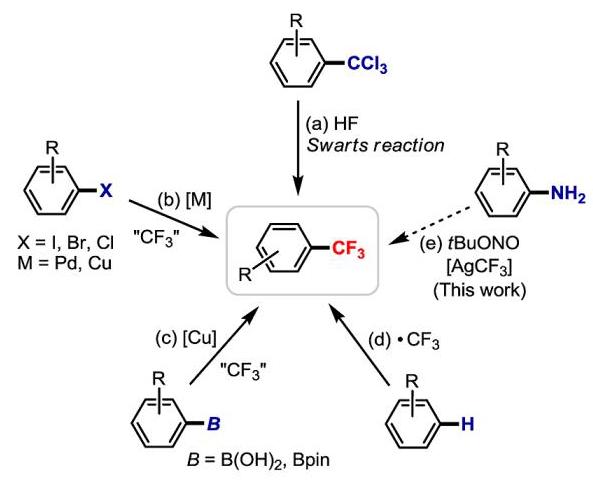
Although numerous efforts have been devoted to aromatic trifluoromethylation and remarkable progress has been made, the problem is far from being solved. Most current methods suffer from at least one of the following drawbacks: harsh reaction conditions, limited substrate scope, low regioselectiv-ity, and expensive reagents or catalysts/ligands. Therefore, further developments are needed to enable the use of cheap and abundantly available starting materials as well as mild trifluoromethylation conditions. To this end, we report herein a novel approach to aromatic trifluoromethylation through direct conversion of an aromatic amino group into ${\mathrm{{CF}}}_{3}$ group (Scheme 1e).
Aromatic amines are commonly used chemicals and easily available. The aromatic amino group serves as a versatile motif, which can be converted into various functional groups. These transformations mostly proceed through arene diazonium salts, which are important intermediates in organic chemistry. Since their first discovery in ${1858},{}^{{11},{12}}$ several named reactions related to arene diazonium salts have been established as classic methods for functional group transformations. Undoubtedly, the most prominent one is the Sandmeyer reaction, which can replace aromatic amino groups with halides or pseudohalides. ${}^{13}$ Another important reaction is Balz-Schiemann reaction, which can convert an amino group into a fluoro group. ${}^{14}$ These classic transformations are not only routinely practised in research laboratories but also widely applied in industry.
Received: June 5, 2013
Based on the oxidizing properties of aryl diazonium salts and the strong $\sigma$ -donor nature of the trifluoromethyl group in the $\left\lbrack {\mathrm{{AgCF}}}_{3}\right\rbrack {\text{ complex }}^{2\mathrm{e}}$ and also inspired by Ritter’s recent reports on reductive elimination from bimetallic high-valent silver complex to form ${\mathrm{C}}_{\text{ avyl }} - \mathrm{F}$ bonds, ${}^{15}$ we proposed that oxidative addition of diazonium salt A would be favored at an electron-rich silver center to afford intermediate $\mathbf{B}$ (Scheme 2).
Scheme 2. Proposed Strategy for Trifluoromethylation of Aromatic Amines
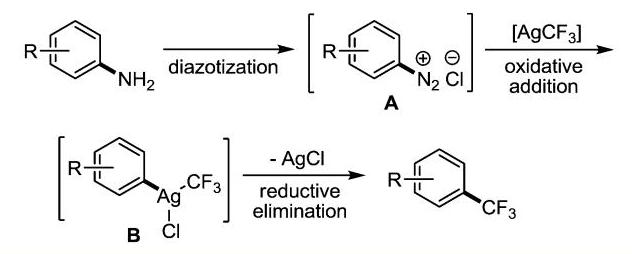
Subsequently, intermediate B undergoes reductive elimination to form a ${\mathrm{C}}_{\text{ aryl }} - {\mathrm{{CF}}}_{3}$ bond and a $\mathrm{{AgCl}}$ precipitate. According to this hypothesis, we envisioned that conversion of aromatic amines into the corresponding trifluoromethyl arenes (trifluor-omethylation variation of the classic Sandmeyer reaction) would be feasible.
Initially, we imitated the classic Sandmeyer reaction conditions by slowly adding a solution of $\left\lbrack {\mathrm{{AgCF}}}_{3}\right\rbrack$ in MeCN, freshly prepared from AgF and ${\mathrm{{Me}}}_{3}{\mathrm{{SiCF}}}_{3}$ (Ruppert-Prakash reagent), ${}^{{16},{17}}$ into the diazonium chloride $2\left( {\mathrm{X} = \mathrm{{Cl}}}\right)$ at $0{}^{ \circ }\mathrm{C}$ , prepared in MeCN from ethyl 4-aminobenzoate 1 through diazotization with $t$ -BuONO/aq HCl (Table 1). ${}^{18}$ To our delight, the expected trifluoromethylated product 3 was formed in 41% yield based on ${}^{19}\mathrm{\;F}$ NMR analysis (entry 1). It was found that the reaction was favored at low temperature. When the solvent was switched to EtCN (mp $- {93}^{ \circ }\mathrm{C}$ ) and the addition of $\left\lbrack {\mathrm{{AgCF}}}_{3}\right\rbrack$ was carried out at $- {78}^{ \circ }\mathrm{C}$ , we observed a dramatic increase in the yield (entry 2). It was noted that 3.5 equiv of $\left\lbrack {\mathrm{{AgCF}}}_{3}\right\rbrack$ was necessary to maintain the high yield. Further study indicates that the counterions of diazonium salt impose significant affect on the reaction. ${\mathrm{{Br}}}^{ - }$ and ${\mathrm{{CF}}}_{3}{\mathrm{{CO}}}_{2}{}^{ - }$ afforded similar results as ${\mathrm{{Cl}}}^{ - }$ , whereas ${\mathrm{{BF}}}_{4}^{ - }$ gave diminished yield and $t - {\mathrm{{BuO}}}^{ - }$ gave only a trace amount of the product (entries 3-6). It is noteworthy that using $\left\lbrack {\mathrm{{CuCF}}}_{3}\right\rbrack$ as the ${\mathrm{{CF}}}_{3}$ source, freshly prepared from CuCl, CsF, and ${\mathrm{{Me}}}_{3}{\mathrm{{SiCF}}}_{3}$ in DMF, the trifluoromethylation also proceeded, albeit with lower yield (entry 7). ${}^{19}$ Finally, other solvents, such as DMF, DCE, MeOH, and EtOH, were all found to give poor results.
With the optimal reaction conditions (Table 1, entry 2), the substrate scope was then surveyed with a series of aromatic amine derivatives (Scheme 3). In general, the aniline derivatives bearing either electron-withdrawing or -donating groups react smoothly to afford the corresponding trifluoromethylation products in moderate to excellent yields. 4-Aminoazobenzene is also a suitable substrate for the reaction, affording product 14. Trifluoromethylation of unprotected alcohol and benzoic acid affords the desired products 15 and 16 in good yields, respectively. Remarkably, oxidation sensitive groups, such as vinyl, alkynyl, Bpin, and TMS groups, also tolerate the reaction conditions (17-22). The anilines bearing ortho-substitutents, including ester and bulky isopropyl groups, also worked well to give 23 and 24, respectively. The diminished yields of 28 and 29 are due to the sublimation of the trifluoromethylated naphthalene products under reduced pressure during purification.
Table 1. Optimization of Trifluoromethylation Conditions ${}^{a}$
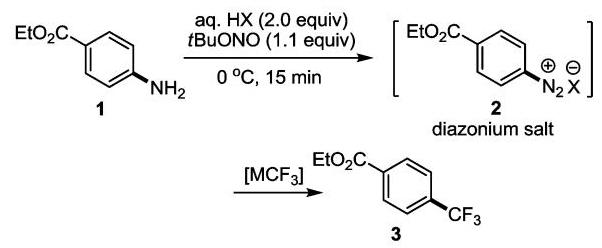
| entry | X | $\left\lbrack {\mathrm{{MCF}}}_{3}\right\rbrack$ | temp | solvent | 3, yield ${}^{b}$ |
| 1 | Cl | ${\mathrm{{AgCF}}}_{3}{}^{c}$ | 0°C-rt | MeCN | 41% |
| 2 | Cl | $\mathrm{{AgC}{F}_{3}}$ | $- {78}^{ \circ }\mathrm{C}$ -rt | EtCN | 95% (80%) |
| 3 | OtBu | $\mathrm{{AgC}{F}_{3}}$ | $- {78}^{ \circ }\mathrm{C}$ -rt | EtCN | trace |
| 4 | BF4 | $\mathrm{{AgC}{F}_{3}}$ | $- {78}^{ \circ }\mathrm{C}$ -rt | EtCN | 46% |
| 5 | Br | $\mathrm{{AgC}{F}_{3}}$ | $- {78}^{ \circ }\mathrm{C}$ -rt | EtCN | 93% |
| 6 | ${\mathrm{{CF}}}_{3}{\mathrm{{CO}}}_{2}$ | $\mathrm{{AgC}{F}_{3}}$ | $- {78}^{ \circ }\mathrm{C}$ -rt | EtCN | 93% |
| 7 | Cl | ${\mathrm{{CuCF}}}_{3}$ | $- {60}^{ \circ }\mathrm{C}$ -rt | EtCN | 37% |
${}^{a}$ Reaction conditions: preparation of the diazonium salt:1(0.3 mmol), aq HX (0.6 mmol), t-BuONO (0.33 mmol), solvent, 0°C, 15 min; preparation of $\left\lbrack {\mathrm{{AgCF}}}_{3}\right\rbrack$ : AgF (1.05 mmol), ${\mathrm{{TMSCF}}}_{3}$ (1.05 mmol), EtCN (3 mL), room temperature, 15 min; preparation of $\left\lbrack {\mathrm{{CuCF}}}_{3}\right\rbrack : \mathrm{{CuCl}}$ (1.05 mmol), $\mathrm{{CsF}}$ (1.05 mmol), ${\mathrm{{TMSCF}}}_{3}$ (1.05 mmol), DMF (3 mL), room temperature, 30 min. The [MCF3] solution was added dropwise to the solution of 2 (0.30 mmol) over a period of $1\mathrm{\;h}$ . The solution was stirred for another $3\mathrm{\;h}$ and then warmed to room temperature. ${}^{b}$ Unless otherwise noted, the yields are based on ${}^{19}\mathrm{\;F}$ NMR with $4 - {\mathrm{{CF}}}_{3}{\mathrm{{OC}}}_{6}{\mathrm{H}}_{4}\mathrm{{OMe}}$ as internal standard. ${}^{c}\left\lbrack {\mathrm{{AgCF}}}_{3}\right\rbrack$ was prepared in MeCN (3 mL). ${}^{d}$ Value in parentheses refers to isolated yield.
For the substrate bearing pyridine moiety, the reaction gave only a low yield of the product 30 , presumably due to the protonation of the pyridine nitrogen. In the case of heteroaromatic amines, such as indoles and benzofurans, the desired products 31-34 could be formed in moderate yields. Besides, various di- and multi-substituted ${\mathrm{{CF}}}_{3}$ -bearing arenes could be accessed through this transformation in generally good yields (35-46). Finally, to demonstrate the applicability of this method in more complex molecules, we smoothly converted the amino groups embedded in the estrone and tocopherol framework into the trifluoromethyl groups (47 and 48).
The reaction with ethyl 4-aminobenzoate 1 was also conducted on a gram scale to generate the desired product 3 in comparable yields as the small-scale experiment (eq 1).
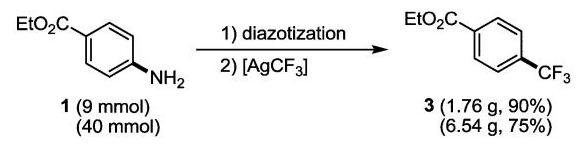
(1)
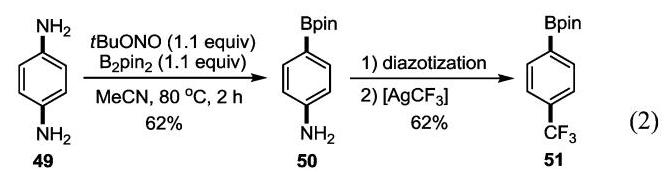
Moreover, by employing our previously established metal-free borylation method, ${}^{20}$ we could smoothly convert the two amino groups of benzene-1,4-diamine 49 into Bpin and ${\mathrm{{CF}}}_{3}$ groups successively, with similar Sandmeyer-type reaction for both steps (eq 2). This transformation shows the oxidation sensitive Bpin group tolerates the Sandmeyer-type trifluor-omethylation (also see 20 in Scheme 3).
Preliminary mechanistic investigations have been carried out on this reaction. For the Sandmeyer-type transformations, it was proposed that the reaction may involve aryl radical probe was introduced by using 2-(but-3-en-1-yl)aniline 52 as the substrate in the reaction (Scheme 4a). The normal trifluoromethylation product 54 was formed in 41% yield ( ${}^{19}\mathrm{\;F}$ NMR), whereas cyclization product 55 could not be detected. ${}^{22}$ The diminished yield of the trifluoromethylation product 54 was due to the decomposition of the substrate and the product under the reaction conditions. These results are not in favor of the possible involvement of aryl radical species.
Scheme 3. Trifluoromethylation of Various Aromatic Amine Substrates ${}^{a}$
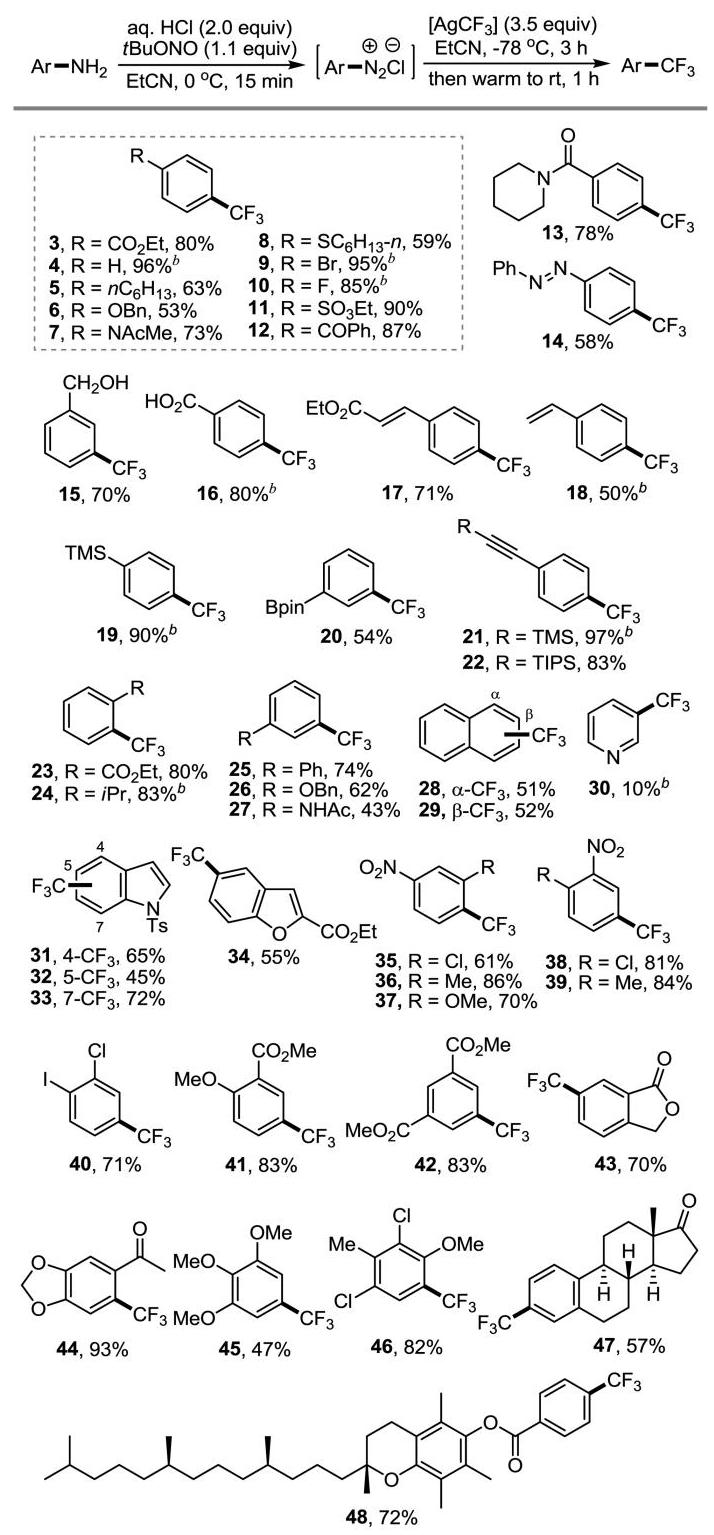
${}^{a}$ Yields refer to the isolated products if not otherwise noted. ${}^{b}$ These yields are based on ${}^{19}\mathrm{\;F}$ NMR with $4 - {\mathrm{{CF}}}_{3}\mathrm{O} - {\mathrm{C}}_{6}{\mathrm{H}}_{4}\mathrm{{OMe}}$ as internal standard.
species. ${}^{21}$ To validate whether aryl radical species are generated in the current trifluoromethylation process, a radical clock
Scheme 4. (a) Radical Clock Probe Experiment. (b) Trapping Experiment for Possible Radical Intermediates. (c) Background Reaction of $\left\lbrack {\mathrm{{AgCF}}}_{3}\right\rbrack$
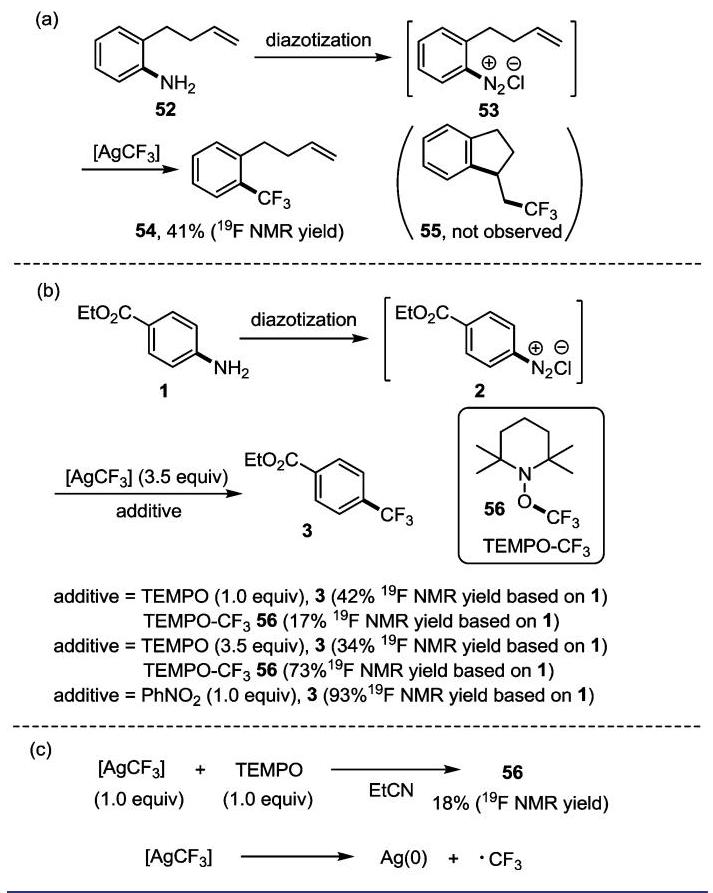
Next, 2,2,6,6-tetramethyl-1-piperidinyloxy (TEMPO), a wellknown free radical scavenger, was introduced as the additive in the standard reaction (Scheme 4b). The yield of 3 was diminished to 42% and TEMPO-CF ${}_{3}$ 56 was formed in 17% yield when 1.0 equiv of TEMPO was added under standard condition. The yield of 3 was further dropped to 34%, and 73% of TEMPO-CF ${}_{3}$ 56 was observed when 3.5 equiv of TEMPO was added. However, TEMPO-Ar adducts were not observed, as judged by both NMR and GC-MS analysis of the crude product. Nitrobenzene, which has been shown to be the inhibitor of SET steps in free radical aryl $\mathrm{C} - \mathrm{H}$ trifluorome-thylation, ${}^{{24},{9c}}$ has essentially no effect on the reaction.
We speculate that the formation of ${\mathrm{{CF}}}_{3}$ radical is due to the background reaction of $\left\lbrack {\mathrm{{AgCF}}}_{3}\right\rbrack$ (Scheme 4c). ${}^{{9c},{10c}}$ Thus, in the absence of aryl diazonium salt, $\left\lbrack {\mathrm{{AgCF}}}_{3}\right\rbrack$ was added to the TEMPO in EtCN. We observed the formation of TEMPO-CF ${}_{3}$ 56 in 18% yield. Moreover, in the trifluoromethylation reaction, we found that most silver remains as $\mathrm{{Ag}}\left( \mathrm{I}\right)$ salt, rather than $\mathrm{{Ag}}\left( 0\right)$ . Collectively, these results indicate that ${\mathrm{{CF}}}_{3}$ radical is unlikely involved in the trifluoromethylation pathway. An oxidative addition-reductive elimination mechanism involving high-valent silver species, as shown in Scheme 2, may be involved. However, rigorous investigations are necessary to unambiguously elucidate the detailed mechanism.
In summary, the conversion of an amino group into a ${\mathrm{{CF}}}_{3}$ group is a valuable complement to the previously established trifluoromethylation methods. ${}^{25}$ The reaction proceeds at low temperature and tolerates various functional groups. Moreover, the amino group can be readily protected and deprotected, rendering this method suitable for late-stage introduction of a ${\mathrm{{CF}}}_{3}$ group onto an aromatic structure.
A ASSOCIATED CONTENT
(c) Supporting Information
Experimental procedure, characterization data, and copies of ${}^{1}\mathrm{H}$ and ${}^{13}\mathrm{C}$ NMR spectra. This material is available free of charge via the Internet at http://pubs.acs.org.
A AUTHOR INFORMATION
Corresponding Author
Notes
The authors declare no competing financial interest.
ACKNOWLEDGMENTS
We thank Ms. Xiu Zhang and Ms. Hui Fu for NMR analysis, Mr. Guojiao Wu (Peking University) for helpful discussions, and Mr. John Thompson (University of Texas at Austin) for correcting the manuscript. Support of this work by 973 Program (no. 2012CB821600) and NSFC (no. 21272010) is gratefully acknowledged.
REFERENCES
(1) Müller, K.; Faeh, C.; Diederich, F. Science 2007, 317, 1881.
(2) Reviews: (a) Shimizu, M.; Hiyama, T. Angew. Chem., Int. Ed. 2005, 44, 214. (b) Schlosser, M. Angew. Chem., Int. Ed. 2006, 45, 5432. (c) Ma, J. -A.; Cahard, D. J. Fluorine Chem. 2007, 128, 975. (d) Ma, J. -A.; Cahard, D. Chem. Rev. 2008, 108, PR1. (e) Tomashenko, O. A.; Grushin, V. V. Chem. Rev. 2011, 111, 4475. (f) Furuya, T.; Kamlet, A. S.; Ritter, T. Nature 2011, 473, 470. (g) Besset, T.; Schneider, C.; Cahard, D. Angew. Chem., Int. Ed. 2012, 51, 5048.
(3) Swarts, F. Bull. Soc. Chim. Belg. 1892, 24, 309.
(4) McLoughlin, V. C. R.; Thrower, J. Tetrahedron 1969, 25, 5921. (5) (a) Chen, Q.-Y.; Wu, S.-W. J. Chem. Soc. Chem. Commun. 1989, 705. (b) Chen, Q.-Y.; Duan, J.-X. J. Chem. Soc. Chem. Commun. 1993, 1389.
(6) Oishi, M.; Kondo, H.; Amii, H. Chem. Commun. 2009, 1909.
(7) Cho, E. J.; Senecal, T. D.; Kinzel, T.; Zhang, Y.; Watson, D. A.; Buchwald, S. L. Science 2010, 328, 1679.
(8) (a) Chu, L.; Qing, F.-L. Org. Lett. 2010, 12, 5060. (b) Senecal, T. D.; Parsons, A. T.; Buchwald, S. L. J. Org. Chem. 2011, 76, 1174. (c) Liu, T.; Shen, Q. Org. Lett. 2011, 13, 2342. (d) Xu, J.; Luo, D.-F.; Xiao, B.; Liu, Z.-J.; Gong, T.-J.; Fu, Y.; Liu, L. Chem. Commun. 2011, 47, 4300. (e) Zhang, C.-P.; Cai, J.; Zhou, C.-B.; Wang, X.-P.; Zheng, X.; Gu, Y.-C.; Xiao, J.-C. Chem. Commun. 2011, 47, 9516. (f) Litvinas, N. D.; Fier, P. S.; Hartwig, J. F. Angew. Chem., Int. Ed. 2012, 51, 536. (g) Novák, P.; Lishchynskyi, A.; Grushin, V. V. Angew. Chem., Int. Ed. 2012, 51, 7767. (h) Ye, Y.; Sanford, M. S. J. Am. Chem. Soc. 2012, 134, 9034.
(9) Recent reports: (a) Nagib, D. A.; MacMillan, D. W. C. Nature 2011, 480, 224. (b) Ji, Y.; Brueckl, T.; Baxter, R. D.; Fujiwara, Y.; Seiple, I. B.; Su, S.; Blackmond, D. G.; Baran, P. S. Proc. Natl. Acad. Sci. U.S.A. 2011, 108, 14411. (c) Ye, Y.; Lee, S. H.; Sanford, M. S. Org. Lett. 2011, 13, 5464. (d) Fujiwara, Y.; Dixon, J. A.; O’Hara, F.; Funder, E. D.; Dixon, D. D.; Rodriguez, R. A.; Baxter, R. D.; Herlé, B.; Sach, N.; Collins, M. R.; Ishihara, Y.; Baran, P. S. Nature 2012, 492, 95. (e) Studer, A. Angew. Chem., Int. Ed. 2012, 51, 8950.
(10) Trifluoromethylation through transition-metal-catalyzed C-H bond activation: (a) Wang, X.; Truesdale, L.; Yu, J.-Q. J. Am. Chem. Soc. 2010, 132, 3648. (b) Zhang, X.-G.; Dai, H.-X.; Wasa, M.; Yu, J.-Q. J. Am. Chem. Soc. 2012, 134, 11948. (c) Hafner, A.; Bräse, S. Angew. Chem., Int. Ed. 2012, 51, 3713.
(11) Griess, J. P. Ann. Chem., Justus Liebigs 1858, 106, 123.
(12) Reviews on arene diazonium salts: (a) Mo, F.; Dong, G.; Zhang, Y.; Wang, J. Org. Biomol. Chem. 2013, 11, 1582. (b) Hari, D. P.; König, B. Angew. Chem., Int. Ed. 2013, 52, 4734.
(13) (a) Sandmeyer, T. Ber. Dtsch. Chem. Ges. 1884, 17, 1633. (b) Sandmeyer, T. Ber. Dtsch. Chem. Ges. 1884, 17, 2650.
(14) Balz, G.; Schiemann, G. Ber. - Umweltbundesamt (Ger.) 1927, 60B, 1186.
(15) (a) Furuya, T.; Strom, A. E.; Ritter, T. J. Am. Chem. Soc. 2009, 131, 1662. (b) Tang, P.; Furuya, T.; Ritter, T. J. Am. Chem. Soc. 2010, 132, 12150. (c) Huang, C.; Liang, T.; Harada, S.; Lee, E.; Ritter, T. J. Am. Chem. Soc. 2011, 133, 13308.
(16) Kremlev, M. M.; Mushta, A. I.; Tyrra, W.; Naumann, D.; Fischer, H. T. M.; Yagupolskii, Y. L. J. Fluorine Chem. 2007, 128, 1385.
(17) (a) Ruppert, I.; Schlich, K.; Volbach, W. Tetrahedron Lett. 1984, 25, 2195. (b) Prakash, G. K. S.; Krishnamurti, R.; Olah, G. A. J. Am. Chem. Soc. 1989, 111, 393. (c) Prakash, G. K. S.; Jog, P. V.; Batamack, P. T. D.; Olah, G. A. Science 2012, 338, 1324.
(18) (a) Doyle, M. P.; Siegfried, B.; Dellaria, J. F., Jr. J. Org. Chem. 1977, 42, 2426. (b) Doyle, M. P.; Dellaria, J. F.; Dellaria, J. F., Jr.; Bishop, S. W. J. Org. Chem. 1977, 42, 3494.
(19) For detailed screening of reaction conditions, see Supporting Information.
(20) (a) Mo, F.; Jiang, Y.; Qiu, D.; Zhang, Y.; Wang, J. Angew. Chem., Int. Ed. 2010, 49, 1846. (b) Qiu, D.; Jin, L.; Zheng, Z.; Meng, H.; Mo, F.; Wang, X.; Zhang, Y.; Wang, J. J. Org. Chem. 2013, 78, 1923.
(21) (a) Kochi, J. K. J. Am. Chem. Soc. 1957, 79, 2942. (b) Galli, C. Chem. Rev. 1988, 88, 765.
(22) Fier, P. S.; Hartwig, J. F. J. Am. Chem. Soc. 2012, 134, 10795.
(23) Wang, X.; Ye, Y.; Zhang, S.; Feng, J.; Xu, Y.; Zhang, Y.; Wang, J. J. Am. Chem. Soc. 2011, 133, 16410.
(24) Wakselman, C.; Tordeux, M. J. Chem. Soc., Chem. Commun. 1987, 1701.
(25) While the manuscript was under revision, a Cu-promoted Sandmeyer trifluoromethylation reaction was reported: Dai, J.-J.; Fang, C.; Xiao, B.; Yi, J.; Xu, J.; Liu, Z.-J.; Lu, X.; Liu, L.; Fu, Y. J. Am. Chem. Soc. 2013, 135, 8436.