Synthesis of Pinacol Arylboronates from Aromatic Amines: A Metal-Free Transformation
中文 / Bilingual · English version
Di Qiu, Liang Jin, Zhitong Zheng, He Meng, Fanyang Mo,* Xi Wang, Yan Zhang, and Jianbo Wang*
Beijing National Laboratory of Molecular Sciences (BNLMS), Key Laboratory of Bioorganic Chemistry and Molecular Engineering of Ministry of Education, College of Chemistry, Peking University, Beijing 100871, China
S Supporting Information
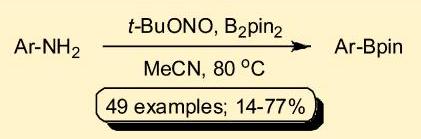
ABSTRACT: A metal-free borylation process based on Sandmeyer-type transformation using arylamines derivatives as the substrates has been developed. Through optimization of the reaction conditions, this novel conversion can be successfully applied to a wide range of aromatic amines, affording borylation products in moderate to good yields. Various functionalized arylboronates, which are difficult to access by other methods, can be easily obtained with this metal-free transformation. Moreover, this transformation can be followed by Suzuki-Miyaura cross-coupling without purification of the borylation products, which enhances the practical usefulness of this method. A possible reaction mechanism involving radical species has been proposed.
INTRODUCTION
Arylboronic acids and arylboronates have shown great importance due to their widespread applications in organic synthesis and other fields. ${}^{1,2}$ In particular, functionalized arylboronic acids and arylboronates are highly valuable because consecutive cross-coupling is possible from these compounds, which can rapidly construct the complex structure of target molecules. ${}^{3}$ Consequently, the syntheses of various functionalized arylboronic compounds have attracted significant attentions in recent years.
The reaction of aryl Grignard reagents or aryllithium species with trialkyl boronates remains the most general synthetic method to prepare aromatic boronic compounds (Scheme 1, path $a$ ). ${}^{4}$ In 1995, Miyaura et al. developed the palladium-catalyzed borylation of arylhalides using bis(pinacolato)diboron as the boron source. ${}^{5}$ Subsequently, Masuda et al. reported the palladium-catalyzed borylation from arylhalides using pinacol-borane. ${}^{6}$ The groups of Ma and Marder then reported the copper-catalyzed borylation reaction (Scheme 1, path $b$ ). ${}^{7}$ In the past decade, direct borylation via aromatic $\mathrm{C} - \mathrm{H}$ bond activation has been extensively explored in the groups of Smith III, Miyaura, Hartwig, Marder, and others (Scheme 1, path $c$ ). ${}^{8}$ Recently, Lewis acid catalyzed electrophilic borylation of electron-rich arenes has been explored (Scheme 1, path d). ${}^{9,{10}}$ These borylation methods have the advantage of being transition-metal-free processes and thus avoiding heavy metal contamination in the final products.
Scheme 1. Different Routes to Arylboronic Acids or Arylboronates
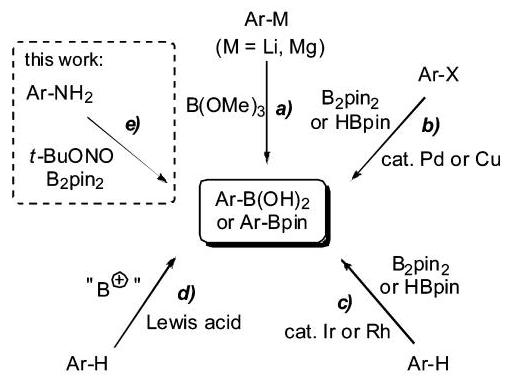
We have recently communicated an entirely different approach toward arylboronates synthesis by direct conversion of the amino group of aniline derivatives to the boronate group (Scheme 1, path $e$ ). ${}^{11}$ This transformation is under Sandmeyer-type reaction conditions by using tert-butyl nitrite ( $t$ -BuONO) as diazotization agent. ${}^{{12},{13}}$ This borylation method has the following features: (1) the reaction is under metal-free conditions, (2) arylamines are cheap and abundant starting materials, (3) the borylation tolerates various functional groups, and (4) the reaction is under very mild conditions. As a result, this novel borylation will not only find wide application in organic synthesis but also shed light on the unique reactivity of aryldiazonium ion and diboron compounds. ${}^{14}$
In this article, we report the further optimization of the reaction conditions and the expansion of the substrate scope to various aniline derivatives. Compared to the results reported in the preliminary communication, the newly optimized reaction conditions offered improved yields and have wider substrate scope. Moreover, this borylation has also been extended to heterocyclic amines, although with limited success.
RESULTS AND DISCUSSION
To further optimize the reaction that was reported in our preliminary communication, ${}^{11}$ we have chosen 2-amino-benzonitrile as the substrate, with which only a low yield of
Special Issue: Howard Zimmerman Memorial Issue
Received: September 2, 2012
22% was obtained under the previous reaction conditions [ $t$ - BuONO, benzoyl peroxide (BPO, 2 mol %), MeCN, rt] (Table 1, entry 1). Thus, a number of experiments were conducted to improve the yield, and these experiments provide further insight into the factors that affect this transformation. First, it was observed that the reaction is significantly affected by temperature (entries 2-4). The yield of 4aa could be improved when the reaction was carried at elevated temperature. At 80 ${}^{ \circ }\mathrm{C}$ ,4aa could be obtained in 77% GC yield and 66% isolated yield. Addition of radical initiator BPO slightly affects the reaction at this temperature (entries 5-7). Use of other solvents, such as toluene, DCE, and dioxane, proved to be ineffective. Finally, alkyl nitrites 2b and 2c were found to be compatible with this reaction, albeit less efficient than 2a (entries 11,12).
Table 1. Optimization of Reaction Conditions for 2- ${\text{ Aminobenzonitrile }}^{a}$
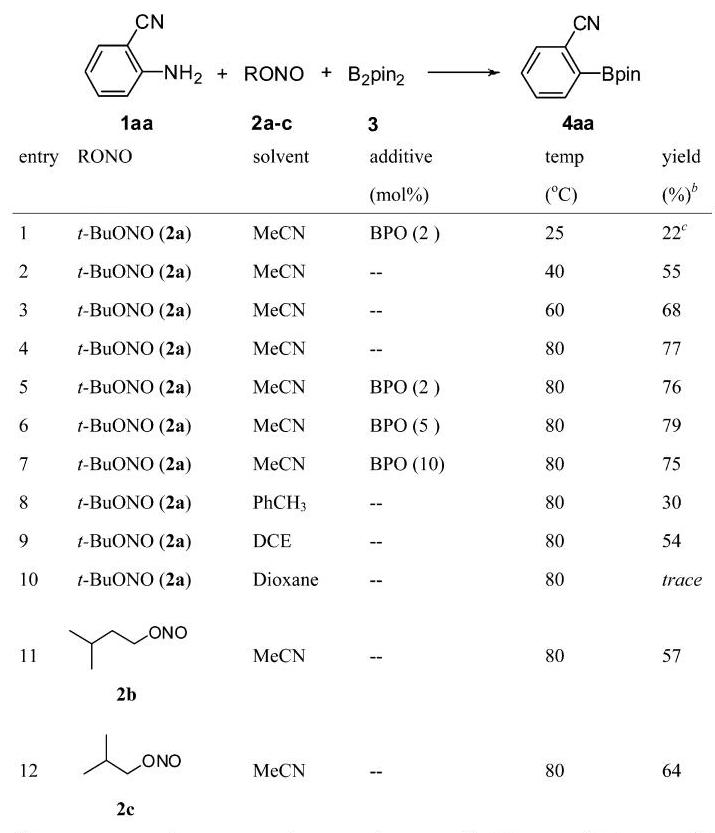
“Reaction conditions: arylamine (1 mmol), ${\mathrm{B}}_{2}{\mathrm{{pin}}}_{2}$ (1.1 mmol), RONO (1.5 mmol),1 h. ${}^{b}\mathrm{{GC}}$ yield measured with $\mathrm{{GC}} - \mathrm{{MS}}$ , mesitylene was used as internal standard. ${}^{c}$ See ref 11. ${\mathrm{B}}_{2}{\mathrm{{pin}}}_{2}$ : bis(pinacolato)diboron. Bpin: 4,4,5,5-tetramethyl-1,3,2-dioxaborolan- 2-yl.
The optimization experiments demonstrate that by simply raising reaction temperature, the yield of the borylation product could be markedly improved. With this in hand, the aniline substrates that afforded the low yields of the corresponding borylation products under the previous conditions were examined, and the yields were compared (Scheme 2). The results show that in general the yields are improved when the reactions are carried out at high temperature, especially for those with halogen substituents (4ab, 4ac, 4af, 4ah).
Encouraged by the results, we proceeded to apply this metal-free borylation to a series of new substrates. First, parasubstituted aniline derivatives were investigated (Scheme 3). Moderate to good yields were obtained for most of the parasubstituted aniline substrates. The borylation showed good tolerance to various functional groups, including methylthio (4ba), hydroxyl (4bb), formyl (4bc), carboxyl (4bd), sulfonyl (4be), azo (4bf), amino (4bh), iodo (4bk), and alkynyl (4bj) groups. In the cases of 4bc, 4bg, and 4bl, the low yields are due to their low stability on column chromatography or TLC. When 4-aminostryne was employed as the substrate, the corresponding boronate 4bg was isolated in very low yield. In this case, a large quantity of precipitate was observed. We speculate that polymerization occurs in this reaction, which may be initiated by a radical intermediate (vide infra). Interestingly, with $p$ -aminoaniline as the substrate, selective mono- or diborylation could be realized by simply controlling the amount of $t$ -BuONO and ${\mathrm{B}}_{2}{\text{ pin }}_{2}$ used in the reaction (4bh and 4bi).
Scheme 2. Comparison of Yields with Those Reported Previously ${}^{a}$
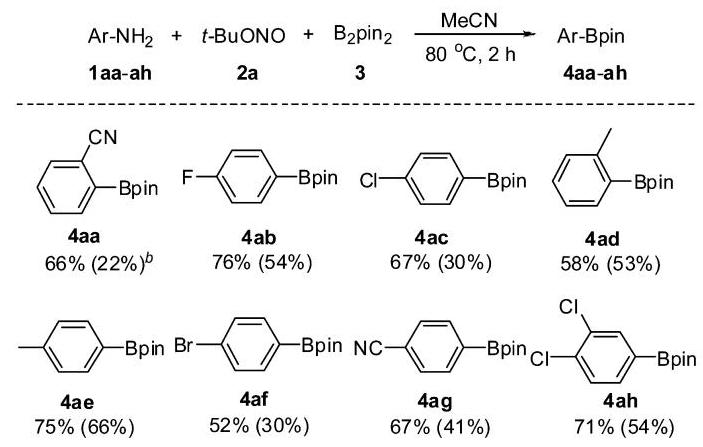
${}^{a}$ Current reaction conditions: arylamine $\left( {1\mathrm{{mmol}}}\right) ,{\mathrm{B}}_{2}{\mathrm{{pin}}}_{2}({1.1}$ mmol), t-BuONO (1.5 mmol), MeCN (3 mL), 80 ${}^{ \circ }\mathrm{C}$ , 2 h. ${}^{b}$ Isolated yield. The figure in brackets refers to the yields reported under the previous reaction conditions; see ref 11. The previous reaction conditions: arylamine $\left( {1\mathrm{{mmol}}}\right) ,{\mathrm{B}}_{2}{\mathrm{{pin}}}_{2}\left( {{1.1}\mathrm{{mmol}}}\right) , t$ -BuONO (1.5 mmol), BPO (2 mol %), MeCN (3 mL), room temperature, 2 h.
Scheme 3. Scope of para-Substitued Aniline Derivatives ${}^{a}$
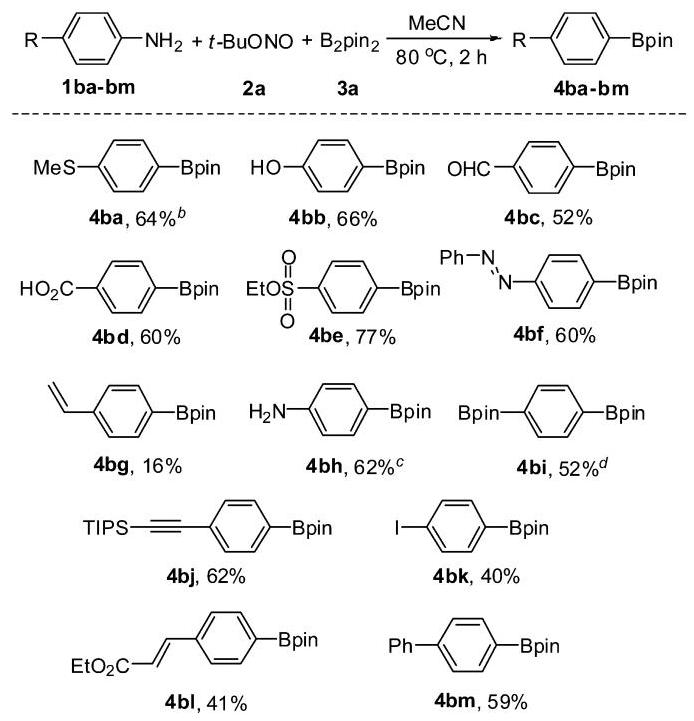
${}^{a}$ Reaction conditions: arylamine $\left( {1\mathrm{{mmol}}}\right) ,{\mathrm{B}}_{2}{\mathrm{{pin}}}_{2}\left( {{1.1}\mathrm{{mmol}}}\right) , t$ - BuONO (1.5 mmol), MeCN (3 mL), 2 h. ${}^{b}$ Isolated yield. ${}^{c}t$ -BuONO (1.1 mmol). ${}^{d}{\mathrm{\;B}}_{2}{\mathrm{{pin}}}_{2}$ (2.2 mmol), $t$ -BuONO (3 mmol).
Furthermore, we expanded the scope of substrates to meta-, ortho-, or multi-substituted arylamine substrates (Scheme 4). The borylation in general affords relatively low to moderate yields. Compared with electron-rich aniline derivatives, electron-deficient ones usually give higher yields when the corresponding borylation products are stable toward column chromatography (for example, 4cj, 4ck, and 4cn). Moreover, the steric bulkiness of the ortho substitution seems to affect the borylation reaction. The substrates with ortho substitution generally afforded diminished yields. For example, reaction with 2,6-dimethylaniline gave only 23% yield (4cd).
Scheme 4. Reaction with meta, ortho, or multi-Substitued Arylamines ${}^{a}$
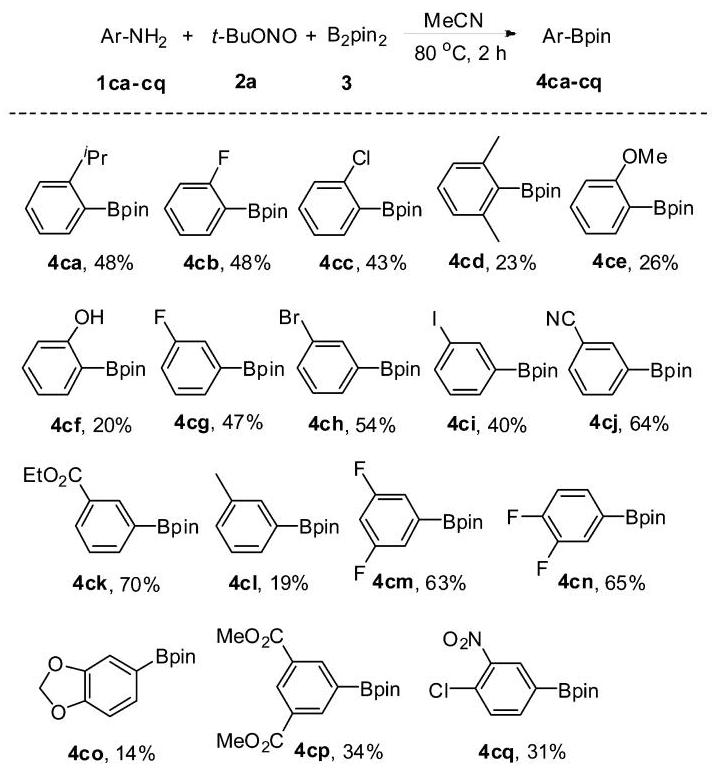
“Reaction conditions: arylamine $\left( {1\mathrm{\;{mmol}}}\right) ,{\mathrm{B}}_{2}{\mathrm{{pin}}}_{2}\left( {{1.1}\mathrm{\;{mmol}}}\right) , t$ - BuONO (1.5 mmol), MeCN (3 mL), 2 h. ${}^{b}$ Isolated yield.
Subsequently, we proceeded to extend the reaction to some complicated aromatic amines and heterocyclic amines. These results are shown in Scheme 5. The reaction with 2- aminonaphthalene afforded 5da with low yield, and large amount of ${\mathrm{B}}_{2}{\text{ pin }}_{2}$ was recovered. This is likely due to the facile oxidation of 2-aminonaphthalene under the reaction conditions. In the case of 5db and 5dc, the low yields are attributed to the instability of these products.
Heterocyclic boronic acids or boronates have found wide applications in organic synthesis, especially for pharmaceuticals. However, these boron compounds are usually not easy to synthesize as a result of the limitations of other methodologies that have been discussed in the Introduction. Thus, we investigated the application of this new borylation method to access heterocyclic boronates. We found that electron-deficient heterocyclic amines demonstrate high reactivity with nearly complete conversion of ${\mathrm{B}}_{2}{\mathrm{{pin}}}_{2}$ . However, electron-rich heterocyclic amines are prone to be oxidized in the presence of $t$ -BuONO, resulting in low yields of borylation products (5de and 5df).
Scheme 5. Scope of Other Aromatic Derivatives ${}^{a}$
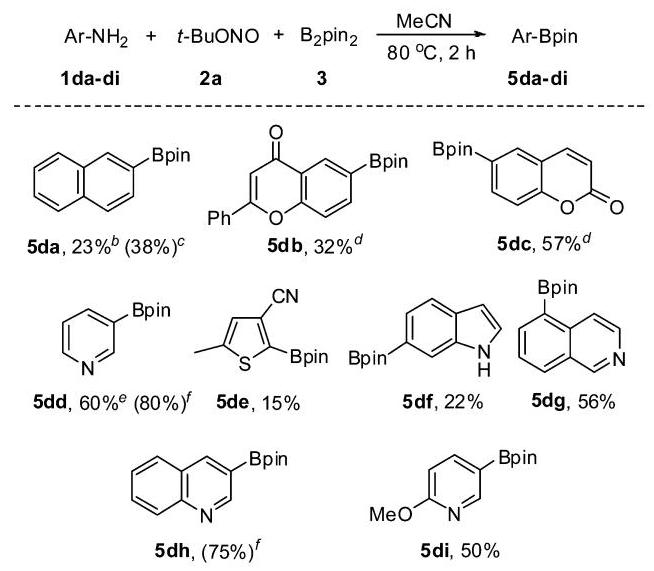
${}^{a}$ Reaction conditions: arylamine (1 mmol), ${\mathrm{B}}_{2}{\mathrm{{pin}}}_{2}$ (1.1 mmol), $t$ - BuONO (1.5 mmol), 2 h, MeCN (3 mL). ${}^{b}$ Isolated yield. ${}^{c}$ The isolated yield of 5da in brackets refer to the reaction in water: a mixture of arylamine $\left( {1\mathrm{\;{mmol}}}\right) ,{\mathrm{{NaNO}}}_{2}\left( {{1.1}\mathrm{{mmol}}}\right) ,\mathrm{{HCl}}({0.41}\mathrm{\;{mL}}$ , ${12}\mathrm{\;{mol}}/\mathrm{L})$ , and ${\mathrm{H}}_{2}\mathrm{O}\left( {1\mathrm{\;{mL}}}\right)$ was stirred at $0{}^{ \circ }\mathrm{C}$ for ${15}\mathrm{\;{min}}$ , then to the mixture was added ${\mathrm{B}}_{2}{\mathrm{{pin}}}_{2}\left( {{1.1}\mathrm{{mmol}}}\right)$ in $\mathrm{{MeCN}}\left( {1\mathrm{{mL}}}\right)$ , and stirring was continued at ${80}^{ \circ }\mathrm{C}$ for $2\mathrm{\;h}.{}^{d}$ Arylamine $\left( {{0.5}\mathrm{{mmol}}}\right) ,{\mathrm{B}}_{2}{\mathrm{{pin}}}_{2}$ (1.1 equiv), $t$ -BuONO (1.5 equiv), MeCN (1.5 mL),2 h. ${}^{e}$ Isolated by recrystallization. ${}^{f}$ Yields in brackets refer to GC yield measured with a GC-MS instrument (mesitylene as internal standard).
It is noteworthy that most of the heterocyclic boronates are not stable on silica gel column chromatography. To simplify the synthetic procedure and in particular to avoid the problem of product decomposition during the purification process, a sequential borylation and Pd-catalyzed cross-coupling reaction has been demonstrated in our preliminary communication. ${}^{11}$ Such a sequential process avoids the troublesome purification process and significantly strengthens the usefulness of this new borylation method. Herein we further expand the scope of this sequential process, especially for the heterocyclic substrates (Scheme 6). Thus, upon completion of the borylation, MeCN is removed under reduced pressure to give crude borylation product, which is then subjected next to Pd-catalyzed Suzuki-Miyaura cross-coupling reaction without further purification to afford coupling products in moderately high yields in general. However, in some cases the yields are less satisfactory (6d, 6h, 6r, and 6s).
Finally, to demonstrate the practical usefulness of this borylation method, the reaction has been carried out in gram-scale for selected substrates. As shown in Scheme 7, the reaction provided the desired boronates in good yields. The sequential borylation and Pd-catalyzed cross-coupling has also been scaled up (eq 1).

(1)
Since it is well documented that Sandmeyer reaction proceeds through a radical mechanism, ${}^{{13}\mathrm{\;b},{15}}$ a possible reaction pathway involving radical species is proposed for this borylation reaction as shown in Scheme 8. First, the tert-butoxide anion interacts with ${\mathrm{B}}_{2}{\mathrm{{pin}}}_{2}$ to form a tetra-coordinated boron
Scheme 6. Sequential Borylation and Pd-Catalyzed Cross-Coupling Reaction ${}^{a}$
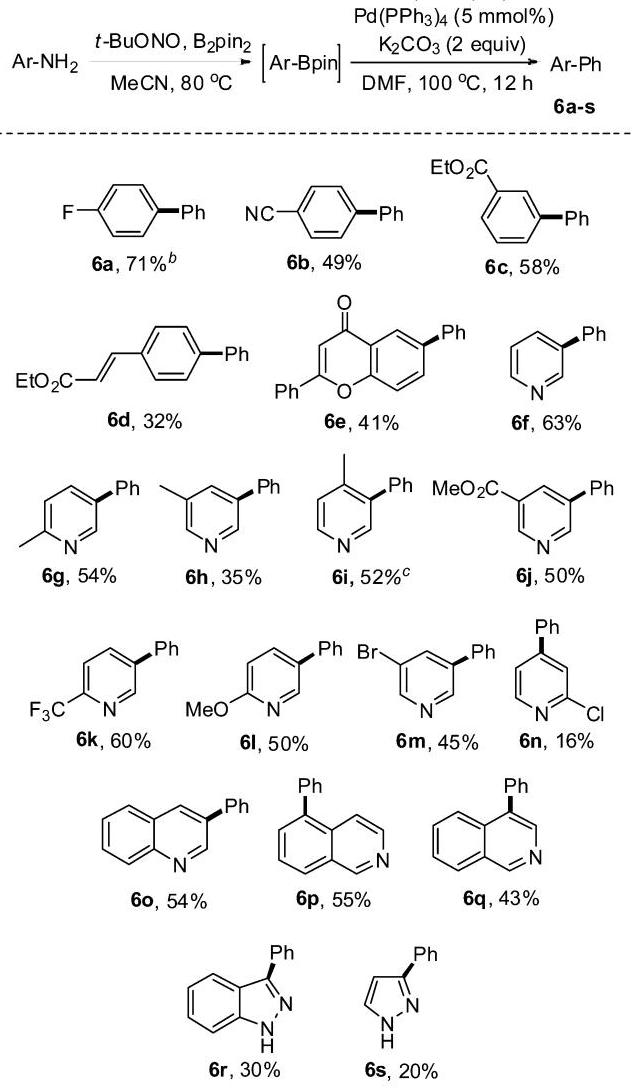
${}^{a}$ Reaction condition for the first step: arylamine (1 mmol), ${\mathrm{B}}_{2}{\mathrm{{pin}}}_{2}$ (1.1 mmol), t-BuONO (1.5 mmol), 2 h; second step: DMF (1.5 mL). ${}^{b}$ Isolated yield. ${}^{c}$ Reaction conditions for the second step: $\mathrm{{Pd}}{\left( {\mathrm{{PPh}}}_{3}\right) }_{4}$ (5 mmol %), 10% aq ${\mathrm{{Na}}}_{2}{\mathrm{{CO}}}_{3}\left( {2\mathrm{\;{mL}}}\right)$ , toluene (4 mL), EtOH (2 mL), 12 h.
Scheme 7. Gram-Scale Experiments ${}^{a}$
$$ {\mathrm{{Ar} - {NH}}}_{2} + t\text{ -BuONO } + {\mathrm{B}}_{2}{\mathrm{{pin}}}_{2}\xrightarrow[{{80}^{ \circ }\mathrm{C},{12}\mathrm{\;h}}]{\mathrm{{MeCN}}}\mathrm{{Ar} - {Bpin}} $$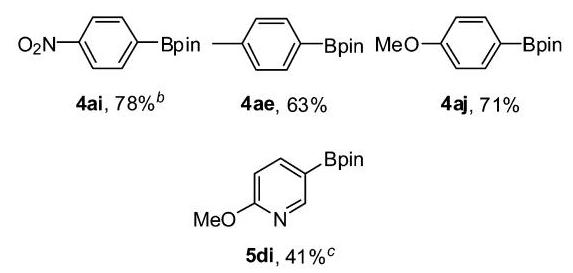
${}^{a}$ Reaction conditions: arylamine (20 mmol), ${\mathrm{B}}_{2}{\text{ pin }}_{2}$ (1.05 equiv), $t$ - BuONO (1.5 equiv),12 h, MeCN (60 mL). ${}^{b}$ Isolated yield. ${}^{c}$ Arylamine (10 mmol).
Scheme 8. Possible Reaction Mechanism
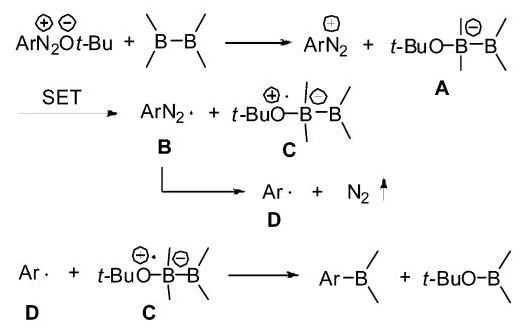
complex A. Single electron transfer (SET) between ate complex A and aryldiazonium ion is then followed to afford aryl radical D through ${\mathrm{N}}_{2}$ extrusion from radical B. Finally, reaction of aryl radical $\mathbf{D}$ with intermediate $\mathbf{C}$ gives the borylation product.
This reaction mechanism is substantiated by the following experimental observations: (1) When the borylation was carried out in the presence of 1.5 equiv of the radical scavenger TEMPO, the reaction became sluggish and phenylboronate was formed in only 8% yield after 4 h, while a control experiment has demonstrated that TEMPO does not react directly with ${\mathrm{B}}_{2}{\mathrm{{pin}}}_{2}$ under these conditions (eq 2). (2) Heating a 1:1 mixture
$$ {\mathrm{{Ph} - {NH}}}_{2} + {\mathrm{B}}_{2}{\mathrm{{pin}}}_{2} + t\text{ -BuONO + TEMPO }\xrightarrow[{\mathrm{{rt}},4\mathrm{\;h}}]{\mathrm{{MeCN}}}\mathrm{{Ph} - {Bpin}} \tag{2} $$$$ \text{ 1.1 equiv 1.5 equiv 1.5 equiv 8\% } $$of BPO and ${\mathrm{B}}_{2}{\mathrm{{pin}}}_{2}$ in MeCN at ${100}{}^{ \circ }\mathrm{C}$ for $4\mathrm{\;h}$ affords the phenylboronate in 37% yield (eq 3). It is known that BPO
$$ {\left( \mathrm{{PhCOO}}\right) }_{2} + \underset{1\text{ equiv }}{{\mathrm{B}}_{2}{\mathrm{{pin}}}_{2}}\xrightarrow[{{100}^{ \circ }\mathrm{C},4\mathrm{\;h}}]{\mathrm{{MeCN}}}\underset{{37}\% }{\mathrm{{Ph}} - \mathrm{{Bpin}}} \tag{3} $$cleaves under thermolytic conditions to benzoic acid radical upon heating, which generates phenyl radical by further decomposition. Thus, the desired product is likely formed by the reaction of benzoic acid radical and/or phenyl radical with ${\mathrm{B}}_{2}{\mathrm{{pin}}}_{2}$ . (3) EPR experiments provide supportive evidence for a radical process. ${}^{16}$
However, when ${\mathrm{B}}_{2}{\mathrm{{pin}}}_{2}$ was set to react with phenyl radical, which was generated by an alternative process (PhI, $n - {\mathrm{{Bu}}}_{3}\mathrm{{SnH}}$ , and AIBN), ${}^{17}$ the product Ph-Bpin was formed only in 7% yield (eq 4). Consequently, even though most of the experimental
$$ \mathrm{{PhI}} + {\mathrm{B}}_{2}{\mathrm{{pin}}}_{2} + n - {\mathrm{{Bu}}}_{3}\mathrm{{SnH}} + \mathrm{{AIBN}}\xrightarrow[{\text{ reflux, }4\mathrm{\;h}}]{\mathrm{{PhH}}}\mathrm{{Ph}} - \mathrm{{Bpin}} \tag{4} $$0.2 equiv 5%
observations are consistent with the mechanism shown in Scheme 8, alternative mechanisms involving an ionic process, such as nucleophilic aromatic substitution of the aryldiazonium salt by the boron ate complex, cannot be completely ruled out. Further rigorous investigation is required to unambiguously establish the reaction mechanism.
CONCLUSION
In this report we have further optimized the metal-free deaminoborylation reaction. The yields are improved, and the substrate scope has been significantly expanded, especially to heterocyclic amine derivatives, for which the corresponding boronate products are highly important both in academic research and in the pharmaceutical industry. A radical mechanism involving SET between aryldiazonium ion and tetra-coordinated boron complex has been proposed. Since arylamines are inexpensive and ubiquitous starting materials, this borylation method is expected to find wide applications in organic synthesis.
EXPERIMENTAL SECTION
The solvents were all distilled prior to use. MeCN and DMF were distilled from calcium hydride. Silica gel, 200-300 mesh, was used for the chromatography. ${}^{1}\mathrm{H}$ NMR (400 MHz) and ${}^{13}\mathrm{C}$ NMR (100 MHz) spectra were recorded in ppm using tetramethylsilane (TMS) as the internal standard; IR spectra are reported in wave numbers, ${\mathrm{{cm}}}^{-1}$ . For HRMS measurements, the mass analyzer is FT-ICR. Melting points are reported as uncorrected.
Typical Procedure of Borylation Reaction. ${\mathrm{B}}_{2}{\mathrm{{pin}}}_{2}$ (279 mg,1.1 mmol) and 2-aminobenzonitrile (1aa, 118 mg, 1.0 mmol) were weighed in a ${25}\mathrm{\;{mL}}$ round-bottom flask. MeCN (3 mL) and $t$ -BuONO (2a, 155 mg, 1.5 mmol) were then added in succession. The resulting reaction solution was stirred for $2\mathrm{\;h}$ at ${80}^{ \circ }\mathrm{C}\left( {\mathrm{N}}_{2}\right.$ evolution completed within 5 to ${15}\mathrm{\;{min}}$ ). The solution was then concentrated under reduced pressure, and the crude residue was purified by flash chromatography (silica gel, petroleum ether/EtOAc = 200:1). 2- (4,4,5,5-Tetramethyl-1,3,2-dioxaborolan-2-yl)benzonitrile ${\left( 4aa\right) }^{11}$ was obtained (152 mg, 66%) as pale yellow solid; mp 80-82 ${}^{ \circ }\mathrm{C}$ ; ${}^{1}\mathrm{H}$ NMR $\left( {{400}\mathrm{{MHz}},{\mathrm{{CDCl}}}_{3}}\right) {\delta 7.89}\left( {\mathrm{{dd}}, J = {1.2},{7.3}\mathrm{\;{Hz}},1\mathrm{H}}\right) ,{7.70}(\mathrm{{dd}}, J = {1.2}$ , 7.5 Hz, 1H), 7.55 (m, 2H), 1.39 (s, 12H); ${}^{13}$ C NMR (100 MHz, CDCl ${}_{3}$ ) $\delta$ 135.8, 133.4, 131.5, 131.0, 118.9, 117.3, 84.8, 24.8; IR (film) 2981 (w), 2228 (w), 1488 (w), 1441 (m), 1382 (s), 1356 (s), 1143 $\left( \mathrm{m}\right) ,{1119}\left( \mathrm{\;m}\right) ,{857}\left( \mathrm{\;m}\right) ,{731}\left( \mathrm{\;m}\right) ,{654}\left( \mathrm{\;m}\right) {\mathrm{{cm}}}^{-1}$ ; EI-MS $(m/z$ , relative intensity) 229 (M*, 24), 214 (46), 188 (50), 186 (61), 171 (45), 130 (100), 129 (29), 103 (24), 85 (17).
2-(4-Fluorophenyl)-4,4,5,5-tetramethyl-1,3,2-dioxaborolane (4ab). ${}^{11}$ Flash chromatography (silica gel, petroleum ether/EtOAc = 500:1) afforded 4ab (169 mg,76%); pale yellow liquid. ${}^{1}\mathrm{H}$ NMR (400 MHz, CDC ${\mathrm{L}}_{3}$ ) $\delta {{7.80}\mathrm{\;\left( {t, J = {7.2}\mathrm{{Hz}},2\mathrm{H}}\right) }},{7.04}\mathrm{\;\left( {t, J = {8.8}\mathrm{{Hz}},2\mathrm{H}}\right) },{1.33}$ (s, 12H); ${}^{13}\mathrm{C}$ NMR (100 MHz, CDCl ${}_{3}$ ) δ 165.1 (d, J = 250.3 Hz), 137.0 (d, J = 8.2 Hz), 114.8 (d, J = 20.3 Hz), 83.8, 24.8; IR (film) 2980 (w), 1603 (m), 1399 (m), 1361 (s), 1143 (m), 1088 (m), 860 (w), 668 (w) cm ${}^{-1}$ ; EI-MS (m/z, relative intensity) 222 (M ${}^{ + }$ , 21), 207 (87), 136 (41), 123 (100), 122 (31), 85 (14).
2-(4-Chlorophenyl)-4,4,5,5-tetramethyl-1,3,2-dioxaborolane (4ac). ${}^{11}$ Flash chromatography (silica gel, petroleum ether, then petroleum ether/EtOAc = 200:1) afforded 4ac (160 mg, 67%); pale yellow liquid. ${}^{1}\mathrm{H}$ NMR (400 MHz, CDCl, ${}_{3}\delta$ 7.73 (d, $J = {7.8}\mathrm{\;{Hz}},2\mathrm{H}$ ), ${7.33}\left( {\mathrm{\;d}, J = {7.8}\mathrm{\;{Hz}},2\mathrm{H}}\right) ,{1.33}\left( {\mathrm{\;s},{12}\mathrm{H}}\right) ;{}^{13}\mathrm{C}$ NMR $\left( {{100}\mathrm{{MHz}},{\mathrm{{CDCl}}}_{3}}\right) \; \delta$ 137.5,136.1,127.9,83.9,24.8; IR (film) 2979 (w),1597 (m),1393 (m), 1360 (s), 1144 (m), 1094 (s), 1017 (m), 858 (m) cm ${}^{-1}$ ; EI-MS ( $m/z$ , relative intensity) 240 (13), ${238}\left( {{\mathrm{\;M}}^{ + },{38}}\right) ,{225}\left( {34}\right) ,{223}\left( {100}\right)$ , 152 (63), 141 (33), 139 (95).
4,4,5,5-Tetramethyl-2-o-tolyl-1,3,2-dioxaborolane (4ad). ${}^{11}$ Flash chromatography (silica gel, then petroleum ether/EtOAc $= {500} : 1$ ) afforded 4ad $\left( {{126}\mathrm{{mg}},{58}\% }\right)$ ; white solid; mp ${32} - {34}{}^{ \circ }\mathrm{C}.{}^{1}\mathrm{H}$ NMR $\left( {{400}\mathrm{{MHz}},{\mathrm{{CDCl}}}_{3}}\right) \delta = {7.78} - {7.74}\left( {\mathrm{\;m},1\mathrm{H}}\right) ,{7.30}\left( {\mathrm{\;m},1\mathrm{H}}\right) ,{7.16}(\mathrm{\;m}$ , 2H), 2.53 (s, 3H), 1.33 (s, 12H); ${}^{13}\mathrm{C}$ NMR (100 MHz, CDCl ${}_{3}$ ) δ 144.8, 135.8, 130.7, 129.7, 124.7, 83.4, 24.9, 22.2; IR (film) 2978 (w), 2926 (w), 1380 (m), 1346 (s), 1146 (m), 1073 (m), 862 (m), 730 (m), 659 (m) cm ${}^{-1}$ ; EI-MS (m/z, relative intensity) 218 (M ${}^{ + }$ , 25), 203 (35), 161 (85), 119 (100), 118 (84), 91 (20).
4,4,5,5-Tetramethyl-2-p-tolyl-1,3,2-dioxaborolane (4ae). ${}^{11}$ Flash chromatography (silica gel, petroleum ether, then petroleum ether/ EtOAc = 250:1) afforded 4ae (163 mg, 75%); white solid; mp 53-54 ${}^{ \circ }\mathrm{C}$ . ${}^{1}\mathrm{H}$ NMR (400 MHz, ${\mathrm{{CDCl}}}_{3}$ ) $\delta$ 7.70 (d, $J = {7.7}\mathrm{\;{Hz}},2\mathrm{H}$ ), ${7.17}(\mathrm{\;d}, J \; = {7.7}\mathrm{\;{Hz}},2\mathrm{H}),{2.35}\left( {\mathrm{\;s},3\mathrm{H}}\right) ,{1.33}\left( {\mathrm{\;s},{12}\mathrm{H}}\right) ;{}^{13}\mathrm{C}$ NMR (100 MHz, ${\mathrm{{CDCl}}}_{3}$ ) $\delta$ 141.3,134.8,128.4,83.5,24.8,21.6; IR (film) 2978 (w), 1613 (w), 1517 (w), 1398 (m), 1360 (s), 1318 (m), 1304 (w), 1144 (m), 860 (m) cm ${\mathrm{{cm}}}^{-1}$ ; EI-MS ( $m/z$ , relative intensity) 218 ( ${\mathrm{M}}^{ + }$ , 44), 203 (61), 132 (67), 119 (100), 118 (50), 91 (17).
2-(4-Bromophenyl)-4,4,5,5-tetramethyl-1,3,2-dioxaborolane (4af). ${}^{11}$ Flash chromatography (silica gel, petroleum ether, then petroleum ether/EtOAc = 500:1) afforded 4af (147 mg, 52%); pale yellow liquid. ${}^{1}\mathrm{H}$ NMR (400 MHz, CDCl ${}_{3}$ ) δ 7.66 (d, $J = {8.1}\mathrm{\;{Hz}},2\mathrm{H}$ ), ${7.50}\left( {\mathrm{\;d}, J = {8.1}\mathrm{\;{Hz}},2\mathrm{H}}\right) ,{1.33}\left( {\mathrm{\;s},{12}\mathrm{H}}\right) ;{}^{13}\mathrm{C}$ NMR $\left( {{100}\mathrm{{MHz}},{\mathrm{{CDCl}}}_{3}}\right) \; \delta$ 136.3,130.9,126.2,84.0,24.8; IR (film) 2978 (w),1589 (m),1389 (m), 1359 (s), 1166 (m), 1144 (m), 1089 (s), 1012 (m), 821 (m) ${\mathrm{{cm}}}^{-1}$ ; EI-MS $\left( {m/z\text{ , relative intensity) 284 (51),282 }\left( {{\mathrm{M}}^{ + },{50}}\right) ,{269}}\right) \; \left( {100}\right) ,{267}\left( {100}\right) ,{198}\left( {71}\right) ,{196}\left( {72}\right) ,{185}\left( {89}\right) ,{183}\left( {96}\right) ,{103}\left( {36}\right)$ .
4-(4,4,5,5-Tetramethyl-1,3,2-dioxaborolan-2-yl)benzonitrile (4ag). ${}^{11}$ Flash chromatography (silica gel, petroleum ether/EtOAc = 30:1 then 0:1) afforded 4ag (153 mg, 67%); pale yellow solid; mp 93- ${95}^{ \circ }\mathrm{C}$ . ${}^{1}\mathrm{H}$ NMR (400 MHz, ${\mathrm{{CDCl}}}_{3}$ ) $\delta$ 7.88 (d, $J = {7.8}\mathrm{\;{Hz}},2\mathrm{H}$ ),7.64 (d, $J = {7.8}\mathrm{\;{Hz}},2\mathrm{H}),{1.35}$ (s,12H); ${}^{13}\mathrm{C}$ NMR (100 MHz, ${\mathrm{{CDCl}}}_{3}$ ) $\delta$ 135.1, 131.1, 118.8, 114.5, 84.4, 24.8; IR (film) 2980 (w), 2229 (w), 1398 (m), 1360 (s), 1168 (m), 1143 (s), 1125 (m), 1088 (s), 668 (m) ${\mathrm{{cm}}}^{-1}$ ; EI-MS ( $m/z$ , relative intensity) 229 ( ${\mathrm{M}}^{ + },{14}),{214}$ (100),213 (20), 186 (12), 143 (81), 130 (50), 58 (16).
2-(3,4-Dichlorophenyl)-4,4,5,5-tetramethyl-1,3,2-dioxaborolane (4ah). ${}^{11}$ Flash chromatography (silica gel, petroleum ether) afforded 4ah (194 mg, 71%); pale yellow liquid. ${}^{1}\mathrm{H}$ NMR (400 MHz, ${\mathrm{{CDCl}}}_{3}$ ) $\delta$ 7.86 $\left( {\mathrm{s},1\mathrm{H}}\right) ,{7.60}\left( {\mathrm{\;d}, J = {7.9}\mathrm{\;{Hz}},1\mathrm{H}}\right) ,{7.43}\left( {\mathrm{\;d}, J = {7.9}\mathrm{\;{Hz}},1\mathrm{H}}\right) ,{1.33}$ (s, 12H); ${}^{13}\mathrm{C}$ NMR (100 MHz, CDCl ${}_{3}$ ) $\delta$ 136.5, 135.5, 133.7, 132.2, 130.0, 84.3, 24.8; IR (film) 2978 (w), 1590 (w), 1381 (m), 1354 (s), ${1143}\left( \mathrm{\;m}\right) ,{1094}\left( \mathrm{\;m}\right) ,{1032}\left( \mathrm{\;w}\right) ,{867}\left( \mathrm{\;m}\right) {\mathrm{{cm}}}^{-1}$ ; EI-MS $(m/z$ , relative intensity) 274 (31), 272 ( ${\mathrm{M}}^{ + }$ , 46), 259 (69), 257 (100), 188 (65), 186 (95), 175 (48), 173 (84), 85 (23).
4,4,5,5-Tetramethyl-2-(4-(methylthio)phenyl)-1,3,2-dioxaboro-lane (4ba). ${}^{18}$ Flash chromatography (silica gel, petroleum ether/ EtOAc = 500:1) afforded 4ba (160 mg,64%); pale yellow liquid. ${}^{1}\mathrm{H}$ NMR (400 MHz, CDCl3) 67.71 (d, J = 7.8 Hz, 2H), 7.22 (d, J = 7.8 Hz, 2H), 2.47 (s, 3H), 1.33 (s, 12H); ${}^{13}\mathrm{C}$ NMR (100 MHz, CDCl ${}_{3}$ ) $\delta$ 142.5, 135.0, 125.0, 83.6, 24.8, 15.0; IR (film) 2978 (w), 1597 (m), 1395 (m), 1359 (s), 1327 (m), 1103 (s), 859 (m), 668 (m) cm ${}^{-1}$ ; EI-MS $\left( {m/z\text{ , relative intensity) 250 ( }{\mathrm{M}}^{ + },{100}}\right) ,{249}$ (28),235 (29),164 (30), 151 (63), 150 (95).
4-(4,4,5,5-Tetramethyl-1,3,2-dioxaborolan-2-yl)phenol (4bb). ${}^{19}$ Flash chromatography (silica gel, petroleum ether/EtOAc = 10:1) afforded 4bb (145 mg,66%); pale yellow solid; mp 113-114 ${}^{ \circ }\mathrm{C}$ . ${}^{1}\mathrm{H}$ NMR (400 MHz, CDCl, 3) 67.68 (d, J = 8.0 Hz, 2H), 6.81 (d, J = 8.0 $\mathrm{{Hz}},2\mathrm{H}),{6.68}\left( {\mathrm{\;s},1\mathrm{H}}\right) ,{1.34}\left( {\mathrm{\;s},{12}\mathrm{H}}\right) ;{}^{13}\mathrm{C}$ NMR (100 MHz, ${\mathrm{{CDCl}}}_{3}$ ) 6 158.7, 136.7, 115.0, 83.9, 24.7; IR (film) 3364 (w), 2979 (w), 1607 (s), 1397 (m), 1358 (s), 1170 (m), 1141 (s), 1084 (m), 670 (m) cm ${}^{-1}$ ; EI-MS $\left( {m/z}\right.$ , relative intensity) ${220}\left( {{\mathrm{M}}^{ + },{48}),{205}\left( {58}\right) ,{134}\left( {40}\right) ,{121}}\right.$ (100), 120 (97).
4-(4,4,5,5-Tetramethyl-1,3,2-dioxaborolan-2-yl)benzaldehyde (4bc). ${}^{20}$ Flash chromatography (silica gel, petroleum ether/EtOAc = 50:1 then 20:1) afforded 4bc (121 mg, 52%); pale yellow solid; mp 55-58 ${}^{ \circ }\mathrm{C}$ . ${}^{1}\mathrm{H}$ NMR (400 MHz, CDCl3) $\delta$ 10.05 (s,1H),7.97 (d, $J = \; {7.9}\mathrm{\;{Hz}},2\mathrm{H}),{7.86}\left( {\mathrm{\;d}, J = {7.9}\mathrm{\;{Hz}},2\mathrm{H}}\right) ,{1.36}\left( {\mathrm{\;s},{12}\mathrm{H}}\right) ;{}^{13}\mathrm{C}$ NMR (100 MHz, CDCl ${}_{3}$ ) δ 192.5, 138.0, 135.2, 128.6, 84.2, 24.8; IR (film) 2979 (w), 1707 (s), 1508 (m), 1358 (s), 1169 (m), 1086 (s), 857 (m), 825 (m), 800 (m) cm ${}^{-1}$ ; EI-MS ( $m/z$ , relative intensity) 232 ( ${\mathrm{M}}^{ + },{21}$ ), 217 (78), 146 (90), 133 (100), 85 (25).
4-(4,4,5,5-Tetramethyl-1,3,2-dioxaborolan-2-yl)benzoic Acid (4bd). ${}^{27}$ Flash chromatography (silica gel, petroleum ether/EtOAc = 50:1) afforded 4bd (150mg,60%); yellow solid; mp 228-231 ${}^{ \circ }\mathrm{C} \cdot {}^{1}\mathrm{H}$ NMR (400 MHz, CDCl ${}_{3}$ ) δ 8.11 (d, J = 8.0 Hz, 2H), 7.91 (d, J = 8.0 Hz, 2H), 1.37 (s, 12H); ${}^{13}\mathrm{C}$ NMR (100 MHz, CDCl3) δ 172.2, 134.7, 133.8, 129.2, 84.3, 24.8; IR (film) 2981 (w), 1686 (m), 1360 (s), 1167 (w), 1143 (m), 1126 (m), 856 (m), 739 (w) cm ${}^{-1}$ ; EI-MS (m/z, relative intensity) 248 (M*, 23), 233 (90), 162 (84), 149 (100), 148 (20), 85 (16).
Ethyl 4-(4,4,5,5-Tetramethyl-1,3,2-dioxaborolan-2-yl)- benzenesulfonate (4be). Flash column chromatography (silica gel, petroleum ether/EtOAc = 30:1 then 10:1) afforded 4be (240 mg, 77%); yellow solid; mp 82-84°C. ${}^{1}\mathrm{H}$ NMR (400 MHz, ${\mathrm{{CDCl}}}_{3}$ ) $\delta \; {7.98}\left( {\mathrm{\;d}, J = {8.3}\mathrm{\;{Hz}},2\mathrm{H}}\right) ,{7.89}\left( {\mathrm{\;d}, J = {8.3}\mathrm{\;{Hz}},2\mathrm{H}}\right) ,{4.12}(\mathrm{q}, J = {7.1}\mathrm{\;{Hz}}$ , 2H), ${1.36}\left( {\mathrm{\;s},{12}\mathrm{H}}\right) ,{1.29}\left( {\mathrm{t}, J = {7.1}\mathrm{\;{Hz}},3\mathrm{H}}\right) ;{}^{13}\mathrm{C}$ NMR (100 MHz, ${\mathrm{{CDCl}}}_{3}$ ) $\delta$ 138.4,135.3,126.7,84.5,67.1,24.8,14.7; IR (film) 2981 (w), 1393 (m), 1358 (s), 1188 (m), 1143 (m), 1099 (w), 962 (w), 668 (m) ${\mathrm{{cm}}}^{-1}$ ; EI-MS ( $m/z$ , relative intensity) 312 ( ${\mathrm{M}}^{ + },7$ ), 297 (52), 226 (100), 213 (27), 185 (18), 104 (18); HRMS (ESI) calcd for ${\mathrm{C}}_{14}{\mathrm{H}}_{22}{\mathrm{{BO}}}_{5}\mathrm{\;S}{\left\lbrack \mathrm{M} + \mathrm{H}\right\rbrack }^{ + }$ 313.1278, found 313.1272.
(E)-1-Phenyl-2-(4-(4,4,5,5-tetramethyl-1,3,2-dioxaborolan-2-yl)- phenyl)diazene (4bf). ${}^{22}$ Flash chromatography (silica gel, petroleum ether/EtOAc = 200:1) afforded 4bf (184 mg, 60%); red solid; mp 87- ${89}^{ \circ }\mathrm{C}.{}^{1}\mathrm{H}$ NMR (400 MHz, ${\mathrm{{CDCl}}}_{3}$ ) $\delta$ 7.98-7.89 (m,6H),7.50-7.43 $\left( {\mathrm{m},3\mathrm{H}}\right) ,{1.35}\left( {\mathrm{\;s},{12}\mathrm{H}}\right) ;{}^{13}\mathrm{C}$ NMR $\left( {{100}\mathrm{{MHz}},{\mathrm{{CDCl}}}_{3}}\right) {\delta 154.3},{152.6}$ , 135.6, 131.1, 129.0, 122.9, 121.9, 84.0, 24.8; IR (film) 2978 (w), 1603 (w), 1397 (m), 1358 (s), 1142 (s), 1087 (s), 858 (m), 688 (m), 667 (w) ${\mathrm{{cm}}}^{-1}$ ; EI-MS $(m/z$ , relative intensity) 308 $\left( {{\mathrm{M}}^{ + },{55}}\right) ,{203}\left( {100}\right)$ , 202 (24), 105 (32), 77 (84).
4,4,5,5-Tetramethyl-2-(4-vinylphenyl)-1,3,2-dioxaborolane (4bg). ${}^{23}$ Flash chromatography (silica gel, petroleum ether/EtOAc = 500:1 then 100:1) afforded 4bg (37 mg,16%); pale yellow liquid. ${}^{1}\mathrm{H}$ NMR (400 MHz, CDCl ${}_{3}$ ) $\delta$ 7.77 (d, $J = {7.8}\mathrm{\;{Hz}},2\mathrm{H}$ ),7.40 (d, $J = {7.8} \; \mathrm{{Hz}},2\mathrm{H}),{6.72}\left( {\mathrm{\;{dd}}, J = {10.9},{17.6}\mathrm{\;{Hz}},1\mathrm{H}}\right) ,{5.81}\left( {\mathrm{\;d}, J = {17.6}\mathrm{\;{Hz}},1\mathrm{H}}\right)$ , ${5.29}\left( {\mathrm{\;d}, J = {10.9}\mathrm{\;{Hz}},1\mathrm{H}}\right) ,{1.35}\left( {\mathrm{\;s},{12}\mathrm{H}}\right) ;{}^{13}\mathrm{C}$ NMR (100 MHz, ${\mathrm{{CDCl}}}_{3}$ ) δ 140.2, 136.9, 135.0, 125.5, 114.8, 83.8, 24.8; IR (film) 2979 (w), 1610 (w), 1398 (m), 1360 (s), 1144 (m), 1108 (w), 963 (w), 859 (m), 668 (m) c ${\mathrm{m}}^{-1}$ ; EI-MS (m/z, relative intensity) 230 (M ${}^{ + }$ , 52), 215 (40), 144 (82), 131 (90), 130 (100).
4-(4,4,5,5-Tetramethyl-1,3,2-dioxaborolan-2-yl)aniline (4bh). ${}^{20}$ Flash chromatography (silica gel, petroleum ether/EtOAc = 25:1) afforded 4bh (135 mg, 62%); yellow solid; mp 148-150 ${}^{ \circ }\mathrm{C}$ . ${}^{1}\mathrm{H}$ NMR $\left( {{400}\mathrm{{MHz}},{\mathrm{{CDCl}}}_{3}}\right) \delta$ 7.62 $\left( {\mathrm{d}, J = {7.8}\mathrm{\;{Hz}},2\mathrm{H}}\right) ,{6.65}(\mathrm{\;d}, J = {7.8}\mathrm{\;{Hz}}$ , 2H), 1.32 (s, 12H); ${}^{13}\mathrm{C}$ NMR (100 MHz, CDCl ${}_{3}$ ) δ 149.3, 136.4, 114.0, 83.2, 24.8; IR (film) 3450 (w), 3358 (w), 2927 (w), 1628 (w), 1359 (s), 1182 (w), 1143 (s), 860 (m), 738 (s) cm ${}^{-1}$ ; EI-MS (m/z, relative intensity) ${219}\left( {{\mathrm{M}}^{ + },{65}}\right) ,{204}\left( {16}\right) ,{161}\left( {13}\right) ,{133}\left( {22}\right) ,{120}$ (77), 119 (100).
1,4-Bis(4,4,5,5-tetramethyl-1,3,2-dioxaborolan-2-yl)benzene (4bi). ${}^{5a}$ Flash chromatography (silica gel, petroleum ether/EtOAc = 500:1 then 100:1) afforded 4bi (172 mg, 52%); pale yellow solid; mp ${232} - {233}{}^{ \circ }\mathrm{C}$ . ${}^{1}\mathrm{H}$ NMR (400 MHz, ${\mathrm{{CDCl}}}_{3}$ ) $\delta$ 7.81 (s,4H),1.34 (s, 24H); ${}^{13}\mathrm{C}$ NMR (100 MHz, ${\mathrm{{CDCl}}}_{3}$ ) $\delta$ 133.8,83.8,24.8; IR (film) 2977 (w), 1439 (w), 1394 (m), 1371 (m), 1354 (s), 1142 (s), 1101 (s),858(s), 701 (w) ${\mathrm{{cm}}}^{-1}$ ; EI-MS (m/z, relative intensity) 330 ( ${\mathrm{M}}^{ + }$ , 35), 315 (52), 273 (27), 244 (88), 231 (100), 230 (50), 131 (30).
Triisopropyl((4-(4,4,5,5-tetramethyl-1,3,2-dioxaborolan-2-yl)- phenyl)ethynyl)silane (4bj. ${}^{24}$ Flash chromatography (silica gel, petroleum ether/EtOAc = 500:1) afforded 4bj (238 mg, 62%); orange solid; mp 80-82 ${}^{ \circ }\mathrm{C}$ . ${}^{1}\mathrm{H}$ NMR (400 MHz, CDCl ${}_{3}$ ) 67.73 (d, J $= {8.1}\mathrm{\;{Hz}},2\mathrm{H}),{7.46}\left( {\mathrm{\;d}, J = {8.1}\mathrm{\;{Hz}},2\mathrm{H}}\right) ,{1.33}\left( {\mathrm{\;s},{12}\mathrm{H}}\right) ,{1.13}\left( {\mathrm{\;s},{21}\mathrm{H}}\right)$ ; ${}^{13}\mathrm{C}$ NMR (100 MHz, ${\mathrm{{CDCl}}}_{3}$ ) δ 134.4,131.1,126.2,107.2,92.0,83.9, 24.8, 18.6, 11.3; IR (film) 2943 (w), 2866 (w), 1606 (m), 1398 (m), 1358 (s), 1143 (m), 1019 (m), 860 (m), 675 (s) cm ${}^{-1}$ ; EI-MS (m/z, relative intensity) 384 (M ${}^{ + }$ , 4), 342 (21), 341 (100), 313 (18), 299 (30), 285 (35), 271 (54), 185 (16), 171 (22).
2-(4-lodophenyl)-4,4,5,5-tetramethyl-1,3,2-dioxaborolane (4bk). ${}^{7a}$ Flash chromatography (silica gel, petroleum ether/EtOAc = 500:1) afforded 4bk (132 mg,40%); pale yellow solid; mp 89-91 ${}^{ \circ }\mathrm{C}$ . ${}^{1}\mathrm{H}$ NMR (400 MHz, ${\mathrm{{CDCl}}}_{3}$ ) $\delta$ 7.71 (d, $J = {8.0}\mathrm{\;{Hz}},2\mathrm{H}$ ),7.51 (d, $J = \; {8.0}\mathrm{\;{Hz}},2\mathrm{H}),{1.33}$ (s,12H); ${}^{13}\mathrm{C}$ NMR (100 MHz, ${\mathrm{{CDCl}}}_{3}$ ) $\delta$ 136.9, 136.2, 98.8, 84.0, 24.8; IR (film) 2976 (w), 1587 (m), 1387 (m), 1359 (s), 1325 (m), 1088 (s), 1007 (m), 857 (m) cm ${}^{-1}$ ; EI-MS (m/z, relative intensity) 330 (M*, 100), 315 (52), 244 (82), 230 (71), 229 (76), 104 (35), 103 (30).
(E)-Ethyl 3-(4-(4,4,5,5-tetramethyl-1,3,2-dioxaborolan-2-yl)- phenyl)acrylate (4bl). ${}^{25}$ Flash chromatography (silica gel, petroleum ether/EtOAc = 50:1 then 10:1) afforded 4bl (124 mg, 41%); Colorless oil. ${}^{1}\mathrm{H}$ NMR (400 MHz, CDCl ${}_{3}$ ) δ 7.82 (d, $J = {8.0}\mathrm{\;{Hz}},2\mathrm{H}$ ),7.69 (d, $J \; = {16.0}\mathrm{\;{Hz}},1\mathrm{H}),{7.52}\left( {\mathrm{\;d}, J = {8.0}\mathrm{\;{Hz}},2\mathrm{H}}\right) ,{6.49}\left( {\mathrm{\;d}, J = {16.0}\mathrm{\;{Hz}},1\mathrm{H}}\right)$ , ${4.26}\left( {\mathrm{q}, J = {7.1}\mathrm{\;{Hz}},2\mathrm{H}}\right) ,{1.36} - {1.34}\left( {\mathrm{m},{15}\mathrm{H}}\right) ;{}^{13}\mathrm{C}$ NMR $({100}\mathrm{{MHz}}$ , ${\mathrm{{CDCl}}}_{3})\delta$ 166.8,144.4,136.9,135.2,127.2,119.1,84.0,60.5,24.8, 14.3; IR (film) 2979 (w), 1714 (m), 1398 (m), 1359 (s), 1143 (s), 1089 (s), 858 (m), 706 (m) cm ${}^{-1}$ ; EI-MS (m/z, relative intensity) 302 $\left( {{\mathrm{M}}^{ + },{100}}\right) ,{287}\left( {72}\right) ,{257}\left( {22}\right) ,{216}\left( {60}\right) ,{203}\left( {92}\right) ,{157}\left( {64}\right) ,{129}$ (58), 77 (38).
2-(Biphenyl-4-yl)-4,4,5,5-tetramethyl-1,3,2-dioxaborolane (4bm). ${}^{26}$ Flash chromatography (silica gel, petroleum ether/EtOAc = 500:1 then 100:1) afforded 4bm (165 mg, 59%); yellow solid; mp 104-106 ${}^{ \circ }\mathrm{C}$ . ${}^{1}\mathrm{H}$ NMR (400 MHz, ${\mathrm{{CDCl}}}_{3}$ ) $\delta$ 7.89 (d, $J = {7.3}\mathrm{\;{Hz}},2\mathrm{H}$ ), ${7.61}\left( {\mathrm{\;d}, J = {7.1}\mathrm{\;{Hz}},4\mathrm{H}}\right) ,{7.43}\left( {\mathrm{t}, J = {7.3}\mathrm{\;{Hz}},2\mathrm{H}}\right) ,{7.35}(\mathrm{t}, J = {7.1}\mathrm{\;{Hz}}$ , 1H), 1.36 (s, 12H); ${}^{13}\mathrm{C}$ NMR (100 MHz, CDCl ${}_{3}$ ) δ 143.8, 141.0, 135.2, 128.7, 127.5, 127.2, 126.4, 83.8, 24.8; IR (film) 2978 (w), 1609 (w), 1398 (m), 1360 (s), 1144 (m), 1092 (m), 766 (m), 697 (m) ${\mathrm{{cm}}}^{-1}$ ; EI-MS $\left( {m/z\text{ , relative intensity) }{280}\left( {{\mathrm{M}}^{ + },{67}}\right) ,{265}\left( {21}\right) ,{194}}\right)$ (60), 181 (74), 180 (100), 152 (18).
2-(2-Isopropylphenyl)-4,4,5,5-tetramethyl-1,3,2-dioxaborolane (4ca). ${}^{27}$ Flash chromatography (silica gel, petroleum ether/EtOAc = 500:1) afforded 4ca (118 mg,48%); pale yellow liquid. ${}^{1}\mathrm{H}$ NMR (400 MHz, CDCl ${}_{3}$ ) $\delta$ 7.74 (d, $J = {7.3}\mathrm{\;{Hz}},1\mathrm{H}$ ), 7.39-7.35 (m, 1H), 7.30 (d, $J = {7.8}\mathrm{\;{Hz}},1\mathrm{H}),{7.15}\left( {\mathrm{\;m},1\mathrm{H}}\right) ,{3.68}\left( {\mathrm{\;m},1\mathrm{H}}\right) ,{1.33}\left( {\mathrm{\;s},{12}\mathrm{H}}\right) ,{1.23}(\mathrm{\;d}, J \; = {6.8}\mathrm{\;{Hz}},6\mathrm{H});{}^{13}\mathrm{C}$ NMR (100 MHz, ${\mathrm{{CDCl}}}_{3}$ ) $\delta$ 155.4,135.7,130.9, 124.8, 124.4, 83.3, 31.5, 24.8, 24.4; IR (film) 2976 (w), 1599 (w), 1380 (m), 1346 (s), 1310 (m), 1144 (s), 1060 (m), 861 (m), 766 (m) ${\mathrm{{cm}}}^{-1}$ ; EI-MS (m/z, relative intensity) 246 (M ${}^{ + }$ , 20), 231 (15), 189 (50), 146 (56), 145 (60), 131 (74), 101 (62), 84 (100).
2-(2-Fluorophenyl)-4,4,5,5-tetramethyl-1,3,2-dioxaborolane (4cb). ${}^{7a}$ Flash chromatography (silica gel, petroleum ether/EtOAc = 500:1) afforded 4cb (108 mg,48%); pale yellow liquid. ${}^{1}\mathrm{H}$ NMR (400 MHz, CDCl ${}_{3}$ ) 67.76-7.72 (m, 1H), 7.42 (m, 1H), 7.13 (m, 1H), 7.02 $\left( {\mathrm{m},1\mathrm{H}}\right) ,{1.36}\left( {\mathrm{\;s},{12}\mathrm{H}}\right) ;{}^{13}\mathrm{C}\mathrm{{NMR}}\left( {{100}\mathrm{{MHz}},{\mathrm{{CDCl}}}_{3}}\right) {\delta 167.2}(\mathrm{\;d}, J = \; {250.8}\mathrm{\;{Hz}}),{136.8}\left( {\mathrm{\;d}, J = {8.0}\mathrm{\;{Hz}}}\right) ,{133.2}\left( {\mathrm{\;d}, J = {8.8}\mathrm{\;{Hz}}}\right) ,{123.5}(\mathrm{\;d}, J =$ 3.2 Hz), 115.2 (d, J = 23.8 Hz), 83.8, 24.8; IR (film) 2980 (w), 1615 (m), 1389 (m), 1356 (s), 1324 (m), 1144 (m), 1074 (m), 790 (w) ${\mathrm{{cm}}}^{-1}$ ; EI-MS $\left( {m/z\text{ , relative intensity) }{222}\left( {{\mathrm{M}}^{ + },{23}}\right) ,{207}\left( {38}\right) ,{160}}\right)$ (19), 123 (100), 122 (33), 85 (18).
2-(2-Chlorophenyl)-4,4,5,5-tetramethyl-1,3,2-dioxaborolane (4cc). ${}^{28}$ Flash chromatography (silica gel, petroleum ether/EtOAc = 500:1) afforded 4cc (102 mg, 43%); yellow liquid. ${}^{1}\mathrm{H}$ NMR (400 MHz, CDCl ${}_{3}$ ) $\delta$ 7.68 (d, $J = {7.2}\mathrm{\;{Hz}},1\mathrm{H}$ ), 7.35-7.32 (m, 2H), 7.24- ${7.20}\left( {\mathrm{\;m},1\mathrm{H}}\right) ,{1.37}\left( {\mathrm{\;s},{12}\mathrm{H}}\right) ;{}^{13}\mathrm{C}$ NMR $\left( {{100}\mathrm{{MHz}},{\mathrm{{CDCl}}}_{3}}\right) {\delta 139.5}$ , 136.4, 131.8, 129.3, 125.8, 84.1, 24.7; IR (film) 2979 (w), 1593 (w), 1380 (m), 1352 (s), 1144 (s), 1039 (m), 758 (m), 670 (m) cm ${}^{-1}$ ; EI-MS $\left( {m/z\text{ , relative intensity) 240 (6),238 (M }{}^{ + }\text{ ,18),223 (21),203 }}\right)$ (100), 161 (44), 139 (90), 103 (20).
2-(2,6-Dimethylphenyl)-4,4,5,5-tetramethyl-1,3,2-dioxaborolane (4cd). ${}^{19}$ Flash chromatography (silica gel, petroleum ether/EtOAc = 500:1) afforded 4 cd (53 mg, 23%); pale yellow liquid. ${}^{1}\mathrm{H}$ NMR (400 MHz, CDCl ${}_{3}$ ) $\delta$ 7.11 (t, $J = {7.6}\mathrm{\;{Hz}},1\mathrm{H}$ ), 6.93 (d, $J = {7.6}\mathrm{\;{Hz}},2\mathrm{H}$ ), 2.39 (s, 6H), 1.38 (s, 12H); ${}^{13}\mathrm{C}$ NMR (100 MHz, CDCl ${}_{3}$ ) δ 141.7, 129.1, 126.4, 83.6, 24.9, 22.2; IR (film) 2978 (w), 1597 (w), 1371 (m), 1332 (s), 1302 (s), 1144 (s), 1060 (s), 859 (m), 770 (m) cm ${}^{-1}$ ; EI-MS (m/ $z$ , relative intensity) ${232}\left( {{\mathrm{M}}^{ + },{32}}\right) ,{175}\left( {100}\right) ,{174}\left( {35}\right) ,{133}\left( {53}\right) ,{132}$ (66).
2-(2-Methoxyphenyl)-4,4,5,5-tetramethyl-1,3,2-dioxaborolane (4ce). ${}^{29}$ Flash chromatography (silica gel, petroleum ether/EtOAc = 100:1 then 50:1) afforded 4ce (61mg,26%); colorless liquid. ${}^{1}\mathrm{H}$ NMR (400 MHz, CDCl, ) 67.69-7.65 (m, 1H), 7.39 (m, 1H), 6.94 $\left( {\mathrm{m},1\mathrm{H}}\right) ,{6.85}\left( {\mathrm{\;d}, J = {8.3}\mathrm{\;{Hz}},1\mathrm{H}}\right) ,{3.83}\left( {\mathrm{\;s},3\mathrm{H}}\right) ,{1.35}\left( {\mathrm{\;s},{12}\mathrm{H}}\right) ;{}^{13}\mathrm{C}$ NMR (100 MHz, CDCl3) δ 164.2, 136.7, 132.4, 120.2, 110.5, 83.4, 55.8, 24.8; IR (film) 2979 (w), 1600 (m), 1461 (m), 1386 (m), 1353 (s),1273 (m),1145 (m),1073 (m),760 (m) cm ${}^{-1}$ ; EI-MS (m/z, relative intensity) ${234}\left( {{\mathrm{M}}^{ + },{67}}\right) ,{219}\left( {28}\right) ,{203}\left( {11}\right) ,{161}\left( {33}\right) ,{134}$ (100), 133 (60), 105 (47), 91 (69).
2-(4,4,5,5-Tetramethyl-1,3,2-dioxaborolan-2-yl)phenol (4cf). ${}^{30}$ Flash chromatography (silica gel, petroleum ether/EtOAc = 100:1) afforded 4cf (44 mg, 20%); pale yellow liquid. ${}^{1}\mathrm{H}$ NMR (400 MHz, ${\mathrm{{CDCl}}}_{3}$ ) $\delta$ 7.80 (s,1H),7.61 (dd, $J = {1.6},{7.5}\mathrm{\;{Hz}},1\mathrm{H}$ ),7.37 (m,1H), ${6.90} - {6.86}\left( {\mathrm{\;m},2\mathrm{H}}\right) ,{1.37}\left( {\mathrm{\;s},{12}\mathrm{H}}\right) ;{}^{13}\mathrm{C}$ NMR (100 MHz, ${\mathrm{{CDCl}}}_{3}$ ) $\delta$ 163.6, 135.7, 133.8, 119.5, 115.4, 84.4, 24.8; IR (film) 3448 (w), 2980 (w), 1620 (s), 1486 (m), 1390 (s), 1167 (m), 1140 (s), 860 (m), 671 (m) ${\mathrm{{cm}}}^{-1}$ ; EI-MS (m/z, relative intensity) 220 (M ${}^{ + }$ , 18), 163 (100), 162 (25), 121 (20), 120 (47).
2-(3-Fluorophenyl)-4,4,5,5-tetramethyl-1,3,2-dioxaborolane (4cg). ${}^{37}$ Flash chromatography (silica gel, petroleum ether/EtOAc = 500:1) afforded 4cg (104mg,47%); pale yellow liquid. ${}^{1}\mathrm{H}$ NMR (400 MHz, CDCl3) 67.57 (d, J = 7.2 Hz, 1H), 7.48 (m, 1H), 7.33 (m, 1H), ${7.13}\left( {\mathrm{\;m},1\mathrm{H}}\right) ,{1.34}\left( {\mathrm{\;s},{12}\mathrm{H}}\right) ;{}^{13}\mathrm{C}$ NMR (100 MHz, ${\mathrm{{CDCl}}}_{3}$ ) δ 162.5 $\left( {\mathrm{d}, J = {246.4}\mathrm{\;{Hz}}}\right) ,{130.3}\left( {\mathrm{\;d}, J = {2.9}\mathrm{\;{Hz}}}\right) ,{129.4}\left( {\mathrm{\;d}, J = {7.0}\mathrm{\;{Hz}}}\right) ,{120.9} \; \left( {\mathrm{d}, J = {19.3}\mathrm{\;{Hz}}}\right) ,{118.1}\left( {\mathrm{\;d}, J = {21.0}\mathrm{\;{Hz}}}\right) ,{84.1},{24.8}$ ; IR (film) 2980 (w), 1431 (m), 1381 (m), 1355 (s), 1144 (m), 1091 (w), 901 (m), 716 (m) ${\mathrm{{cm}}}^{-1}$ ; EI-MS $(m/z$ , relative intensity) 222 (M ${}^{ + }$ , 39), 207 (85), 136 (98), 123 (100), 122 (37), 85 (18), 58 (18).
2-(3-Bromophenyl)-4,4,5,5-tetramethyl-1,3,2-dioxaborolane (4ch). ${}^{32}$ Flash chromatography (silica gel, petroleum ether/EtOAc = 500:1) afforded 4ch (153 mg,54%); pale yellow liquid. ${}^{1}\mathrm{H}$ NMR (400 MHz, CDCl ${}_{3}$ ) $\delta$ 7.93 (s, 1H), 7.71-7.56 (m, 2H), 7.22 (t, J = 7.7 Hz, 1H), 1.33 (s, 12H); ${}^{13}\mathrm{C}$ NMR (100 MHz, CDCl ${}_{3}$ ) δ 137.4, 134.1, 133.0, 129.4, 122.4, 84.1, 24.8; IR (film) 2979 (w), 1407 (m), 1372 (m), 1351 (s), 1321 (m), 1143 (s), 1101 (w), 700 (s) cm ${}^{-1}$ ; EI-MS $\left( {m/z\text{ , relative intensity) }{284}\left( {43}\right) ,{282}\left( {{\mathrm{M}}^{ + },{51}}\right) ,{269}\left( {78}\right) ,{267}\left( {81}\right) }\right)$ , 198 (98), 196 (100), 185 (71), 183 (76), 103 (36), 85 (33).
2-(3-lodophenyl)-4,4,5,5-tetramethyl-1,3,2-dioxaborolane (4ci). ${}^{33}$ Flash chromatography (silica gel, petroleum ether/EtOAc = 500:1) afforded 4ci (132 mg,40%); yellow solid; mp 64-66 ${}^{ \circ }\mathrm{C}$ . ${}^{1}\mathrm{H}$ NMR (400 MHz, CDCl, δ 8.14 (s, 1H), 7.77-7.73 (m, 2H), 7.10 (t, $J = {7.6}\mathrm{\;{Hz}},1\mathrm{H}),{1.33}$ (s,12H); ${}^{13}\mathrm{C}$ NMR (100 MHz, CDCl ${}_{3}$ ) $\delta$ 143.4, 140.0, 133.6, 129.6, 94.5, 84.1, 24.8; IR (film) 2978 (w), 1402 (m), 1372 (m), 1349 (s), 1320 (m), 1143 (s), 1097 (w), 701 (m) cm ${}^{-1}$ ; EI-MS ( $m/z$ , relative intensity) 330 ( ${\mathrm{M}}^{ + }$ , 98), 315 (67), 244 (100), 231 (67), 230 (64), 104 (30), 103 (28).
3-(4,4,5,5-Tetramethyl-1,3,2-dioxaborolan-2-yl)benzonitrile (4cj). ${}^{29}$ Flash chromatography (silica gel, petroleum ether/EtOAc = 30:1) afforded 4cj (147 mg,64%); colorless liquid. ${}^{1}\mathrm{H}$ NMR (400 MHz, CDC1, $\delta$ 8.09 (s, 1H), 8.01 (d, J = 7.5 Hz, 1H), 7.72-7.47 (m, 2H), 1.36 (s, 12H); ${}^{13}\mathrm{C}$ NMR (100 MHz, CDCl, ${}_{3}$ ) δ 138.6, 138.2, 134.2, 128.3, 118.7, 111.9, 84.4, 24.7; IR (film) 2980 (w), 2230 (w), 1603 (w), 1358 (s), 1167 (w), 1143 (s), 880 (m), 700 (s), 672 (m) ${\mathrm{{cm}}}^{-1}$ ; EI-MS $\left( {m/z\text{ , relative intensity) }{229}\left( {{\mathrm{M}}^{ + },{23}}\right) ,{214}\left( {96}\right) ,{186}}\right)$ (17), 143 (100), 130 (65), 58 (31).
Ethyl 3-(4,4,5,5-tetramethyl-1,3,2-dioxaborolan-2-yl)benzoate (4ck). ${}^{18}$ Flash chromatography (silica gel, petroleum ether/EtOAc = 50:1 then 30;1) afforded 4ck (192 mg,70%); pale yellow liquid. ${}^{1}\mathrm{H}$ NMR (400 MHz, CDCl ${}_{3}$ ) $\delta$ 8.48 (s,1H),8.14 (d, $J = {7.8}\mathrm{\;{Hz}},1\mathrm{H}$ ), 7.99-7.44 $\left( {\mathrm{m},2\mathrm{H}}\right) ,{4.39}\left( {\mathrm{q}, J = {7.1}\mathrm{\;{Hz}},2\mathrm{H}}\right) ,{1.40}\left( {\mathrm{t}, J = {7.1}\mathrm{\;{Hz}},3\mathrm{H}}\right)$ , 1.35 $\left( {\mathrm{s},{12}\mathrm{H}}\right) ;{}^{13}\mathrm{C}$ NMR $\left( {{100}\mathrm{{MHz}},{\mathrm{{CDCl}}}_{3}}\right) {\delta 166.5},{139.0},{135.6}$ , 132.2, 129.8, 127.6, 83.9, 60.8, 24.7, 14.3; IR (film) 2980 (w), 1720 (s), 1390 (m), 1358 (s), 1280 (m), 1252 (s), 1167 (m), 1144 (s), 734 (w), ${659}\left( \mathrm{\;m}\right) {\mathrm{{cm}}}^{-1}$ ; EI-MS $(m/z$ , relative intensity) ${276}\left( {{\mathrm{M}}^{ + },{25}}\right) ,{261}$ (40), 233 (100), 205 (64), 177 (86), 149 (28), 131 (33), 103 (35).
4,4,5,5-Tetramethyl-2-m-tolyl-1,3,2-dioxaborolane (4cl). ${}^{34}$ Flash chromatography (silica gel, petroleum ether/EtOAc = 500:1) afforded 4cl (42 mg,19%); colorless solid; mp 33-34 ${}^{ \circ }\mathrm{C}$ . ${}^{1}\mathrm{H}$ NMR (400 MHz, ${\mathrm{{CDCl}}}_{3})\delta$ 7.64-7.61 $\left( {\mathrm{m},2\mathrm{H}}\right) ,{7.27}\left( {\mathrm{\;s},2\mathrm{H}}\right) ,{2.35}\left( {\mathrm{\;s},3\mathrm{H}}\right) ,{1.33}(\mathrm{\;s}$ , 12H); ${}^{13}\mathrm{C}$ NMR (100 MHz, ${\mathrm{{CDCl}}}_{3}$ ) $\delta$ 137.0,135.3,132.0,131.8, 127.6, 83.6, 24.8, 21.2; IR (film) 2978 (w), 1379 (m), 1356 (s), 1145 (s), 1103 (w), 852 (m), 708 (s), 665 (m) cm ${}^{-1}$ ; EI-MS (m/z, relative intensity) 218 (M ${}^{ + }$ , 38), 203 (43), 132 (77), 119 (100), 118 (57), 91 (20).
2-(3,5-Difluorophenyl)-4,4,5,5-tetramethyl-1,3,2-dioxaborolane (4cm). ${}^{35}$ Flash chromatography (silica gel, petroleum ether/EtOAc = 500:1) afforded 4 cm ( ${151}\mathrm{{mg}}$ ,63%); colorless solid; yellow solid; mp ${36} - {38}^{ \circ }\mathrm{C} \cdot {}^{1}\mathrm{H}$ NMR (400 MHz, ${\mathrm{{CDCl}}}_{3}$ ) $\delta$ 7.28 (dd, $J = {1.9},{7.8}\mathrm{\;{Hz}}$ , 2H), 6.87 (tt, J = 2.4, 9.1 Hz, 1H), 1.34 (s, 12H); ${}^{13}\mathrm{C}$ NMR (100 MHz, CDCl ${}_{3}$ ) $\delta$ 162.7 (dd, $J = {11.0},{249.7}\mathrm{\;{Hz}}$ ), 116.8 (dd, $J = {5.7},{17.1}$ Hz), 106.5 (t, J = 25.1 Hz), 84.4, 24.8; IR (film); 2981 (w), 1587 (m), 1427 (s), 1368 (s), 1144 (m), 980 (m), 872 (m), 717 (w) cm ${}^{-1}$ ; EI-MS $\left( {m/z}\right.$ , relative intensity) 240 $\left( {{\mathrm{M}}^{ + },{27}}\right) ,{225}\left( {81}\right) ,{197}\left( {10}\right) ,{154}$ (100), 141 (61), 85 (15), 58 (31).
2-(3,4-Difluorophenyl)-4,4,5,5-tetramethyl-1,3,2-dioxaborolane 4cn). ${}^{36}$ Flash chromatography (silica gel, petroleum ether/EtOAc = 500:1 then 100:1) afforded 4cn (156 mg, 65%); yellow liquid. ${}^{1}\mathrm{H}$ NMR (400 MHz, CDCl ${}_{3}$ ) δ 7.60-7.51 (m, 2H), 7.17-7.10 (m, 1H), 1.34 (s, 12H); ${}^{13}\mathrm{C}$ NMR (100 MHz, CDCl, d 512.6 (dd, J = 12.7, 252.2 Hz), 150.2 (dd, J = 12.0, 248.6 Hz), 131.4 (dd, J = 3.8, 6.7 Hz), 123.3 (d, $J = {15.1}\mathrm{\;{Hz}}$ ), 116.9 (d, $J = {16.3}\mathrm{\;{Hz}}$ ), 84.2, 24.8; IR (film) 2981 (w), 1614 (m), 1519 (m), 1390 (s), 1360 (s), 1272 (s), 1167 (m),1144 (s), 890 (w), 689 (m) cm ${\mathrm{{cm}}}^{-1}$ ; EI-MS (m/z, relative intensity) 240 (M*, 21), 225 (84), 154 (80), 141 (100), 131 (18), 79 (38), 58 (56).
2-(Benzo[d][1,3]dioxol-5-yl)-4,4,5,5-tetramethyl-1,3,2-dioxaboro-lane (4co). ${}^{37}$ Flash chromatography (silica gel, petroleum ether/ EtOAc = 500:1) afforded 4co ( ${35}\mathrm{{mg}},{14}\%$ ); yellow liquid. ${}^{1}\mathrm{H}$ NMR $\left( {{400}\mathrm{{MHz}},{\mathrm{{CDCl}}}_{3}}\right) {\delta 7.36}\left( {\mathrm{\;d}, J = {7.7}\mathrm{\;{Hz}},1\mathrm{H}}\right) ,{7.24}\left( {\mathrm{\;s},1\mathrm{H}}\right) ,{6.83}(\mathrm{\;d}, J \; = {7.7}\mathrm{\;{Hz}},1\mathrm{H}),{5.95}\left( {\mathrm{\;s},2\mathrm{H}}\right) ,{1.33}\left( {\mathrm{\;s},{12}\mathrm{H}}\right) ;{}^{13}\mathrm{C}\mathrm{{NMR}}\left( {{100}\mathrm{{MHz}}}\right.$ , ${\mathrm{{CDCl}}}_{3}$ ) $\delta$ 150.2, 147.2, 129.7, 113.9, 108.3, 100.7, 83.7, 24.8; EI-MS $\left( {m/z\text{ , relative intensity) }{248}\left( {{\mathrm{M}}^{ + },{76}}\right) ,{233}\left( {20}\right) ,{162}\left( {43}\right) ,{149}({67}}\right)$ , 148 (100), 147 (50).
Dimethyl 5-(4,4,5,5-Tetramethyl-1,3,2-dioxaborolan-2-yl)- isophthalate (4cp). ${}^{38}$ Flash chromatography (silica gel, petroleum ether/EtOAc = 50:1) afforded 4 cP (109 mg, 34%); yellow solid; mp ${125} - {127}^{ \circ }\mathrm{C} \cdot {}^{1}\mathrm{H}$ NMR (400 MHz, CDCl ${}_{3}$ ) δ 8.76 (s,1H),8.64 (d, J = 1.4 Hz, 2H), 3.95 (s, 6H), 1.37 (s, 12H); ${}^{13}\mathrm{C}$ NMR (100 MHz, ${\mathrm{{CDCl}}}_{3}$ ) $\delta$ 166.2,139.8,133.2,130.0,84.3,52.2,24.8; IR (film) 1726 (s), 1381 (m), 1334 (m), 1287 (m), 1262 (s), 1244 (s), 1008 (m), 736 (s) ${\mathrm{{cm}}}^{-1}$ ; EI-MS $(m/z$ , relative intensity) 320 $\left( {{\mathrm{M}}^{ + },{11}}\right) ,{305}\left( {28}\right) ,{289}$ (25), 277 (100), 221 (55), 189 (24), 161 (22).
2-(4-Chloro-3-nitrophenyl)-4,4,5,5-tetramethyl-1,3,2-dioxaboro-lane (4cq). ${}^{39}$ Flash column chromatography (silica gel, petroleum ether/EtOAc = 200:1) afforded 4cq (88 mg, 31%); yellow solid; mp 39-41 ${}^{ \circ }\mathrm{C}$ ; ${}^{1}\mathrm{H}$ NMR (400 MHz, ${\mathrm{{CDCl}}}_{3}$ ) δ 8.24 (s, 1H), 7.89 (d, J = ${8.0}\mathrm{\;{Hz}},1\mathrm{H}),{7.54}\left( {\mathrm{\;d}, J = {8.0}\mathrm{\;{Hz}},1\mathrm{H}}\right) ,{1.35}\left( {\mathrm{\;s},{12}\mathrm{H}}\right) ;{}^{13}\mathrm{C}$ NMR (100 MHz, CDCl ${}_{3}$ ) δ 147.8, 138.9, 131.3, 131.2, 129.5, 84.8, 24.8; IR (film) 2981 (w), 1604 (m), 1537 (m), 1390 (m), 1348 (s), 1143 (s), 1097 $\left( \mathrm{m}\right) ,{851}\left( \mathrm{\;m}\right) {\mathrm{{cm}}}^{-1}$ ; EI-MS $(m/z$ , relative intensity) ${285}\left( 2\right) ,{283}\left( {{\mathrm{M}}^{ + }\text{ , }}\right.$ 7), 270 (30), 268 (90), 223 (26), 197 (40), 181 (80), 155 (100), 85 (42),58 (51); HRMS (ESI) calcd for ${\mathrm{C}}_{12}{\mathrm{H}}_{15}{\mathrm{\;B}}^{35}{\mathrm{{ClNNaO}}}_{4}{\left\lbrack \mathrm{M} + \mathrm{{Na}}\right\rbrack }^{ + }$ 306.0677, found 306.0668.
4,4,5,5-Tetramethyl-2-(naphthalen-2-yl)-1,3,2-dioxaborolane (5da). ${}^{40}$ Flash chromatography (silica gel, petroleum ether/EtOAc = 500:1) afforded 5da (58 mg, 23%); white solid; mp 64-66 ${}^{ \circ }\mathrm{C}$ . ${}^{1}\mathrm{H}$ NMR (400 MHz, CDCl ${}_{3}$ ) δ 8.42 (s, 1H), 7.89-7.82 (m, 4H), 7.49- ${7.47}\left( {\mathrm{\;m},2\mathrm{H}}\right) ,{1.39}\left( {\mathrm{\;s},{12}\mathrm{H}}\right) ;{}^{13}\mathrm{C}$ NMR (100 MHz, CDCl ${}_{3}$ ) δ 136.2, 135.0, 132.8, 130.4, 128.6, 127.7, 126.9, 125.8, 83.9, 24.9; IR (film) 2978 (w), 1476 (m), 1383 (s), 1351 (s), 1144 (s), 1080 (m), 877 (m), 747 (s), 687 (m) cm ${}^{-1}$ ; EI-MS (m/z, relative intensity) 254 (M ${}^{ + }$ , 45), 239 (10), 168 (64), 154 (100), 128 (10).
2-Phenyl-6-(4,4,5,5-tetramethyl-1,3,2-dioxaborolan-2-yl)-4H-chromen-4-one (5db). ${}^{41}$ Flash chromatography (silica gel, petroleum ether/EtOAc = 15:1 then 10:1) afforded 5db (56 mg, 32%); yellow solid; mp 88-90 ${}^{ \circ }\mathrm{C}$ . ${}^{1}\mathrm{H}$ NMR (400 MHz, ${\mathrm{{CDCl}}}_{3}$ ) δ 8.73 (d, $J = {1.2} \; \mathrm{{Hz}},1\mathrm{H}),{8.10}\left( {\mathrm{\;{dd}}, J = {1.4},{8.4}\mathrm{\;{Hz}},1\mathrm{H}}\right) ,{7.94} - {7.92}\left( {\mathrm{\;m},2\mathrm{H}}\right) ,{7.56} - \; {7.52}\left( {\mathrm{\;m},4\mathrm{H}}\right) ,{6.85}\left( {\mathrm{\;s},1\mathrm{H}}\right) ,{1.37}\left( {\mathrm{\;s},{12}\mathrm{H}}\right) ;{}^{13}\mathrm{C}\mathrm{{NMR}}({100}\mathrm{{MHz}}$ , ${\mathrm{{CDCl}}}_{3}$ ) δ 178.4, 163.3, 158.2, 139.6, 133.3, 131.7, 131.6, 129.0, 126.3, 123.2, 117.3, 107.9, 84.2, 24.9; IR (film) 2978 (w), 2924 (w), 1644 (s), 1608 (m), 1351 (s), 1306 (m), 1143 (m), 712 (m) cm ${}^{-1}$ ; EI-MS (m/z, relative intensity) 348 (M ${}^{ + }$ , 73), 333 (44), 305 (39), 262 (20), 249 (100), 248 (71), 220 (19), 102 (54).
6-(4,4,5,5-Tetramethyl-1,3,2-dioxaborolan-2-yl)-2H-chromen-2- one (5dc). Flash column chromatography (silica gel, petroleum ether/ EtOAc = 20:1 then 10:1) afforded 5dc (78 mg, 57%); white solid; mp ${105} - {107}{}^{ \circ }\mathrm{C}$ ; ${}^{1}\mathrm{H}$ NMR (400 MHz, ${\mathrm{{CDCl}}}_{3}$ ) $\delta$ 7.96 $- {7.94}\left( {\mathrm{\;m},2\mathrm{H}}\right)$ , ${7.72}\left( {\mathrm{\;d}, J = {9.5}\mathrm{\;{Hz}},1\mathrm{H}}\right) ,{7.32}\left( {\mathrm{\;d}, J = {8.6}\mathrm{\;{Hz}},1\mathrm{H}}\right) ,{6.42}(\mathrm{\;d}, J = {9.5}\mathrm{\;{Hz}}$ , 1H), ${1.36}\left( {\mathrm{\;s},{12}\mathrm{H}}\right) ;{}^{13}\mathrm{C}$ NMR $\left( {{100}\mathrm{{MHz}},{\mathrm{{CDCl}}}_{3}}\right) \delta$ 160.6,156.1, 143.6, 138.1, 135.0, 118.3, 116.5, 116.2, 84.2, 24.8; IR (film) 2984 (w), 1753 (m), 1730 (s), 1393 (m), 1382 (s), 1371 (s), 1180 (m), 1131 (m) ${\mathrm{{cm}}}^{-1}$ ; EI-MS $(m/z$ , relative intensity) 272 $\left( {{\mathrm{M}}^{ + },{71}}\right) ,{257}$ (69), 186 (100), 173 (96), 144 (58), 116 (20), 85 (15); HRMS (ESI) calcd for ${\mathrm{C}}_{15}{\mathrm{H}}_{18}{\mathrm{{BO}}}_{4}{\left\lbrack \mathrm{M} + \mathrm{H}\right\rbrack }^{ + }$ 273.1295, found 273.1291.
3-(4,4,5,5-Tetramethyl-1,3,2-dioxaborolan-2-yl)pyridine (5dd). ${}^{19}$ Recrystallization from cyclohexane afforded 5dd (123 mg, 60%); white solid; mp 99-101 °C. ${}^{1}\mathrm{H}$ NMR (400 MHz, ${\mathrm{{CDCl}}}_{3}$ ) δ 8.95 (s, 1H), ${8.69} - {8.65}\left( {\mathrm{\;m},1\mathrm{H}}\right) ,{8.06}\left( {\mathrm{\;d}, J = {7.5}\mathrm{\;{Hz}},1\mathrm{H}}\right) ,{7.30} - {7.27}(\mathrm{\;m}$ , 1H), 1.36 (s, 12H); ${}^{13}\mathrm{C}$ NMR (100 MHz, CDCl, δ 155.3, 151.8, 142.2, 123.0, 84.2, 24.8; IR (film) 2976 (w), 1474 (m), 1413 (m), 1363 (m), 1156 (s), 1048 (s), 1024 (m), 876 (m), 734 (m) cm ${}^{-1}$ ; EI-MS (m/z, relative intensity) 205 (M ${}^{ + }$ , 36), 190 (100), 148 (44), 120 (15), 106 (87), 105 (33).
5-Methyl-2-(4,4,5,5-tetramethyl-1,3,2-dioxaborolan-2-yl)- thiophene-3-carbonitrile (5de). Flash column chromatography (silica gel, petroleum ether/EtOAc = 20:1) afforded 5de (37 mg, 15%); yellow liquid. ${}^{1}\mathrm{H}$ NMR (400 MHz, ${\mathrm{{CDCl}}}_{3}$ ) $\delta$ 7.05 (s,1H),2.52 (s, 3H), 1.36 (s, 12H); ${}^{13}\mathrm{C}$ NMR (100 MHz, CDCl ${}_{3}$ ) δ 147.9, 129.4, 117.9, 84.9, 24.7, 15.2; IR (film) 2926 (w), 2228 (w), 1726 (w), 1463 (s), 1364 (s), 1167 (m), 1140 (s), 1048 (s), 851 (s) cm ${}^{-1}$ ; EI-MS (m/ $z$ , relative intensity) ${249}\left( {{\mathrm{M}}^{ + },{62}}\right) ,{234}\left( {31}\right) ,{219}\left( {15}\right) ,{207}\left( {54}\right) ,{191}$ (54), 163 (28), 150 (100), 59 (30); HRMS (ESI) calcd for ${\mathrm{C}}_{12}{\mathrm{H}}_{17}{\mathrm{{BNO}}}_{2}\mathrm{\;S}{\left\lbrack \mathrm{M} + \mathrm{H}\right\rbrack }^{ + }{250.1070}$ , found 250.1066.
6-(4,4,5,5-Tetramethyl-1,3,2-dioxaborolan-2-yl)-1H-indole (5df). ${}^{42}$ Flash chromatography (silica gel, petroleum ether/EtOAc = 20:1 then 10:1) afforded 5df (53 pmg, 22%); orange solid; mp 181- ${183}^{ \circ }\mathrm{C}$ . ${}^{1}\mathrm{H}$ NMR (400 MHz, ${\mathrm{{CDCl}}}_{3}$ ) $\delta$ 8.22 (s, $1\mathrm{H}$ ),7.90 (s, $1\mathrm{H}$ ), ${7.65}\left( {\mathrm{\;d}, J = {7.9}\mathrm{\;{Hz}},1\mathrm{H}}\right) ,{7.56}\left( {\mathrm{\;d}, J = {7.9}\mathrm{\;{Hz}},1\mathrm{H}}\right) ,{7.24}(\mathrm{\;d}, J = {1.5}\mathrm{\;{Hz}}$ , 1H), 6.55 (s, 1H), 1.36 (s, 12H); ${}^{13}\mathrm{C}$ NMR (100 MHz, CDCl ${}_{3}$ ) 6 135.5, 130.4, 125.6, 125.5, 120.0, 118.0, 102.7, 83.5, 24.9; IR (film) 3320 (w), 2925 (w), 1514 (m), 1392 (m), 1358 (s), 1166 (w), 1142 (s), ${894}\left( \mathrm{w}\right) {\mathrm{{cm}}}^{-1}$ ; EI-MS $\left( {m/z}\right.$ , relative intensity) 243 $\left( {{\mathrm{M}}^{ + },{79}}\right) ,{228}$ (25), 170 (17), 157 (26), 144 (54), 143 (100), 116 (17).
5-(4,4,5,5-Tetramethyl-1,3,2-dioxaborolan-2-yl)isoquinoline (5dg). ${}^{43}$ Flash chromatography (silica gel, petroleum ether/EtOAc = 10:1) afforded 5dg (143 mg, 56%); yellow liquid. ${}^{1}\mathrm{H}$ NMR (400 MHz, CDCl3) δ 9.23 (s, 1H), 8.57 (s, 2H), 8.27 (d, J = 6.8 Hz, 1H), ${8.02}\left( {\mathrm{\;d}, J = {8.1}\mathrm{\;{Hz}},1\mathrm{H}}\right) ,{7.57}\left( {\mathrm{\;m},1\mathrm{H}}\right) ,{1.41}\left( {\mathrm{\;s},{12}\mathrm{H}}\right) ;{}^{13}\mathrm{C}$ NMR (100 MHz, CDCl ${}_{3}$ ) δ 152.8, 143.5, 139.7, 139.4, 130.9, 128.3, 126.2, 121.0, 83.9, 24.8; IR (film) 2978 (w), 1612 (w), 1488 (w), 1371 (m), 1344 (s), 1136 (s), 1111 (w), 868 (m) cm ${\mathrm{{cm}}}^{-1}$ ; EI-MS (m/z, relative intensity) 255 (M*, 63), 240 (20), 182 (18), 169 (40), 156 (55), 155 (100), 128 (19).
2-Methoxy-5-(4,4,5,5-tetramethyl-1,3,2-dioxaborolan-2-yl)- pyridine (5di). ${}^{44}$ Flash chromatography (silica gel, petroleum ether/ EtOAc = 20:1) afforded 5di (117 mg,50%); yellow liquid. ${}^{1}\mathrm{H}$ NMR $\left( {{400}\mathrm{{MHz}},{\mathrm{{CDCl}}}_{3}}\right) {\delta 8.56}\left( {\mathrm{\;s},1\mathrm{H}}\right) ,{7.92}\left( {\mathrm{\;d}, J = {8.3}\mathrm{\;{Hz}},1\mathrm{H}}\right) ,{6.71}(\mathrm{\;d}, J \; = {8.3}\mathrm{\;{Hz}},1\mathrm{H}),{3.95}\left( {\mathrm{\;s},3\mathrm{H}}\right) ,{1.33}\left( {\mathrm{\;s},{12}\mathrm{H}}\right) ;{}^{13}\mathrm{C}$ NMR (100 MHz, ${\mathrm{{CDCl}}}_{3}$ ) $\delta$ 166.0,154.1,144.3,110.1,83.6,53.2,24.7; IR (film) 2979 (w), 1600 (s), 1500 (w), 1372 (m), 1354 (s), 1145 (m), 859 (m), 687 (w) ${\mathrm{{cm}}}^{-1}$ ; EI-MS $(m/z$ , relative intensity) 235 $\left( {{\mathrm{M}}^{ + },{80}}\right) ,{234}\left( {100}\right)$ , 220 (19), 206 (15), 136 (88), 135 (63), 105 (28).
Borylation of 2-Naphthylamine (1da) in Water. 2-Naphthylamine (1da, 1 mmol, 143 mg), aqueous HCl (0.41 mL, 12 mol/L), and ${\mathrm{H}}_{2}\mathrm{O}\left( {{0.5}\mathrm{\;{mL}}}\right)$ were stirred with ice bath. Then, ${\mathrm{{NaNO}}}_{2}$ (1.1 mmol, ${76}\mathrm{{mg}}$ ) in ${\mathrm{H}}_{2}\mathrm{O}\left( {{0.5}\mathrm{\;{mL}}}\right)$ was added by dropping funnel. The reaction system was stirred for ${15}\mathrm{\;{min}}.{\mathrm{B}}_{2}{\mathrm{{pin}}}_{2}\left( {{1.1}\mathrm{{mmol}},{279}\mathrm{{mg}}}\right)$ and MeCN (1 mL) solution were then added in succession. The resulting solution was stirred at ${80}^{ \circ }\mathrm{C}$ for $2\mathrm{\;h}$ . The reaction mixture was then concentrated under reduced pressure, and the crude residue was purified by silica gel flash chromatography (petroleum ether). 4,4,5,5- Tetramethyl-2-(naphthalen-2-yl)-1,3,2-dioxaborolane (5da) was obtained (95 mg, 38%).
Typical Procedure of Consecutive Suzuki-Miyaura Cross-Coupling Reactions. ${\mathrm{B}}_{2}{\text{ pin }}_{2}$ (279 mg,1.1 mmol) and 3-amino-pyridine ( ${94}\mathrm{{mg}},{1.0}\mathrm{{mmol}}$ ) were weighed in a ${25}\mathrm{\;{mL}}$ round-bottom flask. MeCN ( $3\mathrm{\;{mL}}$ ) and $t$ -BuONO ( $2\mathrm{a},{155}\mathrm{{mg}},{1.5}\mathrm{{mmol}}$ ) were then added in succession. The resulting reaction solution was stirred for $2\mathrm{\;h}$ at ${80}^{ \circ }\mathrm{C}\left( {\mathrm{N}}_{2}\right.$ evolution completed within $5 - {15}\mathrm{\;{min}})$ . After the MeCN was removed by evaporation under reduced pressure, the system was degassed 3 times and was set under nitrogen atmosphere. Then $\mathrm{{Pd}}{\left( {\mathrm{{PPh}}}_{3}\right) }_{4}\left( {{58}\mathrm{{mg}},5\mathrm{{mmol}}\% }\right) ,{\mathrm{K}}_{2}{\mathrm{{CO}}}_{3}\left( {{276}\mathrm{{mg}},2\mathrm{{mmol}}}\right)$ , DMF $({1.5}$ mL), and PhI (245 mg, 1.2 mmol) were added, and the solution was stirred at ${100}^{ \circ }\mathrm{C}$ for ${12}\mathrm{\;h}$ . The solution was then concentrated by rotovap under reduced pressure to leave a crude residue, which was purified by silica gel column chromatography (petroleum ether/EtOAc $= {50} : 1$ , then 5:1) to give 3-phenylpyridine $6{\mathrm{f}}^{45}$ in ${63}\%$ isolated yield as pale yellow liquid. ${}^{1}\mathrm{H}$ NMR (400 MHz, ${\mathrm{{CDCl}}}_{3}$ ) $\delta$ 8.85 (s, $1\mathrm{H}$ ), 8.59 $\left( {\mathrm{d}, J = {4.1}\mathrm{\;{Hz}},1\mathrm{H}}\right) ,{7.86}\left( {\mathrm{\;d}, J = {7.8}\mathrm{\;{Hz}},1\mathrm{H}}\right) ,{7.57}\left( {\mathrm{\;d}, J = {7.5}\mathrm{\;{Hz}},2\mathrm{H}}\right)$ , ${7.47}\left( {\mathrm{t}, J = {7.5}\mathrm{\;{Hz}},2\mathrm{H}}\right) ,{7.42} - {7.33}\left( {\mathrm{\;m},2\mathrm{H}}\right) ;{}^{13}\mathrm{C}$ NMR $({100}\mathrm{{MHz}}$ , ${\mathrm{{CDCl}}}_{3}$ ) $\delta$ 148.4,148.3,137.7,136.5,134.2,129.0,128.0,127.0,123.4; IR (film) 3031 (w), 1582 (w), 1473 (m), 1407 (m), 1024 (w), 1006 (w), 754 (s), 697 (s) cm ${}^{-1}$ ; EI-MS (m/z, relative intensity) 155 (M ${}^{ + }$ , 100), 154 (50), 127 (14), 102 (10), 63 (8), 51 (13).
4-Fluorobiphenyl (6a). ${}^{46}$ Flash chromatography (silica gel, petroleum ether) afforded 6a (122 mg, 71%); white solid; mp 75- ${77}^{ \circ }\mathrm{C}.{}^{1}\mathrm{H}$ NMR (400 MHz, ${\mathrm{{CDCl}}}_{3}$ ) $\delta$ 7.53-7.51 (m,4H),7.41 (t, $J = \; {7.2}\mathrm{\;{Hz}},2\mathrm{H}),{7.32}\left( {\mathrm{t}, J = {7.2}\mathrm{\;{Hz}},1\mathrm{H}}\right) ,{7.12} - {7.08}\left( {\mathrm{\;m},2\mathrm{H}}\right) ;{}^{13}\mathrm{C}$ NMR $\left( {{100}\mathrm{{MHz}},{\mathrm{{CDCl}}}_{3}}\right) {\delta 162.4}\left( {\mathrm{\;d}, J = {246.1}\mathrm{\;{Hz}}}\right) ,{140.2},{137.3}\left( {\mathrm{\;d}, J = {3.1}}\right) \; \mathrm{{Hz}}),{128.8},{128.6}\left( {\mathrm{\;d}, J = {8.0}\mathrm{\;{Hz}}}\right) ,{127.2},{127.0},{115.6}\left( {\mathrm{\;d}, J = {21.4}\mathrm{\;{Hz}}}\right)$ ; IR (film) 1517 (m), 1485 (m), 1235 (m), 1196 (w), 907 (s), 837 (m), ${760}\left( \mathrm{\;m}\right) ,{732}\left( \mathrm{\;s}\right) {\mathrm{{cm}}}^{-1}$ ; EI-MS $\left( {m/z\text{ , relative intensity }}\right) {172}\left( {{\mathrm{M}}^{ + },{100}}\right)$ , 171 (41), 170 (27), 142 (18), 100 (9), 85 (9).
Biphenyl-4-carbonitrile (6b). ${}^{47}$ Flash chromatography (silica gel, petroleum ether/EtOAc = 100:1) afforded 6b (88 mg, 49%); white solid; mp 83-85°C. ${}^{1}\mathrm{H}$ NMR (400 MHz, ${\mathrm{{CDCl}}}_{3}$ ) δ 7.70 (m,4H), 7.59-7.42 (m, 5H); ${}^{13}\mathrm{C}$ NMR (100 MHz, ${\mathrm{{CDCl}}}_{3}$ ) δ 145.6, 139.1, 132.5, 129.1, 128.6, 127.7, 127.2, 118.9, 110.8; IR (film) 2227 (m), 1606 (m), 1485 (m), 1265 (w), 1008 (w), 844 (m), 766 (s), 698 ${\mathrm{{cm}}}^{-1}$ ; EI-MS ( $m/z$ , relative intensity) 179 (M ${}^{ + }$ , 100), 178 (25), 151 (14), 76 (10), 63 (5).
Ethyl Biphenyl-3-carboxylate (6c). ${}^{48}$ Flash chromatography (silica gel, petroleum ether, then petroleum ether/EtOAc = 100:1) afforded 6c $\left( {{131}\mathrm{{mg}},{58}\% }\right)$ ; pale yellow liquid. ${}^{1}\mathrm{H}$ NMR $\left( {{400}\mathrm{{MHz}},{\mathrm{{CDCl}}}_{3}}\right) \delta \; {8.28}\left( {\mathrm{\;s},1\mathrm{H}}\right) ,{8.02}\left( {\mathrm{\;d}, J = {7.9}\mathrm{\;{Hz}},1\mathrm{H}}\right) ,{7.75} - {7.61}\left( {\mathrm{\;m},3\mathrm{H}}\right) ,{7.50} - {7.42} \; \left( {\mathrm{m},3\mathrm{H}}\right) ,{7.35}\left( {\mathrm{t}, J = {7.3}\mathrm{{Hz}},1\mathrm{H}}\right) ,{4.40}\left( {\mathrm{q}, J = {7.2}\mathrm{{Hz}},2\mathrm{H}}\right) ,{1.40}(\mathrm{t}, J = \; {7.2}\mathrm{\;{Hz}},3\mathrm{H});{}^{13}\mathrm{C}$ NMR (100 MHz, ${\mathrm{{CDCl}}}_{3}$ ) $\delta$ 166.4,141.3,140.1, 131.3, 131.0, 128.8, 128.7, 128.2, 128.1, 127.6, 127.1, 61.0, 14.3; IR (film) 1717 (s), 1305 (m), 1272 (w), 1239 (s), 1108 (m), 1084 (w), ${742}\left( \mathrm{\;s}\right) ,{697}\left( \mathrm{\;m}\right) {\mathrm{{cm}}}^{-1}$ ; EI-MS $\left( {m/z\text{ , relative intensity }}\right) {226}\left( {{\mathrm{M}}^{ + },{73}}\right)$ , 198 (30), 181 (100), 153 (55), 152 (75), 76 (21).
(E)-Ethyl 3-(Biphenyl-4-yl)acrylate (6d). ${}^{49}$ Flash chromatography (silica gel, petroleum ether/EtOAc = 200:1 then 100:1) afforded 6d (81mg, 32%); white solid; mp 77-79°C. ${}^{1}\mathrm{H}$ NMR (400 MHz, ${\mathrm{{CDCl}}}_{3}$ ) $\delta$ 7.73 (d, $J = {16.0}\mathrm{\;{Hz}},1\mathrm{H}$ ),7.63-7.58 (m,6H),7.45-7.37 $\left( {\mathrm{m},3\mathrm{H}}\right) ,{6.47}\left( {\mathrm{\;d}, J = {16.0}\mathrm{\;{Hz}},1\mathrm{H}}\right) ,{4.28}\left( {\mathrm{q}, J = {7.1}\mathrm{\;{Hz}},2\mathrm{H}}\right) ,{1.35}(\mathrm{t}, J$ = 7.1 Hz, 3H); ${}^{13}\mathrm{C}$ NMR (100 MHz, CDCl ${}_{3}$ ) δ 167.0, 144.1, 143.0, 140.2, 133.4, 128.9, 128.5, 127.8, 127.5, 127.0, 118.1, 60.5, 14.3; EI-MS $\left( {m/z\text{ , relative intensity) }{252}\left( {{\mathrm{M}}^{ + },{100}}\right) ,{224}\left( {19}\right) ,{207}\left( {100}\right) ,{180}}\right)$ (46), 178 (78), 165 (32), 76 (20).
2,6-Diphenyl-4H-chromen-4-one (6e). ${}^{50}$ Flash column chromatography (silica gel, petroleum ether/EtOAc = 100:1, then 20:1) afforded 6e $\left( {{122}\mathrm{{mg}},{41}\% }\right)$ ; white solid; mp 152-155°C; ${}^{1}\mathrm{H}$ NMR $({400}\mathrm{{MHz}}$ , ${\mathrm{{CDCl}}}_{3}$ ) $\delta$ 8.45 $\left( {\mathrm{d}, J = {2.3}\mathrm{\;{Hz}},1\mathrm{H}}\right) ,{7.96} - {7.93}\left( {\mathrm{\;m},3\mathrm{H}}\right) ,{7.69} - {7.63}(\mathrm{\;m}$ , 3H), 7.55-7.53 (m, 3H), 7.47 (t, J = 7.4 Hz, 2H), 7.39 (t, J = 7.4 Hz, 1H), 6.87 (s, 1H); ${}^{13}\mathrm{C}$ NMR (100 MHz, CDCl ${}_{3}$ ) δ 178.5, 163.4, 155.6, 139.2, 138.4, 132.6, 131.7, 131.6, 129.0, 128.9, 127.8, 127.1, 126.3, 124.0, 123.5, 118.6, 107.5; IR (film) 1634 (s), 1616 (s), 1496 (w), 1473 (m), 1359 (s), 1049 (w), 772 (m), 687 (m) cm ${}^{-1}$ ; HRMS (ESI) calcd for ${\mathrm{C}}_{21}{\mathrm{H}}_{15}{\mathrm{O}}_{2}{\left\lbrack \mathrm{M} + \mathrm{H}\right\rbrack }^{ + }{299.1067}$ , found 299.1063.
2-Methyl-5-phenylpyridine (6g). ${}^{51}$ Flash chromatography (silica gel, petroleum ether/EtOAc = 20:1 then 5:1) afforded 6g (91 mg, 54%); pale yellow liquid. ${}^{1}\mathrm{H}$ NMR (400 MHz, CDCl ${}_{3}$ ) δ 8.73 (s,1H) ${7.75}\left( {\mathrm{\;d}, J = {7.9}\mathrm{\;{Hz}},1\mathrm{H}}\right) ,{7.55}\left( {\mathrm{\;d}, J = {7.6}\mathrm{\;{Hz}},2\mathrm{H}}\right) ,{7.45} - {7.20}\left( {\mathrm{\;m},4\mathrm{H}}\right)$ , 2.59 (s, 3H); ${}^{13}\mathrm{C}$ NMR (100 MHz, CDCl ${}_{3}$ ) δ 157.1, 147.4, 137.8, 134.6, 133.6, 128.9, 127.7, 126.8, 123.0, 24.0; IR (film) 1604 (w), 1479 (m),1445 (w),1374 (w),1030 (w),759 (s),731 (w),697 (s) ${\mathrm{{cm}}}^{-1}$ ; EI-MS $\left( {m/z\text{ , relative intensity) }{169}\left( {{\mathrm{M}}^{ + },{100}}\right) ,{168}\left( {24}\right) ,{141}\left( {23}\right) }\right)$ , 115 (18), 102 (10), 51 (8).
3-Methyl-5-phenylpyridine (6h). ${}^{52}$ Flash chromatography (silica gel, petroleum ether/EtOAc = 50:1 then 5:1) afforded 6h ( ${59}\mathrm{{mg}}$ , 35%); pale yellow liquid. ${}^{1}\mathrm{H}$ NMR (400 MHz, CDCl3) δ 8.66 (s, $1\mathrm{H}$ ), ${8.42}\left( {\mathrm{\;s},1\mathrm{H}}\right) ,{7.66}\left( {\mathrm{\;s},1\mathrm{H}}\right) ,{7.56} - {7.38}\left( {\mathrm{\;m},5\mathrm{H}}\right) ,{2.38}\left( {\mathrm{\;s},3\mathrm{H}}\right) ;{}^{13}\mathrm{C}$ NMR (100 MHz, CDCl3) δ 148.8, 145.4, 137.8, 136.0, 134.8, 132.9, 128.9, 127.8, 127.0, 18.3; IR (film) 3033 (w), 1453 (w), 1414 (m), 1150 (w), ${1028}\left( \mathrm{\;w}\right) ,{875}\left( \mathrm{\;m}\right) ,{760}\left( \mathrm{\;s}\right) ,{697}\left( \mathrm{\;s}\right) {\mathrm{{cm}}}^{-1}$ ; EI-MS $(m/z$ , relative intensity) 169 (M ${}^{ + }$ , 100), 168 (35), 141 (15), 115 (16), 102 (6).
4-Methyl-3-phenylpyridine (6i). ${}^{52}$ Flash chromatography (silica gel, petroleum ether/EtOAc = 50:1 then 5:1) afforded 6i (88 mg, 52%); yellow liquid. ${}^{1}\mathrm{H}$ NMR (400 MHz, ${\mathrm{{CDCl}}}_{3}$ ) $\delta$ 8.44 (s,2H),7.45-7.31 $\left( {\mathrm{m},5\mathrm{H}}\right) ,{7.18}\left( {\mathrm{\;d}, J = {2.6}\mathrm{\;{Hz}},1\mathrm{H}}\right) ,{2.28}\left( {\mathrm{\;s},3\mathrm{H}}\right) ;{}^{13}\mathrm{C}$ NMR (100 MHz, ${\mathrm{{CDCl}}}_{3}$ ) $\delta$ 149.9,148.2,144.4,137.8,137.6,129.2,128.3,127.5,125.1, 19.7; IR (film) 1590 (m), 1444 (m), 1401 (m), 1007 (m), 995 (w), 766 (s), 732 (w), 702 (s) cm ${}^{-1}$ ; EI-MS $(m/z$ , relative intensity) 169 $\left( {{\mathrm{M}}^{ + },{95}}\right) ,{168}\left( {100}\right) ,{167}\left( {49}\right) ,{154}\left( {20}\right) ,{115}\left( {18}\right) ,{91}\left( {18}\right)$ .
Methyl 5-Phenylnicotinate (6j). ${}^{53}$ Flash chromatography (silica gel, petroleum ether/EtOAc = 50:1 then 5:1) afforded 6j (106 mg, 50%); yellow liquid. ${}^{1}\mathrm{H}$ NMR (400 MHz, ${\mathrm{{CDCl}}}_{3}$ ) $\delta$ 9.19 (s, $1\mathrm{H}$ ),9.00 (s, 1H), 8.48 (s, 1H), 7.61-7.43 (m, 5H), 3.98 (s, 3H); ${}^{13}\mathrm{C}$ NMR (100 MHz, CDC1, 5 165.6, 151.7, 149.2, 136.5, 136.3, 135.1, 129.1, 128.5, 127.1, 125.9, 52.4; IR (film) 1726 (s), 1440 (m), 1310 (s), 1251 (s), ${1111}\left( \mathrm{\;m}\right) ,{1026}\left( \mathrm{w}\right) ,{754}\left( \mathrm{\;s}\right) ,{700}\left( \mathrm{\;m}\right) {\mathrm{{cm}}}^{-1}$ ; EI-MS $(m/z$ , relative intensity) ${213}\left( {{\mathrm{M}}^{ + },{100}}\right) ,{182}\left( {67}\right) ,{154}\left( {68}\right) ,{127}\left( {48}\right) ,{77}\left( {30}\right) ,{63}$ (9).
5-Phenyl-2-(trifluoromethyl)pyridine (6k). ${}^{54}$ Flash chromatography (silica gel, petroleum ether/EtOAc = 100:1) afforded 6k (134 mg, 60%); white solid; mp 90-92°C. ${}^{1}\mathrm{H}$ NMR (400 MHz, ${\mathrm{{CDCl}}}_{3}$ ) δ 8.80 $\left( {\mathrm{s},1\mathrm{H}}\right) ,{7.89}\left( {\mathrm{\;d}, J = {8.1}\mathrm{\;{Hz}},1\mathrm{H}}\right) ,{7.61}\left( {\mathrm{\;d}, J = {8.1}\mathrm{\;{Hz}},1\mathrm{H}}\right) ,{7.46}(\mathrm{\;d}, J = \; {7.4}\mathrm{\;{Hz}},2\mathrm{H}),{7.40} - {7.33}\left( {\mathrm{\;m},3\mathrm{H}}\right) ;{}^{13}\mathrm{C}$ NMR (100 MHz, ${\mathrm{{CDCl}}}_{3}$ ) $\delta$ 148.3, 146.6 (q, J = 34.7 Hz), 139.4, 136.2, 135.4, 129.2, 128.9, 127.2, 121.8 (q, J = 272 Hz), 120.3; IR (film) 1376 (w), 1339 (s), 1245 (m), 1174 (m), 1121 (s), 1093 (s), 1042 (w), 754 (m) cm ${}^{-1}$ ; EI-MS (m/z, relative intensity) 223 (M ${}^{ + }$ , 100), 222 (21), 154 (25), 127 (20), 102 (10), 77 (10).
2-Methoxy-5-phenylpyridine (6I). ${}^{55}$ Flash chromatography (silica gel, petroleum ether/EtOAc = 50:1) afforded 61 (92 mg, 50%); yellow liquid. ${}^{1}\mathrm{H}$ NMR (400 MHz, CDCl,3) $\delta$ 8.39 (s,1 H),7.77 (d, $J = {8.5} \; \mathrm{{Hz}},1\mathrm{H}),{7.51}\left( {\mathrm{\;d}, J = {7.6}\mathrm{\;{Hz}},2\mathrm{H}}\right) ,{7.43} - {7.34}\left( {\mathrm{\;m},3\mathrm{H}}\right) ,{6.81}(\mathrm{\;d}, J = {8.5}$ Hz, 1H), 3.98 (s, 3H); ${}^{13}$ C NMR (100 MHz, CDCl ${}_{3}$ ) δ 163.6, 144.9, 137.9, 137.4, 130.0, 128.9, 127.2, 126.6, 110.8, 53.5; IR (film) 1606 (m), 1508 (m), 1480 (s), 1286 (s), 1046 (w), 1019 (m), 830 (m), 769 (s) ${\mathrm{{cm}}}^{-1}$ ; EI-MS $(m/z$ , relative intensity) 185 (M ${}^{ + }$ , 98), 184 (100), 156 (42), 154 (46), 128 (12), 115 (31).
3-Bromo-5-phenylpyridine (6m). ${}^{56}$ Flash chromatography (silica gel, petroleum ether/EtOAc = 50:1 then 5:1) afforded 6m (105 mg, 45%); white solid. mp 43-45 ${}^{ \circ }\mathrm{C}$ . ${}^{1}\mathrm{H}$ NMR (400 MHz, ${\mathrm{{CDCl}}}_{3}$ ) δ 8.74 (s, 1H), 8.64 (s, 1H), 8.00 (s, 1H), 7.54-7.42 (m, 5H); ${}^{13}\mathrm{C}$ NMR (100 MHz, CDCl3) δ 149.3, 146.3, 138.2, 136.8, 136.2, 129.1, 128.6, 127.1, 120.8; IR (film) 1580 (w), 1428 (m), 1405 (m), 1045 (w), 1011 (m), 798 (m), 760 (s), 698 (s) cm ${}^{-1}$ ; EI-MS (m/z, relative intensity) 235 (98), 233 (M’, 100), 154 (32), 127 (71), 77 (28), 63 (22), 51 (18).
2-Chloro-4-phenylpyridine (6n). ${}^{57}$ Flash chromatography (silica gel, petroleum ether/EtOAc = 50:1 then 10:1) afforded 6n (30 mg, 16%); pale yellow solid; mp 64-66 ${}^{ \circ }\mathrm{C}$ . ${}^{1}\mathrm{H}$ NMR (400 MHz, ${\mathrm{{CDCl}}}_{3}$ ) $\delta = {8.34}\left( {\mathrm{\;d}, J = {3.8}\mathrm{\;{Hz}},1\mathrm{H}}\right) ,{7.52}\left( {\mathrm{\;d}, J = {6.1}\mathrm{\;{Hz}},2\mathrm{H}}\right) ,{7.45}\left( {\mathrm{\;s},1\mathrm{H}}\right)$ , ${7.43} - {7.37}\left( {\mathrm{\;m},3\mathrm{H}}\right) ,{7.34}\left( {\mathrm{\;d}, J = {2.1}\mathrm{\;{Hz}},1\mathrm{H}}\right) ;{}^{13}\mathrm{C}$ NMR (100 MHz, CDCl ${}_{3}$ ) δ 152.2, 151.5, 149.9, 136.8, 129.6, 129.2, 127.0, 122.0, 120.4; IR (film) 1604 (w), 1588 (s), 1535 (s), 1375 (m), 1130 (m), 878 (w), 760 (s), 730 (w) c ${\mathrm{m}}^{-1}$ ; EI-MS $\left( {m/z\text{ , relative intensity) 191 (35), 189 }}\right) \; \left( {{\mathrm{M}}^{ + },{100}}\right) ,{154}\left( {57}\right) ,{127}\left( {36}\right) ,{77}\left( {14}\right) ,{51}\left( {10}\right)$ .
3-Phenylquinoline (60). ${}^{58}$ Flash chromatography (silica gel, petroleum ether/EtOAc = 50:1 then 10:1) afforded 6o (111 mg, 54%); pale yellow liquid. ${}^{1}\mathrm{H}$ NMR (400 MHz, CDCl ${}_{3}$ ) δ 9.16 (s,1H) ${8.20}\left( {\mathrm{\;s},1\mathrm{H}}\right) ,{8.13}\left( {\mathrm{\;d}, J = {8.5}\mathrm{\;{Hz}},1\mathrm{H}}\right) ,{7.79}\left( {\mathrm{\;d}, J = {8.1}\mathrm{\;{Hz}},1\mathrm{H}}\right) ,{7.68} - \; {7.64}\left( {\mathrm{\;m},3\mathrm{H}}\right) ,{7.52} - {7.45}\left( {\mathrm{\;m},3\mathrm{H}}\right) ,{7.38}\left( {\mathrm{t}, J = {7.2}\mathrm{\;{Hz}},1\mathrm{H}}\right) ;{}^{13}\mathrm{C}$ NMR (100 MHz, CDCl ${}_{3}$ ) δ 149.7, 147.1, 137.6, 133.6, 132.9, 129.2, 129.0, 129.0, 127.9, 127.8, 127.2, 126.8; IR (film) 3058 (w), 1597 (w), 1493 (m), 1362 (w), 1141 (w), 1025 (w), 786 (s), 761 (s), 696 (s) cm ${}^{-1}$ ; EI-MS $\left( {m/z}\right.$ , relative intensity) 205 (M ${}^{ + }$ , 100), 204 (58), 176 (14), 102 (9), 88 (8), 76 (11).
5-Phenylisoquinoline (6p). ${}^{59}$ Flash chromatography (silica gel, petroleum ether/EtOAc = 50:1 then 5:1) afforded 6p (113 mg, 55%); yellow liquid. ${}^{1}\mathrm{H}$ NMR (400 MHz, CDCl ${}_{3}$ ) δ 9.30 (s,1H),8.48 (d, $J = \; {5.7}\mathrm{\;{Hz}},1\mathrm{H}),{7.96}\left( {\mathrm{\;s},1\mathrm{H}}\right) ,{7.71}\left( {\mathrm{\;d}, J = {5.7}\mathrm{\;{Hz}},1\mathrm{H}}\right) ,{7.63}(\mathrm{\;d}, J = {4.1}\mathrm{\;{Hz}}$ , 2H), 7.52-7.43 (m, 5H); ${}^{13}\mathrm{C}$ NMR (100 MHz, CDCl ${}_{3}$ ) δ 152.8, 143.3, 139.1, 138.9, 134.0, 130.8, 129.8, 128.9, 128.4, 127.7, 127.0, 126.7, 118.4; IR (film) 3055 (w), 1618 (m), 1485 (m), 1058 (w), 829 (s),799 (w), 758 (s), 701 (s) cm ${}^{-1}$ ; EI-MS (m/z, relative intensity) 205 (M*, 100), 204 (76), 178 (19), 176 (30), 151 (13), 102 (18), 88(18).
4-Phenylisoquinoline (6q). ${}^{60}$ Flash chromatography (silica gel, petroleum ether/EtOAc = 50:1 then 5:1) afforded 6q (88 mg, 43%); yellow liquid. ${}^{1}\mathrm{H}$ NMR (400 MHz, ${\mathrm{{CDCl}}}_{3}$ ) $\delta$ 9.25 (s, $1\mathrm{H}$ ), 8.49 (s, 1H), ${8.01}\left( {\mathrm{\;d}, J = {7.7}\mathrm{\;{Hz}},1\mathrm{H}}\right) ,{7.90}\left( {\mathrm{\;d}, J = {8.1}\mathrm{\;{Hz}},1\mathrm{H}}\right) ,{7.64} - {7.59}(\mathrm{\;m}$ , 2H), 7.50-7.46 (m, 5H); ${}^{13}\mathrm{C}$ NMR (100 MHz, CDCl ${}_{3}$ ) δ 151.8, 142.7, 136.9, 134.1, 133.2, 130.4, 130.0, 128.5, 128.3, 127.8, 127.8, 127.0, 124.7; IR (film) 3030 (w), 1620 (w), 1504 (w), 1390 (m), 1219 (w),1073 (w), 828 (w), 760 (s), 703 (s) ${\mathrm{{cm}}}^{-1}$ ; EI-MS $\left( {m/z\text{ , relative }}\right)$ intensity) ${205}\left( {{\mathrm{M}}^{ + },{100}}\right) ,{204}\left( {73}\right) ,{178}\left( {15}\right) ,{176}\left( {22}\right) ,{151}\left( 8\right) ,{102}$ (15), 88 (12), 76 (11).
3-Phenyl-1H-indazole (6r). ${}^{61}$ Flash chromatography (silica gel, petroleum ether/EtOAc = 50:1 then 10:1) afforded 6r (58 mg, 30%); yellow solid; mp 92-94°C. ${}^{1}\mathrm{H}$ NMR (400 MHz, ${\mathrm{{CDCl}}}_{3}$ ) $\delta$ 10.4 (br, $1\mathrm{H}),{7.98}\left( {\mathrm{\;d}, J = {8.2}\mathrm{\;{Hz}},1\mathrm{H}}\right) ,{7.93}\left( {\mathrm{\;d}, J = {7.4}\mathrm{\;{Hz}},2\mathrm{H}}\right) ,{7.46}(\mathrm{t}, J = {7.4} \; \mathrm{{Hz}},2\mathrm{H}),{7.38} - {7.34}\left( {\mathrm{\;m},3\mathrm{H}}\right) ,{7.18}\left( {\mathrm{\;d}, J = {6.8}\mathrm{\;{Hz}},1\mathrm{H}}\right) ;{}^{13}\mathrm{C}$ NMR (100 MHz, CDCl3) δ 145.9, 141.7, 133.5, 128.8, 128.1, 127.6, 126.8, 121.4, 121.2,121.0,110.0; EI-MS $(m/z$ , relative intensity) 194 $\left( {{\mathrm{M}}^{ + },{100}}\right)$ , 193 (22), 167 (14), 165 (12), 77 (16), 51 (12).
3-Phenyl-1H-pyrazole (6s). ${}^{61}$ Flash chromatography (silica gel, petroleum ether/EtOAc = 50:1 then 10:1) afforded 6s (29 mg, 20%); colorless liquid. ${}^{1}\mathrm{H}$ NMR (400 MHz, ${\mathrm{{CDCl}}}_{3}$ ) $\delta$ 7.76 (d, $J = {1.3}\mathrm{\;{Hz}}$ , $1\mathrm{H}),{7.74}\left( {\mathrm{\;s},1\mathrm{H}}\right) ,{7.61}\left( {\mathrm{\;d}, J = {2.0}\mathrm{\;{Hz}},1\mathrm{H}}\right) ,{7.41}\left( {\mathrm{t}, J = {7.4}\mathrm{\;{Hz}},2\mathrm{H}}\right)$ , ${7.33}\left( {\mathrm{t}, J = {7.4}\mathrm{\;{Hz}},1\mathrm{H}}\right) ,{6.61}\left( {\mathrm{\;d}, J = {2.0}\mathrm{\;{Hz}},1\mathrm{H}}\right) ;{}^{13}\mathrm{C}\mathrm{{NMR}}\left( {100}\right)$ MHz, CDCl ${}_{3}$ ) δ 148.8, 133.2, 131.9, 128.8, 128.1, 125.8, 102.7; IR (film) 3213 (m), 2978 (w), 1370 (m), 1353 (w), 1155 (m), 1113 (m), ${757}\left( \mathrm{\;s}\right) ,{693}\left( \mathrm{\;s}\right) {\mathrm{{cm}}}^{-1}$ ; EI-MS $\left( {m/z\text{ , relative intensity }}\right) {144}\left( {{\mathrm{M}}^{ + },{100}}\right)$ , 143 (14), 117 (14), 115 (31), 89 (15), 77 (15), 51 (13).
Typical Procedure of Gram-Scale Borylation. 4-Nitroaniline (1ai, 20 mmol, 2.76 g) and ${\mathrm{B}}_{2}{\mathrm{{pin}}}_{2}$ (5.334 g, 21 mmol) were weighed in a ${250}\mathrm{\;{mL}}$ round-bottom flask. MeCN (60 mL), and $t$ -BuONO (3.09 g, 30 mmol) were then added in succession. The resulting reaction solution was allowed to stir for ${12}\mathrm{\;h}$ at ${80}^{ \circ }\mathrm{C}$ (nitrogen gas evolution completed within $1\mathrm{\;h}$ ). The solution was then concentrated under reduced pressure and the crude residue was purified by silica gel flash chromatography (petroleum ether/EtOAc = 500:1) to give 4,4,5,5- tetramethyl-2-(4-nitrophenyl)-1,3,2-dioxaborolane (4ai) ${}^{11}$ (3.88 g, 78%).
2-(4-Methoxyphenyl)-4,4,5,5-tetramethyl-1,3,2-dioxaborolane (4aj). ${}^{11}$ Flash chromatography (silica gel, petroleum ether/EtOAc = 500:1 then 100:1) afforded 4aj (3.302 g,71%). Colorless liquid. ${}^{1}\mathrm{H}$ NMR (400 MHz, CDCl ${}_{3}$ ) $\delta$ 7.75 (d, $J = {8.7}\mathrm{\;{Hz}},2\mathrm{H}$ ), 6.89 (d, $J = {8.7} \; \mathrm{{Hz}},2\mathrm{H}),{3.82}\left( {\mathrm{\;s},3\mathrm{H}}\right) ,{1.33}\left( {\mathrm{\;s},{12}\mathrm{H}}\right) ;{}^{13}\mathrm{C}$ NMR (100 MHz, ${\mathrm{{CDCl}}}_{3}$ ) $\delta$ 162.1, 136.4, 113.2, 83.5, 55.0, 24.8; IR (film) 2978 (w), 1605 (s), 1396 (m), 1360 (s), 1318 (m), 1277 (m), 1247 (s), 1175 (w), 1143 (s), 1091 (m), 1031 (m), 962 (w), 860 (m), 831 (m), 736 (w) cm ${}^{-1}$ ; EI-MS $\left( {m/z\text{ , relative intensity) 234 }\left( {{\mathrm{M}}^{ + },{62}}\right) ,{219}\left( {27}\right) ,{148}\left( {39}\right) ,{135}}\right)$ (86), 134 (100), 133 (22), 43 (30), 41 (33).
ASSOCIATED CONTENT
S Supporting Information
EPR experiments, copies of ${}^{1}\mathrm{H}$ and ${}^{13}\mathrm{C}$ spectra for all products. This material is available free of charge via the Internet at http://pubs.acs.org.
B AUTHOR INFORMATION
Corresponding Author
Notes
The authors declare no competing financial interest.
ACKNOWLEDGMENTS
The project is supported by National Basic Research Program (973 Program, No. 2012CB821600), Natural Science Foundation of China.
DEDICATION
Dedicated to the memory of Prof. Howard E. Zimmerman.
REFERENCES
(1) Hall, D. G. Boronic Acids: Preparation and Applications in Organic Synthesis, Medicine and Materials, 2nd ed.; Wiley-VCH: Weinheim, 2011.
(2) (a) Suzuki, A. Acc. Chem. Res. 1982, 15, 178. (b) Miyaura, N.; Suzuki, A. Chem. Rev. 1995, 95, 2457. (c) Suzuki, A. In Metal-Catalyzed Cross-Coupling Reactions; Diederich, F., Stang, P. J., Eds.; Wiley-VCH: Weinheim, 1998; pp 49-97. (d) Miyaura, N. Top. Curr. Chem. 2002, 219, 11. (e) Kotha, S.; Lahiri, K.; Kashinath, D. Tetrahedron 2002, 58, 9633. (f) Miyaura, N. J. Organomet. Chem. 2002, 653, 54. (g) Ishiyama, T.; Miyaura, N. Chem. Rec. 2004, 3, 271. (h) Miyaura, N. Bull. Chem. Soc. Jpn. 2008, 81, 1535.
(3) (a) Tobisu, M.; Chatani, N. Angew. Chem., Int. Ed. 2009, 48, 3565. (b) Wang, C.; Glorius, F. Angew. Chem., Int. Ed. 2009, 48, 5240. (c) Merino, P.; Tejero, T. Angew. Chem., Int. Ed. 2010, 49, 7164.
(4) (a) Brown, H. C.; Srebnik, M.; Cole, T. E. Organometallics 1986, 5, 2300. (b) Brown, H. C.; Cole, T. E. Organometallics 1983, 2, 1316.
(5) (a) Ishiyama, T.; Murata, M.; Miyaura, N. J. Org. Chem. 1995, 60, 7508. (b) Ishiyama, T.; Miyaura, N. J. Synth. Org. Chem. Jpn. 1999, 57, 503. (c) Ishiyama, T.; Miyaura, N. J. Organomet. Chem. 2000, 611, 392.
(6) (a) Murata, M.; Watanabe, S.; Masuda, Y. J. Org. Chem. 1997, 62, 6458. (b) Murata, M.; Oyama, T.; Watanbe, S.; Masuda, Y. J. Org. Chem. 2000, 65, 164. (c) Baudoin, O.; Guénard, D.; Guéritte, F. J. Org. Chem. 2000, 65, 9268. (d) Broutin, P.; Cerna, I.; Campaniello, M.; Leroux, F.; Colobert, F. Org. Lett. 2004, 6, 4419. (e) Murata, M.; Sambommatsu, T.; Watanabe, S.; Masuda, Y. Synlett 2006, 1867.
(7) (a) Zhu, W.; Ma, D. Org. Lett. 2006, 8, 261. (b) Kleeberg, C.; Dang, L.; Lin, Z.; Marder, T. B. Angew. Chem., Int. Ed. 2009, 48, 5350.
(8) For reviews, see: (a) Ishiyama, T.; Miyaura, N. J. Organomet. Chem. 2003, 680, 3. (b) Mkhalid, I. A. I.; Barnard, J. H.; Marder, T. B.; Murphy, J. C.; Hartwig, J. F. Chem. Rev. 2010, 110, 890.
(9) (a) Ingleson, M. J. Synlett 2012, 23, 1411. (b) De Vries, T. S.; Prokofjevs, A.; Vedejs, E. Chem. Rev. 2012, 112, 4246.
(10) For recent examples, see: (a) Ishida, N.; Moriya, T.; Goya, T.; Murakami, M. J. Org. Chem. 2010, 75, 8709. (b) Del Grosso, A.; Muryn, C. A.; Pritchard, R. G.; Ingleson, M. J. Organometallics 2010, 29, 241. (c) Del Grosso, A.; Singleton, P. J.; Muryn, C. A.; Ingleson, M. J. Angew. Chem., Int. Ed. 2011, 50, 2102. (d) Prokofjevs, A.; Kampf, J. W.; Vedejs, E. Angew. Chem., Int. Ed. 2011, 50, 2098. (e) Del Grosso, A.; Helm, M. D.; Solomon, S. A.; Caras-Quintero, D.; Ingleson, M. J. Chem. Commun. 2011, 47, 12459. (f) Solomon, S. A.; Del, Grosso, A.; Clark, E. R.; Bagutski, V.; McDouall, J. J. W.; Ingleson, M. J. Organometallics 2012, 31, 1908. (g) Niu, L.; Yang, H.; Yang, D.; Fua, H. Adv. Synth. Catal. 2012, 354, 2211-2217.
(11) Mo, F.; Jiang, Y.; Qiu, D.; Zhang, Y.; Wang, J. Angew. Chem., Int. Ed. 2010, 49, 1846.
(12) (a) Doyle, M. P.; Siegfried, B.; Dellaria, J. F., Jr. J. Org. Chem. 1977, 42, 2426. (b) Doyle, M. P.; Dellaria, J. F., Jr.; Siegfried, B.; Bishop, S. W. J. Org. Chem. 1977, 42, 3494.
(13) For reviews on the Sandmeyer reaction, see: (a) Hodgson, H. H. Chem. Rev. 1947, 40, 251. (b) Galli, C. Chem. Rev. 1988, 88, 765. (c) Merkushev, E. B. Synthesis 1988, 923. (d) Bohlmann, R. In Comprehensive Organic Synthesis; Trost, B. M.; Fleming, I., Eds.; Pergamon, Oxford, 1991; 6, 203. (e) Balz, G.; Schiemann, G. Ber. 1927, 60B, 1186.
(14) While this manuscript was under preparation, Yamane et. al reported a deaminoborylation of aryltriazene with bis(pinacolato) diboron, see: Zhu, C.; Yamane, M. Org. Lett. 2012, 14, 4560.
(15) Kochi, J. K. J. Am. Chem. Soc. 1957, 79, 2942.
(16) For details, see Supporting Information.
(17) Giese, B. Radical in Organic Synthesis: Formation of Carbon-Carbon Bonds, Pergamon Press: New York, 1986.
(18) Claudel, S.; Gosmini, C.; Paris, J. M.; Périchon, J. Chem. Commun. 2007, 3667.
(19) Billingsley, K. L.; Barder, T. E.; Buchwald, S. L. Angew. Chem., Int. Ed. 2007, 46, 5359.
(20) Lu, J.; Guan, Z.; Gao, J.; Zhang, Z. Appl. Organometal. Chem. 2011, 25, 537.
(21) Kumar, A.; Ye, G.; Ahmadibeni, Y.; Parang, K. J. Org. Chem. 2006, 71, 7915.
(22) Harvey, J. H.; Butler, B. K.; Trauner, D. Tetrahedron Lett. 2007, 48, 1661.
(23) Cambre, J. N.; Roy, D.; Gondi, S. R.; Sumerlin, B. S. J. Am. Chem. Soc. 2007, 129, 10348.
(24) Lei, S.; Ver Heyen, A.; De Feyter, S.; Surin, M.; Lazzaroni, R.; Rosenfeldt, S.; Ballauff, M.; Lindner, P.; Mössinger, D.; Höger, S. Chem.-Eur. J. 2009, 15, 2518.
(25) Lipshutz, B. H.; Moser, R.; Voigtritter, K. R. Isr. J. Chem. 2010, 50, 691.
(26) O’Connella, D. P.; LeBlanca, D. F.; Cromleyb, D.; Billheimerb, J.; Raderb, D. J.; Bachovchin, W. W. Bioorg. Med. Chem. Lett. 2012, 22, 1397.
(27) Gross, J. L.; Williams, M. J.; Stack, G. P.; Gao, H.; Zhou, D. PCT Int. Appl. 2005, 2005044812.
(28) Kawamorita, S.; Ohmiya, H.; Hara, K.; Fukuoka, A.; Sawamura, M. J. Am. Chem. Soc. 2009, 131, 5058.
(29) Billingsley, K. L.; Buchwald, S. L. J. Org. Chem. 2008, 73, 5589.
(30) Gonzalez-Rodriguez, D.; Carbonell, E.; Guldi, D. M.; Torres, T. Angew. Chem., Int. Ed. 2009, 48, 8032.
(31) Kianmehr, E.; Yahyaee, M.; Tabatabai, K. Tetrahedron 2007, 48, 2713. Rentzsch, C. F.; Tosh, E.; Herrmann, W. A.; Kuehn, F. E. Green Chem. 2009, 11, 1610.
(32) Qiu, D.; Mo, F.; Zheng, Z.; Zhang, Y.; Wang, J. Org. Lett. 2010, 12, 5474.
(33) Cho, J.; Tse, M. K.; Holmes, D.; Maleczka, R. E., Jr.; Smith, M. R., III. Science 2002, 295, 305.
(34) Ishiyama, T.; Takagi, J.; Ishida, K.; Miyaura, N.; Anastasi, N. R.; Hartwig, J. F. J. Am. Chem. Soc. 2002, 124, 390.
(35) Chotana, G. A.; Rak, M. A.; Smith, M. R., III. J. Am. Chem. Soc. 2005, 127, 10539.
(36) Dunach, I.; Olivero, S.; Pintaric, C. PCT Int. Appl. 2010, 2010055245.
(37) Vanchura, B. A., II; Preshlock, S. M.; Roosen, P. C.; Kallepalli, V. A.; Staples, R. J.; Maleczka, R. E., Jr.; Singleton, D. A.; Smith, M. R., III. Chem. Commun. 2010, 46, 7724.
(38) Tang, W.; Keshipeddy, S.; Zhang, Y.; Wei, X.; Savoie, J.; Patel, N. D.; Yee, N. K.; Senanayake, C. H. Org. Lett. 2011, 13, 1366.
(39) Aspinall, M. B.; Mound, W. R.; Wailes, J. S.; Whittingham, W. G.; Williams, J.; Winn, C. L.; Worthington, P. A. PCT Int. Appl. 2009, 2009081112.
(40) Doux, M.; Mézailles, N.; Melaimi, M.; Ricard, L.; Le Floch, P. Chem. Commun. 2002, 1566.
(41) Moon, T. C.; Quan, Z.; Kim, J.; Kim, H. P.; Kudo, I.; Murakami, M.; Park, H.; Chang, H. W. Bioorg. Med. Chem. 2007, 15, 7138.
(42) Appukkuttan, P.; Van der Eycken, E.; Dehaen, W. Synlett 2003, 1204.
(43) Ouk, S.; Vernier, J.; Gunic, E.; Chen, C. PCT Int. Appl. 2011, 2011159839.
(44) Sośnicki, J. K. Synlett 2009, 2508.
(45) Quasdorf, K. W.; Antoft-Finch, A.; Liu, P.; Silberstein, A. L.; Komaromi, A.; Blackburn, T.; Ramgren, S. D.; Houk, K. N.; Snieckus, V.; Garg, N. K. J. Am. Chem. Soc. 2011, 133, 6352.
(46) Fan, X.; Yang, L. Eur. J. Org. Chem. 2010, 2457.
(47) Yamada, Y. M. A.; Sarkar, S. M.; Uozumi, Y. J. Am. Chem. Soc. 2012, 134, 3190.
(48) an der Heiden, M.; Plenio, H. Chem.-Eur. J. 2004, 10, 1789.
(49) Barrett, A. G. M.; Cramp, S. M.; Roberts, R. S.; Zecri, F. J. Org. Lett. 1999, 1, 579.
(50) Fitzmaurice, R. J.; Etheridge, Z. C.; Jumel, E.; Woolfson, D. N.; Caddick, S. Chem. Commun. 2006, 4814.
(51) Wang, L.; Cui, X.; Li, J.; Wu, Y.; Zhu, Z.; Wu, Y. Eur. J. Org. Chem. 2012, 595.
(52) Ye, M.; Gao, G.; Edmunds, A. J. F.; Worthington, P. A.; Morris, J. A.; Yu, J.-Q. J. Am. Chem. Soc. 2011, 133, 19090.
(53) Thompson, W. J.; Gaudino, J. J. Org. Chem. 1984, 49, 5237.
(54) Louaisil, N.; Pham, P. D.; Boeda, F.; Faye, D.; Castanet, A.; Legoupy, S. Eur. J. Org. Chem. 2011, 143.
(55) Liu, C.; Han, N.; Song, X.; Qiu, J. Eur. J. Org. Chem. 2010, 5548.
(56) Zhang, J.; Wu, Y.; Zhu, Z.; Ren, G.; Mak, T. C. W.; Song, M. Appl. Organometal. Chem. 2007, 21, 935.
(57) Corte, J.; Hangeland, J.; Quan, M.; Smallheer, J. M.; Fang, T. PCT Int. Appl. 2005, 2005123680.
(58) El Hankari, S.; El Kadib, A.; Finiels, A.; Bouhaouss, A.; Moreau, J. J. E.; Crudden, C. M.; Brunel, D.; Hesemann, P. Chem.-Eur. J. 2011, 17, 8984.
(59) Xu, L.; Li, B.; Wu, Z.; Lu, X.; Guan, B.; Wang, B.; Zhao, K.; Shi, Z. Org. Lett. 2010, 12, 884.
(60) Wolf, C.; Ekoue-Kovi, K. Eur. J. Org. Chem. 2006, 1917.
(61) Li, P.; Zhao, J.; Wu, C.; Larock, R. C.; Shi, F. Org. Lett. 2011, 13, 3340.