Synthesis of ortho-Acylphenols through the Palladium-Catalyzed Ketone-Directed Hydroxylation of Arenes
中文 / Bilingual · English version
Fanyang Mo, Louis J. Trzepkowski, and Guangbin Dong*
In memory of Michael W. Day
ortho-Acylphenols are an important structural motif found in a diversity of bioactive molecules ranging from natural products to drugs (Figure 1). ${}^{\left\lbrack 1\right\rbrack }$ Moreover, they also serve as versatile building blocks for the synthesis of various pharmaceuticals, such as warfarin, ${}^{\left\lbrack 2\right\rbrack }$ as well as agrichemicals, flavors, and fragrances. ${}^{\left\lbrack 3\right\rbrack }$ Classic approaches to the synthesis of $o$ -acylphenols generally involve a two-step process: acylation of phenols followed by Fries rearrangement of the resulting phenyl esters (Scheme 1a). ${}^{\left\lbrack 4\right\rbrack }$ On the other hand, direct C-acylation of phenols has also been known under more forcing conditions. ${}^{\left\lbrack 5\right\rbrack }$ Although effective, these approaches are often complicated by the formation of undesired $p$ -substituted products when bulky acyl groups need to be introduced, as well as the limited variety of ketones that can be generated. ${}^{\left\lbrack 6,7\right\rbrack }$
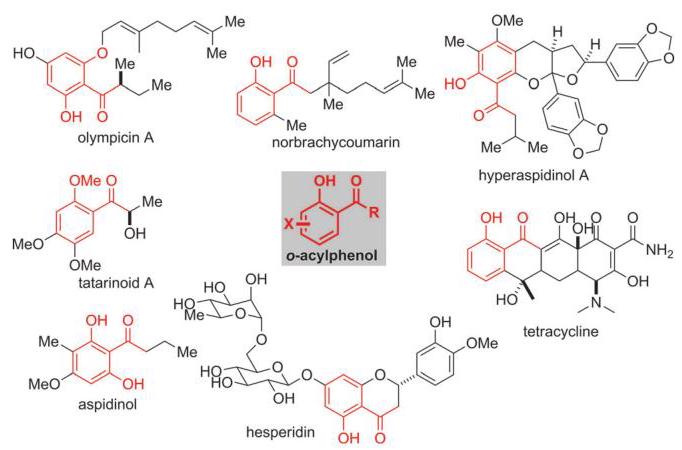
Figure 1. Natural products and drugs containing o-acylphenols.
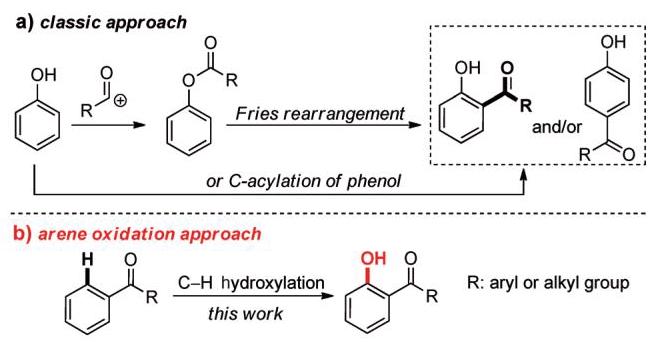
Scheme 1. Synthesis of o-acylphenols.
An alternative approach would be to use ketones as the starting material and introduce the hydroxy group (phenol) by direct arene oxidation (Scheme 1b). This is attractive because aryl ketones are a readily available feedstock and can be prepared in one step through electrophilic aromatic acylation, ${}^{\left\lbrack 8\right\rbrack }$ benzylic oxidation, ${}^{\left\lbrack 9\right\rbrack }$ Wacker oxidation of the corresponding styrenes, ${}^{\left\lbrack {10}\right\rbrack }$ or other means. ${}^{\left\lbrack {11}\right\rbrack }$ The direct hydroxylation of arylketones either through a radical approach ${}^{\left\lbrack {12}\right\rbrack }$ or through heterogeneous catalysts ${}^{\left\lbrack {13}\right\rbrack }$ is known; however, these reactions lack site-selectivity and provide a mixture of all $o - , m - , p$ -isomers. A highly ortho-selective hydroxylation of arylketones remains to be developed.
Transition metal (TM)-catalyzed C-H oxidation presents an increasingly important approach for preparing heteroatom-substituted aromatic compounds. ${}^{\left\lbrack {14}\right\rbrack }$ Recently, such transformations driven by weak coordination have become a powerful means for further functionalization of simple organic feedstocks. ${}^{\left\lbrack {15}\right\rbrack }$ The first carbonyl-directed (carbamate) ${\mathrm{{Pd}}}^{\mathrm{{II}}}$ -catalyzed ${\mathrm{{sp}}}^{3}\mathrm{C} - \mathrm{H}$ oxidation was developed by $\mathrm{{Yu}}$ et al.; ${}^{\left\lbrack {16}\right\rbrack }$ subsequently, a remarkable achievement using carboxylate-directed $\left( {-{\mathrm{{CO}}}_{2}\mathrm{{Na}}}\right) \mathrm{C} - \mathrm{H}$ carboxylation was reported by the same group, which significantly expanded the scope of using weakly coordinating $\sigma$ donors as directing groups (DGs) in $\mathrm{C} - \mathrm{H}$ oxidations. ${}^{\left\lbrack {17}\right\rbrack }$ In terms of ortho-oxidation of arenes, Yu and co-workers further demonstrated an ortho-hydroxylation with carboxylic acids as DGs using air or ${\mathrm{O}}_{2}$ as the source for the hydroxy group. ${}^{\left\lbrack {18}\right\rbrack }$ On the other hand, an ortho-acetoxylation using oximes as DGs was first reported by Sanford et al., wherein oximes can be considered as a ketone surrogate. ${}^{\left\lbrack {19}\right\rbrack }$ Very recently, Ru-catalyzed ortho-hydroxylations using esters and amides as DGs were reported by the groups of ${\text{ Rao }}^{\left\lbrack {20}\right\rbrack }$ and Ackermann, ${}^{\left\lbrack {21}\right\rbrack }$ respectively. These seminal works could potentially serve as effective ways to access o-acylphenols, although additional steps are needed to reveal the phenol or to obtain the ketone moiety. Thus, it would be a more step-economical approach to synthesize o-acylphenols if ketones could be directly employed as the DG for the catalytic arene hydroxylation reaction. ${}^{\left\lbrack {22}\right\rbrack }$
[*] Dr. F. Mo, L. J. Trzepkowski, Prof. Dr. G. Dong
Department of Chemistry and Biochemistry
University of Texas at Austin
100 east 24th street, Austin, TX 78712 (USA)
Homepage: http://gbdong.cm.utexas.edu/
[**] We thank UT Austin and CPRIT for a start-up fund, and thank the Welch Foundation and the Frasch Foundation for research grants. G.D. thanks ORAU for a new faculty enhancement award. We also thank faculty members from the organic division at UT Austin for their generous support. Dr. Lynch is acknowledged for X-ray crystallography. We thank Dr. Shoulders, Mrs. Spangenberg, and Mr. Sorey for their NMR advice.
Supporting information for this article is available on the WWW under http://dx.doi.org/10.1002/anie.201207479.
Although rare compared to other directed reactions, ketone-directed catalytic $\mathrm{C} - \mathrm{H}$ functionalization has been documented for almost two decades since the pioneering work on Ru-catalyzed C-H/olefin coupling reactions by Murai et al. ${}^{\left\lbrack {23}\right\rbrack }$ However, most of these transformations are restricted to $\mathrm{C} - \mathrm{C}$ bond formations (by the groups of Murai, ${}^{\left\lbrack {24}\right\rbrack }$ Chatani, ${}^{\left\lbrack {25}\right\rbrack }$ Miura, ${}^{\left\lbrack {26}\right\rbrack }$ Brookhart, ${}^{\left\lbrack {27}\right\rbrack }$ Cheng, ${}^{\left\lbrack {28}\right\rbrack }$ Glorius, ${}^{\left\lbrack {29}\right\rbrack }$ Jeganmohan, ${}^{\left\lbrack {30}\right\rbrack }$ Shi, ${}^{\left\lbrack {31}\right\rbrack }$ and others). Only recently, the groups of Liu ${}^{\left\lbrack {32}\right\rbrack }$ and Glorius ${}^{\left\lbrack {33}\right\rbrack }$ reported the first ketone-directed $\mathrm{C} - \mathrm{N}$ and $\mathrm{C} - \mathrm{{Br}}/\mathrm{I}$ bond-forming reactions using $\mathrm{{Pd}}$ and Rh catalysts, respectively. To the best of our knowledge, catalytic ketone-directed arene oxidation to form $\mathrm{C} - \mathrm{O}$ bonds has not been previously described. The likely challenges are: 1) As a hard Lewis base and even weaker $\sigma$ donor (compared to oximes, amides, carboxylic acids, and esters), ketones generally do not coordinate strongly with TMs, ${}^{\left\lbrack {34}\right\rbrack }$ which leads to lower reactivity. 2) Undesired oxidations (particularly with oxygen-based oxidants) can occur either at the enolizable $\alpha \mathrm{C} - \mathrm{H}$ bond or at the $\alpha \mathrm{C} - \mathrm{C}$ bond of the ketone through a Baeyer-Villiger-type oxidation. ${}^{\left\lbrack {35}\right\rbrack }$
Stimulated by the previous success of $\mathrm{C} - \mathrm{H}$ activation driven by weak coordination ${}^{\left\lbrack {15},{17}\right\rbrack }$ and the need for efficient synthesis of $o$ -acylphenols from arylketones, we pursued this challenge using a Pd-catalyzed formal arene hydroxylation reaction. It was envisioned that the above-mentioned challenges could potentially be overcome by: 1) increasing the Lewis acidity of the metal and 2) using milder oxidants and reaction conditions. Herein, we report the use of ketone carbonyls as DGs for a Pd-catalyzed ortho-selective formal hydroxylation of arenes to provide various 2-acylpheonols; preliminary results of the first ketone-directed oxidative carbonylation to give an unusual ketal-lactone are also described.
We initiated our studies by examining the ortho-oxidation of 2,2-dimethylpropiophenone, a problematic substrate for the Fries-rearrangement. ${}^{\left\lbrack {36}\right\rbrack }$ Different ${\mathrm{{Pd}}}^{\mathrm{{II}}}$ precatalysts, oxidants, and solvents were tested (Table 1). Not surprisingly, the standard Pd(OAc) ${}_{2}$ and PhI(OAc) ${}_{2}$ (DIB) combination, which is commonly used in nitrogen-based DG-directed $\mathrm{C} - \mathrm{H}$ oxidations, ${}^{\left\lbrack {19},{14}\mathrm{c}\right\rbrack }$ did not give any of the desired product at ${80}^{ \circ }\mathrm{C}$ in 1,2-dichloroethane (DCE) or $\mathrm{{AcOH}}$ (Table 1, entries 1 and 2). A search for more electrophilic catalysts and oxidants was pursued. Eventually, $\mathrm{{Pd}}{\left( \mathrm{{TFA}}\right) }_{2}\left( {5\mathrm{\;{mol}}\% }\right)$ with PhI(TFA) ${}_{2}$ (BTI; 2 equiv) was found to give quantitative conversion with ${83}\%$ yield of the desired ortho-oxidation product (entry 3). Trifluoroacetate $\mathbf{{3a}}$ is the initial product generated, which is confirmed by both GC-MS and NMR analysis. We were delighted to discover that compound $\mathbf{{3a}}$ is labile, and readily converts into the corresponding phenol (2a) upon purification by column chromatography with silica gel. The use of other solvents, such as dioxane, THF, and MeCN, in place of DCE proved much less effective (entries 4- 6). Interestingly, when BTI is used as an oxidant, comparable yields can be obtained when $\mathrm{{Pd}}{\left( \mathrm{{TFA}}\right) }_{2}$ is replaced by either $\mathrm{{Pd}}{\left( \mathrm{{OAc}}\right) }_{2}$ or $\mathrm{{Pd}}{\left( \mathrm{{OPiv}}\right) }_{2}$ , whereas this was not the case for ${\mathrm{{PdCl}}}_{2}{}^{\left\lbrack {37}\right\rbrack }$ (entries 7-9). In contrast, DIB cannot be used in place of BTI, even when using Pd(TFA) ${}_{2}$ as a catalyst (entry 10; see below for a mechanistic discussion). Furthermore, the reaction gives full conversion with ${84}\%$ yield in $9\mathrm{\;h}$ when the catalyst loading is lowered to $2\mathrm{\;{mol}}\%$ (entry 11).
Table 1: Selected optimization of the reaction conditions. ${}^{\left\lbrack a\right\rbrack }$
O Pd precatalyst (5 mol%)
tBu oxidant, solvent tBu and/or
T, 3 h
1a 2a 3a
1a 2a 3a
| Entry | Catalyst | Oxidant ${}^{\left\lbrack b\right\rbrack }$ | Solvent | $T\left\lbrack {{}^{ \circ }\mathrm{C}}\right\rbrack$ | Conv. [%][c] | Yield [%] |
| 1 | Pd ${\left( \mathrm{{OAc}}\right) }_{2}$ | DIB | DCE | 80 | < 5 | 0 |
| 2 | Pd ${\left( \mathrm{{OAc}}\right) }_{2}$ | DIB | AcOH | 80 | 12 | 0 |
| 3 | Pd(TFA) ${}_{2}$ | BTI | DCE | 80 | 100 | 83 |
| 4 | Pd(TFA) ${}_{2}$ | BTI | dioxane | 80 | 30 | 7 |
| 5 | Pd(TFA) ${}_{2}$ | BTI | THF | 80 | 17 | 8 |
| 6 | Pd(TFA) ${}_{2}$ | BTI | MeCN | 80 | 22 | 0 |
| 7 | Pd(OAc) ${}_{2}$ | BTI | DCE | 80 | 100 | 79 |
| 8 | Pd(OPiv) ${}_{2}$ | BTI | DCE | 80 | 100 | 78 |
| 9 | ${\mathrm{{PdCl}}}_{2}$ | BTI | DCE | 80 | 15 | 0 |
| 10 | Pd(TFA) ${}_{2}$ | DIB | DCE | 80 | 8 | 0 |
| 11[d] | Pd(TFA) ${}_{2}$ | BTI | DCE | 80 | 100 | 84 |
| 12 | Pd(TFA) ${}_{2}$ | KPS | DCE | 80 | 12 | 4 |
| ${13}^{\left\lbrack e\right\rbrack }$ | Pd(TFA) ${}_{2}$ | KPS (TFA) | DCE | 80 | 36 | 17 |
| 14 | Pd(OAc) ${}_{2}$ | KPS | TFA | 50 | 100 | 88 |
| 15 | Pd(OAc) ${}_{2}$ | KPS | TFA/DCE (1:1) | 50 | 100 | 77 |
| 16 | - | BTI | DCE | 80 | < 5 | 0 |
| 17 | - | KPS | TFA | 50 | < 5 | 0 |
[a] The reactions were run on a ${0.2}\mathrm{{mmol}}$ scale with $1\mathrm{\;{mL}}$ solvent over 3 h. [b] In all cases, 2 equiv of oxidant was used. [c] Determined by ${}^{1}\mathrm{H}$ NMR spectroscopy using mesitylene as the internal standard. [d] 2 mol % catalyst loading, reaction time 9 h. [e] Reaction time 9 h. BTI = [bis(trifluoroacetoxy)iodo]benzene, DCE = 1,2-dichloroethane, DIB = (diacetoxyiodo)benzene, KPS = K2, S2O, Br iv = pivaloyl, TFA = tri-fluoroacetic acid.
Less expensive inorganic oxidants, such as ${\mathrm{K}}_{2}{\mathrm{\;S}}_{2}{\mathrm{O}}_{8}$ (KPS), have also been examined. The desired product was obtained in 4% yield by simply replacing BTI with KPS (entry 12). The yield was improved to 17% when 2 equiv of TFA was added (entry 13). Towards the end, complete conversion with 88% yield was obtained when using TFA as the solvent and KPS (2 equiv) as the oxidant (entry 14). Note that the reaction proceeds at a lower temperature $\left( {{50}^{ \circ }\mathrm{C}}\right)$ with the less expensive $\mathrm{{Pd}}{\left( \mathrm{{OAc}}\right) }_{2}$ as a pre-catalyst, thus it is complementary to the conditions described in entry 11. Although it is well recognized that BTI is able to oxidize electron-rich aromatic compounds through a single-electron transfer mechanism, ${}^{\left\lbrack {38}\right\rbrack }$ control experiments indicated that neither of the conditions in entries 16 or 17 showed significant reactivity in the absence of Pd.
With the optimized conditions in hand, we next investigated the substrate scope of this reaction (Scheme 2). A variety of aromatic ketones smoothly underwent the ortho-hydroxylation. Both aryl and alkyl-substituted ketones with different steric properties gave satisfying yields of the correspond $o$ -acylphenols. Note that benzylic and enolizable hydrogens, which can participate in various oxidation reactions, are also tolerated under these conditions (2c-2g, 2k, 2l, 2n, 2p). Moreover, aryl bromides, methyl ethers, xanthones, and nitro groups are also compatible (2b, 2j, 2k, 2m, 2q). Mono-oxidation is selectively achieved on mono-arylketones, most likely because further $\mathrm{C} - \mathrm{H}$ activation/oxidation is inhibited by the strong inductive effect of the introduced trifluoroacetate group (which is cleaved upon workup). Notably, a single regioisomer (2f) was obtained in 82% yield using $m$ -methyl-substituted ketone, which indicates that $\mathrm{C} - \mathrm{H}$ oxidation is preferred at the less hindered site. For diarylketones, hydroxylation occurred on both phenyl rings in the presence of 2 equiv of BTI, but formation of mono-oxidized product $2\mathbf{h}$ (91% yield) can be controlled using 1.3 equiv of the oxidant. With excess oxidants, both electron-neutral and electron-rich aromatic rings could be smoothly oxidized without increasing catalyst loading (2o and 2q). Furthermore, for unsymmetrical benzophenone substrates, the more electron-rich aromatic rings are selectively oxidized over the electron-poor ones, which is consistent with an electrophilic palladation mechanism (2m). ${}^{\left\lbrack {14}\right\rbrack }$ The two conditions $\left( {\mathbf{A}\text{ and }\mathbf{B}}\right)$ employed in this study are complementary: generally, condition $\mathbf{A}$ (using BTI as an oxidant and DCE as a solvent) is milder and more selective, whereas condition $\mathbf{B}$ (using KPS/TFA) is more reactive. For example, condition $\mathbf{A}$ effectively circumvents oxidation on the enolizable protons; on the other hand, sterically hindered or nitro-containing ketones react slowly under condition $\mathbf{A}$ , whereas high conversion was obtained under condition $\mathbf{B}$ (21 and $2\mathbf{m}$ ).
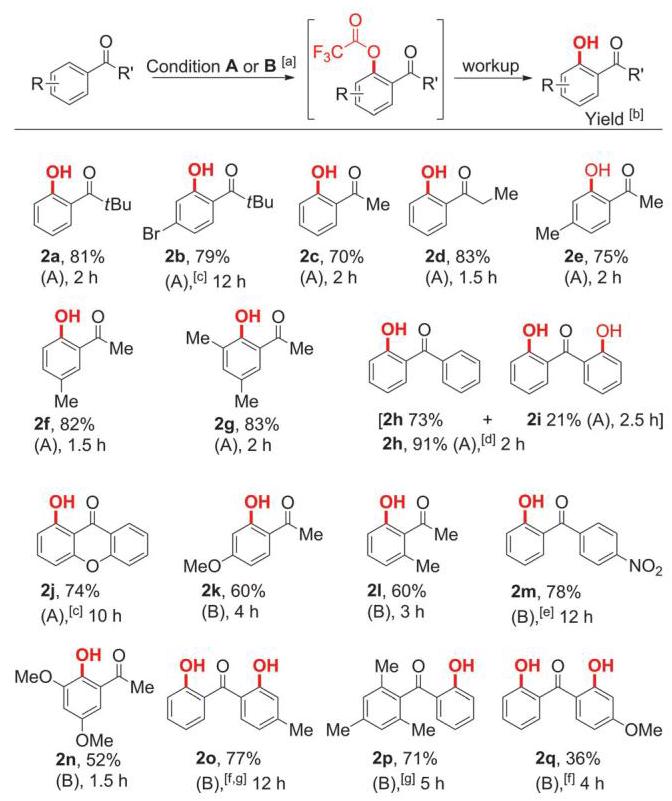
Scheme 2. Substrate scope. [a] 0.4 mmol scale. Condition A: Pd(TFA) ${}_{2}$ (5 mol %), BTI (2.0 equiv), DCE 2 mL, 80°C. Condition B: Pd(OAc) ${}_{2}$ (5 mol %), ${\mathrm{K}}_{2}{\mathrm{\;S}}_{2}{\mathrm{O}}_{8}$ (2 equiv), TFA $2\mathrm{\;{mL}},{50}^{ \circ }\mathrm{C}$ . [b] Yield of isolated product. [c] Pd(TFA) ${}_{2}$ 10 mol %, ${100}^{ \circ }\mathrm{C}$ . [d] with 1.3 equiv of BTI. [e] ${70}^{ \circ }\mathrm{C}$ . [f] ${\mathrm{K}}_{2}{\mathrm{\;S}}_{2}{\mathrm{O}}_{8}$ 3 equiv [g] TFA 1 mL and DCE 1 mL. BTI = [bis(tri-fluoroacetoxy)iodo]benzene, DCE $= 1,2$ -dichloroethane, TFA $=$ trifluoro-acetic acid.
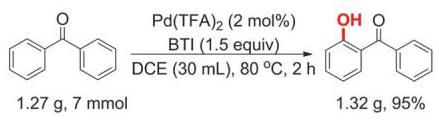
This reaction could also be run on a gram scale with only 2 mol % catalyst loading, affording product $2\mathbf{h}$ in 95% yield within $2\mathrm{\;h}$ [Eq. (1)].
(1)
Next, in order to understand the mechanism of this Pd-catalyzed ketone-directed $\mathrm{C} - \mathrm{H}$ hydroxylation reaction, stepwise stoichiometric reactions were carried out. Compared to previous methods of preparing ketone-chelated palladacycles where additional strong acids (TfOH or TFA) are involved, ${}^{\left\lbrack {28}.,{32}\right\rbrack }$ we found that the ketone is able to react directly with $\mathrm{{Pd}}{\left( \mathrm{{TFA}}\right) }_{2}$ in DCE to give the dimeric $\mathrm{{Pd}}$ complex (3) in good yield [Eq. (2)]. ${}^{\left\lbrack {39}\right\rbrack }$
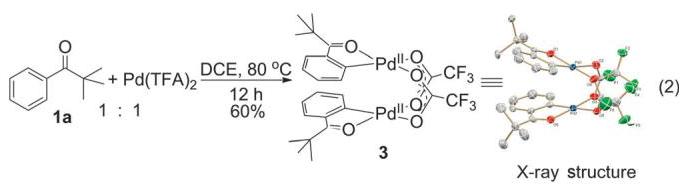
Moreover, although acid is not required for the $\mathrm{C} - \mathrm{H}$ activation step, it was found to be critical in the subsequent KPS-mediated oxidation/C-O bond formation step (Scheme 3). No reaction occurred upon treating palladacycle
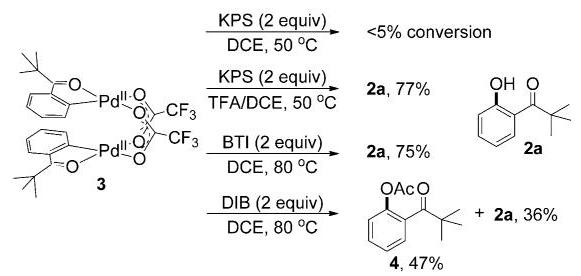
Scheme 3. Oxidation of Complex 3.
3 with KPS alone in DCE, whereas the addition of TFA promoted the formation of the product in 77% yield. When BTI was used as the oxidant (without adding acids), the corresponding arene oxidation products were also obtained in good yields. Moreover, the use of less reactive DIB as an oxidant led to the formation of $o$ -OAc substituted ketone (4).
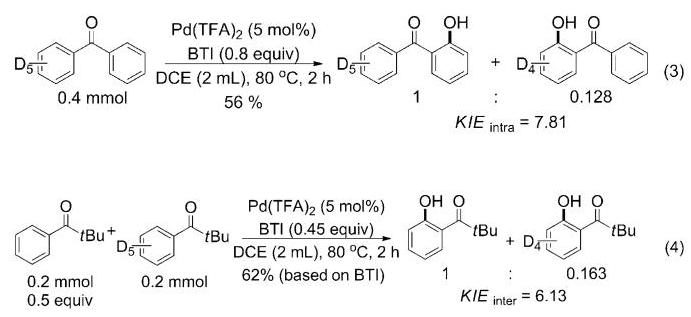
These studies suggest that trifluoroacetate anions play a critical role in maintaining the high electrophilicity of the Pd catalyst for the initial $\mathrm{C} - \mathrm{H}$ bond cleavage, but are not required as a part of the oxidants. Furthermore, high KIE values were observed both in the intramolecular $\left( {{k}_{\mathrm{H}/\mathrm{D}} = {7.81}}\right)$ and intermolecular $\left( {{k}_{\mathrm{H}/\mathrm{D}} = {6.13}}\right)$ competition experiments [Eq. (3) and (4)]. ${}^{\left\lbrack {40}\right\rbrack }$
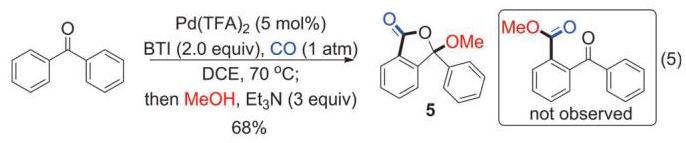
With this mechanistic knowledge in hand, we made further preliminary efforts to explore a ketone-directed Pd-catalyzed oxidative $\mathrm{C} - \mathrm{H}$ carbonylation reaction [Eq. (5)]. ${}^{\left\lbrack {41},{42}\right\rbrack }$ To our delight, under almost identical conditions, except for the use of a CO atmosphere (1 atm), an interesting ortho-carboxylation product (5) was obtained in 68% yield when benzophenone was used as the substrate. ${}^{\left\lbrack {43}\right\rbrack }$ Upon workup with methanol and ${\mathrm{{Et}}}_{3}\mathrm{\;N}$ , the originally anticipated methyl ester was not observed; instead, the methyl ketal-lactone was formed as the major product. ${}^{\left\lbrack {44}\right\rbrack }$ Although the mechanism of this reaction is still unclear, the mixed-anhydride was proposed as the initial product formed. ${}^{\left\lbrack {42}\right\rbrack }$ It is noteworthy that the formation of phenol products were significantly suppressed in the presence of CO.
In summary, a ketone-directed Pd-catalyzed ortho-hydroxylation of arenes has been developed, which is an effective approach to access various o-acylphenol compounds from arylketones. As an exploratory study, a Pd-catalyzed ortho-carboxylation of simple aryl ketones to access an unusual ketal-lactone motif has also been disclosed. Both are the first examples of simple ketone-directed $\mathrm{C} - \mathrm{O}$ bond formation and carboxylation of arenes by $\mathrm{C} - \mathrm{H}$ bond activation. Because of the versatile nature of ketones, the methods described herein are expected to have significant value for practical applications, and should stimulate further research on simple ketone-directed $\mathrm{C} - \mathrm{H}$ functionalizations. Expansion of the scope of the reaction and substrates, as well as more detailed mechanistic studies are ongoing.
Received: September 15, 2012
Revised: October 11, 2012
Published online: November 19, 2012
[1] For the examples shown in Figure 1, see: a) M. G. Charest, C. D. Lerner, J. D. Brubaker, D. R. Siegel, A. G. Myers, Science 2005, 308, 395; b) C. Tan, H. Tasaka, K. P. Yu, M. L. Murphy, D. A. Karnofsky, Cancer 1967, 20, 333; c) A. Hirata, Y. Murakami, M. Shoji, Y. Kadoma, S. Fujisawa, Anticancer Res. 2005, 25, 3367; d) X.-G. Tong, G.-S. Wu, Q. Lu, Y.-H. Wang, C.-L. Long, H.-R. Luo, H.-J. Zhu, Y.-X. Cheng, C.-G. Huang, J. Nat. Prod. 2010, 73, 1160; e) C. Zdero, F. Bohlmann, R. M. King, H. Robinson, Phytochemistry 1986, 25, 509; f) W. Wang, Y. H. Zeng, Q. Mu, K. Osman, K. Shinde, M. Rahman, S. Gibbons, J. Nat. Prod. 2010, 73, 1815; g) W. K. P. Shiu, M. M. Rahman, J. Curry, P. Stapleton, M. Zloh, J. P. Malkinson, S. Gibbons, J. Nat. Prod. 2012, 75, 336.
[2] I. Uwaydah, M. Aslam, C. Browm, S. Fitzhenry, J. McDonough, US Patent 5696274, 1997.
[3] For a review, see: C. Gonzalez-Bello, L. Castedo, Sci. Synth. 2007, 31a, 319.
[4] For recent reviews, see: a) V.P. Reddy, G. K. S. Prakash, Chemistry of Phenols, Vol. 1 (Ed.: Z. Rappoport), John Wiley & Sons, Chichester, 2003, p. 605; b) I. V. Kozhevnikov, J. Kaur, E. F. Kozhevnikova, Catalysis in Application (Eds.: S. D. Jackson, J. S. J. Hargreaves, D. Lennon), Royal Society of Chemistry, Cambridge, 2003, p. 136; c) R. Martin, Org. Prep. Proced. Int. 1992, 24, 369.
[5] C. L. Padró, E. A. Rey, L. F. González Peña, C. R. Apesteguía, Microporous Mesoporous Mater. 2011, 143, 236.
[6] J. A. Miller, J. Org. Chem. 1987, 52, 322, and references therein.
[7] Although the anionic Fries rearrangement is ortho-selective, it requires strong bases (such as organolithium), and enolizable ketones are generally not tolerated, see also Ref. [6].
[8] G. A. Olah, Friedel- Crafts Chemistry, Wiley, New York, 1973.
[9] For some recent examples, see: a) M. Zhou, N. D. Schley, R. H. Crabtree, J. Am. Chem. Soc. 2010, 132, 12550; b) M. S. Yusubov, V. N. Nemykin, V. V. Zhadankin, Tetrahedron 2010, 66, 5745; c) M. Moghadam, V. Mirkhani, S. Tangestaninejad, I. M. Bal-tork, H. Kargar, J. Mol. Catal. A 2008, 288, 116; d) Z. Lounis, A. Riahi, F. Djafri, J. Muzart, Appl. Catal. A 2006, 309, 270; e) B. Karami, M. Montazerozohori, Molecules 2006, 11, 720; f) S. J. Singh, R. V. Jayaram, Catal. Commun. 2009, 10, 2004; g) R. Mayilmurugan, H. Stoechli-Evans, E. Suresh, M. Palaniandavar, Dalton Trans. 2009, 5101.
[10] J. Smidt, W. Hafner, R. Jira, J. Sedlmeier, R. Sieber, R. Ruttinger, H. Kojer, Angew. Chem. 1959, 71, 176.
[11] C. Pan, X. Jia, J. Cheng, Synthesis 2012, 677.
[12] a) O. V. Makhlynets, E. V. Rybak-Akimova, Chem. Eur. J. 2010, 16, 13995; b) G. Palmisano, M. Addamo, V. Augugliaro, T. Caronna, E. Garcia-Lopez, V. Loddo, L. Palmisano, Chem. Commun. 2006, 1012; c) M. Makosza, K. Sienkiewicz, J. Org. Chem. 1998, 63, 4199; d) K. Fujimoto, Y. Tokuda, H. Maekawa, Y. Matsubara, T. Mizuno, I. Nishiguchi, Tetrahedron 1996, 52, 3889; e) J. P. Gesson, J. C. Jacquesy, M. P. Jouannetaud, G. Morellet, Tetrahedron Lett. 1983, 24, 3095.
[13] a) D. Y. Ganapati, G. M. Haresh, Adv. Synth. Catal. 2008, 350, 2286; b) S. Mita, T. Sakamoto, S. Yamada, S. Sakaguchi, Y. Ishii, Tetrahedron Lett. 2005, 46, 7729; c) M. Basu, S. Sarkar, S. Pande, S. Jana, A. K. Sinha, S. Sarkar, M. Pradhan, A. Pal, T. Pal, Chem. Commun. 2009, 7191.
[14] For selected recent reviews, see: a) R. Giri, B.-F. Shi, K. M. Engle, N. Maugel, J.-Q. Yu, Chem. Soc. Rev. 2009, 38, 3242; b) J. Wencel-Delord, T. Dröge, F. Liu, F. Glorius, Chem. Soc. Rev. 2011, 40, 4740; c) T. W. Lyons, M. S. Sanford, Chem. Rev. 2010, 110, 1147; d) L.-M. Xu, B.-J. Li, Z. Yang, Z.-J. Shi, Chem. Soc. Rev. 2010, 39, 712; e) S. R. Neufeldt, M. S. Sanford, Acc. Chem. Res. 2012, 45, 936.
[15] K. M. Engle, T.-S. Mei, M. Wasa, J.-Q. Yu, Acc. Chem. Res. 2012, 45, 788.
Keywords: C-H activation - homogeneous catalysis - ketones - oxidation - palladium
[16] D.-H. Wang, X.-S. Hao, D.-F. Wu, J.-Q. Yu, Org. Lett. 2006, 8, 3387.
[17] a) R. Giri, J. Q. Yu, J. Am. Chem. Soc. 2008, 130, 14082; b) For a seminal report on carboxylate-directed $\mathrm{C} - \mathrm{H}$ activation and $\mathrm{C} -$ C bond formation, see: R. Giri, N. Maugel, J.-J. Li, D.-H. Wang, S. P. Breazzano, L. B. Saunders, J.-Q. Yu, J. Am. Chem. Soc. 2007, 129, 3510.
[18] a) Y. H. Zhang, J.-Q. Yu, J. Am. Chem. Soc. 2009, 131, 14654; b) For a seminal report on Cu-mediated ortho-hydroxylation of 2-arylpyridines, see: X. Chen, X.-S. Hao, C. E. Goodhue, J.-Q. Yu, J. Am. Chem. Soc. 2006, 128, 6790.
[19] a) L. V. Desai, K. L. Hull, M. S. Sanford, J. Am. Chem. Soc. 2004, 126, 9542; b) S. R. Neufeldt, M. S. Sanford, Org. Lett. 2010, 12, 532.
[20] Y. Yang, Y. Lin, Y. Rao, Org. Lett. 2012, 14, 2874.
[21] V. S. Thirunavukkarasu, J. Hubrich, L. Ackermann, Org. Lett. 2012, 14, 4210.
[22] P. A. Wender, V. A. Verma, T. J. Paxton, T. H. Pillow, Acc. Chem. Res. 2008, 41, 40.
[23] S. Murai, F. Kakiuchi, S. Sekine, Y. Tanaka, A. Kamatani, M. Sonoda, N. Chatani, Nature 1993, 366, 529.
[24] F. Kakiuchi, S. Kan, K. Igi, N. Chatani, S. Murai, J. Am. Chem. Soc. 2003, 125, 1698.
[25] F. Kakiuchi, Y. Matsuura, S. Kan, N. Chatani, J. Am. Chem. Soc. 2005, 127, 5936.
[26] a) T. Satoh, Y. Kametani, Y. Terao, M. Miura, M. Namura, Tetrahedron Lett. 1999, 40, 5345; b) Y. Terao, Y. Kametani, H. Wakui, T. Satoh, M. Miura, M. Nomura, Tetrahedron 2001, 57, 5967; c) T. Satoh, M. Miura, M. Nomura, J. Organomet. Chem. 2002, 653, 161.
[27] C. P. Lenges, M. Brookhart, J. Am. Chem. Soc. 1999, 121, 6616.
[28] a) P. Gandeepan, K. Parthasarathy, C.-H. Cheng, J. Am. Chem. Soc. 2010, 132, 8569; b) K. Muralirajan, K. Parthasarathy, C.-H. Cheng, Angew. Chem. 2011, 123, 4255; Angew. Chem. Int. Ed. 2011, 50, 4169; c) P. Gandeepan, C.-H. Hung, C.-H. Cheng, Chem. Commun. 2012, 48, 9379.
[29] a) F. W. Patureau, T. Besset, N. Kuhl, F. Glorius, J. Am. Chem. Soc. 2011, 133, 2154; b) F. W. Patureau, T. Besset, F. Glorius, Angew. Chem. 2011, 123, 1096; Angew. Chem. Int. Ed. 2011, 50, 1064.
[30] K. Padala, M. Jeganmohan, Org. Lett. 2011, 13, 6144.
[31] H. Li, R.-Y. Zhu, W.-J. Shi, K.-H. He, Z.-J. Shi, Org. Lett. 2012, 14, 4850.
[32] B. Xiao, T.-J. Gong, J. Xu, Z.-J. Liu, L. Liu, J. Am. Chem. Soc. 2011, 133, 1466.
[33] N. Schröder, J. Wencel-Delord, F. Glorius, J. Am. Chem. Soc. 2012, 134, 8298.
[34] J. F. Hartwig, Organotransition Metal Chemistry: from Bonding to Catalysis, University Science Books, Mill Valley, 2009.
[35] R. M. Moriarty, K.-C. Hou, I. Prakash, S. K. Arora, Org. Synth. 1986, 64.
[36] R. Martin, Bull. Soc. Chim. Fr. 1979, 373.
[37] This is likely due to stronger Pd-Cl bonds, thus Cl ligands slowly exchange with trifluoroacetate anions.
[38] V. Z. Viktor, Arkivoc 2009, 1.
[39] CCDC 897814 (3) contains the supplementary crystallographic data for this paper. These data can be obtained free of charge from The Cambridge Crystallographic Data Centre via www.ccdc.cam.ac.uk/data_request/cif.
[40] For an example of similar KIEs observed on the activation of aryl $\mathrm{C} - \mathrm{H}$ bonds, see: Ref. [18a].
[41] For early seminal work, see: a) Y. Fujiwara, T. Kawauchi, H. Taniguchi, J. Chem. Soc. Chem. Commun. 1980, 220; b) Y. Taniguchi, Y. Yamaoka, K. Nakata, K. Takaki, Y. Fujiwara, Chem. Lett. 1995, 5.
[42] For some remarkable recent examples of Pd-catalyzed carboxylation of arenes under mild conditions by $\mathrm{C} - \mathrm{H}$ activation, see: R. Giri, J. K. Lam, J.-Q. Yu, J. Am. Chem. Soc. 2010, 132, 686 and Ref. [17].
[43] Alkyl-substituted aryl ketones are much less reactive under these reaction conditions. A full account of our efforts with regards to the reaction mechanism and the substrate scope will be reported later.
[44] M. S. Newman, C. Courduvelis, J. Org. Chem. 1965, 30, 1795.