Studies toward the Synthesis of (R)-(+)-Harmicine
中文 / Bilingual · English version
Beijing National Laboratory of Molecular Sciences (BNLMS) and Key Laboratory of Bioorganic Chemistry and Molecular Engineering of Ministry of Education, College of Chemistry, Peking University, Beijing 100871, China
The study toward the total synthesis of $\left( R\right) - \left( +\right)$ -harmicine is reported in this paper. The enantioselective synthesis of pyrrolidinone, the main backbone of of $\left( R\right) - \left( +\right)$ -harmicine, has been completed by the methodology based on photo-induced Wolff rearrangement of $\alpha$ -diazo- $\beta$ -carbonyl compounds.
Keywords diastereoselective synthesis, (R)-( + )-harmicine, diazo compounds, Wolff rearrangement, photo-induced reaction
Introduction
(R)-(+)-Harmicine (1), a tetracyclic $\beta$ -carboline alkaloid, was first isolated from the leaves of Kopsia grif-fithii by Sim et al. ${}^{\left\lbrack 1\right\rbrack }$ in 1998. This natural product contains a tetrahydro- $\beta$ -carboline unit and a pyrrolidine unit. It exhibits strong anti-leishmania activity. The synthesis of $\left( R\right)$ -(+)-harmicine has attracted great interest because of its unique structure and potential biological activities. A variety of investigations on the synthesis of harmicine have been reported, either in the form of racemic mixture or in the form of optically pure isomers. Knölker and Agarwal reported the first synthesis of racemic harmcine, starting from 4,9-dihydro-3H-pyrido- $\left\lbrack {3,4 - b}\right\rbrack$ indole. ${}^{\left\lbrack 2\mathrm{a}\right\rbrack }$ Three years later, another three-step approach of the synthesis of racemic harmcine was completed from the readily available 4,4-diethoxybutan- 1-amine. ${}^{\left\lbrack 2b\right\rbrack }$ Subsequently, Czarnocki and coworkers achieved the enantioselective synthesis of optically pure $\left( R\right)$ -(+)-harmicine via the asymmetric transfer hydrogenation (ATH) reaction in 2007. ${}^{\left\lbrack 3\mathrm{a}\right\rbrack }$ In the same year, Allin and coworkers completed a facile asymmetric synthesis of $\left( R\right)$ -(+)-harmicine via a step of highly di-atereoselective $N$ -acyliminium cyclzation methodology developed by the same group. ${}^{\left\lbrack 3b\right\rbrack }$ On the other hand, Jacobsen and coworkers completed the synthesis of $\left( R\right)$ -(+)-harmicine starting from tryptamine. The key step in Jacobsen’s synthesis is the enantioselective Pictet-Spengler-type cyclization of hydroxylactam by chiral thiourea catalysis. ${}^{\left\lbrack 4\mathrm{a}\right\rbrack }$ More recently, a cascade one pot condensation including intramolecauler cyclization and Pictet-Spengler reaction for the synthesis of racemic harmicine was completed by Jana and coworker. ${}^{\left\lbrack 4\mathrm{\;b}\right\rbrack }$ In 2009, Ojima and coworkers reported the efficient preparation of racemic harmicine, employing their newly developed Rh-catalyzed cyclohydrocarbon-ylation-bicyclization of $N$ -allylic amides of arylacetic acids. ${}^{\left\lbrack 5\right\rbrack }$ Previous literatures have showed that most of the syntheses of harmicine starts from tryptamine, and the chiral centers are established through asymmetric catalytic reactions. In general, chiral ligands with complicated structure are needed to achieve the high enanti-oselectivity.
Recently, we have developed a new approach toward the enantioselective construction of pyrrolidine ring, based on diastereoselective nucleophilic addition of lithium enolate of $\alpha$ -diazoacetate to chiral $N$ -sulfinyl imine and Wolff rearrangement. ${}^{\left\lbrack 6 - 8\right\rbrack }$ Herein, we report the application of this methodology in the synthesis of (R)-(+)-harmicine (1) (Figure 1).
Experimental
All reactions with air- and moisture-sensitive components were performed under a nitrogen atmosphere. Anhydrous ethyl ether, toluene, benzene and tetrahydrofuran were freshly distilled from Na before use. Dichloromethane was distilled from calcium hydride. The boiling point of petroleum ether is between 60 and 90 °C. 200—300 mesh silica gel for the chromatography was employed. ${}^{1}\mathrm{H}$ NMR (300 MHz) and ${}^{13}\mathrm{C}$ NMR (70 MHz) spectra were measured on a Bruker-400 ARX spectrometer. Chemical shifts are reported relative to tetramethylsilane (TMS) as the internal standard. Mass spectra were determined on a VG ZAB-HS mass spectrometer. IR was recorded with a Nicolet Avatar 330 FT-IR infrared spectrometer.
Received July 3, 2012; accepted August 29, 2012.
Supporting information for this article is available on the WWW under http://dx.doi.org/10.1002/cjoc.201200672 or from the author.
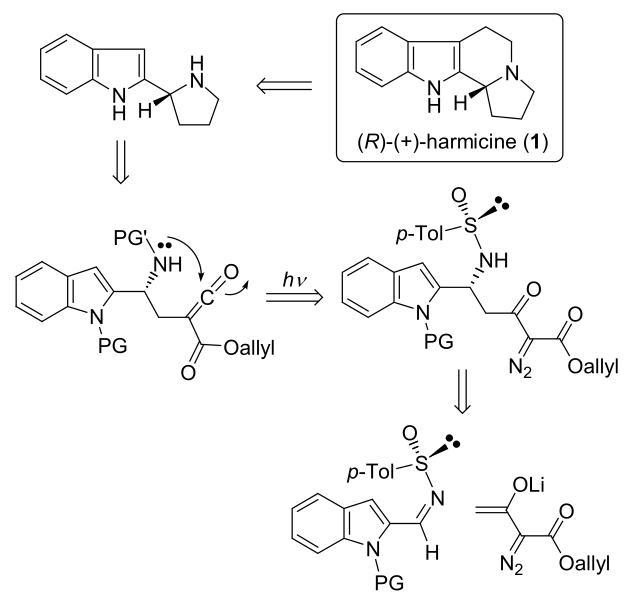
Figure 1 Synthetic plan for $\left( R\right) - \left( +\right)$ -harmicine (1).
Ethyl 1H-indole-2-carboxylate (3) ${}^{\left\lbrack 9\right\rbrack }$
1H-Indole-2-carboxylic acid (2) (2.0 g, 12.4 mmol) was dissolved in absolute ethanol $\left( {{12}\mathrm{\;{mL}}}\right)$ and cooled to 0 °C by ice-water bath. Sulfuryl dichloride (1.6 mL, 22.4 mmol, 2 equiv.) was added to the solution dropwise and the mixture was then refluxed for another $2\mathrm{\;h}$ while monitored by TLC. Ethanol and excessive sulfuryl dichloride were evaporated under vacuum upon completion of the reaction. Dichoromethane (20 mL) was added to dissolve the crude product. The solution was washed by saturated aqueous sodium carbonate (25 $\mathrm{{mL}} \times 2$ ), and the combined organic layer was dried over anhydrous sodium sulfate. Crude product 3 was obtained as yellow oil after removing the solvent under vacuum. ${}^{1}\mathrm{H}$ NMR (300 MHz, ${\mathrm{{CDCl}}}_{3}$ ) $\delta : {9.22}\left( {\mathrm{\;s},1\mathrm{H}}\right)$ , 7.70—7.67 (m, 1H), 7.44—7.41 (m, 1H), 7.34—7.29 $\left( {\mathrm{m},1\mathrm{H}}\right) ,{7.24} - {7.23}\left( {\mathrm{m},1\mathrm{H}}\right) ,{7.17} - {7.12}\left( {\mathrm{m},1\mathrm{H}}\right) ,{4.42} \; \left( {\mathrm{q}, J = {7.2}\mathrm{\;{Hz}},2\mathrm{H}}\right) ,{1.42}\left( {\mathrm{t}, J = {7.2}\mathrm{\;{Hz}},3\mathrm{H}}\right) ;{}^{13}\mathrm{C}\mathrm{{NMR}}$ (75 MHz, CDCl3) 6: 162.1, 136.8, 127.4, 125.2, 122.5, 120.7, 111.8, 108.6, 61.0, 14.3.
Ethyl 1-benzyl-1H-indole-2-carboxylate ${\left( 4\right) }^{\left\lbrack 9\right\rbrack }$
Well powdered potassium hydroxide (1.9 g, 34 mmol) was dissolved in anhydrous DMSO (20 mL) under stirring in a ${100}\mathrm{{mL}}$ round-bottomed flask. Carboxylate (3) (1.6 g, 8.5 mmol) was added to the solution and the mixture was stirred for ${30}\mathrm{\;{min}}$ to give yellow solution. Then benzyl bromide (2 mL, 17 mmol) was added and the solution was stirred for $1\mathrm{\;h}$ while monitored by TLC. The mixture was cooled to $0{}^{ \circ }\mathrm{C}$ and the excessive potassium hydroxide was neutralized by saturated aqueous ammonium chloride solution. Ethyl ether $\left( {{30}\mathrm{\;{mL}} \times 2}\right)$ was added to extract the product and organic layers were combined and washed by deionized water $\left( {{20}\mathrm{\;{mL}}}\right)$ . The organic layer was dried over anhydrous sodium sulfate and the solvent was removed by evaporator under vacuum. The residue was purified by flash column chromatography (petroleum : ethyl acetate $= {30}\text{ : }1, V\text{ : }V)$ on silica gel to give carboxylate (4) in 97% yield (2.3 g). White solid; ${}^{1}\mathrm{H}$ NMR (300 MHz, ${\mathrm{{CDCl}}}_{3}$ ) $\delta : {7.70} - {7.67}\left( {\mathrm{\;m},1\mathrm{H}}\right) ,{7.43} - {7.36}\left( {\mathrm{\;m},1\mathrm{H}}\right)$ , 7.34-7.28 $\left( {\mathrm{m},2\mathrm{H}}\right) ,{7.24} - {7.10}\left( {\mathrm{\;m},4\mathrm{H}}\right) ,{7.04} - {7.01} \; \left( {\mathrm{m},2\mathrm{H}}\right) ,{5.82}\left( {\mathrm{\;s},2\mathrm{H}}\right) ,{4.30}\left( {\mathrm{q}, J = {7.2}\mathrm{\;{Hz}},2\mathrm{H}}\right) ,{1.32}(\mathrm{t}$ , $J = {7.2}\mathrm{\;{Hz}},3\mathrm{H});{}^{13}\mathrm{C}\mathrm{{NMR}}\left( {{75}\mathrm{{MHz}},{\mathrm{{CDCl}}}_{3}}\right) \delta : {161.8}$ , 139.4, 138.2, 128.4, 127.6, 127.0, 126.1, 126.0, 125.1, 122.5, 120.7, 110.9, 110.7, 60.5, 47.7, 14.2.
(1-Benzyl-1H-indol-2-yl)methanol (5) and 1-benzyl- 1H-indole-2-carbaldehyde (6)
Carboxylate (4) (4.853 g, 17.4 mmol) was added to a 500 mL round bottom flask and dissolved in THF (100 mL). The solution was cooled to $0{}^{ \circ }\mathrm{C}$ and lithium aluminium hydride (660 mg, 17.4 mmol) was added slowly. The system was stirred for ${30}\mathrm{\;{min}}$ at $0{}^{ \circ }\mathrm{C}$ until the starting material was completely consumed. Aqueous sodium hydroxide (15%, 20 mL) and deionized water $\left( {{40}\mathrm{\;{mL}}}\right)$ was added gradually to quench the reaction and the precipitate was filtered and washed by ethyl acetate. Organic layer was separated and dried over anhydrous sodium sulfate. The solvent was removed by evaporation under vacuum and the crude alcohol (5) was then dissolved with dichloromethane (25 mL). Manganese dioxide $\left( {{7.57}\mathrm{\;g},{87}\mathrm{{mmol}}}\right)$ was added to the solution and the mixture was stirred for another ${32}\mathrm{\;h}$ while monitored by TLC. Excessive manganese dioxide was filtered and washed by ethyl acetate. The filtration was evaporated under vacuum to remove the solvent. The residue was purified by flash column chromatography (petroleum : ethyl acetate $= {50}\text{ : }1, V\text{ : }V)$ on silica gel to yield carbaldehyde (6) (2.954 g). Compound (5): ${}^{1}\mathrm{H}$ NMR (300 MHz, CDCl3) δ: 7.61-7.58 (m, 1H), 7.24-7.06 (m, 6H), 6.95-6.92 (m, 2H), 6.46 (s, 1H), ${5.36}\left( {\mathrm{\;s},2\mathrm{H}}\right) ,{4.61}\left( {\mathrm{\;s},2\mathrm{H}}\right) ,{1.87}\left( {\mathrm{\;s},1\mathrm{H}}\right) ;{}^{13}\mathrm{C}$ NMR (75 MHz, CDC1, 3 ) & 138.6, 137.9, 137.8, 128.7, 127.3, 127.2, 125.9, 122.2, 120.8, 119.8, 109.7, 102.1, 57.4, 46.7. Compound (6): white solid; 72% yield by two steps; ${}^{1}\mathrm{H}$ NMR (300 Hz, ${\mathrm{{CDCl}}}_{3}$ ) $\delta : {9.89}$ (s, $1\mathrm{H}$ ), 7.76-7.73 (m, 1H), 7.37-7.31 (m, 3H), 7.27-7.14 $\left( {\mathrm{m},4\mathrm{H}}\right) ,{7.09} - {7.07}\left( {\mathrm{m},2\mathrm{H}}\right) ,{5.82}\left( {\mathrm{\;s},2\mathrm{H}}\right) ;{}^{13}\mathrm{C}\mathrm{{NMR}}$ (75 Hz, CDCl3) δ: 182.5, 142.3, 140.5, 137.6, 135.3, 128.5, 127.2, 127.1, 126.5, 123.4, 121.1, 118.2, 110.9, 47.8.
(1H-Indol-2-yl) methanol (13) ${}^{\left\lbrack {11}\right\rbrack }$
Lithium aluminum hydride (1.5 equiv.) was added by portion to the solution of crude product (3) (1 mmol) in THF (100 mL) under vigorous stirring. Several drops of aqueous sodium hydroxide (15%) and deionized water $\left( {{50}\mathrm{\;{mL}}}\right)$ were gradually added to the reaction system. The white precipitation was filtered and washed with ethyl acetate. The organic layer of filtration was separated and the water layer was extracted with ethyl acetate. The organic layers were combined and dried over anhydrous sodium sulfate and the solvent was removed by evaporator under vacuum. The crude residue was purified by flash column chromatography (petroleum : ethyl acetate $= {30} : 1, V : V$ ) on silica gel to yield a pale solid compound (13) (>99%). ${}^{1}\mathrm{H}$ NMR (300 MHz, ${\mathrm{{CDCl}}}_{3}$ ) $\delta : {8.34}\left( {\mathrm{\;s},1\mathrm{H}}\right) ,{7.57} - {7.48}\left( {\mathrm{\;m},1\mathrm{H}}\right) ,{7.24} - {7.02} \; \left( {\mathrm{m},3\mathrm{H}}\right) ,{6.33}\left( {\mathrm{\;s},1\mathrm{H}}\right) ,{4.65}\left( {\mathrm{\;s},2\mathrm{H}}\right) ,{2.45}\left( {\mathrm{\;s},1\mathrm{H}}\right)$ .
tert-Butyl 2-formyl-1H-indole-1-carboxylate (15) ${}^{\left\lbrack {11},{12}\right\rbrack }$
Alcohol (13) (4.551 g, 31 mmol) was dissolved to dichloromethane (100 mL) in a ${500}\mathrm{\;{mL}}$ round-bottomed flask under stirring. Manganese dioxide (13.5 g, 155 mmol, 5 equiv.) was then added to the solution and the mixture was stirred for another ${40}\mathrm{\;h}$ while monitored by TLC. The excessive manganese dioxide was filtered and washed by ethyl acetate. The filtration was evaporated under vacuum to afford the crude aldehyde (14). The crude product was dissolved in THF and cooled to $0{}^{ \circ }\mathrm{C}$ by ice-water bath. Then triethyl amine $({3.7}\mathrm{\;g},{1.2}$ equiv.), di-tert-butyl dicarbonate $\left( {{\mathrm{{Boc}}}_{2}\mathrm{O},{7.9}\mathrm{\;g},{1.2}}\right.$ equiv.) and ${N}^{\prime },{N}^{\prime }$ -dimethylaminopyridine (DMAP,380 mg, 10 mol%) were added to the solution. The ice-water bath was removed and the mixture was stirred for another $2\mathrm{\;h}$ at room temperature. The solvent was evaporated under vacuum and the residue was purified by flash column chromatography (petroleum : ethyl acetate $= {40}\text{ : }1, V\text{ : }V)$ on silica gel to yield aldehyde (15) (87% yield for two steps). Aldehyde (14), white solid; ${}^{1}\mathrm{H}$ NMR (300 MHz, ${\mathrm{{CDCl}}}_{3}$ ) $\delta : {9.86}\left( {\mathrm{\;s},1\mathrm{H}}\right) ,{9.72}(\mathrm{\;s}$ , 1H), ${7.83} - {7.67}\left( {\mathrm{\;m},1\mathrm{H}}\right) ,{7.58} - {7.48}\left( {\mathrm{\;m},1\mathrm{H}}\right)$ , 7.42-7.38 (m, 1H), 7.29-7.25 (m, 1H), 7.20-7.11 (m, 1H); ${}^{13}\mathrm{C}$ NMR (75 MHz, CDCl3) δ: 182.3, 138.2, 135.8, 127.1, 123.3, 121.3, 121.0, 115.0, 112.6. Aldehyde (15): ${}^{1}\mathrm{H}$ NMR (300 MHz, ${\mathrm{{CDCl}}}_{3}$ ) $\delta$ : 10.43 (s, 1H), ${8.18} - {8.15}\left( {\mathrm{\;m},1\mathrm{H}}\right) ,{7.68} - {7.65}\left( {\mathrm{\;m},1\mathrm{H}}\right)$ , 7.51-7.43 (m, 1H), 7.32-7.26 (m, 1H), 1.72 (s, 9H); ${}^{13}\mathrm{C}$ NMR (75 MHz, ${\mathrm{{CDCl}}}_{3}$ ) $\delta$ : 184.0,149.7,137.7, 128.1, 127.3, 123.7, 123.0, 116.3, 116.2, 115.9, 85.5, 28.0.
General procedures for the preparation of sulfinim- ide (8) and (16)
Carbaldehyde (6) or (15) (13.7 mmol) was added to a ${500}\mathrm{\;{mL}}$ round-bottomed flask and dissolved in dichloromethane (100 mL). Chiral sulfinamide (7) (2.3 g, 15 mmol) and $\mathrm{{Ti}}{\left( {\mathrm{O}}^{i}\mathrm{{Pr}}\right) }_{4}$ (12.3 mL,41 mmol) were added to the solution and the mixture was refluxed for 5 h to complete the reaction. The system was cooled to 0 °C and was then quenched by saturated aqueous sodium dicarbonate. The yellow precipitation was filtered and washed with dichloromethane. Organic layer was separated and dried over anhydrous sodium sulfate. The solvent was removed by evaporation under vacuum and the crude residue was purified by flash column chromatography (petroleum : ethyl acetate $= {15}\text{ : }1, V\text{ : }V)$ on silica gel to yield the sulfinimide (8) or (16).
$\left( {S, Z}\right) - N$ -((1-Benzyl-1H-indol-2-yl)methylene)-4-mthyl benzenesulfinimide (8)
Pale yellow oil,85% yield, ${\left\lbrack \alpha \right\rbrack }_{\mathrm{D}}^{20} - {116.9}({c1.5}$ in ${\mathrm{{CHCl}}}_{3}$ ); ${}^{1}\mathrm{H}$ NMR (300 $\mathrm{{Hz}},{\mathrm{{CDCl}}}_{3}$ ) $\delta$ : ${8.77}\left( {\mathrm{\;s},1\mathrm{H}}\right)$ , 7.70—7.67 (m, 1H), 7.41—7.38 (m, 2H), 7.29—7.27 $\left( {\mathrm{m},2\mathrm{H}}\right) ,{7.17} - {7.10}\left( {\mathrm{\;m},7\mathrm{H}}\right) ,{6.92} - {6.89}\left( {\mathrm{\;m},2\mathrm{H}}\right) ,{5.92} \; \left( {\mathrm{d}, J = {6.2}\mathrm{\;{Hz}},1\mathrm{H}}\right) ,{5.75}\left( {\mathrm{\;d}, J = {6.2}\mathrm{\;{Hz}},1\mathrm{H}}\right) ,{2.35}(\mathrm{\;s}$ , 3H); ${}^{13}\mathrm{C}$ NMR (75 MHz, ${\mathrm{{CDCl}}}_{3}$ ) $\delta : {151.5},{142.0},{141.3}$ , 140.6, 137.7, 133.0, 129.6, 128.3, 126.9, 126.1, 125.9, 124.5, 122.5, 120.8, 115.1, 110.4, 48.0, 21.3; IR (film) v: 3054, 3031, 2922, 1586, 1451, 1352, 1094, 1070, 807, 749,736,725,694,684 ${\mathrm{{cm}}}^{-1}$ ; EI-MS $(m/z$ , relative intensity): 278 (14), 232 (69), 139 (53), 123 (24), 91 (100), 65 (30). HRMS (ESI) calcd for ${\mathrm{C}}_{23}{\mathrm{H}}_{21}{\mathrm{\;N}}_{2}\mathrm{{OS}}\left( {\mathrm{M} + \mathrm{H}}\right)$ 373.1369; found 373.1368.
(S, Z)-tert-Butyl 2-((p-tolylsulfinylimino)methyl)-1H- indole-1-carboxylate (16)
Yellow solid, 90% yield, ${\left\lbrack \alpha \right\rbrack }_{\mathrm{D}}^{20} + {44.5}({c1.0}$ in ${\mathrm{{CHCl}}}_{3}$ ); ${}^{1}\mathrm{H}$ NMR (300 MHz, ${\mathrm{{CDCl}}}_{3}$ ) $\delta : {9.35}$ (s, $1\mathrm{H}$ ), ${8.28} - {8.12}\left( {\mathrm{\;m},1\mathrm{H}}\right) ,{7.72} - {7.57}\left( {\mathrm{\;m},3\mathrm{H}}\right) ,{7.44} - {7.23} \; \left( {\mathrm{m},5\mathrm{H}}\right) ,{2.40}\left( {\mathrm{\;s},3\mathrm{H}}\right) ,{1.72}\left( {\mathrm{\;s},9\mathrm{H}}\right) ;{}^{13}\mathrm{C}$ NMR (75 MHz, ${\mathrm{{CDCl}}}_{3}$ ) $\delta$ :154.0,149.7,141.7,141.6,137.9,134.9, 129.8, 128.1, 126.9, 124.7, 123.5, 122.0, 115.9, 114.0, 85.5, 28.2, 21.4; IR (film) v: 2974, 1736, 1570, 1534, 1441, 1382, 1327, 1219, 1159, 1120, 1098, 747, 675 ${\mathrm{{cm}}}^{-1}$ ; EI-MS (m/z, relative intensity): 242 (5),169 (10), 142 (100), 91 (32), 57 (81), 41 (39). Anal. calcd for ${\mathrm{C}}_{21}{\mathrm{H}}_{22}{\mathrm{\;N}}_{2}{\mathrm{O}}_{3}\mathrm{\;S} : \mathrm{C}{65.95},\mathrm{H}{5.80},\mathrm{\;N}{7.32}$ ; found $\mathrm{C}{65.95}$ , H 5.85, N 7.31.
General procedure for preparation of sulfinimide (10) and (17)
LiHMDS (2 mL, 2 equiv., 1.0 mol/L solution in cyclohexane) was added to chilly solution of chiral sulfinimide (8) in dichloromethane (10 mL) at -78 °C. Then the solution of diazoester (9) (1.5 equiv.) in dichloromethane was added dropwise to the mixture in 5 min. The system was stirred for another 15 min until no sulfinimide could be monitored by TLC. Saturated aqueous ammonium chloride solution (10 mL) was added to quench the reaction and the solid was melted by warm blowing. Deionized water $\left( {{10}\mathrm{\;{mL}}}\right)$ was added to the system and dicholoromethane was used to extract the product $\left( {{20}\mathrm{\;{mL}} \times 2}\right)$ . Organic layers were combined and dried over anhydrous sodium sulfate. The solvent was removed by evaporation under vacuum and the crude residue was purified by flash column chromatography (petroleum : ethyl acetate $= 3 : 1, V : V$ ) on silica gel to afford the corresponding diazoester.
(R)-Allyl 5-(1-benzyl-1H-indol-2-yl)-2-diazo-5-((S)-4- methylphenylsulfinamido)-3-oxo-pentanoate (10)
Yellow oil, yield ${77}\% ,{\left\lbrack \alpha \right\rbrack }_{\mathrm{D}}^{20} + {26.4}({c0.86}$ in ${\mathrm{{CHCl}}}_{3}$ ); ${}^{1}\mathrm{H}$ NMR (300 MHz, ${\mathrm{{CDCl}}}_{3}$ ) $\delta : {7.63} - {7.57}(\mathrm{\;m}$ , 1H), 7.34-7.20 (m, 6H), 7.16-7.01 (m, 6H), 6.55 (s, 1H), 5.98-5.85 (m, 1H), 5.58 (dd, J=23.4, 6.3 Hz, 2H), 5.37-5.22 (m, 3H), 4.69 (d, J=5.7 Hz, 2H), 4.61 (d, $J = {8.4}\mathrm{\;{Hz}},1\mathrm{H}),{3.74}$ (dd, $J = {17.4},{10.2}\mathrm{\;{Hz}},1\mathrm{H}$ ), ${3.51}\left( {\mathrm{{dd}}, J = {17.4},{11.1}\mathrm{\;{Hz}},1\mathrm{H}}\right) ,{2.34}\left( {\mathrm{\;s},3\mathrm{H}}\right) ;{}^{13}\mathrm{C}\mathrm{{NMR}}$ (75 MHz, CDC1, 5) & 189.4, 160.6, 141.8, 141.3, 138.9, 137.5, 137.4, 131.2, 129.3, 128.6, 127.2, 127.2, 126.1, 125.1, 122.2, 120.7, 119.9, 119.2, 109.9, 100.9, 65.8, 48.1, 46.7, 45.9, 21.2; IR (film) v: 3031, 2137, 1715, 1649, 1462, 1452, 1371, 1302, 1086, 1065, 1017, 831, ${730}{\mathrm{\;{cm}}}^{-1}$ ; EI-MS $\left( {m/z\text{ , relative intensity }}\right) : {390}\left( {13}\right) ,{374} \; \left( 4\right) ,{333}\left( 5\right) ,{299}\left( 5\right) ,{218}\left( 7\right) ,{124}\left( 7\right) ,{91}\left( {100}\right) ,{65}\left( {11}\right) ,$ 28 (71); HRMS (ESI) calcd for ${\mathrm{C}}_{30}{\mathrm{H}}_{29}{\mathrm{\;N}}_{4}{\mathrm{O}}_{4}\mathrm{\;S}\left( {\mathrm{M} + \mathrm{H}}\right)$ 541.19040, found 541.1909.
tert-Butyl 2-((R)-5-(allyloxy)-4-diazo-1-((S)-4-methyl phenylsulfinamido)-3,5-dioxopentyl)-1H-indole-1- carboxylate (17)
Dark red solid, ${73}\%$ yield, ${\left\lbrack \alpha \right\rbrack }_{\mathrm{D}}^{20} + {92.4}\left( {c.{1.0}}\right.$ in ${\mathrm{{CHCl}}}_{3}$ ); ${}^{1}\mathrm{H}$ NMR (300 MHz, ${\mathrm{{CDCl}}}_{3}$ ) $\delta$ : 8.04-8.01 (m, 1H), 7.31 (d, J=8.4 Hz, 2H), 7.50-7.47 (m, 1H), 7.28-7.25 (m, 3H), 7.22-7.16 (m, 1H), 6.68 (s, 1H), 5.96-5.83 (m, 1H), 5.70-5.54 (m, 2H), 5.35-5.25 $\left( {\mathrm{m},2\mathrm{H}}\right) ,{4.66}\left( {\mathrm{{dt}}, J = {5.7},{1.2}\mathrm{\;{Hz}},2\mathrm{H}}\right) ,{3.78} - {3.71}(\mathrm{\;m}$ , 1H), 3.51 (dd, J=16.8, 5.7 Hz, 1H), 2.39 (s, 3H), 1.69 (s, 9H); ${}^{13}\mathrm{C}$ NMR (75 MHz, CDCl3) δ: 189.8, 160.6, 150.5, 142.2, 141.1, 140.8, 136.7, 131.3, 129.3, 128.5, 125.6, 124.3, 122.8, 120.7, 119.2, 115.7, 109.4, 84.8, 65.8, 50.2, 45.2, 28.1, 21.3; IR (film) v: 2977, 2926, 2139, 1719, 1650, 1453, 1370, 1326, 1304, 1213, 1156, 1117,1090,1065,910,810,768,734 ${\mathrm{{cm}}}^{-1}$ ; EI-MS $(m/z$ , relative intensity): ${300}\left( {17}\right) ,{284}\left( {15}\right) ,{267}\left( {10}\right) ,{246}$ (38), 209 (23), 170 (23), 144 (24), 124 (65), 91 (100), 77 (24), 44 (73), 39 (47); HRMS (ESI) calcd for ${\mathrm{C}}_{28}{\mathrm{H}}_{31}{\mathrm{\;N}}_{4}{\mathrm{O}}_{6}\mathrm{\;S}\left( {\mathrm{M} + \mathrm{H}}\right) {551.1959}$ , found 551.1965.
General procedures for preparation of diazoesters 11 and 18
The addition product (10) or (17) was dissolved in methanol and cooled to 0 °C. Trifluoroacetic acid (TFA, 5.0 equiv.) was added to the solution and the ice-water bath was removed. The system was warmed to room temperature gradually and was stirred for another $2\mathrm{\;h}$ . The solvent was removed by evaporating under vacuum and the crude residue was dissolved in THF and cooled to 0 °C. Triethyl amine (6 equiv.), Boc2O (1.2 equiv.) and ${N}^{\prime },{N}^{\prime }$ -dimethylaminopyridine (5 mol%) were added to the solution. Then ice-water bath was taken away and the mixture was stirred for another $2\mathrm{\;h}$ at room temperature. Solvent was removed by evaporation under vacuum and the residue was purified by flash column chromatography (petroleum: ethyl acetate $= {10}\text{ : }1$ , $V:V$ ) on silica gel to yield $N$ -Boc protected diazoester 11 or 18.
(R)-Allyl 5-(1-benzyl-1/4-indol-2-yl)-5-(tert-butoxy- carbonylamino)-2-diazo-3-oxopentanoate (11)
Yellow solid, ${95}\%$ yield, ${\left\lbrack \alpha \right\rbrack }_{\mathrm{D}}^{20} + {80.5}({c1.0}$ in ${\mathrm{{CHCl}}}_{3}$ ); ${}^{1}\mathrm{H}$ NMR (300 MHz, ${\mathrm{{CDCl}}}_{3}$ ) $\delta : {7.58} - {7.56}(\mathrm{\;m}$ , 1H), 7.25-7.10 (m, 5H), 7.09-7.00 (m, 3H), 6.46 (s, 1H), 5.99-5.86 (m, 1H), 5.51-5.43 (m, 3H), 5.37-5.28 (m, 2H), 4.88 (d, J=8.1 Hz, 1H), 4.70 (d, $J = {5.4}\mathrm{\;{Hz}},2\mathrm{H}),{3.67}\left( {\mathrm{\;{dd}}, J = {15.9},{9.3}\mathrm{\;{Hz}},1\mathrm{H}}\right) ,{3.38}$ (dd, $J = {15.9},{9.3}\mathrm{\;{Hz}},1\mathrm{H}),{1.29}\left( {\mathrm{\;s},9\mathrm{H}}\right) ;{}^{13}\mathrm{C}$ NMR (75 MHz, CDCl3) 6: 189.3, 160.9, 154.3, 139.6, 137.6, 137.3, 131.2, 128.5, 127.2, 127.0, 126.0, 122.0, 120.5, 119.7, 119.1, 109.9, 99.6, 79.6, 65.8, 46.6, 44.7, 43.7, 28.0; IR (film) v: 3346, 2141, 1718, 1678, 1517, 1464, 1356, 1313, 1285, 1246, 1167, 1014, 730 cm ${}^{-1}$ ; EI-MS (m/z, relative intensity): 474 (3), 374 (8), 283 (7), 218 (9), 91 (100), 57 (21), 41 (44). HRMS (ESI) calcd for ${\mathrm{C}}_{28}{\mathrm{H}}_{30}{\mathrm{\;N}}_{4}{\mathrm{O}}_{5}\mathrm{\;{Na}}\left( {\mathrm{M} + \mathrm{{Na}}}\right) {525.2108}$ , found 525.2130.
(R)-tert-Butyl 2-(5-(allyloxy)-1-(tert-butoxycarbon- ylamino)-4-diazo-3,5-dioxopent-yl)-1H-indole-1-car- boxylate (18)
Yellow solid,94% yield, ${\left\lbrack \alpha \right\rbrack }_{\mathrm{D}}^{20} + {45.0}(c$ 1.45 in ${\mathrm{{CHCl}}}_{3}$ ); ${}^{1}\mathrm{H}$ NMR (300 MHz, ${\mathrm{{CDCl}}}_{3}$ ) $\delta : {8.04}(\mathrm{\;d}, J = {8.4} \; \mathrm{{Hz}},1\mathrm{H}),{7.47}\left( {\mathrm{\;d}, J = {7.2}\mathrm{\;{Hz}},1\mathrm{H}}\right) ,{7.27} - {7.16}\left( {\mathrm{\;m},2\mathrm{H}}\right)$ , ${6.61}\left( {\mathrm{\;s},1\mathrm{H}}\right) ,{6.05}\left( {\mathrm{\;d}, J = {9.0}\mathrm{\;{Hz}},1\mathrm{H}}\right) ,{5.93} - {5.80}(\mathrm{\;m}$ , 2H), 5.32-5.24 (m, 2H), 4.65 (d, J=5.7 Hz, 2H), 3.73 (dd, $J = {16.2},{6.0}\mathrm{\;{Hz}},1\mathrm{H}),{3.34}$ (dd, $J = {15.9},{5.1}\mathrm{\;{Hz}}$ , 1H), 1.72 (s, 9H), 1.43 (s, 9H); ${}^{13}\mathrm{C}$ NMR (75 MHz, ${\mathrm{{CDCl}}}_{3})\delta$ :190.3,160.6,154.8,150.3,140.4,136.7, 131.2, 128.5, 124.0, 122.7, 120.5, 119.1, 115.6, 108.7, 84.6, 79.4, 65.8, 46.6, 43.7, 28.3, 28.1; IR (film) v: 2977, 2926, 2136, 1718, 1652, 1488, 1453, 1368, 1327, 1158, 1116, 1085, 1054, 911, 769, 735 cm ${}^{-1}$ ; EI-MS (m/z, relative intensity): 384 (5), 328 (15), 284 (16), 270 (15), 226 (10), 145 (20), 57 (100), 41 (71). HRMS (ESI) calcd for ${\mathrm{C}}_{26}{\mathrm{H}}_{32}{\mathrm{\;N}}_{4}{\mathrm{O}}_{7}\mathrm{{Na}}\left( {\mathrm{M} + \mathrm{{Na}}}\right)$ 535.2163, found 535.2160.
(5R)-3-Allyl N-tert-butyl 5-(1-(tert-butoxycarbonyl)- 1H-indol-2-yl)-2-oxopyrrolidine-1,3-dicarboxylate (19)
$N$ -Boc protected diazoester (18) was dissolved in benzene and subjected to irradiation $({500}\mathrm{\;W},\mathrm{{Hg}}$ lamp, Pyrex tube) under stirring. The system was kept at room temperature by cooling water condenser and the irradiation was kepted for $4\mathrm{\;h}$ until no IR signal of diazo moiety in around ${2100}{\mathrm{\;{cm}}}^{-1}$ could be observed. The mixture was then transferred to round-bottomed flask. Solvent was removed by evaporation under vacuum and the residue was purified by flash column chromatography (petroleum : ethyl acetate $= {10} : 1, V : V$ ) on silica gel to afford 2-oxopyrrolidine (19). Yield 64%, colorless oil; ${}^{1}\mathrm{H}$ NMR (300 MHz, ${\mathrm{{CDCl}}}_{3}$ ) $\delta : {8.09} - {8.01}\left( {\mathrm{\;m},1\mathrm{H}}\right)$ , ${7.49} - {7.42}\left( {\mathrm{\;m},1\mathrm{H}}\right) ,{7.32} - {7.18}\left( {\mathrm{\;m},2\mathrm{H}}\right) ,{6.42}\left( {\mathrm{\;s},1\mathrm{H}}\right)$ , ${6.04}\left( {\mathrm{\;d}, J = {8.7}\mathrm{\;{Hz}},1\mathrm{H}}\right) ,{5.98} - {5.85}\left( {\mathrm{\;m},1\mathrm{H}}\right)$ , ${5.40} - {5.06}\left( {\mathrm{\;m},2\mathrm{H}}\right) ,{4.75} - {4.42}\left( {\mathrm{\;m},2\mathrm{H}}\right) ,{3.71}(\mathrm{\;{dd}}, J =$ 12.3,8.4 Hz,1 H), 2.96-2.85 (m,1 H), 2.54-2.30 (m, 1H), 1.71 (s, 9H), 1.44 (s, 9H); ${}^{13}\mathrm{C}$ NMR (75 MHz, ${\mathrm{{CDCl}}}_{3}$ ) $\delta$ :168.8,168.1,149.9,149.2,139.9,136.6, 131.3, 131.2, 128.2, 124.3, 123.1, 120.4, 118.7, 115.6, 115.6, 105.7, 105.6, 84.8, 83.6, 66.2, 54.8, 54.7, 47.9, 47.9, 29.5, 28.1, 27.7, 27.6; IR (film) v: 2932, 1790, 1730, 1454, 1369, 1328, 1290, 1250, 1148, 1117, 1084, 913,848,769,739 ${\mathrm{{cm}}}^{-1}$ ; EI-MS $\left( {m/z\text{ , relative intensity }}\right)$ : 484 (6), 384 (10), 328 (7), 284 (68), 226 (39), 199 (21), 171 (14), 51 (100), 41 (68). HRMS (ESI) calcd for ${\mathrm{C}}_{26}{\mathrm{H}}_{32}{\mathrm{\;N}}_{2}{\mathrm{O}}_{7}\mathrm{\;{Na}}\left( {\mathrm{M} + \mathrm{{Na}}}\right)$ 507.2102, found 507.2101.
(R)-tert-Butyl 2-(1-(tert-butoxycarbonyl)-5-oxo- pyrrolidin-2-yl)-1H-indole-1-carboxylate (20)
Wolff rearrangement product (19) (454 mg, 0.94 mmol) was dissolved in ${20}\mathrm{\;{mL}}$ THF at room temperature in a ${100}\mathrm{\;{mL}}$ round-bottomed flask. Morpholine (261 mg,3 equiv.) and $\mathrm{{Pd}}{\left( {\mathrm{{PPh}}}_{3}\right) }_{4}\left( {{55}\mathrm{{mg}},5\mathrm{{mol}}\% }\right)$ were added to the solution and the mixture was stirred for $6\mathrm{\;h}$ . Solvent was removed by evaporating under vacuum and the residue was purified by flash column chromatography (petroleum: ethyl acetate $= 5 : 1$ , $V:V)$ on silica gel to produce oxopyrrolidine (20) (0.268 g). White solid, yield ${71}\% ,{\left\lbrack \alpha \right\rbrack }_{\mathrm{D}}^{20} + {139.2}(c$ 0.5 in ${\mathrm{{CHCl}}}_{3}$ ); ${}^{1}\mathrm{H}$ NMR (300 MHz, ${\mathrm{{CDCl}}}_{3}$ ) $\delta$ : ${8.09} - {8.06}\left( {\mathrm{\;m},1\mathrm{H}}\right) ,{7.49} - {7.46}\left( {\mathrm{\;m},1\mathrm{H}}\right) ,{7.32} - {7.20} \; \left( {\mathrm{m},2\mathrm{H}}\right) ,{6.44}\left( {\mathrm{\;s},1\mathrm{H}}\right) ,{6.00}\left( {\mathrm{\;d}, J = {6.9}\mathrm{\;{Hz}},1\mathrm{H}}\right)$ , 3.77-3.73 (m, 1H), 2.71-2.60 (m, 1H), 2.56-2.41 $\left( {\mathrm{m},2\mathrm{H}}\right) ,{2.07} - {2.01}\left( {\mathrm{\;m},1\mathrm{H}}\right) ,{1.92} - {1.83}\left( {\mathrm{\;m},1\mathrm{H}}\right) ,{1.71} \; \left( {\mathrm{s},9\mathrm{H}}\right) ,{1.40}\left( {\mathrm{\;s},9\mathrm{H}}\right) ;{}^{13}\mathrm{C}\mathrm{{NMR}}\left( {{75}\mathrm{{MHz}},{\mathrm{{CDCl}}}_{3}}\right) \delta$ : 174.4, 150.1, 149.6, 140.9, 136.6, 128.5, 124.1, 123.0, 120.4, 115.6, 105.6, 84.6, 83.0, 56.6, 30.5, 28.1, 27.7, 25.4; IR (film) v: 2926, 1785, 1731, 1369, 1328, 1305, 1282,1252,1152,1116,1084,744 ${\mathrm{{cm}}}^{-1}$ ; EI-MS (m/z, relative intensity): 400 (5), 300 (6), 200 (100), 183 (11), 171 (17), 156 (19), 117 (10), 89 (11), 57 (90), 41 (63), 29 (22). HRMS (ESI) calcd for ${\mathrm{C}}_{22}{\mathrm{H}}_{28}{\mathrm{\;N}}_{2}{\mathrm{O}}_{5}\mathrm{{Na}}$ [(M + Na) ${}^{ + }$ ] 423.1890, found 423.1887.
Results and Discussion
As shown in Scheme 1, starting from commercially available 1H-indole-2-carboxylic acid (2), crude ethyl-1H-indole-2-carboxylate (3) was prepared in quantitative yield by chlorination and subsequent esterification. Then, the nitrogen of the indole ring was protected by benzyl group in 97% yield. ${}^{\left\lbrack 9\right\rbrack }N$ -Protected carboxylate (4) was subsequently reduced to alcohol (5), which was then oxidized to aldehyde (6). $\mathrm{{Ti}}{\left( \mathrm{O}i - \mathrm{{Pr}}\right) }_{4}$ - promoted condensation of aldehyde (6) with chiral sulfinamide (7) led to the formation of sulfinimide (8) in 85% yield. ${}^{\left\lbrack 7,8\right\rbrack }$
With sulfinimide (8) in hand, diastereoselective addition of $\alpha$ -diazo- $\beta$ -oxoester ${\left( \mathbf{9}\right) }^{\left\lbrack {10}\right\rbrack }$ to8in the presence of LiHMDS was carried out (Scheme 2). The addition reaction proceeded with high diastereoselectivty and 10 were obtained as essentially single stereoisomer. Since our previous study has indicated that the $N$ -sulfinyl group was not compatible with the subsequent photochemical conditions, ${}^{\left\lbrack 6\mathrm{\;b}\right\rbrack }$ so the $N$ -sulfinyl group was replaced by tert-butyloxycarbonyl (Boc), and the $N$ -Boc diazo compound (11) was subjected to the photolysis. However, the subsequent irradiation of 11 with Hg lamp (500 W) failed to afford the expected cyclization product. The irradiation of diazo compound (12), in which the Boc protecting group was removed, also failed to afford the expected cyclization product.
It is conceivable that the electronic properties of the $N$ -protecting group on indole ring may affect the stability of the starting material as well as the products. An electron-rich indole ring may not be compatible under the irradiation condition. We then considered preparing diazo compound (18), in which the $N$ -protecting group is more electron-withdrawing Boc, as the precursor for photoinduced Wolff rearrangement. Therefore, we designed to synthesize aldehyde (15), which bears electron-withdrawing Boc protecting group (Scheme 3). Starting from carboxylate (3), aldehyde (15) could be synthesized in three steps with good yield. ${}^{\left\lbrack {11} - {13}\right\rbrack }$ Sulfinimide (16) was then prepared through the condensation of 15 with chiral sulfinamide (7). Again, highly diastereoselective addition of $\alpha$ -diazo- $\beta$ -oxoester (9) to 16 took place in the presence of LiHMDS and led to the formation of optically pure diazoester (17) in 73% yield. Then the similar steps as for the preparation of 11 were followed to synthesize $N$ -Boc protected compound 18 in 95% yield. To our delight, irradiation of 18 led to the expected Wolff rearrangement and subsequent cyclization afforded 19 in 64% yield. This result testified our original conjecture that the Wolff rearrangement was affected by the electronic properties of the $N$ -protecting group on indole ring. Finally, the Pd-catalyzed removal of allyl oxycarbonyl group on 3-position of the newly formed pyrrolidinone ring was conducted with decarboxylation in the presence of 3 equiv. alents of morpholine. ${}^{\left\lbrack {14}\right\rbrack }$ It was noted that slightly higher yield of pyrrolidinone (20) could be obtained when $\mathrm{{Pd}}{\left( {\mathrm{{PPh}}}_{3}\right) }_{4}$ was added by portion.
Scheme 1 Preparation of chiral sulfinimide (8)
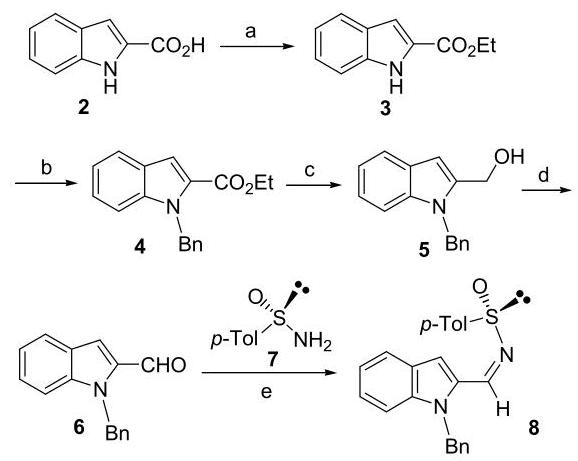
Reagents and conditions: (a) ${\mathrm{{SOCl}}}_{2}$ (2 equiv.), $\mathrm{{EtOH}},{0}^{ \circ }\mathrm{C}$ , then, reflux, 2 h, quant.; (b) BnBr (2 equiv.), KOH (4 equiv.), DMSO, r.t., 1 h, 97%; (c) LiAlH4 (1 equiv.), THF, r.t., 0.5 h, >99%; (d) MnO ${}_{2}$ (5 equiv.), CH ${}_{2}{\mathrm{{Cl}}}_{2}$ , r.t., 32 h, 72%; (e) 7 (1.1 equiv.), Ti(Oi-Pr)4 (3 equiv.), CH ${\mathrm{{Cl}}}_{2}{\mathrm{{Cl}}}_{2}$ , reflux, 5 h, 85%.
Scheme 2 Attempted photoinduced Wolff rearrangement/ cyclization
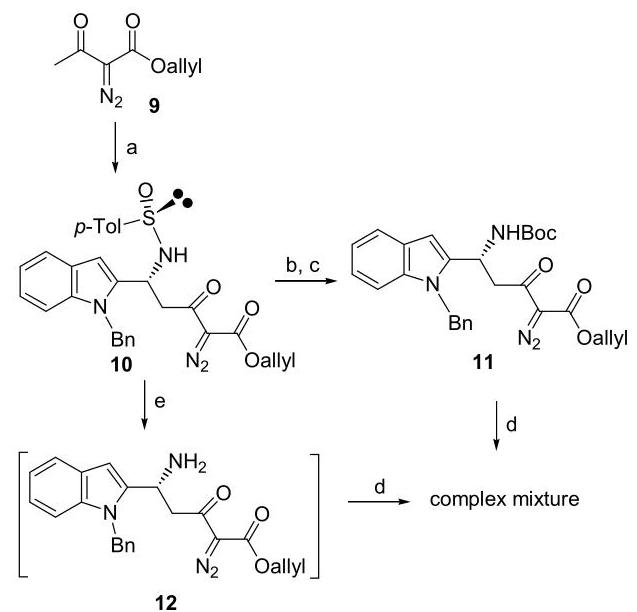
Reagents and conditions: (a) LiHMDS (2 equiv.), 8, ${\mathrm{{CH}}}_{2}{\mathrm{{Cl}}}_{2}, - {78}^{ \circ }\mathrm{C}$ , 77%; (b) TFA (5 equiv.), MeOH, 0 ${}^{ \circ }\mathrm{C}$ to r.t.; (c) Boc2O (1.1 equiv.), ${\mathrm{{Et}}}_{3}\mathrm{\;N}$ (6 equiv.) 5 mol% DMAP, THF, $0{}^{ \circ }\mathrm{C}$ to r.t.,95%, two steps; (d) ${hv}$ , Hg lamp (500 W), benzene,4 h; (e) 1) TFA (5 equiv.), MeOH, ${0}^{ \circ }\mathrm{C},{\mathrm{{Cy}}}_{2}\mathrm{{NMe}}$
Scheme 3 Enantioselective synthesis of indole (20)
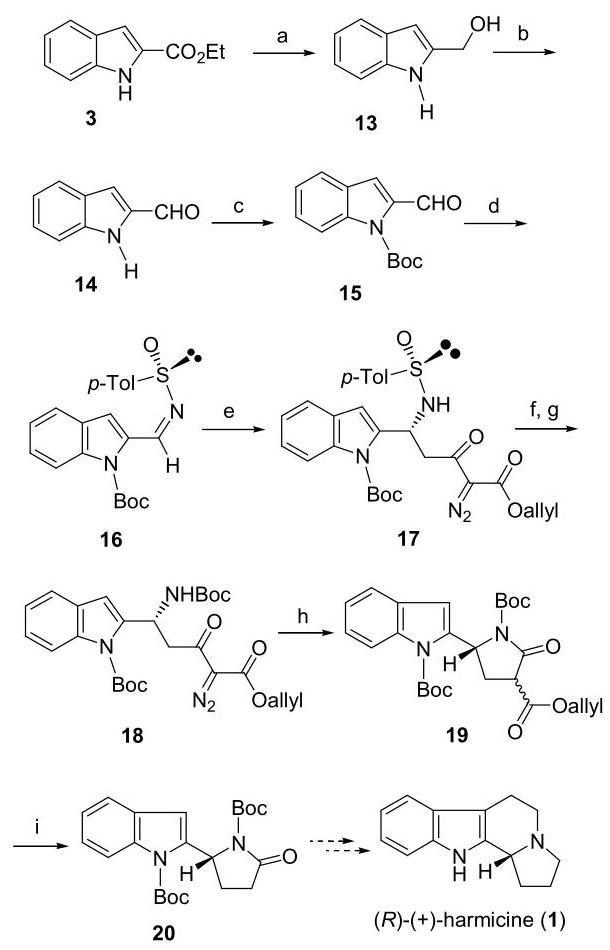
Reagents and conditions: (a) LiAlH ${}_{4}$ (1.5 equiv.), THF, r.t.,1 h, quant.; (b) ${\mathrm{{MnO}}}_{2}$ (5 equiv.), ${\mathrm{{CH}}}_{2}{\mathrm{{Cl}}}_{2}$ , r.t.,40 h; (c) ${\mathrm{{Boc}}}_{2}\mathrm{O}$ (1.2 equiv.), Et ${}_{3}\mathrm{\;N}$ (1.2 equiv.), 10 mol% DMAP, THF, 0 ${}^{ \circ }\mathrm{C}$ to r.t., 2 h, 87%, two steps; (d) 7 (1.1 equiv.), Ti(Oi-Pr)4 (3 equiv.), ${\mathrm{{CH}}}_{2}{\mathrm{{Cl}}}_{2}$ , reflux, 5 h, 90%; (e) LiHMDS (2 equiv.), 9 (1.5 equiv.), ${\mathrm{{CH}}}_{2}{\mathrm{{Cl}}}_{2}$ , -78 ${}^{ \circ }\mathrm{C},{73}\%$ ; (f) TFA (5 equiv.), MeOH, ${0}^{ \circ }\mathrm{C}$ to r.t.; (g) ${\mathrm{{Boc}}}_{2}\mathrm{O}$ (1.2 equiv.), ${\mathrm{{Et}}}_{3}\mathrm{\;N}$ (6 equiv.) 5 mol% DMAP, THF, $0{}^{ \circ }\mathrm{C}$ to r.t. 94%, two steps; (h) ${hv}$ 500 W Hg lamp, benzene,4 h,64%; (i) Pd(PP ${\mathrm{h}}_{3}{)}_{4}\left( {5\mathrm{\;{mol}}\% }\right)$ , morpholine (3 equiv.), THF, r.t., $6\mathrm{\;h},{71}\%$ .
Conclusions
We have successfully employed the diastereoselec-tive nucleophilic addition of lithium enolate of $\alpha$ -diazoacetate to chiral $N$ -sulfinyl imine and subsequent photoinduced Wolff rearrangement/cyclization in the synthesis of an intermediate which contains the required chiral center and three rings for the synthesis of $\left( R\right)$ -(+)-harmicine. Further study is undergoing and the results will be reported in due course.
Acknowledgement
The project is supported by the National Natural Science Foundation of China (No. 21072009, 21172005), National Basic Research Program of China (973 Program, No. 2009CB825300) and the Research Fund for the Doctoral Program of Higher Education (No. 20090001120014).
References
[1] Kam, T. S.; Sim, K. M. Phytochemistry 1998, 47, 145.
[2] (a) Knölker, H.-J.; Agarwal, S. Synlett 2004, 10, 1767; (b) King, F. D. J. Heterocyclic Chem. 2007, 44, 1459.
[3] (a) Szawkalo, J.; Czarnocki, S. J.; Zawadzka, A.; Wojtasiewicz, K.; Leniewski, A.; Maurin, J. K.; Czarnocki, Z.; Drabowicz, J. Tetrahedron: Asymmetry 2007, 18, 406; (b) Allin, S. M.; Gaskell, S. N.; Elsegood, M. R. J.; Martin, W. P. Tetrahedron Lett. 2007, 48, 5669.
[4] (a) Raheem, I. T.; Thiara, P. S.; Jacobsen, E. N. J. Am. Chem. Soc. 2007, 129, 13404; (b) Sanaboina, C.; Jana, S.; Chidara, S.; Patro, B.; Raolji, G. B.; Eppakayala, L. Tetrahedron Lett. 2012, 53, 5027.
[5] Chiou, W. -H.; Lin, G. -H.; Hsu, C. -C.; Chaterpaul, S. J.; Ojima, I. Org. Lett. 2009, 11, 2659.
[6] (a) Mo, F.; Li, F.; Qiu, D.; Wang, J. Tetrahedron 2010, 66, 1274; (b) Dong, C.; Mo, F.; Wang, J. J. Org. Chem. 2008, 73, 1971; (c) Dong, C.; Deng, G.; Wang, J. J. Org. Chem. 2006, 71, 5560.
[7] Zhao, Y.; Ma, Z.; Zhang, X.; Zou, Y.; Jin, X.; Wang, J. Angew. Chem., Int. Ed. 2004, 43, 5977.
[8] (a) Wang, J.; Hou, Y. J. Chem. Soc., Perkin Trans. I 1998, 1919; (b) Wang, J.; Hou, Y.; Wu, P.; Qu, Z. Chan, A. S. C. Tetrahedron: Asymmetry 1999, 10, 4553; (c) Lee, D. J.; Kim, K.; Park, Y. J. Org. Lett. 2002, 4, 873.
[9] Sechi, M.; Neamati, N.; Derudas, M. J. Med. Chem. 2004, 47, 5298.
[10] Mueller, P.; Allenbach, Y. F.; Grass, S. Tetrahedron: Asymmetry 2005, 16, 2007.
[11] Kumamoto, T.; Nagayama, S.; Hayashi, Y.; Kojima, H.; David, L.; Nakanishi, W.; Ishikawa, T. Heterocycles 2008, 76, 1155.
[12] Van der Jeught, S.; De Vos, N.; Masschelein, K.; Ghiviriga, I.; Stevens, C. V. Eur. J. Org. Chem. 2010, 28, 5444.
[13] Vilsmeier, A.; Haack, A. Ber. 1937, 60, 119.
[14] (a) Contrell Jr., W. R.; Lovett, D.; Engles, T.; Anderson, B.; Bauta, W. E.; Wolstenholm-Hogg, P. C. Nucleosides, Nucleotides Nucleic Acids 2008, 27, 901; (b) Shibata, N.; Baldwin, J. E.; Jacobs, A.; Wood, M. E. Tetrahedron 1996, 52, 12839.