Increments for 1H and 13C NMR chemical shifts in pinacol arylboronates
中文 / Bilingual · English version
Di Qiu, Zhitong Zheng, Fanyang Mo, Yan Zhang, and Jianbo Wang
Abstract: Arylboronates are important compounds widely used in cross-coupling reactions. By analyzing the NMR spectra data of a variety of pinacol arylboronates, we have determined the increments for ${}^{1}\mathrm{H}$ and ${}^{13}\mathrm{C}$ NMR chemical shifts caused by a pinacol boronate substituent in the benzene ring. These data can be used in the estimation of chemical shifts of aromatic pinacol boronates.
Key words: ${}^{1}\mathrm{H}$ NMR, ${}^{13}\mathrm{C}$ NMR, pinacol boronates, chemical shift increments.
Résumé : Les esters arylboronates sont des composés importants fréquemment utilisés dans des réactions de couplages croi-sés. Sur la base d’une analyse de données spectrales de RMN pour une variétés d’arylboronates du pinacol, il a été possible de déterminer les incréments dans les déplacements chimiques de RMN du ${}^{1}\mathrm{H}$ et du ${}^{13}\mathrm{C}$ provoqués par un substituant pré- sent dans le noyau aromatique d’un boronate du pinacol. Ces donnéés peuvent être utilisées pour évaluer les déplacements chimiques de boronates aromatiques du pinacol.
Mots-clés : RMN du ${}^{1}\mathrm{H}$ , RMN du ${}^{13}\mathrm{C}$ , boronates du pinacol, incréments dans les déplacements chimiques.
[Traduit par la Rédaction]
Introduction
Functionalized arylboronic acid and arylboronates have attracted much attention in the organic chemistry community in recent years because of their extensive applications in organic synthesis as well as in other fields. ${}^{1,2}$ Particularly, the Pd-catalyzed reaction of aromatic boron compounds, namely Suzuki-Miyaura cross-coupling reactions, have proved to be powerful tools for the construction of ${\mathrm{{Csp}}}^{2} - {\mathrm{{Csp}}}^{2}$ bond formations. The widespread use of aromatic boron compounds has stimulated the development of methods for the synthesis of these valuable chemicals. Pinacol boronic esters can be easily prepared from the corresponding boronic acids. They can also be synthesized by using Pd-catalyzed coupling of bis (pinacolato)diboron with aromatic halides (Miyaura boryla-tion) or by rhodium- or iridium-catalyzed direct $\mathrm{C} - \mathrm{H}$ bond activation. ${}^{\mathrm{{If}},3}$ Because of the importance of aromatic boron compounds, it is highly desirable to develop methods that can conveniently and rapidly determine the structure of aromatic boronates. ${}^{4}$ In this context, Voss and co-workers ${}^{5}$ developed a formula to show the increments for ${}^{1}\mathrm{H}$ and ${}^{13}\mathrm{C}$ NMR chemical shifts of arylboronic acids. Since pinacol arylboronates are also widely used in organic synthesis, it would be helpful to develop methods that can be used for rapid structure elucidation. To the best of our knowledge, the corresponding NMR chemical-shift increments for pinacol arylboronates have not been reported in the literature. As a continuation of our recent interest in the chemistry of aromatic pinacol esters, ${}^{6}$ we have investigated the increments for ${}^{1}\mathrm{H}$ and ${}^{13}\mathrm{C}$ NMR chemical shifts caused by the pinacol boronate group in the benzene rings.
Results and discussion
We used the pinacol arylboronates $\mathbf{1} - \mathbf{6}$ shown below as the reference compounds to calculate the NMR increments. ${\mathrm{{CDCl}}}_{3}$ is used as the NMR solvent and the spectra were all measured with a Bruker 400 MHz NMR spectrometer.
$$ \text{ 1] }{I}^{\mathrm{H}}{}_{\mathrm{B}} = \delta \left( {{}^{1}\mathrm{H}}\right) - \left( {{7.34} + \sum {I}^{\mathrm{H}}\mathrm{s}}\right) $$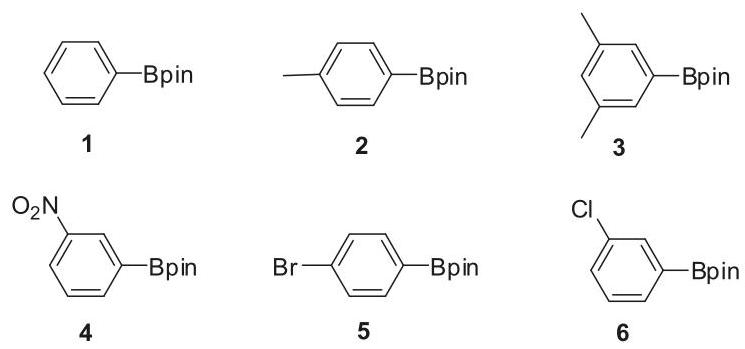
Increments ${I}^{\mathrm{H}}{}_{\mathrm{B}}$ for the ${}^{1}\mathrm{H}$ chemical-shift differences caused by the pinacol boronate group (Bpin) are calculated from the $\delta \left( {{}^{1}\mathrm{H}}\right)$ of the pinacol arylboronates 1-6 by using eq. [1] (7.34 is the ${}^{1}\mathrm{H}$ NMR chemical shift of benzene in ${\mathrm{{CDCl}}}_{3}$ ). The results are summarized in Table 1. The increments for ${I}^{\mathrm{H}}\mathrm{s}$ are taken from the literature (for methyl, meta $= - {0.12}$ and para $= - {0.22}$ ; for nitro, meta $= {0.26}$ ; for bromo, para $=$ -0.04; and for chloro, meta $= - {0.02}){.}^{7}$
Received 21 April 2011. Accepted 28 June 2011. Published at www.nrcresearchpress.com/cjc on 26 October 2011.
D. Qiu, Z. Zheng, F. Mo, Y. Zhang, and J. Wang. Beijing National Laboratory of Molecular Sciences (BNLMS) and Key Laboratory of Bioorganic Chemistry and Molecular Engineering of the Ministry of Education, College of Chemistry, Peking University, Beijing 100871, China.
Corresponding author: Jianbo Wang ().
This article is part of a Special Issue dedicated to Professor Tak-Hang Chan.
Table 1. ${}^{1}\mathrm{H}$ chemical shifts $\left( {\delta ,\mathrm{{ppm}}}\right)$ and increments for the ${}^{1}\mathrm{H}$ chemical-shift differences $\left( {{}^{1}{\mathrm{H}}_{\mathrm{B}}}\right)$ caused by the pinacol boronate group for the pinacol arylboronates.
| Position | Pinacol arylboronate | |||||||||||
| 1 | 2 | 3 | 4 | 5 | 6 | |||||||
| $\delta$ | ${I}^{\mathrm{H}}\mathrm{B}$ | $\delta$ | ${I}^{\mathrm{H}}\mathrm{B}$ | $\delta$ | ${I}^{\mathrm{H}}\mathrm{B}$ | $\delta$ | ${I}^{\mathrm{H}}\mathrm{B}$ | $\delta$ | ${I}^{\mathrm{H}}\mathrm{B}$ | $\delta$ | ${I}^{\mathrm{H}}\mathrm{B}$ | |
| ortho-H | 7.81 | 0.47 | 7.70 | 0.48 | 7.44 | 0.49 | 8.64 | 0.42 | 7.66 | 0.46 | 7.78 | 0.41 |
| 7.81 | 0.47 | 7.70 | 0.48 | 7.44 | 0.49 | 8.10 | 0.39 | 7.66 | 0.46 | 7.66 | 0.37 | |
| meta-H | 7.36 | 0.02 | 7.18 | 0.04 | - | - | 7.54 | -0.01 | 7.50 | 0.03 | 7.30 | 0.01 |
| 7.36 | 0.02 | 7.18 | 0.04 | - | - | - | - | 7.50 | 0.03 | - | - | |
| para-H | 7.45 | 0.11 | - | - | 7.10 | 0.14 | 8.30 | 0.08 | - | - | 7.42 | 0.05 |
From the results shown in Table 1, the mean ${I}^{\mathrm{H}}{}_{\mathrm{B}}$ s and the standard deviation can be calculated as follows:
$$ {I}^{\mathrm{H}}{}_{\mathrm{B}}\text{ (ortho) } = {0.44} \pm {0.04} $$$$ {I}^{\mathrm{H}}{}_{\mathrm{B}}\text{ (meta) } = {0.02} \pm {0.02} $$$$ {I}^{\mathrm{H}}{}_{\mathrm{B}}\text{ (para) } = {0.10} \pm {0.04} $$Compared with the chemical-shift increments caused by the boronic acid group ( ${I}^{\mathrm{H}}{}_{\mathrm{B}}$ (ortho) $= {1.02} \pm {0.03},{I}^{\mathrm{H}}{}_{\mathrm{B}}$ (meta) $= \; {0.25} \pm {0.04},{I}^{\mathrm{H}}{}_{\mathrm{B}}$ (para) $= {0.34} \pm {0.04}),{}^{5}{I}^{\mathrm{H}}{}_{\mathrm{B}}$ values for the pinacol boronate substituent clearly indicate that it is less electron withdrawing when compared with boronic acid. ${}^{8}$ They are comparable to the values of a cyano or a trifluo-romethyl substituent, whereas the corresponding values for the boronic acid substituent are comparable to those of a nitro substituent. However, the factors that are related to the NMR chemical shift of boronic acids are more complicated because of reversible anhydride formation and possible dimerization through hydrogen bonding.
Similarly, the corresponding ${}^{13}\mathrm{C}$ chemical-shift increments $\left( {I{C}_{B}}\right)$ caused by the pinacol boronate substituent can be calculated from the $\delta \left( {{}^{13}\mathrm{C}}\right)$ of the pinacol arylboronates $\mathbf{1} - \mathbf{6}$ by using eq. [2] (128.32 is the ${}^{13}\mathrm{C}$ NMR chemical shift of benzene in ${\mathrm{{CDCl}}}_{3}$ ). The results are summarized in Table 2. The increments for ${I}^{\mathrm{C}}\mathrm{s}$ are taken from the literature for methyl, ipso $=$ 9.3, ortho $= {0.6}$ , meta $= {0.0}$ , and para $= - {3.1}$ ; for nitro, ipso $=$ 19.6, ortho $= - {5.3}$ , meta $= {0.8}$ , and para $= {6.0}$ ; for bromo, ipso $= - {5.4}$ , ortho $= {3.3}$ , meta $= {2.2}$ , and para $= - {1.0}{)}^{7}$
[2] $\;{I}^{\mathrm{C}}{}_{\mathrm{B}} = \delta \left( {{}^{13}\mathrm{C}}\right) - \left( {{128.32} + \sum {I}^{\mathrm{C}}\mathrm{s}}\right)$
From the results shown in Table 2, the average increments and the standard deviation can be calculated as follows:
$$ {I}^{\mathrm{C}}{}_{\mathrm{B}}\text{ (ortho) } = {6.2} \pm {0.2} $$$$ {I}^{\mathrm{C}}{}_{\mathrm{B}}\text{ (meta) } = - {0.5} \pm {0.2} $$$$ {I}^{\mathrm{C}}{}_{\mathrm{B}}\text{ (para) } = {3.1} \pm {0.5} $$With the ${I}^{\mathrm{H}}{}_{\mathrm{B}}$ and the ${I}^{\mathrm{C}}{}_{\mathrm{B}}$ data in hand, we subsequently verified the efficacy of these data in the estimation of chemical shifts of aromatic pinacol boronates by using the compounds 7-22.
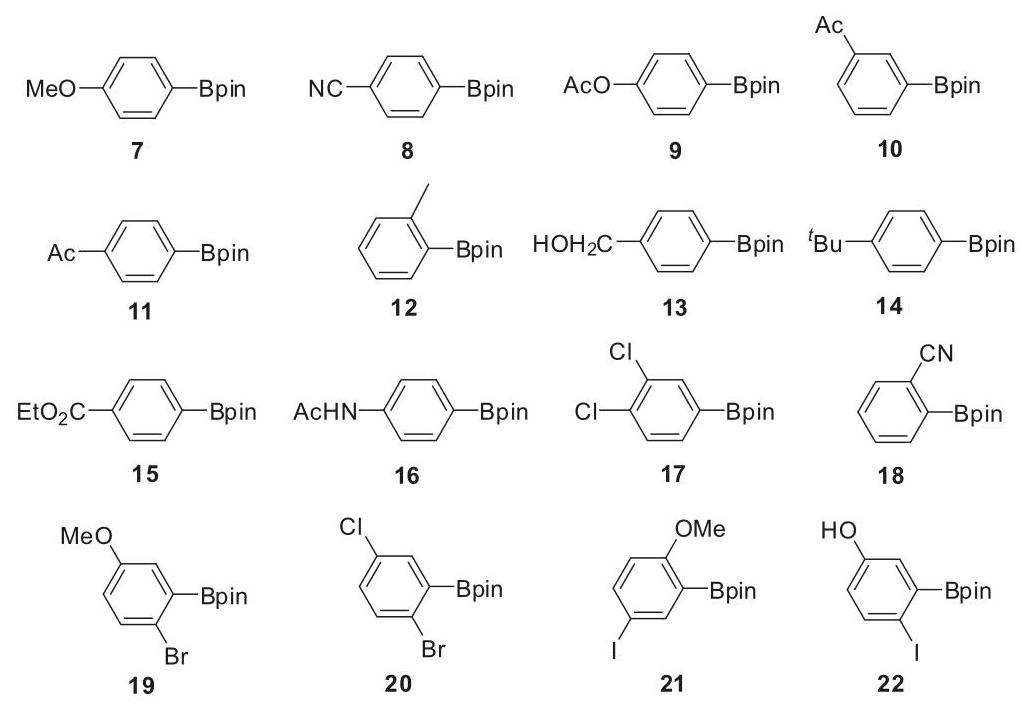
Table 2. ${}^{13}\mathrm{C}$ chemical shifts $\left( {\delta ,\mathrm{{ppm}}}\right)$ and increments for the ${}^{13}\mathrm{C}$ chemical-shift differences $\left( {{I}^{\mathrm{C}}{}_{\mathrm{B}}}\right)$ caused by the pinacol boronate group for the pinacol arylboronates.
| Position | Pinacol arylboronate | |||||||||||
| 1 | 2 | 3 | 4 | 5 | 6 | |||||||
| $\delta$ | ${I}^{\mathrm{C}}{}_{\mathrm{B}}$ | $\delta$ | ${I}^{\mathrm{C}}\mathrm{B}$ | $\delta$ | ${I}^{\mathrm{C}}\mathrm{B}$ | $\delta$ | $I{C}_{B}$ | $\delta$ | ${I}^{\mathrm{C}}\mathrm{B}$ | $\delta$ | ${I}^{\mathrm{C}}\mathrm{B}$ | |
| C-2 | 134.72 | 6.40 | 134.79 | 6.58 | 132.37 | 6.35 | 129.37 | 6.01 | 136.29 | 6.30 | 134.54 | 5.97 |
| C-6 | 134.72 | 6.40 | 134.79 | 6.58 | 132.37 | 6.35 | 140.61 | 6.07 | 136.29 | 6.30 | 132.62 | 6.23 |
| C-3 | 127.69 | -0.63 | 128.49 | -0.52 | 137.12 | -0.62 | 147.82 | -0.23 | 130.93 | -0.55 | 134.01 | -0.20 |
| C-5 | 127.69 | -0.63 | 128.49 | -0.52 | 137.12 | -0.62 | 128.70 | -0.53 | 130.93 | -0.55 | 129.16 | -0.52 |
| C-4 | 131.23 | 2.91 | 141.35 | 3.56 | 132.96 | 3.07 | 125.82 | 2.46 | 126.20 | 3.73 | 131.24 | 2.67 |
Table 3. Comparison of calculated and experimental ${}^{1}\mathrm{H}$ NMR chemical shifts ( $\delta$ , ppm) of the pinacol arylboronates.
| Compound | Position | |||||
| ortho-H | meta-H | para-H | ||||
| $\delta$ (ppm) | ||||||
| Calculated | Measured | Calculated | Measured | Calculated | Measured | |
| 7 | 7.69 | 7.75 | 6.88 | 6.89 | - | - |
| 8 | 7.96 | 7.88 | 7.54 | 7.64 | - | - |
| 9 | 7.81 | 7.83 | 7.11 | 7.09 | - | - |
| 10 | 8.40 | 8.37 | 7.50 | 7.47 | 8.06 | 8.00 |
| 7.99 | 8.06 | |||||
| 11 | 7.92 | 7.94~7.88 | 7.98 | 7.94~7.88 | - | - |
| 12 | 7.66 | 7.76 | 7.16 | 7.16 | 7.32 | 7.31 |
| 7.14 | 7.16 | |||||
| 13 | 7.71 | 7.79 | 7.29 | 7.34 | - | - |
| 14 | 7.70 | 7.76 | 7.38 | 7.41 | - | - |
| 15 | 7.85 | 7.87 | 8.06 | 8.02 | - | - |
| 16 | 7.71 | 7.76 | 7.48 | 7.52 | - | - |
| 17 | 7.83 | 7.86 | 7.41 | 7.43 | - | - |
| 7.58 | 7.60 | |||||
| 18 | 7.96 | 7.89 | 7.72 | 7.70 | 7.55 | 7.55 |
| 7.64 | 7.55 | |||||
| 19 | 7.22 | 7.13 | 7.45 | 7.41 | 6.88 | 6.80 |
| 20 | 7.73 | 7.58 | 7.48 | 7.45 | 7.39 | 7.20 |
| 21 | 8.08 | 7.92 | 6.67 | 6.63 | 7.74 | 7.65 |
| 22 | 7.01 | 7.02 | 7.63 | 7.64 | 6.67 | 6.60 |
The calculated ${}^{1}\mathrm{H}$ and ${}^{13}\mathrm{C}$ chemical shifts of pinacol aryl-boronates found by using eqs. [1] and [2] and the corresponding measured chemical shifts are summarized in Tables 3 and 4 (see the Supplementary data for more information). The measured data were all recorded by a Bruker- 400 NMR spectrometer. The increments of other functional groups are taken from the literature. ${}^{7}$
From the data collected in Tables 3 and 4, the standard deviations for the estimated and measured chemical shifts were obtained.
$$ {d}^{\mathrm{H}}{}_{\mathrm{B}}\left( \text{ ortho }\right) = {0.06} \pm {0.04} $$$$ {d}^{\mathrm{H}}{}_{\mathrm{B}}\left( \text{ meta }\right) = {0.02} \pm {0.02} $$$$ {d}^{\mathrm{H}}{}_{\mathrm{B}}\left( \text{ para }\right) = {0.07} \pm {0.06} $$$$ {d}^{\mathrm{C}}{}_{\mathrm{B}}\left( \text{ ortho }\right) = {0.9} \pm {1.3} $$$$ {d}^{\mathrm{C}}{}_{\mathrm{B}}\left( \text{ meta }\right) = {0.8} \pm {0.9} $$$$ {d}^{\mathrm{C}}{}_{\mathrm{B}}\left( \text{ para }\right) = {0.8} \pm {0.5} $$The data compiled in Tables 3 and 4 demonstrate satisfactory agreement of the calculated and measured ${}^{1}\mathrm{H}$ and ${}^{13}\mathrm{C}$ NMR chemical shifts. However, when there are multiple sub-stituents in the aromatic ring, relatively larger deviations of the ${}^{13}\mathrm{C}$ chemical shifts are observed, as shown by compounds 19-22.
Conclusion
In conclusion, we have obtained the increments for ${}^{1}\mathrm{H}$ and ${}^{13}\mathrm{C}$ NMR chemical shifts caused by the existence of a pinacol boronate substituent in the aromatic rings. These data could be widely used in the estimation of the NMR chemical shifts of aromatic pinacol boronates. ${}^{9}$
Supplementary data
Supplementary data are available for this article through the journal Web site at http://nrcresearchpress.com/doi/suppl/ 10.1139/v11-099.
Table 4. Comparison of calculated and measured ${}^{13}\mathrm{C}$ NMR chemical shifts $\left( {\delta ,\mathrm{{ppm}}}\right)$ of the pinacol arylboronates.
| Compound | Position | |||||
| C-2,6 | C-3,5 | C-4 | ||||
| $\delta$ (ppm) | ||||||
| Calculated | Measured | Calculated | Measured | Calculated | Measured | |
| 7 | 135.4 | 136.48 | 113.1 | 113.29 | 161.6 | 162.13 |
| 8 | 135.2 | 135.06 | 131.3 | 131.10 | 115.4 | 114.51 |
| 9 | 135.8 | 136.16 | 121.4 | 120.91 | 154.4 | 153.16 |
| 10 | 134.7 | 134.76 | 137.1 | 136.47 | 131.6 | 130.72 |
| 138.7 | 139.35 | 128.0 | 127.99 | |||
| 11 | 134.7 | 134.86 | 128.0 | 127.24 | 140.7 | 138.94 |
| 12 | 144.0 | 144.81 | 128.6 | 129.75 | 131.3 | 130.75 |
| 135.2 | 135.83 | 124.8 | 124.68 | |||
| 13 | 134.5 | 134.96 | 126.4 | 126.00 | 144.4 | 144.00 |
| 14 | 134.1 | 134.67 | 124.4 | 124.68 | 153.5 | 154.47 |
| 15 | 134.3 | 134.59 | 128.9 | 128.52 | 133.5 | 132.65 |
| 16 | 135.0 | 135.78 | 119.9 | 118.51 | 141.3 | 140.55 |
| 17 | 136.6 | 136.52 | 131.9 | 132.21 | 135.5 | 135.45 |
| 133.8 | 133.73 | 129.9 | 129.98 | |||
| 18 | 118.5 | 118.91 | 131.3 | 131.03 | 132.1 | 133.37 |
| 135.2 | 135.80 | 132.1 | 131.51 | |||
| 19 | 122.0 | 121.09 | 157.0 | 158.05 | 118.9 | 118.31 |
| 121.0 | 118.04 | 132.0 | 133.47 | |||
| 20 | 136.9 | 136.04 | 133.2 | 132.77 | 133.8 | 133.90 |
| 127.1 | 125.68 | 132.1 | 131.74 | |||
| 21 | 164.3 | 163.84 | 115.7 | 112.94 | 142.2 | 140.89 |
| 145.3 | 144.83 | 87.4 | 83.76 | |||
| 22 | 124.4 | 123.17 | 154.3 | 154.88 | 121.3 | 119.51 |
| 94.9 | 88.65 | 139.1 | 140.48 | |||
Acknowledgements
Financial support from the National Natural Science Foundation of China (Grant Nos. 20902005, 20832002, 210722009, and 20821062) and the 973 Program (No. 2009CB825300) is gratefully acknowledged.
References
(1) (a) For selected reviews see Miyaura, N.; Suzuki, A. Chem. Rev. 1995, 95 (7), 2457. doi:10.1021/cr00039a007; (b) Suzuki, A. Acc. Chem. Res. 1982, 15 (6), 178. doi:10.1021/ar00078a003; (c) Miyaura, N. J. Organomet. Chem. 2002, 653 (1-2), 54. doi:10.1016/S0022-328X(02)01264-0; (d) Miyaura, N. Bull. Chem. Soc. Jpn. 2008, 81 (12), 1535. doi:10.1246/bcsj.81.1535; (e) Merino, P.; Tejero, T. Angew. Chem. Int. Ed. 2010, 49 (40), 7164. doi:10.1002/anie.201003191; (f) Miyaura, N. Top. Curr. Chem. 2002, 219, 11. doi:10.1007/3-540-45313-X_2.
(2) Hall, D. G. Boronic Acids; Wiley-VCH: Weinheim, 2005.
(3) (a) Mkhalid, I. A. I.; Barnard, J. H.; Marder, T. B.; Murphy, J. M.; Hartwig, J. F. Chem. Rev. 2010, 110 (2), 890. doi:10.1021/ cr900206p; (b) Ishiyama, T.; Murata, M.; Miyaura, N. J. Org. Chem. 1995, 60 (23), 7508. doi:10.1021/jo00128a024.
(4) (a) Wrackmeyer, B. Prog. Nucl. Magn. Reson. Spectrosc. 1979, 12 (4), 227. doi:10.1016/0079-6565(79)80003-5; (b) Gragg, B. R.; Layton, W. J.; Niedenzu, K. J. Organomet. Chem. 1977, 132 (1), 29. doi:10.1016/S0022-328X(00)92511-7; (c) Niedenzu, K.; Müller, K.-D.; Layton, M. S.; Komorowsky, L. Z. Anorg. Allg. Chem. 1978, 439, 112. doi:10.1002/zaac.19784390113.
(5) Bruns, S.; Sinnwell, V.; Voss, J. Magn. Reson. Chem. 2003, 41 (4), 269. doi:10.1002/mrc.1163.
(6) (a) Mo, F.; Jiang, Y.; Qiu, D.; Zhang, Y.; Wang, J. Angew. Chem. Int. Ed. 2010, 49 (10), 1846. doi:10.1002/anie. 200905824; (b) Qiu, D.; Mo, F.; Zheng, Z.; Zhang, Y.; Wang, J. Org. Lett. 2010, 12 (23), 5474. doi:10.1021/ol102350v.
(7) Williams, D. H.; Fleming, I. Spectroscopic Methods in Organic Chemistry; 5th ed.; McGraw-Hill: Berkshire, 1995.
(8) Entwistle, C. D.; Marder, T. B. Chem. Mater. 2004, 16 (23), 4574. doi:10.1021/cm0495717.
(9) The validity of these data has been further verified by comparison of the estimated NMR chemical shifts with those reported in the literature; see the Supplementary data.