Highly Diastereoselective Addition of the Lithium Enolate of α-Diazoacetoacetate to N-Sulfinyl Imines: Enantioselective Synthesis of 2-Oxo and 3-Oxo Pyrrolidines
中文 / Bilingual · English version
Highly Diastereoselective Addition of the Lithium

Enolate of $\alpha$ -Diazoacetoacetate to $N$ -Sulfinyl Imines: Enantioselective Synthesis of 2-Oxo and 3-Oxo Pyrrolidines
Changqing Dong, Fanyang Mo, and Jianbo Wang*
Beijing National Laboratory of Molecular Sciences (BNLMS) and Key Laboratory of Bioorganic Chemistry and Molecular Engineering of Ministry of Education, College of Chemistry, Peking University, Beijing 100871, China
Received October 24, 2007
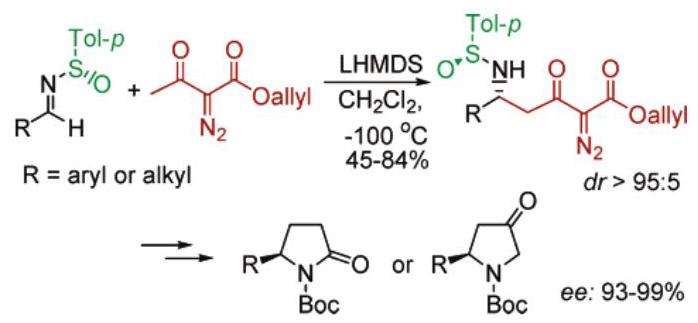
The highly enantioselective synthesis of 2-oxo and 3-oxo pyrrolidines has been achieved by diastereoselective addition of the lithium enolate of $\alpha$ -diazoacetoacetate to chiral N-sulfinyl imines, followed by photoinduced Wolff rearrangement or Rh(II)-catalyzed intramolecular N-H insertion.
2-Oxo and 3-oxo pyrrolidines are widespread among natural products and biologically active molecules. ${}^{1}$ Chiral pyrrolidi-nones are used as excellent building blocks for the synthesis of a plethora of nitrogen-containing natural products, such as pyrrolizidines and indolizidines. ${}^{{1a} - c}$ Consequently, many methodologies have been developed for their synthesis over the years. ${}^{2}$ The most widely applied ways to synthesize 2-oxo pyrrolidines include ring expansion of $\beta$ -lactam derivatives, ${}^{3}$ formal [3+2] annulations, ${}^{4}$ and metal carbene intramolecular C-H insertions. ${}^{5,6}$ Compared to 2-oxo pyrrolidines, there are relatively fewer methods for the synthesis of 3-oxo pyrrolidines.
The common ways to obtain this type of compounds are intramolecular $\mathrm{N} - \mathrm{H}$ insertions through decomposition of dia-zocarbonyl compounds by Lewis acid or protic acid, ${}^{7}$ and radical carbonylation-reductive cyclizations. ${}^{8}$
Although the above-mentioned reactions provide diverse access to these compounds, there are only limited methods to synthesize them in an enantioselective manner. ${}^{{3a}, c,{6e}, h,{7e},9}$ Consequently, it is highly desirable to develop efficient methods that allow one to access substituted 2-oxo and 3-oxo pyrrolidines
(3) For recent examples of the synthesis of 2-oxo pyrrolidines through ring expansions, see: (a) Alcaide, B.; Almendros, P.; Alonso, J. M. J. Org. Chem. 2004, 69, 993-996. (b) Park, J.-H.; Ha, J.-R.; Oh, S.-J.; Kim, J.-A.; Shin, D.-S.; Won, T.-J.; Lam, Y.-F.; Ahn, C. Tetrahedron Lett. 2005, 46, 1755-1757. (c) Alcaide, B.; Almendros, P.; Cabrero, G.; Ruiz, M. P. Org. Lett. 2005, 7, 3981-3984. (d) Van Brabandt, W.; De Kimpe, N. J. Org. Chem. 2005, 70, 3369-3374. (e) Scott, M. E.; Schwarz, C. A.; Lautens, M. Org. Lett. 2006, 8, 5521-5524.
(4) For examples of [3 + 2] annulations in 2-oxo pyrrolidine synthesis, see: (a) Roberson, C. W.; Woerpel, K. A. J. Org. Chem. 1999, 64, 1434- 1435. (b) Sun, P.-P.; Chang, M.-Y.; Chiang, M. Y.; Chang, N.-C. Org. Lett. 2003, 5, 1761-1763. (c) Romero, A.; Woerpel, K. A. Org. Lett. 2006, 8, 2127-2130.
(5) For recent examples of 2-oxo pyrrolidine synthesis by metal carbene intramolecular C-H insertions, see: (a) Yoon, C. H.; Zaworotko, M. J.; Moulton, B.; Jung, K. W. Org. Lett. 2001, 3, 3539-3542. (b) Wee, A. G. H.; Duncan, S. C. Tetrahedron Lett. 2002, 43, 6173-6179. (c) Yoon, C. H.; Nagle, A.; Chen, C.; Gandhi, D.; Jung, K. W. Org. Lett. 2003, 5, 2259- 2262. (d) Choi, M. K.-W.; Yu, W.-Y.; Che, C.-M. Org. Lett. 2005, 7, 1081- 1084. (e) Wee, A. G. H.; Duncan, S. C.; Fan, G. J. Tetrahedron: Asymmetry 2006, 17, 297-307.
(6) For recent examples of other methods to synthesize 2-oxo pyrro-lidines, see: (a) Ryu, I.; Matsu, K.; Minakata, S.; Komatsu, M. J. Am. Chem. Soc. 1998, 120, 5838-5839. (b) Benati, L.; Leardini, R.; Minozzi, M.; Nanni, D.; Spagnolo, P.; Strazzari, S.; Zanardi, G. Org. Lett. 2002, 4, 3079- 3081. (c) Vergnon, A. L.; Pottorf, R. S.; Winters, M. P.; Player, M. R. J. Comb. Chem. 2004, 6, 903-910. (d) Hu, T.; Li, C. Org. Lett. 2005, 7, 2035-2038. (e) He, M.; Bode, J. W. Org. Lett. 2005, 7, 3131-3134. (f) Ramachandran, P. V.; Burghardt, T. E. Chem. Eur. J. 2005, 11, 4387- 4395. (g) Masse, C. E.; Ng, P. Y.; Fukase, Y.; Sanchez-Rosello, M.; Shaw, J. T. J. Comb. Chem. 2006, 8, 293-296. (h) Gheorghe, A.; Schulte, M.; Reiser, O. J. Org. Chem. 2006, 71, 2173-2176. (i) Zhou, C.-Y.; Che, C.- M. J. Am. Chem. Soc. 2007, 129, 5828-5829.
(7) For intramolecular N-H bond insertion in the synthesis of 3-oxo pyrrolidine derivatives, see: (a) Moyer, M. P.; Feldman, P. L.; Rapoport, H. J. Org. Chem. 1985, 50, 5223-5230. (b) Clark, J. S.; Hodgson, P. B. J. Chem. Soc., Chem. Commun. 1994, 2701-2702. (c) Wang, J.; Hou, Y.; Wu, P. J. Chem. Soc., Perkin Trans. 1 1999, 2277-2280. (d) Yang, H.; Jurkauskas, V.; Mackintosh, N.; Mogren, T.; Stephenson, C. R. J.; Foster, K.; Brown, W.; Roberts, E. Can. J. Chem. 2000, 78. 800-808. (e) Davis, F. A.; Fang, F.; Goswami, R. Org. Lett. 2002, 4, 1599-1602.
(8) Berlin, S.; Ericsson, C.; Engman, L. J. Org. Chem. 2003, 68. 8386- 8396.
(8) Berlin, S.; Ericsson, C.; Engman, L. J. Org. Chem. 2003, 68. 8386 - 8396。
(9) For recent examples of enantioselective synthesis of 2-oxo and 3-oxo pyrrolidines, see: (a) Escalante, J.; González-Tototzin, M. A. Tetrahedron: Asymmetry 2003, 14, 981-985. (b) Fernandes, R. A.; Yamamoto, Y. J. Org. Chem. 2004, 69, 3562-3564. (c) Newhouse, B.; Allen, S.; Fauber, B.; Anderson, A. S.; Eary, C. T.; Hansen, J. D.; Schiro, J.; Gaudino, J. J.; Laird, E.; Chantry, D.; Eberhardt, C.; Burgess, L. E. Bioorg. Med. Chem. Lett. 2004, 14, 5537-5542. (d) Forzato, C.; Nitti, G.; Pitacco, E.; Valentin, S.; Morganti, E.; Rizzato, D.; Spinelli, C.; Dell’Erba, P.; Petrillo, G.; Tavani, C. Tetrahedron 2004, 60, 11011-11027. (e) Ramachandran, P. V.; Burghardt, T. E. Chem. Eur. J. 2005, 11, 4387-4395. (f) Park, J.-H.; Ha, J.-R.; Oh, S.-J.; Kim, J.-A.; Shin, D.-S.; Won, T.-J.; Lam, Y.-F.; Ahn, C. Tetrahedron Lett. 2005, 46, 1755-1757. (g) Raghavan, B.; Johnson, R. L. J. Org. Chem. 2006, 71, 2151-2154. (h) Hansen, J. D.; Newhouse, B. J.; Allen, S.; Anderson, A.; Eary, T.; Schiro, J.; Gaudino, J.; Laird, E.; Allen, A. C.; Chantry, D.; Eberhardt, C.; Burgess, L. E. Tetrahedron Lett. 2006, 47, 69-72. (i) Davis, F. A.; Xu, H.; Wu, Y.; Zhang, J. Org. Lett. 2006, 8, 2273-2276. in enantiomerically pure form. We have recently developed a new synthesis of 2-oxo pyrrolidines based on the nucleophilic addition of Ti(IV) enolate to N-tosylimines. ${}^{10}$ Here we report the further extension of this method to the enantioselective synthesis of 2-oxo and 3-oxo pyrrolidines (Scheme 1).
(1) For selected reviews, see: (a) Daly, J. W.; Spande, T. F.; Garraffo, H. M. J. Nat. Prod. 2005, 68, 1556-1575. (b) O’Hagan, D. Nat. Prod. Rep. 2000, 17, 435-442. (c) Leclercq, S.; Braekman, J. C.; Daloze, D.; Pasteels, J. M. Prog. Chem. Org. Nat. Prod. 2000, 79, 115-229. (d) Corey, E. J.; Li, W.-D. Z. Chem. Pharm. Bull. 1999, 47, 1-10.
(2) For recent reviews on 2-oxo pyrrolidine syntheses, see: (a) Huang, P.-Q. In New Methods for the Asymmetric Synthesis of Nitrogen Hetero-cycles; Research Signpost: Trivandrum, India, 2005; pp 197-222. (b) Smith, M. B. In Science of Synthesis; Weinreb, S., Ed.; Georg Thieme Verlag: Stuttgart, Germany, 2005; Vol 21, pp 647-711. (c) Renaud, P.; Giraud, L. Synthesis 1996, 913-926. (d) Fallis, A. G.; Brinza, I. M. Tetrahedron 1997, 53, 17543-17594. (e) Ley, S. V.; Cox, L. R.; Meek, G. Chem. Rev. 1996, 96, 423-442.
SCHEME 1. Enantioselective Synthesis of 2-Oxo and 3-Oxo Pyrrolidines
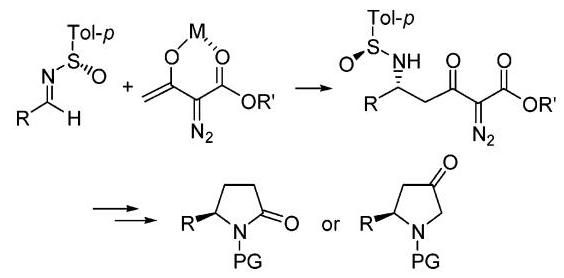
SCHEME 2. Enantioselective Synthesis of 2-Oxo and 3-Oxo Pyrrolidines
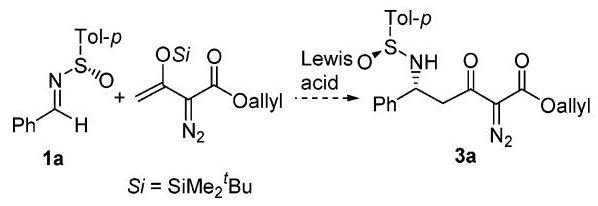
In the outset of this work, we attempted catalytic Mukaiyama strategy. Thus, the silyl enol ether of $\alpha$ -diazoacetoacetate was expected to add to N-(benzylidene)-p-toluene sulfinamide 1a under catalysis with Lewis acids, such as ${\mathrm{{Et}}}_{2}\mathrm{O} \cdot {\mathrm{{BF}}}_{3},{\mathrm{{TiCl}}}_{4},\mathrm{{Cu}}$ - ${\left( \mathrm{{OTf}}\right) }_{2},\mathrm{{La}}{\left( \mathrm{{OTf}}\right) }_{3}$ , and TBSOTf. ${}^{13}$ We found that only TBSOTf could provide a low yield of the expected addition product. After some attempts, we reached the conclusion that the reaction with the silyl enol ether of α-diazoacetoacetate could not be optimized (Scheme 2).
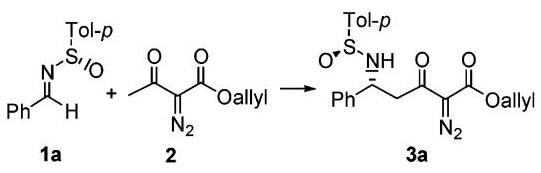
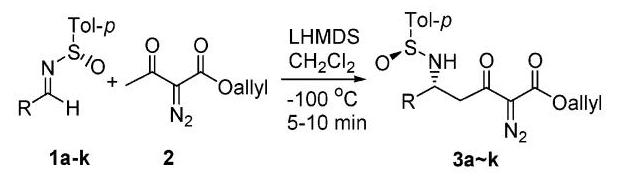
We then turned to a straightforward way to generate the enolate by using a strong base (Table 1). When ${}^{t}\mathrm{{BuOK}}$ was added to the mixture of $\alpha$ -diazoacetoacetate and N-sulfinyl imine, no reaction occurred at all. A similar result was obtained with LDA. Since LDA is obviously strong enough to remove the $\alpha$ proton of a carbonyl compound, we speculated that the byproduct ${}^{1}{\mathrm{{Pr}}}_{2}\mathrm{{NH}}$ might hamper the following nucleophilic addition. tert-Butyllithium was then examined. The expected addition product 3a was indeed obtained, albeit in low yield. To our delight, the diastereoselectivity of the product was moderately high (entry 3). Since ‘BuLi is a very strong base that may cause side reactions, other bases were examined. With potassium bis(trimethylsilyl)amide (KHMDS), both yield and diastereoselectivity were improved (entry 4). However, sodium bis(trimethylsilyl)amide (NaHMDS) resulted in a complex mixture. Eventually, we found lithium bis(trimethylsilyl)amide (LHMDS) was the most suitable base for this reaction. Further examination of solvent effects led to the following optimized reaction conditions: with ${\mathrm{{CH}}}_{2}{\mathrm{{Cl}}}_{2}$ as solvent, LHMDS as base, at $- {100}{}^{ \circ }\mathrm{C}$ .
TABLE 1. Optimization of Reaction Conditions with 1a
| entry | base | solvent | yield ${\left( \% \right) }^{\mathrm{a}}$ | $\mathrm{d{r}^{b}}$ |
| 1 | 'BuOK | THF | N.R.c | |
| 2 | LDA | THF | N.R.c | |
| 3 | 'BuLi | THF | 25 | 91:9 |
| 4 | KHMDS | THF | 44 | >95:5 |
| 5 | NaHMDS | THF | d | |
| 6 | LHMDS | THF | 55 | >95:5 |
| 7 | LHMDS | Et ${}_{2}\mathrm{O}$ | 81 | 91:9 |
| 8 | LHMDS | ${\mathrm{{PhCH}}}_{3}$ | 59 | 94:6 |
| 9 | LHMDS | ${\mathrm{{CH}}}_{2}{\mathrm{{Cl}}}_{2}$ | 78 | >95:5 |
a Isolated yield after chromatography. ${}^{\mathrm{b}}$ Ratio was determined by ${}^{1}\mathrm{H}$ NMR (300 MHz) of the crude product. ${}^{\mathrm{c}}$ No reaction occurred. ${}^{\mathrm{d}}$ The reaction gave a complex mixture.
TABLE 2. The Reaction of 2 with N-sulfinylimine 1a-k
| entry | imine $\left( {1\mathrm{a} - \mathrm{k},\mathrm{R}}\right)$ | yield ${\left( \% \right) }^{\mathrm{a}}$ | ${\mathrm{{dr}}}^{\mathrm{b}}$ |
| 1 | $1\mathrm{a},\mathrm{R} = \mathrm{{Ph}}$ | 3a,78 | >95:5 |
| 2 | $1\mathrm{\;b},\mathrm{R} = \mathrm{p} - {\mathrm{{FC}}}_{6}{\mathrm{H}}_{4}$ | 3b,78 | >95:5 |
| 3 | $1\mathrm{c},\mathrm{R} = \mathrm{p} - {\mathrm{{CH}}}_{3}{\mathrm{{OC}}}_{6}{\mathrm{H}}_{4}$ | 3c,66 | >95:5 |
| 4 | $1\mathrm{d},\mathrm{R} =$ o, p- ${\mathrm{{Cl}}}_{2}{\mathrm{C}}_{6}{\mathrm{H}}_{3}$ | 3d,74 | >95:5 |
| 5 | le, $\mathrm{R} =$ piperonyl | 3e,70 | >95:5 |
| 6 | $1\mathrm{f},\mathrm{R} = \mathrm{o} - {\mathrm{{CH}}}_{3}{\mathrm{C}}_{6}{\mathrm{H}}_{4}$ | 3f, 84 | >95:5 |
| 7 | $1\mathrm{\;g},\mathrm{R} =$ trans- ${\mathrm{C}}_{6}{\mathrm{H}}_{5}\mathrm{{CH}} = \mathrm{{CH}}$ | 3g, 63 | >95:5 |
| 8 | 1h, R = 2-furyl | 3h, 69 | >95:5 |
| 9 | 1i, R = cyclohexyl | 3i, 45 | >95:5 |
| 10 | 1j, R = hexyl | 3j, 53 | >95:5 |
| 11 | 1k, R = isobutyl | 3k, 56 | >95:5 |
${}^{a}$ Isolated yield after chromatography. ${}^{b}$ Ratio was determined by ${}^{1}\mathrm{H}$ NMR (300 MHz) of the crude product.
The optimized reaction condition was then applied to a series of N-sulfinyl imines (Table 2). All aromatic imines reacted smoothly with allyl diazoacetoacetate and afforded excellent diastereoselectivities and good yields. The substituents on the aromatic ring had little influence on the reaction. When aliphatic imines were subjected to the reaction, the yields somewhat decreased but diastereoselectivities remained high. It was worth noting that in all cases the addition reaction proceeded very fast and could complete within ${10}\mathrm{\;{min}}$ .
The absolute configuration of the newly generated chiral center was established by X-ray analysis of a single crystal of 3c. When the chiral center of sulfur has the S configuration, the newly formed chiral center has the R configuration (Figure 1).
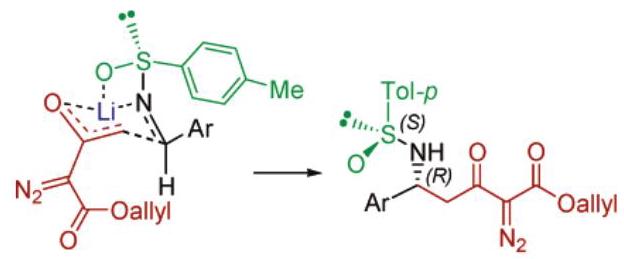
This stereochemical outcome is consistent with the previous reports of the addition of enolates derived from ester or ketones to N-sulfinyl imines. ${}^{{12},{14}}$ On the basis of the stereochemical information, we conclude that the sense of induction can be similarly predicted by invoking a six-membered Zimmerman-Traxler-type transition state as previously suggested for the similar addition of acetate enolates to N-sulfinyl imines (Scheme 3). In this transition state, the chelation of the ${\mathrm{{Li}}}^{ + }$ with the sulfinyl oxygen plays a vital role in controlling the attack of the enolate to the Re face of the imine. ${}^{14}$
(10) (a) Deng, G.; Jiang, N.; Ma, Z.; Wang, J. Synlett 2002, 1913-1915. (b) Dong, C.; Deng, G.; Wang, J. J. Org. Chem. 2006, 71, 5560-5564.
(11) (a) Calter, M. A.; Sugathapala, P. M.; Zhu, C. Tetrahedron Lett. 1997, 38, 3837-3840. (b) Calter, M. A.; Zhu, C. J. Org. Chem. 1999, 64, 1415-1419. (c) Deng, G.; Tian, X.; Qu, Z.; Wang, J. Angew. Chem., Int. Ed. 2002, 41, 2773-2776. (d) Zhao, Y.; Wang, J. Synlett 2005, 2886- 2892. (e) Liao, M.; Dong, S.; Deng, G.; Wang, J. Tetrahedron Lett. 2006, 47, 3927-3929.
(12) For reviews, see: (a) Ellman, J. A.; Owens, T. D.; Tang, T. P. Acc. Chem. Res. 2002, 35, 984-995. (b) Zhou, P.; Chen, B.-C.; Davis, F. A. Tetrahedron 2004, 60, 8003-8030.
(13) (a) Kundu, K.; Doyle, M. P. Tetrahedron: Asymmetry 2003, 17, 574-577. (b) Doyle, M. P.; Kundu, K.; Russell, A. E. Org. Lett. 2005, 7, 3131-3134.
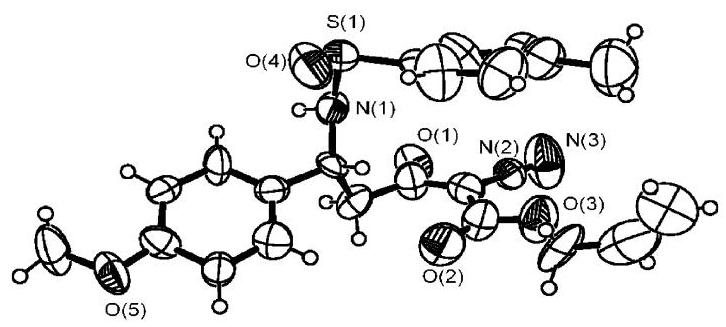
FIGURE 1. X-ray structure of 3c.
SCHEME 3. Transition State of the Diastereoselective Addition Reaction
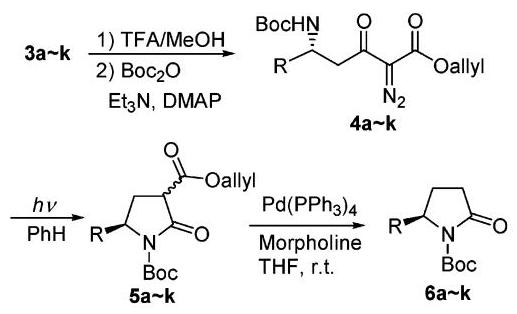
With the addition products in hand, we proceeded to convert these chiral diazo compounds to 2-oxo and 3-oxo pyrrolidines by the reaction sequence that we have reported previously. ${}^{10b}$ First, the diazo compound $3\mathrm{a}\left( {\mathrm{R} = \mathrm{{Ph}}}\right)$ was photolyzed with a high-pressure Hg lamp $\left( {\lambda > {300}\mathrm{\;{nm}}}\right)$ in a Pyrex tube. The Wolff rearrangement was expected to occur to form the ketene intermediate, ${}^{15}$ followed by intramolecular nucleophilic attack by the amino group to afford 2-oxo pyrrolidines. ${}^{16}$ However, the expected 2-oxo pyrrolidines were not obtained, instead, the photolysis resulted in a dark complex mixture. Considering our previous study with N-sulfonyl diazo compounds, which gave the corresponding 2-oxo pyrrolidines in good yield, ${}^{{10}\mathrm{\;b}}$ we concluded that the N-sulfinyl group was not compatible with the photochemical condition. So the N-sulfinyl group was replaced by tert-butyloxycarbonyl (Boc), and the N-Boc diazo compound 4a was subjected to the photolysis. To our delight, the corresponding 2-oxo-3-allyloxycarbonyl pyrrolidine 5a was obtained in excellent yield, but the diastereoselectivity of this reaction was poor due to the easy epimerization at C3. Consequently, the allyloxycarbonyl was removed by Pd(0)- catalyzed reaction ${}^{17}$ and 5-substituted 2-oxo pyrrolidine 6a was obtained with ${98}\%$ ee. This reaction sequence was then applied to other diazo compounds $3\mathrm{\;b} - \mathrm{k}$ , and the corresponding 5-substituted 2-oxo pyrrolidines 6b-k were obtained in excellent overall yields with high enantiomeric selectivities (Table 3).
TABLE 3. Reaction of 2a with Various Aromatic Compounds
| entry | imine $\left( {{3a} - k, R}\right)$ | 4, yield (%) a | 5, yield (%) | 6, yield (%) | ee (%) |
| 1 | $3\mathrm{a},\mathrm{R} = \mathrm{{Ph}}$ | 98 | 77 | 87 | 98 |
| 2 | $3\mathrm{\;b},\mathrm{R} = \mathrm{p} - {\mathrm{{FC}}}_{6}{\mathrm{H}}_{4}$ | 96 | 66 | 87 | 99 |
| 3 | $3\mathrm{c},\mathrm{R} = \mathrm{p} - {\mathrm{{CH}}}_{3}{\mathrm{{OC}}}_{6}{\mathrm{H}}_{4}$ | 98 | 60 | 93 | 96 |
| 4 | $3\mathrm{d},\mathrm{R} =$ o, p- ${\mathrm{{Cl}}}_{2}{\mathrm{C}}_{6}{\mathrm{H}}_{3}$ | 97 | 60 | 87 | 98 |
| 5 | 3e, $\mathrm{R} =$ piperonyl | 96 | 51 | 85 | 96 |
| 6 | $3\mathrm{f},\mathrm{R} = \mathrm{o} - {\mathrm{{MeC}}}_{6}{\mathrm{H}}_{4}$ | 98 | 75 | 88 | 94 |
| 7 | $3\mathrm{\;g},\mathrm{R} =$ trans- ${\mathrm{C}}_{6}{\mathrm{H}}_{5}\mathrm{{CH}} = \mathrm{{CH}}$ | 99 | ${84}^{\mathrm{c}}$ | 86 | 95d |
| 8 | 3h, R = 2-furyl | 98 | 53 | 74 | 96 |
| 9 | 3i, R = cyclohexyl | 92 | 94 | 99 | 95 |
| 10 | 3j, R = hexyl | 92 | 92 | 96 | 94e |
| 11 | 3k, R = isobutyl | 91 | 89 | 93 | 94e |
a Isolated yield after chromatography. ${}^{\mathrm{b}}$ Ee was determined by HPLC with chiral column. ${}^{\mathrm{c}}$ Under photochemical conditions, partial isomerization of the double bond occurred. ${}^{d}6\mathrm{\;g}$ was derivatized and the derivative was measured as the ${96}\%$ ee value. See the Supporting Information. ${}^{e}$ The ee value was determined after removing the Boc group. See the Supporting Information.
SCHEME 4. Conversion of 4a, h, k to 3-Oxa Pyrrolidines $8\mathrm{a} - \mathrm{c}$
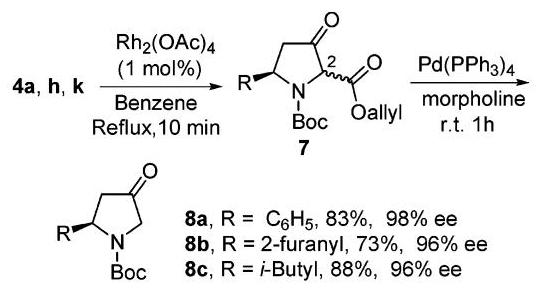
Next, we conceived that intramolecular N-H insertion of metal carbene generated from diazo compound 3 or 4 would afford 3-oxo pyrrolidine derivatives. ${}^{7}$ Davis and co-workers have previously reported the ${\mathrm{{Rh}}}_{2}{\left( \mathrm{{OAc}}\right) }_{4}$ -catalyzed intramolecular $\mathrm{N} - \mathrm{H}$ insertion of $\delta$ -amino $\alpha$ -diazo $\beta$ -ketoesters to give 3-oxo pyrrolidines. ${}^{7\mathrm{e}}$ We found that reaction of $3\mathrm{a}$ with ${\mathrm{{Rh}}}_{2}{\left( \mathrm{{OAc}}\right) }_{4}$ catalysis resulted in a complex mixture. When N-Boc protected $\delta$ -amino diazo compound $4\mathrm{a}$ was subjected to the same ${\mathrm{{Rh}}}_{2}$ - ${\left( \mathrm{{OAc}}\right) }_{4}$ catalysis, the expected intramolecular $\mathrm{N} - \mathrm{H}$ product was obtained as a mixture of diastereoisomers and tautomers. The mixture was further catalyzed with $\mathrm{{Pd}}{\left( {\mathrm{{PPh}}}_{3}\right) }_{4}$ to remove the alloxycarbonyl group. 5-Phenyl-substituted 3-oxo pyrrolidine 8a was thus obtained with ${98}\%$ ee and in ${83}\%$ overall yield from 4a. This transformation was also applied to 4h and 4k, and similar results were obtained (Scheme 4). Therefore, starting from chiral N-Boc protected $\delta$ -amino $\alpha$ -diazo $\beta$ -ketoesters, both 2-oxo and 3-oxo 5-substituted pyrrolidines could be prepared efficiently.
(14) (a) Davis, F. A.; Reddy, R. E.; Szewczyk, J. M. J. Org. Chem. 1995, 60, 7037-7039. (b) Davis, F. A.; Yang, B. J. Am. Chem. Soc. 2005, 127, 8398-8407.
(15) For a recent review on Wolff rearrangement, see: Kirmse, W. Eur. J. Org. Chem. 2002, 2193-2256.
(16) (a) Wang, J.; Hou, Y. J. Chem. Soc. Perkin Trans. 1 1998, 1919- 1924. (b) Wang, J.; Hou, Y.; Wu, P.; Qu, Z.; Chan, A. S. C. Tetrahedron: Asymmetry 1999, 10, 4553-4561. (c) Lee, D. J.; Kim, K.; Park, Y. J. Org. Lett. 2002, 4, 873-876.
(17) Jeffrey, P. D.; McCombie, S. W. J. Org. Chem. 1982, 47, 587- 590.
JOCNote
In summary, the highly diastereoselective addition of the lithium enolate of $\alpha$ -diazoacetoacetate to N-sulfinylimines has been achieved to afford $\delta$ -N-sulfinylamino $\alpha$ -diazo $\beta$ -ketoesters. The chiral $\delta$ -N-sulfinylamino $\alpha$ -diazo $\beta$ -ketoesters can be easily converted into 5-substituted 2-oxo and 3-oxo pyrrolidines. This transformation represents a new route to 5-substituted 2-oxo and 3-oxo pyrrolidines with high enantiomeric purity.
Experimental Section
Caution: Diazo compounds are generally toxic and potentially explosive. They should be handled with care in a well-ventilated fume hood.
General Procedure for the Diastereoselective Addition of Allyl $\alpha$ -Diazoacetoacetate 2 with N-Sulfinylimine 1. To a solution of 1 (1 mmol) in dichloromethane (12 mL) was added LHMDS (2 mmol of ${1.0}\mathrm{M}$ in hexane) at $- {100}^{ \circ }\mathrm{C}$ and then 2 (1.5 mmol) in dichloromethane $\left( {8\mathrm{\;{mL}}}\right)$ was dropped into the solution. After being stirred for approximate $5 - {10}\mathrm{\;{min}}$ , the reaction was quenched with saturated aqueous ${\mathrm{{NH}}}_{4}\mathrm{{Cl}}$ at $- {100}{}^{ \circ }\mathrm{C}$ and then warmed quickly to room temperature. The organic layer was separated and the aqueous layer was extracted with ${\mathrm{{CH}}}_{2}{\mathrm{{Cl}}}_{2}\left( {2 \times {15}\mathrm{\;{mL}}}\right)$ . The organic layers were then combined and dried over ${\mathrm{{Na}}}_{2}{\mathrm{{SO}}}_{4}$ . The crude product was purified by flash silica gel column chromatography to yield the addition products $3\mathrm{a} - \mathrm{k}$ .
General Procedure for the Replacement of the Sulfinyl Group in 3 by the Boc Group. The addition product 3a-k (0.5 mmol) was treated by TFA (5.0 equiv) in $\mathrm{{MeOH}}\left( {5\mathrm{\;{mL}}}\right)$ and the sulfinyl group in 3 was removed in $1\mathrm{\;h}$ to give the corresponding amine salt. The solution was concentrated, and then was dissolved in THF. The solution was treated at $0{}^{ \circ }\mathrm{C}$ with ${\mathrm{{Boc}}}_{2}\mathrm{O}$ (1.2 equiv) $/{\mathrm{{Et}}}_{3}\mathrm{\;N}$ (6 equiv) and a catalytic amount of DMAP. After being stirred for about $2\mathrm{\;h}$ , the solution was concentrated and purified by silica gel. The N-Boc protected product $4\mathrm{a} - \mathrm{k}$ was obtained nearly quantitatively for the two steps.
General Procedure for the Irradiation of the Diazo Compound $4\mathrm{a} - \mathrm{k}$ . A solution of $4\mathrm{a} - \mathrm{k}\left( {{0.5}\mathrm{{mmol}}}\right)$ in benzene $\left( {{25}\mathrm{\;{mL}}}\right)$ in a Pyrex tube was irradiated with a 300-W Hg lamp with a water-cooled tube inserted in the solvent. The reaction temperature was kept at about ${35}^{ \circ }\mathrm{C}$ . The reaction was complete in about ${30}\mathrm{\;{min}}$ . The solution was concentrated under reduced pressure to give the crude product, which was purified by flash silica gel column chromatography to yield the diastereomeric mixture of the corresponding 3-allyloxycarbonyl-2-oxo pyrrolidines 5a-k. The dia-stereomeric mixture could not be separated by column chromatography because of the isomerization of the products on silica gel.
General Procedure for the Removal of Allyloxycarbonyl Group of 5 with $\mathrm{{Pd}}{\left( {\mathrm{{PPh}}}_{3}\right) }_{4}{.5}\mathrm{a} - \mathrm{k}\left( {{0.2}\mathrm{{mmol}}}\right)$ was dissolved in THF ( $5\mathrm{\;{mL}}$ ) and $\mathrm{{Pd}}{\left( {\mathrm{{PPh}}}_{3}\right) }_{4}$ ( $5\mathrm{\;{mol}}\%$ ) and morpholine (1.5 equiv) were added at room temperature. When the reaction was complete as monitored by TLC, the solution was concentrated under reduced pressure and purified by flash column chromatography with silica gel to afford the pyrrolidine derivative 6a-k.
General Procedure for the ${\mathrm{{Rh}}}_{2}{\left( \mathrm{{OAc}}\right) }_{4}$ -Catalyzed Reaction of Diazo Compound 4a, h, k, Followed by Pd(PPh3)4-Catalyzed Removal of the Allyloxycarbonyl Group. A solution of 4a, h, k $\left( {{0.5}\mathrm{{mmol}}}\right)$ and ${\mathrm{{Rh}}}_{2}{\left( \mathrm{{OAc}}\right) }_{4}\left( {{0.005}\mathrm{{mmol}}}\right)$ in benzene $\left( {{15}\mathrm{\;{mL}}}\right)$ was heated to reflux. The reflux was continued for about ${10}\mathrm{\;{min}}$ and then the solution was cooled to room temperature. $\mathrm{{Pd}}{\left( {\mathrm{{PPh}}}_{3}\right) }_{4}$ (5 mol %) and morpholine (1.5 equiv) were added and the mixture was stirred for about $1\mathrm{\;h}$ under argon. When the reaction was complete as monitored by TLC, the solution was concentrated under reduced pressure and purified by flash column chromatography with silica gel to afford the 3-oxo pyrrolidines 8a, b, c.
Acknowledgment. The project is generously supported by the Natural Science Foundation of China (Grant Nos. 20572002, 20521202, and 20772003) and the Ministry of Education of China.
Supporting Information Available: Characterization data, CIF for $3\mathrm{c}$ , and ${}^{1}\mathrm{H}$ and ${}^{13}\mathrm{C}$ NMR spectra for all new compounds. This material is available free of charge via the Internet at http://pubs.acs.org.
JO702275A