Mo Group Student Team Wins Grand Prize at PKU's 34th 'Challenge Cup' — May Fourth Youth Science Award Competition
Recently, the results of the 34th “Challenge Cup” series at Peking University were announced. Under the guidance of Prof. Mo Fanyang, the student team of Yang Mingbo, Zhao Boxuan, and Liu Chengjun from the College of Engineering, together with Cai Wendi from the School of Artificial Intelligence (Shenzhen Graduate School), won the Grand Prize of the May Fourth Youth Science Award Competition with their project “AI-Driven Intelligent Chromatographic Separation and Purification Technology” (competition entry title: “Writing a New Chapter—Pioneers of AI-Driven Intelligent Chromatographic Separation and Purification Technology”).
The “Challenge Cup” is Peking University’s largest, longest-running, and most authoritative and influential extracurricular academic research activity for students. This edition attracted 1,326 teams in total; 121 entries advanced to the university-level final defense, and ultimately 41 Grand Prizes were awarded in the May Fourth Youth Science Award Competition.
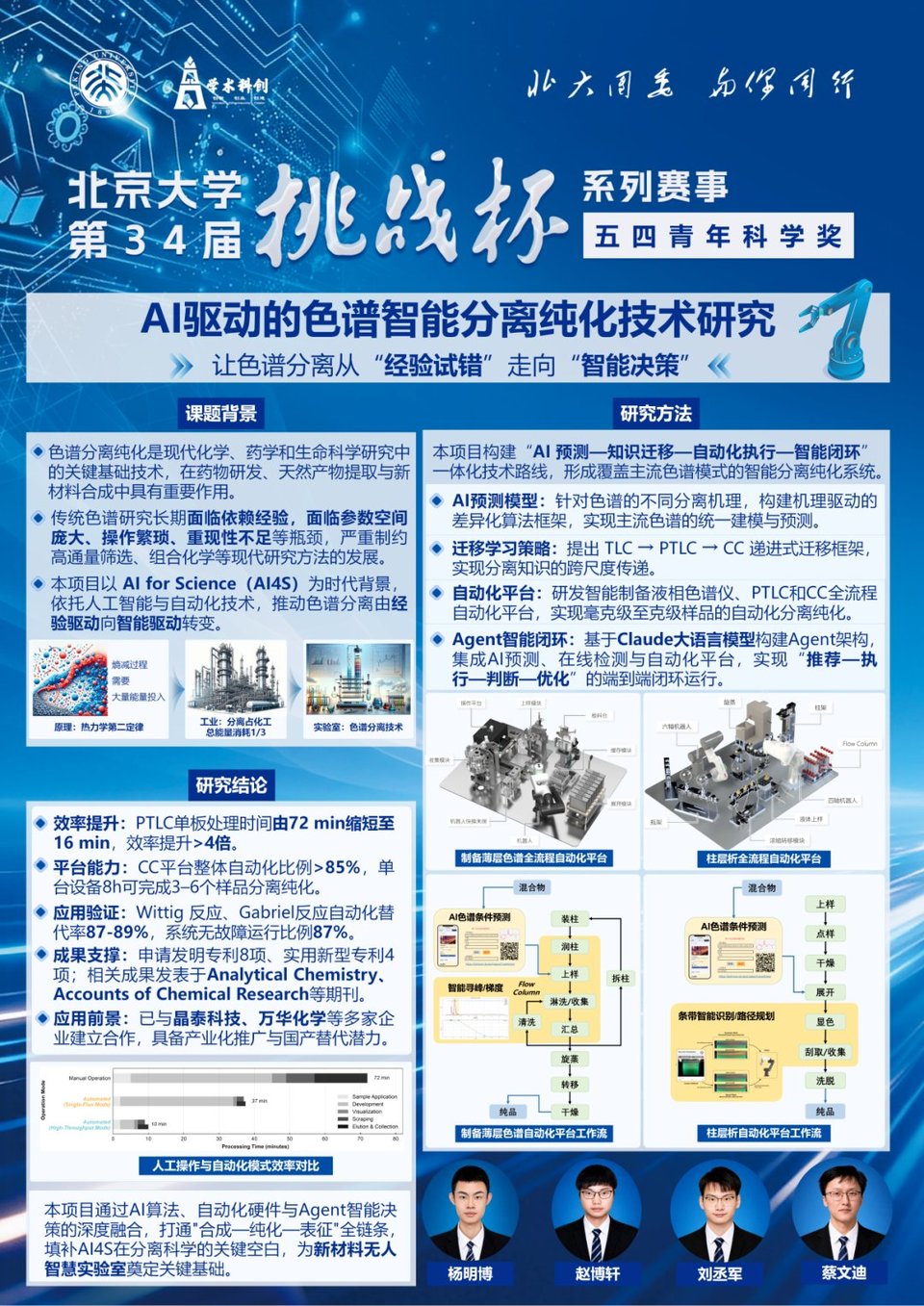
About the Award-Winning Project
Chromatographic separation and purification is an indispensable core technique in chemistry, pharmacy, and life-science research. Yet traditional chromatography has long been constrained by bottlenecks such as heavy reliance on human experience, vast and tightly coupled parameter spaces, lack of effective theoretical prediction models, and difficulty passing down tacit knowledge—which hinder the development of modern methods like high-throughput screening and combinatorial chemistry.
Relying on AI and automation, the project team built an intelligent separation and purification system covering mainstream chromatographic techniques such as HPLC, TLC, PTLC, and CC, shifting chromatography from “experience-driven” to “intelligence-driven.” The research focuses on three key questions: establishing a quantitative mapping between molecular structure and chromatographic retention behavior; enabling cross-system knowledge transfer and fusion; and achieving the coordinated optimization of intelligent decision-making and automatic execution.
On this basis, the team proposed a progressive transfer-learning framework of TLC→PTLC→CC, designed an adaptive gradient-elution algorithm based on Rf-value prediction, built a high-throughput data-acquisition platform and standardized datasets, and developed a full-process automation platform. By leveraging a large-language-model interface for natural-language interaction, it forms a virtuous cycle of “use–learn–improve.”
A Message from the Advisor
Prof. Mo Fanyang noted that the value of scientific innovation lies in grounding oneself in reality and exploring across disciplines. He hopes students will dare to break out of fixed mindsets, keep a close eye on real research problems, and actively engage in innovation and entrepreneurship. This award not only reflects the educational impact of the “Challenge Cup” as a high-level academic platform, but also showcases the spirit of the College of Engineering’s students—standing at the frontier of the discipline, facing real problems, and daring to explore.
Source: the official WeChat account “Boyacaisi” of the College of Engineering, Peking University (June 7, 2026).
Congratulations to the award-winning student team!